Sheila, Tony, Camilla
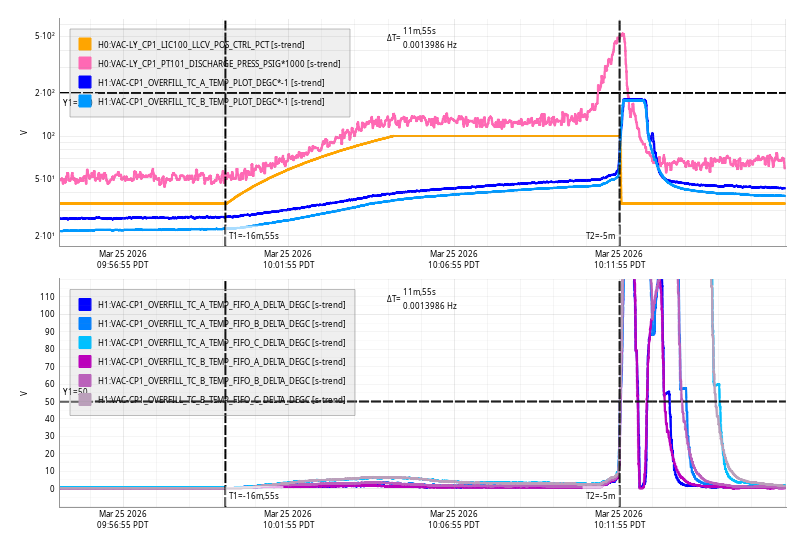
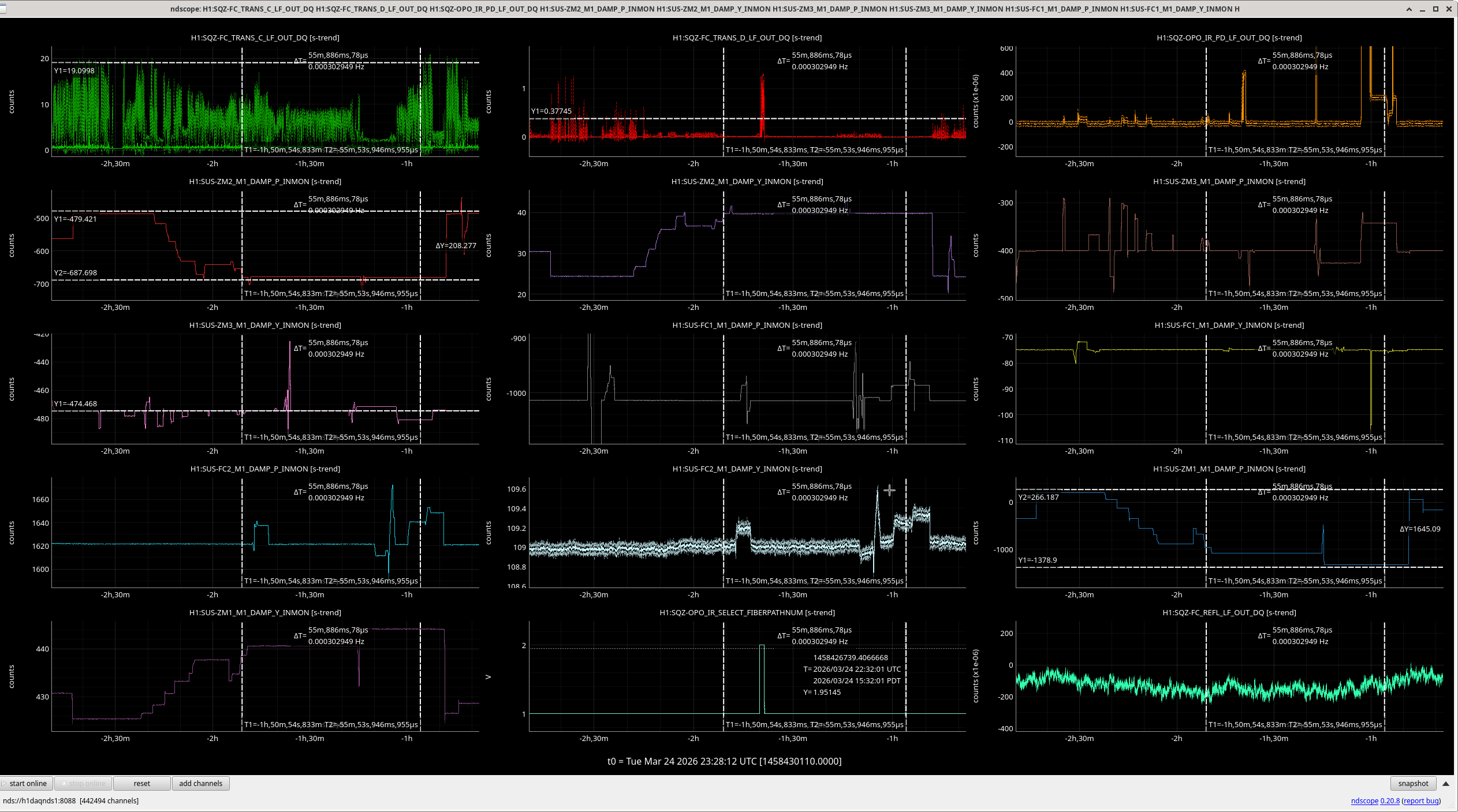
Sheila and Tony noticed that we had a ~30 minute 10MPc range drop last night with related extra low-freq glitches, from the range BLRMs this is most clear in th 20-34Hz band. This noise is broadband 15-100Hz looking at DARM, plot. And trending the common range drop channels form last year, plot, we see a slight increase in FC2_M3_NOISEMON, plot, confirmed as the cause by the dtt spectrum. Sheila is proposes the cause could be FC backscatter into the IFO. There is no increase in FC1 noise apart from small regions at 80Hz, 160Hz, 190Hz, plot.
There is slighly more noise 8-20Hz in HAM8 in the low range time and 3 peaks at 7-9Hz are gone, plot.
We see the same increased noise in H1:SUS-FC2_M3_NOISEMON_LL_OUT16 in the early morning range drop, see attached.
Running the same template as yesterday, attached yellow traces, there is increased noise in the FC2 and FC LSC control channels, more noise in HAM8 ISI, and a ISI peak at 3.3Hz (there was an earthquake 45mins before but the FC noise started before the EQ), however, the noise in DARM is actually less than yesterday so the coupling isn't constant.
Jim and I had a look at the HAM8 motion and although it increases at times when the ground motion increases, these times do not seem correlated with the FC excess movement and range drops, attached. Maybe the 3.3Hz ISI peak is related to the noisier ground motion times.
Wed Aug 27 10:09:46 2025 INFO: Fill completed in 9min 43secs
Joe B, Elenna
Since the ETMX ESD bias was changed, kappa TST has been trending upwards. This could be due to charging. Kappa TST has increased nearly 3%.
The following packages were added to the default CDS Conda environment on workstations.
- hws (Hartmann Wavefront Sensor)
- epics-striptool
- mypy, a linter and type checker for python programs
TITLE: 08/27 Day Shift: 1430-2330 UTC (0730-1630 PST), all times posted in UTC
STATE of H1: Observing at 150Mpc
OUTGOING OPERATOR: Oli
CURRENT ENVIRONMENT:
SEI_ENV state: CALM
Wind: 6mph Gusts, 4mph 3min avg
Primary useism: 0.01 μm/s
Secondary useism: 0.08 μm/s
QUICK SUMMARY:
H1 Has been Locked in Nominal Low Noise for 17.5 + hours.
All Sub Systems seem to be running well.
TITLE: 08/27 Eve Shift: 2330-0500 UTC (1630-2200 PST), all times posted in UTC
STATE of H1: Observing at 153Mpc
INCOMING OPERATOR: Oli
SHIFT SUMMARY:
IFO is in NLN and OBSERVING as of 21:14 UTC
We were locked for the entire shift. I had a chance to test out Jim and Elenna's new EQ survival ASC gain in which ASC gain is ramped when we are threatened by EQ-related lockloss. I manually turned it on when a 6.0 EQ came in from Eastern Russia upon activation of EQ mode (auto) and at least in this instance, we managed to stay locked.
Nothing else of note
LOG:
None
This logpost is a follow up to the executive summary on PR3 OSEM estimator Filter and Blend design [LHO: 86563]
Oli took the measurements needed to commission the PR3 OSEM estimator in P and Y [see LHO: 86459]. The P measurements were taken with all M1_DAMP gains at -1, except for M1_DAMP_P, which was set to -0.2. Similarly, Y, All M1_DAMP gains were -1, except for M1_DAMP_Y, which was set to -0.2.
Ivey and I used her vectfit3 scripts to fit the transfer functions. The fits were committed to the SUS SVN under revision 12616. They live in 'sus/trunk/HLTS/Common/FilterDesign/Estimator/'
We made a few minimal changes to the original output from vectfit to match our expectation of the plants:
The images of the resulting filters, together with the data that Oli took are summarized in the attached pdfs.
In order of appearance, the zpk of the fits are:
Suspoint Y to M1_DAMP_Y fit
'zpk([-0.012+20.621i,0,0,-0.012-20.621i,-0.012+11.426i,-0.012-11.426i],[-0.218+6.292i,-0.218-6.292i,-0.382+14.697i,-0.382-14.697i,-0.226+21.579i,-0.226-21.579i],-0.001)'
M1 drive Y to M1_DAMP_Y fit
'zpk([-0.024-8.341i,-0.024+8.341i,-0.011+19.405i,-0.011-19.405i],[-0.088+6.403i,-0.088-6.403i,-0.115+14.485i,-0.115-14.485i,-0.069+21.379i,-0.069-21.379i],13.34)'
Suspoint P to M1_DAMP_P fit
'zpk([-2.428-2.295i,-2.428+2.295i,-0.795-9.324i,-0.795+9.324i,-0.011-22.26i,-0.011+22.26i,0.034-5.811i,0.034+5.811i,0.382-13.672i,0.382+13.672i,1.168-1.459i,1.168+1.459i],[-0.507-1.499i,-0.507+1.499i,-0.395-10.253i,-0.395+10.253i,-0.204-4.167i,-0.204+4.167i,-0.141-4.759i,-0.141+4.759i,-0.13-13.137i,-0.13+13.137i,-0.066-22.16i,-0.066+22.16i],-0.001)'
Suspoint L to M1_DAMP_P fit
'zpk([-0.773-7.242i,-0.773+7.242i,-0.635-18.11i,-0.635+18.11i,0.301-20.227i,0.301+20.227i,1.062-6.916i,1.062+6.916i,-99.035,-0.197,0.331,45.41],[-1.293-19.638i,-1.293+19.638i,-0.33-10.141i,-0.33+10.141i,-0.289-13.191i,-0.289+13.191i,-0.162-4.1i,-0.162+4.1i,-0.122-4.732i,-0.122+4.732i,-0.087-22.103i,-0.087+22.103i],0)'
M1 drive P to M1_DAMP_P fit
'zpk([-0.339-4.576i,-0.339+4.576i,-0.031-21.157i,-0.031+21.157i,-0.009-5.455i,-0.009+5.455i],[-0.298-13.183i,-0.298+13.183i,-0.205-4.126i,-0.205+4.126i,-0.138-4.803i,-0.138+4.803i,-0.092-22.128i,-0.092+22.128i],80.907)'
TITLE: 08/26 Day Shift: 1430-2330 UTC (0730-1630 PST), all times posted in UTC
STATE of H1: Observing at 152Mpc
INCOMING OPERATOR: Ibrahim
SHIFT SUMMARY:
We tried to run an Initial_ Alignment but SRC aligning didn't work because the New Whitening Chassis or cable that was installed had an issue.
NLN @ 21:14:27 UTC
Back to Observing by 21:20:06 UTC
21:52 UTC Tyler started pushing his rocks around with the tractor over at the far end of the Staging building.
22:50 UTC Tyler's tractor work has lost traction with the commissioning crew and there will be no more tractoring rocks around while locked.
LOG:
| Start Time | System | Name | Location | Lazer_Haz | Task | Time End |
|---|---|---|---|---|---|---|
| 15:03 | FAC | Erik | EY | No | Changeing Presure release valve | 15:38 |
| 15:04 | FAC | Randy | LVEA | N | Forklifing from LSB to OSB | 15:46 |
| 15:06 | VAC | Jordan | HAM Shaq | N | Gauge work in FTCE | 19:06 |
| 15:10 | wFAC | Chris | EY | N | Filter Checks | 16:20 |
| 15:14 | FAC | Kim & Nellie | LVEA | N | Technical Cleaning. | 17:44 |
| 15:16 | VAC | Travis & Janos | Mid Y -> Mid X | N | Getting tools from Mid Y then heading to Mid X | 23:26 |
| 15:17 | Richard | LVEA | N | Measure Viewport Simulator | 15:26 | |
| 15:22 | FAC | Tyler & Beaver Bark | Staging Bld | N | Dumping rocks from a Dump truck, & Moving gravel with tractor | 17:20 |
| 15:27 | FAC | Randy & Mitchel | LVEA | N | Working on Clean room | 15:46 |
| 15:31 | EE | Fil | LVEA HAM 6&7 | N | SUS & IOC rack cable racks | 18:56 |
| 15:33 | 3IFO | Tyler | LVEA & ES | N | 3 IFO checks | 16:03 |
| 15:37 | LN2 | NORCO | Both Mid X&Y | no | Liquid Nitrogen refill | 17:30 |
| 15:45 | SPI | Jeff | Optics lab | N | Dropping off parts | 15:46 |
| 15:45 | SUS | Rahul | End Station | N | SUS Charge measurements. | 18:26 |
| 15:51 | FAC | Randy | LVEA | N | Cleaning off Emod in West bay | 17:51 |
| 15:52 | EE | Marc | LVEA | N | Helping Fil with IOC & SUS racks | 18:56 |
| 16:21 | VAC | Jordan , Gerardo, Anna, Mitchel | HAM Shaq | N | FTCE Gauge work & a lil Craning, Mitchel Out early | 19:08 |
| 16:32 | FAC | McCarthy | LVEA | N | Joining Randy | 16:50 |
| 16:53 | FAC | Chris | End & Mids X&Y | N | Checking phones | 16:08 |
| 17:05 | FAC | Eric | HAM Shaq | N | Planning a 120V Electrical Run | 17:24 |
| 17:20 | PEM | SAM | LVEA + Y Arm | N | Checking accelerometers. | 17:33 |
| 17:24 | ISC | Keita | LVEA ISC Racks | N | Checking Cable Lengths at eh ISC racks | 18:56 |
| 17:25 | FAC | Nellie | EY | N | Technical Cleaning | 18:52 |
| 17:29 | FAC | Kim | EX | N | Technical Cleanin | 18:52 |
| 17:47 | FAC | Eric | EY | N | Moving an extension cord | 18:08 |
| 17:53 | SEI | Jim | LVEA HAM1 | N | HAM1 SEI Injections | 18:58 |
| 18:17 | FAC | Richard | LVEA Input arm | N | measuring the distance from the floor to Ceiling | 18:45 |
| 18:17 | PEM | TJ | HEPI Mezz | N | Setting up Dust Mon | 19:08 |
| 19:56 | ISC | Daniel | LVEA | N | Checking whitening chass for AS_C issues | 20:21 |
| 20:14 | ASC | Daniel | LVEA | N | Swapping ASC Whitening chassis | 20:21 |
TITLE: 08/26 Eve Shift: 2330-0500 UTC (1630-2200 PST), all times posted in UTC
STATE of H1: Observing at 153Mpc
OUTGOING OPERATOR: Tony
CURRENT ENVIRONMENT:
SEI_ENV state: CALM
Wind: 5mph Gusts, 2mph 3min avg
Primary useism: 0.01 μm/s
Secondary useism: 0.09 μm/s
QUICK SUMMARY:
IFO is in NLN and OBSERVING as of 21:14 UTC
IFO is still behaving. Expecting a quiet shift.
J. Kissel After today's H1 SUS SR3 Pitch Estimator's inclusion of the Sus. Point L to M1 P feed forward from the HAM5 ISI GS13s (where we had mistakenly only installed Sus. Point P to M1 P) -- see LHO:86567, I now compare the times of ASC signals (using 0.02 Hz binwidth, 64 sec FFT chunks, 30 averages, and a Hanning window with 50% overlap): 2025-08-20 18:29 UTC - Both P and Y Estimators are OFF 2025-08-24 18:18 UTC - Both P and Y Estimators are ON, but for the P estimator, only the Sus. Point P to M1 P contribution is included in the GS13 FF 2025-08-26 22:00 UTC - Both P and Y Estimators are ON, and for the P estimator, both P to P and L to P contributions are included in the GS13 FF. I'm showing only the control signals, and only the ASC DOFs which are impacted by SR3: DHARD, MICH, SRC1, and SRC2; both pitch and yaw. In All DOFs, the 0.64 and 0.75 Hz modes that had been made worse with only the P to P model of suspension point contribution have now been restored to no-estimator levels. In some DOFs, the 1-10 Hz broadband motion is just barely improved, but enforces the conclusion that SR3 is only partially, if not 'not the dominate contribution' to the ASC signals. Here's a fun one for you -- look at SRC2 Y CTRL -- and look at how much the SRC2 *yaw* motion has changed from including the *longitudinal* suspension point contribution to M1 *pitch* top mass. #ThrowsHandsInAir But -- overall -- with the improvements and all design intent included -- the SR3 P and Y estimators slightly improve the ASC noise from 1 to 10 Hz. Great! As Oli notes in LHO:86551 comparing all of these different configurations from totally different days and times is dubious. We'll get "official" versions of all of these ON vs. OFF configurations on Thursday 8/28. I also attach the local estimator metrics for pitch described in LHO:86553, comparing "only Sus Point P to M1 P modeled contribution" against "P to P and L to P sus point to M1 contribution." That similarly shows that L to P contribution forms a good fraction of the signal needed for damping.
Great to see that the inclusion of the SUSpoint L to M1 P block makes a difference.
Unfortunately, the P2Y coupling is a wierd non-reciprocal coupling we were seeing on the measurements [See page 21 about the SR3 measurements from june after an OSEM calibration test]. The Pitch to Yaw transfer function is consistent with the conversion of pitch motion to observed yaw signals on the LF and RT OSEMs, this apparent motion gets turned into yaw feedback drive and creates the transfer function you see in the measurements linked.
Brian and I discussed it before and we had decided against adding a cross-term in the estimator to address it because it is both not well understood (at least we don't know why the LF and RT OSEMs see Pitch signals) , and because it is possible that we might only be able to address it if we commission the estimators in a fully serialized way, which would be even more time consuming for (probably) minimal benefit.
Depending on schedule, we can figure out if it is worth adding an M1 drive P to M1 Y estimator path, and probably commission a baby version of it with the measurements that Oli already took to see if it makes a difference.
I've confirmed in 86784 that the excess noise seen in the red trace between 1-3 Hz is not due to the SR3 Estimator having L2P compensation
This logpost is a follow up to the executive summary on PR3 OSEM estimator Filter and Blend design [LHO: 86563]
Edgard, Brian, Ivey.
We used Brian's scripts to generate the blends for the PR3 OSEM estimator. We tuned these blends to the specific resonances of PR3 (which we expect to differ from SR3, as explored by Oli in [LHO: 86554]. We emphasized trying to match the bumps in the OSEM filter with the various resonances of the M1 to M1 plant [see in the figures attached].
The scripts used to create the filters, together with a script to load them into foton were updated to the SUS SVN inside 'sus/trunk/HLTS/Common/FilterDesign/Estimator'.
For pitch:
The pitch blends were created using 'blend_PR3_pitchv2.m' (see first pdf attached). The filters follow the same design principle as Brian did in [LHO: 86510] and [LHO:86452]. The blends are created by making the OSEM bandpass by adding an overall low-pass filter with four low-Q bumps that match the observed resonanced of the M1 to M1 plant. The high-frequency gain of this filter does not asymptote to zero to keep the phase of the bumps close to zero at the resonances of the modeled PR3 M1 to M1 plant, while not creating a zero in between bumps.
The zpks are:
model_filter =
'zpk([-0.083+22.156i,-0.083-22.156i,-0.097+13.118i,-0.097-13.118i,0,-0.037+4.136i,-0.037-4.136i,-0.045+4.738i,-0.045-4.738i],[-0.188,-0.171+4.106i,-0.171-4.106i,-0.199+4.771i,-0.199-4.771i,-0.438+13.125i,-0.438-13.125i,-0.37+22.177i,-0.37-22.177i],0.9)'
osem_filter =
'zpk([-1.807+20.726i,-1.807-20.726i,-2.733+10.99i,-2.733-10.99i,-8.429,-0.227+4.431i,-0.227-4.431i,-1.381+2.186i,-1.381-2.186i],[-0.188,-0.171+4.106i,-0.171-4.106i,-0.199+4.771i,-0.199-4.771i,-0.438+13.125i,-0.438-13.125i,-0.37+22.177i,-0.37-22.177i],0.1)'
For yaw:
For the yaw estimator, we used 'Estimator_blend_skinnynotch_PR3yaw_20250825.m' which follows the design procedure on [LHO: 86265]. In this case the procedure is more similar to designing blends for the ISI: we pick a rolloff for the Highpass (model filter) and Lowpass (OSEM) filter, but add a few notches onto the model filter. Then by using the SEI SVN function 'maketruecomplements_tol' they are turned into complementary blends. The advantage of this process is that we can ensure the OSEM filter rolls off at high frequencies. One disadvantage is that it is a bit harder to tune the amplitude and phase of the OSEM blend around the suspension resonances.
The zpks are
model_filter =
'zpk([-0.306+21.389i,-0.306-21.389i,-0.242+14.516i,-0.242-14.516i,-0.128+6.404i,-0.128-6.404i,0],[-1.528-21.337i,-1.528+21.337i,-1.21-14.467i,-1.21+14.467i,-0.641-6.374i,-0.641+6.374i,-0.628],1)'
osem_filter =
'zpk([-0.81-18.387i,-0.81+18.387i,-0.473-9.928i,-0.473+9.928i,-0.216-3.503i,-0.216+3.503i],[-1.528-21.337i,-1.528+21.337i,-1.21-14.467i,-1.21+14.467i,-0.641-6.374i,-0.641+6.374i,-0.628],6.034)'
FAMIS26547
Script reports ETMX_ST1_CPSINF_V2 is high. HAM3 H2 also seems high.
I unplugged two unused extension chords and I also unplugged what is labeled as the PCALX camera computer, but it is really the the computer to take pictures of ITMX from the spool. The computer is off and not being used, so I unplugged it. I turned the lights off as I left.
J. Kissel, E. Bonilla Thanks to the hard and quick work of the Stanford team overnight designing blend filters and super sensor model filters (LHO:86563), I was able to install everything needed to get the H1SUSPR3's estimator up, running, and functional this morning. After having run it for bit during maintenance (and thus corner-station sensor correction was off), I've turned the "use OSEMs or use Estimator" switch to "use OSEMs" such that the SUS is performing in a functionally equivalent way as "no estimator." We'll run like this until (a) I make some plots analyzing the performance and (b) Until Thursday's commissioning period when we're in nominal low noise, so we can do similar ON vs. OFF comparisons with ASC as our metric. The P and Y estimators were ON from 2025-08-26 18:05 UTC to 19:00 UTC. Some extra design points beyond whats made in LHO:86563, with the mind-set of "can we 'just' copy and paste SR3's filters into PR3?" In short: No. In long: The existing OSEM-only damping is different -- all SR3's damping loop's overall EPICs gain is -0.5, where PR3's is -1.0. This is demonstrated by LHO:86554, that means the damped M1 drive to M1 response "damped plant" is different. Namely, on resonance, the loop suppression 1/(1+G), is different because G is different, and thus P/(1+G) is different. This has the effect of shifting the fundamental mode frequencies and changing the residual Q. *That* means two things: (1) that the OSEM vs. Estimator blend filters -- which are relatively tight notches around resonances -- in principle, should be different. That being said, depending on the performance we end up getting we could *see* if making the blend filters generically wide enough would work. But, for now, we err on the side of "let's make the blend filters specific" because we have the measurements and the person power. (2) The "undamped plant" measurements for the estimator -- which are really "lightly damped" plants with whatever loop suppression is left from the broadband OSEM damping that's still always used; an EPICs gain of -0.1 for SR3 and -0.2 for PR3's damping loop controllers -- are different. So, the filters that are modeling that response -- the Sus. Point drive to M1 response filters and the M1 drive to M1 response filters -- will also necessarily be different. However, the differences are almost entirely resonance shifts and Q changes that are proportional to the differences in 1/(1+G) of the light damping (one with scaled with G = -0.1 and one with G=-0.2). Said differently, so far, only the on-diagonal M1 to M1 transfer functions are proving to be needed, and only the P to P, L to P, and Y to Yaw suspension point to M1 transfer functions are needed, and these are almost identical between PR3 and SR3. I'll put a comparison of the filters and details of the installation in the comments.
Here're the comparison between the PR3 and SR3 Suspension Point to M1 response transfer functions.
These we installed using the scripts
/ligo/svncommon/SusSVN/sus/trunk/HLTS/Common/FilterDesign/Estimator/
make_PR3_pitch_model.m rev 12622
make_PR3_yaw_model.m rev 12622
which push the filters from the saved .mat files
/ligo/svncommon/SusSVN/sus/trunk/HLTS/Common/FilterDesign/Estimator/
fits_H1PR3_P_2025-08-19.mat rev 12622
fits_H1PR3_Y_2025-08-19.mat rev 12619
(Most are at rev 12622 because the file names had differing arrangements of underscores and hyphens, so I cleaned that up before running.)
Notably -- we uncovered the oversight of missing L to P filter install in SR3 (LHO:86567) in enough time to make sure the same oversight didn't happen with PR3.
So -- PR3 has
- Pitch Estimator P to P, H1:SUS-PR3_M1_EST_P_FUSION_MODL_SUSP_P_2GAP, comparison plot
- Pitch Estimator L to P, H1:SUS-PR3_M1_EST_L_FUSION_MODL_SUSP_P_2GAP, comparison plot and
- Yaw Estimator Y to Y, H1:SUS-PR3_M1_EST_Y_FUSION_MODL_SUSP_Y_2GAP, comparison plot.
Here's the comparison between the M1 to M1 drive transfer functions.
These are also installed with the same run of the scripts
/ligo/svncommon/SusSVN/sus/trunk/HLTS/Common/FilterDesign/Estimator/
make_PR3_pitch_model.m rev 12622
make_PR3_yaw_model.m rev 12622
which push the filters from the saved .mat files
/ligo/svncommon/SusSVN/sus/trunk/HLTS/Common/FilterDesign/Estimator/
fits_H1PR3_P_2025-08-19.mat rev 12622
fits_H1PR3_Y_2025-08-19.mat rev 12619
(Most are at rev 12622 because the file names had differing arrangements of underscores and hyphens, so I cleaned that up before running.)
Here's the comparison between the blend filters. Because I want to have a bit more conversation about this, I show the comparison in detail for each PIT and YAW, and when showing them all together, I show both zoomed in and out in frequency. Namely: The pitch super sensor blend filter magnitude tops out at 0.9 rather than the traditional 1.0 for a complimentary blend filter. As Brian briefly mentions in his design aLOG (LHO:86510) this because he is mindful of the phase of the sum of this filter and its compliment. The pitch super sensor blend filter was designed to be (SS Blend) = 1 - (OSEM Blend). In his design aLOG, he phrases it as "The low-pass [OSEM Blend] is a zero-pole pair so that it levels off to a transmission of 0.1. This is so the gap between the two [0.64 and 0.75 Hz] resonant peaks [which were designed as separate, single z:p pairs] will be well behaved. [The pairs] will cross at about 180 degrees of phase shift and make a sharp zero [between resonances], and [that] deep zero seemed to be causing numerical issues when Oli was implementing the yaw blends. The flat bottom at 0.1 prevents that." So, if you force the OSEM blend to bottom out at 0.1, then the super-sensor blend will top out at 1 - 0.1 = 0.9. This, in effect, sacrifices 10% loop gain for numerical stability. Brian says he's working on a -v3 design that might improve this. Honestly, I think it's probably fine from an overall loop gain perspective -- I guess this can be rectified by increasing the estimator control filter by 10%, but even if not, 10% less damping is totally fine. If loop or numerical stability demands that we can't increase the overall gain can we augment this design such that *well* above the 0.64 and 0.75 Hz resonances -- can we still roll off the OSEM contribution? Say, multiply the whole -v2 OSEM filter by a high-pass at, 10 Hz (and then adjust the SS blend accordingly to keep things complimentary)?
M. Todd, C. Compton, S. Dwyer
We changed the gain settings in TCS-SIM that convert the powers of each actuator (including self-heating) to surface defocus for calculating the overall radius of curvature of each test mass at a given thermal state.
The motivation for this was that the simulation seems to be largely overestimating the Higher Order Mode spacing. Hopefully, with these new predictions, we will observe better agreement between the simulation and HOM measurements.
We also changed the absorption values using values taken from alog 80714 for the ITMs, and using galaxy for the values for the ETMs.
Jeff, Oli
On Thursday (86507) I alogged the differences we were seeing in the ASC with the SR3 estimator on. The time that I was taking as our 'reference time' for the estimator off, however, doesn't seem like it was a good time showing the lowest the ASC noise could be. You could say this caused us to over estimat(or) the differences.
So I plotted some more times with the estimator off, then with the estimator on, and I found that maybe the SR3 noise is limiting the ASC noise less than shown in 86507. However, I also found that below 0.2 Hz, where we thought that the estimators were elevating the noise, that also seems to have been not related to the estimator, so that is something we might not have to worry about.
Of course the peaks at 0.6 and 0.7 Hz are elevated in the estimator plots below due to not damping them in the inital blend filter (mentioned in 86507), and this is something that we partially fixed this morning (86544), and will be working on further damping at the next available commissioning time.
There are still times where the estimator on makes the noise better at some frequencies, but there are also other times where the estimator is on, but something else is limiting the noise, so it looks like SR3 isn't limiting the noise very much at all. It will still be interesting to see if adding estimators onto the rest of the SRC give us different results.
In the plots below, I am showing the variation in noise with the estimators off and the estimators on,
The 'bad' time for the estimators OFF is: 2025-08-17 09:00 UTC (green)
The 'good' time for the estimators OFF is: 2025-08-20 18:29 UTC (blue)
For the estimators ON times, they're both 'good' and 'bad' at different frequencies, so I'll just list their times:
2025-08-21 16:35 UTC (red)
2025-08-24 18:18 UTC (gold)
| Pitch | Yaw | |||||
| ASC-DHARD | Error | |||||
| Est OFF | Est ON | Both | Est OFF | Est ON | Both | |
| Control | ||||||
| Est OFF | Est ON | Both | Est OFF | Est ON | Both | |
| ASC-MICH | Error | |||||
| Est OFF | Est ON | Both | Est OFF | Est ON | Both | |
| Control | ||||||
| Est OFF | Est ON | Both | Est OFF | Est ON | Both | |
| ASC-SRC1 | Error | |||||
| Est OFF | Est ON | Both | Est OFF | Est ON | Both | |
| Control | ||||||
| Est OFF | Est ON | Both | Est OFF | Est ON | Both | |
| ASC-SRC2 | Error | |||||
| Est OFF | Est ON | Both | Est OFF | Est ON | Both | |
| Control | ||||||
| Est OFF | Est ON | Both | Est OFF | Est ON | Both | |
| ASC-AS_A_DC | Control | |||||
| Est OFF | Est ON | Both | Est OFF | Est ON | Both | |
| ASC-AS_B_DC | Control | |||||
| Est OFF | Est ON | Both | Est OFF | Est ON | Both | |
| ASC-OMC_A | Control | |||||
| Est OFF | Est ON | Both | Est OFF | Est ON | Both | |
| ASC-OMC_B | Control | |||||
| Est OFF | Est ON | Both | Est OFF | Est ON | Both | |
| OMC-DCPD_SUM_OUT | Est Off | Est ON | Both |
| OMC-REFL_A_LF_OUT | Est Off | Est ON | Both |
Jeff, Oli, this is good to know!
I also noticed that the SUSpoint L to M1 P block of the estimator does not have the corresponding filter fit. For the Pitch degree of freedom, we expect the ISI longitudinal contribution to be relevant enough that it should be modeled. Maybe this explains some of the inconsistent behavior around the length/pitch modes.
I modified 'make_SR3_pitch_model.m' inside sus/trunk/HLTS/Common/FilterDesign/Estimator to ensure that we get the correct fits into this filter bank. This update is current as of SVN revision 12616
In total, autoquack should populate 3 filter banks for the pitch estimator:
Wow. Thanks for all the data. One quick clarification. Above it says "Of course the peaks at 0.6 and 0.7 Hz are elevated in the estimator plots below due to not damping them in the inital blend filter"
To be clear, the first version of the pitch estimator was designed to damp these peaks. But - recall that "estimator" is the blend of the model and the measurements. In the first version, nearly all of the damping signal in the estimator was from the MODEL, whereas the 2 higher frequency peaks (and all 3 yaw peaks) use the MEASUREMENT path from estimator. In version 1, the model path for the estimator wasn't working well. This seems to mean that the model is not correctly predicting the gap motion. We suspect that this is because of an unmodeled drive, which we think is DAC noise.
So we were applying damping with the estimator, but it was not working as expected. Version 2 has updated blend filters which use the osem signals around all 4 peak frequencies, and hopefully this will improve the estimator performance.
DriptaB, TonyS, RickS
J. Kissel, quoting R. Savage: A few extra explanatory words for the uninitiated on how this measurement works / how the results were derived: The uncertainties reported are the statistical variations for the measurements we made, highlighted in the attached plots. The authors have not attempted an assessment of potential systematic errors. I suspect that the largest sources of systematic error would likely result from - deviations of the incident polarization (as defined by the plane of incidence of the beamsplitter) from pure p-pol and - deviations of the Angle of Incdence from 45 deg. I also suspect that the errors we might have in this regard are much smaller than what you will have in the SPI installation given the much longer path lengths measured here vs. the SPI in-chamber setup. The next largest source of systematic errors might be - the temperature dependence of the reflectivity of the beamsplitters. We did not attempt to quantify this. We do measure, and correct for, the temperature dependence of the power sensor responsivities and their dark levels during the measurements. I suspect these will have a negligible impact on the measurement results reported for this effort. Regarding the measurement setup and math to derive the answers: The description of the responsivity ratio measurements given in D. Bhattacharjee et al., CQG 38.1 (2020): 015009 (P2000113) -- specifically the caption and text surrounding Figure 3 -- is the gist of the measurement method - simply replace "... the square root of the product of the ratios... replaced with "... the square root of the quotient of the ratios ..." from that caption. This yields the beamsplitter ratio, T/R, rather than the responsivity ratio of the two integrating sphere PDs that the PCAL team is after. (called \alpha_{W1W2} in the caption, but could also be any two responsivities, \alpha_{WG}, \alpha_{RW}, etc). Only - laser power variations that occur over the difference between times of recording the two power sensor outputs (less than 0.1 sec) - variations of the reflectivity of the BS or the responsivities of the two power sensors that occur over the time difference between measuring in the A-B and B-A configurations (less than 40 seconds) should impact the measurements. We record four time series: the output of both power sensors (in volts) and the temperatures (in volts) recorded by sensors on the circuit boards of both power sensors. The any temperature variation in the power sensor time series is normalized out, leaving two conditioned voltage time series for a given physical arrangement of PDs -- and thus are the (power) transmission, T, and (power) reflection, R, of the beam splitter (the A path's HR steering mirror -- that reflects light 90 [deg] to be parallel with the B path -- reflectivity is measured and taken into account as well -- see details below). The responsivity of these PCAL integration sphere + photodiode assemblies -- here we'll call them \rho_1 and \rho_2 -- is known to extremely high accuracy. Each data point you see in the plot is the ratio of [[ the BS ratio (T/R) resulting from one set of (two conditioned) time series when the sensors are in one configuration ]] and [[ a second BS Ratio (T/R) when PD positions have been swapped ]], i.e. accounting for - what was the T time series (from \rho_1 PD in the B position; the "A-B" configuration) becomes the R time series (from \rho_1 PD in the A Position; the "B-A" configuration). - what was the R time series (from \rho_2 PD in the A position; the "A-B" configuration) becomes the T time series (from \rho_2 PD in the B Position; the "B-A" configuration), and conversely So the math is T/R = sqrt { [(P x T x rho_1) / (P x R x rho_2)]_{A-B} / [(P x R x rho_1) / (P x T x rho_2)]_{B-A} } = sqrt{ (T/R)^2 } where again - P is the input power (in [W]), - R and T are the beam splitter reflectivity and transmission (in power; [W]), - \rho_1 and \rho_2 are the two different working standards, and - the subscript _{A-B} and _{B-A} are the answers in the two different physical configurations of the integrating spheres. Assuming no other loss or absorption, then the (power) reflectivity, R, displayed on the plots is R + T = 1 1 + T/R = 1/R R = 1 / (1 + T/R) As noted earlier, the powers (sensor outputs) for the transmitted path are multiplied by about 1.00035 to account for the transmissivity of the the HR mirror that reflects the transmitted beam to the power sensor.
/ligo/home/camilla.compton/Documents/sqz/templates/dtt/20250819higher_order_modes.xml screenshot attached. Elenna opened POP beamdiv.| Type | Time (UTC) | Angle | DTT Ref | Notes |
| SQZ | 15:30:00 - 15:35:00 | (-)133 | ref 0 | |
| FDS Mid - SQZ | 15:37:00 - 15:39:00 | (-)111 | ref 1 | At 4dB ASQZ |
| FDS Mid SQZ, SRM YAW -1urad (offset -0.3) | 15:47:00 - 15:49:00 | (-)108 | ref 2 | Made better today and in 86363 |
| Mid SQZ, , SRM YAW -1urad, +8cts DHARD YAW | 15:51:30 - 15:53:30 | (-)108 | ref 3 | No change at 5 or 10kHz |
| Mid SQZ, , SRM YAW -1urad, CAM3Y -1count | 16:04:30 - 16:06:30 | (-)108 | ref 4 | Loop takes ~5 minutes to converge, buildups worse. No change at 5 or 10kHz. |
| Mid SQZ, , SRM YAW -1urad, CAM3Y +1count | 16:15:30 - 16:16:30 | (-)108 | not taken | Builds-ups same as normal. No change at 5 or 10kHz. |
| Mid SQZ, , SRM YAW -1urad, SRM PIT +2urad (offset +0.6) | 16:23:00 - 16:25:00 | (-)110 | ref 5 | Buildups worse, saw 5kHz was a little worse at 5kHz with +0.3 so went further. DHARD PIT started to grow at 1Hz. |
| Mid SQZ, , SRM YAW -1urad, SRM PIT -1urad (offset -0.3) | 16:27:00 - 16:29:00 | (-)107 | ref 6 | 5kHz better |
| Mid SQZ, SRM YAW -1urad, SRM PIT -2urad (offset -0.6) | 16:30:00 - 16:32:00 | (-)106 | ref 7 | 5kHz slightly worse |
| Mean SQZ | 16:35:00 - 16:37:00 | N/A | ref 8 |
camilla.compton/Documents/sqz/templates/dtt/20250818_SQZdata.xml and attached.| Type | Time (UTC) | SRCL Offset | Angle | DTT Ref |
| FIS SQZ | 16:42:30 - 16:45:30 | -382 | (-)124 | ref 1 |
| FIS SQZ | 16:48:30 - 16:51:30 | -200 | (-)153 | ref 2 |
| FIS SQZ | 16:58:30 - 17:01:30 | 0 | (-)224 | ref 3 |
| No SQZ | 17:02:30 - 17:05:30 | -382 | N/A | ref 0 |
Took above data at NLG of 16.0, checked and improved the NLG after data taken 76542.
| OPO Setpoint | Amplified Max | Amplified Min | UnAmp | Dark | NLG | Note |
| 80 | 0.108523 | 0.00199724 | 0.0067894 | -1.22e-5 | 16.0 | Without Optimizing Temp |
| 80 | 0.154115 | 0.00199724 | 22.7 | After Optimizing Temp |
I think we like these SRC ASC offsets, so I set up the guardian to keep them. While the overall effect is minimal, there was a small increase in the buildups that was repeatable: we switched these offsets on and off a few times as we were commissioning today and the buildups got slightly worse when they went off and slightly better when they went on. I tried to process the FIS data, and I think it shows that the overall change in the SRCL offset is minimal, but maybe someone else can confirm. Similarly, the calibration report show the fit of the sensing function is very good in the current model.
Now the guardian engages these SRC ASC offsets in the LOWNOISE_ASC state.
I have attached the results (plot one and plot two) from the FIS measurement, and the fit indicates that our current SRCL offset is fine (I think that's the correct interpretation here).
Here is a trend of the buildups and SRC ASC offsets (pitch and yaw are right on top of each other in the bottom plot). The plot shows that the buildups increase when we add these offsets and decrease when we disengage these offsets.
The calibration report is linked in this alog, and shows that the calibration model is still very good. (There are some strange errors in the report generation, but they are unrelated to this change).
Here is a more to-the-point executive summary of what these results today are indicating:
A large positive SRM pitch offset caused a growing 1 Hz oscillation in DHARD pitch as well. I'm not sure what to make of that yet, but I wanted to re-emphasize for future moves.
Since we are seeing an improvement in the buildups when adding SRM offsets, I think some of the prevalence of these modes could be related to some uncontrolled AS 72 offset which is changing the SRM alignment offset. We reran dark offsets when coming back from the vent, so the dark offset change on AS 72 could be effecting the SRM alignment in some way.
In a follow up discussion, Sheila and I referring Matt's slides regarding the HOMs here.
Based on Matt's work, we think that the lower frequency mode is the Y-arm mode, and the higher frequency mode is the X arm mode.
Therefore, this indicates that the SRM yaw alignment offset effected the Y arm mode and the SRM pitch alignment offset effected the X arm mode.
Also, as a follow up test, we should try CAM2 offsets, which is the X arm soft degree of freedom.
We could also try MICH alignment offsets.
Andrei, Naoki, Sheila
Following the research of aLOG 78125 and aLOG 78262, we aimed to quantify the value of backscattering from the ZM2 and ZM5. We performed backscattering measurements under the assumption that modulation of the optical path between scatterer and interferometer would introduce additional noise in the DCPD spectrum [1-4].
We used data from the H1:OMC-DCPD_SUM_OUT_DQ channel (calibrated to mA of photocurrent) for the times of aLOG 78125. We've then calculated RIN with correction for the DARM control loop. Using Eq. 25 from [1], we performed manual fit. Although we couldn’t perfectly fit within the range from 15 Hz to 21 Hz (probably because of the chosen Welch's transform parameters), we were still able to obtain meaningful results for the backscattering coefficients (see Fig. Backscattering_meas.png). The resulting coefficients are below:
rZM5 ≈ 4 x 10⁻⁴
rZM2 ≈ 0.1 x 10⁻⁴
Also note, that the amplitude of the excitation used for fit is several times larger than that we've measured from the H1:SUS-ZM#_M1_DAMP_L_INMON channel (1.2 μm unstead of 0.4 μm).
Code that was used for this calculation is attached to this report. OM1_fringewrapping_test.m (Sheila's code) was used to calculate RIN, main.nb was used for manual fit and plotting.
[1] Martynov, D. V., Hall, E. D., Abbott, B. P., Abbott, R., Abbott, T. D., Adams, C., ... & McIver, J. (2016). The sensitivity of the Advanced LIGO detectors at the beginning of gravitational wave astronomy. Physical Review D, 93(11), 112004.
[2] Ottaway, D. J., Fritschel, P., & Waldman, S. J. (2012). Impact of upconverted scattered light on advanced interferometric gravitational wave detectors. Optics express, 20(8), 8329-8336.
[3] Nguyen, P., Schofield, R. M. S., Effler, A., Austin, C., Adya, V., Ball, M., ... & Moreno, G. (2021). Environmental noise in advanced LIGO detectors. Classical and Quantum Gravity, 38(14), 145001.
[4] Fricke, T. T. (2011). Homodyne detection for laser-interferometric gravitational wave detectors. Louisiana State University and Agricultural & Mechanical College.
Camilla, Elenna, Sheila
We wanted to compare this to the design requirement for the filter cavity, table 1 on page 11 T1800447. We are operating with about 47mW of carrier going to the AS port, and the r's above should be amplitude reflectivities. So, this means that we should have 47mw *(1e-5)^2 = 5 pW. This is a factor of 10 less than the assumption in the document.