As we prepare for O4 we've been getting the IFO Guardian node's exclude list more polished (see alog69130 and alog69088), but we still aren't O4 ready. We've had to keep some node ignored to allow us to go to an Observing state but with some non-nominal setting that is only for during ER15.
A big one of note that we were ignoring was our DIAG_EXC node. This was due to some calibration lines that were needed at least during calibration week, but might be kept on until last minute. Ignoring this entire node isn't a great idea so I've made some local changes to this common code and not committed it to the svn to allow us to not ignore this entire node, but only the front end models that these lines are on - omc and caley. When we are done with these lines we can just revert this file and monitor it all again.
Current IFO exclude list:
EXCLUDE_NODES = [
'BRSX_STAT',
'BRSY_STAT',
'DIAG_MAIN',
'H1_MANAGER', # This node should get taken out of this list after testing
'HIGH_FREQ_LINES',
'IFO_NOTIFY',
'IFO_UNDISTURBED',
'PEM_MAG_INJ',
'SEI_CONF',
'SEI_DIFF',
'SEI_ENV',
'SQZ_SHG',
'SQZ_OPO_LR',
'SQZ_CLF_LR',
'SQZ_LO_LR',
'SQZ_FC',
'SR3_CAGE_SERVO',
'SUS_CHARGE',
'TEST',
'VIOLIN_DAMPING',
]
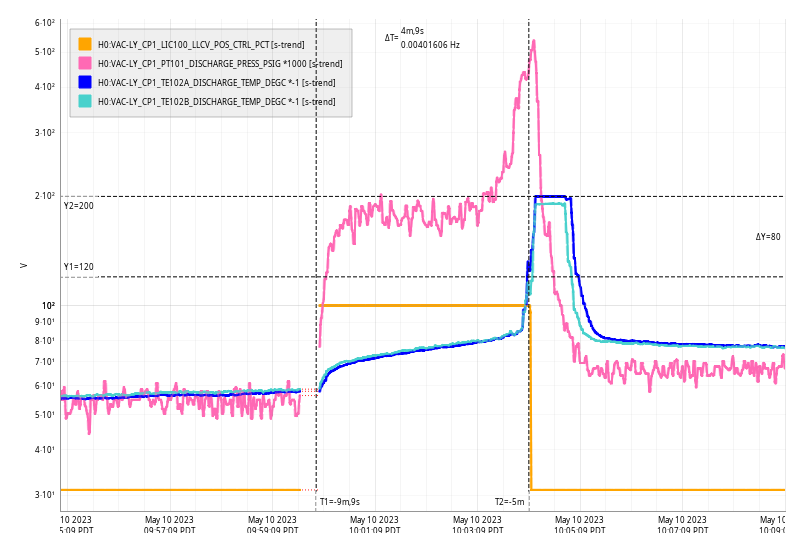
Wed May 10 10:04:09 2023 INFO: Fill completed in 4min 9secs
Jordan confirmed a good fill curbside.
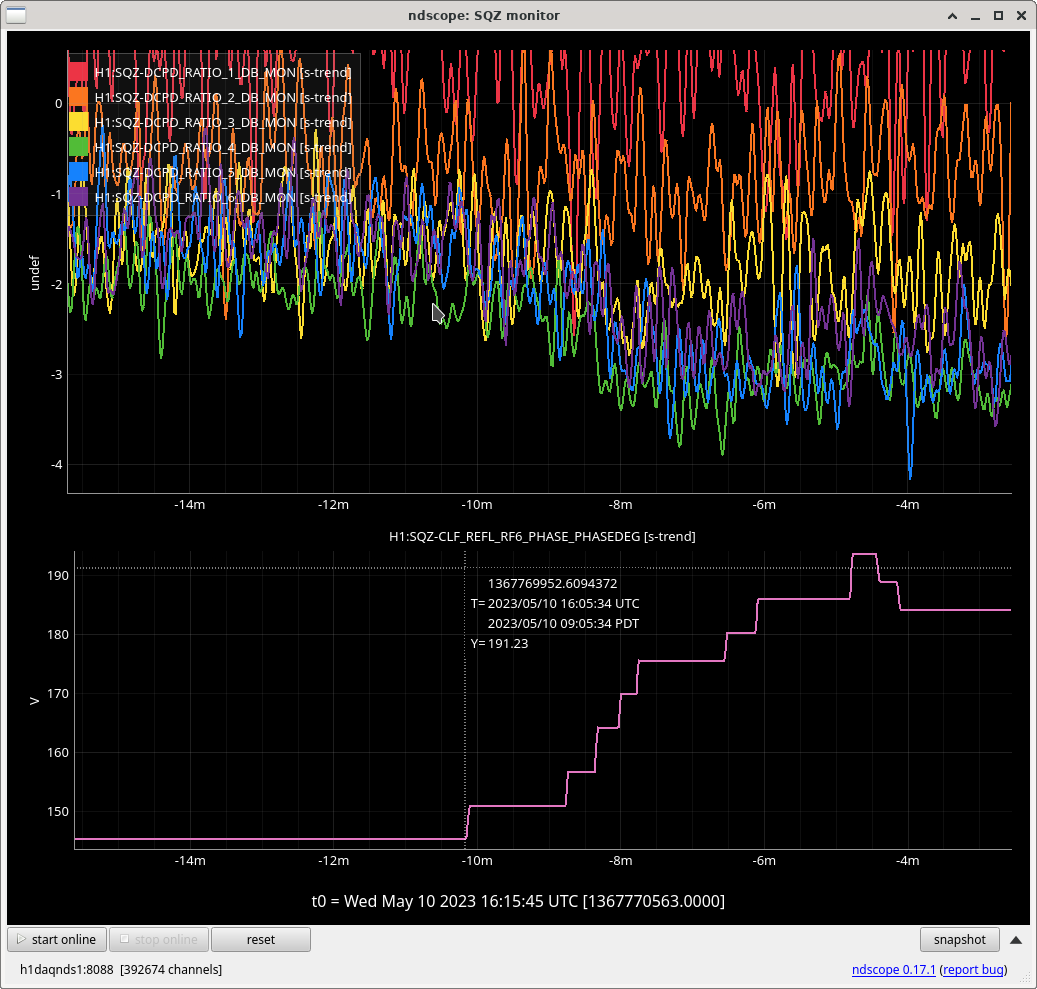
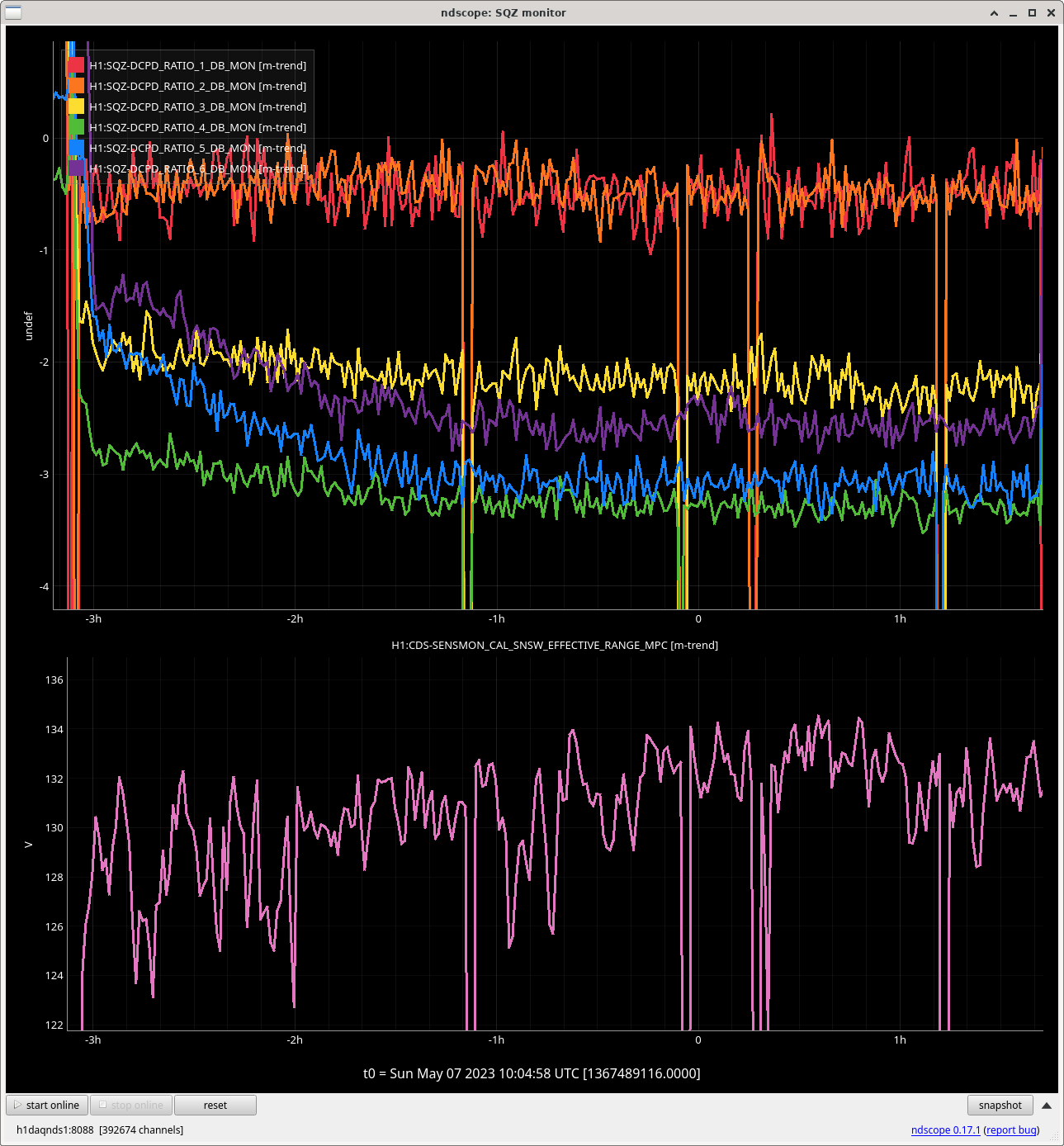
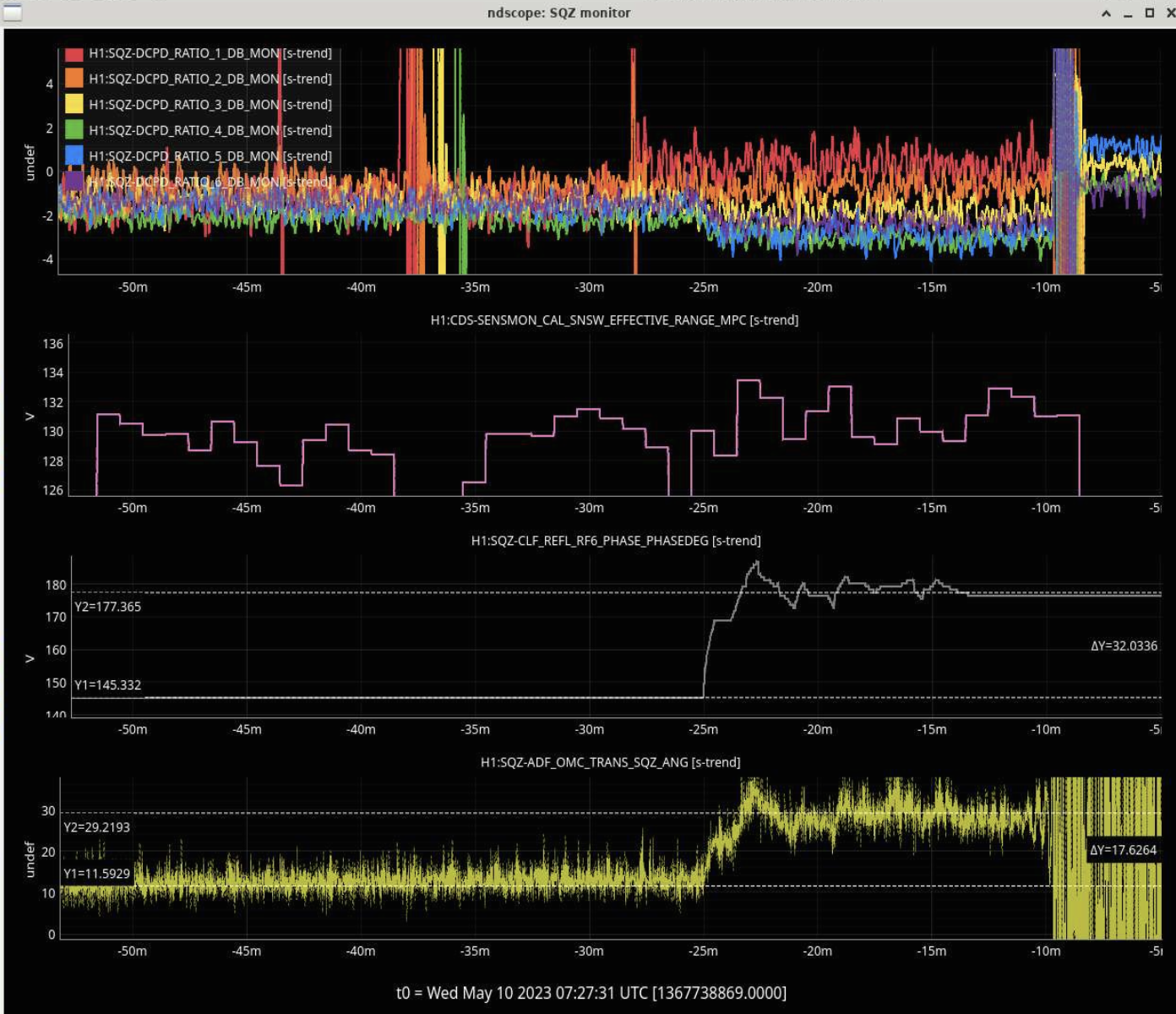
See attached plot for SQZ BLRMS improvement moving angle from 145 to 185degrees. I will set sqzparams.SQZ_ANGLE to 175 degrees (agreed by Vicky in 69464) and reload THERMALIZATION (okay to do as IFO is unlocked).
For Detchar, some additional info on our squeezer "ADF" line (our "audio diagnostic field"). We ran our ADF squeezer line at 1.3 kHz last night. The ADF is seen as a narrow in-band squeezer line that we inject into DARM. It is visible when the squeezer is on, and the ADF is on. See relevant channels below.
Once the squeezer locks to the IFO, the ADF line is very narrow. The ADF frequency is often static, but we sometimes change its frequency, and sometimes we sweep its frequency across the band. Squeezer logs refering to the "ADF" refer to this line; it helps us monitor our squeeze angle and alignment, and sweeps of it help us understand how squeezing propagates through the IFO.
TITLE: 05/10 Day Shift: 15:00-23:00 UTC (08:00-16:00 PST), all times posted in UTC
STATE of H1: Observing at 122Mpc
CURRENT ENVIRONMENT:
SEI_ENV state: CALM
Wind: 8mph Gusts, 4mph 5min avg
Primary useism: 0.01 μm/s
Secondary useism: 0.17 μm/s
QUICK SUMMARY: The IFO has been locked for 3.5 hours after it relocked by itself 2x after 2 earthquakes (yay). I've just flipped the intention bit to OBSERVING at (1456 UTC).
WP11180 Move ADF from h1sqz to h1ioplsc0
Daniel, Erik, EJ, Dave:
New h1sqz and h1ioplsc0 models were installed. This required multiple restarts of all h1lsc0's models and a DAQ restart.
WP11176 Pass filter-module files through foton -c
EJ, Dave:
70 models had their FM files passed through 'foton -c' to prevent future CFC flags. The procedure is:
70 of the 82 models which need this were done, I'll extend the WP to cover the remaining 12 models.
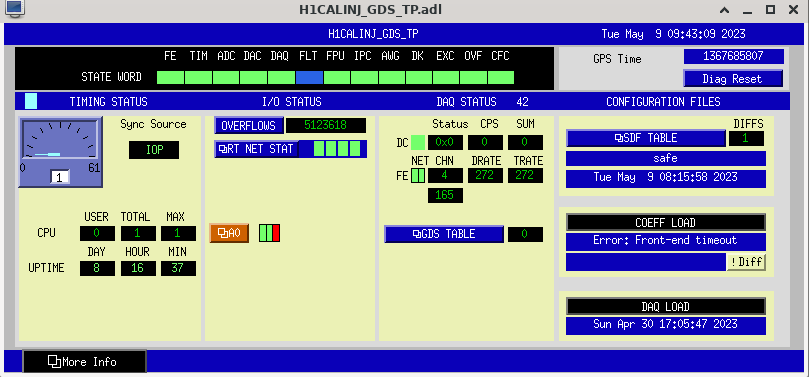
It was found that h1calinj reported errors loading its file due to large filters. EJ tracked this down to a shorter timeout for file loading while running compared to file loading on model startup.
The error is "Error: front-end timeout" in the COEFF-LOAD message string [see attachment]. EJ thinks the filter did get loaded and this is a verification warning, but to make sure we restarted h1calinj to get a clean load
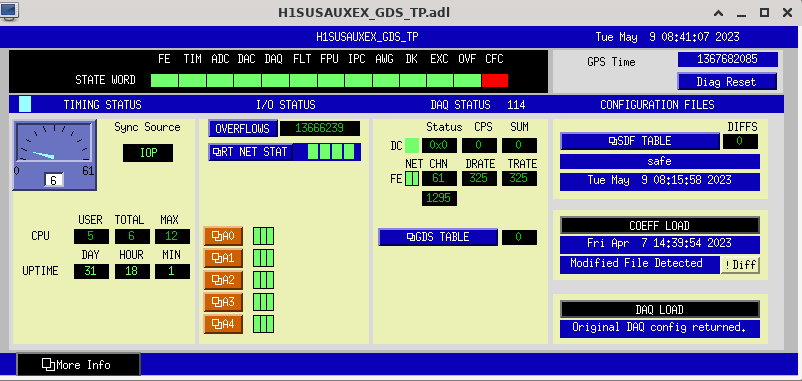
It was noted that some IOP and SUSAUX models had a DAQ LOAD message string of "Original DAQ config returned." [see attachment]
Because I had started with these models I initially thought it was somehow connected to today's work. We now think these messages have been there since the 5.14RCG upgrade on 11th April. We had pre-upgraded the SUSAUX systems the Friday prior to the main RCG upgrade, but on the 11th we did a full set of installs. This meant that the INI file went away and then returned with the same file, hence this message.
WP11141 Add large number of channels to DAQ GDS broadcaster
Jamie, Jonathan:
99 channels were added to the DAQ GDS broadcasters. This required increasing the size of GDS buffers to accomodate the larger data size.
WP11183 Removal of unused ADC signals in h1omc
Daniel, Dave:
Unfortunately this was not done today. Will reschedule for next week.
During CER DC-power supply upgrades h1omc0's IO Chassis was powered down. We rebooted h1omc0 when the chassis' power was returned.
Tue09May2023
LOC TIME HOSTNAME MODEL/REBOOT
09:24:31 h1daqgds0 [DAQ] <<<< GDS Broadcaster channels addition
09:25:21 h1daqgds1 [DAQ]
09:38:24 h1lsc0 h1ioplsc0 <<< ADF #1
09:38:38 h1lsc0 h1lsc
09:38:52 h1lsc0 h1lscaux
09:39:06 h1lsc0 h1sqz
09:39:20 h1lsc0 h1ascsqzfc
10:04:18 h1lsc0 h1ioplsc0 <<< ADF #2
10:04:32 h1lsc0 h1lsc
10:04:46 h1lsc0 h1lscaux
10:05:00 h1lsc0 h1sqz
10:05:14 h1lsc0 h1ascsqzfc
10:15:02 h1oaf0 h1calinj <<< Clean load of filter file
10:24:36 h1lsc0 h1ioplsc0 <<< ADF #3
10:24:50 h1lsc0 h1lsc
10:25:04 h1lsc0 h1lscaux
10:25:18 h1lsc0 h1sqz
10:25:32 h1lsc0 h1ascsqzfc
11:08:17 h1omc0 ***REBOOT*** <<<< Recovery of h1omc0 from IO Chassis power cycle
11:09:44 h1omc0 h1iopomc0
11:09:57 h1omc0 h1omc
11:10:10 h1omc0 h1omcpi
12:11:27 h1lsc0 h1ioplsc0 <<< ADF #4
12:11:41 h1lsc0 h1lsc
12:11:55 h1lsc0 h1lscaux
12:12:09 h1lsc0 h1sqz
12:12:23 h1lsc0 h1ascsqzfc
12:20:59 h1daqdc1 [DAQ] <<< DAQ restart for h1ioplsc0 and h1sqz models
12:21:08 h1daqfw1 [DAQ]
12:21:08 h1daqtw1 [DAQ]
12:21:10 h1daqnds1 [DAQ]
12:21:18 h1daqgds1 [DAQ]
12:21:45 h1daqgds1 [DAQ] <<< 2nd GDS1 restart
12:28:16 h1daqdc0 [DAQ]
12:28:25 h1daqfw0 [DAQ]
12:28:25 h1daqtw0 [DAQ]
12:28:26 h1daqnds0 [DAQ]
12:28:34 h1daqgds0 [DAQ]
12:28:54 h1daqgds0 [DAQ] <<< 2nd GDS0 restart
DAQ/GDS Chanel Changes.
Complicated by the fact that some channels were moved from h1sqz to h1ioplsc0 with no name change
| fast removed | slow removed | fast added | slow added | |
| h1ioplsc0 | 0 | 0 | 0 | 132 |
| h1sqz | 0 | 167 | 0 | 61 |
DAQ/GDS
| Removed | Added | |
| DAQ Full Frame Channels | 62 | 88 |
| GDS Broadcaster Channels | 0 | 99 |
Full lists in attached tar file.
TITLE: 05/10 Eve Shift: 23:00-07:00 UTC (16:00-00:00 PST), all times posted in UTC
STATE of H1: Commissioning
CURRENT ENVIRONMENT:
SEI_ENV state: CALM
Wind: 5mph Gusts, 3mph 5min avg
Primary useism: 0.01 μm/s
Secondary useism: 0.14 μm/s
QUICK SUMMARY:
Locking Went well.
Violin mode ITMY Mode8 was ringing up and I turning off damping for it at 1:15 UTC
Seems to have stopped the mode from ringing up.
Lockloss from unknown cause at 1:40 UTC
https://ldas-jobs.ligo-wa.caltech.edu/~lockloss/index.cgi?event=1367717996
Relocking went into and through AQUIRE_PRMI without any intervention.
IFO locked at NOMINAL_LOWNOISE at 2:57 UTC
2 Calibration Sweeps were ran one at the begining of a lock stretch and another after about 3.5 hours of the same lock stretch.
ITMY Violin mode8 did creep up a little but it settled at 4.37 and started to slowly fall towards the tail end of the lock.
IFO Current status:
IFO is in NOMINAL_LOWNOISE and OBSERVING
IFO just now broke lock due to an earthquake .
https://ldas-jobs.ligo-wa.caltech.edu/~lockloss/index.cgi?event=1367738288
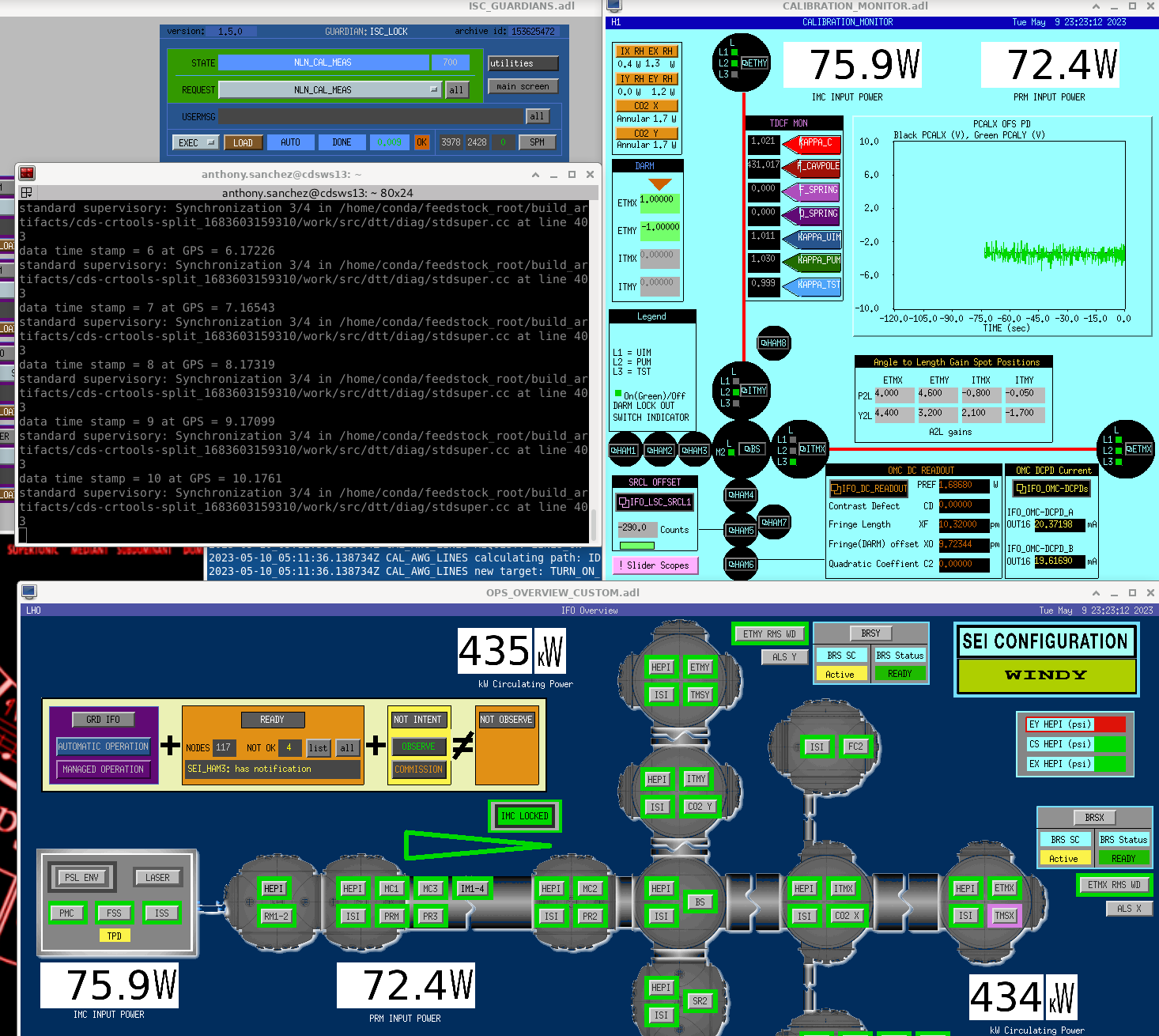
After being locked for 3+ hours at around 6:23 UTC I started another calibration sweep.
I took the IFO to NLN_CAL_MEAS and ran the following cmmand:
pydarm measure bb sens pcal --run-headless
then took a screenshot of the calibration Monitor screen.
Once this finished I ran pydarm report to create this report:
/ligo/groups/cal/H1/reports/20230510T062635Z/H1_calibration_report_20230510T062635Z.pdf
When this finished I noticed there were these BUG reports:
*** BUG ***
In pixman_region32_init_rect: Invalid rectangle passed
Set a breakpoint on '_pixman_log_error' to debug
*** BUG ***
In pixman_region32_init_rect: Invalid rectangle passed
Set a breakpoint on '_pixman_log_error' to debug
I took the IFO to NLN_CAL_MEAS
Ran the command :
pydarm measure bb sens pcal --run-headless
Once it Finished, I ran pydarm report to create the following report:
/ligo/groups/cal/H1/reports/20230510T042516Z/H1_calibration_report_20230510T042516Z.pdf
I then put the IFO back into NOMINAL_LOW_NOISE and back to observing mode.
Locking Went well.
Violin mode ITMY Mode8 was ringing up and I turning off damping for it at 1:15 UTC
Seems to have stopped the mode from ringing up.
Lockloss:
Lockloss from unknown cause at 1:40 UTC:
https://ldas-jobs.ligo-wa.caltech.edu/~lockloss/index.cgi?event=1367717996
Relocking:
ISC_LOCK Guardian went into and through AQUIRE_PRMI without any intervention and the IFO locked at NOMINAL_LOWNOISE at 2:57 UTC.
The IFO is almost thermalizing and, once it's circulating arm powers settle I'll start a calibration measurement.
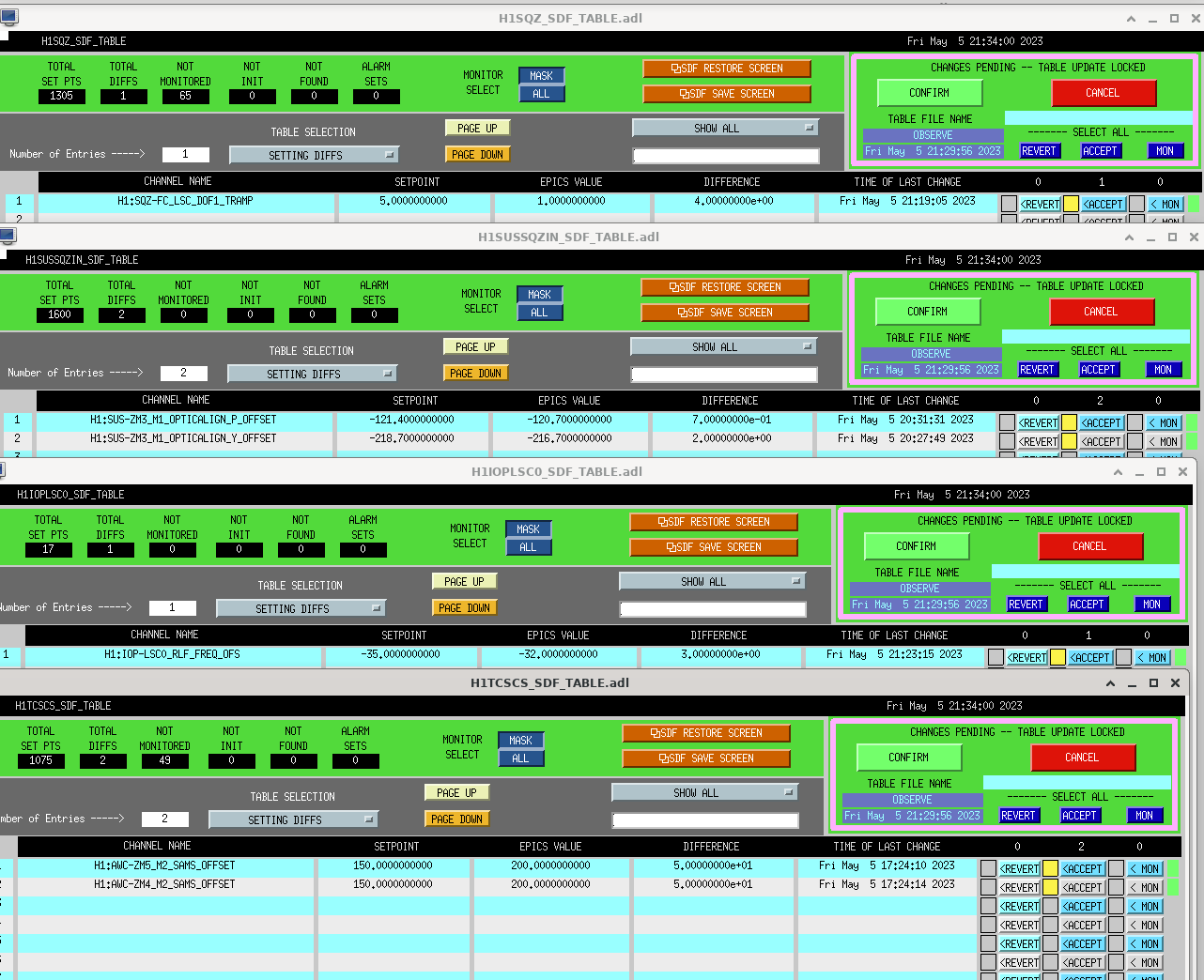
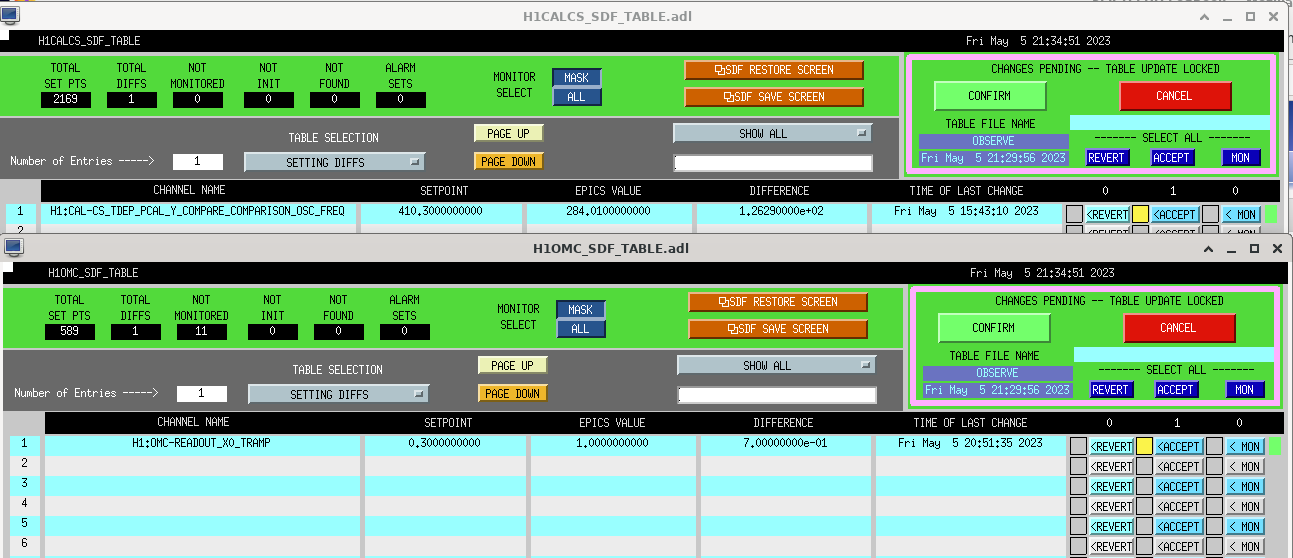
I have attached a picture of the SDF that I have accepted into SDF so i can get back to Observe mode.
CAL_AWG_LINES : ERROR while trying to get to NLN_CAL_MEAS
Reloaded CAL_AWG_LINES Guardian and the problem was resolved.
Picomotor controllers should always be off in observe, i.e. PICO_x_CURRENT_ENABLE should be set to disabled.
I disabled the picomotor that was left on (sitemap > LSC > Picomotors > SQZT 0 > Disabled) and accepted in SAFE sdf. Tagging CAL for the sdf diffs in main alog.
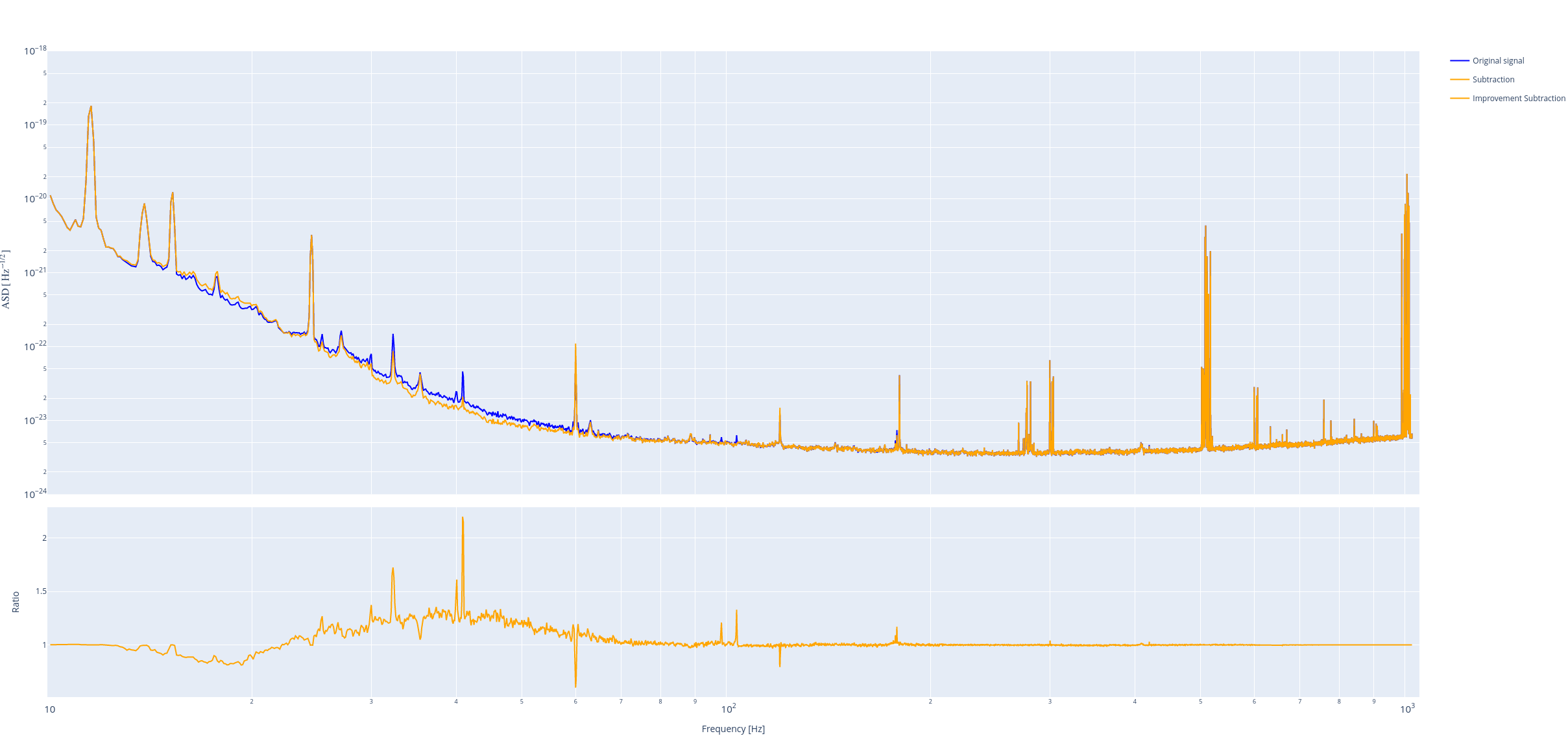
With lots of help from JamieR, GabrieleV, MaddieW, and AaronV, I think I've maybe gotten a better handle on applying appropriate phase advance / delays to the NonSENS training, for online cleaning that creates the _CLEAN channel.
A caveat is that we haven't had a nicely thermalized IFO this afternoon to try the cleaning on, but I'm hopeful that since I trained everything on a thermalized IFO from last night, that once the IFO thermalizes the subtraction will be good.
For tonight, I am letting the subtraction subtract, so I've set the NOISE_CLEAN guardian to send signal out to the GDS calibration pipeline. I think I've accepted everything in safe and observe sdfs, so that Tony will have no problem going to Observing later.
A caveat is that some of the training needs more time, including this LSC training result attached, showing that I'm expecting I'll be injecting noise below 25 Hz, but cleaning things up above 25 Hz. This is noise injection something that requires improvement over the next few days, and is a work in progress.
Today I updated the Jitter cleaning, with a slightly different time-stamping delay. But, if I just ask it to subract the Jitter noise, it injects noise. Not good. I've accepted for tonight a -1 in the gain on the (updated, but overall the same as yesterday) Jitter noise estimate.
Attached is measured data showing that the subtraction is working (again, with Jitter having an unexplained minus sign, all others having the expected plus sign). The colors on the various contributions to the Noise_Estimate are roughly meant to align with the colors on the nice summary page that Derek updated recently.
The summary page will also be helpful for showing how the cleaning efficacy changes with time (it's not being updated throughout the lock stretches). I still don't think I've got this phase delay thing quite right, so still some room for improvement, but it's at least doing something.
Notes for self:
Jitter was trained with 239e-6 sec hand-added, others trained with 408e-6 s advance hand-added. Need to update other traces, since 239e-6 sec is the value that is used in the calibration pipeline. The 408 number was me misreading things. None of these are trained using the nonsens_firfilt and re-time-stamped with the nonsens_firfilt_delay.
Naoki, Camilla, Vicky
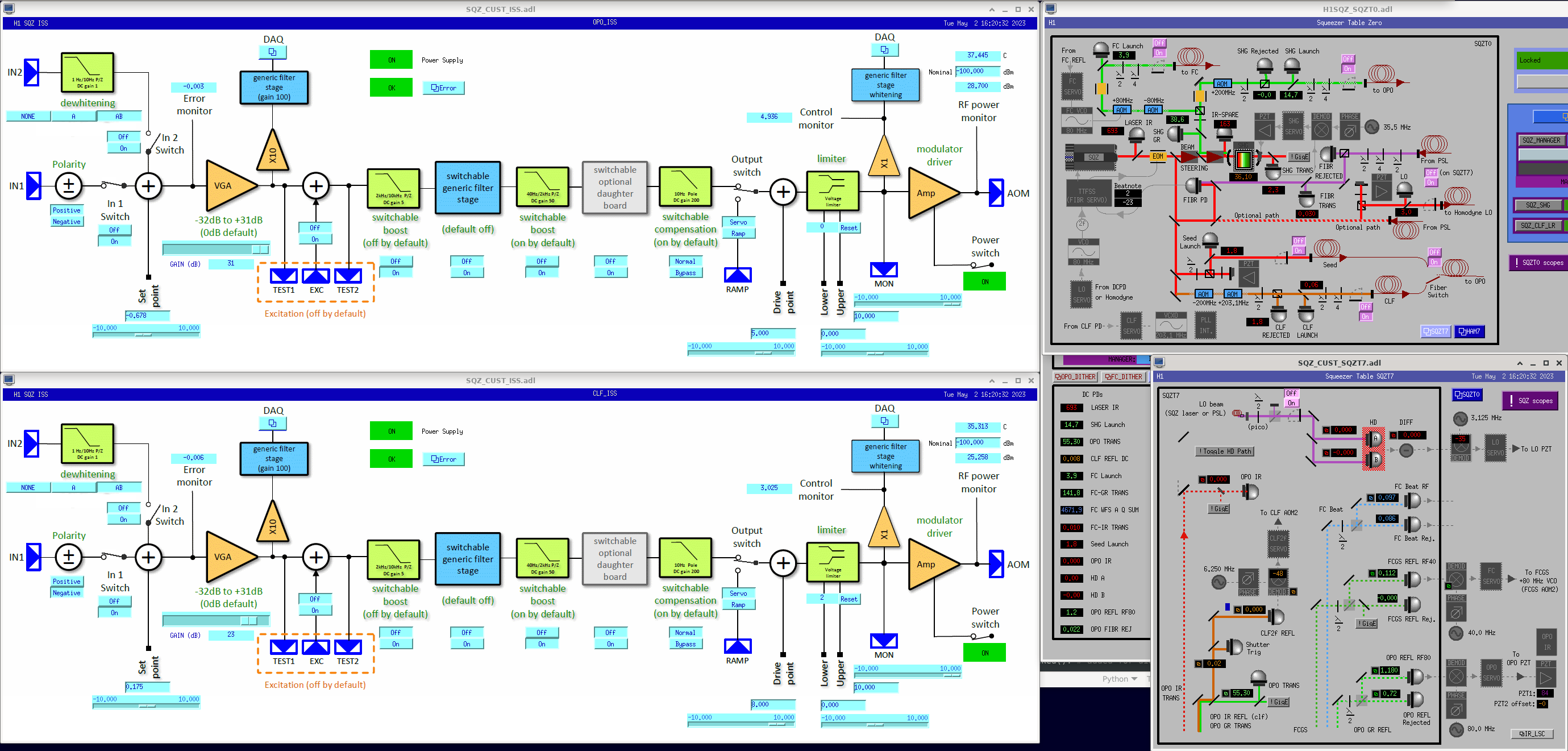
For O4, we have swapped the CLF path's M5 mirror optic back its original 5:95 beam-splitter. This is the design (D1201210), and how it will be for O4. CLF ISS settings have been accordingly to our recent CLF ISS OLG measurements, with AOM RF @ 25.7dBm, and so ISS gain at 23dB (May 2023, LHO:69268). CLF_LAUNCH PD beam-splitter ratio has been updated and SDF'd according to our table measurements with the Thorlabs power meter (screenshot).
Some history of swapping the CLF BS/mirror:
-- July 2022. When we had the broken CLF fiber on HAM7 in Summer 2022, we replaced the CLF BS 5:95 to a mirror to get enough CLF power to lock, LHO:63893, ~July 2022.
-- Dec 2022. After fixing the fiber feedthrough, we swapped it back to the 5:95, LHO:66260.
-- Late-Jan 2023. LHO:67038, we swapped the CLF path back to a mirror to investigate how high-CLF levels can inject technical noise and limit squeezing.
-- Late-April 2023 68991+ 69084, Nutsinee and Daniel made interesting measurements of CLF intensity noise in DARM, related to RF AM at the CLF frequency, which is projected something like a factor of 8 below DARM. They installed an RF intensity noise monitor, LHO:69013, that'll live on SQZT0, so we can continue to monitor RF AM -- note: this intensity noise monitor is currently demodulated using the homodyne demod board e.g. SQZ-HD_DIFF_RF3_DEMOD_RFMON, so we will not be able to use the homodyne for now.
-- Some summary alogs looking at CLF noise due to seeding or AOM RF drive power: LHO:67038, 67068, 67210. It seemed to us then that, driving the AOM at high RF powers was better.
-- LHO:67219 Feb 2023, our most recent NLG sweeps on the homodyne measured up to 5.5 dB SQZ on HD, and suggested there was some technical noise about 10dB below shot noise, alongside ~25% loss and ~15 mrad phase noise.
The omc model was updated with any unused ADC channels removed for good.
Unfortunately this was not done on Tuesday 09 May. We have rescheduled this for 16 May.
I have added sqz angle adjustments to the THERMALIZATION guardian that Gabriele made to servo the PRCL gain (alog 68948). SQZ angle will be adjusted from 165 to 145 degrees over the first 90 minutes of the IFO's lock. This is based on the SQZ Angle Adjustments tests in alog 69055.
In the SERVO_PRCL_GAIN state of the THERMALIZATION guardian, just before SQZ is injected, H1:SQZ-CLF_REFL_RF6_PHASE_PHASEDEG will be set to 20 degrees (SQZ_CHANGE) higher than nominal. Over 90 minutes (SQZ_THERM_TIME), the angle with be linearly taken to 145 degrees (sqzparams.SQZ_ANGLE). Adjustments to final sqz angle should be saved to /sqz/h1/guardian/sqzparams.py as SQZ_ANGLE and THERMALIZATION reloaded (only reload during lockloss).
Hope that this will increase H1 range at the start of the lock, if this isn't the case, we can revert these changes.
Due to a typo in the guardian code, I restarted the THERMALIZATION guardian so that the SERVO_PRCL_GAIN actually started 5 minutes later than it should have done for this lock.
Given the recent update of the SRCL offset to -290 this past week (69402), it looks like our ideal squeeze angle when thermalized has changed quite a bit from before, when Camilla found a good squeeze angle for that IFO configuration. Here are trends of rotating the sqz angle a bit, watching the 1.3kHz ADF line phase-rotate (oops, we should probably look at the ADF magnitude, ie the IQ_RMS, as well; that will tell us if we're "squeezing" at the ADF frequency), the sqz blrms, and the range. We will probably want to update the "thermalized" angle in sqzparams.py.
LOCK#1
After the IFO was locked 5h13, we lost lock at 01:06UTC from ASC changes.
Elenna loaded a new MICH filter after the lockloss.
LOCK #2
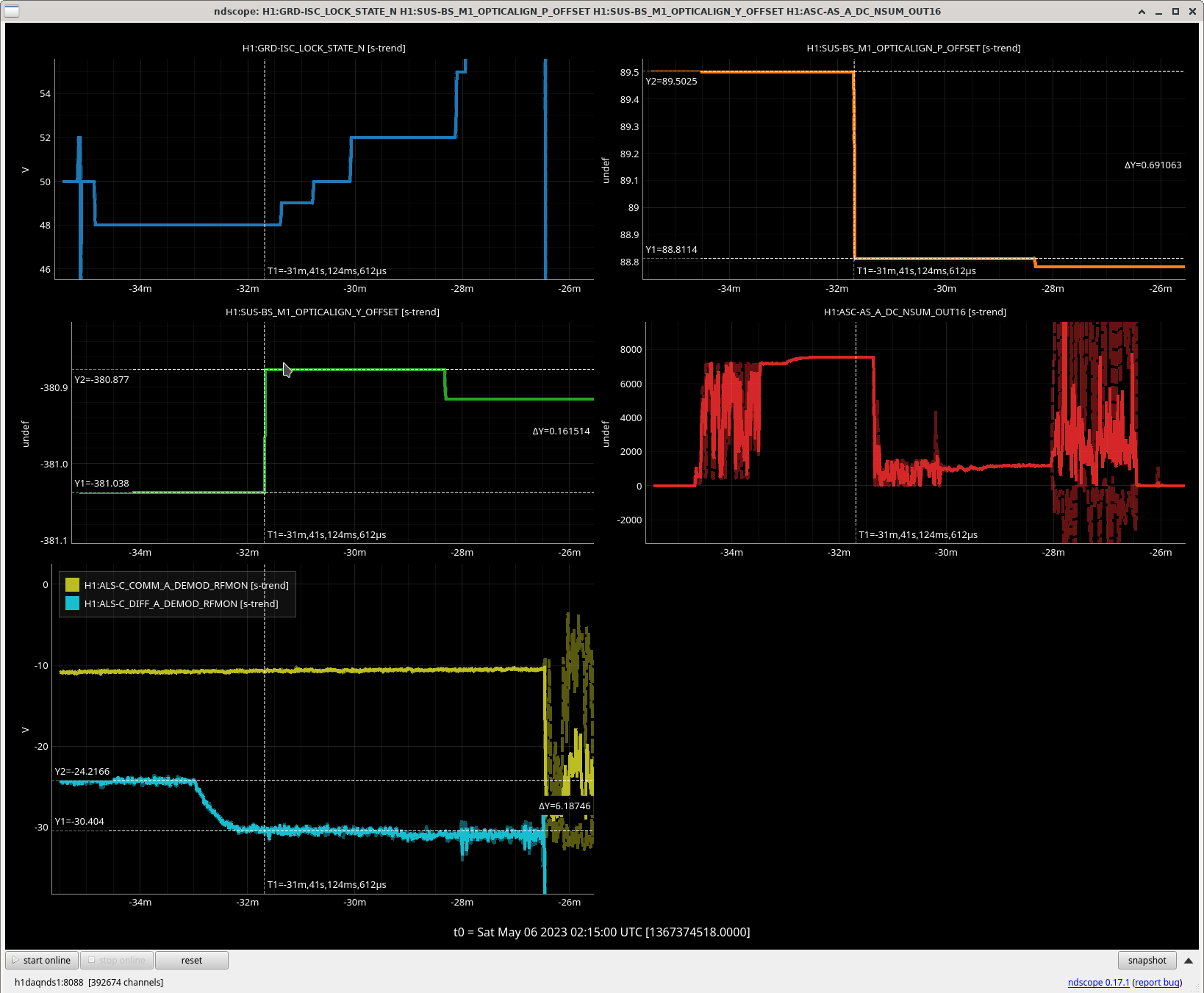
Had a tough time relocking (later we noticed it seemed like CHECK_MICH_FRINGES moved the BS the wrong way at around 2:00UTC). This BS move made the DIFF beat note too low (-30) for LOCKING_ALS. I attempted an initial alignment. Couldn't get XAMR IR locked eso exited from initial alignment. Reverted BS pointing to before CHECK_MICH_FRINGES and touched PRM during ACQUIRE PRMI. Finally locked again. Inputting 76W at 03:45 UTC and at NLN at 04:20UTC. Delay due to OMC_WHITENING limited needed to be changed, alog69371.
Observing at 04:35UTC. SDFs accepted:
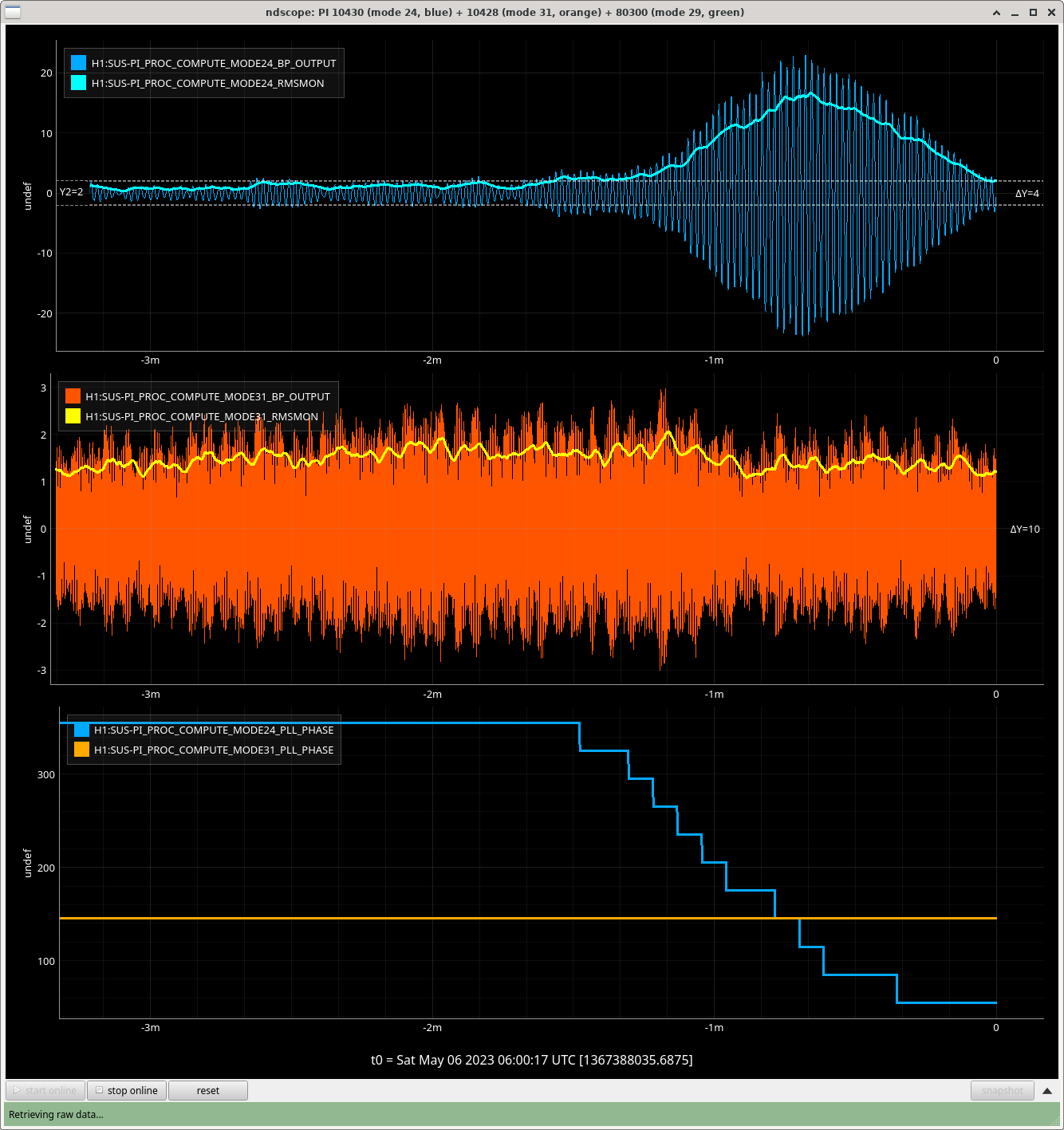
At 05:59UTC we had the 10.4Hz PI ring up (PI # 24), I was notified via verbalalarms and it and was successfully damped by the PI_DAMPING guardian, no intervention needed, Vicky's alog 69318 changes were good. See attached plot.
| Start Time | System | Name | Location | Lazer_Haz | Task | Time End |
|---|---|---|---|---|---|---|
| 21:39 | COMM | Jennie.Naoki.Vicky | CR | N |
DARM spring and SCRL offsets, SQZ, FC alignments. |
01:08 |
| 03:22 | SQZ | Naoki | CR | N | Injecting SQZ during locking | 04:22 |
| 6:45 | SQZ | Camilla | CR | N | SQZ angle adjustments | 6:52 |
| 6:55 | CAL | Louis | Remote | N | Calibration | eta 7:30 |
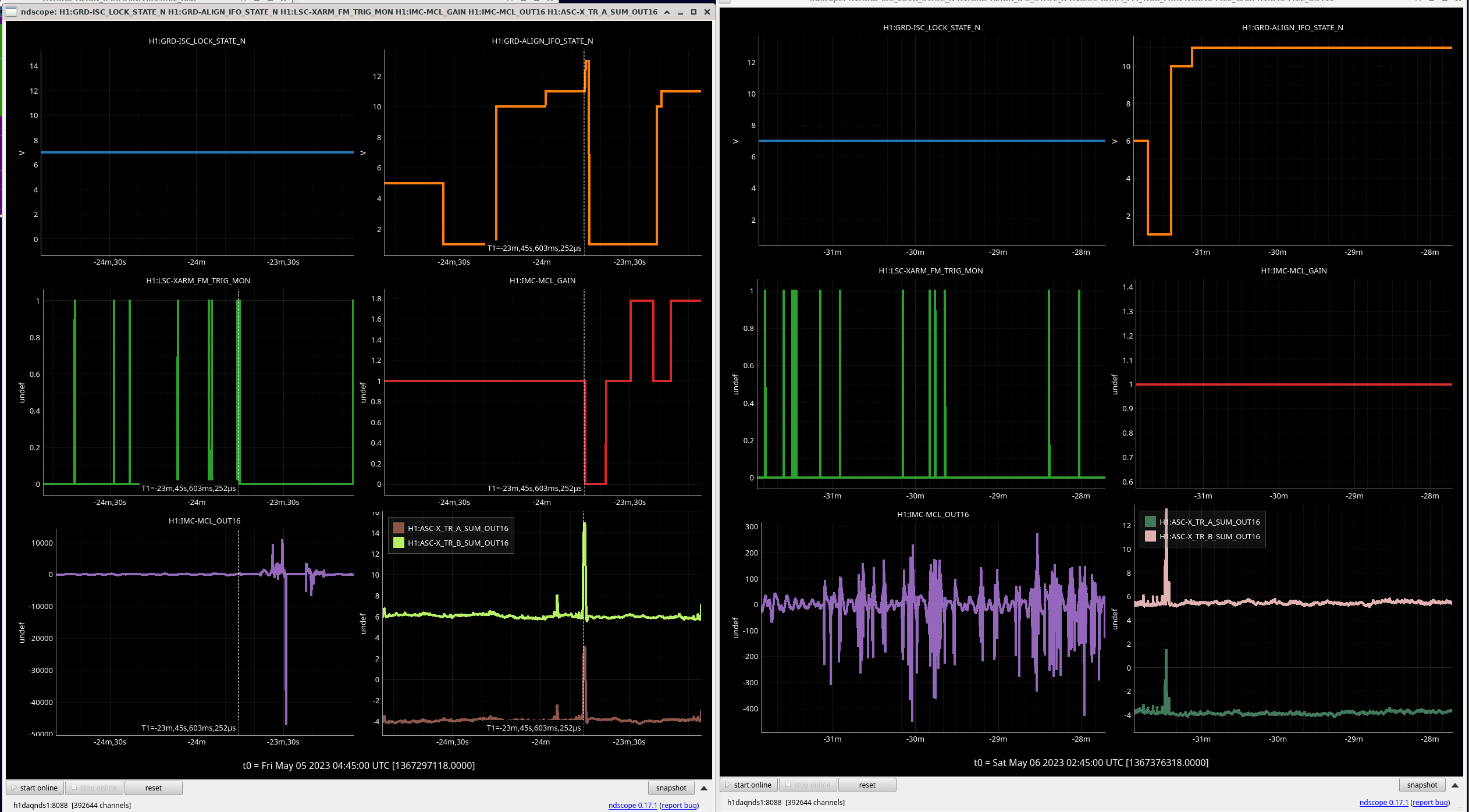
Notes on struggle Austin (69378) and I had for ACQUIRE_XARM_IR (state 11 of ALIGN_IFO) during INITIAL_ALIGNMENT. ALIGN_IFO is checking for LSC-XARM_FM_TRIG_MON to trigger and then it will turn off MCL gain and continue, since Friday evening this has triggered but not hed and ALIGN_IFO hasn't moved forward.
Plot attached comparing on the left a successful Initial alignment 2023/05/05 04:15 UTC verus on the right the failed alignment 2023/05/06 02:00 UTC. Light levels on the H1:ASC-X_TR_A_SUM_OUT16 while unlocked didn't get above their zero values.
Attaching plot for time (2023/05/06 01:43 UTC) that CHECK_MICH_FRINGES reduced DIFF beatnote from -24 to -30. Not sure if this is expected.
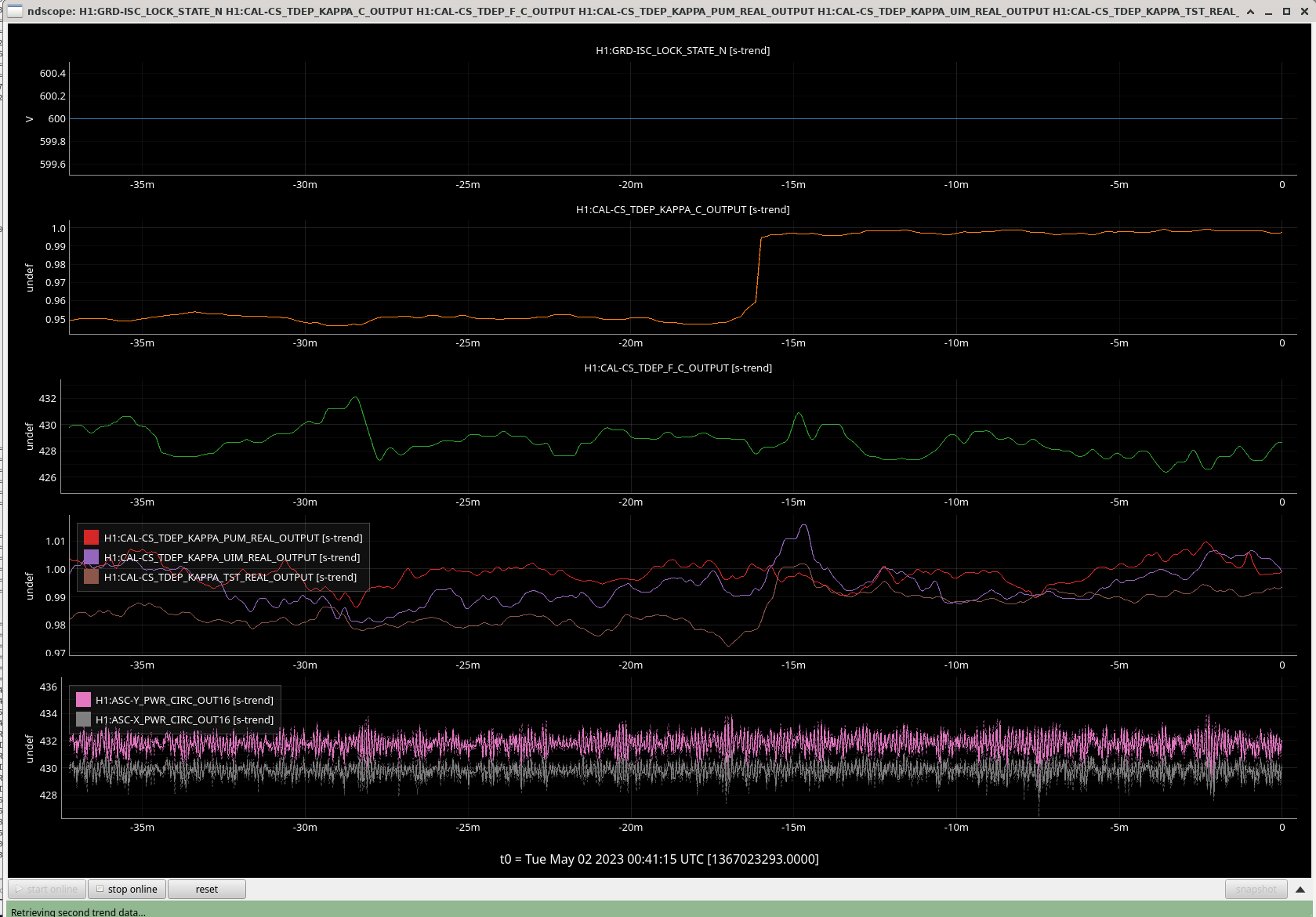
E. Goetz, J. Kissel, L. Dartez I regenerated report 20230426T224835Z using LHO's pyDARM cmd tools to produce a new set of GDS FIR filters that includes new filters for NonSens subtraction pipeline. The report also generated a new set of Cal EPICS records to clear out unused demod phase records and update the TDCF calculations. As a result of the push, KappaC has shifted from ~0.945 to ~0.99. The actuation Kappas are also much closer to 1 now as Evan updated the actuation gains inpydarm_H1.inithat inform the pyDARM EPICS channel calculations. The push to the front end was done withpydarm export --epics-only --push. For a list of all values submitted see pydarm_export_output.txt. We opted to *not* update the inverse sensing and actuation filters because we could not (at the time) explain why we saw that the pydarm report was producing different values than were already installed on the front end (CAL-CS filterbanks). We later realized that the new report was informed by a new sensing function measurement (2023/04/26 as opposed to 2023/04/20). We may yet want to update these CAL-CS filterbanks after all. We'll revisit this tomorrow.
The PDF attachment in the log above stopped loading for some reason. It can be accessed directly at https://ldas-jobs.ligo-wa.caltech.edu/~cal/archive/H1/reports/20230426T224835Z/H1_calibration_report_20230426T224835Z.pdf.