TITLE: 05/02 Eve Shift: 23:00-07:00 UTC (16:00-00:00 PST), all times posted in UTC
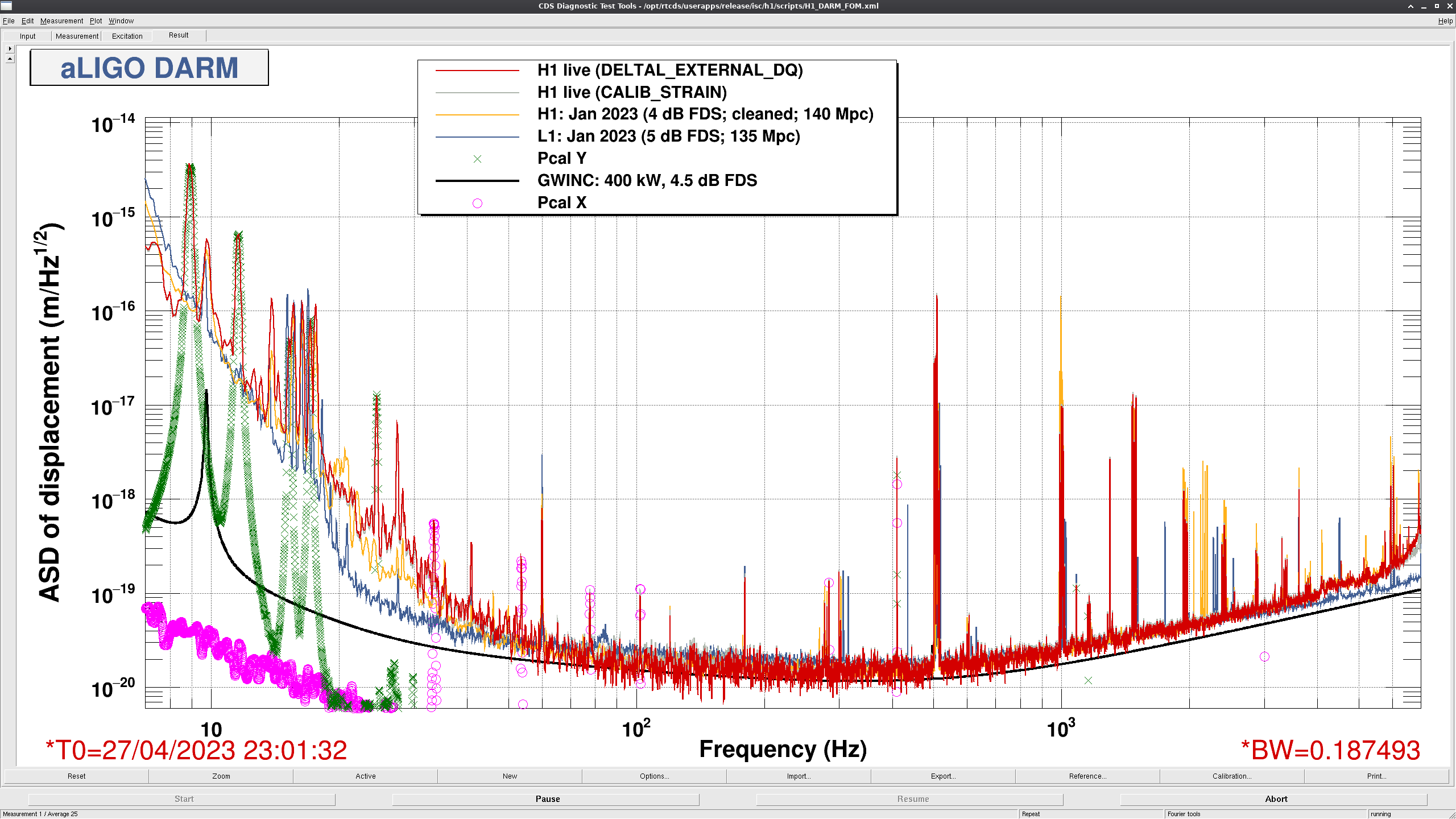
STATE of H1: Observing at 137Mpc
SHIFT SUMMARY: Quiet night with first ER15 candiate! 11hours at NLN between 130 and 140MPc range. T
LOG: here was a lightening storm to the East of LIGO 11:15 - 11:45pm.
Out of Observing Time:
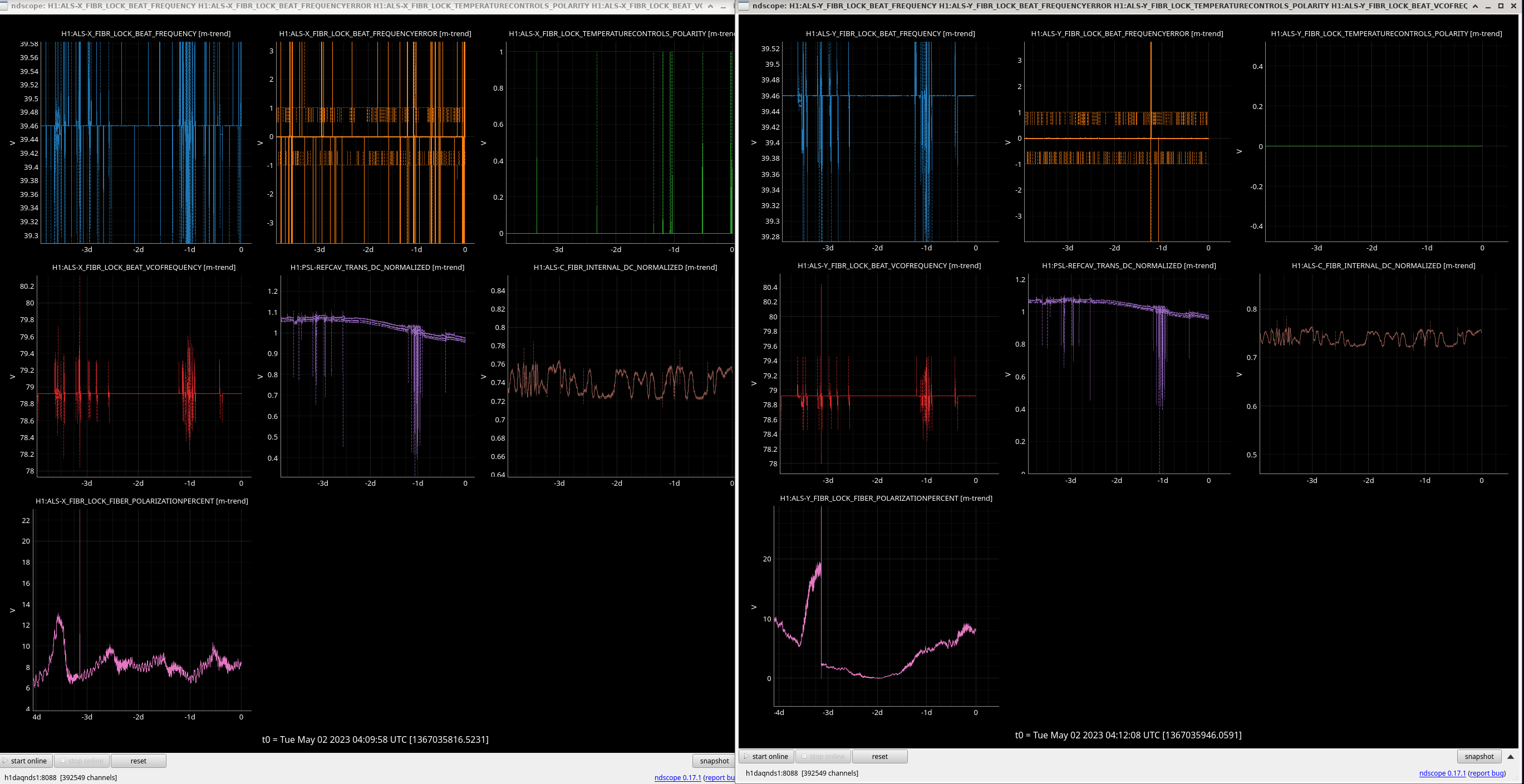
Dan's PI monitor on nuc25 needed restarting twice.
| Start Time | System | Name | Location | Lazer_Haz | Task | Time End |
|---|---|---|---|---|---|---|
| 19:56 | LVEA | LASER HAZARD | LVEA | YES | THE LVEA IS LASER HAZARD | 00:54 |
| 23:08 | CAL | Dripta | PCAL Lab | N | Parts sort | 23:26 |
| 23:37 | CAL | Rick | PCAL Lab | N | Getting Equipment (driving to Receiving area) | 00:30 |
| 01:28 | FAC | Alarm | Computer users room | - | Fire Panel had a high pitched alarm. Daniel say message "missing card", Richard emailed. | 01:29 |
| 06:05 | FAC | Alarm | Computer users room | - | Fire Panel "Card 5, color user interface card missing/failed" alarm | 06:10 |
Looks like you caught those other two EX_ISC SDF diffs I was too slow for. Nice!
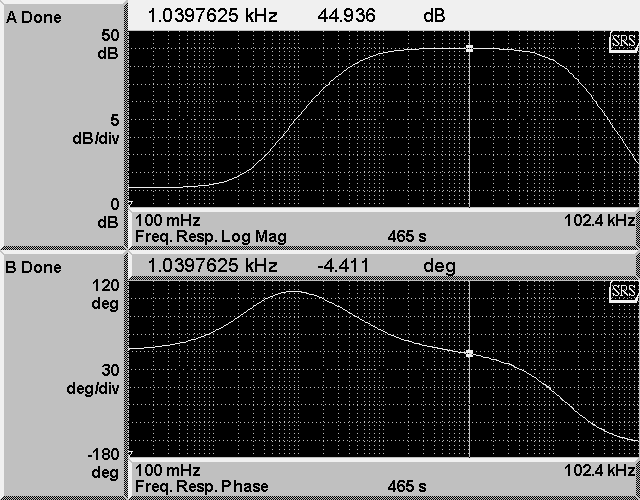
The following readback channels of the CLF and OPO ISS servos are saturated: SQZ-OPO_ISS_ERR_OUT, SQZ-OPO_ISS_CTRL_OUT, and SQZ-CLF_ISS_ERR_OUT. The only one working is SQZ-CLF_ISS_CTRL_OUT. However, comparing this channel with the corresponding slow readacks, it looks like this is actually the OPO readback.
The working CTRL output shows roughly twice what the slow monitor indicates, so this may explain what the other one saturates.
The ERR readbacks may saturate because none of the boost filters are engaged.
The DAQ readback cables were swapped at the remote rack. Fixed now.
The discrepancy in the DAQ control readbacks was traced to a missing 18.7K resistor, R197, in D1900049.
The fixed spare unit, S1900202, has been installed at the CLF ISS location.
The fixed CLF ISS units, S1900203, was then installed at the OPO ISS location.
Finally, the fixed OPO ISS, S2100110, has now become our spare.
Transfer function of whitening filter in fixed DAQ readback.
TITLE: 05/02 Eve Shift: 23:00-07:00 UTC (16:00-00:00 PST), all times posted in UTC
STATE of H1: Observing at 139Mpc
CURRENT ENVIRONMENT:
SEI_ENV state: CALM
Wind: 9mph Gusts, 6mph 5min avg
Primary useism: 0.04 μm/s
Secondary useism: 0.22 μm/s
QUICK SUMMARY: IFO has been locked for 3 hours.
IFO locked for 7 hours. We've been in Observing for >2 hours, since 00:45UTC.
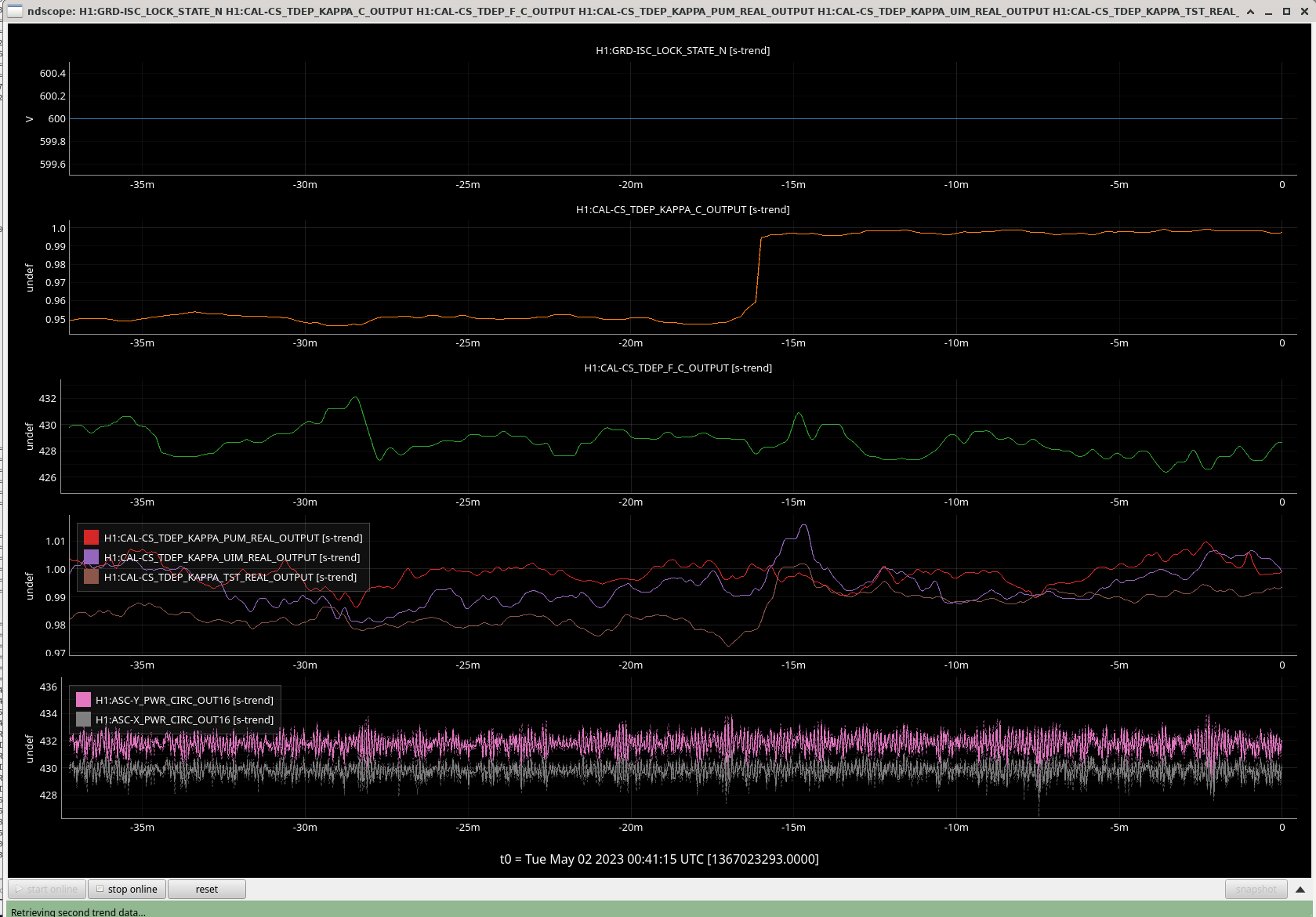
E. Goetz, J. Kissel, L. Dartez I regenerated report 20230426T224835Z using LHO's pyDARM cmd tools to produce a new set of GDS FIR filters that includes new filters for NonSens subtraction pipeline. The report also generated a new set of Cal EPICS records to clear out unused demod phase records and update the TDCF calculations. As a result of the push, KappaC has shifted from ~0.945 to ~0.99. The actuation Kappas are also much closer to 1 now as Evan updated the actuation gains inpydarm_H1.inithat inform the pyDARM EPICS channel calculations. The push to the front end was done withpydarm export --epics-only --push. For a list of all values submitted see pydarm_export_output.txt. We opted to *not* update the inverse sensing and actuation filters because we could not (at the time) explain why we saw that the pydarm report was producing different values than were already installed on the front end (CAL-CS filterbanks). We later realized that the new report was informed by a new sensing function measurement (2023/04/26 as opposed to 2023/04/20). We may yet want to update these CAL-CS filterbanks after all. We'll revisit this tomorrow.
The PDF attachment in the log above stopped loading for some reason. It can be accessed directly at https://ldas-jobs.ligo-wa.caltech.edu/~cal/archive/H1/reports/20230426T224835Z/H1_calibration_report_20230426T224835Z.pdf.
J. Kissel, J. Betzwieser ECR E2300125 IIET Ticket 27801 WP 11166 Executive Summary: Based on the *very* encouraging results from last week's install of the prototype of real-time monitoring of the systematic error lines that we inherited from LLO (see LHO:68961 for code changes, and the success story a mere 3 days later in LHO:69157), we crave finalizing this prototype infrastructure by incorporating standard stuff that other time-dependent calculations are doing, and re-casting the final answers into units that we regularly use elsewhere. In addition, we're also making some changes to the demodulation parameters given the systems-level compromises we discovered on at the end of last week LHO:69175, namely, changing undocumented hard-coded values into user-definable EPICs records. I've compiled the model with the below detailed changes, so the model is ready for build, install, and restart tomorrow. This will result in removal of 28 EPICs records, in addition to the addition of 164 EPICs records. This aLOG covers the changes to the front end model library parts that enacts the changes to the following library parts: /opt/rtcds/userapps/release/cal/common/models/ CAL_LINE_MONITOR_MASTER.mdl CAL_CS_MASTER.mdl as well as the following c-code chunk /opt/rtcds/userapps/release/cds/common/src/ RING_BUFFER.c These common parts have had their changes committed to the above mentioned location in the userapps SVN repo. (1) In order to support LLO's independent, front-end subtraction of calibration lines, he'd installed "gated running median" (GRM) infrastructure on the live calculations of (DELTAL / PCAL) transfer functions and (DELTAL / SUS) calculations on the output of those ratios that come directly from the DEMOD I and Q outputs. The GRM process is "just" a copy and paste from what we've been using for years to smooth out the answers for the the time-dependent correction factors (TDCFs). Indeed, the front-end GRM process is itself a copy of the gst-lal_calibration, "GDS" pipeline's function that's used in production of TDCF-corrected GDS-CALIB_STRAIN. The I and Q outputs are good enough for what Joe needs to subtract them out of DELTAL. However, in order to produce a true systematic error, the DELTAL / PCAL transfer function needs corrected for flaws in CALCS and then a conversion into magnitude and phase systematic error transfer functions for ease of interpretation. But -- the trends of the answer from this prototype of the systematic error transfer functions are quite noisy (2023-04-28_SYSERROR_LINES_FirstResults_30minutetrend.png from LHO:69157). As such, we've now moved the gated running median down-stream of the simple ratio of I & Q demod outputs, such that *both* the subtraction output *and* the systematic error output receive the noise cleaning benefits of the standard GRM process. (2) For better or worse, the "gated running median" is a bubble-gum and duct tape with super glue process for the DEMOD I and Q outputs: (A low-passed) The DEMOD I and Q banks themselves, have low-passes in them. As discussed in LHO:69175, these low passes correspond to "FFT lengths" if one were doing the analysis in the frequency domain. This has been traditionally a 0.1 Hz corner frequency low pass to correspond to a "10 second FFT." (B buffered) In the first stage of the GRM process, this low-passed I and Q data is held in a ring buffer for 10 seconds (and in the front-end this duration *used* to be a hard-coded input of RING_BUFFER.c as 163840 samples, i.e. model_sampling_frequency * buffer_size_sec = 16384 Hz * 10 sec = 163840.) (C gated) The output of RING_BUFFER.c, is then feed into a gating function, that either passes the current values through, or holds on the previous 10 second's value based on the last cycle's median. This reduces the sensitivity to glitches in the current 10 seconds. (D down-sampled and medianed) The current cycle's low-passed, buffered, gated output is then passed into a median function, which has an "array size" parameter, and a "stride" parameter. These parameters were hard-coded in the front-end to be a stride, (or a sample rate) of 1/16 seconds = 0.0625 seconds -- essentially down sampling the data, with an array size, or it's own collection of 2049 samples, i.e. 16384 / 8 -- 2048 ... so it calculates the median of 8 seconds of 16 Hz data. (E averaged) The current cycle's low-passed, buffered, gated, medianed output is then fed into an averaging buffer, with the same stride (sample rate) of 0.0625 sec, and it's own buffer of 160 samples i.e. (F up-sampled) Finally the current cycle's low-passed, buffered, gated, medianed, averaged 16 Hz signal is then uses a spline algorithm to upsample the data back to 16384 Hz. Thus *it* has a hardcoded parameter that serves as the upsampling ratio of 16384 Hz / 16 Hz = 1024. It's gross. Anyways, I walk through all this to illuminate that -- for the DELTA / PCAL and DELTA / SUS transfer functions, which are now mapped through the GRM process (see (1) above) -- I've converted all of these simulink hard-coded numbers that are all inter-related to the choice of FFT length into user-definable EPICs records. This way, if we every decide to make a *different* choice of FFT length, then we can change all of the inter-related parameters at the same time, in a hopefully intelligent way without an ECR to change the front-end model. Importantly, all the front-end computed TDCF values are the same, and are still using all the old hard-coded values. This is *just* for the newly commissioned DELTA/PCAL and DELTAL/SUS transfer functions that are now newly passed through their own GRM process. (3) Here's an easy one -- for the DELTAL / PCAL transfer function, which had been converted from the TF's real and imaginary parts to magnitude and phase -- I've converted added an additional readback that converts the phase from radians as it was to degrees. (4) It's important that the systematic error monitor has an uncertainty associated with it. To date, we've been using *only* a coherence based uncertainty, the usual Bendat and Piersol sqrt( (1 - coh) / (2 * navg * coh) ). This covers the *statistical* uncertainty of this transfer function nicely, but it does not reflect the fixed uncertainty in the model of the amplitude of PCAL displacement -- typically between 0.25 - 0.5%. So, if one of the PCAL lines has particularly loud signal-to-noise ratio, the measurement uncertainty can be quite low, lower than the uncertainty in the model of PCAL displacement. As such, I've added an additional EPICs record where one can install the fixed uncertainty of the PCAL amplitude, and that uncertainty will be added in quadrature to the coherence-based measurement uncertainty. (5) Finally, while we're still exploring what the best options are for the "FFT length," i.e. the frequency of the low-pass filter of the I & Q demods, we want to make sure that there's no fundamental code limit to choosing a long FFT -- say 100 seconds. As such, we've modified /opt/rtcds/userapps/release/cds/common/src/ RING_BUFFER.c , which was formerly limited to have a maximum buffer (a hard-coded definition in the c-code itself) of 20 seconds (16384 Hz * 20 seconds = 327680 samples). After some verification of of whether the front-end process could handle this increased limit (see TST:15369), we've increased this limit to 100 seconds (i.e. 16384 Hz * 100 seconds = 163840 samples). I'll post screenshots of the changes in a series of comments below.
Derek made the point to me this afternoon that it would be nice if the summary page for the NonSENS subtraction could plot the noise contribution from each individual noise source (rather than just the sum, which is all we can do now with the channels that we have). Also, that if we have the individual channels we can feed them into various DetChar tools such as hveto, to watch for glitches.
I have written an ECR E2300126, and filed a work permit, in anticipation of hopefully getting these in tomorrow. If things aren't signed, then I can defer until next Tuesday.
In anticipation of favorable approval, I've added 7x 16kHz channels to h1oaf's DAQ channel list (this is still far fewer than I removed from the DAQ the last time we booted h1oaf on a Tuesday).
DriptaB, TonyS, RickS
Details regarding the Pcal calibraiton for H1 for the O4 observing run can be fournd in the Pcal review document, LIGO-G2300471.
We expect that the numbers for the calibration of the Pcal Rx sensor signal channels will change by as much as a few tenths of a percent by the start of O4 as we apply the calibrations from the TSA and TSB trasfer standards currently in transit to LHO from NIST.
The Pcal calibration uncertainty for both end stations, 0.28 % (1-sigma), will likely change slightly as well.
We will also post the final numbers to the aLog before the start of O4.
We should have at least preliminary numbers for L1 by early next week.
Rick Savage, Dripta
As Rick mentioned in his alog 69213, chi_XY was ~ 1.0013. This should have been close to 1.0 instead since we are already applying correction factors using a previously-measured value of 1.0020. In order to investigate this deviation from 1.0, we have now changed the EPICS variables for the channels H1:CAL-PCALX_XY_COMPARE_CORR_FACT and H1:CAL-PCALY_XY_COMPARE_CORR_FACT from 0.9991 to 1.0 and from 1.0011 to 1.0 respectively. We will measure the chi_XY value without any correction applied over the next long lock stretch.
TITLE: 05/01 Day Shift: 15:00-23:00 UTC (08:00-16:00 PST), all times posted in UTC
STATE of H1: Observing at 138Mpc
SHIFT SUMMARY:
Lock#1
LOCK #2
LOG:
| Start Time | System | Name | Location | Lazer_Haz | Task | Time End |
|---|---|---|---|---|---|---|
| 19:56 | LVEA | LASER HAZARD | LVEA | YES | THE LVEA IS LASER HAZARD | Ongoing |
| 15:13 | FAC | Kim | Optics lab | N | Tech Cleaning | 15:30 |
| 16:24 | FAC | Mitch, Randy | EndY | N | Wind Fence work | 22:18 |
| 16:40 | FAC | Chris | EndY | N | Wind fence work | 22:18 |
| 16:47 | FAC | Cindy | MidY | N | Tech clean | 17:58 |
| 16:56 | FAC | Kim | MidX | N | Tech clean | 17:54 |
| 17:16 | CAL | Rick | PCAL lab | LOCAL | PCAL work | 18:22 |
| 17:19 | EE | Fil | CER | N | Inventory check | 17:30 |
| 17:35 | CAL | Elenna | CR | N | CARM measurement | 17:53 |
| 17:42 | CAL | Elenna | LVEA | Y | Check on SR785 | 17:51 |
| 17:48 | SQZ | Vicky | CR | N | New SQZ reference | 18:36 |
| 18:00 | CAL | Elenna | LVEA | N | Check on SR785 | 18:17 |
| 18:57 | CDS | Jonathon | MidX | N | Rack checks | 19:25 |
| 20:00 | SQZ | Vicky | CR | N | SQZ work | 21:19 |
| 20:02 | CAL | Dripta | PCAL | LOCAL | PCAL work out @ 21:33 | 21:33 |
| 20:07 | SUS | Ibrahim, Austin | CER | N | Checking equipment | 20:40 |
| 20:27 | CAL | Elenna | CR | N | CARM measurement | 20:30 |
| 21:02 | CAL | Elenna | CR | N | CARM measurement | 21:03 |
| 21:09 | VAC | Travis & Gerardo | EndY | N | Mech room, check a pump | 22:14 |
Rick Savage, Dripta
In preparation for shipping the PS11 standard to LLO, which is the working standard for Livingston, we made few responsivity ratio measurements with PS5 (the gold standard). Attached is a photo of the log sheet (made by Tony) relevant to these measurements. A summary plot of the PS11/PS5 responsivity ratio measurements (the .pdf file) is also attached. The last four data points are the most recent measurements in Back-Front (BF), Front-Back (FB), FB, BF configuration respectively. We don't see any significant impact of the FB-BF configuration change. The last two measurements uses a 25 ft DB9 cable as will be used by LLO when doing end station measurements with the PS11 standard whereas the two previous measurements used the 10 ft DB9 cable, which is usually used in the Pcal lab for responsivity ratio measurements. Again we don't see any significant impact of using two different cables. During these measurements we turned off the lab lights, something that we did not do during the measurements taken in 2022 or the one in February.
Note: The plot provides a summary of the PS11/PS5 responsivity ratio trends, which will be converted to responsivity of PS11 as soon as the TSA, TSB and WSS are received from NIST and we make measurements with PS5.
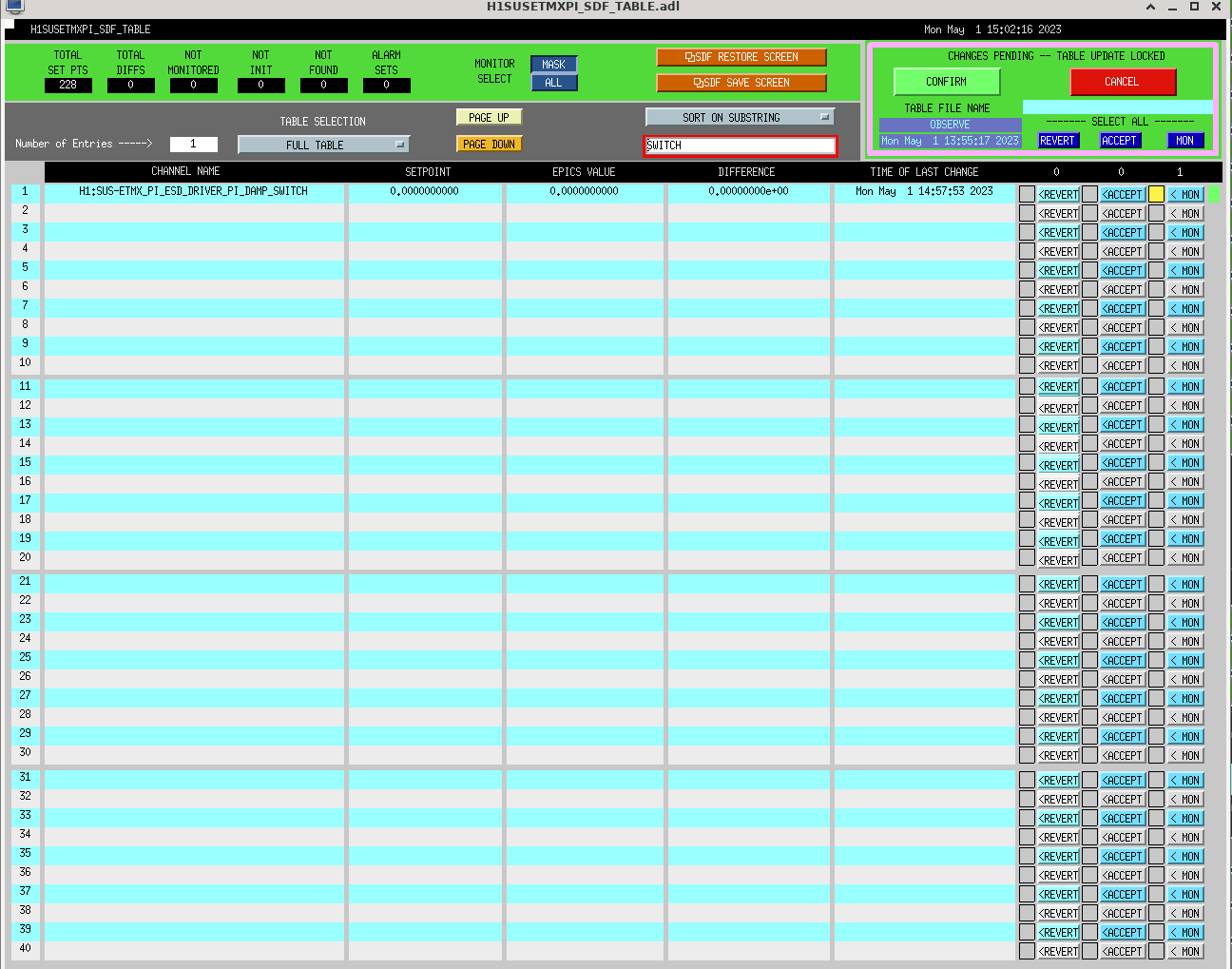
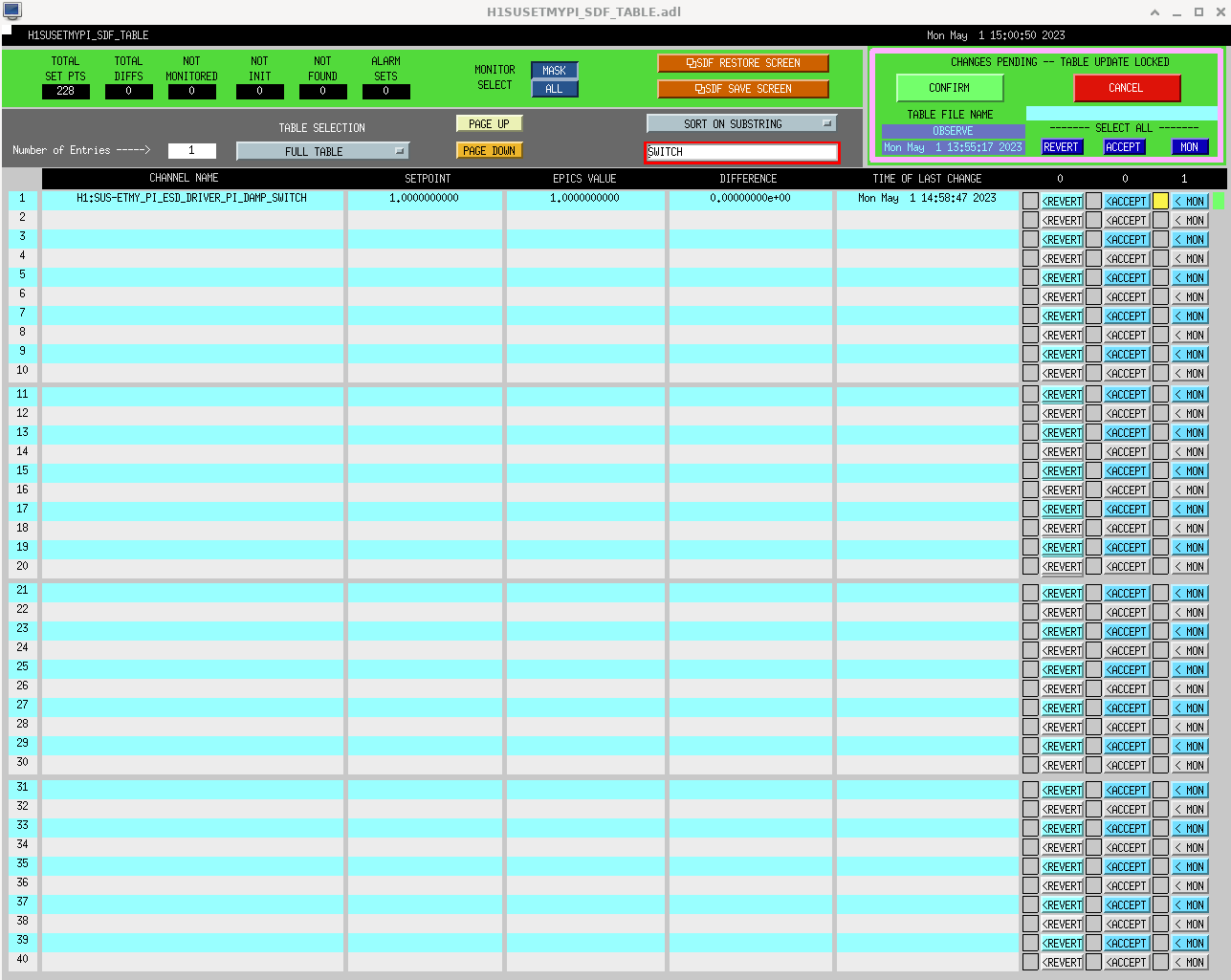
I've unmonitored the SUSETMX/YPI SWITCH channels at Vicky's request
I don't think we need PI damping most of the time now as TCS has settled, so I am minimalizing the SUS_PI guardian code to only start ESD damping if necessary. The following changes have been made to SUS_PI guardian; if all is good we can remove SUS_PI from ISC_LOCK soon.
The guardian reload kicked us out of "OBSERVING", because SUS_PI guardian was not "OK" for about 60ms as it reloaded, see trends.
Camilla, Vicky. We've increased the PI damping thresholds to: mode24 @ RMSMON = 10, mode31 @ RMSMON = 12.
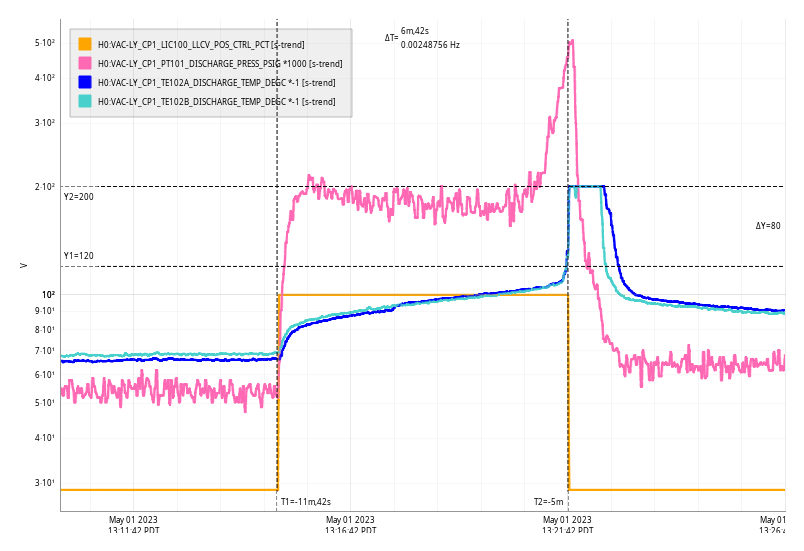
Mon May 01 13:21:42 2023 INFO: Fill completed in 6min 41secs
Gerardo confirmed a good fill curbside.
I went out to mid-x during a lock loss to troubleshoot the ipmi connection to h1pemmx. The fiber link was down, after re-seating the optic the link came back up. I was able to ping the management (ipmi) interface on h1pemmx from h1pemmx.
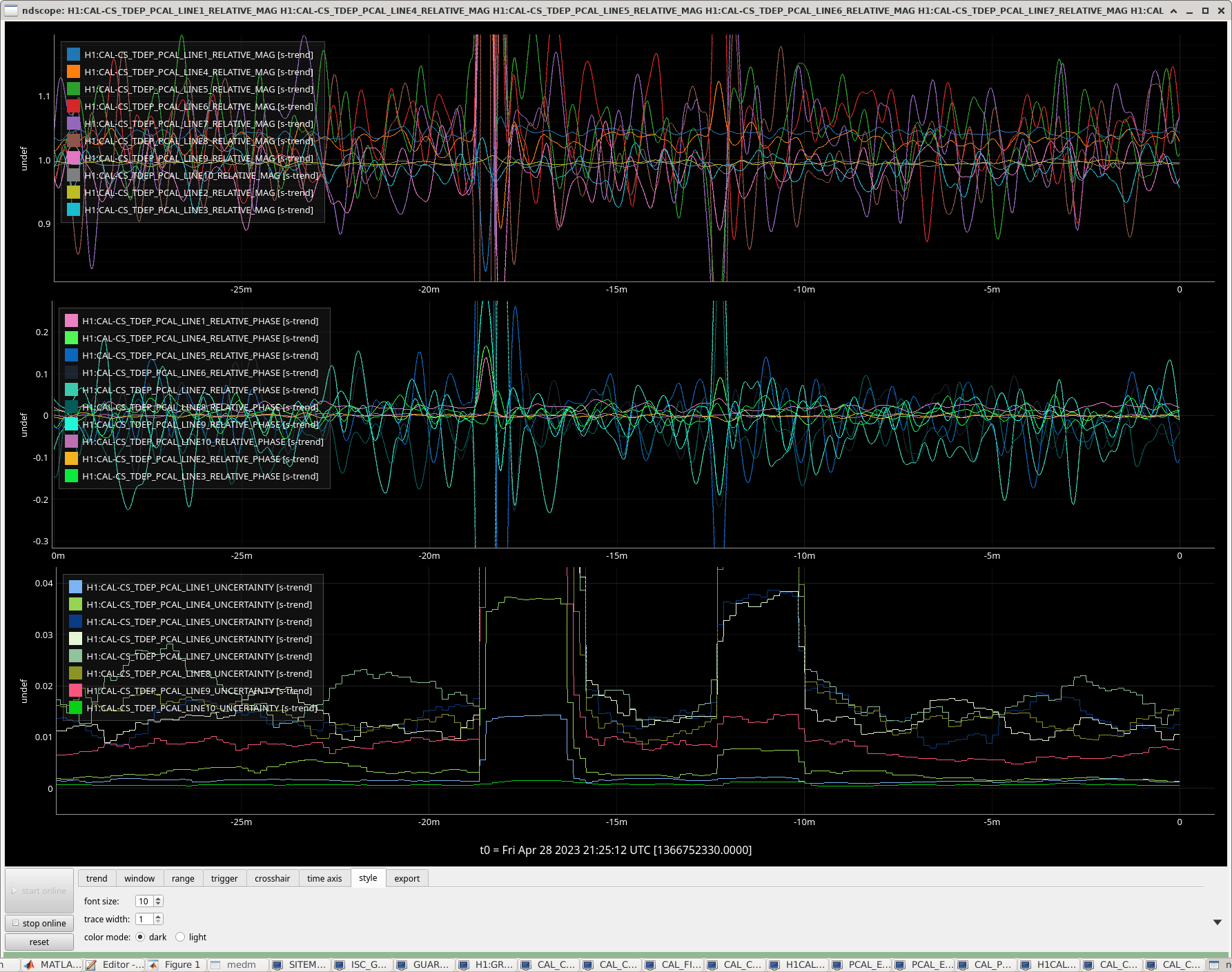
Calculations using DTT with 0.001 Hz BW FFTs and 10 averages indicate that chi_XY, the comparison of the X-arm and Y-arm calibrations, is about 1.0013 during the recent 9 hour lock stretch from 08:30 - 17:30 UTC.
This agrees pretty well with the Pcal X/Y comparison calculation in the front end: H1:CAL-CS_TDEP_PCAL_X_OVER_Y_REL_MAG (see attached plot).
Since we are already applying correction factors for a previously-measured chi_XY of 1.0020 (Xend: 1/0.9991; Yend: 1.0011), the X/Y comparison should be 1.0.
These X/Y correction coefficients will likely need to be updated after some more investigation. We will also need to investigate and take into account differences in the response function between 410.1 and 410.2 Hz.
We have determined we want to operate with higher carm gain. Instead of slowly increasing the carm gain during thermalization, we decided to try increasing it from the start and avoid causing glitches. The SERVO gain for REFL A and B will both be set to 9 dB instead of 6 dB in LASER NOISE SUPPRESSION.
The CARM gain adjustment in the THERMALIZATION guardian has been disabled yesterday
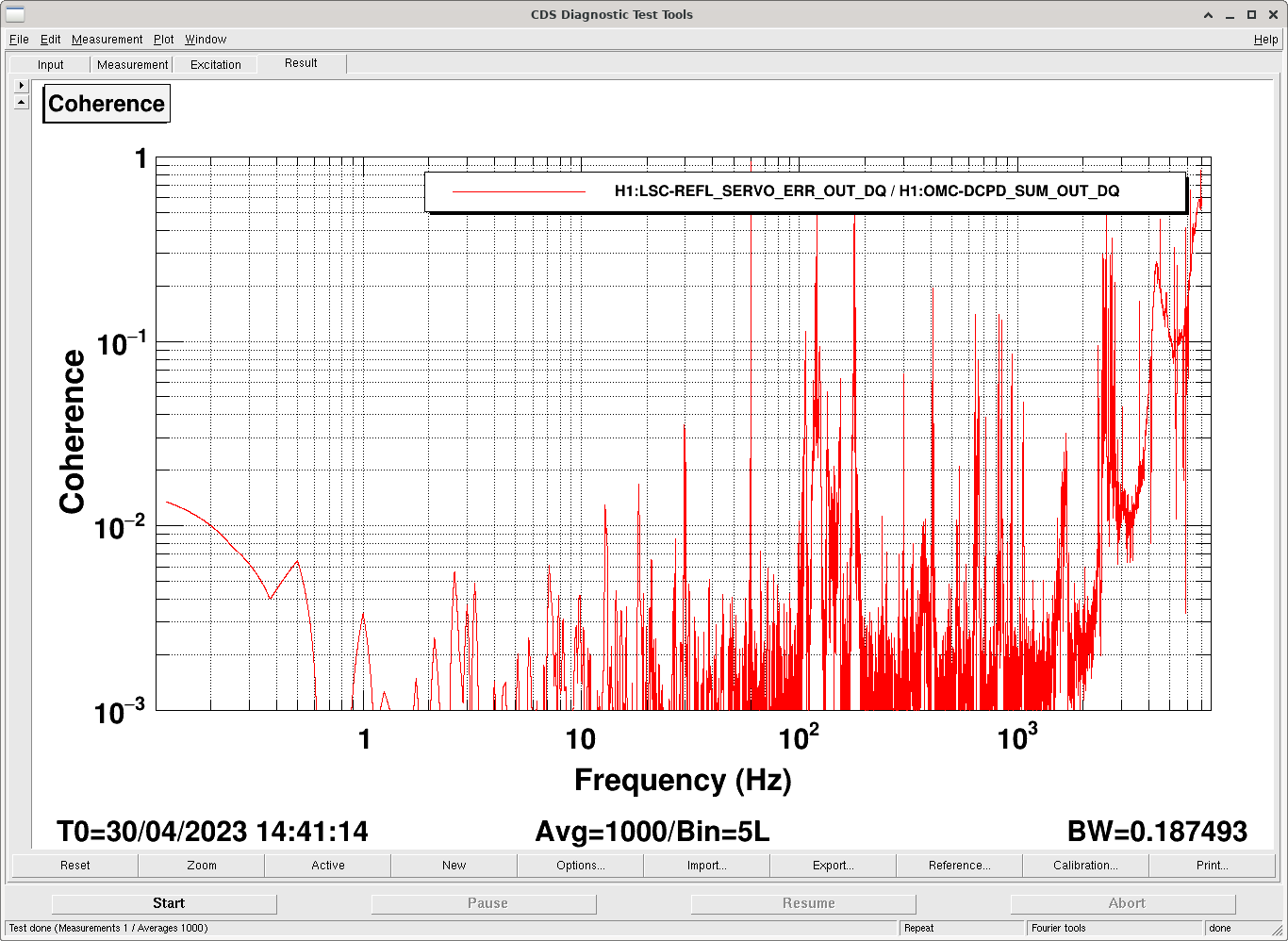
I measured the CARM gain today 30 minutes and 1 hour into the lock stretch to see the effect of the 3 dB increase. See attached plot. I think this plot shows, as predicted, we start with the UGF around 25 kHz, which is a bit high. However, we thermalize back to about where we want the UGF to be. We have not completely suppressed the high frequency "tail" shape in DARM with this gain increase, but we are unlikely to win much more by increasing the gain further. Daniel and I ran a long coherence from the long lock this weekend, see plot, that shows that we are not limited very much at 1 kHz by frequency noise (this time stretch comes well after thermalization is complete). The high coherence around 100 Hz is probably coming from PRCL or SRCL. We think this is a decent place to run for O4. I declare our CARM adjustments complete! I will unplug the SR785 at the next possible opportunity.
To get a calibration factor for Anamaria in order to run coincident magnetic injections at both sites in the future, I drove the CS vertex coil with a gain of 600,000 between 18:28 and 18:33 UTC. Response in DARM and my injection settings are attached.
Looking back on this injection duration, I was unintentionally saturating the vertex magnetometers (oops). Since we want these to remain functional, I reran the injection with a (much) lower gain of 65,000 and saw a lower response in DARM, but enough for this to work for an initial calibration.
Coupling function html report for this time can be found here: https://ldas-jobs.ligo.caltech.edu/~adrian.helmling-cornell/mag_inj_test/injection_1366848018_1366671318/
I think there was an IFO configuration change which is why DARM differs at 300 and 800 Hz. Because the floor sensor is out, it's hard to see the 10-40 Hz broadband injection in other EX sensors (attached example), but maybe it's visible in DARM. Fil and I will swap the EX floor box tomorrow - hopefully it starts working then.
Closes FAMIS 25063
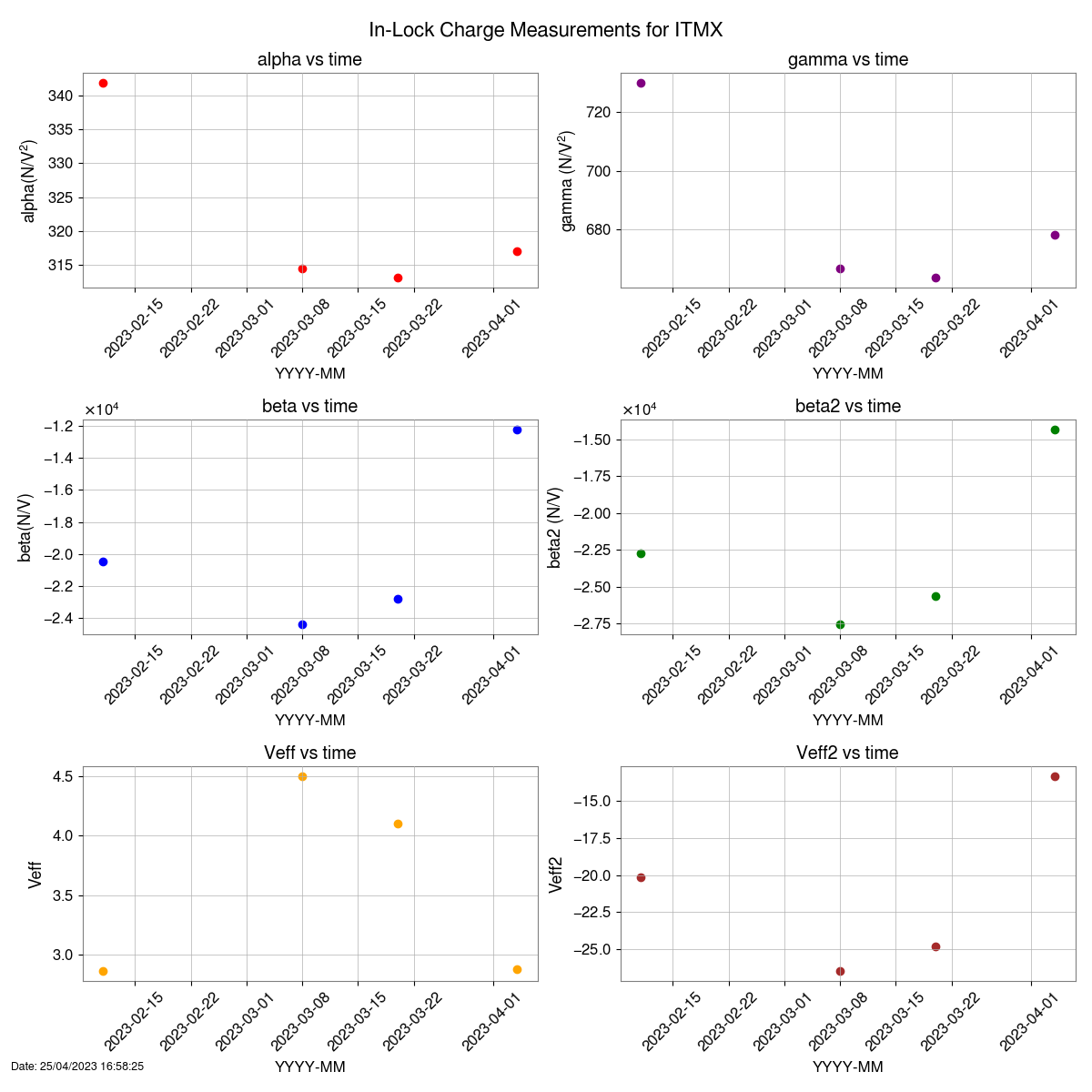
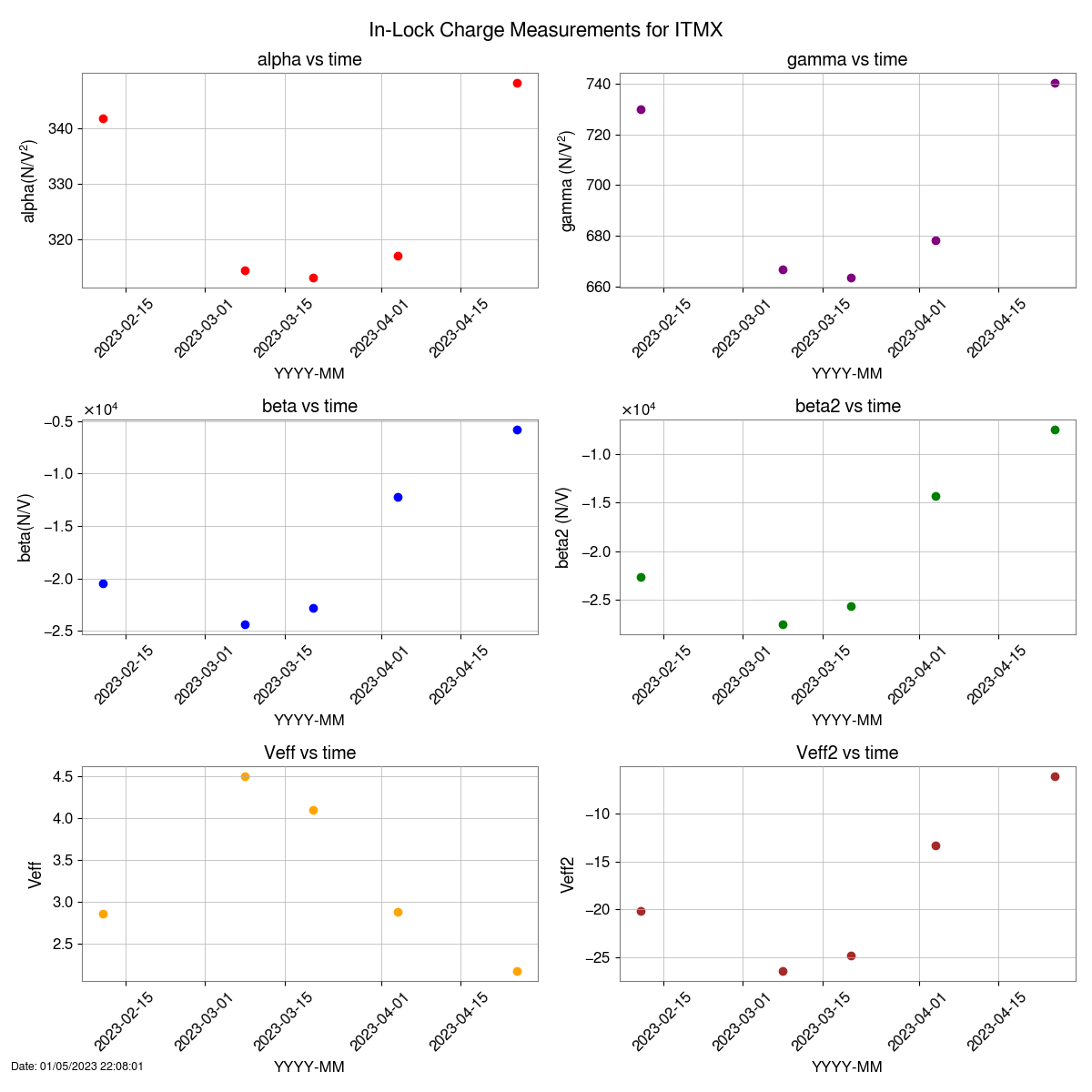
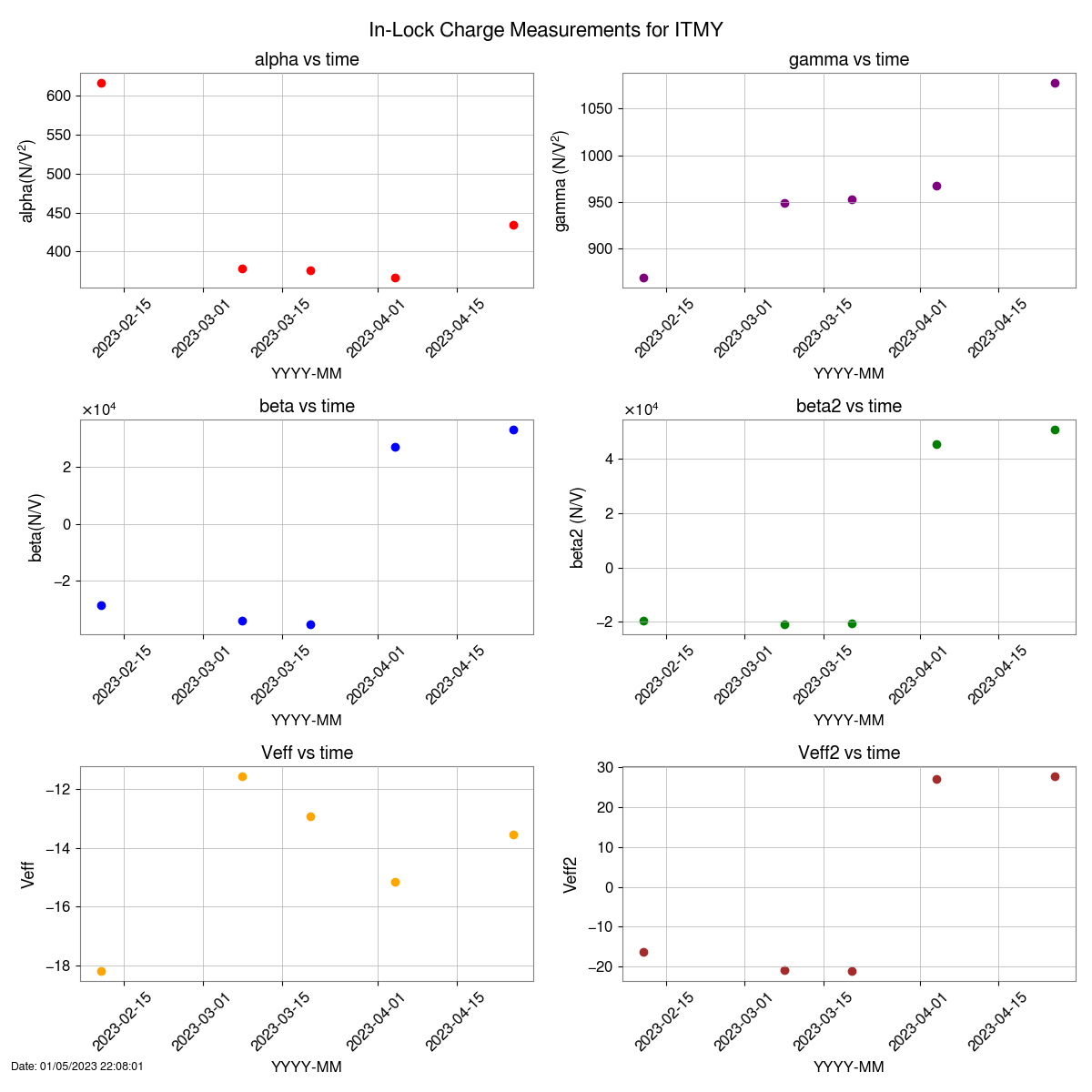
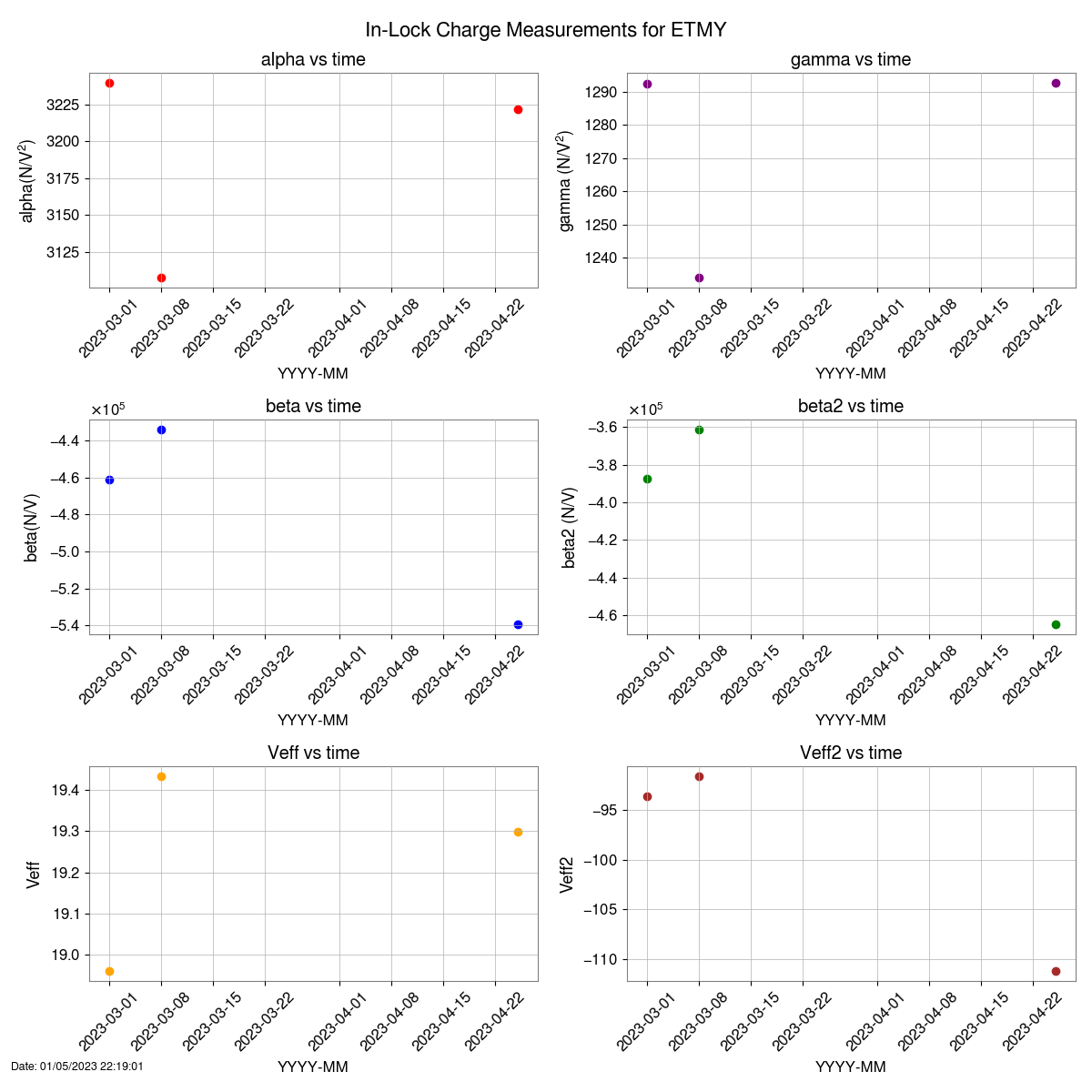
Attached are 4 images of in-lock charge measurements for 3 of the quads. ETMX was omitted as the data produced by the script was bad, alog on that here.
Measurements in the past month or so look for the most part, similar. Ryan last ran these measurements a month ago, alog here.
Ryan C realized that the Matlab analysis didn't run. The RUN_ESD_EXC.py guardian code wasn't clearing the log list so that the times of the old excitations were written to the new list and causing an error. I've fixed this and attached the correct plots.
This morning we lost lock at 16:00 UTC (alog 68974) while the last 13Hz ETMX In-lock charge measurement was still running. So ETMX measurement isn't valid.
1. The SUS_CHARGE log doesn't properly refect that but I've edited/reloaded the SUS_CHARGE code so that in future it will continually monitor ISC_LOCK rather than just check we are locked at the start of the injection states. If we loose lock, it takes all nodes to DOWN, which will stop and clear all injections.
2. The measurement took too long, total of 18 minutes where we want <15 minutes. I'll look into the ramp times.
I reduced all 60 second ramp time to 20 seconds. This should save us 240 seconds (4 minutes).