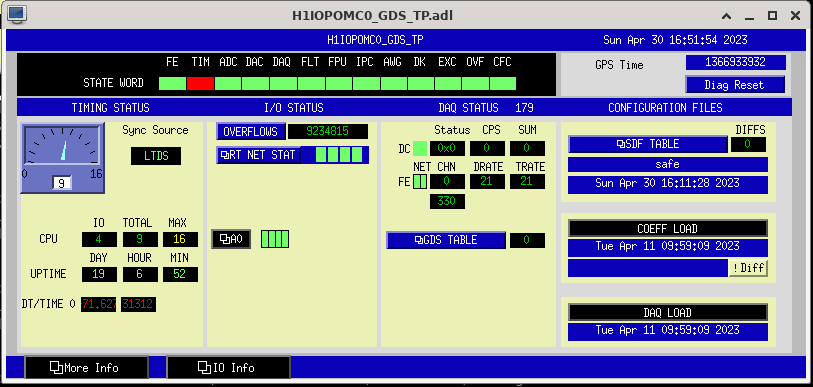
We have lost several corner stations front end models in what may be a Dolphin glitch. Caused the lock loss at 16:12PDT.
h1omc0 was synchronized at the wrong time, see the attached GSD TP screen. Duotone value is negative. T0 shows timing was lagging behind by 30 ms.
Output from timing card looked normal.
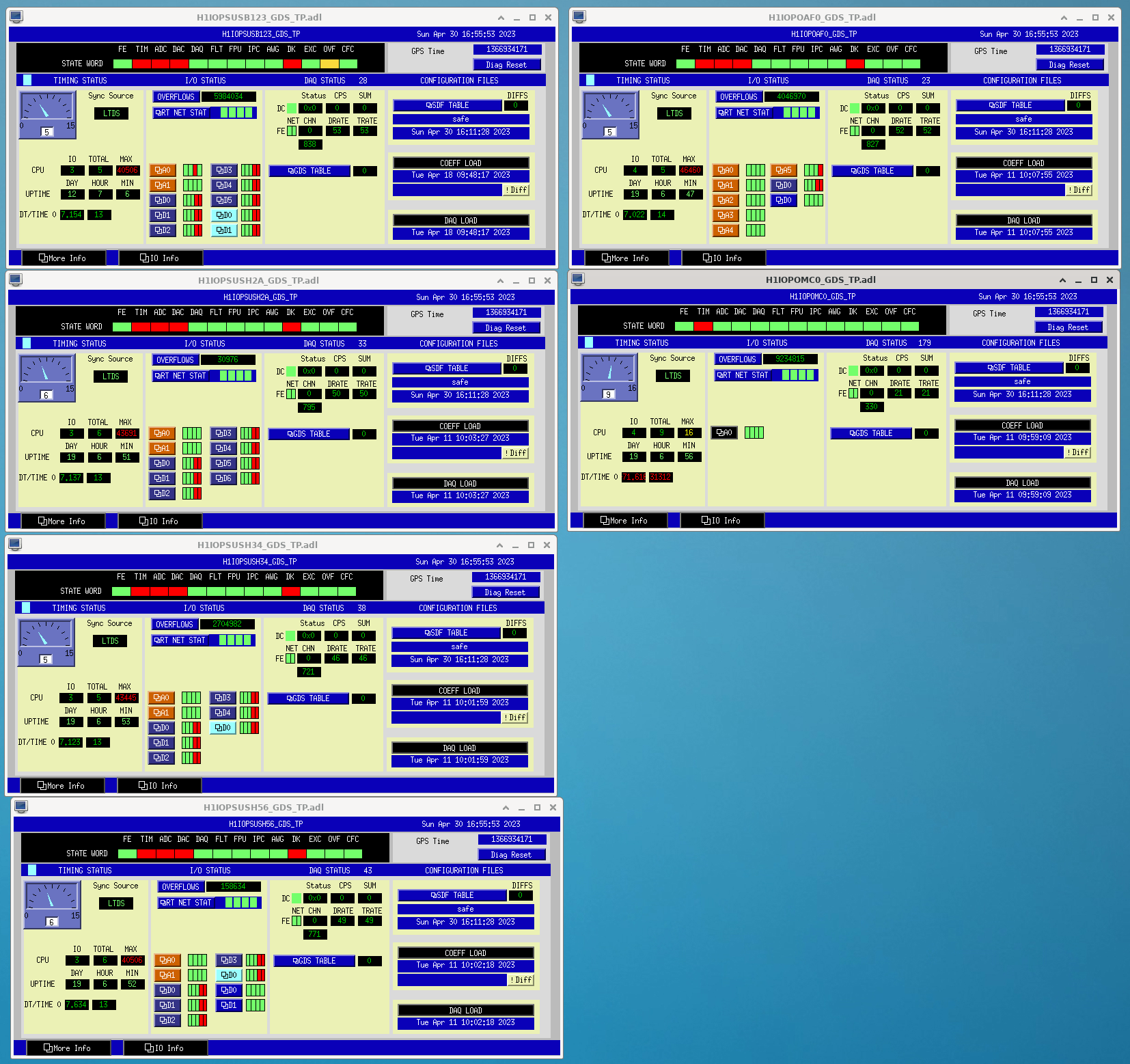
Full set of IOP GDS-TP screens
Jonathan, Erik, Dave, TJ:
We did not see anything useful in the front end logs.
Erik restarted the models on h1omc0, h1susb123, h1sush2a, h1sush34, h1sush56 and h1oaf0.
Note, we did not need to fence front ends from Dolphin and reboot, just model restarts were sufficient.
I cleared all the SWWD watchdogs, no SEI WDs had tripped.
We called TJ who will continue the recovery of the interferometer.
Sun30Apr2023
LOC TIME HOSTNAME MODEL/REBOOT
16:59:56 h1omc0 h1iopomc0
17:00:10 h1omc0 h1omc
17:00:24 h1omc0 h1omcpi
17:02:29 h1susb123 h1iopsusb123
17:02:34 h1sush2a h1iopsush2a
17:02:43 h1susb123 h1susitmy
17:02:48 h1sush2a h1susmc1
17:02:57 h1susb123 h1susbs
17:03:02 h1sush2a h1susmc3
17:03:11 h1susb123 h1susitmx
17:03:11 h1sush34 h1iopsush34
17:03:16 h1sush2a h1susprm
17:03:25 h1susb123 h1susitmpi
17:03:25 h1sush34 h1susmc2
17:03:30 h1sush2a h1suspr3
17:03:35 h1sush56 h1iopsush56
17:03:39 h1sush34 h1suspr2
17:03:53 h1sush34 h1sussr2
17:03:55 h1sush56 h1sussrm
17:04:01 h1oaf0 h1iopoaf0
17:04:09 h1sush56 h1sussr3
17:04:15 h1oaf0 h1pemcs
17:04:23 h1sush56 h1susifoout
17:04:29 h1oaf0 h1tcscs
17:04:37 h1sush56 h1sussqzout
17:04:43 h1oaf0 h1susprocpi
17:04:57 h1oaf0 h1seiproc
17:05:11 h1oaf0 h1oaf
17:05:25 h1oaf0 h1calcs
17:05:39 h1oaf0 h1susproc
17:05:54 h1oaf0 h1calinj
17:06:08 h1oaf0 h1bos
TITLE: 04/30 Day Shift: 15:00-23:00 UTC (08:00-16:00 PST), all times posted in UTC
STATE of H1: Observing at 130Mpc
SHIFT SUMMARY:
LOG:
Sun Apr 30 13:18:03 2023 INFO: Fill completed in 3min 3secs
TITLE: 04/30 Day Shift: 15:00-23:00 UTC (08:00-16:00 PST), all times posted in UTC
STATE of H1: Observing at 127Mpc
CURRENT ENVIRONMENT:
SEI_ENV state: CALM
Wind: 2mph Gusts, 1mph 5min avg
Primary useism: 0.02 μm/s
Secondary useism: 0.22 μm/s
QUICK SUMMARY:
TITLE: 04/29 Day Shift: 15:00-23:00 UTC (08:00-16:00 PST), all times posted in UTC
STATE of H1: Observing at 129Mpc
SHIFT SUMMARY:
Stayed in NLN for the whole shift, no issues
LOCK#1:
LOG:
| Start Time | System | Name | Location | Lazer_Haz | Task | Time End |
|---|---|---|---|---|---|---|
| 19:56 | LVEA | LASER HAZARD | LVEA | YES | THE LVEA IS LASER HAZARD | 00:54 |
| 17:19 | CAL | Rick & Dripta | PCAL lab | LOCAL | PCAL work | 20:36 |
| 22:27 | CAL | Rick & Dripta | PCAL lab | LOCAL | PCAL work | 23:00 |
Sat Apr 29 13:17:44 2023 INFO: Fill completed in 2min 44secs
We're still locked at NLN since 15:14 (3:52) and we've been in observing mode since 15:31UTC, quiet day.
TITLE: 04/29 Day Shift: 15:00-23:00 UTC (08:00-16:00 PST), all times posted in UTC
STATE of H1: Lock Acquisition
CURRENT ENVIRONMENT:
SEI_ENV state: CALM
Wind: 5mph Gusts, 3mph 5min avg
Primary useism: 0.02 μm/s
Secondary useism: 0.23 μm/s
QUICK SUMMARY:
In Observing at 15:31UTC
TITLE: 04/28 Eve Shift: 23:00-07:00 UTC (16:00-00:00 PST), all times posted in UTC
STATE of H1: Lock Acquisition
SHIFT SUMMARY:
Main Notes:
- LVEA is LASER HAZARD until at least Monday morning
- IFO is in Observing mode as of 06:47 Apr 29th UTC
- Lock #1:
- Held at ENGAGE ASC since ADS PIT/YAW 3 were not converging whatsoever
- Lock #2:
- LOCKLOSS @ 0:25 - LOCKING ARMS GREEN, unknown reason
- Lock #3:
- This lock went fairly well, acquired NLN @ 01:56 UTC
- Do have a "Diffracted power low" on DIAG_MAIN for the PSL
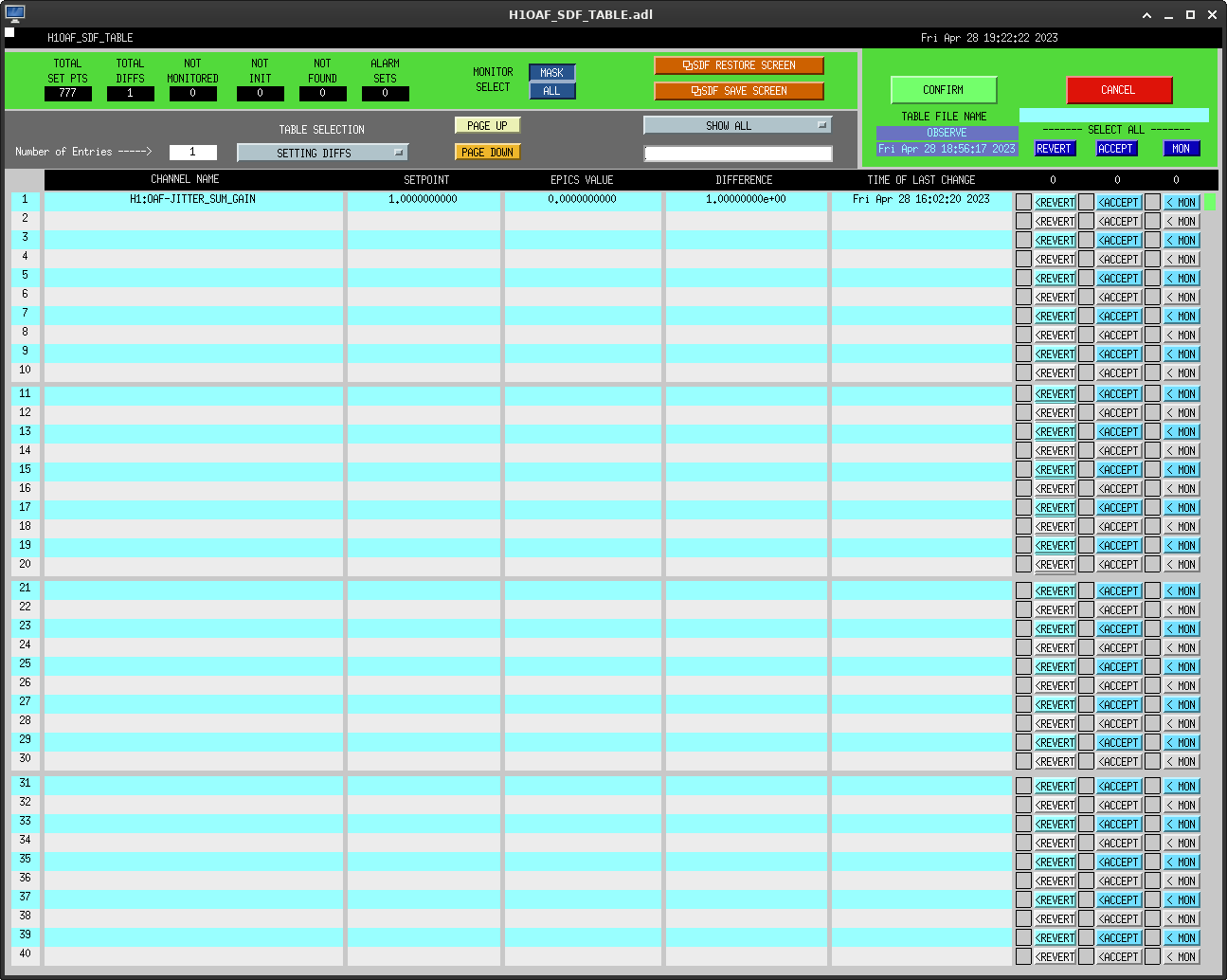
- There were differences in the observe SDFs preventing me from going into Observe but after talking with commissioners, they have been reconciled - Screenshots attached
- IN OBSERVING: 02:59 UTC
- EX saturation @ 04:41, no ringups on ASC but do see a glich/spike on the OAF BLRMS screen for all bandpasses and DCPD saturations went bonkers for a second - glitch?
- LOCKLOSS @ 04:44 (DCPD saturation on verbal), shortly after, probably due to whatever caused the glitch above
- Lock #4/5/6:
- Had to touch ALS DIFF just a hair to catch IR
- LOCKLOSS @ 05:19 ACQUIRE DRMI, then again at LOCKING_ALS, then again at LOCKING_ALS...
- Lock #7:
- GRD was able to do most of the heavy lifting but still noticing that the ADS PIT/YAW 3 going off the rails when we get to ENGAGE ASC - but after awhile it calmed down and started to converge
- Acquired NLN @ 06:20 UTC
- IN OBSERVING: 06:47 UTC
Other Notes:
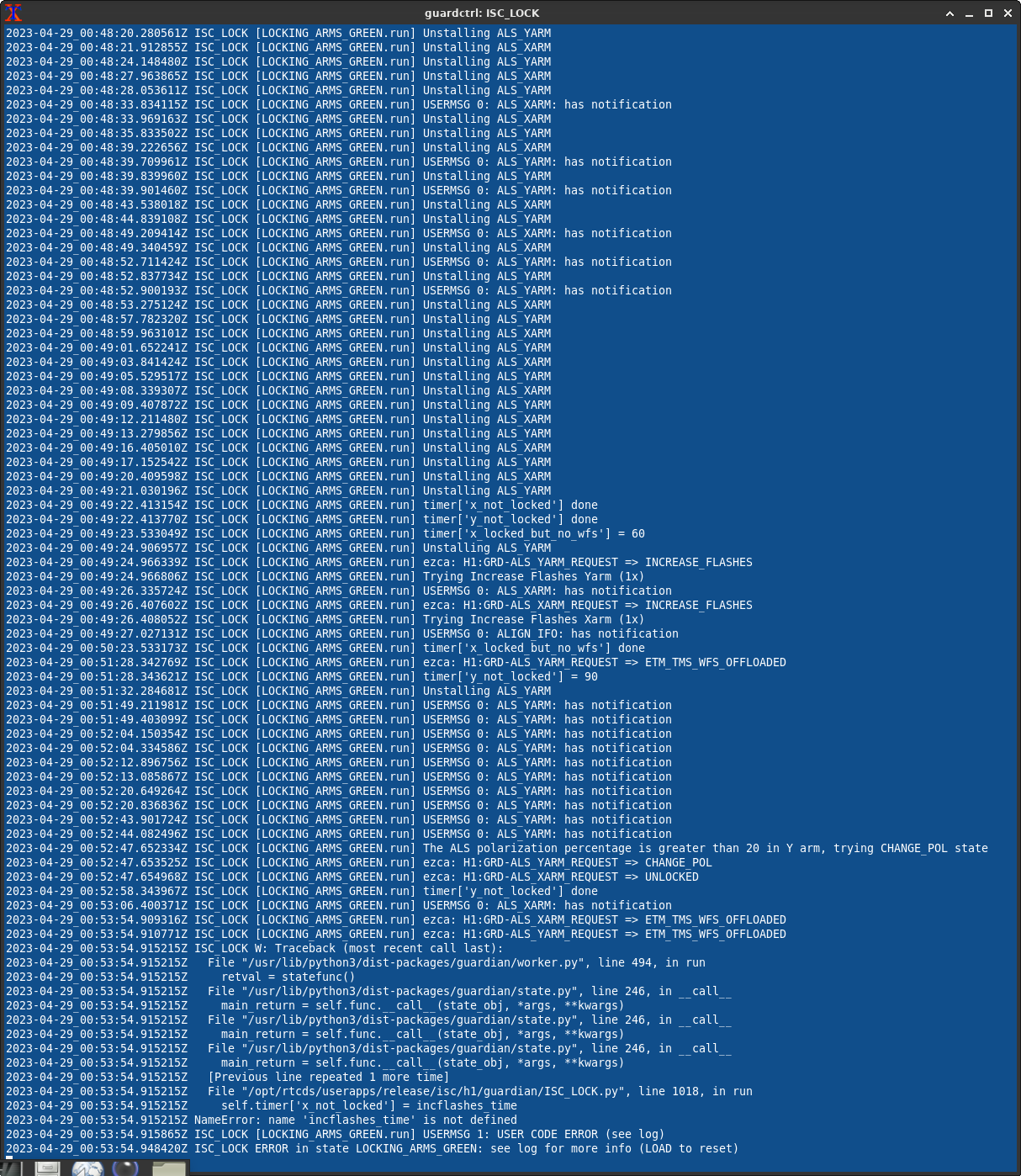
- Upon finishing an initial alignment, ISC LOCK went into ERROR - see screenshot
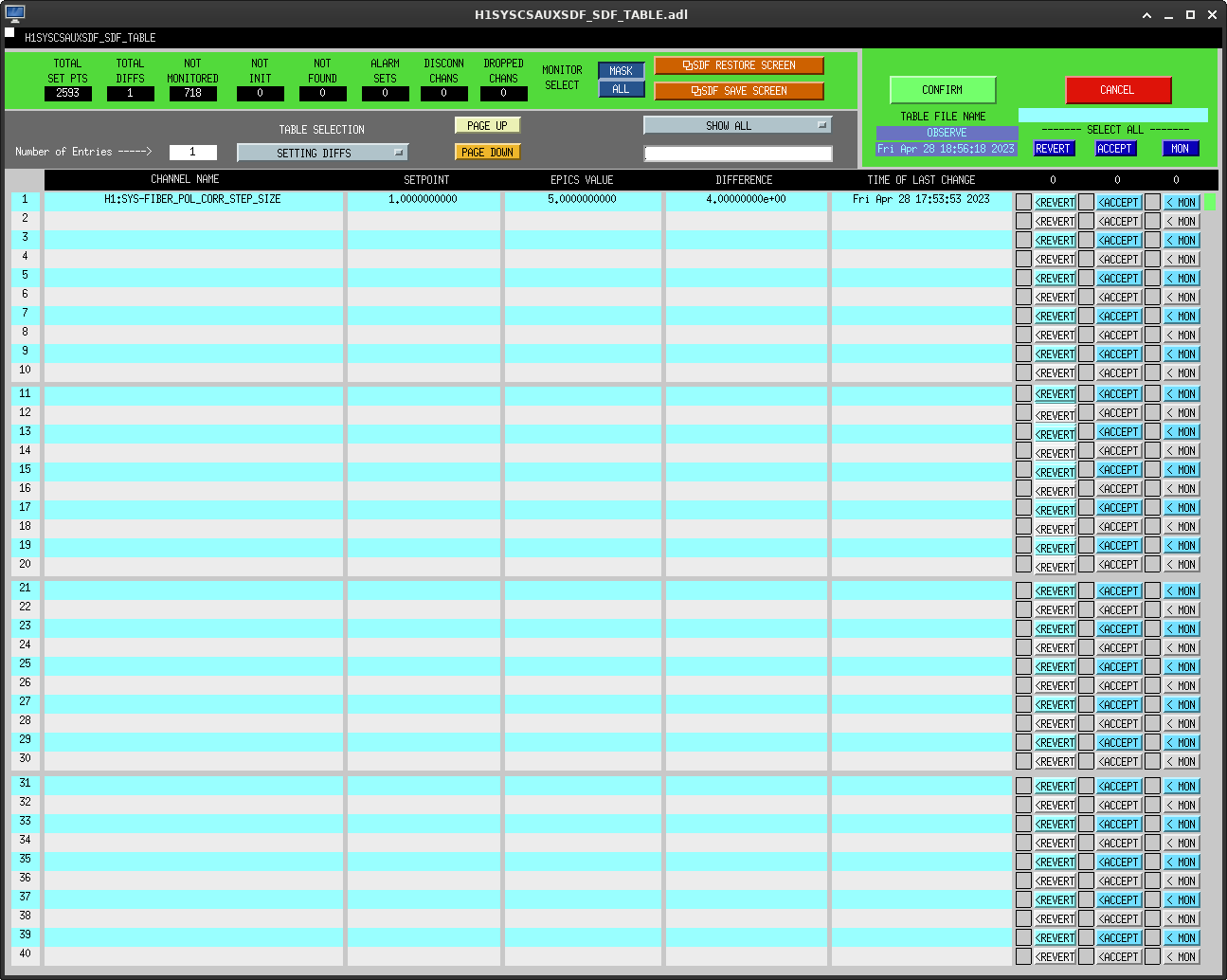
- The ALS GRD went through CHANGE_POL and in doing so created an Observe sdf diff in SYSCSAUX, the channel in question was just a step size so I vote we unmonitor this channel (and channels alike) so we don't run into it in the future
LOG:
| Start Time | System | Name | Location | Lazer_Haz | Task | Time End |
|---|---|---|---|---|---|---|
| 19:56 | LVEA | LASER HAZARD | LVEA | YES | THE LVEA IS LASER HAZARD | 10:54 |
| 22:59 | CAL | Elenna | CR | N | Test new HAM1 FF loop | 23:17 |
| 23:35 | ISC | Elenna | PSL racks | YES | Switch SR785 for CARM sensing | 23:44 |
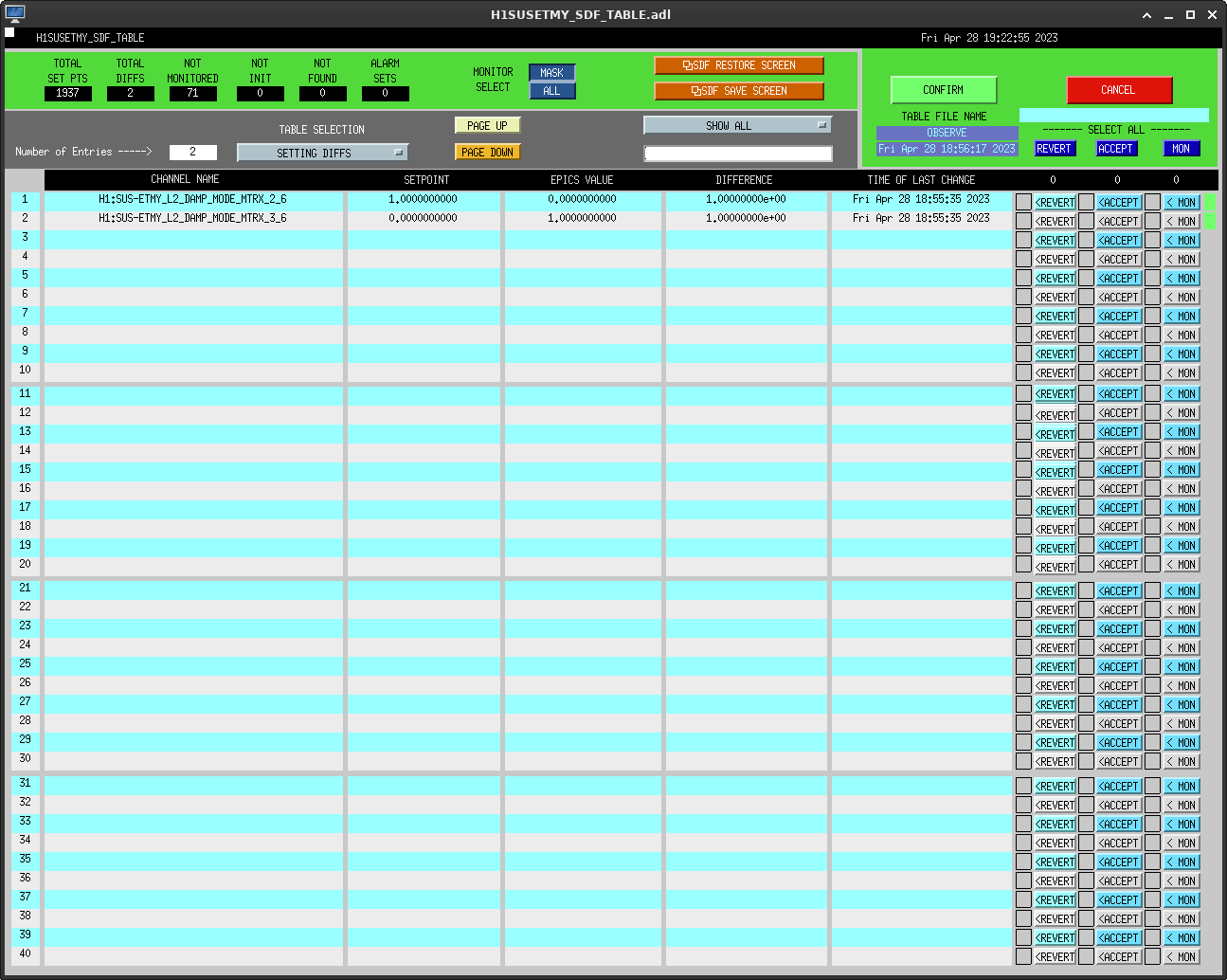
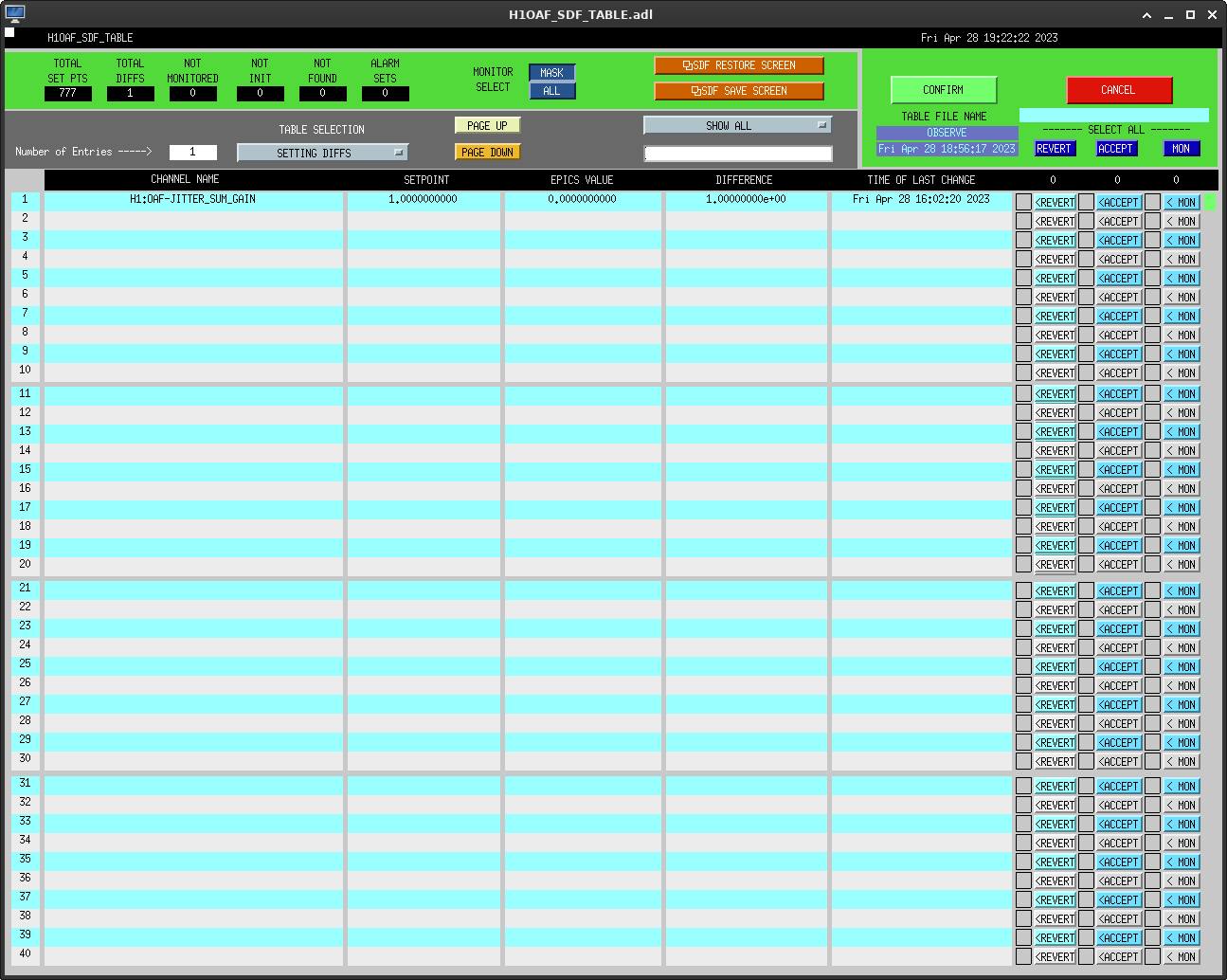
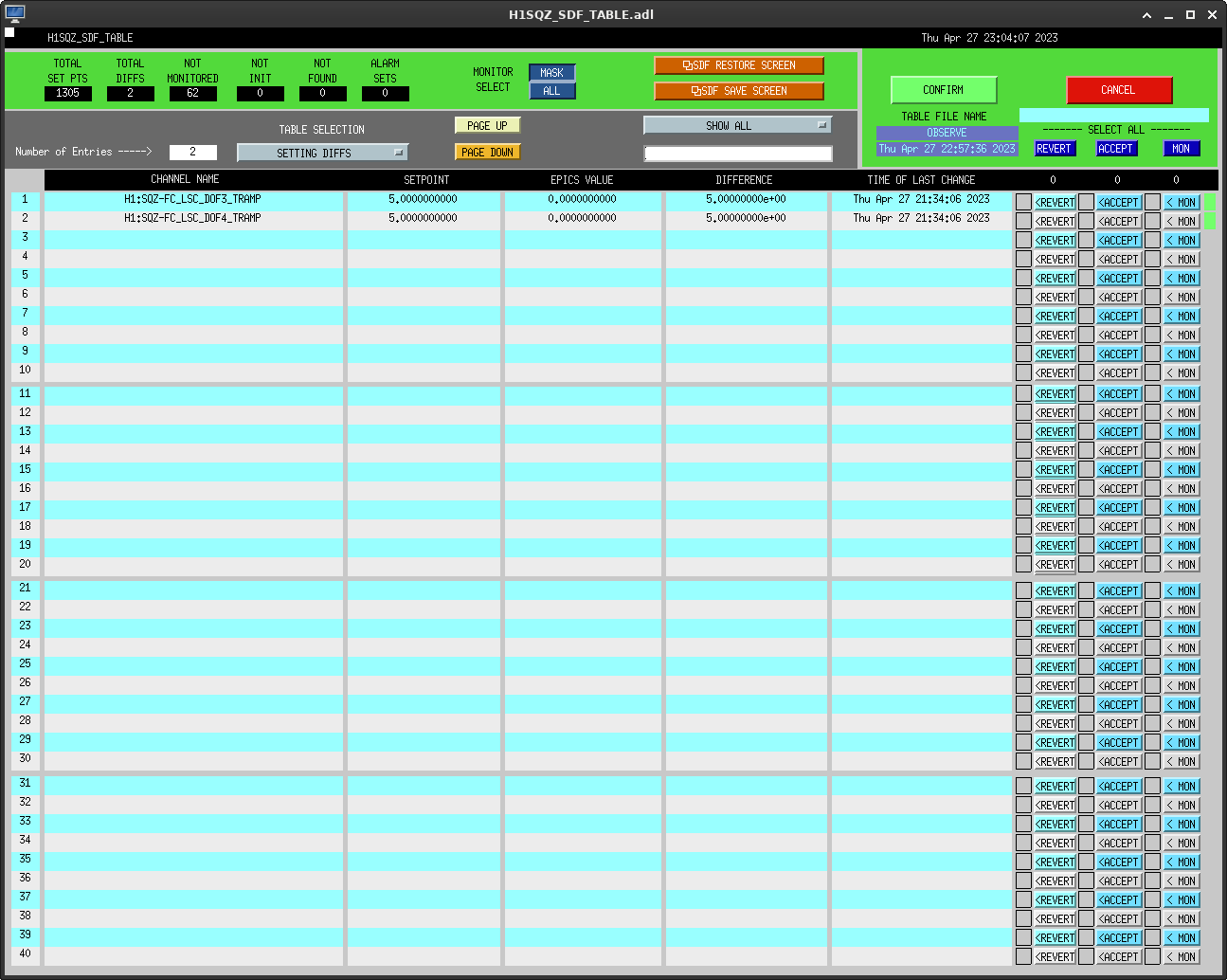
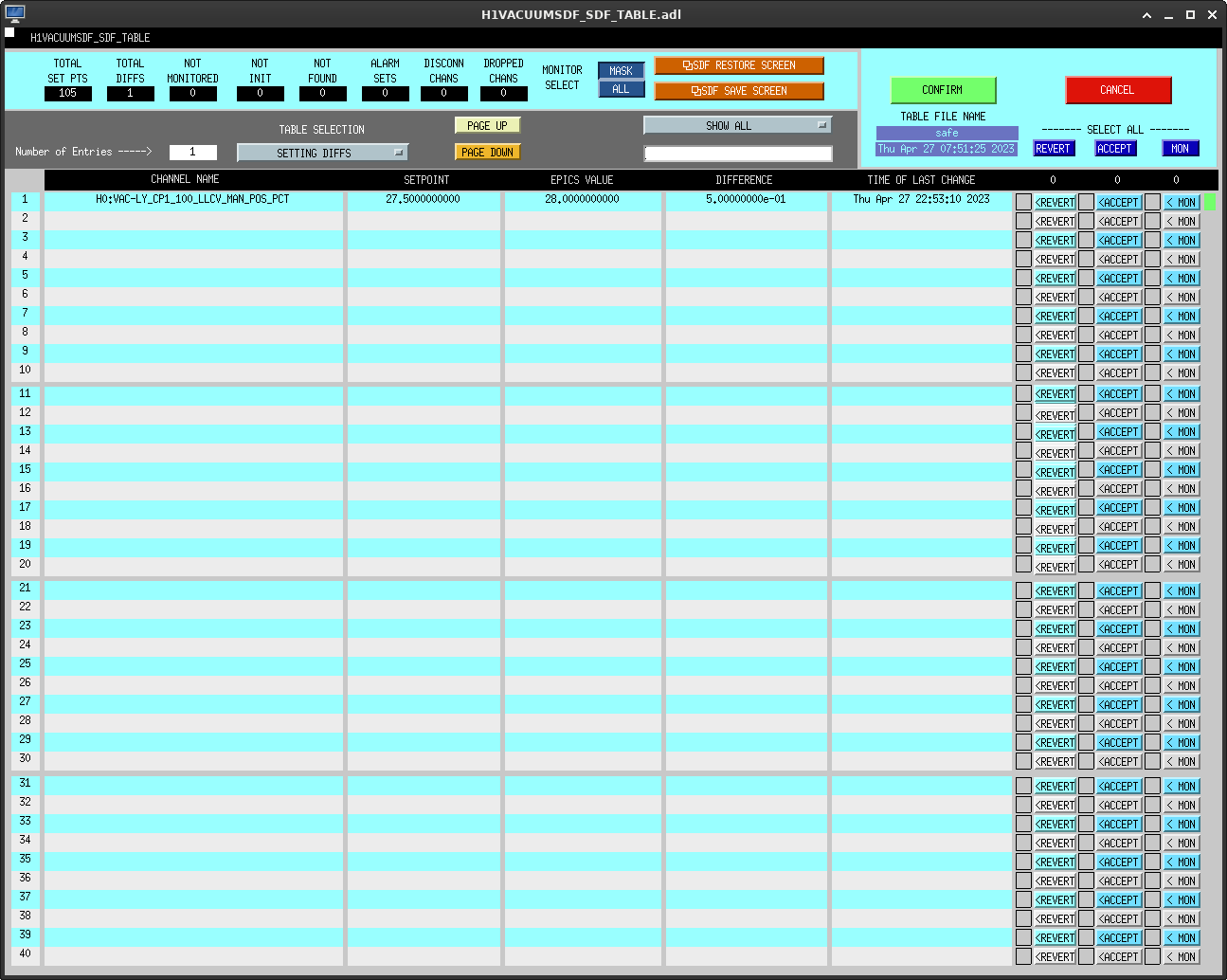
After having some issues relocking after a lockloss, I did an initial alignment and we are now back up at NLN as of 01:56 UTC. However, I cannot flip the Observing bit due to a few sdf diffs left. I have cleared most already but I have attached the two remaining channels left just in case anyone seeing this knows if we should accept or revert these changes.
EDIT: At Jenne's request, I have accepted both changes. Tagging SUS to notify of the accepting of the EY matrix to look at on Monday.
The EY SDF changes were from me changing the damping DOF from Y to P for EY mode6, I thought I had already accepted the change but maybe not? Or maybe I accepted it in SAFE instead of Observe?
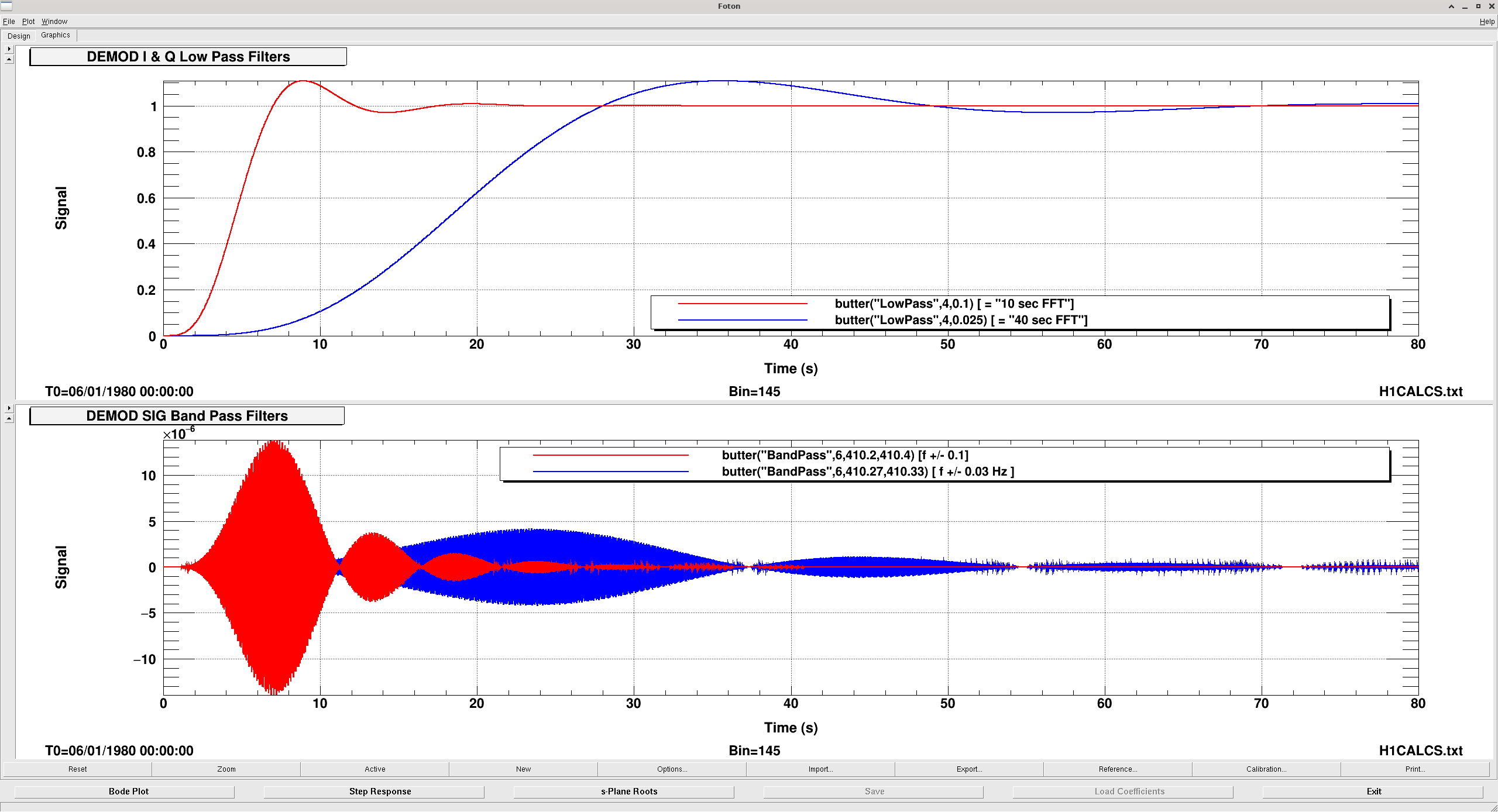
J. Kissel, E. Goetz Executive Summary: after thinking about things a bit more, and considering all the conflicting metrics, we need to change frequency of the PCALX 410.2 Hz calibration line, and update/revert *all* the CALCS DEMOD filters and parameters, in order to achieve a compromise between Line-to-Line Bias, IFO parameter change time scales, and accuracy in uncertainty estimate. We'll do this on Monday 2023-05-01. The other day, when Evan and I increased the time-constant of the I & Q low pass filters in all of the calibration line DEMODS (LHO:69117), our metrics under consideration were: (1) We need to narrow up the band-pass for the PCALY 410.3 Hz line because we found that the adjacent PCALX 410.2 Hz line was polluting the TDCF estimates of the relative optical gain and cavity pole (LHO:68479) (2) As a general principle for any DEMOD process, one must make the impulse response of the I and Q low pass filters longer than the impulse response of the SIG band-pass filters, or else the DC component of the I and Q signals (the output of the low pass) is going to be entirely confused by the impulses of the filter rather than actual changes in the line amplitude and phase. So, based on those criteria, we figured "let's just make all the low-pass filters long, i.e. with a 40 sec time constant, or 0.025 Hz corner frequency" so that regardless of whether the band pass on the PCAL lines is narrow (+/- 0.03 Hz) or wide (+/- 0.1 Hz), we can just consistently "average for longer and get a less noisy answer of the (I and Q) cast into (Real and Imag) cast into (magnitude and phase)." That's LHO:69117. Today as a part of the thinking that went into this aLOG, we confirm that Metric (2) is satisfied by comparing the step responses of the two filter pairings -- see 2023-04-28_DEMOD_Filter_ImpulseResponses.png. Indeed in both cases (red and blue), the impulse response of the SIG band-pass is shorter than the I & Q low-pass. But, then we remembered that we also want to compute the uncertainty in the answers we get from the TDCFs and systematic error monitoring. The uncertainty calculation depends on the coherence, C, of the transfer function as well as the "number of averages", Navg. In the frequency domain, the thing that you're averaging is consecutive FFTs. The relationship between coherence and uncertainty we've been using for decades is the ol' Bendat and Piersol formula, Unc [rad] = sqrt( (1 - C) / (2*Navg*C) ) Here, in the case of a live calculation, we treat the FFT length as equivalent to the time constant of I & Q low-pass filters. The critical thing to remember there is that increasing the number of averages does NOT improve the uncertainty, it improves the accuracy of the estimate of coherence or uncertainty. So, this adds two more metrics to consider: if we want to keep the time over which we're creating this live rolling average constant -- at ~2 minutes, or ~120 seconds -- the time scale that we think is about the right time scale to capture the speed at which the IFO thermalizes and/or changes alignment (a number we collectively settled on after an old, crude, study by Sudarshan in LHO:22753) then we should favor more averages of shorter FFTs. (3) We want FFT stride * Navg to be ~120 seconds, and (4) in order to achieve a more accurate estimate of the coherence and thus uncertainty we want higher corner frequencies on our I and Q low-pass filters, and more averages In the CALCS front-end code as it stands now, the FFT length and Number of averages for all DEMOD's uncertainty estimate are determined by one pair of parameters, Navg = H1:CAL-CS_TDEP_COH_BUFFER_SIZE and FFT length = I & Q Low Pass Time Constant = H1:CAL-CS_TDEP_COH_STRIDE. This means - whatever we choose for the I & Q filters' low-pass time constant, you MUST update the FFT Length = COH_STRIDE to match it, and - Once one update the FFT length = COH_STRIDE, you have to update the Navg = BUFFER_SIZE to keep the overall time period sampled constant (and in our case we want this at 2 minutes). So Metric (4) -- wanting high corner frequencies, low time-constants on our I & Q low passes in order to get the best estimate, is in direct opposition to Metric (1) -- wanting narrow SIG band-passes to isolate the line frequencies from other lines, because of Metric (2) -- a narrow band pass has a long impulse response, and we'd need low corner frequencies, high time-constants on out I & Q low passes. So how do we decide on the compromise? At the moment, we're leaning towards "it's right before the engineering run, so the newest thing that's causing problems must change." That means: - Move the PCALX 410.2 Hz PCALXY comparison line further away from the pre-existing PCALY 410.3 Hz TDCF line. Joe, for entirely different reasons, recommends 0.5 Hz separation instead of 0.1 Hz. - Update the "DARM Model transfer function values at calibration line frequencies" EPICs records for the PCALX 410.2 Hz line, - Revert all DEMOD the band-passes to have a pass band that's +/- 0.1 Hz wide (what we had in O3) - Revert all DEMOD I & Q low passes to a 10 second time constant, or 0.1 Hz corner frequency - Change COH_STRIDE back to 10 seconds to match the low pass, and Change the BUFFER_SIZE back to 13.0 in order to preserve the rolling average of 2 minutes. This is too much to do on a Friday night at 6pm local time, so we'll make all these changes on Monday morning. That'll also give some time for others to weigh in if they're leaning a different way on the compromise, or they've got other metrics we haven't yet considered.
We will not be able to make frequency noise injections at this time. We should make an effort to measure CARM through thernalization and check if the additional gain (see alog 69152) is sufficient.
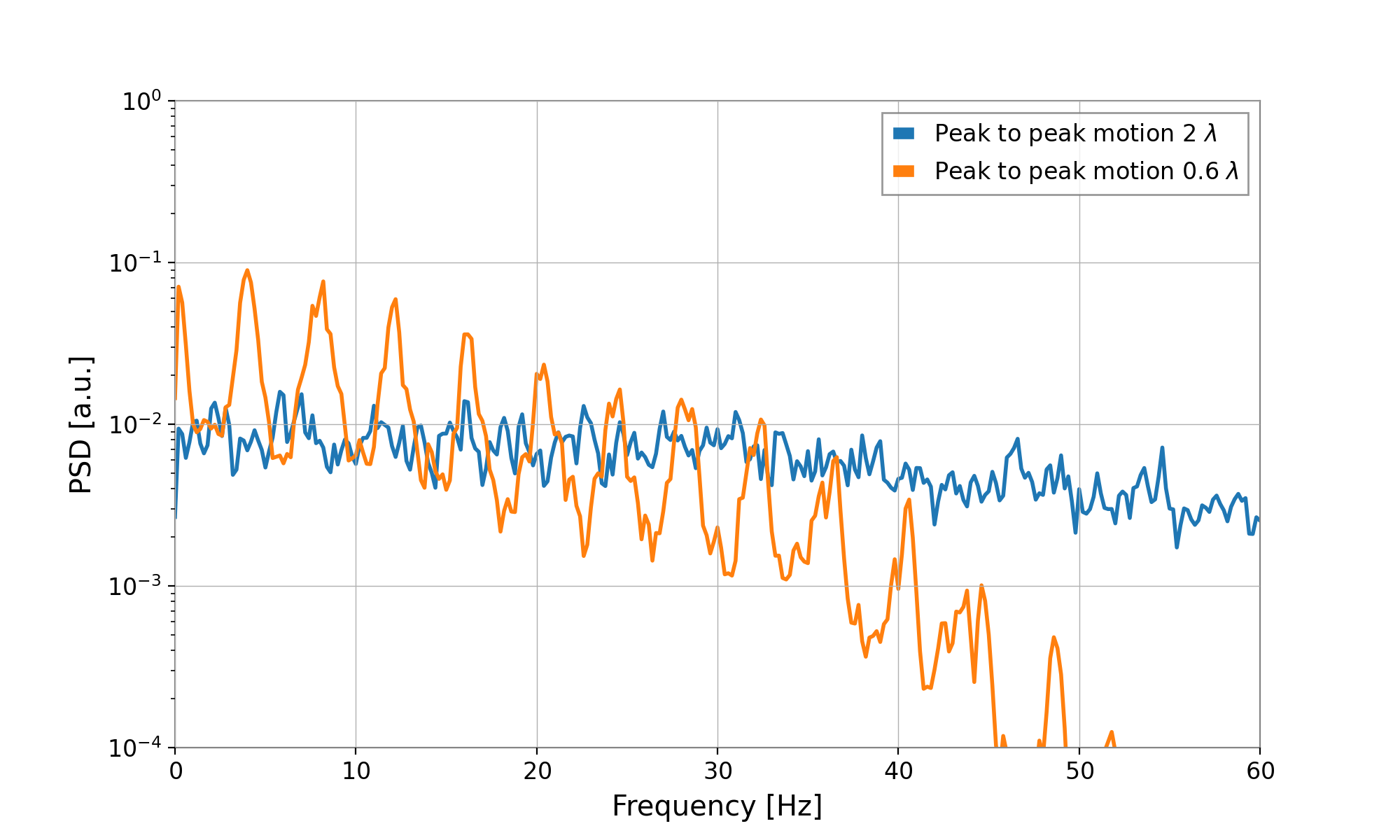
A simple classic scattered light model for the 4 Hz bumps can explain the bumpy shape. For example, something moving at 4.05 Hz with a Q of ~80 seems reasonable.
We would see scattered light bumps only when the scattering element peak to peak motion is lower, for example 0.6 lambda peak. If the object is moving faster, like 1-2 lamba peak, then the scattered light noise would be broad band and without any distincitve feature.
If this were the case, we would see the 4 Hz bumps only when the scattering object is, by chance, moving slower than normal, and we would always have a continuos scattered light background.
This would also imply that all attempts to find the origin of the 4 Hz bumps by exciting the scattering object would fail: we see the bumps only when the scattering element is by chance moving less than usual.
TITLE: 04/28 Eve Shift: 23:00-07:00 UTC (16:00-00:00 PST), all times posted in UTC
STATE of H1: Commissioning
CURRENT ENVIRONMENT:
SEI_ENV state: CALM
Wind: 11mph Gusts, 6mph 5min avg
Primary useism: 0.02 μm/s
Secondary useism: 0.13 μm/s
QUICK SUMMARY:
- IFO just lost lock @ 23:02 UTC due to HAM1 FF changes by commissioners
- Working to get the IFO back up to NLN
- CDS/SEI/DMs ok
TITLE: 04/27 Eve Shift: 23:00-07:00 UTC (16:00-00:00 PST), all times posted in UTC
STATE of H1: Commissioning
SHIFT SUMMARY:
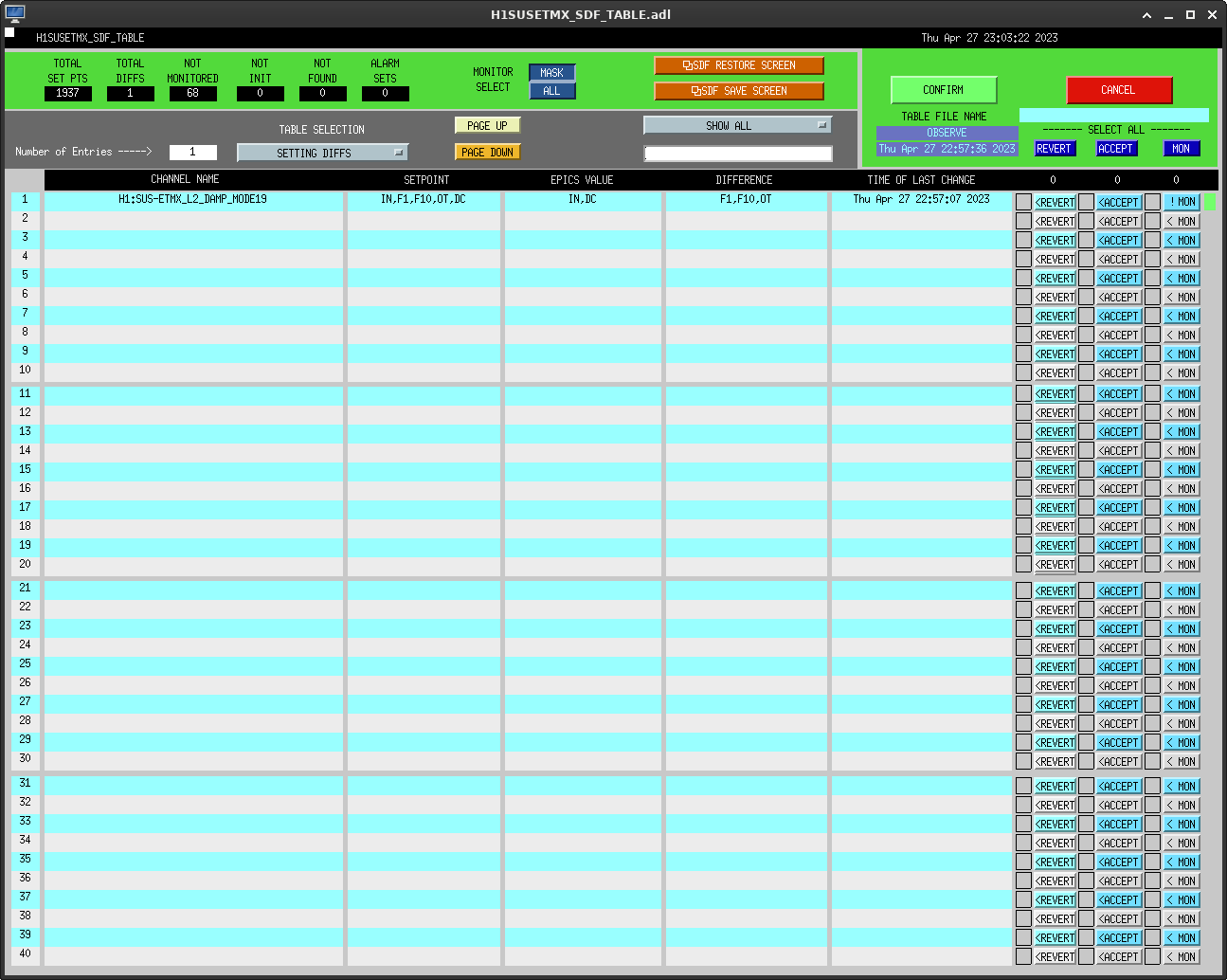
- IFO is locked at NLN, but not in Observing Mode due to unreconciled observe SDFs, attached below, so I am leaving it in Commissioning mode - Tagging ISC
- Lock #1:
- Lock #2:
Other Notes:
- 2:14 UTC - inc EQ from South Georgia - 5.8 mag eq
- 3:25 UTC - EX saturation, IFO was a little unstable, seeing ringups in INP1_P_INMON, MICH_Y_INMON, CSOFT_P_OUT, CHARD_Y_OUT, and DHARD_Y_OUT
LOG:
| Start Time | System | Name | Location | Lazer_Haz | Task | Time End |
|---|---|---|---|---|---|---|
| 19:56 | LVEA | LAZER HAZARD | LVEA | YES | THE LVEA IS LASER HAZARD | 19:55 |
| 23:45 | ISC | Elenna | CR | N | Switching over camera filters | 23:52 |
| 23:51 | ISC | Elenna | CR | N | QUIET TIME Measurement | 00:07 |
| 01:52 | GAINS | Rick S | Y Arm | N | Bike ridin | 03:00 |
I've added some lines to the SQZ_FC guardian DOWN state to return the (currently unused) H1:SQZ-FC_LSC_DOF{3,4}_TRAMP to 5 seconds, rather than either 0 or 5 seconds, depending on the state of FC2. This to avoid the sdf diffs Austin found: FC_LSC sdf diffs. The guardian shows at some point we planned to send WFS_A_I to DOF3 for Laser AOM feedback...