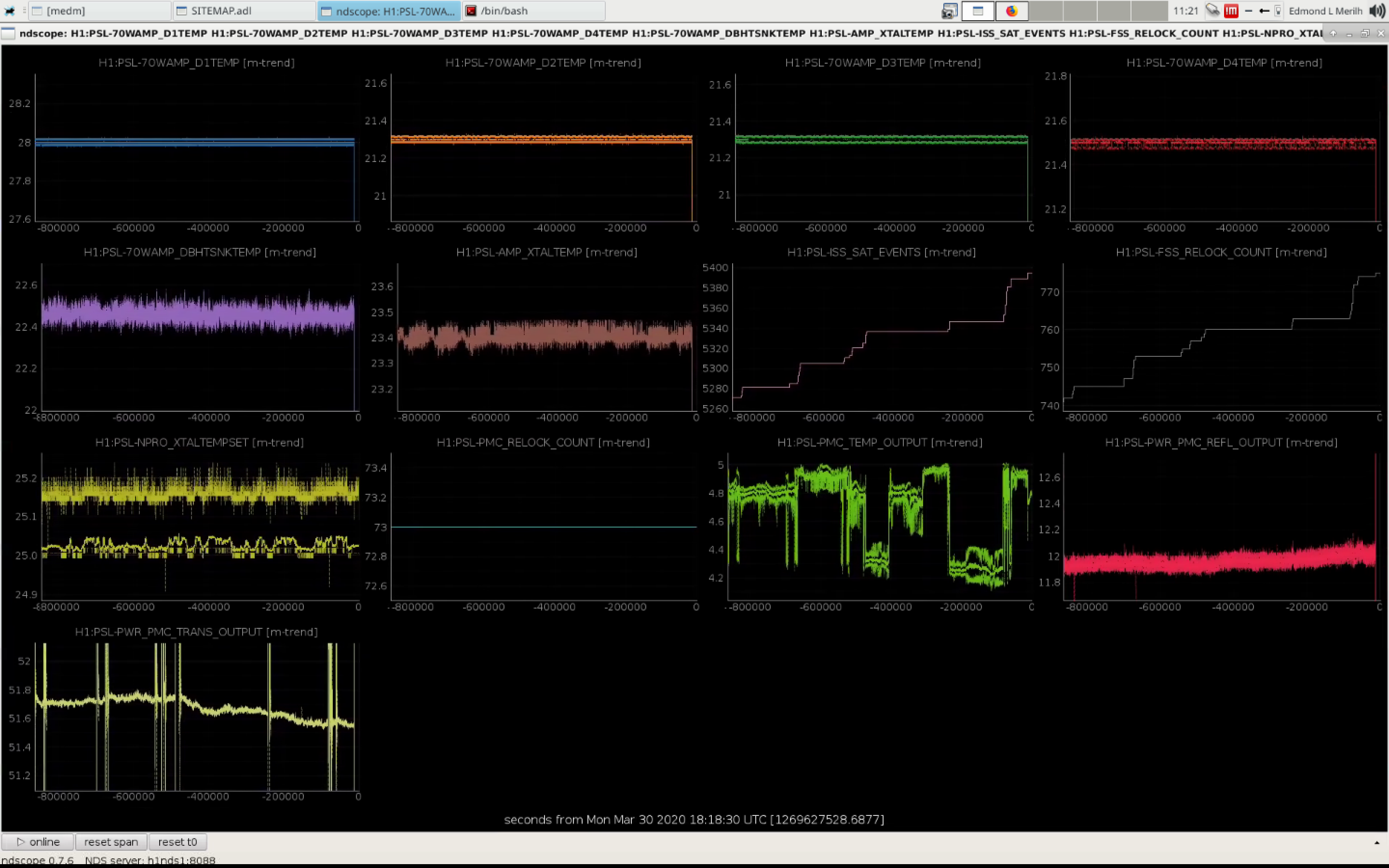
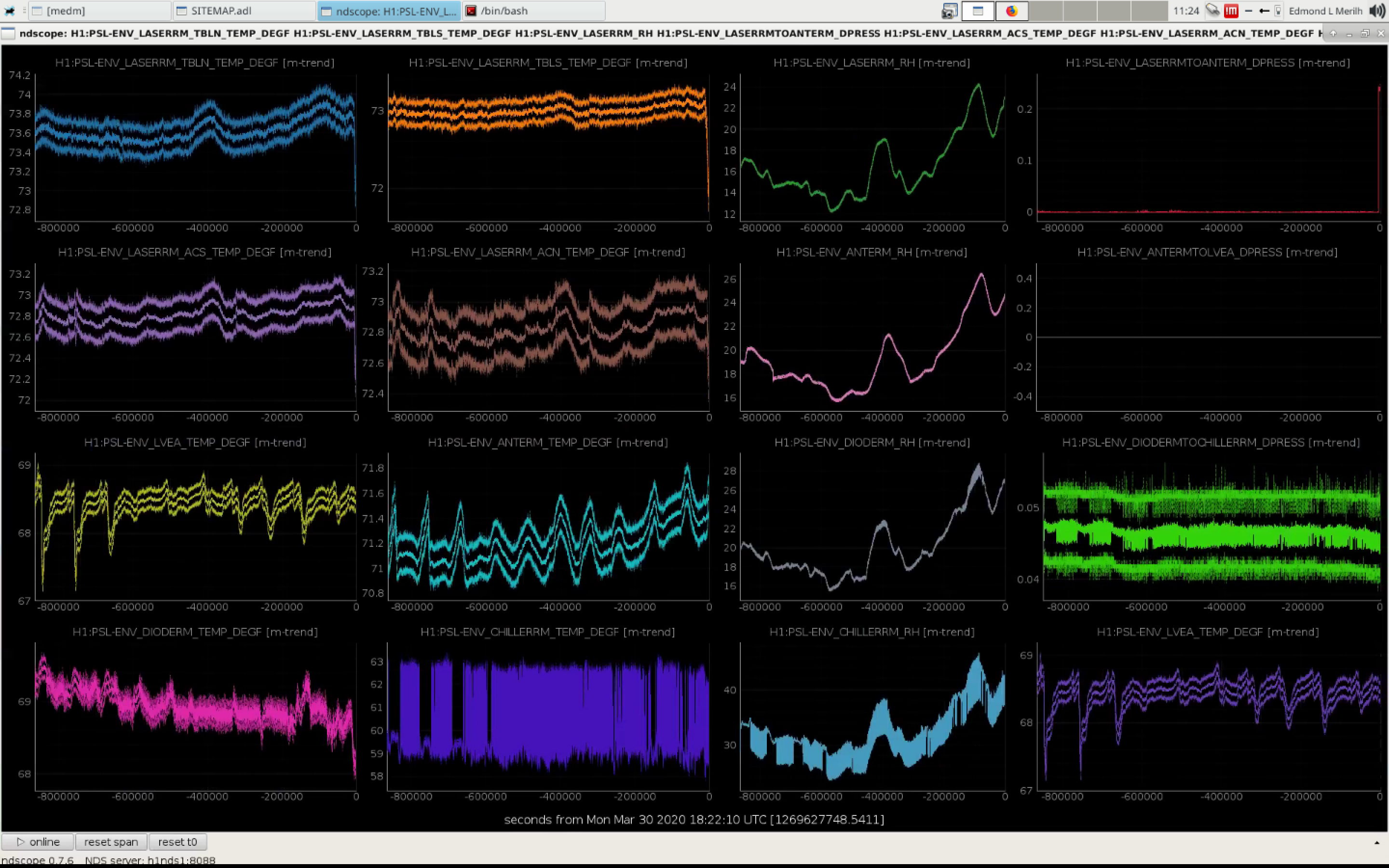
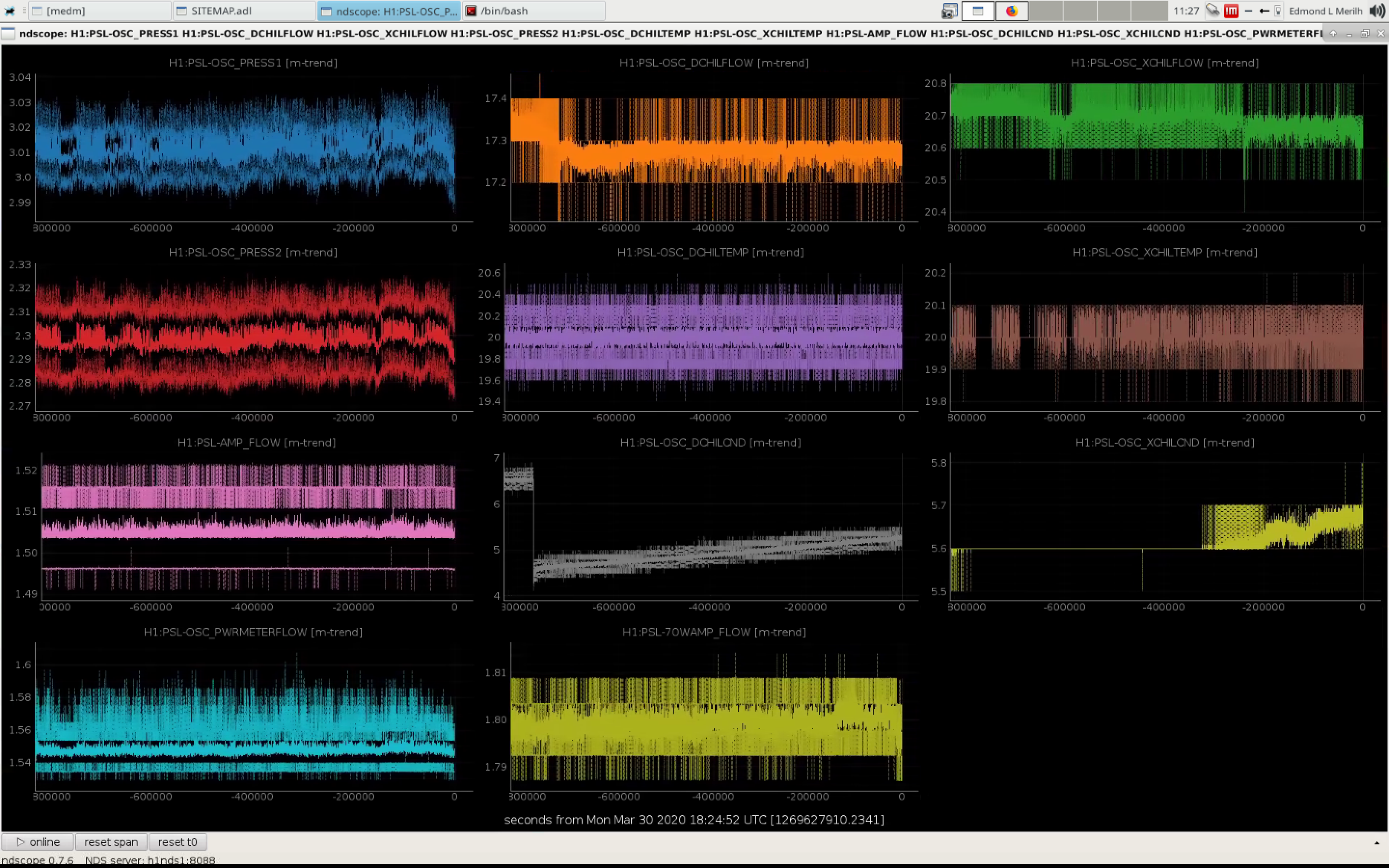
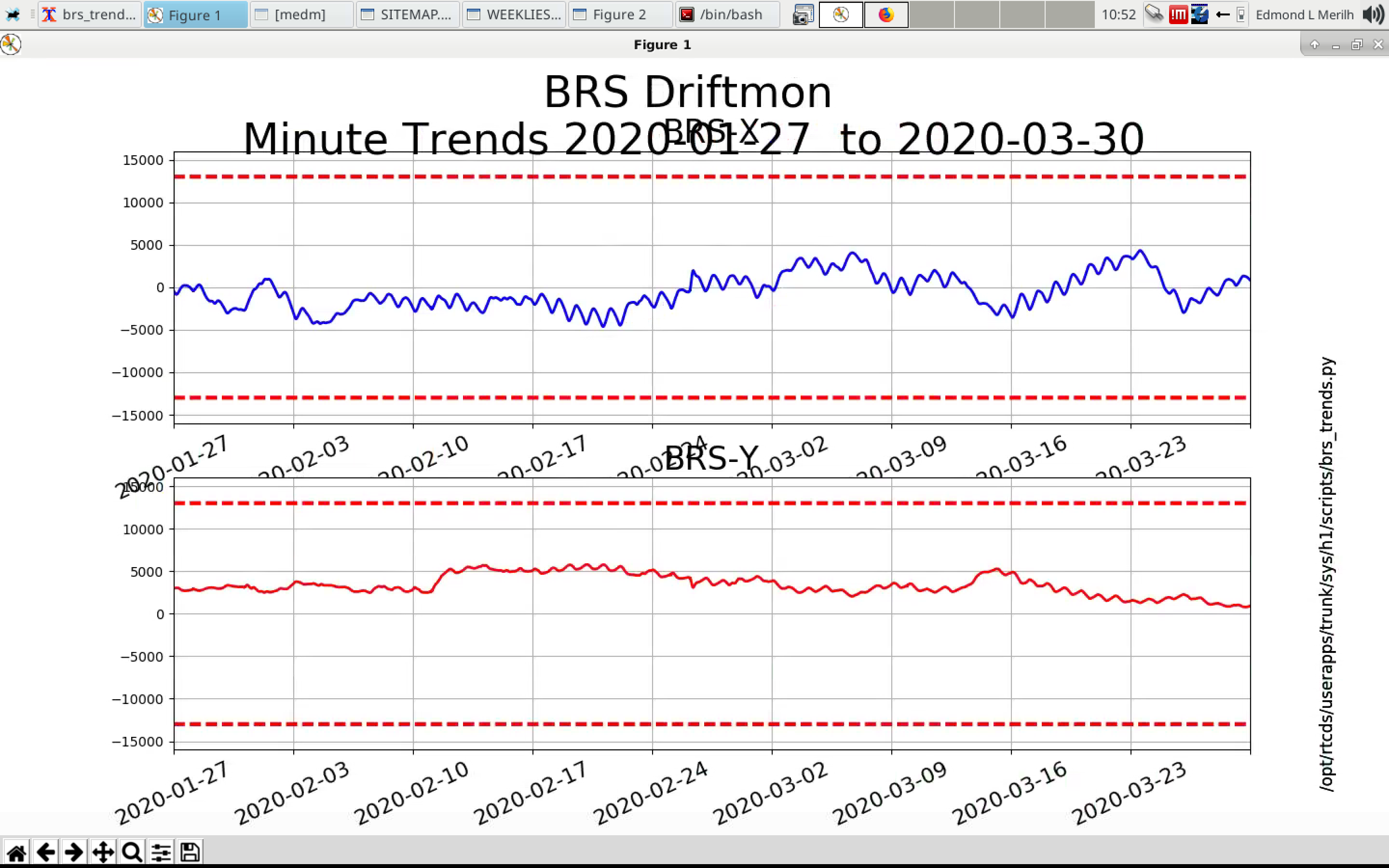
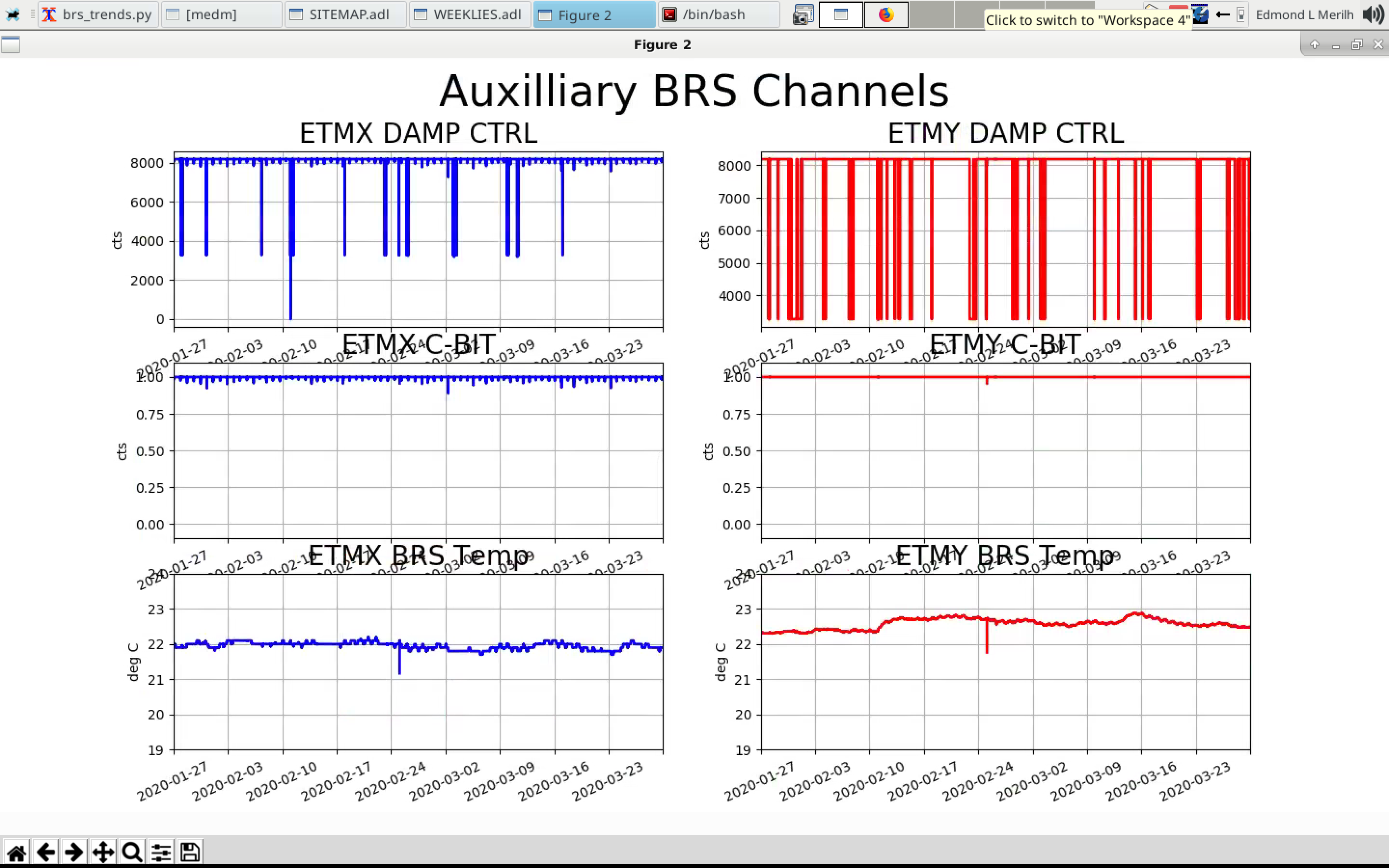
These tasks are being postponed until the COVID-19 restrictions are removed. Currently the PSL is shutdown for post O3 upgrades. Additionally, the plumbing in the PSL enclosure is to be reworked for the new laser configuration. The above factors render these check moot, therefore no need to make an entry into the PSL enclosure. Closing FAMIS #13090
These tasks are being postponed until the COVD-19 restrictions are removed. Closing FAMIS #12981
The control room FOM machine nuc22 has been showing two copies of the vacuum overview screens during the day (with only one updating). I rebooted this machine at 22:18 and restored the wind speed and vacuum plots.
TITLE: 03/30 Day Shift: 15:00-23:00 UTC (08:00-16:00 PST), all times posted in UTC STATE of H1: Commissioning LOG: 14:56 UTC Took IFO from NLN to READY 15:00 UTC Jason shutting down PSL 15:02 UTC Jason done 15:04 UTC Richard purposely trips lasers from control room. Checking that they are all off.
The laser, oven, and all other electronics in the Pcal lab have been shut off for phase 3.
Richard already turned off all of the lasers and cameras physically (alog55819), and then I turned things off on the software side as well.
TCS
I took the TCS_ITM{X/Y}_CO2 Guardians to their DOWN state. I left their associated PWR nodes in the FAULT state since they don't have any laser power.
I left the ring heaters on.
HWS
I stopped the code on all of the machines in their tmux sessions. I turned off the CS SLEDs, cameras, and RCX links, from the medms. I also did this for EX and EY was already mostly off.
All trends look nominally ok, right up until they all dropped off the scope :/ . It seems that the DCHILLFLOW finally found a happy spot after stepping down one last time.
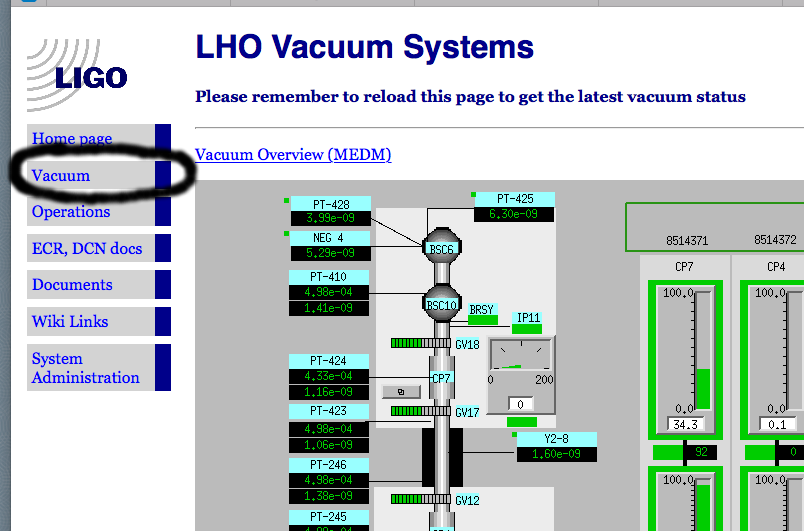
I've added a new "Vacuum" sidebar entry on the main CDS webpage (https://lhocds.ligo-wa.caltech.edu/index.html) to speed up viewing the vacuum overview snapshots.
The vacuum overview is snapshotted in two locations, the MEDM snapshots service (captures the medm version) and the control room FOM screen capture (captures the CaQtDm version). Both are displayed on the new vachome.html page linked by the sidebar entry.
Thank you, Dave!
Centering looks good.
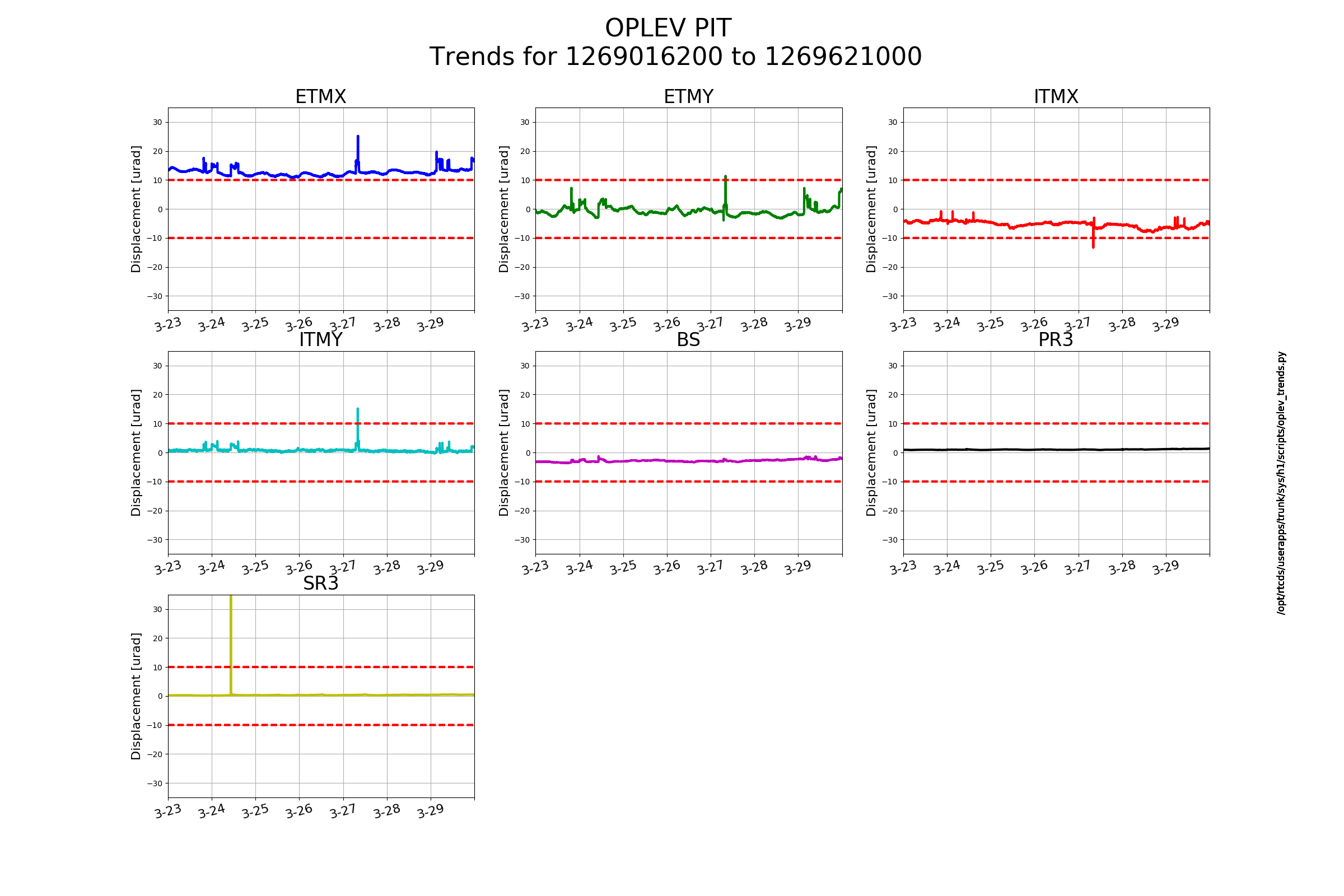
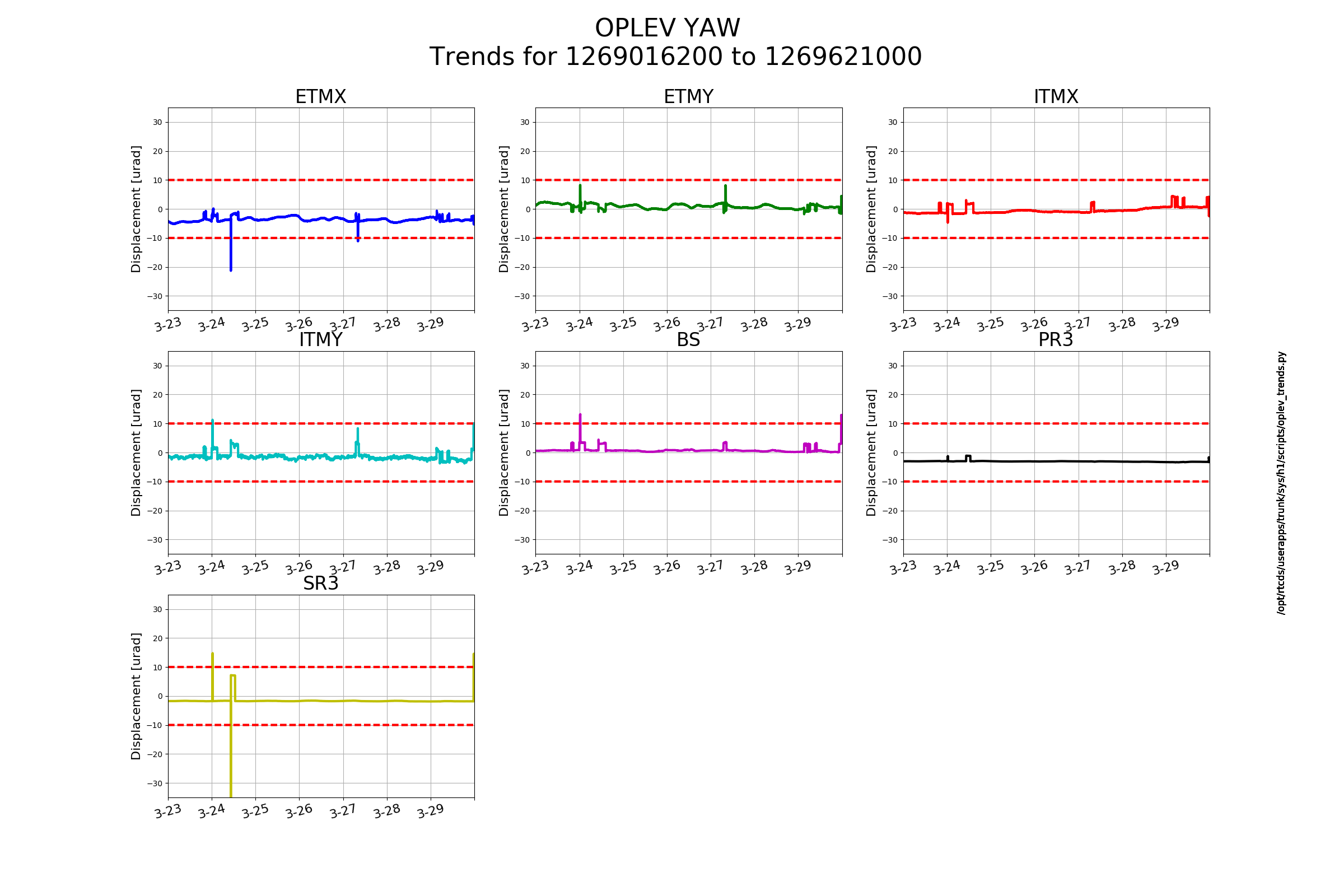
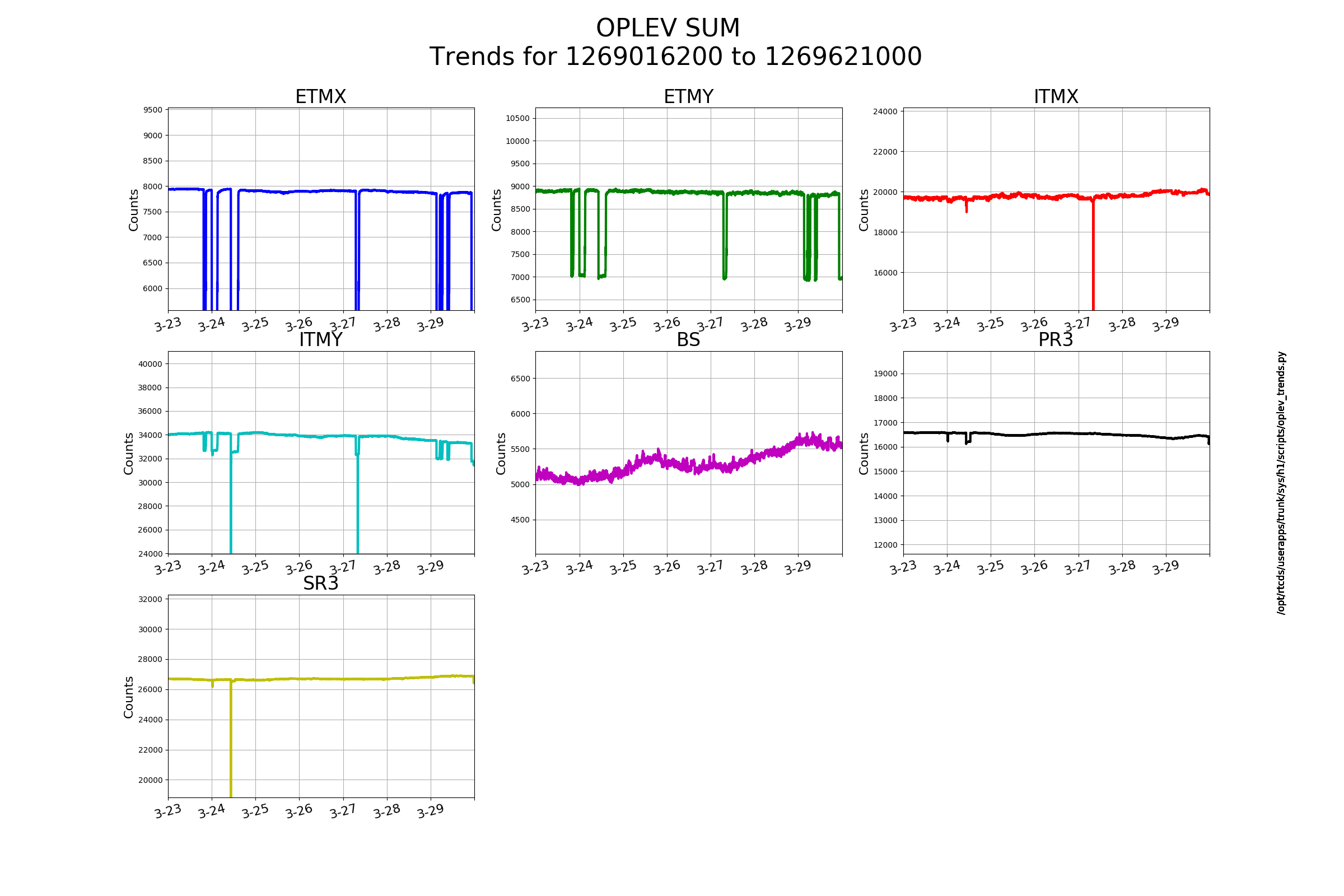
All oplev Sums, and Yaws are all within expected range. All Pits are within expected range except for ETMX. This was recently centered.
Started the shutdwon of the end stations after Jason shut off the PSL. My first was a test of the interlock system. I pushed the kill button in the control room, Patrick T. restored the safety and I verified the lasers wer off.
EX-
EY-
Corner Station-
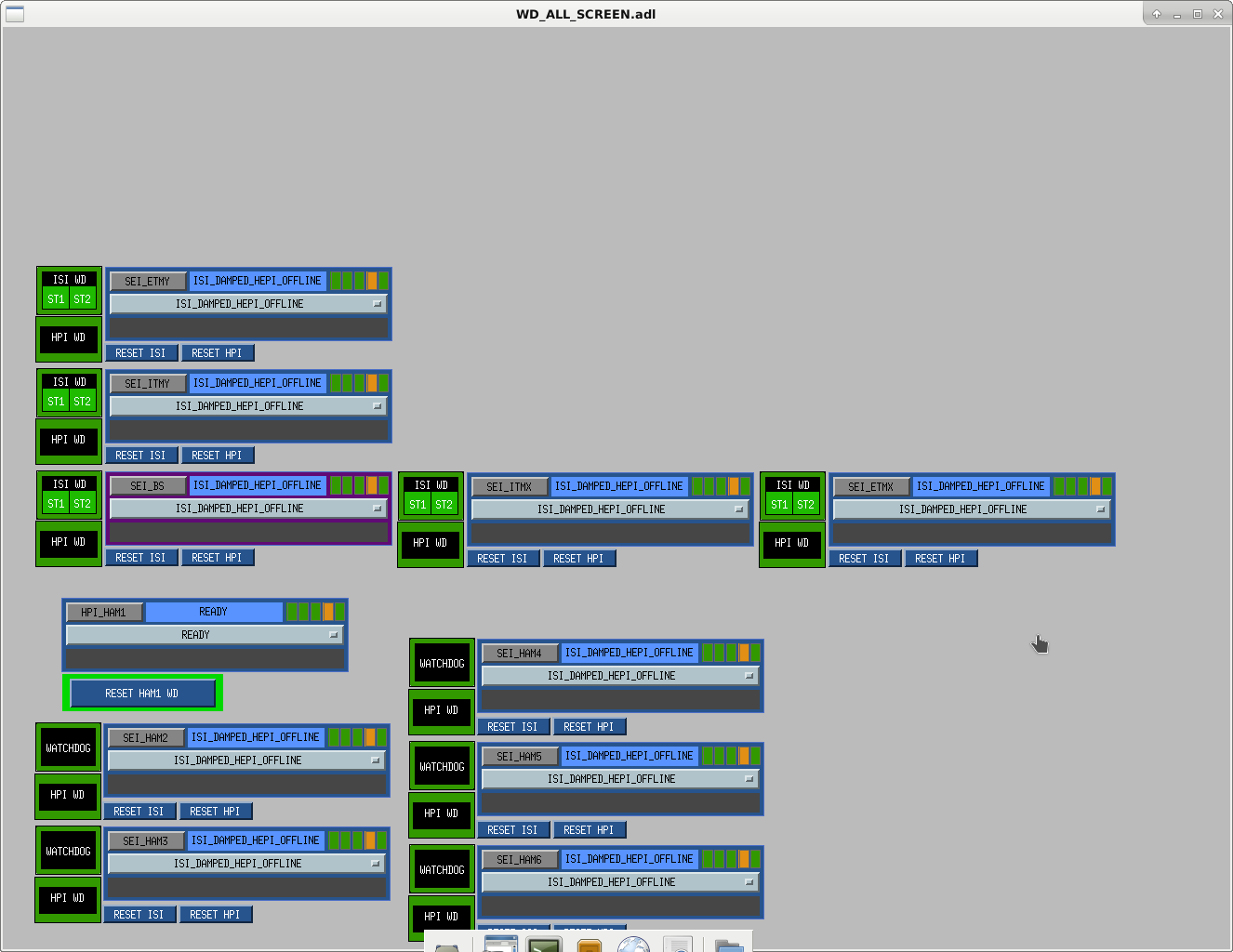
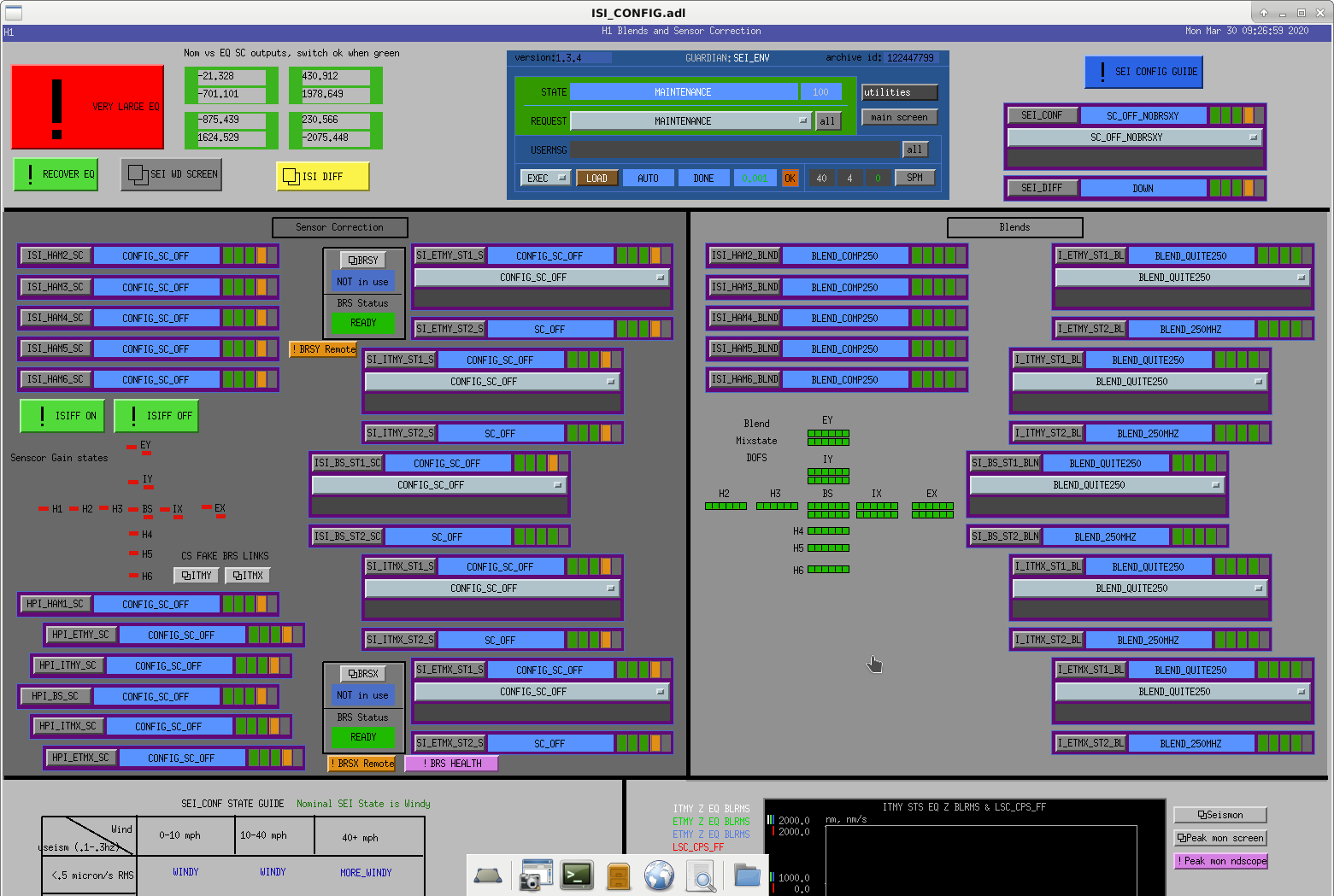
All the SEI platforms are in ISI_DAMPED_HEPI_OFFLINE, ISI damping loops are engaged, but HEPI controls are off.
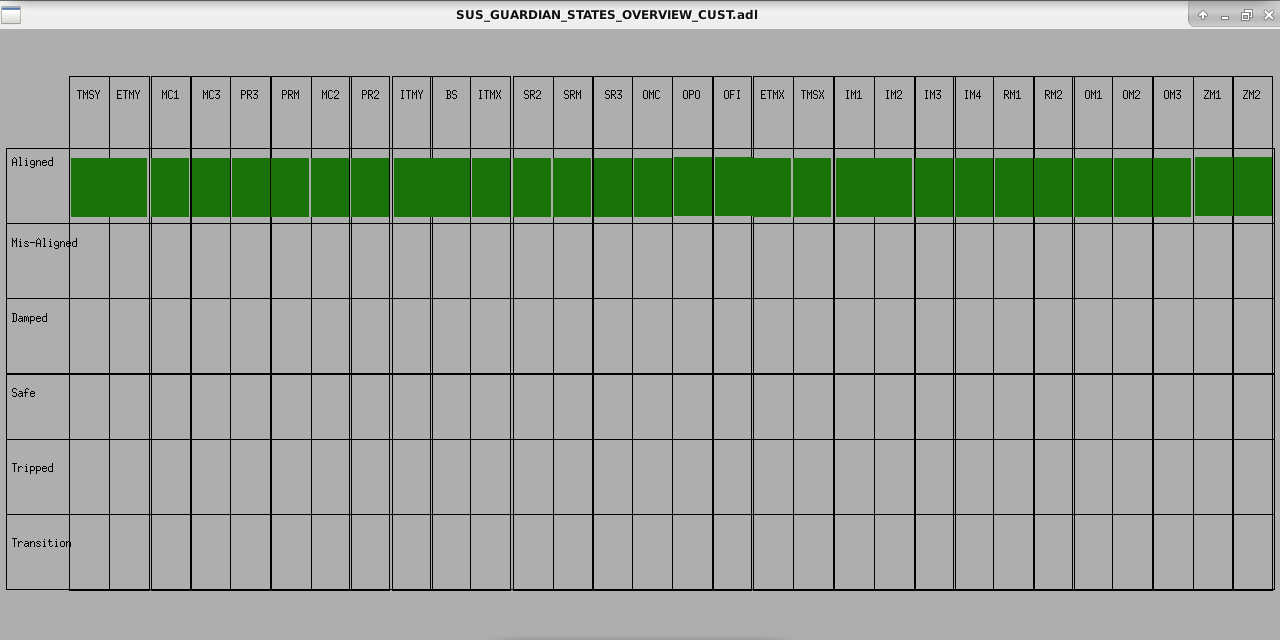
The suspensions are currently in the ALIGNED state (which was last week planned to be in the Damped, however after discussing with Jenne and Betsy this morning, we decided to keep it in Aligned state) - in response to the LHO PHASE 3 transition (COVID-19). In the ALIGNED state the beam will be centered on the OPLEV and we have useful OPLEV data.
I had left the SUS state for SRM and PRM in MISALIGNED state - to which Jenne pointed it out that it should be changed to ALIGNED state like every other suspensions. I have made those two changes, please find attached a screenshot of the Guardian states for all the Suspensions.
This morning, in accordance with LHO's move to Phase 3 operations of our COVID-19 response, I shut down the PSL (WP 8581). All stabilization loops (PMC, ISS, FSS) were disabled, then the laser was shut down; both shutters (external and 35W internal) are closed. The chillers remain on for the moment, they will be shut down and drained by J. Bartlett and R. Savage at a later date.
This is now a Part 1 of 1. In discussion this morning among the PSL team, we decided to leave the chillers on and request that staff already onsite for other maintenance activities (VAC, FAC, etc.) check on the chillers to top them off. This decision was made to minimize overall staff time onsite.
While doing final prep this morning for the chiller drain tomorrow, it became clear that draining them was a larger job than originally anticipated, 4+ hours for 2 people (8+ person hours). Therefore, in keeping with LHO's stance on Phase 3 operations, we decided that staff already onsite spending 2-5 minutes to check on the chillers every other week was a better method to minimize onsite time versus two PSL personnel spending 4+ hours to drain the chillers. To meet the same person time onsite as draining the chillers (8 person hours, best case), it would take someone already onsite 96 visits to the PSL chillers (assuming 5 minutes/visit). With a 5 minute check every 2 weeks (twice/month), we would have to be shut down and performing these checks for 48 months (i.e. 4 years, or until April 2024) to equal the person time required to drain them. Big difference in person time onsite by leaving the chillers running.
Should it become necessary in the future we will drain the chillers, but for now they will remain ON. PSL personnel have the capability to monitor the chillers remotely, so we will do so.
This now completes LHO WP 8581.
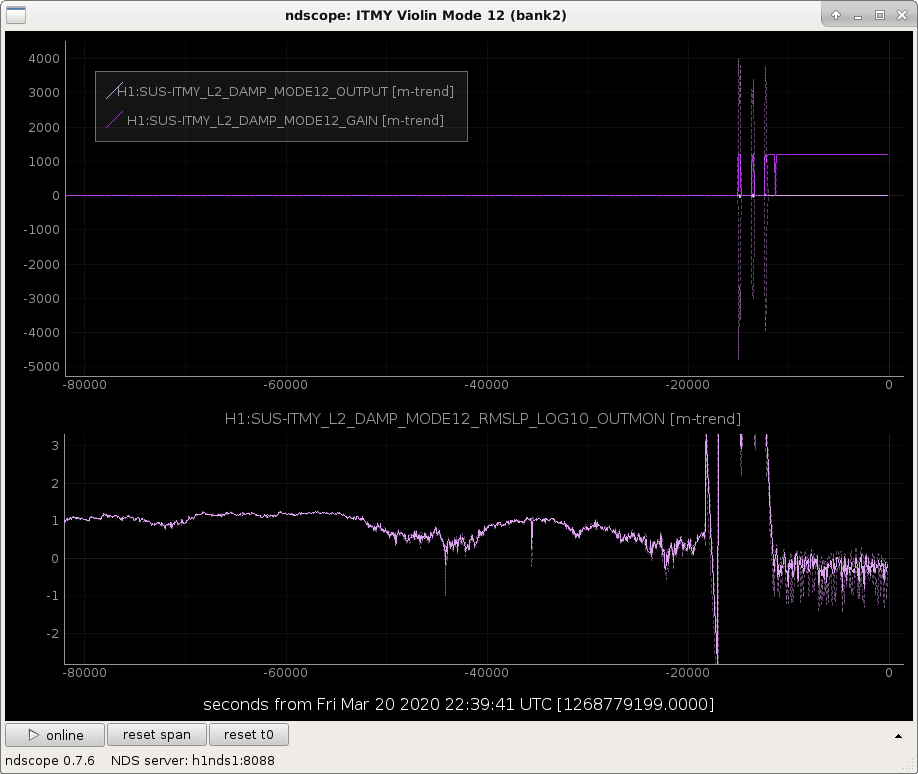
Since we lost lock this morning, I took this opportunity to change the max gain to nominal values for ITMY mode 3, 12 and 15. Previously these modes had their max gain set to zero (although we had non zero nominal values for them). Often Guardian would set the gain to max for these modes and hence stop damping them - which is not ideal. In the changed scenario, Guardian will damp these modes regardless of whether max or nominal gain is applied. I have committed the lscparams.py on the svn and loaded the coefficients.
I will track their development over the next few lock stretches.
Cheryl (over phone), Rahul
This morning we made changes to the damping filter for ITMX mode 2,3,4. We narrowed down the band pass filter and moved them away from Interfering from each other. Next we loaded the coefficients and made the gains to be zero on lscparam (followed by svn commit). Jeff. B then attempted to lock the IFO and during this time I found a good gain settings for ITMX mode 3 (gain of -20) and was tinkering with IMTX mode 2 (with a very small gain of -0.1). We lost lock after some time hence I was not able to find a good value for mode 2.
During the second attempt of locking, the modes were rung up and we lost lock very quickly. Next I reverted all the damping filter settings (including lscparams) back to how it was this morning at 8am. In the third attempt I requested Jeff. B to hold on at PREP_ASC_FOR_FULL_IFO, while I was manually damping the rung-up modes. We stayed at this state for an hour or so, and the rung up modes were damping well. Hence I requested Ed (who took over form Jeff. B) to start moving up the ISC lock state - here we lost the lock once again.
In the fourth attempt, the violins looked fine and we are currently locked and Observing (at 0:14 UTC).
Plots of the three attempts at reaching NLN that did not make it, which include the ITMX violin modes 2, 3, 4, 5, 6, and 7. New filters were tested on modes 2, 3, and 4. One unexpected event was that damping mode 4 caused mode 5 output to increase, suggesting modes 4 and 5 are the same fiber. A couple of the lockloss events resulted in ITMX L2 DAMP pitch changing bu about 10urad, which doesn't seem to be the case for every lockloss, however the third lockloss can be attributed to violins, since some were rung up to a level where the RMS was 6.5 to 7.
Plot showing ITMX mode 5 ringing up. This is about 60 seconds of data, showing damping on modes 2, 3, 5, and 7
Trends are color coded:
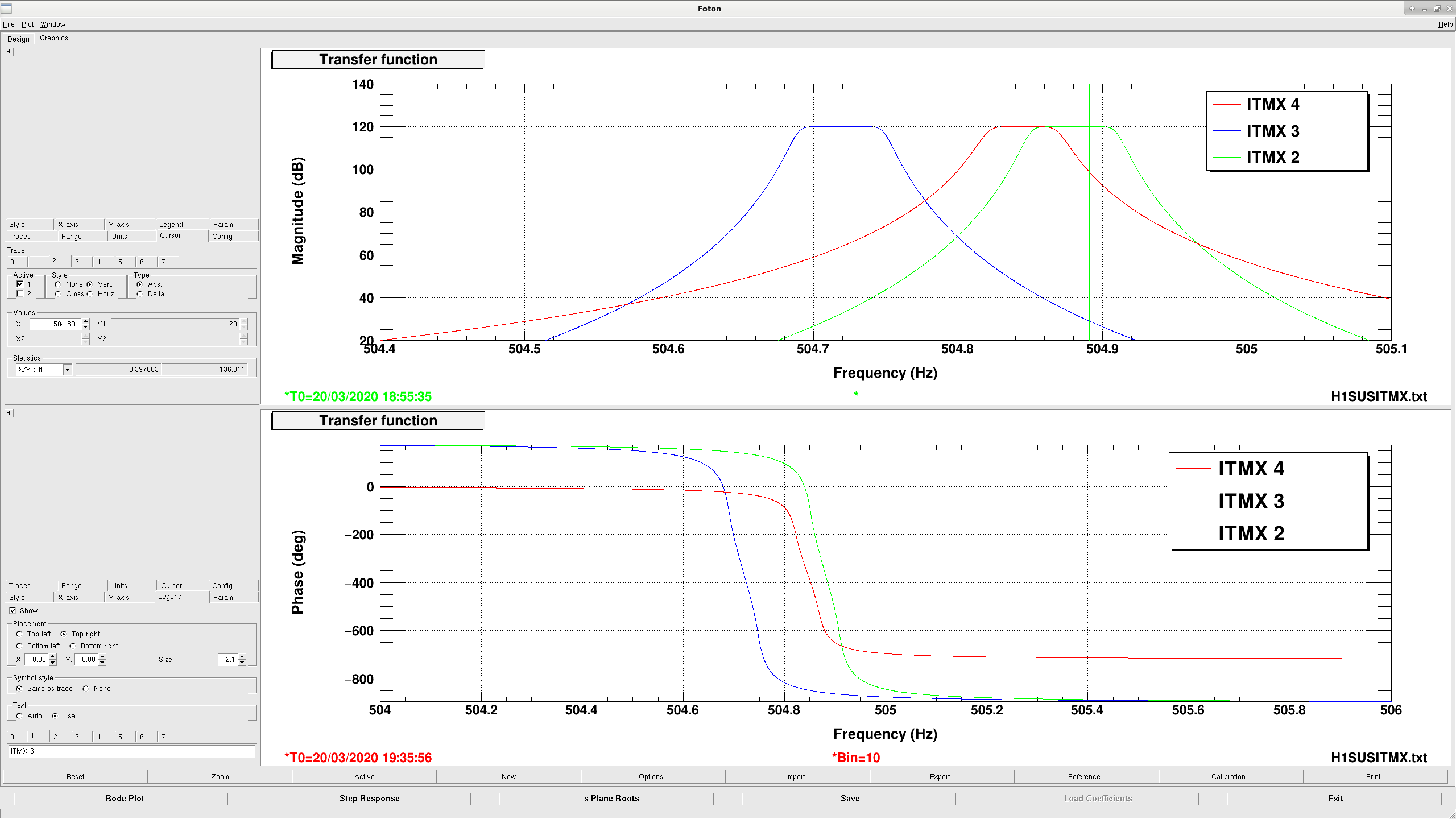
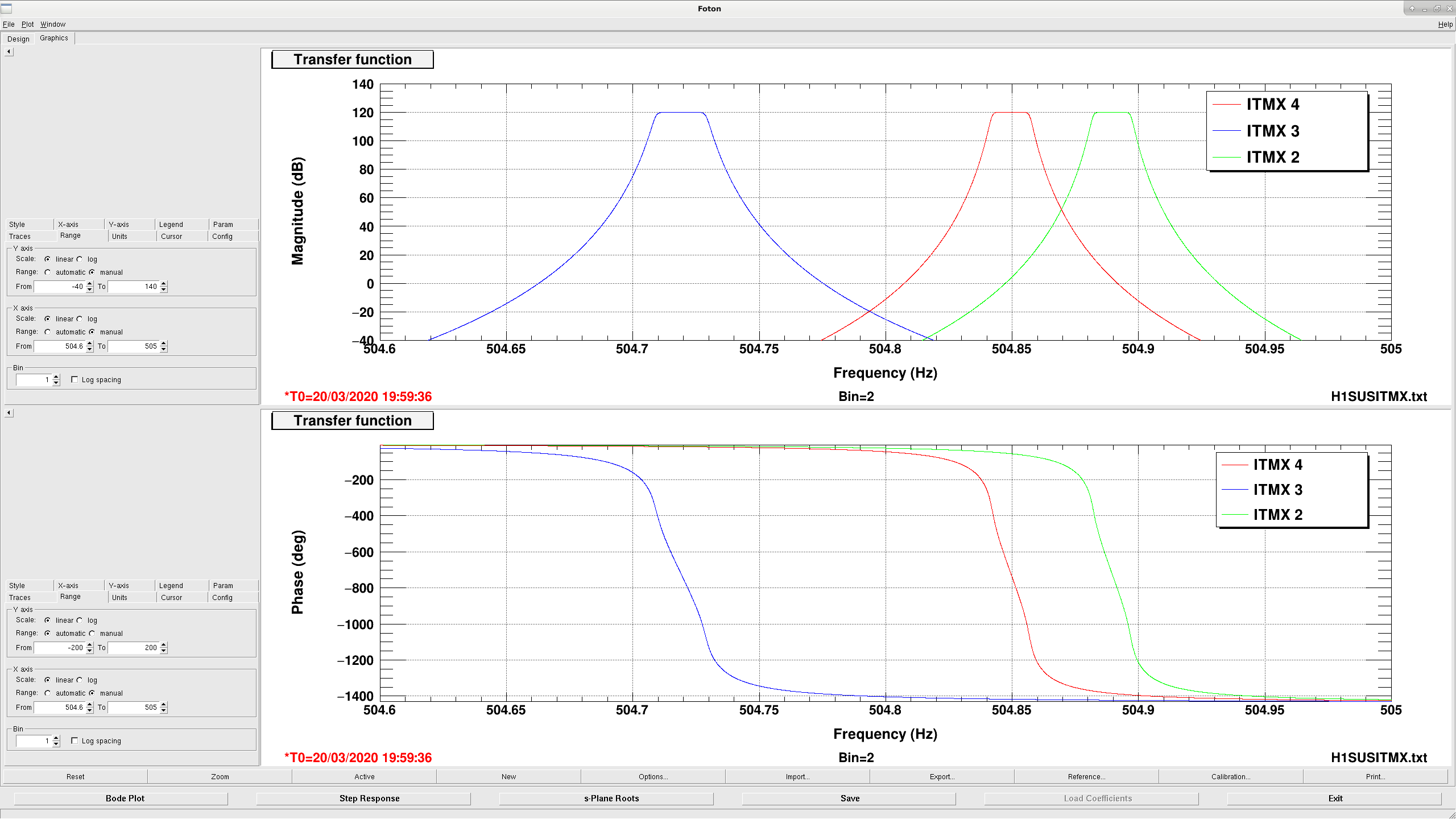
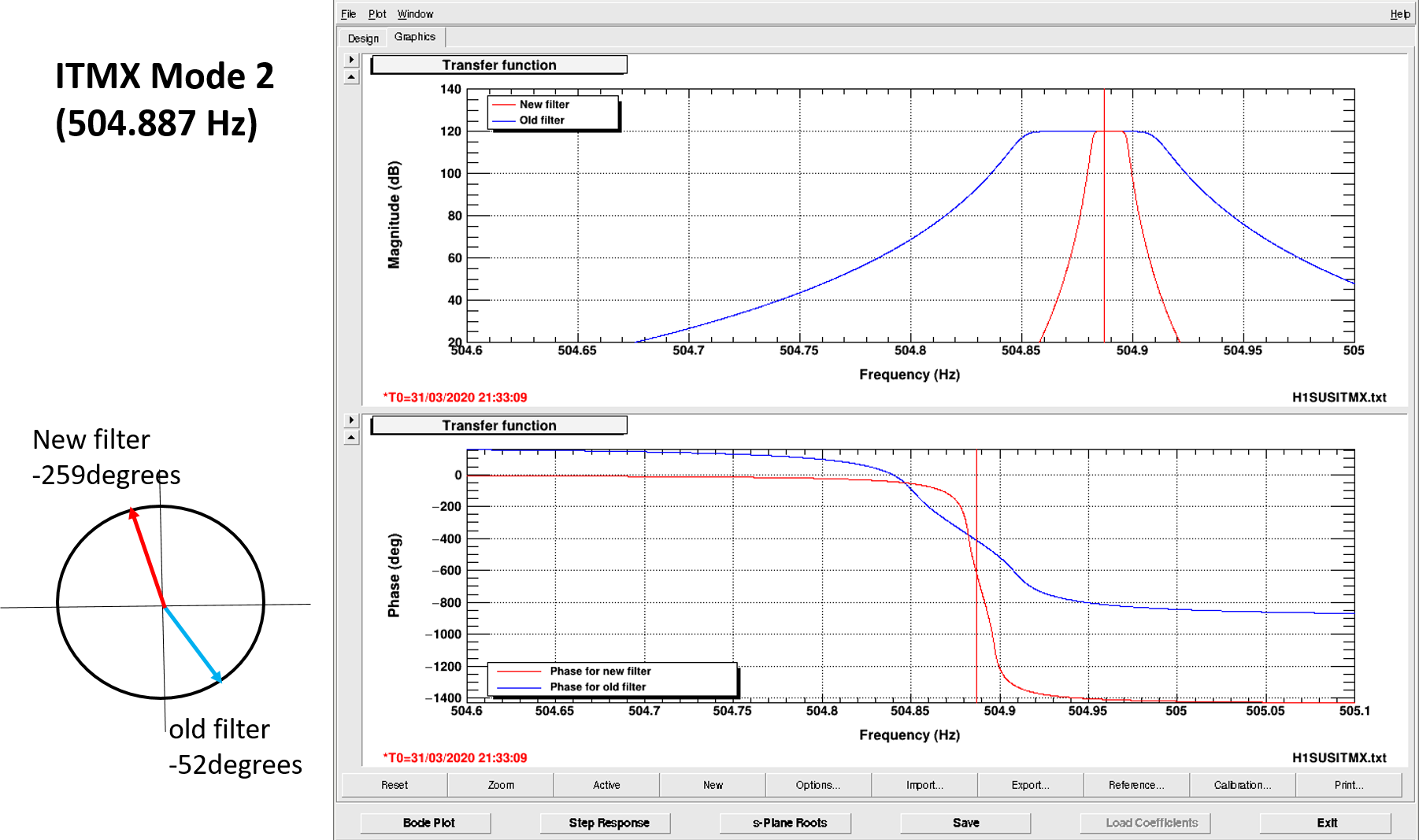
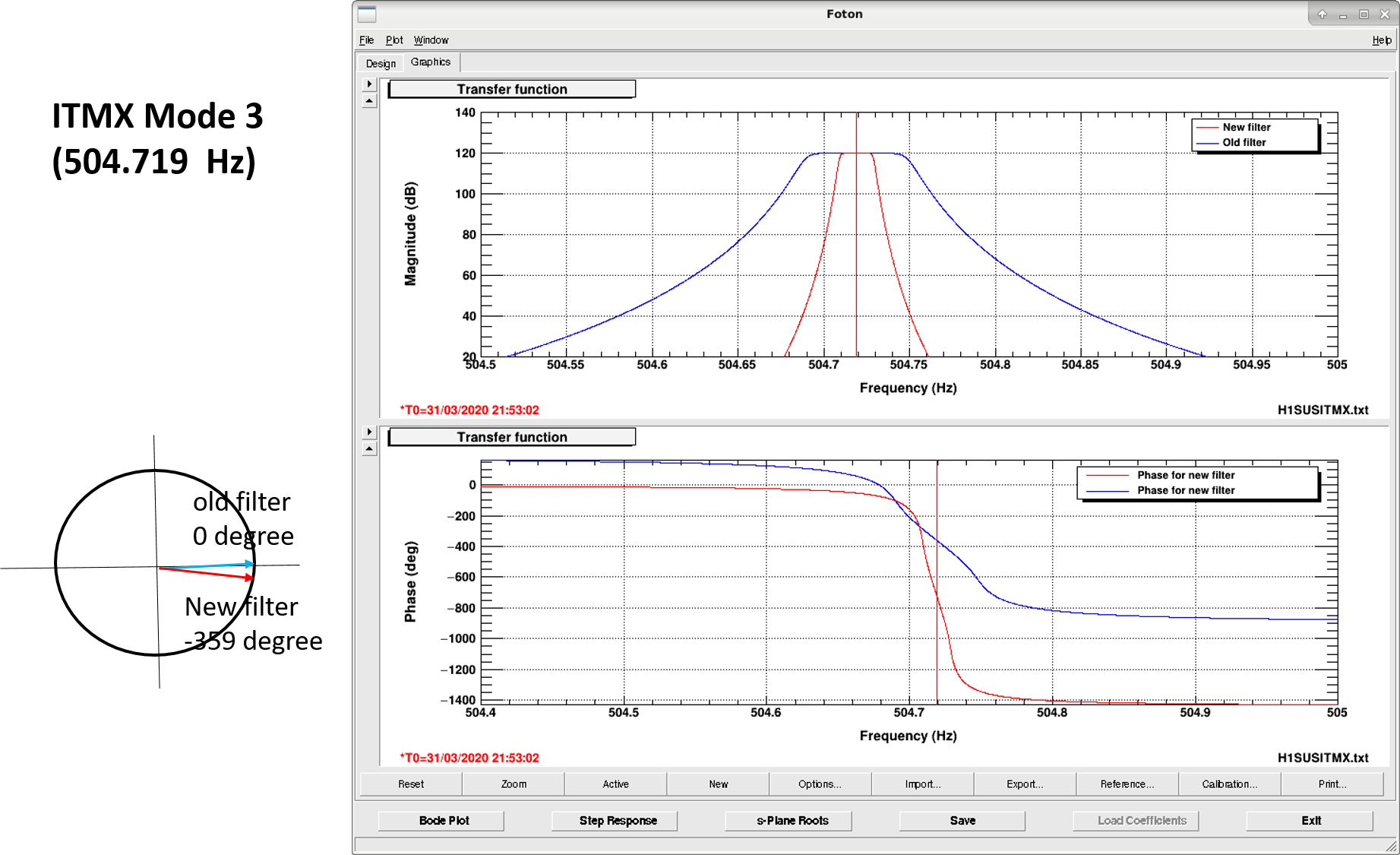
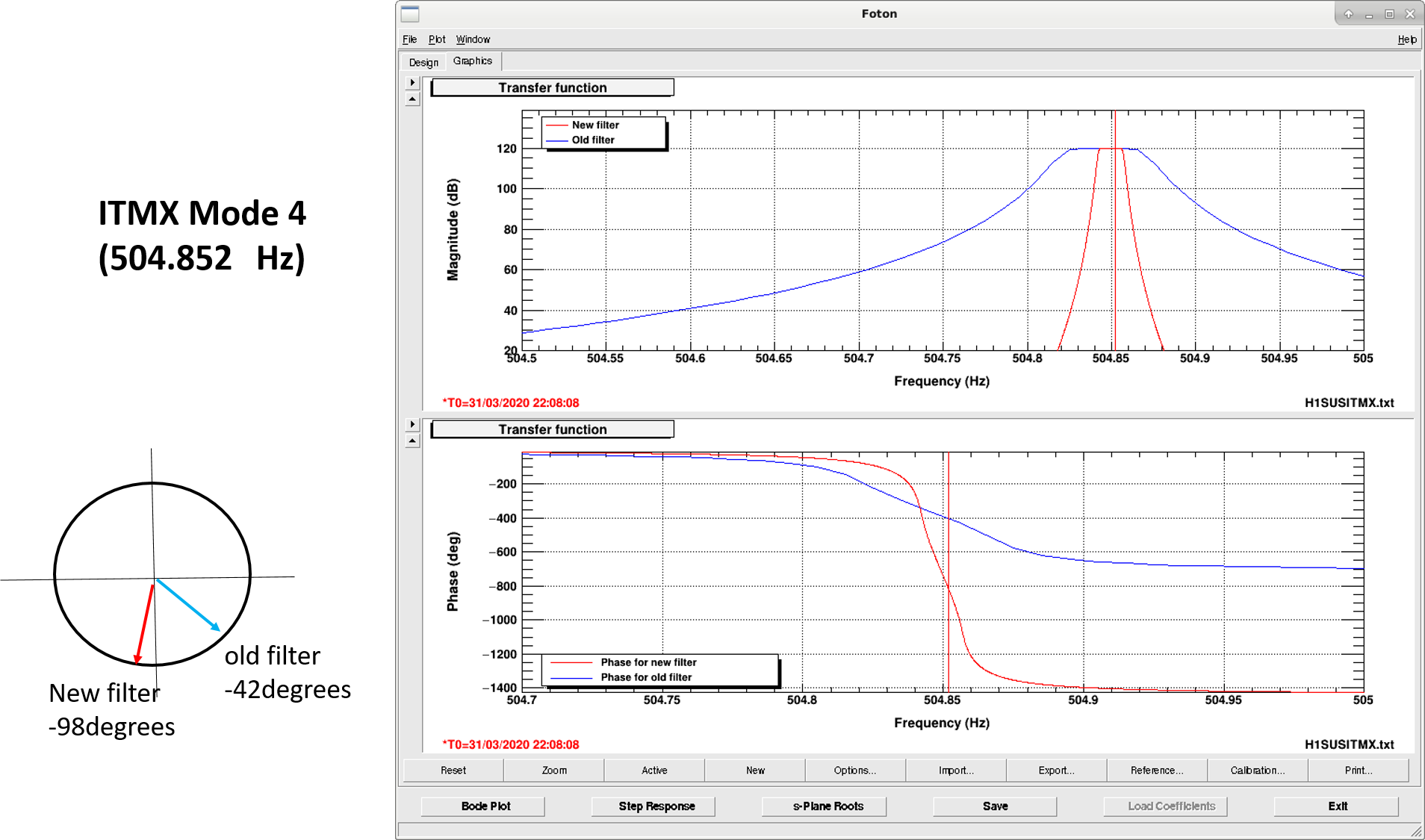
Phase plots of the old and new damping filter is attached below.
Given below are the phase information (old vs new) for the band pass filter designed for ITMX mode 2,3,4. I have also attached 3 figures which shows the bode plot from foton. One can compare the old and new filter design using these plots.
ITMX mode 2 (504.887 Hz)
Phase old: -412 (+360-412= -52 degrees)
Phase new: -619 (+360-619 = -259 degrees)
This filter has a Phase difference of -207 degrees, hence will require a sign change by 180 degrees.
ITMX mode 3 (504.719 Hz)
Phase old: -360 (+360-360 = 0 degrees)
Phase new: -719 (+360-719= -359 degrees)
This filter has a Phase difference of 1 degree, hence will not require any phase change.
ITMX mode 4 (504.852 Hz)
Phase old: -402 (+360-402= -42degrees)
Phase new: -818 (=360 – 818 = -458 degrees, i.e. -98degrees)
This filter has a Phase difference of -57 degrees, hence will require a sign change by -60 degrees.