
thomas.shaffer@LIGO.ORG - posted 12:24, Friday 13 March 2020 - last comment - 12:24, Friday 13 March 2020(55584)
Lock loss 1754 UTC
Happened during some commissiong, unsure of the cause.
Happened during some commissiong, unsure of the cause.
Sheila D, Chris W
While we were out of observing for other reasons, I turned off the pum noisemon filters which were calibrating the signals into DAC counts. This was because Chris found that with the signals calibrated this way, we would need whitening to avoid digitization noise in the DQ channels. Instead of doing that we are just removing the calibration filters.
Accepted in SDF.
Sheila, Jenne, Rahul
We are implementing new Guardian settings in the python code for damping the violin modes. Till now Guardian use to switch off damping for any of the modes rising by 1 order of magnitude. In the new settings, Guardian will just flag the following message (give below) and will continue damping them.
'mode %s is growing!! not turning off gain'
We have found that during Monday CAL sweeps (modes rise slowly over few hours) or other days whenever the modes were rung up (often the monitor levels were below 1, and they are just bouncing up and down), Guardian use to switch them off. We feel this is not necessary as those modes with their correct damping settings should be successfully damped.
I will keep on eye on the new settings (especially on Monday when Jeff. K will perform CAL sweeps) and will report the progress.
The updated VIOLIN_DAMPING.py has been committed to the svn.
TITLE: 03/13 Day Shift: 15:00-23:00 UTC (08:00-16:00 PST), all times posted in UTC
STATE of H1: Observing at 117Mpc
OUTGOING OPERATOR: Corey
CURRENT ENVIRONMENT:
SEI_CONF state: WINDY
Wind: 5mph Gusts, 3mph 5min avg
Primary useism: 0.01 μm/s
Secondary useism: 0.17 μm/s
QUICK SUMMARY: Locked for almost 2 hours after some trouble and a lock loss. Calm environment.
Summary: At about 8:30utc, H1 took a 20Mpc drop in range & hovered there for ~4hrs until it dropped out of lock. Cursory look didn't show anything obvious. H1 was able to get back to NLN without intervention in under an hour and the range appears to be normal-ish so far.
Timeline:
Quick Check:
Did a quick check on a few items to see about reasons why H1 took the drop to 102Mpc, and looked at "usual suspects":
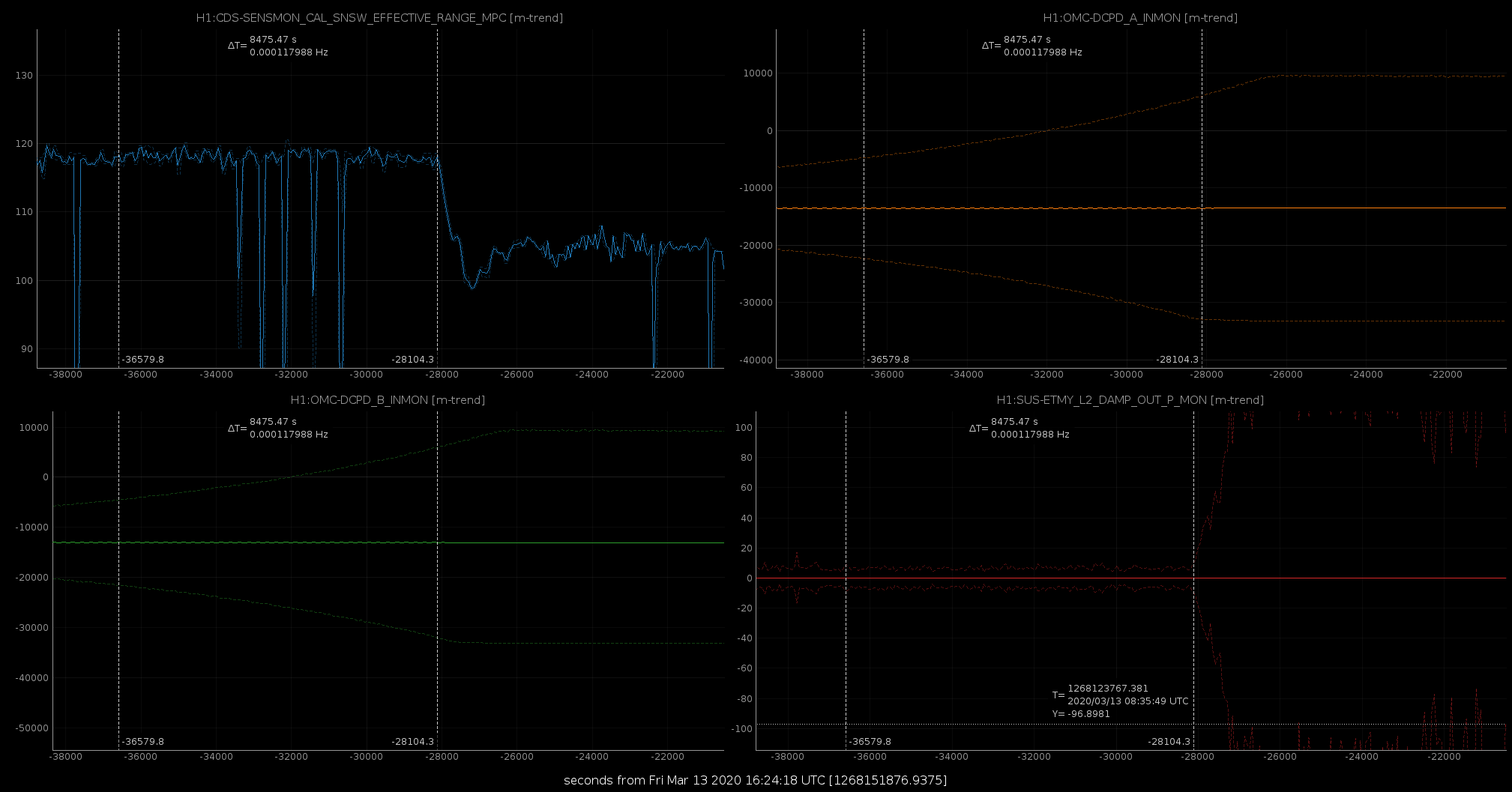
It looks like the issue was ETMY violin mode 2 (505.0794hz) started a very slow ringup until the DCPDs started to saturate and we began to lose range. This mode normally has a gain applied but the violin Guardian turned it off yesterday, March 12 00:49 UTC. The mode didn't increase for about 8 hours, but then started a slow increase around Mach 12 08:30 UTC. Why it changed and started to increase at this is still under investigation.
The irony here is that there was plan for Rahul to change the violin Gaurdian today to handle this exact situation. A day too late unfortunately.
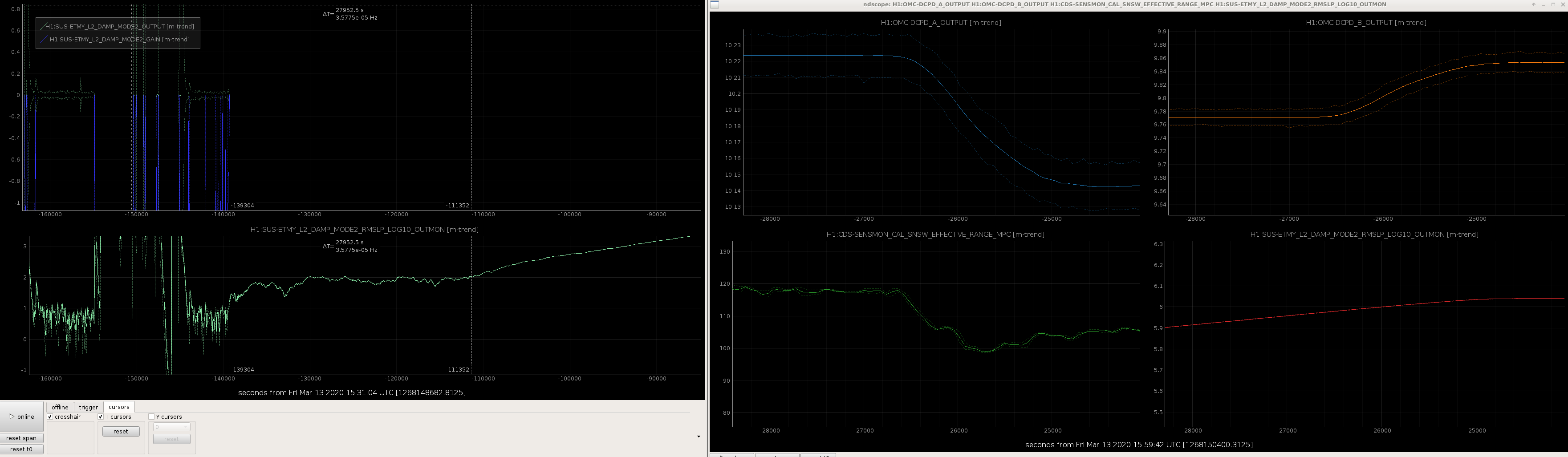
Adding a better plot of when the DCPDs saturated.
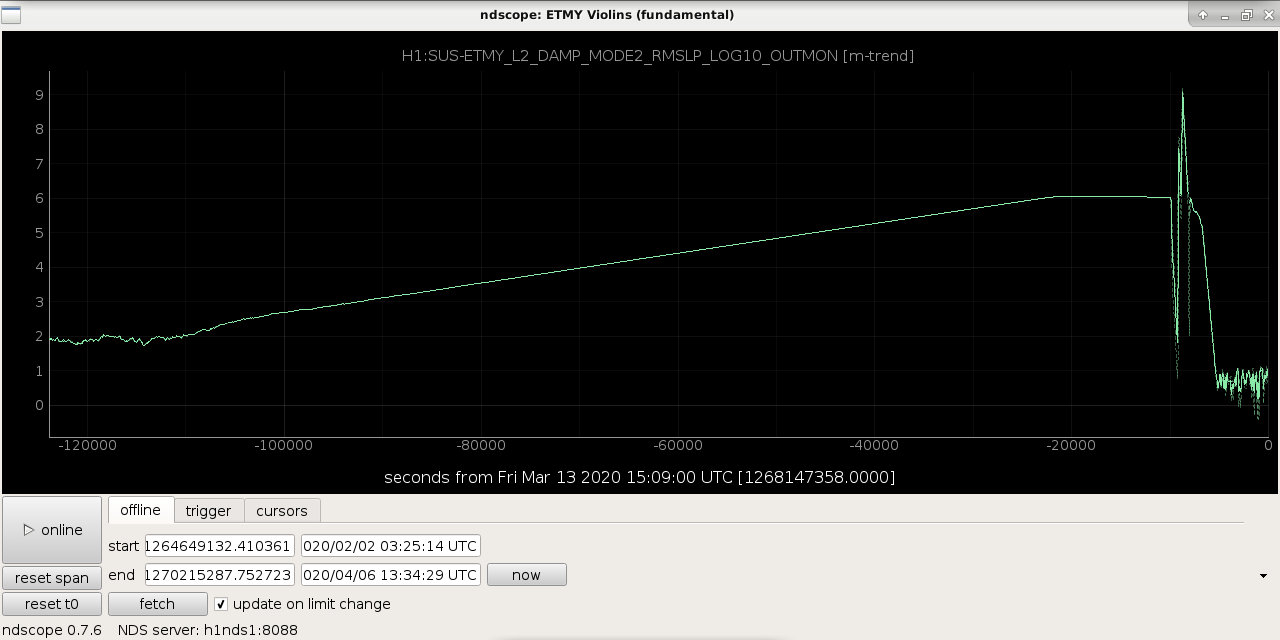
I am attaching the ndscope plot for ETMY mode 2 from March 13 - which resulted in DCPD lockloss. At the lockloss time the monitor level was around 6, if we go back 2 hrs in time then the monitor level was around 5.5. If we choose this value (monitor level 5.5) as a threshold for setting up a verbal alarm and IFO_NOTIFY, then operators will have 2 hours of advance warning, giving them some time to damp the mode manually.
TITLE: 03/13 Eve Shift: 23:00-07:00 UTC (16:00-00:00 PST), all times posted in UTC
STATE of H1: Observing at 119Mpc
INCOMING OPERATOR: Corey
SHIFT SUMMARY: Nothing to report
LOG:
TITLE: 03/12 Eve Shift: 23:00-07:00 UTC (16:00-00:00 PST), all times posted in UTC
STATE of H1: Observing at 114Mpc
OUTGOING OPERATOR: TJ
CURRENT ENVIRONMENT:
SEI_CONF state: WINDY
Wind: 11mph Gusts, 7mph 5min avg
Primary useism: 0.02 μm/s
Secondary useism: 0.19 μm/s
QUICK SUMMARY:
TITLE: 03/12 Day Shift: 15:00-23:00 UTC (08:00-16:00 PST), all times posted in UTC
STATE of H1: Observing at 115Mpc
INCOMING OPERATOR: Jim
SHIFT SUMMARY: We had a few hours of commissioning, but stayed locked. Current count is 23 hours.
LOG:
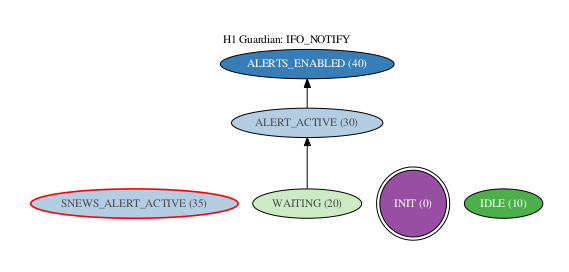
Ive added a state in IFO_NOTIFY for when we receive a SNEWS alert. This will work in conjunction with Dave's LLA system to make the proper notifications when necessary. Upon receiving a SNEWS alert on site, this node will stay in that state for 30min. At this point it is up the the operator to follow the normal Site Response to Astronomical Alarms (L1500117) procedure.
[SudarshanK, SheilaD]
We were able to stay locked with lower DHARD Gain last time (LHO alog #55526) ans Sheila made some changes to the DHARD filter yesterday ( LHO alog #55556). We took a regular sensing function measurement to make sure the filter change has not affected our calibartion. We also made another sensing function measurment with a lowered DHARD Pitch gain (from -30 to -10). Both measurements are saved at the following location below. Analysis to follow.
aligocalibration/trunk/Runs/O3/H1/Measurements/FullIFOSensingTFs/2020-03-12_H1_DARM_OLGTF_LF_SS_5to1100Hz_15min.xml
aligocalibration/trunk/Runs/O3/H1/Measurements/FullIFOSensingTFs/2020-03-12_H1_PCALY2DARMTF_LF_SS_5t1100Hz_10min.xml
aligocalibration/trunk/Runs/O3/H1/Measurements/FullIFOSensingTFs/2020-03-12_H1_DARM_OLGTF_LF_SS_5to1100Hz_DHARDGain10_15min.xml
aligocalibration/trunk/Runs/O3/H1/Measurements/FullIFOSensingTFs/2020-03-12_H1_PCALY2DARMTF_LF_SS_5t1100Hz_DHARDGain10_10min.xml
On Tuesday I measured the dark noise of the OMC DCPDs in various analog electronics configurations, to help understand what our options might be for running in a different configuration that would allow us to use a higher DARM offset.
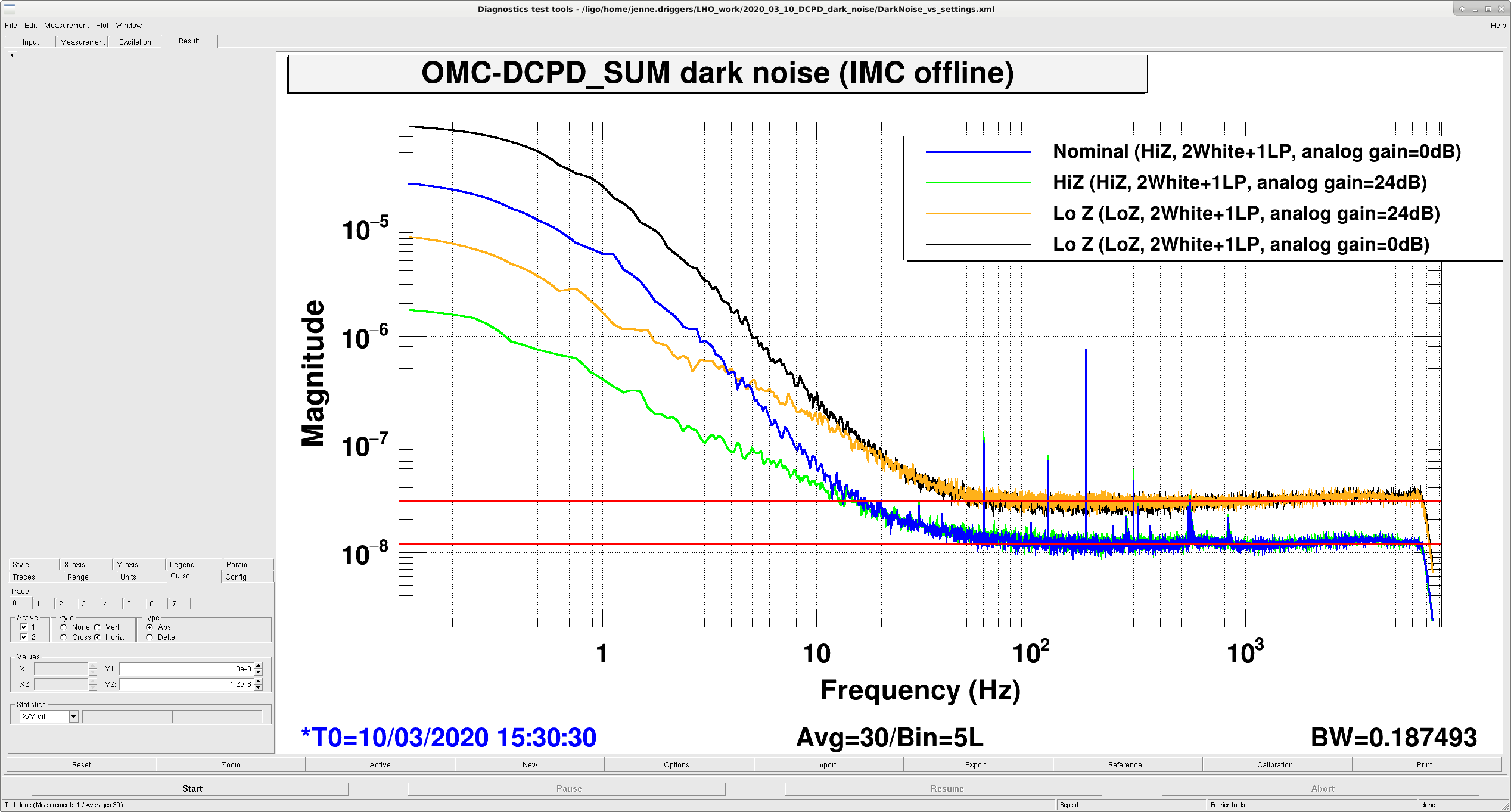
In the attached screenshot I have the dark noise of 4 different configurations, high and low transimpedance and high and low analog whitening gain. Although unlabeled, the yaxis is in mA/rtHz. These are at OMC DCPD SUM, so have digital compensation for the analog changes: the High Z filter module is off for the Low Z measurements, and the digital gain is reduced by 24dB for the measurements with increased analog gain. The increase in analog gain has an impact in the region where we are limited by the ADC noise, below 12 Hz or so. Above about 12 Hz, the dark noise increases by a factor of 2.5 when we reduce the transimpedance by a factor of 4.
The noise limit at higher frequencies for the LowZ case is well explained by noise from the DCPD itself, which Rich Abbott has quoted to me as 300 nV/rtHz at 100 Hz over the low Z 100 Ohm resistor coming into the whitening chassis. This translates to 3.02e-8 mA / rtHz and matches my spectrum at 100 Hz. If I assume that the 300nV/rtHz over the 100 Ohm resistor is a current noise, then that gives me 3 nA/rtHz. Assuming that that current noise is constant then over the higher impedance 400 Ohm resistor I should have 1200 nV/rtHz coming into the whitening chassis. But, that would result in 2.15e-8 mA/rtHz at 100 Hz, which is higher than what I measure. So, I think I need to check with Rich to see if the DCPD noise is different somehow over the higher impedance.
Anyhow, Rich and PeterF have looked at some noise simulations, and it seems like we can reduce the analog whitening gain by a factor of 2 and leave the DCPDs with the higher transimipedance, so we'll likely pursue that avenue.
In the attached .xml file, I have the several references saved, in case they are ever helpful to come back to. For each case, I have the OMC DCPD sum, as well as the IN1 channel of each PD.
I could not understand "3.02 mA/rtHz" and "2.15 mA/rtHz". Is there a unit issue? -> The main entry was corrected
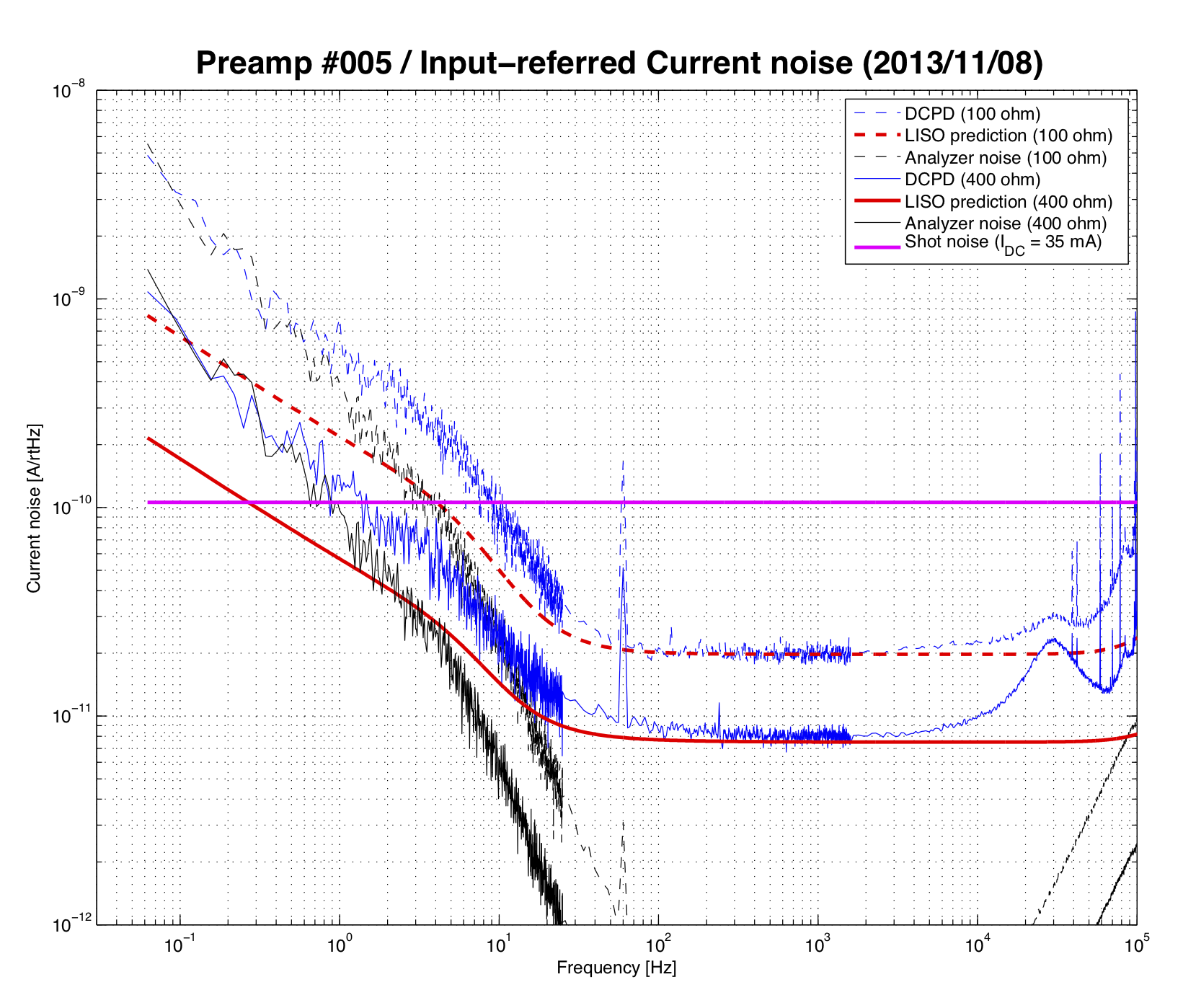
Your measurement matches with the measured noise of the DCPD preamps:
- These photodiodes were tested at Caltech and indicated low current noise (<0.2pA/rtHz). See Attachments 1&2 blue curves. i.e. The dark noise is supposed to be dominated by the preamp noise.
- The DCPD preamps (D060572) were tested and documented as T1300552. There, the input equivalent current noise of the DCPD amp was measured to be 20pA/rtHz and 8pA/rtHz for Z=100Ohm and 400Ohm, respectively. (See Attachments 3&4 for the excerpt from the document). The noise level is determined by the combination of the current noise of Z and the noise of the preamp circuit. As you are adding the noise of two preamps, the total noise is sqrt(2) higher, i.e. 11pA/rtHz and 28pA/rtHz for Z=100Ohm and 400Ohm, respectively. These numbers match with your measurement.
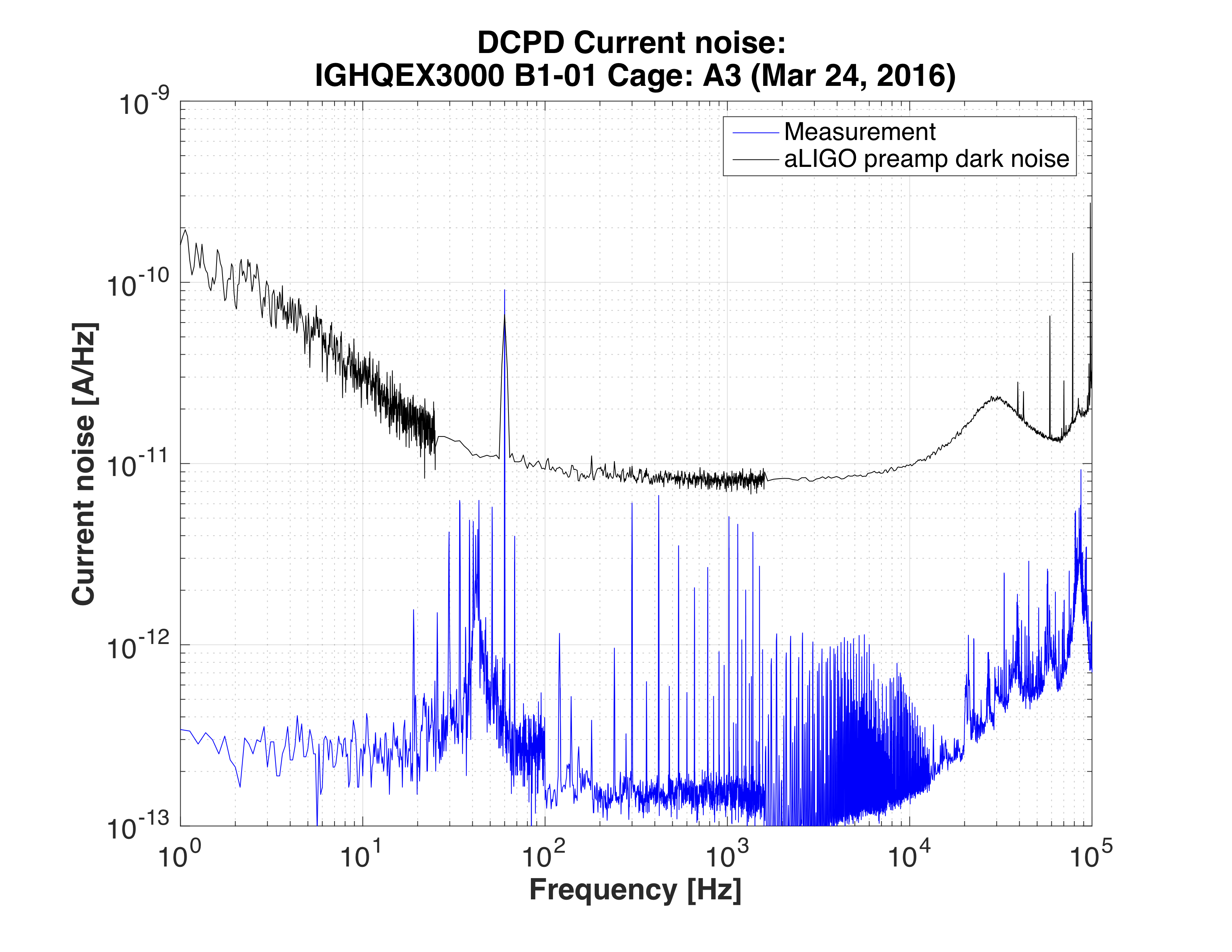
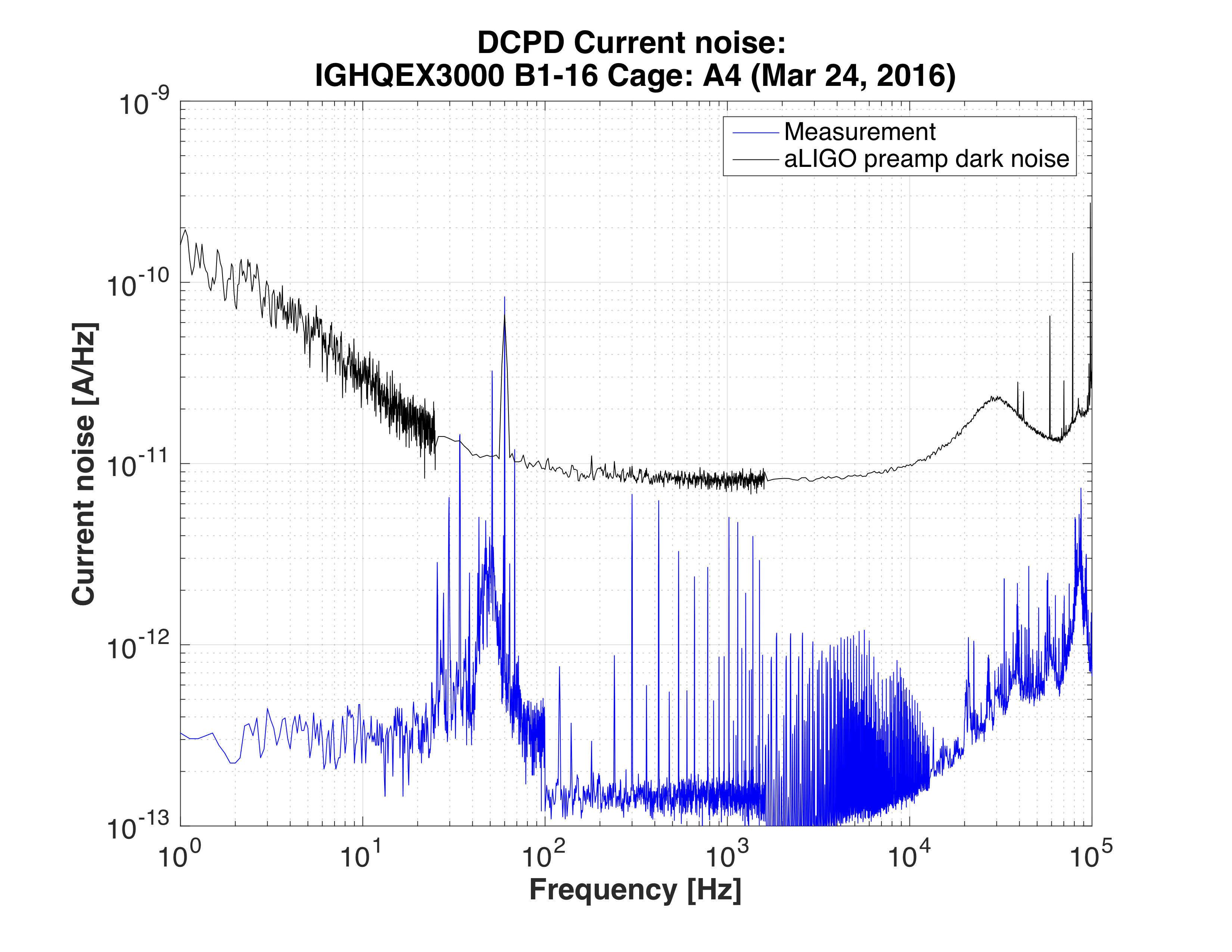
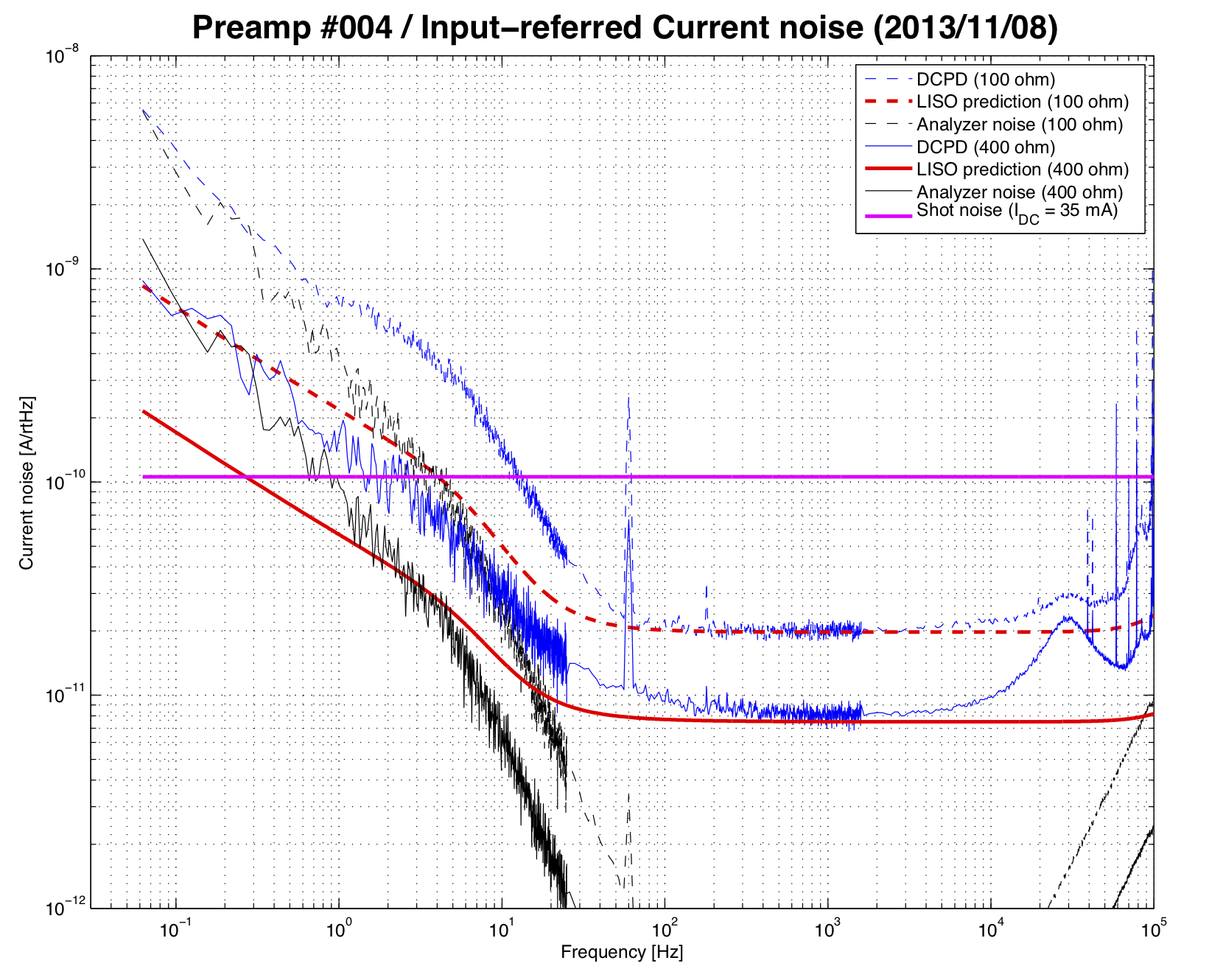
Okay, thanks Koji for clarifying. Also, those numbers should have been 2-3 * 10^(-8) mA/rtHz. I forgot to include the 1e-8 part :/
(this comment is obsolete now)
Out of Observing at 1724 UTC. Planned to be out for around 2 hours.
Back to observing at 1930 UTC
There was a small earthquake this morning that passed through, which I expected to have cause the seismic system to transition to the earthquake state. It didn't, and probably didn't need to, but it did indicate that the seismon test in SEI_ENV was too strict. That test stopped checking whenever the seismon arrival time went to 0, so wouldn't trigger on an earthquake if arrived after the seismon prediction. There's an independent "passive" test that triggers when peak mon goes above 1000 nm/s, but for moderate earthquakes, that could be too late to prevent a lockloss.
I've changed the test to give us a window of 2 minutes after the seismon prediction. So line 49 used to be:
ezca['SEI-SEISMON_LHO_R35_ARRIVALTIME_TOTAL_SECS_{}'.format(i)] > 0:
is now:
ezca['SEI-SEISMON_LHO_R35_ARRIVALTIME_TOTAL_SECS_{}'.format(i)] > -120:
My choice of 2 minutes was a bit arbitrary and LLO uses 6 minutes, which seems reasonable. Not on site today, so I (or TJ or someone) will update at some point soon.
This time was updated to 6 minutes on March 11, 2020.

Observing 1900 UTC