Displaying reports 35281-35300 of 89220.Go to page Start 1761 1762 1763 1764 1765 1766 1767 1768 1769 End
Reports until 08:01, Thursday 12 March 2020
LHO General
thomas.shaffer@LIGO.ORG - posted 08:01, Thursday 12 March 2020 (55565)
Ops Day Shift Transition

TITLE: 03/12 Day Shift: 15:00-23:00 UTC (08:00-16:00 PST), all times posted in UTC
STATE of H1: Observing at 117Mpc
OUTGOING OPERATOR: Camilla
CURRENT ENVIRONMENT:
    SEI_CONF state: WINDY
    Wind: 6mph Gusts, 4mph 5min avg
    Primary useism: 0.02 μm/s
    Secondary useism: 0.22 μm/s
QUICK SUMMARY: Locked for 15 hours, calm environment. SEI_ENV recently transitioned back from the earthquake state after automatically taking us there for an EQ from Tonga area.

H1 General
jim.warner@LIGO.ORG - posted 00:00, Thursday 12 March 2020 (55564)
Shift Summary

TITLE: 03/12 Eve Shift: 23:00-07:00 UTC (16:00-00:00 PST), all times posted in UTC
STATE of H1: Observing at 116Mpc
INCOMING OPERATOR: Camilla
SHIFT SUMMARY: Windy at the beginning of the shift, but it calmed down
LOG:

23:37 Observing

H1 SEI (ISC, OpsInfo)
jim.warner@LIGO.ORG - posted 19:27, Wednesday 11 March 2020 (55563)
Resonance Locklosses and BS ISI ST2 trips

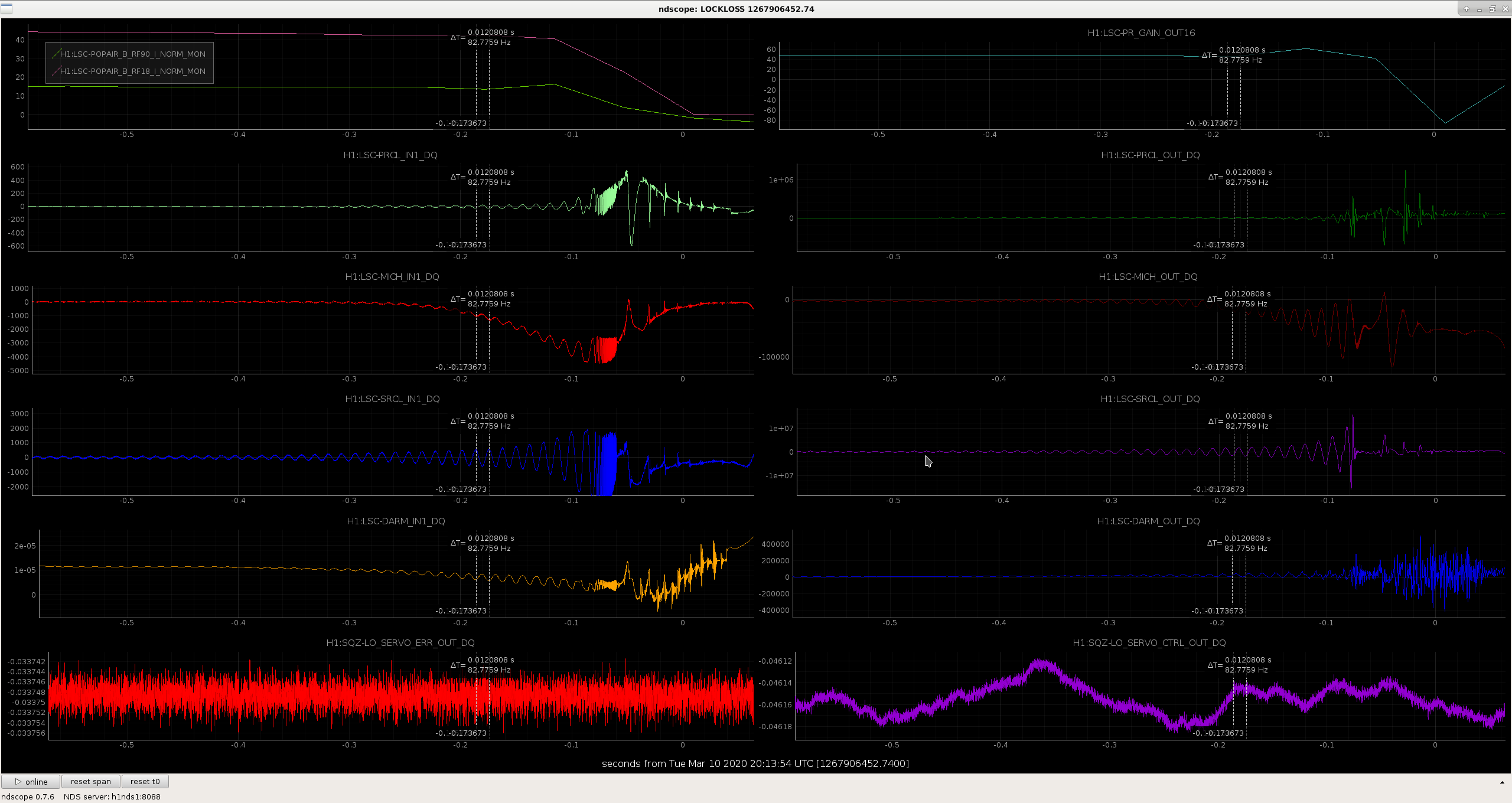
The short version: There have been some Resonance locklosses recently with simultaneous BS ISI Stage 2 trips, I think the ISI trips are a symptom, not a cause. We could avoid the trips by possibly moving the BS Stage 2 loops later in locking, or it might be possible to adjust SRCL to make it more stable. It would help diagnosing this if we could collect a SRCL open loop measurement while pausing at Resonance the next time we lock.

The blah blah blah: Over the last week or so there have been roughly 4 locklosses at Resonance that have had simultaneous trips of the BS ISI Stage 2. I have looked at a couple of these locklosses and it looks like SRCL might be going unstable, causing the locklosses. Because SRCL and MICH are coupled, this is causing trouble for the BS ISI. According to the lockloss page there have been about a dozen total locklosses at Resonance since Nov 1 of last year. Many of them are associated with BS M2 and SRM M3 drives ringing up.

First attached plot shows the LSC lockloss ndscope for one of the locklosses recently where the BS ISI ST2 tripped. MICH and SRCL see something ring up at ~82 hz before the lockloss.

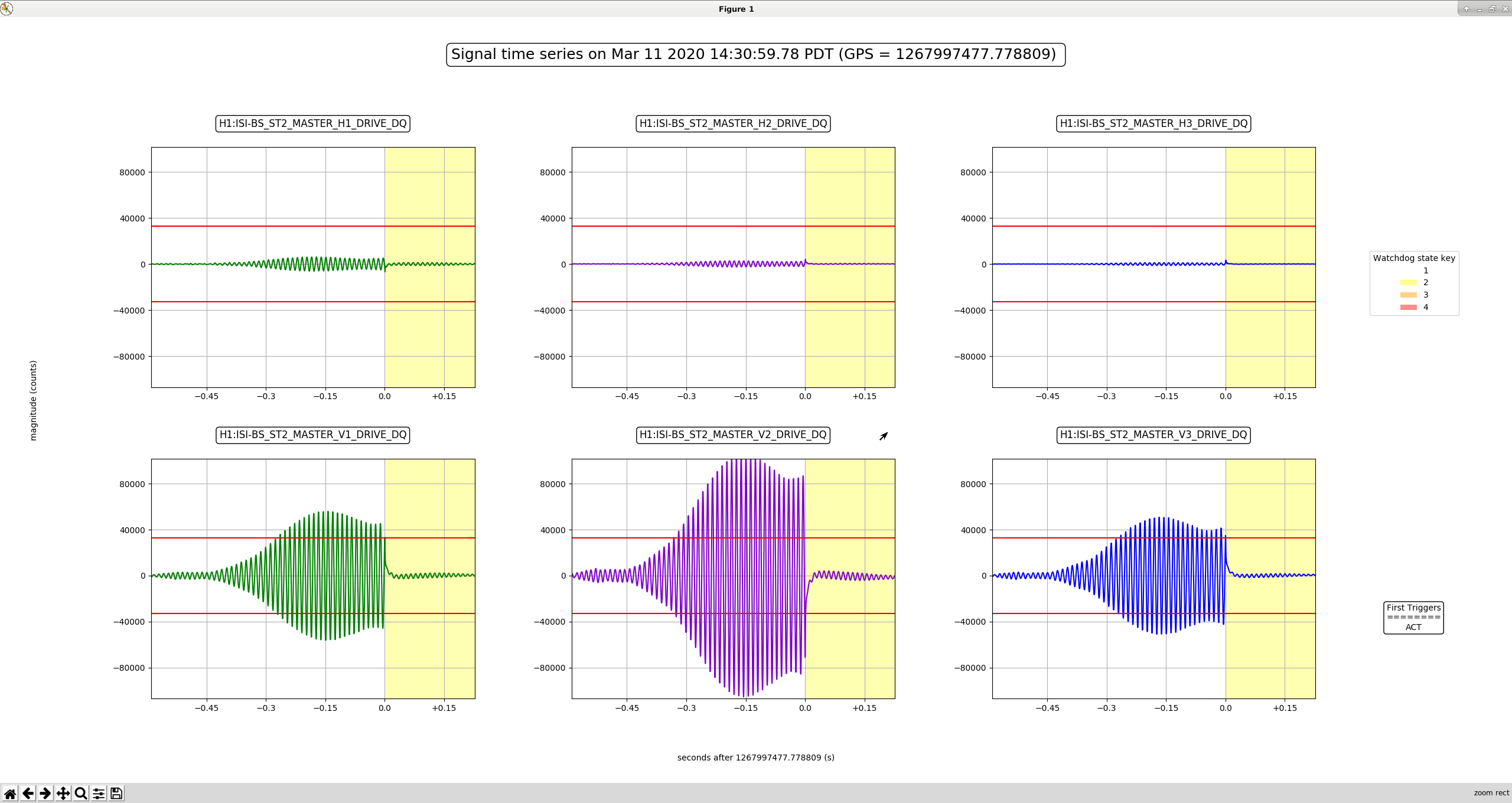
The second attached plots are the drives for the BS ST2 for the most recent lockloss/trip, but every case I've looked at so far looks pretty similar, due to the SUS BS drive pushing on the ISI BS Stage 2. I've also seen locklosses where this same ring up happens in MICH and SRCL, but the BS Stage 2 doesn't trip. At this point I don't think the ISI is causing the locklosses, the trips are just a symptom of a particular kind of lockloss.

Sheila has suggested that optical gains are changing rapidly at this point, and was ready to believe that maybe something in SRCL in particular might be the culprit. When we get a chance, during the next re-lock she suggested we try measuring the open loop gain with the DTT template here: /opt/rtcds/userapps/release/lsc/h1/templates/SRCL/SRCL/SRCL_OLG_NOISE_FULL_LOCK.xml

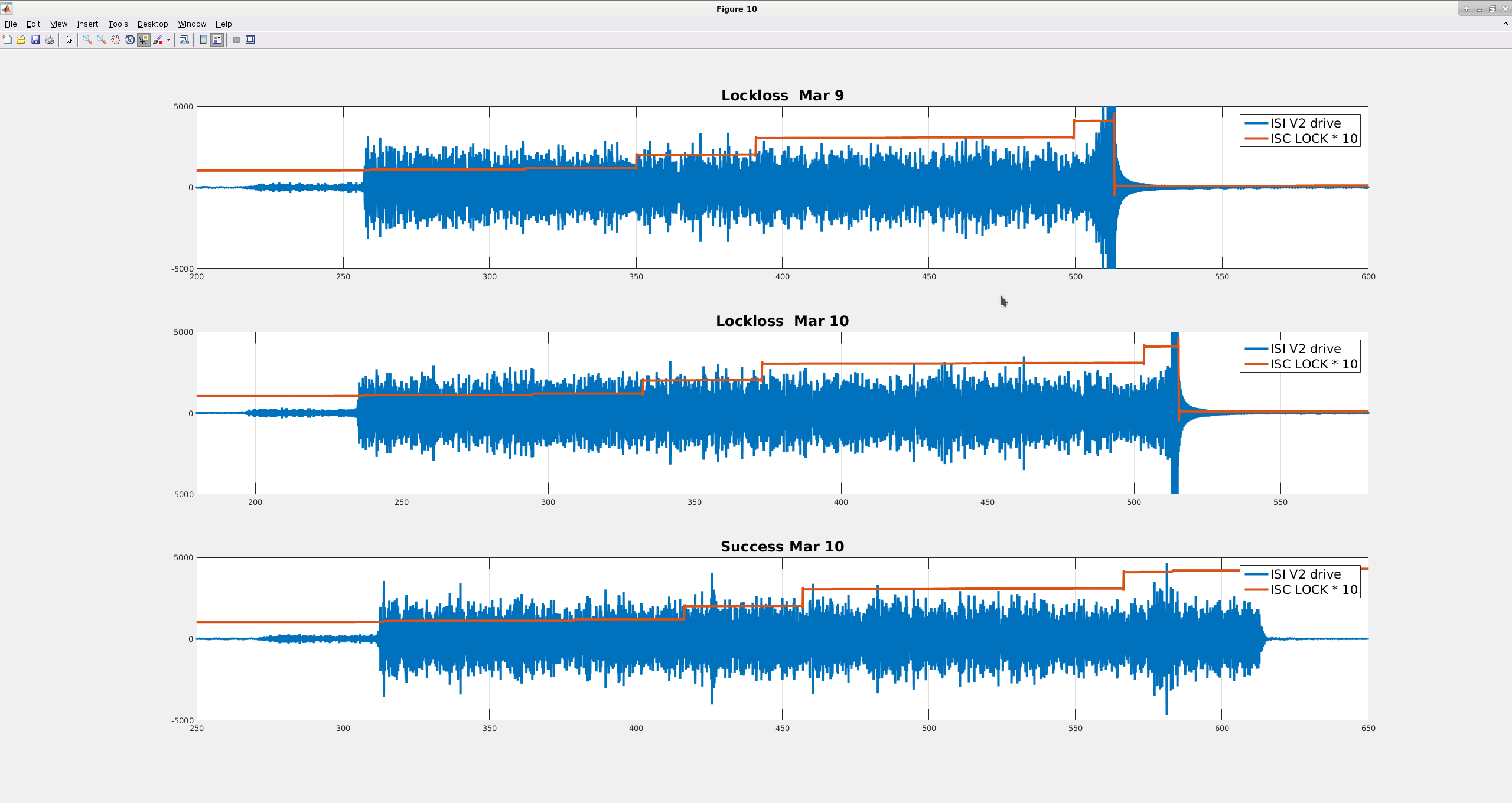
Another solution would be to push turning the BS Stage 2 loops on later in the process. The third attached plot shows the BS ISI Stage2 V2 drives for 2 ISI trip/locklosses and 1 successful lock acquisition. For each subplot, the blue trace is the V2 drive, the red trace is the ISC_LOCK state *10. For each lock, after DRMI asc comes on the SUS BS is pushing pretty hard on the ISI Stage 2, increasing the V2 drive in response. At Resonance (where the red trace on the upper 2 plots show a lock loss), each lock shows the ISI drive increasing a bit more, ringing up and causing a trip for the top two plots. The bottom plot was a successful lock, and after Resonance the BS Stage2 drives calm down a lot. If we could wait until after DRMI on POP to turn on the Stage 2 loops, we would run much less risk of tripping the BS ISI. There were some foggy recollections of trying this in the past and it was too disruptive to turn on the loops later, but no one was very sure if that was true.

Images attached to this report
H1 ISC
camilla.compton@LIGO.ORG - posted 17:13, Wednesday 11 March 2020 (55561)
Spikes in DARM before locklosses
Camilla C, Sheila D, Jenne D, Jeff K
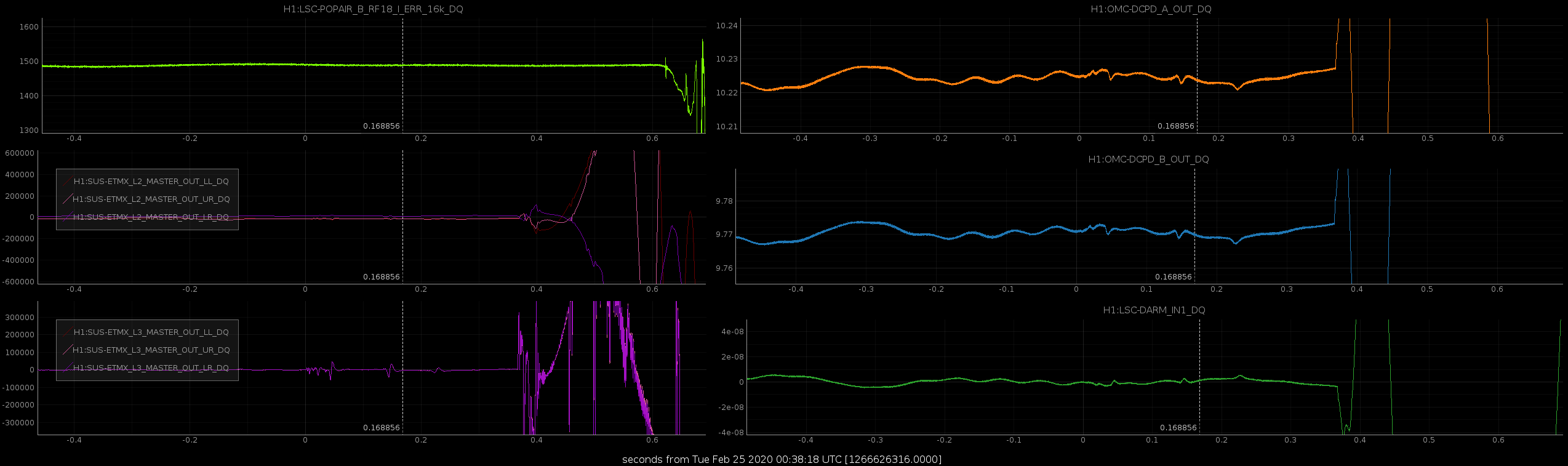
While investigating unknown locklosses, we have noticed spikes in DARM <1 second  before we loose lock.
 
This has happened in 5 out of 24 unknown slower locklosses in Feb ( 20% ). Similar spikes were seen in the 2 locklosses where the DARM offset was changed (alog 55204).
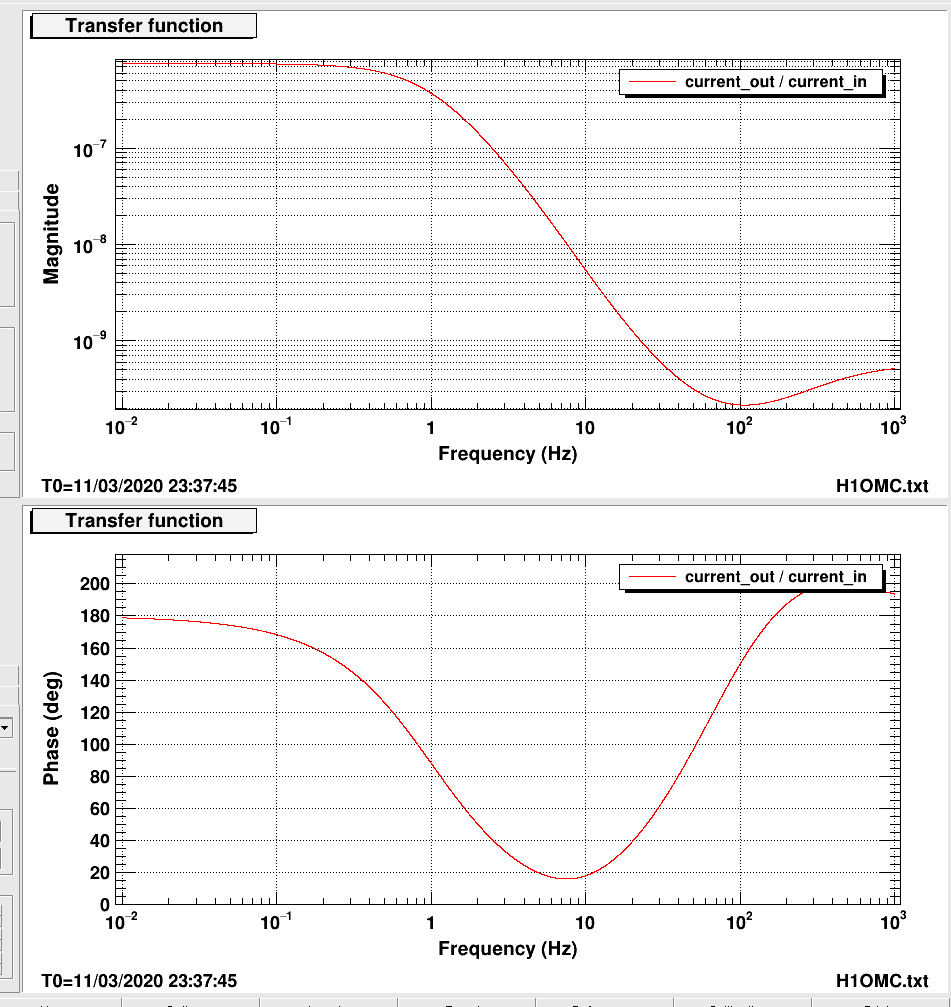
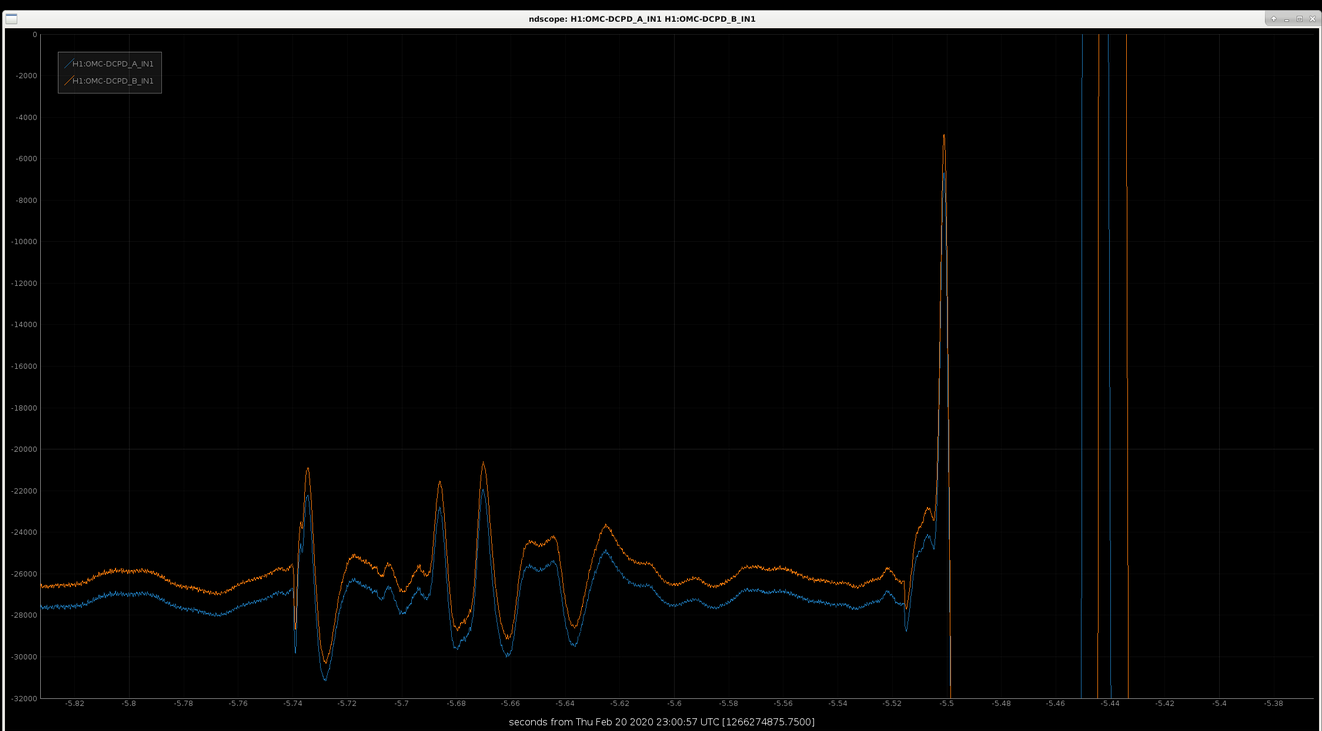
We are suspicions that the OMC-DCPD's are saturating. I have attached images of the lockloss with the OMC-DCPD OUTPUT channels, the input channels are slow so don't currently have good data but it is important to note that the filters applied reduce these ~100Hz features by a factor of 103!
Jenne captured the features on fast input channels from the higher DARM offset lockloss very close to saturating the DCPCs (saturates at value of+/-32768) although these features look small on the output channels (photo of OUTPUT CHANNELS and INPUT CHANNELS ). The other lockloss with higher DARM offset doesn't look as bad (photo).
 
There is lots of examples of other locklosses with spikes before that I have attached:  here, here, here.
The bigger (~200,000 in ETMX_L3) spikes seem to occur without us loosing lock around 5-9 times a day. Not very often compared to how many times we loose lock just after seeing them!
Images attached to this report
LHO General
thomas.shaffer@LIGO.ORG - posted 16:03, Wednesday 11 March 2020 (55551)
Ops Day Shift Summary

TITLE: 03/11 Day Shift: 15:00-23:00 UTC (08:00-16:00 PST), all times posted in UTC
STATE of H1: Aligning
INCOMING OPERATOR: Jim
SHIFT SUMMARY: Strong winds have hampered some of our commissioning and relocking efforts. Since the most recent lock loss we have lost lock from DARM_TO DC_READOUT three times. I just finished an initial alignment and Jim will be starting to try locking gain.
LOG:

H1 General
thomas.shaffer@LIGO.ORG - posted 15:23, Wednesday 11 March 2020 (55560)
Lock Loss 2030 UTC

The wind is picking up to ~45mph gusts, and it's coming from a direction that the wind fences don't cover.

We have since been having trouble getting past DC_READOUT.

H1 ISC
sheila.dwyer@LIGO.ORG - posted 11:25, Wednesday 11 March 2020 (55556)
DHARD P resonant gains removed

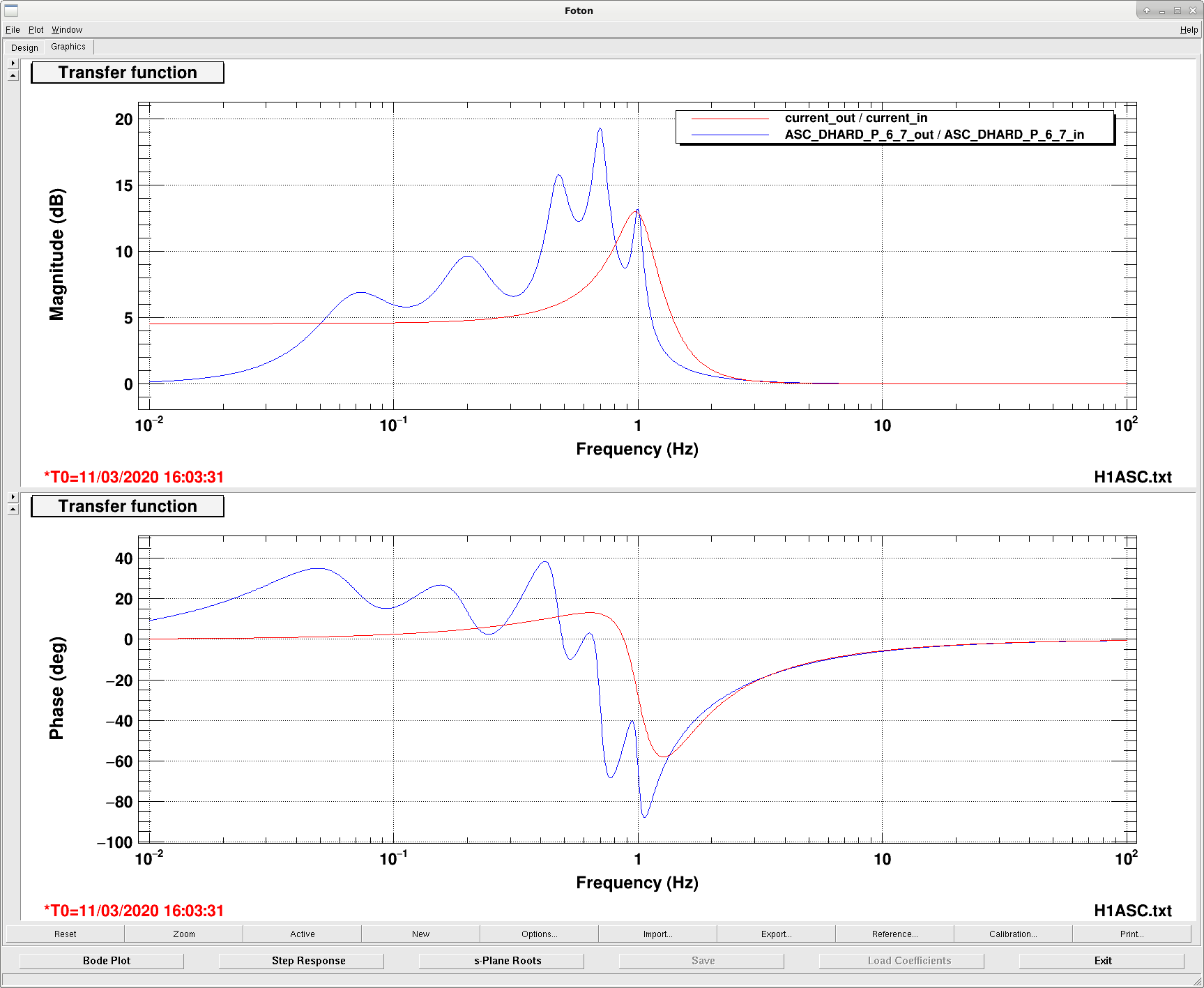
We have been running the DHARD P loop with a series of 5 resonant gains for historical and idiosyncratic reasons.  We had previously designed and tested a 1Hz boost with a bit of resonant gain to replace this a year ago, but we didn't keep this also for historical and idiosyncratic reasons.  

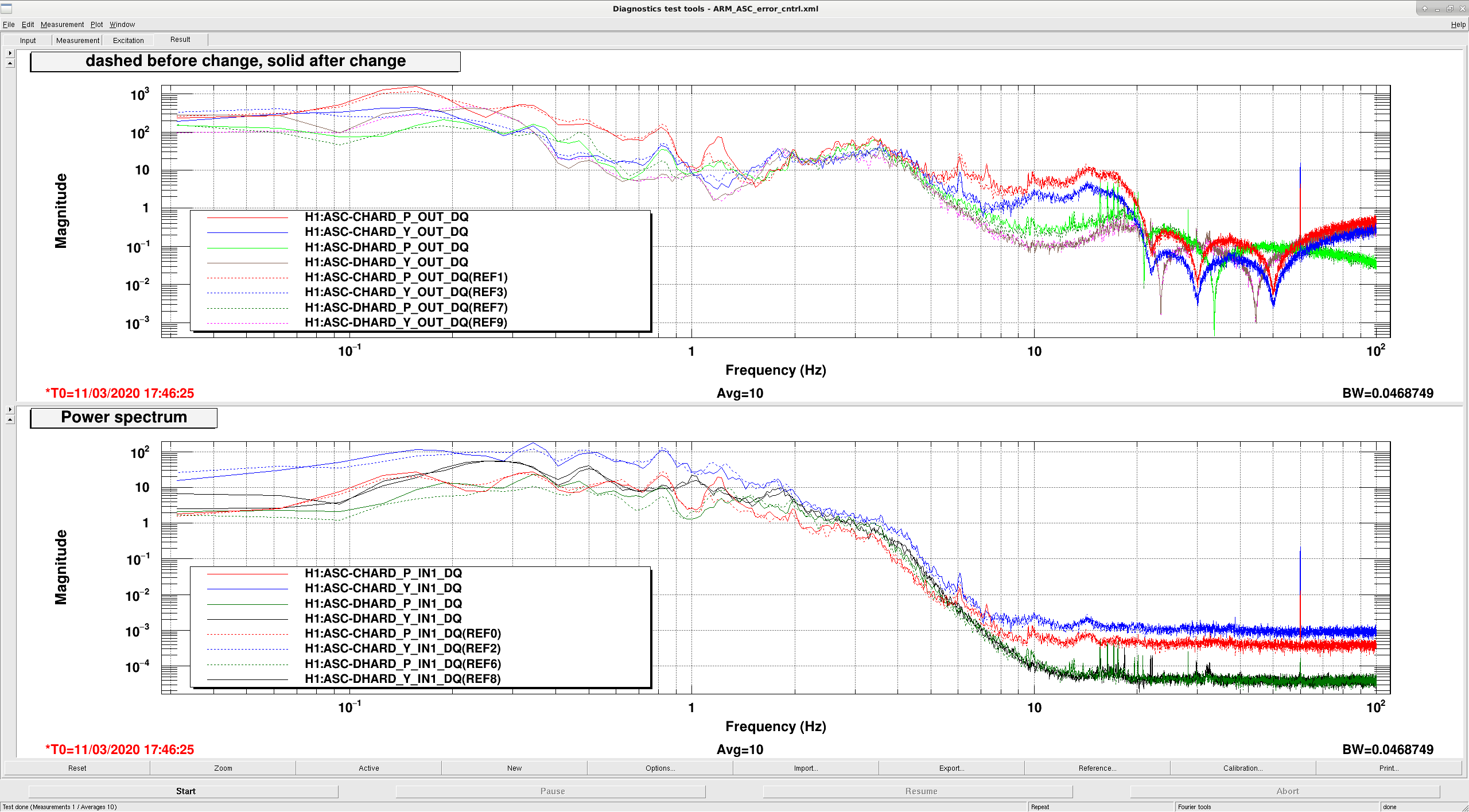
The attachment shows the comparison of the old resonant gain filter and the new boost.  The second attachment is a comparison of the ASC error and control signals before and after the change, things seem fine.  Our first lock with the new configuration was short, Camilla looked at the lockloss and said there were some of the fast glitches in DARM shortly before we lost lock.  

Since we still have not had a lon lock with this configuration, here are instructions for reverting it if we don't stay locked overnight:

Images attached to this report
H1 General
thomas.shaffer@LIGO.ORG - posted 10:55, Wednesday 11 March 2020 - last comment - 11:52, Wednesday 11 March 2020(55558)
Lock Loss 1751 UTC

We had a total of 23 minutes in Observing before we lost it again.

Comments related to this report
thomas.shaffer@LIGO.ORG - 11:52, Wednesday 11 March 2020 (55559)

Observing 1841 UTC. No lock losses during reacqusition, no intervention.

H1 SEI (OpsInfo)
thomas.shaffer@LIGO.ORG - posted 10:48, Wednesday 11 March 2020 - last comment - 10:50, Wednesday 11 March 2020(55555)
Rearranged the ISI_CONFIG screen

Since SEI_ENV is now the manager of SEI_CONF (alog55296), I made it a bit bigger on the ISI_CONFIG.adl screen.

Reminder to operators: On Tuesdays, make sure to take SEI_ENV to the MAINTENANCE state, otherwise it may jump to earthquake and turn on sensor correction during maintenance times. The MAINTENANCE state will turn off sensor correction so we won't have worry about it during that time.

Comments related to this report
thomas.shaffer@LIGO.ORG - 10:50, Wednesday 11 March 2020 (55557)

I should note that this is reflected in our usual daily check sheet as well: https://lhocds.ligo-wa.caltech.edu/ops/opchecksheet

H1 General
thomas.shaffer@LIGO.ORG - posted 09:40, Wednesday 11 March 2020 (55553)
Adjusted ALSX fiber polarization

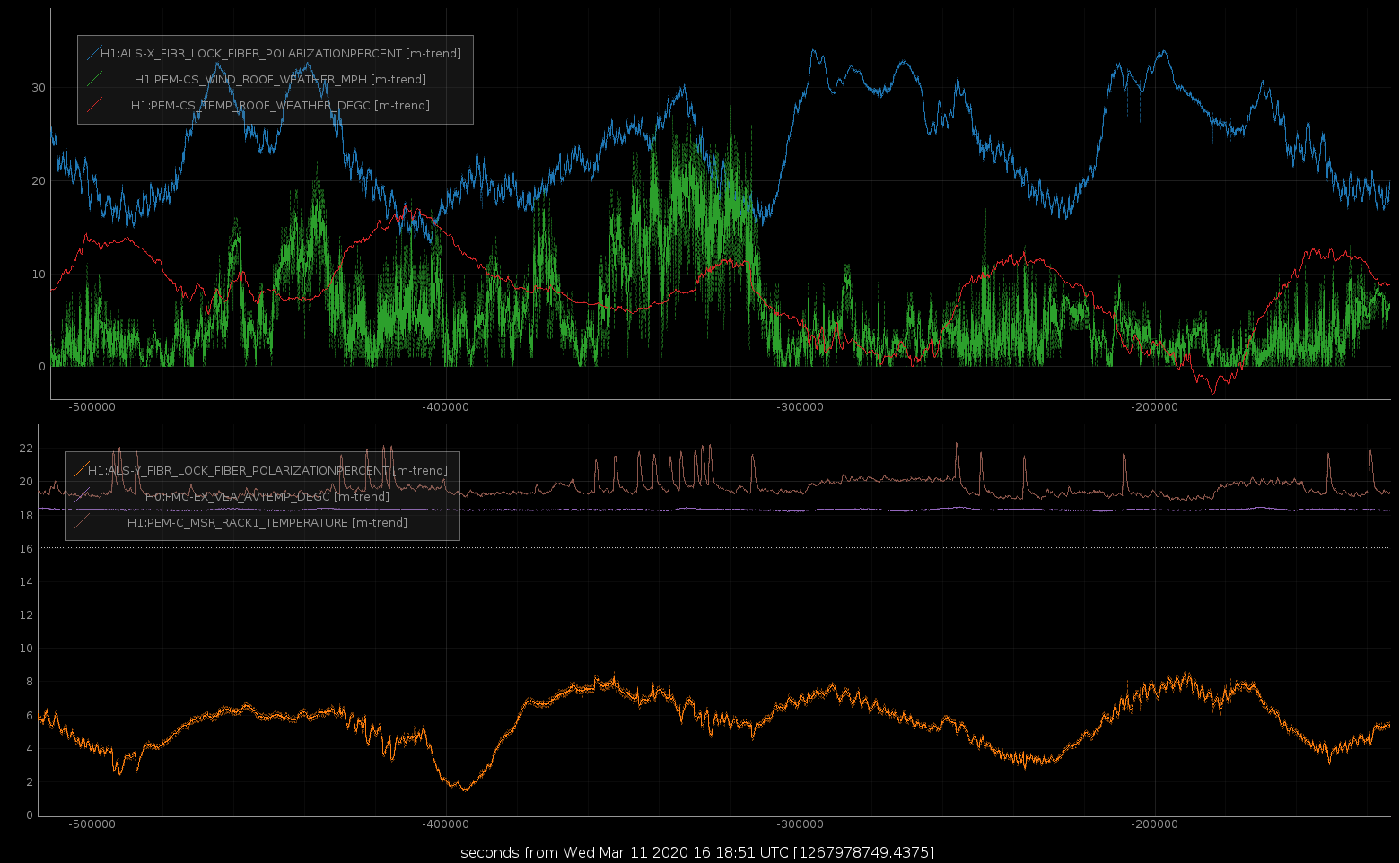
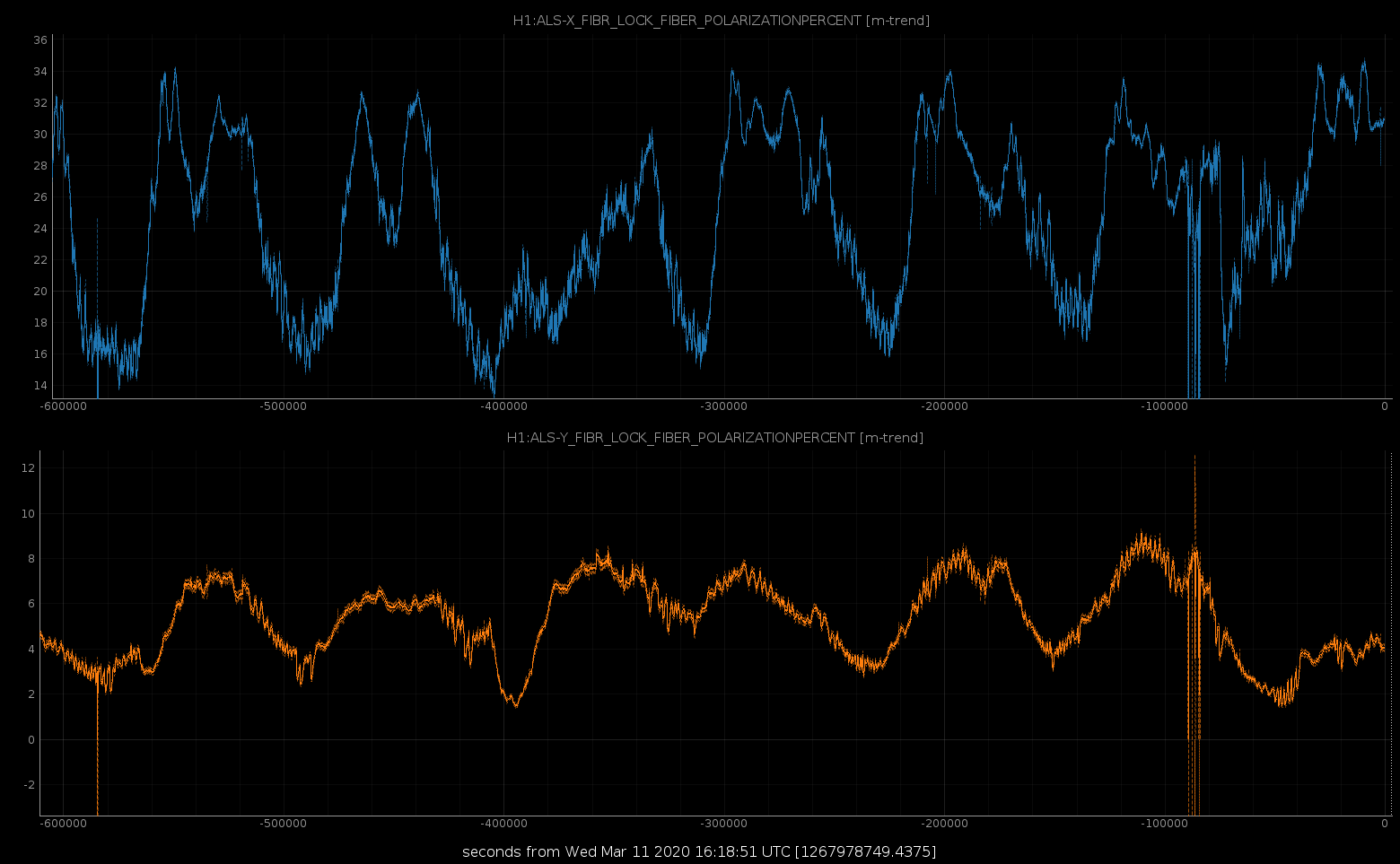
Went from 49% to 30%. it seems that ALSX polarization is moving with the outside Temperature, and it seems to be moving much more than Y. In the first attached plot the X polarization (blue) matches up with the outside temp (red). Second plot is just the polarizations for the past ~6 days.

Images attached to this report
H1 General
thomas.shaffer@LIGO.ORG - posted 08:47, Wednesday 11 March 2020 - last comment - 10:36, Wednesday 11 March 2020(55552)
Lock Loss 1544 UTC

No obvious cause

Comments related to this report
thomas.shaffer@LIGO.ORG - 10:36, Wednesday 11 March 2020 (55554)

Observing 1728 UTC.

I adjusted the ALSX fiber polarization after the first few lock losses that happened before we could get off of green. We then had a few lock losses on our way up at various places, but eventually made it all the way up.

I still haven't found any clues about the last lock loss. It seemed pretty sudden, and I'm not seeing much reaction from ASC and very little from LSC only about ~0.1 before we lose lock. The FSS seemed to be good for this lock reacqusition, and wasn't the cause of the lock loss either.

LHO General
thomas.shaffer@LIGO.ORG - posted 08:00, Wednesday 11 March 2020 (55550)
Ops Day Shift Transition

TITLE: 03/11 Day Shift: 15:00-23:00 UTC (08:00-16:00 PST), all times posted in UTC
STATE of H1: Observing at 116Mpc
OUTGOING OPERATOR: Camilla
CURRENT ENVIRONMENT:
    SEI_CONF state: WINDY
    Wind: 3mph Gusts, 1mph 5min avg
    Primary useism: 0.02 μm/s
    Secondary useism: 0.23 μm/s
QUICK SUMMARY: Locked for 15 hours, calm environment.

H1 General
jim.warner@LIGO.ORG - posted 00:05, Wednesday 11 March 2020 (55549)
Shift Summary

TITLE: 03/11 Eve Shift: 23:00-07:00 UTC (16:00-00:00 PST), all times posted in UTC
STATE of H1: Observing at 116Mpc
INCOMING OPERATOR: Camilla
SHIFT SUMMARY: One canadian earthquake, not much else to report
LOG:

23:50 Observing 

1:21 Verbal notification for a nearby earthquake, but it wasn't too rough on site

LHO General
thomas.shaffer@LIGO.ORG - posted 17:07, Tuesday 10 March 2020 (55521)
Ops Day Shift Summary

TITLE: 03/11 Eve Shift: 23:00-07:00 UTC (16:00-00:00 PST), all times posted in UTC
STATE of H1: Observing at 119Mpc
INCOMING OPERATOR: Jim
SHIFT SUMMARY: Maintenance day. Not a tough recovery, but one lock loss before shift end.
LOG:

H1 CDS
david.barker@LIGO.ORG - posted 16:40, Tuesday 10 March 2020 (55548)
lock loss alert system new features

I added two new features to the lock-loss-alerting system today.

Guardian repeat alerts

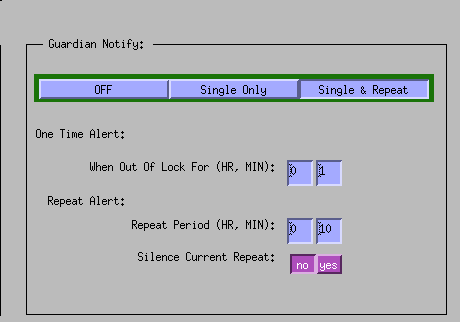
Guardian alerts are now handled the same way as lock-loss and out-of-observation alerts. The user has the option for a single alert (default time is immediate) or single alert plus repeat alerts (see attachment).

GraceDb event time

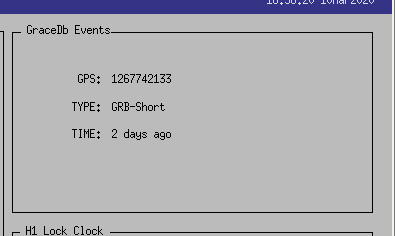
The time of the GraceDb event is shown both as its GPS time and a more readable time string like '50 minutes ago' or '5 hours ago' (see attachment)

Images attached to this report
LHO VE (VE)
gerardo.moreno@LIGO.ORG - posted 15:58, Tuesday 10 March 2020 (55547)
Y-Mid Station RGA is Online

(Filiberto C, Carlos P, Gerardo M)

The cable run was done last week as well as the termination of end connectors.  Today comunication was established with the rga at the Y mid station.

H1 CAL (CAL, ISC)
sudarshan.karki@LIGO.ORG - posted 16:45, Monday 02 March 2020 - last comment - 17:27, Wednesday 11 March 2020(55274)
Low Frequency Sensing Function

Sheila, Sudarshan

Since sensing function measurements taken during O3A, at low frequencies, couldnot be entirely explained by the detuned signal recycling cavity, efforts were made to understand the mechanism by which the measured sensing function could be explained. There were indications that some of these effect could be a result of unmodeled cross couplings between length and angle. Details of some previous efforts can be found in LHO alog # 50511 and DCC document G1901353.

Here we have explored the deviation in measured sensing function from the simple DARM model (with a cavity pole and optical gain) in two different configurations, with A2L gain turned on and A2L gain turned off. The details about the measurment can be found in LHO alog # 54679.

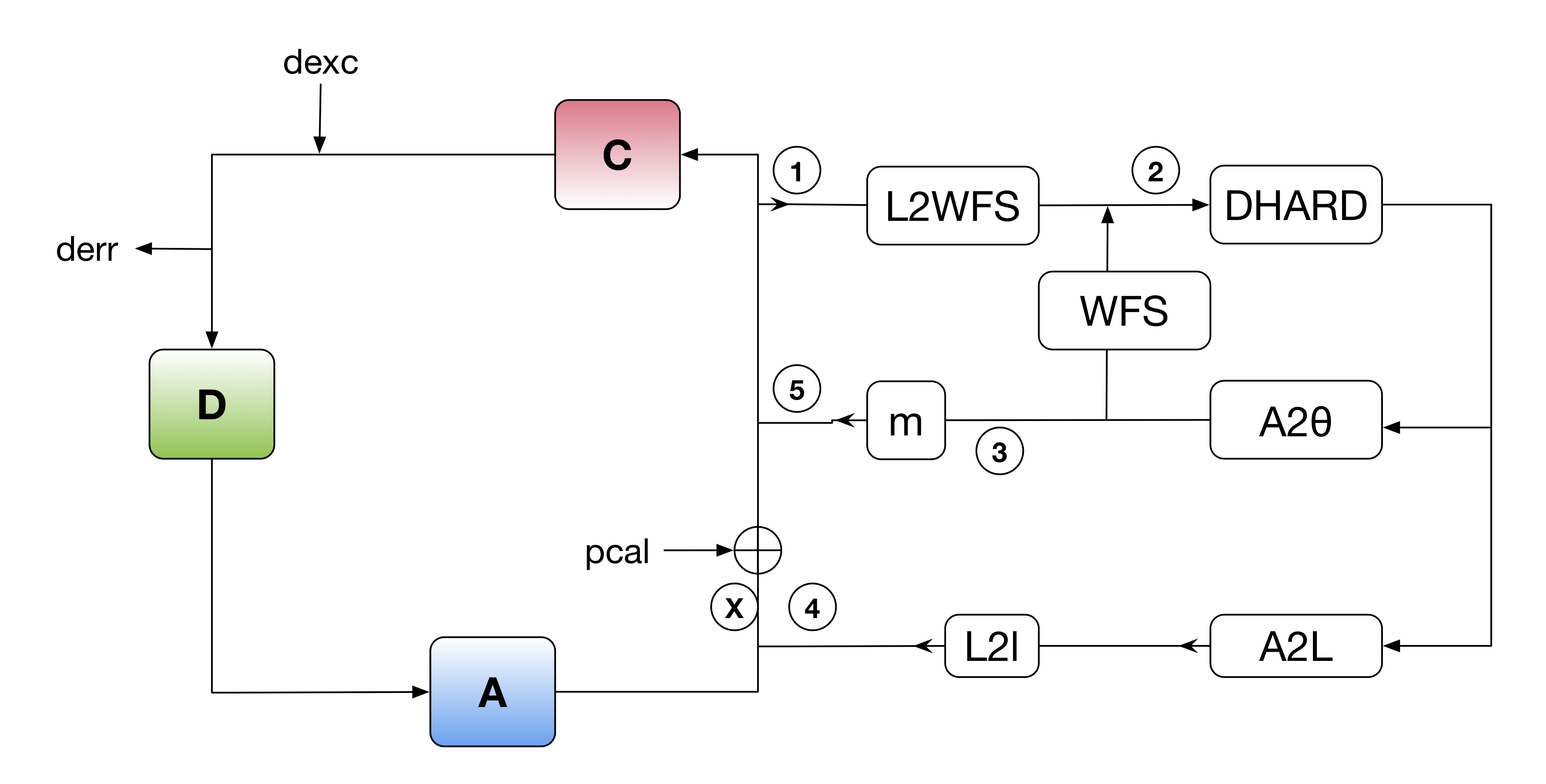
The sensing function model that is considered here is shown in the block-diagram below:

Model Block Diagram

This model considers length (DARM) to angle coupling through the wavefront sensor of the DHARD loops. In this model, the sensing function depends on the the DHARD loop shape  as well as the A2L gain. The resultant sensing function differs from the simple model (without cross couplings) as follows:

C_new = C_old/[1-B(L2l*A2L/A2theta+m)]

where B is:

B = GDH/(1-GDH)*(L2WFS/WFS)

and GDH is the DHARD open loop gain.

The comparison between the model and the measurement is shown in the first attached pdf. It shows a reasonable agreement between the model and measurement, although there is some discrepancies at frequencies below 10 Hz. This model only includes the length to angle coupling in pitch. Coupling in yaw, we believe it to be relatively small, has not been considered. Additionally, the model of the DAHRD loop that is considered here doesnot completely agree with the measurement as shown in the second attachment. 

Images attached to this report
Non-image files attached to this report
Comments related to this report
sudarshan.karki@LIGO.ORG - 17:27, Wednesday 11 March 2020 (55513)

Some of the terms used above are defined here:

1. L2WFS : WFS sensitivity to DARM length

2. A2θ : PUM angle drive to test mass angular displacment

3. A2L : Angle to length drive-align digital filters

4. L2l : PUM length drive to testmass length displacment 

5. m : miscentering of the IFO beam on testmass

Displaying reports 35281-35300 of 89220.Go to page Start 1761 1762 1763 1764 1765 1766 1767 1768 1769 End