Displaying reports 35541-35560 of 89220.Go to page Start 1774 1775 1776 1777 1778 1779 1780 1781 1782 End
Reports until 13:10, Tuesday 25 February 2020
H1 CDS
david.barker@LIGO.ORG - posted 13:10, Tuesday 25 February 2020 (55293)
CDS Maintenance Summary: Tuesday 25th February 2020

h1pslctrl0 restart, IOC now running

Rick, Jason, Dave:

The diode room OPC computer h1pslctrl0 was rebooted. This fixed the problem with its EPICS IOC which has been down since 23jan2020. I added the H1EPICS_PSLOPC0.ini back into the DAQ.

h1seiproc model, added ramped mux matrix parts

Jim, Dave:

The h1seiproc model was changed and restarted. This adds slow ramped mux-matrix parts.

restarted stuck GigE cameras

Dave:

Cameras 08, 18 and 26 were stuck and not restarting via web. I restarted them as root on the servers.

Guardian Node Rename

TJ, Jim, Dave:

The ENV_STAT node was renamed SEI_ENV. H1EPICS_GRD.ini was updated.

DAQ restart

DAQ and h1edc restarted for: h1seiproc change, guardian node rename, add back h1pslctrl0 channels.

FOM upgrades and restarts

Dave:

I patched and restarted all the control room FOM machines. nuc30 launch.sh needed a bit more delay when starting the digital video.


H1 General
camilla.compton@LIGO.ORG - posted 12:58, Tuesday 25 February 2020 (55292)
LVEA Swept

East crane is a few meters off it's parking spot. I don't think this is new.

H1 CDS (ISC, SUS, TCS)
filiberto.clara@LIGO.ORG - posted 12:54, Tuesday 25 February 2020 - last comment - 17:07, Tuesday 25 February 2020(55291)
ALS EX Laser interlock reconnected to safety system

WP 8543
FRS 14250

Safety system at EX was restarted this morning. Power cycling the system cleared the interlock errors for both the ALS (FRS 14250, alog 55171 ) and PCAL (alog 55260).

The temporary bypassed jumper was removed and the ALS laser interlock reconnected to the safety system. With system down, we moved the 24V power for the safety chassis to its own dedicated power supply.

Effected systems from this work were powered back on.

ALS EY laser
ALS EX laser
EX ESD HV
SQZ laser
TCSX/Y lasers

F. Clara, C. Compton, R. McCarthy, T. Shaffer, and P. Thomas

Comments related to this report
jeffrey.kissel@LIGO.ORG - 17:07, Tuesday 25 February 2020 (55305)CAL, DetChar, INJ
For future reference and data quality flags, the total time that PCALX laser was down is as follows (based on trending the channel showing the PCALX laser diode current, H1:CAL-PCALX_LASERDIODECURRENT):
2020-02-19 00:16:57 UTC to 2020-02-25 17:38:49 UTC 
1266106635 to 1266687547
580912.0 seconds
161.36 hours
6.7 days.
H1 PSL
jason.oberling@LIGO.ORG - posted 12:07, Tuesday 25 February 2020 (55290)
PSL Work Today (including LHO WP 8544 & FAMIS 10751)

J. Oberling, R. Savage, P. Thomas

Today we tuned up the FSS path (due to a slow drop in the TPD) and restarted h1pslctrl0 (WP 8544).

FSS Tune Up

The RefCav TPD had been trending down over the last week or so, and today was at 2.5 V, so Rick and I went into the enclosure to tune the FSS.  All work was done with the ISS OFF.

We began by measuring the power at a few points:

Looking at where we left things after our last tune up in December 2019, the power into the AOM is unchanged but the power out is a decent bit lower; this indicates the alignment through the AOM had slightly shifted.  With the RefCav locked, the alignment of the AOM was tweaked; the tweaks were primarily in the vertical direction, with some pitch adjustment as well.  When done, the TPD read ~5.2 V, an over 100% improvement from where we started.  We then measured the power in the same places as above and found the following:

This matches better with where we left things in December.  We then fine tuned the RefCav alignment using the picomotor-equipped mirror mounts and ended with a final TPD of ~5.54 V.  To end, we measured the TF of the FSS loop.  We started with a common gain of 20 and a fast gain of 16, and measured a UGF of 536 kHz.  The common gain was dropped by 2 dB to 18 to give a little more gain margin, with the fast gain unchanged at 16; with these settings the UGF is ~406 kHz, with 52° of phase margin (see attachment).  The change in common gain was accepted in SDF.

h1pslctrl0 Restart (WP 8544)

With the FSS tuning complete, we then grabbed Patrick (our resident Beckhoff expert) and proceeded to restart h1pslctrl0.  The PSL stabilization loops were disabled, then the PSL was turned off and the chillers shut down.  This complete, we restarted the computer; it came back without issue.  The chillers were restarted and the PSL was turned back on; all this occurred without a single problem.  We confirmed the OPC-IOC shell was functioning correctly by looking at the Laser MEDM screen (this screen is populated primarily by channels forwarded to EPICS by the OPC-IOC shell) and confirming the values were displaying correctly; they were.  As a further test, and so we could open the external shutter to provide light to the PMC, the EPICS Alarm interlock was reset from the Laser MEDM screen (the only place this interlock can be reset without forcing the variable in Beckhoff); this worked without issue and I was able to open the external shutter.  As a further further test, I enabled both power watchdogs from MEDM (at 19:14 UTC, 11:14 PST, completing FAMIS 10751 in the process); this also functioned correctly.  Therefore we conclude that the restart of h1pslctrl0 was a success and all PSL Beckhoff channels are once again available within EPICS.  This completes LHO WP 8544.

With the above complete and with the laser having warmed up for ~30 minutes, I enabled the PMC and FSS.  The PMC reflected power was reading 11.9 W, which is a little high, so I quickly tweaked the beam alignment into the PMC using the picomotor-equipped mounts.  The best I could get quickly was a reflected power of 11.7 W, which gave a transmitted power of 51.8 W.  I then turned the ISS ON, and found the diffracted power at ~1.6%; a little low, but not enough to worry about at this point (I'll give this and the PMC reflected power a little more attention during a future maintenance window).  This completes all PSL work for this maintenance window.  The PSL is currently, with the 1st loop ISS ON but the 2nd loop ISS OFF, outputting ~52.5 W; the FSS TPD is currently reading ~5.6 V.

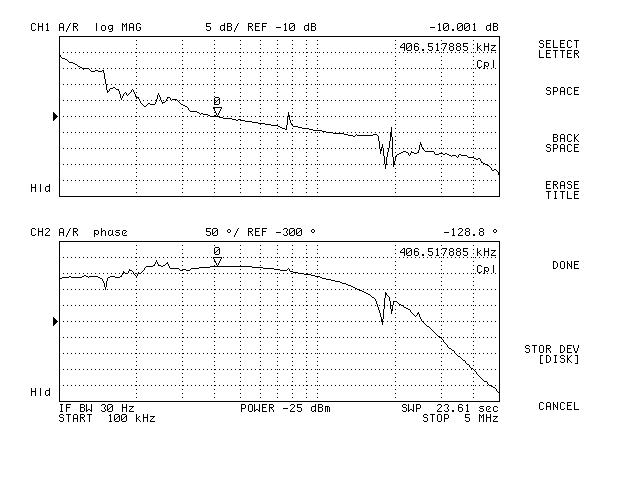
Images attached to this report
H1 TCS
camilla.compton@LIGO.ORG - posted 11:17, Tuesday 25 February 2020 - last comment - 13:57, Wednesday 26 February 2020(55288)
TCS X Chiller filter changed
WP 8545 TJ, Camilla.
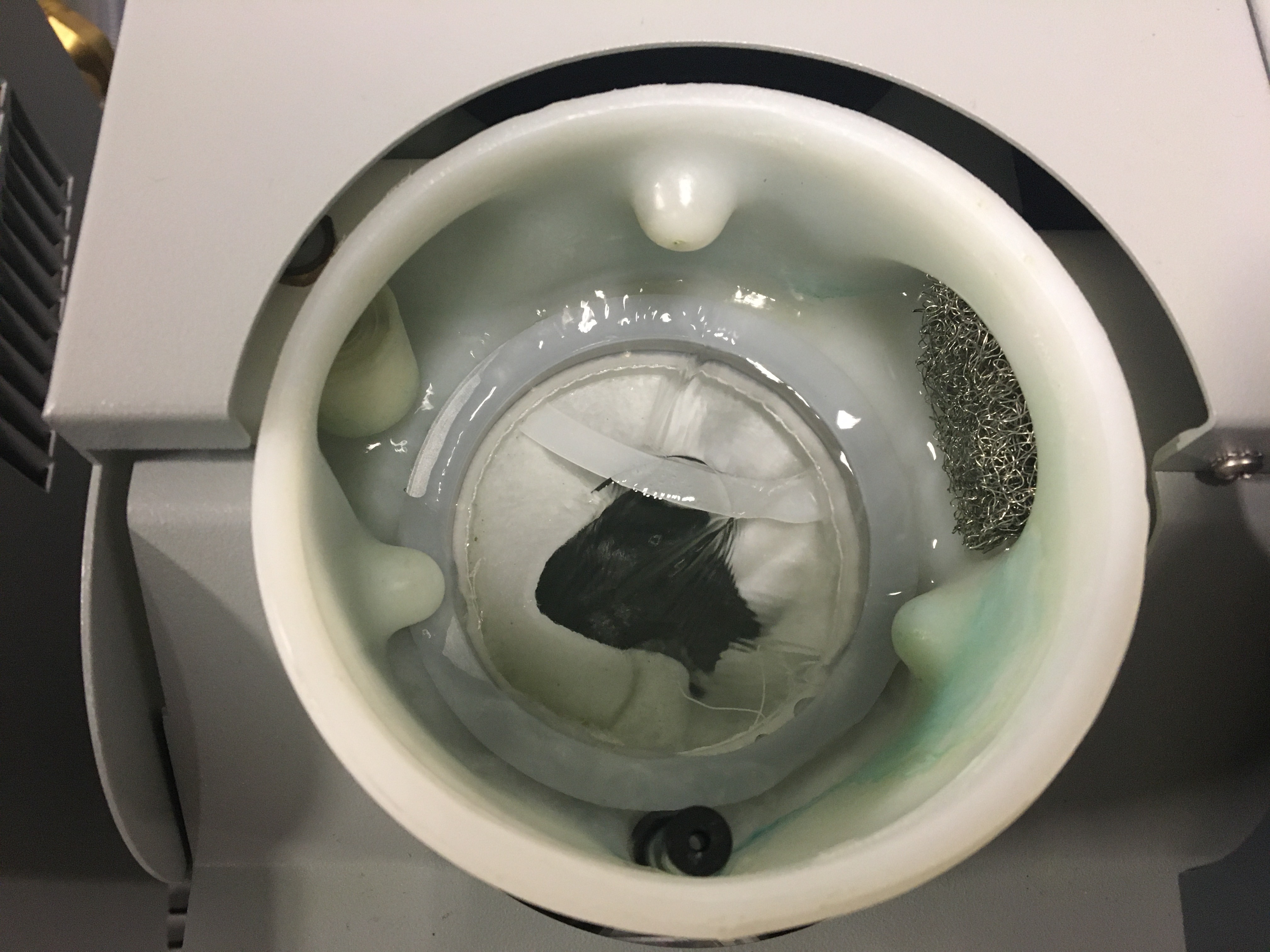
The TCS X chiller filter which has been looking green was changed to a new one (photo) and the area wiped out/ metal wire plug rinsed. This involved turning the CO2 X laser and TCS X chiller off around 16:45 UTC to 17:15 (chiller), 18:15 (laser).
Images attached to this report
Comments related to this report
stephen.appert@LIGO.ORG - 11:26, Wednesday 26 February 2020 (55315)TCS

Does this green filter look more green than usual, given service life? Are there any substantial particles within the mesh? Wondering how those on site are reacting to the findings of this log.

It seems that there is no apparent large particulate, which may have been precursors to the LLO TCS CO2 laser chiller filter issues (ref. LLO aLOG 25658, LLO aLOG 22766, E1600282). However, thought I'd check to confirm that this is the case.

thomas.shaffer@LIGO.ORG - 13:57, Wednesday 26 February 2020 (55317)

There isn't any particulate like in the LLO2276, just the usual greenish-grey coloring and sludge of the same color in the wire mesh filter. I don't think that the this greening has been getting worse, but I could anecdotally say that I find the TCSX filter needing to be swapped more frequently (need to check logs at the chiller to verify).

LHO General
patrick.thomas@LIGO.ORG - posted 08:15, Tuesday 25 February 2020 (55283)
Ops Day Shift Start
TITLE: 02/25 Day Shift: 16:00-00:00 UTC (08:00-16:00 PST), all times posted in UTC
STATE of H1: Preventive Maintenance
OUTGOING OPERATOR: TJ
CURRENT ENVIRONMENT:
    SEI_CONF state: SC_OFF_NOBRSXY
    Wind: 2mph Gusts, 1mph 5min avg
    Primary useism: 0.02 μm/s
    Secondary useism: 0.30 μm/s 
QUICK SUMMARY: Ran PEM injection at 15:45 UTC. Maintenance has begun.
H1 SQZ
sheila.dwyer@LIGO.ORG - posted 06:28, Tuesday 25 February 2020 - last comment - 11:15, Tuesday 25 February 2020(55281)
squeezer cycled

Looks like we had a repeat of the squeezer 15kHz oscillation problem.  It sounds like neither TJ nor I got an alert. I requested no_squeezing and then after it arrived requested squeezing again. We are back in observe.


Comments related to this report
thomas.shaffer@LIGO.ORG - 06:38, Tuesday 25 February 2020 (55282)CDS

IFO_NOTIFY correctly saw the issue and moved to the ALERT_ACTIVE state at 13:03 UTC, but I didn't receive anything until it went back to WAITING at 14:23 UTC when Sheila fixed it.

2020-02-25_13:03:03.143111Z IFO_NOTIFY [ALERT_ACTIVE.enter]
2020-02-25_13:03:03.218729Z IFO_NOTIFY [ALERT_ACTIVE.run] SQZ OPO REFL DC Power has increased. Sending
2020-02-25_14:23:27.577427Z IFO_NOTIFY JUMP target: WAITING
2020-02-25_14:23:27.578100Z IFO_NOTIFY [ALERT_ACTIVE.exit]


Out of Observing from 1422-1423 UTC

sheila.dwyer@LIGO.ORG - 09:01, Tuesday 25 February 2020 (55284)

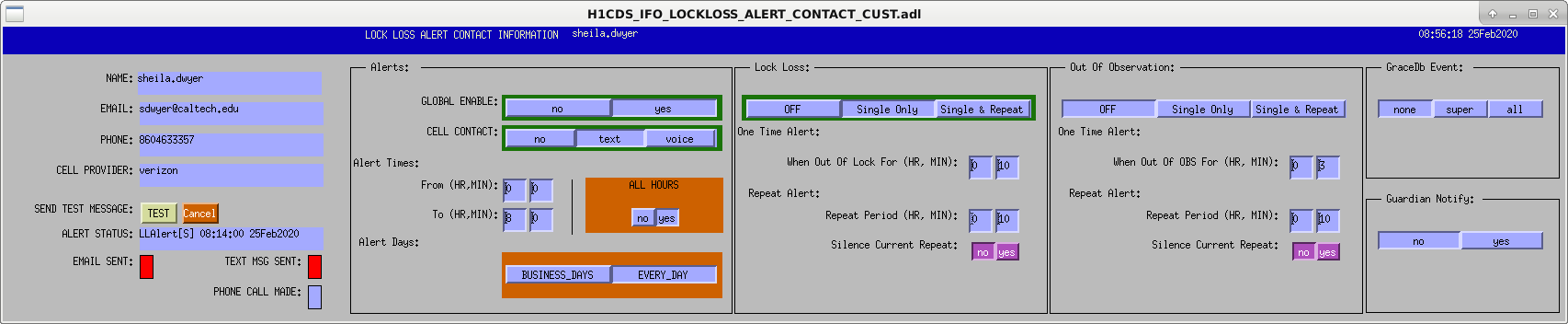
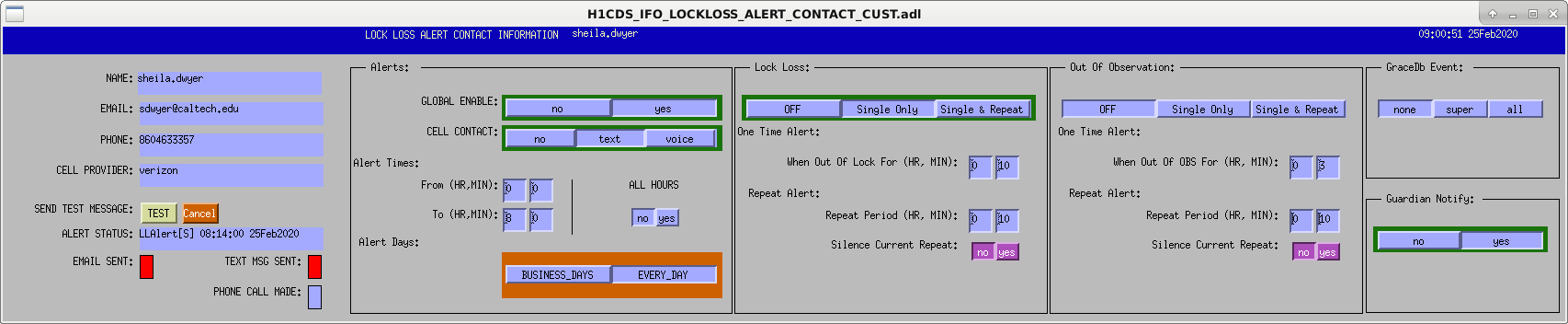
The reason that I didn't get a notification might be that I didn't have guardian notify set to yes.  Screenshots attached.

Images attached to this comment
david.barker@LIGO.ORG - 11:15, Tuesday 25 February 2020 (55289)

The system is currently designed not to send Guardian alerts if the IFO is both locked and in observe. This morning when H1 was briefly taken out of observe to reset the squeezer the pending alert was issued.

Design details: if the IFO is not locked+observe and IFO_NOTIFY state transistions to state 30, then GRD alerts are immediately sent out and the system is latched to prevent repeat alerts. The latch is cleared when the IFO goes into locked+observe.

If it is determined that Guardian alerts should be sent irrigardless of the IFO state (e.g. squeezer causing range degradation), I can change the code to do this. We will need to ensure that IFO_NOTIFY does not oscillate between its states too quickly otherwise many alerts could be sent.

LHO General
corey.gray@LIGO.ORG - posted 23:57, Monday 24 February 2020 (55280)
Eve Shift Summary

TITLE: 02/25 Eve Shift: 00:00-08:00 UTC (16:00-00:00 PST), all times posted in UTC
STATE of H1: Observing at 119Mpc
INCOMING OPERATOR: TJ
SHIFT SUMMARY:

A little lockloss here, some commissioning there, and a superevent candidate near the end.  Environmentally, winds have died down & microseism is flattening out at a fairly nice and low-ish value.
LOG:

LHO General
corey.gray@LIGO.ORG - posted 20:13, Monday 24 February 2020 (55279)
Mid Shift Status

Had one lockloss & some commissioning time during the 1st half of the shift, and currently have been locked for 90+min.

Winds are hovering around 10mph & micrseism continues to drop.

H1 ISC
sheila.dwyer@LIGO.ORG - posted 19:11, Monday 24 February 2020 - last comment - 15:50, Tuesday 03 March 2020(55278)
45 minutes of commissioning for DARM offset change tests

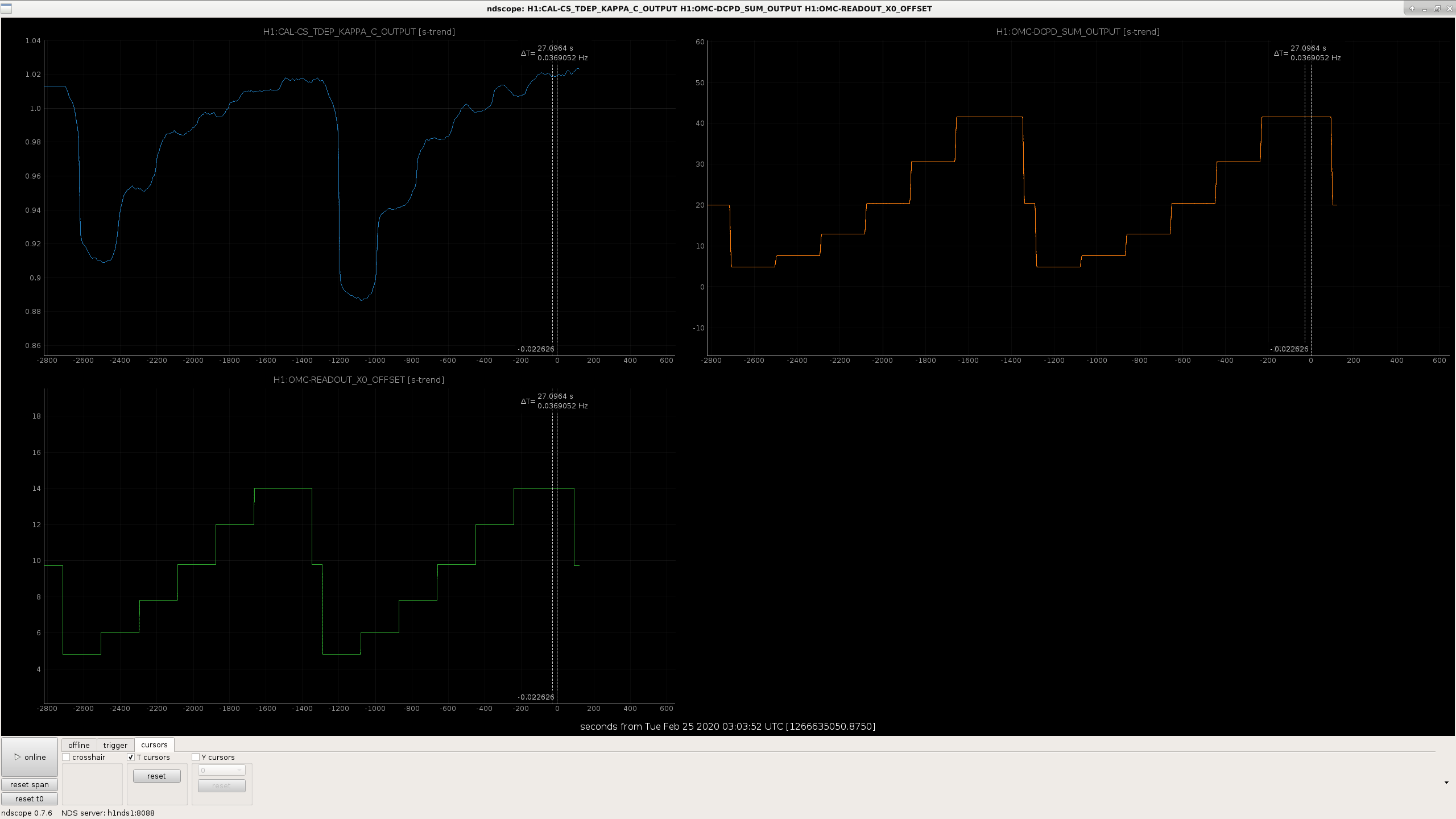
I measured the optical gain for different light levels on the DCPDs before and after lowering the 9MHz modulation depth.  We did this as we relocked. 

The scan started at 2:18:40 UTC Feb 23rd, and went until 3:05:23 UTC


Images attached to this report
Comments related to this report
sheila.dwyer@LIGO.ORG - 10:49, Wednesday 26 February 2020 (55287)

Attached is a plot of the DCPD power vs optical gain during this test.  Although these two traces look similar when plotted this way, there is a consistent difference between the two, and fitting for the amount of junk light inboth cases gives 1.09 +/- 0.06 mA in the high modulation depth measurement, and 1.35+/- 0.06 mA in the low modulation depth case.  

While looking at this data I realized that I had made an error in an earlier alog about modulation depths, which is corrected in the comment now.  Based on the change in modulation depth (first scan taken with a 23.4dBm epics setting on driver, which means 0.189 radians modulation depth, second scan taken at 20.3dBm setting which means 0.159 radians), we would expect that carrier light in the interferometer would be reduced by 0.5% and the sideband power injected would be increased by 40% when the modulation depth is decreased. 

This result suggests that the junk light we are seeing is probably not the 9th order 9MHz mode which is near resonance in H1's OMC 46667.  

One explanation for this result could be that I made the test while the interferometer was still thermalizing.  The attached screenshot shows trends while the measurement was taken, the fastest part of the thermal transient was over. 

There was a 0.8% increase in the circulating power in the Y arm, 0.9% increase in the X arm, when the modulation depth was increased, so both of those are sligthly higher than we expected for the change in modulation depth.  It could be that an alignment set point changes when we change the 9MHz modulation depth, which is generating extra carrier junk light. 

Non-image files attached to this comment
sheila.dwyer@LIGO.ORG - 13:57, Wednesday 26 February 2020 (55316)

The increase in junk light after the 9MHz reduction made Keita and I ask ourselves why we are doing this reduction, and if the tests that motivated the change would have the same outcome in our current configuration.  It seems plausible that the reason this produces junk light (if it does) are related to TCS settings, spot positions and circulating power.

history of 9MHz modulation depth:

  • Sept 2016:
    • 9MHz reduction by 6dB added to guardian after power increase.  29983
    • OMC trans image changed with 6dB reduction in 9MHz; suggestion that 900 Hz peak is reduced by 9MHz reduction, 29817 I seem to remember that this change in the 900Hz peak was not repeatable, we were just being confused by noise which came and went.
    • Identification of 9th order 9MHz mode in transmission through OMC: 29395
  • Nov 2016:
    • 9MHz reduction which was done after power increase is removed from guardian because of locklosses, we weren't sure if it mattered for sensitivity.
  • April 2018:
    • EOM swapped, so dBm settings are not directly comparable before and after this time. 41435
  • late Oct 2018:  
    • Refl 9 slew rate limited: 44771
    • The first result in this alog looks dramatic but if you read all the comments and the story becomes much less clear.  The drive levels being compared aren't written in the alog, but I am infering from the plots that these are comparisons between 23dBm drive setting (nominal at the time, 0.184rad) and 17dBm (called redcued here, 0.130 radians) : 44781
  • Nov 2018:
    • increasing 9MHz by 6dB compared to nominal setting (of 20dBm) makes DARM worse, lowering it doesn't help 45173
    • I am not finding this discussion in the alog, but my memory is that Koji told us that the EOM driver is more noisy when operating at it's max power, so we probably have more 9MHz RIN when we operate at 26dBm on the driver. 
  • Mid Jan 2019: 
    • 46444 we were operating with a 20dBm setting on the 9MHz driver, (0.159 radians 55304) and reported that increasing the drive by 3dBm reduced the range by 10Mpc. (Also estimated sideband/carier ratios on OMC QPDs)
sheila.dwyer@LIGO.ORG - 15:50, Tuesday 03 March 2020 (55405)

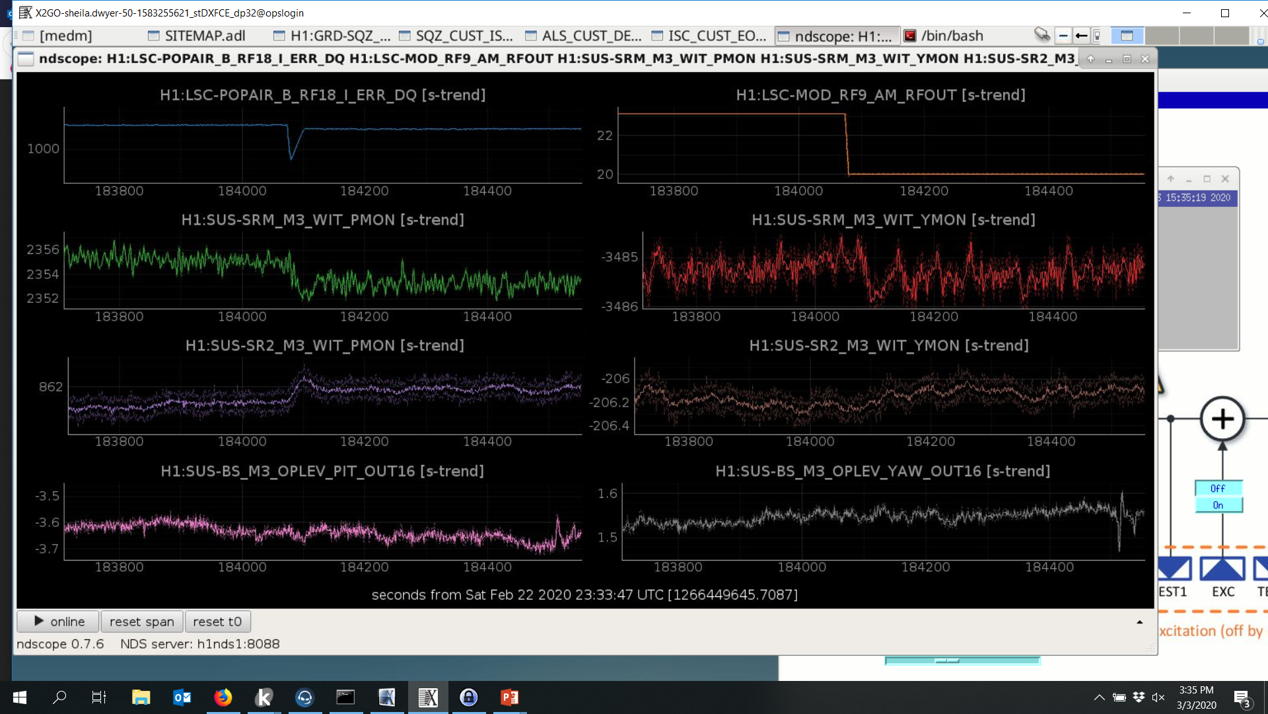
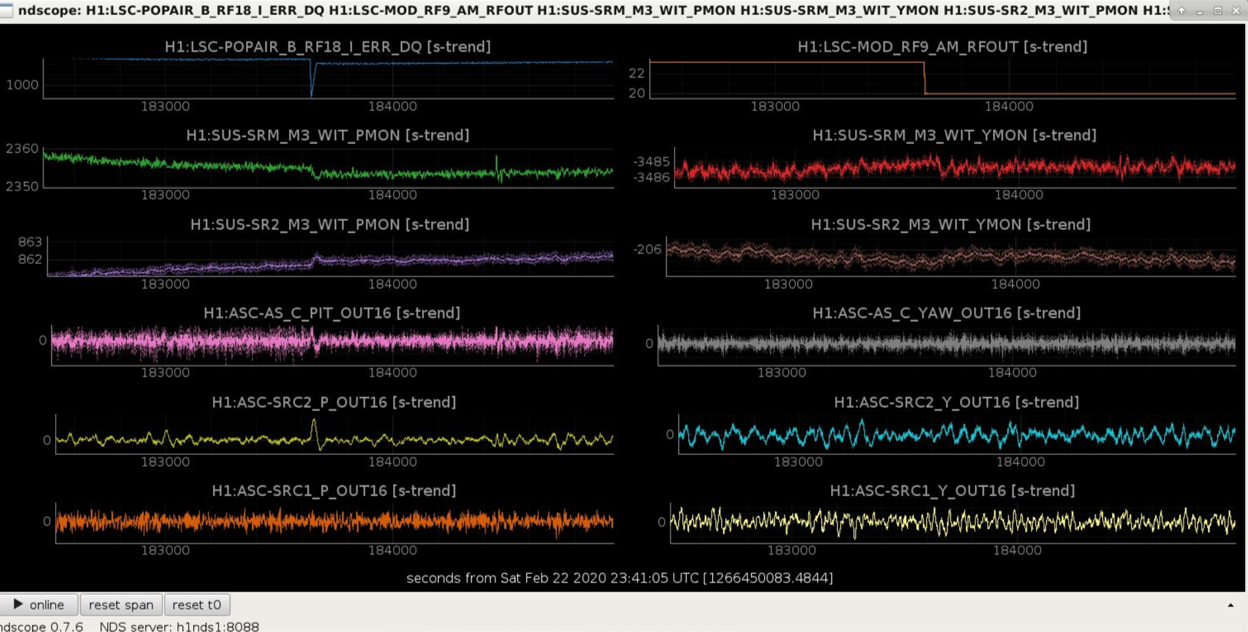
Daniel suggested that we look at what happens to the BS alignment when the modulation depth changes, since AS36 is the signal used to control the BS alignment.  Jenne looked into this and found that the beam splitter doesn't react to the change in modulation depth, but SR2 and SRM both do.  The first attachment shows that this is mostly in pitch, but there is also a yaw reaction. The second attachment shows that the AS-C QPD seems to be the reason why changing this modulation depth changes the alignment of the SRC.  (You can see the change in AS_C before the SRC2 loop brings it back to it's error point by moving the alignment of SR2+SRM).  There is not much happening in the AS72 loop (SRC1), which you would expect if they are well diagonalized. 

This suggests that the amount of junk light we have on the DCPDs can be changed by changing our offset on AS_C.  We plan to try a test of this tomorow.


Images attached to this comment
H1 SEI (SEI)
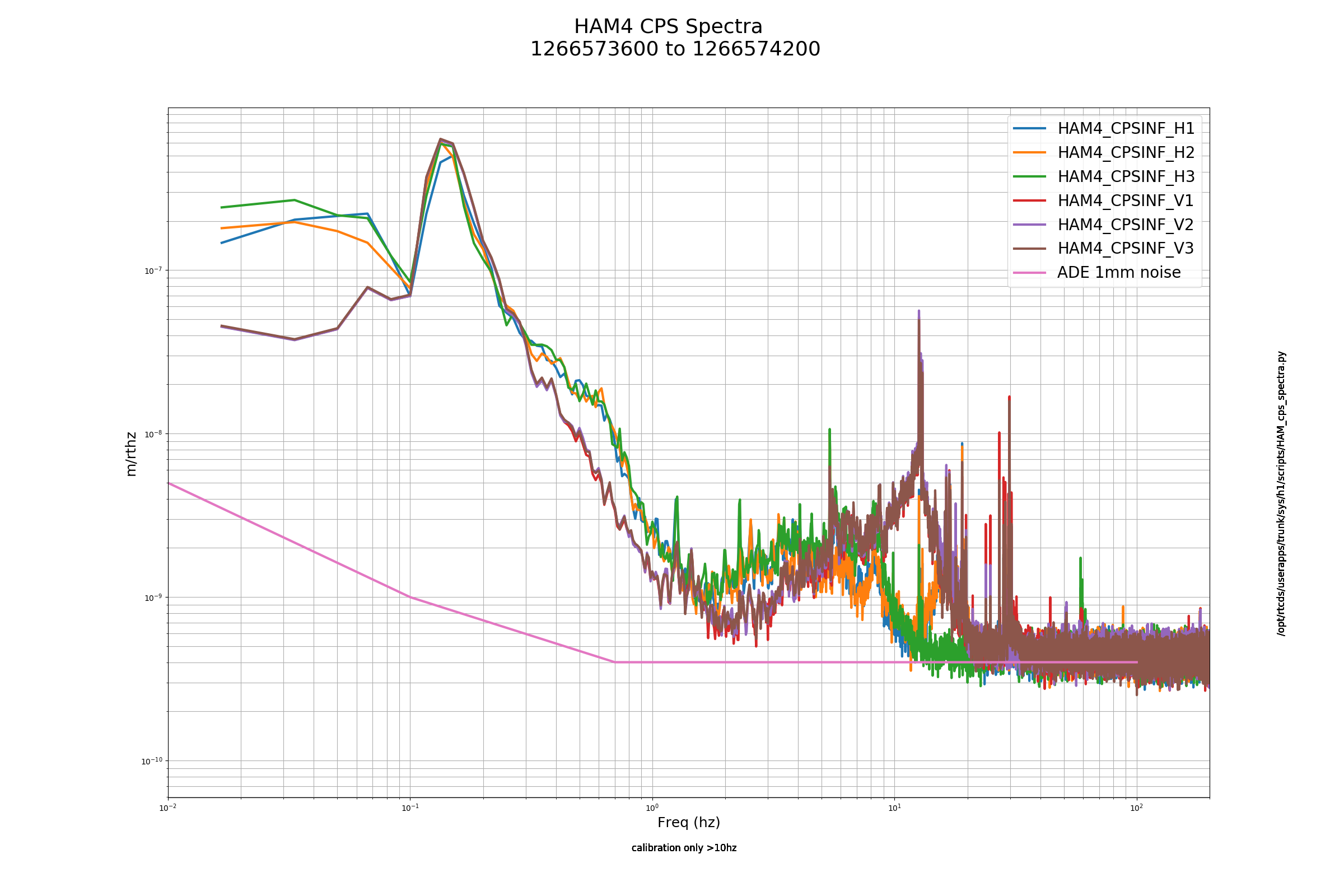
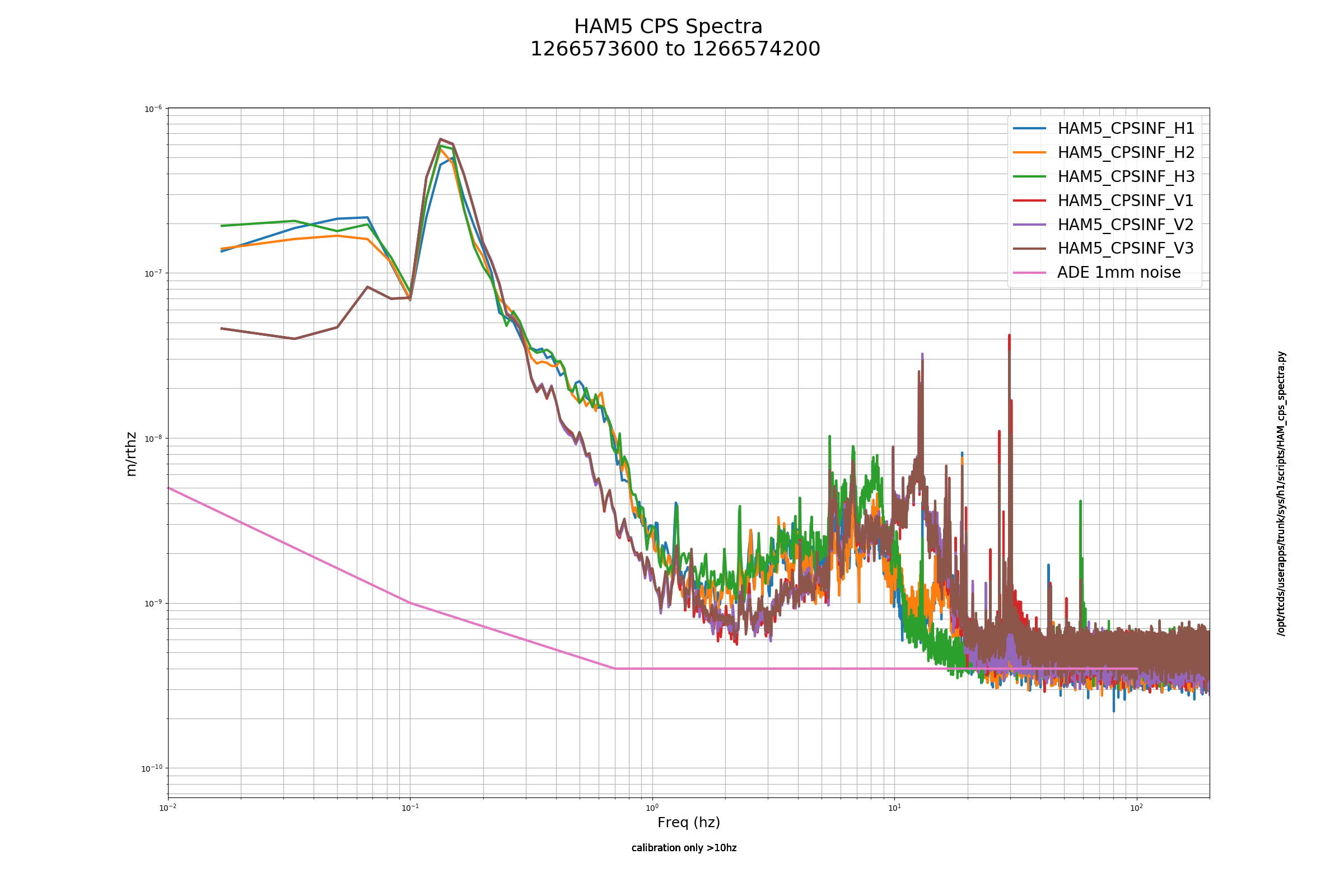
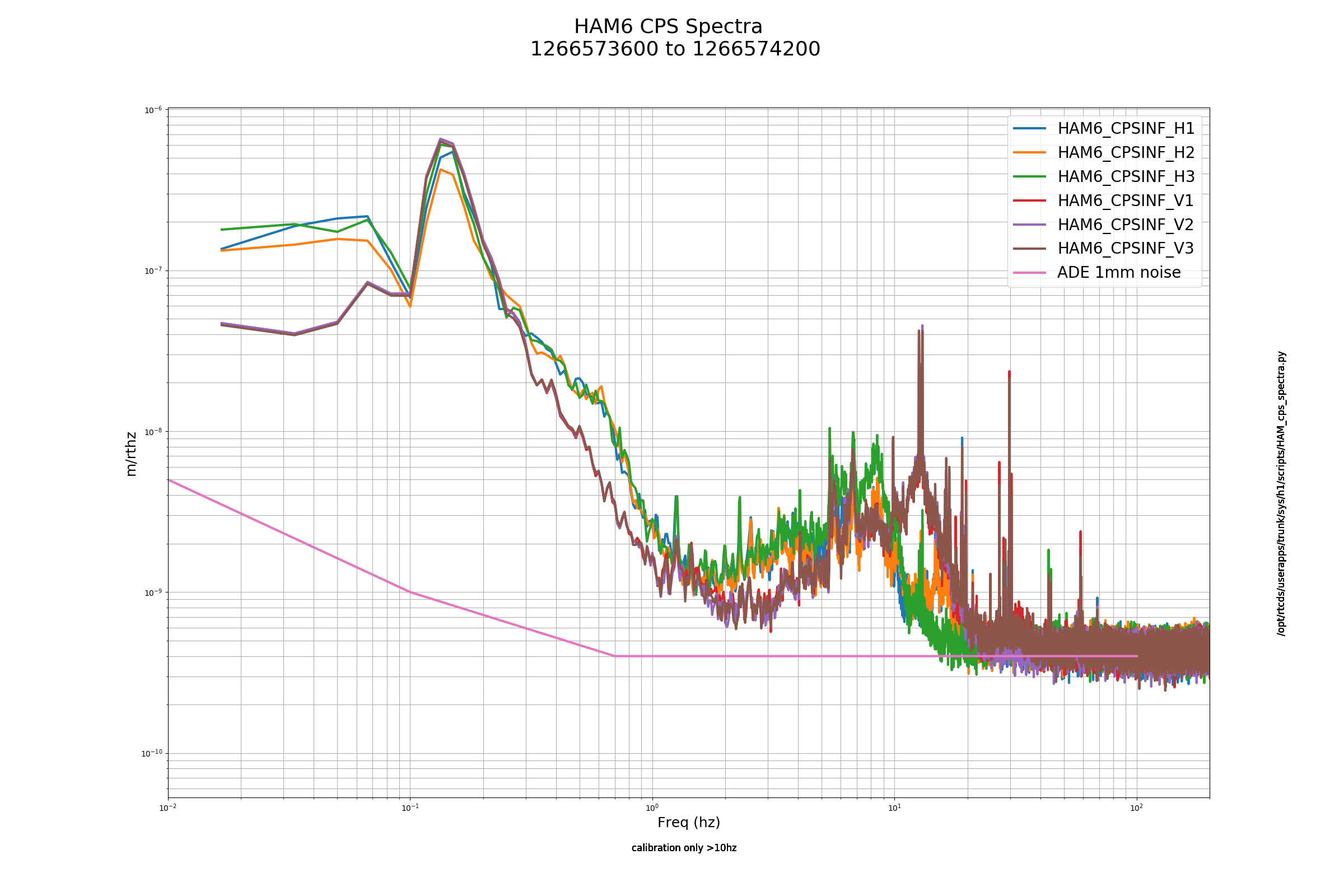
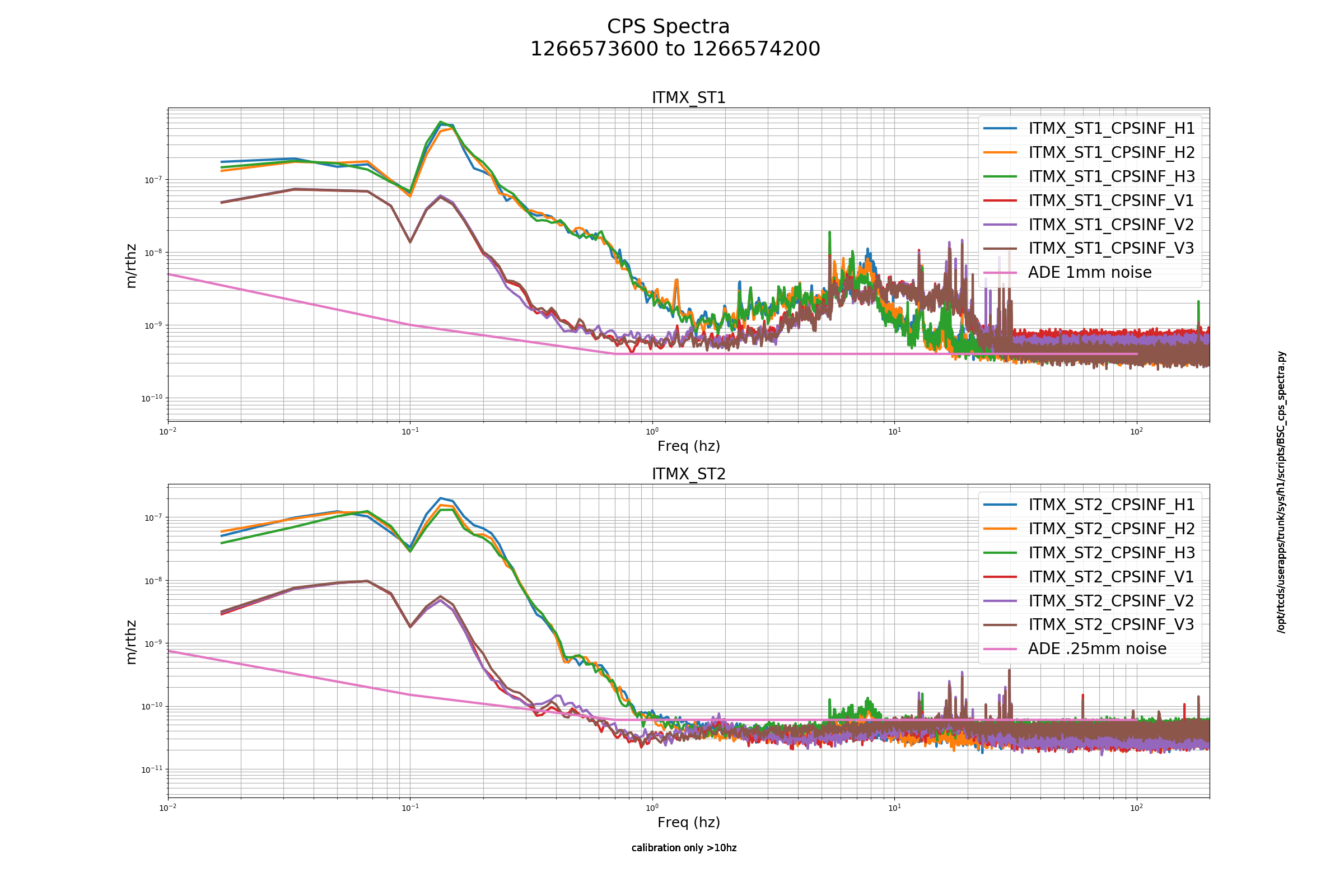
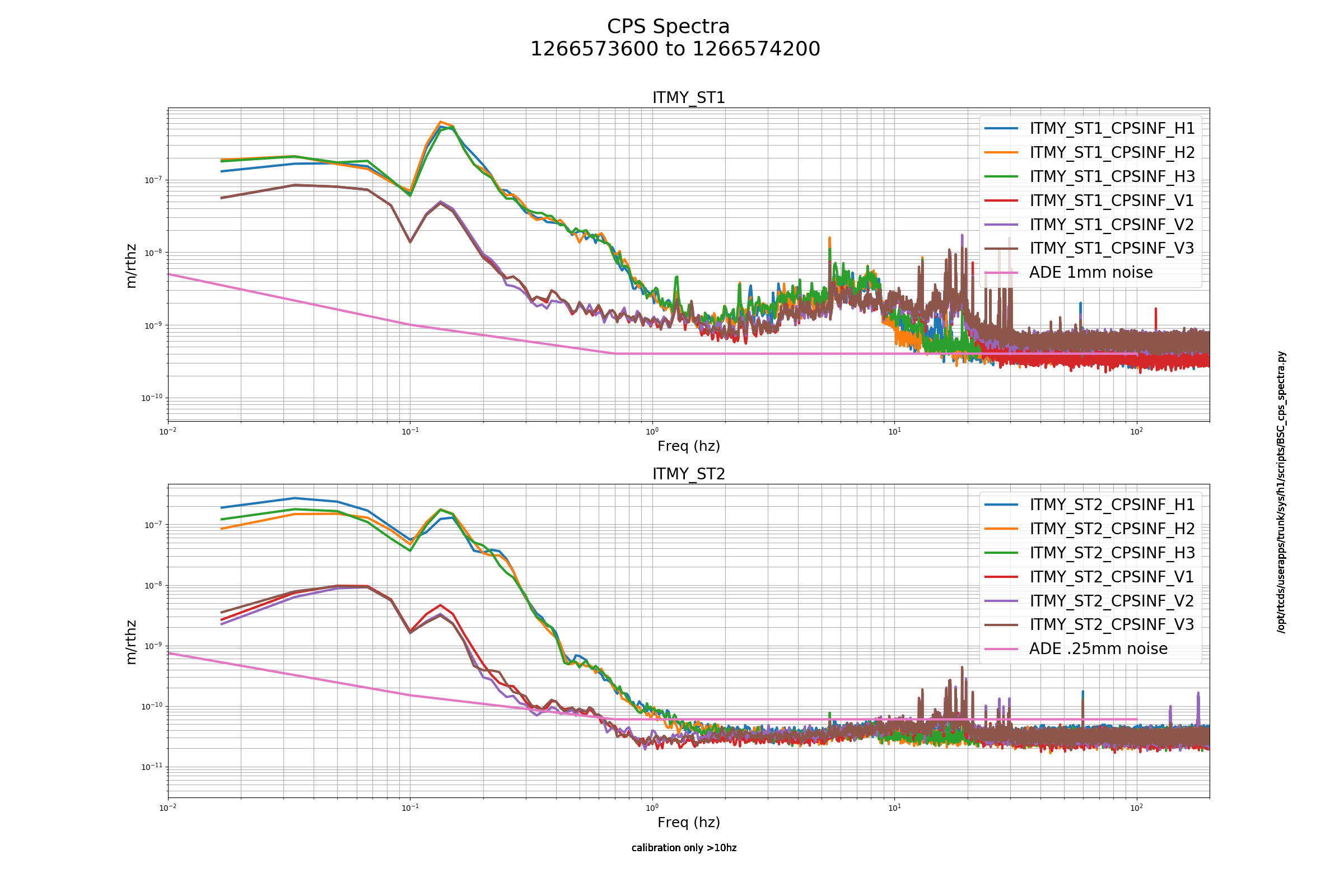
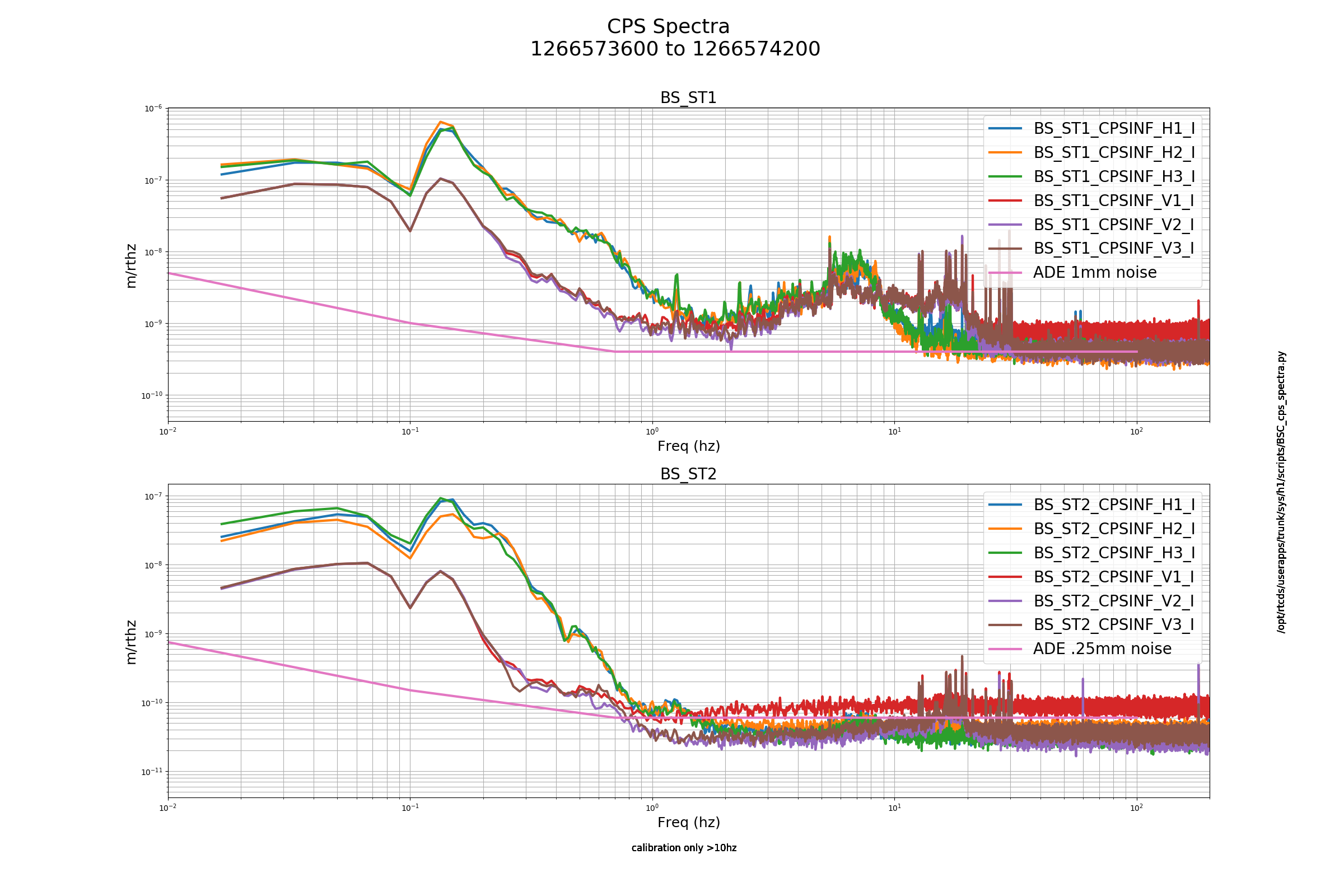
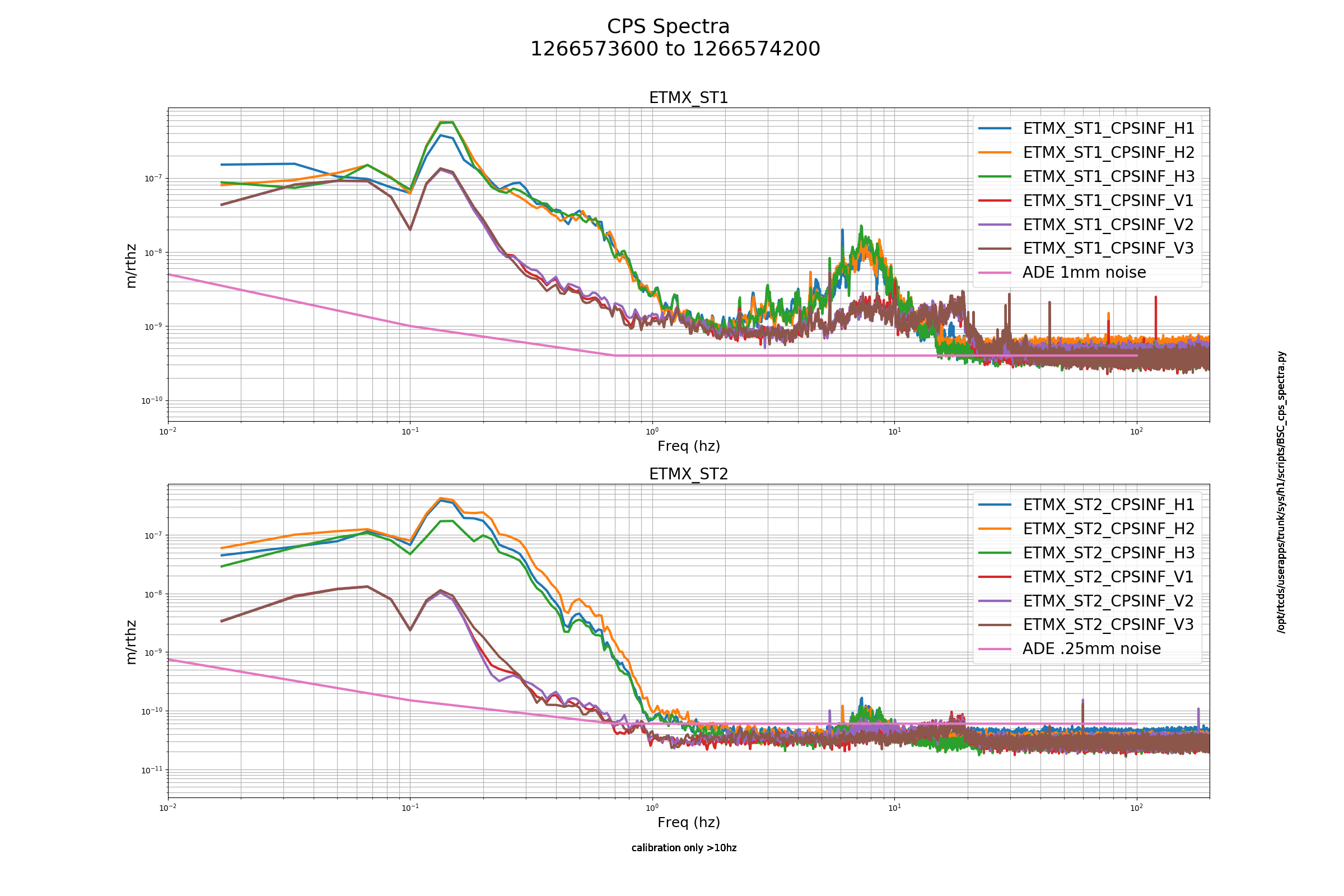
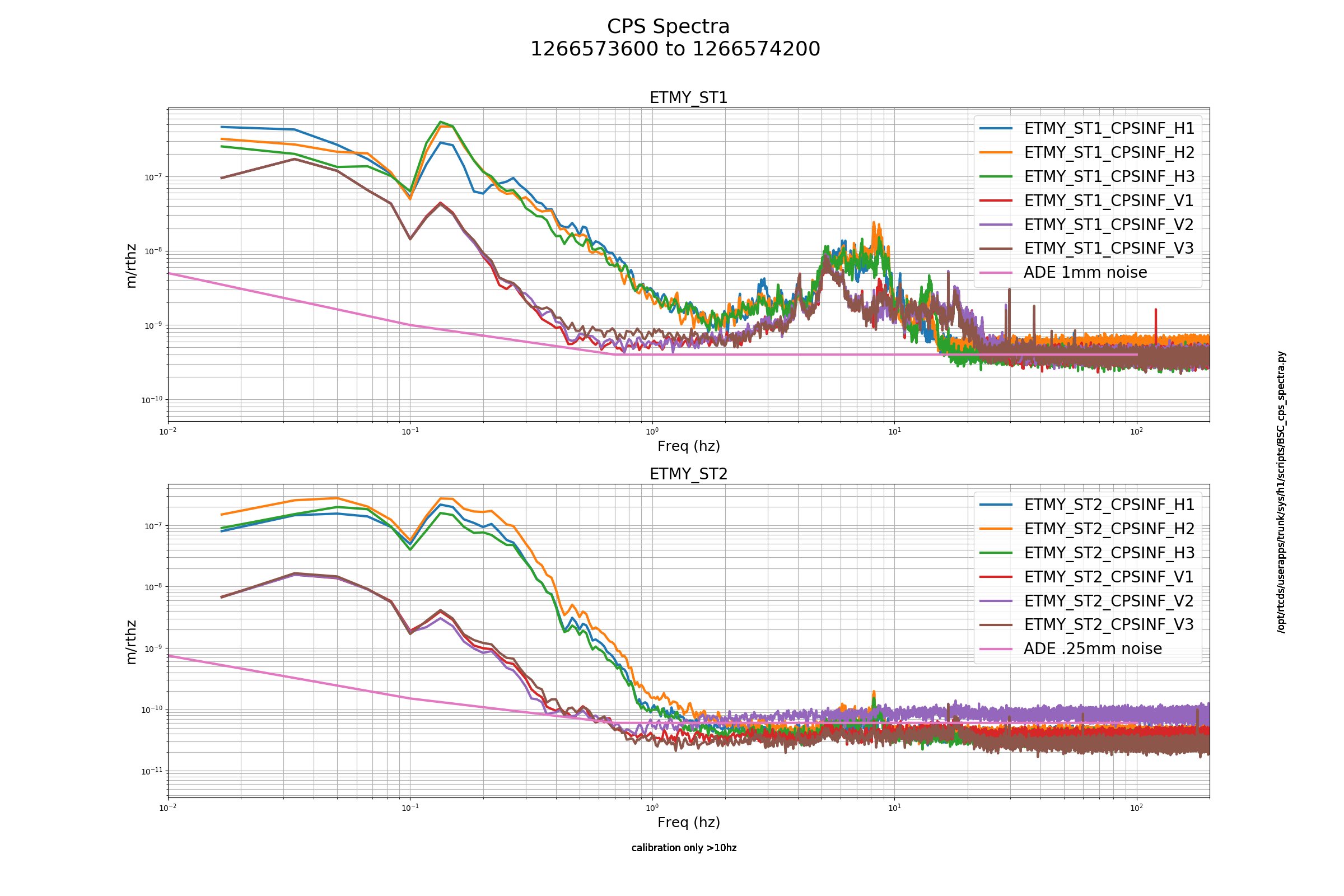
corey.gray@LIGO.ORG - posted 18:51, Monday 24 February 2020 (55276)
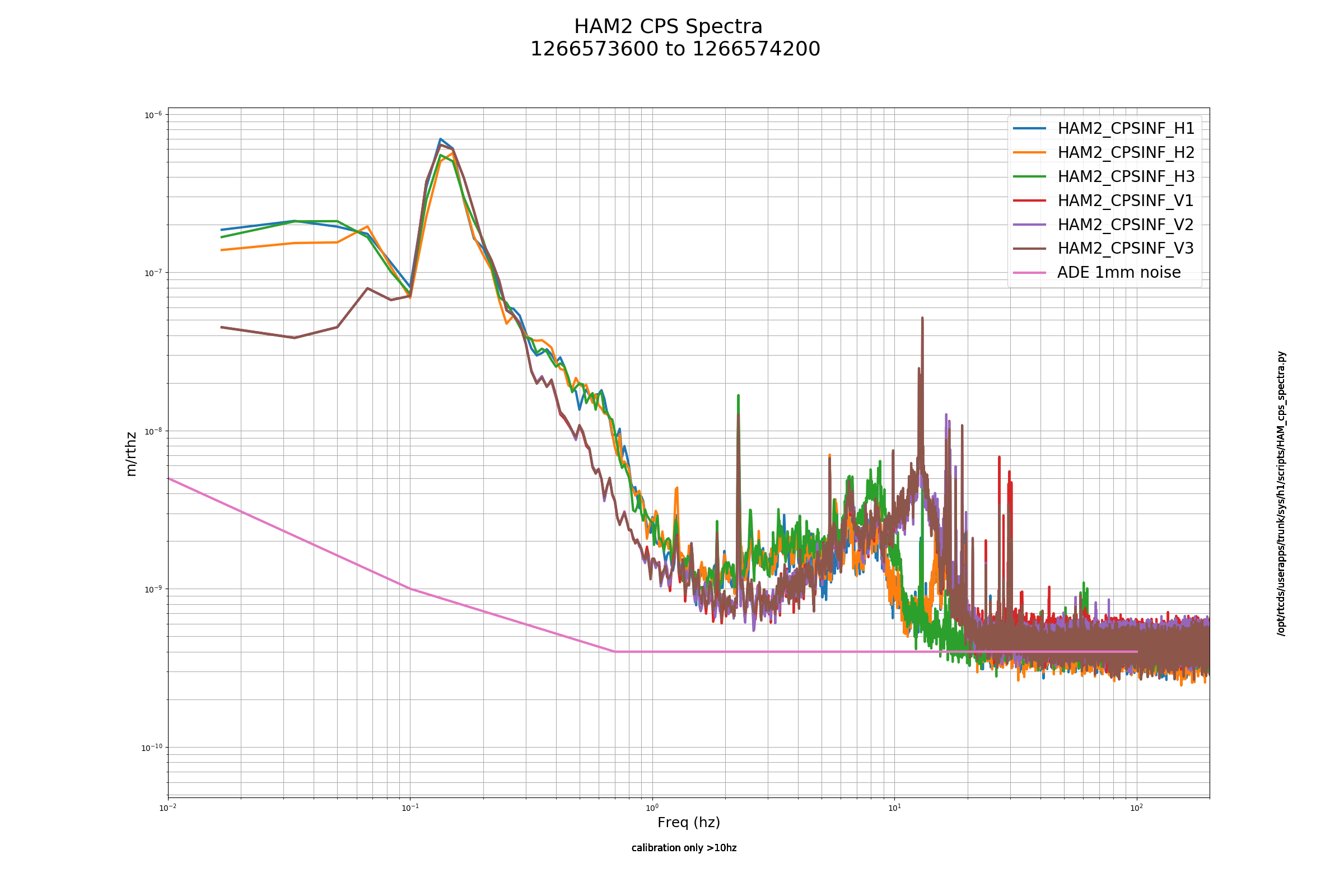
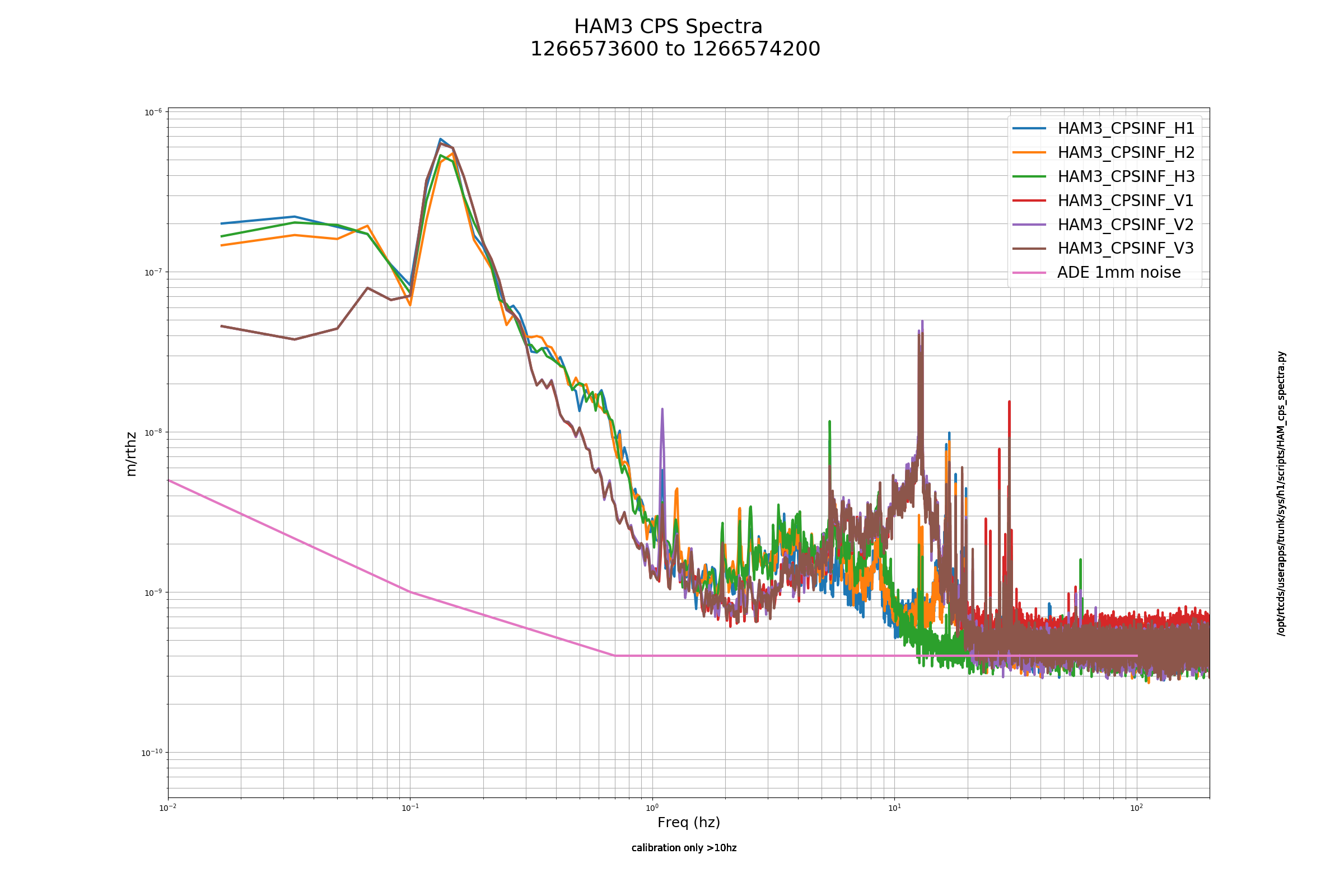
H1 BSC/HAM ISI CPS Sensor Noise Spectra Check (FAMIS task, #12888)

The following CPS is listed as over threshold (all others OK & all spectra attached):

Images attached to this report
H1 CDS
david.barker@LIGO.ORG - posted 16:20, Monday 24 February 2020 - last comment - 19:06, Monday 24 February 2020(55270)
command to set owl operator's lock-loss-alerting configuration

To set an operator's lock-loss alert configuration prior to their shift type the following command:

owl_op operator.name

Where operator.name is the operator's ligo.org name. These settings rely on the Guardian IFO_NOTIFY node to alert for both lock-loss and out-of-observation events. GraceDB events are disabled, and alerting times restricted to the shift times.

I've added the IFO_NOTIFY node status and link to the LOCKLOSS ALERT Overview page. Anyone with voice-call option selected is shown with an ORANGE phone indicator.

Comments related to this report
david.barker@LIGO.ORG - 17:36, Monday 24 February 2020 (55273)

I've updated the lock-loss-alert DCC document T2000061

thomas.shaffer@LIGO.ORG - 19:06, Monday 24 February 2020 (55277)

I made a REMOTE_OWL_SELECTION.adl that has names listed as cammand buttons (only my name currently). This launches a shell script that calls Dave's owl_op and changes the IFO mode & IFO_NOTIFY state. Should make it easy.

H1 CAL (CAL, DetChar)
sudarshan.karki@LIGO.ORG - posted 11:45, Monday 24 February 2020 - last comment - 14:01, Tuesday 25 February 2020(55260)
PCALX Laser Issues

Evan and Yanyan noted that PCALX was malfunctioning since Wednesday (LHO alog 43959 and 55257). Jeff has added an alert that will notify operators if this happens in the future (LHO alog 55257). 

Since, simply switching on and off the OFS control loop, didnot bring PCAL back, I looked at the PD singals and saw all PD signals were reading zero values. I tried switching on and off the laser remotely but still no signals on any of the photodiodes. Further investigations (on AOM status and/or the laser itself) will require  going down to the endstation. Stay tuned!


Comments related to this report
sudarshan.karki@LIGO.ORG - 17:54, Monday 24 February 2020 (55275)CAL, DetChar

The Pcal laser could have been potentially shut off because of the interlock system that has been down at X-end since Tuesday maintenance (last week). Someone will have a look at it tomorrow to see if that was the cause.

jeffrey.kissel@LIGO.ORG - 10:55, Tuesday 25 February 2020 (55286)CDS, DetChar, INJ, ISC, OpsInfo
For more details of what we believe happened, see comment LHO aLOG 55285.

Stay tuned for results of today's investigation.
jeffrey.kissel@LIGO.ORG - 14:01, Tuesday 25 February 2020 (55294)CAL, CDS, DetChar, INJ, OpsInfo
PCALX Laser functionality restored after interlock was repaired today. See LHO aLOG 55291.
H1 CAL (CAL, DetChar)
evan.goetz@LIGO.ORG - posted 09:24, Monday 24 February 2020 - last comment - 14:02, Tuesday 25 February 2020(55257)
X-arm PCAL optical follower servo saturated since Wednesday Feb 19 2020
Yanyan noted in the DQ shift for LHO that the x-arm PCAL lines--both high frequency lines and CW hardware injections--disappeared on Wednesday Feb 19 2020 (see summary page plot). It looks like the optical follower servo saturated on this day. The loop should be opened and closed again to regain normal operations as soon as is possible. Likely this will cause a glitch so perhaps it should be done out of observing.
Comments related to this report
jeffrey.kissel@LIGO.ORG - 11:17, Monday 24 February 2020 (55259)DetChar, INJ, OpsInfo
Thanks for catching this Evan!! 

I've added an *additional* check to the DIAG_MAIN notification guardian to look at the *error* signals of the PCAL OFS loops, e.g. H1:CAL-PCALX_OFS_ERR_OUT16. If either PCALX or Y's OFS error signal channels are less than -2.0 for more than 120 seconds, DIAG_MAIN throws the error "PCAL: PCAL [X,Y] OFS servo malfunction". We have loaded the new DIAG_MAIN guardian check, and confirmed that it now throws the correct error given this current state.

Instructions for what to do about this (in a "normal" situation) have been updated in the DIAG_MAIN page of the OPS wiki.

Note -- Sudarshan and I tried following those basic instructions, but it appears that PCALX is more broken than just a saturated OFS control loop.

Rick and Sudarshan are actively investigating while I run calibration measurements.
jeffrey.kissel@LIGO.ORG - 10:53, Tuesday 25 February 2020 (55285)CDS, DetChar, INJ, OpsInfo
"Wednesday Feb 19 2020" is a bit of a misnomer: a better summary page plot at which to determine the time of failure is the PCALX laser current here, which shows the current drop to 0.0 at 
2020-02-19 00:15 UTC, which is 
       Feb 18 2020 16:15:00 PST
i.e. Tuesday at 4pm local, i.e. only 4 hours after maintenance day closed.

This time is coincident with Keita and Fil's journey to the EX and reboot of the EX ISC IO chassis (see LHO aLOG 55171). *That* effort was a result of the CDS team attempting to mitigate sharp spectral line features earlier in the day, which thwarted some ALS WFS, (see LHO aLOG 55173).

The last sentence of that 55173 aLOG indicates what happened:
"Then we found, after driving back to the corner, that power cycling IO chassis, or maybe disconnecting AA from IO, triggered the safety system at EX to go crazy, the safety system thought that the status was fine but the laser interlock was kept open so the laser couldn't be turned on. This was manually bypassed."

The *ALS* laser system's interlock was bypassed, but the PCALX laser system's interlock was forgotten about.

The CDS/PCAL teams will further investigate if this is what happened during today's maintenance. 

Stay tuned!

jeffrey.kissel@LIGO.ORG - 14:02, Tuesday 25 February 2020 (55295)CAL, CDS, DetChar, INJ, OpsInfo
Story confirmed. PCALX Laser functionality restored after interlock was repaired today. See LHO aLOG 55291.
Displaying reports 35541-35560 of 89220.Go to page Start 1774 1775 1776 1777 1778 1779 1780 1781 1782 End