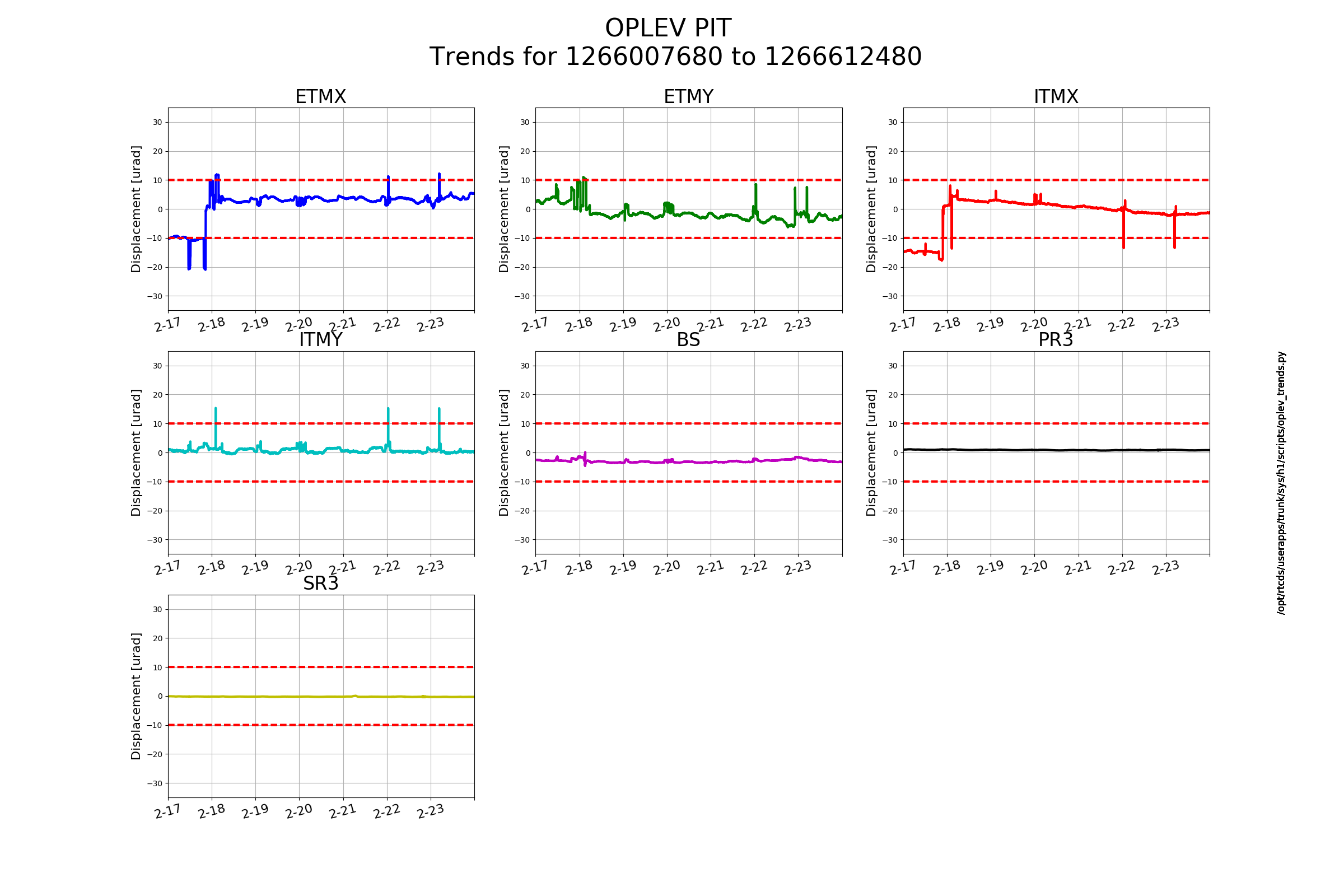
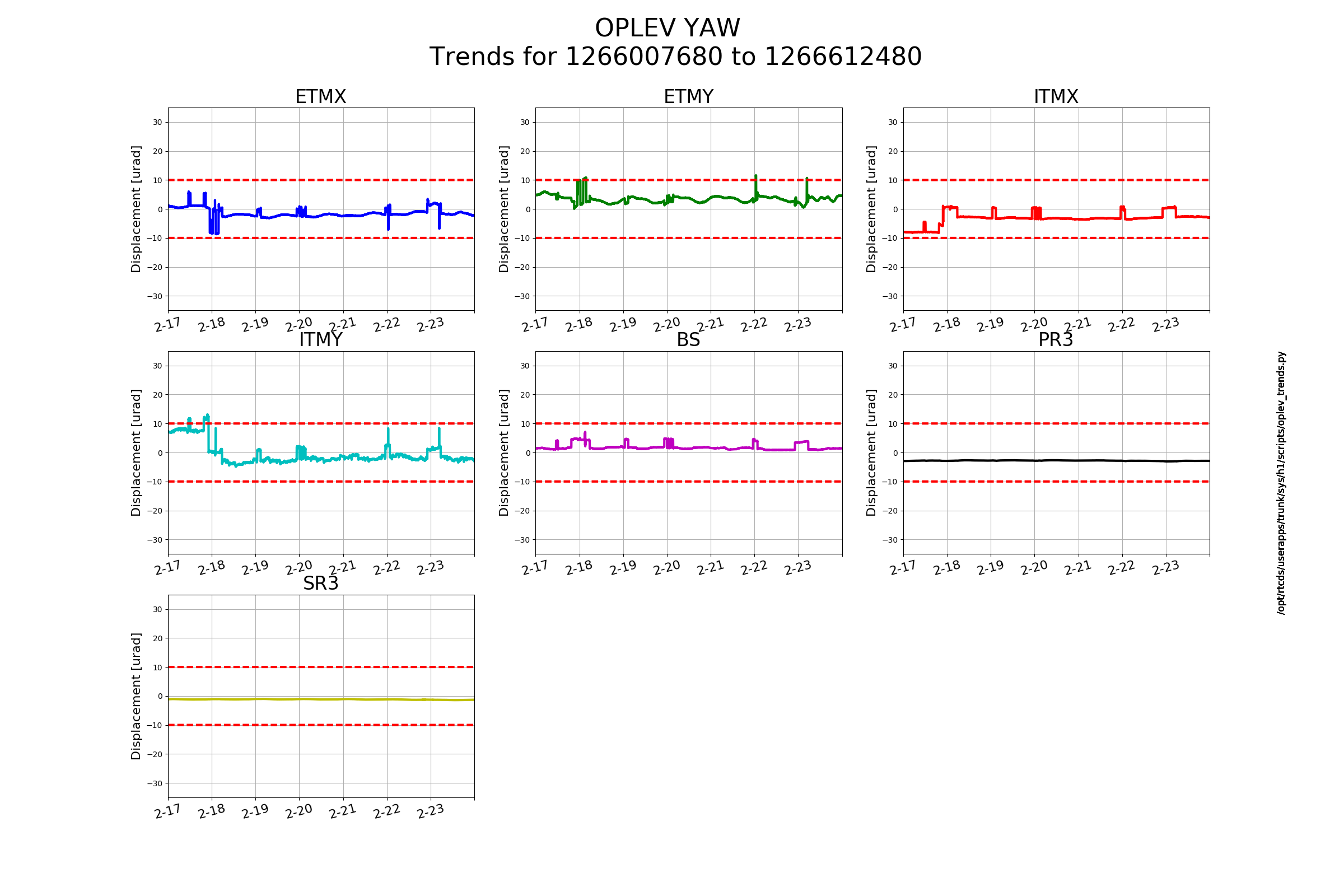
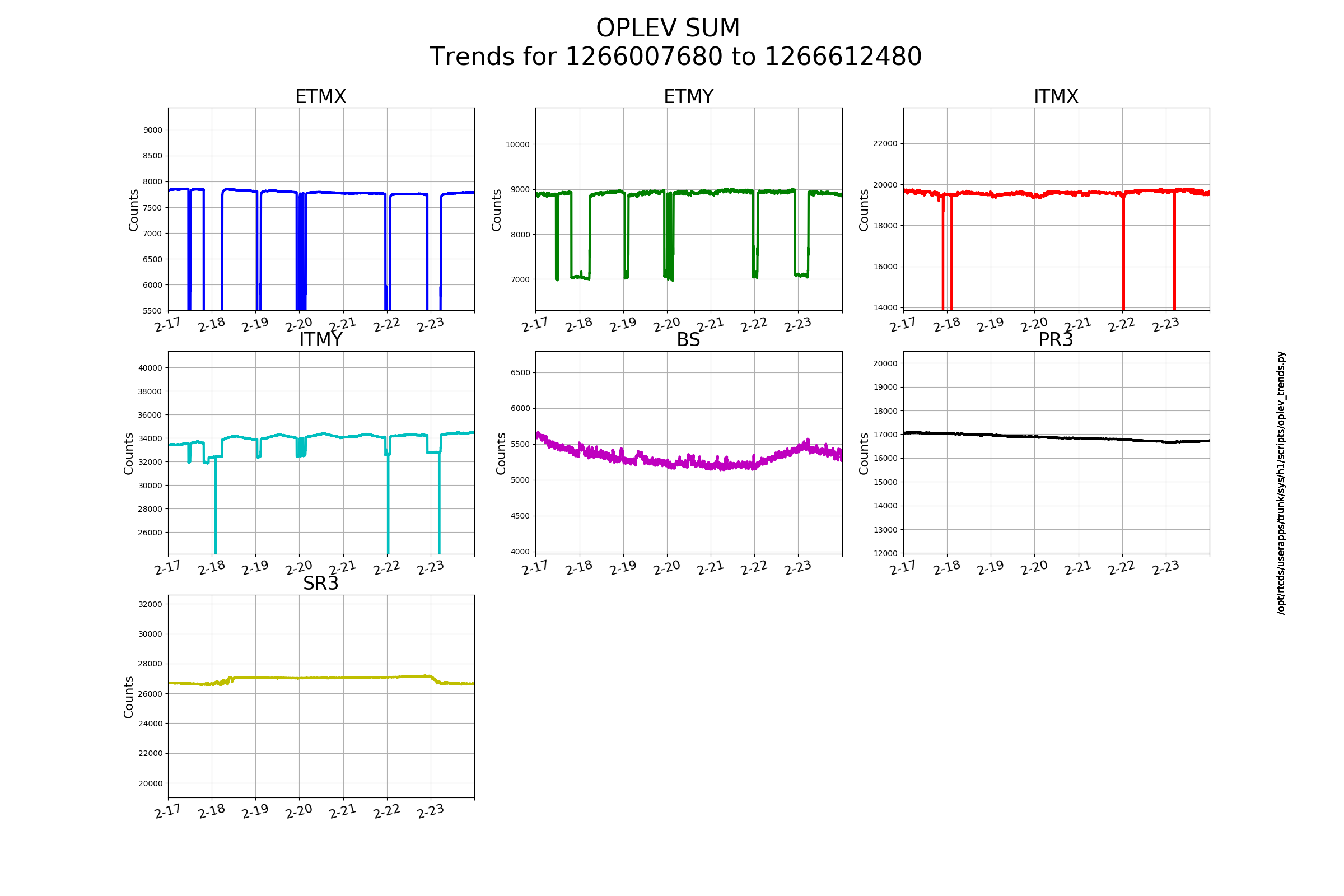
Attached is a photo of what we have on the white board.
Addressed TCS Chillers (5:08pm local):
To set an operator's lock-loss alert configuration prior to their shift type the following command:
owl_op operator.name
Where operator.name is the operator's ligo.org name. These settings rely on the Guardian IFO_NOTIFY node to alert for both lock-loss and out-of-observation events. GraceDB events are disabled, and alerting times restricted to the shift times.
I've added the IFO_NOTIFY node status and link to the LOCKLOSS ALERT Overview page. Anyone with voice-call option selected is shown with an ORANGE phone indicator.
I've updated the lock-loss-alert DCC document T2000061
I made a REMOTE_OWL_SELECTION.adl that has names listed as cammand buttons (only my name currently). This launches a shell script that calls Dave's owl_op and changes the IFO mode & IFO_NOTIFY state. Should make it easy.
TITLE: 02/24 Eve Shift: 00:00-08:00 UTC (16:00-00:00 PST), all times posted in UTC
STATE of H1: Observing at 120Mpc
OUTGOING OPERATOR: Patrick
CURRENT ENVIRONMENT:
SEI_CONF state: WINDY
Wind: 9mph Gusts, 7mph 5min avg
Primary useism: 0.02 μm/s
Secondary useism: 0.31 μm/s
QUICK SUMMARY:
H1's been locked 21.5+hrs. Microseism has been trending down the last 14hrs (currently between 90th-50th percentile).
DIAG_MAIN has: "PCAL X OFS servo malfunction", but this was noted earlier.
TITLE: 02/24 Day Shift: 16:00-00:00 UTC (08:00-16:00 PST), all times posted in UTC STATE of H1: Observing at 117Mpc INCOMING OPERATOR: Corey SHIFT SUMMARY: Remained locked the entire shift. Out of observing for Jim to address SEI_DIFF issues, calibration, and ASC sensing matrix measurement. Received alert for S200224ca. LOG: 16:14 UTC Tyler and Chris tumbleweed chipping on X arm 16:21 UTC Tyler and Chris tumbleweed chipping on Y arm, instead of X arm 17:03 UTC Out of observing. Jim addressing SEI_DIFF issues (alog 55258) 17:07 UTC Jim done. Back to observing. 17:10 UTC Dripta to optics lab 17:28 UTC Dripta back 19:00 UTC Out of observing for Jeff K. to run calibration measurements 19:31 UTC Sheila investigating increase in H1:SQZ-OPO_REFL_DC_POWER. 20:32 UTC Jeff K. done. Back to observing. 20:34 UTC Received Hanford monthly alert test phone call 21:51 UTC Tyler getting close to end station with tumbleweed chipping at end X 22:23 UTC S200224ca alert 22:29 UTC Called Bubba to have tumbleweed chipping stand down 22:31 UTC Tumbleweed chipping machine shutdown about a quarter of the way from mid to end station 22:32 UTC Set INJ_TRANS to INJECT_KILL 22:57 UTC Set INJ_TRANS to INJECT_SUCCESS 23:57 UTC Gerardo to mid Y
We were out of observing during the operator meeting for the ASC sensing matrix measurement 55265 from 23:05 UTC until 23:22 UTC
Took ASC sensing matrix measurement with 'userapps/asc/h1/scripts/sensingMatrix/run_sensmat.py', using updated injection amplitudes. DHARD & CHARD yaw were too low to get a coherent measurement, I've left a note for next time.
| dof: | DHARD | CHARD | DSOFT | CSOFT |
| AS_A_DC_PIT | 7.4e+04 118 | 1.7e+02 -60 | 4.6e+02 66 | 3.6e+02 86 |
| AS_A_RF36_I_PIT | 1.1e+06 -16 | 2.3e+03 13 | 1.37e+05 163 | 2.1e+04 -170 |
| AS_A_RF36_Q_PIT | 1.3e+06 -80 | 9.2e+03 157 | 2.17e+05 156 | 2.4e+04 -125 |
| AS_A_RF45_I_PIT | 3.0e+05 18 | 3.98e+03 -130 | 8.57e+03 170 | 9.39e+03 11 |
| AS_A_RF45_Q_PIT | 8.54e+05 -24 | 1.53e+04 -171 | 1.43e+04 -119 | 2.09e+04 -8 |
| AS_B_DC_PIT | 2.7e+04 -83 | 3.3e+02 -49 | 6.0e+02 161 | 8.8e+02 -135 |
| AS_B_RF36_I_PIT | 2.9e+06 37 | 1.7e+04 -57 | 2.52e+05 -19 | 1.1e+05 168 |
| AS_B_RF36_Q_PIT | 3.5e+06 -162 | 1.3e+04 148 | 2.24e+05 -24 | 5.4e+04 -24 |
| AS_B_RF45_I_PIT | 1.2e+05 -29 | 3.22e+03 176 | 7.94e+03 -162 | 5.5e+03 100 |
| AS_B_RF45_Q_PIT | 7.70e+05 157 | 8.82e+03 39 | 1.01e+04 29 | 1.98e+04 154 |
| AS_C_PIT | 1.6e-02 58 | 5.49e-04 -69 | 1.55e-03 -119 | 1.0e-03 109 |
| REFL_A_DC_PIT | 4.1e+04 150 | 3.6e+02 -103 | 1.7e+03 -87 | 3.1e+03 155 |
| REFL_A_RF9_I_PIT | 7.1e+06 137 | 2.42e+05 168 | 1.9e+05 -117 | 4.7e+05 135 |
| REFL_A_RF9_Q_PIT | 7.4e+06 -7 | 9.76e+04 -12 | 6.0e+04 24 | 2.3e+05 -38 |
| REFL_A_RF45_I_PIT | 6.3e+06 107 | 3.42e+05 172.9 | 1.9e+05 -88 | 2.2e+05 147 |
| REFL_A_RF45_Q_PIT | 3.1e+06 52 | 1.01e+05 171 | 3.1e+04 88 | 1.3e+05 -17 |
| REFL_B_DC_PIT | 1.6e+04 48 | 5.4e+02 173 | 7.7e+02 -66 | 3.4e+03 137 |
| REFL_B_RF9_I_PIT | 4.5e+06 130 | 1.71e+05 162 | 6.8e+04 -120 | 1.5e+05 147 |
| REFL_B_RF9_Q_PIT | 1.4e+06 -3 | 4.80e+04 -15 | 2.3e+04 -69 | 3.0e+04 -10 |
| REFL_B_RF45_I_PIT | 3.0e+07 143 | 3.26e+05 161 | 3.6e+05 -105 | 3.0e+05 110 |
| REFL_B_RF45_Q_PIT | 9.6e+06 146 | 1.03e+05 160 | 1.1e+05 -110 | 6.7e+04 88 |
| POP_X_RF_I_PIT | 2.7e+06 -3 | 1.62e+05 -16 | 9.3e+04 158 | 2.2e+05 -37 |
| POP_X_RF_Q_PIT | 3.3e+06 -97 | 2.3e+04 172 | 2.5e+04 -3 | 4.2e+04 164 |
| POP_A_PIT | 3.8e+03 -119 | 7.81e+01 -28 | 2.2e+01 92 | 9.0e+01 -55 |
| POP_B_PIT | 3.1e+02 148 | 1.34e+01 143 | 1.2e+01 72 | 7.2e+00 -152 |
| X_TR_A_PIT | 2.5e+03 -179 | 4.31e+03 157 | 1.01e+02 -3 | 1.8e+02 -32 |
| X_TR_B_PIT | 3.5e+03 -166 | 5.29e+03 157 | 2.89e+02 159 | 3.46e+02 164 |
| Y_TR_A_PIT | 6.2e+03 -20 | 5.37e+03 159 | 3.78e+02 163 | 3.3e+02 -6 |
| Y_TR_B_PIT | 4.0e+03 -80 | 1.53e+03 156 | 7.75e+02 -22 | 7.37e+02 167 |
| dof: | DHARD | CHARD | DSOFT | CSOFT |
| AS_A_DC_YAW | 8.1e+04 40 | 7.6e+03 157 | 5.1e+02 -169 | 4.0e+02 -2 |
| AS_A_RF36_I_YAW | 3.8e+06 -129 | 9.0e+04 52 | 1.12e+05 -12 | 6.37e+04 167 |
| AS_A_RF36_Q_YAW | 4.7e+06 -154 | 1.2e+05 -75 | 2.05e+05 -19 | 2.4e+04 -22 |
| AS_A_RF45_I_YAW | 3.3e+05 0 | 1.1e+04 87 | 1.02e+04 20 | 3.1e+03 -22 |
| AS_A_RF45_Q_YAW | 9.0e+05 -5 | 1.7e+04 127 | 1.12e+04 57 | 4.8e+03 40 |
| AS_B_DC_YAW | 6.6e+04 -84 | 2.5e+03 128 | 6.6e+02 49 | 3.1e+02 -17 |
| AS_B_RF36_I_YAW | 3.8e+06 -118 | 1.7e+05 -60 | 2.11e+05 167 | 1.2e+05 145 |
| AS_B_RF36_Q_YAW | 4.2e+06 154 | 3.9e+05 117 | 2.26e+05 156 | 9.3e+04 -49 |
| AS_B_RF45_I_YAW | 1.8e+05 -23 | 1.7e+04 -130 | 6.14e+03 -19 | 2.1e+03 69 |
| AS_B_RF45_Q_YAW | 8.7e+05 -173 | 2.4e+04 -26 | 1.21e+04 -78 | 8.2e+03 172 |
| AS_C_YAW | 1.4e-01 -175 | 4.2e-03 -4 | 1.44e-03 143 | 6.2e-04 -147 |
| REFL_A_DC_YAW | 2.8e+05 -75 | 1.7e+04 -137 | 2.3e+03 52 | 3.2e+03 97 |
| REFL_A_RF9_I_YAW | 4.5e+07 -69 | 2.1e+06 -116 | 1.3e+05 171 | 3.0e+05 108 |
| REFL_A_RF9_Q_YAW | 7.2e+06 -116 | 3.1e+05 -17 | 5.6e+04 -136 | 2.5e+04 144 |
| REFL_A_RF45_I_YAW | 1.2e+08 -82 | 7.1e+06 -96 | 5.2e+05 -175 | 8.1e+05 133 |
| REFL_A_RF45_Q_YAW | 2.8e+07 -88 | 2.0e+06 -91 | 1.6e+05 -177 | 1.7e+05 152 |
| REFL_B_DC_YAW | 5.6e+04 -166 | 1.3e+04 -86 | 6.3e+02 -23 | 1.3e+03 141 |
| REFL_B_RF9_I_YAW | 9.9e+06 96 | 6.3e+05 165 | 4.7e+04 28 | 1.25e+05 -13 |
| REFL_B_RF9_Q_YAW | 1.6e+06 137 | 3.5e+05 11 | 1.5e+04 163 | 6.6e+04 170 |
| REFL_B_RF45_I_YAW | 5.8e+07 102 | 2.4e+06 108 | 3.0e+05 158 | 2.1e+05 -6 |
| REFL_B_RF45_Q_YAW | 1.9e+07 111 | 8.1e+05 76 | 8.2e+04 -169 | 5.0e+04 -34 |
| POP_X_RF_I_YAW | 8.1e+06 175 | 1.1e+06 7 | 8.6e+04 -145 | 1.4e+05 175 |
| POP_X_RF_Q_YAW | 4.6e+06 87 | 2.3e+05 -50 | 7.1e+04 -24 | 4.8e+04 -36 |
| POP_A_YAW | 7.2e+03 7 | 6.8e+02 -164 | 1.6e+02 -45 | 9.8e+01 -59 |
| POP_B_YAW | 2.3e+03 11 | 7.7e+01 84 | 3.9e+01 -38 | 9.4e+00 46 |
| X_TR_A_YAW | 5.2e+03 -76 | 4.39e+03 161 | 1.2e+02 -168 | 1.8e+02 129 |
| X_TR_B_YAW | 6.6e+03 -93 | 3.22e+03 169 | 7.96e+02 -23 | 6.17e+02 -23 |
| Y_TR_A_YAW | 9.0e+03 177 | 5.50e+03 -24 | 2.7e+02 147 | 2.8e+02 -14 |
| Y_TR_B_YAW | 1.2e+04 165 | 2.72e+03 -22 | 6.74e+02 -31 | 6.24e+02 166 |
Updated yaw sensing matrix, with DHARD & CHARD inputs increased by a factor of 3:
| dof: | DHARD | CHARD | DSOFT | CSOFT |
| AS_A_DC_YAW | 2.8e+04 -152 | 2.2e+03 -25 | 4.6e+02 -100 | 4.0e+02 108 |
| AS_A_RF36_I_YAW | 6.3e+05 -177 | 9.6e+04 -84 | 1.22e+05 -18 | 5.7e+04 130 |
| AS_A_RF36_Q_YAW | 1.6e+06 -28 | 5.4e+04 -49 | 1.98e+05 -15 | 1.9e+04 -39 |
| AS_A_RF45_I_YAW | 3.73e+05 -6 | 1.31e+04 164 | 1.11e+04 5 | 1.4e+03 16 |
| AS_A_RF45_Q_YAW | 9.41e+05 -22 | 2.9e+04 174 | 1.50e+04 47 | 3.5e+03 105 |
| AS_B_DC_YAW | 1.7e+04 37 | 1.7e+03 -96 | 3.8e+02 -43 | 4.9e+02 -50 |
| AS_B_RF36_I_YAW | 1.2e+06 -169 | 1.2e+05 -52 | 2.20e+05 162 | 7.1e+04 107 |
| AS_B_RF36_Q_YAW | 7.5e+05 -111 | 1.4e+05 171 | 1.96e+05 169 | 1.7e+04 -50 |
| AS_B_RF45_I_YAW | 8.6e+04 -47 | 7.8e+03 -163 | 6.00e+03 -12 | 4.9e+03 68 |
| AS_B_RF45_Q_YAW | 7.93e+05 161 | 2.96e+04 -4 | 1.10e+04 -91 | 4.5e+03 -105 |
| AS_C_YAW | 4.94e-02 -163 | 1.9e-03 -38 | 1.2e-03 129 | 7.9e-04 -126 |
| REFL_A_DC_YAW | 4.0e+04 -56 | 7.3e+02 -37 | 1.2e+03 109 | 7.2e+02 -7 |
| REFL_A_RF9_I_YAW | 1.9e+06 131 | 2.7e+05 82 | 2.1e+05 80 | 8.3e+04 63 |
| REFL_A_RF9_Q_YAW | 1.2e+06 -168 | 3.5e+05 18 | 4.0e+04 23 | 3.0e+04 68 |
| REFL_A_RF45_I_YAW | 8.0e+06 149 | 1.9e+06 36 | 7.2e+05 65 | 2.3e+05 49 |
| REFL_A_RF45_Q_YAW | 3.3e+06 133 | 6.9e+05 38 | 2.2e+05 56 | 7.8e+04 52 |
| REFL_B_DC_YAW | 1.6e+04 -94 | 3.1e+03 20 | 2.6e+02 106 | 7.8e+02 -36 |
| REFL_B_RF9_I_YAW | 1.4e+06 8 | 3.85e+05 154 | 4.4e+04 103 | 9.6e+04 -4 |
| REFL_B_RF9_Q_YAW | 5.3e+05 124 | 1.2e+05 -94 | 4.4e+04 -122 | 4.7e+04 -166 |
| REFL_B_RF45_I_YAW | 3.4e+06 43 | 1.3e+06 -169 | 2.6e+05 -127 | 1.2e+05 -167 |
| REFL_B_RF45_Q_YAW | 2.6e+05 -110 | 2.6e+05 -147 | 1.0e+05 -116 | 4.8e+04 -93 |
| POP_X_RF_I_YAW | 2.0e+06 -172 | 2.9e+05 -58 | 1.2e+05 -104 | 5.4e+04 179 |
| POP_X_RF_Q_YAW | 7.1e+05 161 | 9.7e+04 -169 | 3.7e+04 -75 | 7.3e+04 118 |
| POP_A_YAW | 1.1e+02 -48 | 7.16e+01 -21 | 6.4e+00 45 | 3.7e+00 -50 |
| POP_B_YAW | 6.0e+02 -50 | 5.84e+01 159 | 8.9e+00 -124 | 1.0e+01 148 |
| X_TR_A_YAW | 5.3e+03 165 | 3.53e+03 159 | 1.6e+02 -120 | 4.5e+01 -31 |
| X_TR_B_YAW | 3.6e+03 167 | 2.73e+03 160 | 7.08e+02 -26 | 6.96e+02 -32 |
| Y_TR_A_YAW | 7.1e+03 159 | 6.04e+03 -20 | 3.69e+02 156 | 2.8e+02 -10 |
| Y_TR_B_YAW | 4.3e+03 152 | 2.01e+03 -25 | 7.64e+02 -22 | 6.72e+02 151 |
The whitening / anti-whitening gains in runAnalysis_vII.py were outdated. Attached are the tables with corrected gains, and also in raw cts/rad.
FAMIS 11258 All appear in range.
J. Kissel I've gathered all standard measurements for putting together estimates of the current sensing and actuation functions, in order to continue to beat down the statistical uncertainty in the unknown systematic error (especially in the actuator stages; see LHO aLOG 55055). The data sets live and have been committed here: Sensing Function: /ligo/svncommon/CalSVN/aligocalibration/trunk/Runs/O3/H1/Measurements/FullIFOSensingTFs/ Swept sine excitation: 2020-02-24_H1_DARM_OLGTF_LF_SS_5to1100Hz_15min.xml 2020-02-24_H1_PCALY2DARMTF_LF_SS_5t1100Hz_10min.xml Broadband excitation 2020-02-24_H1_PCALY2DARMTF_BB_3min.xml << start time 2020-02-24 19:00:39 UTC, for later GDS / DCS processing Actuation Function: /ligo/svncommon/CalSVN/aligocalibration/trunk/Runs/O3/H1/Measurements/FullIFOActuationTFs/ 2020-02-24_H1SUSETMX_L1_iEXC2DARM_8min.xml 2020-02-24_H1SUSETMX_L1_PCAL2DARM_5min.xml 2020-02-24_H1SUSETMX_L2_iEXC2DARM_12min.xml 2020-02-24_H1SUSETMX_L2_PCAL2DARM_6min.xml 2020-02-24_H1SUSETMX_L3_iEXC2DARM_12min.xml 2020-02-24_H1SUSETMX_L3_PCAL2DARM_6min.xml These data sets will be added to the uncertainty budget in due time.
Evan and Yanyan noted that PCALX was malfunctioning since Wednesday (LHO alog 43959 and 55257). Jeff has added an alert that will notify operators if this happens in the future (LHO alog 55257).
Since, simply switching on and off the OFS control loop, didnot bring PCAL back, I looked at the PD singals and saw all PD signals were reading zero values. I tried switching on and off the laser remotely but still no signals on any of the photodiodes. Further investigations (on AOM status and/or the laser itself) will require going down to the endstation. Stay tuned!
The Pcal laser could have been potentially shut off because of the interlock system that has been down at X-end since Tuesday maintenance (last week). Someone will have a look at it tomorrow to see if that was the cause.
For more details of what we believe happened, see comment LHO aLOG 55285. Stay tuned for results of today's investigation.
PCALX Laser functionality restored after interlock was repaired today. See LHO aLOG 55291.
DQ Shifter: Yanyan Zheng
Email:zytfc@umsystem.edu
Fellow(s): Sudarshan
Mentor:NA
Summary:
Lock/Range
Noise/Strain
Dechar:
Pcal:
Spectra: Nothing unusual.
Full report can be seen here:https://wiki.ligo.org/DetChar/DataQuality/DQShiftLHO20200217
Still trying to figure out full story, but last night when SEI_DIFF was transitioned to the corner only state, this engaged some filters (for the arm cps diff, which was being disengaged, so nothing weird was actually used) and created some sdf differences, which were accepted. I've fixed the filter settings and made some changes to the SEI_DIFF guardian that should keep this from being an issue in the future. I've also turned the full cps diff back on, I don't think this has an adverse affect on our ability to lock during high microseism any more, and it should be beneficial in high winds like we had over the weekend.
Out of Observe at 17:03 utc, back to Observing at 17:07 utc.
Yanyan noted in the DQ shift for LHO that the x-arm PCAL lines--both high frequency lines and CW hardware injections--disappeared on Wednesday Feb 19 2020 (see summary page plot). It looks like the optical follower servo saturated on this day. The loop should be opened and closed again to regain normal operations as soon as is possible. Likely this will cause a glitch so perhaps it should be done out of observing.
Thanks for catching this Evan!! I've added an *additional* check to the DIAG_MAIN notification guardian to look at the *error* signals of the PCAL OFS loops, e.g. H1:CAL-PCALX_OFS_ERR_OUT16. If either PCALX or Y's OFS error signal channels are less than -2.0 for more than 120 seconds, DIAG_MAIN throws the error "PCAL: PCAL [X,Y] OFS servo malfunction". We have loaded the new DIAG_MAIN guardian check, and confirmed that it now throws the correct error given this current state. Instructions for what to do about this (in a "normal" situation) have been updated in the DIAG_MAIN page of the OPS wiki. Note -- Sudarshan and I tried following those basic instructions, but it appears that PCALX is more broken than just a saturated OFS control loop. Rick and Sudarshan are actively investigating while I run calibration measurements.
"Wednesday Feb 19 2020" is a bit of a misnomer: a better summary page plot at which to determine the time of failure is the PCALX laser current here, which shows the current drop to 0.0 at 2020-02-19 00:15 UTC, which is Feb 18 2020 16:15:00 PST i.e. Tuesday at 4pm local, i.e. only 4 hours after maintenance day closed. This time is coincident with Keita and Fil's journey to the EX and reboot of the EX ISC IO chassis (see LHO aLOG 55171). *That* effort was a result of the CDS team attempting to mitigate sharp spectral line features earlier in the day, which thwarted some ALS WFS, (see LHO aLOG 55173). The last sentence of that 55173 aLOG indicates what happened: "Then we found, after driving back to the corner, that power cycling IO chassis, or maybe disconnecting AA from IO, triggered the safety system at EX to go crazy, the safety system thought that the status was fine but the laser interlock was kept open so the laser couldn't be turned on. This was manually bypassed." The *ALS* laser system's interlock was bypassed, but the PCALX laser system's interlock was forgotten about. The CDS/PCAL teams will further investigate if this is what happened during today's maintenance. Stay tuned!
Story confirmed. PCALX Laser functionality restored after interlock was repaired today. See LHO aLOG 55291.
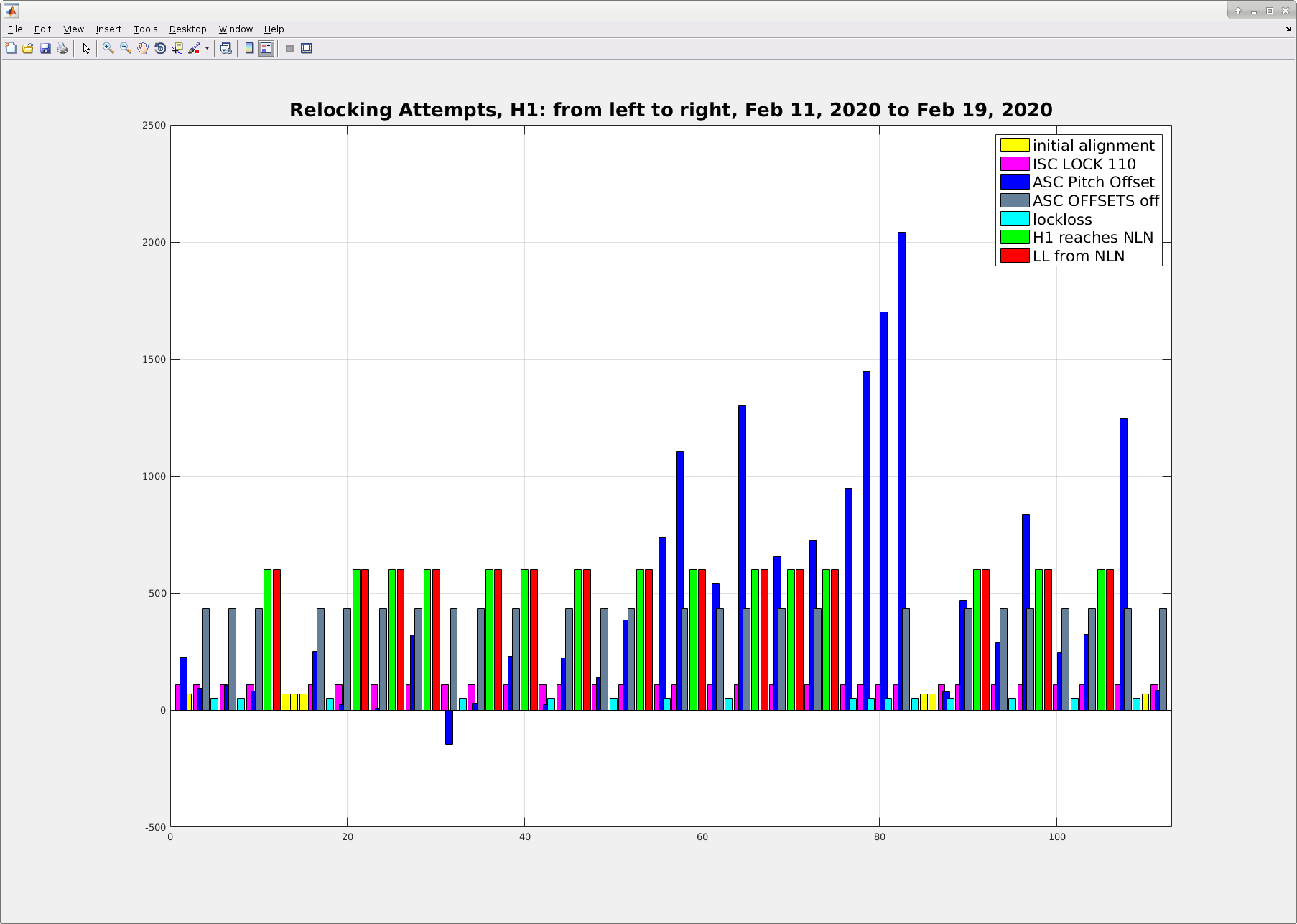
This plot covers 11 Feb to 19 Feb, 2020, a more recent stretch of time, showing H1 locking and Initial Alignment, and the ASC_A Pitch and Yaw Offsets. My original post, for 29 Jan to 5 Feb, is alog 55194. Color scheme for the previus plot and this plto are the same. There are a coule places where there are multiple Initial Alignments, and I can tell that in at least one case, these repeat Initial Alignments are a result of going back to recheck one state, and not a full Inital Alignment. Gathering further info on these situations, to incorporate in future plots.
TITLE: 02/24 Owl Shift: 08:00-16:00 UTC (00:00-08:00 PST), all times posted in UTC
STATE of H1: Observing at 120Mpc
INCOMING OPERATOR: Patrick
SHIFT SUMMARY: locked all shift in Observe
LOG:
H1 SEI Configuration:
[Sheila, Jenne, Keita]
Since we thought that increasing our DARM offset would improve our sensitivity slightly (alog 55105) we wanted to do one more on/off test using online SRCL FF with the new filter (alog 55189). We took 2 sets of on/off, and then determined that although very slight, there did seem to be a consistent improvement with the higher DARM offset and so put into guardian to relock with the higher DARM offset. However it has been reverted since it seems that we can't hold lock through glitches.
After noting that I couldn't change the SRCL LSC loop's cutoff filter (alog 55207) we moved the DARM offset such that we had 40mA sum on the OMC DCPDs and turned on the iterative SRCL FF filter. Sheila did a brief scan of squeezing angle to see if there was any change to the squeezing angle from the DARM offset change (not that we expect that their should be). We left the squeezing angle 5 degrees different from how it had been, but determined that this was a pretty small change and didn't change it again when going back to check the 20mA DARM offset.
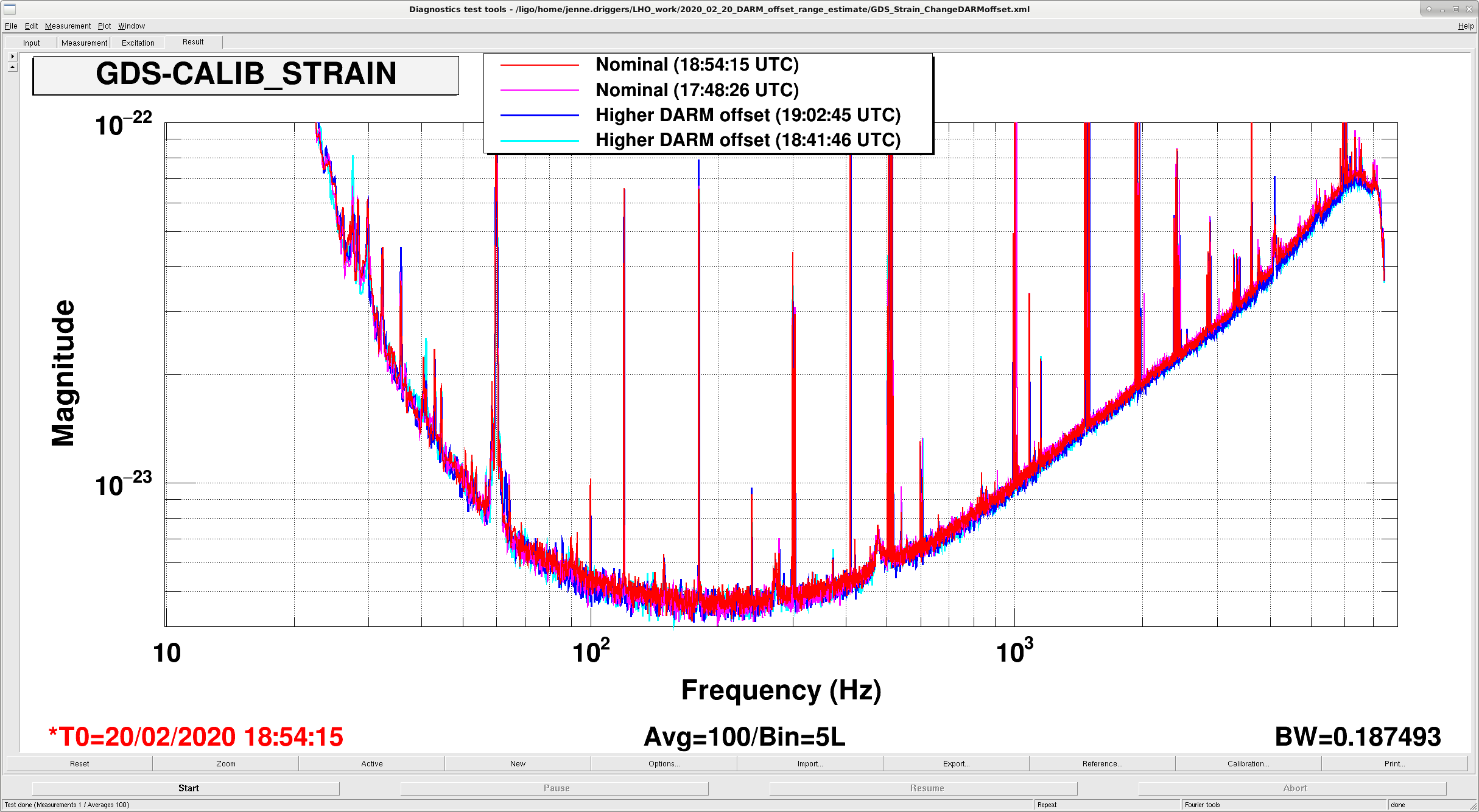
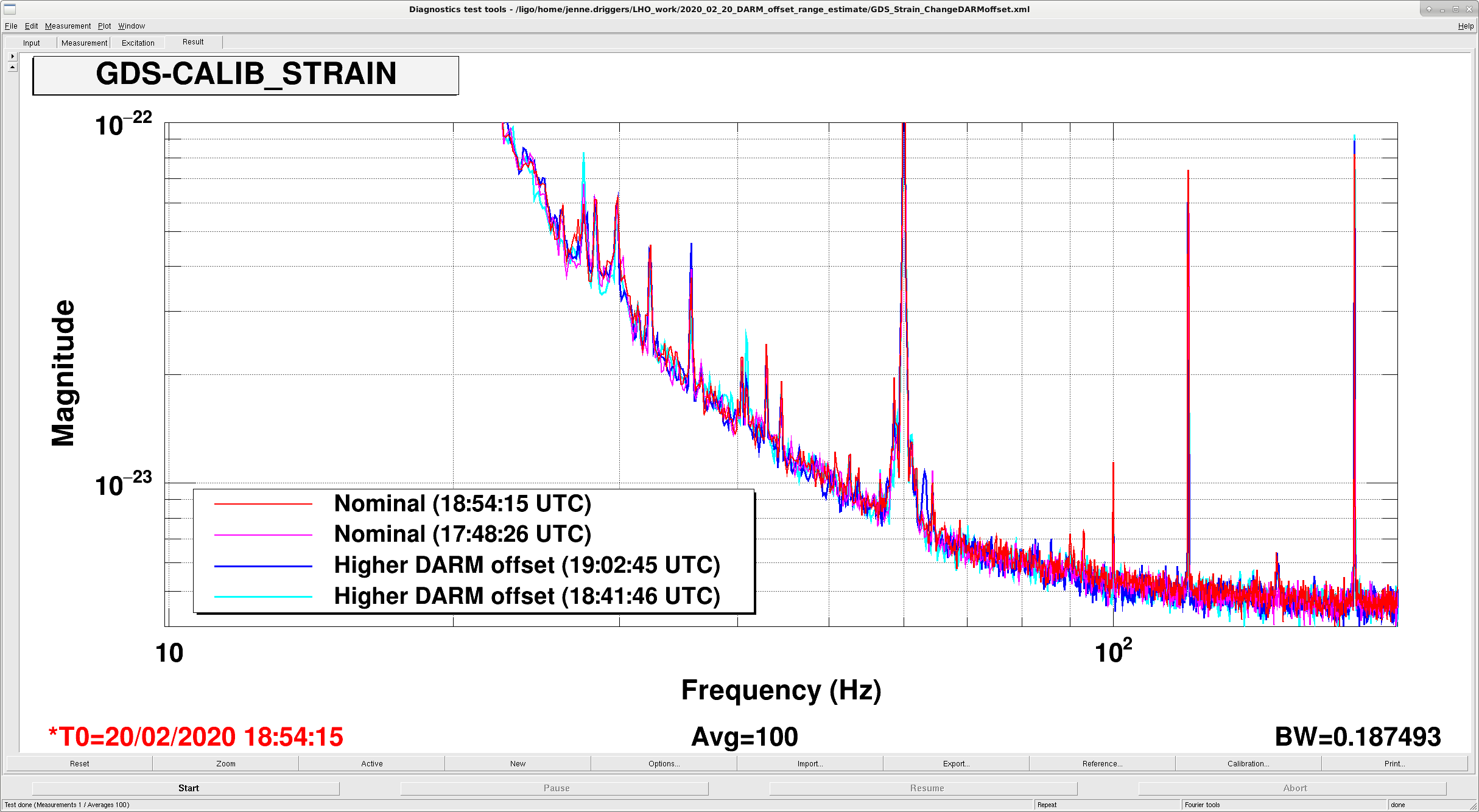
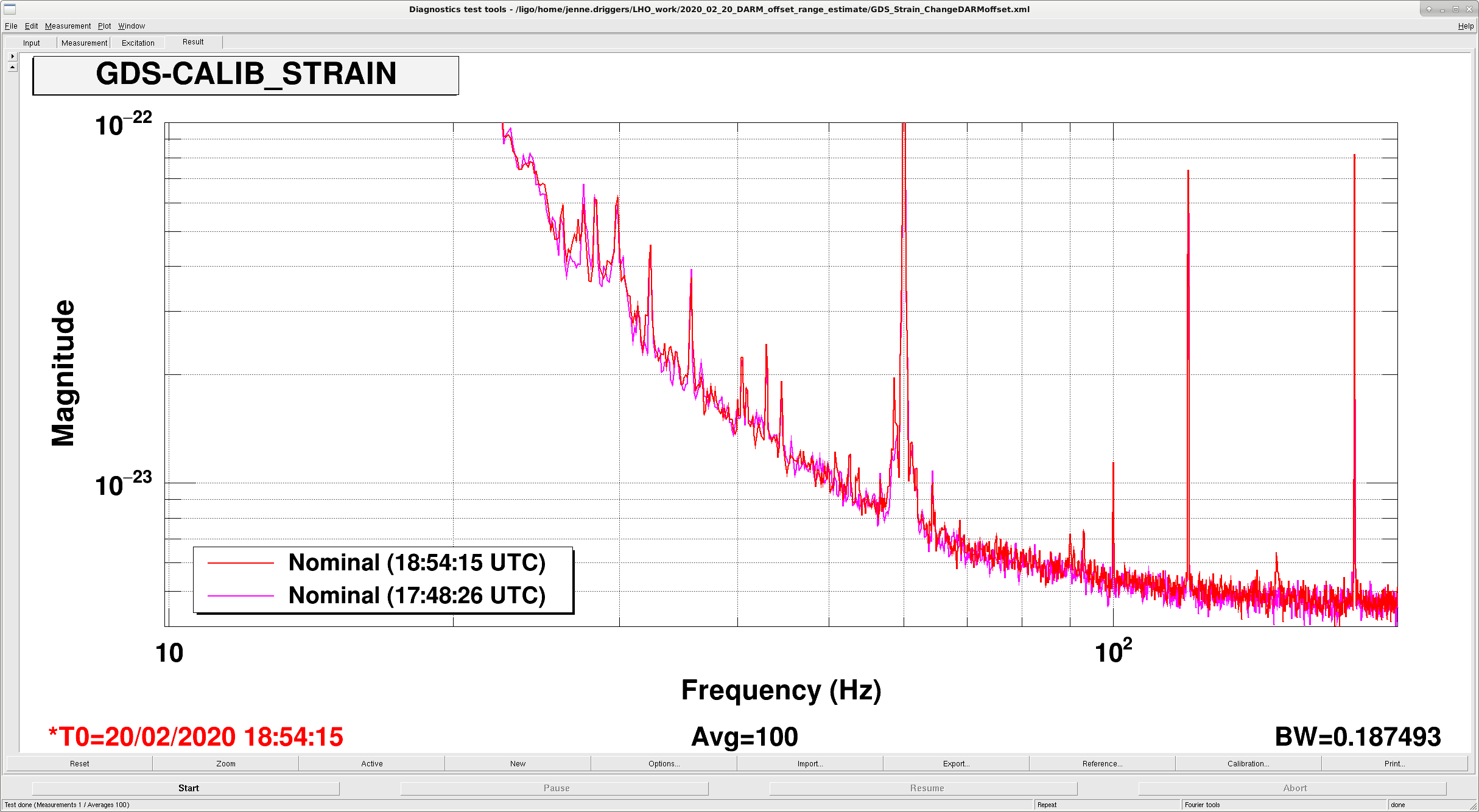
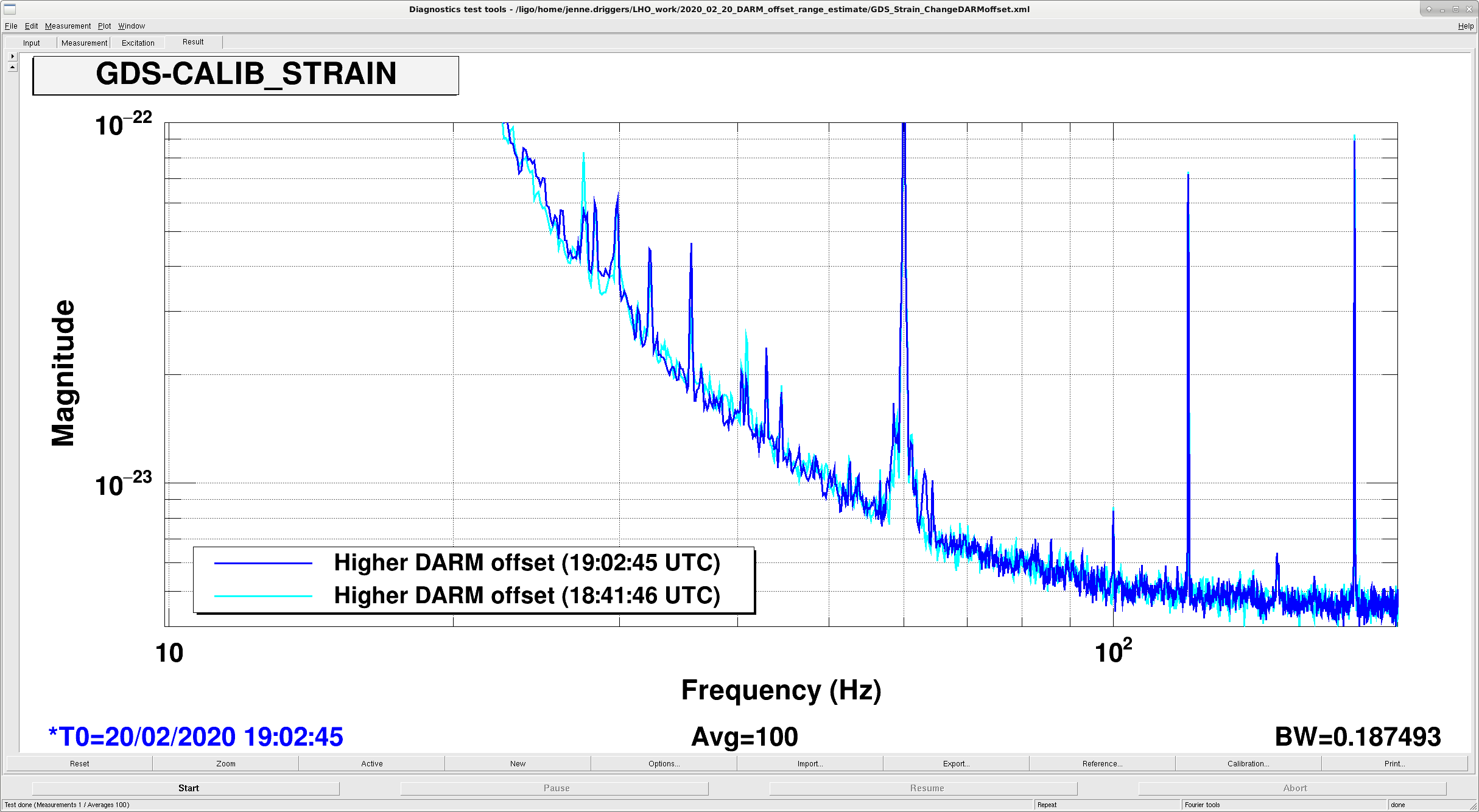
We took 2 sets of on/off spectra to (try to) convince ourselves that it was a real effect that we were seeing, and determined that we could also continue to look at more new configuration spectra after going to Observing. The difference is much more subtle than we were expecting, although it seems to be repeatable.
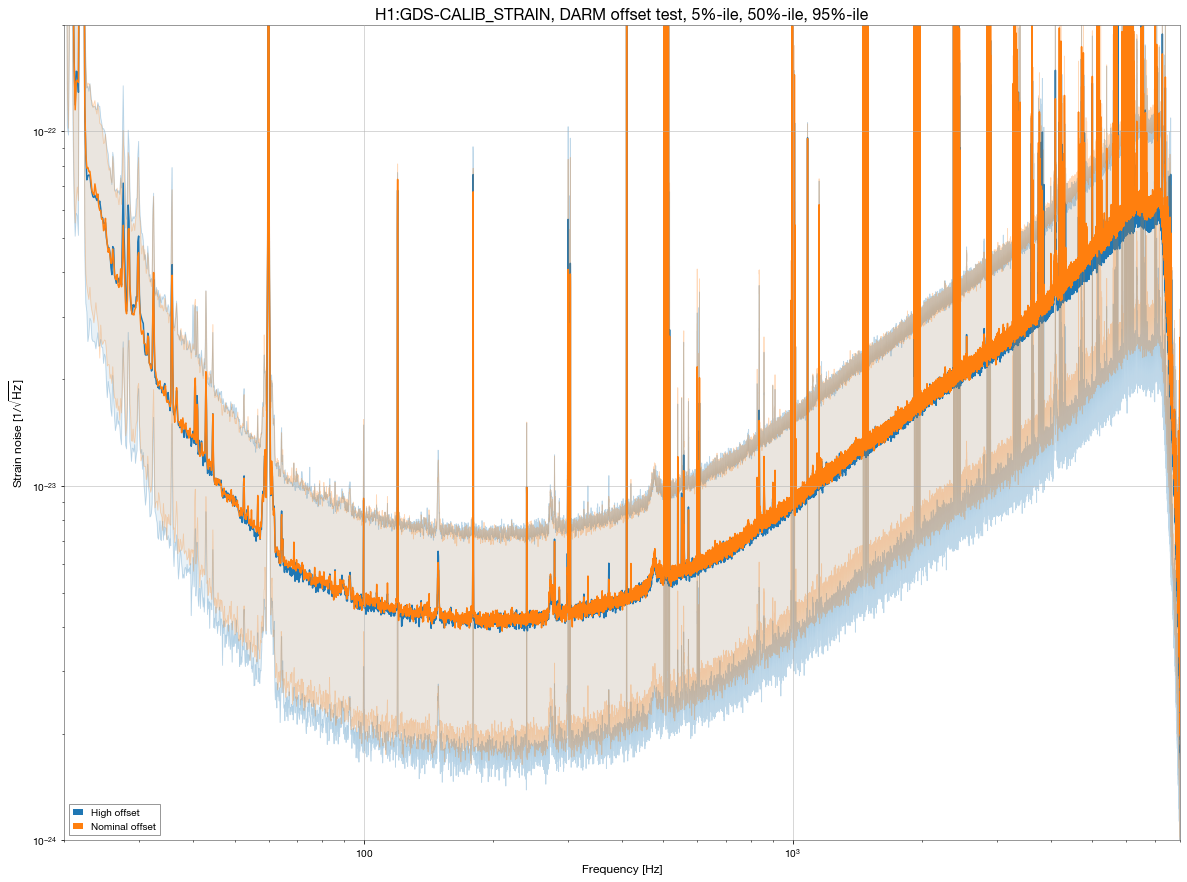
The first 4 attachements are all the same spectra (2 old nominal config, 2 candidate high DARM offset config) in 4 different zooms. The first attachment is over the full GW band, and the other 3 are zoomed from 10-200 Hz. The second plot is to show a zoom of the small improvement we see, and then the third and fourth plots are just to show that the spectra in each configuration are similar to one another, since they are all overlapped in the second plot. In all of these plots, the pink/red traces are from the nominal DARM offset, and the blue/cyan traces are with the higher DARM offset.
Particularly around 90 Hz, there seems to be a repeatable improvement with the higher DARM offset. There is also an improvement at higher frequencies, perhaps due to smaller influence of any intensity noise or frequency noise on the junk light.
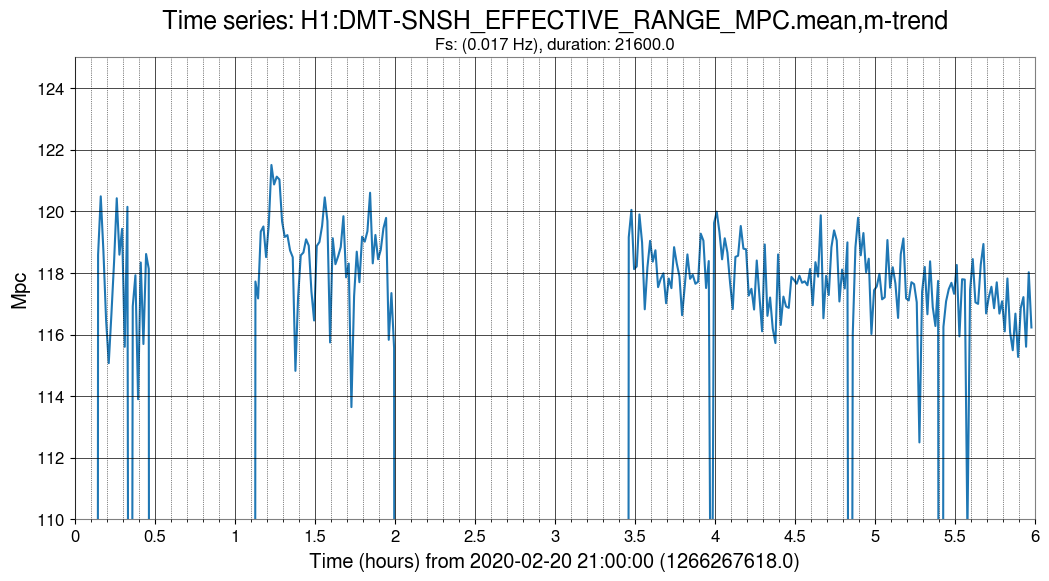
I added a new state to the ISC_LOCK guardian to change the DARM offset just after Lownoise_length_control, and added the new iterative SRCL FF filter to the guardian, and it worked twice to relock. The 5th attachment shows the range calculated by the summary page (after the effect on calibration is taken into account), showing that we seem to have eked out a small improvement. Noteable is that with the slightly different optical gain, in the high DARM offset configuration the control room reported range number (which does not track time dependent calibration corrections) becomes a slight underestimate rather than our usual case of a slight overestimate.
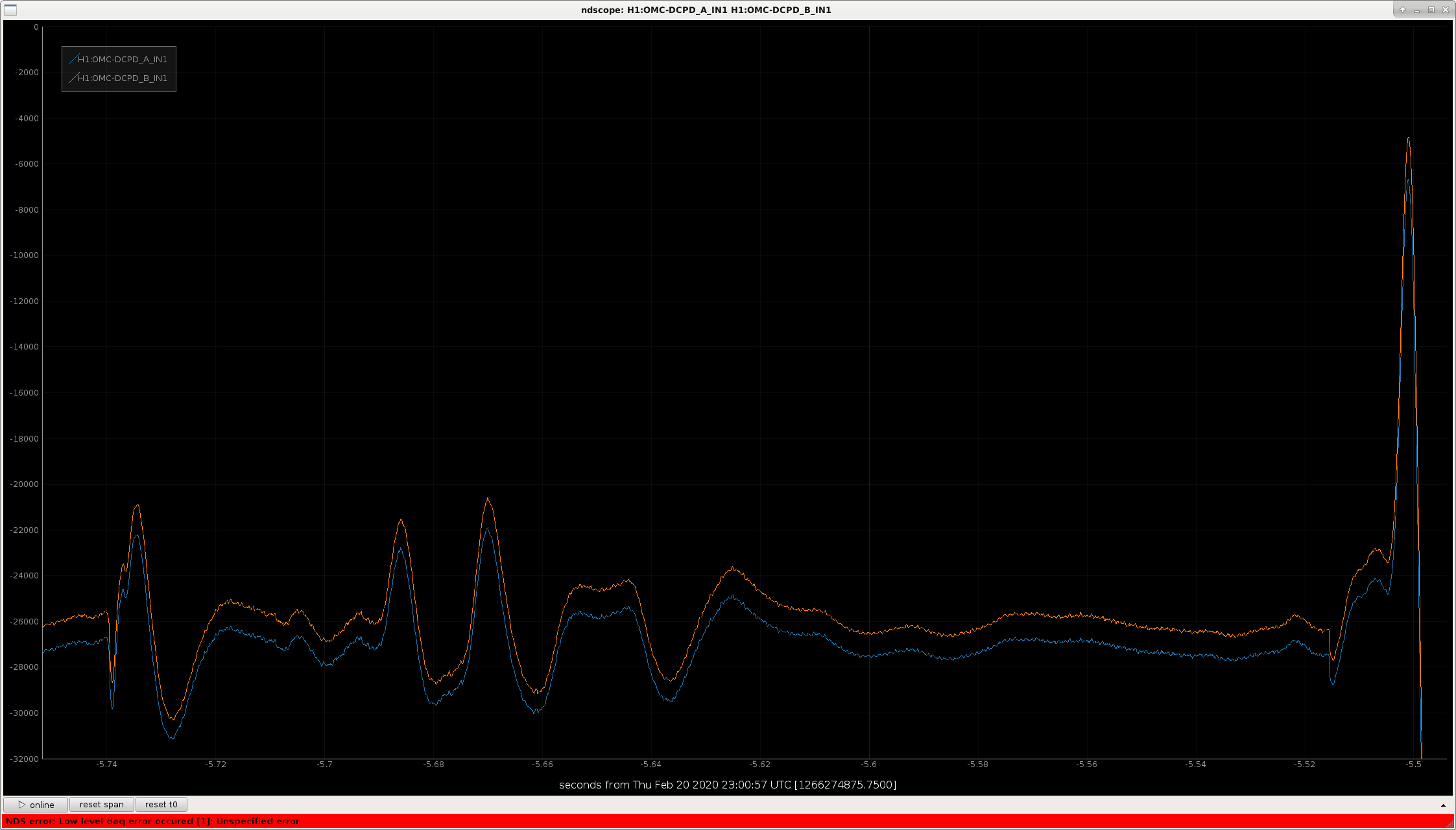
The higher DARM offset does put us much closer to the edge of our ADC range when we have 2 stages of whitening on (as is our nominal configuration). We seem to not be able to survive glitches when running in this state, and have had 2 locklosses after very brief Observing segments with the higher DARM offset, and so have backed out the change by bypassing the new change_darm_offset state and taking out the iterative SRCL FF filter. The 6th figure shows the OMC DCPD inputs before they are filtered to account for the analog whitening, and you can see that just before we lost lock we came extremely close to hitting the ADC limit, although we didn't actually go over 32000 counts. Something that we may consider is what the tradeoff would be if we were to operate in the LowZ transimpedance option for the DCPDs, since that would keep us farther away from the edge.
Sheila suggested that looking at the spectra with ranges just like on the summary pages might help illuminate where we are seeing an improvement.
The first attached plot is of 2 1-hour-long stretches of data, with orange the nominal 20mA OMC DCPD sum, and blue being the candidate higher DARM offset of 40mA OMC DCPD sum. There certainly does seem to be better sensitivity with the higher DARM offset, although as we found last week we can't actually hold the lock through glitches with the higher DARM offset. Calculating the expected range improvement from the median spectra here, we expect to see about a 1.7 Mpc improvement, which is consistent with what we see in the range plot (2nd attachment).
We could consider trying to run at 30mA, although that would take time and would likely result in a minimal improvement. Right now, we're choosing to defer this in favor of measurements to help us actually understand our junk light at the AS port.
Sheila, Jenne, Rahul
I went through all the monitor filters for the violin modes to confirm the following,
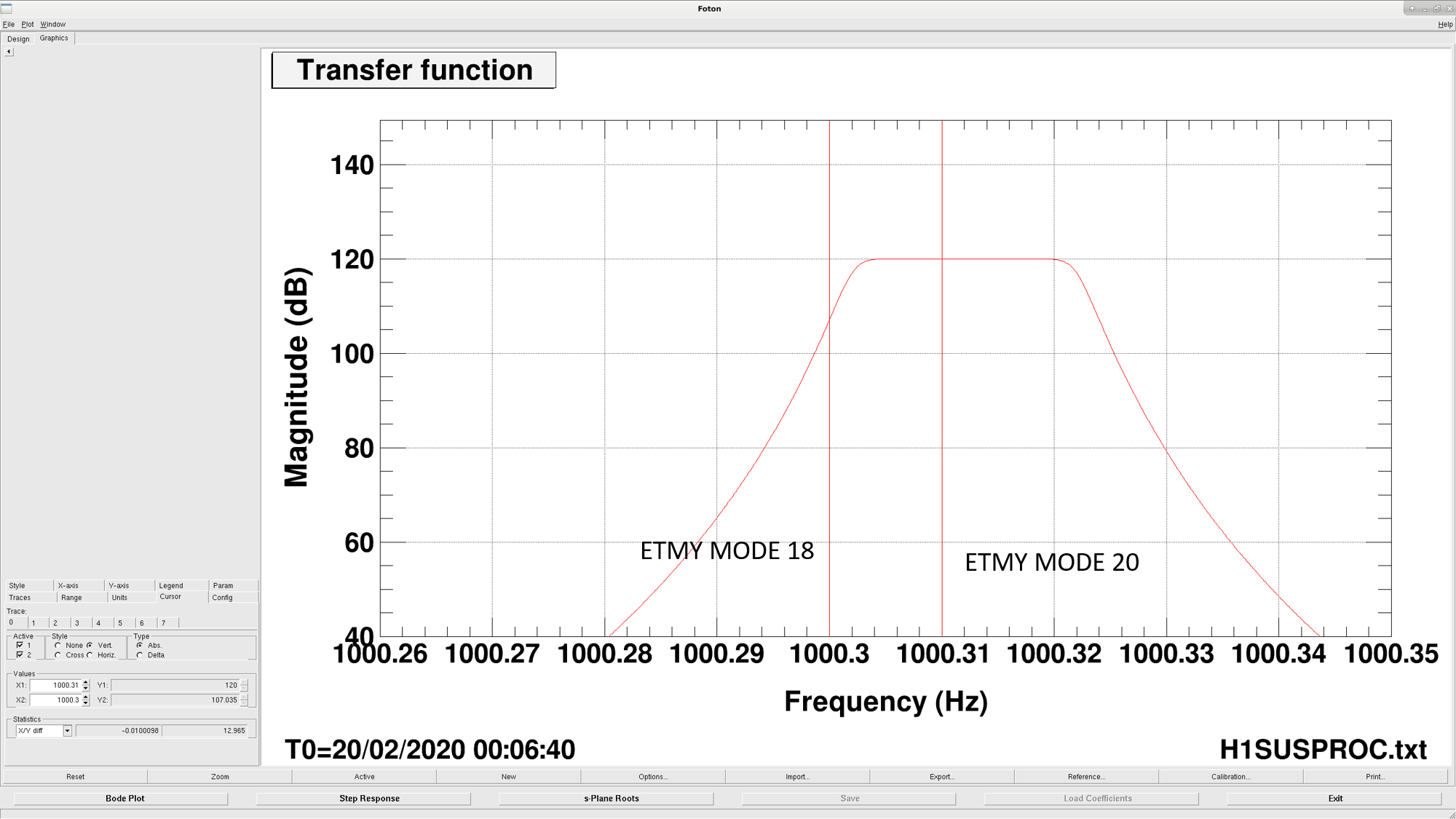
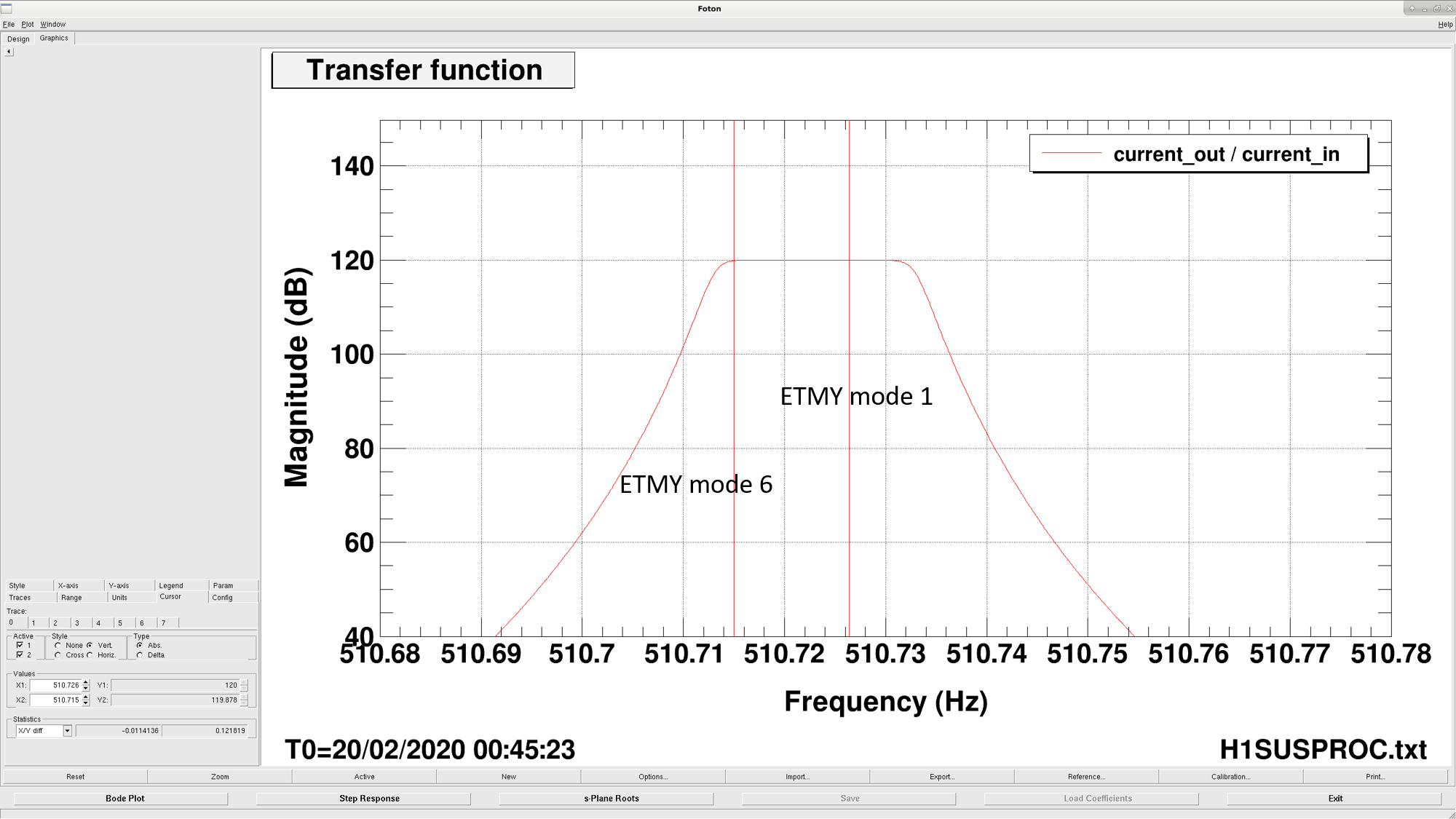
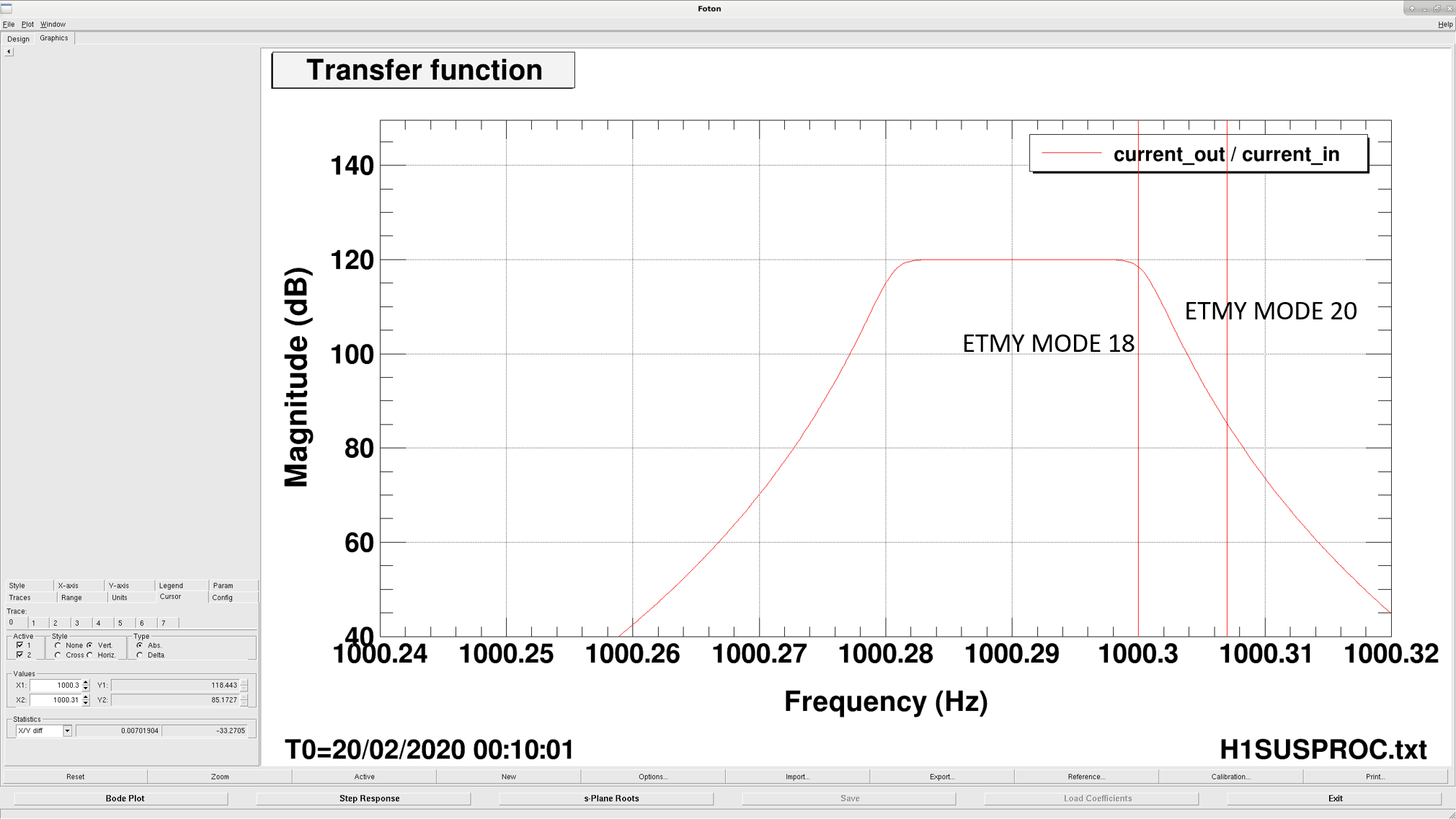
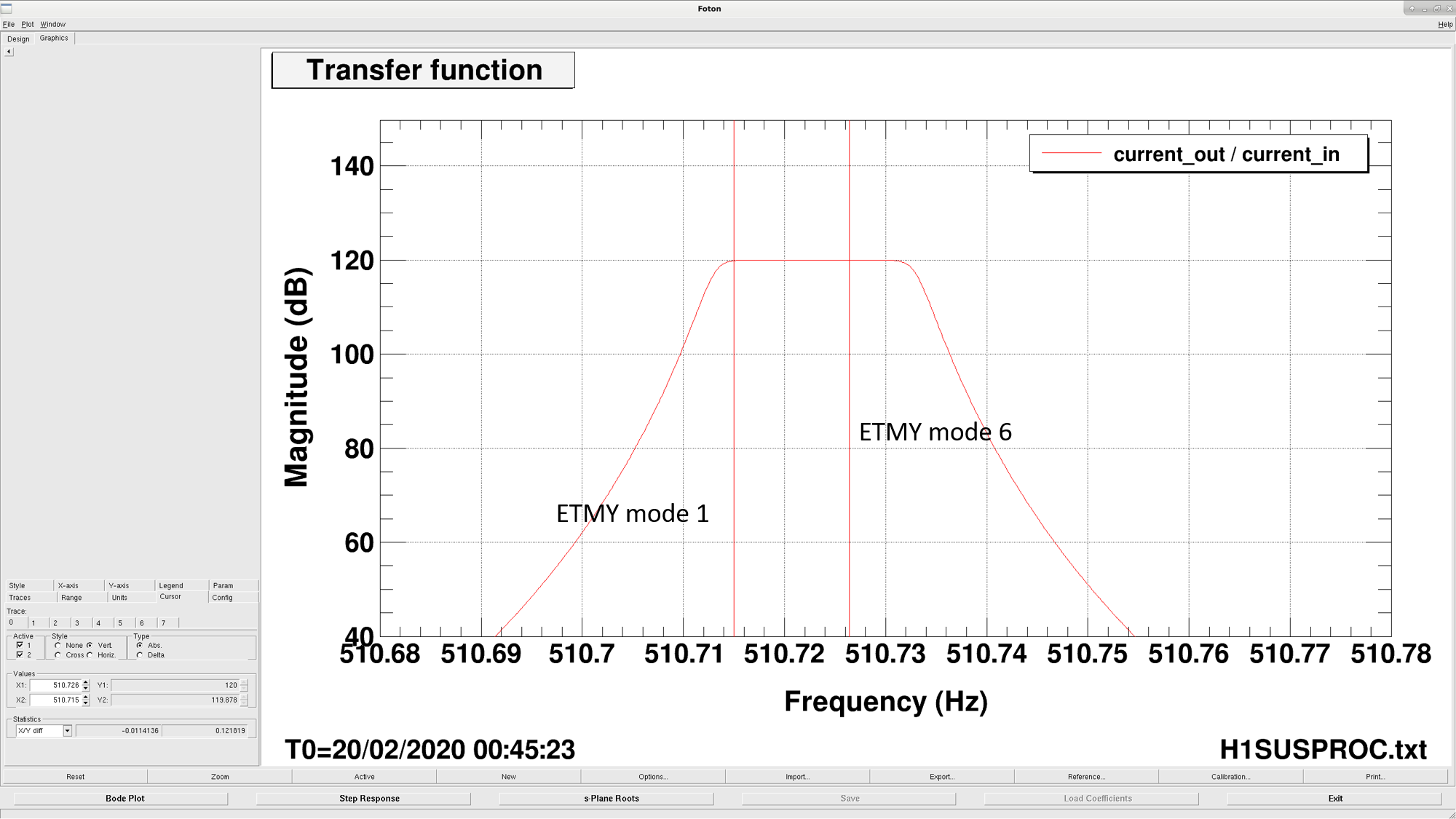
The band pass filter has a gain of 120db and the bandwidth is 0.02Hz. The bandwidth at 80db is 0.04Hz.
With this boundary condition, I found 4 modes (ETMY 1,6 and ETMY 18,20) which are very close to each other (or are pairs), i.e. within 0.04Hz. The bode plots for all 4 modes are attached below.
In fact mode 1 and mode 6 and only 0.011 Hz apart and they are sitting on the flat top of the band pass filter (which is not good, since they are creating beating and hence Guardian cannot effectively damp them). Sheila suggested that we can use notch filters to reject signals in this case.
...adding a few more lines to bring clarity to the above alog,
The aim was to hunt for pair modes in the monitor filter which are very close in frequencies and hence could be crossing over into the narrow band pass filter of each other. Since the gain for the narrow band pass filter was defined as 120db, we looked for modes which are crossing over at 80db and above. The bandwidth has been user defined and is consistent for all the violin mode monitor filters. Below 80db, the beating of the two modes won't be that significant and hence can be ignored.
Keita, Sheila
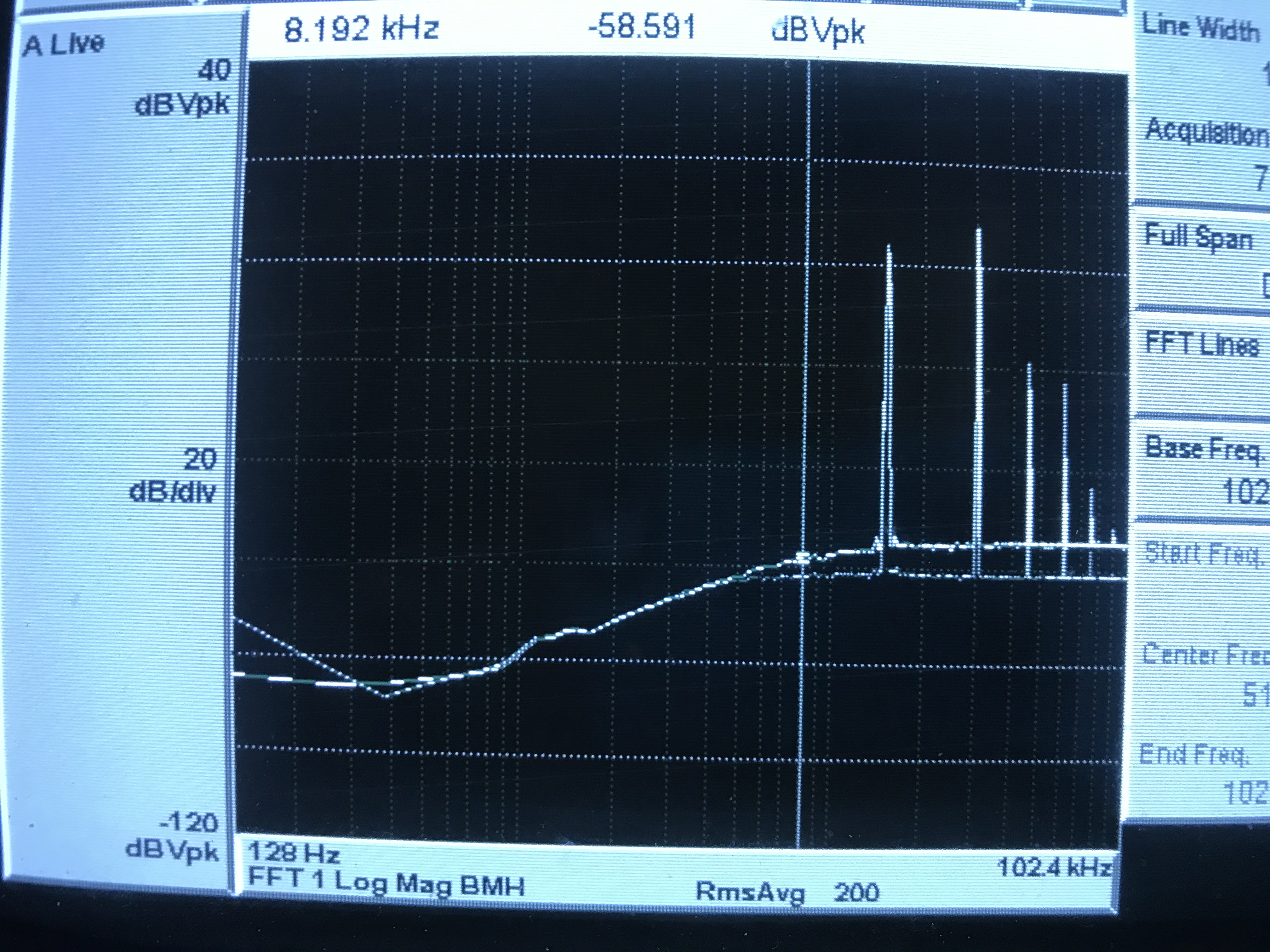
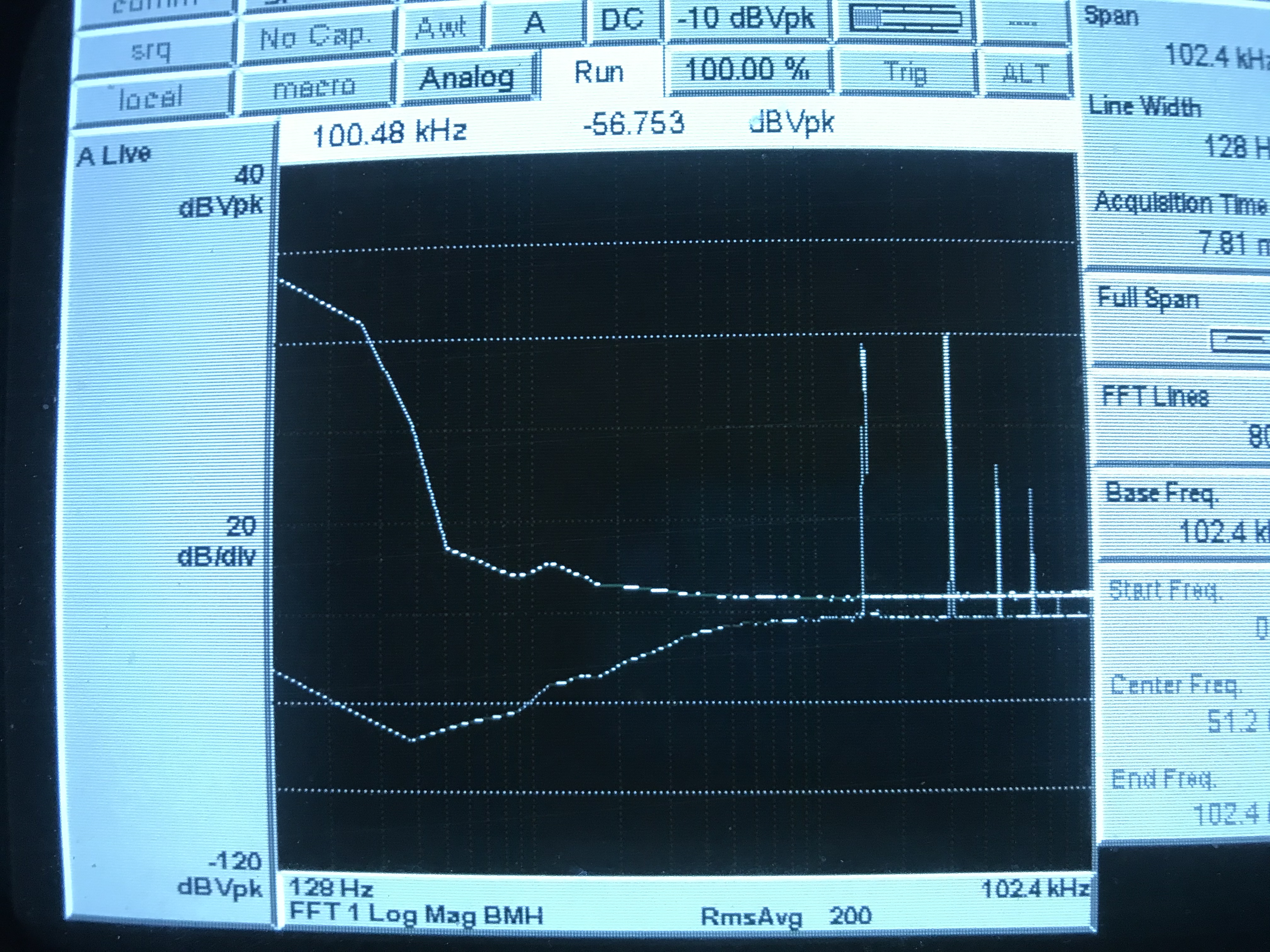
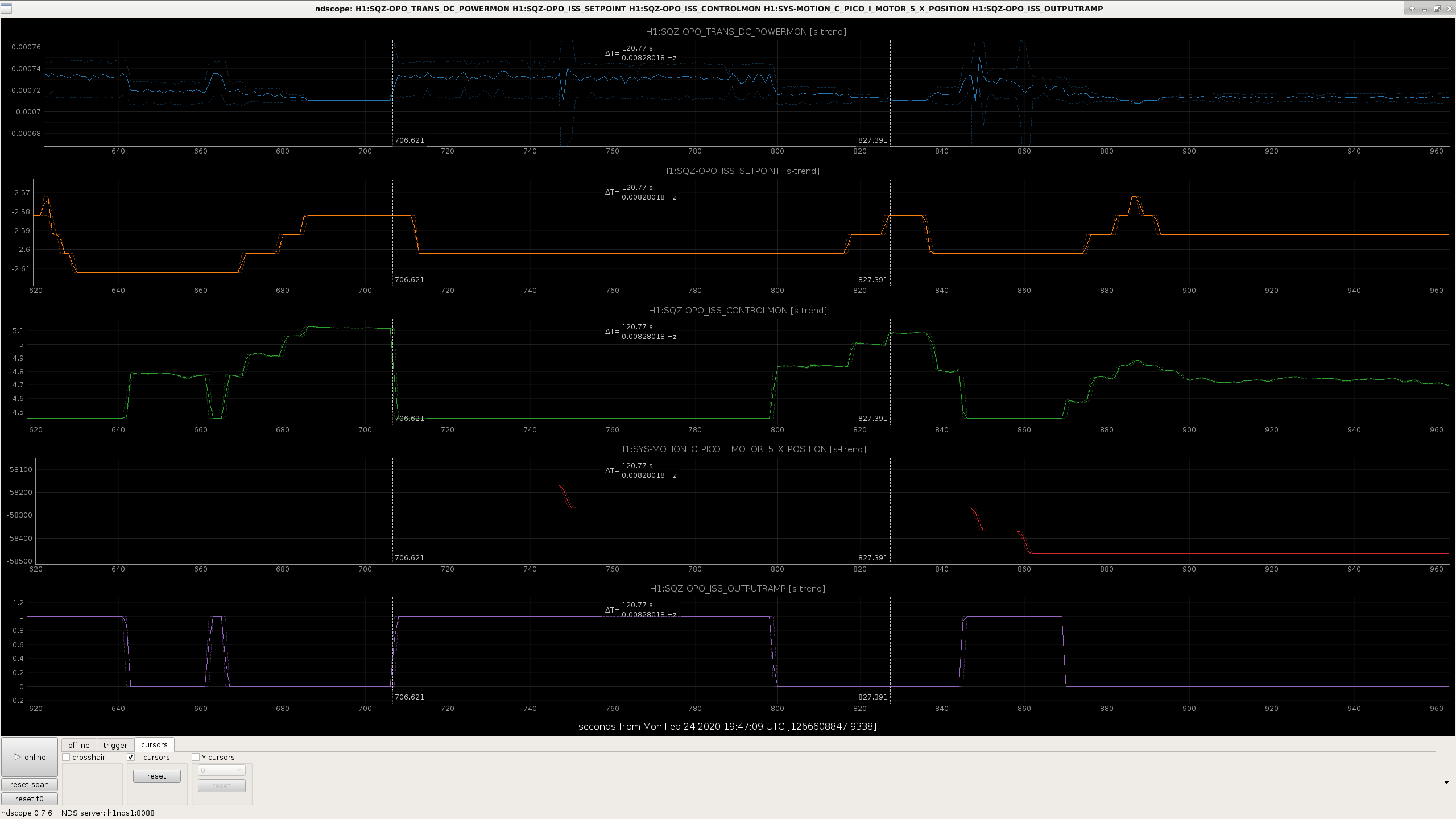
We had another example of the squeezer oscillations that were seen last weekend: 54864 The first screenshot shows the signals related to gree power in the OPO getting very noisy over ~ 6 hours this morning. We went out of observing earlier than our planned commisioning time to try to address this. We turned off the green ISS, which brough all the signals back to normal. Turning that loop back on brought the noise back. We also tried reducing the gain in that loop, which did reduce the peak to peak noise seen in the ndscope. Based on loop measurements taken on Tuesday, 54888, the shape of this loop at its nominal 31dB gain setting should be fine.
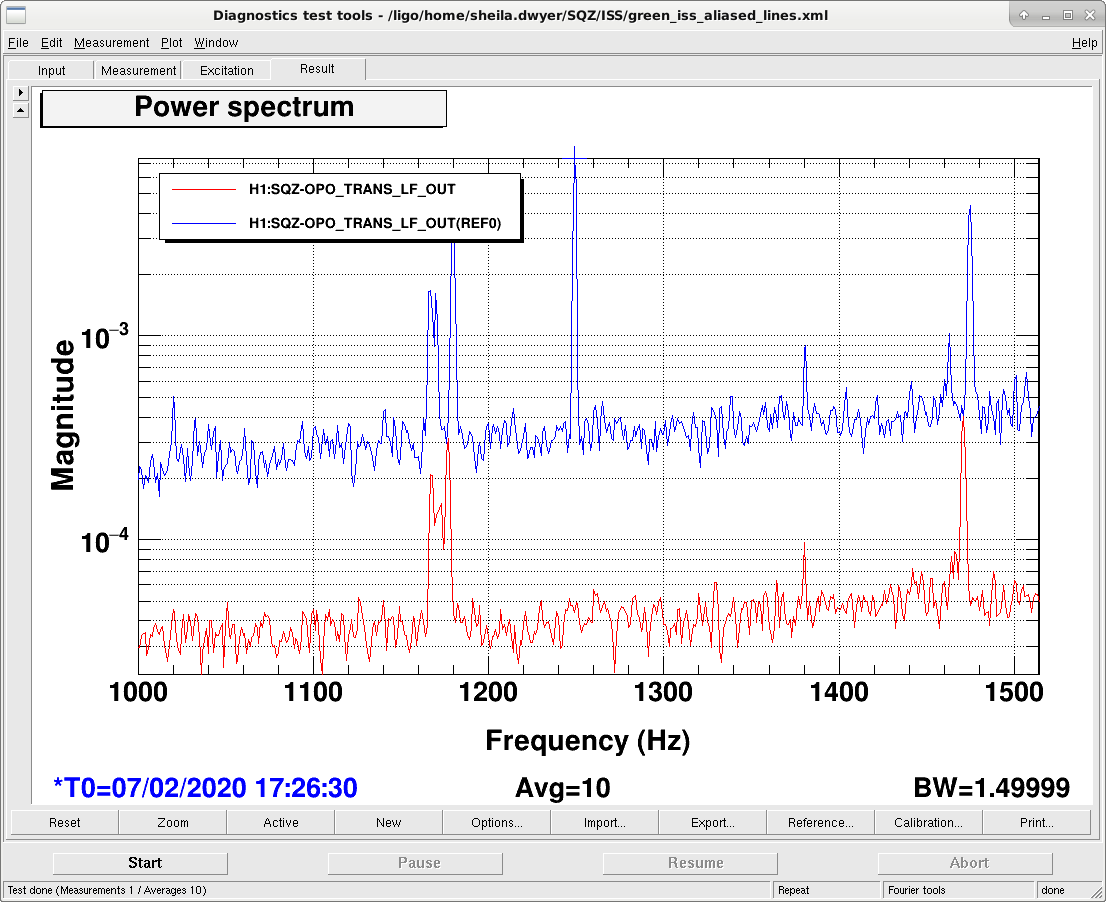
Next I went to the floor, while Keita took spectra and changed the gain from the control room. On the floor I measured a spectrum of IN1 (the error point) on the green ISS, and I saw large lines at 15kHz and 30kHz. Keita saw that there is an aliased line at 1249Hz in the spectra in the control room, which would correspond to a line at 15135 Hz. The height of the 15kHz and 30kHz lines didn't change with gain changes, although the overall noise floor did change. Ketia disabled the loop, and I could no longer see the lines on the error point, and the low frequency intensity noise increased (as you would expect).
We then unlocked the squeezer by requesting no squeezing, and relocked it. We saw no evidence of the 15kHz and 30kHz lines on the analyzer, although the red trace in the second attachment shows that the 1kHz line is still present. We reset the ISS gain to 31Hz, which is nomal, and everything seems fine for the time being.
Photos attached (after screenshots):
For operators:
The first attached screenshot is from the ndscope that is accessible from the upper right corner of the SQZ_OVERVIEW screen, called locking signals. If you see the range dropping, open this ndscope and see if there is trend similar to what is shown in the attached screenshot that lines up in time with the range drop. In the left column of the screenshot you can see that the OPO REFL power is changing and the max-min difference gets larger, the max-min difference of OPO_IR_RESONANCE trigger gets larger, and the SQZ_SHG_LAUNCH power max-min difference also gets larger. If this is happening and corresponds to a range drop, please unlock the squeezer by requesting "NO_SQUEEZING" from SQZ_MANAGER, then once it arrives, request SQZ_READY_IFO. Once it arrives there hopefully the signals in the ndscope will have returned to normal, if so you can request "SQUEEZING" again. If not you can try again or call for help.
Tagging OpsInfo to propagate the message
During today's calibration time, this oscillation happened again, and Patrick called me so I could make a few more observations.