Issues reported on some ALS WFS channels. Keita and I drove down to EX to investigate. We powered down both the WFS interface and AA chassis and found one channel still showed a high offset count. Power supply voltage was increased to ensure we had 24V at the ISC IO chassis. IO chassis was powered cycled, offset issue cleared.
Next we looked at the error for the ALS laser. For now we hardwired the interlock on the ALS laser controller. Further investigation needed next Tuesday.
D. Barker, F. Clara, K. Kawabe
[Camilla, Jenne]
The updated CHECK_MICH_FRINGES from last week (alog 55042) was causing some trouble over the weekend, since the MICH_BRIGHT_ALIGN wasn't always giving us a good BS alignment. It was easier to see when checking the BRIGHT alignment against a MICH_DARK_LOCKED michelson today than last week, since we had some time with sensor correction on, so things were much more stable.
A first obvious problem was that the BS clear alignment history after offloading was happening before the ADS was fully off, so some leftover junk was left in the LOCK P and Y filter banks. This would be cleared before main IFO locking, but if this was present when we did SRY locking and alignment, then it's possible that we were aligning SR2 and SRM to a not so great place, thus potentially making DRMI locking harder. So, now the MICH_BRIGHT_ALIGN state turns off the ADS gains after it decides that things are converged. This does mean that it'll turn itself off if you're trying to do initial alignment by hand, state-by-state (not very common anymore), so you'll have to turn the ADS gains back up if you want to actually sit and let the MICH alignment converge more than the guardian is requiring. We confirmed that now we're no longer leaving junk in the BS top stage integrators after running MICH_BRIGHT_ALIGN.
A somewhat trickier problem was that we wanted to have the ADS convergence checker look at the average value of the ADS output, not a momentary value. After a short while of trying to re-invent the guardian wheel, we copied TJ's code from the ALS guardian to the ISC_Library, and modified it to use the ADS channels (we didn't change or move the ALS version). Now it looks at a 20 second average of the ADS outputs, and has a somewhat tighter threshold on convergence. I sped the loops up considerably, and tested them with extremely bad MICH alignments during initial alignment, and they seem to work well. The ADS gains used to be 10 for both pitch and yaw; now the gain is 300 for pitch and 100 for yaw.
Several times today we offloaded the MICH bright alignment, then looked at MICH_DARK_LOCKED. With the more strict convergence checking it seems like MICH_BRIGHT_ALIGN is doing a pretty good job. However, the final alignment of the beam splitter is slightly different depending on how well aligned the signal recycling cavity is (which makes some sense, as we're demodulating the power at the AS port for MICH alignment, so if SR2 is significantly off, things might come out a bit differently). The alignment was better (AS_A sum was smaller) when I re-ran MICH_BRIGHT_ALIGN after aligning SRY. That said, I think that these changes will already make the BS alignment better than it has been, and it really just needs to be good enough to get PRMI locked (if DRMI won't catch), and then PRMI or DRMI ASC will fix up the BS even better.
With Sheila's work from last Tuesday of making these states into generators, all of these changes should also be implemented in the CHECK_MICH_FRINGES path of the main guardian. I also hope that this makes MICH initial alignment more reliable (having it converge fully before offloading), so that perhaps we don't need to do CHECK_MICH_FRINGES much anymore. But, if we do, then I hope it's a little better behaved. I haven't checked the CHECK_MICH_FRINGES in the main locking sequence yet, since we're recovering from some end X issues, but I think it should work fine.
TITLE: 02/17 Day Shift: 16:00-00:00 UTC (08:00-16:00 PST), all times posted in UTC
STATE of H1: Corrective Maintenance
INCOMING OPERATOR: TJ
SHIFT SUMMARY: Busy Maintance day with trouble relocking. Currently holding IFO in DOWN while Keita and Fil are at EX investigating ALS.
LOG:
TITLE: 02/18 Eve Shift: 00:00-08:00 UTC (16:00-00:00 PST), all times posted in UTC
STATE of H1: Corrective Maintenance
OUTGOING OPERATOR: Camilla
CURRENT ENVIRONMENT:
SEI_CONF state: WINDY
Wind: 7mph Gusts, 4mph 5min avg
Primary useism: 0.04 μm/s
Secondary useism: 0.19 μm/s
QUICK SUMMARY: Having some issues locking green, so Keita and Fil are investigating.
WP 7803
Replaced the temporary power supply for the microphones with a dual output acopian power supply. 60hz magnitude shows up higher in power spectrum with new power supply configuration. Will try isolating/grounding power suppy next Tuesday.
F. Clara, R. McCarthy
Lights are off in end stations and Cheryl has swept LVEA.
The DMT production computers at LHO have been patched and rebooted to bring in the latest security patches. After several restarts, low latency DMT H1 hoft is flowing to CIT again and going to disk at LHO. And everything else in the DMT is working again, as well. This completes WP 8539.
Oplevs at ETMs and ITMs were centered.
WP 8537
alog 55041
Ongoing noise hunting efforts at EX continue. Last week we moved auxiliary beckhoff electronics away from the ESD electronics (alog 55041) and powered down the Baffle Photodiode Amplifier chassis.
Today the ISC IO chassis 24V power was moved to same power supply that feeds the SEI IO chassis. Previously the 24V feeding the ISC chassis was also powering the slow controls Beckhoff electronics.
The Baffle Photodiode Amplifier chassis that was turned off last week was powered back on. Leaving unit off showed no change in our lines.
F. Clara, R. McCarthy
Tagging @DetChar and @CAL, in case these changes impact results. I'll post the time of next observation ready segment for which these changes would take affect once we get back up from maintenance.
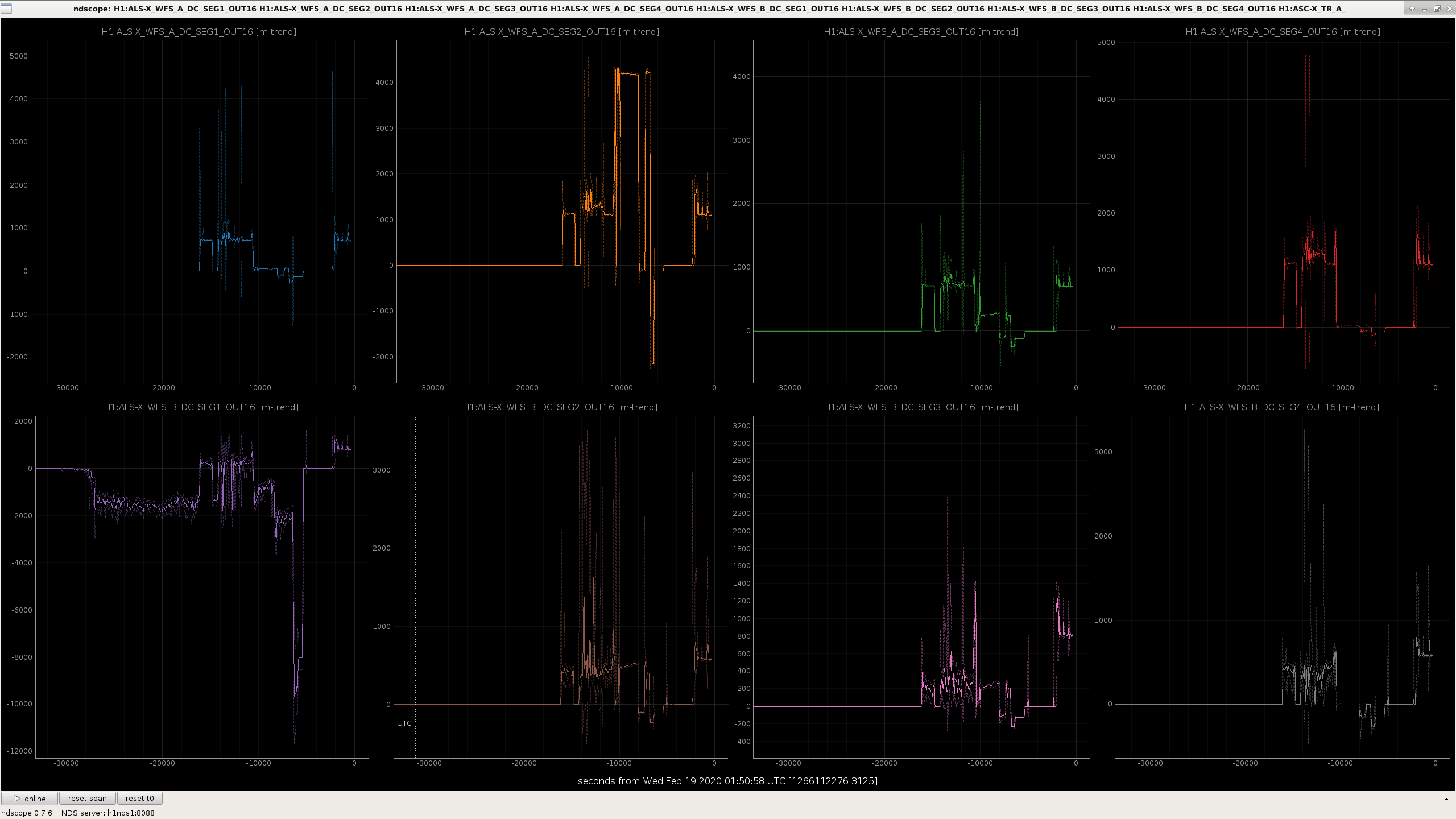
This afternoon Jenne and Camilla had a hard time taking care of green WFS at EX. Turns out that SEG1 of WFSB developed a huge offset of about -2000 counts after the IO chassis was power cycled, and that channel got much noisier too. This was not a sudden change. In the attached, the problem started at about t=-30000 (~ 17:30 UTC) and gradually got worse over the course of tens of minutes.
I was suspicious about analog problem, so I and Fil went to the end station and powered off WFS DC interface as well as AA chassis, but the offset remained. When Fil disconnected the AA chassis from the IO chassis, though, the offset jumped to ~-10k counts, WFSA SEG2 offset also jumped to -2k counts.
Next we power cycled the IO chassis anyway, and that particular problem went away. Don't ask me why.
Then we found, after driving back to the corner, that power cycling IO chassis, or maybe disconnecting AA from IO, triggered the safety system at EX to go crazy, the safety system thought that the status was fine but the laser interlock was kept open so the laser couldn't be turned on. This was manually bypassed.
Chris S., Bubba G., Scott L., Tyler G., Kyle R.
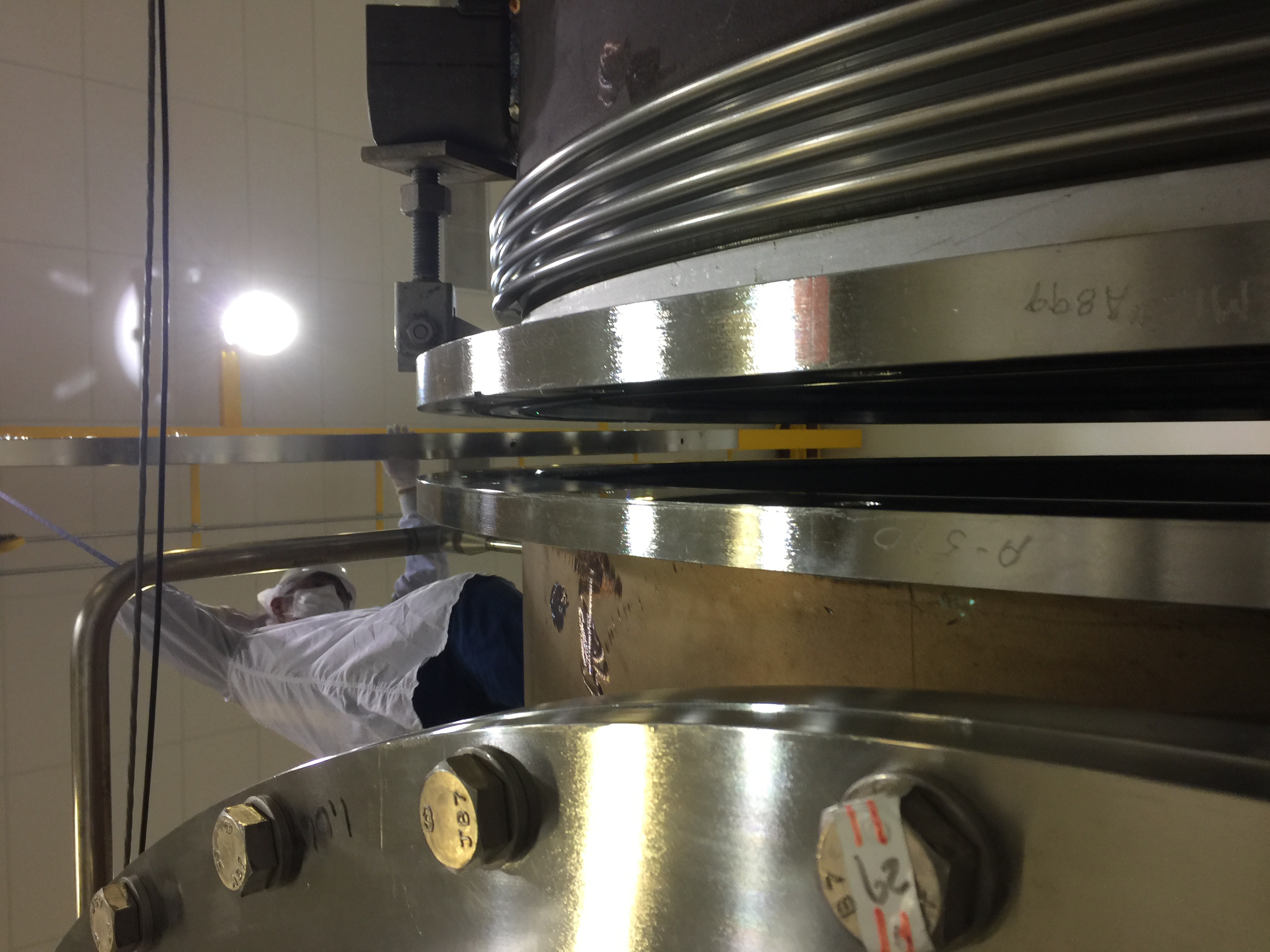
Purge air at maximum flow (dew point < -26C), crane hook used as fall protection tie-off when standing, rigid aluminum "shipping covers" installed on both HAM7 (O-rings) and HAM8 (no O-rings) flanges with C-3 soft covers used over the "capped" assembly to ensure dust protection -> note that the Class-B aluminum shipping covers only had provisions for every 3rd flange bolt. This differs from the 84" shipping covers used on HAM11/12 which had provisions for every flange bolt. O-rings which had been in septum flange were kept clean, bagged, labeled and stored. O-rings in HAM7 flange were left in place.
Good work, guys! With holes every third bolt, does it look like the shipping cover seals against the o-ring in all places?
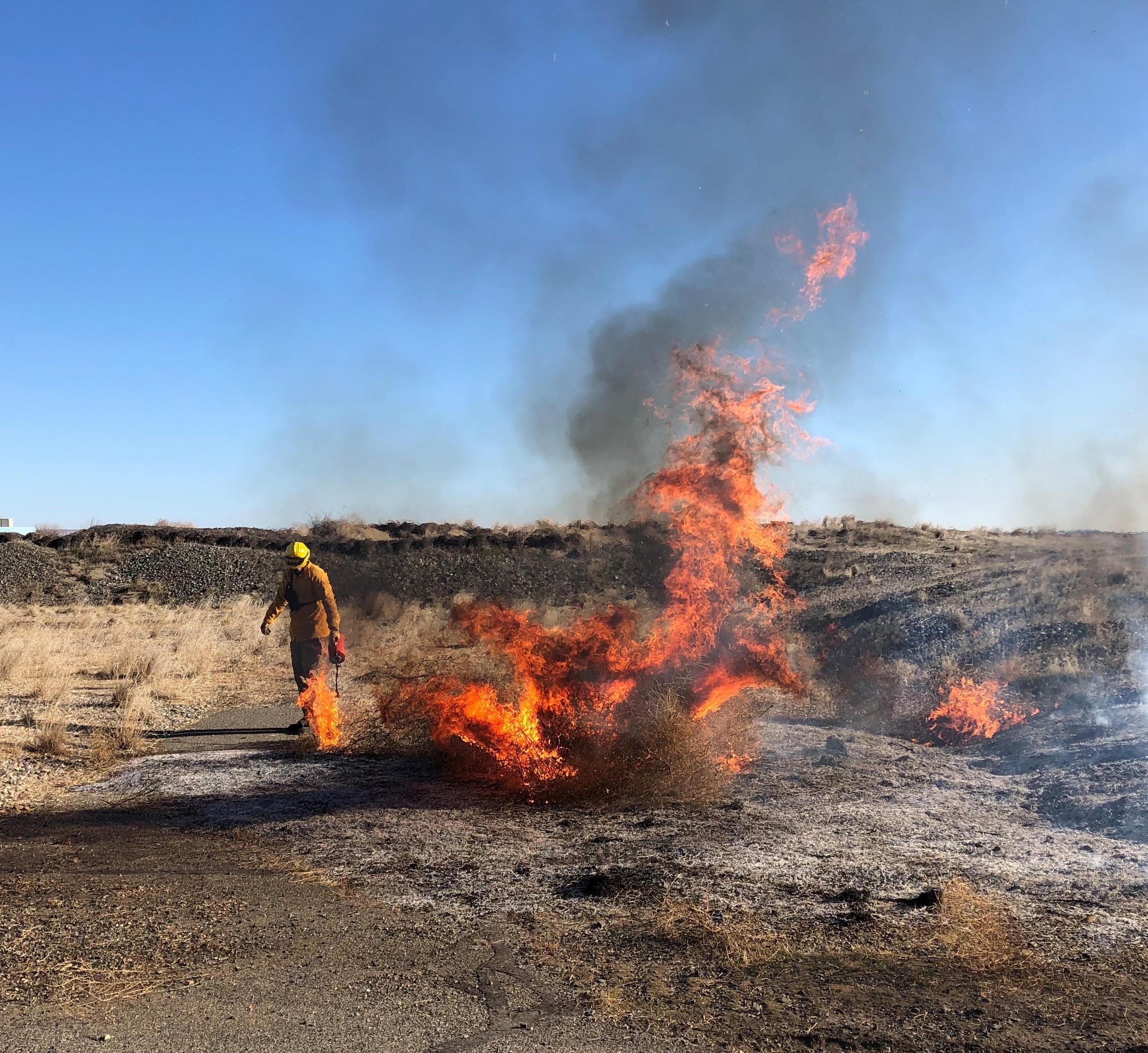
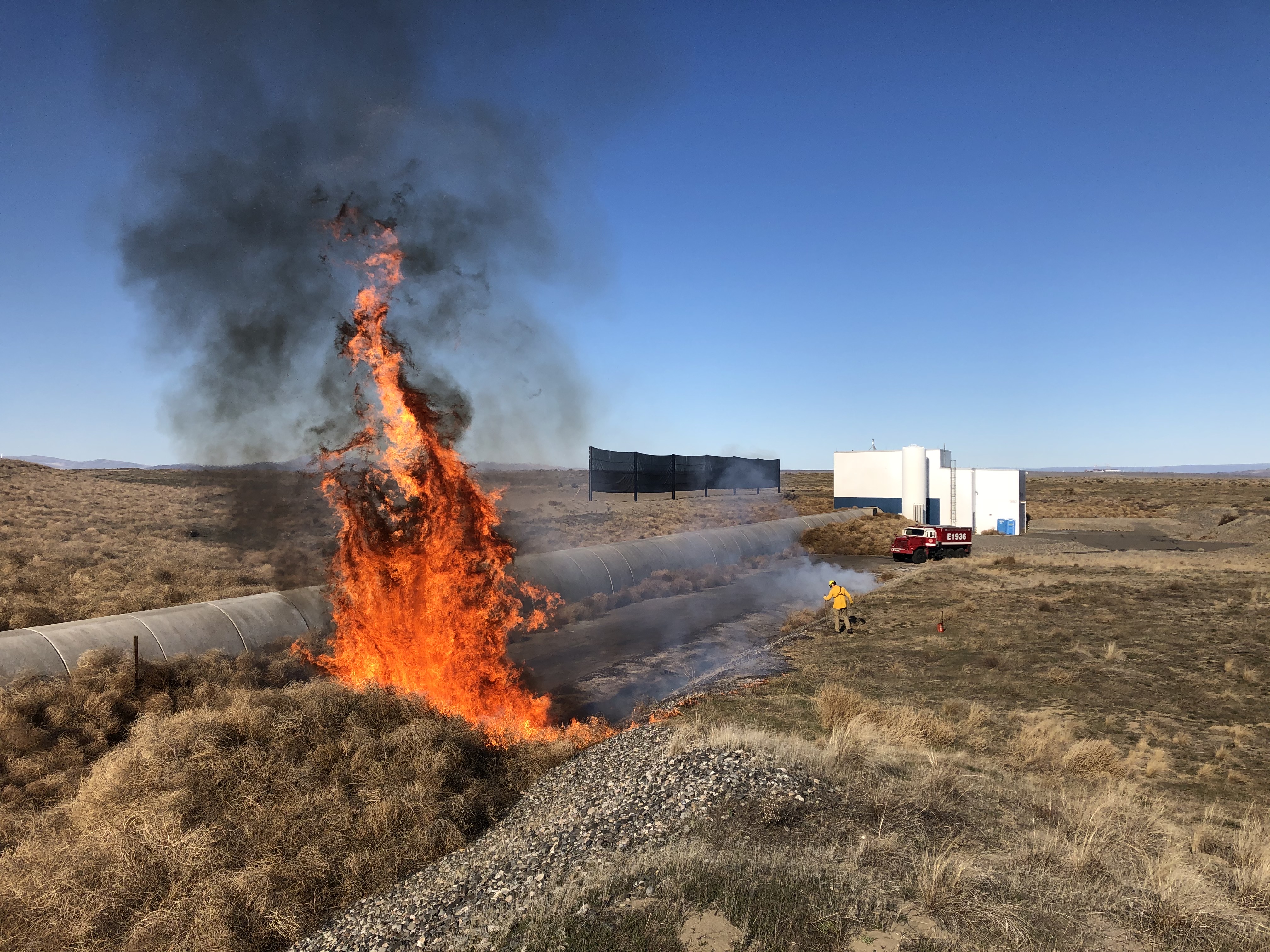
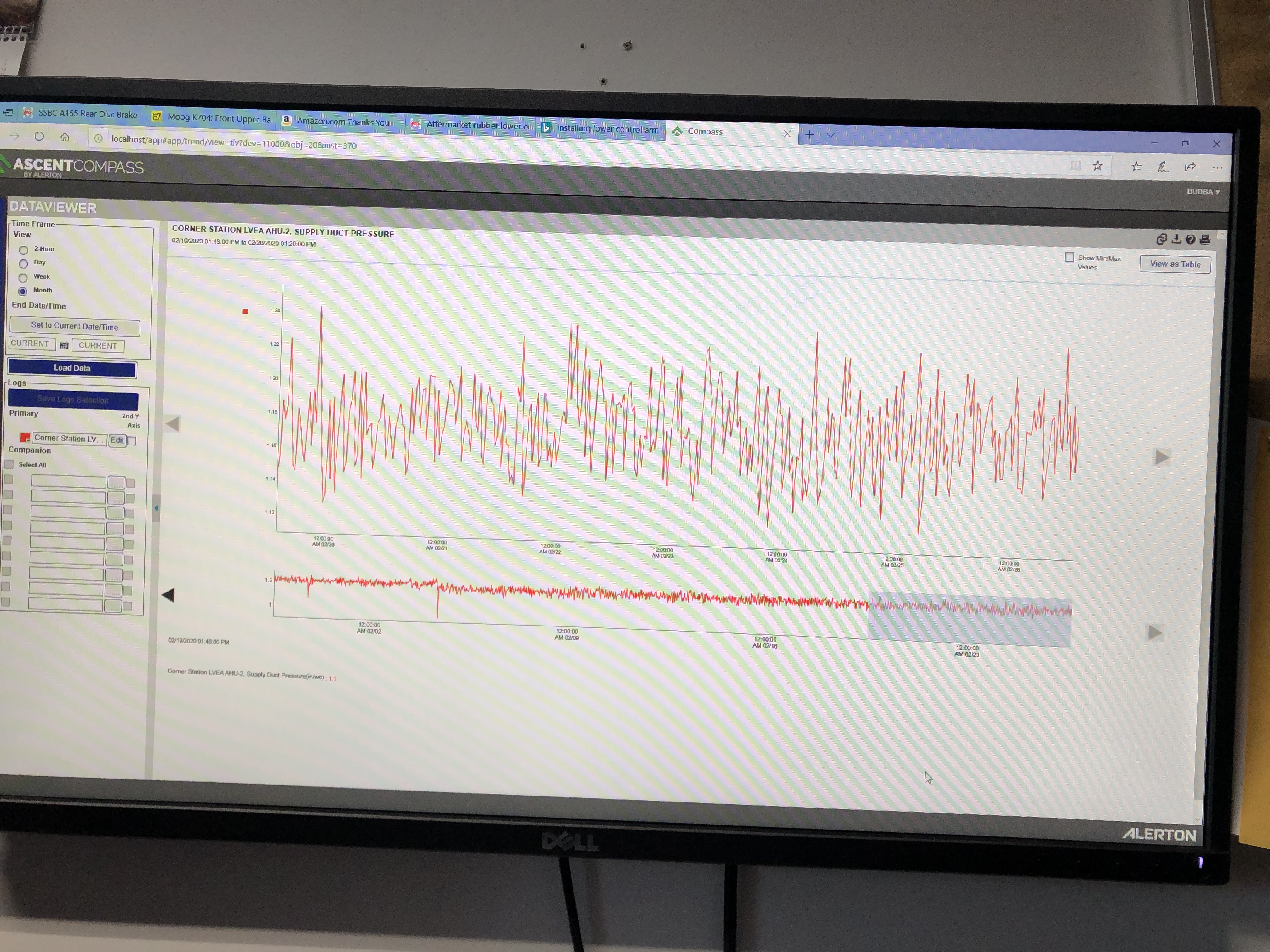
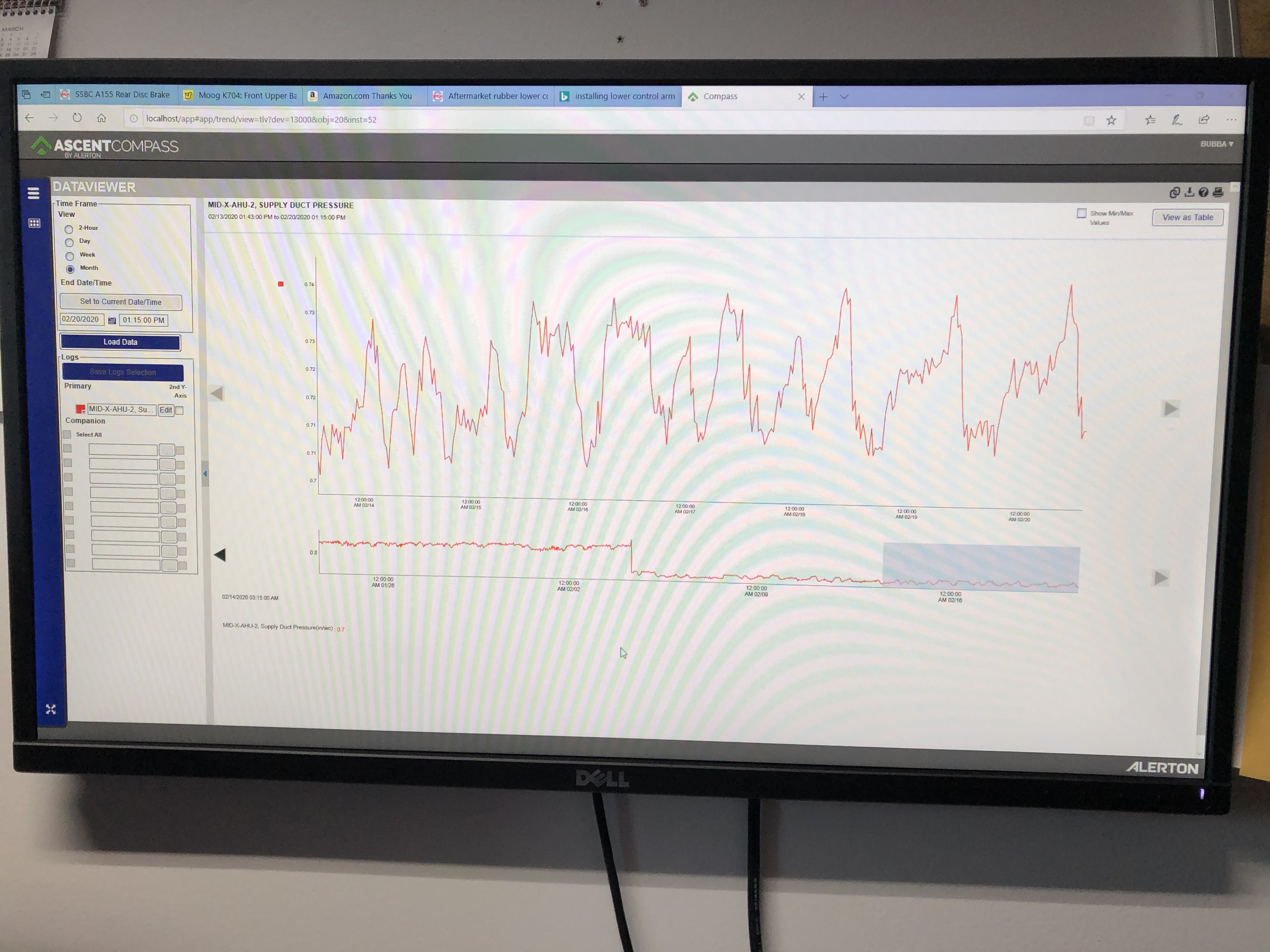
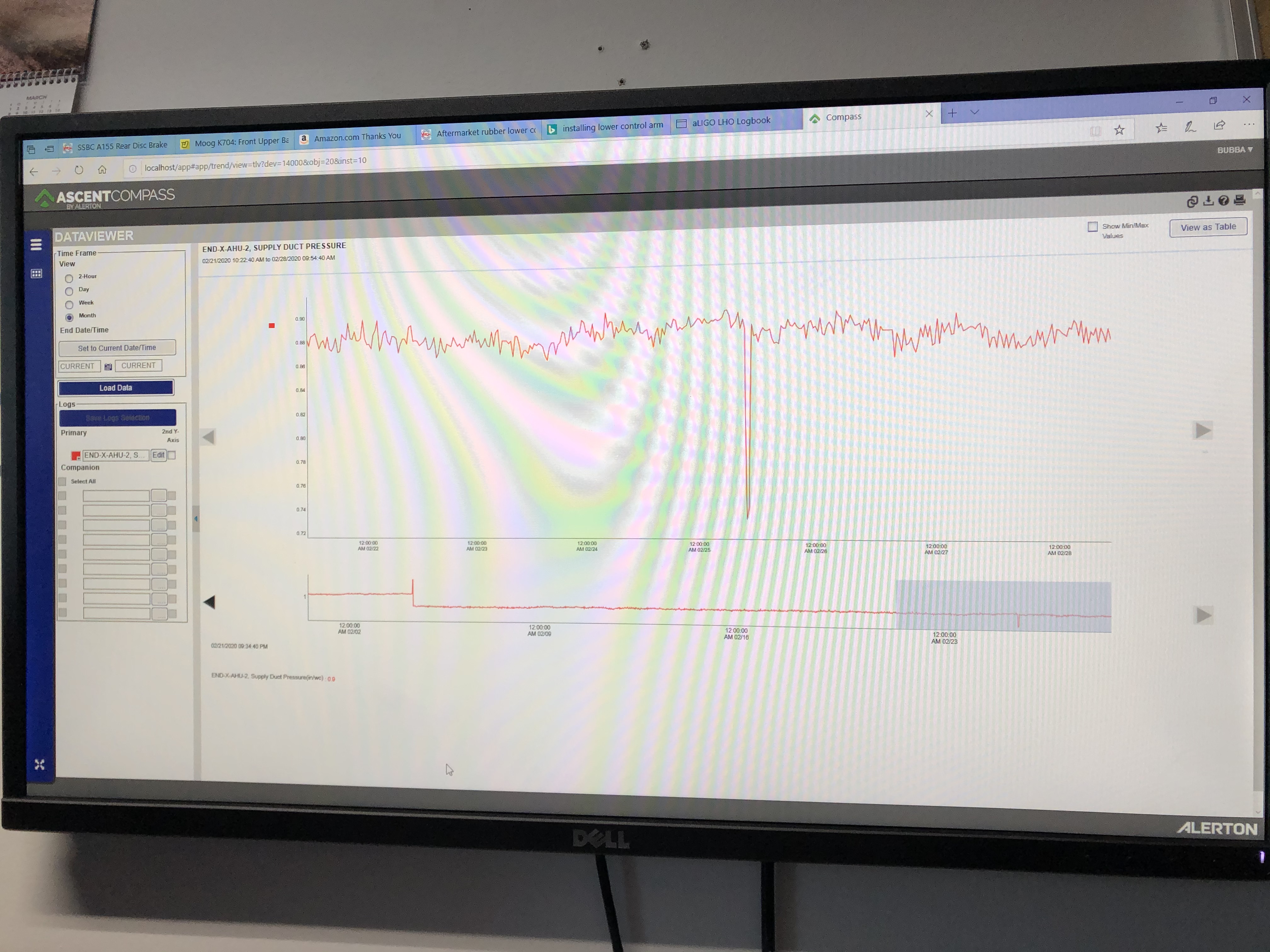
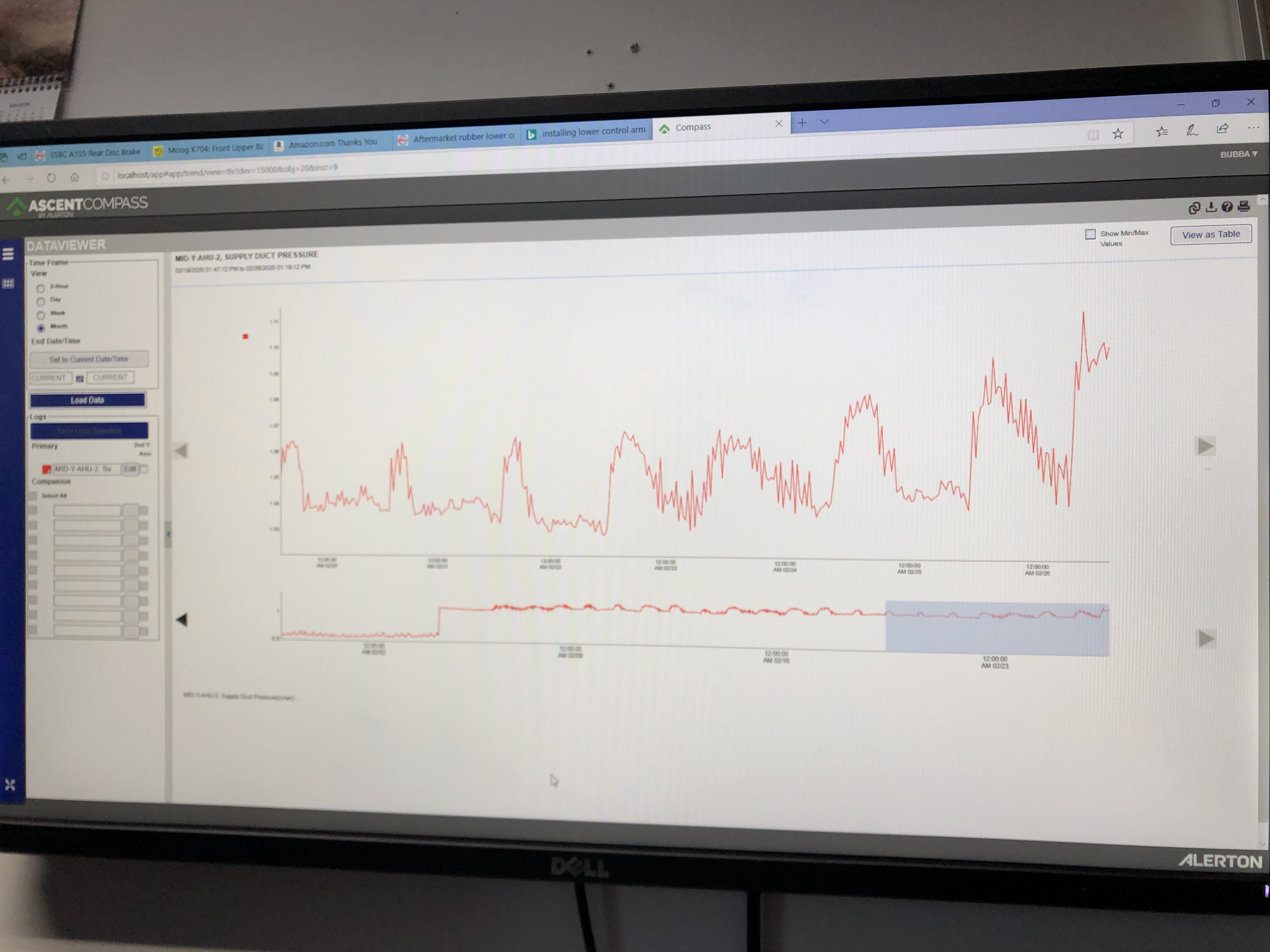
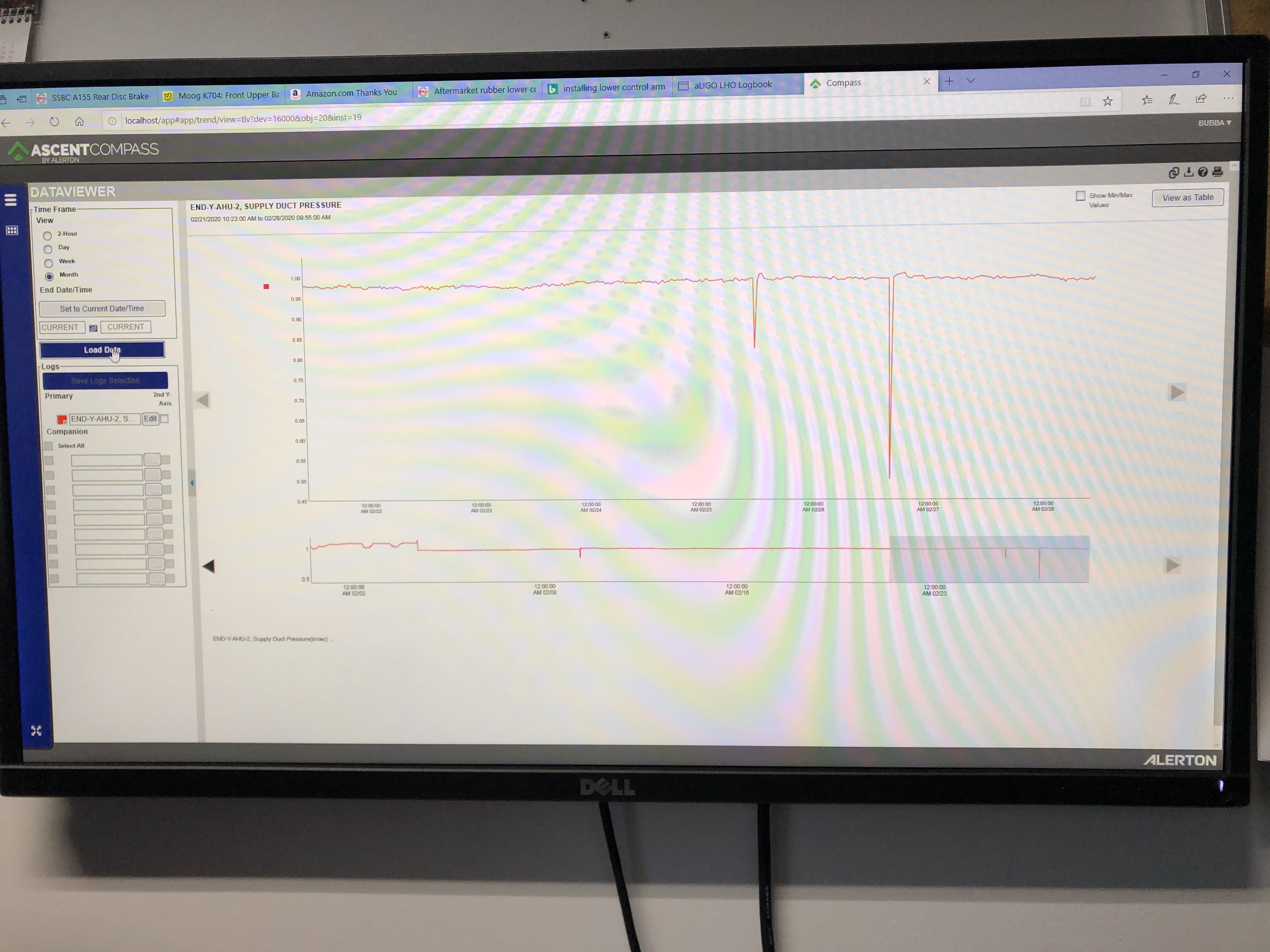
Bubba arranged for the Hanford Fire Department to begin a controlled burn this morning, starting at EX so that they would be well away from the end station as Tuesday maintenance activities draw to a close. We are grateful that this hazard is being removed, and for the expert care they are showing in the process.
As a follow-up to the controlled burn, plots of HVAC filter dP for corner/mids/ends were displayed to look for any corresponding uptick in dP near the Feb 18 timeframe. None were found. Plots are attached; lower graphs show pressure vs. date for one-month intervals.
ETMY modes 11, 12, 18, and 20. Modes 18 and 20 have had their filters updated to be more narrow and thus separate the damping of one peak from another.
| mode 20 damping filter at mode 20 frequency (1000.307Hz) | 120 dB |
| mode 11 damping filter at mode 20 frequency (1000.307Hz) | 65 dB |
| mode 12 damping filter at mode 20 frequency (1000.307Hz) | 91 dB |
| mode 18 damping filter at mode 20 frequency (1000.307Hz) | 52 dB |
Possible updates to mode 11 and 12 filters:
Sheila, Jenne, Keita
Summary: We have some evidence that our sensitivity can be better with a higher DARM offset.
Details:
Last Thursday I took some data with the squeezer off at different DARM offsets, 55086 to compare with the data that Jenne took 54969.
The high frequency noise is consistent with the measured change in optical gain and the dark noise:
The last two plots show the low frequency sensitivity and the impact of SRCL subtraction, comparing our nominal DARM offset of 10pm to the candidate new offset of 14pm.
I went back and got a few more data points of DCPD current vs optical gain from the time when Jenne moved the DARM offset (54969). Attached is a new version of the 4th attachment above, where the optical gain is plotted against the DCPD power along with a fit to the data (from both times). There are only 2 parameters in the fit, the quadratic coefficient and an offset from junk light which doesn't change with the DARM offset or contain any DARM signal.
This fit suggests that we have 1.7mA of photocurrent from junk light, which would mean 1.95mW of junk light (without the data from Jenne's ealier test we get 1.5mA). This can be compared to the 1.7mW that Craig found in 51273, with 20W of input power.
Summary: I've made an estimate of low frequency noise that could be explained by intensity noise on the junk light that we have on the DCPDs. It is below the DARM residual but within a factor of a few.
If we assume that the low frequency increase in noise at 5pm compared to 14pm is due to intensity noise on the junk light, and assume that intensity noise stays the same when the DARM offset is changed, we can make an estimate of where this noise is when we are operatoing at 10pm.
The first attachment shows the GDS strain data from above with the power based SRCL subtraction, you can more clearly see that there is a low frequency sensitvity difference. If this is due to intensity noise on the junk light, we can use the difference here to estimate the intensity noise. The DARM PSD in displacement is
DARM PSD(5 pm) = Intensity PSD /(optical gain (5pm)^2) + PSD of noises which are independent of DARM offset
and similar for 14pm DARM offset. We can find the Intensity PSD by comparing the two DARM PSDs and knowing the optical gain.
Intensity PSD = [DARM PSD(5pm) - DARM PSD(14pm)]/[1/optical gain(5pm)^2 - 1/optical gain(14pm)^2 ]
The RIN estimated this way is around 5e-8 at 40Hz, shown in the second attachment. The third attachment shows the estimated intensity noise scaled by the optical gain at our nominal DARM offset of 10pm. We can compare this to the attached noise budget residual This is a noise budget for Jan 20th, although we haven't updated the coupling measuremetns used here in several months. The reason that the noise budget misestiamted the quantum noise around 200 Hz is that we don't have the frequency dependence of the squeezer modeled correctly here). The peak at around 48Hz in this noise budget total is from a vibration noise estimate from the PEM website before the 48Hz peak was fixed, this peak should go away when we update that. The message is that the noise I'm estimating to be caused by junk light intensity noise is about half of our noise budget residual at 50Hz, and about a third of the residual at 40 Hz. We would need 4 noise sources of this size to explain our residual at 50Hz, and 8 noise sources this size to explain our residual at 50Hz).
I reset both PSL power watchdogs at 17:59 UTC (9:59 PST); this completes FAMIS 10750.
Shifter: Derek Strom
Stromd3@my.erau.edu
Fellow: Sudarshan
Mentor: Brennan Hughey
Full report: https://wiki.ligo.org/DetChar/DataQuality/DQShiftLHO20200210
Violins Possibly Relatated To / Cause of Lockloss at 16:23:55 UTC:
ETMX violin mode 13 was ringing up for most of this lock. The damping was on at first, and at around -24000 seconds the RMS wasaround 0.5, then the damping gain is set to zero, and the mode grows from there until lockloss (t=0). It's notable that ETMY mode 14 drive grows steadily, then has a significant increase at -1400 seconds.