{Kyle, Tyler, Chandra}
In an attempt to find air leak at EX and based on some aLOGs from summer 2018 (43165 & 43184), we had reason to believe that IP12 may be leaking and so today we isolated IP12 + chevron baffle from main volume and leak checked with a background of 1.5e-9 Torr-L/s of He. We sprayed ample amounts of He and saw no rise in signal.
We also sprayed the beamtube side flange of isolation GV while Jeff Jones remotely watched the RGA screen in control room, running in MID mode with new Labview based software with no change in AMU 4. This test is inconclusive, however, because we were opened to BT.
We suspect the leak is in the e-7 Torr-L/s range.
Next opportunity to leak check with BT GV closed is March 3 when we replace the maglev turbo.
Work Permits Executed:
Vendors:
Recovery:
Tyler G., Kyle R.
Tyler also installed the bellows retractors (finger tight)
One of the more common manual interventions that operators have been doing is that when PRMI won't lock they use check_MICH_FRINGES to see the dark michelson and manually adjust the beam splitter. (This seems to account for most of the DRMI interventions lately). Jenne and I had talked about automating this, today I took some time during maintence to implement it.
For operators:
Details about the guardian change:
If for some reason this change is a problem, it can be avoided by setting the timer of how long to wait in ACQUIRE_PRMI before trying CHECK_MICH to be very long. This timer is on line 966 of ISC_LOCK, and is currently 300 seconds, but you could set it to 3000 and reload ISC_LOCK if there is a problem with these states.
Tagging OpsInfo,
The following modifications were made at EX to help with the ongoing noise hunting investigation.
1. Baffle Photodiode Amplifier moved from SUS-R1 to FAC-R1
2. Baffle Photodiode Amplifier powered down
3. Beckhoff hub isolated from rack
4. ESD current limit resistor box removed and SHV barrels installed
The removal of the current limit resistor should have no impact. The installed ETM Low Noise ESD Driver Chassis (D1500129) has built-in current limit protection.
The Baffle Photodiode Amplifier unit was powered down to see if the Beckhoff terminal might be a noise source. Unit at EX is normally not used to lock the Interferometer. Unit can be powered back on by reconnecting the ±24V power cable.
F. Clara, R. Mccarthy, R. Schofield
Tagging DetChar and CAL.
These changes *should* not have any *bad* effect on the detector, but
(DETCHAR) These changes were made in order to reduce the amount of spectral features in h(t) based on Evan's studies for the CW group (e.g. LHO aLOG 53439, G1902208) and the differences between H1 and L1.
We would appreciate any help that @DetChar can provide over the coming days/weeks in assessing whether this change made a difference (whether that be positive, negative, or even "can't tell.")
(CAL) The change in the resistor box -- "ESD current limit resistor box removed and SHV barrels installed" -- should, nominally, NOT affect the actuation strength of the ETMX ESD, but I'll be taking a look to see if the online tracking system *of* that strength made a difference.
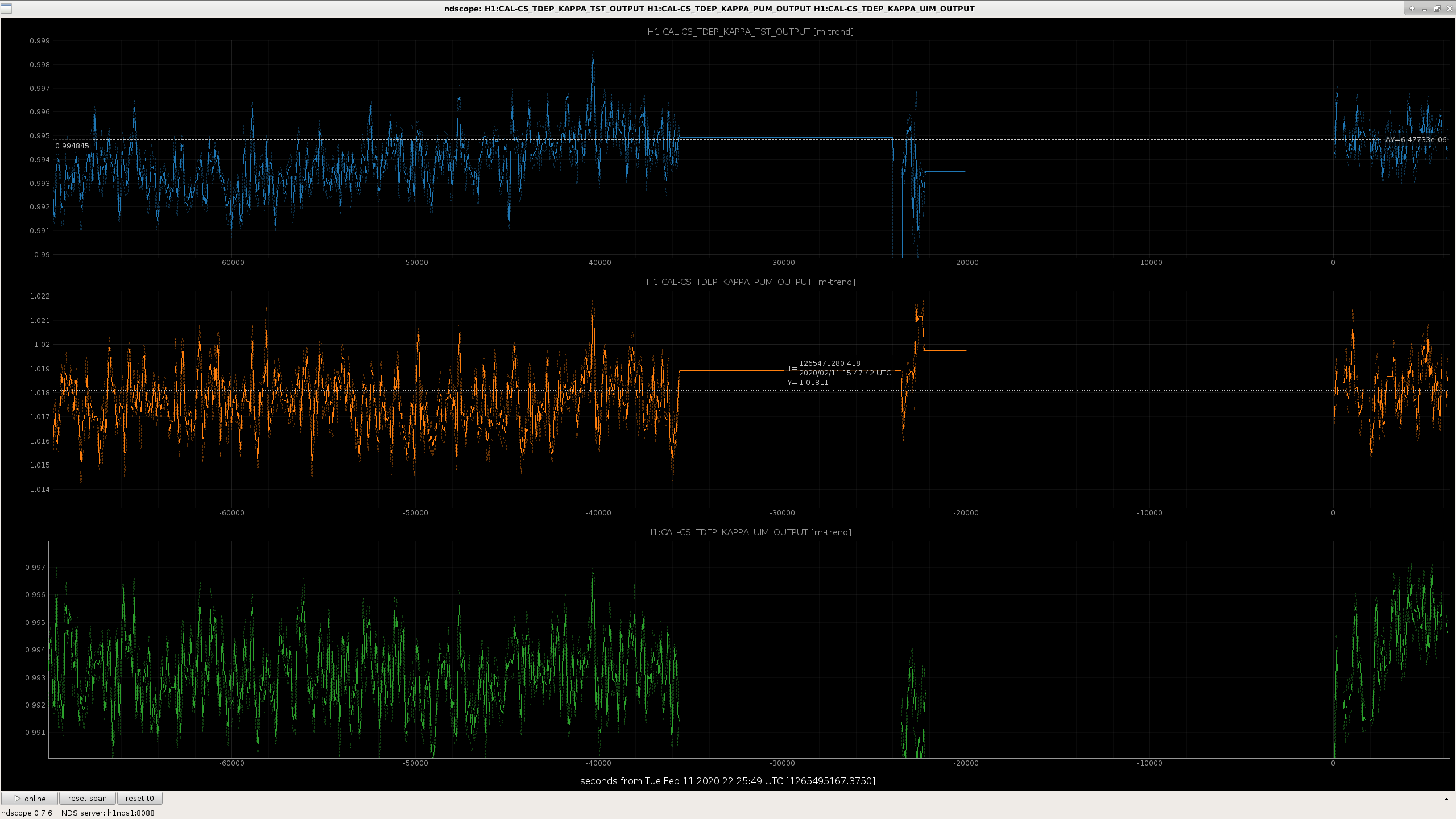
The first observation ready segment after these changes were made started on Feb 11 2020 22:25:54 UTC, at GPS time 1265495172, or 14:25:54 PST. Upon initial investigation, the DARM actuator's time-dependent correction factors (i.e. the point-estimate of the actuation strength relative to the 2020-01-03 model installed on 2020-01-13) are the same as prior to today's maintenance activity and thus I'm 90% confident that there has been no change to the actuator as a result of the electronics activity at EX today. Nice!
R. Abbott, J. Kissel Upon further investigation of calibration measurements taken of the TST stage over the remainder of the run, there appears to be a clear bifurcation in the data between the 2020-02-10 and 2020-02-24 measurements (see attached data collection). The bifurcation in the data is consistent with a ~4-5 deg change at 1 kHz. After consulting with Rich, we agree that -- given the residual parasitic cable capacitance between the chamber feedthrough and the ESD pattern itself (we guesstimate at ~600 pF), the act of replacing the former 10k current limiting resistors on the quadrant "signal" paths with the SHV connections (which have negligible resistance) removed the voltage-divider-like, passive low-pass response of a pole at 1/(2*pi*10e3*600e-12) = 26525 kHz, which *was* incurring a phase loss at 1 kHz of 180/pi*atan(-2pi * 1000 Hz * 10e3 Ohm * 600e-12 Farad) = -2.15 deg. Given the uncertainty in the cable capacitance, we could easily imagine a phase change of 5 deg after switching to ~0 Ohm SHV barrels. The consequence: we'll just have to split up this collection TST measurements in O3B in to two periods, and run the standard fit for unknown systematic error separately.
EY was swept; because we are planning to do some shaking later this week, the shaker amp is on.
Ed called, said the PSL quad display flashed and the PMC had reacquired lock on a non-00 mode. The usual fix for this is to raise the resonant condition of the locking loop so it won't lock on a non-00 mode, but for some reason the PMC doesn't like it when the resonant condition is raised; it will have a very hard time locking (this is one of the those small, rarely-occurring instances that we haven't had the time to fully investigate as it happens so rarely). In this instance, I manually unlocked and relocked the PMC a couple times and it locked on a 00 mode with no issues.
The FSS RefCav relocked almost immediately upon reactivating the autolocker, and the PSL_FSS guardian node functioned as we intended with our recent mod.
Upon relocking the ISS, the diffracted power dropped to <1% and the loop would unlock itself (as it does when the diffracted power gets too low), then this behavior would repeat; the fix was simply to raise the ISS refsignal until the loop became stable (in this case, a small bump to -1.97V from -1.99V), then slowly lower until the diffracted power is within the desired range (in the majority of cases, like this one today, the refsignal will return to its original value).
Unclear at this time why the PMC unlocked.
The Pcal team swept after finishing our work, and the VAC team will unplug what they plug in and turn off the lights when they're finished
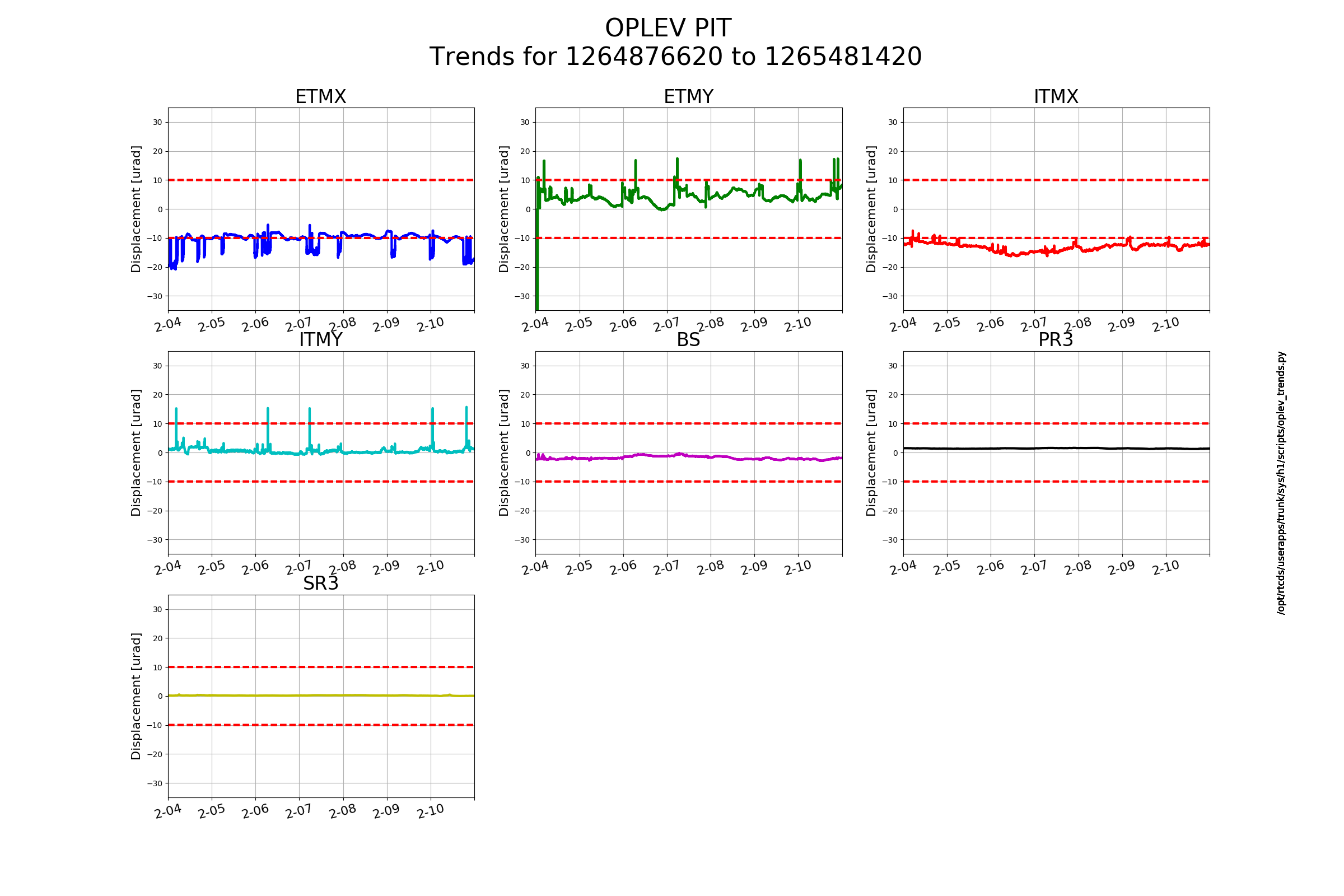
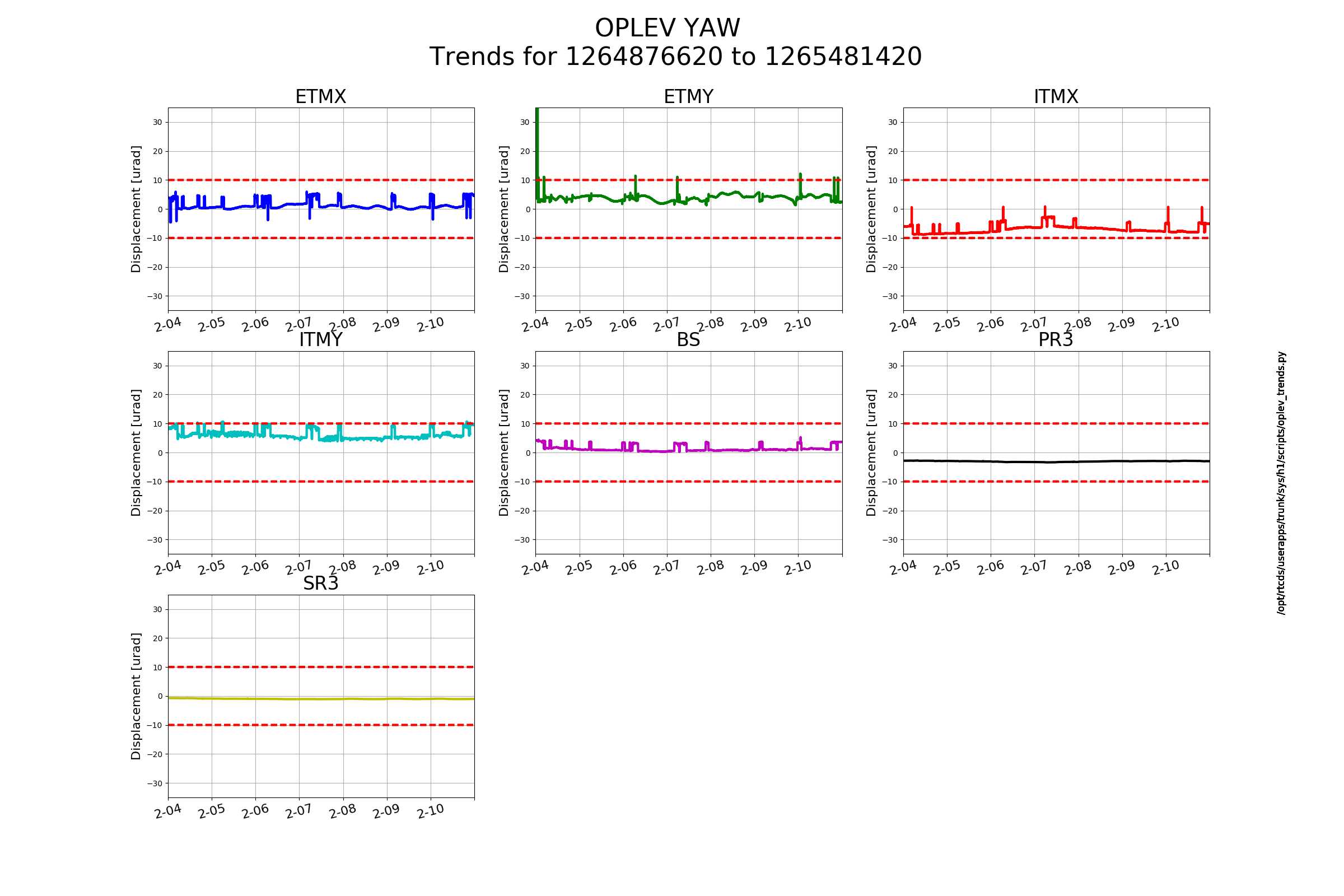
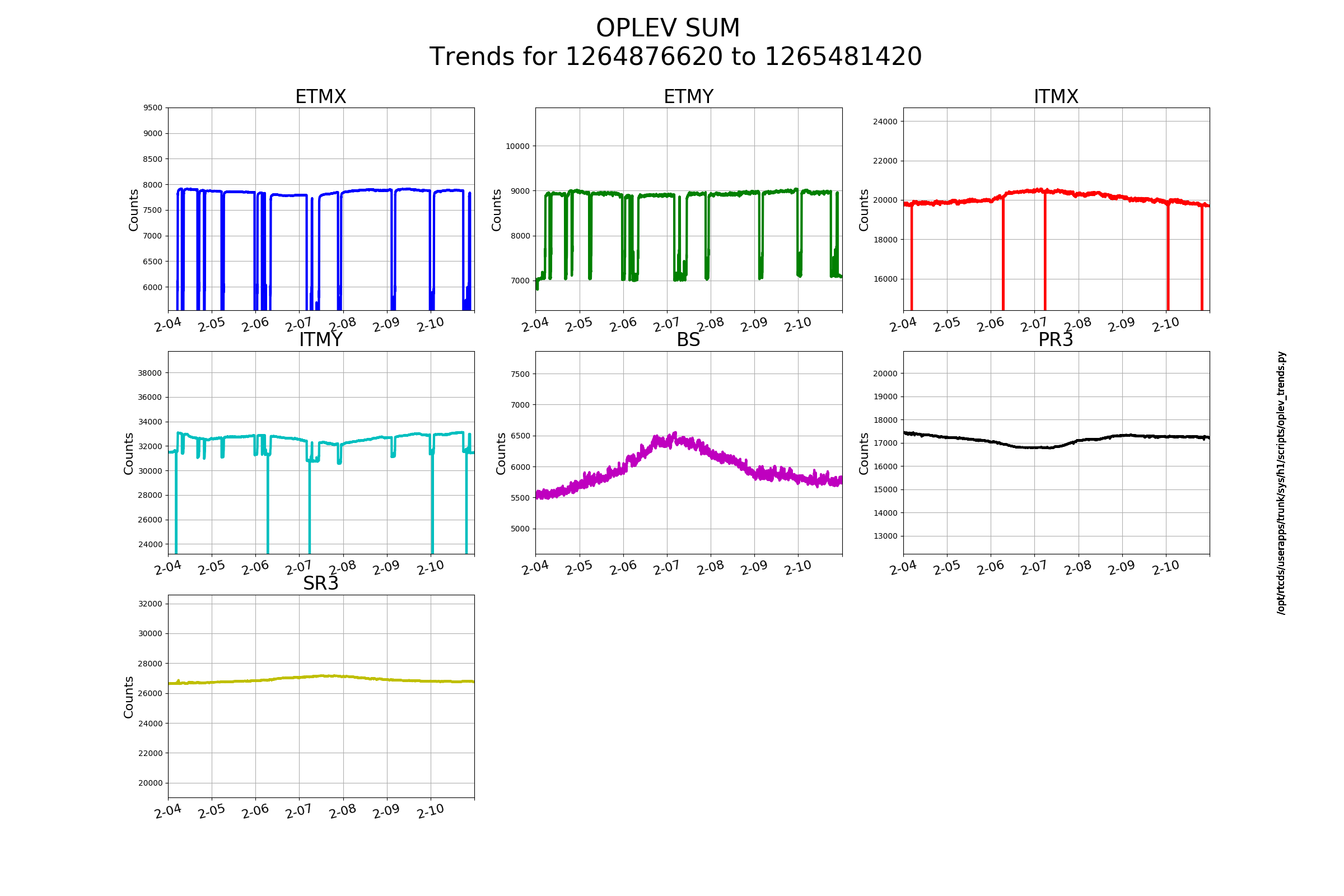
The ETMY diurnal drift seems more pronounced than the ETMXfor both Pitch and YAW. Worse for Pit, is there a reason for that? Curious.
Shifter: Adrian Helmling-Cornell
ahelmlin@uoregon.edu
Highlights from my DQ shift this past week:
For the full report see: https://wiki.ligo.org/DetChar/DataQuality/DQShiftLHO20200203
All three Dust Monitor Vacuum Pumps are running well. Made slight adjustment in vacuum pressure at End-Y and the CS. All temperatures were normal. The mufflers were clear of carbon dust. Closing FAMIS #13006
Checked all three HEPI pump skids. CS - 6 5/16" - Down 1/16 from last check. No visible leaks noted on any of the four skids. EX - 7 13/16" - Down 1/16 from last check. No visible leaks noted on the pump skid. EY - 8 14/16 - No change from last check. No new visible leaks noted on the pump skid. Closing FAMIS #13496
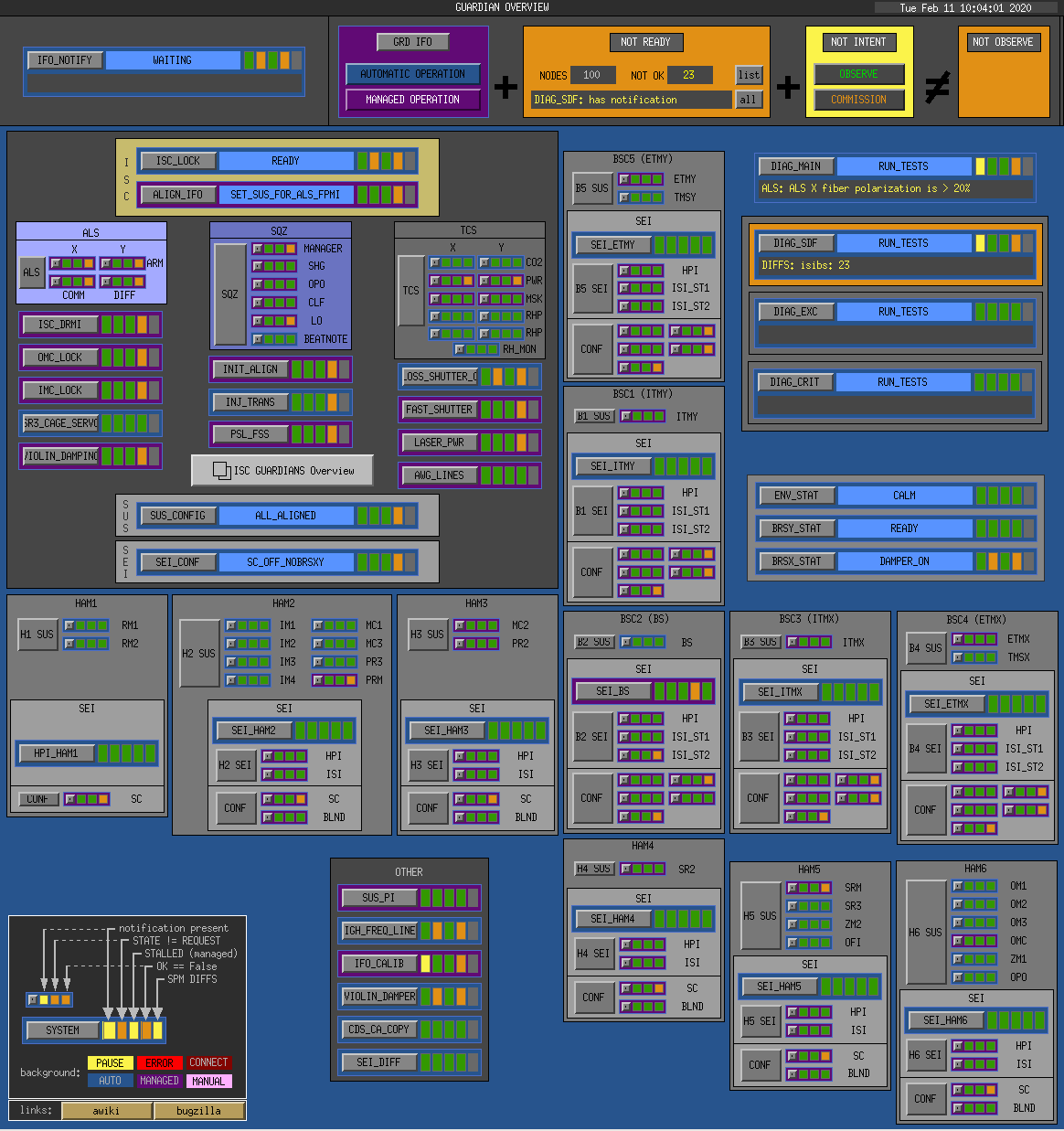
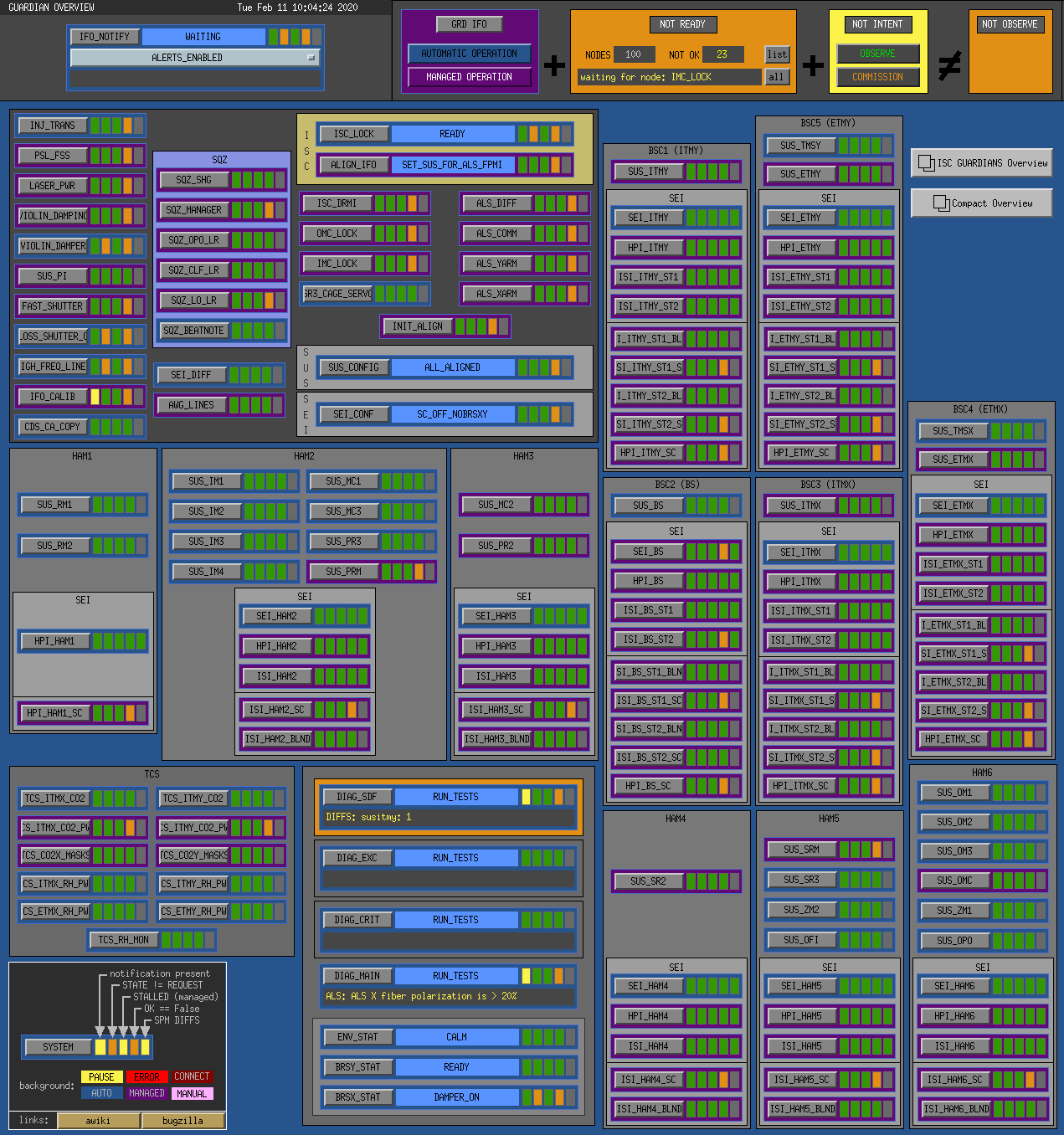
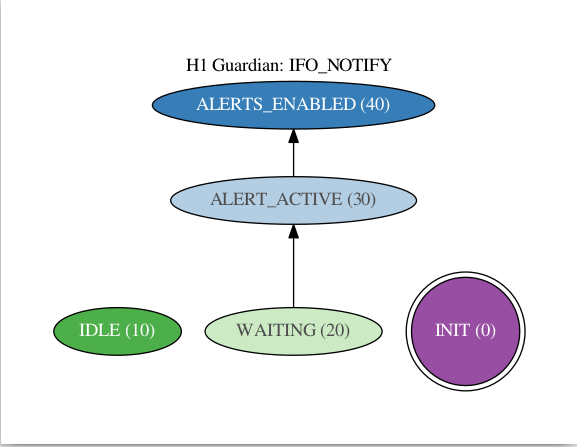
Added a new Guardian node that will monitor the relocking status and move to a state that Daves phone alert system will then alert from. We still need some time to test the logic of when to alert, but for the most part it follows the regular T1900725 Operator Thresholds for H1 Intervention document as well as checking for some other major errors. During this testing time we will not be sending out actual alerts.
This node was added to the top of the Guardian overviews and I checked that all nodes are on them.
I reset both PSL power watchdogs a 17:54 UTC (9:54 PST); this completes FAMIS 10749.
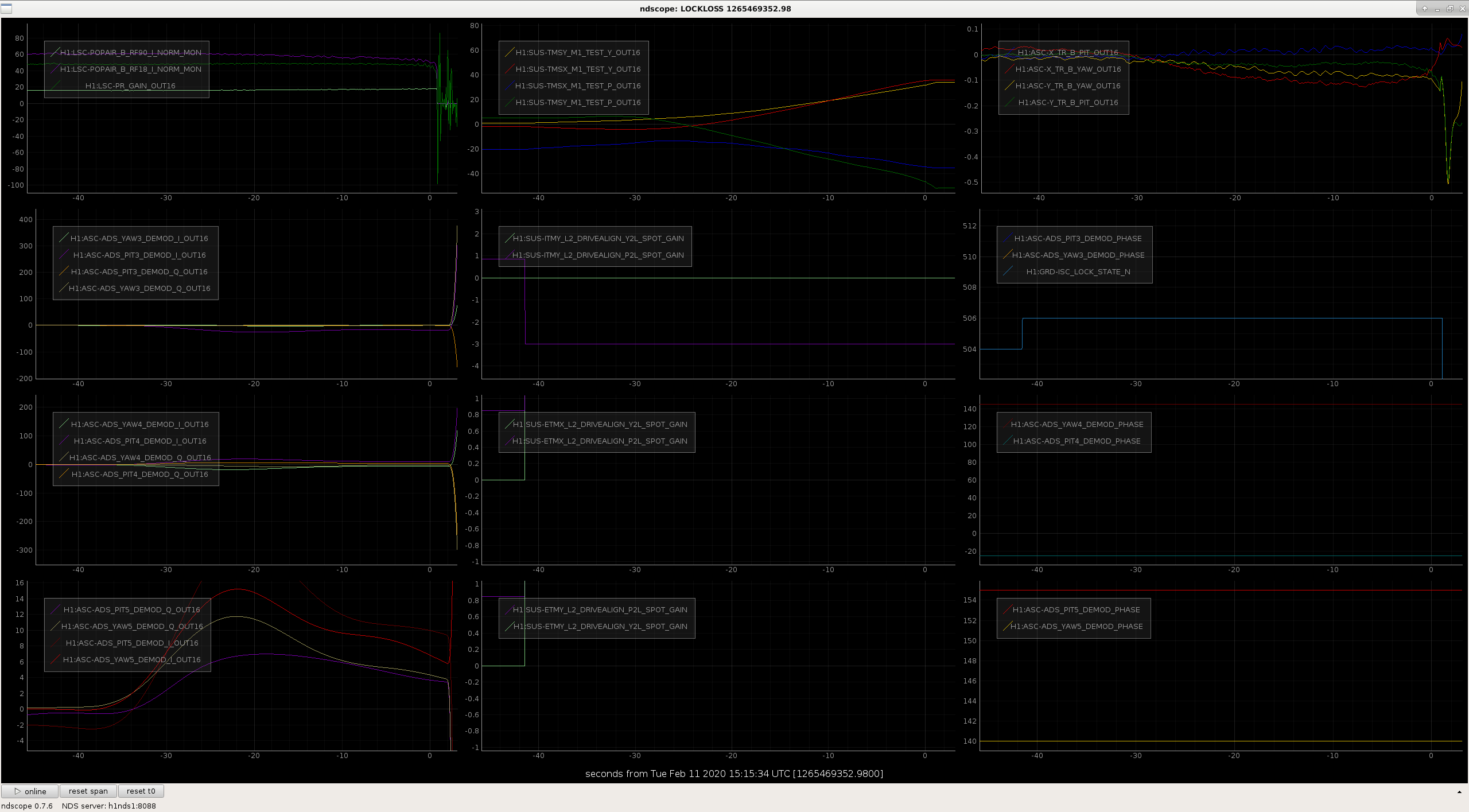
Last week Jenne realized that when I moved the MOVE_SPOTS state Jan 1st, I copied some things that inadventently were causing a 2 minute pause 54949 54219. We've had 8 locklosses from MOVE_SPOTS since these accidental pauses were removed, but only had 3 locklosses in this state since I moved it in January. This morning Patrick had 3 locklosses from this state. The attached screenshot shows that the servo to TMS seems to be working fine with Jenne's change, as you would expect.
However, we only had three locklosses in this state between Jan 1st and Feb 6th, but we've had 8 locklosses from this state in the last 5 days, including 3 that Patrick had this morning. It might be that the unintentional pause here was needed to let the ASC converge after the power up before moving the spots. I added a 2 minute timer where the TMS servo will run but the A2L gains will not get changed for the first 2 minutes in this state, we will see if this fixes the problem.
[Jenne, Niko]
Last week I discovered that the MICH_BRIGHT_ALIGN state of initial alignment wasn't waiting long enough (or waiting at all) for convergence (alog 54802).
Today Niko changed the convergence thresholds from 10 to 0.5, and that indeed made the initial alignment guardian wait until the ADS servos were closer to ready before offloading.
However, I don't think that the BS ADS setpoints are actually where we want them. After initial alignment was complete, Niko went to MICH_DARK_LOCKED and hand adjusted the BS since it was clearly not well aligned. I then turned on the ADS dither lines (but not the servos), and saw the lines quite clearly in the H1:ASC-AS_A_DC_NSUM_OUT_DQ (although I did not check where they were in MICH Bright, since it was time to head back to Observing). The BS M2 Y2L gain is currently set to 11, and was last changed in ~August 2018 when we were doing TCS tests to check the contrast defect. Before then it had smaller but still nonzero values.
Next week during maintenance I'd like to revisit this by hand-aligning the BS in MICH_DARK_LOCKED, and then using that alignment in MICH_BRIGHT, and set the A2L gains for BS to minimize the lines in the ADS error signals. We may want to revert to the current NomLowNoise values of P2L=0, Y2L=11 in the DOWN state if those are indeed giving us the best A2L decoupling at full lock, but they seem to not be putting us in a good spot for acquisition.
This morning I went back and forth between MICH dark and MICH BRIGHT a couple of times to check the alignment that we get from MICH_BRIGHT, it seems like mich bright and mich dark do give us the same alignments.
The sensor correction was off while I was doing this, so the sopt is moving around and I cannot get as nice of a dark michelson as we normally see with sensor correction on. I started with the dark michelson, checked that it was well aligned. Then I locked the birght michelson and noticed that the ADS error point was around zero. Since the ADS demodulates the AS DC power for the BS alignment, the BS A2L gains don't have an impact on the signal (I double checked this by changing Y2L and saw that as expected it has no impact). I then went back to the dark michelson and the alignment still looked fairly good.
Attached is RGA scan of AMUs 2,4,28,32,40,44 during leak checking. H2 rose when we isolated IP12 from main volume (no surprise). There is an ever so slight increase in He when we sprayed the tube side of GV flange.
Glad to see some things never change :)
https://alog.ligo-wa.caltech.edu/aLOG/index.php?callRep=5561
Gerardo and I reported no leaks on the new IP12 GV, but we will redo this measurement, including bonnet.
https://alog.ligo-wa.caltech.edu/aLOG/index.php?callRep=42721