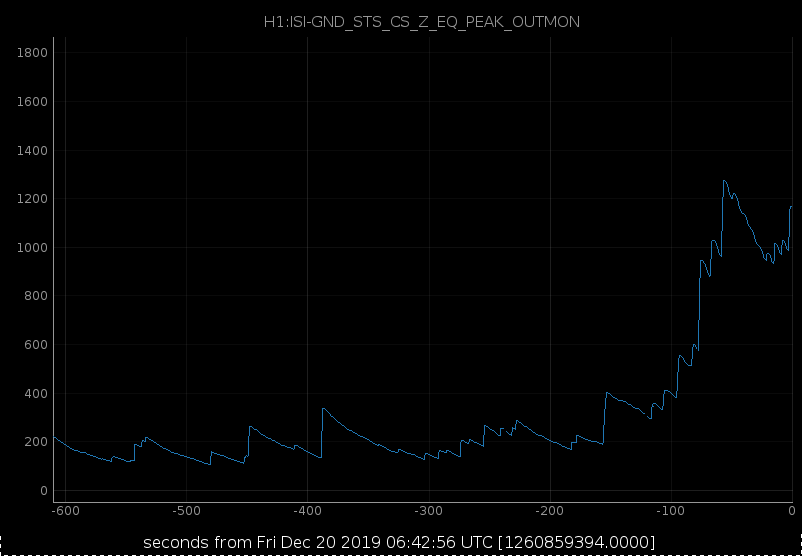
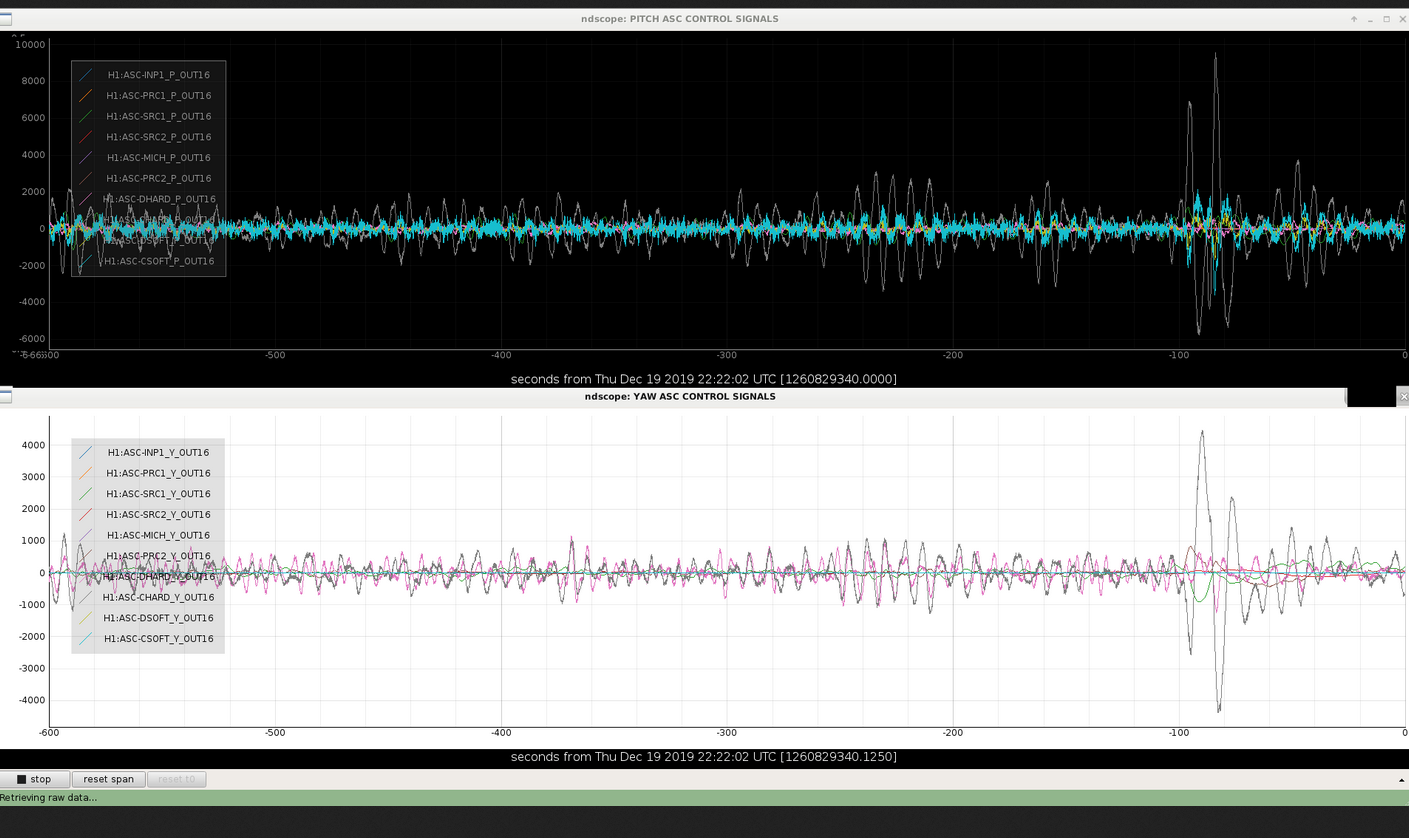
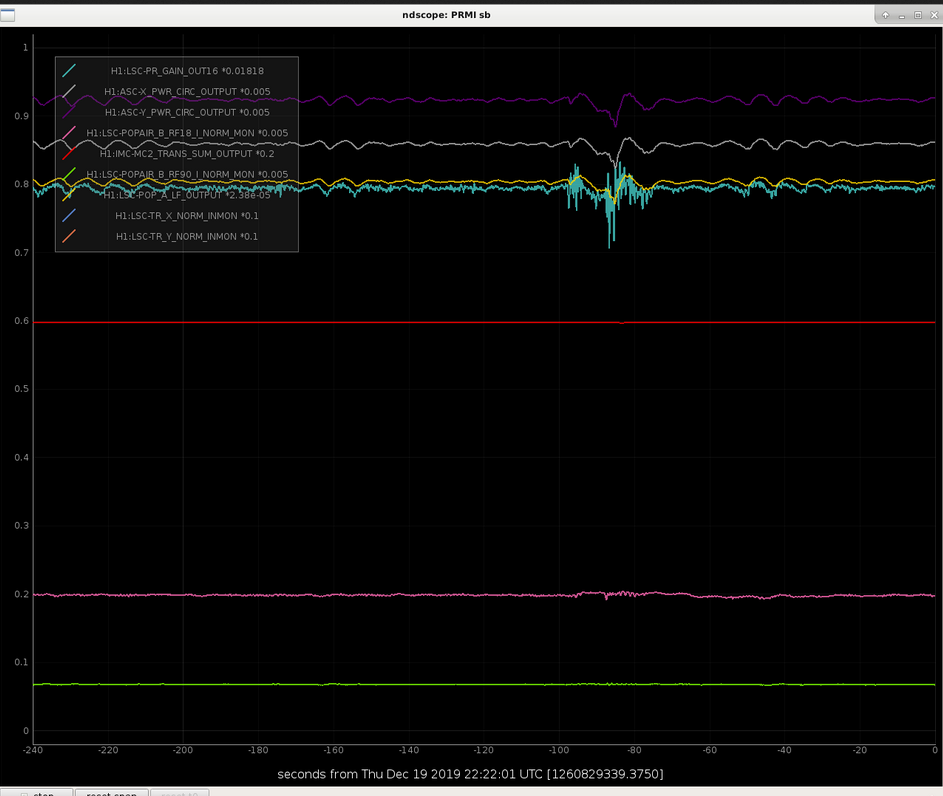
The problem reported by Cheryl from the owl shift (alog 54008) is the same thing as we experienced before (alog 53965), 3MHz beat note degrades as SQZ ASC tilts ZMs, eventually ASC runs away, SQZ guardian resets ASC, beat note goes back to normal, and it repeats it many, many times (1st attachment). We had the same problem in the afternoon.
We first tried to relieve the ASC output by moving ZM2 YAW manually, but the runaway behavior only got faster.
Then we checked the dark offset of ASC-AS_A_RF42 and AS_B for all I and Q channels after closing the beam diverter and some of them were 20 to 30, which is significant as the sum channel is only 150-160 counts when the beam diverter is open. Usually an offset of 20 to 30 counts is not huge, but in this case the signal is very small, therefore we want to monitor this periodically.
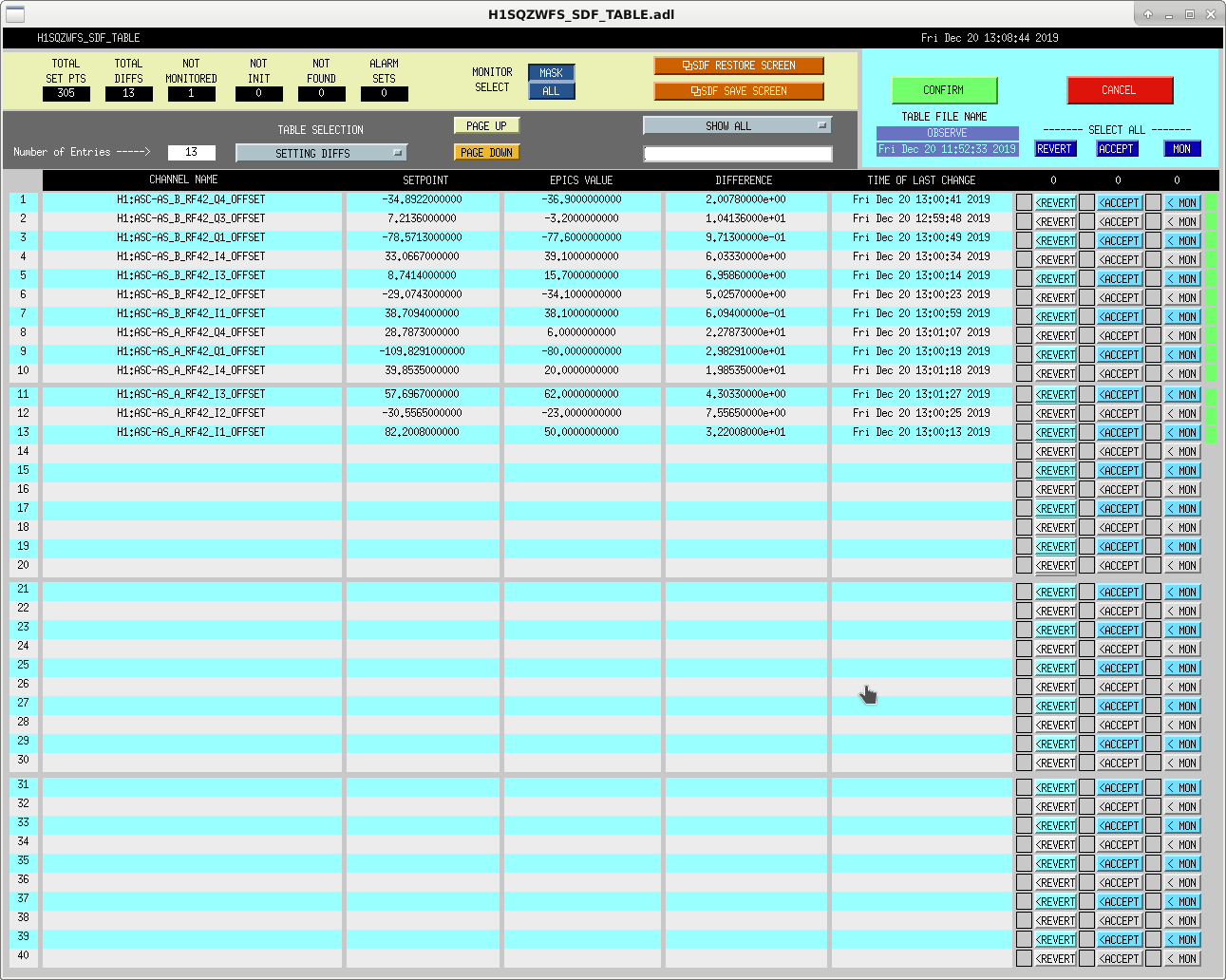
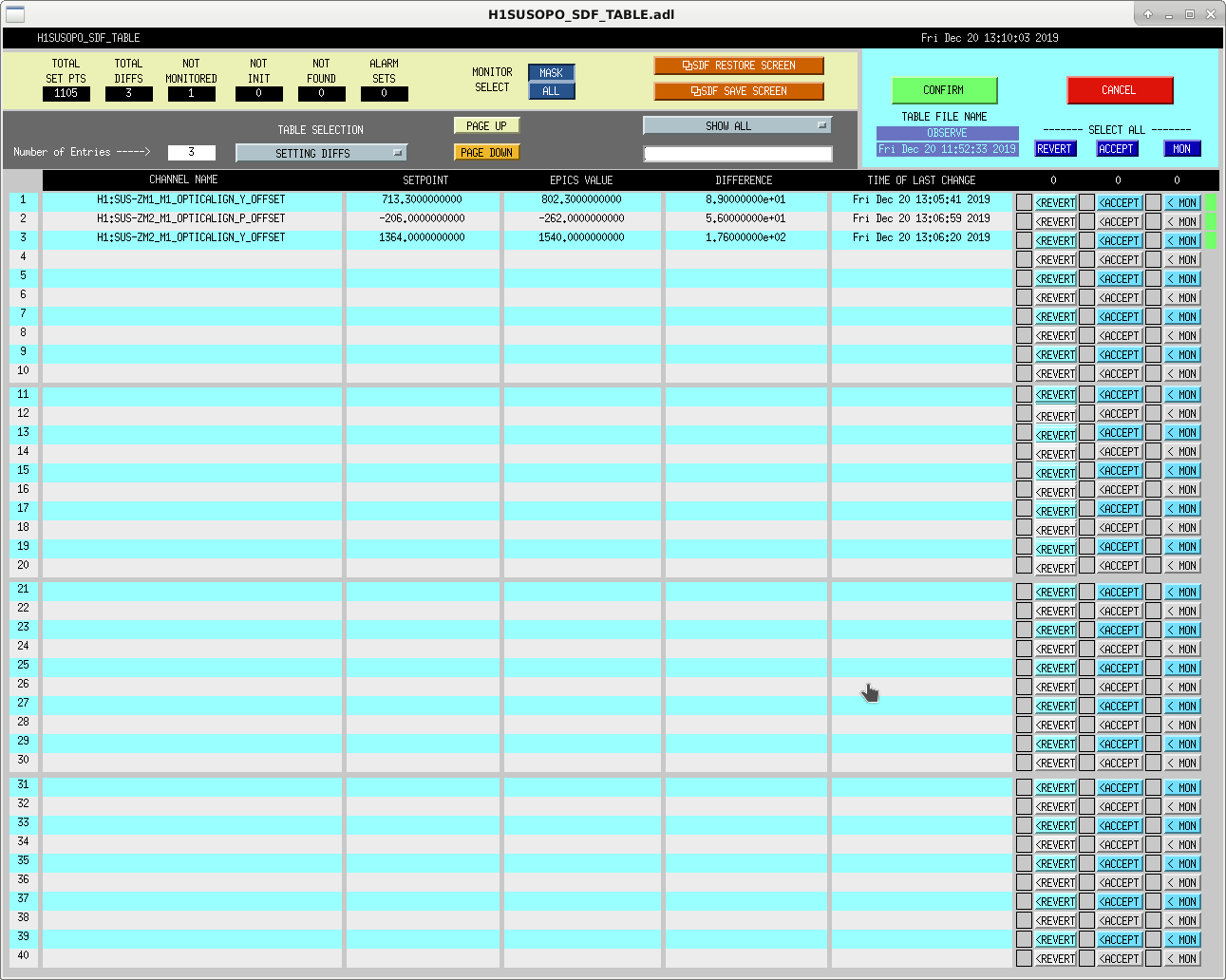
After adjusting this, the running away behavior was gone. 2nd and 3rd attachment shows the sdf diff (except for ZM1 P offset because it was unmonitored, we changed the setting to monitor it).
Daniel also found that the NLG was somewhat lower than before. H1:SQZ-SHG_LAUNCH_DC_POWERMON keeps creeping up (6.9 today VS 5.2 on Dec/17) though OPO TRANS is still 1.0, and CLF REFL 6MHz monitor was ~ -30.5 instead of -29.5-ish. Daniel changed the OPO temperature (H1:SQZ-OPO_TEC_SETTEMP) from 33.246 to 33.214 degree Celsius to gain 1dB or so for H1:SQZ-CLF_REFL_RF6_DEMOD_RFMON. That doesn't mean that degradation is OK, we have to keep monitoring.
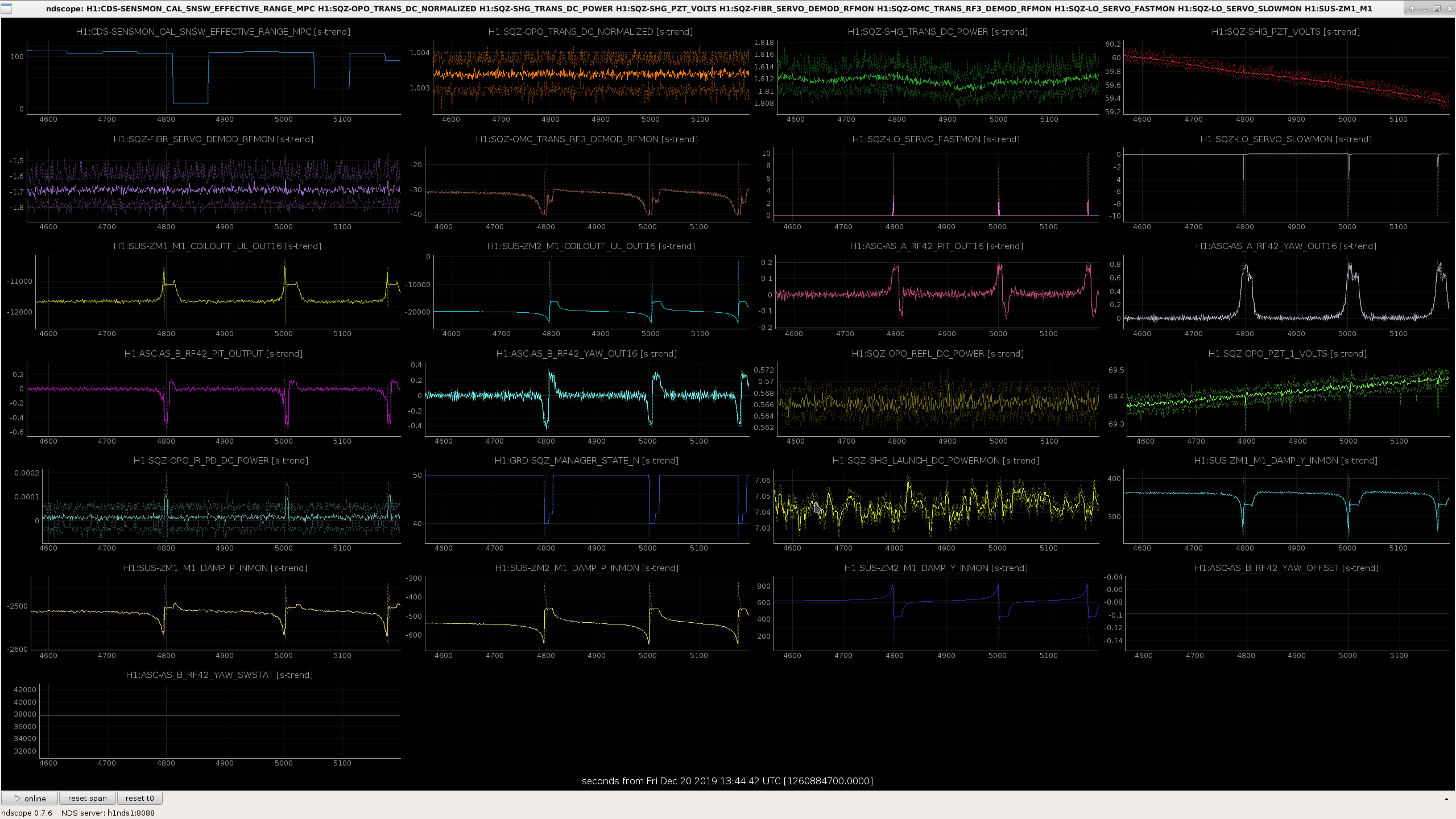
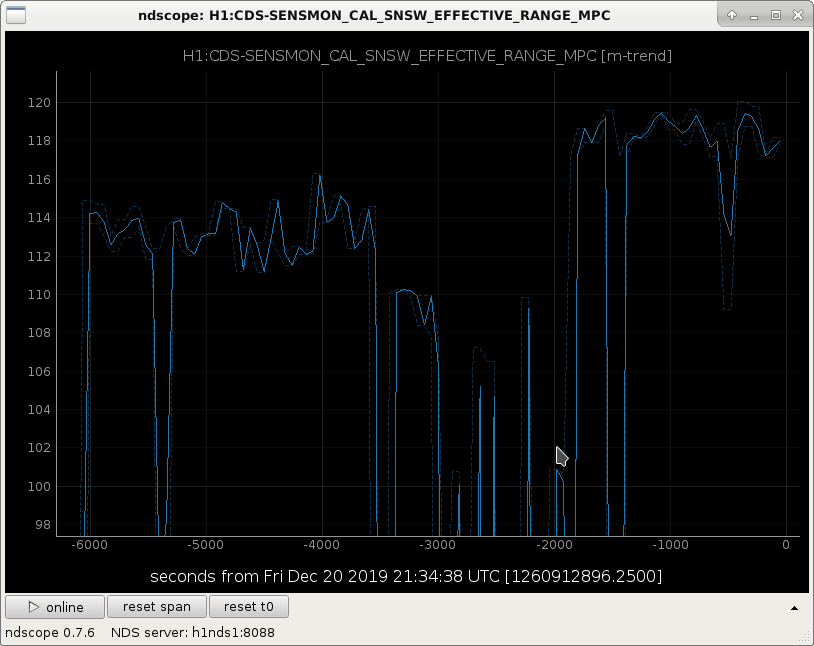
After SQZ ASC change the BNS range jumped up.
Apparently the ASC used to do something but wasn't at the optimal point before. Daniel points out that the SQZ angle scan (alog 53979) was probably not good.
I have been using the BSC10 -X door central viewport to make movies of the flashing of scattered light from ETMY. Replacing the bellows requires large forces, so, after consulting with Ed and Jason, I have left the bellows disconnected from the viewport, but with the open end covered in aluminum foil, and I have placed a standard viewport cover over the viewport in the BSC door. The VEA is thus laser safe. The beam that travels through this bellows is from the TMS, but we have been leaving the beam diverter closed at all times, so there is no beam currently, and this shouldnt affect operations. I will put the bellows back on when we arent trying to keep locked and I can apply large forces (e.g. a Tuesday or earthquake).
TITLE: 12/20 Owl Shift: 08:00-16:00 UTC (00:00-08:00 PST), all times posted in UTC
STATE of H1: Observing at 115Mpc
INCOMING OPERATOR: Camilla
SHIFT SUMMARY: an active night for H1, in and out of Observe, currently in Observe
LOG:
Violin Current State:
TITLE: 12/20 Day Shift: 16:00-00:00 UTC (08:00-16:00 PST), all times posted in UTC
STATE of H1: Observing at 114Mpc
OUTGOING OPERATOR: Cheryl
CURRENT ENVIRONMENT:
SEI_CONF state: USEISM
Wind: 17mph Gusts, 15mph 5min avg
Primary useism: 0.04 μm/s
Secondary useism: 0.69 μm/s
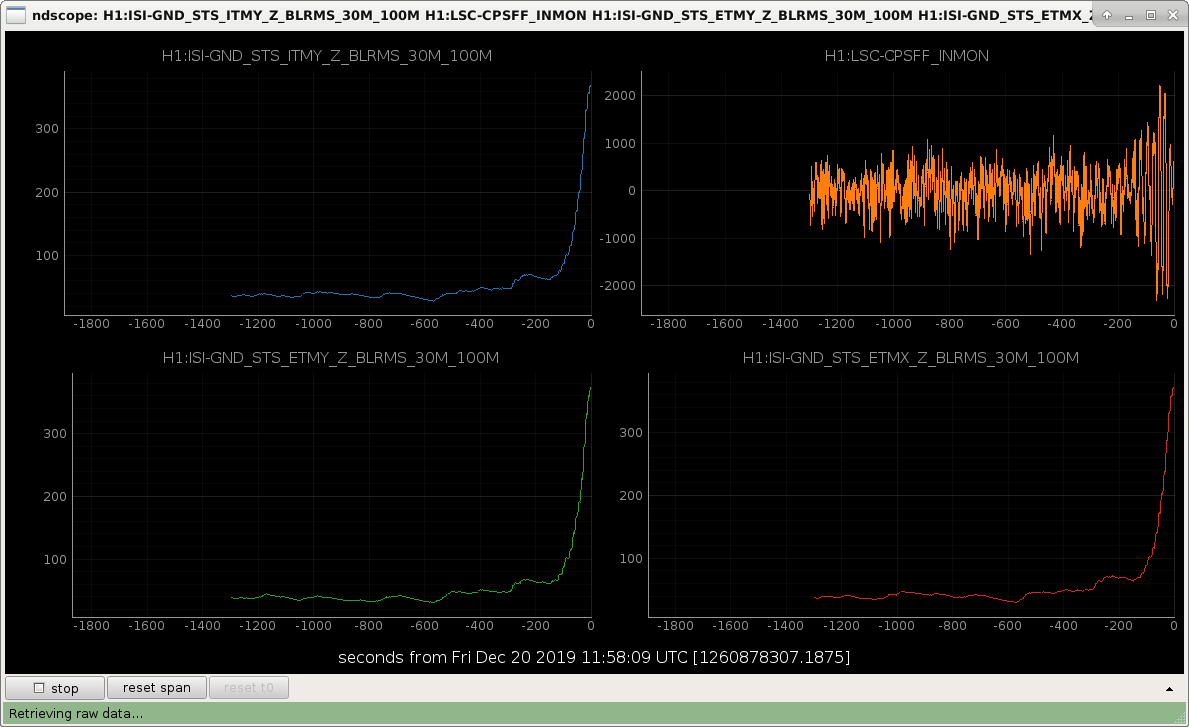
QUICK SUMMARY: Locked 2h25, high microseism, some wind. Watching ITMX Mode 8 as it is rung up.
Lockloss quad-fecta: Glitch, EQ ground motion, useism, and wind.
CURRENT ENVIRONMENT:
SEI_CONF state: USEISM
Wind: 18mph Gusts, 15mph 5min avg
Primary useism: 0.19 μm/s
Secondary useism: 0.75 μm/s
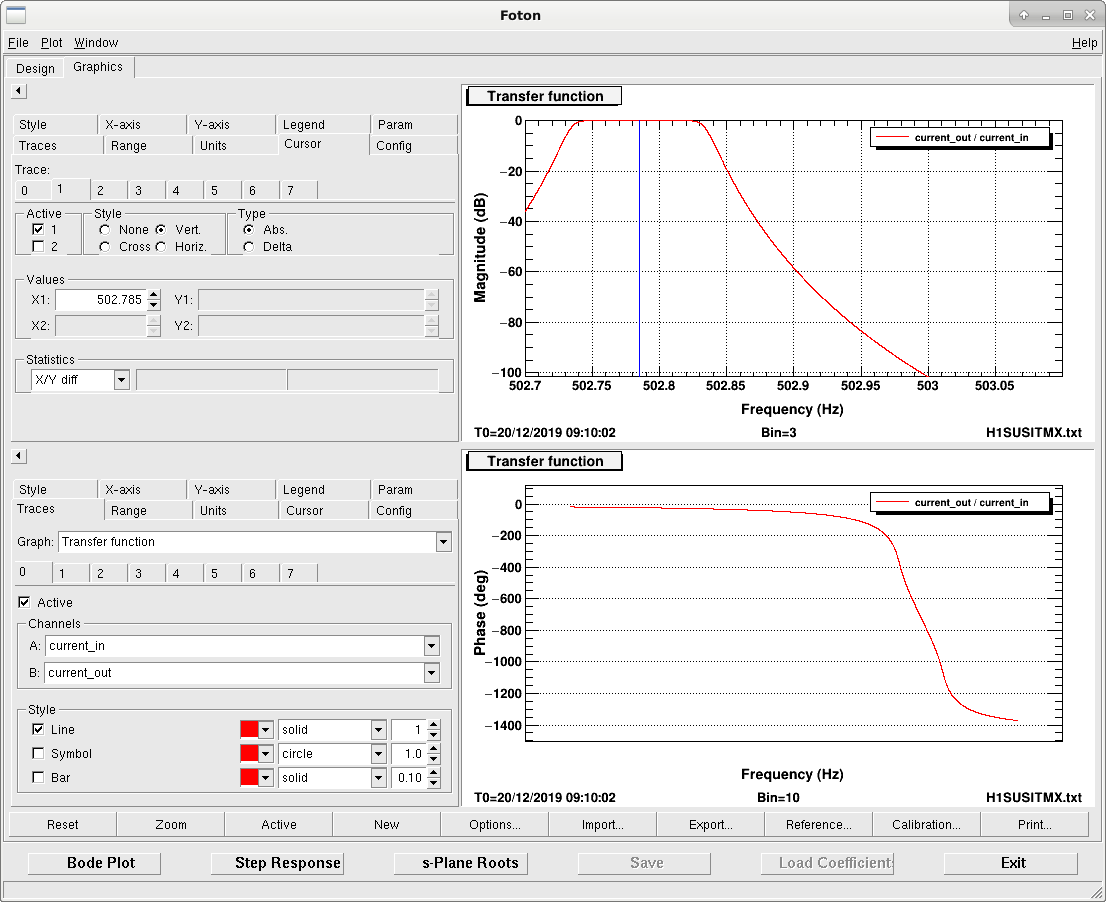
Tonight I started looking at ITMX modes that are close in frequency. Mode 7 is at 502.784, and mode 8 is at 502.909. I checked the damping filters, and mode 8 damping filter was biased toward the mode 7 peak, so I shifted that bias to be away from the mode 7 peak, saved and loaded the filter file. On can see where I loaded the new filter because the drive on mode 8 starts to grow, and the LOG10 signal increases. I turned the gain to zero, and waited, and then tried a smaller positive gain, and watching dtt, I could see that again mode 8 was ringing up, so I tried a negative gain, and at the time of the snapshot mode 8 gain was -20, and the mode was damping/damped quite nicely. Mode 7 gain remains at it's nominal of +10. Now that mode 8 is damped, I'm turning down the gain, and will alog that number at the end of my shift. Mode 7 and mode 8 damping filter bode plots, and the time series showing the -20 gain on mode 8 are attached below.
TITLE: 12/20 Owl Shift: 08:00-16:00 UTC (00:00-08:00 PST), all times posted in UTC
STATE of H1: Observing at 110Mpc
OUTGOING OPERATOR: TJ
CURRENT ENVIRONMENT:
SEI_CONF state: USEISM
Wind: 13mph Gusts, 11mph 5min avg
Primary useism: 0.04 μm/s
Secondary useism: 0.77 μm/s
QUICK SUMMARY: TJ was locking when I arrived, I did nothing, H1 in Observe
<b>TITLE:</b> 12/20 Eve Shift: 00:00-08:00 UTC (16:00-00:00 PST), all times posted in UTC
<b>STATE of H1:</b> Lock Acquisition
<b>INCOMING OPERATOR:</b> Cheryl
<b>SHIFT SUMMARY:</b> A 31 hour lock was ended by a nearby earthquake. I lost lock a few times while the DRMI ASC was trying to engage, so I decided to run an initial alignment. Made it through DRMI 2 times since then.
<b>LOG:</b>
A surprise nearby earthquake showed up faster than I could react. Still nothing on seismon or USGS.
Locked for 29 hours. No issues to report.
Several changes to the lock clock:
TITLE: 12/19 Eve Shift: 00:00-08:00 UTC (16:00-00:00 PST), all times posted in UTC
STATE of H1: Observing at 114Mpc
OUTGOING OPERATOR: Camilla
CURRENT ENVIRONMENT:
SEI_CONF state: USEISM
Wind: 3mph Gusts, 2mph 5min avg
Primary useism: 0.03 μm/s
Secondary useism: 0.57 μm/s
QUICK SUMMARY: 24.5 hour lock, sesism is trending up.
Jenne, Camilla
Operator: When next out of observe. Please reload ISC_LOCK Guardian.
I worry about this during a lock loss. With this change, we will have have to get through our DOWN state with swinging optics and 38W injected.
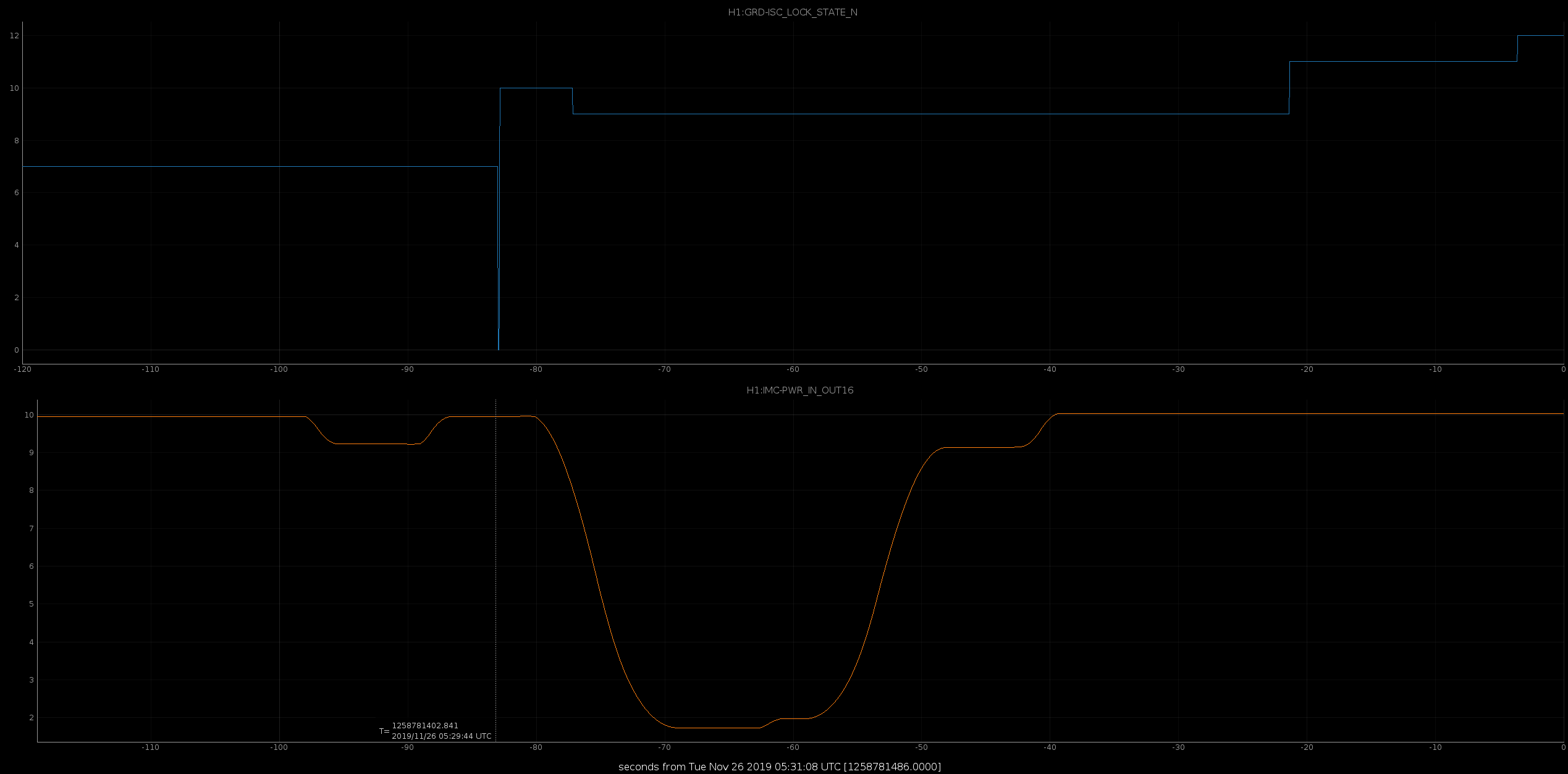
What happened for Camilla of the 26th was unfortunate timing. ALIGN_IFO had bailed on a MICH_BRIGHT attempt and started to run DOWN, then ISC_LOCK got the request to go to DOWN setting the power to 2W and doing some other stuff before then requesting ALIGN_IFO to DOWN. In the space between ISC_LOCK requesting 2W and requesting ALIGN_IFO to go to DOWN, ALIGN_IFO made a request to go to 10W. The LASER_PWR node had to finish its first request before it could execute the second. ISC_LOCK had a user message saying:
"2019-11-26_05:50:48.578006Z ISC_LOCK [DOWN.main] USERMSG 1: LASER_PWR: REQUEST CHANGED (was: POWER_2W, now: GOTO_POWER_10W_FAST)"
I think this is a rare case that has a message already associated with it and does not warrent a change.
I've reverted ISC_LOCK.py from 20765 to 20763, and copied the change to ISC_LOCK_Camilla.py if others feel like the change is necessary.
{Tyler, Scott}
From 1:45 pm to 2:15 pm (local), Tyler and Scott operated the overhead crane at mid-Y to set two newly rebuilt BT roughing pumping. The EH2600 blower sits on the cement slab and the EDP200 pump sits next to slab. These pumps are located next to CP4 (toward end station) and will eventually bolt to the 10" GV on side of BT.
During this exercise, PT-246 cold cathode pressure gauge tripped. It will alarm until it comes back online (sometimes takes hours).
I have semi automated the analysis of the high frequency roaming lines. The timestamp for these roaming lines can be found here: LHO alog 53624
The scripts used to obtain the data and convert it into appropriate format for processing lives here: svn/aligocalibration/trunk/Runs/O3/H1/Scripts/HighFrequency/
The results are saved at the following location: svn/aligocalibration/trunk/Runs/O3/H1/Measurements/HighFrequency/
The instructions on how to run the code can be found in README file here: svn/aligocalibration/trunk/Runs/O3/H1/Scripts/HighFrequency/README
The four high frequency sweeps listed in LHO alog 53974 (the last one has not finished yet) have been analyzed and the data is in the svn at following location:
svn/aligocalibration/trunk/Runs/O3/H1/Measurements/FullIFOSensingTFs/HighFrequencyResults/
The raw FFT data is at the following location: https://ldas-jobs.ligo.caltech.edu/~cal/hfdata/H1/