Displaying reports 36841-36860 of 89199.Go to page Start 1839 1840 1841 1842 1843 1844 1845 1846 1847 End
Reports until 16:06, Tuesday 17 December 2019
H1 CAL (DetChar, ISC, OpsInfo)
jeffrey.kissel@LIGO.ORG - posted 16:06, Tuesday 17 December 2019 - last comment - 09:52, Thursday 19 December 2019(53951)
Second Attempt at Time-Dependent CAL Line Comb
J. Kissel

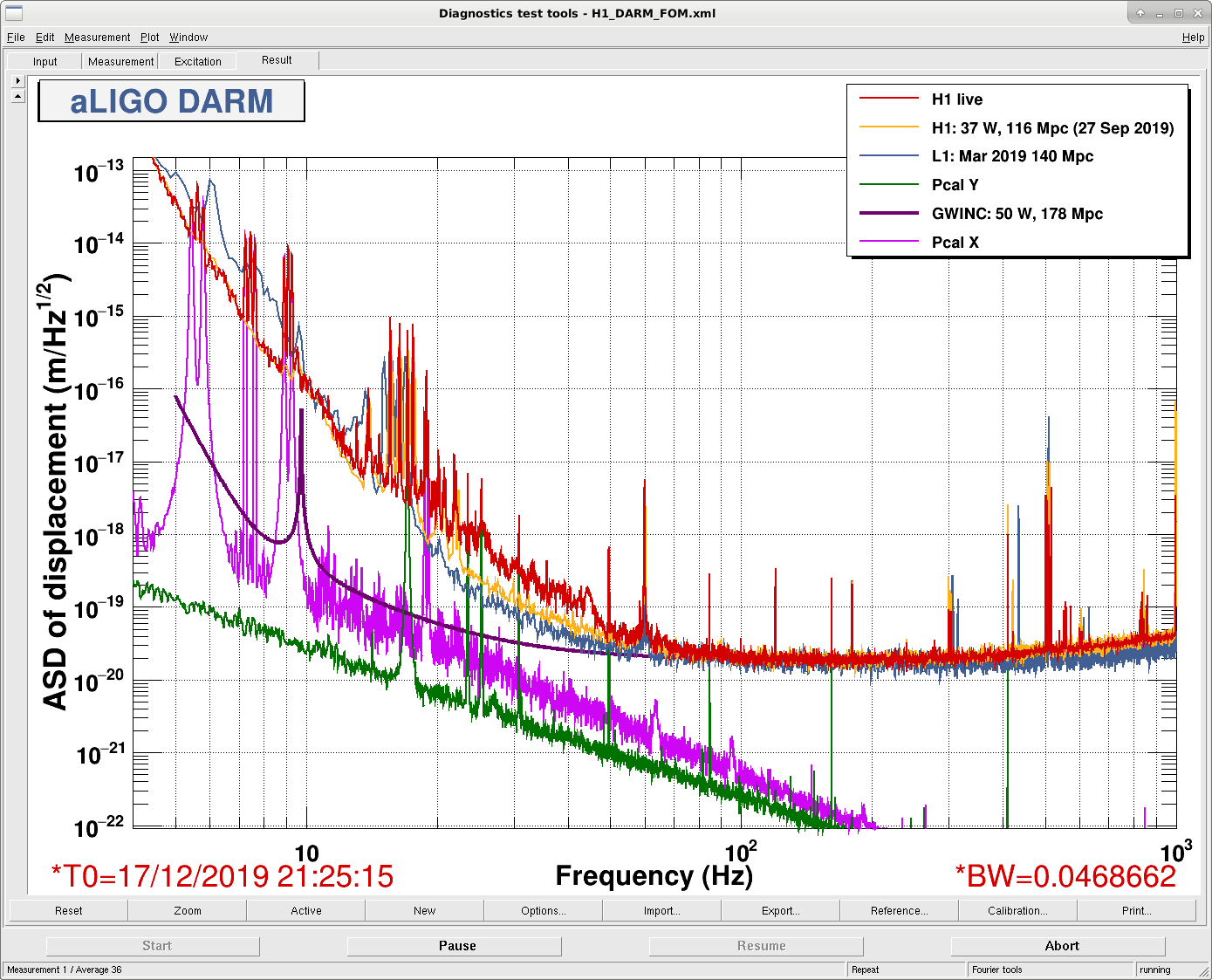
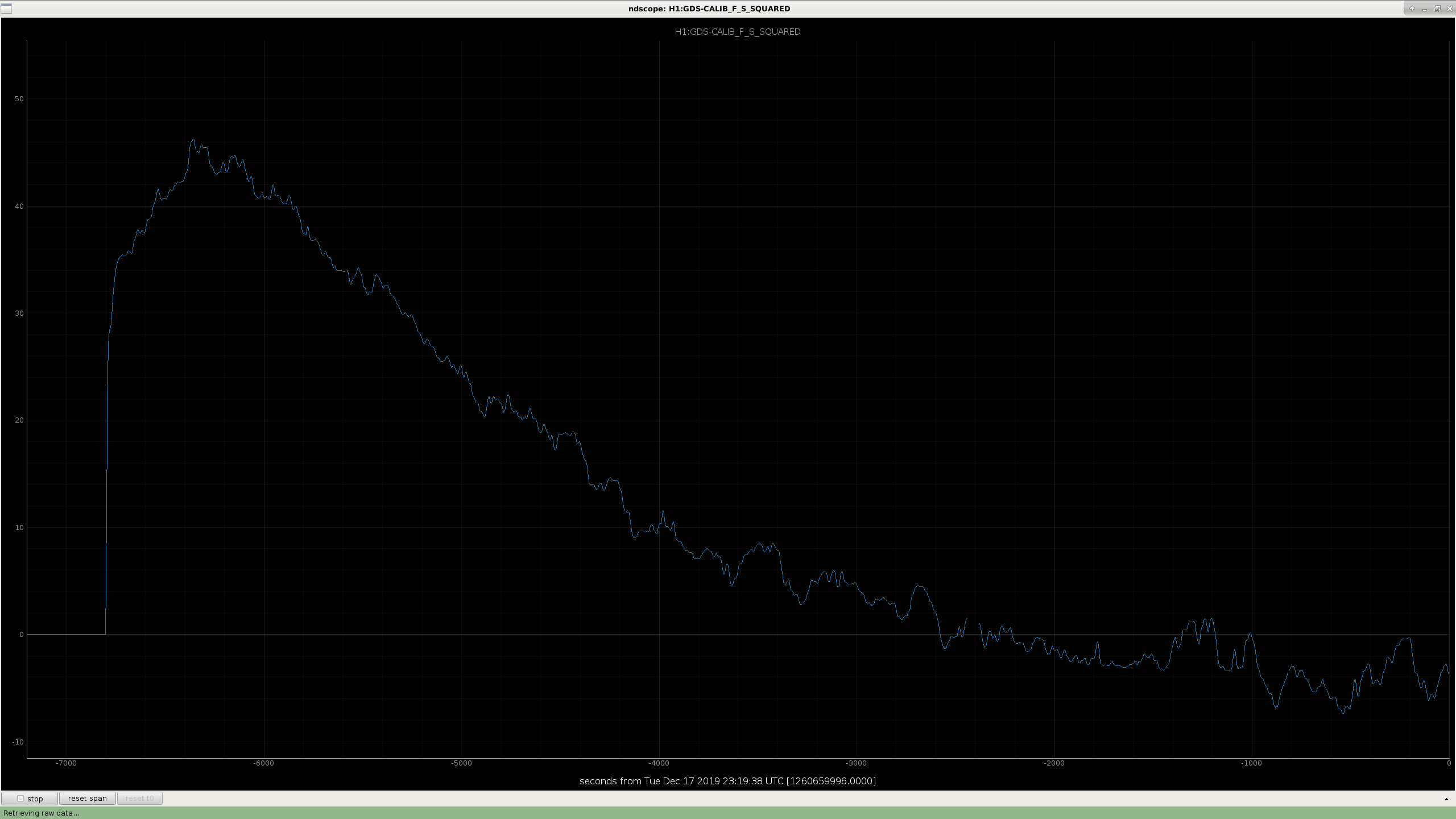
I've made a second, better attempt at tracking the long-time-scale thermalization of the IFO for the first few hours of a nominal low noise stretch -- originally attempted in LHO aLOG 53824. 

The data analysis will take some time, but here're are the measurement details. (All times are UTC on 2019-Dec-17)

    21:22 Test Start
    21:23 All lines on at conservative amplitude, SEI conf = USEISM, with SEI DIFF ON
    21:24 Hit Nominal Low Noise, all lines visible in DELTAL_EXT
    21:26:(15-30) Accidental brief turn off of (specifically) DARM lines
    21:40 Begin increase in line strength, and turn OFF of SEI DIFF
    22:03 Increase in some PCALY line heights to increase coherence
    23:20 All lines OFF, test done.

Hopefully, with all the changes in the lines during the measurement, the only effect will be that the coherence in the transfer function improves with time. During today's measurement, the microseism was well above the 90th percentile, in the ~1 um/sec range, so the 15 - 50 Hz data was rather glitchy, full of scattering arches.

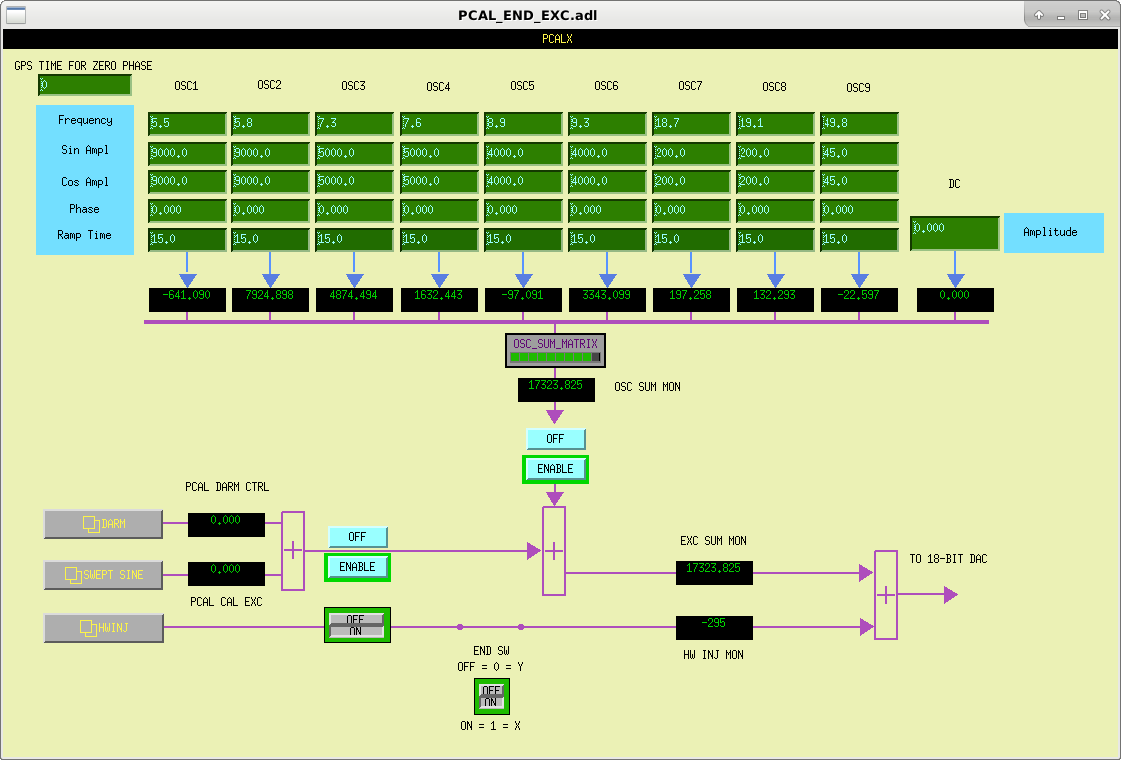
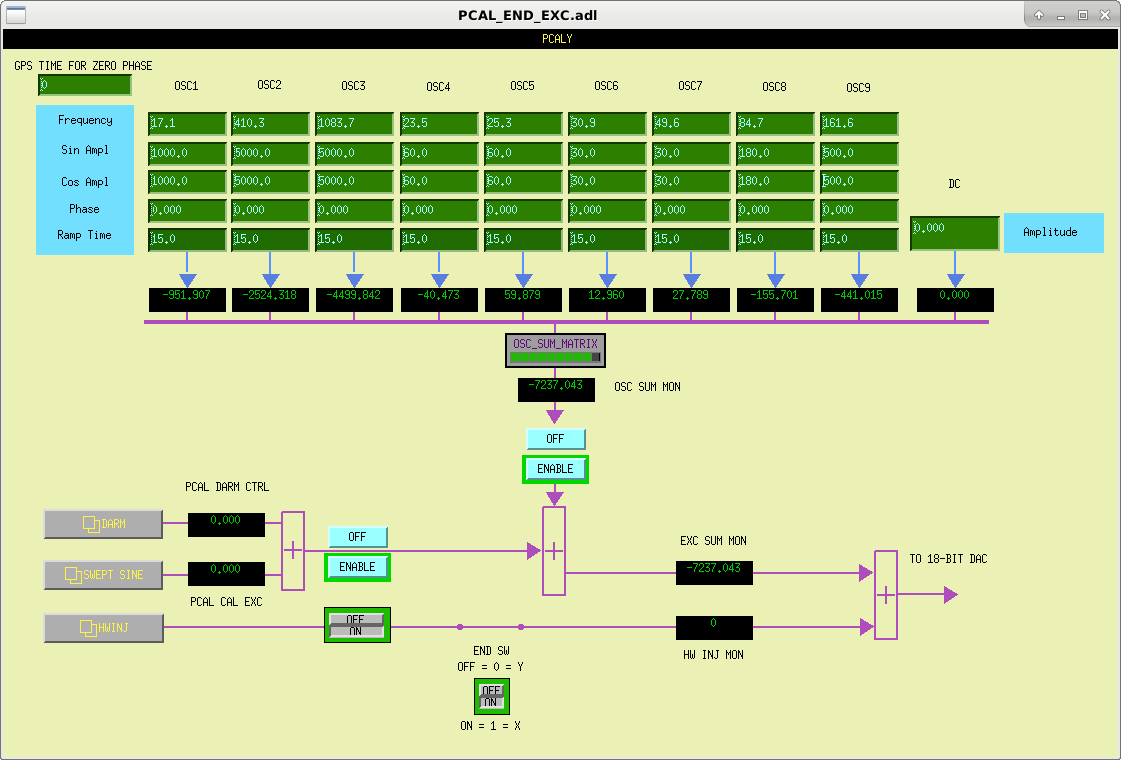
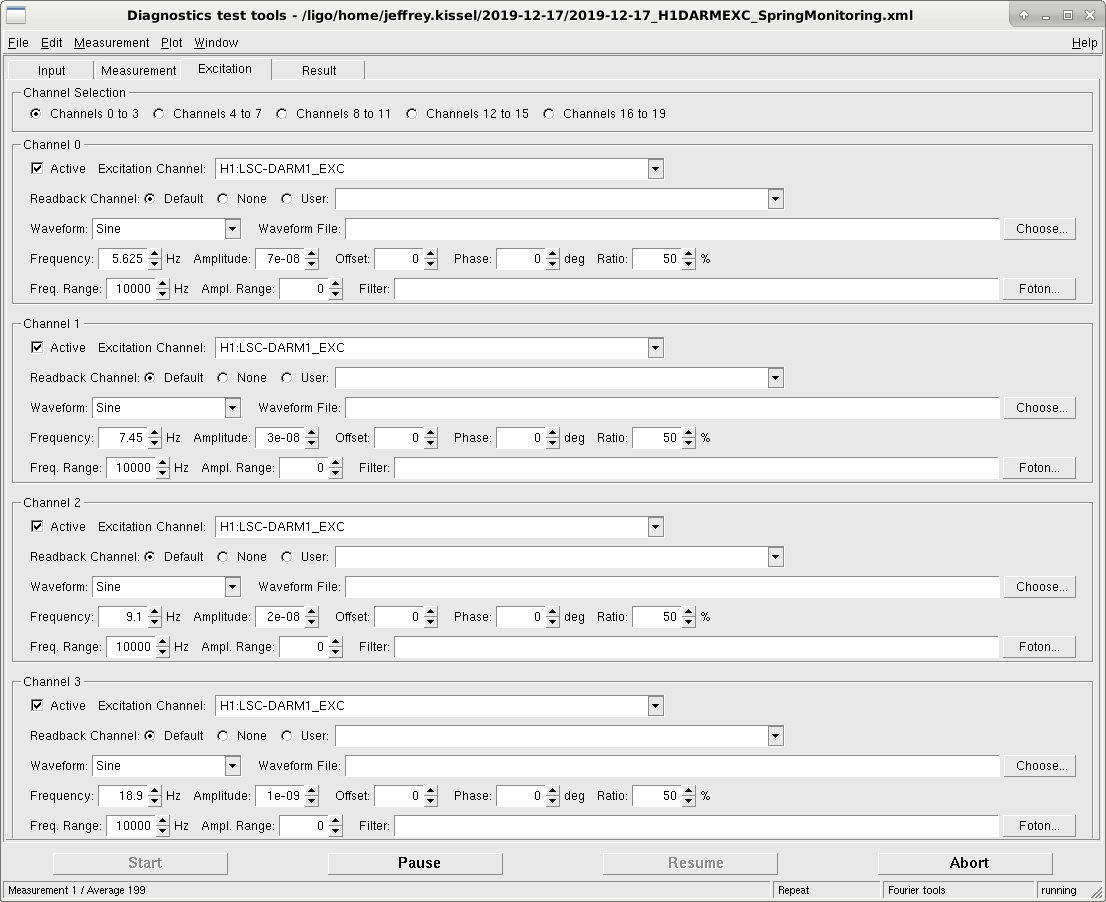
Here're the list of frequencies driven (exactly, in Hz, bold frequencies are standard calibration lines):
    freqlist_darmx = [5.625,    7.45,    9.1,   18.9]
    freqlist_pcalx = [  5.45,    5.8,   7.25,  7.625,    8.9,  9.275, 18.725,  19.1, 49.775]
    freqlist_pcaly = [17.100, 410.30, 1083.7, 23.525,   25.3,  30.85, 49.625, 84.65,161.625]

Script to turn on PCAL EXC lines:
    /ligo/svncommon/CalSVN/aligocalibration/trunk/Runs/O3/H1/Scripts/CALCS_FE/setup_sensingfunction_callinecombs.py

DTT template to turn on DARM EXC lines:
    /ligo/svncommon/CalSVN/aligocalibration/trunk/Runs/O3/H1/Measurements/FullIFOSensingTFs/2019-12-17_H1DARMEXC_SpringMonitoring.xml

(To turn off all the extra lines, I just hit Abort on the DTT template, and used SDF to revert all the PCAL settings. The only thing that *didn't* work for was the PCALX high frequency roaming line frequency, which I had to restore by hand at it's current sweep point, 3001.3 Hz).
Images attached to this report
Comments related to this report
evan.goetz@LIGO.ORG - 09:52, Thursday 19 December 2019 (53990)
The script to grab the data, and process it to compute the transfer functions for the individual lines is located at
aligocalibration/trunk/Runs/O3/H1/Scripts/FullIFOSensingTFs/process_sensing_20191217_darm_comb.py

The data is saved to these output files where columns are [GPS time] [TF mag] [TF phase (deg.)] [TF coherence] [TF relative uncertainty computed via coherence]:
aligocalibration/trunk/Runs/O3/H1/Results/FullIFOSensingTFs/2019-12-17_H1_sensing_comb_[1plusG_DARM,R_PCALX,R_PCALY]_[frequency]Hz.txt

Further analysis of the time series of transfer functions will need to happen in order to pull out the changes to the sensing and response function at the start of lock stretches, as the IFO thermalizes.
LHO General
corey.gray@LIGO.ORG - posted 16:00, Tuesday 17 December 2019 (53938)
DAY Shift Summary

TITLE: 12/17 Day Shift: 16:00-00:00 UTC (08:00-16:00 PST), all times posted in UTC
STATE of H1: Preventive Maintenance
INCOMING OPERATOR: TJ
SHIFT SUMMARY:

Microseism is still fairly high, so staying in the USEISM state.  

Maintenance Activities were complete at 20:20utc (12:20pm).  Went straight into locking immediately at 20:24utc & made it to pseudo-NLN at 21:23utc (1:23pm) on the first lock!  Then JeffK took H1 for ~2hrs of calibration measurements.

Wind Fence work has been going on all day first at EX & then at EY.  There has been small moves with the manlift for this fence work (Heard that Robert says this noise is observable in DARM).
LOG:

H1 IOO (IOO, PSL)
cheryl.vorvick@LIGO.ORG - posted 15:59, Tuesday 17 December 2019 (53950)
two beam blocks added to the PSL

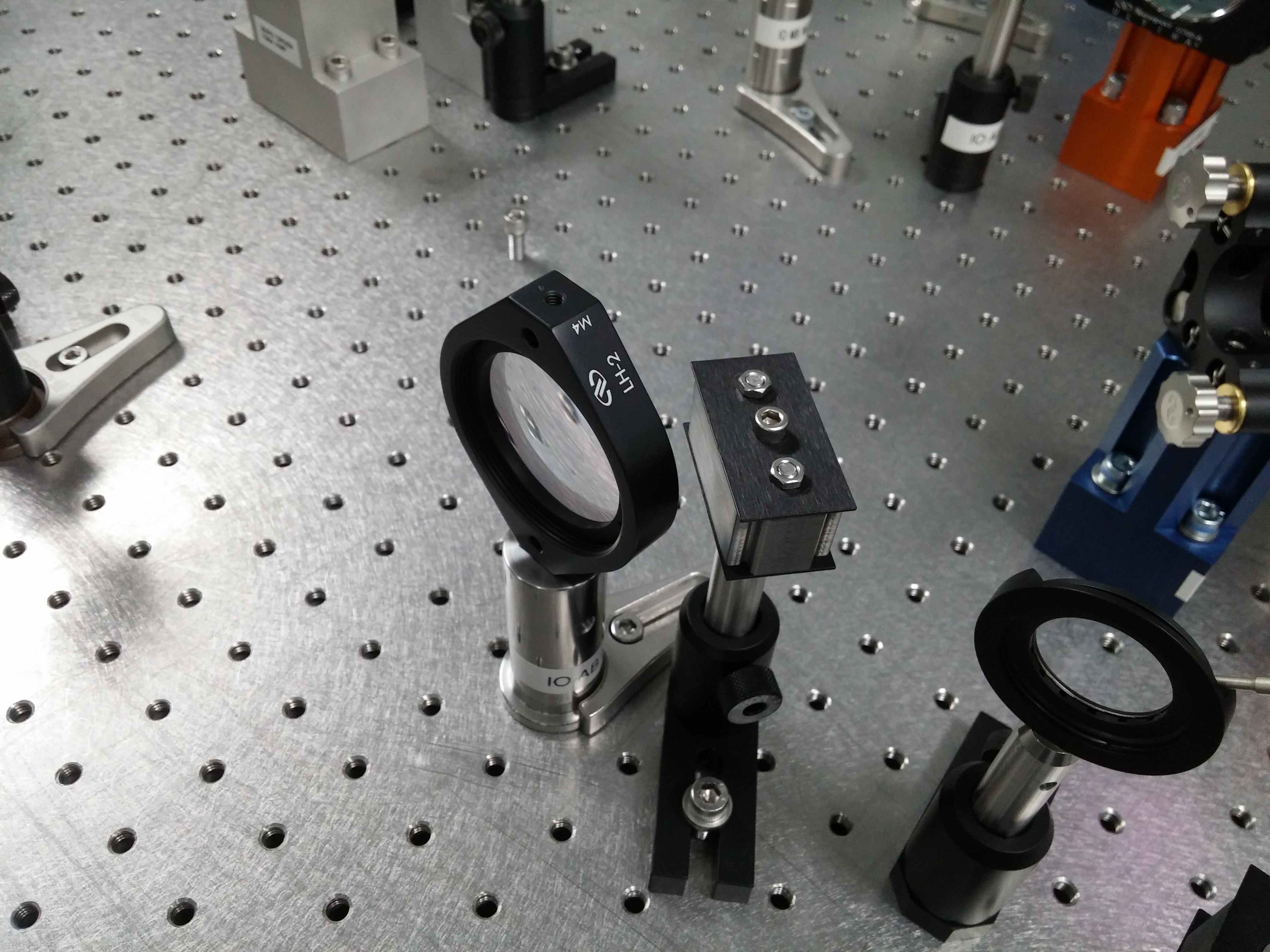
The DBB, which is not currently on the PSL, was blocking some stray light, so a black metal panel was added to catch the llight instead.  A reflection from a PD has shifted, and a razor blade dump was added to catch some light that was hitting the edge of a lens, where the beam is dumped on the lens mount (IO EOM pickoff).   Image attached is of the new razor blade beam dump.

Images attached to this report
H1 PSL
jason.oberling@LIGO.ORG - posted 14:27, Tuesday 17 December 2019 - last comment - 15:37, Tuesday 17 December 2019(53946)
PSL FSS Tune-up and Power Watchdog Reset (FAMIS 10741)

R. Savage, J. Oberling

This morning we tuned up the FSS RefCav beam path in advance of the holiday break.  The TPD had been trending down over the last couple of weeks, so we wanted to get things tuned up to hopefully avoid the TPD falling too low in the middle of the break.  This work was done with the ISS OFF.

We began by performing a power budget to look for any areas where it was obvious we were losing power.

With the above powers we find that the AOM diffraction efficiency is lower than it generally is.  On the first pass (AOM Output/AOM Input) we have a 69% diffraction efficiency; on the 2nd pass (EOM Input/AOM Output) we have a diffraction efficiency of 59%.  To improve this, the AOM alignment is adjusted to peak up the AOM Output, then M25 adjusted to peak up the EOM input.  We were only able to increase the AOM Output by ~1 mW by adjusting the angle of the AOM, but gained ~13 mW by adjusting the vertical position of the AOM higher (~1/4 - 1/2 turn on the vertical adjustment knobs, so not much adjustment needed at all).  This was the most we could get with AOM adjustments; the AOM output power increased to 114 mW, therefore increasing our 1st pass diffraction efficiency to 78.6%.  We measured this at 75.5% in November, so we're good to go here.  We now had 34 mW input into the FSS EOM, which is lower than when we started; this makes sense, as we adjusted the position of the AOM to peak the 1st pass diffraction efficiency but had not yet realigned the 2nd pass.  Mirror M25 was adjusted to peak up the power incident into the EOM.  When finished we had 85 mW incident on the EOM, which gives a 2nd pass diffraction efficiency of 74.6%.

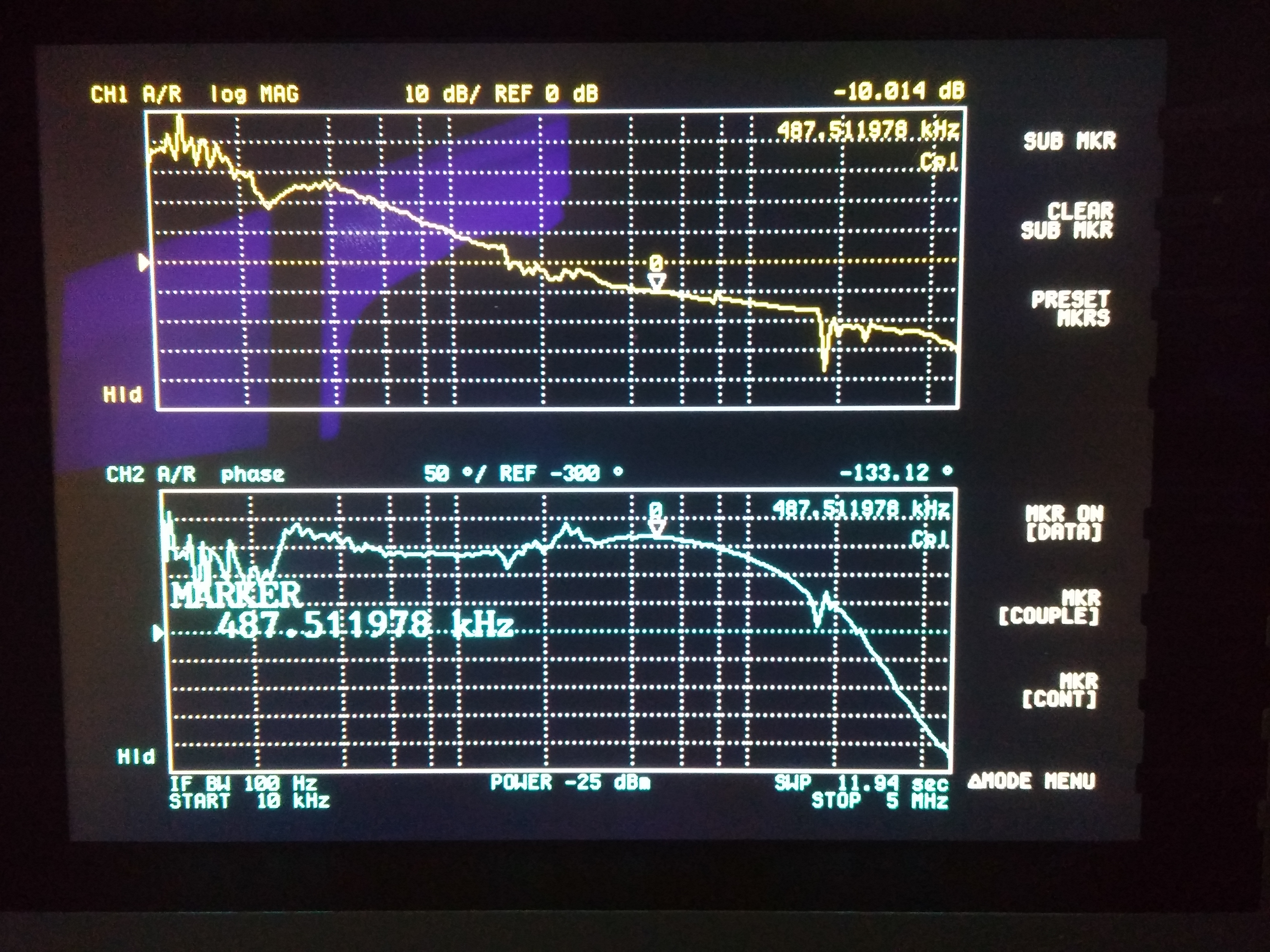
At this point Rick noticed that the beam spot on the viewer card we were using looked odd, almost like a HG01 mode.  We traced the beam back through the beam path, looking for dirty optics along the way.  We noticed that the 2nd FSS mode matching lens, L10, looked really dirty.  We attempted to clean it in situ, but that didn't work out so well so we removed the lens and cleaned it.  We also noticed some spots on WP05 and M25, so we cleaned these optics as well (done in situ).  This complete, the beam on the card looked a good deal better but still had a bit of HG01 look to it.  Pressed for time, we decided to move on and see how the RefCav locked before persuing this more.  Before relocking the RefCav, the beam alignment through the EOM was checked and found to be a little off horizontally on the EOM output aperture.  An iterative alignment between mirror M26 and the EOM itself was used to fix this; this was done to hold the beam near the center of the RefCav Refl camera, our rough alignment reference.  That complete, we used the autolocker to lock the RefCav, which locked with no issues.  The picomotor-controlled mirror mounts were used to peak up the TPD; when done, we had a RefCav TPD of 5.58 V.  To finish, we measured the TF of the FSS, see attachment (if the phase plot looks weird, that's only because it was unwrapped).  With the gains unchanged (common gain at 20, fast gain at 16), we have a UGF of 487 kHz, so no gain adjustment was needed (recall that the UGF of the FSS is measured at a magnitude of -10dB due to the electronics of the 2nd gen TTFSS we currently use).  This completed the FSS tune-up.  As of right now, the RefCav TPD is reading 5.66 V.

Finally, I turned both power watchdogs ON (we turn them off when working in the enclosure) at 20:30 UTC (12:30 PST), thereby completing FAMIS 10741.

I do want to note one interesting thing.  We forgot to turn the ISS 1st loop back ON when we were done.  Once I remembered to do this IFO recovery had already started, and Guardian was at the INCREASE POWER stage.  This means the locking sequence survived all the way to INCREASE POWER with no 1st loop ISS engaged (the 2nd loop is generally engaged shortly after DRMI acquisition, I did not notice if it was engaged with no 1st loop); DARM did have a fairly ugly, and expected, high-frequency noise hump.  The 1st loop engaged with zero issues, didn't even break the lock.  The noise hump went away and Guardian continued on its merry way like nothing had happened.  Huh.  *nods head sagely*

Images attached to this report
Comments related to this report
richard.savage@LIGO.ORG - 15:37, Tuesday 17 December 2019 (53949)

For future reference, the vertical adjustment of the AOM was in the direction of increasing its distance from the table surface.

This is not the first time we have experienced the need to change the AOM height.  In fact, adjustment knobs were already installed in both actuators needed to change the AOM height.

When time allows, we want to try swapping out the AOM to see if this FSS alignment issue is related to issues with this particular AOM.  We don't recall having these issues with previous incarnations of the LIGO PSLs.  We have been using the same AOMs in very similar optical configurations for more than 20 years.

H1 CAL
ethan.payne@LIGO.ORG - posted 12:19, Tuesday 17 December 2019 (53941)
PCal EY calibration measurement

Niko, Ethan

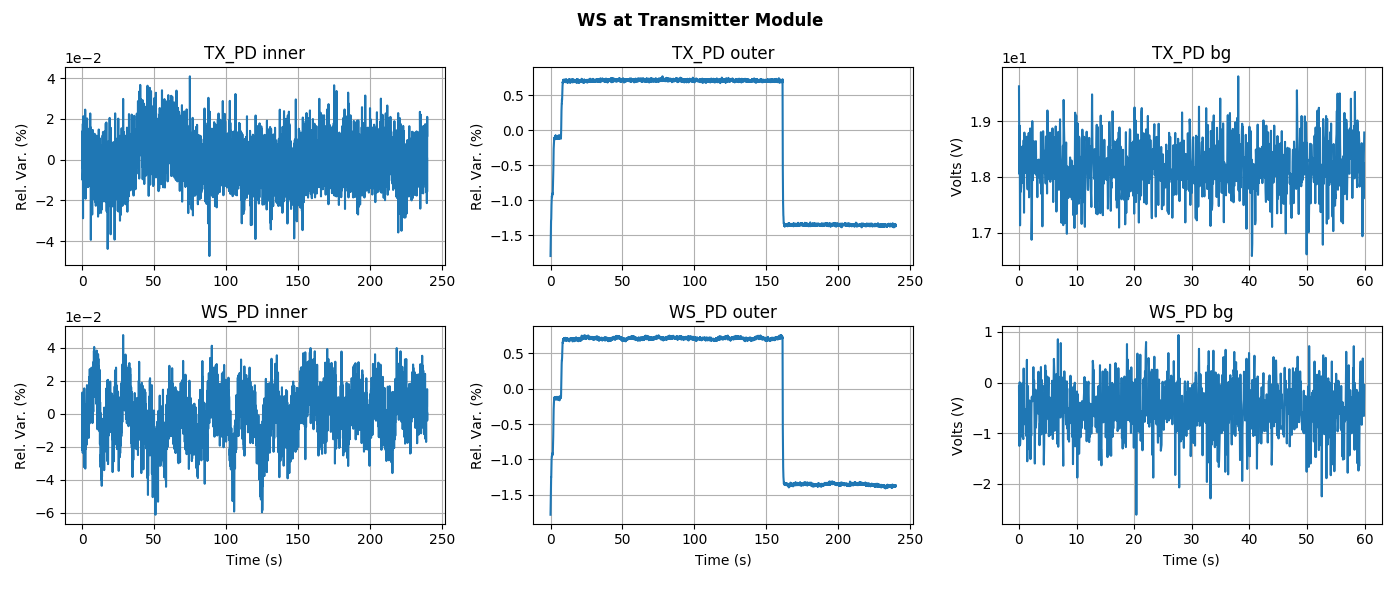
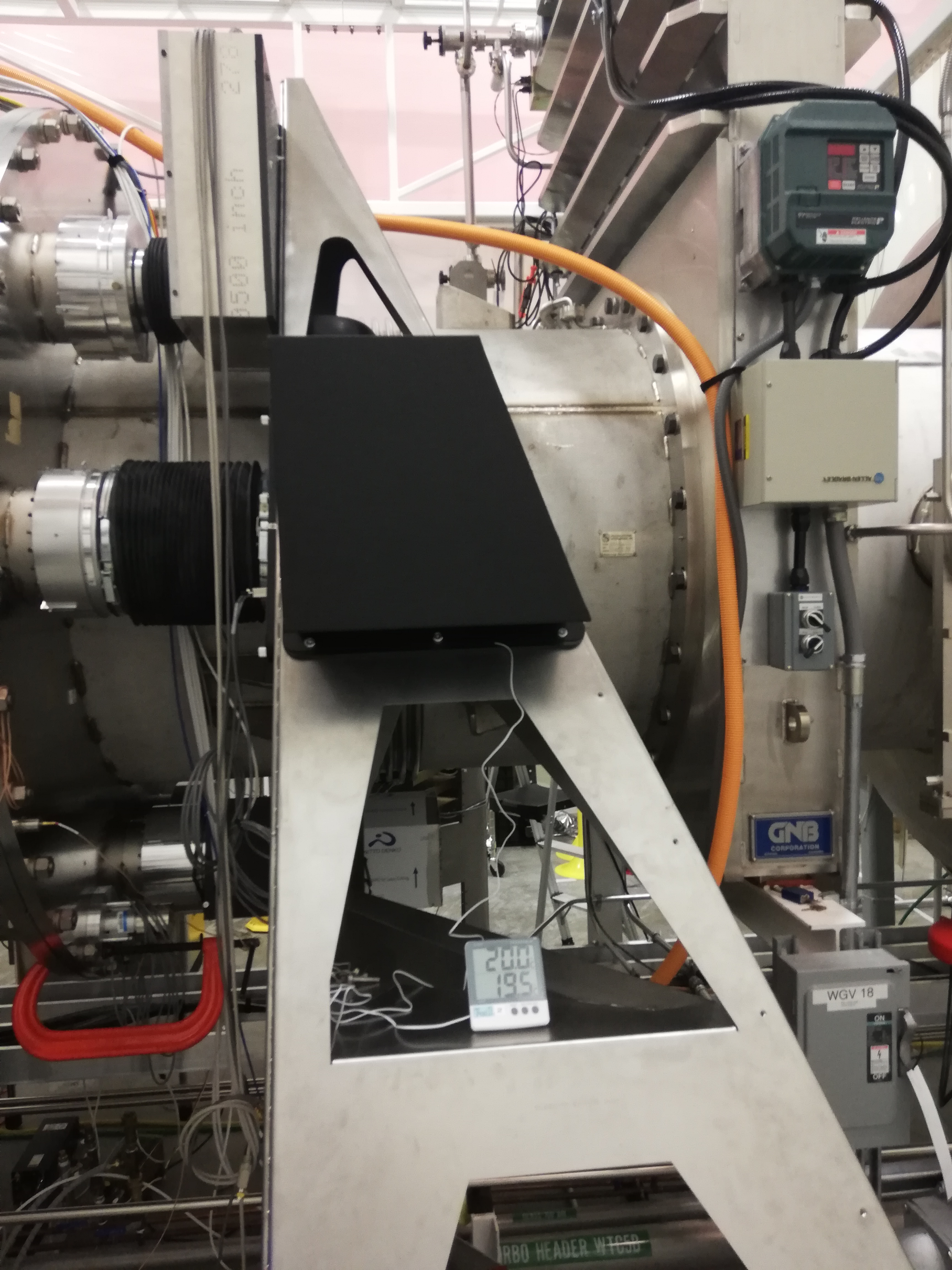
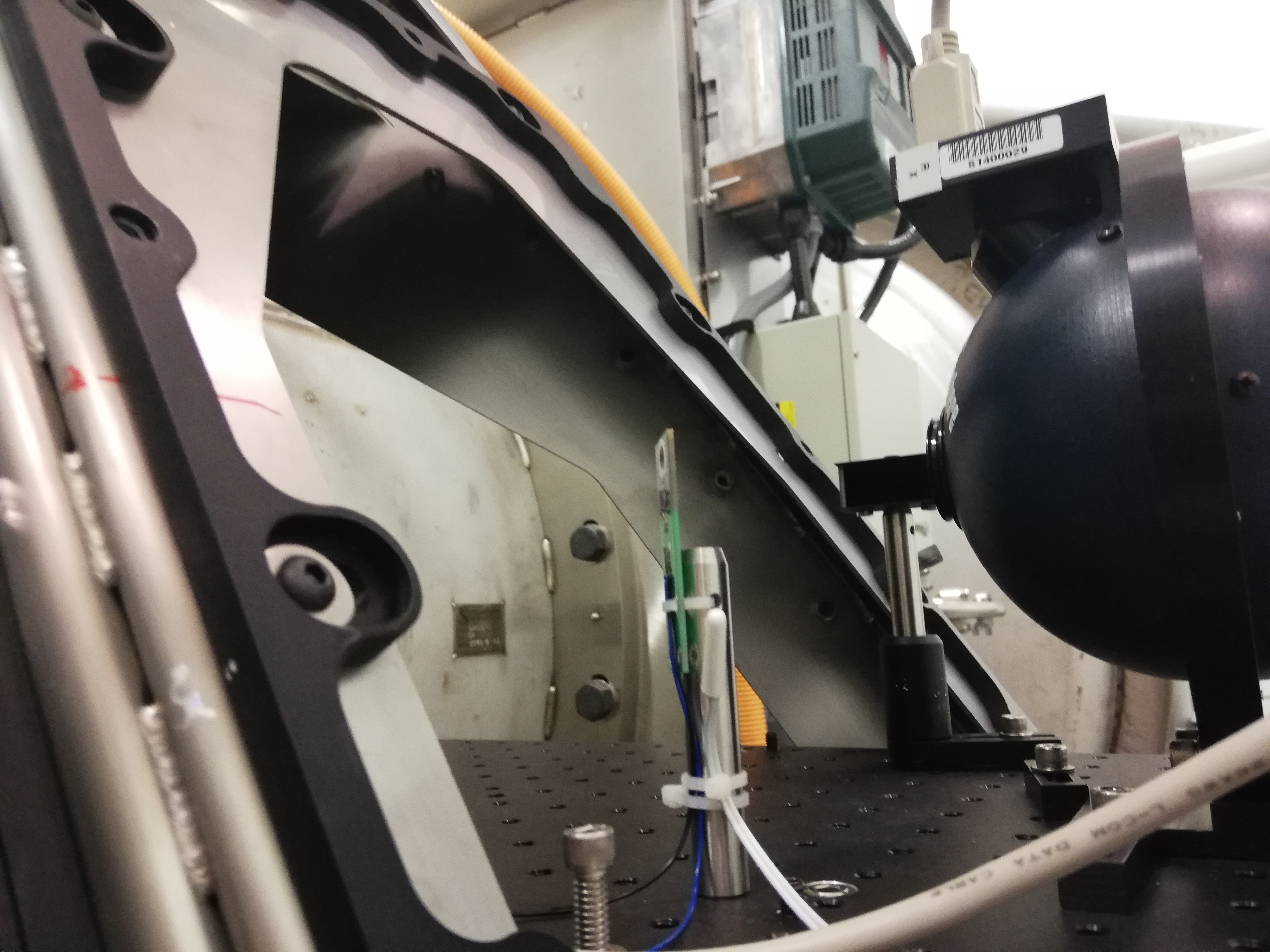
Today (12/17/19), a standard PCal endstation calibration measurement was undertaken. The results of the calculation are consistent with previous calibration measurements of the endstation. Some attached documents are the procedure document (with the measurement times), the trends documents with the final datapoint in each plot corresponding to today's measurement, WS/GS responsivity trends document, and the pictures of the alignment of the beams on the RX PD. The alignment seems similar to the last time it was checked (alog 53373). 

Some things to note:

1. Jeff K was inadvertently changing the gain on the optical follower servo at EY during the calibration. The times for this are

These times align with one of the sets of measurements at the endstation, labelled measurement 2, when the WS is in the outer beam of the TX module. This is seen in the data during the measurement, see the middle two panels of attached WS_at_TX.png. However, this has no effect on the calibration, as these two timeseries are taken as a ratio. It does, however, affect the measurement of the power imbalance (not used in the calibration), see power_imbalance.pdf. 

2. The portable temperature probe was moved from the TX module to the RX module. This is seen in the attached photos labelled temperature_probe_*.png. The reason for moving the probe is to coordinate reducing uncertainty in the RX PD responsivity due to temperature, as this is the photodetector used for IFO calibration.


Images attached to this report
Non-image files attached to this report
H1 SQZ
daniel.sigg@LIGO.ORG - posted 11:54, Tuesday 17 December 2019 - last comment - 12:39, Tuesday 17 December 2019(53943)
New OPO Crystal Position

Sheila Marc Daniel

We changed the OPO crystal position by a random amount.

New OPO parameters:

Before the crystal move we were at the maximum SHG launch power of 20mW with 2.6 mW on OPO REFL DC  and weren't able to maintain the OPO green pump power anymore.  We now need 4x less power.

Comments related to this report
sheila.dwyer@LIGO.ORG - 12:39, Tuesday 17 December 2019 (53944)

Before moving the crystal, we set up the OPO scanning with the Thorlabs PZT driver (so that we can scan quickly), and saw that the red and green were co-resonant for a scannin cavity.  We then moved the crystal using 100 count steps on the controller, the first direction that we tried moving (toward the right according to the UI) we found the edge of the crystal (red transmission peaks nearly disappeared) before we found an additional co-resonance.  We went back in the other direction (left arrows) until we found our first co-resonaonce, then stopped at the next one.  We after locking the cavity there we measured the nonlinear gain of 2.56 for a normalized OPO trans of 1 (OPO Refl is 0.5mW, fiber launch is 5.4mW).    

H1 AOS (CAL, CDS, DCS)
gregory.mendell@LIGO.ORG - posted 11:51, Tuesday 17 December 2019 (53942)
Patched and rebooted the DMT production computers

The DMT production computers have been patched and rebooted to bring in the latest security patches and production updates from lscsoft. The GDS and calibration software on the DMT were not changed. Everything on the DMT is working and this completes WP #8497.

H1 GRD (CAL)
jeffrey.kissel@LIGO.ORG - posted 11:10, Tuesday 17 December 2019 (53939)
Adding IFO_CALIB Guardian Node to H1 Guardian Universe
J. Kissel, D. Barker, T. Shaffer,
WP 8500

I've instantiated the IFO_CALIB guardian for general use of automatic calibration measurements in the future. The node was originally constructed by Timesh at LLO, e.g. LHO aLOG 44318.

The source code lives in 
    /opt/rtcds/userapps/release/cal/h1/guardian/IFO_CALIB.py
At the moment, it only parameter file it references is
    /opt/rtcds/userapps/release/isc/h1/guardian/lscparams.py

TJ has added this node to the guardian overview screens, as indicated in LHO aLOG 53933.

I'm not yet confident that this has been added to the list of guardians to check the happiness of before observing. We'll check that later.

guardutil print IFO_CALIB     # check for gross syntax errors or bad references before starting
guardctrl enable IFO_CALIB    # instantiate the channel space for the node
guardctrl start IFO_CALIB     # start the node

Instantiating the channel space requires a DAQ restart, which has been done.
H1 CAL (CAL)
sudarshan.karki@LIGO.ORG - posted 10:17, Tuesday 17 December 2019 - last comment - 16:34, Thursday 19 December 2019(53911)
High Frequency Calibration Lines for O3B

I have semi automated the analysis of the high frequency roaming lines. The timestamp for these roaming lines can be found here: LHO alog 53624

The scripts used to obtain the data and convert it into appropriate format for processing lives here:  svn/aligocalibration/trunk/Runs/O3/H1/Scripts/HighFrequency/

The results are saved at the following location: svn/aligocalibration/trunk/Runs/O3/H1/Measurements/HighFrequency/

The instructions on how to run the code can be found in README file here: svn/aligocalibration/trunk/Runs/O3/H1/Scripts/HighFrequency/README

Comments related to this report
sudarshan.karki@LIGO.ORG - 16:34, Thursday 19 December 2019 (53997)

The four high frequency sweeps listed in LHO alog 53974 (the last one has not finished yet) have been analyzed and the data is in the svn at following location:

svn/aligocalibration/trunk/Runs/O3/H1/Measurements/FullIFOSensingTFs/HighFrequencyResults/

The raw FFT data is at the following location: https://ldas-jobs.ligo.caltech.edu/~cal/hfdata/H1/


LHO General
corey.gray@LIGO.ORG - posted 08:18, Tuesday 17 December 2019 (53937)
Transition to Day Summary

TITLE: 12/17 Day Shift: 16:00-00:00 UTC (08:00-16:00 PST), all times posted in UTC
STATE of H1: Preventive Maintenance
OUTGOING OPERATOR: Jim
CURRENT ENVIRONMENT:
    SEI_CONF state: SC_OFF_NOBRSXY
    Wind: 4mph Gusts, 3mph 5min avg
    Primary useism: 0.06 μm/s
    Secondary useism: 0.90 μm/s 
QUICK SUMMARY:

Well into Maintenance!!!
H1 broke lock as soon as I transitioned to SC_OFF_NOBRSXY....ending a 55hr36min lock.

H1 General
jim.warner@LIGO.ORG - posted 07:56, Tuesday 17 December 2019 (53935)
Shift Summary

TITLE: 12/17 Owl Shift: 08:00-16:00 UTC (00:00-08:00 PST), all times posted in UTC
STATE of H1: Observing at 115Mpc
INCOMING OPERATOR: Corey
SHIFT SUMMARY: Microseism is pretty high
LOG:

8:25 Knocked out of observe for about a minute by transitioning SEI_CONF to USEISM, I was able to catch the filter banks and unmonitor, this shouldn't happen again

LHO General
thomas.shaffer@LIGO.ORG - posted 00:00, Tuesday 17 December 2019 (53931)
Ops Eve Shift Summary

TITLE: 12/17 Eve Shift: 00:00-08:00 UTC (16:00-00:00 PST), all times posted in UTC
STATE of H1: Observing at 108Mpc
INCOMING OPERATOR: Jim
SHIFT SUMMARY: Quiet shift with the useism still climbing. 47.5 hour lock.
LOG:

H1 GRD (CAL)
thomas.shaffer@LIGO.ORG - posted 23:40, Monday 16 December 2019 (53933)
Added IFO_CALIB guardian node to the overview

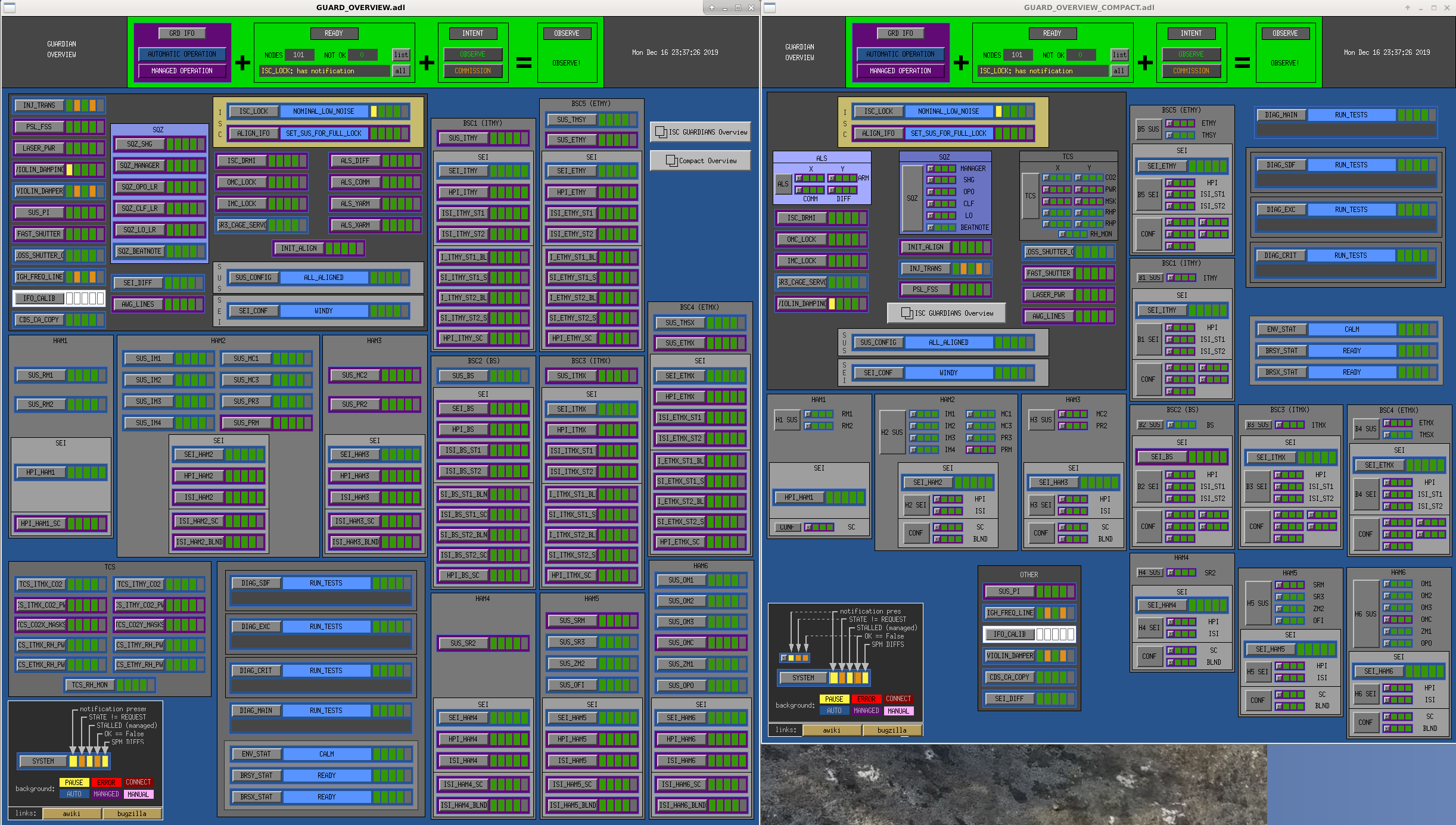
I added the IFO_CALIB node to the two guardian overviews in preparation for the addition of this node tomorrow.

Since the node hasn't been created or started yet, it will be white until then.

Images attached to this report
H1 SEI
jenne.driggers@LIGO.ORG - posted 15:29, Monday 16 December 2019 - last comment - 14:54, Tuesday 17 December 2019(53926)
Turned off CPS DIFF

Sheila pointed out that we're having a lot of scattered light for the microseism level we've got, and at the Commish meeting asked about our sensor correction / seismic configuration.

Since the CPS differential is designed to help at the wind and earthquake band, it makes some sacrifices of isolation performance in the microseism band.  As a test, I've turned off the CPS differential system by ramping down the final output gain (H1:ISI-DIFF_CONTROL_BIT to zero, ramping down over 10 seconds), and we'll see if we see a bit less scattering. 

I took the IFO out of observing for a few minutes to make the transition, accepted the SDF diff, and went back to observing.  Note that I left the SEI_DIFF guardian in its nominal state which might make one think that it's on, but since the Run state does nothing but return True, it is not writing to that EPICS channel.  I didn't want to edit the guardian's nominal state, which is why I've left it alone.

Comments related to this report
jenne.driggers@LIGO.ORG - 17:42, Monday 16 December 2019 (53930)

It's been a little over 2 hours, and the IFO seems to like having the CPS diff off, so I'll leave it off for now.

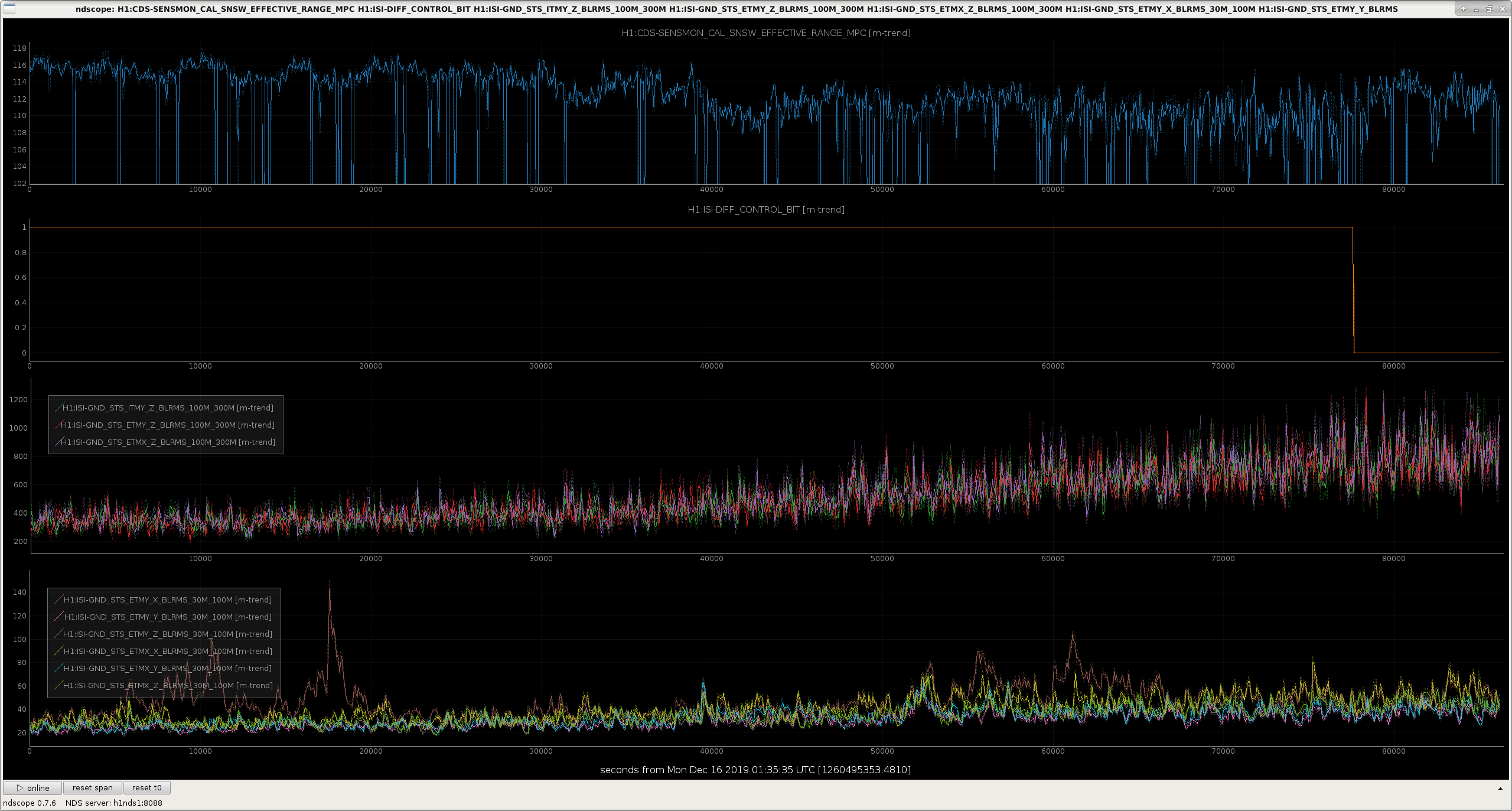
In the attached screenshot, the top row is the BNS range, 2nd row is the DIFF control bit showing when I turned off CPS diff.  While we're still seeing glitches, they (with this limited amount of time) seem to be somewhat less frequent, and the range seems a little bit better.  The third row is microseism BLRMS for the z-axis STS at each building, showing that the microseism has not decreased since turning off the CPS diff.  The 4th row is X, Y, Z axis BLRMS in both the EX and EY stations for the wind and earthquake band, showing that we haven't had too much wind or very low frequency seismicity, which is where the CPS diff helps most anyway. Note for the seismic plots that these units are nm/sec, whereas they are displayed in um/sec on the control room wall.

Images attached to this comment
jim.warner@LIGO.ORG - 07:30, Tuesday 17 December 2019 (53934)

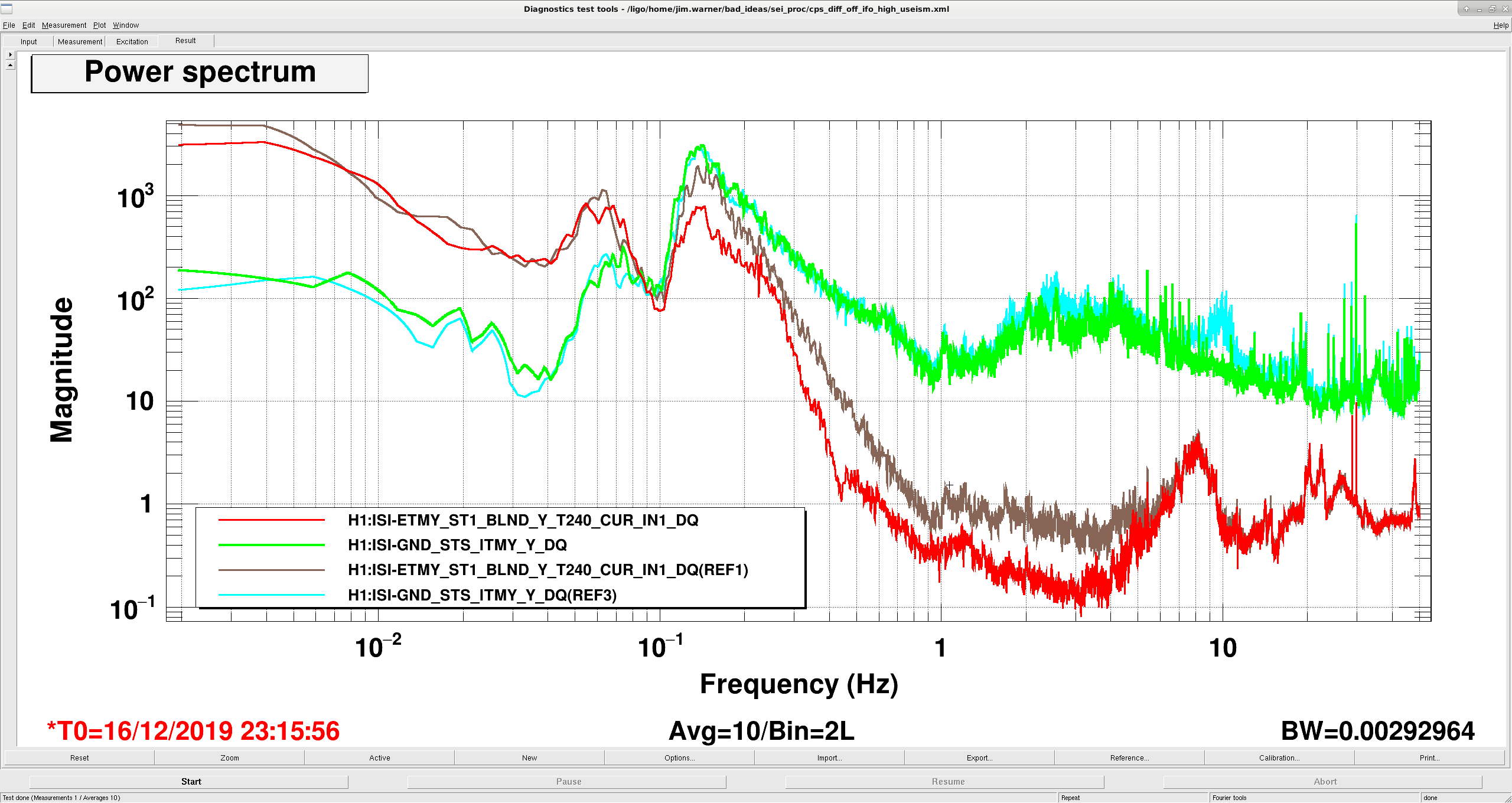
Looking at the ETM ISIs, the current cps diff filter makes the microseismic table motion and above worse on Stage 1, this is fine most of the time, but not a good thing for us at the moment. The attached plot shows the ground and St1 motion before Jenne turned off the cps diff (cyan and brown) and immediately after (red and green). The effect on the BSCs is pretty dramatic One thing we could try is just making a state that doesn't engage the ETM cps diff. It doesn't seem to be a problem to impress this extra motion on the BS, it would be good to get some time to try engaging different parts and seeing what hurts us. It would also be good to see what the effect is when SEI_CONF is in the useism state (which I switched to a few hours ago, as the microseism has gone over 1 micron/s rms).

Images attached to this comment
jenne.driggers@LIGO.ORG - 14:54, Tuesday 17 December 2019 (53947)

Turning off the CPS diff had a clear impact on the size of glitches apparent in omicron on the summary pages. 

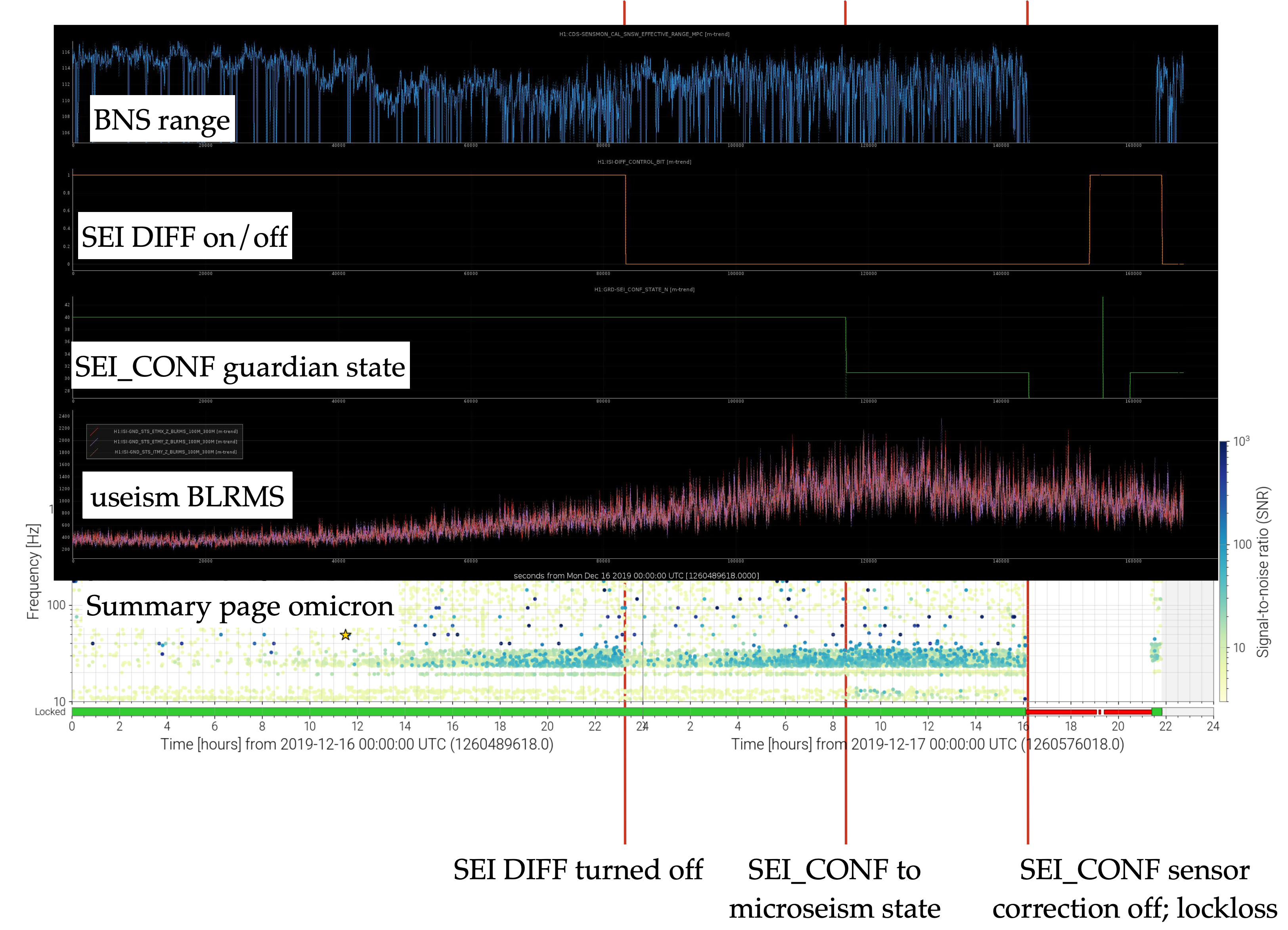
The attached plots is a stitch-together of 2 days of omicron plots from the summary pages, along with the same time period of data in ndscope for the BNS range, whether the CPS diff was on (high) or off (low), what state the SEI_CONF guardian was in (high=nominal WINDY, med-low = microseism state, low-off-plot = sensor correction off), and the ground STS BLRMS in the microseism band.  I've included vertical bars at the locations where the CPS diff is turned off yesterday, where Jim changed the SEI_CONF state to microseism, and where Corey changed the SEI_CONF state to have no sensor correction, in preparation for maintenance day.

The glitches from about 20 Hz - 40 Hz seem to immediately drop away when I turned off CPS diff yesterday afternoon, but then they start to come back as the ground motion continues to get even worse. The microseism has gone down a bit, but it looks like the CPS diff got turned back on (not yet sure if that was a guardian thing, or an SDF accept thing), and JeffK pointed out that we were again seeing big glitches.  I've again turned off CPS diff (all of it, not just ETMs, although that is an interesting suggestion by Jim that perhaps we should try sometime).

One might think at first glance that Jim's having put the SEI_CONF guardian into the microseism state increased glitches between 10-20 Hz, but I suspect that those are actually just coming from the increased microseism during that time.  There's some subtle threshold, but when the microseism BLRMS fall below that level, those glitches fade away, even though the seismic configuration has not changed.


Images attached to this comment
H1 DetChar
alan.weinstein@LIGO.ORG - posted 12:21, Monday 16 December 2019 - last comment - 07:54, Tuesday 17 December 2019(53923)
DQ shift report December 9 - December 15
Comments related to this report
cheryl.vorvick@LIGO.ORG - 07:54, Tuesday 17 December 2019 (53936)

Expanding on this comment:

  • "ETMY violin modes 18 & 20 (at 1kHz) were ringing up; much effort put into damping them. It produced lots of omicron glitches at 1 kHz, through Wednesday Dec 11. Much reduced after PSL chiller recovery."

ETMY violin mode damping of modes 18 and 20 was completed early on Friday, Dec. 13th (Pacific), alog 53875.

H1 CAL
vladimir.bossilkov@LIGO.ORG - posted 17:58, Thursday 12 December 2019 - last comment - 13:49, Tuesday 17 December 2019(53870)
UIM Dynamics propagated through tagged models and to python friendly filter files available to pyDARM

Following up from the last alog.

With the UIM dyanamics filter ready I propagated it through a set of new tagged sus models. I made a set of three to help make an informed decision on how to treat the new UIM dynamics - the complication being that there appears to be dynamics around the violin modes. I have split off a second tagsusdynamicalmodel.m so I don't interfere with livingston using the file.

I have created the following files using /ligo/svncommon/SusSVN/sus/trunk/Common/MatlabTools/tagsusdynamicalmodel_h1.m

/ligo/svncommon/SusSVN/sus/trunk/Common/SusModelTags/Matlab/
quadmodelproduction-rev9944_ssmake4pv2eMB5f_fiber-rev8442_h1etmx-rev10093_h1etmx_options-rev10093_released-2019-12-12.mat
quadmodelproduction-rev9944_ssmake4pv2eMB5f_fiber-rev8442_h1etmx-rev10090_h1etmx_options-rev10090_released-2019-12-12_noUIMdyn.mat
quadmodelproduction-rev9944_ssmake4pv2eMB5f_fiber-rev8442_h1etmx-rev10093_h1etmx_options-rev10093_released-2019-12-12_noviolins.mat

And from these I have generated the following files using /ligo/svncommon/CalSVN/aligocalibration/trunk/Common/pyDARM/matlab_scripts/export_AAAI_SUS.m:

/ligo/svncommon/CalSVN/aligocalibration/trunk/Common/pyDARM/matlab_scripts/

H1susdata_O3_new.mat
H1susdata_O3_new_noUIMdyn.mat
H1susdata_O3_new_noviolins.mat

Using these I can compare before are afters, namely:

compare_with_no_violin.png
compare_with_violin.png

In the case when I plotted against no violins, the MATLAB removes the highest most zero in the UIM dynamics, making the TF look like its going down more than it should be (an effective extra 1/f term). This is a problem in the current workflow that takes the tagged model and splits it up into low frequency terms and the violin terms, where I'd need to add a separate operation that takes the tagged model that has no violin modes to split off these dynamics. Looks like I will have to rethink.

Also the low frequency features are being changed by a bit - seems even matlab has its limits of tolerance when it comes to how many poles and zeros it can play with at a time.

I think a better approach is to have the dynamics added into the "H1susdata_O3" matrix directly by export_AAAI_SUS.m, and make no changes to the tagged susmodels as they stand. At the end of the day I am always drawing from the same file into which I have saved my dynamics... I can just do that later down the line even for the foton file.

Images attached to this report
Comments related to this report
vladimir.bossilkov@LIGO.ORG - 12:08, Friday 13 December 2019 (53884)

Looks like how I've treated my raw data for the higher frequencies (near the violin modes) is incorrect. It seems the violin mode part of the TF is conflating with my data in part of the processing.

When I was doing fitting, I was dividing out a TF that had no violin modes (as was my intention), but "umodelUIM_afterLock_freqresp" was being divided out instead in a pyDARM function

I'll be dividing out more correctly, removing any data >200 Hz and refitting now.

Images attached to this comment
vladimir.bossilkov@LIGO.ORG - 10:41, Monday 16 December 2019 (53921)

After following through:

Things look pretty good, however,

  • Matlab seems to skip a zero pole pair at low frequency
    • For the foton filters, this is irrelevant as the minreal function cuts that out anyway
    • Somewhat important for the pyDARM models, and they would be relying on this model.
  • there is a little dip in magnitude after the 150 Hz feature (visible in both attachments), that restores  restores after about 1kHz. (This is an artifact of fitting)
  • Phase is flipped 180 degrees after the 150 Hz feature
  • There is something at 300 Hz, which may be the first harmonic of the 150 Hz feature.
    • It is hard to tell its significance without careful measurement with fine scale sweep sine measurements in the future.
  • There is a small misfit the the magnitude gain visible in the pdf.
    • The fit gets the mganitude correct at the 150Hz feature
    • Any added poles and zeroes are <410 Hz such that the TF can be broken up into 3 constituent pieces:
      • Low frequency part <45 Hz
      • UIM dynamics: 45-410 Hz
      • Violins: >410 Hz
    • better fits would push poles into the region of violin modes
Images attached to this comment
Non-image files attached to this comment
vladimir.bossilkov@LIGO.ORG - 13:49, Tuesday 17 December 2019 (53945)

Vlad, Jeff

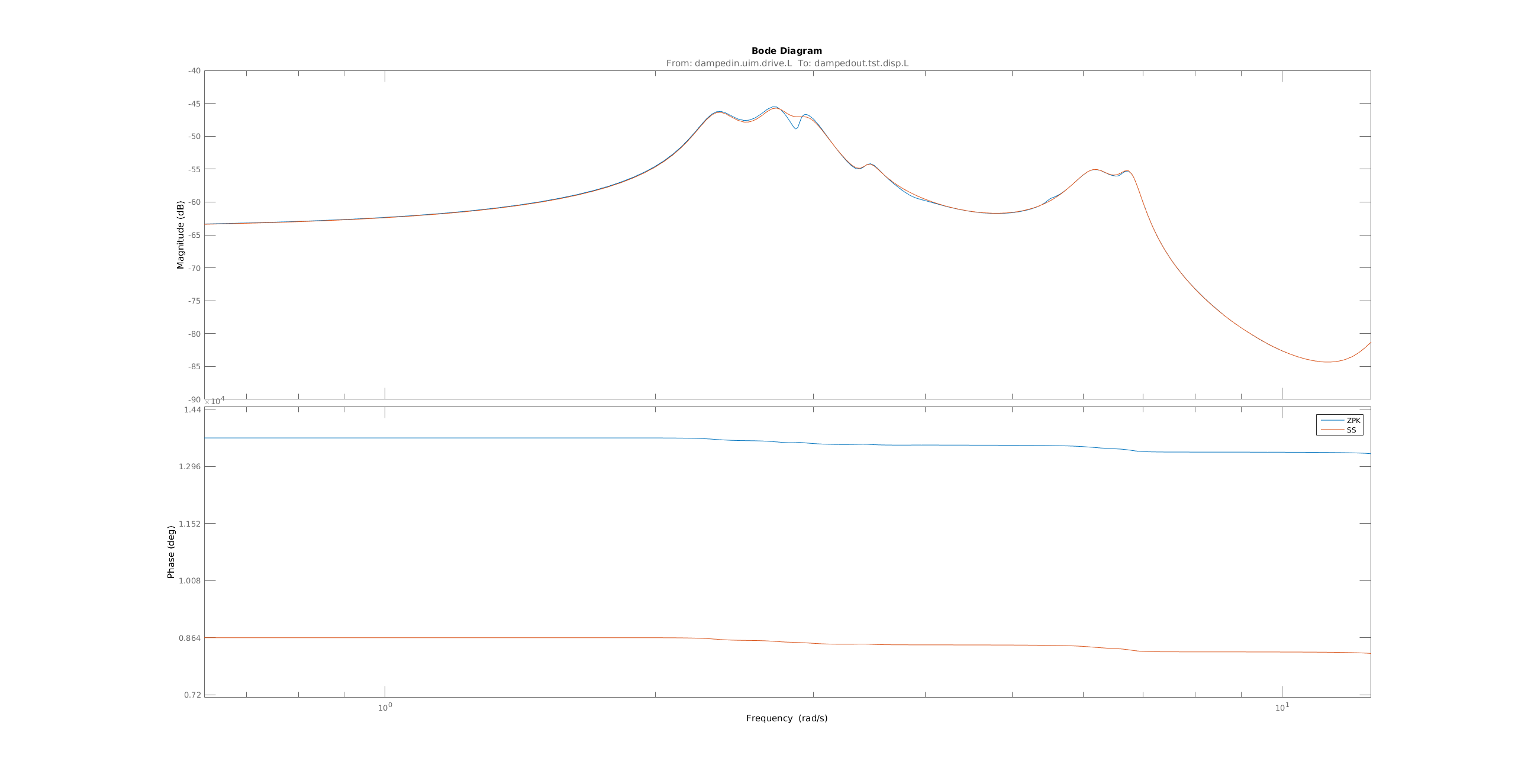
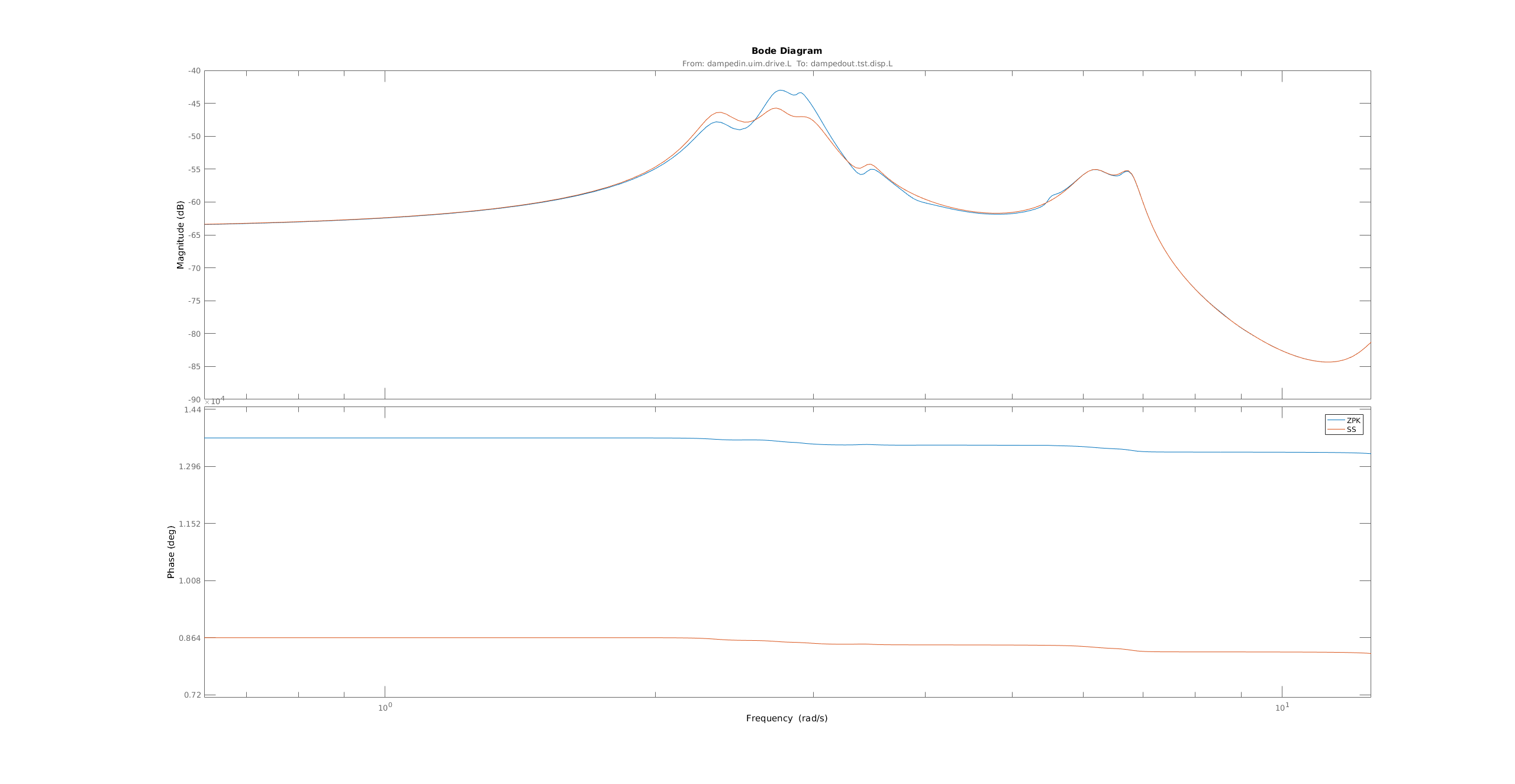
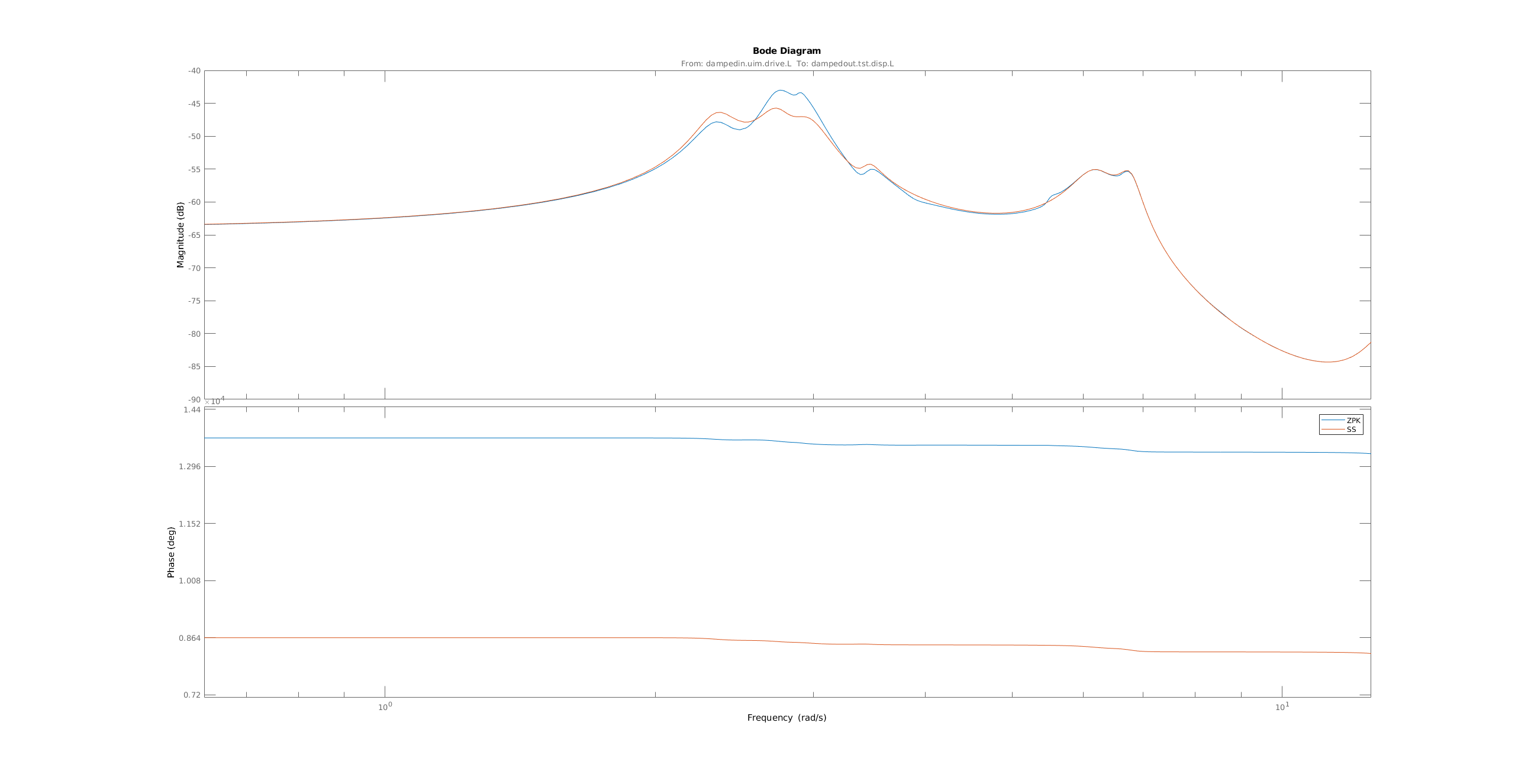
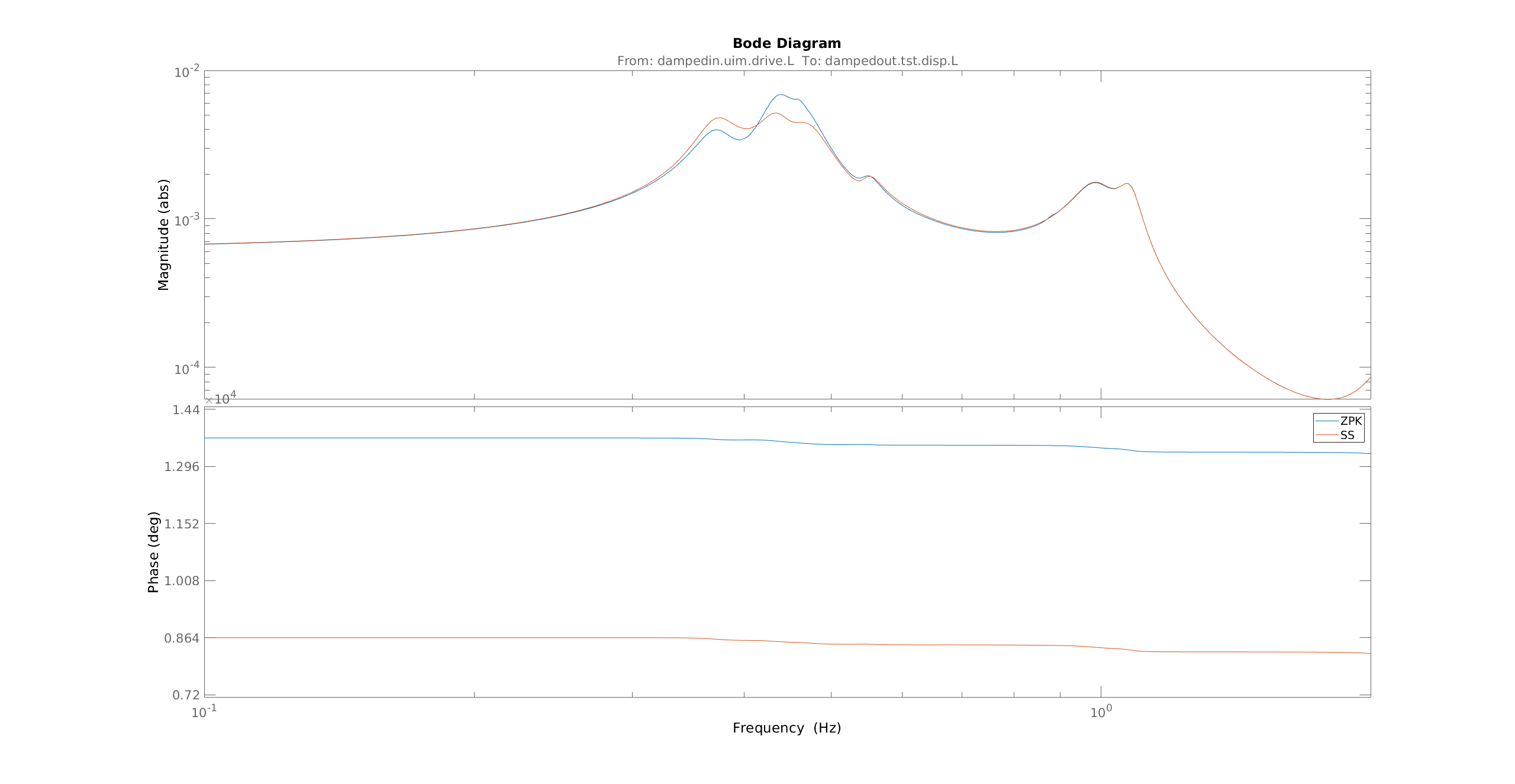
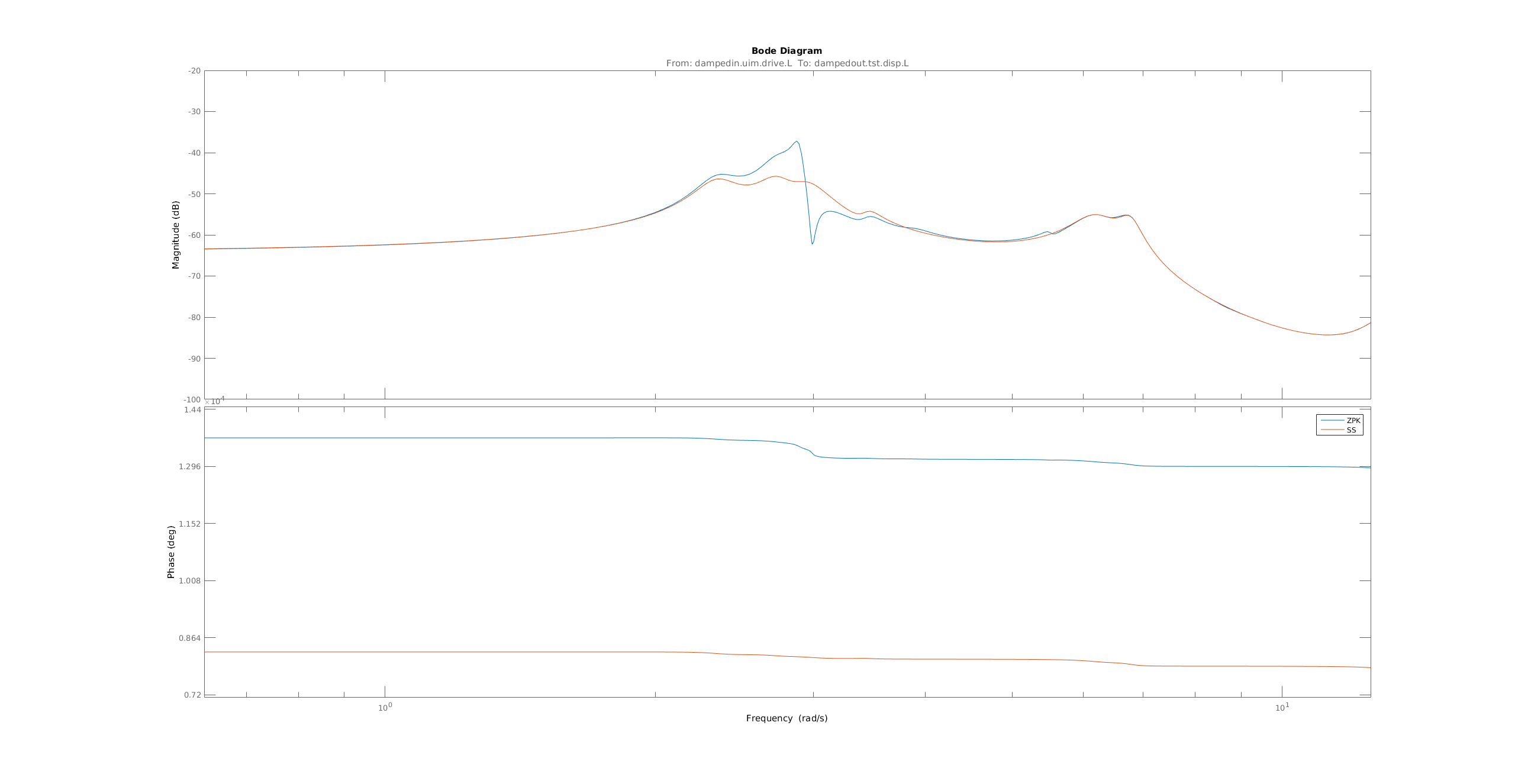
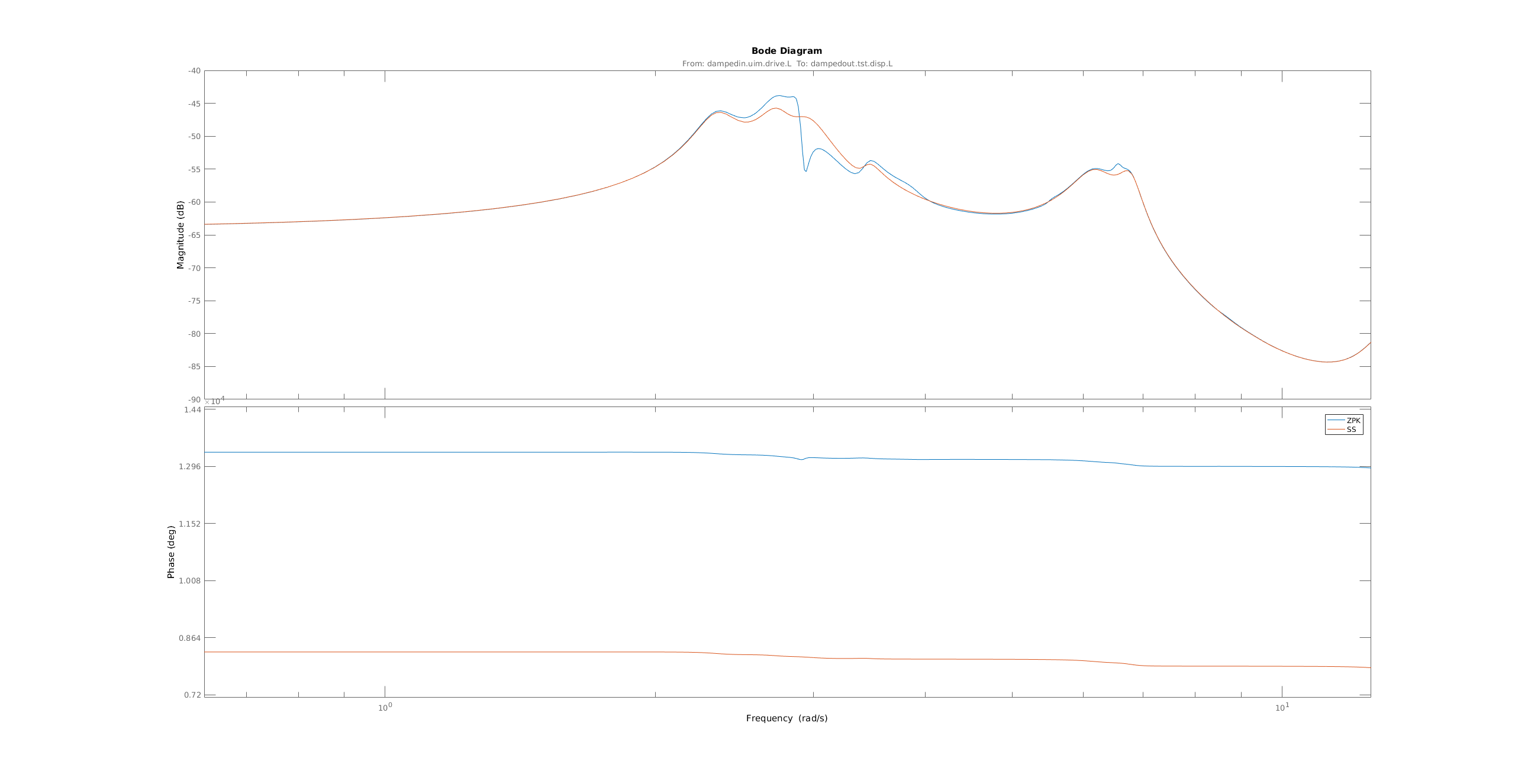
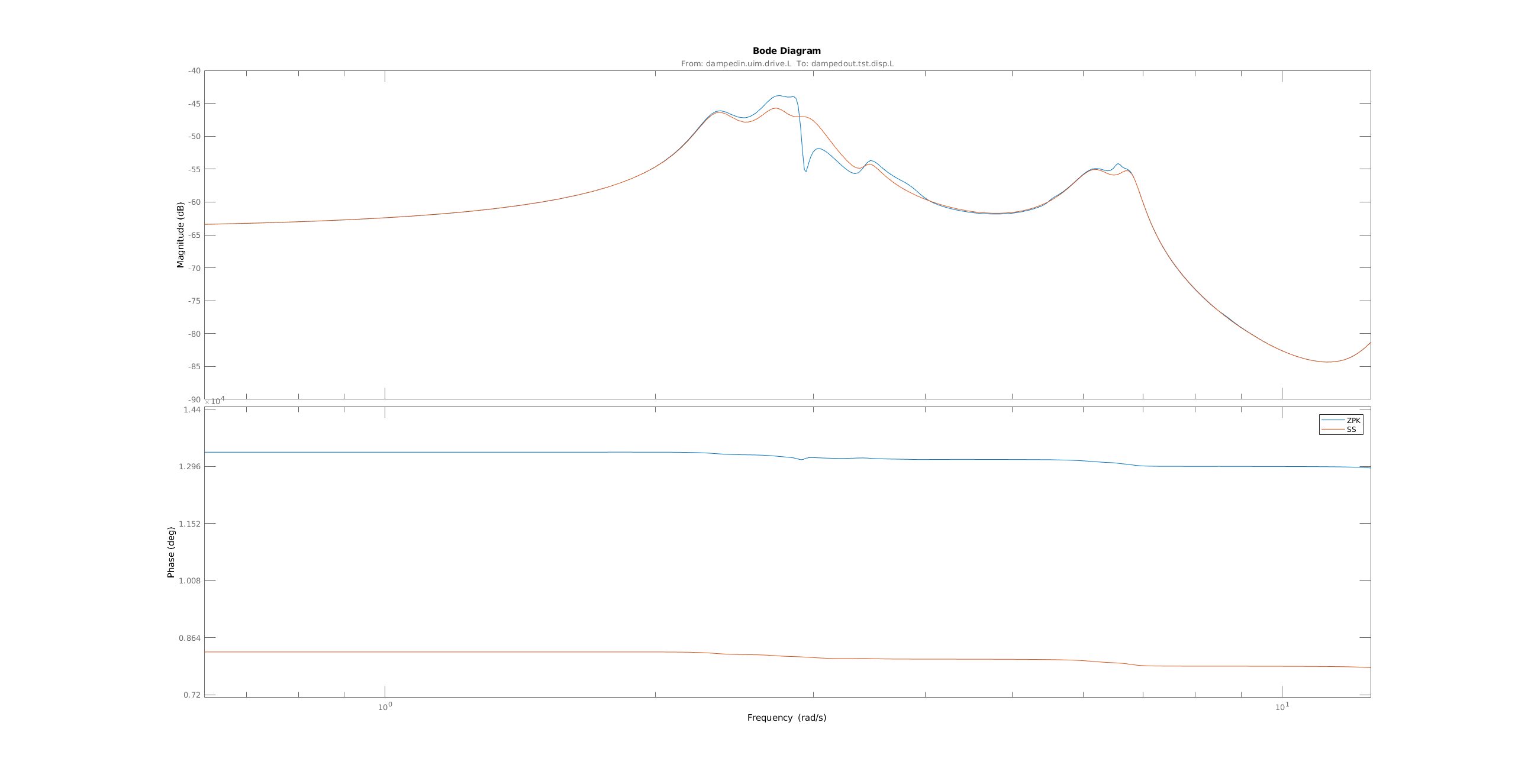
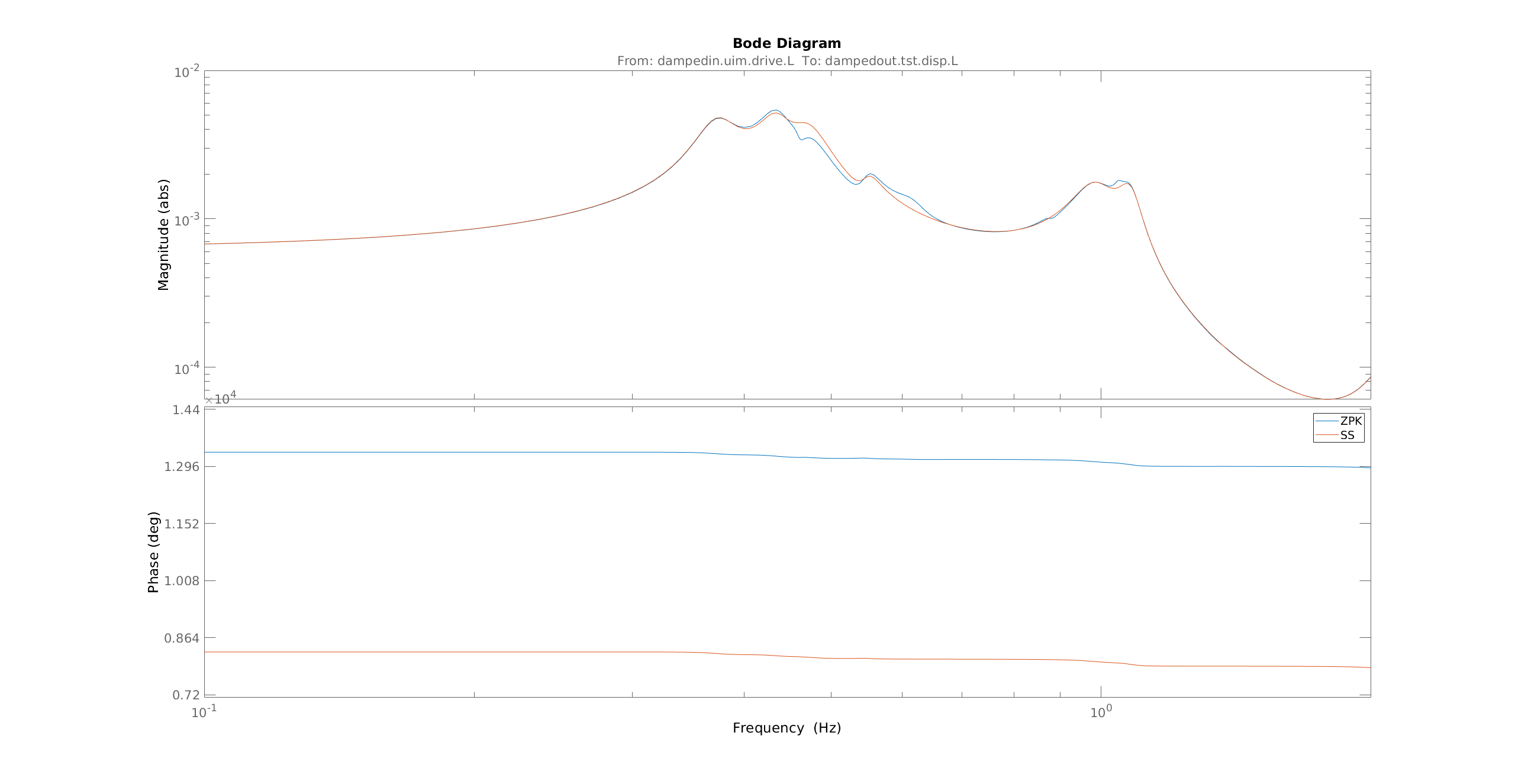
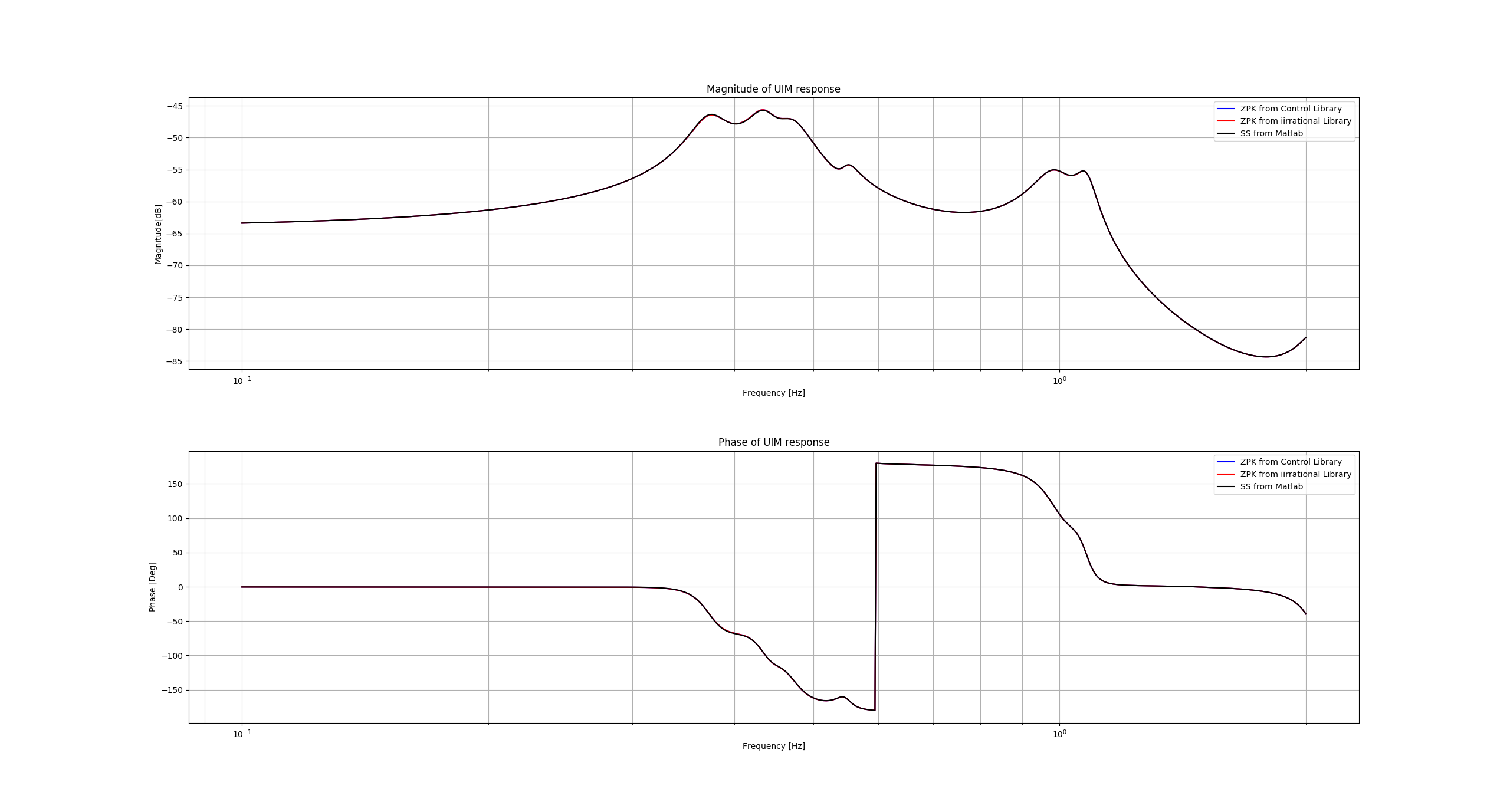
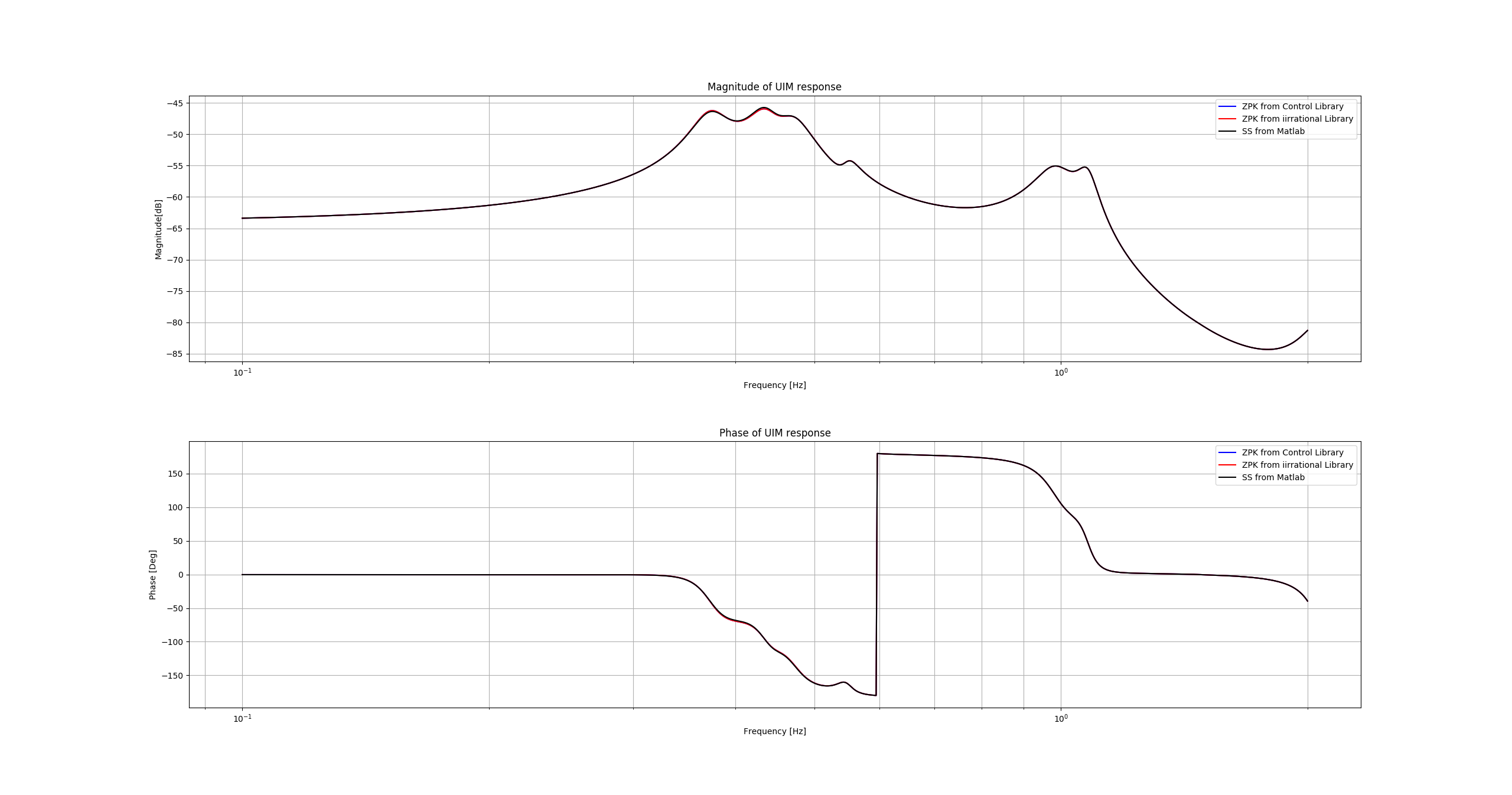
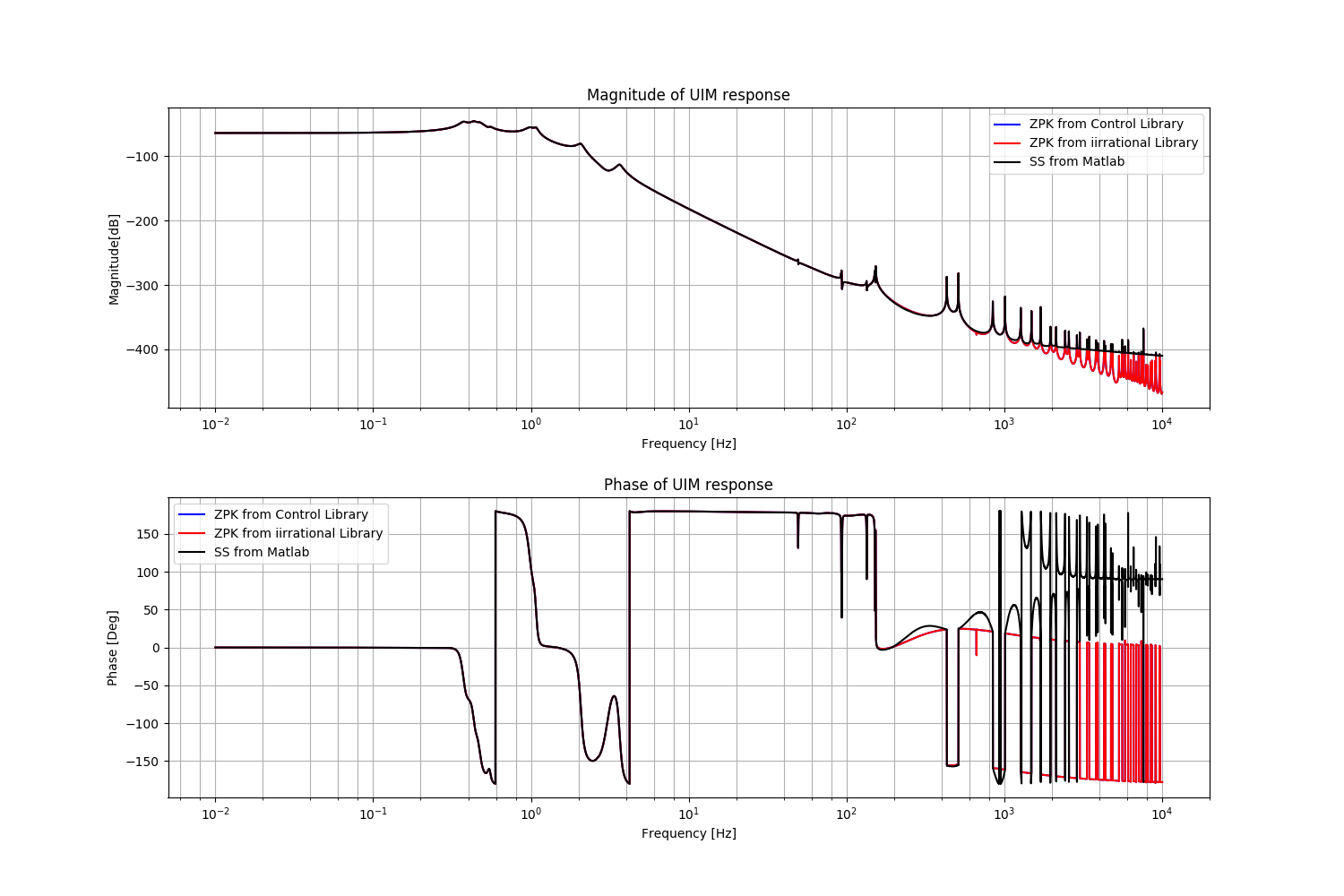
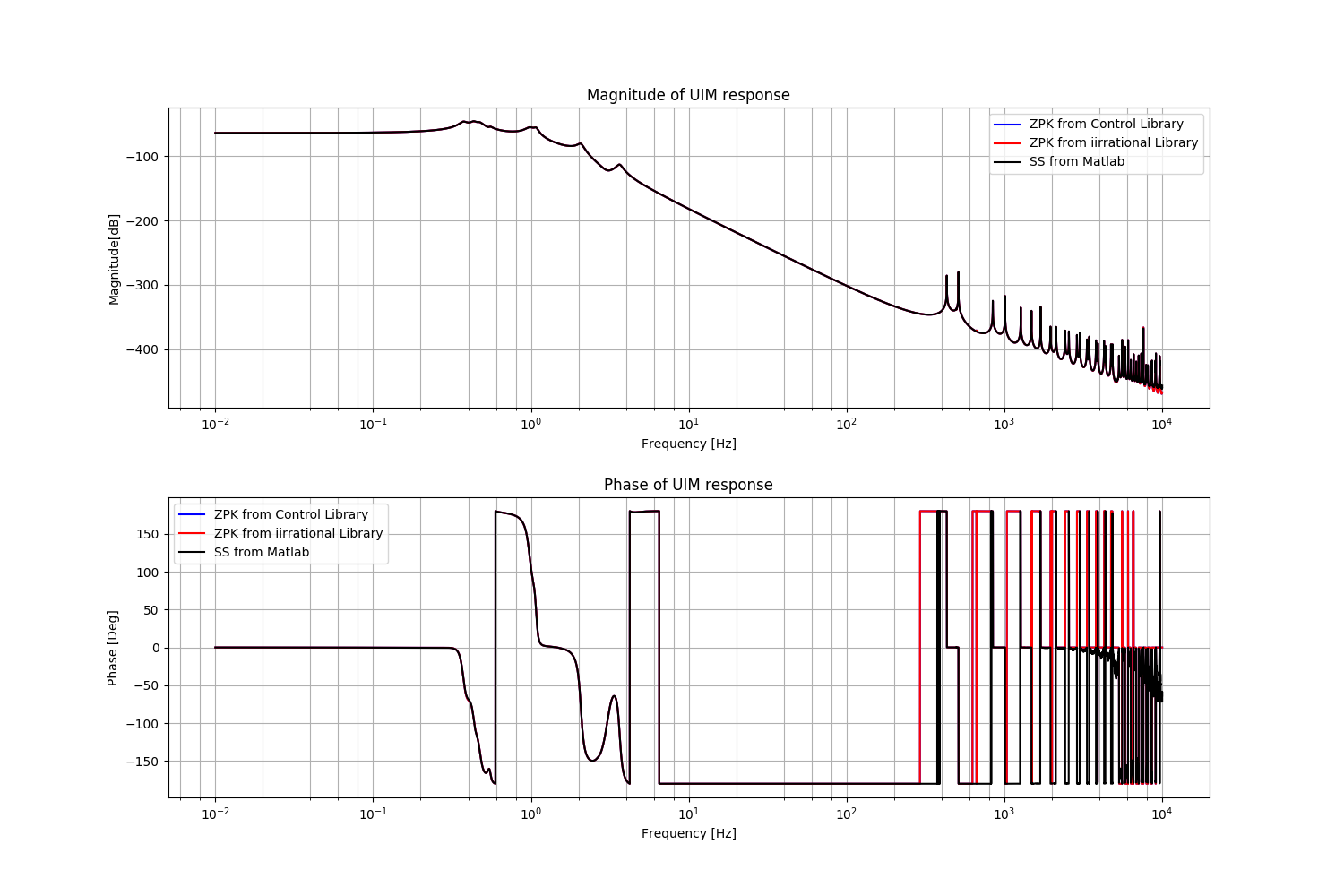
We investigated the source of this apparent blip at around 0.5Hz, and traced it down to Matlab doing funny things when converting from SS to ZPK model. In fact, we got different results for every input for each of the latest 4 Matlab versions we have available (actually 2016b and 2017b gave identically bad results).

I have made a number of plots which I hope will convince people that we should, and importantly *can*, migrate this step to python.

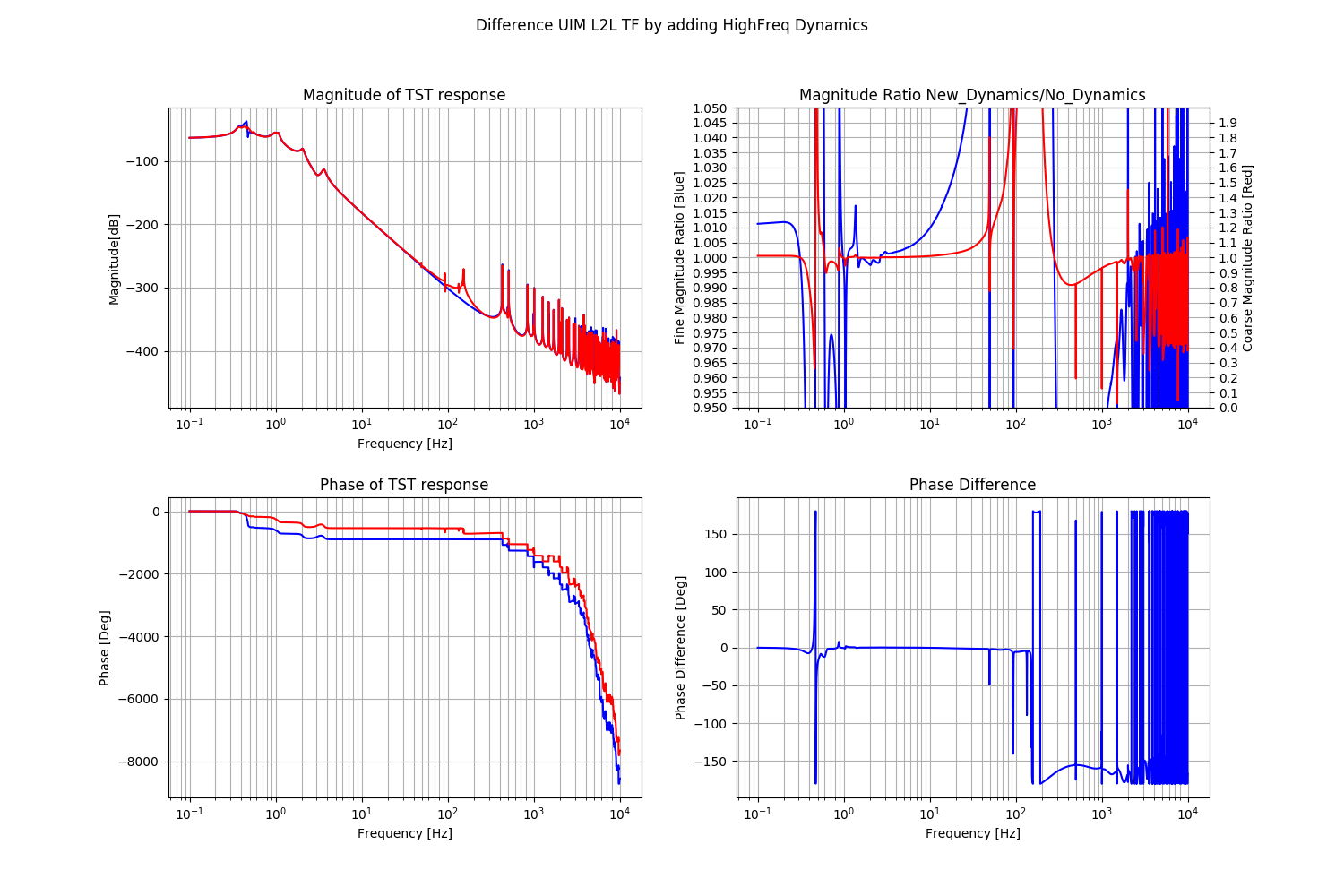
I have put up a whole lot of plots which have one consistent aspect: the SS model response never changes.  The most plots worth highlighting are  are:

Old_Model_2015b.png and New_Model_2015b.png: Here you can see that my addition of the UIM dynamics (which has no features at <45 Hz)
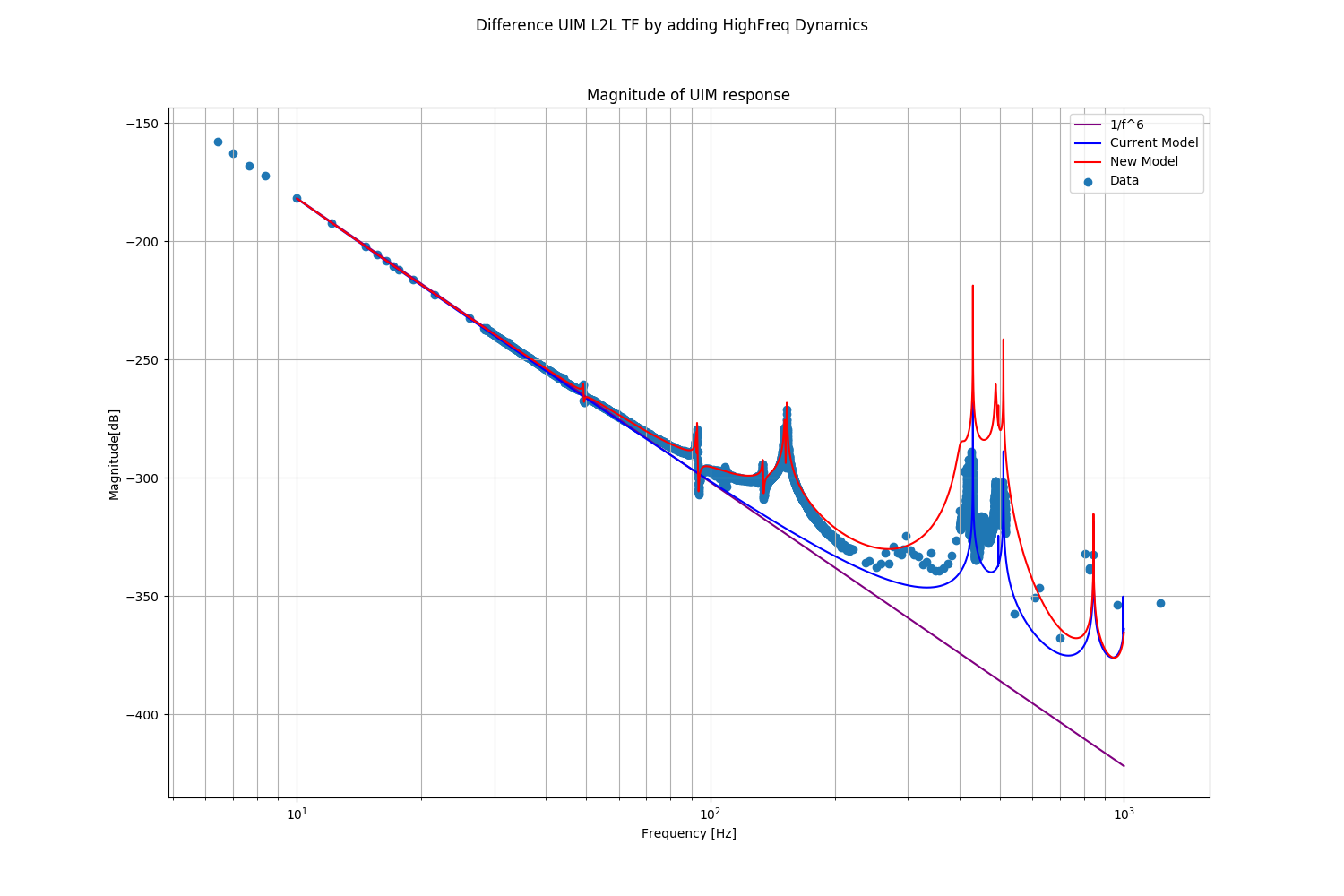
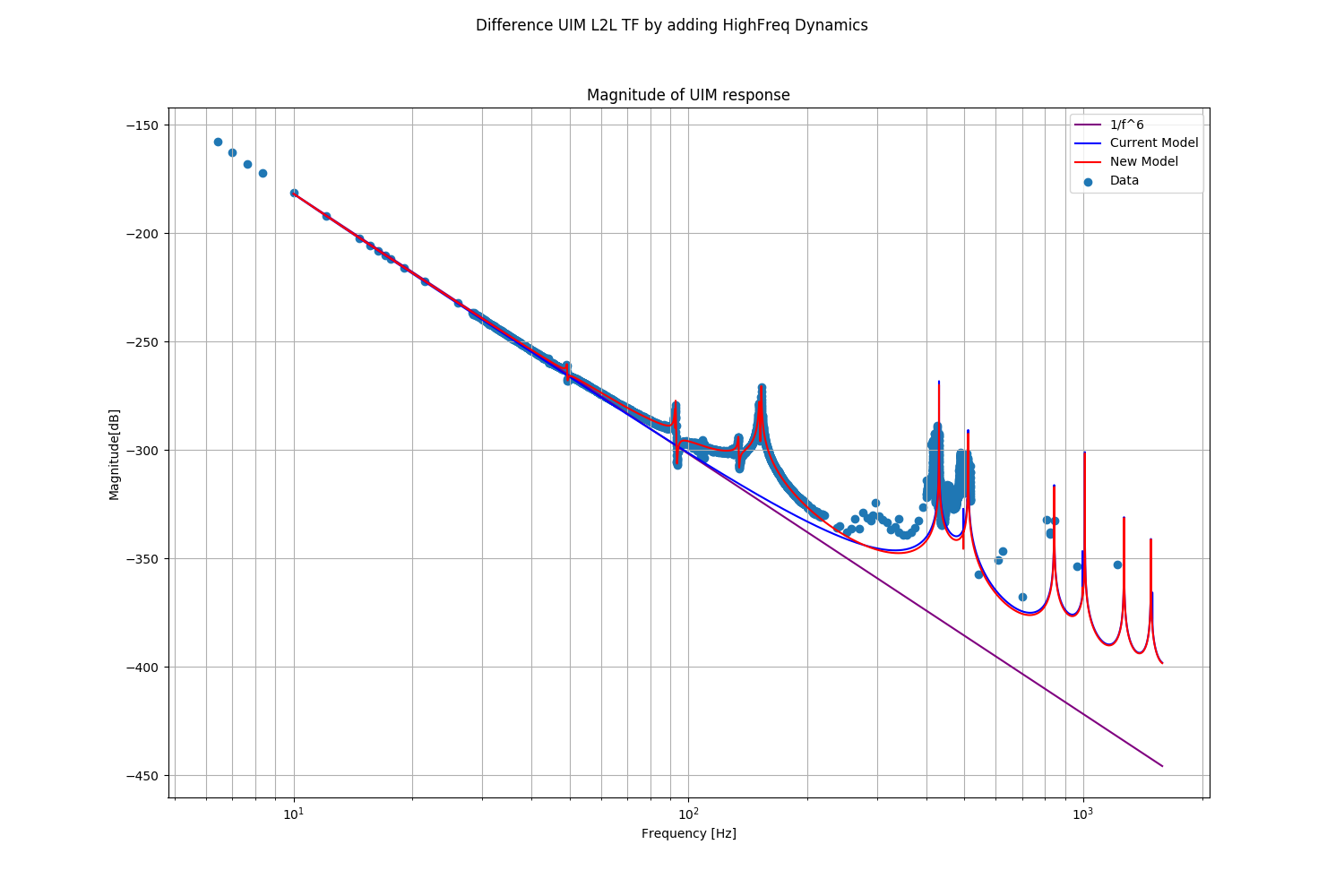
Old_Model_Python.png and New_Model_Python.png: Here you can see that when I evaluate the SS->ZPK transition in Python, I get consistent results, which are far closer to the SS model. [Blue and Red lines just about perfectly overlap]
Old_Model_Python_Full.png and New_Model_Python_Full.png: Here you can see results are consistent up to higher frequencies. The Matlab's frequency response is degrading at some step: either at the output of Matlab, or at the import of Python.
 
I recommend that SS models are extracted from Matlab and that further conversion to ZPK is done within Python for the future. Vlad is overseeing improvements to the flow of this data through to pyDARM and foton, and can implement this.
Images attached to this comment
H1 DetChar (DetChar, SQZ)
vladimir.bossilkov@LIGO.ORG - posted 17:31, Thursday 05 December 2019 - last comment - 15:05, Tuesday 17 December 2019(53718)
Apparent anti-squeezing in 500-900 Hz band

Vlad and Jenne,

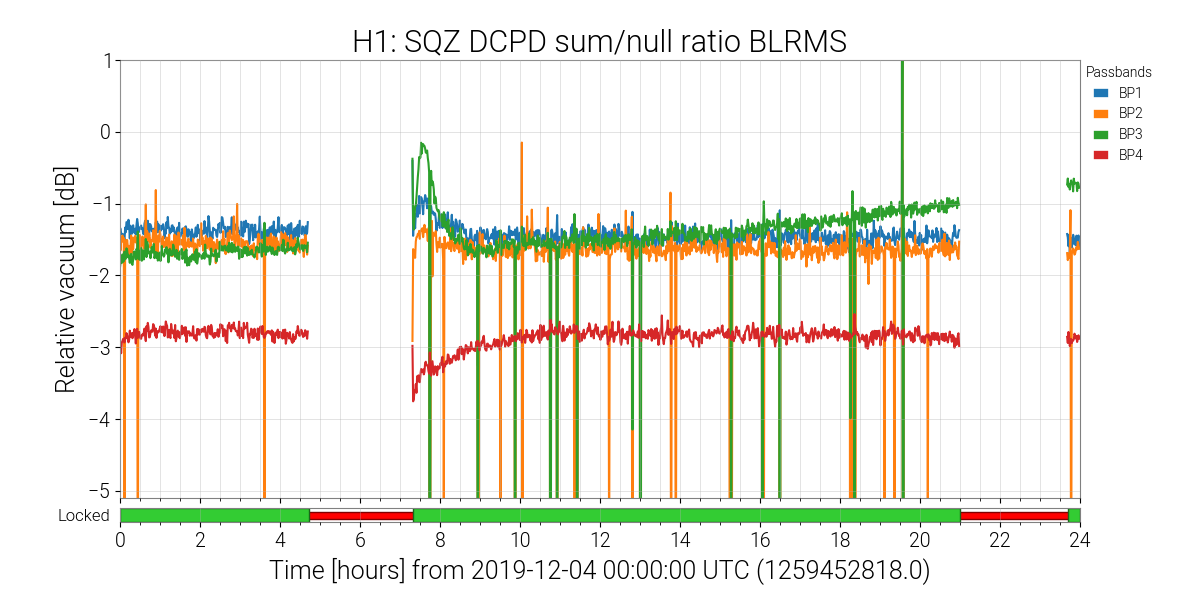
From the summary pages, as of 0200 UTC 20191204, the 3rd bandpass region of the sqeezing has beern reporting increasingly degrading squeezing starting at near -2dB, to sitting at above +2dB currently.

Jenne nagivated the the sitemap to find that this band corresponds to the region between 500-900 Hz, and suggested I run a BruCo before this happened, as well as more recently to help find an issue, to hopefully spot a noise contributor to DARM in that band.

I am currently running a BruCo - and should be able to inspect the data tomorrow.


In the attachments you can see the relevant plot of this band creeping up over the last two days. (its the green one)

Images attached to this report
Comments related to this report
vladimir.bossilkov@LIGO.ORG - 15:23, Friday 06 December 2019 (53728)

Completed Bruo:

Before: https://ldas-jobs.ligo.caltech.edu/~ldvw/bruco/vladimir.bossilkov/H1-CAL-DELTAL_EXTERNAL_DQ_2019-12-03-13.00.00-180/results/

After: https://ldas-jobs.ligo.caltech.edu/~ldvw/bruco/vladimir.bossilkov/H1-CAL-DELTAL_EXTERNAL_DQ_2019-12-03-13.00.00-180/results/


I shall guide your eyes to the frequencies 838 and 839.

Here you will see many channels correlating somewhat strongly in the After that were not present in the Before.

Importantly things like:


PEM-CS_MAG_LVEA_VERTEX_X_DQ, PEM-CS_MAG_LVEA_VERTEX_Y_DQ,PEM-CS_MAG_LVEA_VERTEX_QUAD_SUM_DQ

suggest something new in the magnetic spectrum


PEM-CS_RADIO_ROOF4_BROADBAND_DQ, PEM-CS_RADIO_ROOF3_BROADBAND_DQ

also suggest something electronic - visible on the LVEA roof? need to be sure whether it is internal or external


LSC-MOD_RF9_AM_ERR_OUT_DQ, LSC-MOD_RF45_AM_ERR_OUT_DQ

suggests that this is affecting the sideband generation before it is applied to the EOM in the PSL

LSC-MOD_RF45_AM_CTRL_OUT_DQ, LSC-MOD_RF9_AM_AC_OUT_DQ

suggests that the cavity control sidebands are affected


Many channels like :PEM-CS_ADC_5_30_2K_OUT_DQ

Visible in many electronics monitors


ASC-AS_B_RF72_Q_SUM_OUT_DQ, ASC-AS_A_RF72_Q_SUM_OUT_DQ, ASC-AS_B_RF72_I_SUM_OUT_DQ, ASC-AS_A_RF45_I_SUM_OUT_DQ, ASC-REFL_A_RF45_Q_YAW_OUT_DQ, ASC-AS_B_RF36_I_PIT_OUT_DQ, ASC-AS_B_RF36_Q_YAW_OUT_DQ, 

That the noise propagates through to the various wavefront sensors


I am currently trying to use Lasso to see how one of the more interesting channels has evolved in that band:H1:PEM-CS_RADIO_ROOF4_BROADBAND_DQ

vladimir.bossilkov@LIGO.ORG - 15:05, Tuesday 17 December 2019 (53948)

As of 0300 UTC 20191213, This noise has stopped and Sqeezing seems to be reported fine.

Displaying reports 36841-36860 of 89199.Go to page Start 1839 1840 1841 1842 1843 1844 1845 1846 1847 End