In an effort to minimize noise sources we have installed a remote controlled power switch on the PEM amplifiers at the End station. They are controlled via a telnet session over ethernet. The script for the Tuesday injections should turn these on automatically. eyrpc and exrpc.
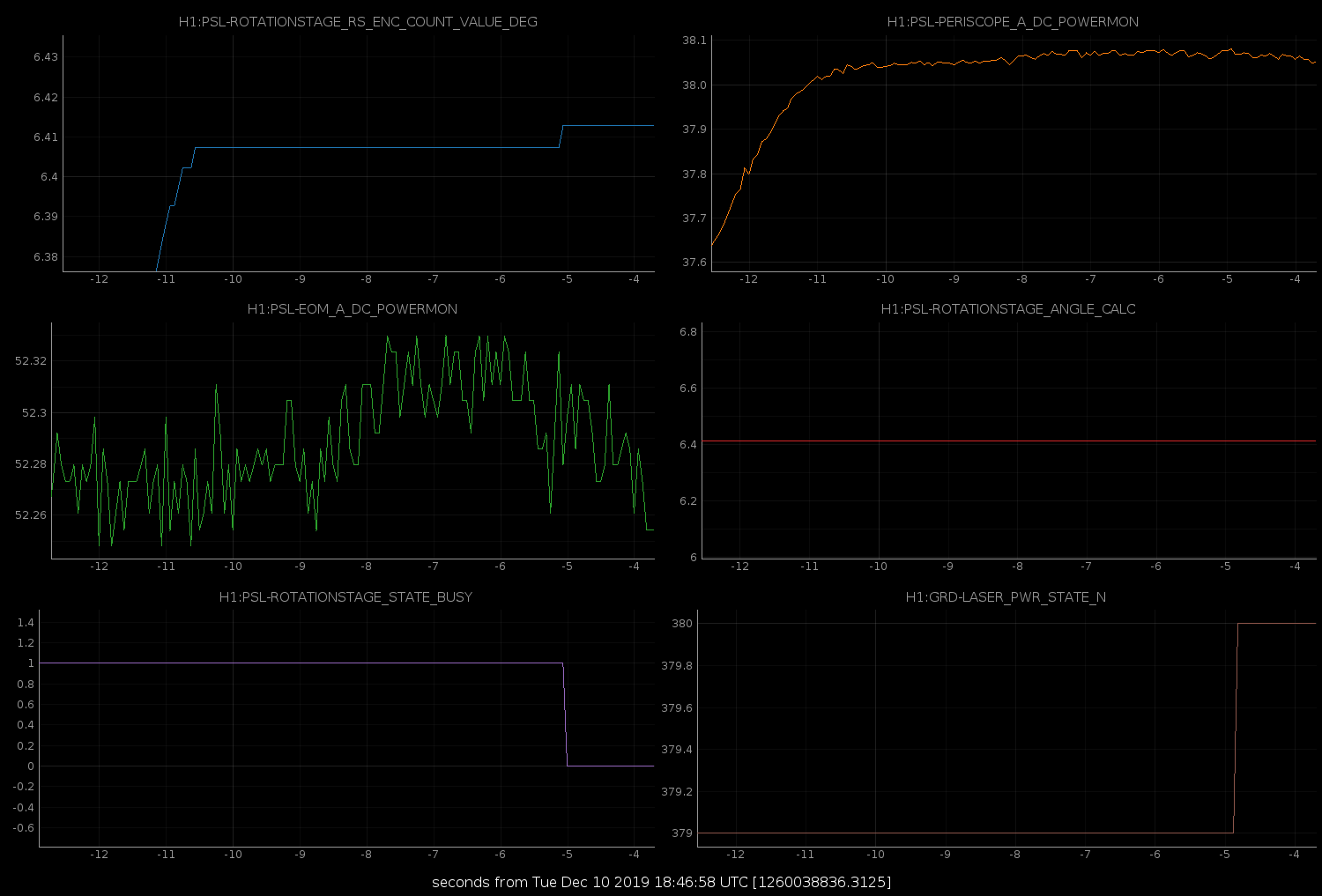
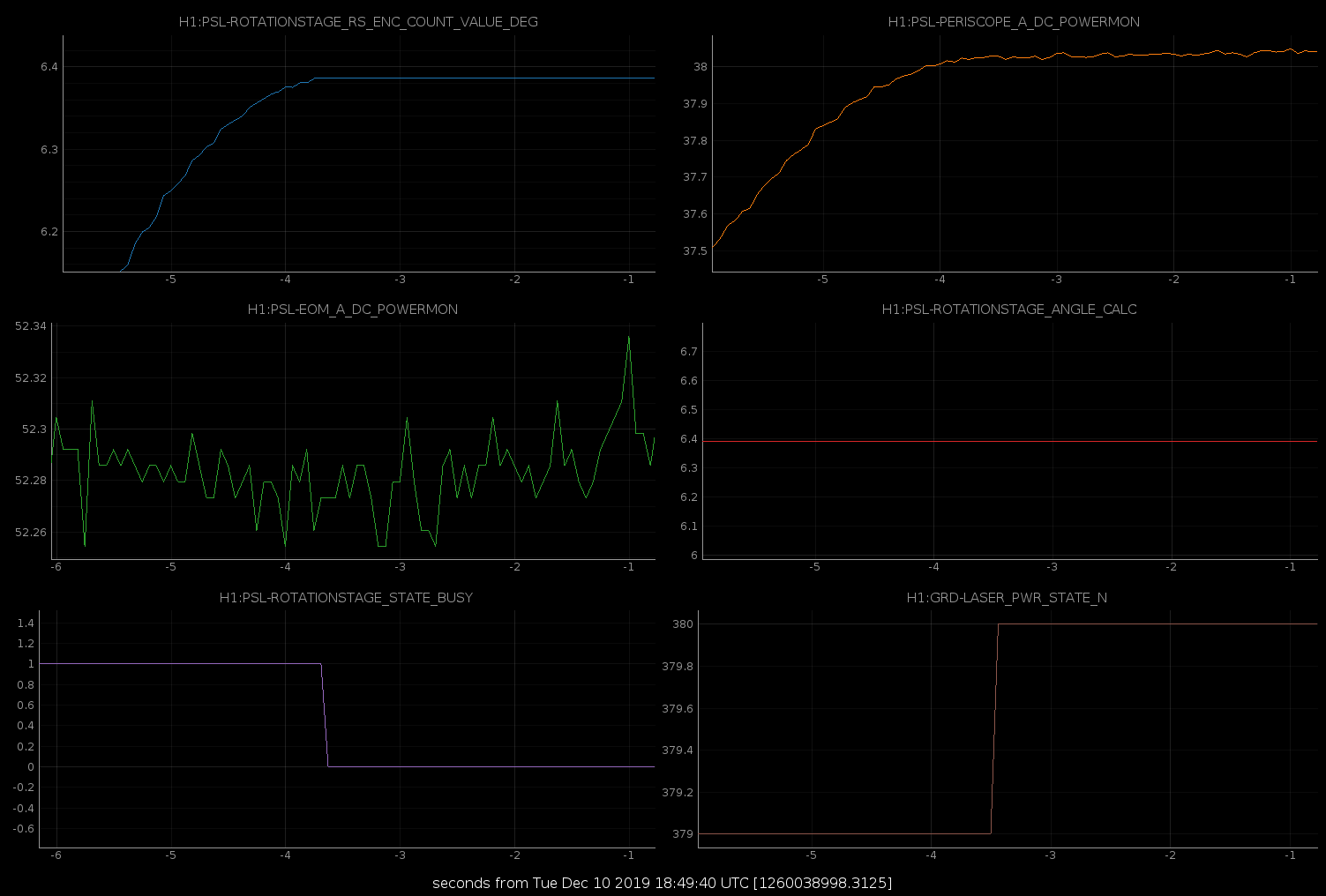
I have turned off the fine adjust (H1:PSL-ROTATIONSTAGE_FINEADJUST) for the PSL rotation stage because it was causing a sudden change of power at the end of power changes. This was worse at high powers, and would change the power almost immediately by almost a watt (see alog53068). Wih this off, I turned the bootstrapping turned back on.
Searching for home the other week seemed to help slightly with reducing the size of this rot. stage "snap", and I'm sure getting a new calibration would also help, but the sudden change in the rot. stage is not desired. The fine adjust angle set in H1:PSL-ROTATIONSTAGE_ANGLE_ADJUST, doesn't seem to be accurate either. This is set to 0.005 deg, but looking at Sheila's alog linked above, it would move by ~0.8 deg. I added into the LASER_PWR node a call to make sure that this feature is off.
I also testing a timer to see if waiting a second longer between the initial call and the bootstrapping call would help anything. It didn't help with this rot. stage "snapping" at all when the fine adjust was on, and with the fine adjust off it didn't make a difference. So I left out a timer between the calls.
Attachment 1 - Fine adjust on. Small step in the encoder value seen at the end of the bootstrapping. This is a small step compared to Sheila's alog, but it still shows the sudden movement.
Attachment 2 - Fine Adjust off. No step seen at the end of the bootstrapping.
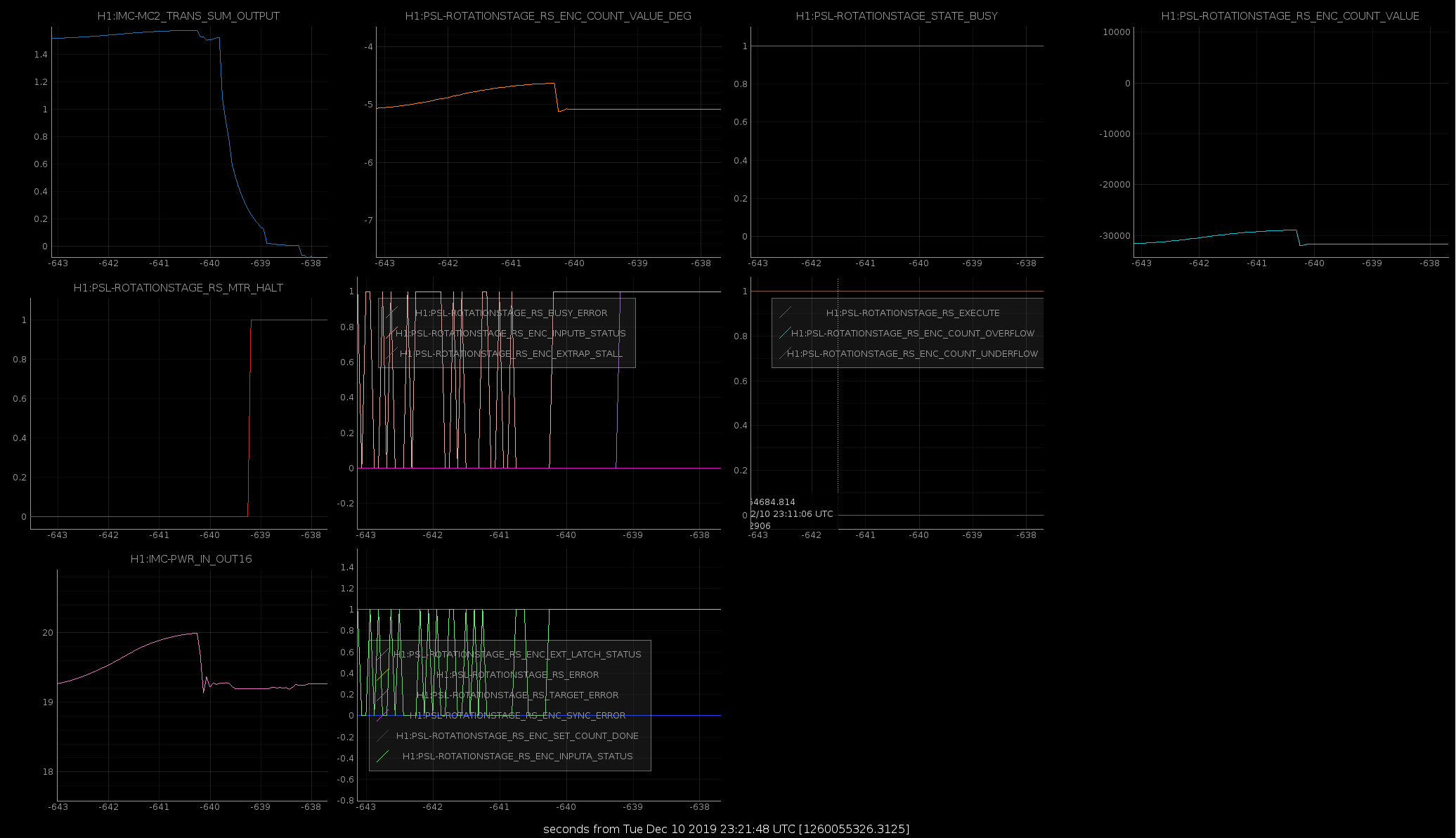
The Beckhoff Fiber Bus coupler at EY failed causing us to lose our readbacks from the timing system. The faulty unit has been replaced and the PLC restarted. 1501-0010 single mode.
I reset both power watchdogs at 17:43 UTC (9:43 PST). This completes FAMIS 10740.
Check of the HEPI pump fluid levels:
End-Y - Level is 8 14/16, which is a change of -1/16. Note this is 1/16 above trip level.
End-X - Level is 7 14/16, which is No change.
CS - Level is 6 5/16, which is a change of +1/16.
No new leaks noted on any the 6 pump skids.
Closing FAMIS #13492
Lowered the trip level about 3/16" giving us a bit of head room to prevent unwarranted trips.
[JeffK, Jenne]
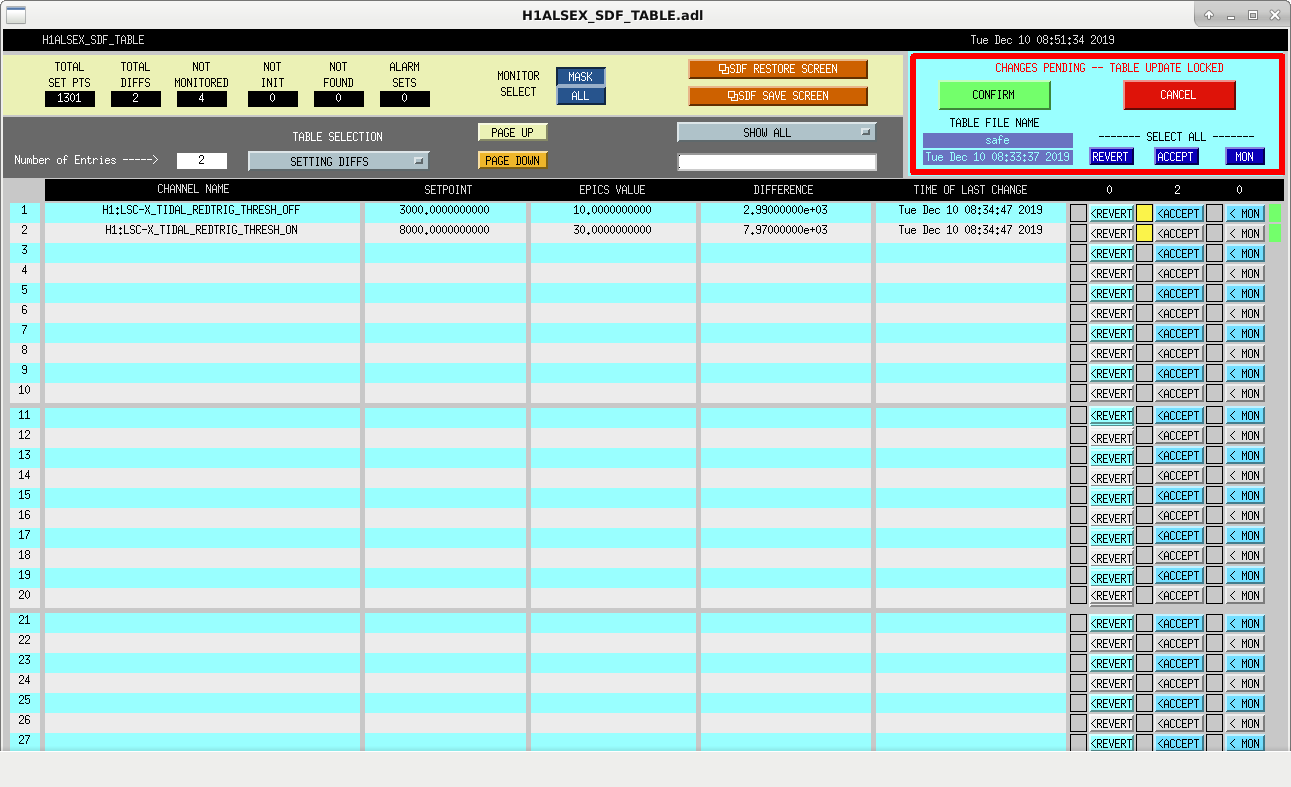
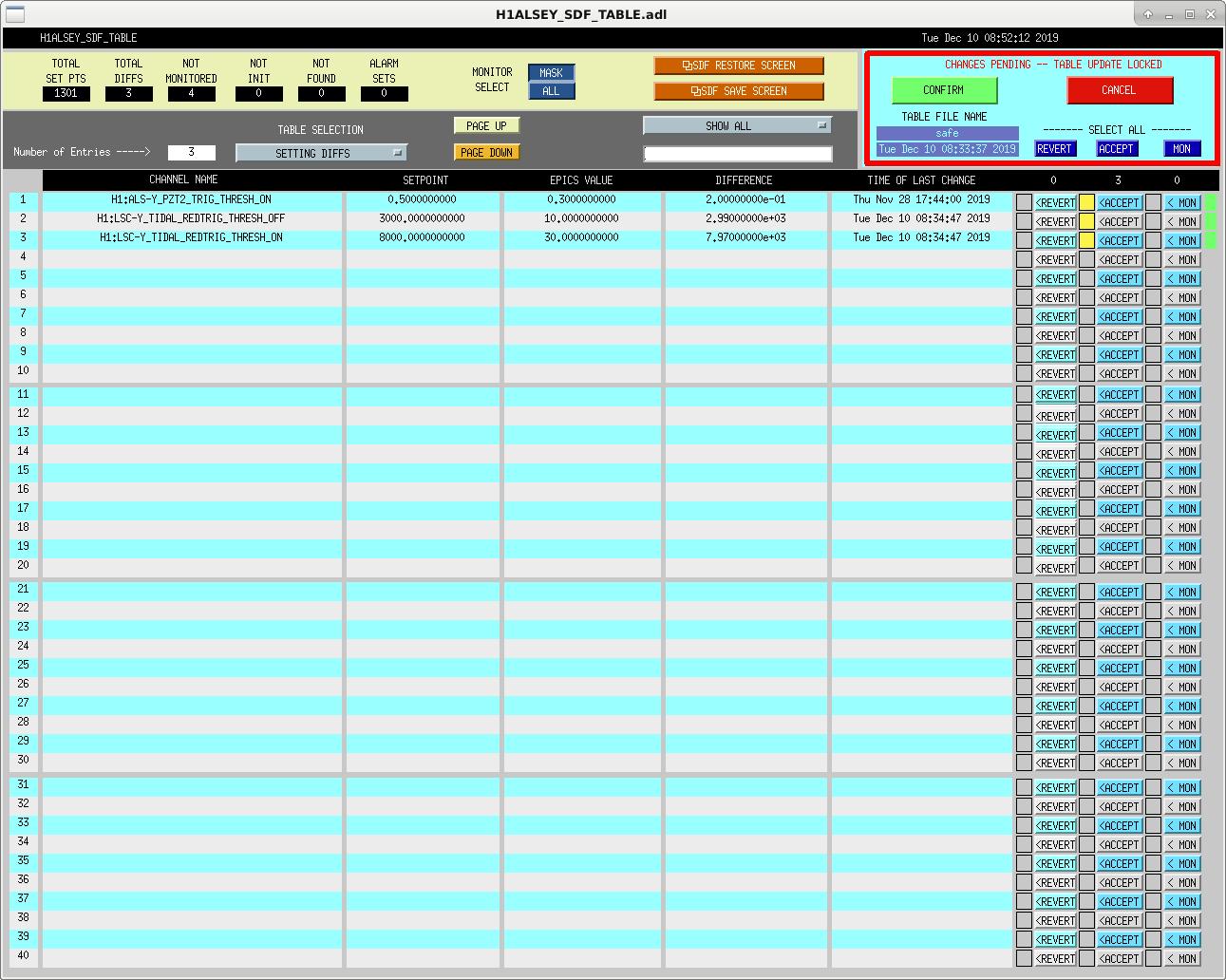
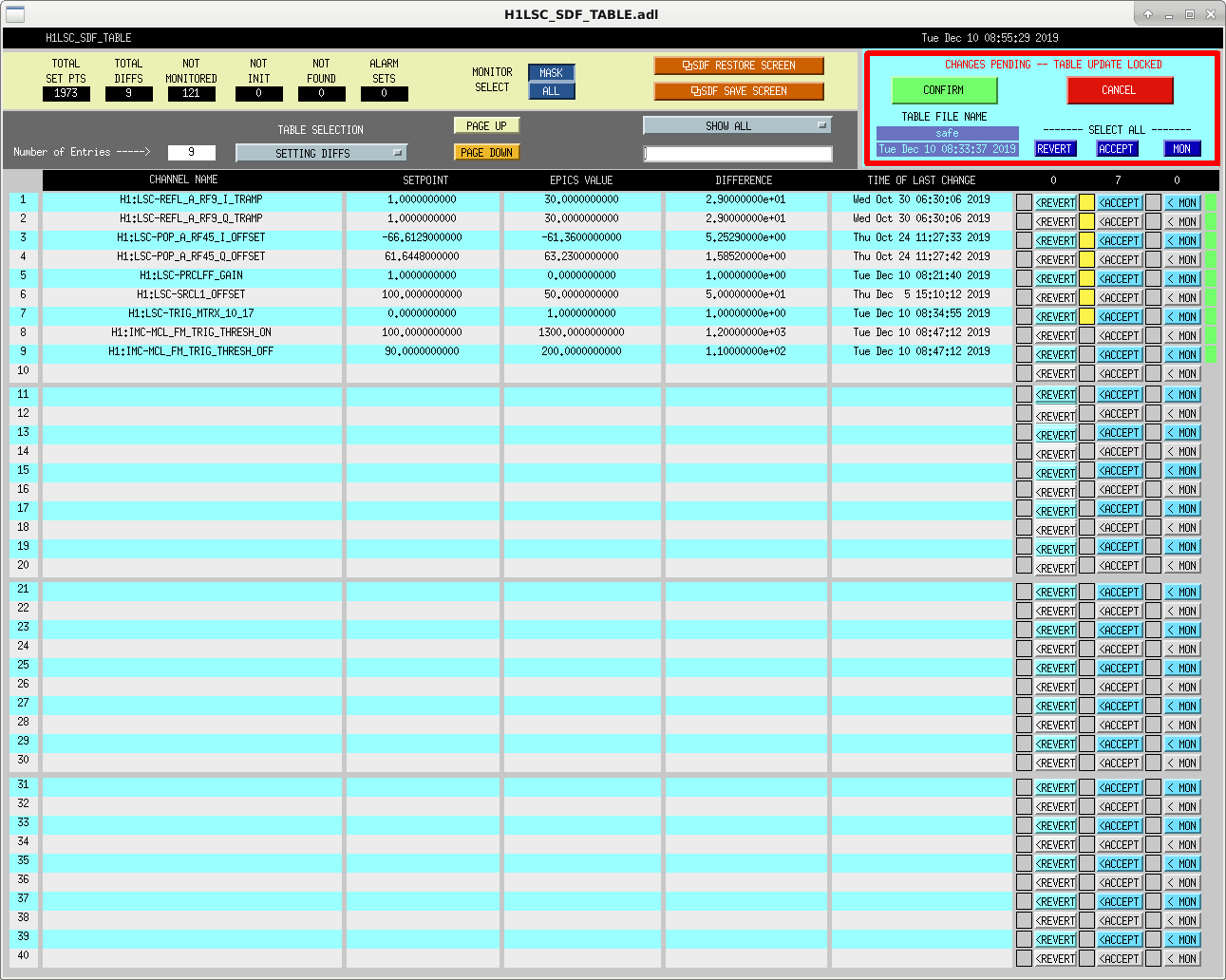
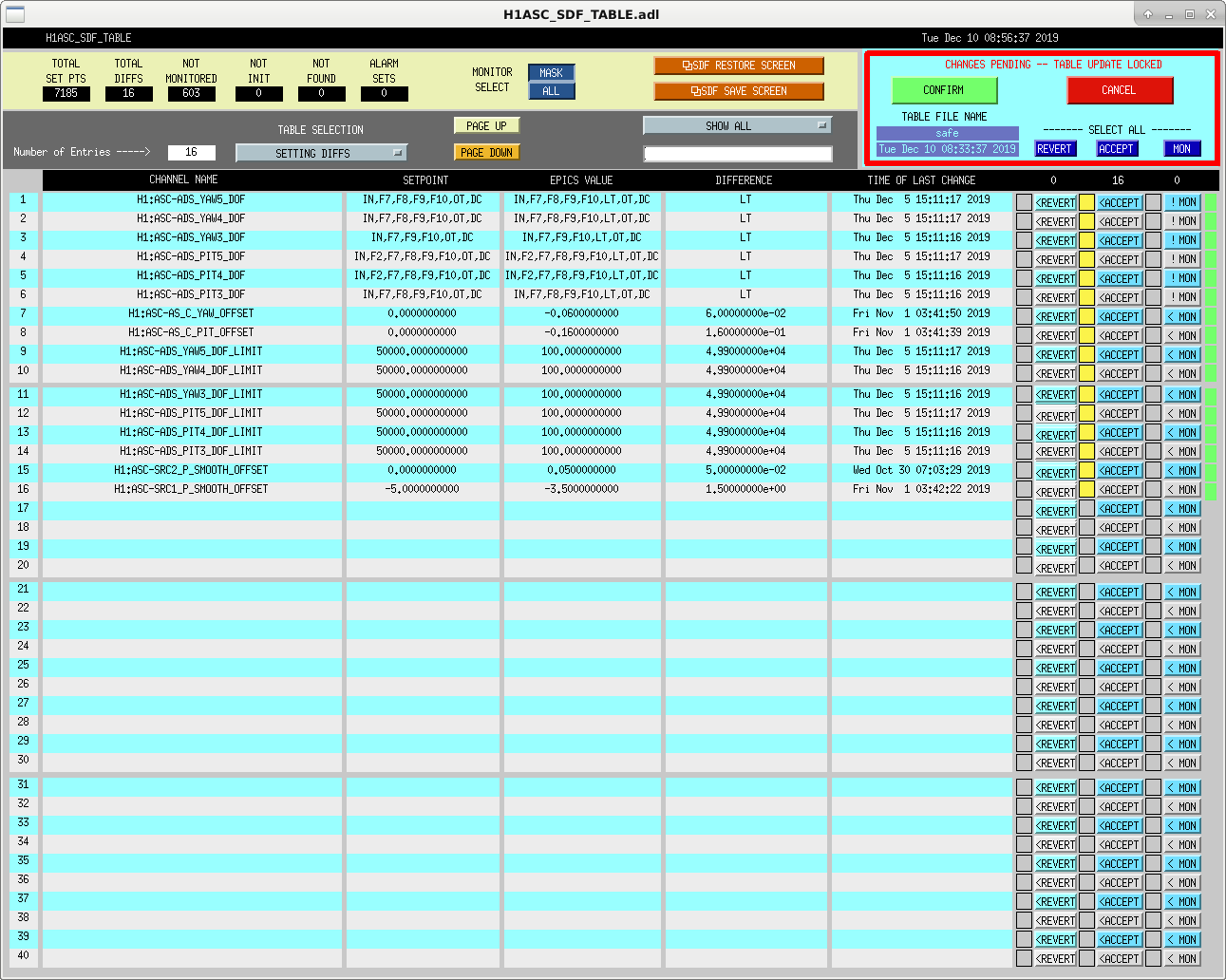
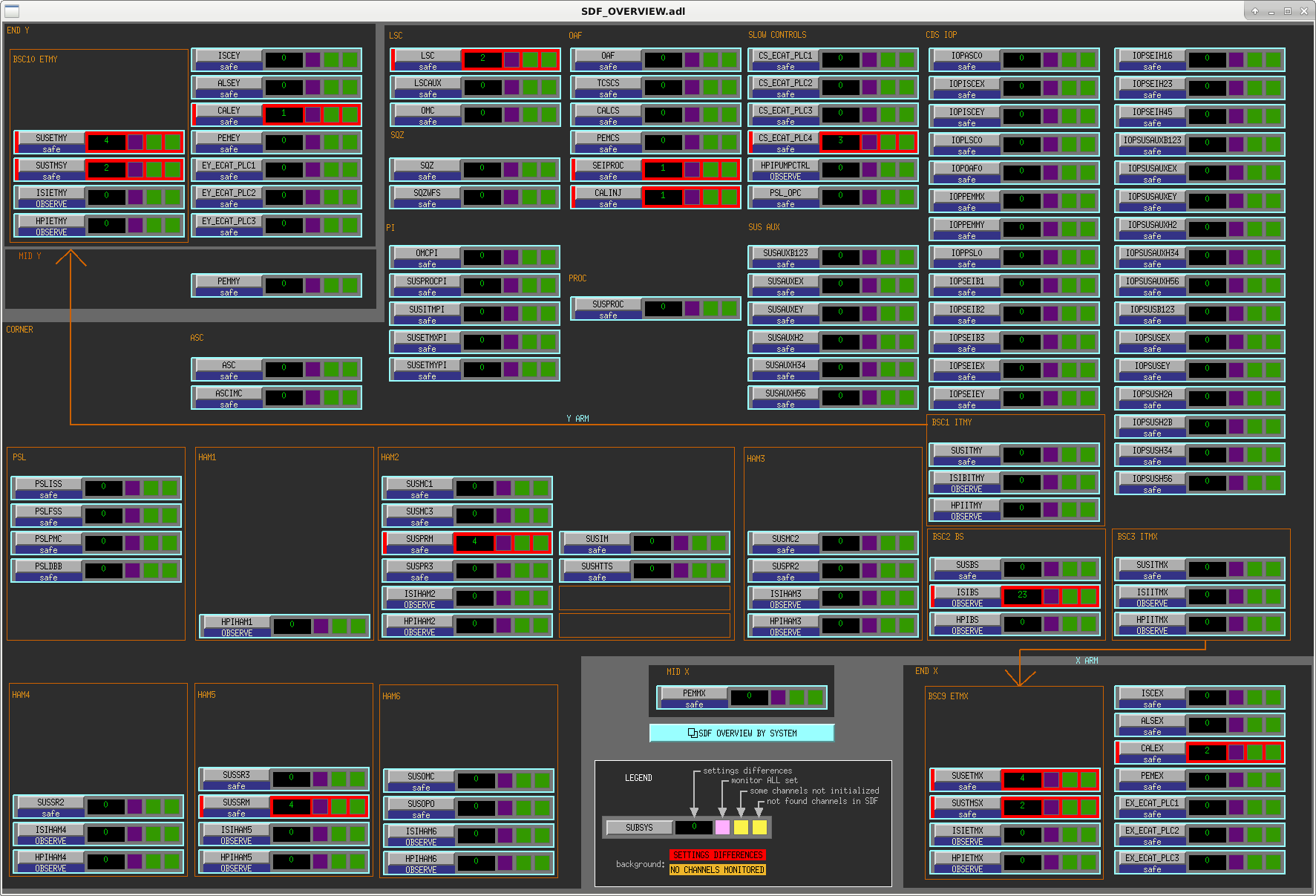
We went through and checked on the SDF diffs right after lockloss from NomLowNoise. There had been a few accumulated over the last few weeks from commissioning.
All three dust monitor vacuum pumps are running within spec. Made a couple of minor tweaks to the air bypass to adjust the vacuum pressure. All operating temps are normal. There is no apparent buildup of carbon dust on the muffler.
Closing FAMIS #13002
I restarted the primary and redundant calibration pipelines at GPS time 1260032637. The purpose of this restart was to bring down the latency, which had climbed to ~8 s. I'm hoping this will delay further increases in latency, so that we don't have to do any restarts outside of maintenance.
Y2-8 and X2-8 location ion gauges are off due to lack of juice in solar powered batteries. This is a known issue during our gray winters.
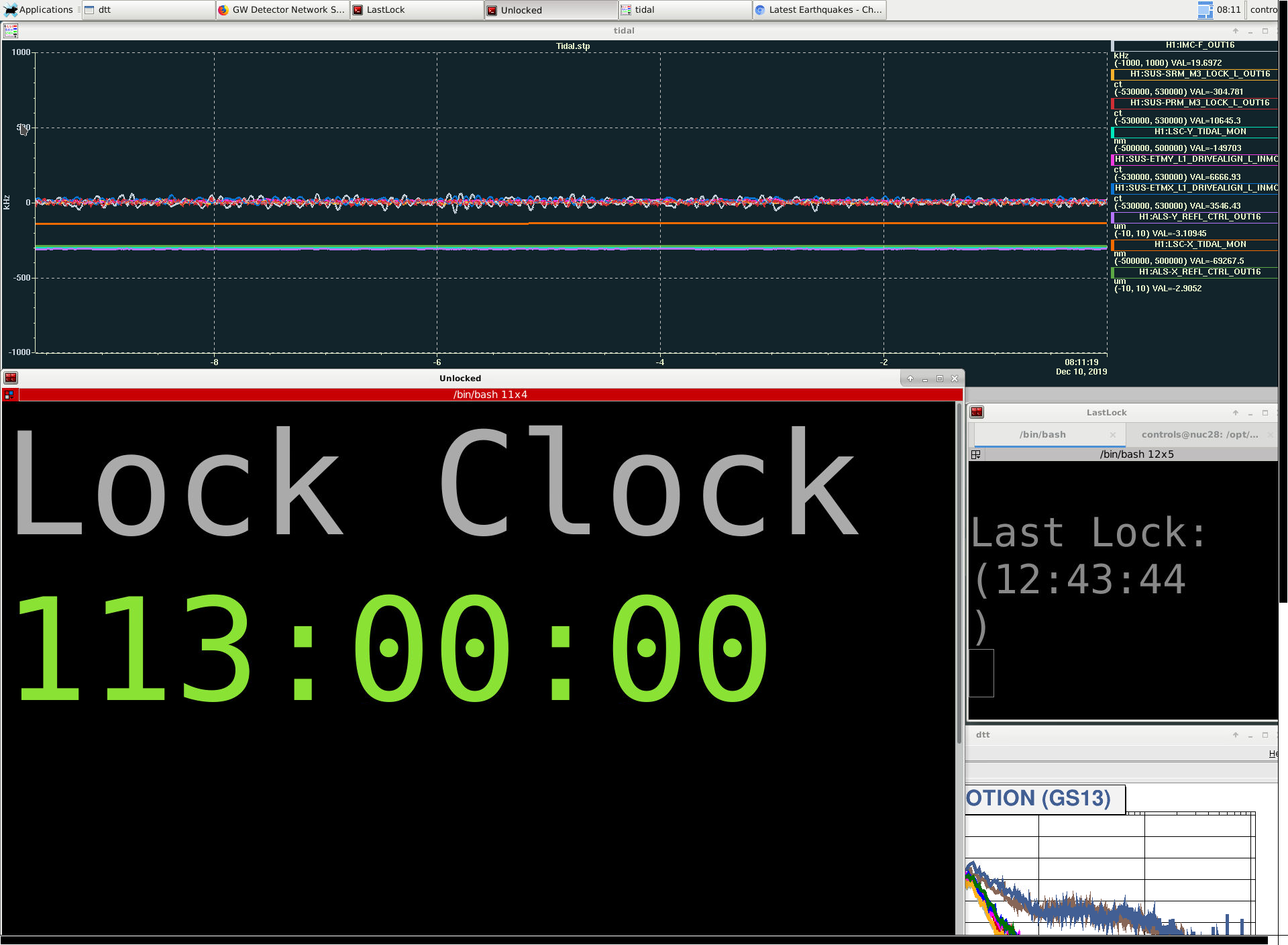
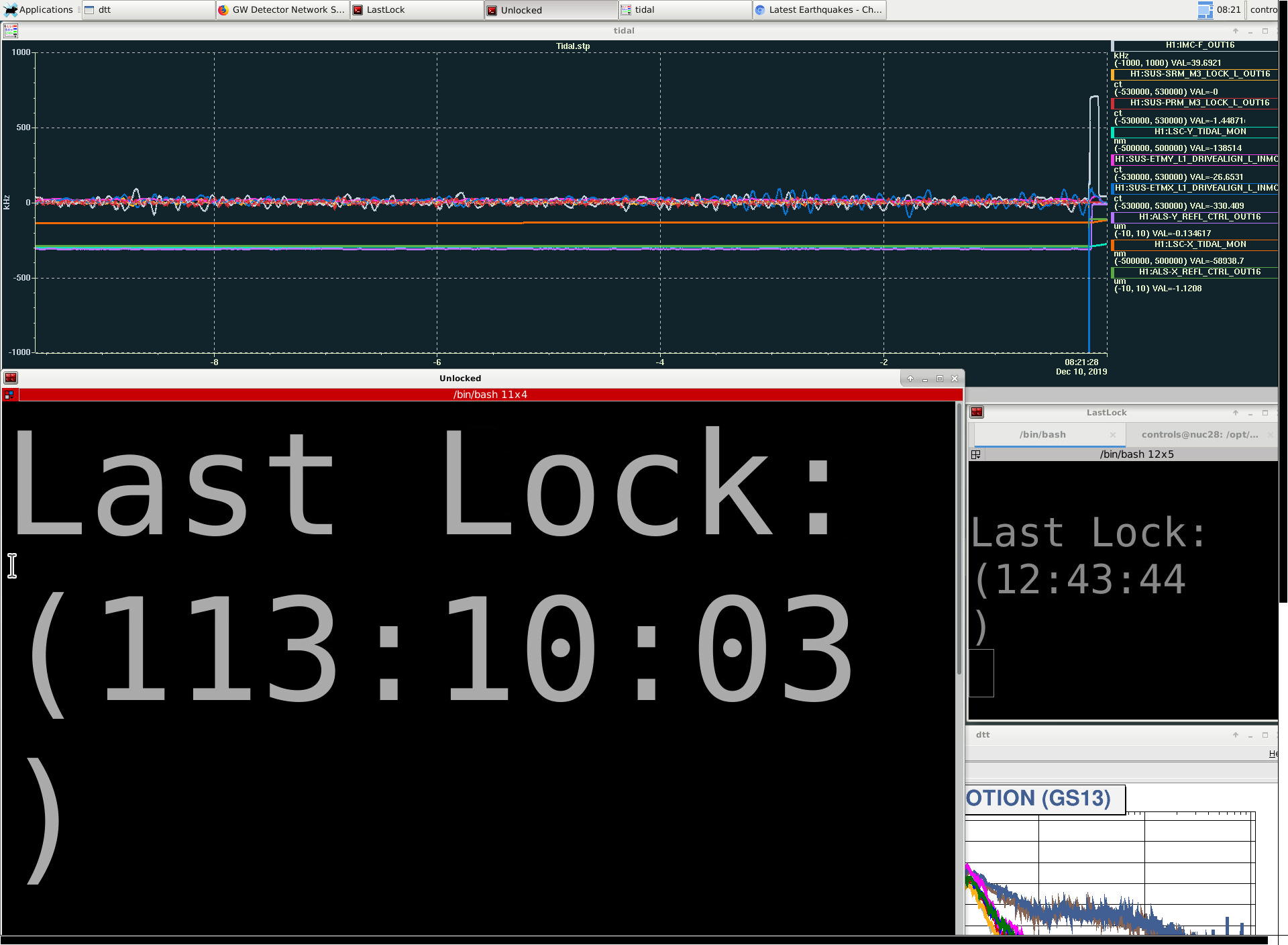
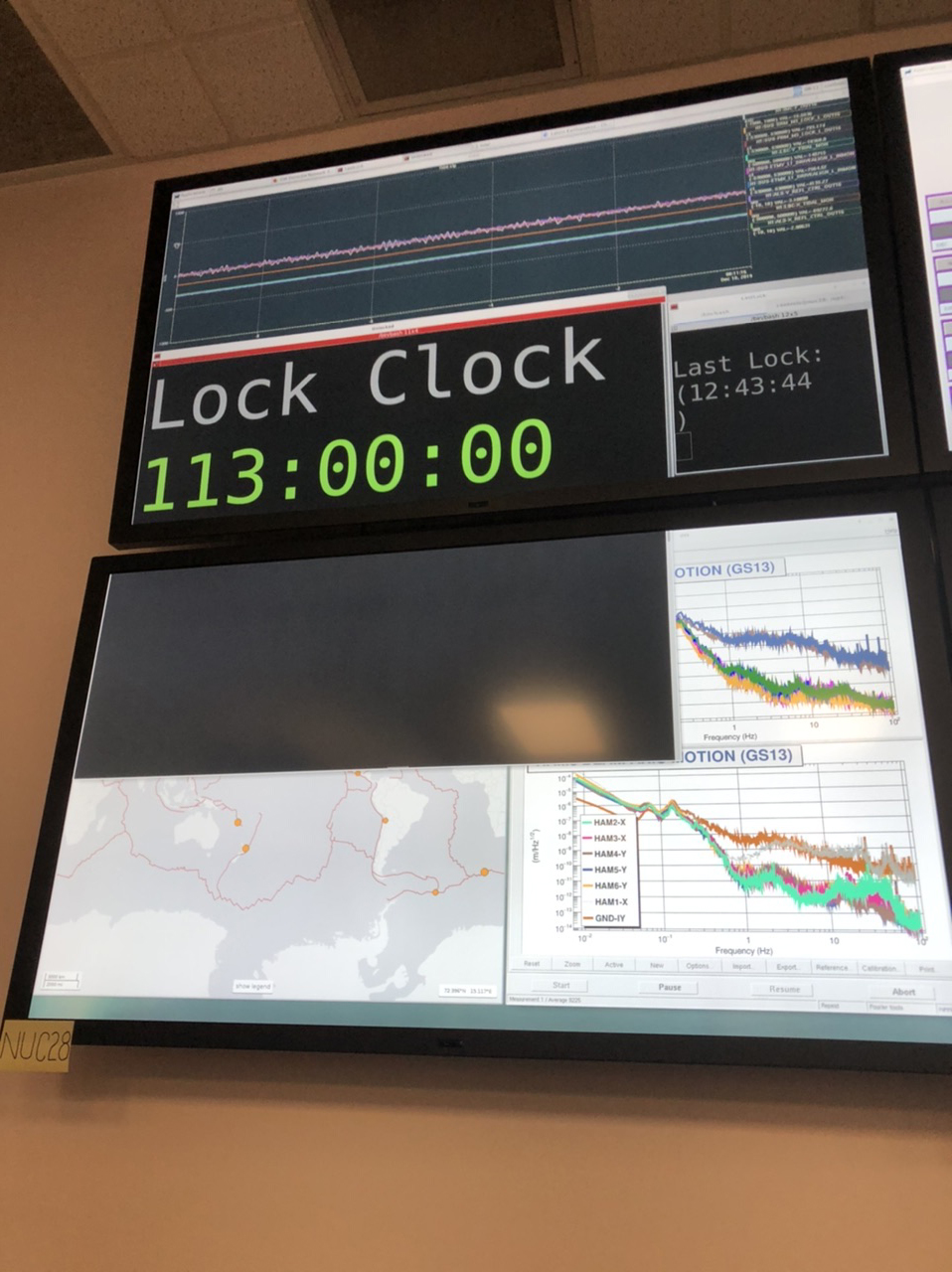
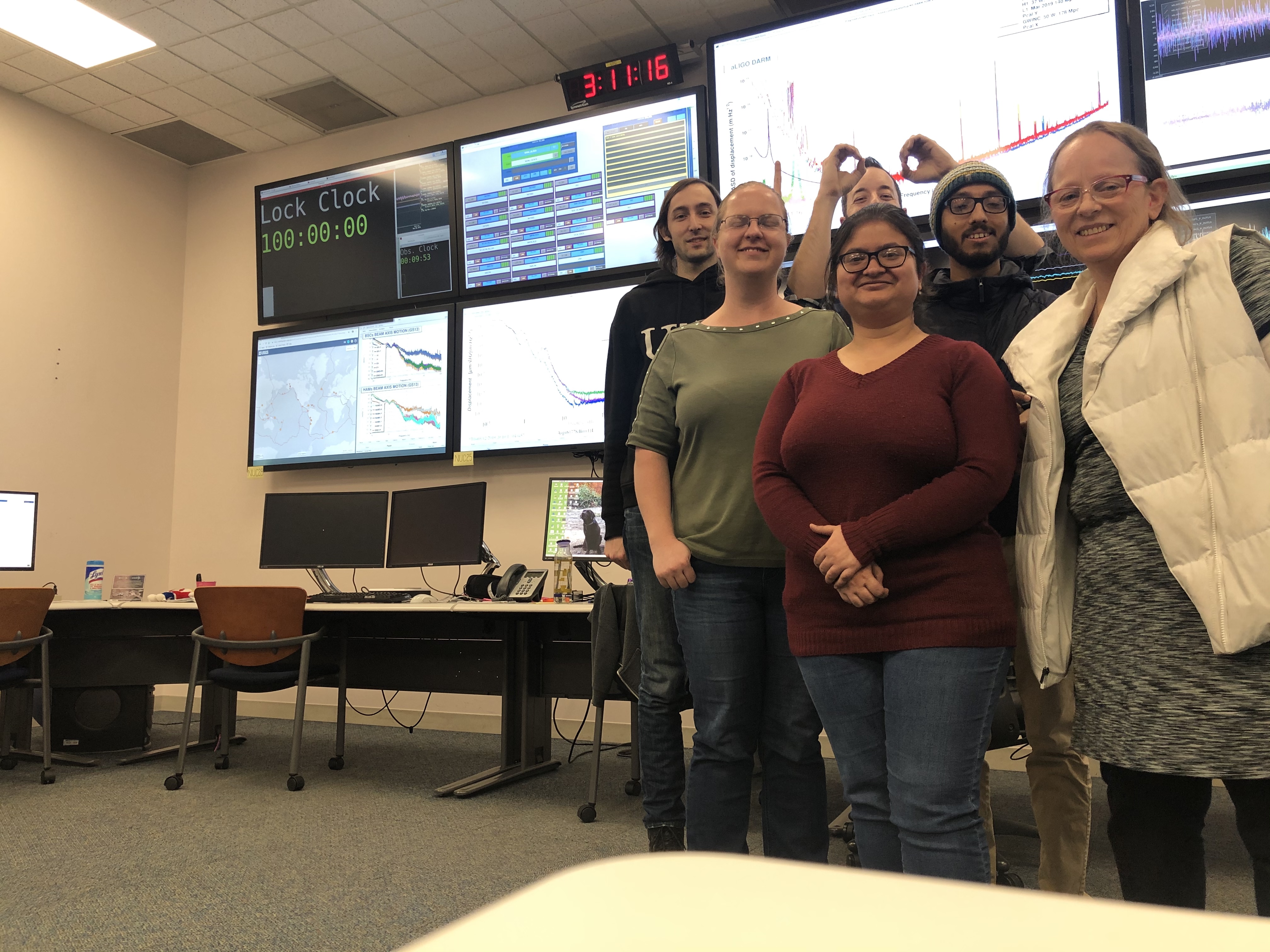
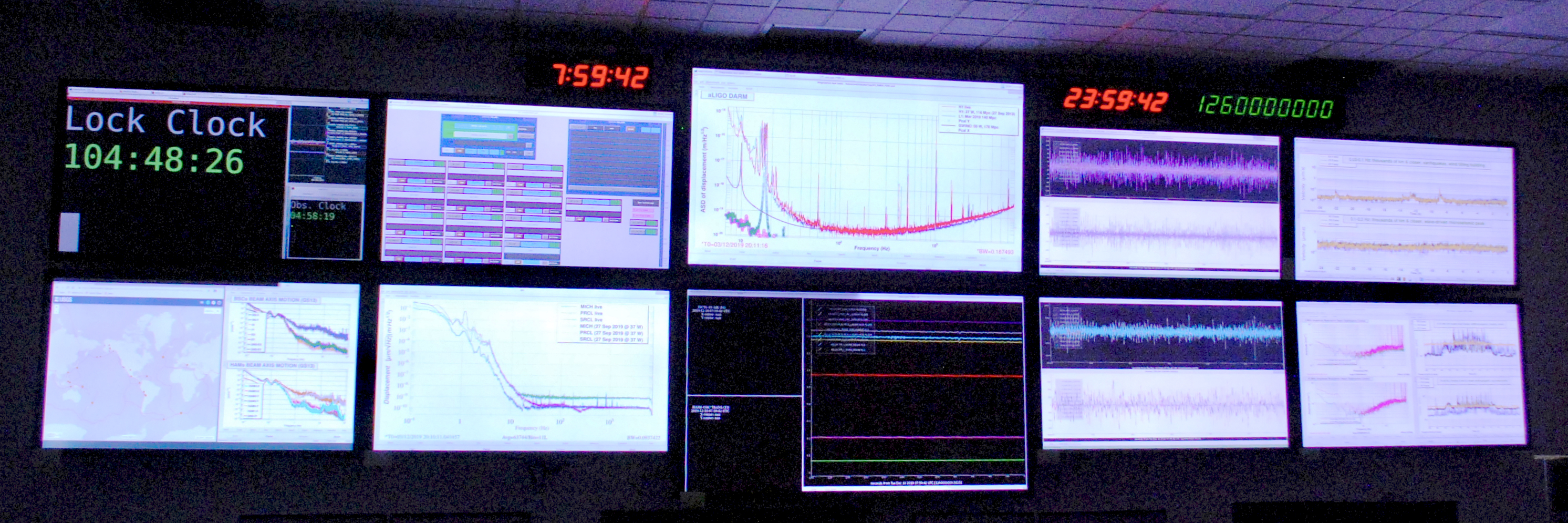
At 16:21:18 UTC, H1 was intentionally unlocked for necessary maintenance. How long would it have lasted? We may never know! We held off to make an even 113 hrs and then a little more while waiting for those with more invasive work to prepare to start which resulted in a few seconds mor than 10 minutes. Way To GO!
Congratulations! That was well done.
In a nod to the saying "success has many parents", I made a quick log about riding through the earthquakes on Dec 6 so we can point to that as one of the many things done to improve the robust performance of the detectors.
Truly awesome! But why was lock intentionally broken? Was that really necessary? You should have just let it go while you went on with maintenance activities. Maybe it could have gone much longer!
In general, I see almost no reason why lock should ever be intentionally broken. If a maintenance activity breaks lock so be it, no probblem, more information on the various things that can cause lock loss. But if it doesn't, then that's great and we have even longer lock stretches.
TITLE: 12/10 Owl Shift: 08:00-16:00 UTC (00:00-08:00 PST), all times posted in UTC
STATE of H1: Observing at 113Mpc
INCOMING OPERATOR: Ed
SHIFT SUMMARY:
H1's been locked (at NOMINAL LOW NOISE) since Niko's DAY shift last Thurs (12/5) at 3:12pmPDT (that's over 4.5 days!!)!
LOG:
Apologies. I had to best you by 10minutes 3 seconds. ;-)
Laser Status:
Front End Power is 32.22W (should be around 30 W)
70W Output Power is 69.7W
Front End Watch is GREEN
70W Watch is GREEN
PMC:
It has been locked 6 days, 18 hr 27 minutes (should be days/weeks)
Reflected power = 11.62Watts
Transmitted power = 52.22Watts
PowerSum = 63.85Watts.
FSS:
It has been locked for 4 days 15 hr and 25 min (should be days/weeks)
TPD[V] = 4.12V (min 0.9V)
ISS:
The diffracted power is around 2.5%
Last saturation event was 4 days 15 hours and 25 minutes ago (should be days/weeks)
Possible Issues: None.
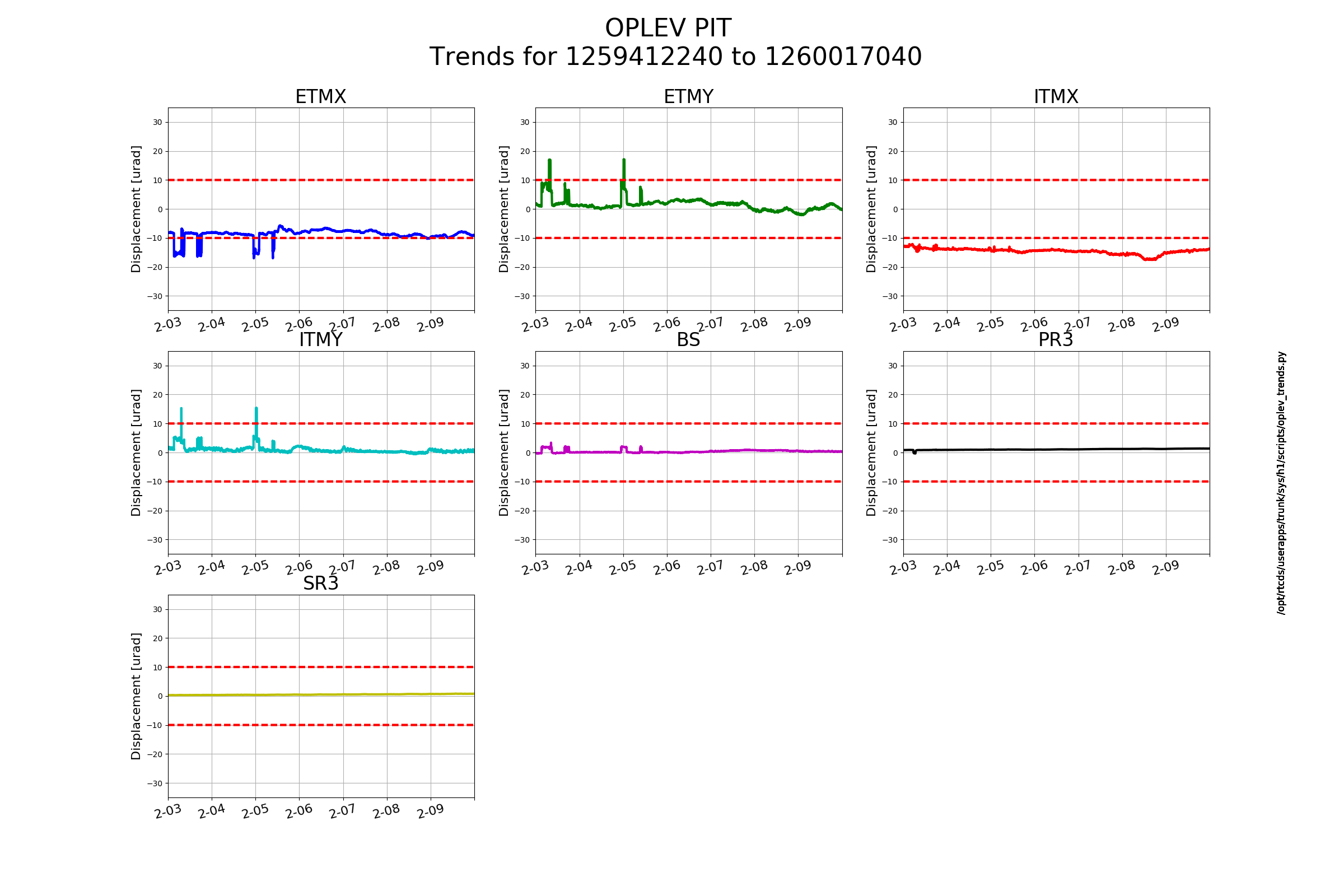
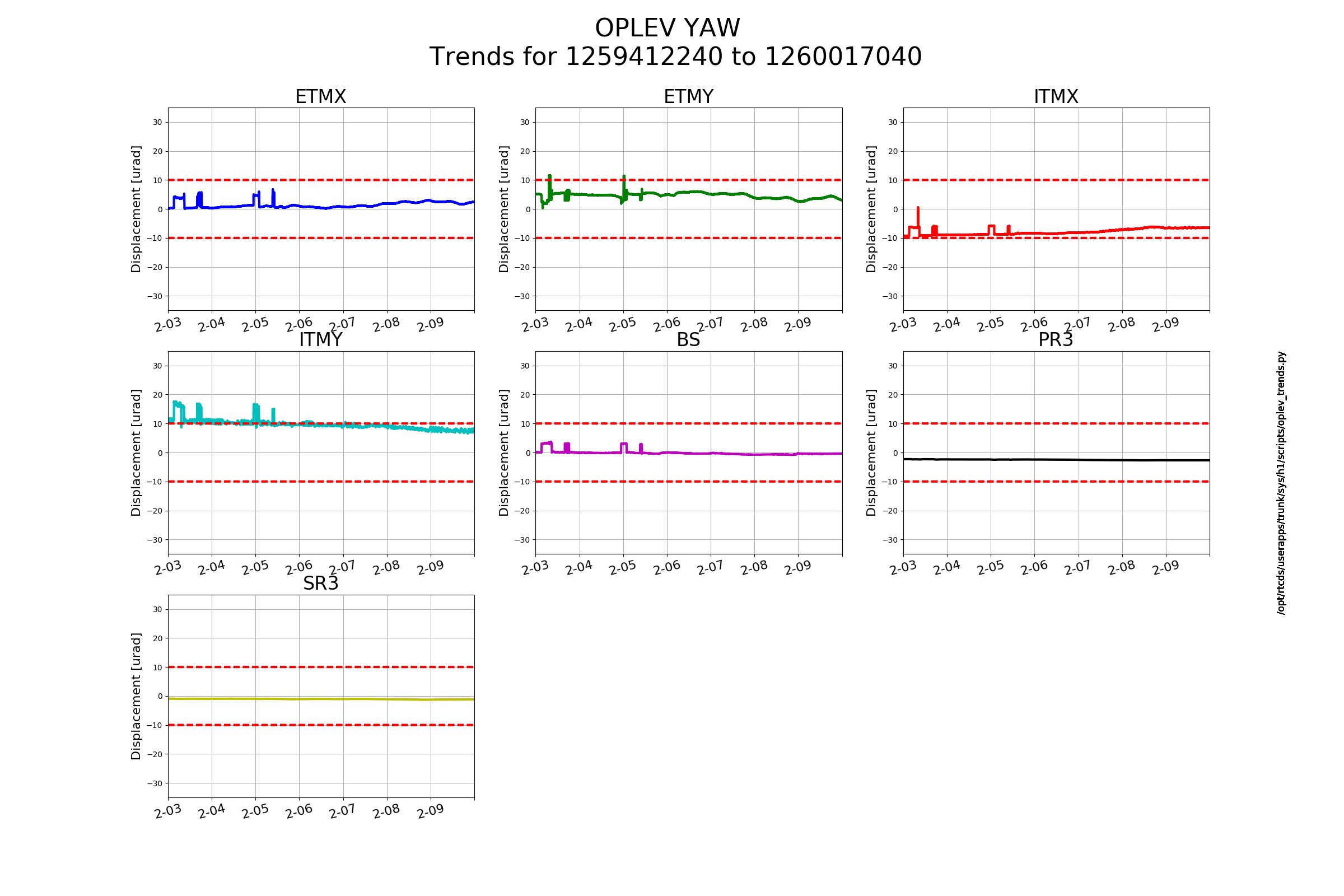
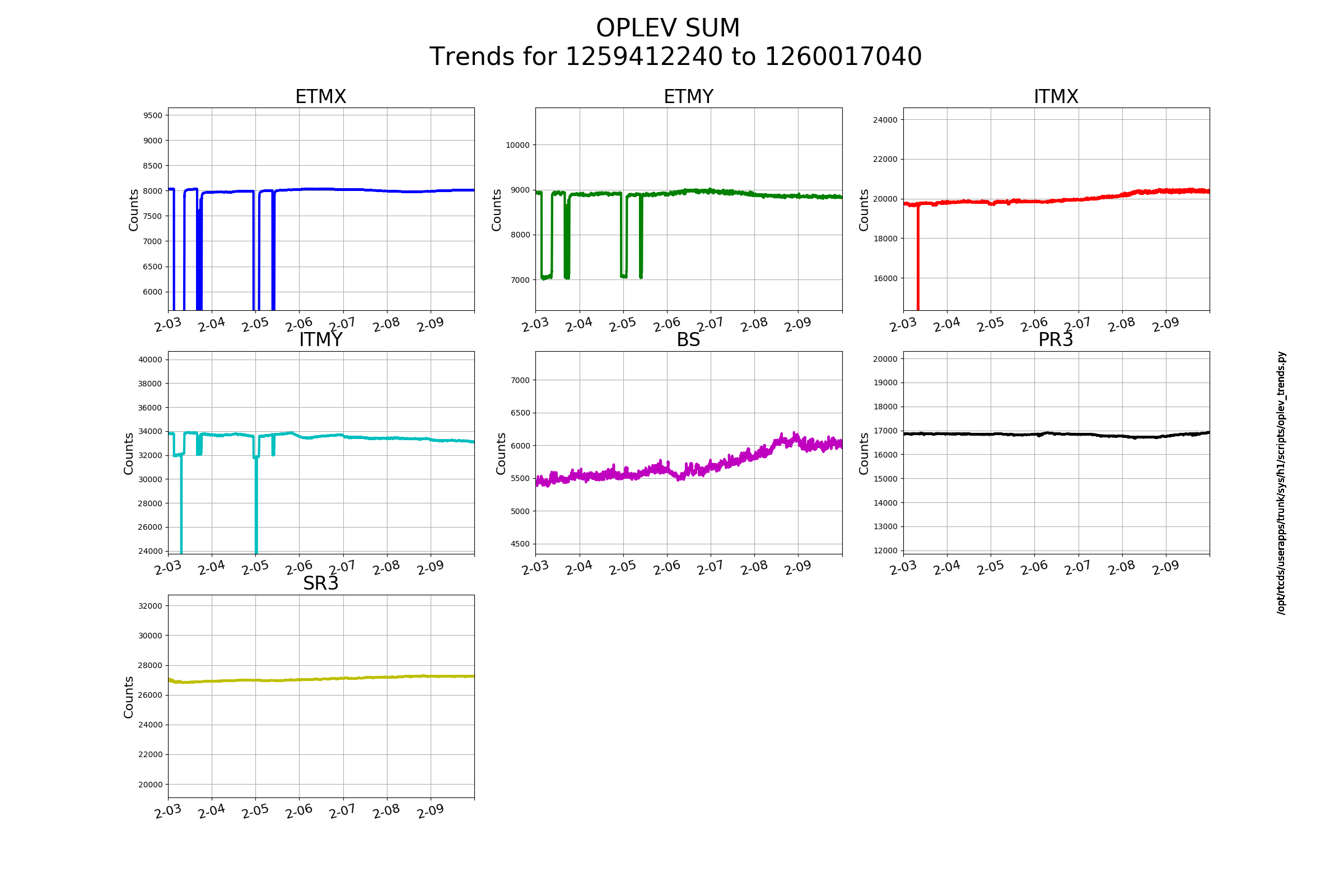
Attached are trends for oplevs.
NOTE:
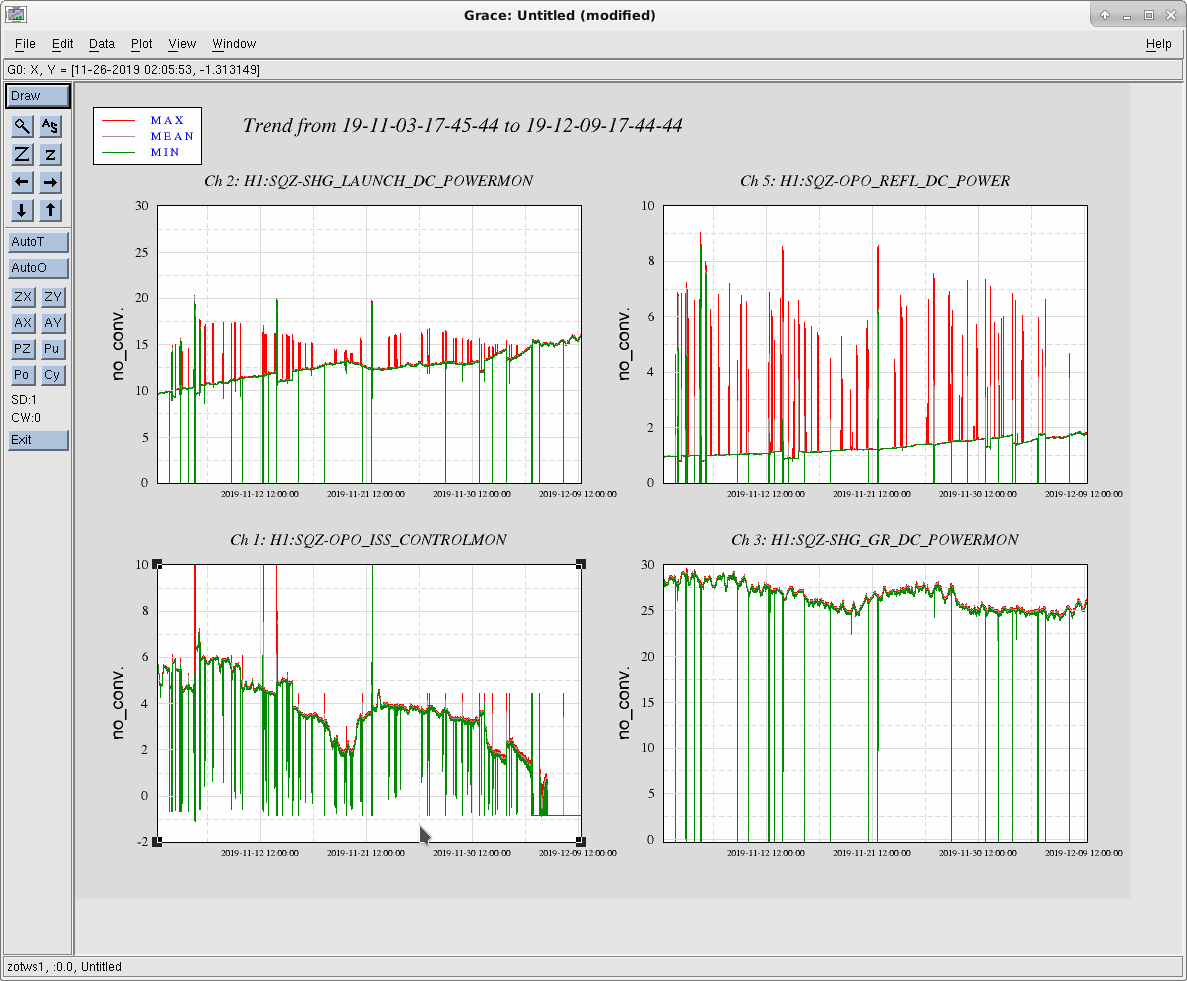
Today, I noticed that we have reached the maximum power value of the green power stabilization. The green transmitted power is currently not stabilized and only 90% of what it should be. Since the reflected green OPO power is increasing as well, I suspect that we are seeing a crystal degradation rather than a fiber degradation.
Maximized the available green power after the SHG. We now lock with 17.5mW into the fiber and have about 15% headroom.
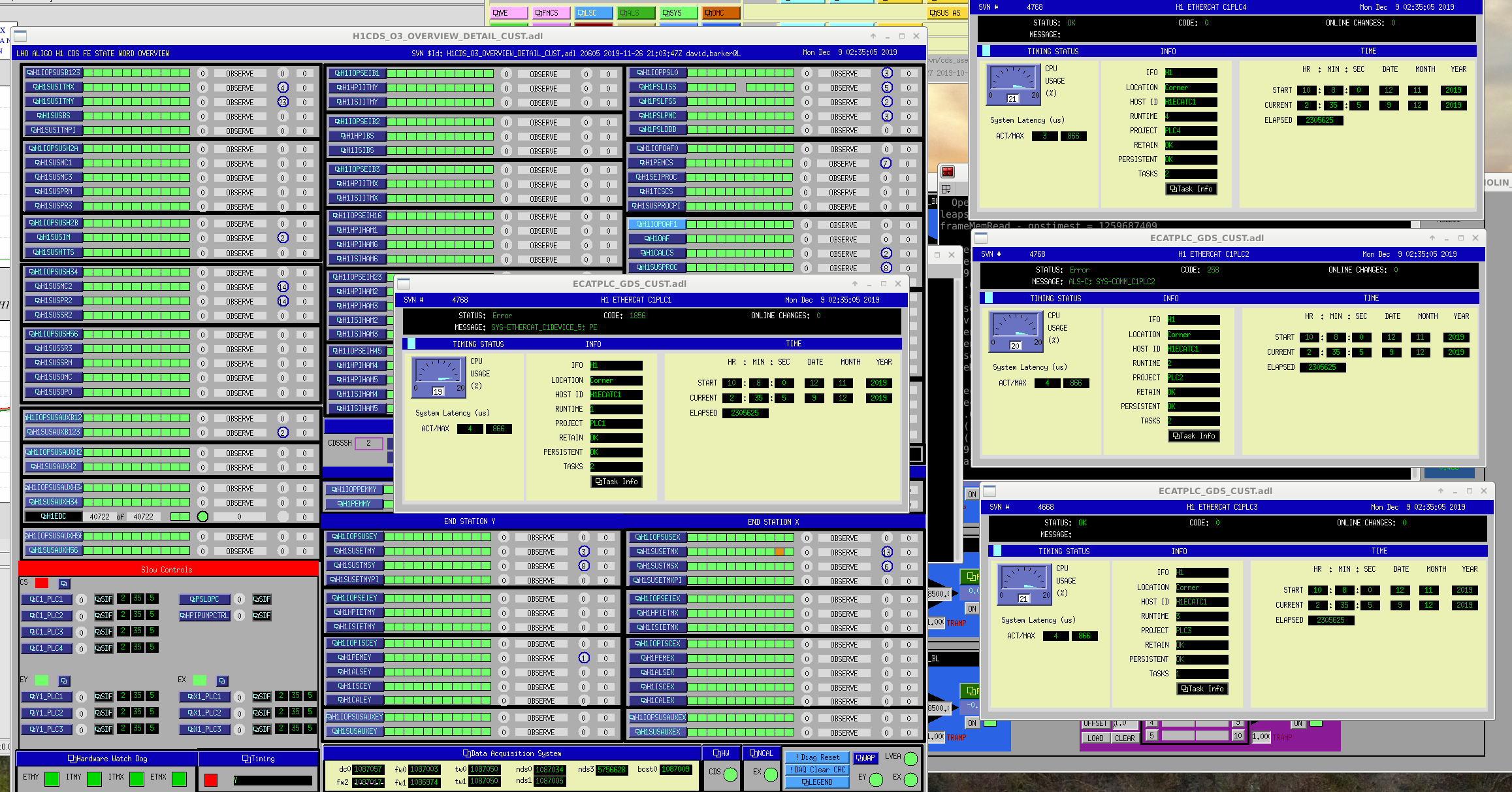
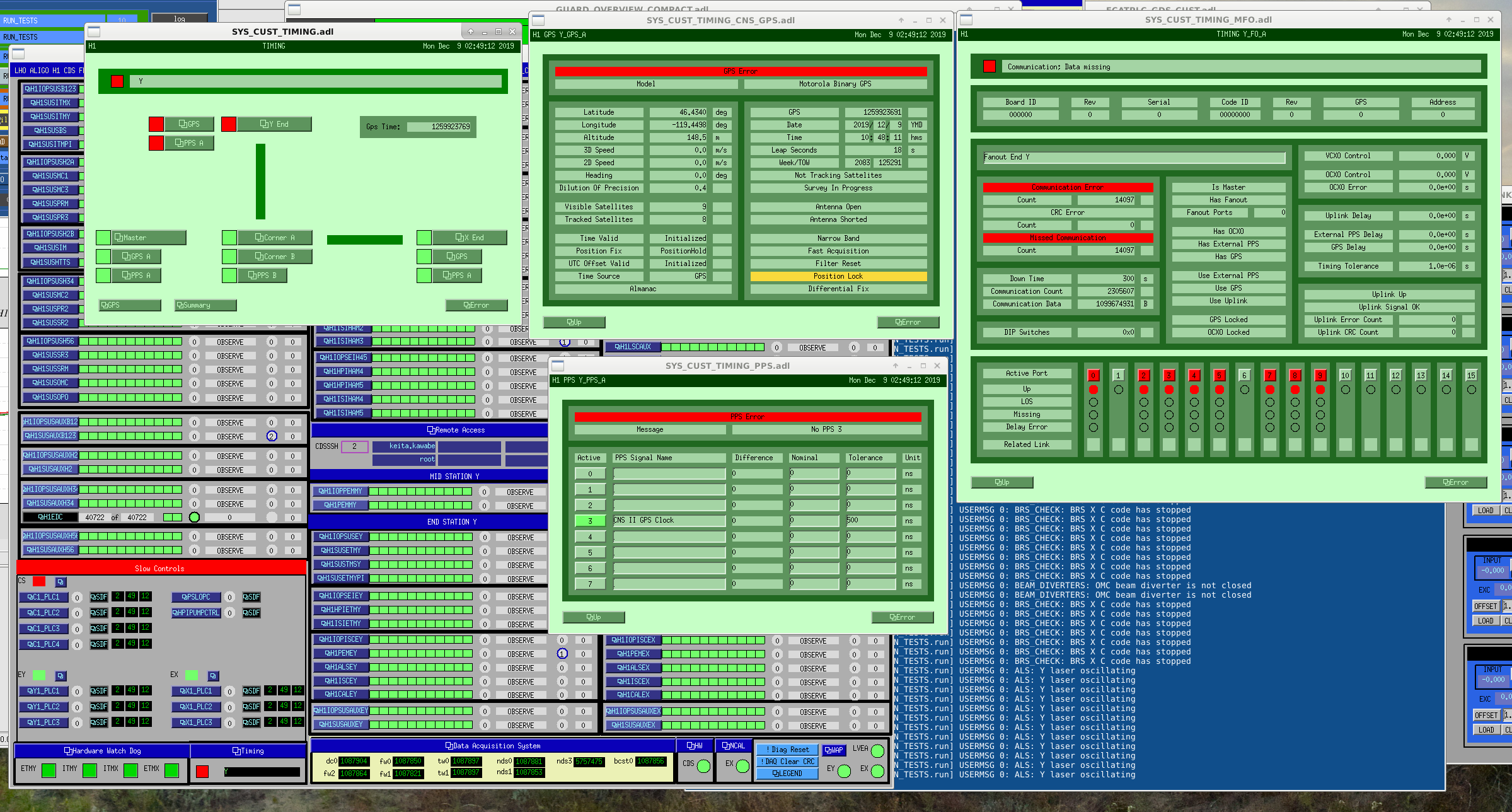
10:31utc (2:31am) Begin receiving verbal alarm: "Timing system error: SYS-TIMING_Y_FO_A_ERROR_FLAG" (also "...Y_PPS_A_ERROR_FLAG")
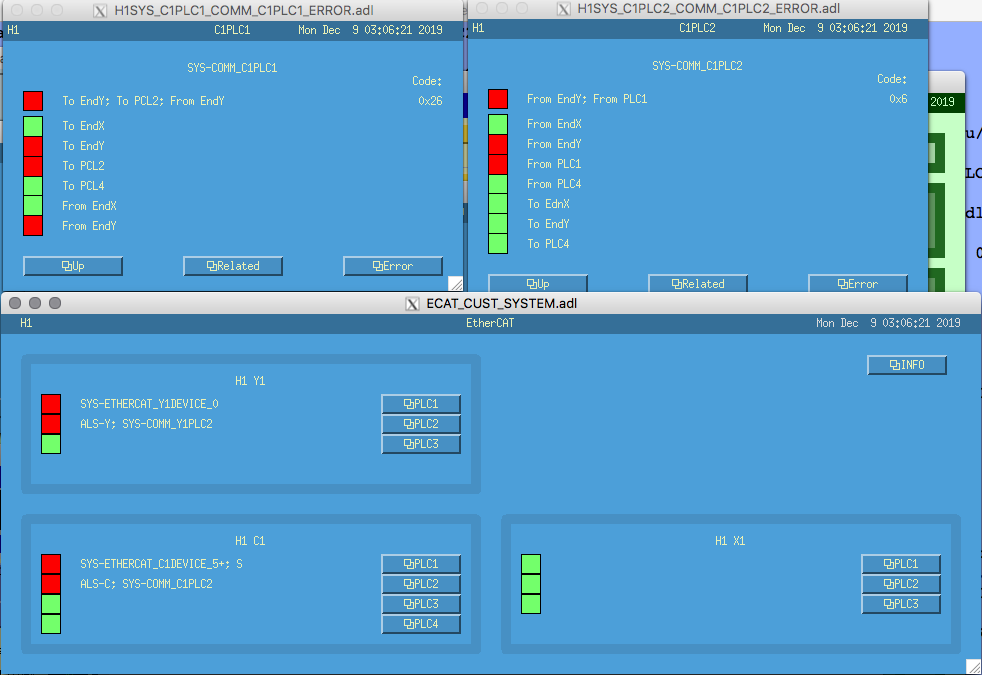
On the CDS Overview, the Slow Controls area has been flashing RED for the Corner Station with errors coming up for C1_PLC1 & C1_PLC2 (see attached for error with both of them showing error at same time).
H1 is currently locked and OBSERVING. Not sure what if this warrants waking David up (maybe he already has texts about this alarm/issue?). Since it's the middle of the night, I'm tempted to wait since it is intermittant, and we are locked.)
I'll search through alogs to see if this issue has come up before.
Perhaps not related, but at 10:29, DIAG_MAIN has been giving the message: "ALS: Y laser oscillating"
Timing Error for Y
Now have noticed Timing Error for "Y" (screenshot shows this new red box on CDS Overview & windows associated with this).
Will give Dave a call/voicemail.
Corner station Beckhoff PLC1 and PLC2 errors show a comms error with EY (see attached). So both the Beckhoff and Timing errors suggest fiber connection issues between corner and EY.
It looks like the fiber link between the slow controls Beckhoff chassis in the corner and EY has failed. CS-PLC1 reports failure in both directions to EY, CS-PLC2 has receive error but no transmit error.
If there was a true timing system failure at EY in that the timing master in the MSR has lost connection to the timing fanout at EY then the IOP models would skew and stop driving their DAC cards. We are not seeing this, so it looks like a Beckhoff reporting problem.
Opened FRS13929
At this point in time, recommend waiting for Richard to get on site to investigate the EY fiber comms.
Fiber bus coupler EK1501-0010 replaced system working again.
J. Driggers, J. Kissel, Y. Lecoeuche T. Shaffer
We've been running in to a problem with the MICH_BRIGHT initial alignment step for the past few days (months?) in which the interaction between the automated initial alignment guardian manager (INIT_ALIGN) and its subordinate (ALIGN_IFO) does not make sufficient checks of the MICH system upon failure to lock before requesting to reacquire. As such, Jenne, TJ, and I set out to find a solution.
The conclusion: there are two problems --
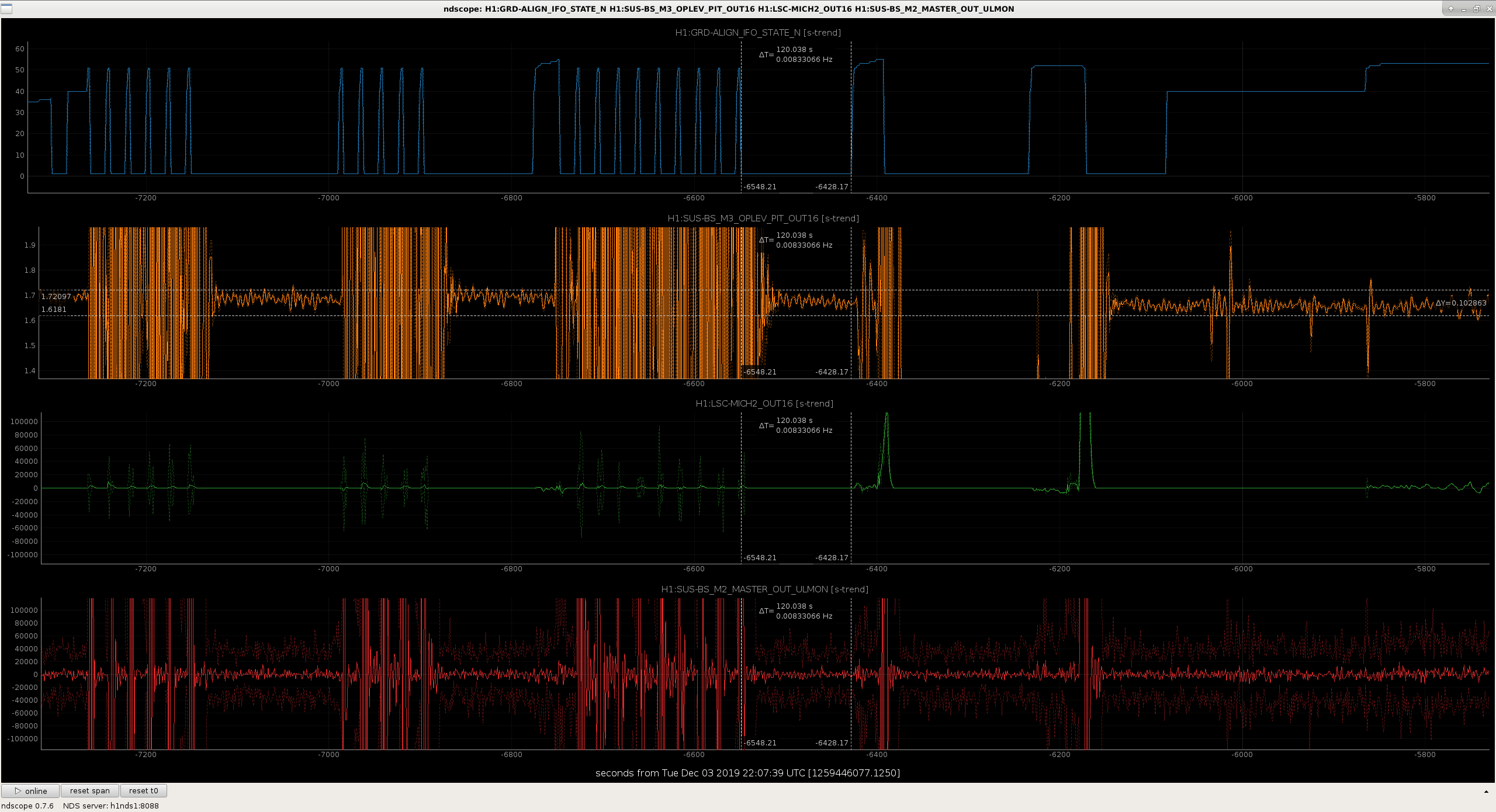
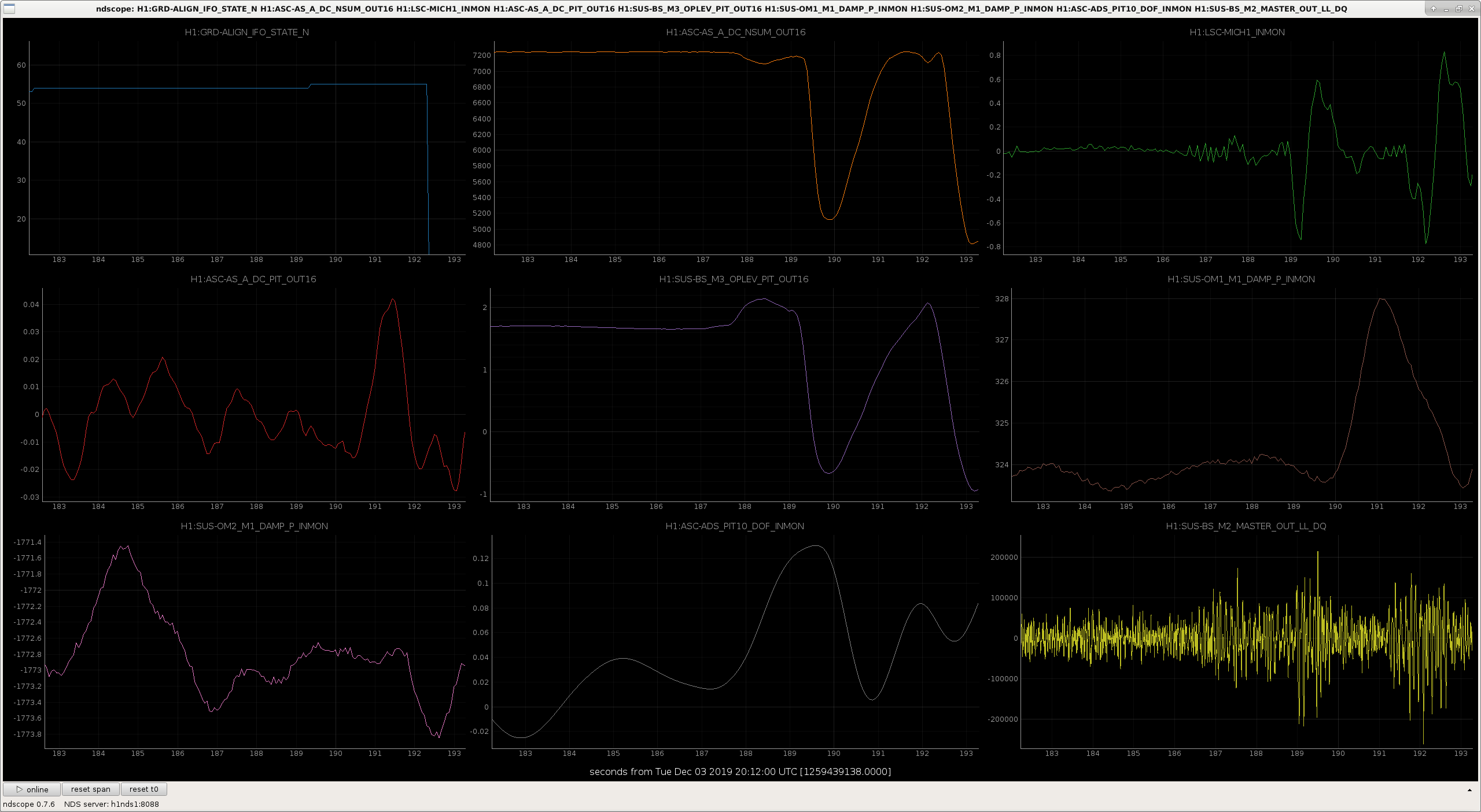
(1) During a successful first attempt at locking MICH BRIGHT, while the WFS loops are trying to converge MICH alignment, the M2 stage saturates (with a quite fast, but normal noise excursion). This saturation impulse kicks the ASC loops slewing the alignment to slowly bad, dropping the AS port QPD SUM which is used as a length-locking error signal, H1:ASC-AS_A_DC_SUM_OUT16, down below the threshold for a check whether MICH_BRIGHT is locked.
See first attachment.
(2) Once it's lost lock the first time, there's some screwy logic corner between the INIT_ALIGN manager, and the ALIGN_IFO subordinate which means the manager never realizes that the beam splitter is oscillating wildly, and at the same time trying to reaquire, which is blasting the SUS, pitching it more, and causing an AS port, Beam Splitter Dance Party / Laser Light Show.
See second attachment.
TJ and I worked a bit on Problem 2, by changing some of the logic and clearing up the issues with the screwy logic corner this past Tuesday. These change were all inside the INIT_ALIGN guardian, in the states MICH_BRIGHT_ALIGNING: we
- used the (IMHO) much more clear guardian call to gather the current state of a guardian (e.g. nodes['ALIGN_IFO'].STATE == 'DOWN', instead of just nodes['ALIGN_IFO'] == 'DOWN', which looks much like the request to *change* the state, nodes['ALIGN_IFO'] = 'DOWN', and only differs by one equal sign)
- Instead INIT_ALIGN's MICH_BRIGHT_ALIGNING state making of two ambiguous checks that ALIGN_IFO has locked MICH BRIGHT before advancing to OFFLOADING_MICH_BRIGHT by only checking whether ALIGN_IFO has "arrived" in any state and that state is "done", we use more rigorous check that it has arrived and has completed the state "MICH_BRIGHT_ALIGN," i.e. the state that cooks the initial alignment.
- Hoping that we've removed the logic flaw, we also reduced the "chill out" timer -- which is used after several attempts at locking MICH -- from 75 seconds to 45 seconds.
Since we've made the change (on Tuesday), we've NOT run an initial alignment beyond INPUT_ALIGN_OFFLOAD, so this change has not been tested.
Also -- while I *thought* that we'd added an additional check in the ALIGN_IFO state for ACQUIRE_MICH_BRIGHT to check that the max-min of the optical lever pitch signal is less than 0.5 urad, that test appears to have gotten lost in the fray.
We have some more work to do to understand Problem (1), and to develop tests against it. [And today, as I was writing LHO aLOG 53711, I realize that we may have been having his problem since August 2019 because we have been in the wrong coil driver state!]
Just went through this state a few times, including intentionally breaking the MICH bright lock, and it seems that Jeff's find and fix of ensuring that the BS coil driver is in the correct state did indeed solve the problem.
The "Phase" of the OSC9 line for the PCALY excitation at 1153.1 Hz was changed from -15 deg to 0 deg.
The amplitude of the 1153.1 line for PCALX was changed from 5000 to 5007.
The 5007 ct amplitude was determined by looking at the ratio of the Xend to Yend Pcal Rx signals and adjusting the amplitude to bring it clost to 1.
(note that the "Cos Ampl" field was bland for this excitation at Xend; it was updated to match the "Sin Ampl" value.
WIth 0.1 Hz BW and 50 averages, the X/Y ratio of the line amplitudes at 1153.12 Hz was (1.00002236, 1.00005868, 0.999899413) for three consecutive 50-avg measurements.
The original configuration of these lines can be found in entry 51915 in this log from Sept. 11, 2019.
On 2019-12-10, the phase change from -15 to 0 deg on PCALY has been accepted in its safe.snap file.