
cheryl.vorvick@LIGO.ORG - posted 05:54, Thursday 21 November 2019 (53407)
Mid-Shift Update
H1 remains locked, winds are low, so far no EQs.
H1 remains locked, winds are low, so far no EQs.
TITLE: 11/21 Owl Shift: 08:00-16:00 UTC (00:00-08:00 PST), all times posted in UTC
STATE of H1: Observing at 112Mpc
OUTGOING OPERATOR: Ed
CURRENT ENVIRONMENT:
SEI_CONF state: WINDY
Wind: 10mph Gusts, 9mph 5min avg
Primary useism: 0.02 μm/s
Secondary useism: 0.24 μm/s
QUICK SUMMARY: locked and in Observe
TITLE: 11/21 Eve Shift: 00:00-08:00 UTC (16:00-00:00 PST), all times posted in UTC
STATE of H1: Observing at 111Mpc
INCOMING OPERATOR: Cheryl
SHIFT SUMMARY:
My last aLog entry containied all of the night's highlights.
Included below is a plot of the drop in range correlation as note in Sheila's previous aLog
LOG:
05:41 EX Saturation
Activities:
00:49 LOCKLOSS - 6.1 Laotian EQ
00:50 LOCKING_ARMS_GREEN
01:47 INITIAL_ALIGNMENT
02:10 Attempt#1
02:52 H1 Observing
3:30 Squeezer unlocked and relocked - Intention bit Commissioning
03:31 Squeezer re-acquired lock - Intention bit Observing
Adam Mullavey called about his intention to send two Injections for stochastic and requested that I ready the INJ_TRANS Guardian Node
04:30 Verbal Alarm: Transient Injections detected
I've scheduled a couple more stochastic injections for tonight. The first one will go in at 20:30 PT (04:30 UTC, 1258345818 gpstime), the second one will go in at 22:30 PT (06:30 UTC, 1258353018 gpstime). Below are the updates to the schedule file.
1258345818 H1L1 INJECT_STOCHASTIC_ACTIVE 1 1.0 stoch/Waveform/SB_O2A_{ifo}.txt
1258353018 H1L1 INJECT_STOCHASTIC_ACTIVE 1 1.0 stoch/Waveform/SB_O2A_{ifo}.txt
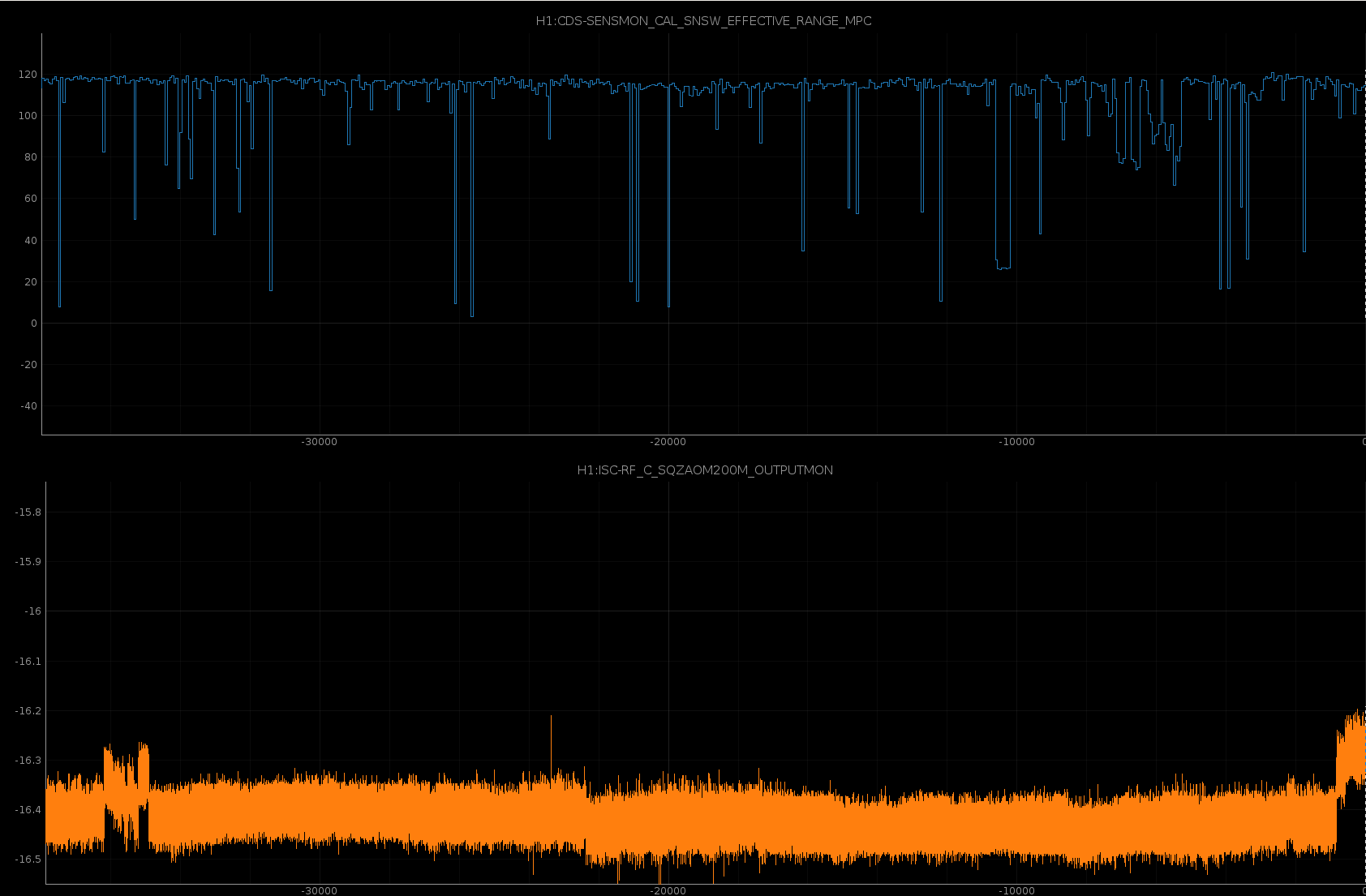
Corey pointed out that as our range dropped a bit this afternoon, the H1:ISC-RF_C_SQZAOM200M_OUTPUTMON channel had a small increase.
The attached screenshot shows that there might be a relationship between the CLF power and the range (and maybe the ISC-RF channel as well), but we would want a few more iterations to be sure.

Vlad, Timesh,
Timesh has asked for a summary of X-End noises, that DetChar suspected arose from NCAL related work there on Tuesday.
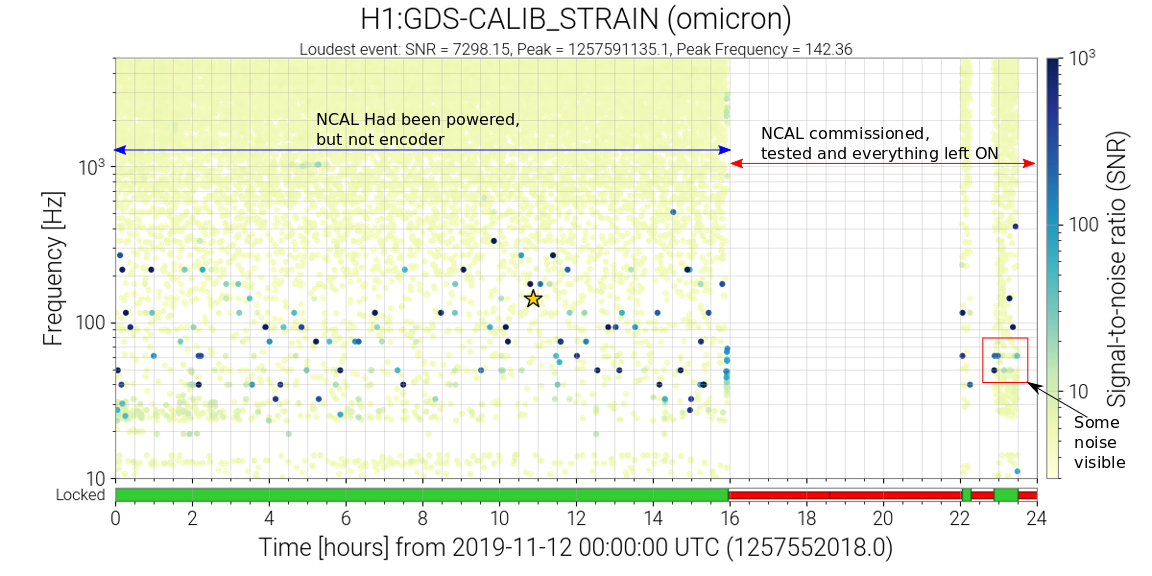
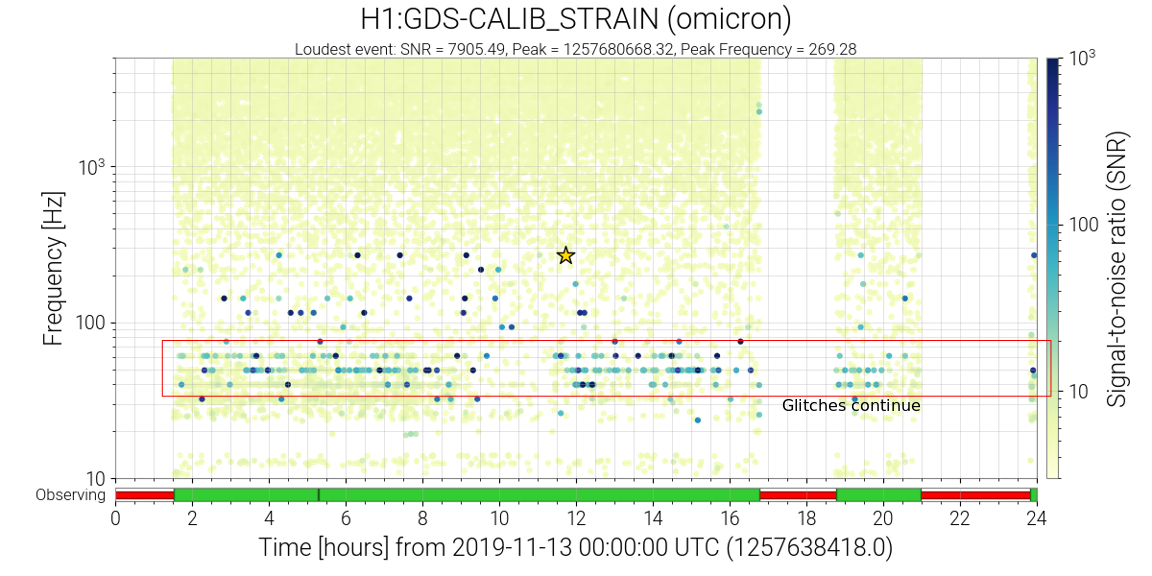
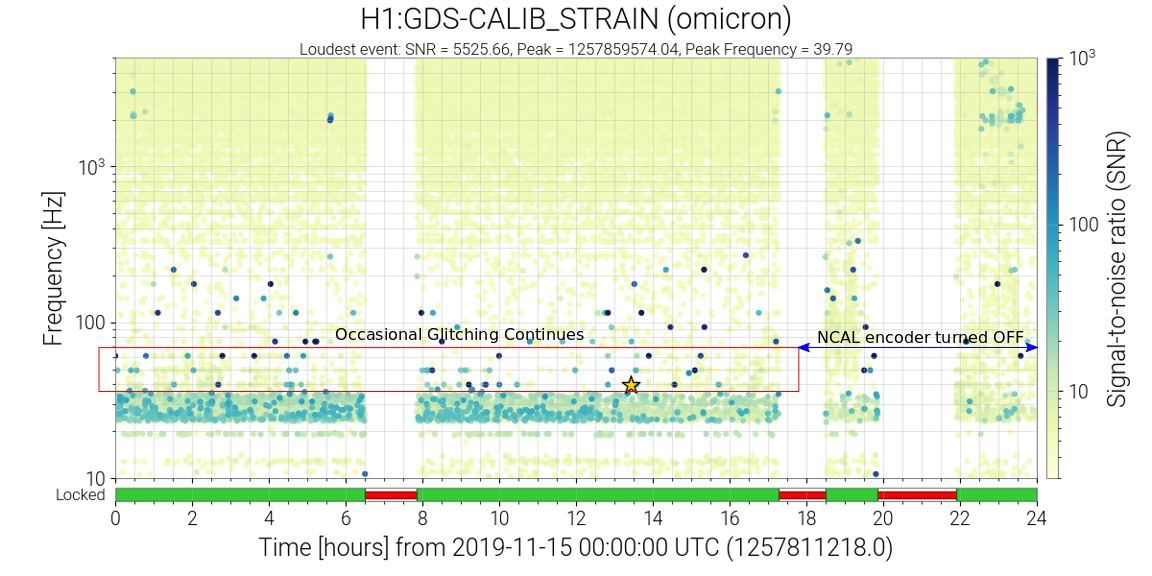
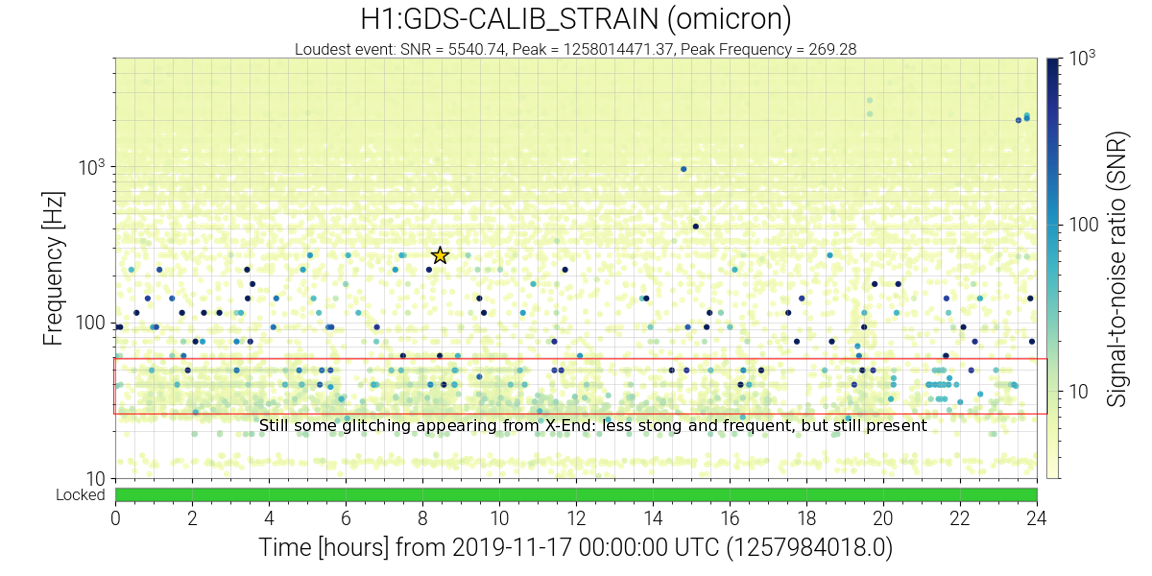
I have attached here what DetChar was monitoring in the main glitch monitor, and annotated relevant activty. For relevant correlation analysis on the noise source, one can look at any day between Wednesday (2019-11-13) to Monday this week (2019-11-18), under the DetChar-Hveto tab and look for at the analysis concerning H1:PEM-EX_ADC_0_18_OUT_DQ,
I was informed last week that NCAL had been powered down at some point before Friday. It seems I may have been misinformed and everything had been left on. Timesh should know better than I.
When I went and turned the encoder off (assuming that the rest of the electronics had been off), I asked to leave them turned on to be in the same state as we were in the Tuesday before NCAL was first used: when we didn't see any glitching. This is strange, and I am surprised that there was no glitching before this time if everything had been powered just the same. Possibly something had changed, or something was powered differently before that Tuesday.
As seen by DetChar over the weekend: glitches were fewer and less strong - but still present and correlated to the X-end.
Recently there was an overhaul of electronics in the X-end, especially concerning NCAL, so we'll have to see if that helps.
TITLE: 11/21 Eve Shift: 00:00-08:00 UTC (16:00-00:00 PST), all times posted in UTC
STATE of H1: Commissioning
OUTGOING OPERATOR: Corey
CURRENT ENVIRONMENT:
SEI_CONF state: WINDY
Wind: 13mph Gusts, 10mph 5min avg
Primary useism: 0.05 μm/s
Secondary useism: 0.25 μm/s
QUICK SUMMARY:
TITLE: 11/20 Day Shift: 16:00-00:00 UTC (08:00-16:00 PST), all times posted in UTC
STATE of H1: Observing at 115Mpc
INCOMING OPERATOR: Ed
SHIFT SUMMARY:
H1 locked for ~16.75hrs.
Energy Committee visiting site. Wind fence work continues; BRS has been needing to go to the Damping state today (which is concurrent with when Wind Fence work started this morning).
Little over 2hrs of Calibration time was taken on H1.
Had a couple of EQ alerts (but no action taken for either). And ended shift with a 6.0 incoming EQ for Ed!
LOG:
V. Bossilkov, J. Kissel

We grabbed standard measurements of the sensing function today, in order to continue the exploration of the time dependence in the low frequency response (due to the mixing of a detuned SRC and parasitic angular loop coupling). Also, we took some time to characterize the high frequency response of the UIM, because -- even though we know that these dynamics are non-f^6 (see LHO aLOG 38295) -- we've not remeasured this after we replaced the test masses between O2 and O3.

The data has been committed to the CalSVN here:
/ligo/svncommon/CalSVN/aligocalibration/trunk/Runs/O3/H1/Measurements/FullIFOSensingTFs/
    2019-11-20_H1_DARM_OLGTF_LF_SS_5to1100Hz_15min.xml

    2019-11-20_H1_PCALX2DARMTF_LF_SS_5t1100Hz_10min.xml
    2019-11-20_H1_PCALY2DARMTF_LF_SS_5t1100Hz_10min.xml

    2019-11-20_H1_PCALX2DARMTF_BB_3min.xml
    2019-11-20_H1_PCALY2DARMTF_BB_3min.xml


/ligo/svncommon/CalSVN/aligocalibration/trunk/Runs/O3/H1/Measurements/FullIFOActuationTFs/
Real, new, good data:
    2019-11-20_H1SUSETMX_L1_iEXC2DARM_HFDynamicsTest_200-600Hz.xml
    2019-11-20_H1SUSETMX_L1_iEXC2DARM_HFDynamicsTest_30-100Hz.xml
    2019-11-20_H1SUSETMX_L1_iEXC2DARM_HFDynamicsTest_90-250Hz.xml
    2019-11-20_H1SUSETMX_L1_PCAL2DARM_HFDynamicsTest_200-600Hz.xml
    2019-11-20_H1SUSETMX_L1_PCAL2DARM_HFDynamicsTest_30-100Hz.xml
    2019-11-20_H1SUSETMX_L1_PCAL2DARM_HFDynamicsTest_90-250Hz.xml

Dummy templates that are still under development:
    2019-11-20_H1SUSETMX_L1_PCAL2DARM_HFDynamicsTest_30-500Hz.xml
    2019-11-20_H1SUSETMX_L1_iEXC2DARM_HFDynamicsTest_25-700Hz_SweptSine.xml
    2019-11-20_H1SUSETMX_L1_iEXC2DARM_HFDynamicsTest_30-500Hz.xml


Processed data, analysis, and conclusions to come.
This is an added note mostly for DetChar.
In todays calibration time, we were driving the top stage (UIM) of the ETMX quad stack, to better image features of the top stage dyanmics that we can see through DARM (which appear between 44 Hz and ~460Hz). We still have more data to gather, and then do fitting with iirrational for better TF models in the moderately near future.
DetChar: This is a note that as of 3pm local time (11 pm UTC): The ~500Hz violin mode will have been strongly excited by our activty, as we were performing broadband injections at the top stage from 30 to 600 Hz.
Chiara, Jenne.
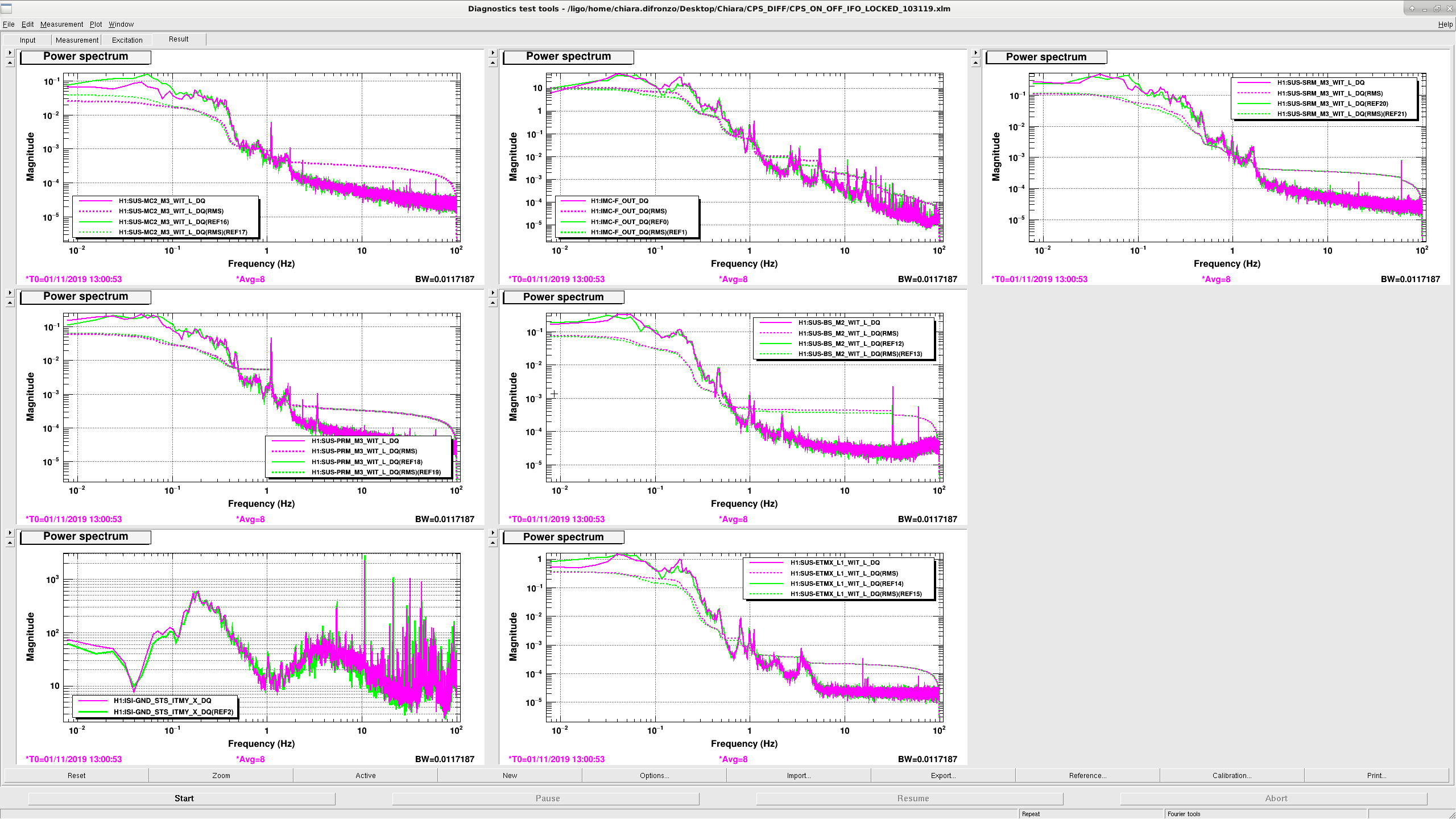
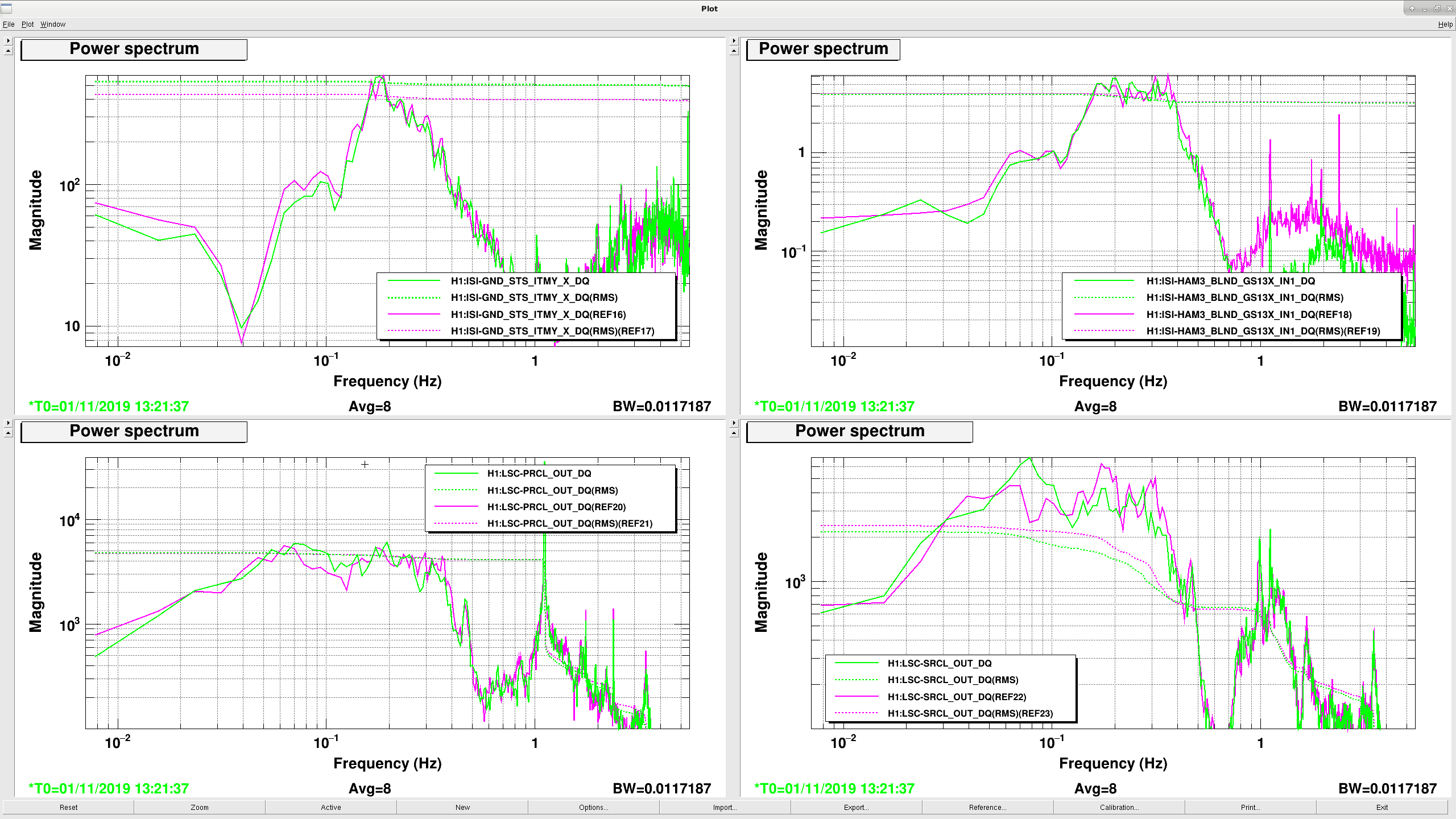
During some tests with CPS_DIFF in the past weeks, we took some measurements of the DARM when the IFO was locked (10/31/2019). The plot is shown in attachments 1: the green trace is in OFF configuration, the pink one is the ON configuration. The plot shows an improvement below 0.1 Hz when all the chambers (HAMs and BSCs) where locked togehter via CPS_DIFF configuration. Above 0.1 Hz it's a little worse and this is still under investigation.
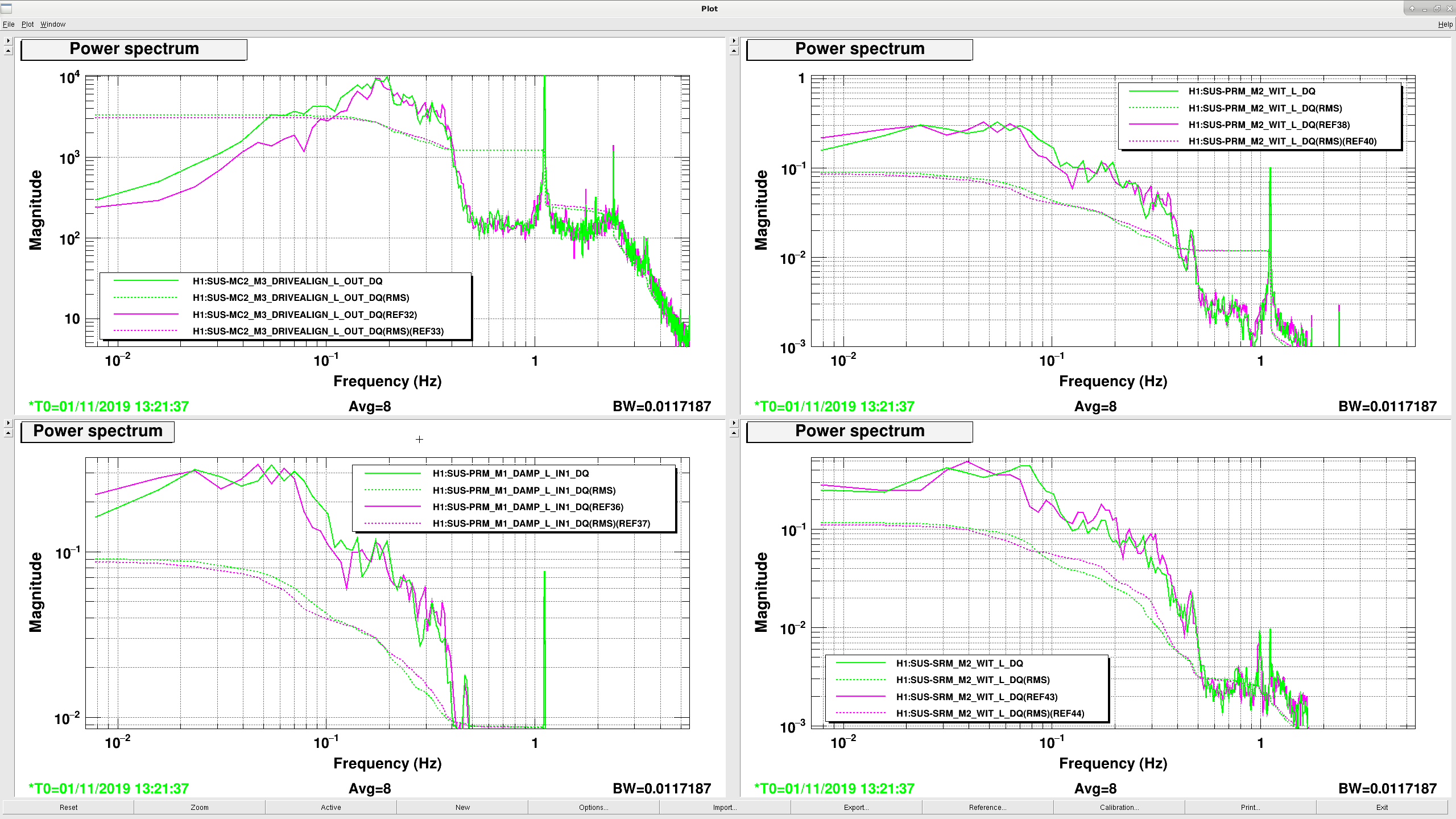
Attachment 2 shows the ground conditions and other measurements in other channels: these measurements all show that at low frequency the RMS when the CPS_DIFF is ON is always below the RMS when the CPS_DIFF is OFF. Green traces are the OFF status, pink traces are the ON status. The suspensions investigated are:
MC2_M3 -> top left plot
IMC-F -> first row, center plot
SRM_M3 -> top right plot
PRM_M3 -> second row, left plot
BS_M2 -> second row, center plot
GND -> bottom left
ETMX_L1 -> third row, center plot

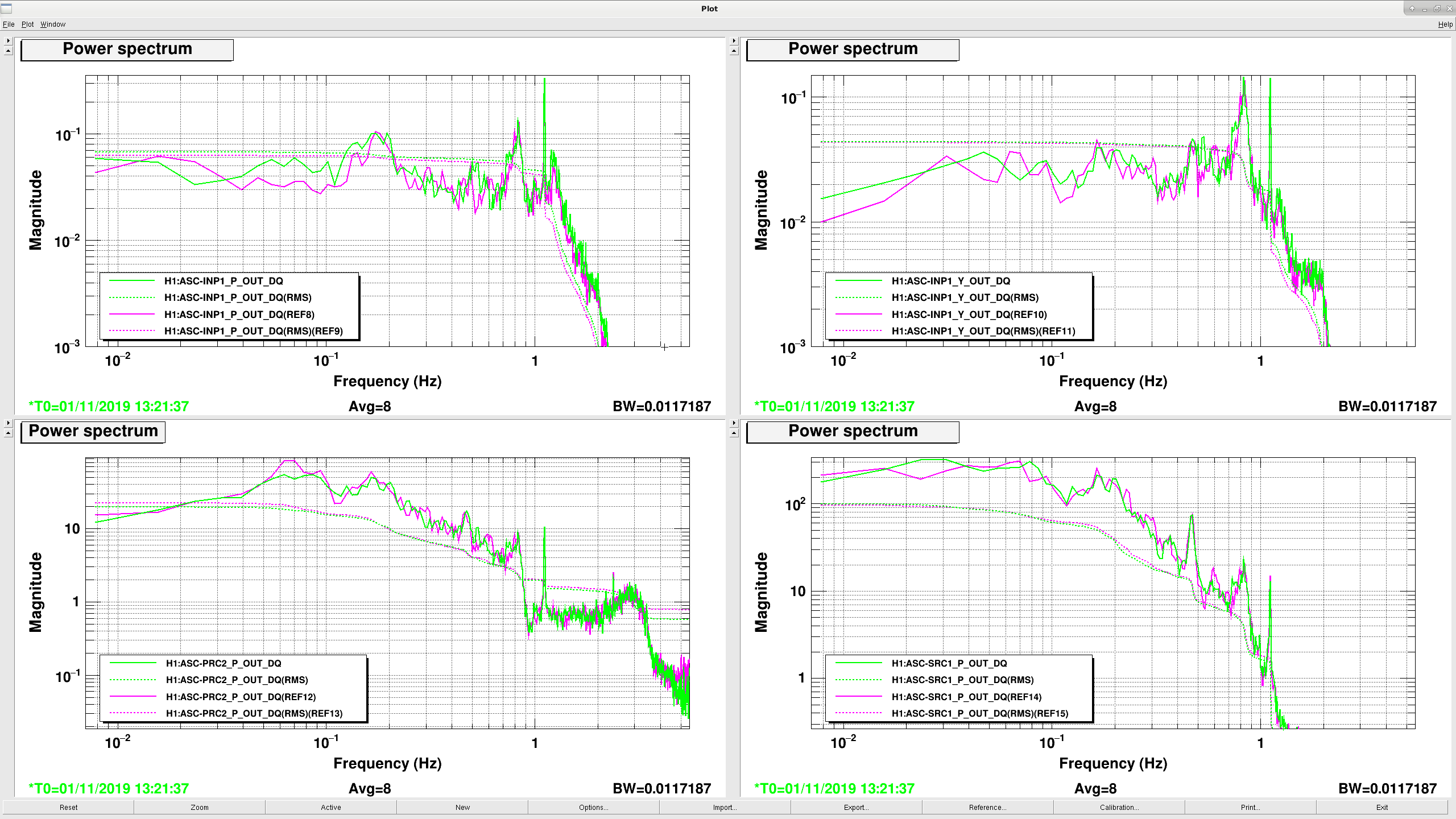
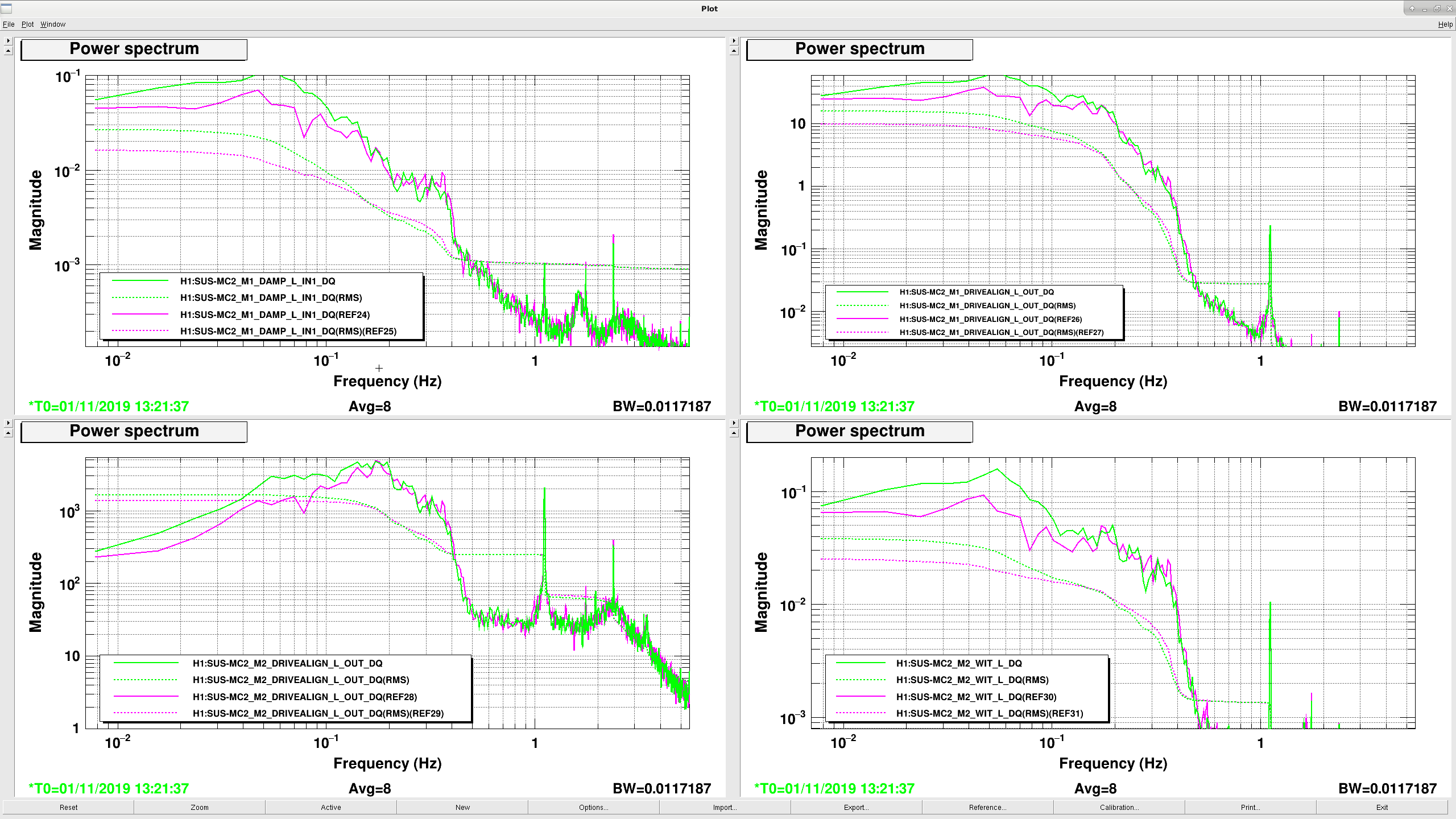
Following Arnaud suggestions (see LLO alog 49728), I am adding some other plots with measurements of other suspensions, and also pitch and yaw.
As usual, green traces are the OFF conditions and pink traces are the ON conditions of CPS_DIFF.

[Gavin, Jenne]
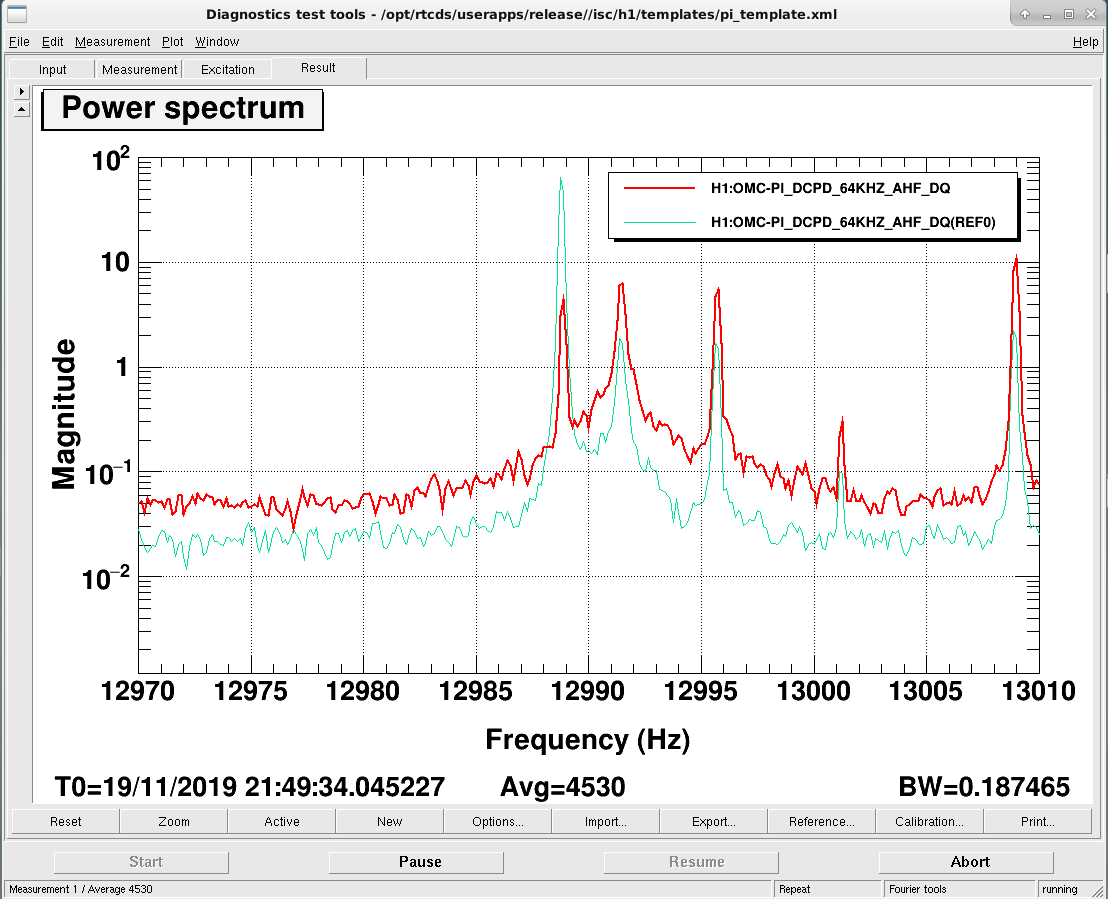
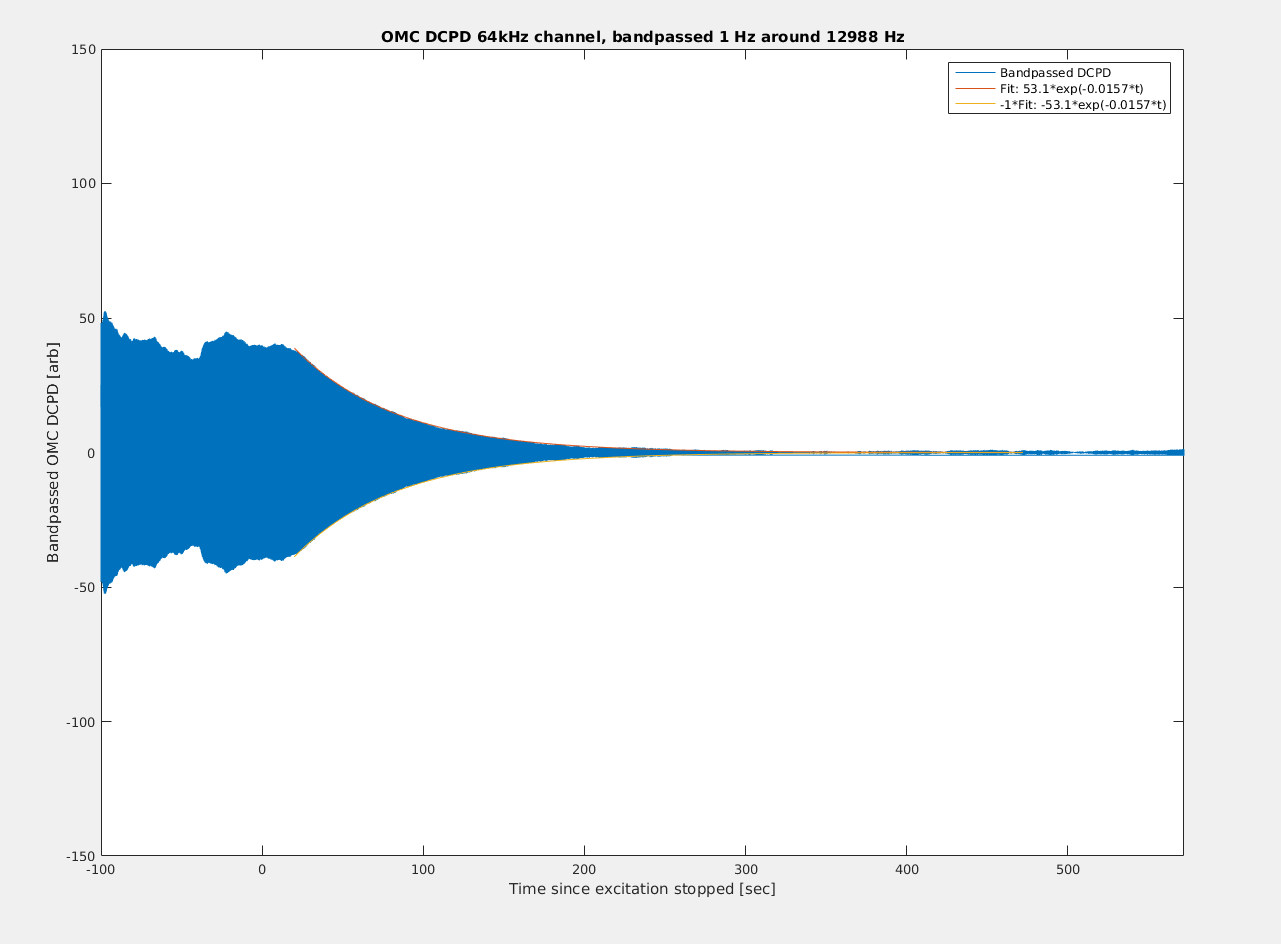
We got commisioning time yesterday at 2W laser power to conduct a Q ringdown of the 12.988 kHz mode of ITMY. Before commencing we realised that the filter in alog 52836 needed altered to include ALWAYS ON & RAMP (3 seconds) options. In addition the bandpass filter in H1:SUS-PI_PROC_COMPUTE_MODE4_BP [FM2] required an alteration to extend to 13.01 kHz (210 Hz in oscillator bandpass land) after originally being set to have an upper limit of 13 kHz (200 Hz).
We also relised we needed to create the appropriate phase filters for the measurement. We then create the filters needed to ring up the 12.988 kHz mode on ITMY. Also we created a script which should make it easier to create phase filters in the future (attached).
To do this we drove a high gain of approx. 1.85e8 through the Test Mass to an amplitude of approx. 100 and then zero the gain to measure the natural amplitude decay of the TM.
Using the script described in alog 53013 we will extract the Q value of this mode (attached). The time constant tau = 63.6943 therefore Q = 2.5989e6 at 12.988 kHz (1/(f * pi * tau)). This measurement will be an interesting addition to the ringdown data for the Acoustic Modal Loss Tomography analysis of the TMs.
I've scheduled a couple of stochastic injections for tonight (early tomorrow morning). The first one will go in at 22:30 PT (06:30 UTC, 1258266618 gpstime), the second one will go in at 00:30 PT (08:30 UTC, 1258273818 gpstime). Below are the updates to the schedule file.
1258266618 H1L1 INJECT_STOCHASTIC_ACTIVE 1 1.0 stoch/Waveform/SB_O2A_{ifo}.txt
1258273818 H1L1 INJECT_STOCHASTIC_ACTIVE 1 1.0 stoch/Waveform/SB_O2A_{ifo}.txt
The first injection failed as the IFO was down, but the second one was successful. However, neither injection was successful at LLO, so we will try again tonight for a coherent injection.
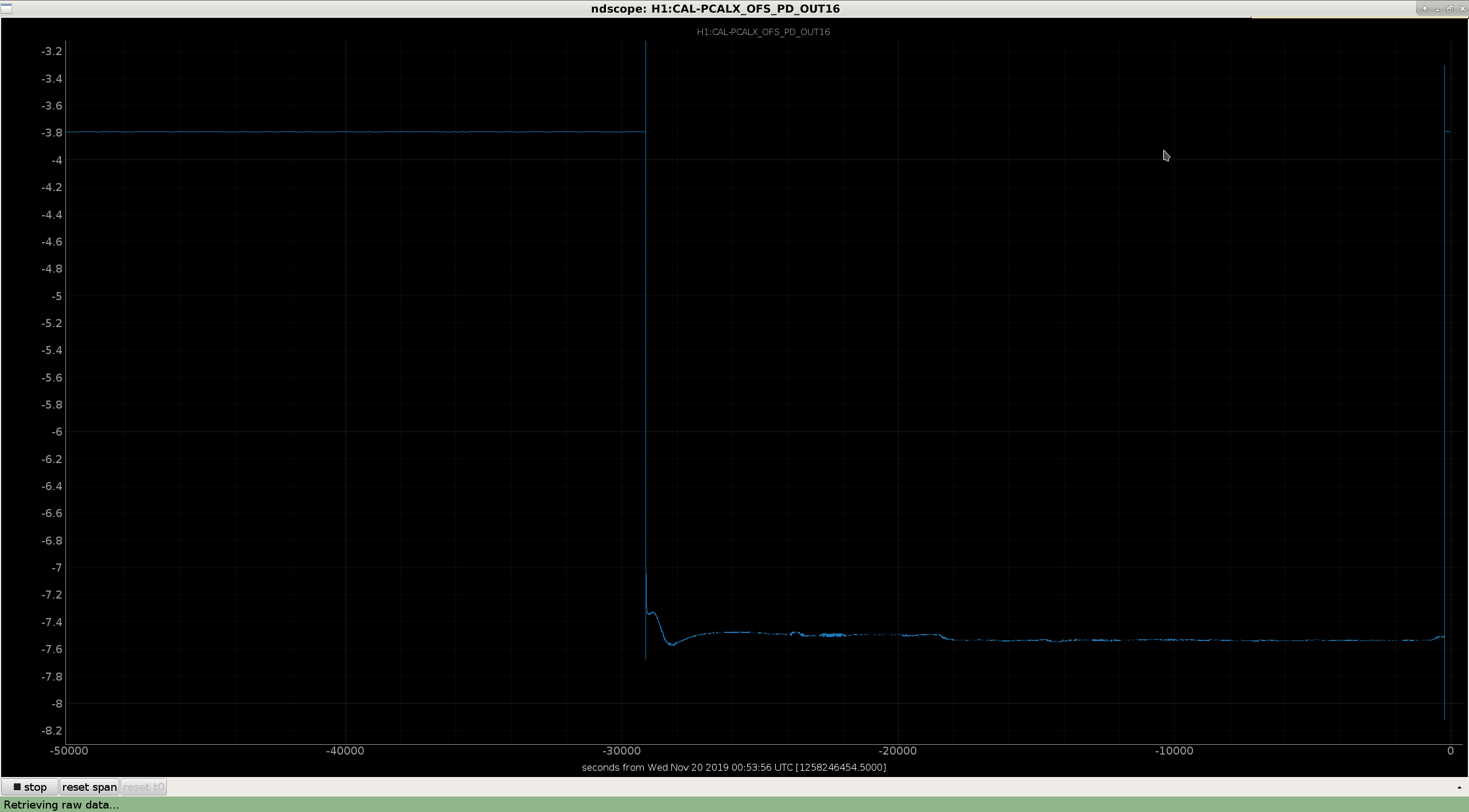
8.3 hours ago PCAL X saturated.  I flipped the optical follower servo on and off to fix this.
We should monitor the optical follower servos to make sure they aren't railed.

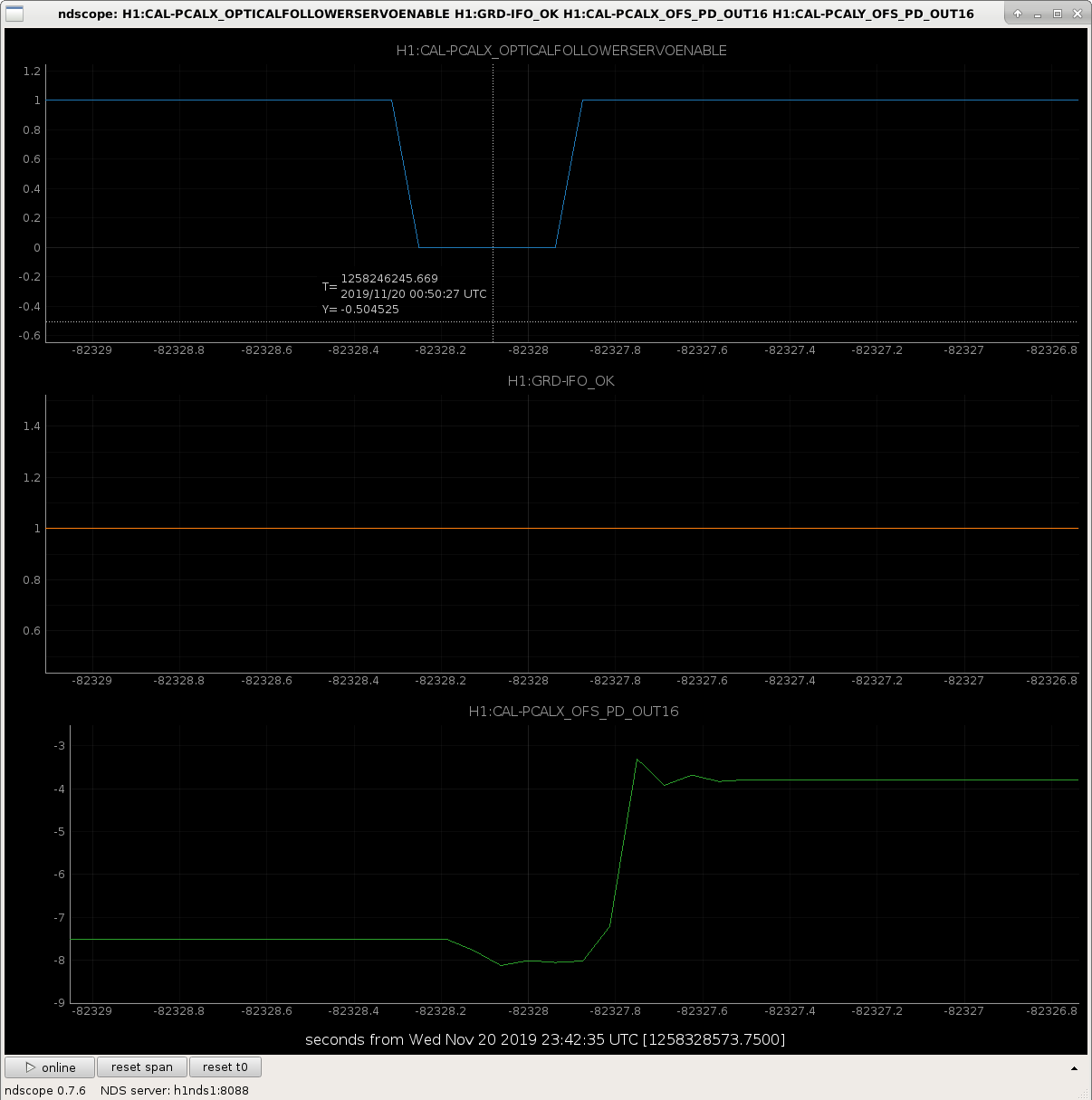
Notably, this switch-flipping did not knock us out of Observe, although it probably should have.
J. Kissel, T. Shaffer

The exact time at which Craig flipped the switch is 1258246245.4 and flipped the switch back 1258246245.8 within the second of Nov 20 2019 00:50:27 UTC. That should be roughly when the broadband, 1/f^2 in displacement glitch occurred.

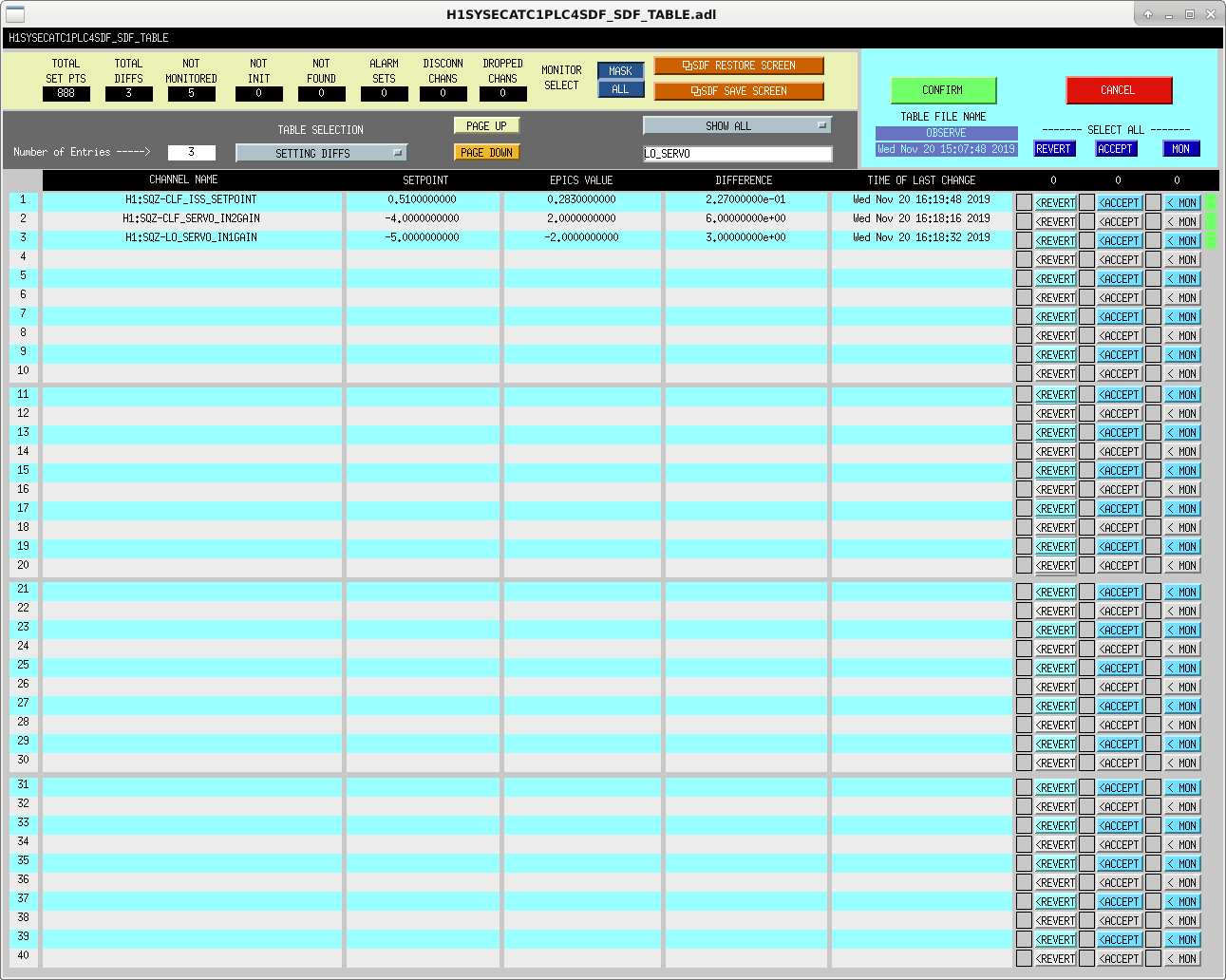
See attached screen shot, which shows that flipping this switch, which is on h1sysecatx1_pl3, doesn't take us out of observing. IT SHOULD.
This is under investigation.

Also, we should write a DIAG_MAIN check that checks whether the OFS is saturated, for both PCALs.
This is under construction.
I wrote a test in DIAG_MAIN to check this for both PCAL X & Y. I had to improve the StaticTester class to look for greater than or less than values rather than just static, a welcomed improvement for future tests.
If Operators get a "PCAL (X/Y) OFS servo malfunction" notification on DIAG_MAIN:
Toggling the OFS loop should fix it. This is found as the orange toggle switch in the respective PCAL screen, or the channel H1:CAL-PCALX_OPTICALFOLLOWERSERVOENABLE
I'm still very confused why the DIAG_SDF did not show a difference when this happend. The guard log shows a difference for sysecatx1plc3 a handful of hours before this happened, so we know it is being monitored. The snap file should have been in observe because ISC_LOCK switches them as we get to NLN. No idea why it wouldn't have flagged it.
It seems that the range drop which happened on Friday is closely realted to the range drops we had been seeing before Daneil and Nutsinee lowered the CLF power (see comments on 52984)
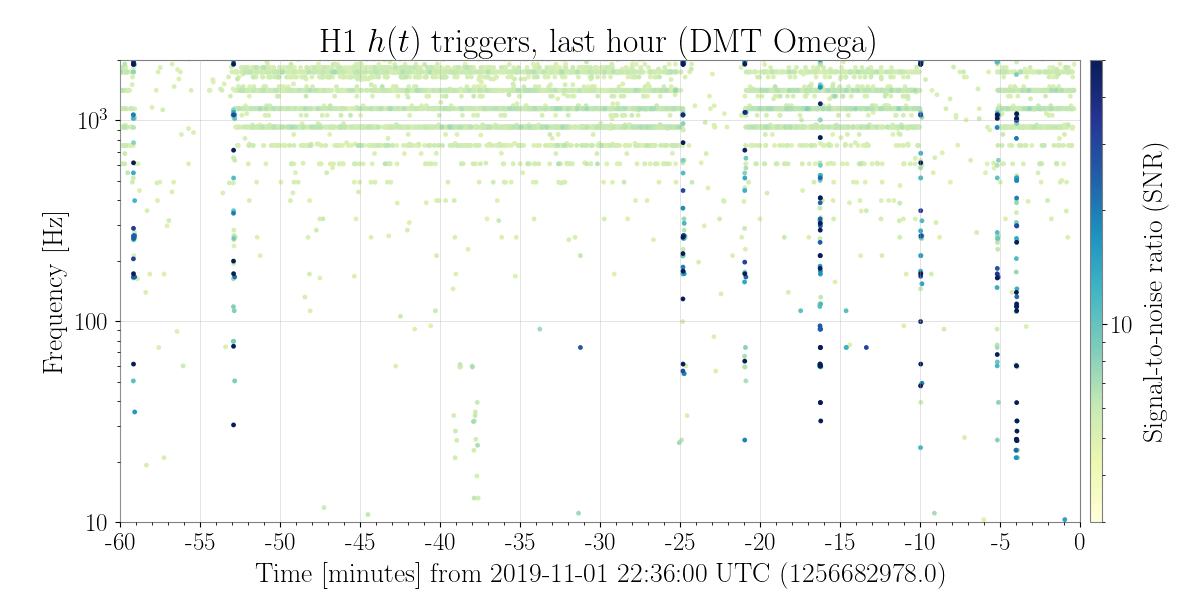
We still see the distinctive low SNR lines of high frequency glitches in the control room glitch monitor, (although they seem less loud now), which previously were shown to go away when the squeezer was blocked (image) It seems that our glitch rate since friday has been just about 1/second of SNR 5 glitches, which is a bit lower than what we saw previously when the range dropped, but higher that the previously quiet state (compare today to Nov 8)
Since the CLF was lowered Nov 8th, we have continued to see a correlation of jumps in the now disconnected channel H1:ISC-RF_C_SQZAOM200M_OUTPUTMON and range jumps, although it isn't a consistent relationship (similar to what was seen in 53096) The attached screenshot shows that there was a change in the behavoir of this channel friday during the time when the range dropped and it has been more stable since then (but seemingly stable in the state that is correlated with worse shot noise in the IFO).
Some tests we could think of trying would be to lower the CLF power, adjust the waveplate to keep the CLF power the same while changing the AOM drive, or disabling the ISS on the CLF.
Any insights from hveto, lasso, or other detchar people and tools could be helpful.

After yesterday's maintence time the range has been back in the 117 MPc range (front end range which is a bit higher than GDS), and the behavoir of the monitor channel for the removed 200MHz driver is still related to the range. (Screenshot attached).
Comparig the glitch rate on the summary pages for today and yesterday shows that the glitch rate is again reduced when we are in the lower range state.
Yesterday durring the maintence window Richard and I went to the racks to attempt to understand better what this channel could be connected to. We didn't do anything that should have had an impact. We did find that there were BNC T's left in the drive input channels for both of the AOM drivers used for itensity stabilization. We removed these and replaced them with the right adapters, but this should not have any impact.
Mark also spent some time trying to understand where this channel is coming from, (H1:ISC-C_RF_SQZAOM200M_OUTPUTMON), no real clues came from that.


04:43 Injection ended
4:44 Set SEI_CONF back to WINDY after realizing it was still set to EARTHQUAKE.
06:30 Second Transient Injection detected