Displaying reports 37421-37440 of 89133.Go to page Start 1868 1869 1870 1871 1872 1873 1874 1875 1876 End
Reports until 08:16, Saturday 16 November 2019
H1 General
camilla.compton@LIGO.ORG - posted 08:16, Saturday 16 November 2019 - last comment - 09:16, Saturday 16 November 2019(53291)
Shift transition to DAY

TITLE: 11/16 Day Shift: 16:00-00:00 UTC (08:00-16:00 PST), all times posted in UTC
STATE of H1: Lock Acquisition
OUTGOING OPERATOR: Jim
CURRENT ENVIRONMENT:
    SEI_CONF state: WINDY
    Wind: 4mph Gusts, 2mph 5min avg
    Primary useism: 0.02 μm/s
    Secondary useism: 0.41 μm/s
QUICK SUMMARY: Have been out of lock for 9h38. Jims log  53289  explains the trouble he was having. I will try again.

Comments related to this report
camilla.compton@LIGO.ORG - 08:23, Saturday 16 November 2019 (53292)
IMC_LOCK has the notification in it's log: IMC WFS not centered
which does seems to line up with Jeff's 50920 alog as Jim pointed out, though there doesn't seem a simple solution.
I'm also concerned that we have a full saturation for OM1 (attached image), although this could be normal on lockloss??
Images attached to this comment
camilla.compton@LIGO.ORG - 09:16, Saturday 16 November 2019 (53293)

After speaking on the phone to Sheila, found that the OM2 filters were off. After turning them back on we have finally got past DRMI! Hopefully this has solved the problem.

H1 ISC
jim.warner@LIGO.ORG - posted 02:40, Saturday 16 November 2019 - last comment - 09:41, Saturday 16 November 2019(53289)
DRMI locking being hindered by bogus IMC guardian message?

Still trying to get locked after Niko left, but being stopped by some weird issues. First was an OM1 trip at during I think DRMI asc offload, IFO stayed locked for a bit while I tried to figure out where to clear histories because all of the OMs were railed.

After that, I couldn't move past DRMI at all. The buildups were gradually degrading through several attempts to get DRMI, and each time ISC_LOCK would get stuck after DRMI or PRMI initial acquisition, then refuse to move on simply reporting "IMC_LOCK has notification". When I looked at IMC_LOCK, it didn't seem to have any such notification.

After multiple rounds of that, I'm trying to run initial alignment, but that is starting to look equally fruitless. The input alignment state seems to be hanging, saying ALIGN_IFO has notification. But ALIGN_IFO seems to be waiting for the input to a DC YAW loop to come on. This has continued through a number of steps in initial alignment, and the only way I've been able to move on is by manually selecting the the next offload state. This is probably all wrong. 

Initial alignment is "done", so back to locking. With an incoming earthquake. Oy.

Comments related to this report
jim.warner@LIGO.ORG - 04:07, Saturday 16 November 2019 (53290)

ISC_LOCK continues to move on from DRMI acquisition. The only clue I have are some alogs ending with Jeff's comment here, some related alogs it points to and FRS 5109. It's called alternately a red herring and occasional issue, but other than some wfs system that doesn't seem to be implemented, I don't see a solution. Seems like the IMC WFS need to be better centered, but I can't figure out how. Can't proceed past DRMI and can't seem to find a solution. 

sheila.dwyer@LIGO.ORG - 09:41, Saturday 16 November 2019 (53294)

The IMC WFS message is a red herring, the gaurdian is just giving that as a warning occasionally that we are off center, but it doesn't wait for the IMC WFS.  It looks like in a couple of the cases, ISC_LOCK was waiting in ACQUIRE_DRMI_1F for the DRMI guardian, ISC_DRMI was stuck in the DC centering state.  This is trying to center the AS + REFL WFS before turning on the DRMI ASC, which it couldn't do because the outputs of those filters were off.  With those off center the DRMI ASC won't work, which would cause locklosses if we moved on to DRMI_ASC.  So the guardian was doing the right thing, the problem was that the outputs were off.  

H1 General
yannick.lecoeuche@LIGO.ORG - posted 00:03, Saturday 16 November 2019 (53288)
Shift Summary - Evening

TITLE: 11/15 Eve Shift 00:00 – 08:00 (16:00-00:00), all times posted in UTC

STATE of H1: Locking

INCOMING OPERATOR: Jim

SHIFT SUMMARY: Very quiet shift until sudden lockloss at 07:33. One lockloss from PREP_DC_READOUT_TRANSITION

LOG:

07:33 (23:33) Sudden lockloss. Unsure as to cause.

08:00 (00:00) Lockloss from PREP_DC_READOUT_TRANSITION

H1 General
yannick.lecoeuche@LIGO.ORG - posted 00:02, Saturday 16 November 2019 (53287)
Re-locking notes (so far)

Green arms locked without issue

IR was not found, had to adjust ALS_DIFF

DRMI locked without issue

CARM Reduction States ran without issue

Lockloss from PREP_DC_READOUT_TRANSITION

H1 SEI (PEM, SYS)
hugh.radkins@LIGO.ORG - posted 17:18, Friday 15 November 2019 (53286)
Wind Fence Build Update--Concrete is complete!

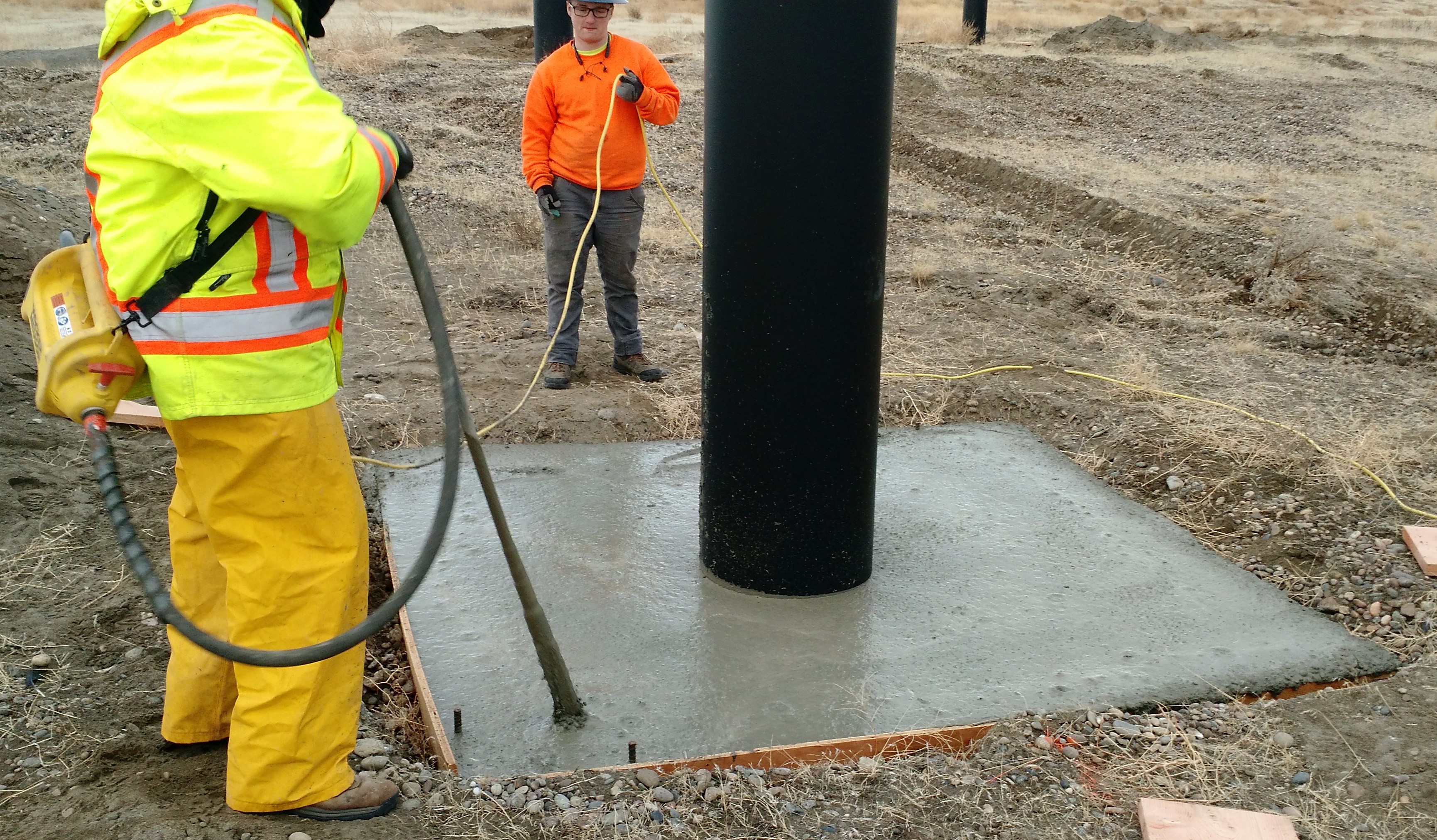
We hope this means future build noise will be much less but there will be genie man-lift work as the hardware and fabric are installed over the next few days.

Attached image collar now filled with concrete.

Images attached to this report
LHO General
kyle.ryan@LIGO.ORG - posted 16:44, Friday 15 November 2019 (53285)
Beam tube overpass weight limit

Marc P., Tyler G., Kyle R.

During lunch today, a driver of one of the multiple concrete delivery trucks came into the multi-purpose room where we were eating and asked us where he was supposed to make his delivery -> I phoned the control room and confirmed that it should be at the X-end (at that time, later deliveries were made to the Y-end).  In the 1/2 hour prior to this driver's inquiry, we had observed other trucks heading down the X-arm but I wanted to confirm with the CR.  The driver mentioned something about attempting to use the beam tube overpass road initially but that he had noticed the 20 TON limit signage.  We clarified that he could get to his location by following the X-arm 2 1/2 miles all of the way to the end building etc...

Marc P. suggested that we immediately place traffic cones at the entry point of the overpass so as to prevent further confussion, which we did. 

Later, I noticed "75,000 GVW" marked on the side of one of these trucks. 

H1 General
jeffrey.bartlett@LIGO.ORG - posted 16:16, Friday 15 November 2019 (53284)
Ops Day Shift Summary
Ops Shift Log: 11/15/2019, Day Shift 016:00 – 00:00 (08:00 - 16:00) Time - UTC (PT)
State of H1: Locked at NLN, with 105.6Mpc of range
Intent Bit: Observing
Support: N/A
Incoming Operator: Niko
Shift Summary: IFO broke lock twice during the shift mostly due to wind fence activity. It took many tries to relock from the second lockloss. The cementing of the poles for the wind fence is finished at both ends. The crews may have some more cleanup but the pole and cement work is finished.
Microseism is still high (0.6um/s) but is in a downward trend.  
 
Activity Log: Time - UTC (PT)
16:00 (08:00) Take over from Jim
17:16 (09:16) Lockloss – Possible wind fence activity at End-X
17:20 (09:20) Kyle & Chandra – Going into LVEA to change some valves of the instrument air
17:23 (09:23) Richard – Going to End-X
17:38 (09:38) Kyle & Chandra – Out of the LVEA
18:33 (10:33) Relocked and back to Observing
19:15 (11:15) Two tours of the control room
20:00 (12:00) Lock loss – High microseism and heavy trucks working on wind fence at End-X
20:09 (12:00) First cement truck on site and going to End-X
20:24 (12:24) Start pumping cement at End-X
20:35 (12:35) Second cement truck on site and going to End-X
20:55 (12:55) Third cement truck on site Going to End-X
21:15 (13:15) Mechanic truck on site going to End-X to repair contractor’s truck
21:35 (13:35) Fourth cement truck on site and going to End-X
21:43 (13:43) Timesh – Going to End-X to check on NCal stuff
21:54 (13:54) IFO relocked
21:57 (13:57) Back in Observing
22:02 (14:02) Fifth cement truck on site and going to End-Y
22:23 (14:23) Sixth cement truck on site and going to End-Y
23:48 (15:48) Last of the cement trucks going down End-Y
00:00 (16:00) Turn over to Niko

  

H1 General
yannick.lecoeuche@LIGO.ORG - posted 16:15, Friday 15 November 2019 (53283)
Ops EVE Shift Transition

Ops Shift Transition: 11/15/2019, Eve Shift 00:00–08:00 (16:00-00:00) - UTC (PT)

State of H1: Locked

Intent Bit: Observing

Weather: 0-5 mph wind

Primary 0.03 – 0.1Hz: 0.01 um/s

Secondary 0.1 – 0.3Hz: 0.15 um/s

Outgoing Operator: Jeff

Quick Summary: Locked and Observing for two hours. Wind fence trucks starting to leave EY.

H1 SQZ (SQZ)
lee.mcculler@LIGO.ORG - posted 15:04, Friday 15 November 2019 (53280)
Speculative source of CLF related noise

Following the discussion on the ISC call, there was a question of mechanisms to generate or propagate 3.125MHz noise out of the interferometer that the AS port has over vacuum. I remember that the themal noise of bulk modes in the optics can reach up to rather high frequencies. While the arms are the usual place to look, they aren't a great lead for the 3.125MHz since that won't resonate, but MICH sensing is still likely plenty sensitive to see bulk modes of the ITMs, in fact with 4kW in MICH it is more sensitive that the 2kW in the Holometer experiment interferometers. Those were 2kW power recycled Michelson interferometers (no arm or signal recycling cavities). Take a look at the AS port RF spectrum of that instrument.

HOLO_T0_thermal.png

The green is the shot noise. The red is the ASPD cross correlation over ~100 Hours, ~400Hz bin-width. Note that there are plenty of spots ABOVE shot noise and and almost everywhere the noise is above vacuum (even if below shot noise).
The peaks are separated by some 230kHz, which is longitudinal-mode frequency separation of the 0.5"-thick optics used in the Holometer. See section 6.5 of Class. Quantum Grav. 34 065005 for more details related to this plot.
 
So the question is if a similar mechnism could explain noise at 3.125MHz coming out of the AS port in the LIGO IFO. The MICH degree of freedom still has ~1e-18m/rtHz sensitivity at the AS port. Actually, it may be decently better than that, since the SRCL cavity is resonant above the cavity pole (antiresonant below, for signal extraction), I believe it should enhance the MICH sensitivity at the CLF frequency (haven't checked yet though).
 
What is the mode density of the test masses? Maybe a higher CLF frequency could get above them. The magnificantly high Q's of the ITMs means the lines will be narrower and higher (more resolvable), potentially enough to offset the 700x larger mass of the testmasses vs 2" optics shown above. The larger optic size also means they will be much more dense as well. I'll have to do a more accurate comparison of the sensitivities. Perhaps we are unlucky and right in a forest of modes (we should see it in the LO error spectrum if there are unexplained lines are the right spacing for the test-mass modes). With 20cm thick ITMs, the longitudinal bulk mode is
14.750kHz and the CLF 3.125MHz modulo 14.750kHz is -2kHz (so the 211th longitudinal mode is at 3.11225MHz), which means that the CLF is actually pretty far and must be in the forest of mixed longitudinal+HOM frequencies. Since mixed-mode frequencies add in quadrature, the mode density is quite high at MHz, as seen in the attached plot. While the OMC cleans up the mechanical->optical HOMs, the fact they show so readily in other fringe-offset Michelsons indicates there is likely enough overlap with the carrier 00 that the OMC won't fully clean them out.
 
If these lines are there and large enough, they could also inject effective phase noise, which should diminish with higher CLF power injection as the bulk-thermal noise lines are overpowered in the RF3 demod.
 
This is a bit of a crazy idea, but maybe not unreasonable to look into further. We are likely looking for a broadband noise that this wouldn't explain unless the mode density is truly high, but given that the CLF related noise is only shown to be a few percent on range, it could be a set of weak narrow lines. Long integrations/cross correlations at different CLF powers might resolve changing line features. Moving the CLF  may also change things (minding where the arm notch lands).
Images attached to this report
H1 General
camilla.compton@LIGO.ORG - posted 14:41, Friday 15 November 2019 (53279)
H1 Lockloss
19:51 Lockloss due to Truck with concrete boom moving around the back of EX
19:58 Lockloss #2 at LOCKING_ALS
20:00 Lockloss #3 at LOCKING_ALS
20:04 Attempting Initial Alignment
20:09 1st Concrete truck on site
20:24 Concrete flowing
20:27 Initial Alignment Complete
20:30 Lockloss #4 at LOCKING_ALS
20:38 2nd Concrete truck on site
20:51 Lockloss #5 at CARM_TO_ANALOG (happened exactly when concrete truck 2 went behind EX)
20:58 Lockloss #6 at ENGAGE_DRMI_ASC
21:00 3rd Concrete truck on site
21:00 Lockloss #7 at LOCKING_ALS
21:03 Lockloss #8 at LOCKING_ALS
21:05 Lockloss #9 at LOCKING_ALS
21:10 Lockloss #10 at LOCKING_ALS
21:14 Lockloss #11 at LOCKING_ALS
21:20 Lockloss #12 at ENGAGE_DRMI_ASC exactly when truck begins moving at EX
21:38 4th Concrete truck on site
21:54 NLN
21:57 Observing!!
H1 General (DetChar)
grace.johns@LIGO.ORG - posted 12:43, Friday 15 November 2019 (53277)
DQ Shift Report for November 1 to November 3 2019

Full DQ Shift Report can be found here: https://wiki.ligo.org/DetChar/DataQuality/DQShiftLHO20191028


Images attached to this report
H1 General
jeffrey.bartlett@LIGO.ORG - posted 12:21, Friday 15 November 2019 (53278)
Ops Day Mid-Shift Summary
Camilla & Jeff B. 

   Two lock losses so far this shift. Both are related to the elevated microseism and wind fence activity at End-X. At the commissioners request, Camilla is running an initial alignment to see if we can improve the range a bit. Will try relocking when Initial Alignment is complete. 

  
H1 DetChar (DetChar, Lockloss, SEI, SUS)
timesh.mistry@LIGO.ORG - posted 11:03, Friday 15 November 2019 (53272)
H1 Lockloss at 17:16 UTC

Shiela, Arnaud, Timesh

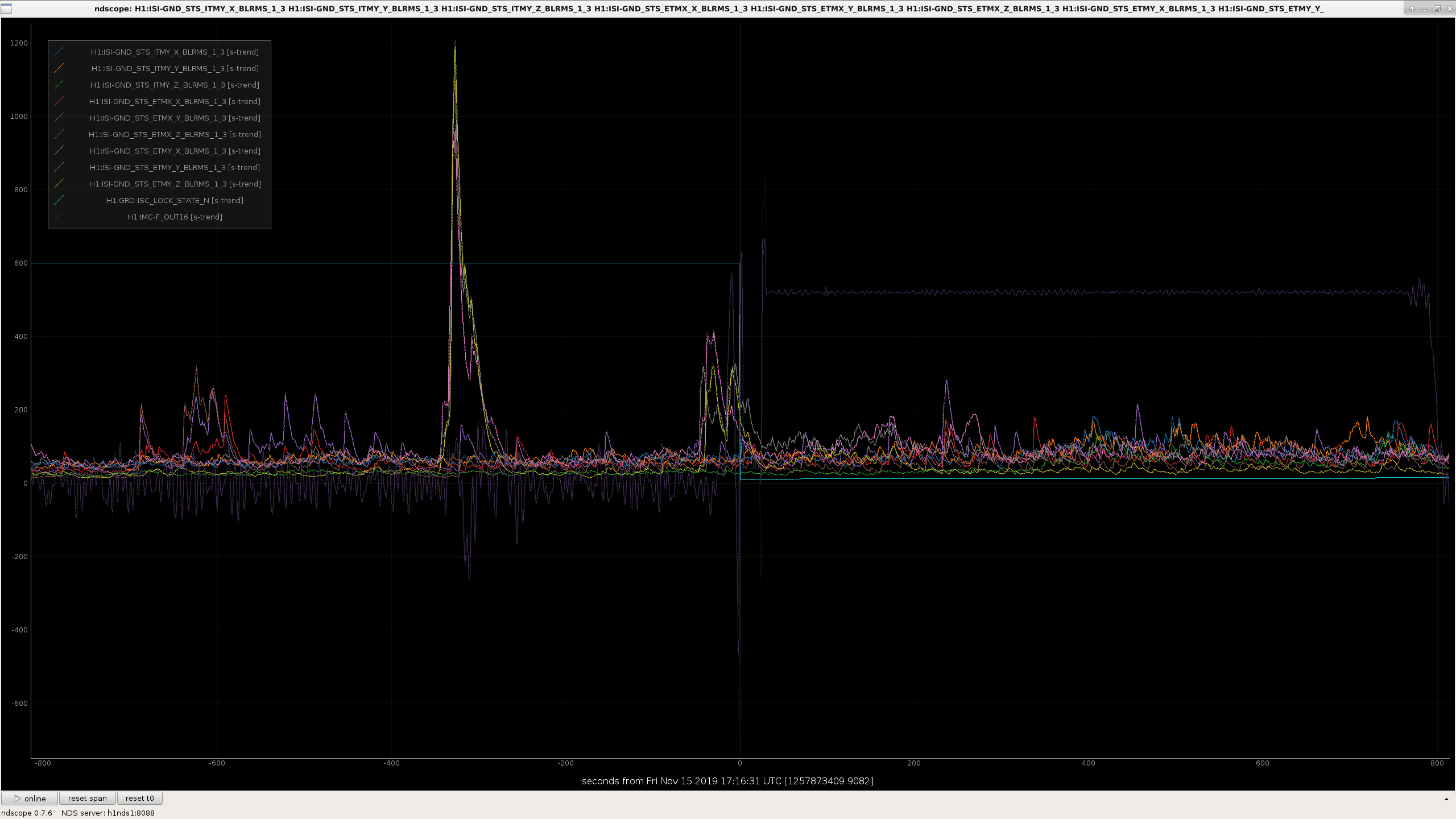
The lockloss at 17:16:32 UTC appears to have been caused by ground motion at the Y end. We see that in the H1:ISI-GND_STS_ETMX_Y_BLRMS_1_3 seismometer, there are multiple peaks in the time series amplitude indicating increased ground motion at the Y end. As a result, H1:IMC-F_OUT16 became unstable and the lockloss occurred. We think this could be attributed to the wind fence installation that is currently being undertaken at the Y end. 

It appears that during periods where there are spikes in the 1_3 BLRMS, the IMC-F responds i.e there is some correlation between loud events at the end station seismometers and the IMC-F.

The NDSCOPE attachment shows the timeseries of the IMC, Lockstate, 10_30 STS BLRMS and the 1-10 STS BLRMS around the time of the lockloss.The y axis units are nanometres per second.

Images attached to this report
H1 CAL (CAL)
timesh.mistry@LIGO.ORG - posted 10:12, Friday 15 November 2019 - last comment - 10:48, Friday 15 November 2019(53274)
NCAL Update -- Encoder Powered Off and NCAL Beckhoff turned on
[Vlad, Fil, Timesh]
 
So since the Noise in EX didn't go away (see LHO alog 53242). Apparently they powered down the NCAL motor, but not the data encoder that goes into the ADC. The ADC is where we see our noise. Vlad and Fil went down to EX and had this encoder fully powered down and disconnected, at about 0935 local time (so 1735 UTC).
 
This will also mean that the is currently no data avaiable from this time in the frames for H1:CAL-NCALX_ENCODER_VELOCITY_OUT_DQ
Comments related to this report
filiberto.clara@LIGO.ORG - 10:48, Friday 15 November 2019 (53276)

Encoder power was switched off at the BRS rack. The encoder cable going into the AA chassis was disconnected in the electronics bay.

LHO VE (DetChar, PEM)
chandra.romel@LIGO.ORG - posted 09:13, Friday 15 November 2019 - last comment - 15:19, Friday 15 November 2019(53271)
instrument air

We left the air compressor (in chiller yard) off and valved out all night, with only the compressed N2 bottle feeding the four pneumatic gate valves in corner station. This morning the bottle pressure is quite low i.e. consumption/loss is high. We have some ideas to improve this but need LVEA access first.

At 8:36 am (16:36 UTC) I turned air compressors back on and valved in to corner building (but not LVEA). Before we start receiving alarms on PT199, I will valve back into LVEA, and request DetChar to look at data again to confirm correlation between noise and air compressor turned ON/OFF, but not valved into LVEA.

Nov. 14 (UTC - locked)

18:01 - turned compressor OFF

Nov. 15 (UTC - locked)

0:12 UTC - turned compressor ON

1:30 UTC - turned compressor OFF

16:36 UTC - turned compressor ON

17:26 UTC - valved in compressor to LVEA (after losing lock)


Comments related to this report
chandra.romel@LIGO.ORG - 09:54, Friday 15 November 2019 (53273)

With bottle pressure falling fast (300 psig), we valved in air from compressor to LVEA at 9:26 am local (17:26 UTC). Spreadsheet attached.

Kyle and I entered LVEA during lock loss to adjust valve pressure regulators. GV7 will not rise beyond 60 psig. The others match the supply (~66 psi). Next opportunity we will squirt SNOOP at joints to leak hunt.

Non-image files attached to this comment
vladimir.bossilkov@LIGO.ORG - 15:19, Friday 15 November 2019 (53282)

I've translated Chandras changes into times where we see things in gw-strain, and what we see in accelerometers.

So the accelerometers [second attachment] don't seem to care if the Compressor is valved out.

In the GW-strain we see something when you turned the compressor on at 00:12 UTC, until it was turned off; But then when you turned it on for the second time, I can't conlcusively say we see something. Our range is a bit low right now, so maybe we are just a bit more noisy than usual and the noise peak is buried below that.

Images attached to this comment
H1 General (SUS)
arnaud.pele@LIGO.ORG - posted 20:48, Thursday 14 November 2019 - last comment - 14:34, Friday 15 November 2019(53264)
Comparison temperature stability H1/L1

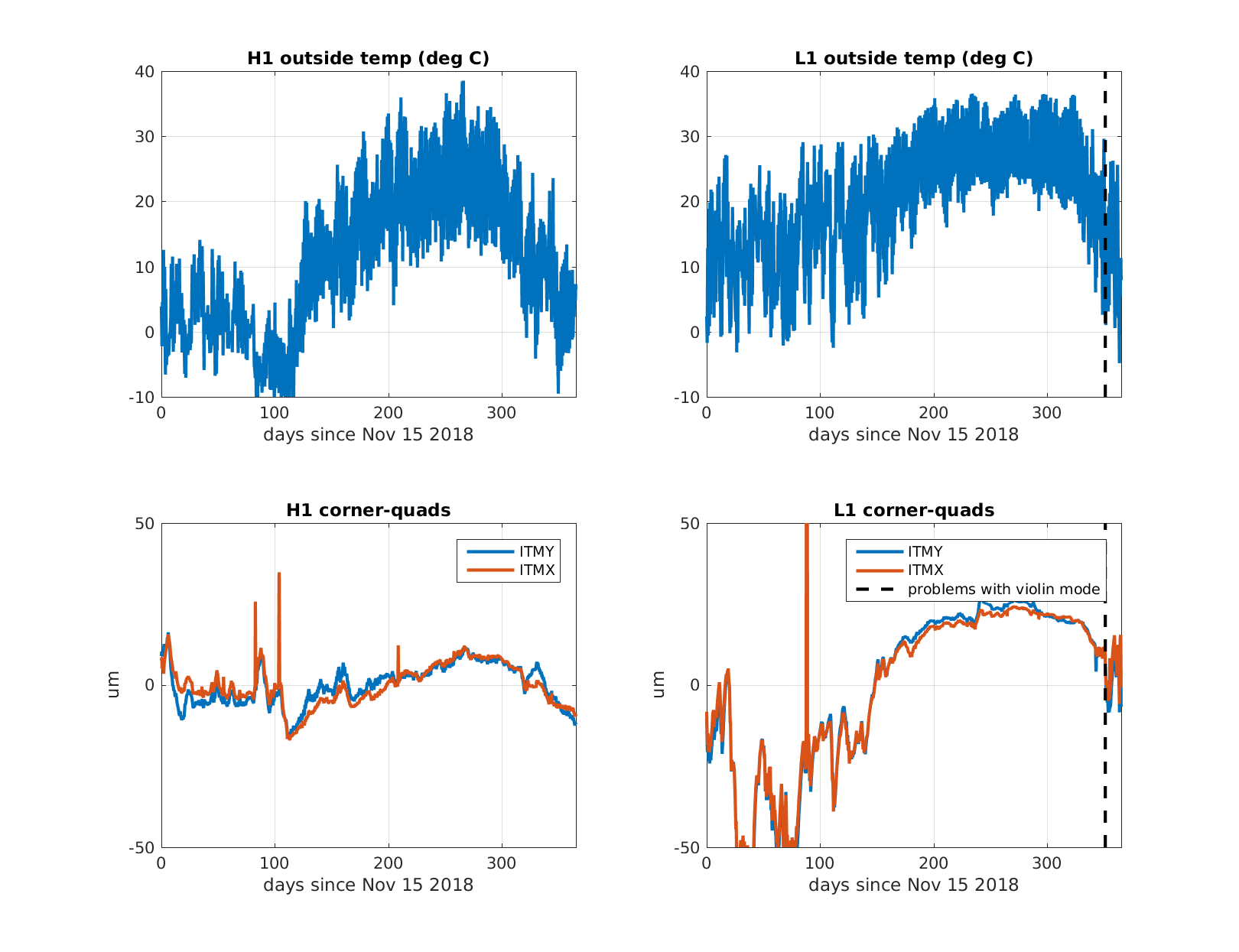
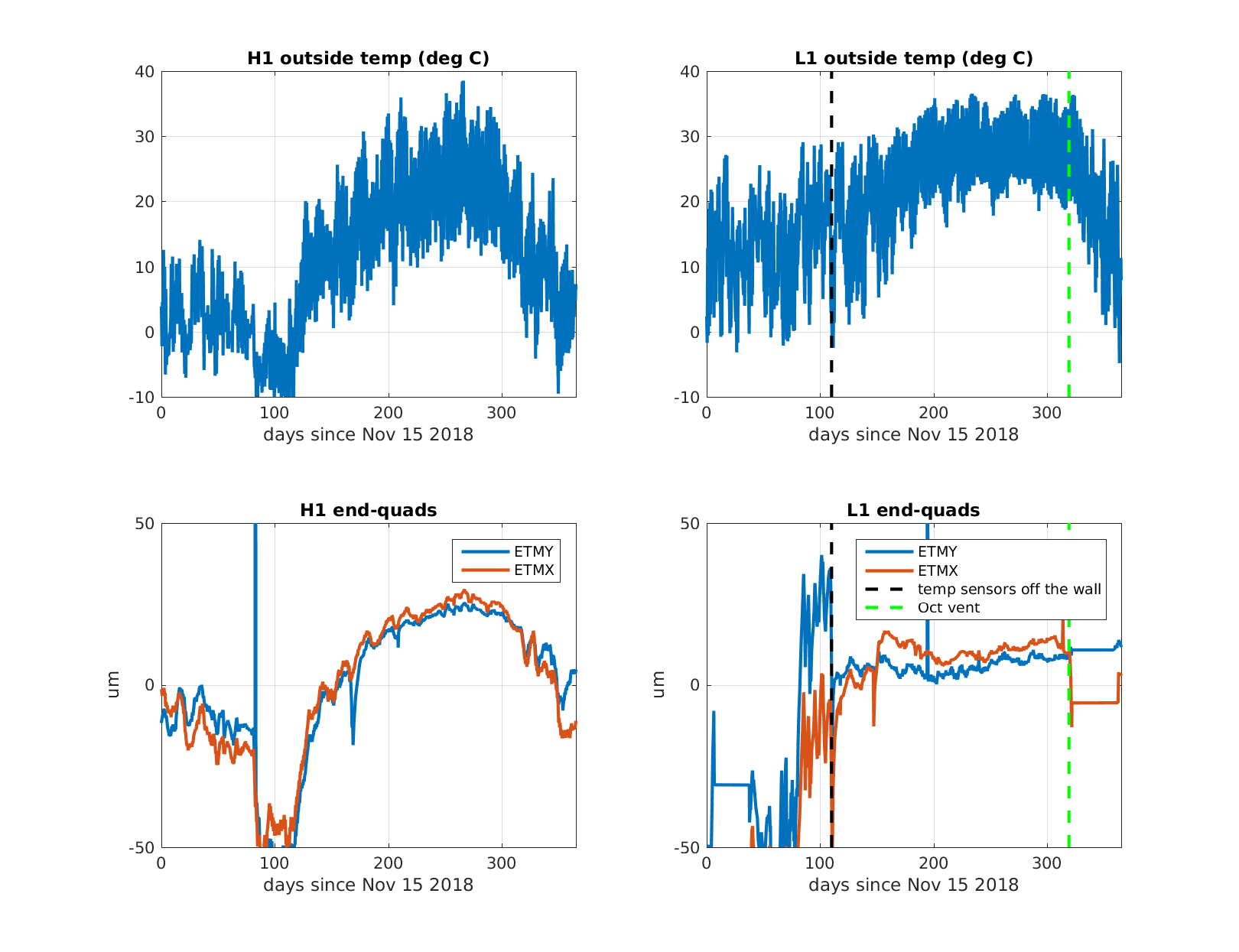
I compared one year of temperature stability of the two LIGO facilities using the quadruple suspension blades sag as a proxy for changes in building temperature.
The first figure shows the corner station data, the second figure the end stations.
The LHO corner station looks more stable than LLO, whereas the LLO ends (after the temperature sensors were moved away from the walls) look more stable than LHO.
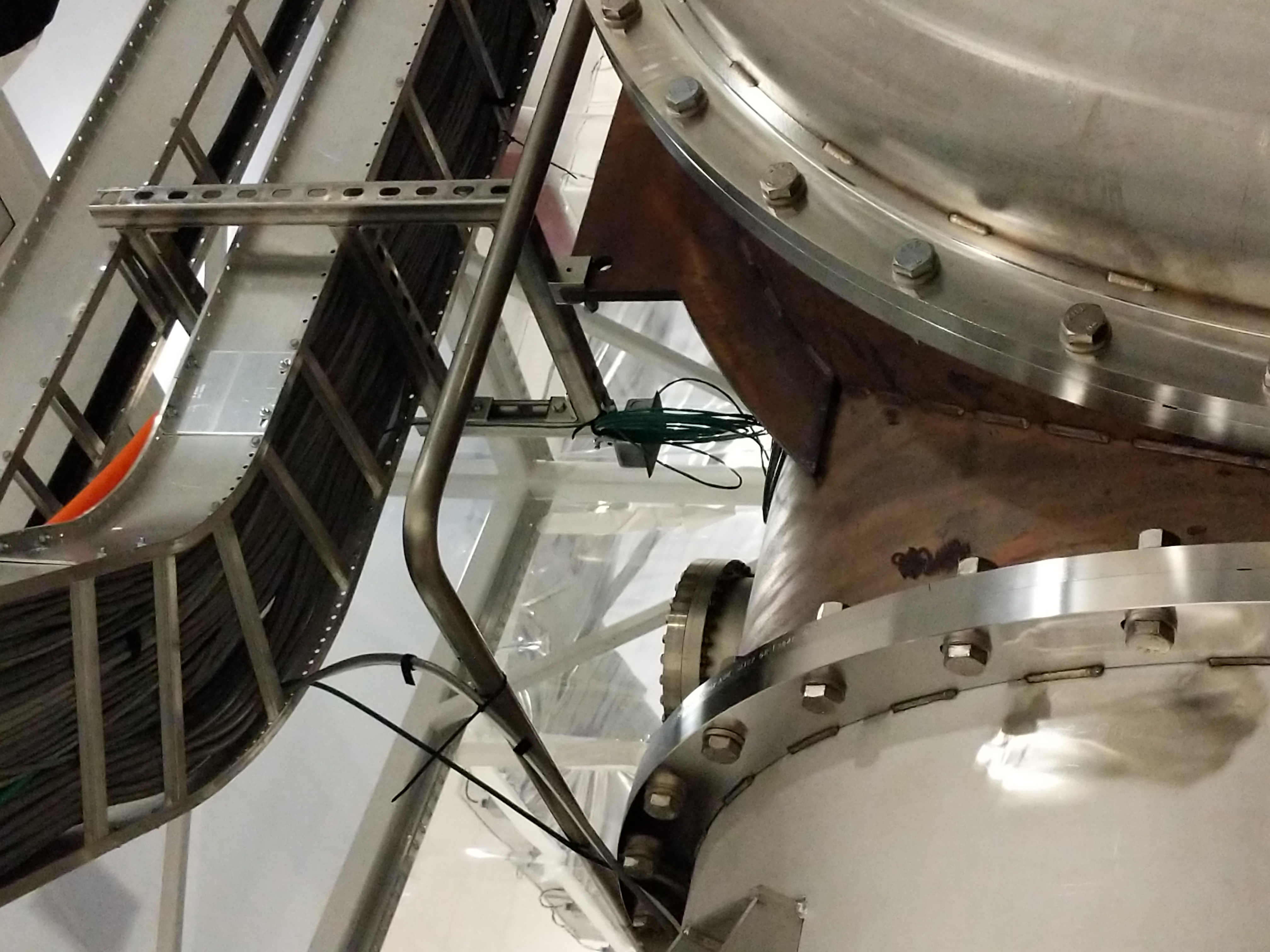
I am reviewing how LHO controls their corner temperature so LLO could benefit from their stability. My understanding so far is that several of the in-loop temperature sensors are located on top of the beamtube (see picture attached for the HAM5 temperature sensors for instance). It is not yet clear to me how many sensors are used in-loop for the LHO corner station, and if any still from the wall sensors. At LLO we use all 34 wall sensors and do not have sensors near the chambers.
LHO could certainly improve the end stations temperature by moving the sensors away from the walls. Robert mentioned at last commissioning meeting this was a planned upgrade. A picture of the newly placed LLO end stations sensors is shown in this alog.

Images attached to this report
Non-image files attached to this report
Comments related to this report
arnaud.pele@LIGO.ORG - 14:34, Friday 15 November 2019 (53281)

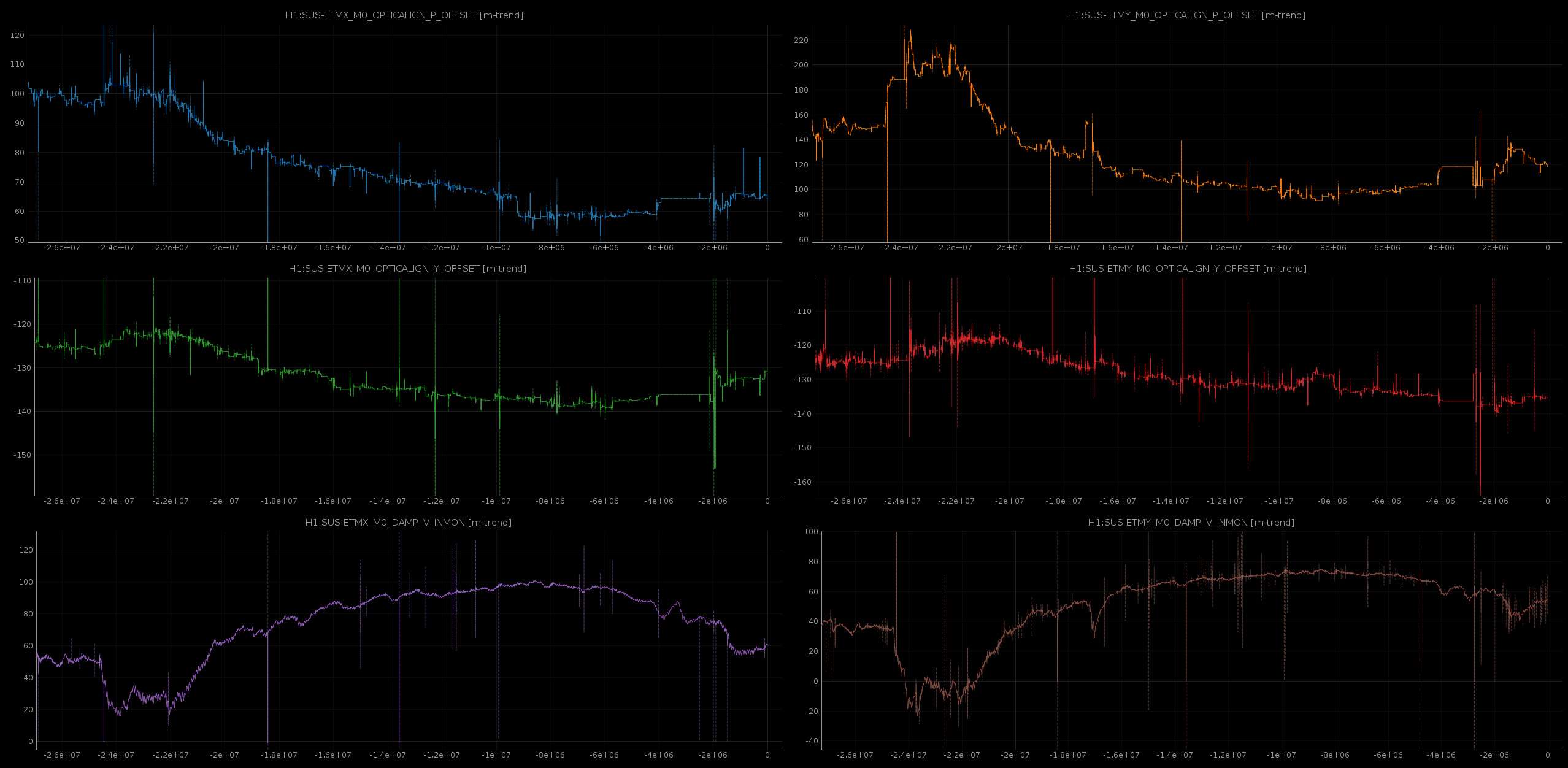
Regarding LHO end station, we can see the correlation between the change in alignment over the year and the vertical sag.
Most of the angular drift is in pitch, similarly as what we saw at LLO.
For similar sag between EX and EY, it looks like EY pitch is roughly 2 times more sensitive to vertical drift/temperature changes than EX.

Images attached to this comment
Displaying reports 37421-37440 of 89133.Go to page Start 1868 1869 1870 1871 1872 1873 1874 1875 1876 End