Took advantage of the quiet time at the end of the day to change the gauge at top of HAM6. No problems to report during the installation of the new gauge.
Issue report per FRS ticket 10750, gauge still needs further testing to close such ticket.
Serial number of gauge removed 168.
Serial number of new gauge installed 217.
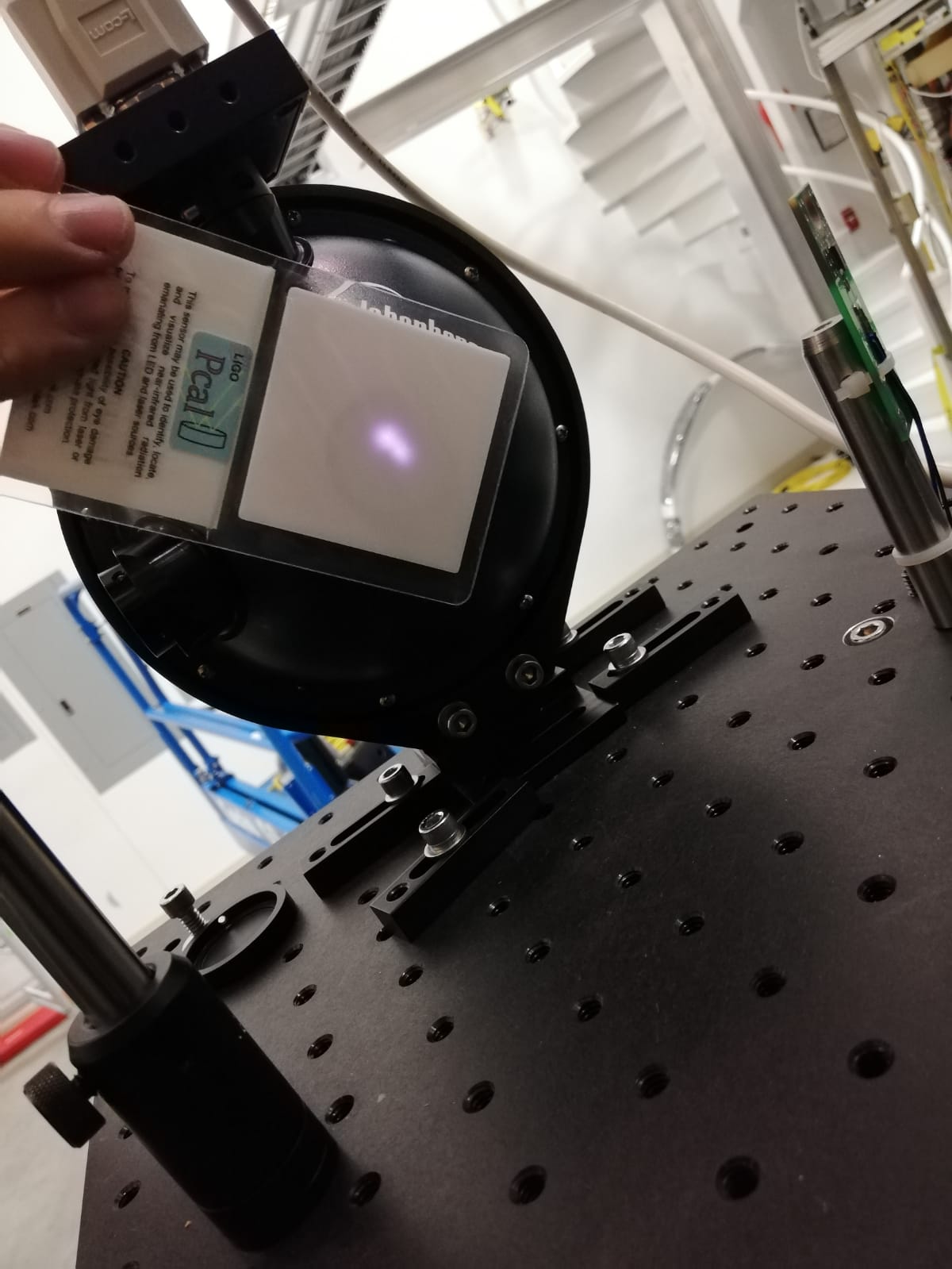
Rick, Ethan, Vladimir, Dripta On Tuesday we performed an EY end station calibration. The measurement procedure/log and a picture of the beam alignment on the RX integrating sphere aperture are attached. Looks similar to the spot position in alog 51106. Analysis of the calibration data seems in line with the last few calibration measurements we've performed.
TITLE: 10/01 Day Shift 15:00 – 23:00 (08:00-16:00), all times posted in UTC
STATE of H1: Planned Engineering
INCOMING OPERATOR: None
SHIFT SUMMARY: First day of commissioning month went well, finished all Trello items and started two items for tomorrow.
LOG:
14:57 (07:57) Bubba, Chris to LVEA -- finish HAM6 scaffolding
14:57 (07:57) Hugh to LVEA -- lock HAM6 HEPI
15:00 (08:00) Chandra to LVEA -- close GV’s
15:00 (08:00) Richard to LVEA -- close laser shutter, turning interlock keys for TCS, SQZ lasers
15:04 (08:04) Dripta to Pcal lab -- collect end station calibration equipment
15:06 (08:06) Fil to HAM6 -- help with cabling/rotate ISCT6
15:09 (08:09) TJ, Daniel to LVEA -- help with ISCT6 cabling
15:09 (08:09) Vanessa, Karen, Christina to LVEA
15:10 (08:10) Richard back from LVEA
15:10 (08:10) Richard to CER -- turn off HAM6 high voltage power supplies
15:17 (08:17) Richard back from CER -- ring heaters switched off, HAM6 HV off, ITM ESD HV off
15:21 (08:21) Chris, pest control to LVEA
15:29 (08:29) Fil to LVEA -- disconnect TCS, SQZ interlock cables
15:29 (08:29) Marc to LVEA -- assist with ISCT6 work
15:31 (08:31) Chris, pest control to MY, EY, MX, EX
15:36 (08:36) Hugh to LVEA -- check on HEPI HAM1 watchdog trip
15:37 (08:37) Richard to LVEA -- make sure rotation stage key is in lock
15:40 (08:40) Hugh back from LVEA
BSC7 SUS rack in bier garden has been moved
15:45 (08:45) Chandra to LVEA -- begin XB manifold vent
ISCT6 successfully moved
16:04 (09:04) Betsy to LVEA -- check on overall progress
16:08 (09:08) TJ to EY -- measure optics distances for HWS on ISCTEY table
16:14 (09:14) Ethan, Dripta to EY -- pcal end station calibration measurement
16:16 (09:16) Timesh to Optics Lab -- Ncal work
16:16 (09:16) Jason to Optics Lab
16:18 (09:16) EY VEA transitioning to laser hazard
XB manifold venting postponed while pressure gauges reset
16:31 (09:31) Betsy to LVEA -- finish walkthrough
16:43 (09:43) Nutsinee to SQZT6
16:45 (09:45) Jeff to LVEA -- check on progress
16:51 (09:51) Georgia, Jason to PSL enclosure -- ALS Bypass pickoff work
17:00 (10:00) Nutsinee out of LVEA
17:11 (10:11) TJ back from EY
17:11 (10:11) Richard out of LVEA
17:16 (10:16) Rick, Vlad to EY
17:23 (10:23) Fil out of LVEA
17:23 (10:23) Fil to EX -- survey for future BRS, Ncal work
Scaffolding work complete
17:34 (10:34) Jeff out of LVEA
Phone on at EY, green laser on
17:50 (10:50) Chris to LVEA -- move BSC 7,8doors to high bay
17:50 (10:50) TJ to EY -- retake measurements
18:03 (11:01) Pest control finished onsite
18:15 (11:15) Rick, Timesh to Optics Lab
18:41 (11:41) Hugh, Gavin to LVEA -- set up HAM6 HEPI steps, lock HAM5 HEPI
18:47 (11:47) Chris out of LVEA
18:50 (11:50) Fil back from EX
18:53 (11:53) TJ back from EY, EX
18:58 (11:58) Ethan, Dripta, Vlad heading back from EY -- EY VEA transitioned to laser safe
19:02 (12:02) Chandra out of LVEA -- BSC7 vent complete, HAM6 vent underway
19:15 (12:15) Jason, Georgia out of PSL enclosure
19:19 (12:19) Nutsinee to SQZT6
19:32 (12:32) Craig, Dan to LVEA -- put laser barriers up around ISCT1
19:33 (12:33) Nutsinee back from LVEA
19:33 (12:33) Nutsinee, Georgia to SQZ Bay -- hunt for components
19:58 (12:58) Nutsinee, Georgia back from SQZ Bay
20:08 (13:08) Gerardo to LVEA -- unplug hoses from North Bay/SQZ Bay
20:11 (13:11) Chandra to LVEA -- flatten spool and place C3 cover over BSC7
20:11 (13:11) Chris, Tyler to LVEA -- break HAM6 bolts
20:27 (13:27) Dripta, Vlad to Optics Lab -- drop off equipment
20:34 (13:34) Jeff to LVEA -- check on spool work
20:39 (13:39) Richard to LVEA -- find Fil
20:47 (13:47) Gerardo to MY -- look for tap handle
21:00 (14:00) Dripta, Vlad out of Optics Lab
21:02 (14:02) Betsy, Rahul to LVEA
21:02 (14:02) Jeff back from LVEA
21:14 (14:14) Gerardo back from MY
21:35 (14:35) Betsy to LVEA
21:48 (14:48) Tyler, Chris out of LVEA -- all bolts broken
21:53 (14:53) Richard, Daniel, Betsy to lVEA -- set up laser barriers around HAM6
23:02 (16:02) Sheila turning on HAM6 HV
{Bubba, Gerardo, Chris, Rahul}
Finished erecting safety railing around HAM 5 & 6 this morning to allow cleaning crew to climb on top of chamber. HAM6 and area have been wiped down for first pass cleaning. Second cleaning scheduled tomorrow morning.
(Kyle, Chris, Tyler)
Kyle trained Tyler how to close GVs while hard closing GV 2,5,7 and then vented HAM6. Tyler and Chris removed all but four bolts from north and east doors in preparation for door removal tomorrow morning.
{Bubba, Chub, Jordan, Chandra}
Hard closed GV 2 & 7 (and GV 5) to vent x-beam manifold volume, including BSC7 chamber, with purge air dew point measuring -37degC. We were able to remove all BSC7 flange bolts on the H2/+Y side, apply tension to four tie rods in the mating expansion spool, and remove all but four bolts on other spool flange. BSC7 and spool flanges are covered with C3 cloth with purge air flowing for contamination control and the spool is attached to overhead crane for secondary support.
We are deviating slightly from procedure (E1900259) and plan to remove the expansion spool first thing tomorrow morning to provide more work space for new door installation, rather than trying to slide the new door into 3" gap.
Cleaning crew <Christina, Karen, Vanessa> wiped BSC 7,8 area for contamination control. This activity relies on positive purge air and does not have a cleanroom over the workspace due to clearance conflicts.
IP6 is isolated and will remain so indefinitely.
Daniel, Marc, Nutsinee
Following ECR E1900262 we modified the currently installed homodyne (S1800623, circuit diagram D1300671) to have lower RF gain for the upcoming CLF power stabilization servo installation (E1900231). U11 has been replaced with LT6200CS8, R46 removed, and R48 replaced with 0Ohm resister. We sent in 0.2Vpp of 3.125MHz signal into the test input (gain = 18mA/V) and measured 151mV rms at RF2 OUT (213.5 mVpk). Taken into account a factor of 2 (50Ohms at the output) we have 427mV before U11. 0.1Vpk input corresponds to 0.18mA. Thus,
Transimpedance = 427mV/1.8mA = 237 Ohms.
According to the ECR we should have 2kOhms.
I wouldn't trust the test input too much for that. It wasn't re-engineered for the low 3.125MHz resonance. When it is on, a high pass capacitor is on the test injection input (an possibly inductance from transformer coupling, can't remember) and it detunes the RF circuit. The 3.125MHz tuning is particularly sensitive. It needs to be calibrated optically. Either use a modulated LED source (cross calibrated from a reference diode like a PDA10CS), or calibrate from the real CLF (the DC outputs are plenty sensitive to get the power level accurately).
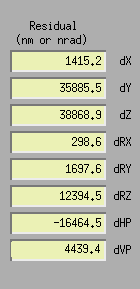
Here is the position residuals from nominal isolated position:

I reset both PSL power watchdogs at 19:05 UTC (12:05 PDT). This completes FAMIS 10730.
Leaving a note here for future forgetfulness.
The end station tables (ISCTEY & ISCTEX) lights are now turned on and off through Beckhoff. Getting to the medm screen to turn them on/off is as such (EY for example):
SITEMAP -> SYS -> EtherCat overview -> H1 Y1 PLC1 -> Sys -> Enclosure -> Y -> Isctey
There is also a physical switch on the side of the table that can be toggled if this is enable in Beckhoff.
Tagging OpsInfo, ISC, and TCS.
Chandra has requested that HAM6's cell phone alarm be bypassed. I've initially set the bypass for 10 days in duration:
Bypass will expire:
Fri Oct 11 11:32:55 PDT 2019
For channel(s):
H0:VAC-LX_Y0_PT110_MOD1_PRESS_TORR
Nutsinee, Fil, Fabrice, TJ, Daniel
We decabled the green/CLF fibers and rotated ISCT6 away in preparation for the HAM6 door removal. Viewport covers have been installed, and a few cables that were in the way have been removed. Laser is off, of course.
Matthew Ball, Adrian Helmling-Cornell, Robert Schofield
Following up on our beating shaker injections, we found stray beams shining on the Ham 3 doors. We put black glass over the viewport with the brightest beam we observed (HAM3 illuminator viewport). More to come.
This eliminated the 48 Hz peak: https://alog.ligo-wa.caltech.edu/aLOG/index.php?callRep=52184
Kara Sheila Fil Daniel
Continuing replacing cabling for the CLF AOM1, old alog 51537.
We replaced the feedthrough and the helix cable to AOM1 of teh CLF. First, we saw the RF power monitor coming back to the old value of 33.5dBm. After a minute or so it went down to 5dBm. Most likely the RF amp blew. Unclear why, but after replacing it we carefully measured the RF power delivered to the AOM. We needed an additional 3dB attenuation to get back to the previous value of 34dBm, see alog 40071. Maybe the cable was defective and we got more power than the AOM could handle? Assuming the AOM potententially has a problem, we swapped it with the spare and reconnected. A lot of alignment tweaking was required to get back to the previous difraction power. All seems to be working again.
We also installed a 1064nm wavelength filter, Thorlabs FLH1064-8, in front of the CLF launch PD. This PD was very sensitive to the table lights. The filter transmission at 1064 should be >90%.
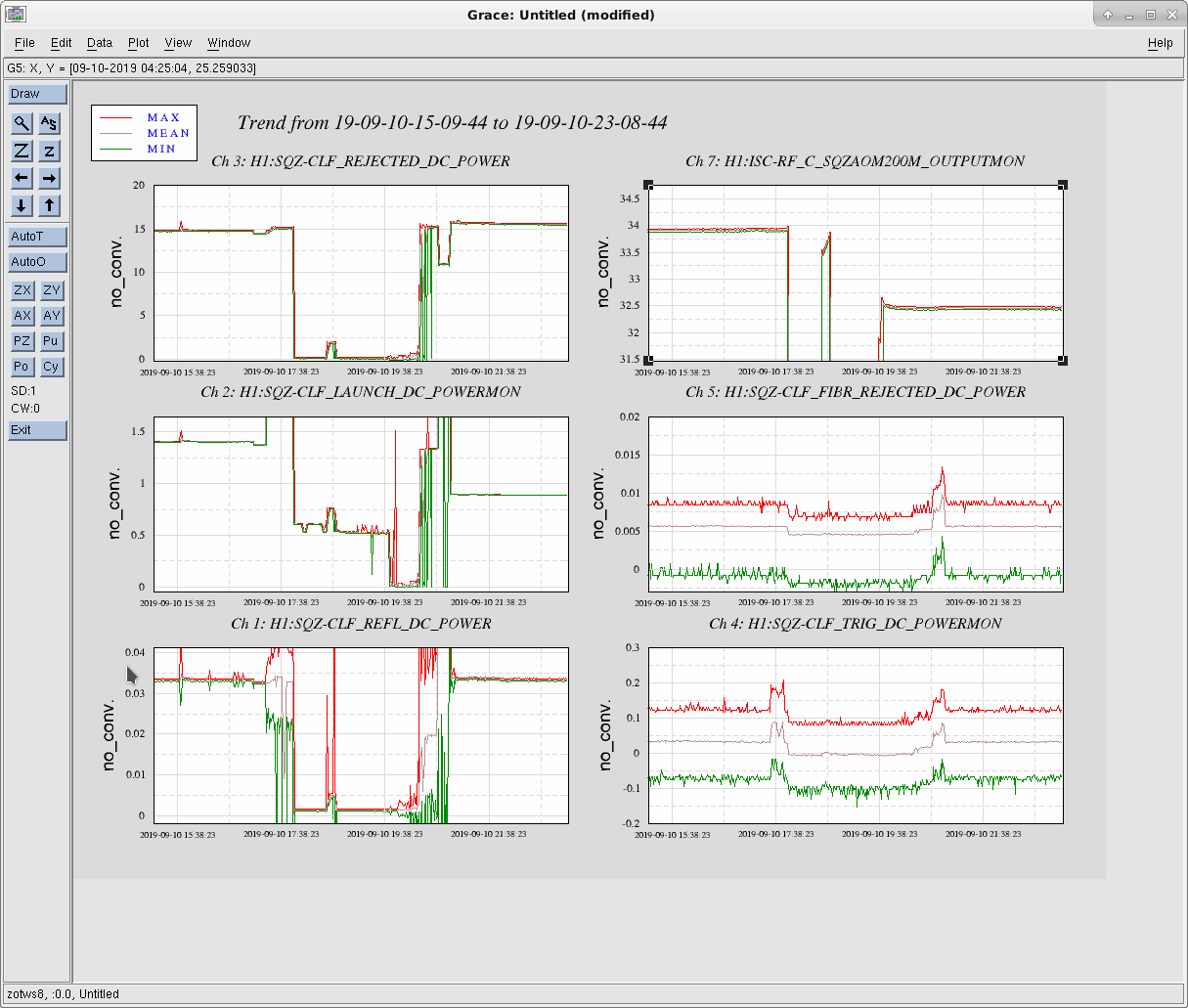
CLF power level trend
We made the following measurements of the power on ISCT6: After 1st periscope mirror: 3.32mW Out of vacuum: 3.32mW After 2nd periscope mirror: 3.25mW Input to cube: 3.24mW Output of Cube: 3.16mW wrong polarization: .09mW Front of Detector: 3.11mW We made the follow power measurements on the Squeezer table: OPO REFL: 3.06mW and 1.28v Output monitor: 32.6dBm Drive into AOM: 33.7dBm
Yesterday, I tested, if the removed AOM still looks like a 50Ω load to make sure we didn't fry the input circuit. Indeed, it looked like a 150-250 MHz bandpass with proper 50Ω termination. However, I noticed that the SMA bulkhead thread of the AOM is tad bit too short. Out of 5 male SMA I tired 4 bottomed out, which potentially prevents a proper electric connection. This probably explains the flaky behaviour we observed.
S. Karki, J. Kissel
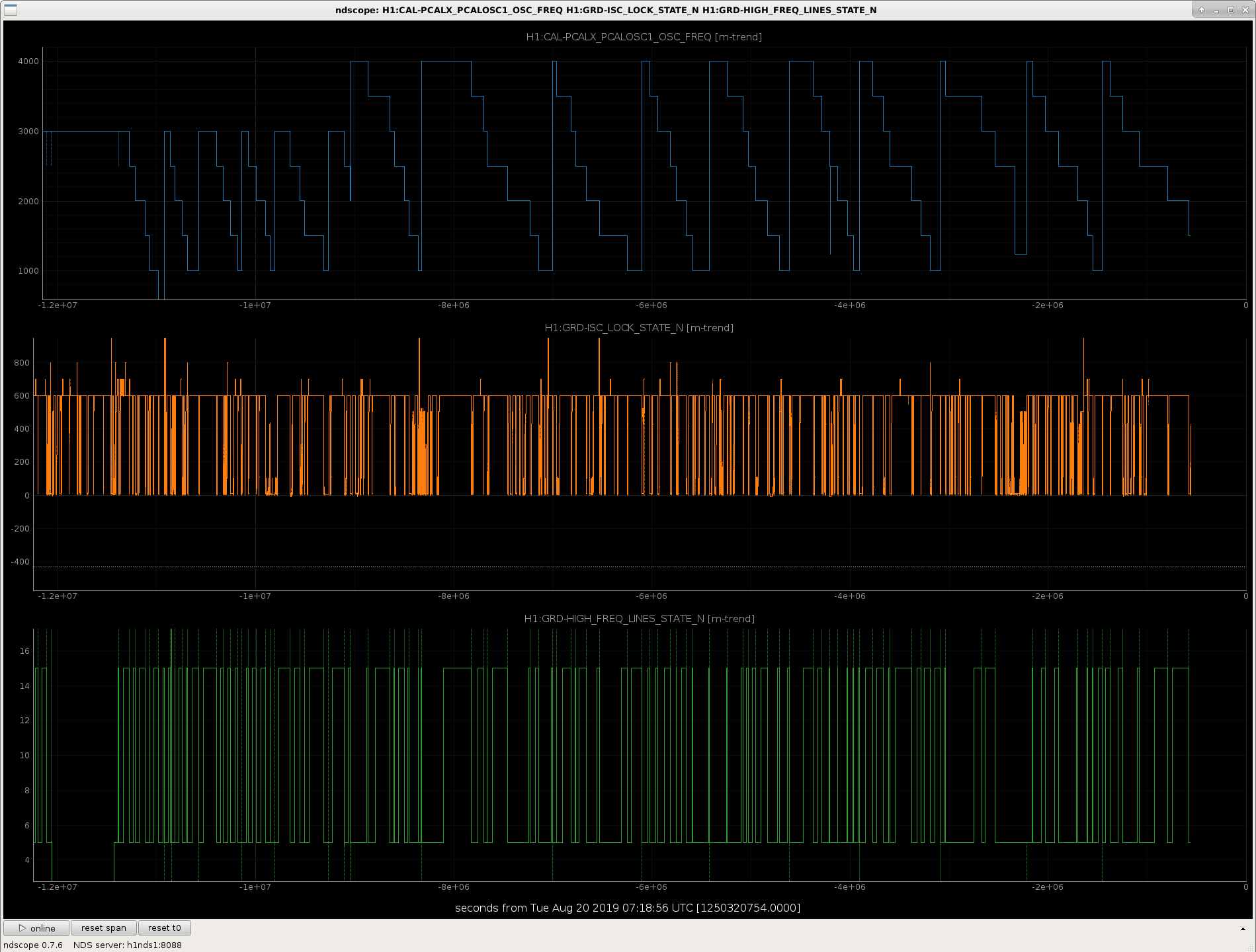
Sudarshan is working on processing the high-frequency roaming PCALX line that has been sweeping through the DARM data above 1 kHz throughout the run. In order to facilitate that processing, and to pick up where Pep left off I report the times at which the sweep restarted during the run thus far, determined by a trend of the requested frequency channel, H1:CAL-PCALX_PCALOSC1_OSC_FREQ. We should consider a modification of the HIGH_FREQ_LINES guardian such that we have a less GUI way to gather this information in the frames.
For now, I give you the dates of the repeat to-date at H1 via ndscope trends and cursoring:
2019-04-01 16:00 UTC Starts at 3001.3 Hz. Start of the run (spends a long time at 3001.3 Hz until bug fix, see aLOG below).
2019-04-15 21:27 UTC Re-start at 3001.3 Hz LHO aLOG 48505
2019-04-19 23:22 UTC Re-start at 3001.3 Hz
2019-04-24 23:51 UTC Re-start at 3001.3 Hz
2019-04-28 19:08 UTC Re-start at 3001.3 Hz
2019-05-05 01:16 UTC Re-start at 3001.3 Hz
2019-05-07 17:22 UTC Re-start at 4001.3 Hz More bug-fixes, no running nominally LHO aLOG 49064
2019-05-15 22:40 UTC Re-start at 4001.3 Hz
2019-05-31 06:54 UTC Re-start at 4001.3 Hz
2019-06-10 17:07 UTC Re-start at 4001.3 Hz
2019-06-18 13:34 UTC Re-start at 4001.3 Hz
2019-06-27 22:08 UTC Re-start at 4001.3 Hz
2019-07-06 03:20 UTC Re-start at 4001.3 Hz
2019-07-15 13:10 UTC Re-start at 4001.3 Hz
2019-07-25 17:16 UTC Re-start at 4001.3 Hz
2019-08-03 11:55 UTC Re-start at 4001.3 Hz
2019-08-18 01:02 UTC Re-start at 4001.3 Hz
More data points! (As usual, trending H1:CAL-PCALX_PCALOSC1_OSC_FREQ, and determining the starting points of the long duration, roaming, high frequency sweep data from PCALX:) 2019-08-25 17:39 UTC Restart at 4001.3 Hz 2019-09-03 01:53 UTC Restart at 4001.3 Hz 2019-09-10 04:39 UTC Restart at 4001.3 Hz 2019-09-22 11:42 UTC Restart at 4001.3 Hz
One final data point for O3A:
2019-10-01 11:54 UTC Restart at 4001.3 Hz
This should allow for three data sets
(1) 2019-09-03 to 2019-09-10
(2) 2019-09-10 to 2019-09-22
(3) 2019-09-22 to 2019-10-01
that are entirely in the regime of the 2019-09-09 model to be used in the high-frequency GPR estimate of the unknown systematic error in the sensing function.