WP8341 Remove old ext_alert service
Jonathan, TJ, Dave:
I removed the old ext_alert service on the ext-alert machine. This was being managed by systemd. The removal process is:
systemctl stop ext_alert.service
systemctl disable ext_alert.service
mv /etc/systemd/system/ext_alert /etc/systemd/removed_systems
systemctl deamon-reload
systemctl reset-failed
The remaining systemd services are ext-alert-credentials.service and lv_alert.service (note we have not been too consistent with underscores and dashes).
WP8347 SDF of ALS shutter settings
Dave:
h1sysecat[x,y]1plc1sdf systems were modified to SDF the end station ALS shutter settings. Please see related alog for details.
These SDF systems were restarted, and the new channels were ACCEPT+MON
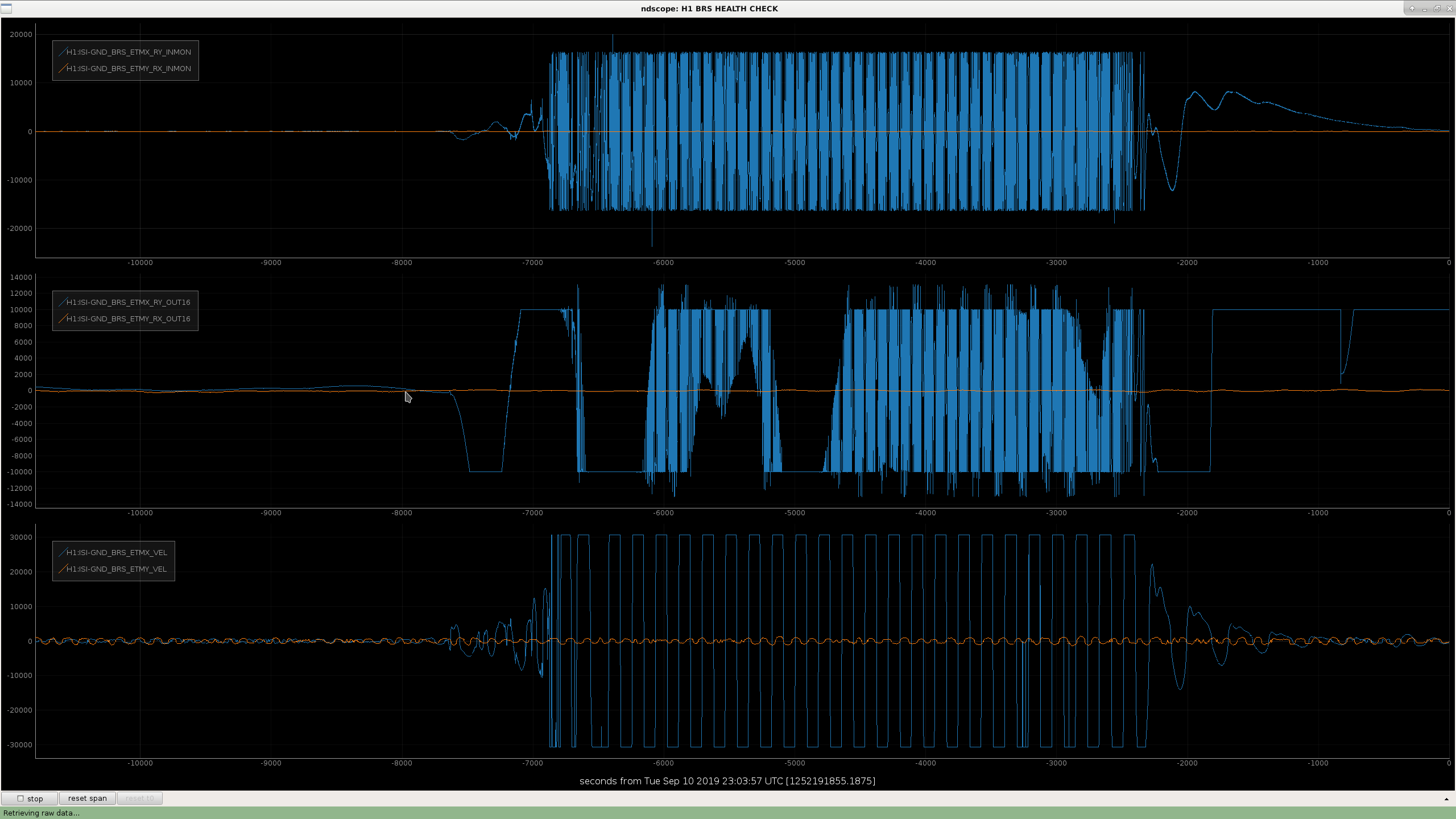
Fil and I went to EX to look inside the BRSX enclosure in prep for the work next month. While we were there I touched up the centering of the BRS. While we had the box open, we must have disturbed the cable into the interface box inside, because when we got back to the corner station the BRS wasn't damping down. I went back down to look at it and it took a little to realize there is not retention on the ethercat cable into the interface box, so it's really easy to knock loose. It immediately started damping down when I pushed the ethernet cable into the interface chassis.
The BRS is still calming down, so we shouldn't use it for a little while yet. The operator should watch the the BRS health ndscope and wait for the BRSX RY OUT to look more like the BRSY RX OUT signal, i.e. the blue trace on the middle timeseries looks like the yellow(?) trace on that same plot.
Opened FRS Ticket 13570 to track that H1 BRS EX ethernet connector at interface box needs to be repaired.
Is it safe to transition from WINDY NO BRSX back to regular WINDY while in NOMINAL LOW NOISE? (Or do we have to wait until we are not locked to make this transition?)
The transition is handled by the SEI_CONF guardian, and is very similar to making the transition to the earthquake state, and does not affect the observation bit. If anything, putting the BRSX back into the loop should make the IFO quieter, assuming the BRS has calmed down.
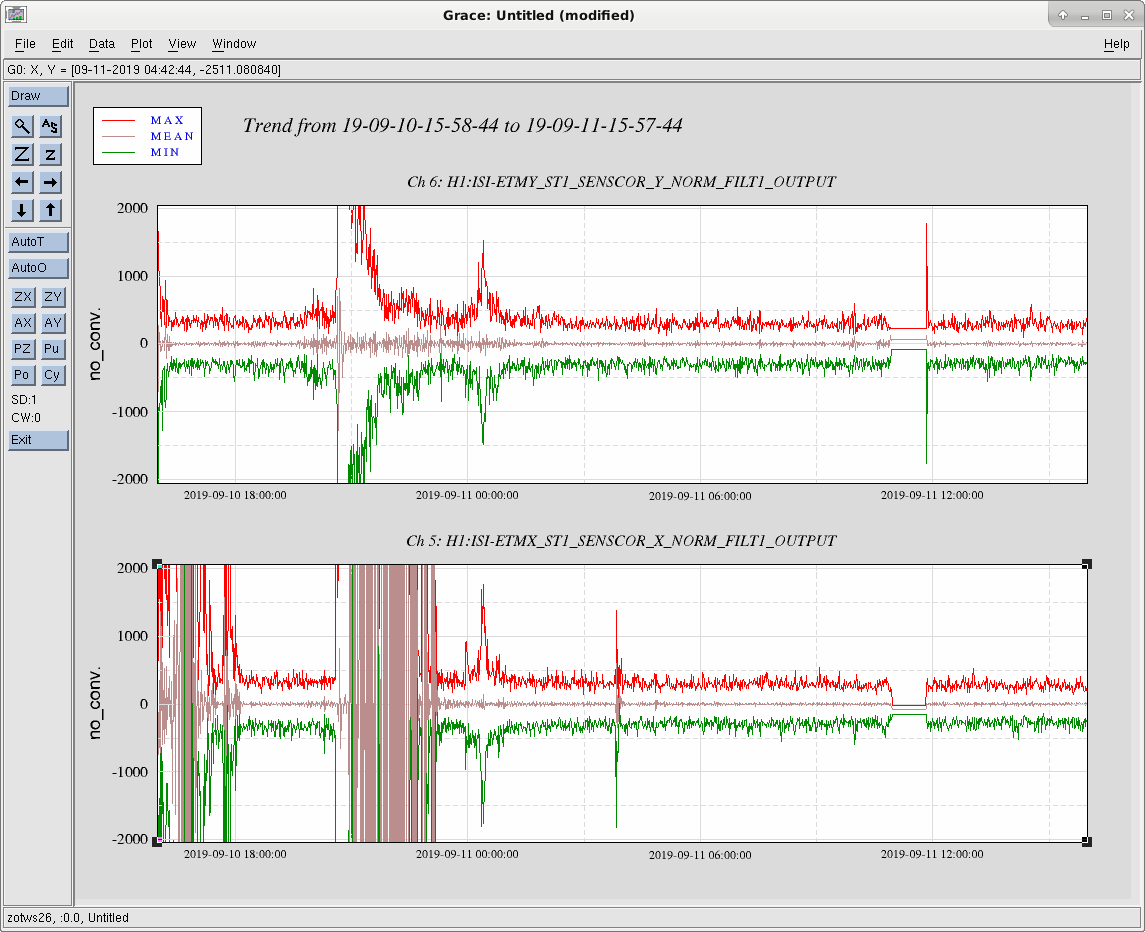
Looking at minute trends of the sensor correction outputs for EX and EY for the last day, we could have transitioned back about 5pm local last night, first plot.
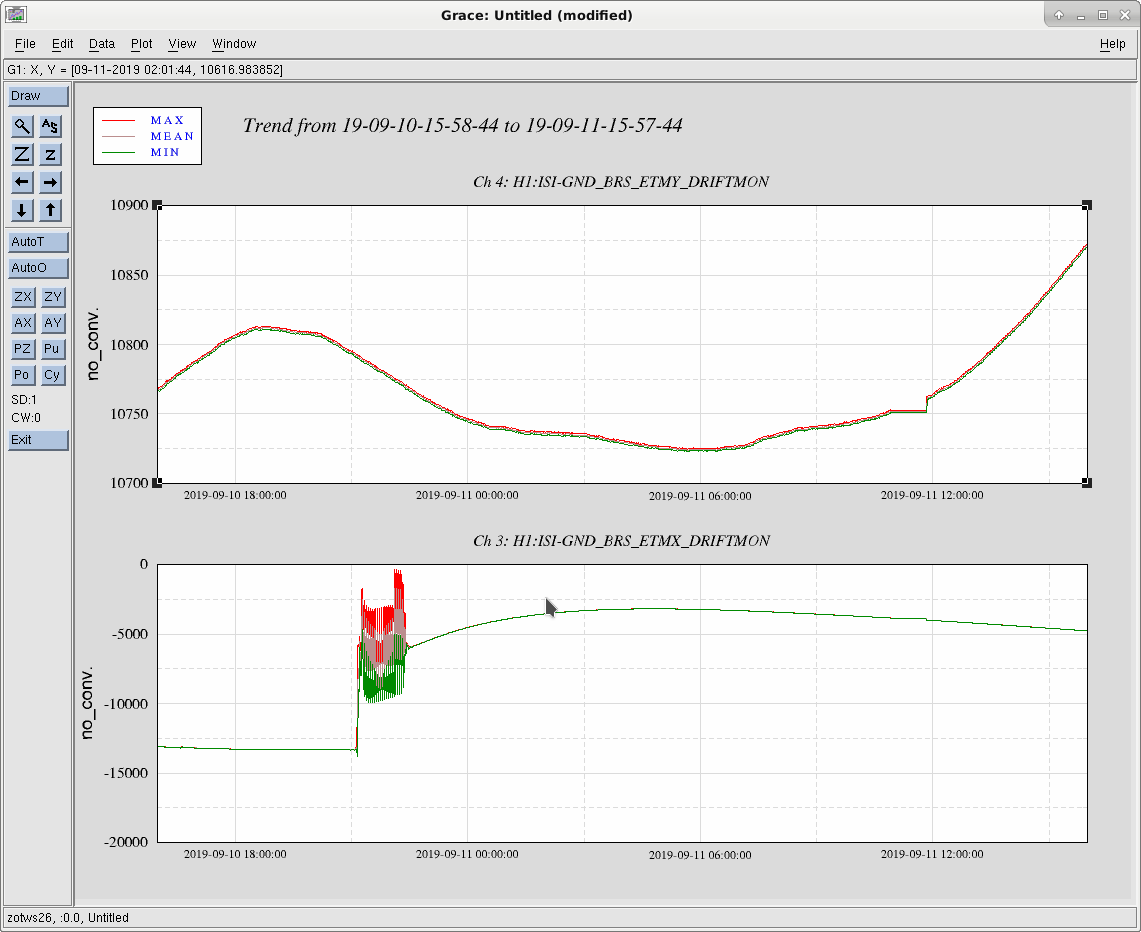
This is inspite of the fact that the BRSX was still not totally settled, the DC position is still slowly settling down, second plot.
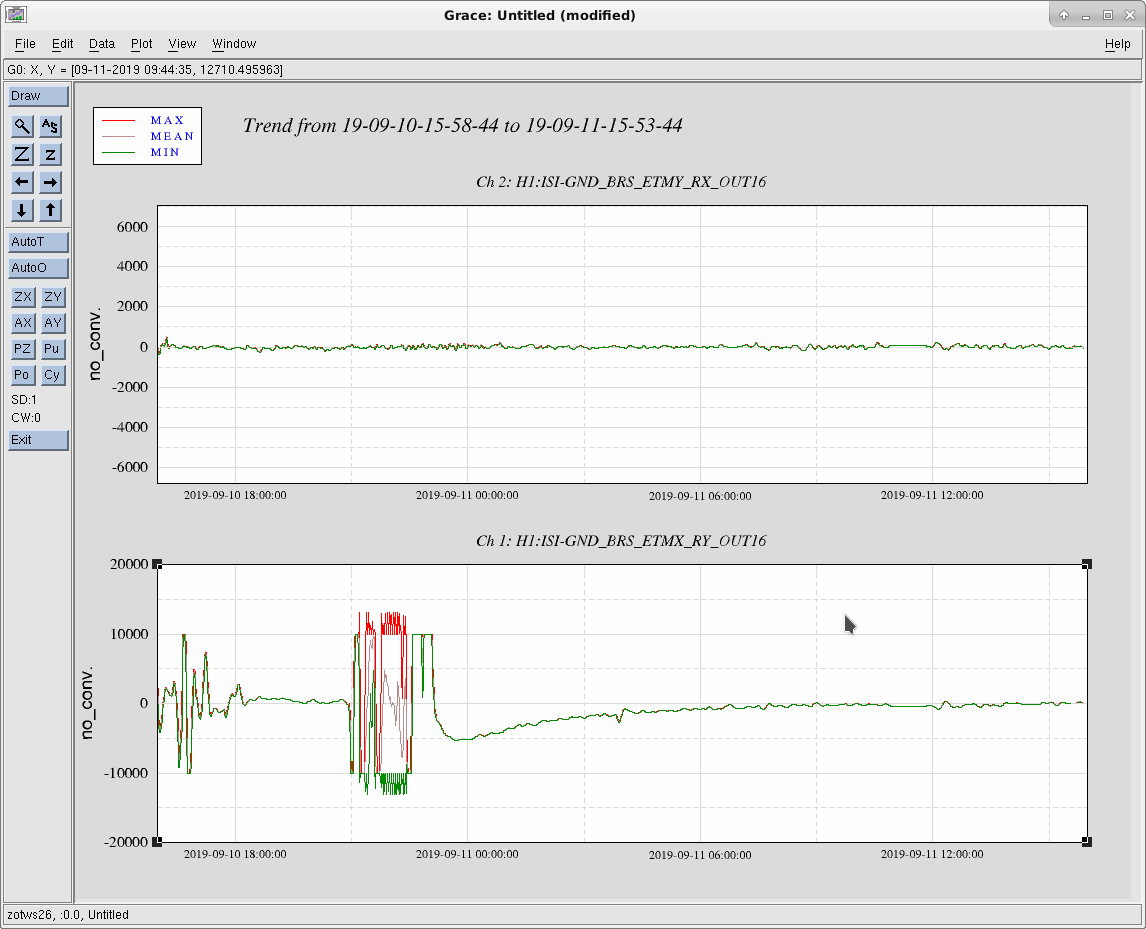
And, the BRSX RY out still had something like a 5000 nrad offset (third image), it was moving slowly enough to not affect the sensor correction signal.
Ah, My Bad.
Could this be the source of my woes with locking after the h1boot1 recovery?
TITLE: 09/10 Day Shift: 15:00-23:00 UTC (08:00-16:00 PST), all times posted in UTC
STATE of H1: Lock Acquisition
INCOMING OPERATOR: Niko
SHIFT SUMMARY:
Maintenenace went well. Squeezer Table work went a litle long due to a cable issue. Recovery locking has been unsuccessful for the remainder of my shift. Handing of to Niko.
LOG:
15:00 Bubba out to move bees
15:01 Sensor Correction turned off
15:01 Karen out to EY
15:02 Richard and Ken out to LVEA then out to X-Arm to survey for future PEM work
15:03 Jeff B to outbuildings to check Dust monitor pumps, HEPI pumps and TCS
15:08 PCal team to EX
15:25 Vanessa out to LVEA
15:40 Fil out to LVEA
15:45 TJ to LVEA
15:52 TJ out
16:01 Bub, Ty, and Chris out to LVEA ot start craning
16:06 Rich and Ken back from x-arm
16:08 Jeff B back
16:12 Karen headed back
16:!6 H1 unlocked - holding t DOWN for teh duration of maintenance
16:21 Norco on site - dewar 75 Y-Corner
17:00 Jim out to LVEA to deliver parts to HAM6 area
17:16 Hugh and contractor out to EX for Wind Fence
17:16 EX LASER SAFE - PCal team done
17:21 TJ out to LVEA for TCSY investigation
17:41 Richard out to LVEA for physical measurements
17:49 TJ back
18:00 Ethan back from a return trip to EX to disable WAP
18:35 Jeff K out to LVEA to check on maintenance progress
18:37 Bubba is back - Chris and Tyler still out
18:46 Chris and Tyler back
18:49 Jason running rotation stage calibration script - about 5 minutes
19:07 Begin Initial Alignment
19:15 Hugh back
19:09 Sensor correction turned back ON
19:27 Initial Alignment finished - Re- locking attempt 1
19:49 Fil back
20:?? Jim and Fil out to EX during EQ TOO for BRS tuning
21:05 Daniel back
21:35 Initial Alignment
22:20 Kyle to X-mid
Patrick Thomas wrote a script that restores alignment sliders to a time in the past. Dave showed me this today, when we wanted to restore to before the IMs were moved on Sunday (see Corey's alog and comments 51837), and we tested it. We added some rounding to avoid having the 10^-15 SDF differences, but the script is working. I'm just writing it here because it is something that could be useful for operators occasionally.
/opt/rtcds/userapps/release/sus/h1/scripts$ python restore_suspensions.py 1251771354
It sounds like Dave and Patrick have plans to make this a button that can be on an medm screen and allow the user to type in a gps time.
Thanks Patrick!
The LVEA was swept at 1430 local time. Kyle was still in there but promised to turn the lights off when he left.
And he informed the operator that he did so upon departure. The lights are indeed OFF.
Kara Sheila Fil Daniel
Continuing replacing cabling for the CLF AOM1, old alog 51537.
We replaced the feedthrough and the helix cable to AOM1 of teh CLF. First, we saw the RF power monitor coming back to the old value of 33.5dBm. After a minute or so it went down to 5dBm. Most likely the RF amp blew. Unclear why, but after replacing it we carefully measured the RF power delivered to the AOM. We needed an additional 3dB attenuation to get back to the previous value of 34dBm, see alog 40071. Maybe the cable was defective and we got more power than the AOM could handle? Assuming the AOM potententially has a problem, we swapped it with the spare and reconnected. A lot of alignment tweaking was required to get back to the previous difraction power. All seems to be working again.
We also installed a 1064nm wavelength filter, Thorlabs FLH1064-8, in front of the CLF launch PD. This PD was very sensitive to the table lights. The filter transmission at 1064 should be >90%.
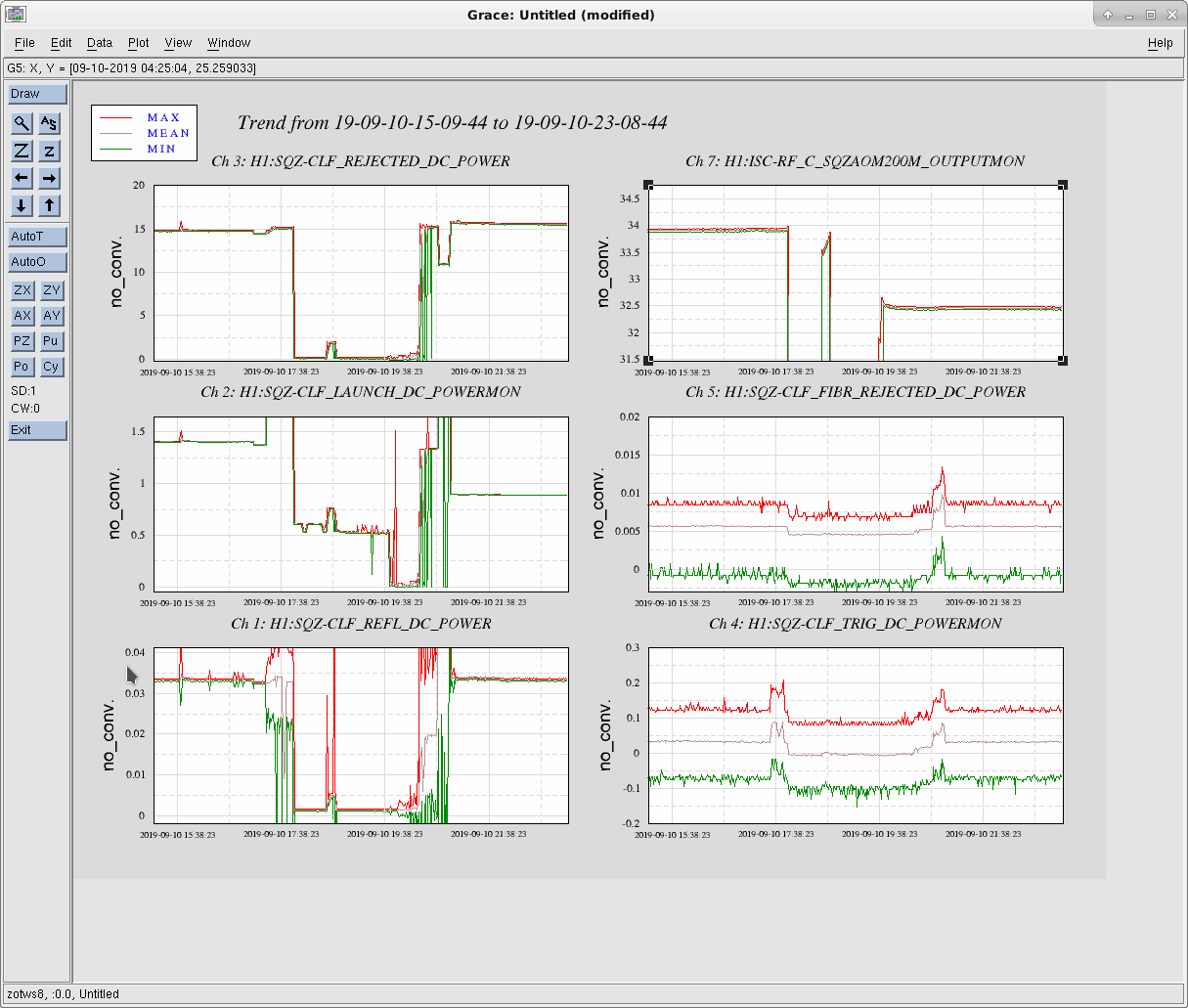
CLF power level trend
We made the following measurements of the power on ISCT6: After 1st periscope mirror: 3.32mW Out of vacuum: 3.32mW After 2nd periscope mirror: 3.25mW Input to cube: 3.24mW Output of Cube: 3.16mW wrong polarization: .09mW Front of Detector: 3.11mW We made the follow power measurements on the Squeezer table: OPO REFL: 3.06mW and 1.28v Output monitor: 32.6dBm Drive into AOM: 33.7dBm
Yesterday, I tested, if the removed AOM still looks like a 50Ω load to make sure we didn't fry the input circuit. Indeed, it looked like a 150-250 MHz bandpass with proper 50Ω termination. However, I noticed that the SMA bulkhead thread of the AOM is tad bit too short. Out of 5 male SMA I tired 4 bottomed out, which potentially prevents a proper electric connection. This probably explains the flaky behaviour we observed.
J. Kissel, E. Merilh
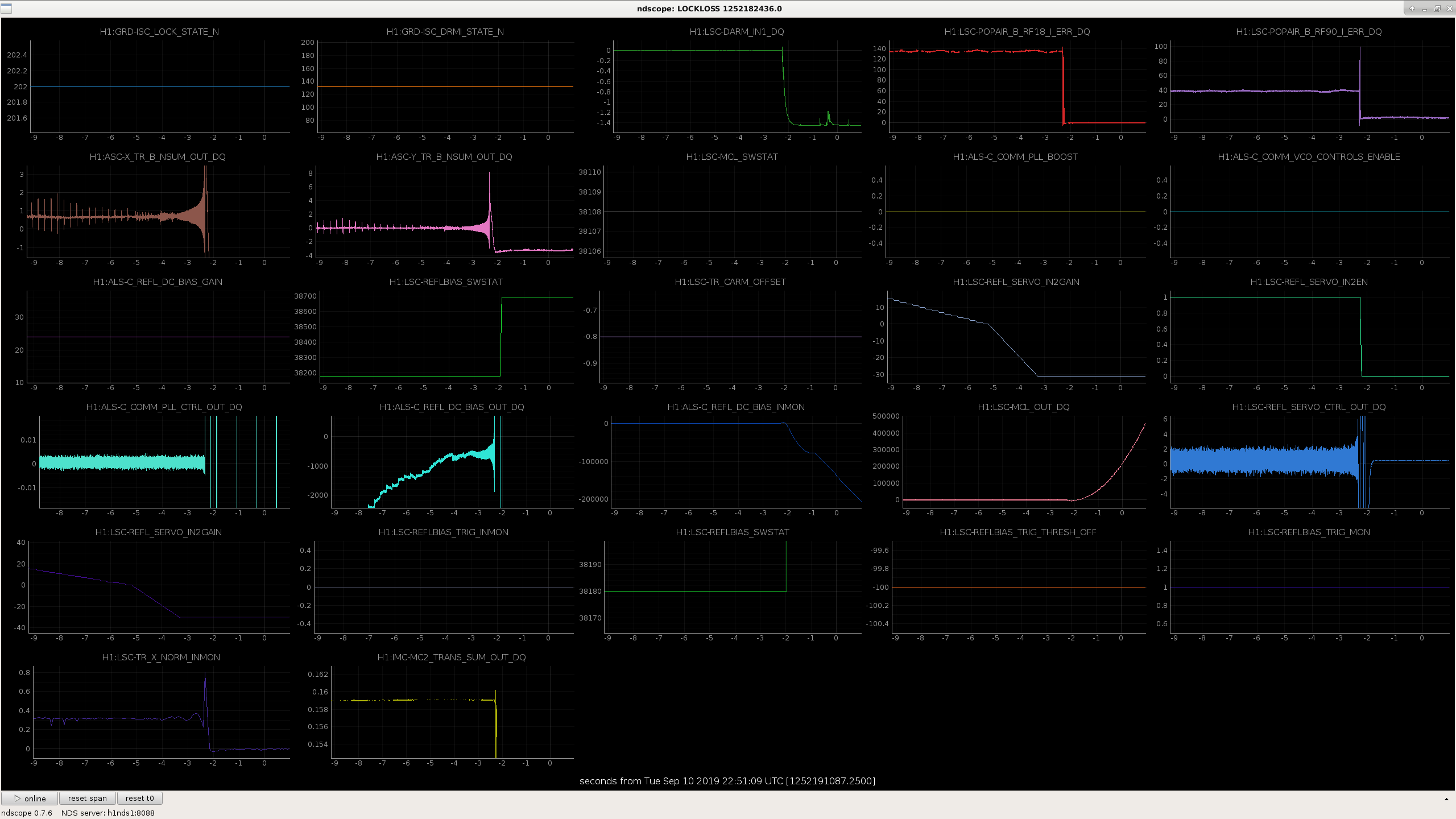
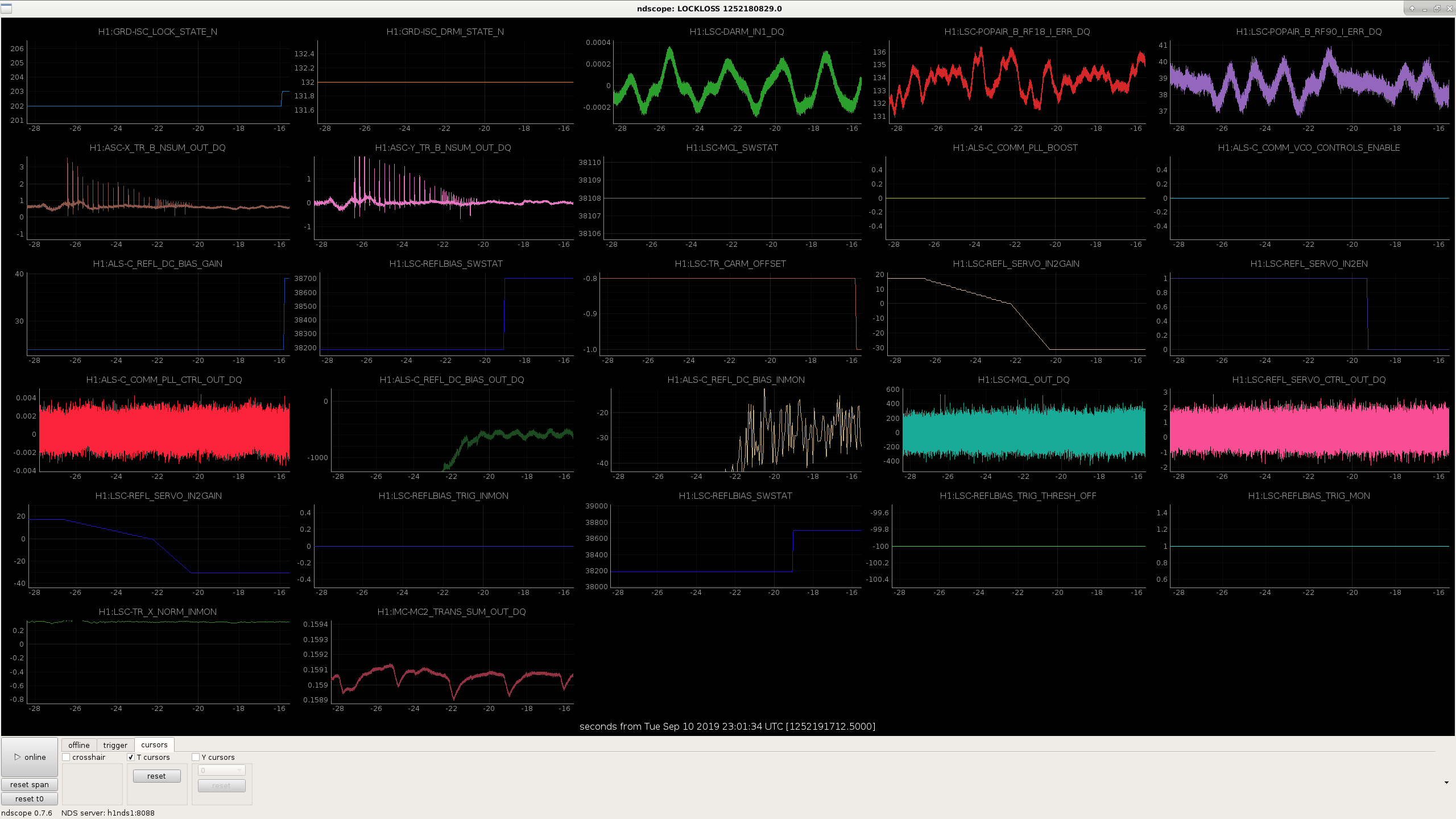
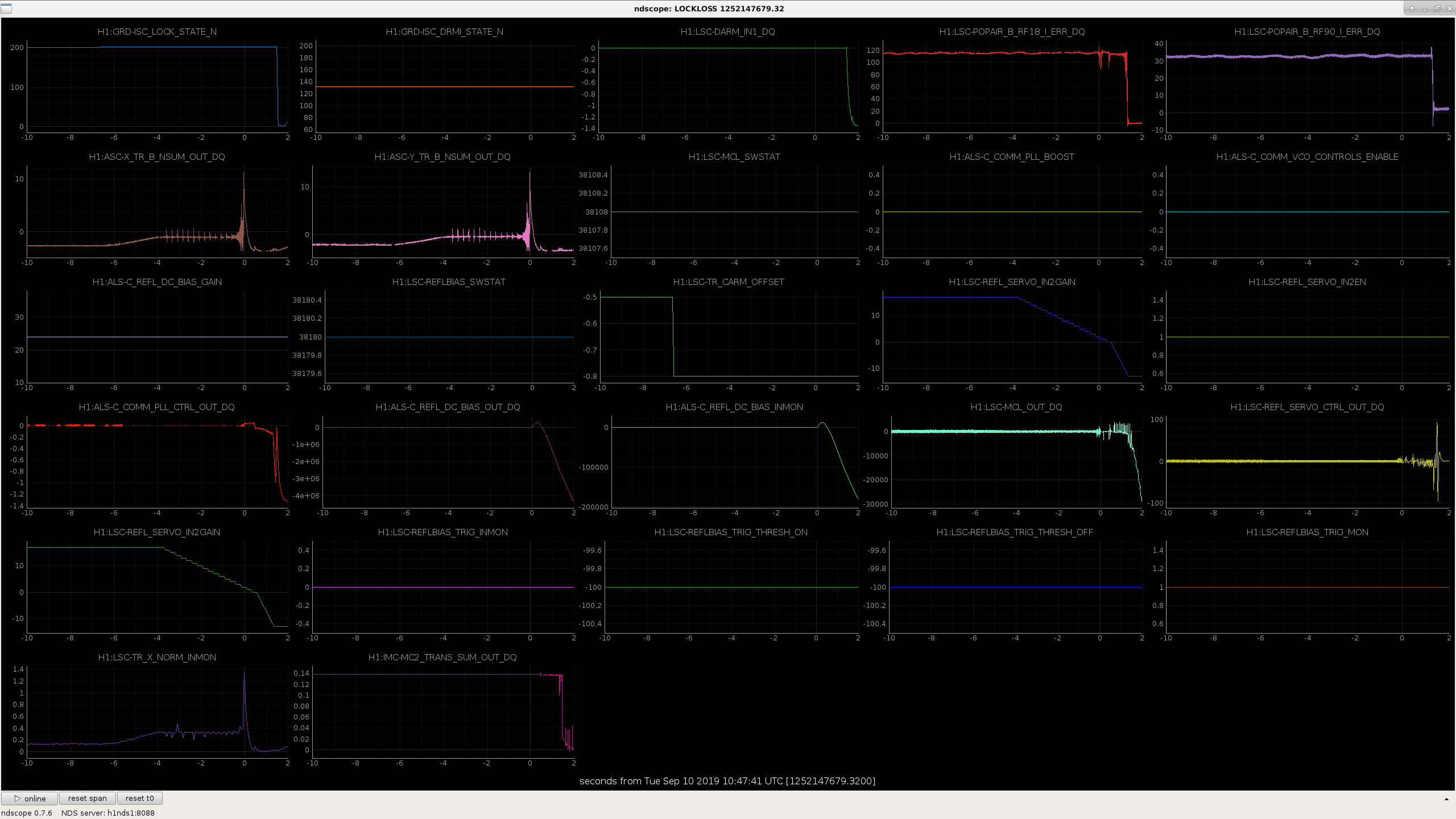
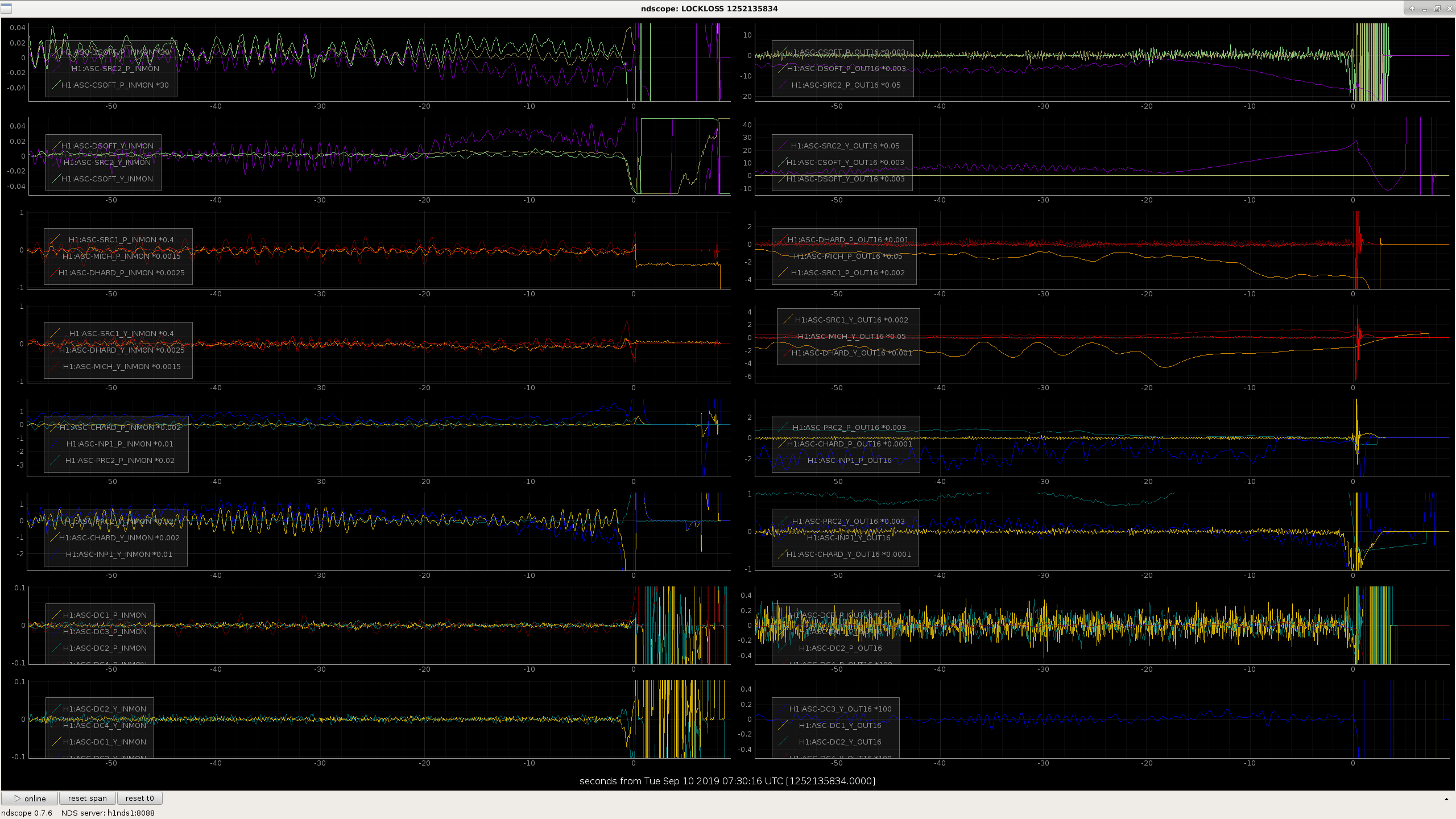
Just before a big EQ in Alaska/Canada took us out of maintenance recovery lock acquisition attempts, we had 2 lock losses at / around the start of the CARM reduction sequence.
Grabbing some plots from the lockloss tool (though the web server appears to be down): it appears as though there's some positive feedback that triggers around this step, ringing up and causing the locklosses. At the moment, I only have POP_A_LF, and the arm powers in red (ASC-[X,Y]_TR_NSUM) showing this symptom, but it's worth looking in to, and I will. Help would be appreciated, though.
Plots are of the three lock losses, attached in chronological order:
UTC time GPS Time
2019-09-10 10:47:42 1252147680
2019-09-10 20:00:11 1252180829
2019-09-10 20:26:58 1252182436
Looking at the guardian, code history a little, it seems that we used to engage REFLBIAS FM4 before reducing the gain in the ALS path, which would give the TR_CARM loop a little bit more phase margin around 90 Hz, which might avoid locklosses like this (it seems like this is a case where the optical gain for TR_CARM was low, which might be alignment related.)
The alogs I can find about this anti-boost are 43190 (some errors where made in these states when the guardian was re-written, this alog includes debugging that), and 36686
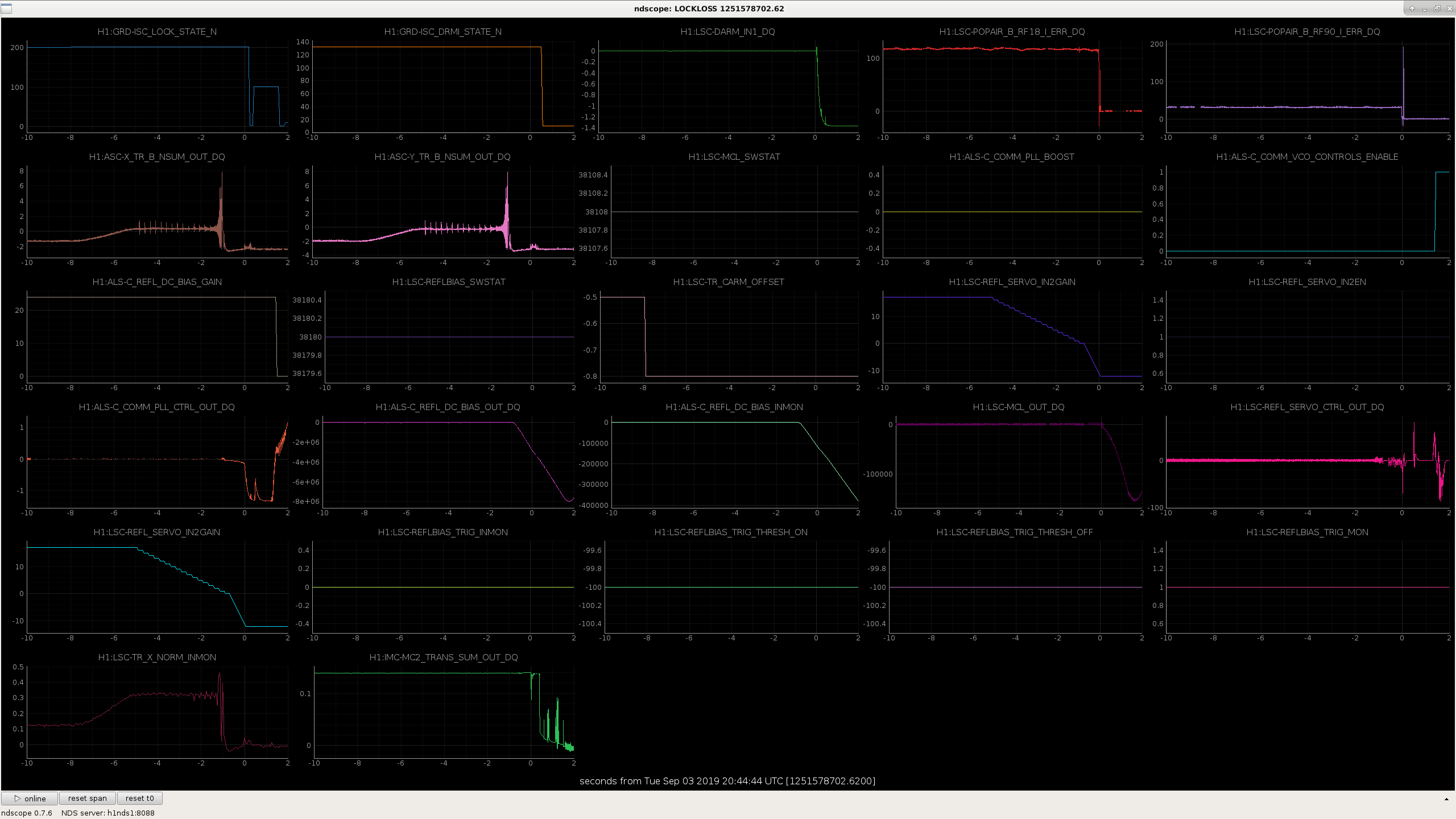
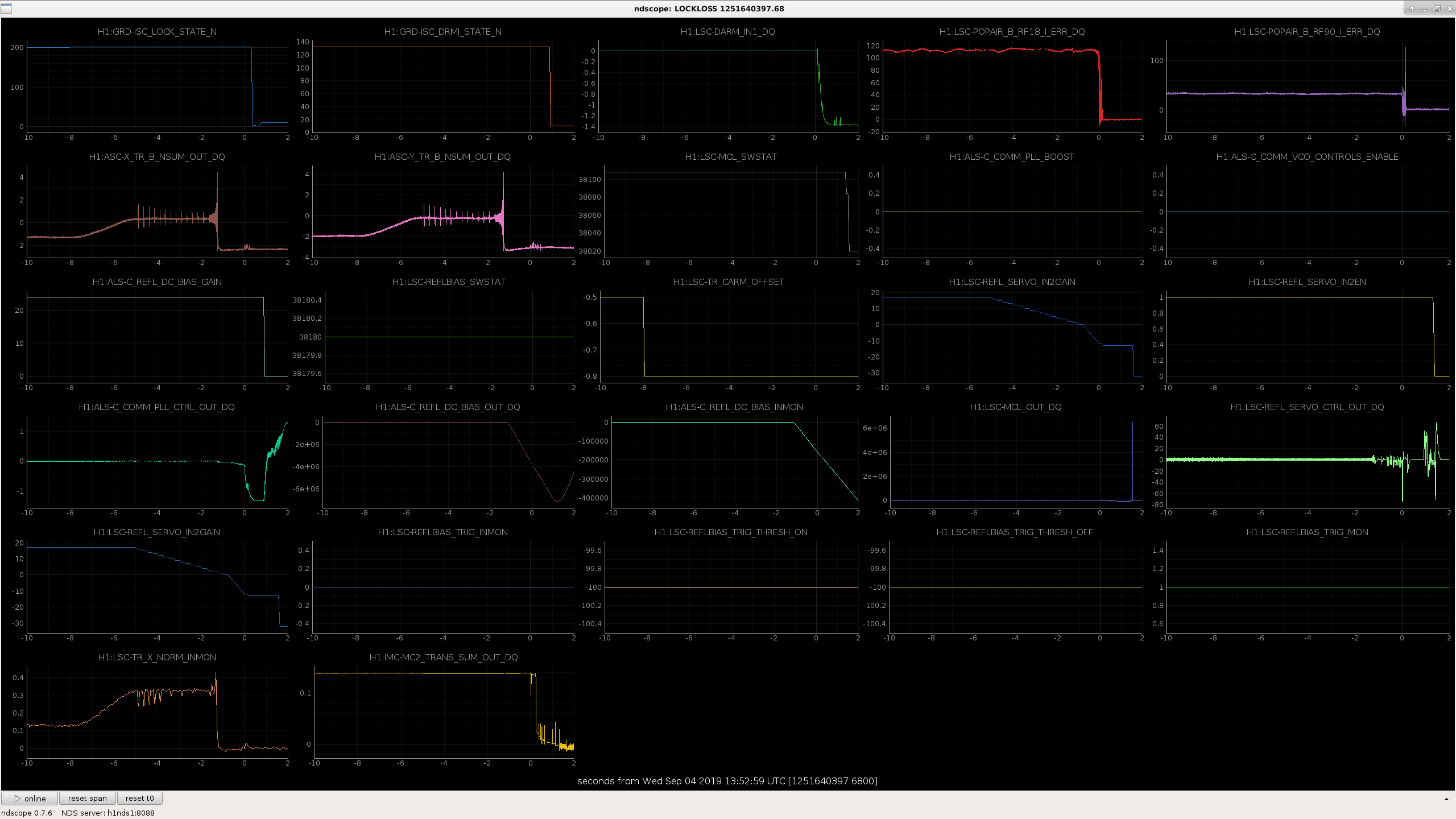
For now I have changed the CARM to TR state so that it is engaging FM4n (the anti-boost) before ramping down the ALS analog gain, restoring it to the way it used to work. This seems to have worked, you can compare the two ndscopes from before and after the change.
Ed and Jeff K also reported that when they tried to request PRMI (while DRMI was trying to acquire), the guardian didn't change state. This was because there was a timer which would increment if DRMI triggered momentarily but didn't actually lock, and if that counter was incremented the guardian would not check for a change in the target state. That is working now.
Trying to analyze CARM_TO_TR locklosses, based on the channels listed by Sheila (/ligo/home/sheila.dwyer/Desktop/Locklosses/ lockloss -c channels_to_look_at_TR_CARM.txt select). I am attaching screenshots of the last 3 locklosses which falls under this category. This is still ongoing, as there are several things which I am trying to understand. The following 2 channels (H1:ASC-X_TR_B-NSUM_OUT_DQ, ASC-Y_TR_B-NSUM_OUT_DQ) rings up 1 second before lockloss.
For this week's Tuesday, 4-hour maintenance break, I cut-to-length, dressed and terminated the individual wires with the correct crimp sockets on the turbo-end of the signal cable for the Vertex Turbo Station and then installed the CPC connector. I also cored a hole in the LVEA floor and installed the sole remaining (4th of 4) threaded adhesive anchors for the Vertex Turbo Station. Prior to the coring operation, I had to use the portable band saw to cut/remove a section of the existing Turbo's support stand weldment so as to provide clearance for the coring drill head,
I was informed by Jeff K. that an earthquake had occurred and that quiet TOO work would be allowed in the LVEA for ~2 hours -> As such, I was able to finish the turbo-end connector of the XBM's signal cable this afternoon.
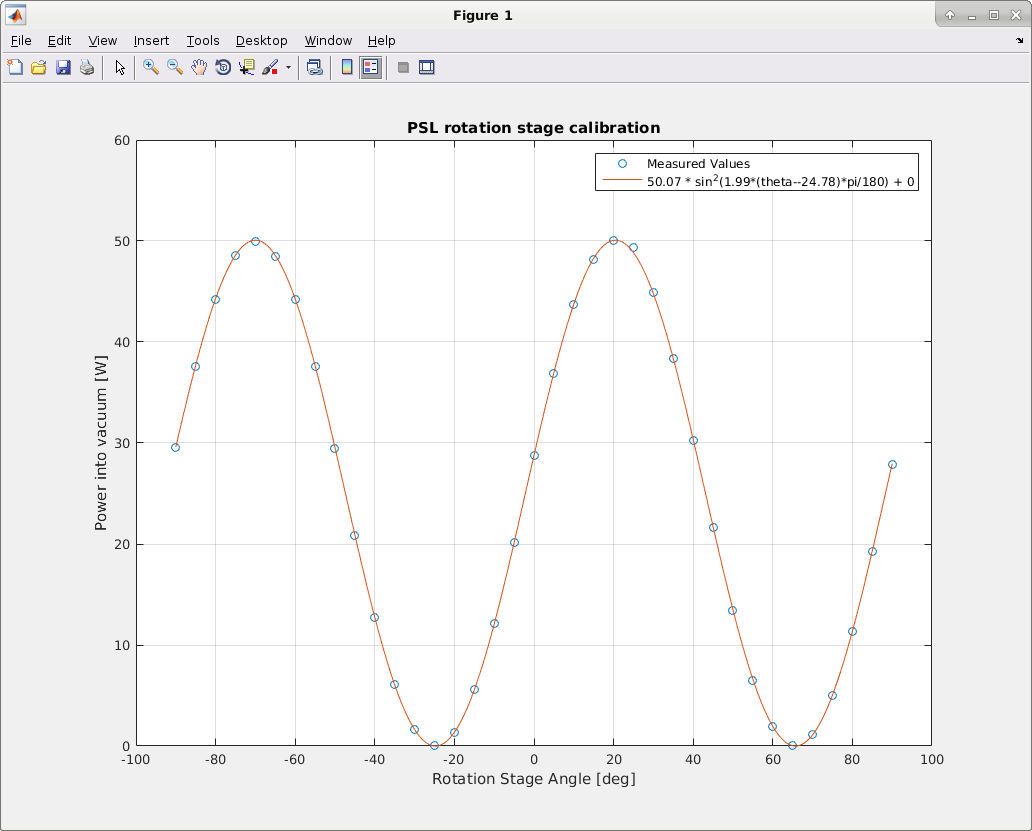
Since I was unable to get the PMC transmitted power back to where it was at the start of the run, I re-calibrated the PSL/IO rotation stage. I followed the Jenne's instructions in alog 30479 and updated the PSL rotation stage Calibrate MEDM screen. The only changes were the input power went from 49 W to 50.07 W and the minimum power angle changed from -25.2 to -24.78. I've attached a screenshot of the data fit plotted in Matlab and the new rotation stage calibration screen. These values are monitored in SDF, so I accepted these changes in the safe.snap SDF file (the OBSERVE.snap file did not register the change, so I'm guessing these channels are unmonitored in OBSERVE?). No change was seen in the low power state the rotation stage is currently in, so hopefully when we request 37W into the IFO we are closer to 37W than we have been; we'll see how close this actually is as the IFO recovery from today's maintenance plays out.
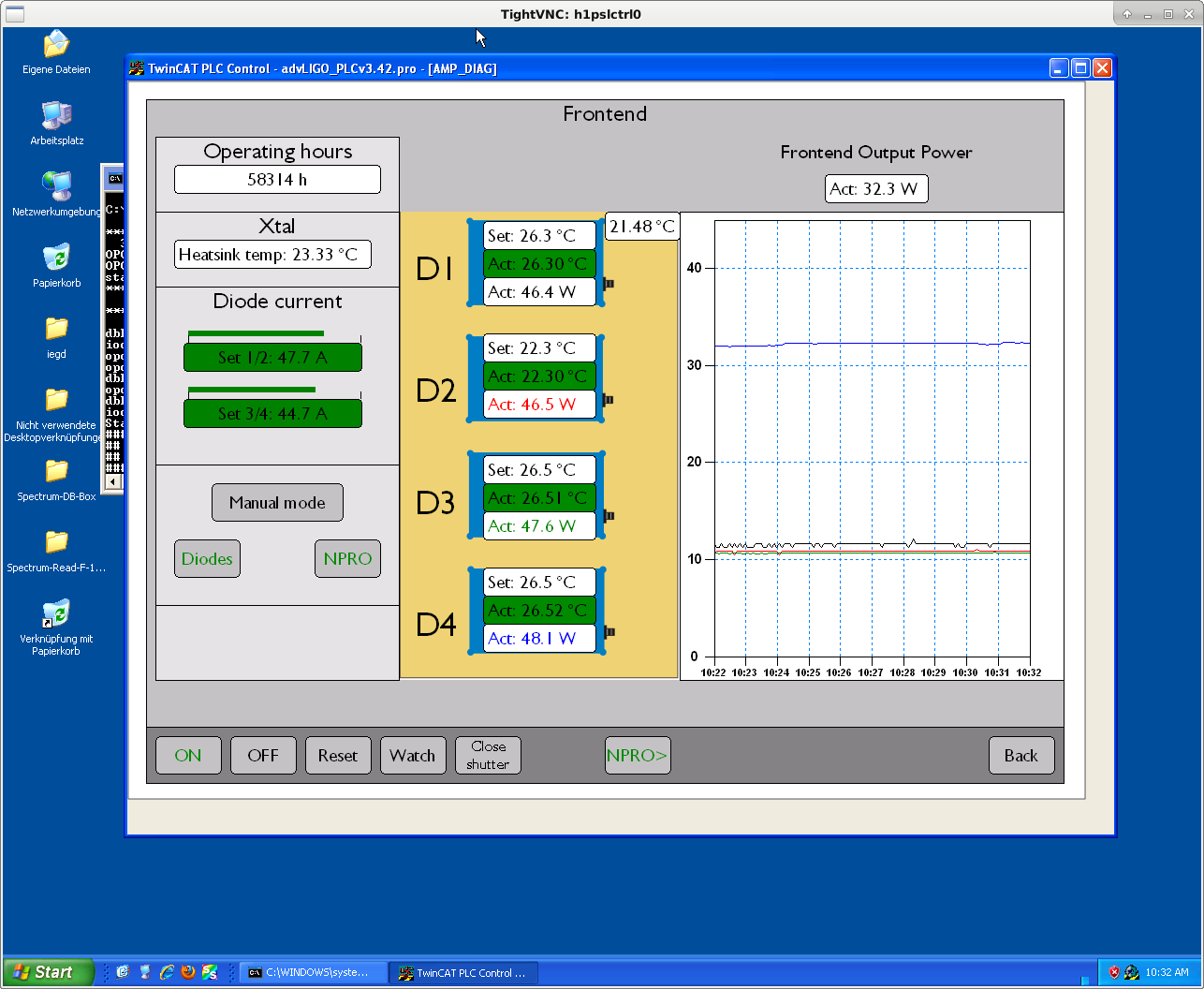
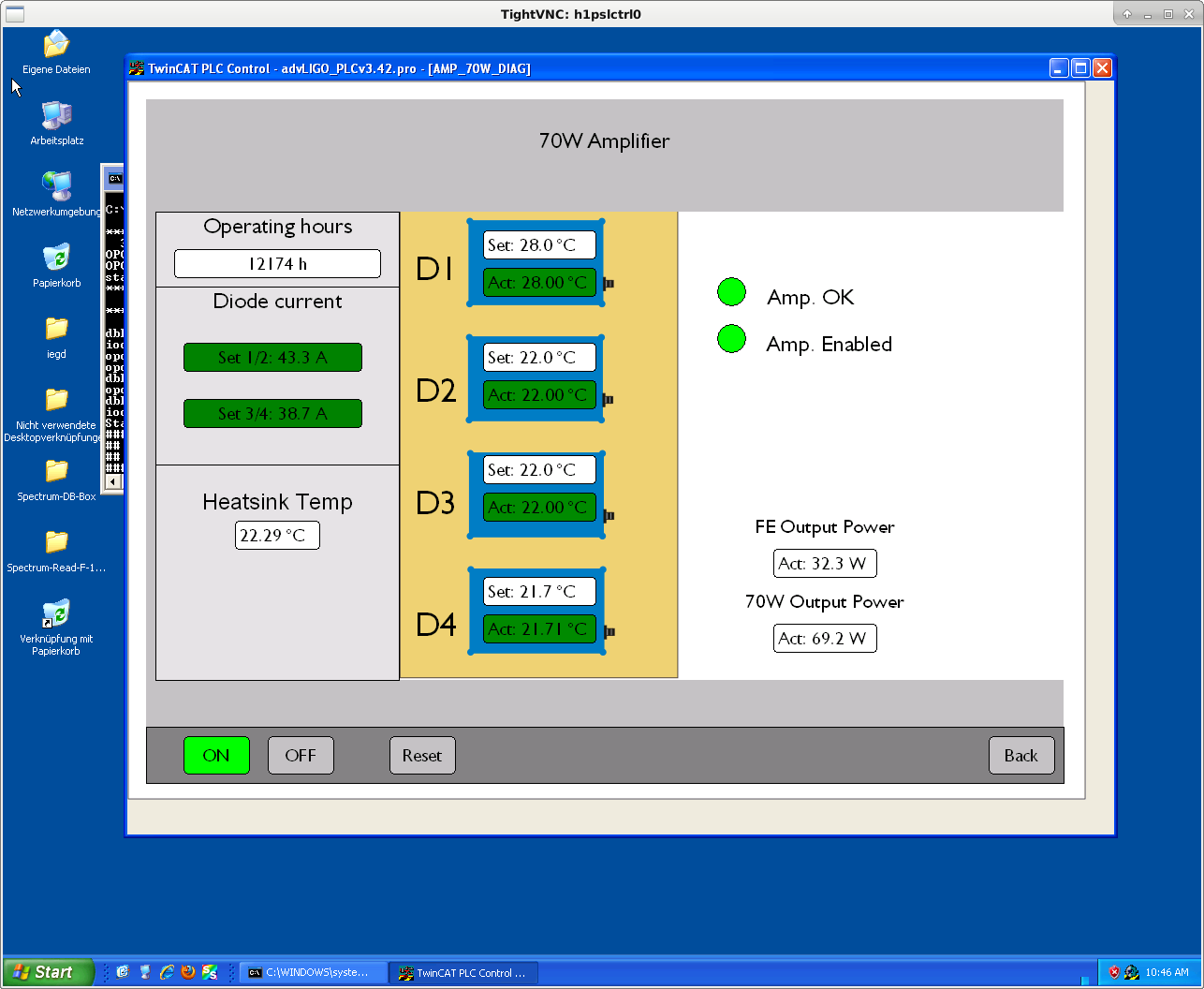
In an effort to get more power out of the PMC, with the ISS OFF I tweaked the beam alignment into the PMC. Unfortunately I was unable to get any more power out of the PMC. Since the alignment tweak didn't help, I adjusted the operating currents and temperatures of the pump diodes for the 35W FE and the 70W amp (with the ISS still OFF). The thinking here is that since the power drop out of the PMC is not due to alignment, it's likely due to changes in mode content caused by the normal deterioration of the pump diodes. The changes are summarized in the below table.
| 35W FE | 70W Amp | |||||||
| Current (A) | Temperature (°C) | Current (A) | Temperature (°C) | |||||
| Old | New | Old | New | Old | New | Old | New | |
| D1 | 47.5 | 47.7 | 26.3 | 26.3 | 43.2 | 43.3 | 28.0 | 28.0 |
| D2 | 47.5 | 47.7 | 22.3 | 22.3 | 43.2 | 43.3 | 21.8 | 22.0 |
| D3 | 44.5 | 44.7 | 26.8 | 26.5 | 38.5 | 38.7 | 21.8 | 22.0 |
| D4 | 44.5 | 44.7 | 26.8 | 26.5 | 38.5 | 38.7 | 21.8 | 21.7 |
I've attached screenshots of the relevant PSL Beckhoff screen for future reference. After the above changes the 35W FE is outputting 32.4 W (was outputting 32.0 W before I started) and the 70W amp is outputting 68.0 W (was outputting 67.1 W before I started). I should mention that the 70W amp power is as read by the old HPO power monitor PD (H1:PSL-PWR_HPL_DC_LP_OUTPUT). I'm using this PD as I think something isn't quite right with the 70W amp power monitor PD; it did not register any changes in output power as I adjusted the 70W amp pump diodes (I'll look into this next time I'm able to go into the enclosure).
This adjustment increased both the transmitted and reflected PMC powers, but increased the transmitted more than the reflected (so moving in the right direction). I re-tweaked the alignment to try to lower the reflected power to no avail. At this point I think I will need to go into the enclosure to tweak the PMC up in order to impove the reflected power. All things said and done, with the ISS ON we now have 53.8 W transmitted through the PMC and 10.8 W reflected (when I started it was 52.9 W transmitted and 10.6 W reflected). So all in all, not too bad. Managed to get almost 1 W back in transmitted power and only increased the reflected power by 0.2 W. Because of this change in PMC output power I had to adjust the ISS RefSignal from -2.02 V to -2.04 V, which now has the ISS diffraction % at ~2.1%; this change was accepted in both the safe.snap and OBSERVE.snap SDF files.
In addtion, I reset both PSL power watchdogs at 17:52 UTC (10:52 PDT), thereby completing FAMIS 10727.
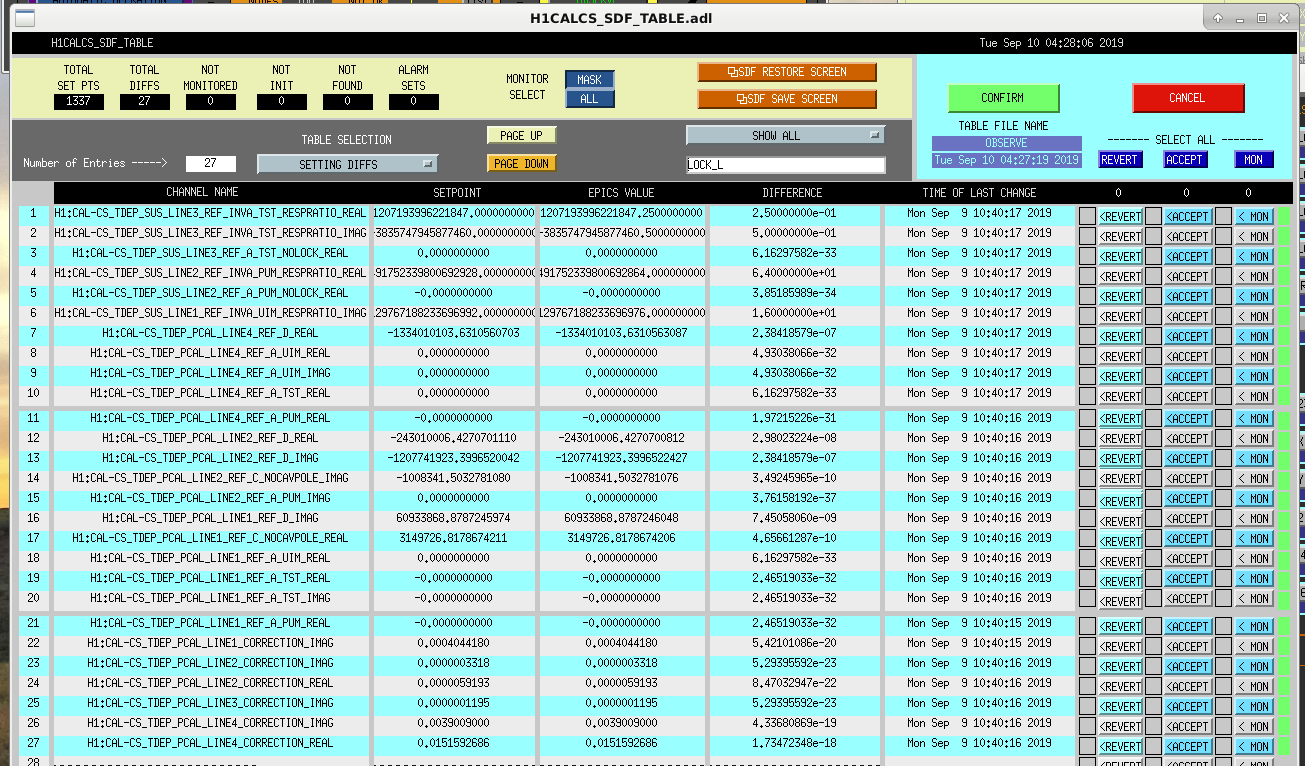
J. Kissel Browsing through SDFs compared against our recent commissioning activity, I've reconciled a few safe.snaps this morning: H1SUSETMX: - accepted L2_DRIVEALIGN_A2L matrices as 1.0 (i.e. permanently turning ON the L2A decoupling filters, recommissioned with new frequency-dependent matrix topology); see LHO aLOGs 51717, 51709, 51604, and 49825. H1SUSETMY: - Accepted ETMY PUM A2L spot position gains as 4.3 and 3.6. H1SUSITMY: - Accepted ITMY PUM P2L spot position gain as -3.0 H1SUSITMX: - Accepted ITMX PUM P2L spot position gain as -3.965 These are the "FULL POWER" positions, according to the current revision of ${userapps}/release/isc/h1/guardian/lscparams.py The "CENTERED" positions, at which we now "start" the ADS loops (see last paragraph of LHO aLOG 51715, which is a shortened version of the dance around the point absorber position, discussed in LHO aLOG 51426), don't get reset (from FULL POWER) until just before the ADS loops are turn on in PREP_ASC_FOR_FULL_IFO, quite a ways along in the lock acquisition sequence. Thus, after a lock loss, and even after the DOWN state is run, the A2L gains will remain at their FULL POWER position, and not be reset. Apparently, some of the FULL POWER A2L gains had been accepted in some safe.snaps, but not consistently in all. This has now been remedied. In reality, since the spot position gains *are* set by guardian *eventually* before they're used, this dosn't really matter, but it reduces the number of SDFs which are noise when reconciling in the future. H1LSC: - Accepted the filter configuration needed for the improved PRCL FF filter (accepting the configuration shown in the OBSERVE.snap as an attachment to LHO aLOG 51553). - Also accepted PRCL FF TRAMP to be 3 seconds, as was apparently commissioned on Aug 28 2019, though now appears to be in guardian as well, so again, just reducing noise here. H1SUSPRM: - Reverted SUS-PRM_M1_DITHER_P_TRAMP from 10.0 to 0.0. Now inconsequential tramp turned on for a brief test back on Aug 29th. Reverting the tramp to 0.0, since it's otherwise been unused for the entire run. #AlarmNoiseReduction H1CALCS: - Accepted values of new Calibration Reference Model Values at Calibration Line Frequencies (aka "EPICS RECORDS", installed and accepted in yesterday's install; see ), but these are different only at the sub-double precision level -- so these diffs will continue re-appear until we round these numbers. I'll take this as an action to fix the precision at which we write these values. There are several other unknown differences that may be maintenance / commissioning related activities currently on-going, so we'll take a look after we've re-run the DOWN state at the *end* of maintenance today.
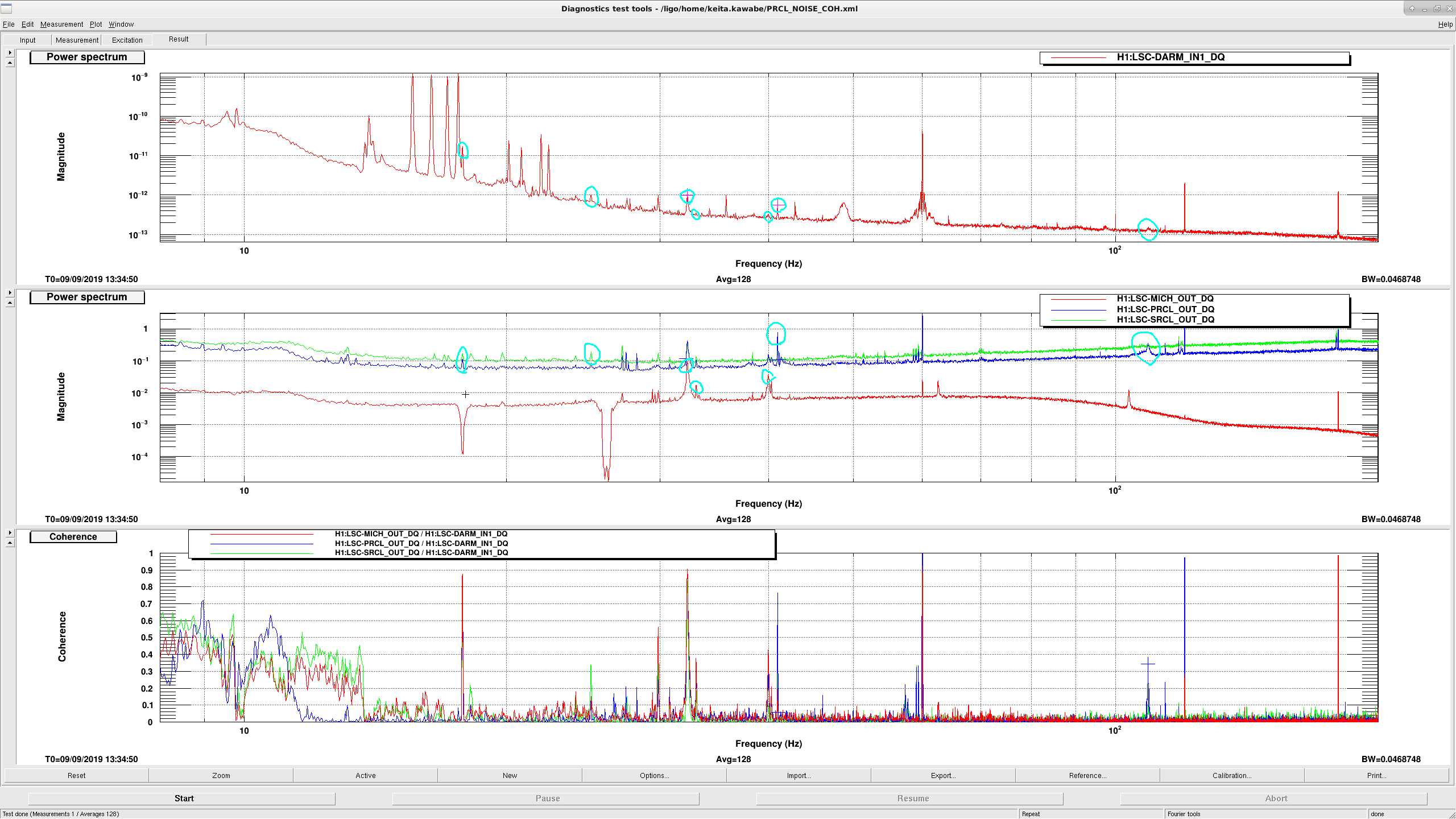
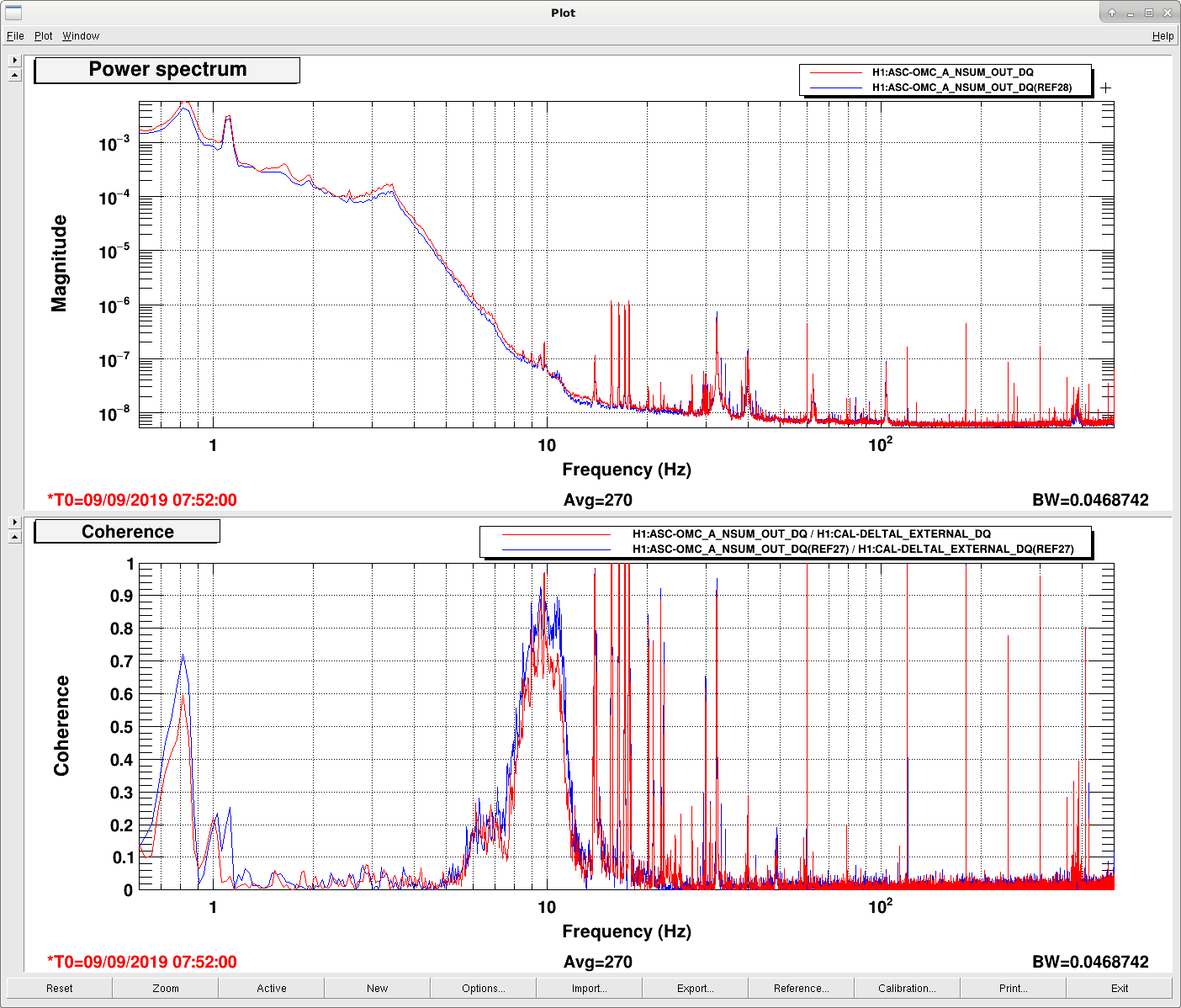
As the attached shows, there are many peaks/bumps in DARM that are highly coherent with LSC auxiliary control outputs. Low frequency behavior is not good either. I used a glitch-free segment of about 2000 seconds in observing. (It's yet to be seen if the noise transfer function would be stable over longer time scale.)
Anyway, this could be improved. Circled in cyan are the ones that look easier than the others.
BS: 17.8Hz, 32.2Hz and a tiny bump right next to it, ~40Hz.
PRCL: 40.9Hz, a tiny bump around 108.9Hz.
SRCL: ~25Hz
All: Behavior for f<15Hz or so is not good and I believe could be improved without making lower frequency behavior much worse.
Note that 17.8Hz peak which is next to EX L3 17.6Hz calline is BS bounce (https://alog.ligo-wa.caltech.edu/aLOG/index.php?callRep=49643). We should move the band stop from MICH filter to SUS-BS, that way it's easier to finesse the MICH feed forward at this frequency than e.g. using PRCL as a poor man's sensor for feed forward.
I don't have time to work on this but I'll work with Kara/Jenne. This kind of work has been done routinely before, but not in O3, it's just that obtaining long glitch-free observation segment has been difficult in O3.
Tagging @DetChar, in hopes that it reaches the CW group.
Checked all three (End-X, End-Y, & CS) dust monitor vacuum pumps. Both end station pumps are running great. There temps are all in range and there is no accumulation of carbon dust on the mufflers. The CS pump (which was rebuilt on 09/04) new vanes have broken in well and the pump is running with low temps and no carbon dust accumulations. Made an adjustment in the air bypass to bring the vacuum pressure to 18inHg. This adjustment is normal for a newly rebuild pump.
Now that we are back to Observing, figured I'd post locking notes from the night.
Summary:
Locking Notes:
J. Kissel
Regarding Corey's comment:
NOTE: getting "IMC WFS not centered" messages for IMC LOCK. Observe this in all the space it takes up in the ISC LOCK log.
This is a known issue/problem that is not resolvable without a hardware change: check out my aLOG from tail end of July: LHO aLOG 50920, and Daniel's subsequent reference to 5109.
To quote my aLOG: "This message appears, typically, after PSL incursions (rare), site power outages (rare), or computer failures (rare) when the IMC suspensions's or PSL Periscope PT alignments get lost. Because these events are rare, instituional memory loss causes confusion for folks when they see that error message and wonder if action is needed. However, once these alignments are roughly recovered (via reseting sliders on suspensions), the WFS, again typically, eventually recover their centering all on their own as the RF loops converge [there are no "DC centering" loops on IMC WFS, as there are for many of the the WFS systems]."
However, last night, none of these things happen, and the IM alignment is all down stream of the IMC WFS. So I'm equally confused as to why the WFS got outside of their range. Worth trending.
But in short -- while these warnings are annoying -- they are reflecting of a real issue, so don't ignore them.
CAL CS differences are due to poor rounding of the installation of Calibration Model Reference Values art Calibration Line frequencies. Will work on resolving this later today.
Today we did have the problems with TR_CARM that Corey and Niko descirbed last night, and we think we have addressed the problem: 51861
We didn't have any of the locklosses from ENGAGE_SOFT_LOOPS today. I did look at one of them from last night, and it does seem that we still have low gain in SRC2 (P+Y) and INP1 P so that the loops aren't holding their error signals around 0 in these steps. Speeding these up a bit might help us out here. Keita and I started to work on speeding up some of the ASC for similar reasons last Tuesday 51715, but we didn't get a chance to try increasing the gain in these very slow loops.
TITLE: 09/09 Eve Shift: 23:00-07:00 UTC (16:00-00:00 PST), all times posted in UTC
STATE of H1: Observing at 118Mpc
INCOMING OPERATOR: Corey
SHIFT SUMMARY: dropped lock during EQ, relocked with small changes to IMs, in Observe
LOG:
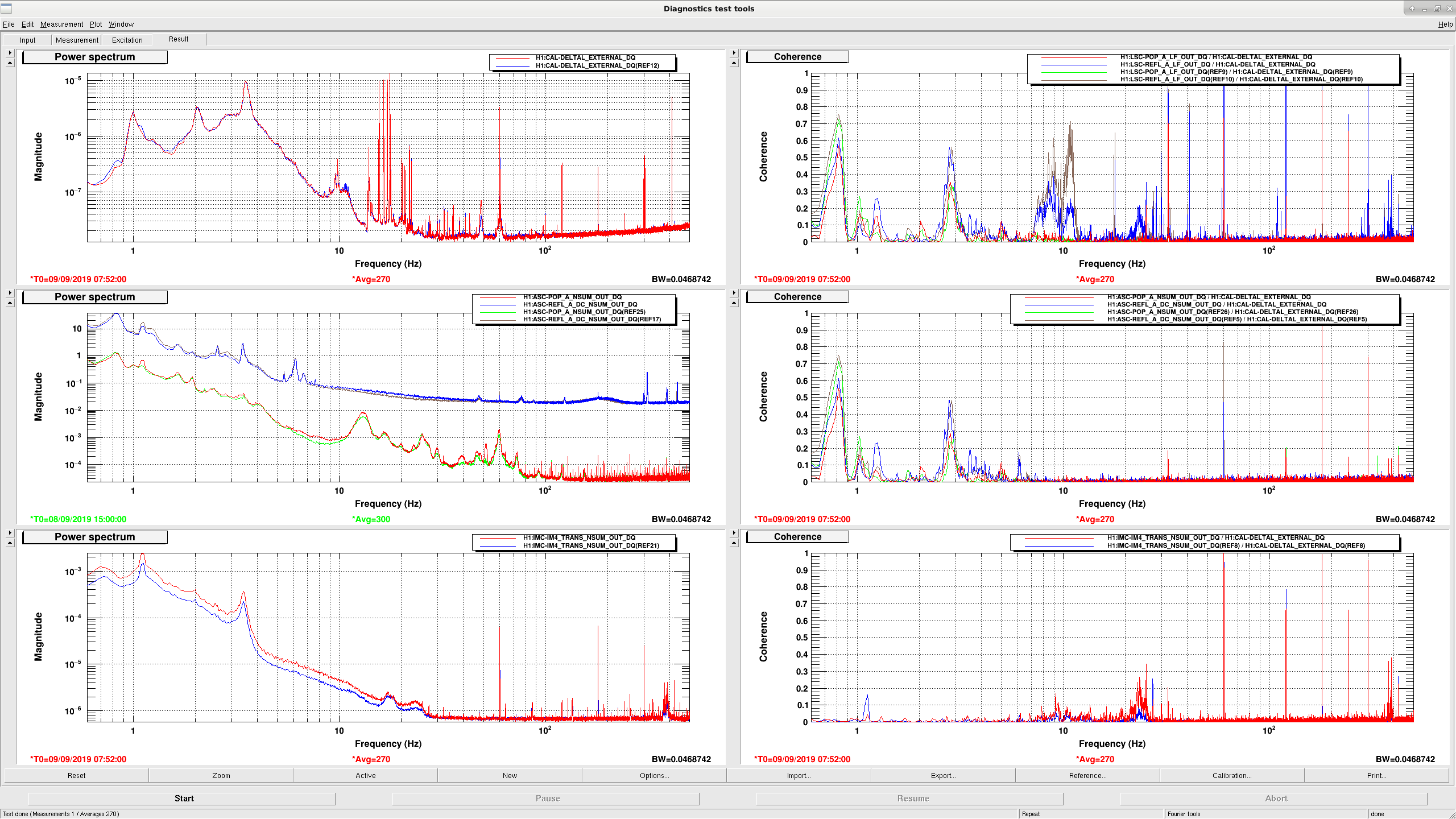
While I didn't plan to make any changes to the IMs, I am aware that the IMs haven't had their alignment looked at for a significant amount of time, while the input pointing, the IMC mirrors, and the rest of the optics in H1 have changed, so I made some very small changes, that imporved POPAIR_B_REF18_I_NORM, and REFL_A LF.
Changes made to IMs, which are 6.5urad or less.
Summary:
These IM alignment slider positions have been reverted -- see LHO aLOG 51858.