Displaying reports 38981-39000 of 89059.Go to page Start 1946 1947 1948 1949 1950 1951 1952 1953 1954 End
Reports until 11:01, Thursday 29 August 2019
H1 CDS
richard.mccarthy@LIGO.ORG - posted 11:01, Thursday 29 August 2019 (51607)
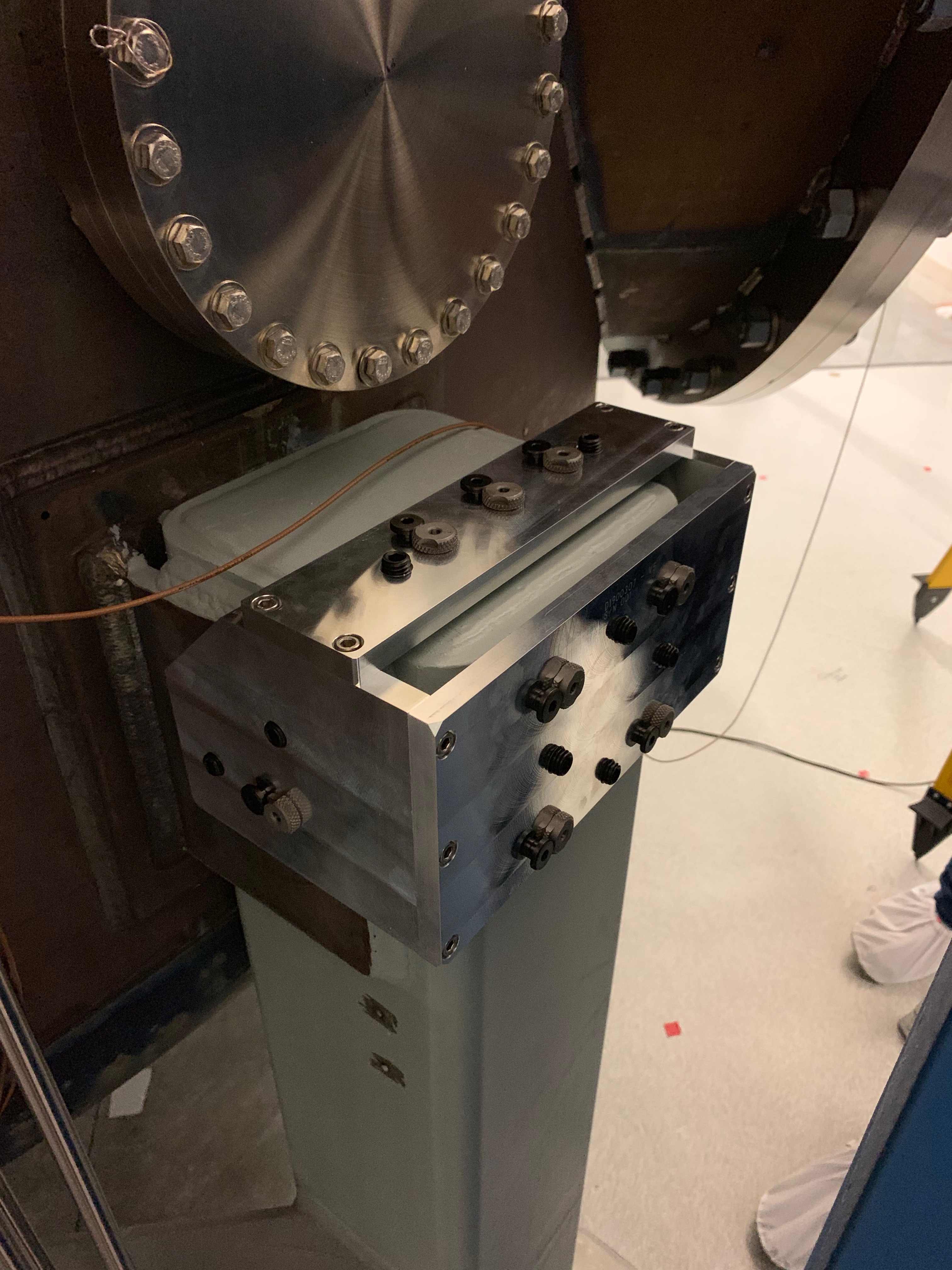
ETMX Camera housing

This morning I installed one of the aLIGO rectangular camera housings for the EX spool camera.  The iligo round can was not deep enough to allow the 300X lens and camera to be adjusted at all.  The new housing is in and a rough alignment is complete.  Once spots are restored the camera can be adjusted for the proper view.

Work permit 8328 https://services.ligo-la.caltech.edu/LHO/workpermits/view.php?permit_id=8328

H1 CAL (CAL)
richard.savage@LIGO.ORG - posted 10:08, Thursday 29 August 2019 (51605)
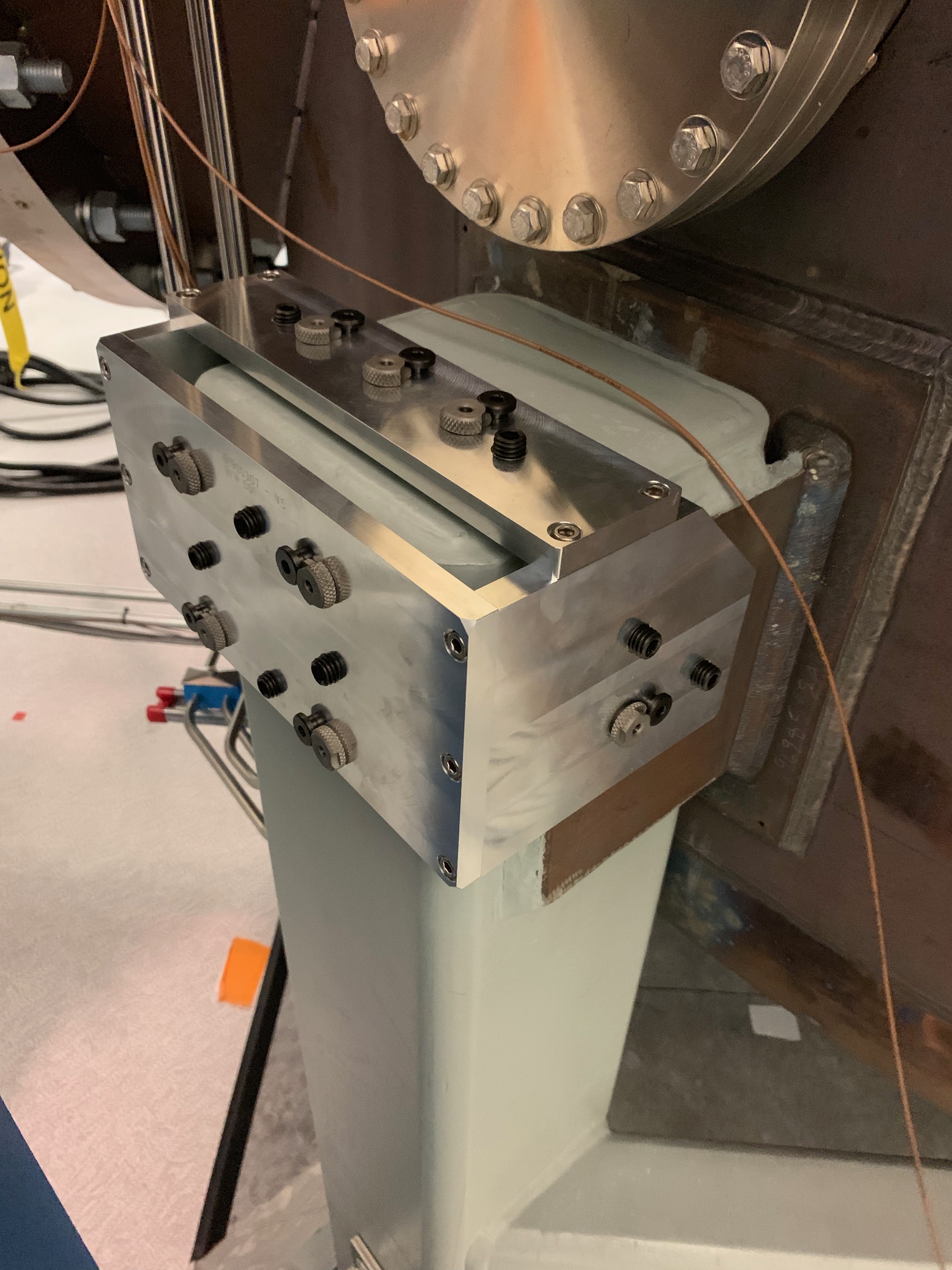
Fit check of Ncal drill fixture at Xend

Dripta Bhattacharjee, Ethan Payne, RickS

We did a fit check of the drill fixture for the NCal mount at Xend this morning (see attached photos).

Everything look good - about 1/16" to 1/8" horizontal play between the inside surfaces of the drill bushings and the pylon surface, with the ability to adjust the orientation and location slightly with the set screws.

We took the fixture back to the Ncal space in the optics lab.

The plan is to wait until the Ncal support is ready, then do a fit check of the support in early October when Timesh Mistry is here, before drilling and tapping the pylon.


Images attached to this report
LHO General
patrick.thomas@LIGO.ORG - posted 08:38, Thursday 29 August 2019 (51602)
Ops Day Shift Transition
TITLE: 08/29 Day Shift: 15:00-23:00 UTC (08:00-16:00 PST), all times posted in UTC
STATE of H1: Preventive Maintenance
OUTGOING OPERATOR: Ed
CURRENT ENVIRONMENT:
    SEI_CONF state: LARGE_EQ_NOBRSXY
    Wind: 6mph Gusts, 5mph 5min avg
    Primary useism: 1.89 μm/s
    Secondary useism: 3.23 μm/s 
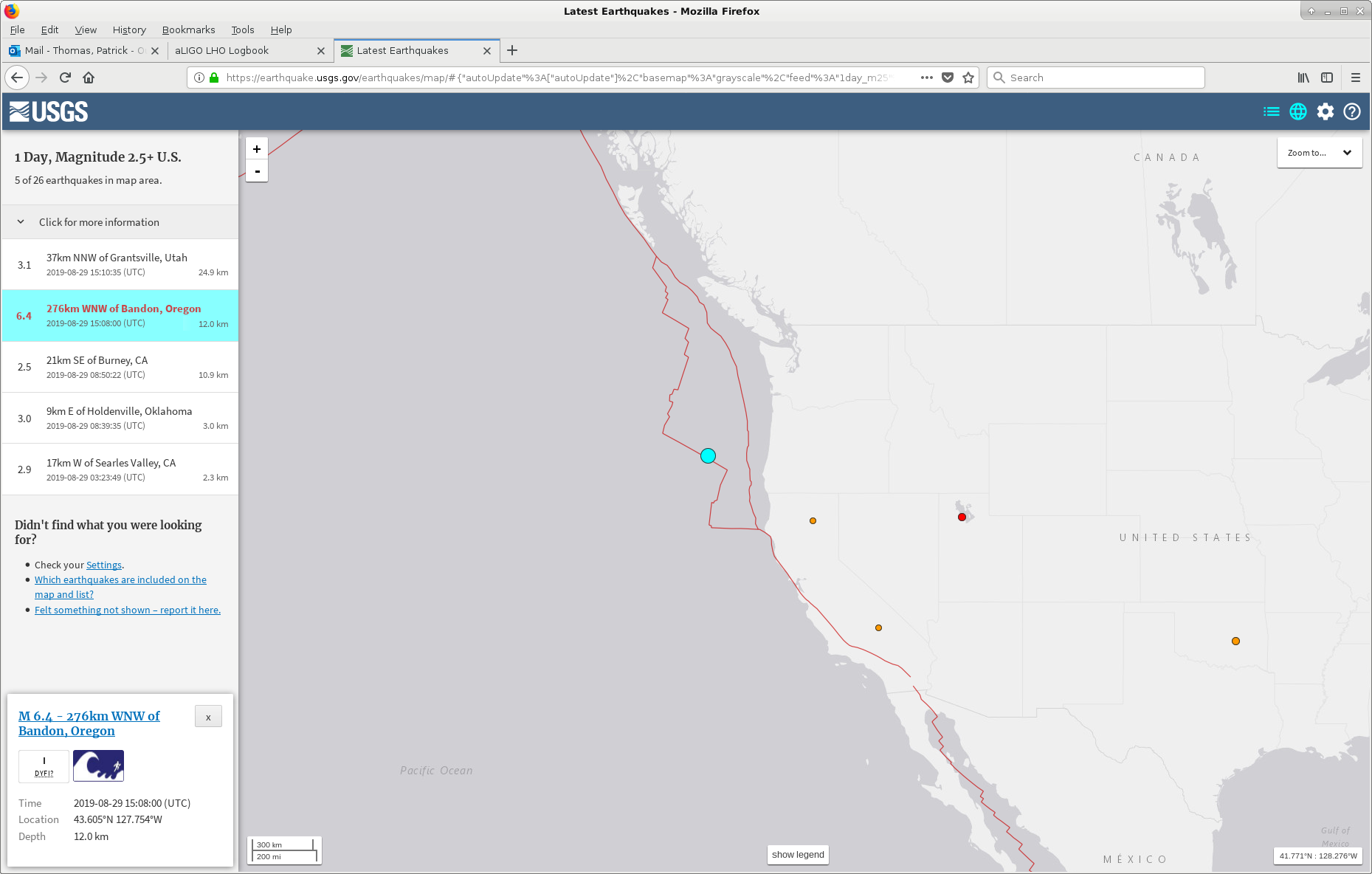
QUICK SUMMARY: L2A complete. GV14 and GV15 closed for mid X turbo pump work. End X HEPI pump replacement starting. 6.4 mag earthquake 276km WNW of Bandon, Oregon.
H1 SEI
patrick.thomas@LIGO.ORG - posted 08:30, Thursday 29 August 2019 - last comment - 15:31, Thursday 29 August 2019(51601)
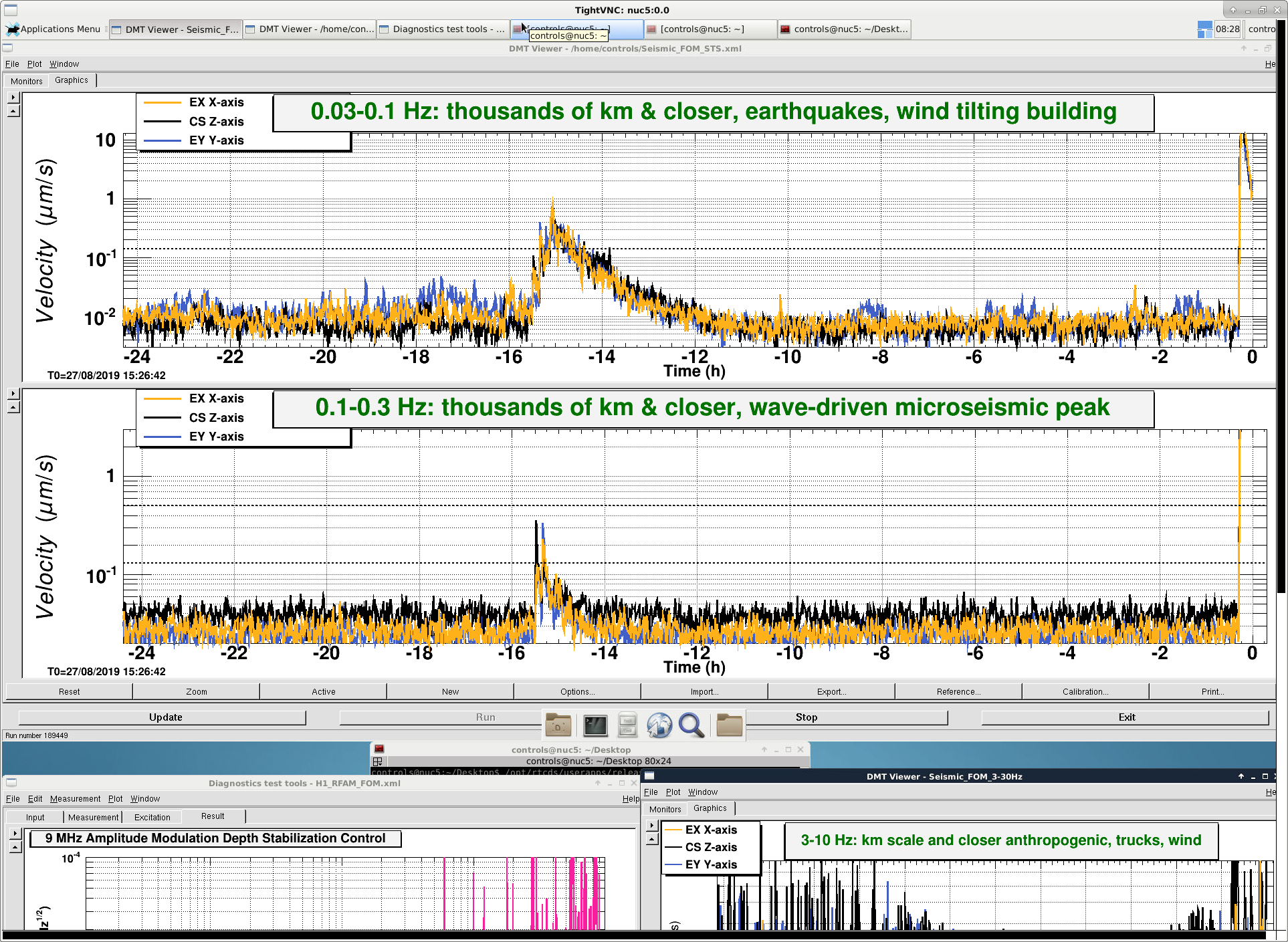
6.4 mag eq 276km WNW of Bandon, Oregon
Hit Very Large Earthquake button, although too late to prevent most of the HEPI and ISI watchdogs from tripping.
Images attached to this report
Comments related to this report
peter.king@LIGO.ORG - 15:31, Thursday 29 August 2019 (51611)
Both the reference cavity reflected and transmitted beams were moving quite a lot according to the CCD images.  I
do not recall ever having seen them move that much before.
H1 General
edmond.merilh@LIGO.ORG - posted 07:54, Thursday 29 August 2019 - last comment - 09:20, Thursday 29 August 2019(51599)
Shift Summary - Owl

TITLE: 08/29 Owl Shift: 07:00-15:00 UTC (00:00-08:00 PST), all times posted in UTC
STATE of H1: Commissioning
INCOMING OPERATOR: Patrick
SHIFT SUMMARY:

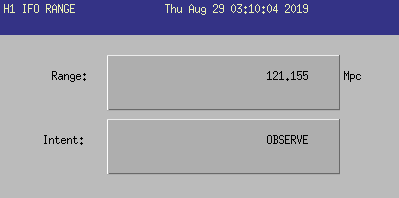
Quiet night. Range was the highest I've seen yet (see image). Also, a little pre-dawn rain made for a really interesting sunrise show ( more images)

14:45UTC planned commissioning beginning

Handing of to Patrick
LOG:

Images attached to this report
Comments related to this report
jenne.driggers@LIGO.ORG - 09:20, Thursday 29 August 2019 (51603)

While we are pretty excited that Kara's work on Tuesday got us an extra ~2Mpcs (alog 51553), we should all remember (although it's easy to forget) that this number we report in the control room isn't the final calibrated range.  The red trace in the range plot on the summary pages uses the version of GW strain that incorporates all of the extra fine-tunings on the calibration, and is a more reliable estimate of our actual range.  So, we're maybe at 117 Mpcs, which is still really awesome!

H1 General (DetChar)
edmond.merilh@LIGO.ORG - posted 07:19, Thursday 29 August 2019 (51598)
Spike in Anthro BLRMS Coincident With DCPD Saturation?

14:00-14:11 Forklift driven past from LSB, past the OSB to woodshop and back.

Images attached to this report
H1 General
edmond.merilh@LIGO.ORG - posted 00:05, Thursday 29 August 2019 (51597)
Shift Transition - Owl

TITLE: 08/29 Owl Shift: 07:00-15:00 UTC (00:00-08:00 PST), all times posted in UTC
STATE of H1: Observing at 117Mpc
OUTGOING OPERATOR: Corey
CURRENT ENVIRONMENT:
    SEI_CONF state: WINDY
    Wind: 9mph Gusts, 6mph 5min avg
    Primary useism: 0.01 μm/s
    Secondary useism: 0.05 μm/s
QUICK SUMMARY:

LHO General
corey.gray@LIGO.ORG - posted 23:58, Wednesday 28 August 2019 (51589)
EVE Operator Summary

TITLE: 08/28 Eve Shift: 23:00-07:00 UTC (16:00-00:00 PST), all times posted in UTC
STATE of H1: Lock Acquisition
INCOMING OPERATOR: Ed
SHIFT SUMMARY:

Nice shiftLocked H1 at beginning of the shift (no issues walking it up to NLN).  Been locked the rest of the night with 7+hrs of Observing.
LOG:

H1 CAL (ISC)
jeffrey.kissel@LIGO.ORG - posted 21:09, Wednesday 28 August 2019 - last comment - 12:20, Tuesday 24 September 2019(51592)
Nice Repeatability of SRCL Offset's Effect on DARM Loop Sensing Function; Now Permanemtly 100 ct
J. Kissel

In order to assess its time-dependence, and to go a little bit further to confirm the effect, we repeated last week's measurement of the DARM sensing function's low-frequency response to SRCL offset (see LHO aLOG 51440), this time with a SRCL offset of 
    - 0 ct (what we've been running with since O3 started), 
    - 100 ct, and 
    - today, newly 200 ct (we lost lock 3/4s of the way through the measurement suite, but enough to salvage the data)
to make some definitive conclusions and decisions about it.

%%%% Executive Summary%%%%
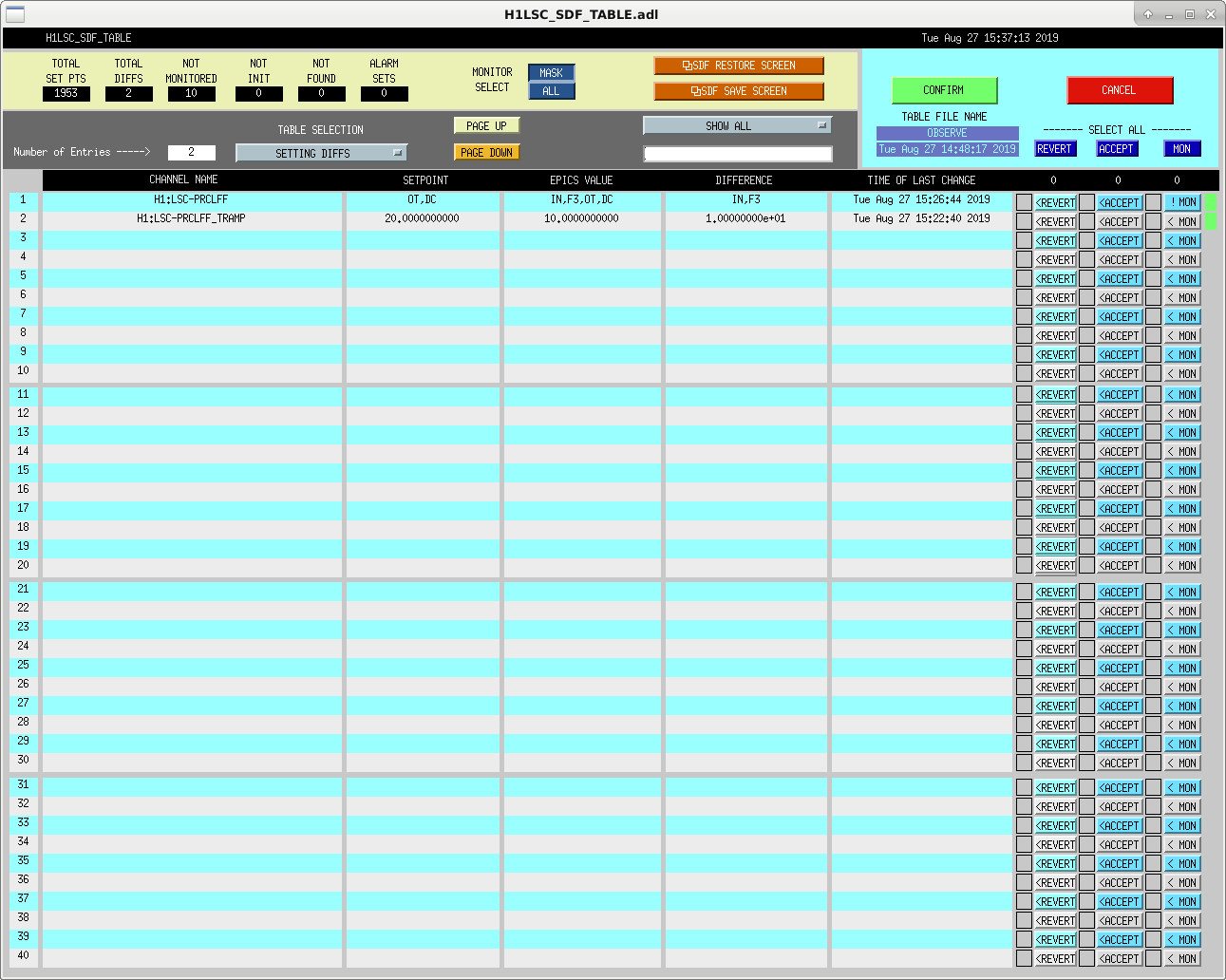
We installed a 100 ct digital offset in the SRCL loop, and modified the ISC_LOCK guardian to turn it on during the LOWNOISE_LENGTH_CONTROL state; it succeeded, and we've accepted it into the OBSERVE SDF. This improves the low-frequency sensing function by reducing the detuned SRC optical spring effects, reducing the complexity of the DARM response to displacement. We have not yet updated the calibration to reflect this, and I think we may not have to.

Also, more details later (see point 5 below), but just so we're no longer sad about the physical interpretation of this digitally requested, I give you my crude calibration for the digitally requested SRCL offset: 
  Digital      SRC Phase             SRC Length
      0 ct = - 0.34 (+/- 0.02) deg = - 57.6 (+/-3.4) nm
    100 ct = + 0.00 (+/- 0.01) deg =    0.0 (+/-1.7) nm
    200 ct = + 0.28 (+/- 0.02) deg = + 47.4 (+/-3.4) nm
(with dl- = [ lambda / (2*pi) ] * phase, and lambda = 1064e-9 m)

%%%% DETAILS and FIGURES %%%%
Here're the conclusions:
 
(1) A requested digital SRCL offset of 100 ct can repeatedly reduce the amount of detuning seen in the DARM sensing function -- however, what's left over is still time-dependent.
See first attachment: 2019-08-28_H1_SRCLOffsetTest_Jul100ct_sensingFunction_referenceModel_vs_allMeasurements.pdf
This compares last week's and this week's measurements in the pre-August spot positions against a model.
As in previous aLOGs, I divided the measurement by an hand-tuned sensing function model with no optical spring, in order to show / expose what response is down there, since we know we can't attribute the response entirely to just SRC detuning; some parasitic L2A2L coupling remains. And indeed, we can't disentangle whether it's the parasitic L2A2L or the SRC detuning that's time dependent.

This hand-tuned model parameter set: 
/ligo/svncommon/CalSVN/aligocalibration/trunk/Runs/O3/H1/params/
    modelparams_H1_20190416_byopticalresponseforjulspot100ctSRCLoffset.py

which only differs from the nominal O3 model in 
    - lack of optical spring (detuneSpringFreq = 0.0), 
    - the optical gain (ccOpticalGain) is 3.16e6 (corresponding to a \kappa_C of 0.972, as expected from the lack of updating for power up from 35W to 37W), and 
    - the cavity pole frequency (ccPoleFreq) is 417.0 Hz

but at least, (yes, only a sample size of 2),  we conclude the low-frequency response is still time dependent with a 100 ct offset, but not by much.

(2) While we lost lock halfway through the PCAL2DARM sweep, I had a full DARM Loop Suppression measurement in the can during the time which the IFO had a requested digital SRCL offset 200 ct. Thankfully this is enough data to resolve the low-freqnecy response. 
See second attachment: 2019-08-28_H1_SRCLOffsetTest_OffsetComp_sensingFunction_referenceModel_vs_allMeasurements.pdf
This compares the three measurements of the above mentioned offsets. One can clearly see that between a digital offset of 0 to 200 ct, we're flipping between an pro-spring (0 ct offset) an anti-spring (200 ct offset), and some how, miraculously 100 ct offset lands use pretty darn close to perfectly tuned.

However, as is seen in the first and now the second plots -- at 100 ct, there remains some for of stuff going on. We'll blame it on parasitic L2A2L, so we won't for now, try to find the "perfect" SRCL offset, and continue down the Sheila / Matt path of trying to crush the parasitic L2A2L. From these two plots, we conclude that a 100 ct SRCL offset is good, and we'll now stick permanently with it.

(3) Now -- what does this mean for the calibration? 
See third attachment: 2019-08-28_H1_SRCLOffsetTest_Jul100ct_NomModel_sensingFunction_referenceModel_vs_allMeasurements.pdf
Here, I show the currently installed reference model against the two data sets we have with the July spot positions, but with a 100 ct SRCL offset. 
    - We already know the optical gain is too high at 3.25e6 ct/m, but that's covered by \kappa_C at 0.97.
    - We already know that the cavity pole is a bit too low at 411, but that's covered by f_cc which nicely is reporting 418 Hz or so at the beginning of a nominal lownoise stretch after power-up, and settles in to about 414 Hz after thermalization.
    - So it's only the low-frequency response that should concern us: since there's essential no detuning at a 100 ct SRCL offset, the current model, which has a pro-spring of 4.47 Hz, gives as much as 4% systematic error at 20 Hz, and 14% error at 10 Hz. BUT -- as Evan inadvertently shows in the Action Item Follow-up Slides of G1901479, if we have a systematic error in the sensing function (as represented by the 68% CI shaded region), then it's not until that error starts getting about a factor of 2 worse -- ~8% at 20 Hz (25-30% at 10 Hz) -- that we really start to spoil the systematic error of the entire response function. 

So I think we're OK here. The resulting low-frequency systematic error created by improving the sensing function reality without updating the calibration model of it is smaller than other dominant overall response function systematic errors and uncertainties in this frequency region.

I wouldn't be opposed to creating a new reference model starting with this data set, but there's *a lot* of things to remember to do besides just updating the front-end model (see, e.g., an incomplete list here: T1800469.)

(4) What if we went forward with our existing techniques and pushed a new model that is derived from the MCMC fit infrastructure we have?
See fourth and fifth attachment: 
    2019-08-28_H1_SRCLOffsetTest_Jul100ct_NomModel_sensingFunction_mcmcModel_vs_measurement.pdf
    2019-08-28_H1_SRCLOffsetTest_Jul100ct_NomModel_sensingFunction_mcmcModel_paramCornerPlot.pdf
The MCMC puts forth a pretty solid fit, with 
       Optical gain, H_c (ct/m)                 | 3.159e+06 (+1041,-959.4) or (+0.03297%,-0.03037%)
       Cavity pole, f_cc (Hz)                   | 419.8 (+0.7607,-0.8149) or (+0.1812%,-0.1941%)
       Detuned SRC spring frequency, f_s (Hz)   | 2.152 (+0.02577,-0.02861) or (+1.198%,-1.33%)
       Detuned SRC spring quality factor, Q_s   | 97.36 (+2007,-4929) or (+4.85%,-1.975%)
       Residual time delay, tau_c (usec)        | 1.987 (+0.4861,-0.5282) or (+24.46%,-26.58%)
which is consistent with my by-hand fit, has .... let's say 1-2% / 2 deg scatter level systematic error down to at least 7 Hz, and only has a few walkers in parameter "islands." I would be comfortable attributing the rest of the systematic error to the parasitic L2A2L coupling, and moving on without having to worry about a detuned spring anymore. Plus -- if Sheila / Matt are getting closer to trying out their L2A decoupling, then maybe this secondary effect will also disappear...
I'm getting ahead of myself though.

I've gotta sleep on this (and we've gotta replace an HEPI pump tomorrow), but stay tuned for a decision on whether to update the reference model.

(5) The promised details on the calibration of the SRCL offset: 
This calibration / fit to the data uses the very handy Cahillane DARM Plant interactive plotter python script from LHO aLOG 48366, updated for an input power of 36.8 W, with a PRG of 45, and (perhaps incorrectly, oddly the data demands that) the SRM transmission is 36.05% (where "we know" that the SRM has been replaced with SRM-06 Post O2, which galaxy, says LIGO measured 32.34%, but the report is empty, and the vendor data sheet says 31.80%).
I agree that 
    (a) I've probably done something wrong, 
    (b) that the physical values for the detuning appear to be an order of magnitude larger than what they were in O1/O2 (see LHO aLOG 27675)
so forgive me for now while I still try to get an understanding of how the calibration of this offset works.
*I've* done nothing complicated -- Craig has done all the work for me of making the amazing tool which converts physical parameters into a sensing function -- and gives you interactive control over the important ones that influence the shape of the response function. 
So -- that's what I did. Eyeballed the fits (with the above state precision), and came up with that kind of SRC phase.
See sixth attachment: 2019-08-28_H1DARM_SensingFunction_CraigModel.pdf
    This shows three pages for the three measurements with three different offsets. Virtually all physical parameter values are kept at their nominal measured values, except for -- as mentioned above -- the SRM transmission.  (well, and yes, OK, there's a 0.07 log-scale correction to the optical gain, but optical gain loss could be anything). Importantly though -- between the three fits, I only varied the SRC detuning phase.
    Anyways -- more to sleep on.
Non-image files attached to this report
Comments related to this report
jeffrey.kissel@LIGO.ORG - 21:24, Wednesday 28 August 2019 (51596)DetChar, ISC, OpsInfo
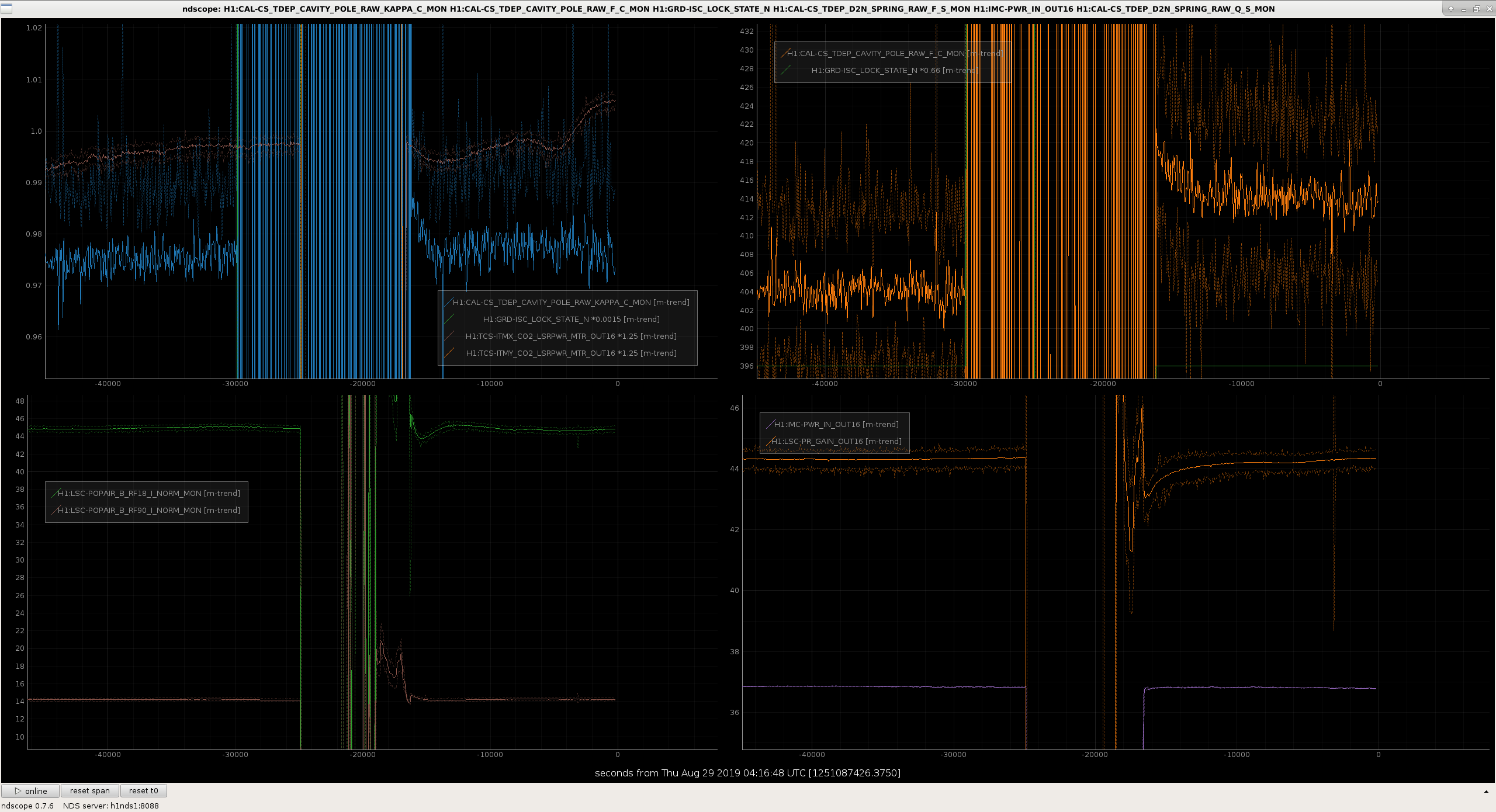
Just a quick *before* vs. *after* (the application of the 100 ct offset) trend of \kappa_C and f_cc between the previous nominal_low_noise / observation segment and this one.

The cavity pole frequency is now back to Mar 2019 levels in the ~415 Hz region!

Also -- you'll note that before the soft loops / ADS settle -- which, PS, still takes on the order of an hour or two (why??) -- we hit the nominal low noise segment with a cavity pole of 420 Hz, and a nicely high optical gain, but it drops from there... 

PRC gain is about the same.
POP18 / POP90 build-ups are about the same.
"thermalized" / "ads converged" optical gain is about the same.
Images attached to this comment
jeffrey.kissel@LIGO.ORG - 12:20, Tuesday 24 September 2019 (52097)
The first observation ready segment that permanently employed this new SRCL offset started at GPS 1251071403 (aka Aug 28 2019 23:49:45 UTC; Aug 28 2019 16:49:45 PDT).
H1 ISC (ISC)
kara.merfeld@LIGO.ORG - posted 20:54, Wednesday 28 August 2019 (51553)
PRCL feedforward filter created
Kara Merfeld, Jenne Driggers, Keita Kawabe

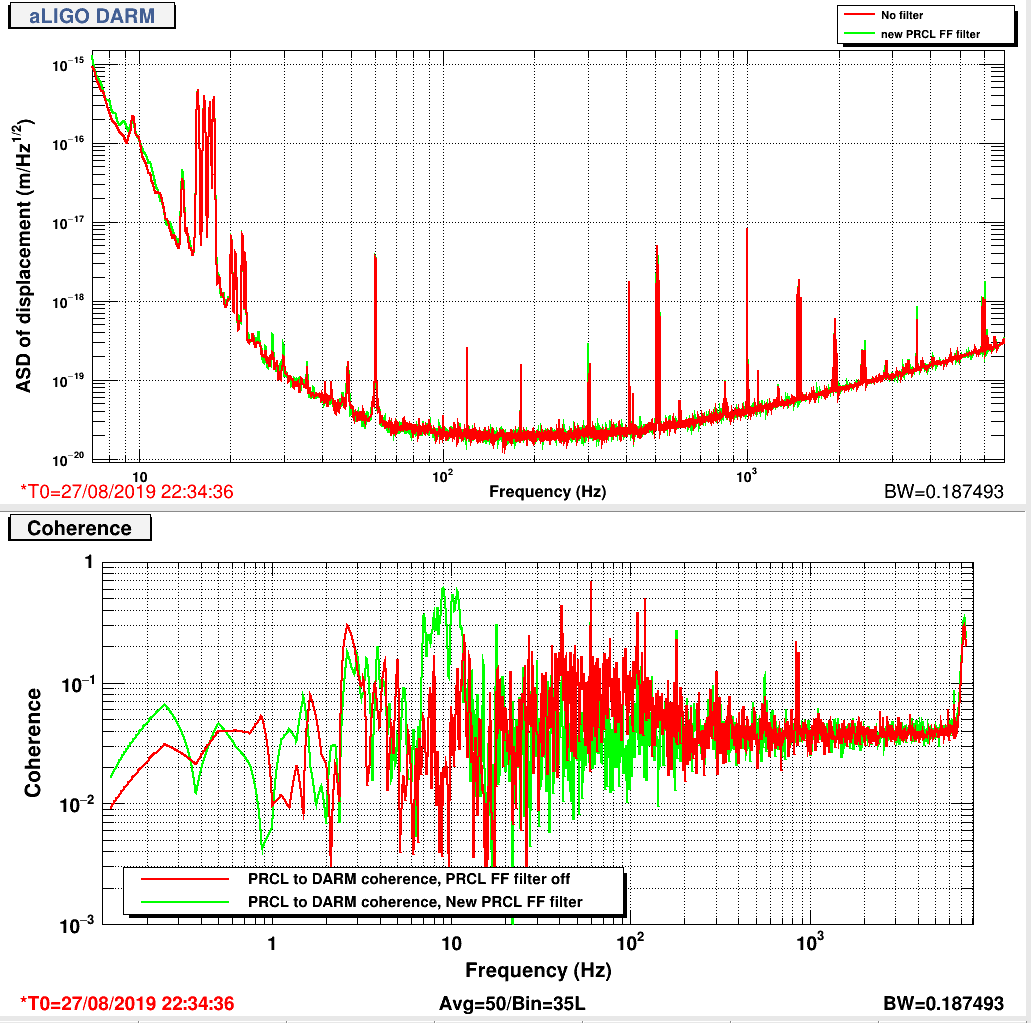
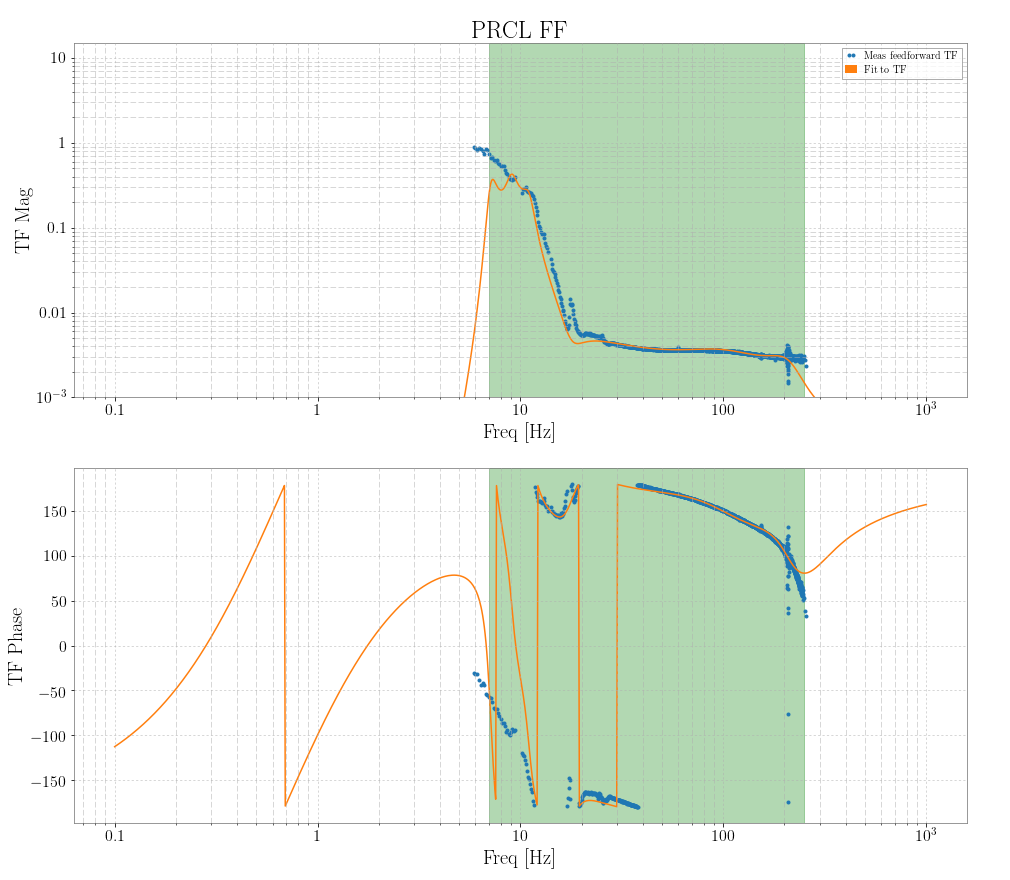
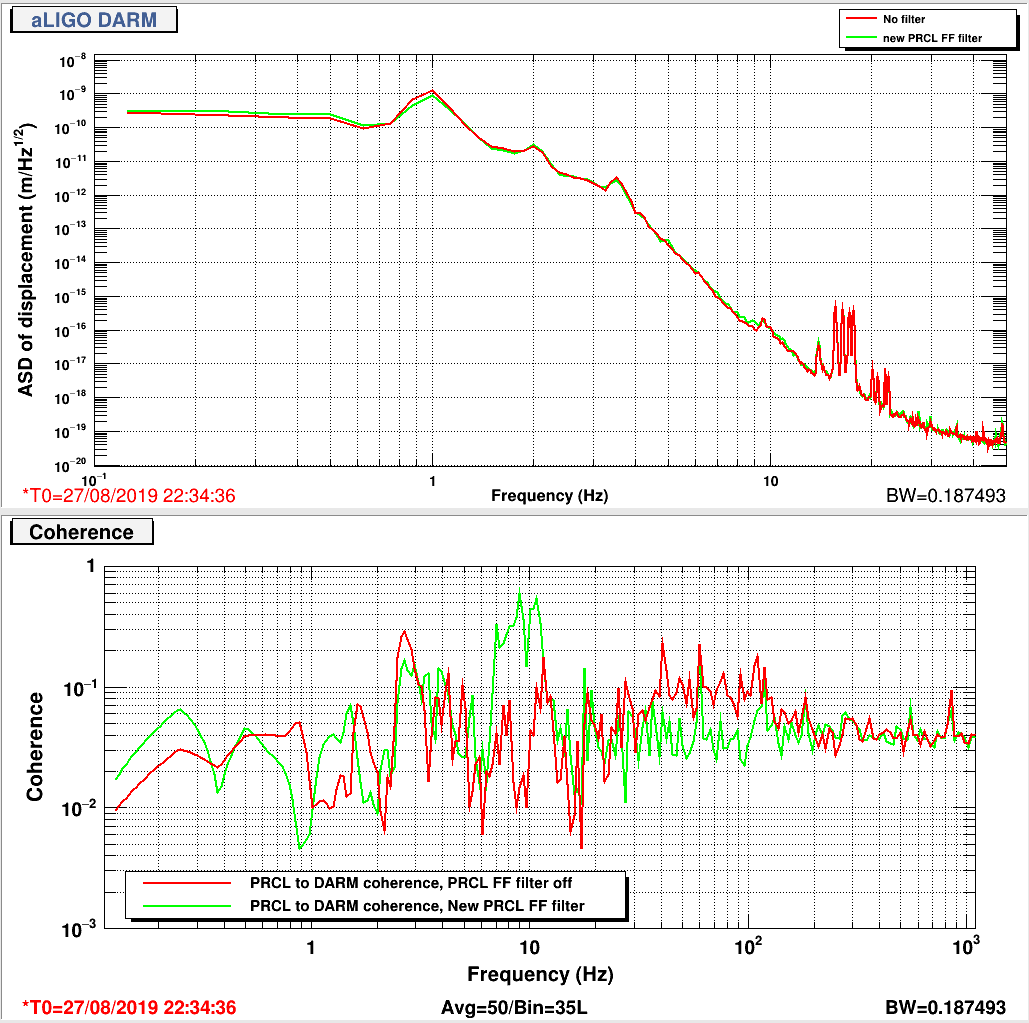
We have created a PRCL feedforward filter such that it reduces the coherence between PRCL and DARM at frequencies between about 20-200Hz.  

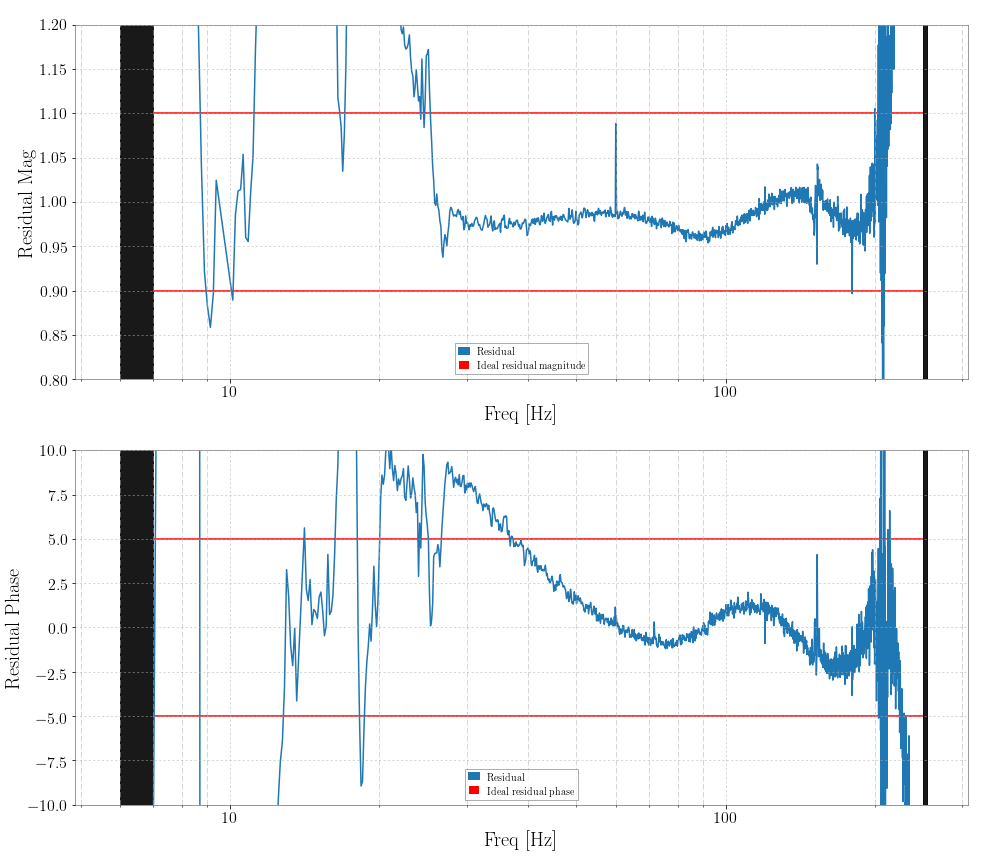
We isolated the frequencies that had a coherence with DARM higher than .9, and fit a function to the necessary transfer function at those frequencies.  In the plots of the fit and the residuals below, we only care about the quality of the fit within the frequency band that is highlighted green.  Outside of this band, we only care that the fit has a small magnitude well below the transfer function, so as to avoid injecting into DARM.  

The residuals of the magnitude in the attachment are a ratio of the transfer function to the fit, so an optimal fit has magnitude residuals =1.  

We can see in the coherence spectrum that we have increased coherence around 10Hz from what we had with no filter.  This is a result of the filter fitting the transfer function poorly around those frequencies, and we are actually making an injection around there.  We can also see this at lower frequencies in the DARM spectrum.  But more importantly, we reduced the coherence between PRCL and DARM between ~20 and ~200 Hz.  We did an on/off test to confirm that the reduction of coherence above a few tens of Hz is really from the new FF. 

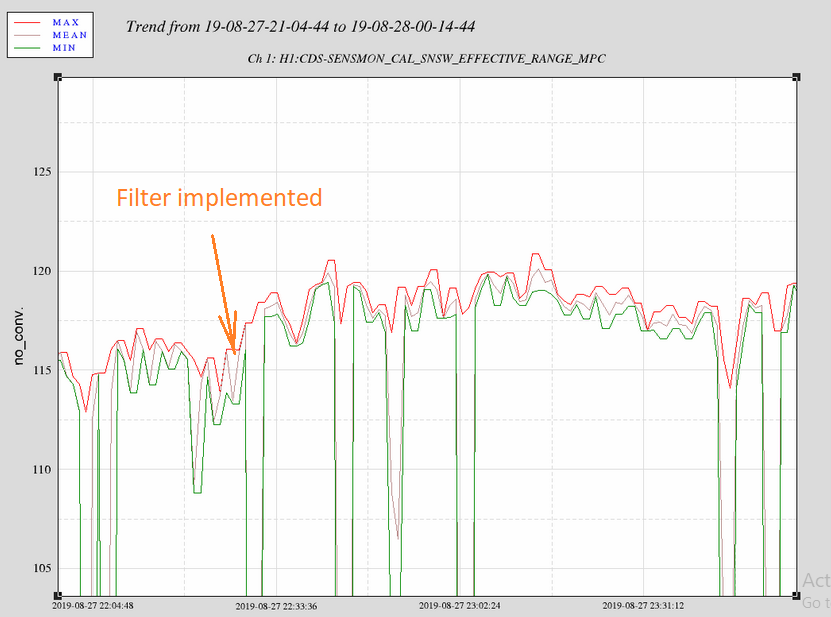
After applying this filter, our range increased by 2-2.3Mpc, giving us about 5% more sky volume.  Here is a url to the range plot: https://ldas-jobs.ligo-wa.caltech.edu/~detchar/summary/day/20190827/ to show the increased range, after proper calibration is applied.

The new settings for the filter are included as an attachment.  This filter has been added to the ISC_LOCK guardian.  We implemented this filter on August 8th, 2019, 22:30:00 UTC.

Images attached to this report
LHO General
corey.gray@LIGO.ORG - posted 20:22, Wednesday 28 August 2019 (51595)
Mid Shift Status

Smooth sailing with H1locked & observing for 3.5+hrs (it even rode through another earthquake!  Woo Woo.).

LHO VE (VE)
gerardo.moreno@LIGO.ORG - posted 19:17, Wednesday 28 August 2019 (51594)
X-Mid Station Noisy Work

(Kyle R, Gerardo M)

We used power tools, air compressors, vacuum equipment and manual tools at the X-Mid station to prepare for tomorrow's turbo pump replacement.
Noisy activity started at 22:17 utc, and we stopped generating noise at 23:40 utc.  IFO reached low noise state at 23:47 utc.

H1 PSL (PSL)
corey.gray@LIGO.ORG - posted 18:58, Wednesday 28 August 2019 (51593)
PSL Chiller Water Level Top-Off (FAMIS #10524)
H1 OpsInfo
sheila.dwyer@LIGO.ORG - posted 16:28, Wednesday 28 August 2019 (51587)
some changes to green WFS

Sheila, Cheryl

Cheryl had some trouble with ALS WFS after our recent lockloss, I looked at the ASC signals after she had tried locking several times.  

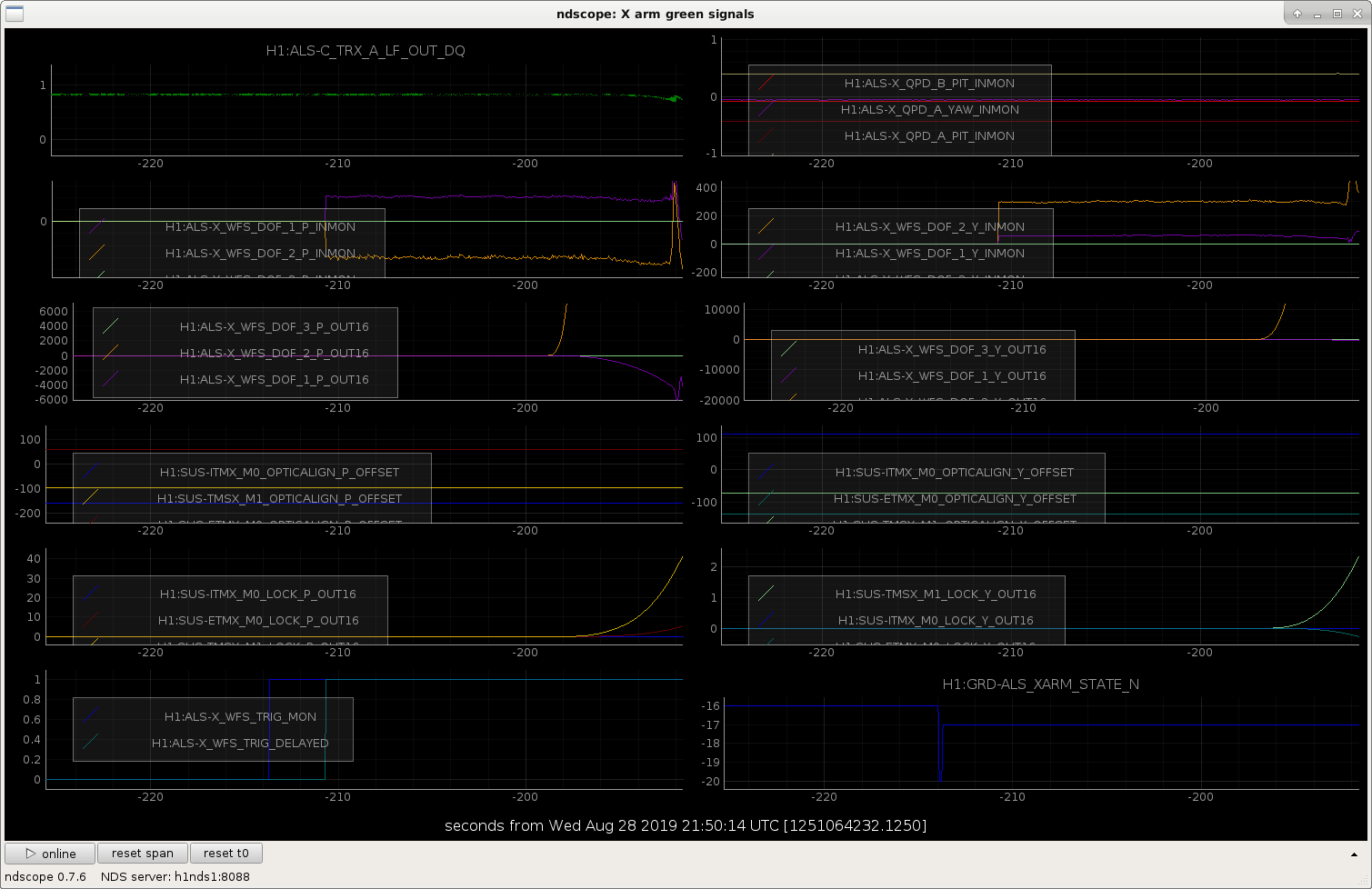
The first attachment shows that as the error signal for DOF1 (ETM) is brought to 0, the DOF2 error signal (TMS) is pushed away, and the loop is too slow to keep up, which made me think that we need more gain in DOF2 and less gain in DOF1.  I changed those gains in the guardian, which seemed to solve this problem for our next lock. I believe this is likely to be the reason why the operators have been manually turning off DOF1, so hopefully this helps. 

The second attachment shows the next locking attempt, the WFS worked OK when they first came on (both error signals are trending towards 0).  At around -1380, the boosts, which have a delayed trigger in the front end, come on.  The guardian state changes to offlaoding just a few seconds after the boosts come on, whlie the control signals are still changing rapidly, and when the offloading finishes and the top mass filters are reengaged with cleared history they drive the alignment away.  I modified the guardian state LOCKED_SLOW_ETM_TMS_WFS so that it sets a timer after the boosts come on, and waits 13 seconds before checking for convergence. I've loaded this but we haven't tested it.  

Images attached to this report
H1 General
cheryl.vorvick@LIGO.ORG - posted 16:15, Wednesday 28 August 2019 (51586)
OPS Day Summary:

TITLE: 08/28 Day Shift: 15:00-23:00 UTC (08:00-16:00 PST), all times posted in UTC
STATE of H1: Lock Acquisition
INCOMING OPERATOR: Corey
SHIFT SUMMARY: in Observe and then Calibrations and during an offset test, H1 lost lock, JeffK and others looking into it
LOG:

PLANS FOR TOMORROW: 8 hour break for HEPI pump and VAC work at MX

H1 SQZ (SQZ)
peter.king@LIGO.ORG - posted 13:25, Wednesday 28 August 2019 - last comment - 16:25, Wednesday 28 August 2019(51580)
Quick look at removed squeezer laser
I performed a cursory inspection of the Mephisto laser that was used in the squeezer (S/N 8552).
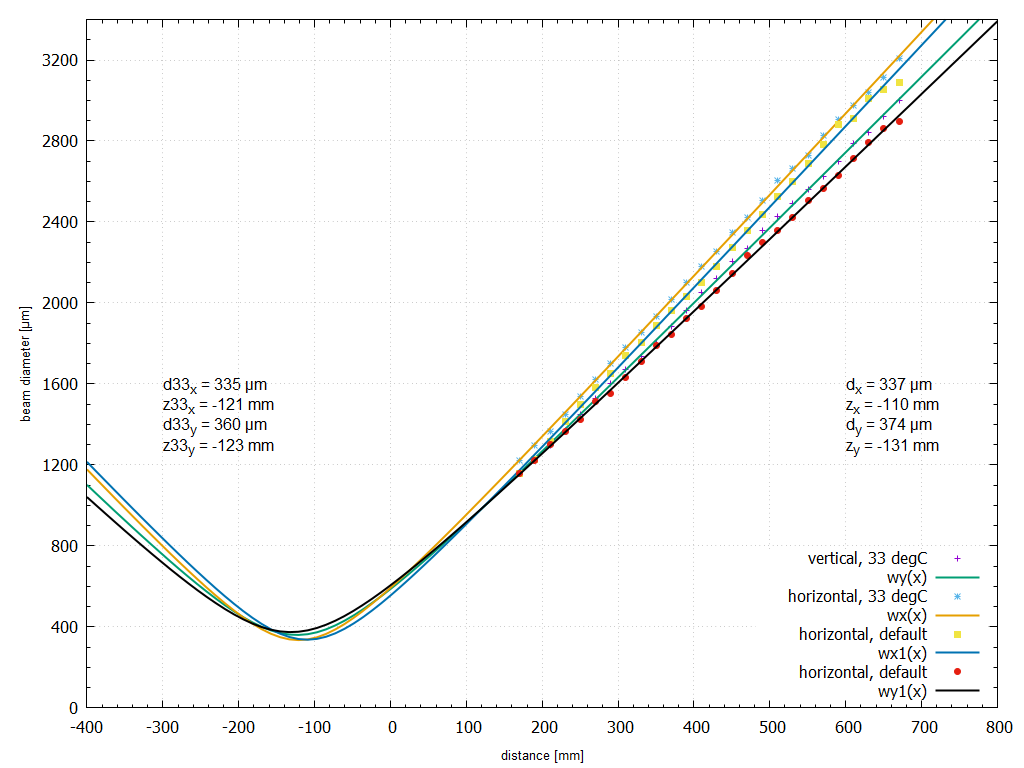
The output beam looked good with a beam profiler.  The beam propagation was measured at its
factory set crystal temperature of 25.10 degC and the last used temperature, 33.00 degC
(see 8552Removed.png).  The output beam pretty much remained the same at both temperatures.

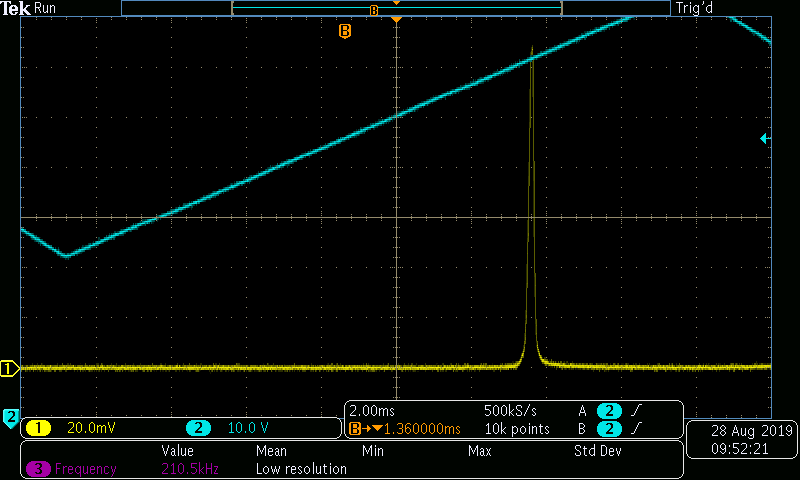
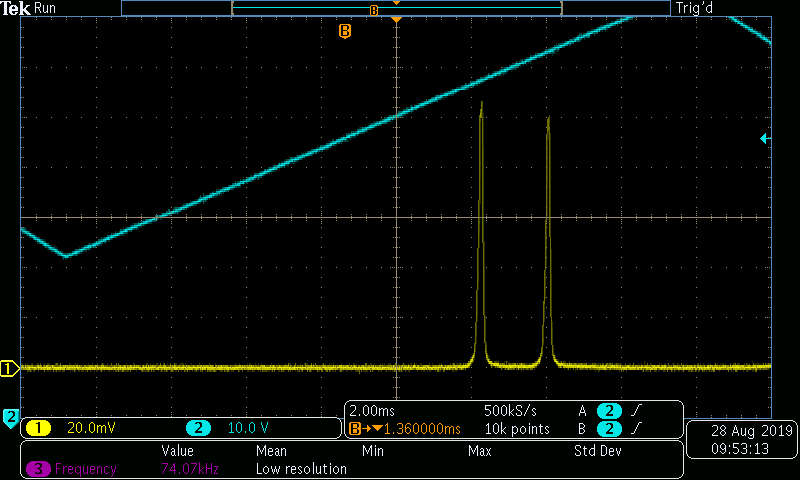
    With the diode current set to 2.15 A, the output of a spectrum was recorded for both
crystal temperatures.  25R10C.png shows the output when the crystal temperature was 25.10 degC.
33R00C.png when it was 33.00 degC.  The presence of another mode is clearly seen.  At the
higher temperature, the output power of the laser was ~10-15 mW higher and anecdotally seemed
a little less stable.

    The crystal temperature was scanned, starting from 25.00 degC.  The following regions are
where the multi-mode behaviour was observed.
 - 28.90 to 29.75
 - 32.48 to 33.35
 - 35.9 to 36.7

    Will check the behaviour for different diode currents next up.
Images attached to this report
Comments related to this report
peter.king@LIGO.ORG - 16:25, Wednesday 28 August 2019 (51590)
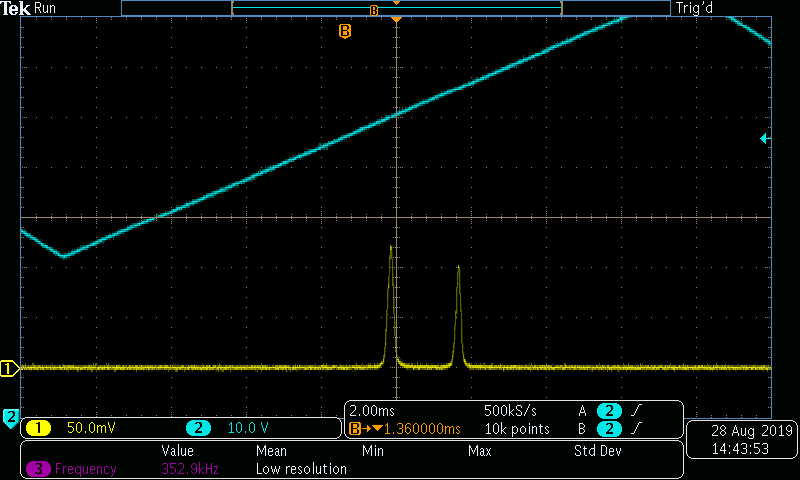
Checked the laser out at the last operated squeezer settings (tek00005.png).  The
laser was multi-mode, or mode hopping at the diode current of 2.025 A and crystal
temperature of 31.68 degC.  The laser was okay when the diode current was decreased
to 1.980 A and down to 1,822 A, where the output power of the laser was ~740 mW and
~550 mW respectively.  The laser was okay from 2.125 A to 2.250 A, where the output
power was 895 mW and 960 mW respectively.
Images attached to this comment
H1 GRD (GRD, Lockloss)
sheila.dwyer@LIGO.ORG - posted 11:42, Friday 23 August 2019 - last comment - 17:27, Wednesday 28 August 2019(51465)
making sure DOWN gets run for subordinate guardians

Jamie, Sheila,

Each time we run an initial alignment, it seems that we loose lock in the early stages of the CARM offset reduction in the the next locking attempt, although these steps are otherwise quite reliable, so it seems as though some setting is not being set correctly after initial alignment is run until the IFO looses lock once. 

After we run initial alignment, we do run the down state of ISC_LOCK, which requests 'DOWN' from several of its subordinate guardians, however, since some of these guardians are already in the DOWN state making the request doesn't cause them to re-run their main states, where the settings get reset.  (For a similar situation and a different solution see 49520 and comments). Yesterday I tried to look manually at the ALS_COMM and IMC_LOCK down states, but catch the problem with my first look.  Patrick also tried to use SDF to find the probelm setting yesterday, 51452 but that didn't show us anything obviously wrong either.

On the phone Jamie told me that when the guardian code was changed so that re-requesting a state doesn't cause the state to be re-run (which was a change that solved problems with having code that isn't idempotent), he added a feature that would allow us to choose the old behavoir for certain states, by adding an edge from that state to itself.  In that case if the guardian is in DOWN and gets a request for DOWN it will re-run its main state. 

So, I've added paths from DOWN to DOWN in ALS_COM, ALS_DIFF, ISC_DRMI, IMC_LOCK, FAST_SHUTTER, and OMC_LOCK.  IMC_LOCK doesn't get sent to DOWN in the DOWN state of ISC_LOCK, so that if the mode cleaner is already locked after initial alignment runs we don't unlock it, and I haven't changed that, I simply added the edge from DOWN to DOWN. 

So, the next time that we have a chance, (when we are out of observing) I'd like to load all of these guardians.  Then we can see if this will solve the problem of loosing lock on the first attempt after initial alignment. 

Comments related to this report
sheila.dwyer@LIGO.ORG - 15:44, Friday 23 August 2019 (51471)OpsInfo

Patrick loaded these changes after a lockloss, and didn't have guardian problems when relocking.  

Request for operators:  I am hoping that this might solve the problem of the IFO lossing lock in the early CARM reduction steps in the first locking attempt after each time we run initial alignment.  I would appreciate if you would report relocking attempts over the weekend, including if you run initial alignment, and if on the first relocking attempt you make it to the CARM offset reduction do you survive those steps?

As a reminder, there is a spreadsheet which could be used to help us keep track of problems encountered when relocking:

https://docs.google.com/spreadsheets/d/1byXR-s2ATegciJCEjORb1FEZhZTp77j6DS-fZuvEY-8/edit#gid=0

sheila.dwyer@LIGO.ORG - 17:27, Wednesday 28 August 2019 (51591)

In the first locking attempt after Tuesday maintence, initial alignment was run, and the interferometer was relocked without loosing lock, on the first attempt https://alog.ligo-wa.caltech.edu/aLOG/index.php?callRep=51561 (Also confirmed by trending the guardian state at the times Jeff aloged)

This means that this solution has worked, and we shouldn't have these failed locking attempts after each initial alignment. 

H1 DetChar (DetChar, SEI)
anne.baer@LIGO.ORG - posted 15:12, Friday 26 July 2019 - last comment - 07:51, Thursday 29 August 2019(50846)
Impact of Extremely Large EQs in O3

Anne Baer, Derek Davis

Summary: Extremely large earthquakes create short periods of significant periods of scattering that can produce significant background triggers for the searches.

Through mid-June of O3 there have been eight earthquakes that resulted in ground motion above 1000 nm/s. For half of these times, the interferometer was able to stay in lock throughout the entire period of the earthquake.

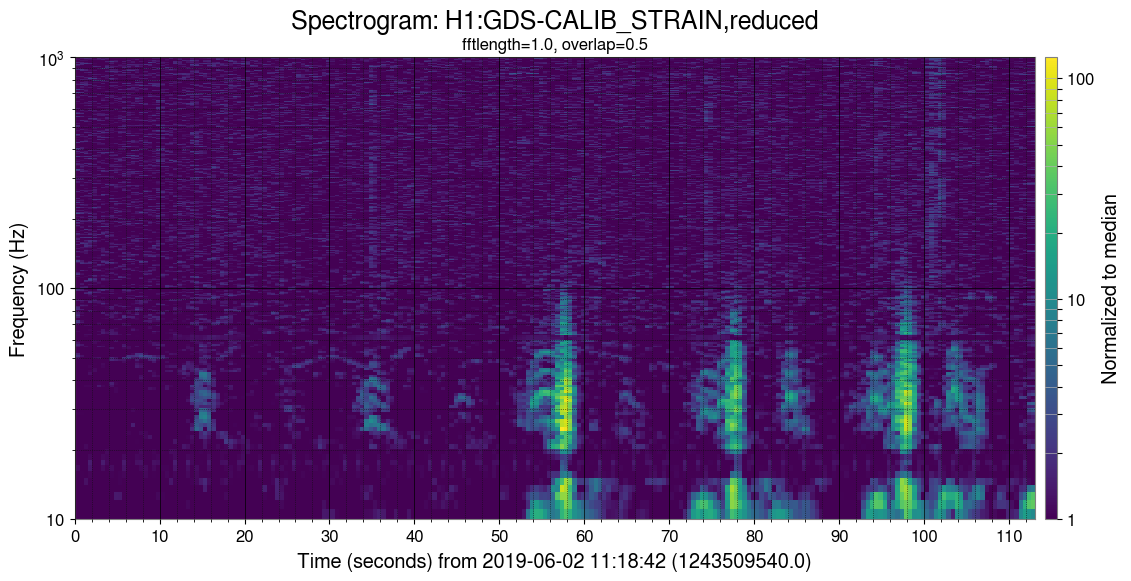
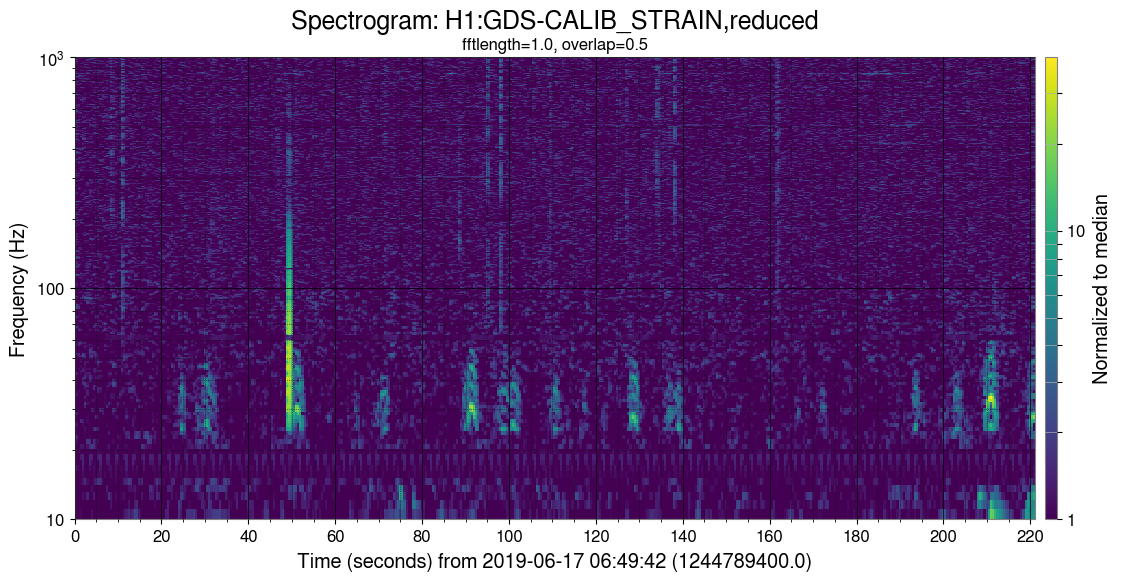
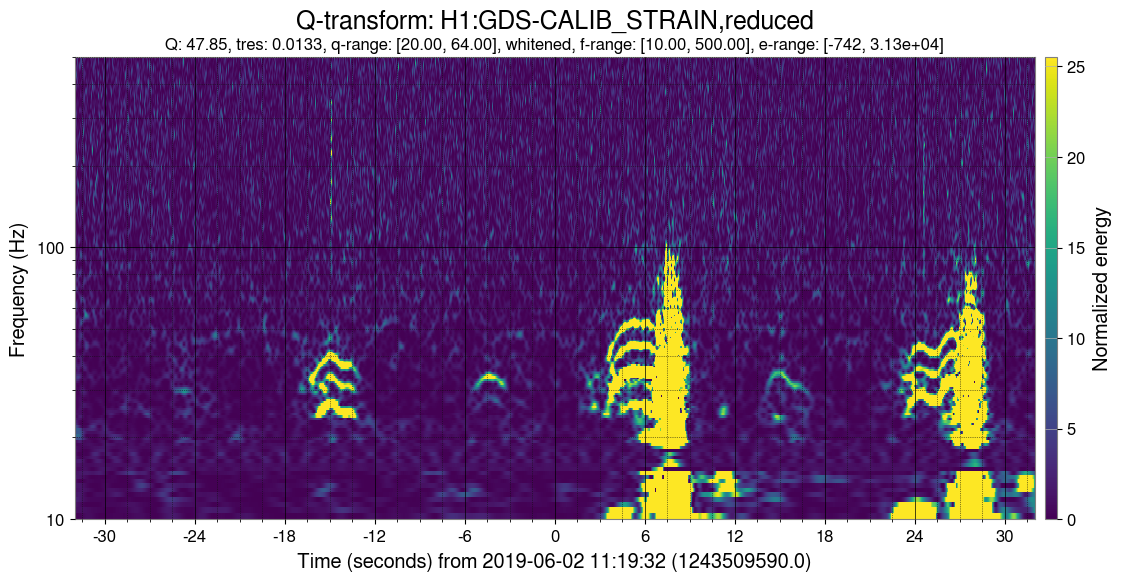
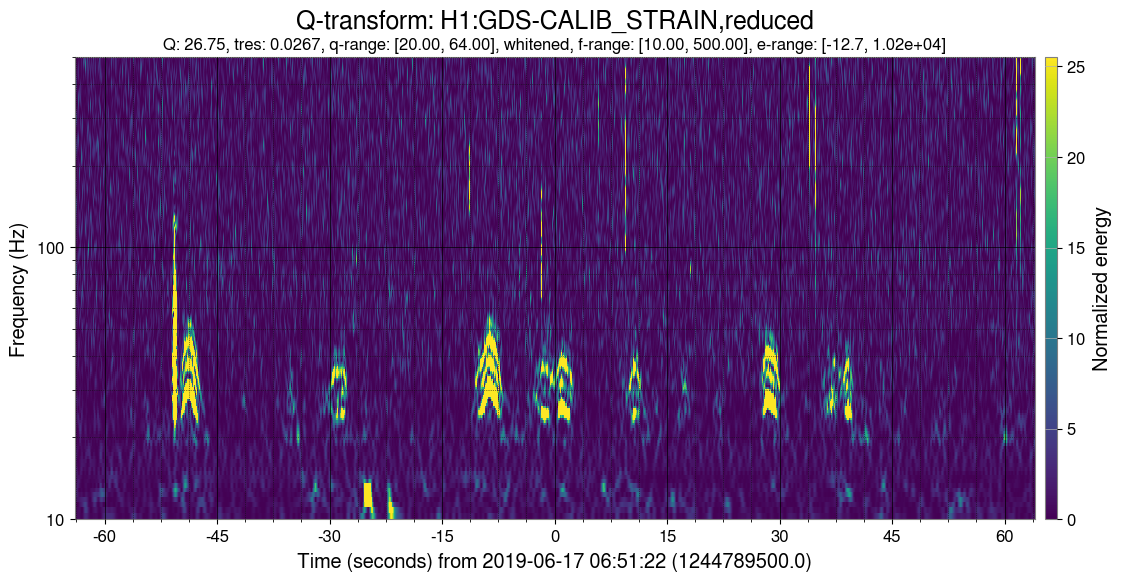
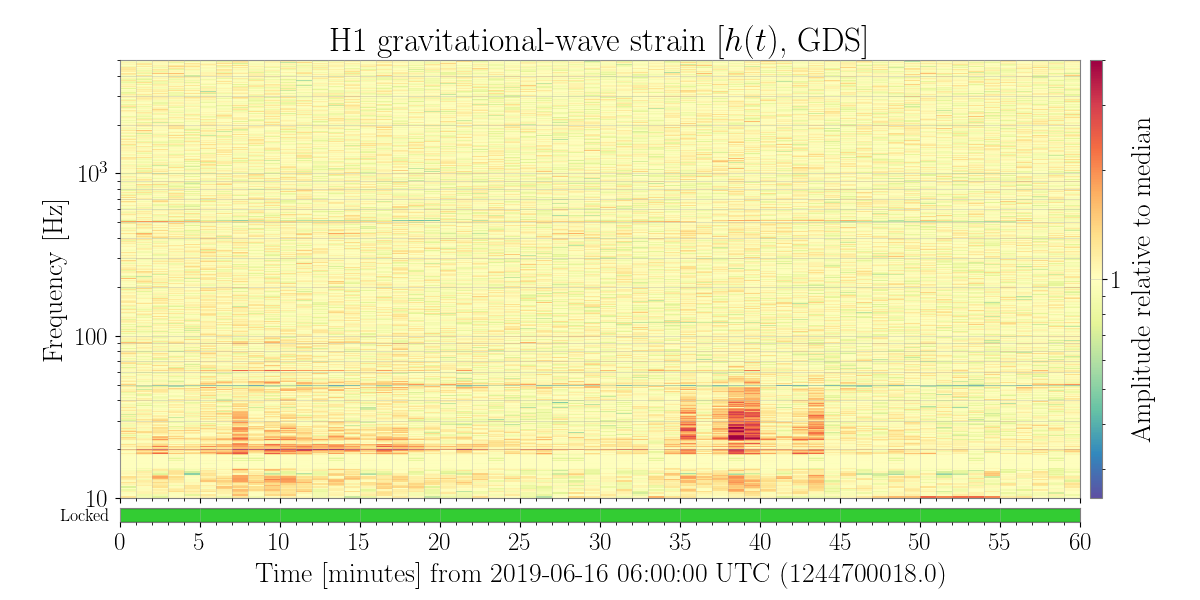
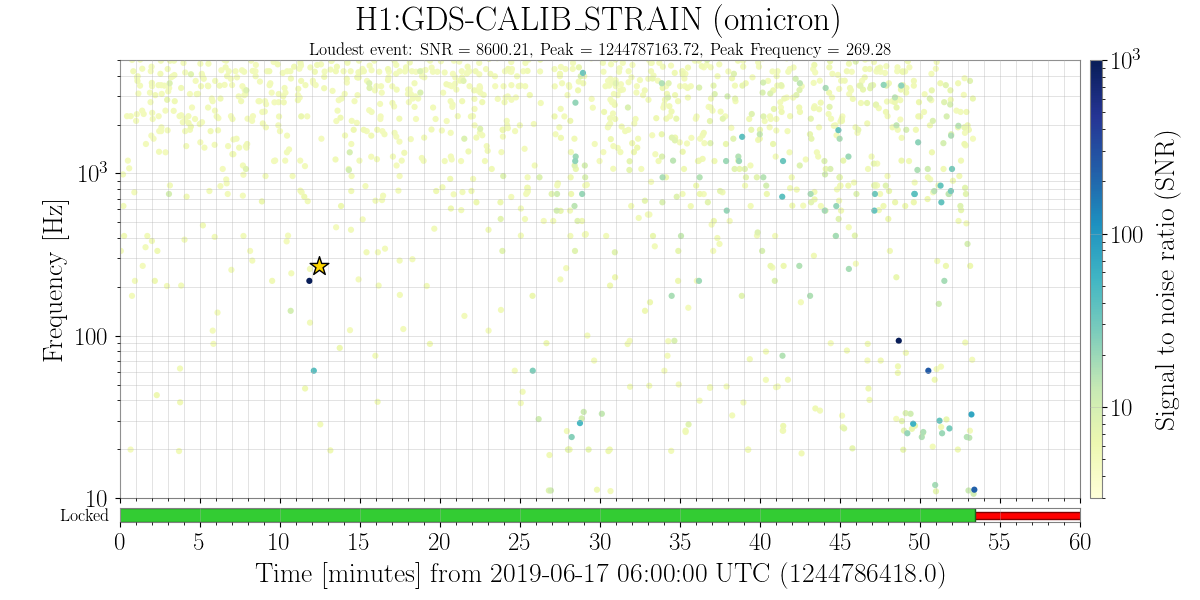
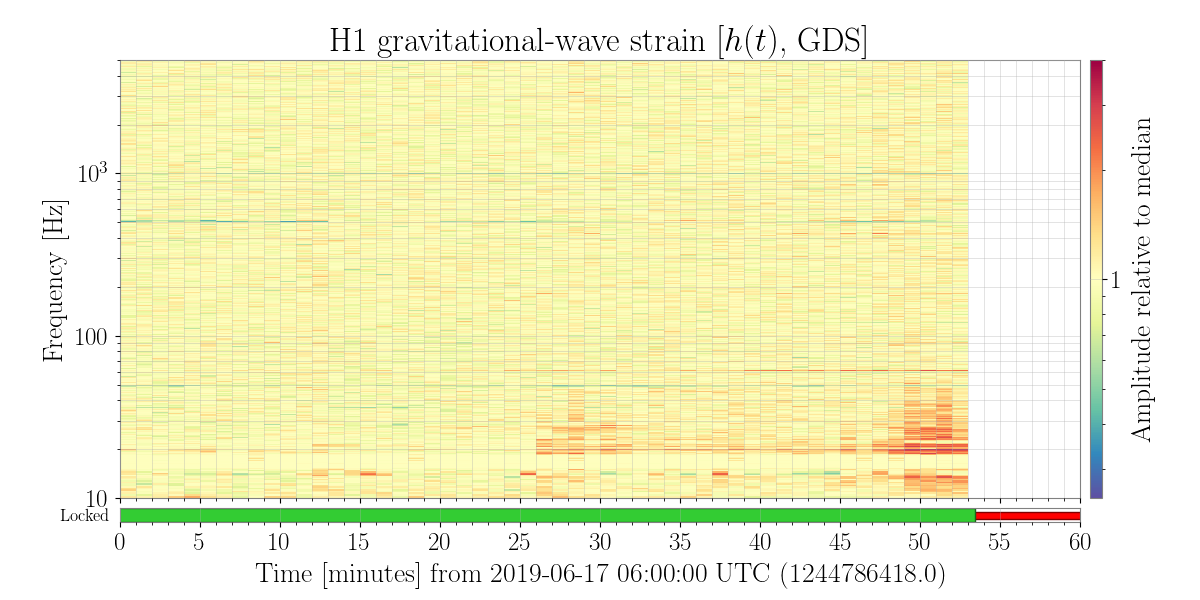
Half of these high earthquake times have significant periods of loud scattering arches that impact the searches. It is not clear what causes these times to result in a larger number of glitches. When this scattering does occur, the glitches tend to produce loud outliers in the PyCBC background, especially for templates with durations of 0.5-4.0 seconds. Earthquake-related glitching is one of the limiting sources of noise for this part of the parameter space.

Spectrograms showing the duration of the high earthquake periods show significant noise at low frequency (see attachments 1 and 2), corresponding to scattering arches in the zoomed in omega scans (see attachments 3 and 4).

The excess noise produced by these large earthquakes is also visible in hourly omicron glitch plots, with excess glitching at 20-50 Hz lining up with the start of the earthquake periods (see attachment 5, 6, 7, and 8).

In all, extremely large earthquakes are related to significant periods of excess noise and should be flagged by the searches. However, as noted in alog 50844, this glitching is not significant enough to warrant leaving observing mode and sacrificing the increase in observing time.

Images attached to this report
Comments related to this report
anne.baer@LIGO.ORG - 07:51, Thursday 29 August 2019 (51600)

Here is the link to the rest of the analysis I did during the noise sprint, as requested.  


Displaying reports 38981-39000 of 89059.Go to page Start 1946 1947 1948 1949 1950 1951 1952 1953 1954 End