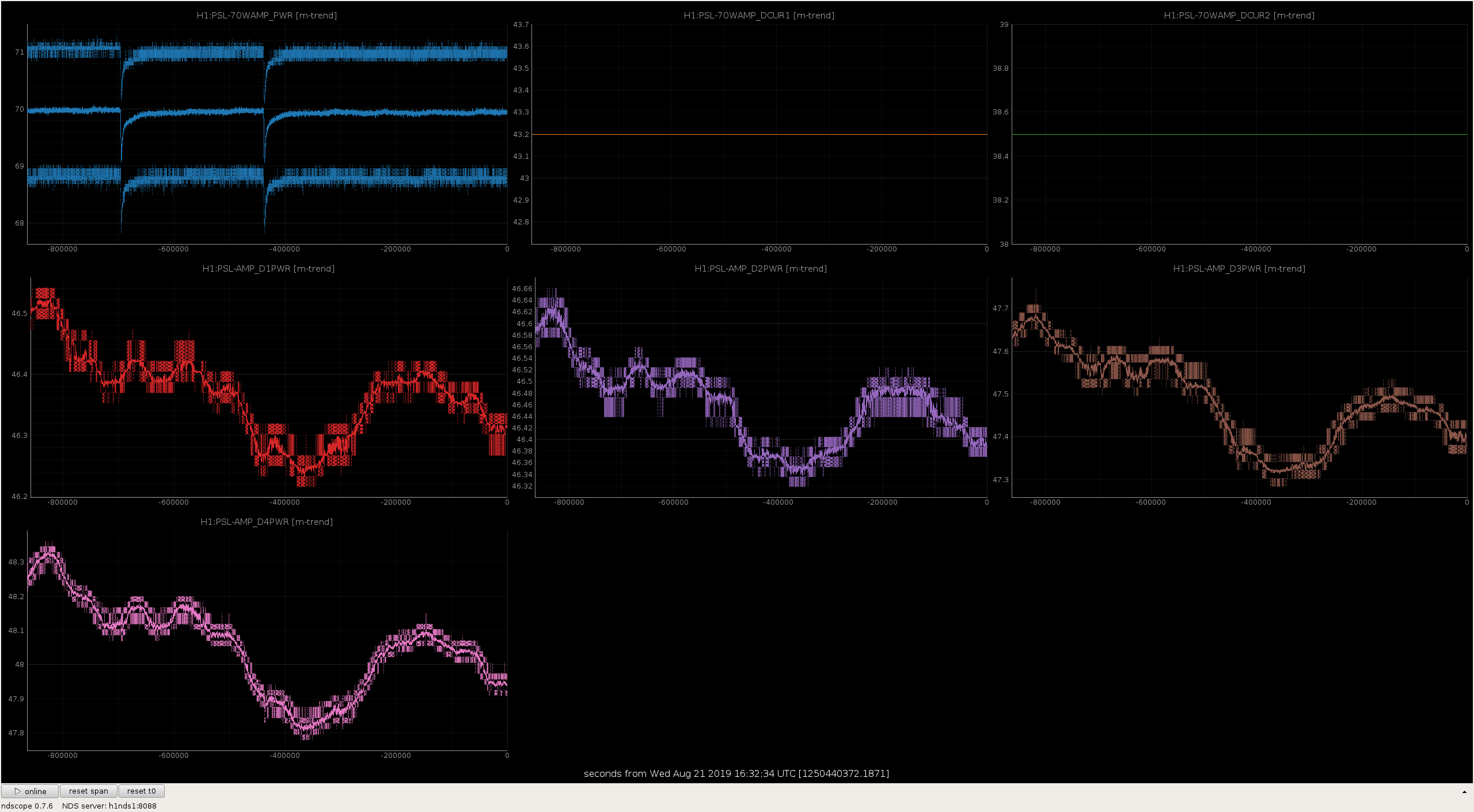
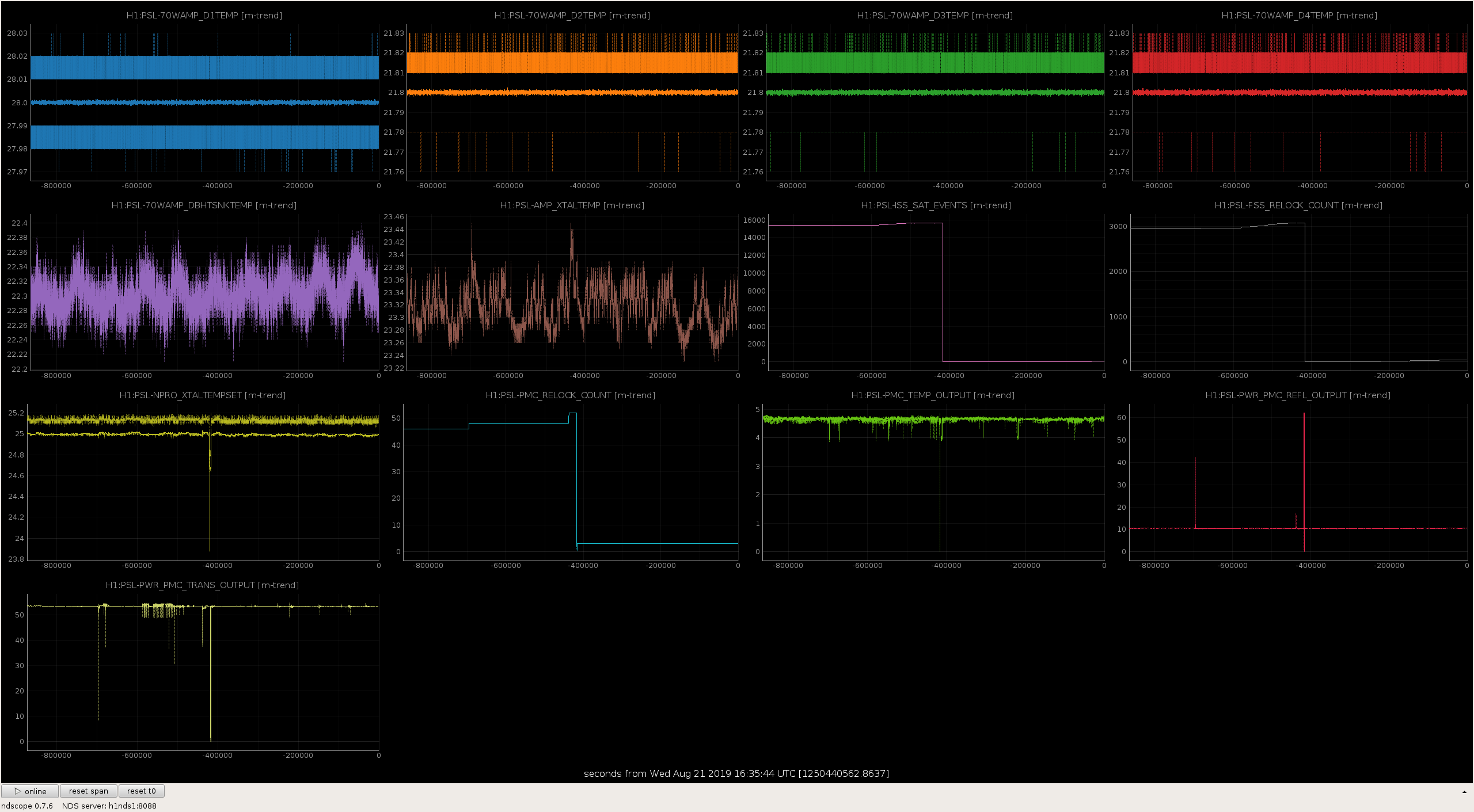
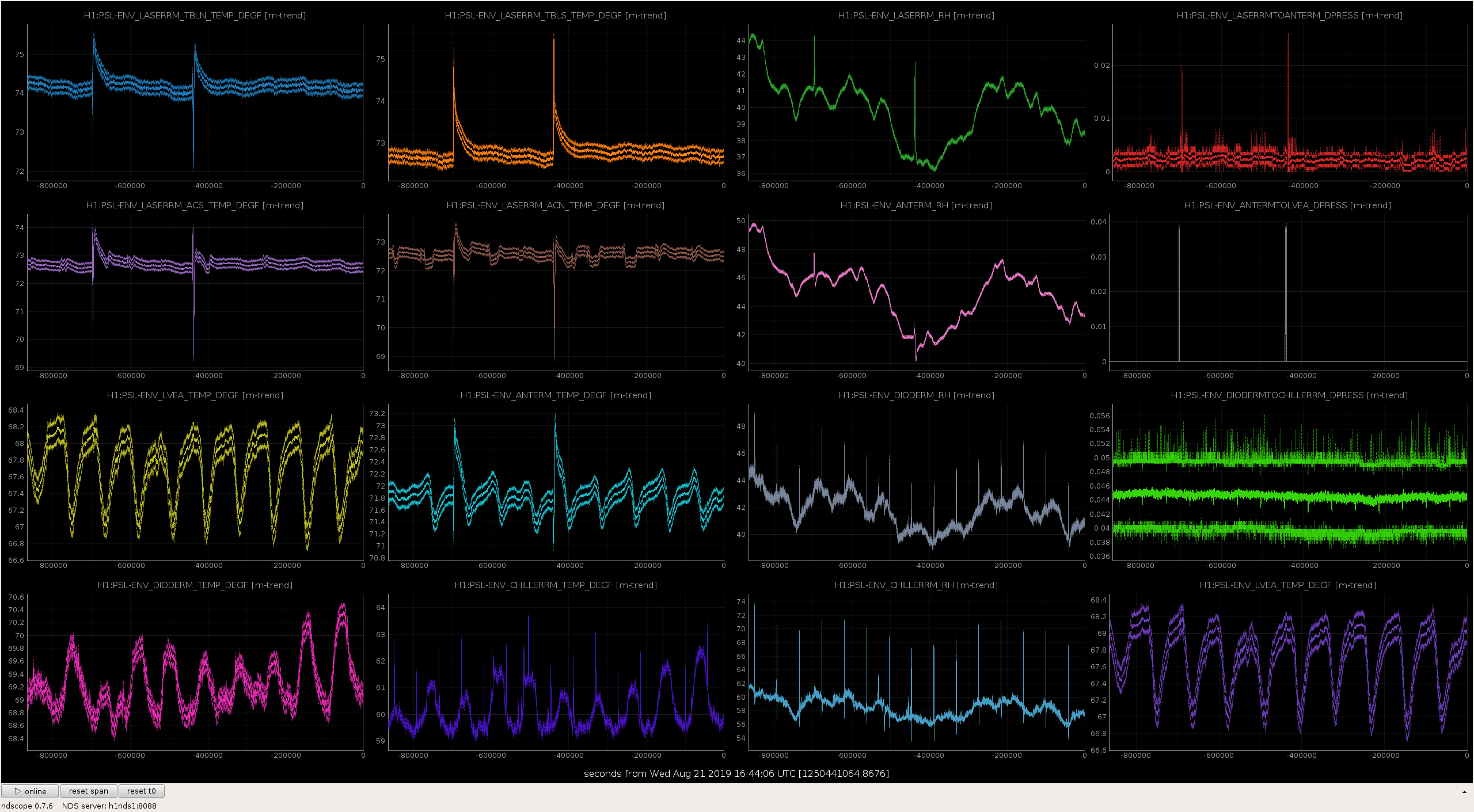
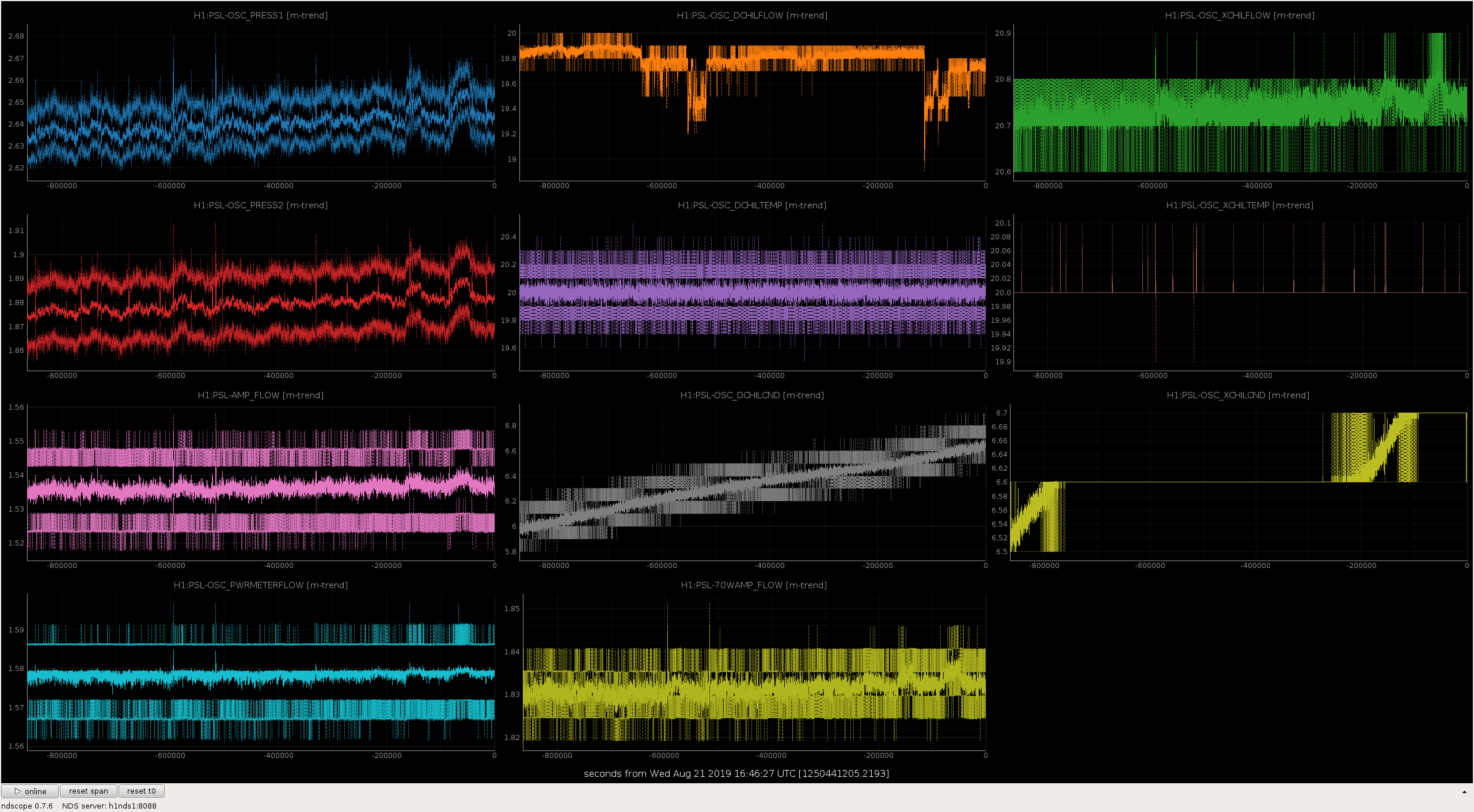
H1 continues to be locked from Niko's shift (just under 11hrs).
COMPLETED: Non-Observing measurements this morning for ~2hrs (Sheila, JeffK)
This Afternoon Plan: Currently H1's in Observing, but we are waiting to coordinate going out of Observing with L1 ( for PEM work & Injections). Will only do this when L1 is out of Observing (and when Virgo remains in Science/Observing). This was discussed/approved with Keita.
S. Dwyer, J. Kissel We've repeated Monday's measurements (see LHO aLOG 51393) of the IFO's DARM Opto-mechanical Response (Sensing Function) Vs. SRCL Offset now at the "July" spot positions (where Monday's were at the "August" positions -- see attachments to LHO aLOG 51436 for what this means in terms of A2L gains). There is similar drastic impact on the sensing function. See attached: 2019-08-21_H1_100ctSRCLOffset_sensingFunction_referenceModel_vs_allMeasurements.pdf I'm again using the "No Spring" loop model, which has H_c Optical Gain 3.13e6 [ct/m] f_cc Cavity Pole Frequency 411 [Hz] and *no* optical spring from SRC detuning, in order to emphasize / better quantify the effects of either actual detuning or remaining L2A2L issues. In the July Spot positions, with a 100 ct SRCL offset, both of these effects are minimized, and the sensing function appears quite flat, where the other three configurations have interesting features. In fact, the cavity pole frequency also best matches the model at 411 Hz in the July positions and with a 100 ct offset, where the other configurations have lower frequency (the worst being 395 Hz from Monday's Aug positions and no SRCL offset [determined by "by-hand" fitting from LHO aLOG 51393]). Looking at the phase, my preliminary interpretation of these data are that (a) Changing the spot position moves the detuned spring frequency to lower frequency but keeps the detuning Q / amplitude level about the same, and (b) Adjusting the SRCL offset reduces "the amount" (the Q and amplitude) of detuning. I'm not yet ready to say this is definitively true, since -- in the beginning of O3 up to July 31, the low-frequency response was bouncing around from week to week (see LHO aLOG 50498), which may be a result of the L2A2L issues. Monday's measurement of Aug spot positions with 100ct SRCL offset show evidence of the "unphysical" phase turn-up and funky magnitude response, yet today's July spot positions, with no SRCL offset don't appear reproduce the unphysical issues -- when we would expect them to be quite similar to all previous O3 sensing function measurements before the spot move. More to come, I'm sure...
J. Kissel
In the above aLOG, I've compared all of the measurements to the same, no spring, low-frequency optical response model to emphasize how much it changes with spot position and srcl offset. We see that there is not only a spring-like effect, but also some (what we believe to be) parasitic L2A2L coupling of some unknown shape or form (especially evident in the requested 100ct SRCL Offset, August Spot position data).
We also know that our MCMC algorithm for fitting this data, for which we only give it the poles and zeros to model a spring (2 zeros at 0.0 Hz, and an arbitrary set of complex poles at frequency f_s with phase separation defined by Q), cannot accurately give us approximations for what at least the spring part is doing because it's getting confused by the parasitic L2A2L response.
However, in order to make progress on how much detuning we have, and how the requested 100 ct SRCL offset changes that detuning in physical units, we need *something*.
So -- I've noodled around with the optical plant parameters that we *do* have in order to make a "best" by-hand fit of the data. Here, "best" is based on minimizing the residual (ratio) between measurement and model, acknowledging that I will never be able to get an actually good fit, because I'm not using enough poles and zeros to cover the L2A2L effect. Also, acknowledge that my by-eye happiness is determining the uncertainty in the parameters, so we have no nice neat, multi-dimensional posterior distribution that exposes the (very real) covariance between the parameters.
Given those caveats, I attach the results.
Here's a table of the resulting fit parameters.
No Offset 100 ct SRCL Offset
Aug spots Jul Spots Aug Spots Jul Spots
optical gain, H_c [1e6 ct/m] 3.13 (0.01) 3.16 (0.01) 3.13 (0.01) 3.16 (0.01)
caviy pole frequency, f_cc [Hz] 395 (3) 405 (3) 409 (3) 415 (3)
optical spring frequency, f_s [Hz] 7.2 (0.5) 6.0 (0.5) 5.0 (1.0) 0.0 (1)
optical spring quality, Q [n.a.] 10 (5) 35 (5) 10 (5) 1.0 (1)
spring type [n.a.] pro pro anti? no?
measurement date [YYYY-MM-DD] 2019-08-19 2019-08-21 2019-08-19 2019-08-21
attachment page page 1 page 2 page 3 page 4
Again, in the 100ct SRCL offset data, there's not enough poles and zeros in the fit, and/or not a visible enough spring to really trust the spring-related assessment last two columns, and I thoroughly recommend we map out the parameter space better and develop a model (or get rid of) the supposed L2A2L coupling so we can really do a proper fit on this.
We can at least confidently say that Jul spot positions, with a requested 100 ct SRCL offset is best for the optical gain and cavity pole.
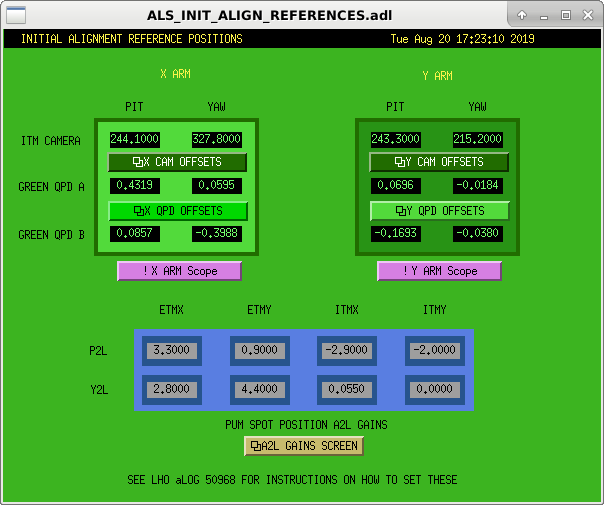
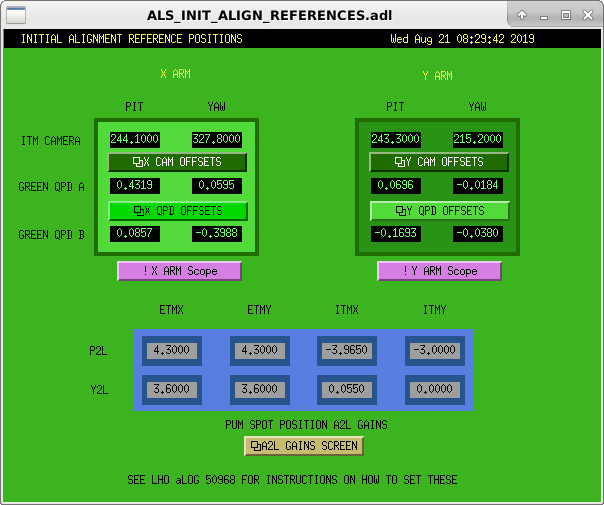
J. Kissel for J. Driggers and N. Lecoeuche After Jenne's re-work of the ISC_LOCK guardian code (see LHO aLOG 51426), we lost lock at 1250407425 (Aug 21 2019 07:23:27 UTC). Niko then loaded the guardian changes (after a few more bug fixes), and ran through the newly minted -- and very slow! -- ENGAGE_SOFT_LOOPS steps which brings the spot positions from centered, out wide in yaw, up in pitch, and then back over in yaw to land back in the old pre-August, "July" spot positions. See LHO aLOG 51433 for Niko's summary of activity. Other than the length of the ENGAGE_SOFT_LOOPS state, everything seemed to have run smoothly, and is currently running smoothly (though the microseimm and EQ band are pretty high at the moment). Thus, at the start of this observation segment -- started 1250414457 (Aug 21 2019 09:20:39 UTC) -- now (and hopefully "for good") has the pre-August, "July" O3 spot positions, and we've finally recovered from the initial alignment reference loss. Sheila and I will be characterizing the IFO today in these reverted spot positions (in similar fashion to LHO aLOG 51393 and LHO aLOG 51394). I attach BEFORE (first) vs AFTER (second) screenshots of the initial alignment references and spot positions.
TITLE: 08/21 Day Shift: 15:00-23:00 UTC (08:00-16:00 PST), all times posted in UTC
STATE of H1: Observing at 114Mpc
OUTGOING OPERATOR: Niko
CURRENT ENVIRONMENT:
SEI_CONF state: EARTH_QUAKE
Wind: 15mph Gusts, 11mph 5min avg
Primary useism: 0.06 μm/s
Secondary useism: 0.22 μm/s
In the last 12hrs microseism has made a big jump above the 50th percentile. And Niko passed on info about an incoming EQ which is a Mag6.0 south of Australia (I've recently transitioned to the SEI EARTHQUAKE state).
QUICK SUMMARY:
In Niko's hand-off he mentioned being able to RELOAD ISC_LOCK to take H1 to its new spots (i.e. alignment we liked pre-camera bump). Range has been hovering around 111-117Mpc for the last 6+hrs of lock/observing.
On the Menu today: Non-OBSERVING time for characterization of our new spot location state (which will involve a suite of measurements such as calibrations, SQZ stuuf, etc.). This was tentatively scheduled for 9am and JeffK is going to confirm with Keita with this plan.
TITLE: 08/21 Owl Shift 07:00 – 15:00 (00:00-08:00), all times posted in UTC
STATE of H1: Observing
INCOMING OPERATOR: Corey
SHIFT SUMMARY: Early lockloss, followed by loading/quickly troubleshooting ISC_LOCK, running initial alignment, and relocking. Locked and Observing for a little under 6 hours.
LOG:
07:00 (00:00) Start of shift
07:10 (00:10) ‘all’ button on Guardian nodes not working.
07:23 (00:23) Lockloss a few seconds after large ETMX_L3 glitch. Loaded ISC_LOCK, but there’s some kind of error.
07:35 (00:35) Some nested dictionaries weren’t closed off in lscparams.py. Load successful, starting re-lock (‘all’ works now as well). AS AIR looks off-center
08:02 (01:02) Starting an initial alignment
08:26 (01:26) Initial alignment complete, starting to relock
09:17 (02:17) At NLN (much time spent in ENGAGE_SOFT_LOOPS)
09:20 (02:20) Accepting sdf changes, going to Observing
15:00 (08:00) End of shift
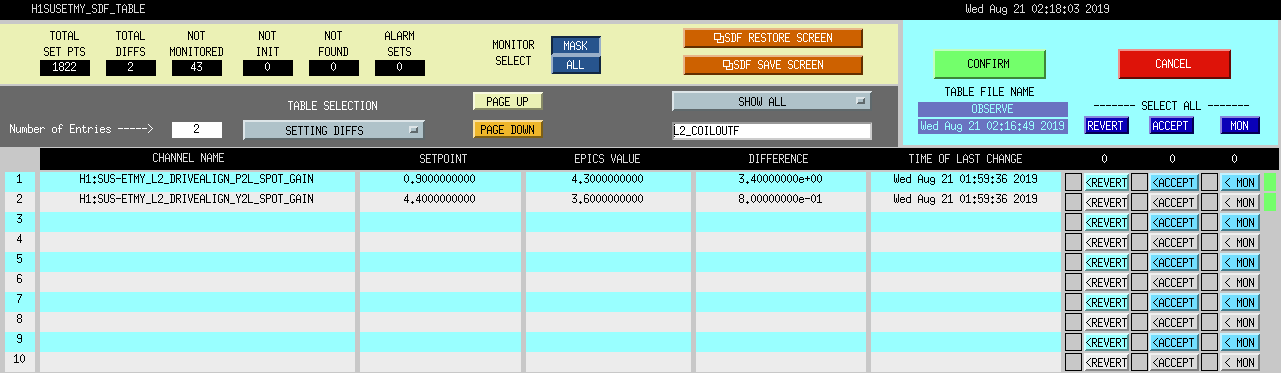
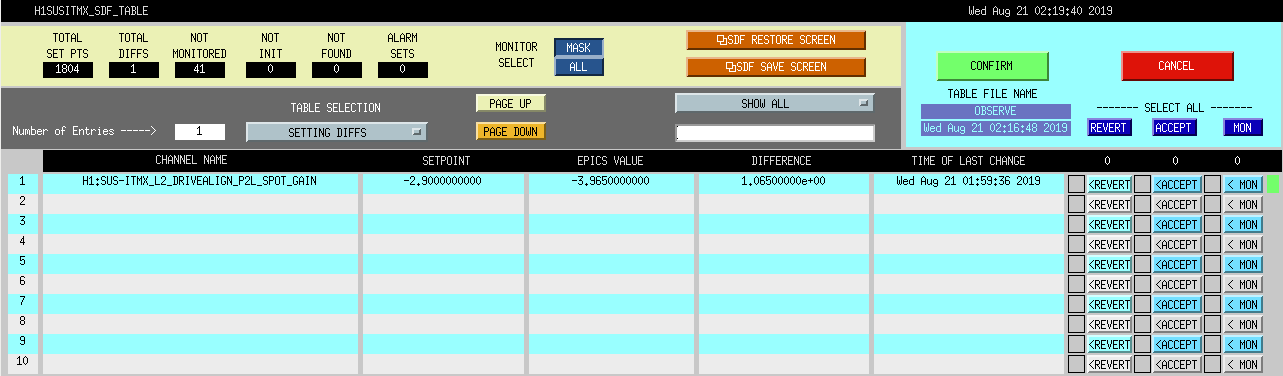
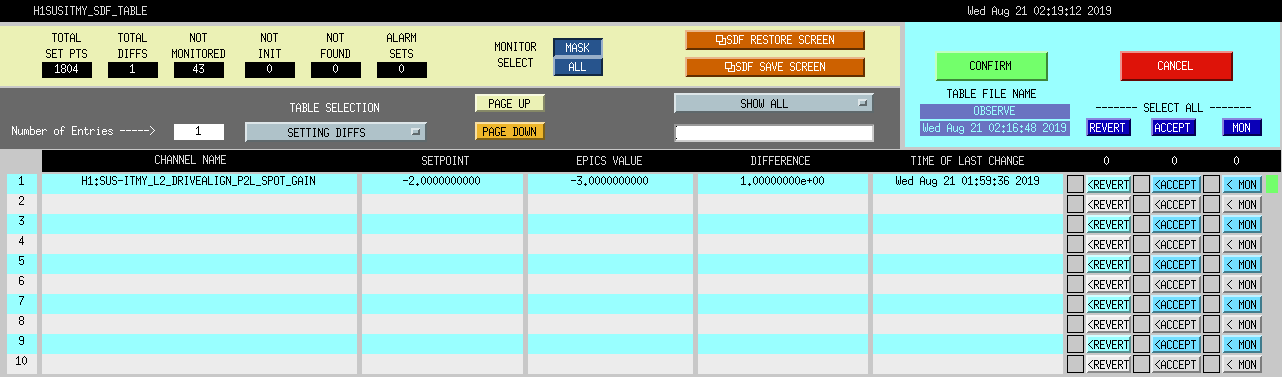
Accepting the sdf changes (attached) to go into Observing.
These changes are accepting that, in observing, we've now switched from "August" spot positions back to "July" spot positions. The spot positions to which the ASC ADS system steers are defined by the test masses' L2 (PUM) A2L gains, thus the channels above. See further details in LHO aLOG 51436, and references therein.
Ops Shift Transition: 08/21/2019, Owl Shift 07:00 – 15:00 (00:00-08:00) - UTC (PT)
State of H1: Locked
Intent Bit: Observing
Weather: 0-20 mph wind
Primary 0.03 – 0.1Hz: 0.01 um/s
Secondary 0.1 – 0.3Hz: 0.1 um/s
Outgoing Operator: Jeff
Quick Summary: Locked and Observing for 8 hours, wind is up slightly from earlier.
Smooth shift so far. No Issues or problems to report. Environmental conditions are good. The range is currently 116.6Mpc.
[Jenne, JeffK]
We discovered a bug in the guardian code that was modified today, that ended up with us locking at the August spot positions rather than our goal of the July positions. Since we really do want to go to the July positions, I have prepared the guardian to do so, although there is also a backup plan in there so that if it doesn't work, the operator can revert and just lock at the July positions. This should only be necessary in case of lockloss tonight, as commissioners will address this more fully in the morning. But, if we lose lock, we'd (Jeff, Keita, and I) like the operators to try locking at least once with the new code.
The new version of ISC_LOCK's ENGAGE_SOFT_LOOPS now has 12(!) counter steps. Half of these are convergence checkers, so we can probably clean this up at some point, but for now I've just extended the methodology that we'd been using.
To use this code, if we lose lock, the operator will need to load ISC_LOCK.
If this code does not work ("not work" will likely look like power buildups falling low, and then lockloss), open up lscparams.py Try at least once, maybe twice if it looked like it almost worked. Comment out lines 249 through line 287 in lscparams.py. Uncomment lines 289 through line 332. Load ISC_LOCK. This replaces positionA, positionB, and FullPower all with the August positions, so should effectively be the same as we've been doing the last several lock acquisitions.
lscparams.py can be found by: >>> cd /opt/rtcds/userapps/release/isc/h1/guardian/ Or, the edit button from the guardian screens often brings it up automatically.
If there is an error in ISC_LOCK and it's not an obvious thing that you're able to diagnose and fix, you can revert to the recent version from the svn (both lscparams.py and ISC_LOCK.py). You can also call me at any time tonight, and I'll help.
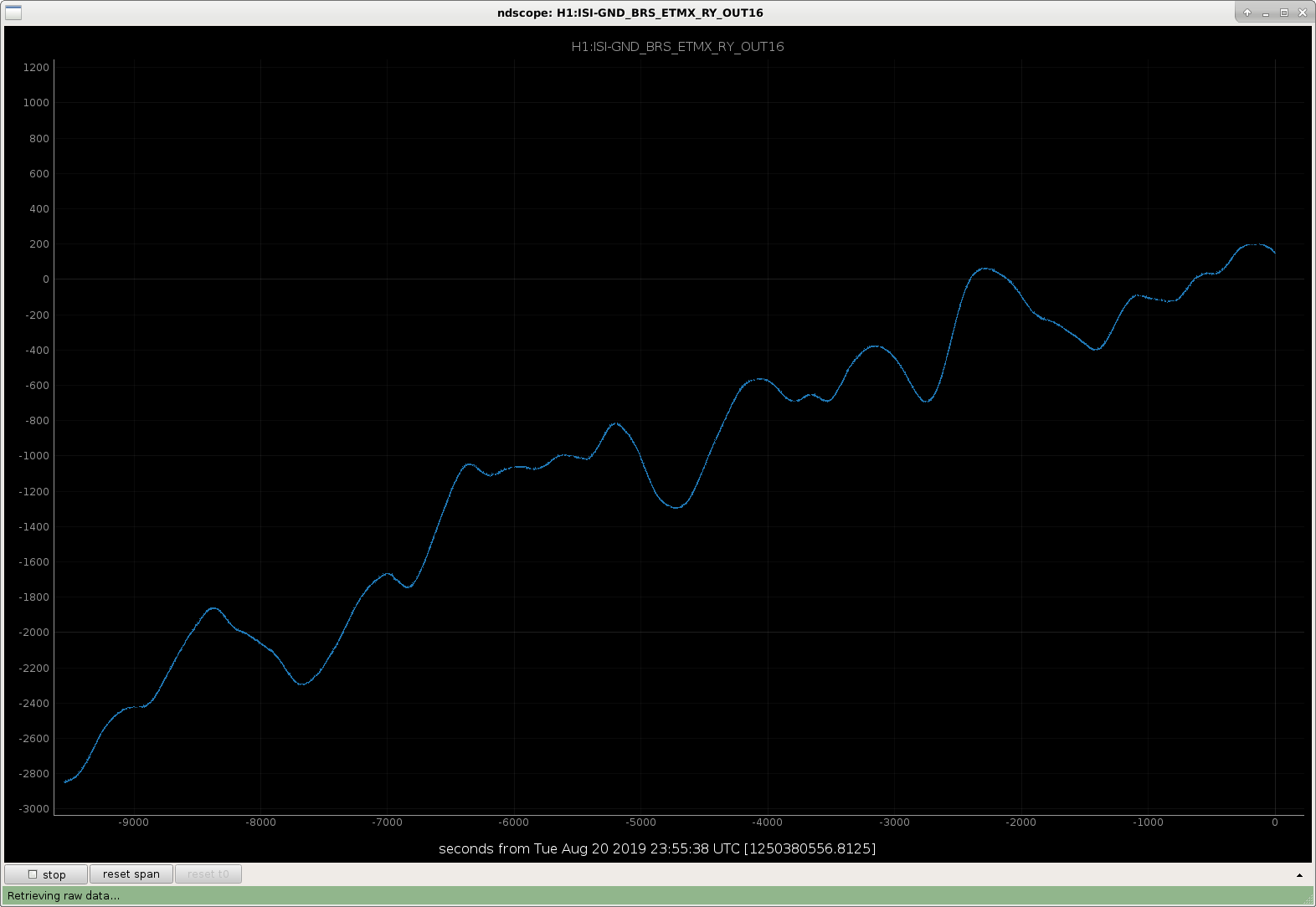
J. Kissel, for H. Radkins, M. Ross, and J. Warner. Thanks to the work of the seismic team today (see LHO aLOG 51417 and LHO aLOG 51421), after watching the BRS X signal for a few hours, we've found it to be glitch free -- so we've resumed including it in the ETMX ISI's sensor correction leading up to and including the current observation ready segment, and plan to continue to include it until further notice. Attached is a live stream of the last 10000 seconds of BRS X signal. It is glitch free. The "DC" value is still evolving with a very long time-constant which we suspect to be the normal ~12 hour thermal recovery time-constant after opening the thermal enclosure, unraveling some of the additional BRS vacuum chamber thermal shielding, etc. during today's deBUGging. This should close out FRS Ticket 13417.
S. Dwyer, J. Jones, J. Kissel, T. Shaffer
Just a few notes on the things out of the ordinary during today's maintenance recovery:
(1) Upon finishing initial alignment (to the now-standard "zeroed / centered" spot positions for acquisition), we had a good bit of trouble with ALS COMM. Found the COMM beat note was "low" at -9 dBm, though we've been skating by at this level for a few days. Thinking it was similar to the DIFF beatnote, we first adjusted the position of PR3. However, after having done so, MICH, PRMI, and DRMI were getting zero flashes (which makes sense, since initial alignment requires PR3 to be in a fixed position, and the IFO alignment is sensitive to PR3 position at the 0.25 - 0.5 urad level, and that's how much we had to move it). So, instead, we revert the PR3 position, and adjusted the position of the ALS / POP in-vacuum steering mirror via picomotor. The units aren't calibrated, but the COMM beat note was highest ~ -5 dBm with an X & Y position of the picomotor adjusted by a few 10s of counts.
(2) PRMI ASC did an excellent job of recovering a rather gross looking PRMI after that -- nice work!
(4) We had programmed in the July spot positions a priori, so we have now steered their instead of the "August" positions after turning on ENGAGE_SOFT_LOOPS, but this also went relatively smoothly.
EDIT: There was a typo in the modified guardian code -- we're still in the August spot positions
(3) Once we got in to full IFO resonance and began turning on FULL IFO ASC -- every suspension started saturating. Found that the DHARD P control signal was very large (even though the error signal was small), so reduced the gain from standard -50 to -30. (And then later reverted).
EDIT: Our suspicion is that this problem was a result of the ISC_LOCK bug in spot position placement. The code had us going from "centered" to "July" to "August" in rapid succession -- and this path takes us *through* the point absorber.
(5) The OMC_LOCK guardian had trouble recognizing there was light going in to the OMC, needed to re-request "DOWN" of the OMC_LOCK guardian before it successfully locked the OMC. TJ & Sheila will look into to modifying the Guardian so it takes care of this hiccup on its own.
The only "problems" were (1), (3), and (5). We attribute (1) to the lingering collection of issues associated with the initial alignment reference lost in early August, and not a "fault" of maintenance day activity. (3)'s cause is still unclear, but not yet terribly abnormal that the FULL IFO ASC struggles a bit to pull the alignment of the IFO in from the initial alignment references after a maintenance day. EDIT: (3)'s cause was the errant attempt at reverting spot positions.
Started recovery (initial alignment) at 19:12 UTC.
Recovered to nominal low noise by 21:44 UTC, and we've agreed to do a bit of commissioning (restoring OMC ASC offsets to correspond with the new spot positions, and further 48 Hz feature research) and calibration (to capture the new spot position impact).
TITLE: 08/20 Day Shift: 15:00-23:00 UTC (08:00-16:00 PST), all times posted in UTC
STATE of H1: Commissioning
INCOMING OPERATOR: Jeff
SHIFT SUMMARY: Recovered from maintenance and locked at NLN. See Jeff K's alog for more details with recovery.
LOG:
We have moved our interferometer spot positions back to those we had before the change on the ~1st of August. See alog 51262 for a summary of why several indicators that the July spots were better for the IFO.
We have done this by modifying the powerup A2L spot position gains in the lscparams guardian file, so that we will still acquire lock with the beams roughly centered on the optics, but once we start engaging the soft loops we change the A2L gains and go to the final 37W spots, then power up.
Also, I have reverted the OMC ASC QPD setpoints back to their values from the July time, undoing alog 50973. Hopefully we will see a marked reduction in the number of low frequency glitches. The OMC ASC setpoints were saved in both observe and safe snap files.
Jenne and I were assuming Sheila's modification to the ISC_LOCK guardian were successful, but alas -- a typo meant that we are still using the Aug positions for this observing stretch starting at2019-08-20 23:01 UTC.
The game plan will be to
- not move the spot positions today
- fix the code, reload it
- walk operators through the "if it breaks lock, here's how lock acquisition will look" scenarios, or
- if we don't lose lock, Sheila and I will walk the spot positions to July at 37W tomorrow morning to execute the as-planned commissioning activity.
OMC ASC offsets are still reverted to July though.
I have updated the GPR HDF5 files for use in computing response function uncertainty. Scripts used to produce the HDF5 files: trunk/Runs/O3/H1/Scripts/Uncertainty/process_allmeas_writeGPRHDF5_model20190416-A.py r8224 trunk/Runs/O3/H1/Scripts/Uncertainty/process_allmeas_writeGPRHDF5_model20190416-C.py r8228 GPR HDF5 files for use by RRNom.py: trunk/Runs/O3/H1/Results/Uncertainty/O3_H1_A_GPR_20190416_multi.hdf5 r8186 trunk/Runs/O3/H1/Results/Uncertainty/O3_H1_C_GPR_20190416_multi_nofsQcorr_fmin30Hz_lengthscaleZp5.hdf5 r8230 Note that there is a new file to use for the GPR of the optical plant. The reason for the change is that below 30 Hz, the MCMC does a poor job fitting the data. This impacts the fit for optical gain and coupled cavity pole frequency (see G1901479, slides 10, 11, and 19), which need to be correctly fit in the frequency range of importance. Also, currently C00 and C01 do not correct for any spring frequency or quality factor Q, so we should not be correcting our measurements by these values--our systematic error at low frequency will naturally expand because of this. Actuation and sensing MCMC values for the reference model remain the same, as per our procedure.
After updating the hdf5 files, the latest online C00 uncertainty estimate is https://ldas-jobs.ligo.caltech.edu/~ling.sun/Calibration/Uncertainty/O3/LHO/2019-08-20/Aug-20-2019_O3_LHO_GPSTime_1250374522_C00_RelativeResponse1SigmaUncertainty.png
(from 1250373618 - Aug 20 2019 22:00:00 UTC)
S. Karki, J. Kissel
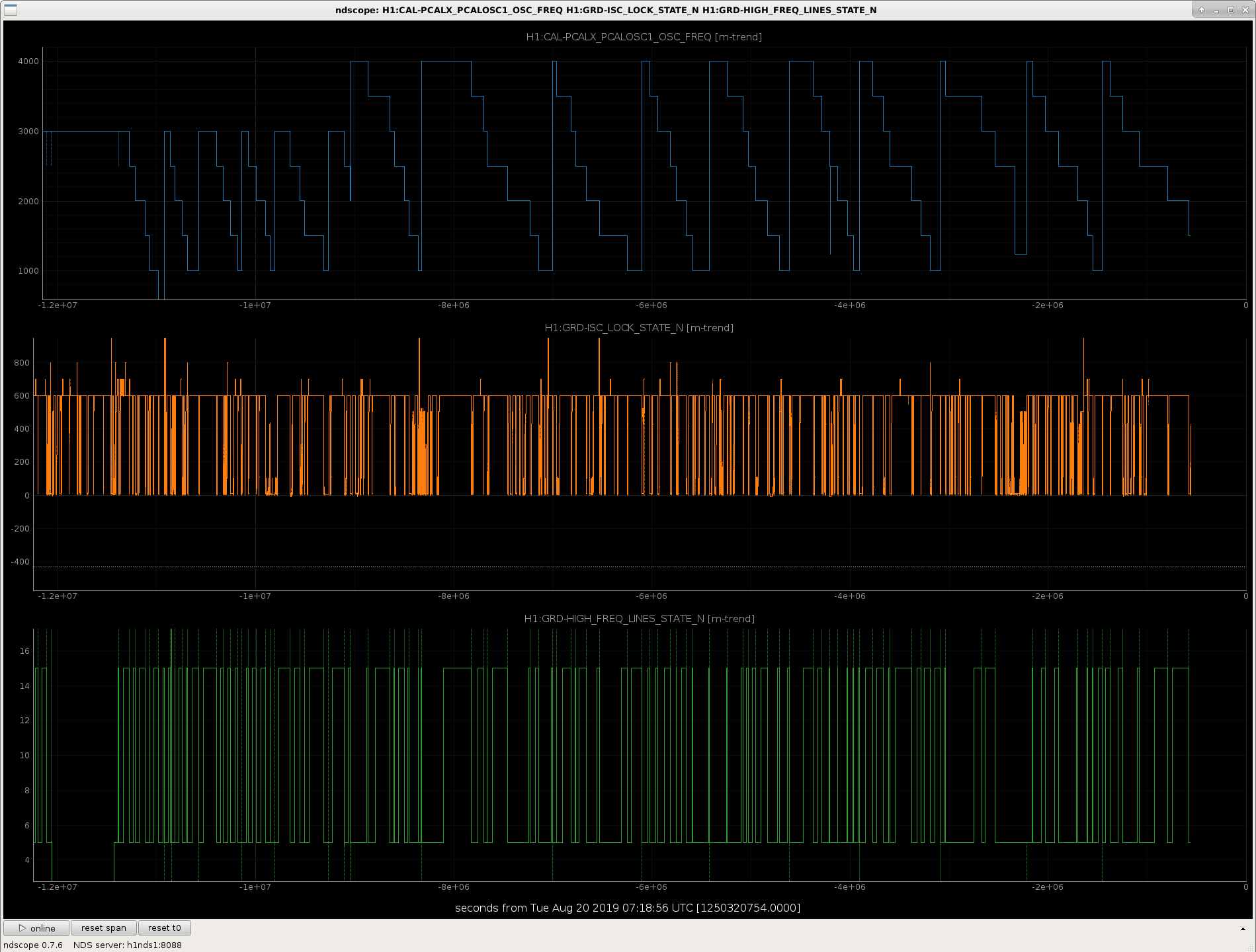
Sudarshan is working on processing the high-frequency roaming PCALX line that has been sweeping through the DARM data above 1 kHz throughout the run. In order to facilitate that processing, and to pick up where Pep left off I report the times at which the sweep restarted during the run thus far, determined by a trend of the requested frequency channel, H1:CAL-PCALX_PCALOSC1_OSC_FREQ. We should consider a modification of the HIGH_FREQ_LINES guardian such that we have a less GUI way to gather this information in the frames.
For now, I give you the dates of the repeat to-date at H1 via ndscope trends and cursoring:
2019-04-01 16:00 UTC Starts at 3001.3 Hz. Start of the run (spends a long time at 3001.3 Hz until bug fix, see aLOG below).
2019-04-15 21:27 UTC Re-start at 3001.3 Hz LHO aLOG 48505
2019-04-19 23:22 UTC Re-start at 3001.3 Hz
2019-04-24 23:51 UTC Re-start at 3001.3 Hz
2019-04-28 19:08 UTC Re-start at 3001.3 Hz
2019-05-05 01:16 UTC Re-start at 3001.3 Hz
2019-05-07 17:22 UTC Re-start at 4001.3 Hz More bug-fixes, no running nominally LHO aLOG 49064
2019-05-15 22:40 UTC Re-start at 4001.3 Hz
2019-05-31 06:54 UTC Re-start at 4001.3 Hz
2019-06-10 17:07 UTC Re-start at 4001.3 Hz
2019-06-18 13:34 UTC Re-start at 4001.3 Hz
2019-06-27 22:08 UTC Re-start at 4001.3 Hz
2019-07-06 03:20 UTC Re-start at 4001.3 Hz
2019-07-15 13:10 UTC Re-start at 4001.3 Hz
2019-07-25 17:16 UTC Re-start at 4001.3 Hz
2019-08-03 11:55 UTC Re-start at 4001.3 Hz
2019-08-18 01:02 UTC Re-start at 4001.3 Hz
More data points! (As usual, trending H1:CAL-PCALX_PCALOSC1_OSC_FREQ, and determining the starting points of the long duration, roaming, high frequency sweep data from PCALX:) 2019-08-25 17:39 UTC Restart at 4001.3 Hz 2019-09-03 01:53 UTC Restart at 4001.3 Hz 2019-09-10 04:39 UTC Restart at 4001.3 Hz 2019-09-22 11:42 UTC Restart at 4001.3 Hz
One final data point for O3A:
2019-10-01 11:54 UTC Restart at 4001.3 Hz
This should allow for three data sets
(1) 2019-09-03 to 2019-09-10
(2) 2019-09-10 to 2019-09-22
(3) 2019-09-22 to 2019-10-01
that are entirely in the regime of the 2019-09-09 model to be used in the high-frequency GPR estimate of the unknown systematic error in the sensing function.