Displaying reports 39161-39180 of 89029.Go to page Start 1955 1956 1957 1958 1959 1960 1961 1962 1963 End
Reports until 17:16, Monday 19 August 2019
H1 ISC (ISC, Lockloss)
jeffrey.kissel@LIGO.ORG - posted 17:16, Monday 19 August 2019 (51389)
H1 ALS DIFF Beatnote Still OK After Changing Beam Spot Positions to Centered During Lock Acquisiton
J. Kissel

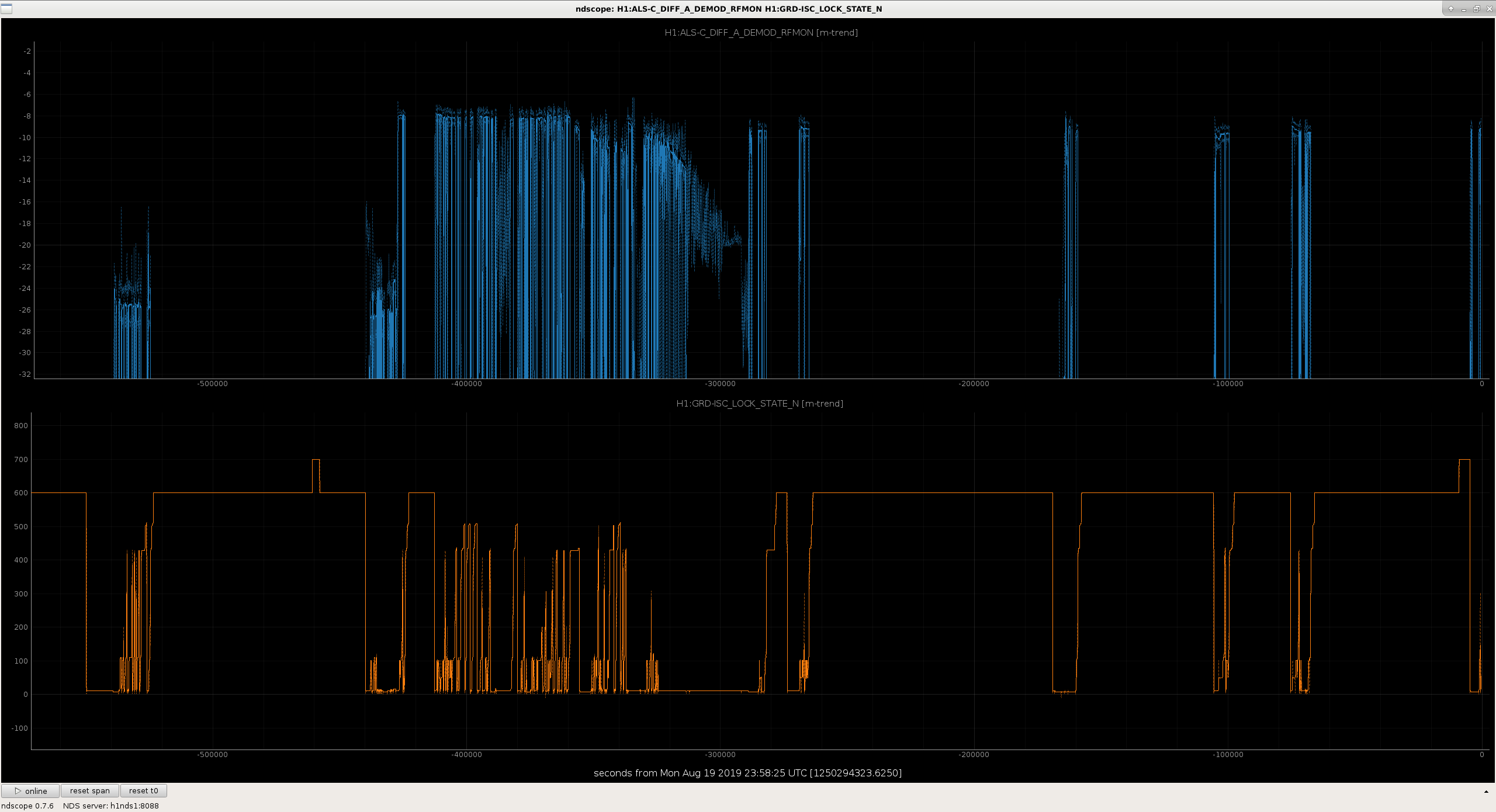
Last Wednesday -- while initial alignment references were set to the "August" position (see on Aug 01; see LHO aLOG 50954) -- Sheila adjusted the alignment of the ALS DIFF beatnote beam on its diode on ISCT1 LHO aLOG 51280 because we thought that was one of the problems causing the last weeks locking problems (turns out it was BRSX glitching, see FRS Ticket 13417). She improved the beat note power on the diode from ~ -26 dBm to ~ -8 dBm.

Last Thursday (8/15), we adjusted the initial alignment offsets to reference a position centered on the test masses LHO aLOG 51307.

I wanted to confirm that in the new "centered," "acquisition" positions, the ALS DIFF beat note was still nice and high, and we didn't need to go back and revisit the ISCT beat note alignment. 
It is confirmed: Although it did change a bit for the worse, the power, on average, is stil about -9.5 dBm -- plenty high.

See attached ~1 week trend of the ALS DIFF beatnote power vs. the guardian state (to remind us that the ALS DIFF beatnote is only meaningful when ALS is in use during the lock acquisition sequence).
Images attached to this report
H1 SEI
jim.warner@LIGO.ORG - posted 16:54, Monday 19 August 2019 (51388)
Comparing earthquake robustness over 3 observing runs

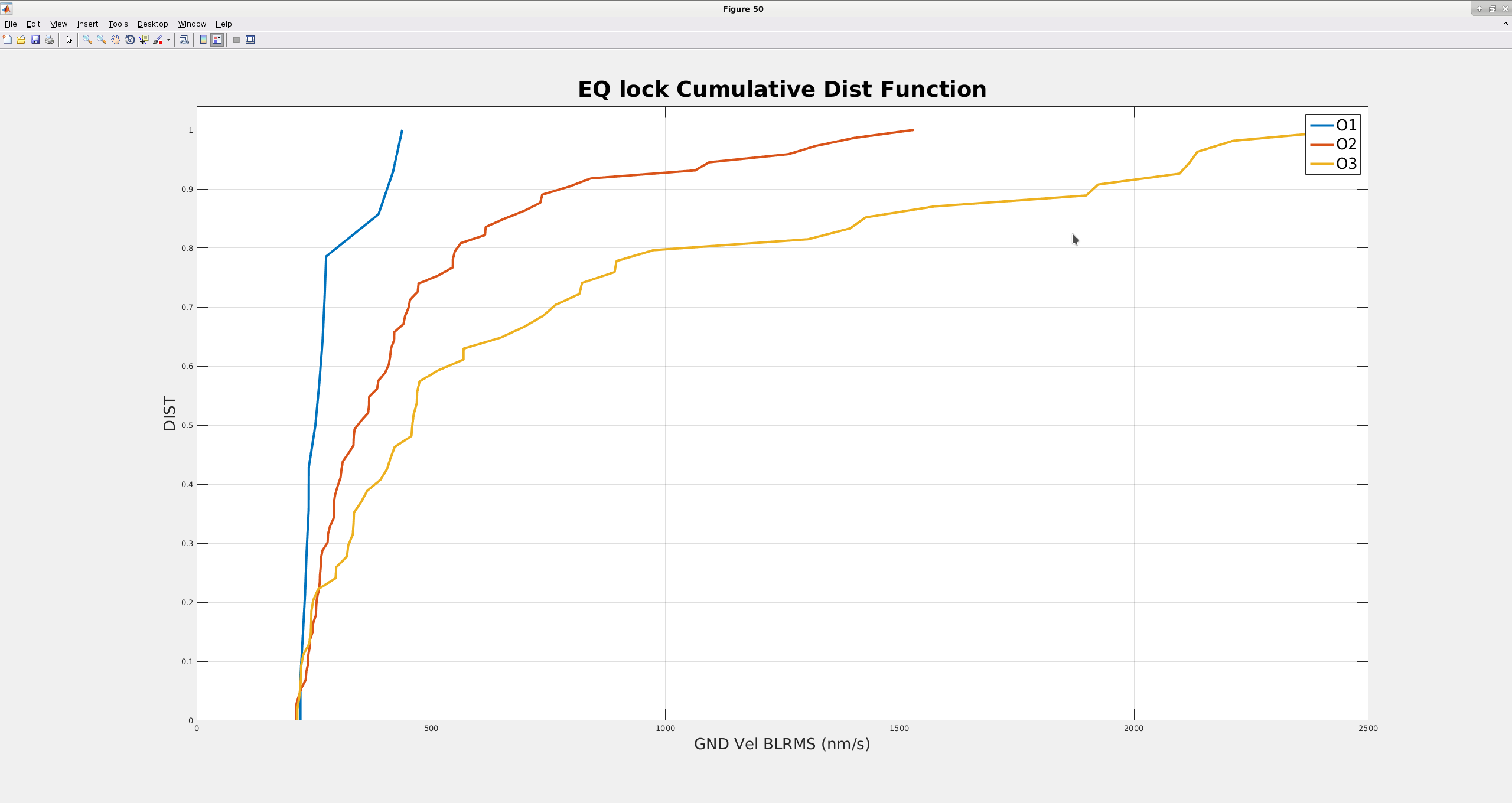
I've been trying to put together some data on improvements to our earthquake robustness, kind of related to work that EyalS has done while LLO works on their earthquake stuff. My attached plot compares the cumulative distributions of earthquakes that we have ridden out over the 3 observing runs. The blue trace is O1, red is O2, gold is O3. I generated this plot by using the matlab peakfinder code to find peaks in the .03-.1hz Z ground blrms to find all peaks in this band above 200nm/s and found all of the peaks that we were in NLN 10 minutes before and 10 minutes after. I would interpret this plot as for a given peak velocity in O3 we are about twice as likely to stay locked as we were during O2. Maybe someone smarter has a better interpretation. 

My original intent was to show that the earthquake mode has improved our ability to ride out an earthquake, and this plot does show that we are doing better now than in previous runs. But, I would like to try to do a comparison during O3 when we used used the earthquake settings and when we didn't touch anything. Still working on that.

Images attached to this report
H1 General
jeffrey.bartlett@LIGO.ORG - posted 16:31, Monday 19 August 2019 - last comment - 16:46, Monday 19 August 2019(51386)
Ops Evening Shift Transition
Ops Shift Transition: 08/19/2019, Evening Shift 23:00 – 07:00 (16:00 -00:00) - UTC (PT)
State of H1: Unlocked
Intent Bit: Locking
Weather:  Skies are sunny and clear; the current temperatures are in the high 80s to low 90s. Winds are Calm to a Moderate Breeze. There is no rain on the forecast. 
Primary 0.03 – 0.1Hz: 0.02um/s
Secondary 0.1 – 0.3Hz: 0.08um/s
Outgoing Operator: TJ
Quick Summary: The IFO is unlocked. TJ started running Initial Alignment. Working with Sheila on difficulty with MITCH BRIGHT phase. Will continue with relocking when the alignment is finished.   
Comments related to this report
jenne.driggers@LIGO.ORG - 16:46, Monday 19 August 2019 (51387)

Sheila and JeffB found that the MICH_Bright state of ALIGN_IFO is having trouble (and maybe TJ had found that to be true also in the last couple of days?).  Since tomorrow is maintenance and we can work on MICH bright alignment then, we're electing to bypass this step for now.  Sheila already did a hand alignment of the BS in MICH_DARK.  Operators:  If you need to do an initial alignment, instead of letting the INIT_ALIGN guardian go to MICH_BRIGHT, hand-select MICH_DARK_LOCKED and align the BS to make the image on the camera dark and symmetric.  This should correspond to a minimum in H1:ASC-AS_A_DC_NSUM_OUT16. 

LHO General
thomas.shaffer@LIGO.ORG - posted 15:59, Monday 19 August 2019 (51380)
Ops Day Shift Summary

TITLE: 08/19 Day Shift: 15:00-23:00 UTC (08:00-16:00 PST), all times posted in UTC
STATE of H1: Lock Acquisition
INCOMING OPERATOR: Jeff
SHIFT SUMMARY: Lost lock an hour into a commissioning break. Running an initial alignment now.
LOG:

H1 CAL (CAL)
evan.goetz@LIGO.ORG - posted 14:34, Monday 19 August 2019 - last comment - 16:33, Tuesday 20 August 2019(51384)
Updated calibration GPR HDF5 files for use in response function uncertainty
I have updated the GPR HDF5 files for use in computing response function uncertainty.

Scripts used to produce the HDF5 files:
trunk/Runs/O3/H1/Scripts/Uncertainty/process_allmeas_writeGPRHDF5_model20190416-A.py   r8224
trunk/Runs/O3/H1/Scripts/Uncertainty/process_allmeas_writeGPRHDF5_model20190416-C.py   r8228

GPR HDF5 files for use by RRNom.py:
trunk/Runs/O3/H1/Results/Uncertainty/O3_H1_A_GPR_20190416_multi.hdf5   r8186
trunk/Runs/O3/H1/Results/Uncertainty/O3_H1_C_GPR_20190416_multi_nofsQcorr_fmin30Hz_lengthscaleZp5.hdf5   r8230

Note that there is a new file to use for the GPR of the optical plant. The reason for the change is that below 30 Hz, the MCMC does a poor job fitting the data. This impacts the fit for optical gain and coupled cavity pole frequency (see G1901479, slides 10, 11, and 19), which need to be correctly fit in the frequency range of importance. Also, currently C00 and C01 do not correct for any spring frequency or quality factor Q, so we should not be correcting our measurements by these values--our systematic error at low frequency will naturally expand because of this.

Actuation and sensing MCMC values for the reference model remain the same, as per our procedure.
Comments related to this report
ling.sun@LIGO.ORG - 16:33, Tuesday 20 August 2019 (51424)

After updating the hdf5 files, the latest online C00 uncertainty estimate is https://ldas-jobs.ligo.caltech.edu/~ling.sun/Calibration/Uncertainty/O3/LHO/2019-08-20/Aug-20-2019_O3_LHO_GPSTime_1250374522_C00_RelativeResponse1SigmaUncertainty.png

(from 1250373618 - Aug 20 2019 22:00:00 UTC)

LHO General
thomas.shaffer@LIGO.ORG - posted 09:28, Monday 19 August 2019 - last comment - 14:37, Monday 19 August 2019(51381)
Morning Meeting Minutes

LVEA will be laser SAFE at the start of maintenance tomorrow. We will transition to hazard after this work is complete.

See (sideways) picture for current list of maintenance activities.

Images attached to this report
Comments related to this report
thomas.shaffer@LIGO.ORG - 10:33, Monday 19 August 2019 (51383)

Typo on whiteboard, the green "laser hazard" should be "laser safe". The red is laser hazard activities.

jeffrey.kissel@LIGO.ORG - 14:37, Monday 19 August 2019 (51385)INJ
.
H1 General (TCS)
thomas.shaffer@LIGO.ORG - posted 08:42, Monday 19 August 2019 (51379)
Out of Observing 1539-1540 UTC

ITMY CO2 laser dropped lock, and then reaquired.

I will see if finding a new lock point tomorrow during maintenance will help.

LHO General
thomas.shaffer@LIGO.ORG - posted 08:12, Monday 19 August 2019 (51378)
Ops Day Shift Transition

TITLE: 08/19 Day Shift: 15:00-23:00 UTC (08:00-16:00 PST), all times posted in UTC
STATE of H1: Observing at 115Mpc
OUTGOING OPERATOR: Niko
CURRENT ENVIRONMENT:
    Wind: 5mph Gusts, 2mph 5min avg
    Primary useism: 0.01 μm/s
    Secondary useism: 0.08 μm/s
QUICK SUMMARY: 9.5 hour lock, calm environment.

H1 General
yannick.lecoeuche@LIGO.ORG - posted 08:00, Monday 19 August 2019 (51377)
Shift Summary - Owl

TITLE: 08/19 Eve Shift 07:00 – 15:00 (00:00-08:00), all times posted in UTC

STATE of H1: Observing

INCOMING OPERATOR: TJ

SHIFT SUMMARY: Quiet shift, small interruption in Observing from TCS ITMY CO2 laser unlocking. Locked for 9 hours, Observing for 5 hours.

LOG:

07:00 (00:00) Start of shift

09:27 (02:27) Dropped out of Observing, TCS_ITMY_CO2 laser unlocked.

09:29 (02:29) Laser re-locked, back to Observing

14:58 (07:58) Ethan to Optics Lab

15:00 (08:00) End of shift

H1 General
yannick.lecoeuche@LIGO.ORG - posted 00:09, Monday 19 August 2019 (51376)
Ops OWL Shift Transition

Ops Shift Transition: 08/19/2019, Owl Shift 07:00 – 15:00 (00:00-08:00) - UTC (PT)

State of H1: Locked

Intent Bit: Observing

Weather: 0-10 mph wind

Primary 0.03 – 0.1Hz: 0.01 um/s

Secondary 0.1 – 0.3Hz: 0.1 um/s

Outgoing Operator: Ed

Quick Summary: Quiet at the moment, been in Observing for a little over an hour.

H1 General
edmond.merilh@LIGO.ORG - posted 22:44, Sunday 18 August 2019 (51375)
Lockloss and recovery 03:04
Images attached to this report
H1 General
edmond.merilh@LIGO.ORG - posted 16:23, Sunday 18 August 2019 - last comment - 16:51, Sunday 18 August 2019(51373)
Shift Transition - Eve

TITLE: 08/18 Eve Shift: 23:00-07:00 UTC (16:00-00:00 PST), all times posted in UTC
STATE of H1: Observing at 25Mpc
OUTGOING OPERATOR: Corey
CURRENT ENVIRONMENT:
    Wind: 3mph Gusts, 1mph 5min avg
    Primary useism: 0.01 μm/s
    Secondary useism: 0.07 μm/s
QUICK SUMMARY:

H1 Locked and Observing for 2.5 hours. no noticinble 1-20 Hz glitching at this time. EX saturations happening at 30-40 minute intervals


Comments related to this report
edmond.merilh@LIGO.ORG - 16:51, Sunday 18 August 2019 (51374)

Correction: not all glitches are EX sats.

LHO General
corey.gray@LIGO.ORG - posted 16:05, Sunday 18 August 2019 (51364)
DAY Operator Summary

TITLE: 08/18 Day Shift: 15:00-23:00 UTC (08:00-16:00 PST), all times posted in UTC
STATE of H1: Observing at 107Mpc
INCOMING OPERATOR: Ed
SHIFT SUMMARY:

Had a lockloss due to an earthquake (EARTHQUAKE ISI state not possible currently).  Back to OBSERVE after waiting for Earth to quiet down and also while babysitting ASC.  Range currently hovering around 112-119Mpc.
LOG:

H1 General
corey.gray@LIGO.ORG - posted 15:46, Sunday 18 August 2019 (51372)
Back To OBSERVING: Babysat ASC & No Initial Alignment

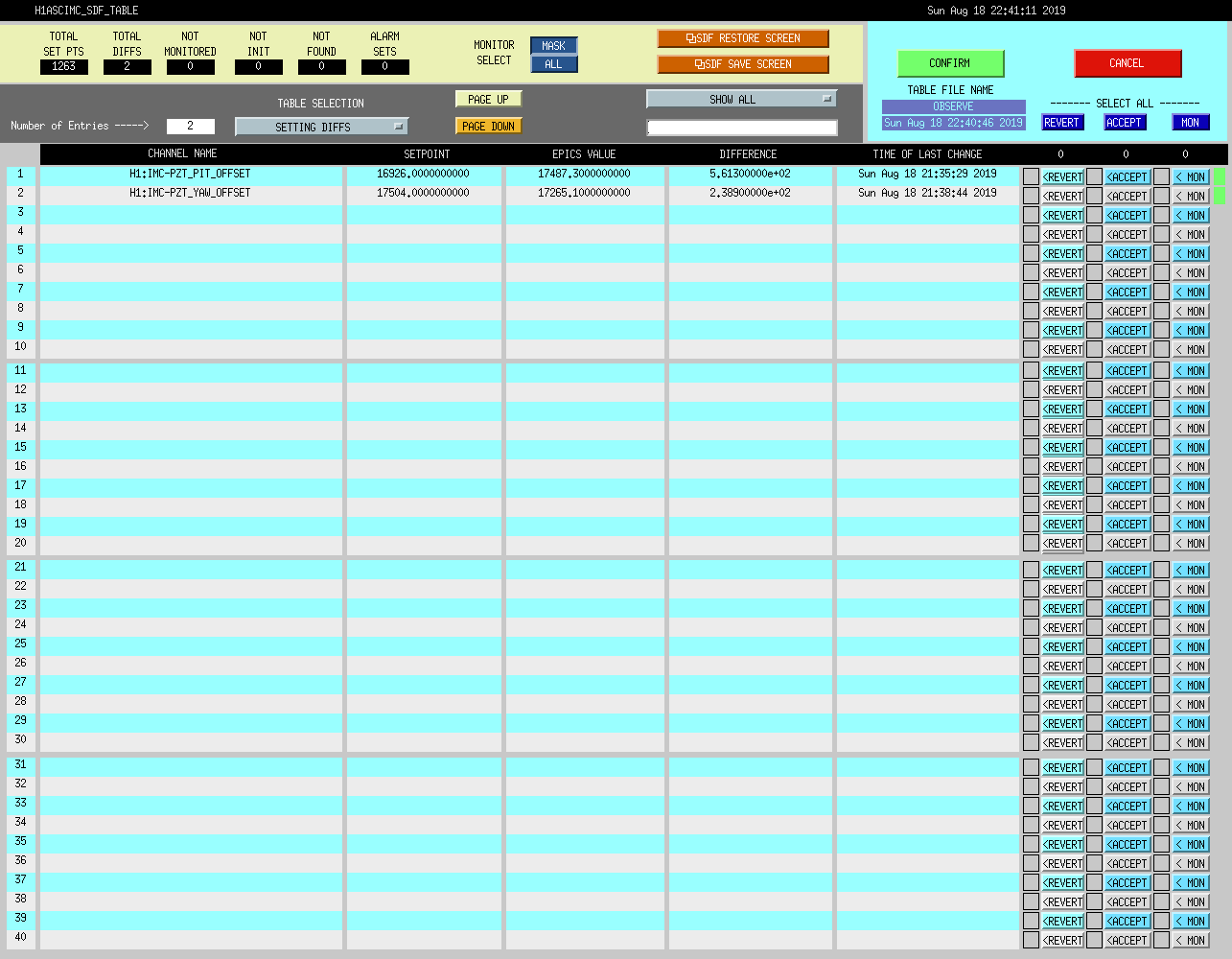
After the lockloss at ENGAGE SOFT LOOPS, made sure to babysit the ASC error signals.  Ended up making adjustments for CHARD pit/yaw mostly & then a little DHARD pit.  Here are my locking notes:

H1 General
corey.gray@LIGO.ORG - posted 13:12, Sunday 18 August 2019 (51371)
EQ Recovery: Lockloss at ENGAGE SOFT LOOPS

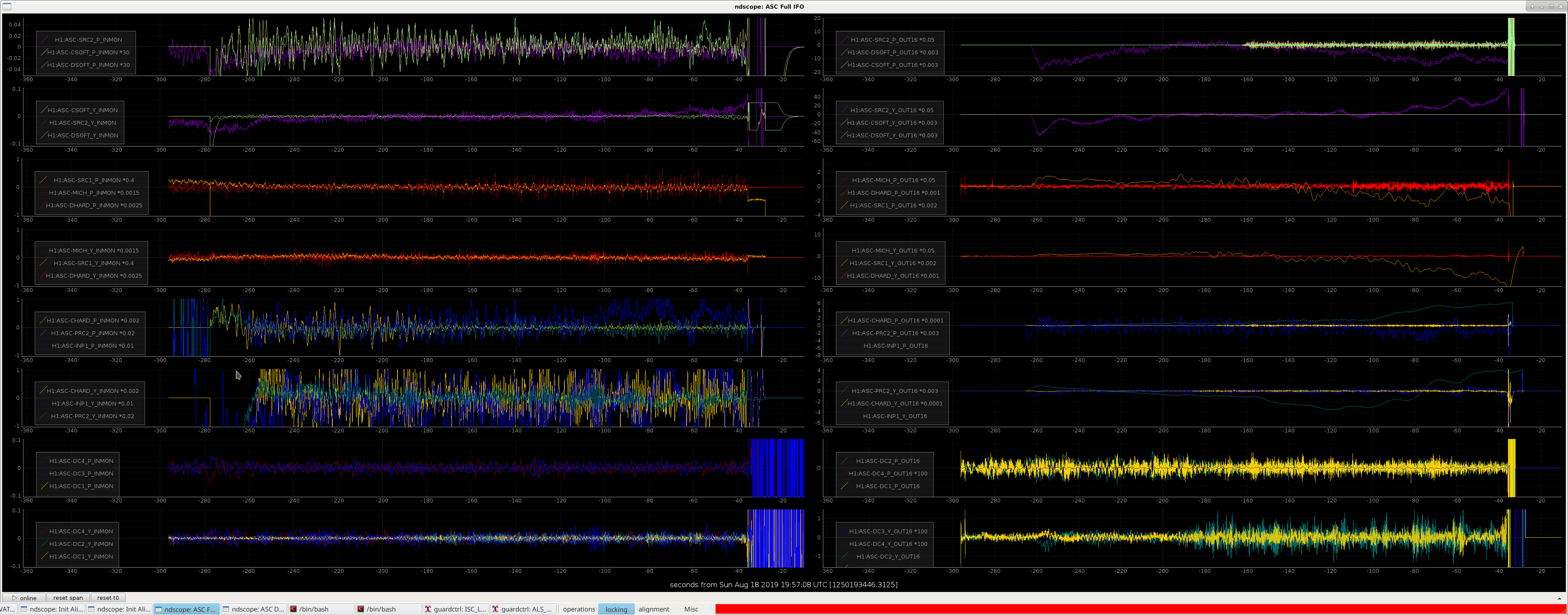
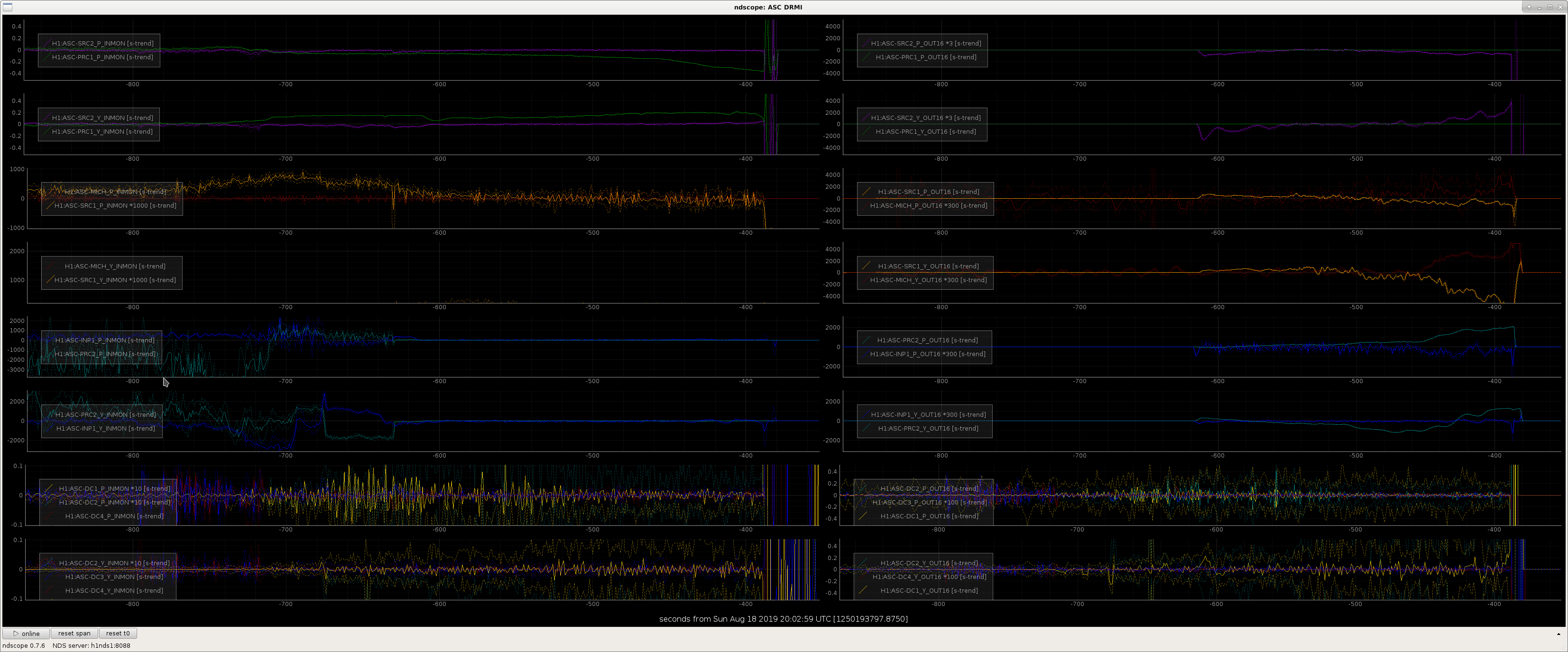
After waiting for EQ to die down, tried locking.  PRMI was dead (but off in yaw, so tweaked BS/PRM).  Eventually had some action and locked/optimized PRMI by hand. 

Then continued with locking.  DRMI locked fine and went through most steps fine, except....

Lockloss at:  ENGAGE SOFT LOOPS

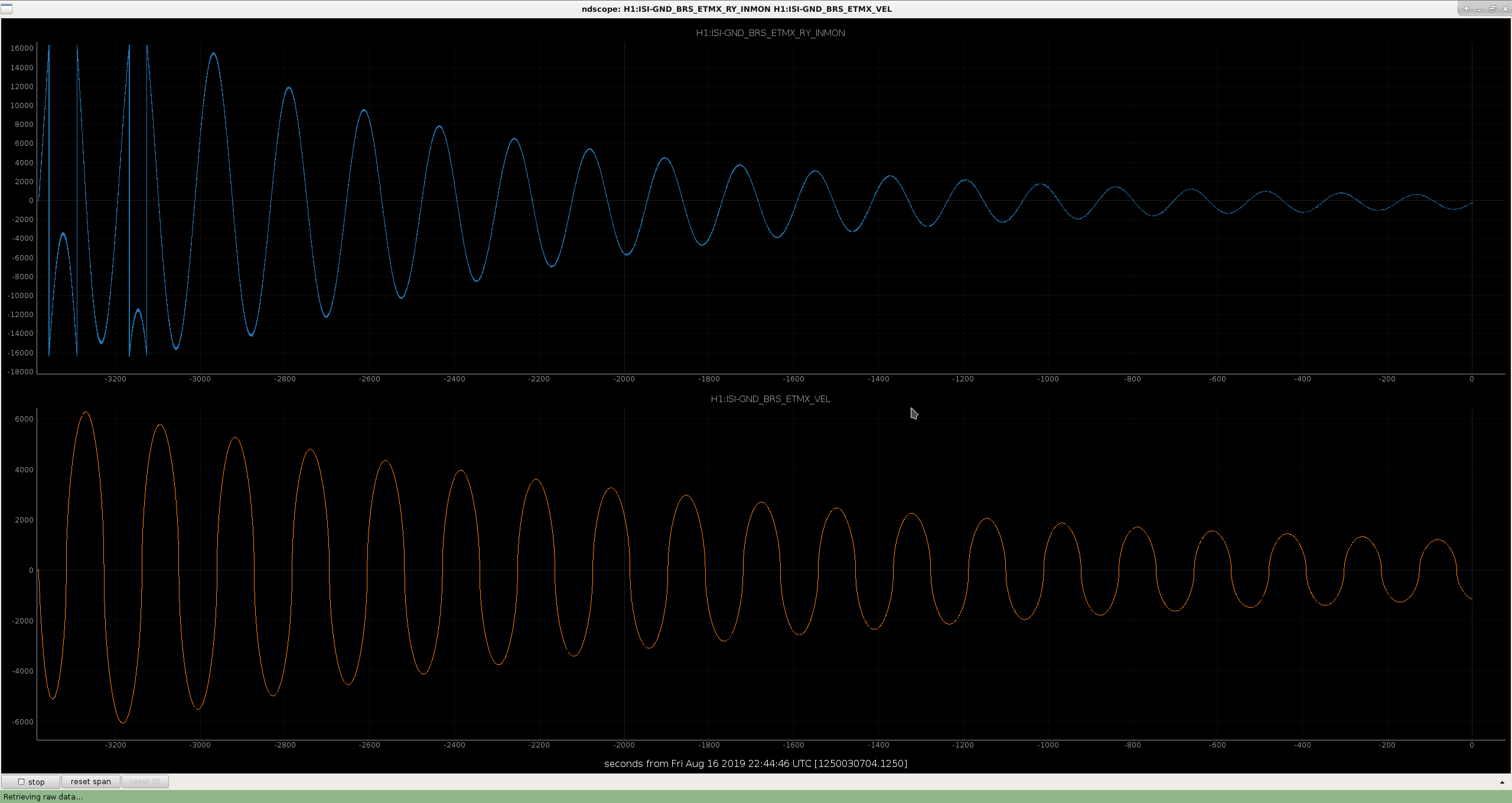
Here it looks like we might have been having ASC driving off PRC/SRC (see attached ndscopes).  So maybe I'll need to scripts Jeff K posted about last time I was on shift (alog here) and there were ASC issues last week.  But looking at this lockloss, I'm seeing all kinds of signals getting big (CHARD, CSOFT, DSOFT, etc.) ...so not sure who I would try!  :-/

NOTE:  Did not do an Initial Alignment.  That is another idea to try.

Images attached to this report
H1 SEI
jim.warner@LIGO.ORG - posted 15:45, Friday 16 August 2019 - last comment - 10:20, Monday 19 August 2019(51342)
BRSX troubleshooting today

I'm putting a summary of the things we tried with BRSX today here. It might be fixed, but we need to monitor it overnight.

First thing, Patrick and I remotely restarted the BRSX beckhoff computer. This didn't resolve the glitching. 

Next, Hugh, Fil and I went to the end station. We checked nothing was hitting the box, the inside looked undisturbed. Fil and Hugh power cycled the 24V power to the beckhoff (not sure what all that involved) and I restarted the beckhoff computer again. Still glitching.

Later, I found that there were fluctuations on the reference spots on the CCD, as Jeff K put in the DCC earlier.

Hugh and I went to EX again, this time we pulled the power on the light source, then plugged it back in. While we were there, we also opened the BRS enclosure again and pulled the CCD of the top of the light pipe. After looking down into the light pipe, we noticed two pretty good sized, dead, bugs sitting on the viewport at the bottom of the light pipe.  I couldn't get my phone to focus on them through the beamsplitter. Since we couldn't reach them and didn't want to take the light pipe off, we put the CCD back on.

The BRS is more or less back in it's nominal state and I've been watching it for the last hour. It hasn't glitched since being restored after this last incursion, but it's still pretty rung up. Looking at trends from earlier, it seems possible that the glitches don't appear when the BRS is moving above some threshold. Could also be that power cycling the light source fixed it.

We should still monitor the BRS for at least overnight, before trying to run with it again.

Images attached to this report
Comments related to this report
michael.ross@LIGO.ORG - 18:12, Friday 16 August 2019 (51345)

C. Hagedorn, M. Ross

After watching the video Jeff posted (G1901492), scanning through some of the glitches, and the fact that dead bugs were found, we believe that a live bug on the lens or vacuum window is the most likely culprit for the glitches. This will require intervention before this BRS can be trusted again.

It is quite unlikely that it is a light-source problem. Both patterns are illuminated from the same source and we were able to find transients that affected only one of the two patterns. Additionally the video shows asymmetric transient intensity variations which is very unlikely to come from the light source.

We believe that there's still a live insect inside the autocollimator in addition to the dead insect. Dead insects won't give frequent transients in both patterns. The transients in the Ref and Main traces and the distortions in the video are all consistent with a bug on the condensing lens, beamsplitter, objective lens, or window. This causes smaller and wider intensity dips than the bug that previously caused problems (40396) which was directly on the CCD. 

jim.warner@LIGO.ORG - 10:20, Monday 19 August 2019 (51382)

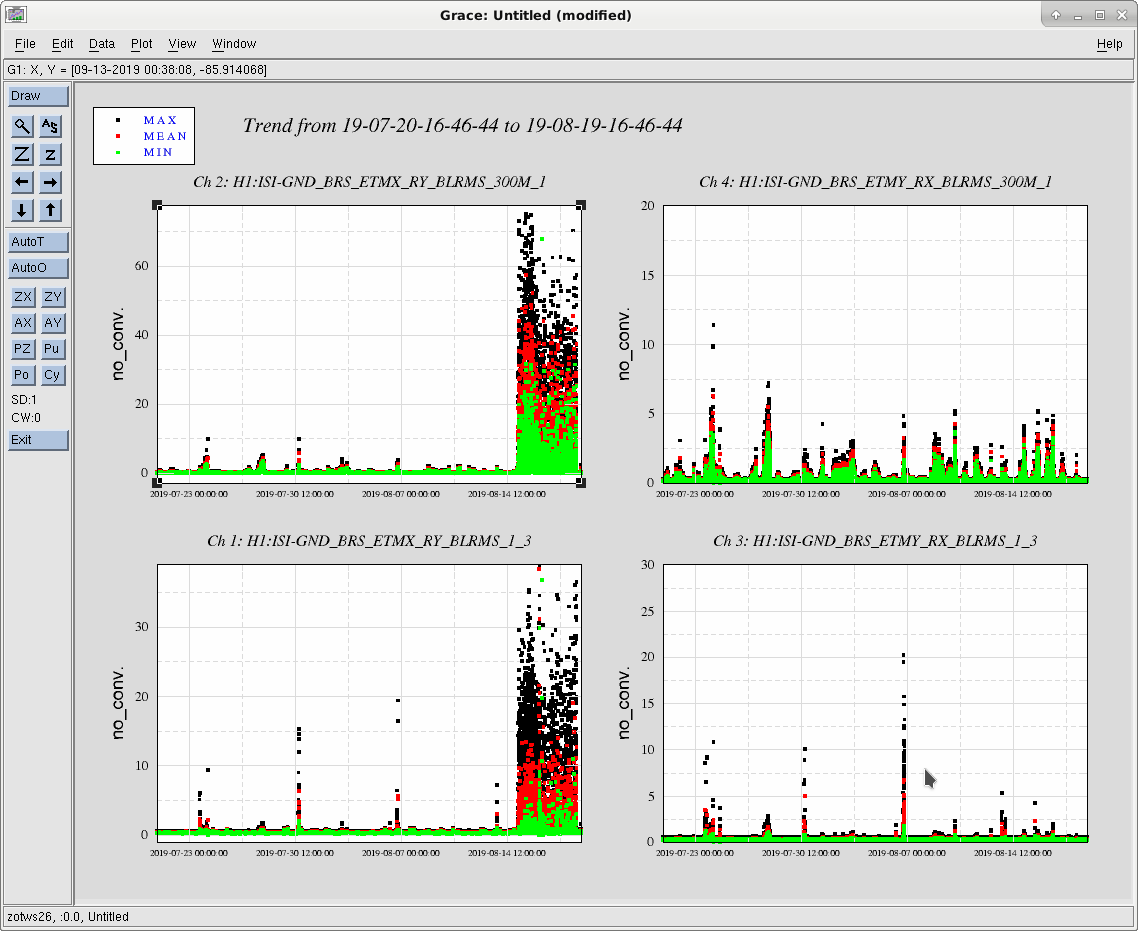
With some help from TJ, I've added a simple test to DIAG_MAIN to help diagnose this in the future. It just looks at the 300mhz - 1 hz blrms for the BRS and if that channel goes above 20, DIAG_MAIN will report the BRS as noisy, see the last two lines here: 

@SYSDIAG.register_test
def BRS_CHECK():
    """Check the two end station Beam Roation Sensors to make sure that
    they are not in FAULT (as read from their Guardian status node state.
    Also checks the status of the CBIT, to see if C code is live
    """
    for end in ['X', 'Y']:
        if ezca['ISI-GND_BRS_ETM{}_CBIT'.format(end)] == 0:
            yield 'BRS {} C code has stopped'.format(end)
        elif ezca['GRD-BRS{}_STAT_STATE'.format(end)] == 'FAULT':
            yield 'BRS {} is in FAULT'.format(end)
        if ezca['ISI-GND_BRS_ETM{}_R{}_BLRMS_300M_1'.format(end, 'X' if end == 'Y' else 'Y')] > 20:
            yield 'BRS{} is noisy'.format(end)

On the attached trend, neither BRS goes above this value, or even close, in the last 30 days except BRSXwhen it went "buggy".

Images attached to this comment
Displaying reports 39161-39180 of 89029.Go to page Start 1955 1956 1957 1958 1959 1960 1961 1962 1963 End