
edmond.merilh@LIGO.ORG - posted 11:09, Wednesday 07 August 2019 (51099)
H1 Out of Observing: 18:09UTC
Squeezer unlocked and recovered itself.
18:08UTC H1 back to Observing
Squeezer unlocked and recovered itself.
18:08UTC H1 back to Observing
TITLE: 08/07 Day Shift: 15:00-23:00 UTC (08:00-16:00 PST), all times posted in UTC
STATE of H1: Observing at 115Mpc
OUTGOING OPERATOR: Patrick Corey
CURRENT ENVIRONMENT:
Wind: 3mph Gusts, 2mph 5min avg
Primary useism: 0.01 μm/s
Secondary useism: 0.05 μm/s
QUICK SUMMARY:
TITLE: 08/07 Owl Shift: 07:00-15:00 UTC (00:00-08:00 PST), all times posted in UTC
STATE of H1: Observing at 117Mpc
INCOMING OPERATOR: Ed
SHIFT SUMMARY:
Current lock looks to be plagued by 8-30Hz noise which appears every 1/2 min to several minutes, but oddly the range is holding at about 114Mpc.
Other than that H1 has been locked/observing 8+hrs.
LOG:
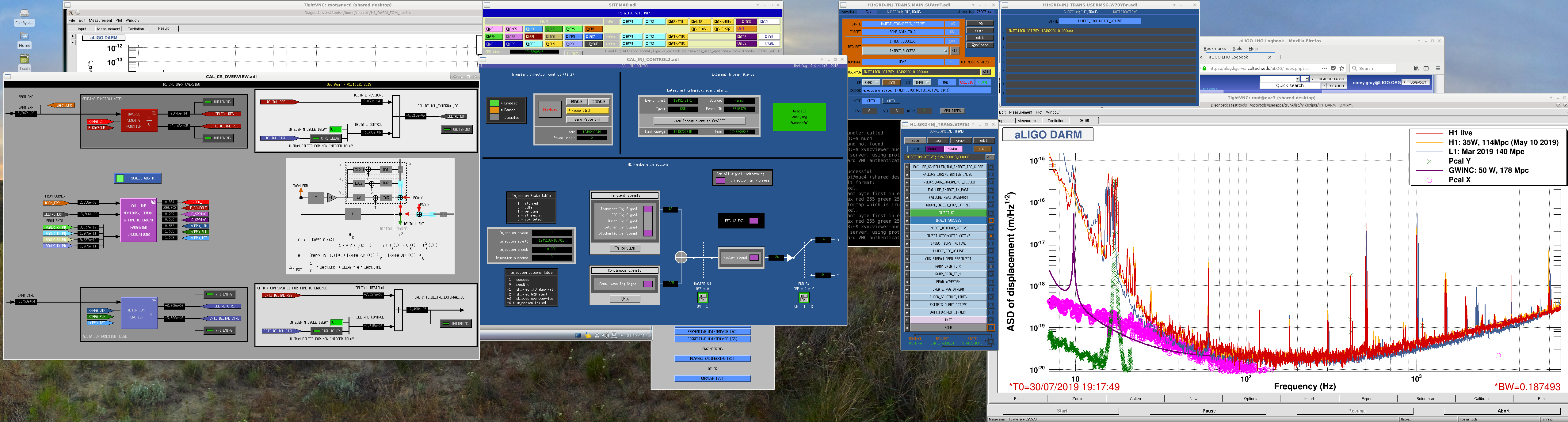
At 8:00 received Verbal of an injection ("Transient injections detected"). Could noticeably see elevated PCALX spectrum (pink circle trace) on the running DARM measurement in the front of the Control Room. Attached is a screenshot of the INJ_TRANS guardian node windows, other CAL windows and running DARM measurement as well.
With regards to the Guardian, this was controlled automatically (i.e. no operator intervention). INJ_TRAN went to a INJECT_STOCHASTIC_ACTIVE state when it was running and then returned to the normal WAIT_FOR_NEXT_INJECT state when injection was complete.
8:00-8:13 Period when injection was run. H1 range took a notable drop to about 105Mpc during this time.
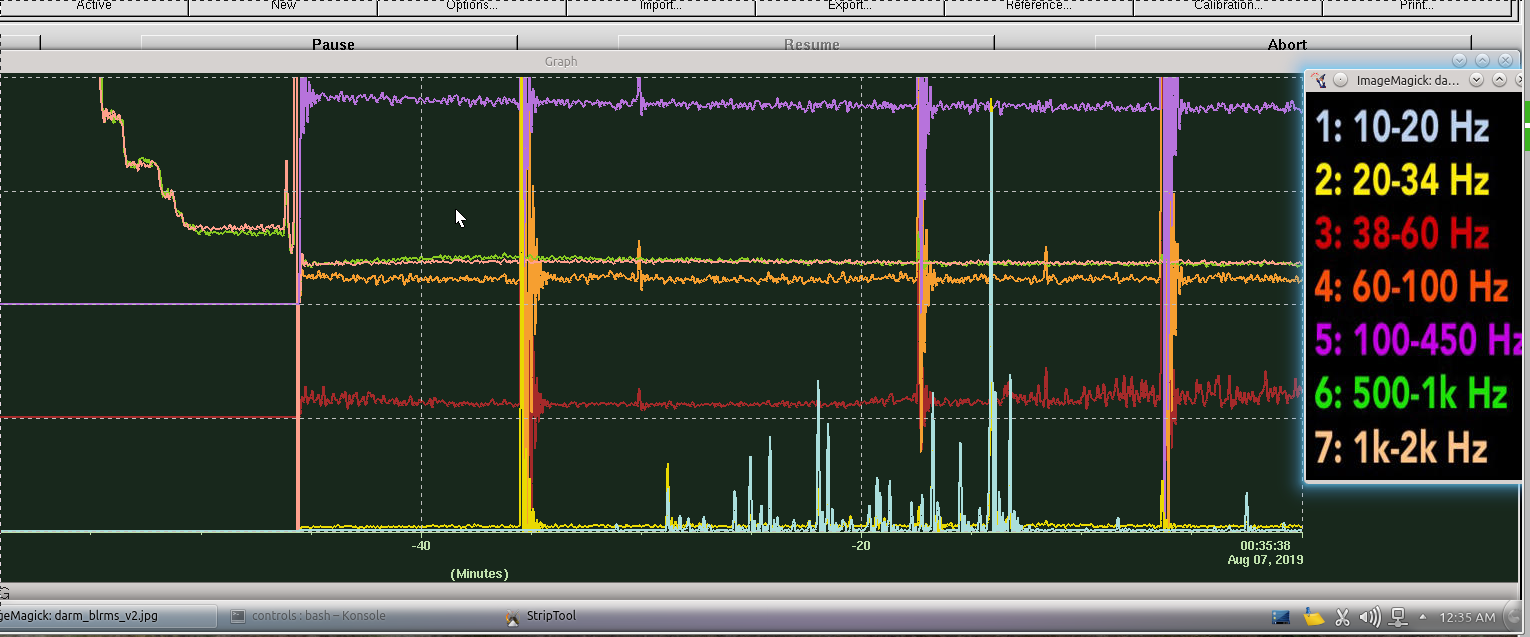
As mentioned earlier in my shift transition alog, noticed increased noise on H1 through various computers on the wall in the Control Room. For the most part I do not recall any odd activity for the DARM bands in question (10-20 & 20-34Hz), so when they are noisy, it's pretty obvious & so then an investigation begins.
Overall there was a noticeably noisy period, then it died down (but lingered), and then went quiet...but still getting glitches. Unfortunately I only snapped screenshots of the BLRMS striptool. (I was too slow to grab screenshots of the DARM spectra as well as the MICH/PRCL/SRCL spectra.
Since this is a much different feature from the high-freq noise I observed last night, I did not run Keita's measurement.
Here is an updated summary:

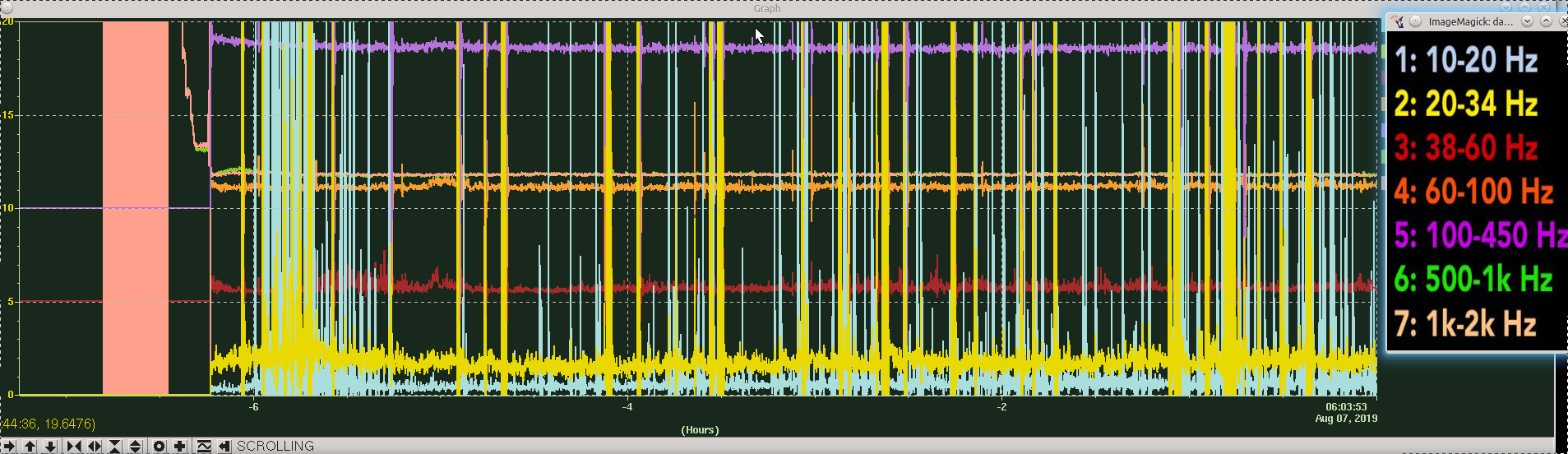
Just to give an update, we have not had the really noisy stretch like we did at the beginning of this current lock, BUT this 8-30Hz noise has not gone away either. Attached is a look at the last 7+hrs & you can see the noise has been fairly regular for the entire lock.
Scanning through Summary Pages tonight's lock as seen with DMT OMEGA looks somewhat similar over the last few days (i.e. since 8/2), and 2nd attachment is looking at 8/5 where we have a long lock which also has this low-freq noise.

Corey -- There's a brief comment in LHO aLOG 51034, and it's come up verbally in commissioning meetings, but not clearly stated in any aLOGs -- sorry for not catching you up! #OwlsAreTough

Here's the story:

This excess glitchiness below ~15 Hz is a result of the new alignment position of the beam going in to the OMC. We think this alignment position is making the OMC (and thus DC readout, DARM, and DETLAL EXTERNAL) more sensitive to scattered light in and around the OMC. We made this alignment change at the tail end of Aug 1 2019, as a result of the new global alignment position after losing our reference on July 30 -- which is why it's been seen since Aug 2. We're not super happy with it, but it did recover some optical gain that we lost else where. The tentative plan is to reduce the gain of the OMC ASC loops to see if this glitchiness goes away, if that doesn't work, we may consider a new alignment in to the OMC.

We'll try to find a way to keep owl shifters better posted!
No worries! I figured this was proably related to recent alignment work (due to the camera bump). I didn't know a whole lot about this recovery because of being away on vacation and then did not have time to catch up on alogs last night due rough 1st half of the graveyard trying to relock H1. THANKS for explaning this though! (OK, time to sleep for tonight's shift.)
TITLE: 08/07 Eve Shift: 23:00-07:00 UTC (16:00-00:00 PST), all times posted in UTC
STATE of H1: Observing at 114Mpc
INCOMING OPERATOR: Patrick
SHIFT SUMMARY: lockloss, unknown reason, relocking required an initial alignment, Hi in Observe
LOG:
TITLE: 08/07 Owl Shift: 07:00-15:00 UTC (00:00-08:00 PST), all times posted in UTC
STATE of H1: Observing at 116Mpc
OUTGOING OPERATOR: Cheryl
CURRENT ENVIRONMENT:
Wind: 12mph Gusts, 11mph 5min avg
Primary useism: 0.02 μm/s
Secondary useism: 0.05 μm/s
QUICK SUMMARY:
Walked in right after Cheryl took H1 to Observing.
While scanning our computers on the walls, noticed some noisiness on DARM (different from high freq of last night, this was much lower). Here are symptoms so far:
Kara Merfeld, T. Shaffer
To plan for DI.PROJ39 "Add alignment control and sensing system for vertex HWS", we needed to get the power of the ALS beams that make it onto the table. We locked the arms in green and then went on table with a power meter and measured before and after the top periscope mirror. Like LLO (LLOalog47455), we have a few other ghost beams that make it out of the viewport, but there is one that is clearly the brightest for each arm. The beam for the Y misses the top periscope mirror, so we were unable to get the power anywhere else, but it is very close to what we see at X.
| (power in uWatts) | X | Y |
| Under top periscope mirror | 580 | n/a |
| Above top periscope mirror | 620 | 610 |
After NLN was recovered after maintenance, H1:PSL-ISS_SECONDLOOP_GAIN was 3 (instead of 5 that was in observing.snap). This is set by IMC_LOCK guardian but the actual number is hard coded in lscparams.py. We looked at the number and it seems as if 3 is the right number.
input_power = {'PRXY': 2,
'MICH': 10,
'SRXY': 10,
'INCREASE_POWER': 20,
'NLN':37}
# normally MICH=10, SRXY=10, but lowering for time when HAM6 in air### ISS Final Gain Value
ISS_acquisition_gain = 0
if input_power['NLN'] > 35:
ISS_FinalGain = 3 #for 40 W
elif input_power['NLN'] > 30:
ISS_FinalGain = 5 #for 35W alog 47607
else:
ISS_FinalGain = 7 #for 30W
The nominal power of 37 W and nominal gain of 3 in lscparams.py listed above were set on June 5th according to svn log, so it's been a while. You'd think we've been running with 37W and ISS_FinalGain=3 since then, but actually today was the first time the gain was set to 3.
TJ found that the last time IMC_LOCK was reloaded was June 4th. IMC_LOCK was never reloaded after that until today, and that's the reason why we suddenly found this. This is sneaky because IMC_LOCK itself was not changed, it's just the parameter file that is read by IMC_LOCK.
Anyway, the new gain was accepted together with H1:PSL-ISS_SECONDLOOP_REFERENCE_IN_MTRX_1_4. If somebody finds that ISS 2nd loop gain is too low, change lscparams.py and reload IMC_LOCK guardian. But don't change that gain during NLN, it will break lock.
TITLE: 08/06 Day Shift: 15:00-23:00 UTC (08:00-16:00 PST), all times posted in UTC
STATE of H1: Observing at 115Mpc
INCOMING OPERATOR: Cheryl
SHIFT SUMMARY:
Maintenance day. Most tasks completed despite 25 minute delay in starting. There was a slight issue with re-locking the mode cleaner due to a lack of communication regarding taking the IMC down before taking all the ISIs down. H1 crecovered relatively easy after that following some ASC tweaks by Jenne. Handing off to Cheryl
LOG:
14:56 Peter out to optics lab
15:05 Karen and Vanessa to ends
15:06 HFD on site
15:06 Sensor correction off
15:08 Adrian and Matt out to LVEA to pull cables by Y manifol;d
15:08 ACE on site
15:10 Sigg ou to LVEA
15:16 Chandra out to LVEA
15:18 Adrian and Matt back
15:19 Ken headed to EX - emergency lighting
15:28 Chris out to LVEA with HFD
15:36 Ethan and Niko out to optics lab
15:39 Chris/HFD back - out to EX to begin IFO wide inspections
15:44 Jeff B out for sitewide dust monitor inspections
15:47 IMC is relocked after safe.snap work by Hugh - the spots look much different then pre-work. Letting WFS hanndle it.
15:57 IMC looking better
16:02 Richard out to LVEA - stay clear for cameras
16:05 Niko and Adrian back
16:21 Jason out to EY for ALS Beam Profiling
16:25 Rahul ending EY charg measurement earlyto make way fo Pcal Work
16:26 Chris out to LVEA - pest control
16:27 Niko, Laurence, Ethan, and Dripta to EY for PCal work
16:43 Chris/pest back - out to Y arm
16:54 Richard back
16:58 Ken back from EX and headed to EY - emergency lighting
17:19 Norco on site - #74 - MidY
17:35 Chris back - pest control done
17:41 TJ out to LVEA
17:46 Gerardo back
17:47 Jason Back
17:48 ITMY model restart and ITMY ISI and SUS recovery - done
17:49 Marc out to to LVEA to join Dick
18:00 TJ out to transition LVEA to LASER HAZARD
18:04 Sigg out to LVEA
18:09 Hugh finished craning
18:14 LVEA is LASER HAZARD
18:36 Gerardo out to LVEA to turn off a pump
18:46 Richard out to LVEA w/Hugh and Gerardo
18:47 Timesh out to optics lab
18:55 SEI_CONF back to Windy
19:11 Gerardo, Hugh, and Richard back
19:13 MC1, PRM, and PR2 CDS Difital Cameras not working - Dave restarting processes
19:16 Dick and Mrc back - PCAL team is back for a while now
19:18 All tasks completed - Begin Alignment/Recovery
21:50 H1 Observing
TITLE: 08/06 Eve Shift: 23:00-07:00 UTC (16:00-00:00 PST), all times posted in UTC
STATE of H1: Observing at 115Mpc
OUTGOING OPERATOR: Ed
CURRENT ENVIRONMENT:
Wind: 10mph Gusts, 6mph 5min avg
Primary useism: 0.06 μm/s
Secondary useism: 0.04 μm/s
QUICK SUMMARY: locked in Observe
Over the course of O3 thus far, Jeff K. and others have made numerous optical plant and actuator measurements. A concern has been about the variability of the optical plant at low frequencies and how this may impact calibration and calibration uncertainty. This aLOG serves as a study of all of the measurements made up to the present date and assess the impact on the optical plant variations on calibration.

Disclaimer: I am not proposing, at this point, to have any new calibration epoch. I merely explore this idea as a possibility given the changing state of the detector as commissioners make changes. Ideally, time-dependent correction factors will track the changing state, provided that the optical plant model remains faithful to the measured state of the instrument. If so, then we would certain time-dependent correction factors to correct the calibration for known systematic errors.

Optical plant measurements, data stored at and under the following dates:
trunk/Runs/O3/H1/Measurements/FullIFOSensingTFs/
2019-03-28
2019-03-29
2019-03-31
2019-04-04 (but labeled in filename as 2019-04-03; this is the measurement used to inform the reference model for O3 installed to date)
2019-04-10
2019-04-17
2019-05-02
2019-05-08
2019-05-09
2019-05-22
2019-05-29
2019-06-06
2019-06-12
2019-06-19
2019-06-27
2019-07-03
2019-07-10
2019-07-17
2019-08-01

UIM actuator measurements, stored at and under the following dates:
trunk/Runs/O3/H1/Measurements/FullIFOActuationTFs/
2019-03-27
2019-04-03 (this is the measurement used to inform the reference model for O3 installed to date)
2019-04-10
2019-04-24
2019-06-06

PUM actuator measurements, stored at and under the following dates:
trunk/Runs/O3/H1/Measurements/FullIFOActuationTFs/
2019-04-03 (this is the measurement used to inform the reference model for O3 installed to date)
2019-04-10
2019-04-24
2019-05-08
2019-06-06
2019-06-26
2019-07-03

TST actuator measurements, stored at and under the following dates:
trunk/Runs/O3/H1/Measurements/FullIFOActuationTFs/
2019-03-27
2019-04-03 (this is the measurement used to inform the reference model for O3 installed to date)
2019-04-10
2019-04-24
2019-05-08
2019-06-06
2019-06-26
2019-07-03

The reference model used to date is trunk/Runs/O3/H1/params/modelparams_H1_20190416

Optical plant measurements have shown variability, especially at low frequencies, probably because of changing parasitic coupling of angle to length via spot position and gain changes of the DHARD control loop. To investigate this behavior, Jeff has associated changes in optical plant parameters with specific commissioning tweaks to the interferometer in LHO aLOG 50966 and in G1901353. It was suggested that because we see 3 different sets of optical plant parameters (especially in optical gain), there may also need to be three different epochs for the calibration of H1 (suggested Apr 1 - Jun 11, Jun 11 - Aug 1, Aug 1 - present). It may be unnecessary to have three epochs, however, if the calibration systematic uncertainty between measurement and model does not differ significantly for these different potential epochs. Alternatively, if time-dependent correction factors do not faithfully track optical plant changes, then different epochs would be difficult to define. Attached are Gaussian Process Regression measurements of the three epochs Jeff described as well as the overall systematic uncertainty for all optical plant measurements made to date.

Fig 1 pdf: "Epoch 1" optical plant residuals and Gaussian Process Regression (Apr 01 - Jun 11)
Fig 2 pdf: "Epoch 2" optical plant residuals and Gaussian Process Regression (Jun 11 - Aug 01)
Fig 3 pdf: "Epoch 3" optical plant residuals and Gaussian Process Regression (Aug 01 - now); note, there is only one measurement. If this is a separate epoch, then this is kind of meaningless until more measurements are made
Fig 4 pdf: all O3 optical plant residuals and Gaussian Process Regression (Apr 01 - now)

To generate these figures, the script is stored at
aligocalibration/trunk/Runs/O3/H1/Scripts/Uncertainty/process_allmeas_writeGPRHDF5_model20190416-C.py

Important notes regarding Figures 1-4:
1) Optical gain and coupled-cavity pole frequency changes, as measured by the MCMC values have been divided out of the measurements. This brings measurements made on different days to the same state as on the reference date. Doing so presumes that the time-dependent correction factors faithfully follow the MCMC values
2) Low frequency spring (or anti-spring) and quality factor have *not* been divided out, because we cannot presume--at least for now--that the time-dependent correction factors track these changes.
3) The input to the Gaussian Process Regression algorithm for these figures has been modified: we don't input every individual measurement residual and instead we input a weighted average and standard deviation of each measurement frequency. The reason for making this change is because we cannot assume the measurement residuals are purely statistical in nature; there is an unmodeled effect that we hope the different measurements capture and thus can compute a standard deviation that well-quantifies the changing state of the optical plant at the cost of increasing uncertainty in the systematic error.

I have similarly generated residuals and Gaussian Process Regression plots for each of the actuators, attached below

Fig 5 pdf: UIM actuator residuals and Gaussian Process Regression
Fig 6 pdf: PUM actuator residuals and Gaussian Process Regression
Fig 7 pdf: TST actuator residuals and Gaussian Process Regression

To generate these figures, the script is stored at
aligocalibration/trunk/Runs/O3/H1/Scripts/Uncertainty/process_allmeas_writeGPRHDF5_model20190416-A.py

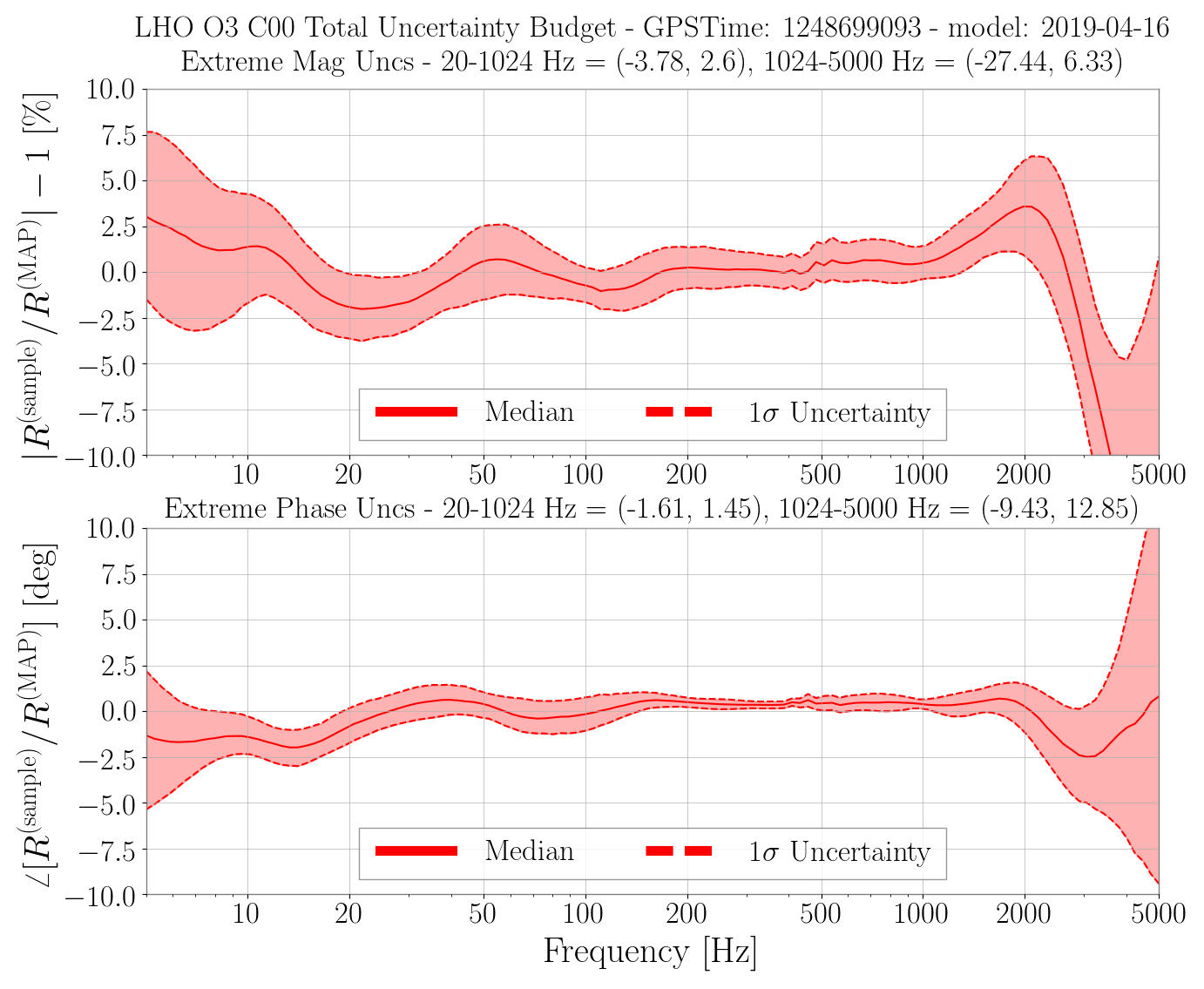
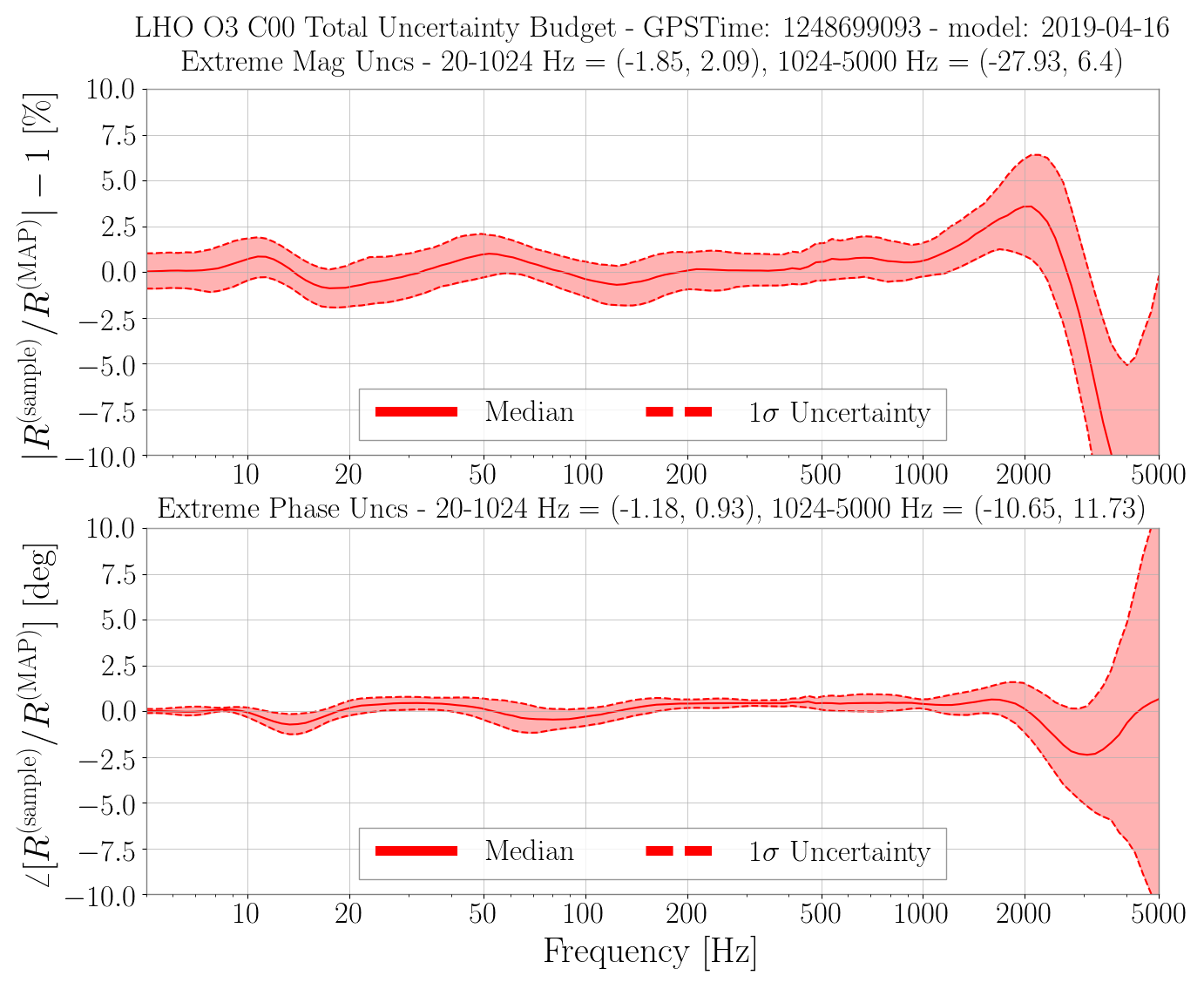
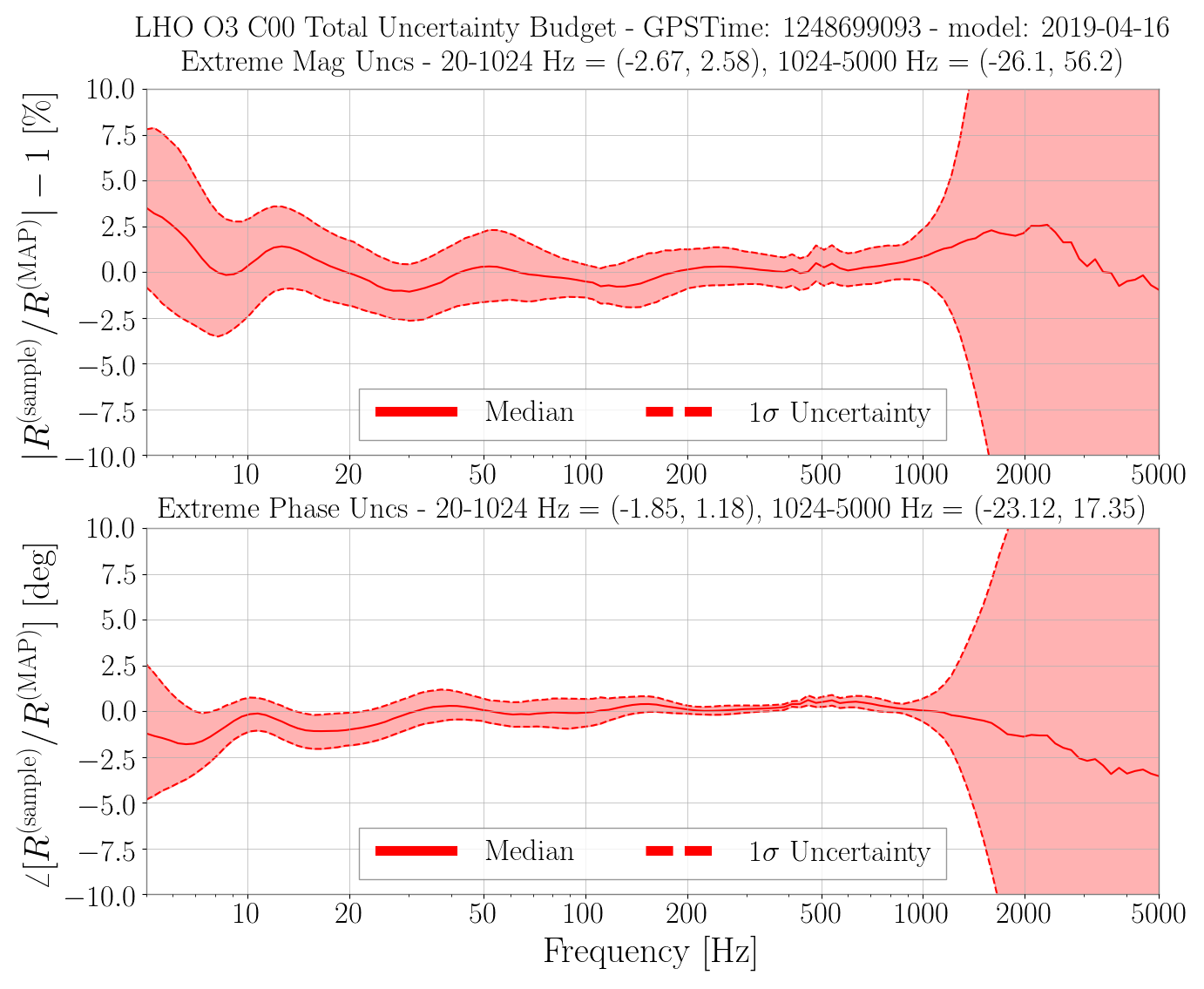
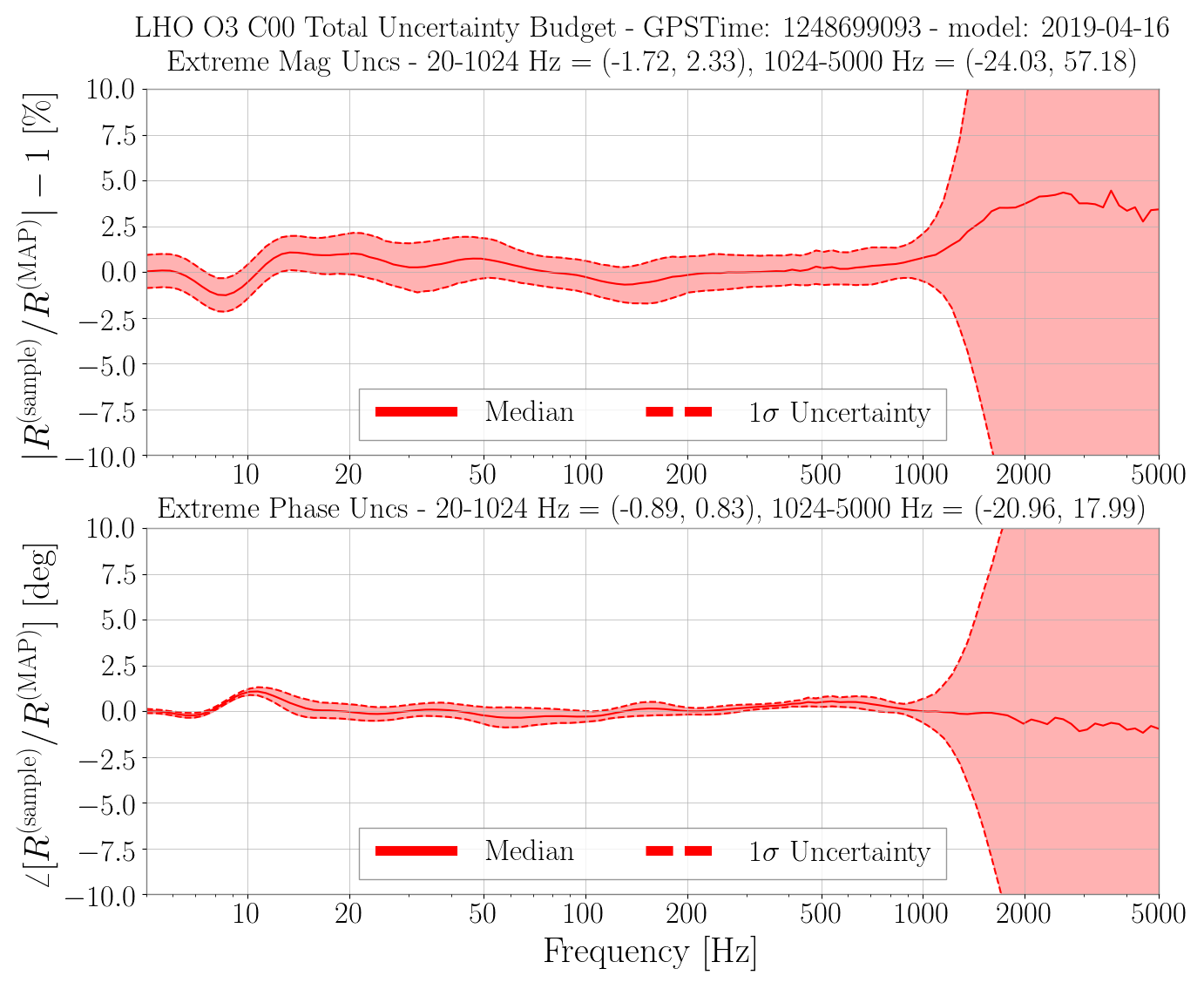
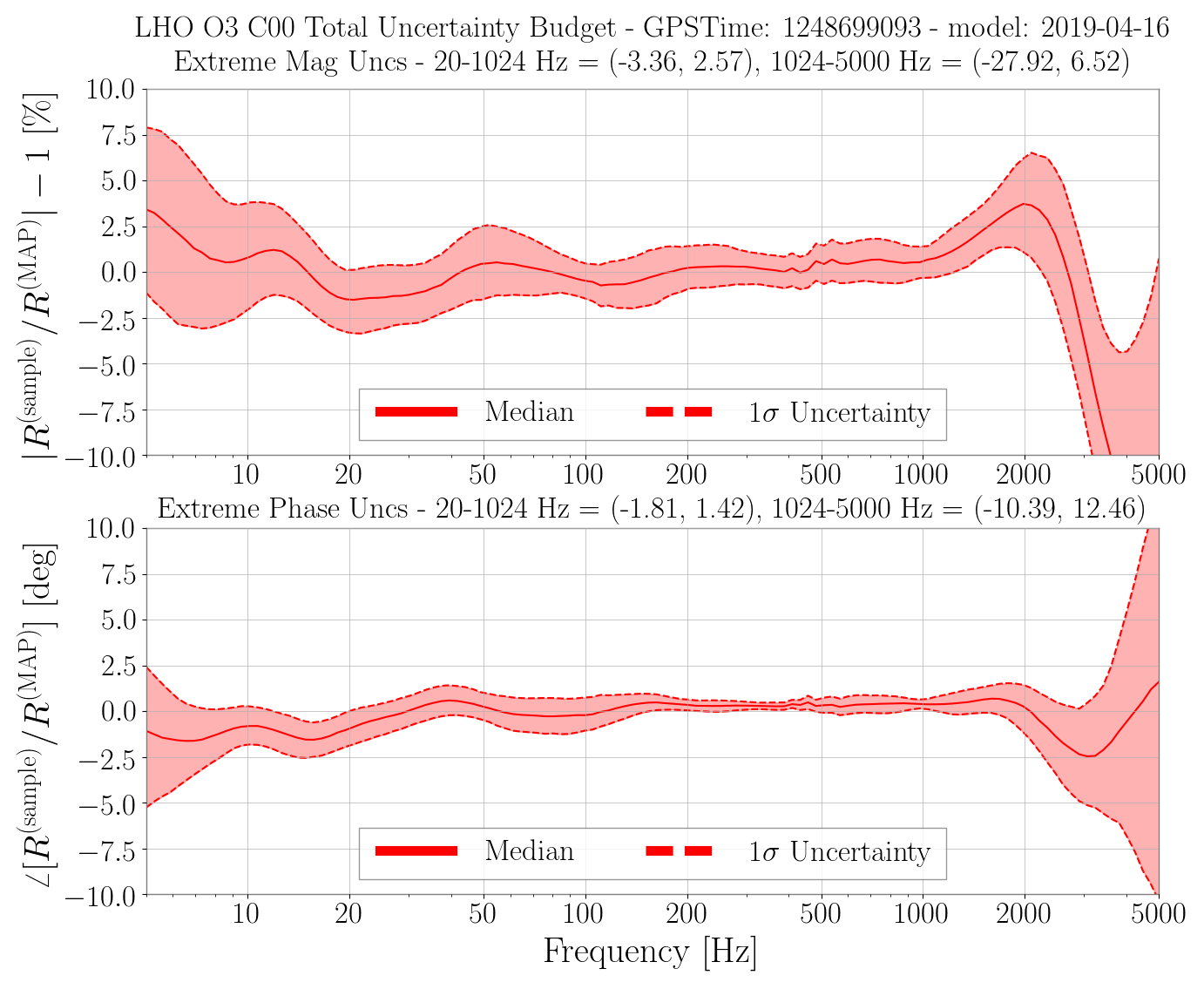
To understand the final impact on the systematic uncertainty, we run the RRNom.py script on the HDF5 files that contain the maximum a postiori and posterior GPR results. Only "epoch 1", "epoch 2", and all the measurements are compared. I chose an arbitrary GPS time, 1248699093 (= Aug 01 2019 12:51:15 UTC):
$ python3 RRNom.py --outDir=../../O3/H1/Results/Uncertainty/ --HDF5_A_MCMCresults=../../Runs/O3/H1/Results/Uncertainty/O3_H1_A_MCMC_20190404.hdf5 --HDF5_A_GPRresults=../../Runs/O3/H1/Results/Uncertainty/O3_H1_A_GPR_20190416_multi.hdf5 --HDF5_C_MCMCresults=../../Runs/O3/H1/Results/Uncertainty/O3_H1_C_MCMC_20190404.hdf5 --IFO=LHO --modelPath=../../Runs/O3/H1/params/ --modelFilename=modelparams_H1_20190416 --IFOmodel=modelPars --gpsTime=1248699093 --sampleNumber=1000 --version=C00 --plot1SigmaUncs --HDF5_C_GPRresults=../../Runs/O3/H1/Results/Uncertainty/O3_H1_C_GPR_20190416_all.hdf5

Fig 1 png: response function uncertainty and confidence intervals for "epoch 1"
Fig 2 png: response function uncertainty and confidence intervals for "epoch 1" removing systematic error and uncertainty of the actuation stages
Fig 3 png: response function uncertainty and confidence intervals for "epoch 2"
Fig 4 png: response function uncertainty and confidence intervals for "epoch 2" removing systematic error and uncertainty of the actuation stages
Fig 5 png: response function uncertainty and confidence intervals for all of O3
Fig 6 png: response function uncertainty and confidence intervals for all of O3 removing systematic error and uncertainty of the actuation stages

The good news is that there is not significant impact on response function uncertainty for different "epochs" at low frequency. The main difference between PNG Fig 1 and PNG Fig 3 is at high frequency: we have only analyzed high frequency measurements once, but we have plenty of data in the can, waiting to be analyzed. Including all optical plant measurements to date, and not correcting for any time-dependent changes does not detrimentally impact response function uncertainty. Between 20 Hz and 1024 Hz, the maximum 1-sigma deviation from nominal is about 3% in magnitude and about 2 degrees in phase. Of course, another GPS time will have somewhat different values.

So, for now, I'd argue that we shouldn't necessarily need a new epoch. We don't know if our optical plant model at low frequencies is actually valid, which may mean that any time-dependent correction factor derived from that model for low frequencies would even correctly track the changes. Perhaps we can stick with this for now and if the commissioning team is able to resolve the coupling between angular control loops at low frequency with the length degree of freedom, then we could start a new epoch.

TODO:
1) analyze high frequency optical plant measurements and include in GPR computation
2) determine to what degree the time dependent correction factors can track and follow the low frequency changes of the optical plant
3) Currently, we are just computing a weighted standard deviation for the input to GPR, but we should instead compute a correct Student's-t distribution measure of the variance for each frequency because we have low number statistics

| location/computer | One Stop Card | Notes |
| h1lsc0 | not readable | V4 machine |
| h1asc0 | 12040004 | V1 can be upgraded to V4 |
| h1oaf0 | 12120006 | V1 can be upgraded to V4 |
| h1oaf1 | NA | NA |
| h1seib1 | 12140003 | V1 can be upgraded to V4 |
| h1seib2 | 12120004 | V1 can be upgraded to V4 |
| h1seib3 | not readable | |
| h1seih16 | 12110006 | V1 can be upgraded to V4 |
| h1seih23 | 12110003 | V1 can be upgraded to V4 |
| h1seih45 | 12120005 | V1 can be upgraded to V4 |
| h1susb123 | not readable | V4 machine |
| h1sush2a | not readable | V4 machine |
| h1sush2b | not readable | V4 machine |
| h1sush34 | not readable | V4 machine |
| h1sush56 | not readable |
V4 machine |
| h1psl0 | 10500001 | not upgradable |
| h1susauxb123 | 11020001 | V1 can be upgraded to V4 |
| h1susauxh2 | 10490002 | not upgradable |
| h1susauxh34 | 10270017 | not upgradable |
| h1susauxh56 | 1051000E | not upgradable |
| In rack | 10280005 | was h1lsc0 sep/2018, good V1 spare |
| 12110005 | was h1oaf0? Broken? | |
| 10490003 | had been used, Broken? | |
| 11040002 | has SP marking, spare? | |
| 12210007 | good spare | |
| 10510002 | had been used, Broken? | |
| 10500002 | was h1sush56 sep/2018, good V1 spare | |
| 12210009 | good spare | |
| On top of rack | 10510001 | had been used, Broken? |
| 12020005 | good spare | |
| 12020008 | good spare | |
| 1051000F | had been used, Broken? |
8 machines could be upgraded from V1 to V4 with existing fibers. 4 of the remaining 5 machines (PSL and SUSAUX) could be upgraded by swapping fibers around, assuming those with no markings are good spares. I would presume the SUSAUX machine upgrade would likely happen around the time the new IO Chassis are installed, at which point this becomes moot.
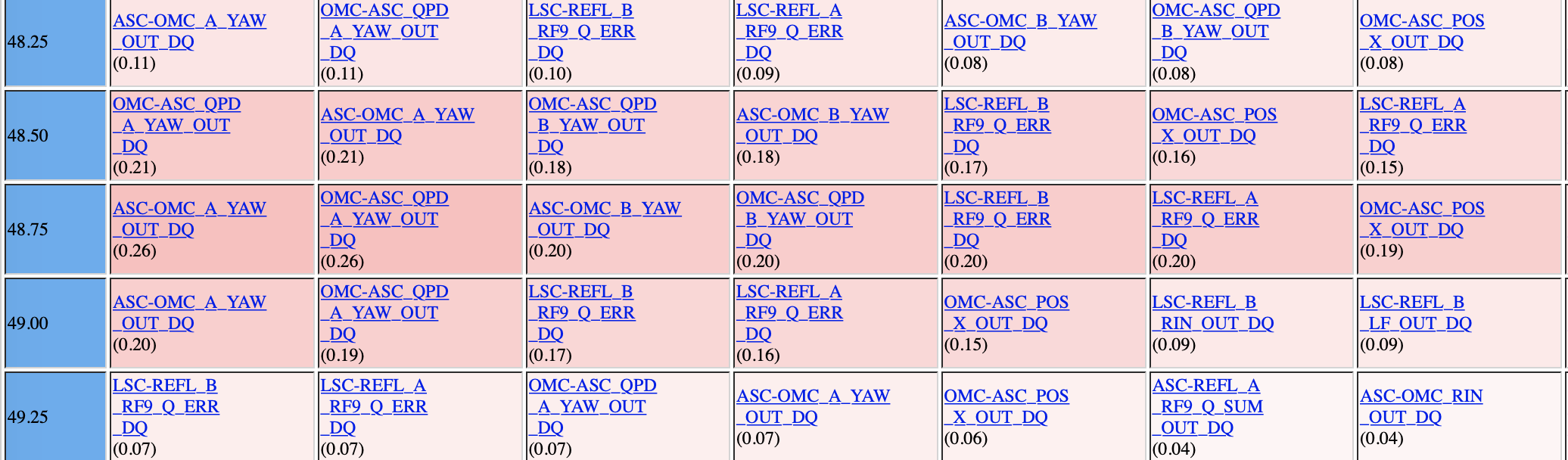
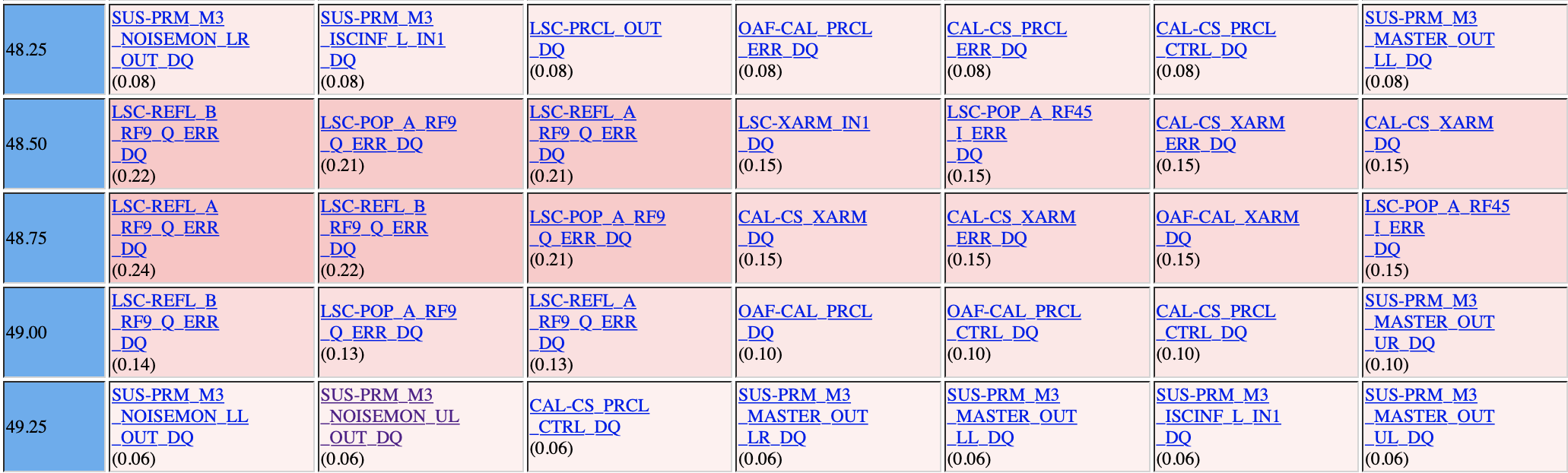
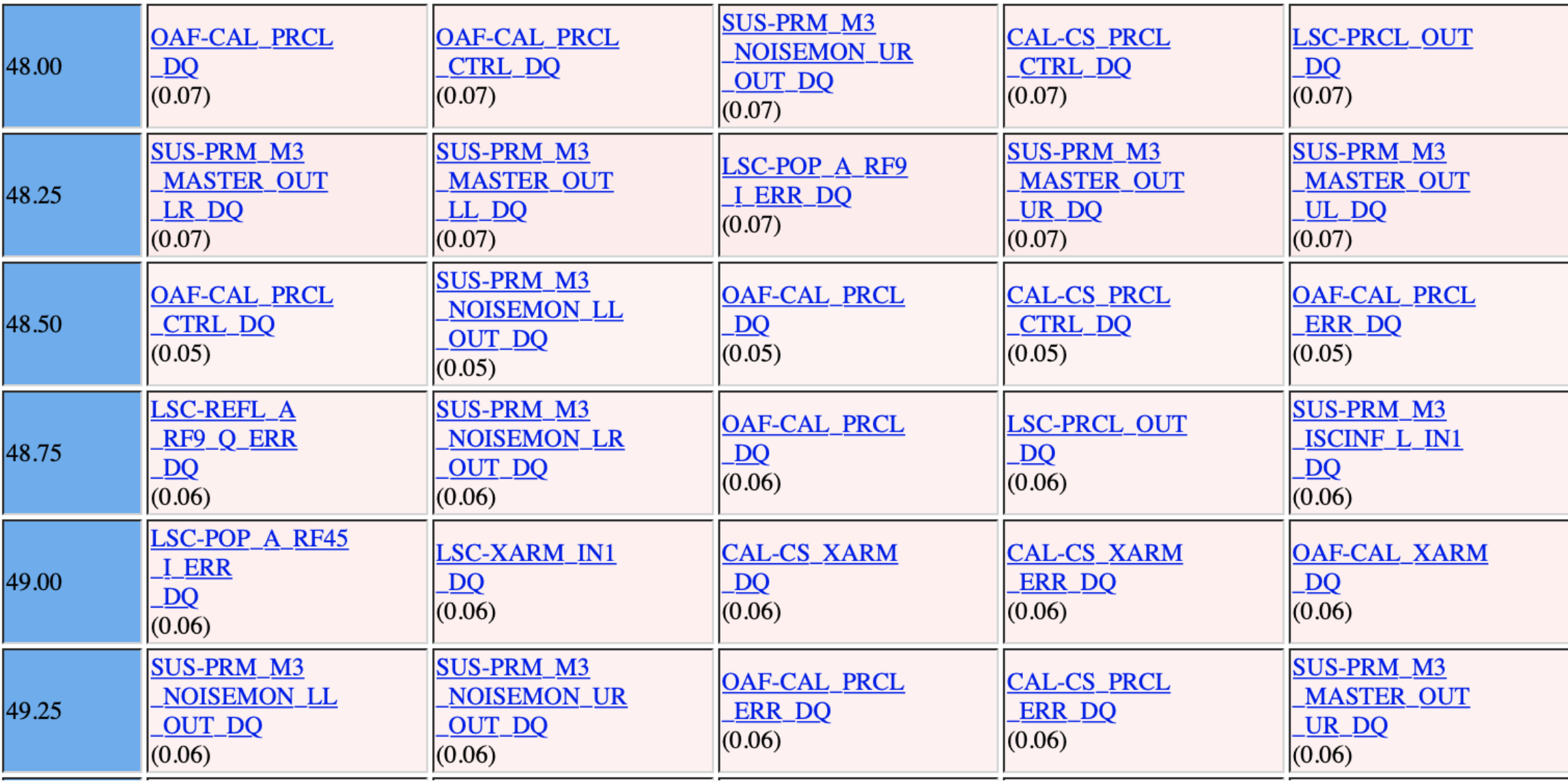
Comparing Bruco runs made when the 48 Hz line is visible to those when it is not reveals correlations with ASC-OMC and OMC-ASC channels. The strength of the correlations increases when the strength of the loine increases. The correlation is not present when the line is not visible. Results were obtained for 2019-07-26, at 11:30 UTC (line present) and 8:00 UTC (line absent), and on 2019-08-04, at 9:32 UTC (line present) and 13:20 UTC (line absent). On 2019-08-04, the line was stronger when present than on 2019-07-26 and the period chosen for its absence had the line amplitude below the mean in a normalized plot. All runs were for 10 minutes. Relevant excerpts of the results are attached with appropriate labels in the order mentioned above. More details and links to the full Bruco results may be found in the attached .pdf.

Kara and I swept the LVEA.
The LVEA was left in laser HAZARD
The LVEA was then quickly transitioned back to laser SAFE
WP8391 h1isiitmy model change
Jim W, Hugh, Jeff K, Dave:
h1isiitmy was restarted to fix some ADC->IPC connection issues. No DAQ restart was needed
DNS issues
Carlos:
ns0 and ns1 were rebooted to fix a DNS issue.
tagging SEI and Detchar, so we don't forget when this change was made.
HAM2 and ITMY STS channels are now swapped back.
see alog 1487.
Summary of Down Time during shift:
Locking notes: (Alignment notes were posted earlier.)
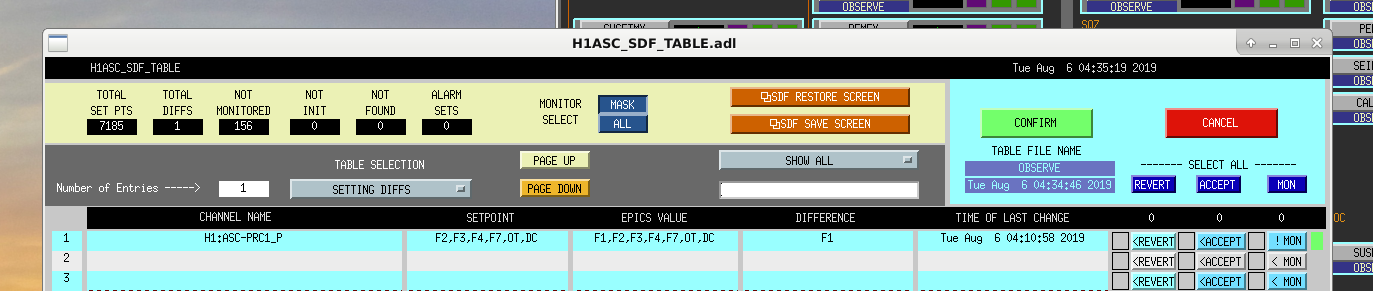
Thanks Corey! Hopefully things are now guardian-ified so that no one needs to do anything by hand for either PRX in initial alignment, or DRMI ASC. I turned off (and accepted as off) the PRC1 P FM1, so that it is back to how it has been. However, since we don't use PRC1 during full IFO anymore (we use the ADS system to control the PRM pointing in full lock), it would have been okay to turn off this filter :)
Jenne: Ahhhh, thanks for clarifying. (I think I noticed the Input was OFF, but can't remember.) Wonder what got me through DRMI last night on Lock #3...Lock#1 & #2 had locklosses at this point...but maybe it was waiting for ASC signals to converge that helped? But I remember waiting for Locks #1 & #2. So maybe just luck of H1 was looking over me or it was a nice IFO Voodoo step which helped me get through in the middle of the night. ;) Anyway, thanks for the note & glad recovery was smooth today!
