Displaying reports 39781-39800 of 88941.Go to page Start 1986 1987 1988 1989 1990 1991 1992 1993 1994 End
Reports until 15:27, Friday 19 July 2019
H1 CDS (DAQ)
david.barker@LIGO.ORG - posted 15:27, Friday 19 July 2019 - last comment - 16:00, Friday 19 July 2019(50660)
Started h1tw0 raw minute trend file offload

WP8280

At the start of this afternoon's commissioning break, I commenced the minute trend offload process on h1tw0.

1. past 5 months data files captured in temporary location /trend/minute_raw_1247609238

2. h1nds0 configured to serve past 5 months minute trend from this temporary location

3. h1nds0 restarted with new configuration

I have verified h1nds0 can serve past 24 hours raw minute data.

Comments related to this report
david.barker@LIGO.ORG - 16:00, Friday 19 July 2019 (50661)

I've started the file transfer from h1tw0(/trend/minute_raw_1247609238) to h1ldasgw0(/trend-0) using h1fw0 as the transfer agent. To transfer 254,217 files usually takes about 24 hours.

H1 SQZ (ISC, SQZ)
lee.mcculler@LIGO.ORG - posted 11:03, Friday 19 July 2019 - last comment - 15:48, Monday 09 September 2019(50610)
More on SRC Mode-mismatch, freq. dep. shotnoise and apparent phase noise

After Wednesdays commissioning discussion, I added mode-mismatching to the cavity model used in 50589 to enable internal SRC<-> ARM mode mismatch in its 2-mode rotation-matrix approach. This is to study how relevant the internal mode-matching is to squeezing and frequency dependent degradations to shotnoise. Internal mode matching is a bit more tricky, as the "best" operating point for the cavity model becomes non-trivial. Finesse and other transverse-mode capable simulators have tools to tackle this problem, but I'm not aware if any lock-point optimizers which handle squeezing in a simple manner. Because of frequency-dependent degradation, optimizing lock points is not uniquely defined and in principle, optimizing SQZ'ed spectra for BNS range or "science case" is the most general solution. Unfortuantely, this kind of optimization is very opaque for complex simulations.

I derived a few metrics to make finding lock-points more tractable for this two-cavity SRC+IFO simulation. Past studies have focused on the SRCL tuning - to optimize the sqz angle rotation, and measuring SQZ Loss and phase noise. There is one more important degradation that has not been studied in interferometer measurements or simulations. This is the loss imbalance in upper/lower sideband transfer of the squeeze field. This effect is known from how it can degrades the filter cavity operation, and not previously expected in the interferometer operating in its nominal SRC/ARM tuning. In T1900446 I derive the metrics, and show that the parameter "d", related to unbalanced loss in the arms, will cause a degradation that behaves identically to phase noise, except in a frequency-dependent manner. It also shows concise formula to help set the operating point of the squeezer in a simulation. The similarity to phase noise means that it is an irriducible coupling of anti-squeezing into the observation quadtrature (phase).

The reason that loss imbalance couples anti-squeezing is that the squeezing relies on a magnification of quantum noise from parametric gain, with a corresponding correlation in the upper and lower sidebands that allows them to strongly cancel in the readout (despite the magnification). The squeezing angle modifies the correlation from cancelling to adding, rotating from squeezing to anti-squeezing. Phase noise is a background modulation of the rotation between the two.  Loss imbalance removes the correlation, but not the magnification to the noise, which also causes irriducible anti-squeezing. Loss imbalance in the SRC reflected sidebands could potentially account for the apparent phase-noise excess observed at both sites.

The question is whether after fixing the sqz-angle detuning (SRCL offset), there can be imbalance in the loss on sidebands of the SRC reflection, even with the sideband phasing well-balanced. It appears that this is possible. It is a weak contribution with loss and mode-mismatch within the SRC. For mode-mismatch outside of the SQZ to IFO, the contribution is much stronger, altough in this model does not saturate the observed excess phase noise.

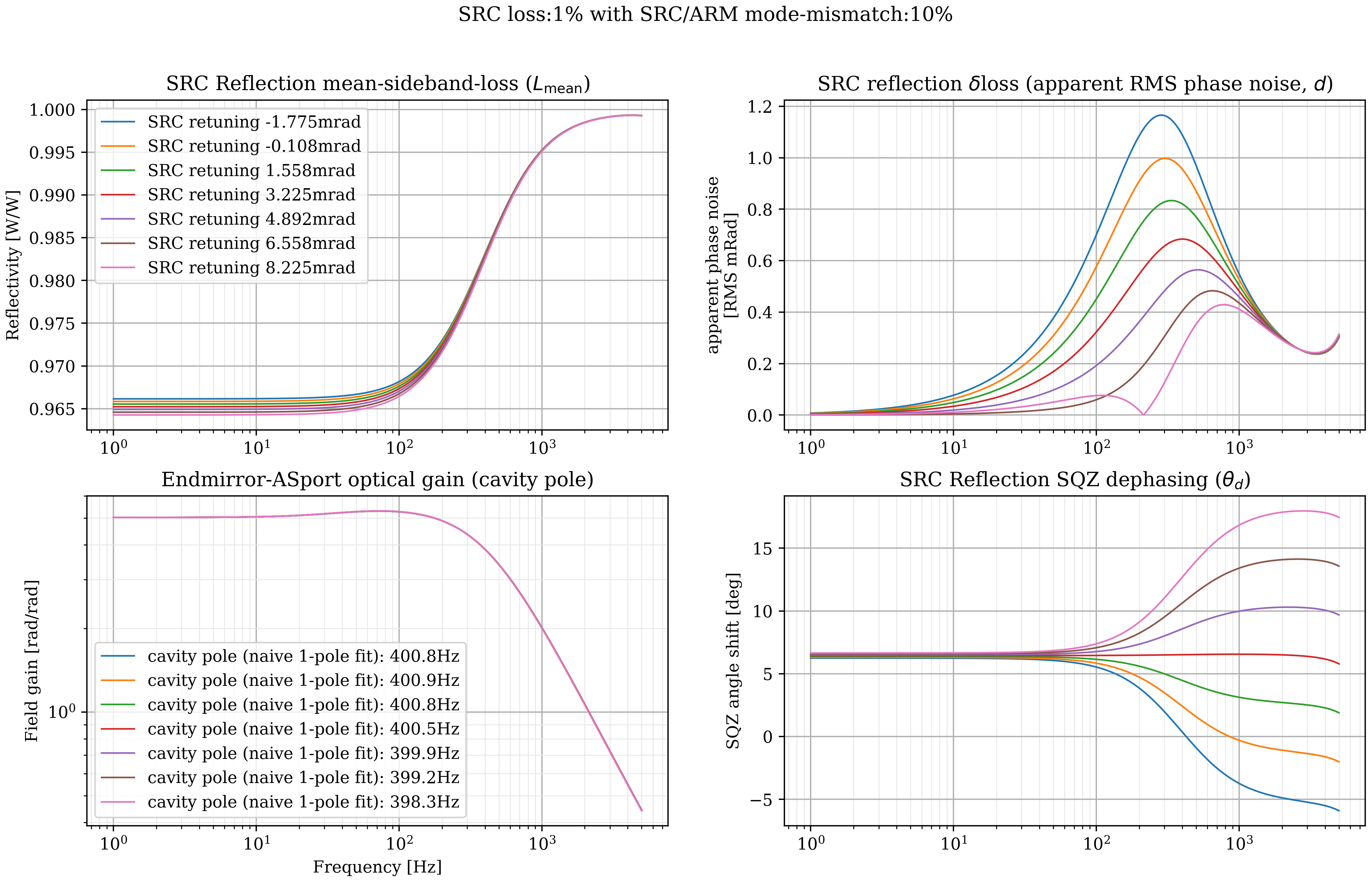
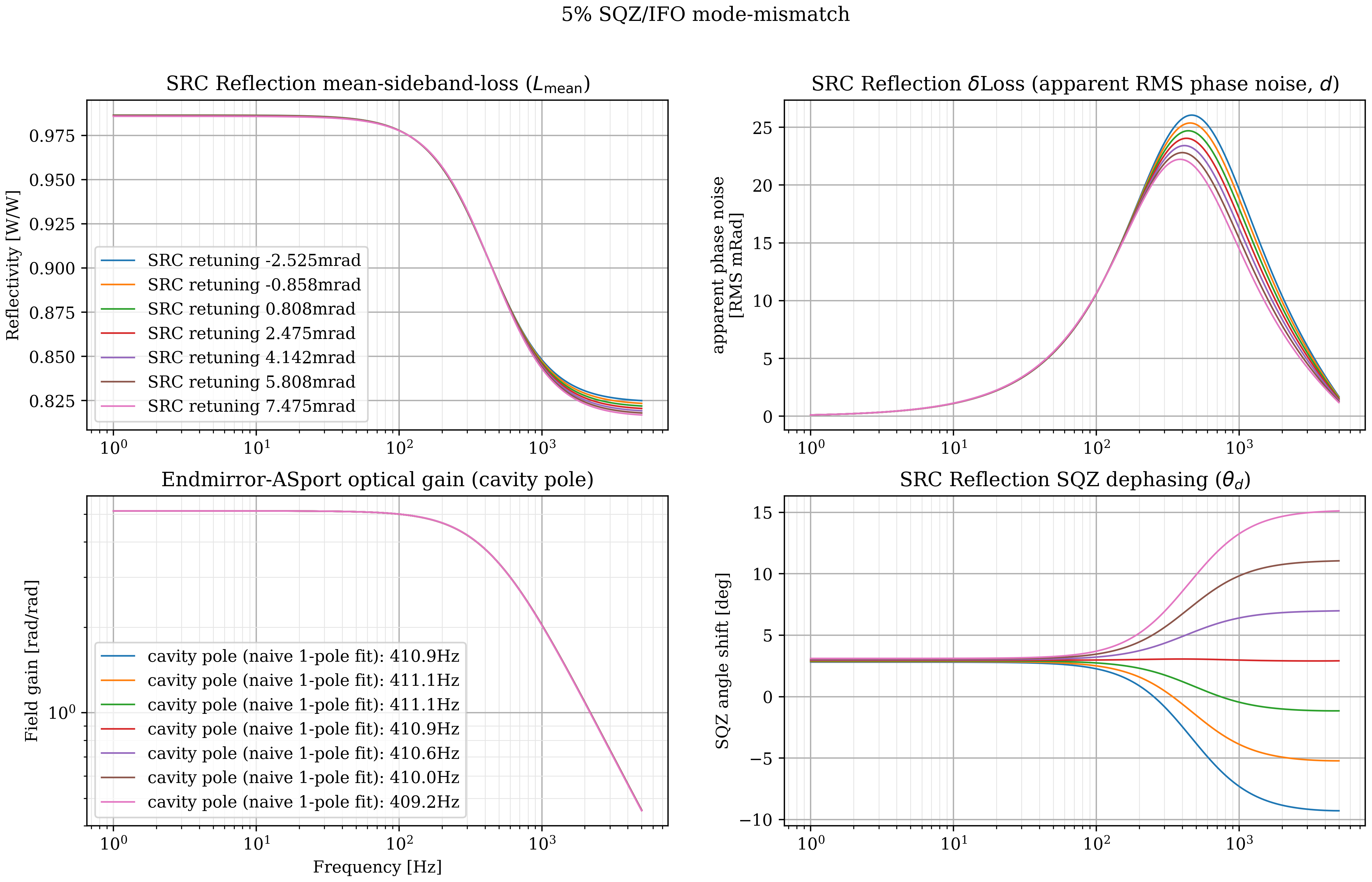
 cavity_pole_SRCtuningSRCmm.png shows a set of transfer-functions of the 00-mode reflecting from the SRC. The mode-matching of the SQZ to the IFO is perfect, but the SRC has 1% loss and 5% mode-mismatch to the arms. The code in coupled_cavity.py shows the full equations for the cavity reflection in the function coupled_cavity(...).  There the 2-mode cavity model is applied to both upper and lower sidebands, giving

r_src(+F) and r_src(-F)

which is initially nF x 2 x 2 matrix for the HG00 and HG02 modes modeled. Here, only the HG00->HG00 coupling is used, since the mode-matching to the OMC is assumed perfect, so r_src is a scalar. This r_src is the h(f) in T1900446.

arg(r_src(+F) * r_src(-f))/2 is the squeezing angle upon reflection from the cavity. This is the lower-right plot. The SRC tune-phase (Shiela's SRCL scans 50591) is adjusted and optimized to flatten the squeezing angle, showing that there is a tuning which has no residual frequency depenence to the squeezing angle. This is observed as having the optimal noise independently at each frequency.

abs(r_src(+F) * r_src(-f)) is the upper-left plot, the (geometric) mean sideband Reflectivity. This is related to how much unsqueezed vacuum creeps in. min/max(abs(r_src(+F))**2, abs(r_src(-f))**2) sets bounds on this number. The "c" and "L_mean" metrics are similar and nearly equal to this, but, when the losses are substantially different and these loss metrics show some discrepancy, the noise will not be dominated by the vacuum, but rather the loss-imbalance, so the geometric mean is a sufficient heuristic.

When the upper/lower sideband reflectivity losses are different, the imbalance is expressed by

   d = abs(abs(r_src(+F)) - abs(r_src(-f)))

This is shown in the upper right. This is a rather conceptually-opaque expression, but is derived to act just like RMS phase noise.

The lower-left of the plot is the cavity pole. At this level of mode-mismatch the DARM sensitivity has a considerable pole-splitting. The fits are using only a naive single-pole, but it is reported as a figure-of-merit to relate to the current/past cavity poles. It is surprising that an operating point exists with a flattened SQZ angle despite the pole-splitting, which is from a single optical pole aliasing to different frequencies in the upper-lower -> quadrature sideband projection. Such aliasing causes frequency effects on the angles that would not be expected to cancel so exactly without also cancelling the pole-splitting. It must be that the DARM-xfer and SQZ SRCrefl xfer sample sufficiently different things that this is possible. These transfer functions might suggest that SRCL tuning should not affect calibration, but RPN is not included and the optical-spring effects are missing.

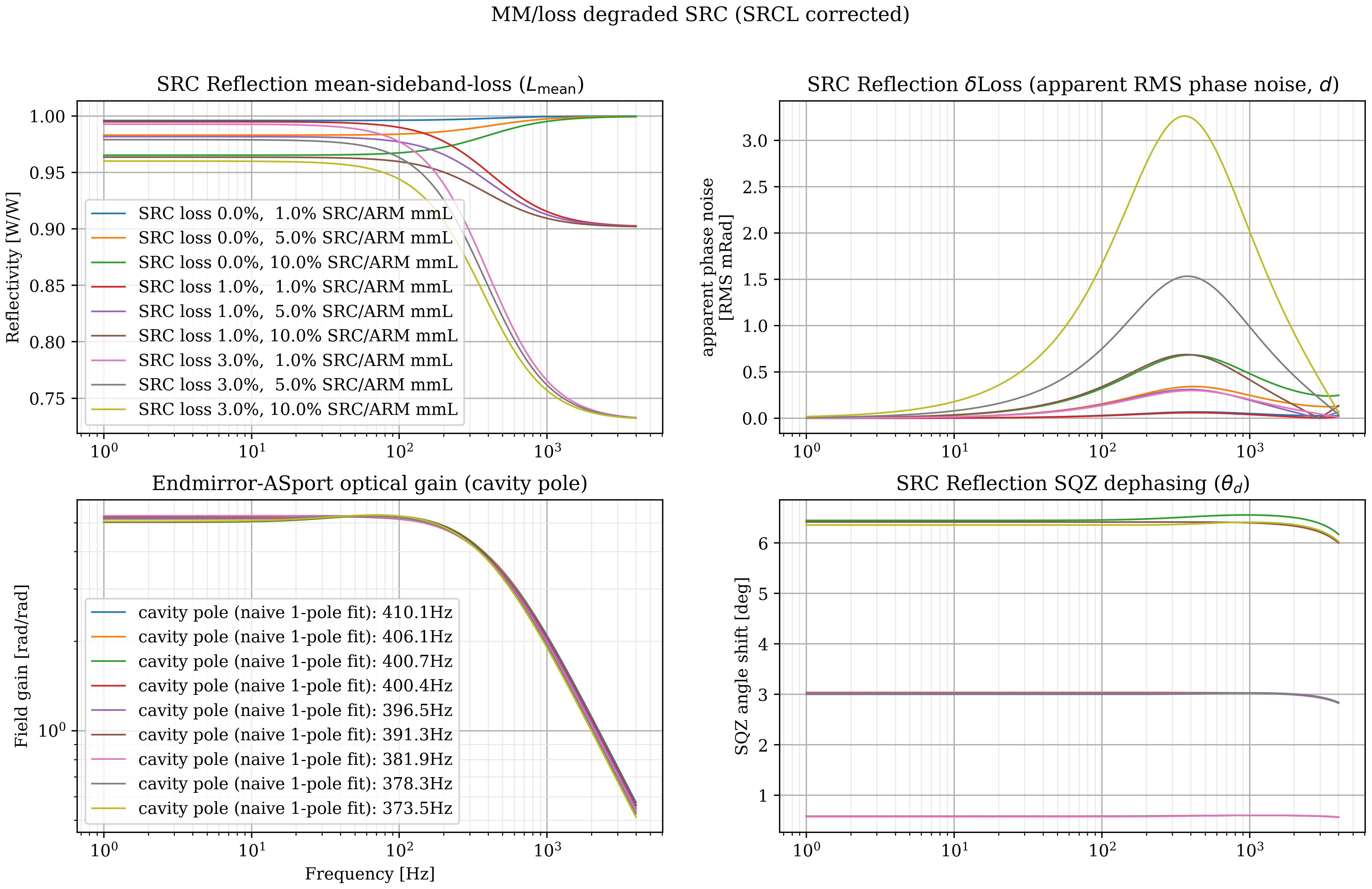
cavity_pole_SRCtunedSRCmm.png Performs the same analysis, where the SQZ-angle shift is always optimized for flatness, and the SRC mode-mismatch loss and dissipative losses are varied. These show that further degradation strongly affects loss at high-frequencies (from SRC loss), but these do not affect loss-imbalance significantly.


Now, introducing mode-mismatch between the SQZ and IFO gives a different story.

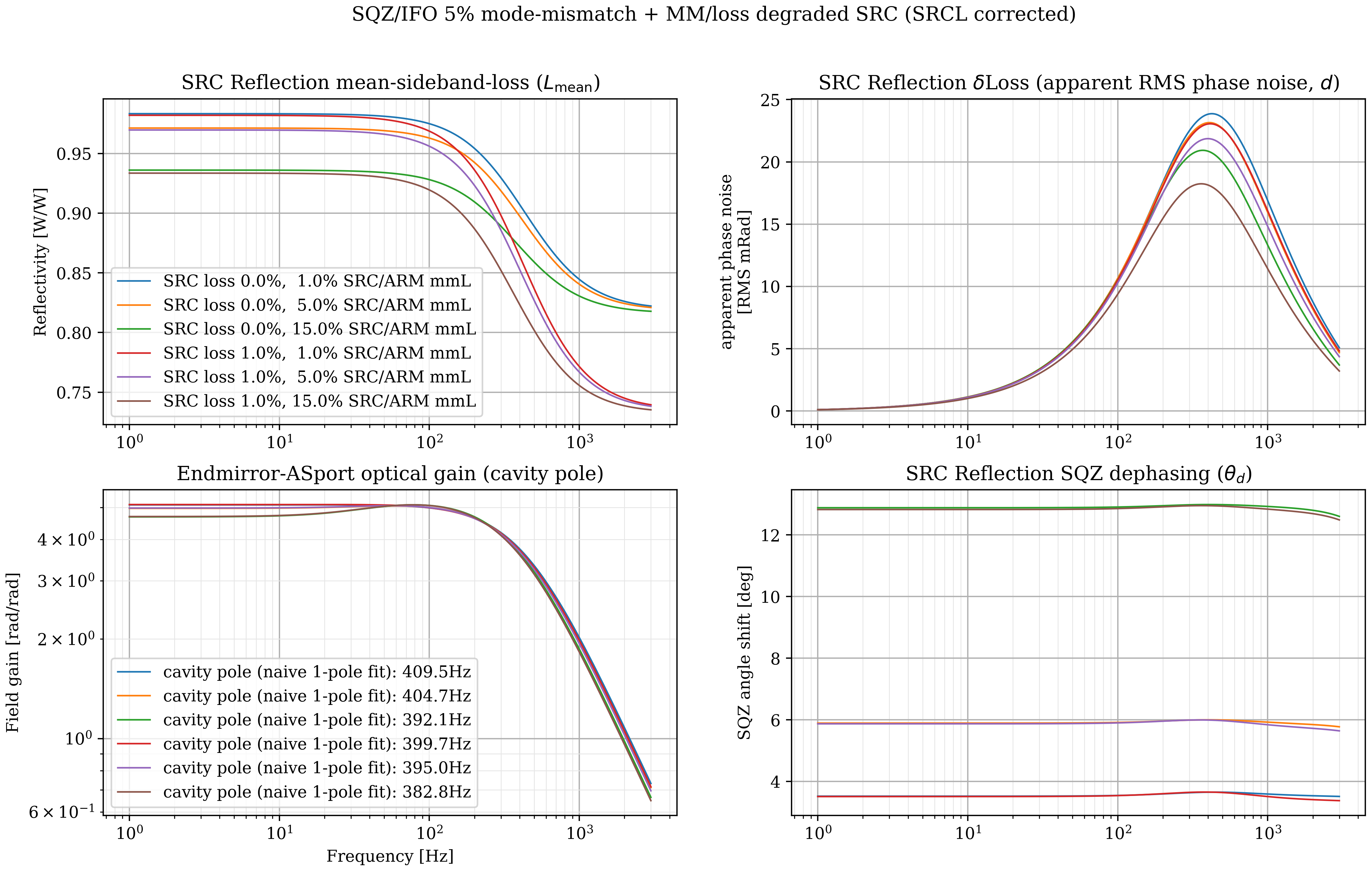
cavity_pole_SRCtuningIFOmm.png shows the metrics with 5% SRC/ARM internal mismatch loss, as well as 5% SQZ/IFO. The curves show different SRCL tunings. At high-frequencies this large IFO mismatch causes a large effective loss, and at intermediate frequencies, it causes substantial phase noise as well (although not as much as we are looking for).

cavity_pole_SRCtunedIFOmm.png Shows 5% SQZ/IFO mode-mismatch, with tuned SRCL, but varying the SRC loss and SRC/ARM mismatch.

From some studies not shown, the differential loss (apparent phase noise) is affected by the SRC Gouy phase (I am using .345rad, 19.8 deg, or .11/FSR single-pass for the HG02). When the Gouy is decreased, the loss-imbalance grows. This suggests that a model of HG01 alignment noise, using less Gouy from the lesser mode, will show larger degradation.

I matched these Gouy phases by using this model to simulate Jon Richardson's measurements in LLO39779 Interestingly, those measurments show a 30db dip in SRC reflectivity! This can indeed happen when mode-mismatch is bad, and similar measurements (at lower frequencies) may be useful in the future to characterize SQZ degradations.

Although this model does not saturate the observed losses and phase noise, It suggests that further studies of the controls noise may show substantial contributions from residual motion RMS. A more complete simulation will also be insightful and hopefully these metrics will be useful for even more complicated models. Loss-imbalance might be a canidate for the squeezing "phase noise" identified in advanced detectors.

Images attached to this report
Non-image files attached to this report
Comments related to this report
lee.mcculler@LIGO.ORG - 15:48, Monday 09 September 2019 (51832)

Errata: The DARM transfer function resonance (lower left) that is visible is not right. The code has two matrix-multiplies switched, but only on the endmirror-to-OMC transmission that indicates the DARM transfer function. The other three squeezer plots and code should be OK. Fixing the matrices gives no resnant feature, but does predict DARM pole changing.

H1 SEI
jim.warner@LIGO.ORG - posted 09:57, Friday 19 July 2019 - last comment - 13:51, Friday 19 July 2019(50483)
Reducing ISI corner differential motion by matching blends

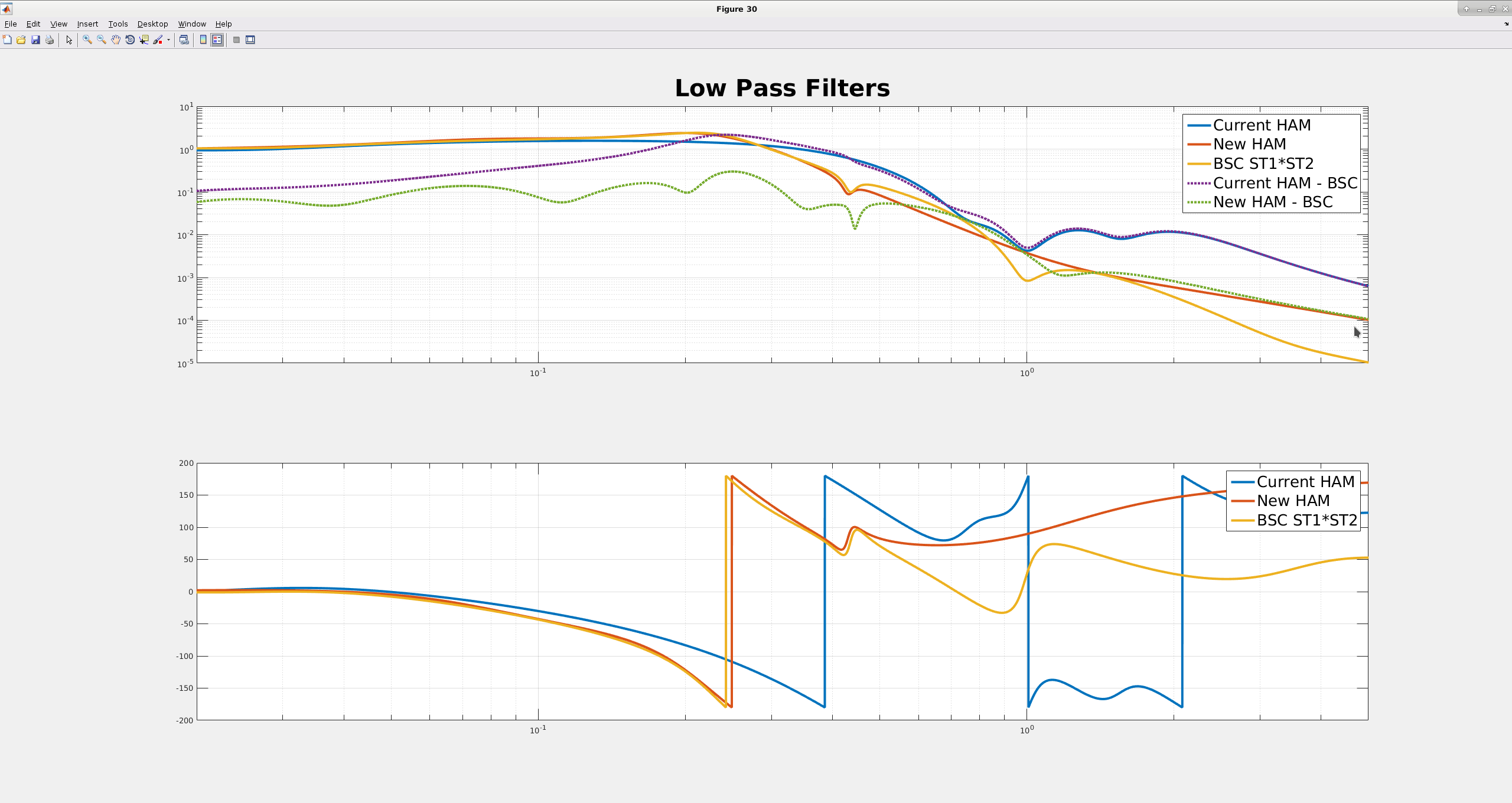
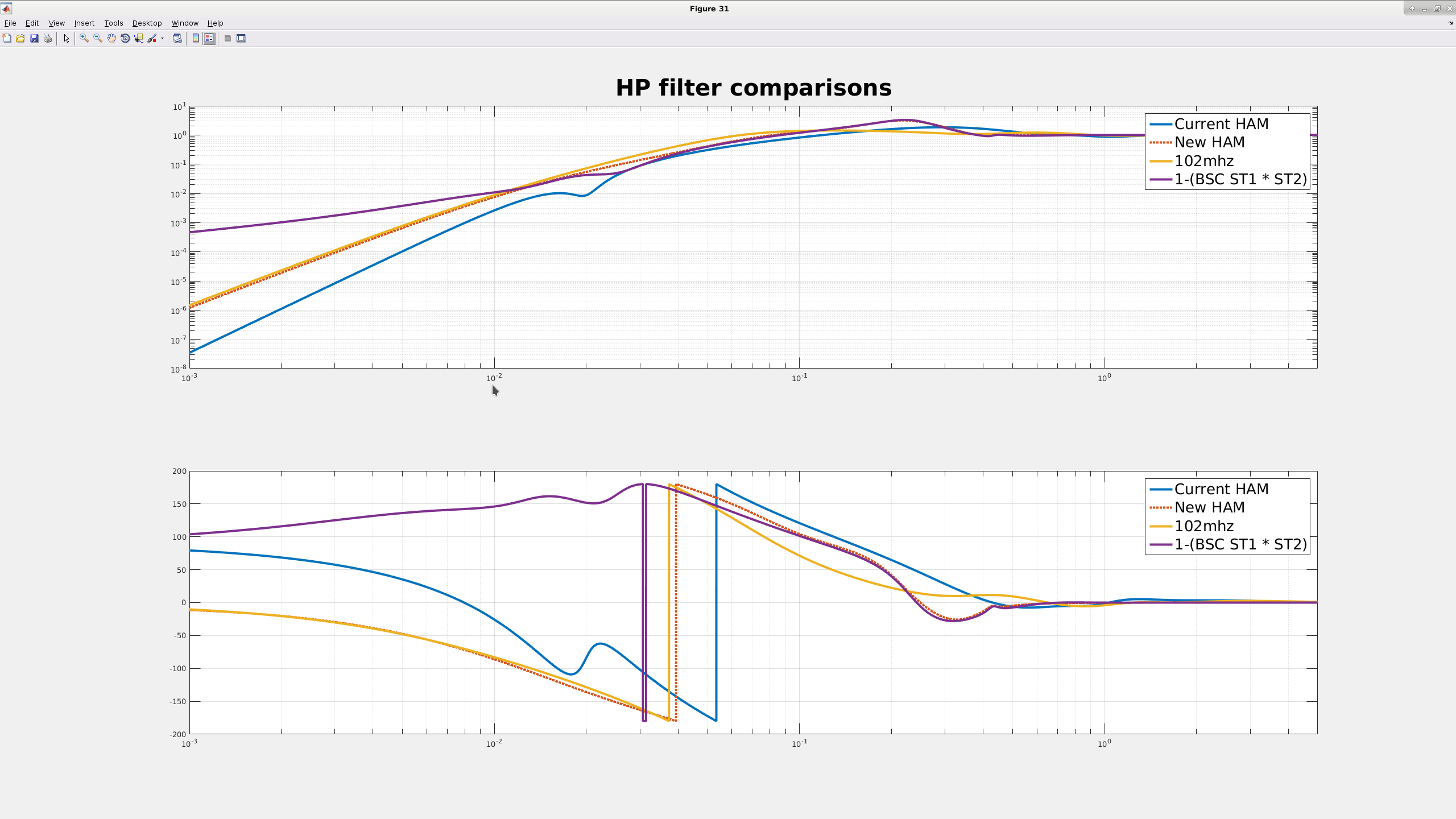
In the SEI log there is a thread about differences in HAM and BSC blend filters creating differential motion between the chambers in the corner. I've tried to come up a new blend for the HAMs to better match their motion to the BSCs by fitting a HAM blend to the product of the BSC ST1 and ST2 blends.

The current HAM blend, my new blend and the product of the BSC ST1 and ST2 blends are compared in the first attached image. The dashed lines are each HAM cps blend - BSC ST1*ST2 cps blend. The new blend has slightly more gain peaking around .2 hz, but rolls off faster above .3 hz, so it should give better absolute isolation. Comparing the dashed lines shows the new blend follows the BSC "total" blend much better below .5 hz. At these frequencies the ground motion is common in the corner, so the close the HAM blend is to the BSC blend, the less differential motion there should be.

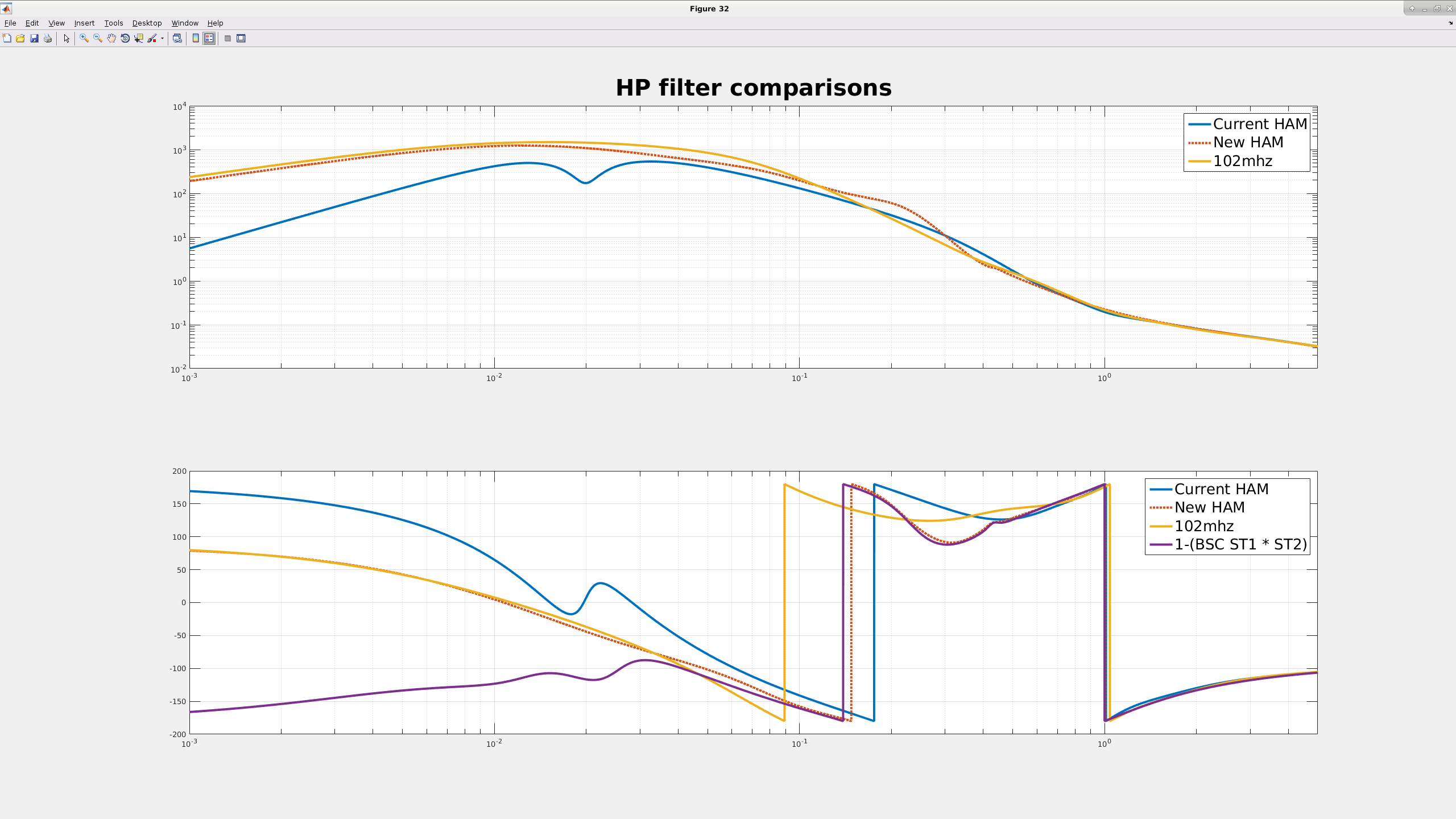
The second image compares the complementary high passes for each HAM filter, which determines how much GS13 noise and tilt gets injected into the table motion. The new blend (dashed) is roughly the same as the current blend below .1hz down to 40mhz, but is worse below that. The gold line is the high pass for a blend that LLO uses during high microseism, which I'm using as an upper limit. It also similar below .1 hz to the complement to the BSC ST1 & ST2 product, but this may not be the right way to compare to the BSC blends. Again, more gain peaking for the new blend around .2 hz. 

The last plot compares the "install" high pass filters which have to include the GS13 inversion and integration to get the GS13 signal into nm. Again, the new blend is higher magnitude on than the current blend, but is slightly below the blend LLO uses.

My plan currently is to install these filters, work with TJ on adding HAM blend nodes to SEI_CONF guardian and make a test configuration so it will be easy to test this when it is convenient. Probably need some DRMI time to really test if this helps, but maybe this is something that can be done during a maintenance day.

Images attached to this report
Comments related to this report
jim.warner@LIGO.ORG - 13:51, Friday 19 July 2019 (50659)

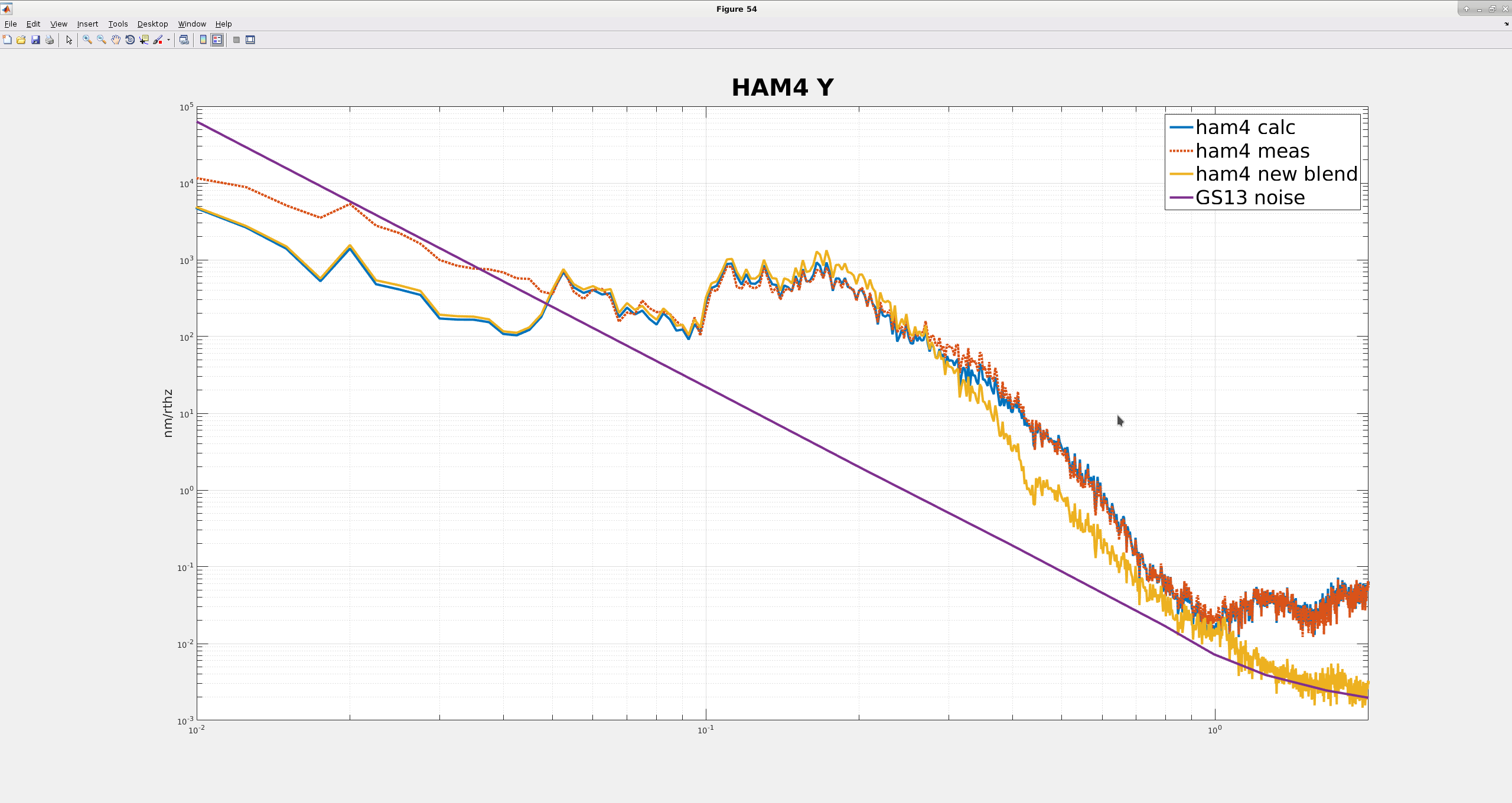
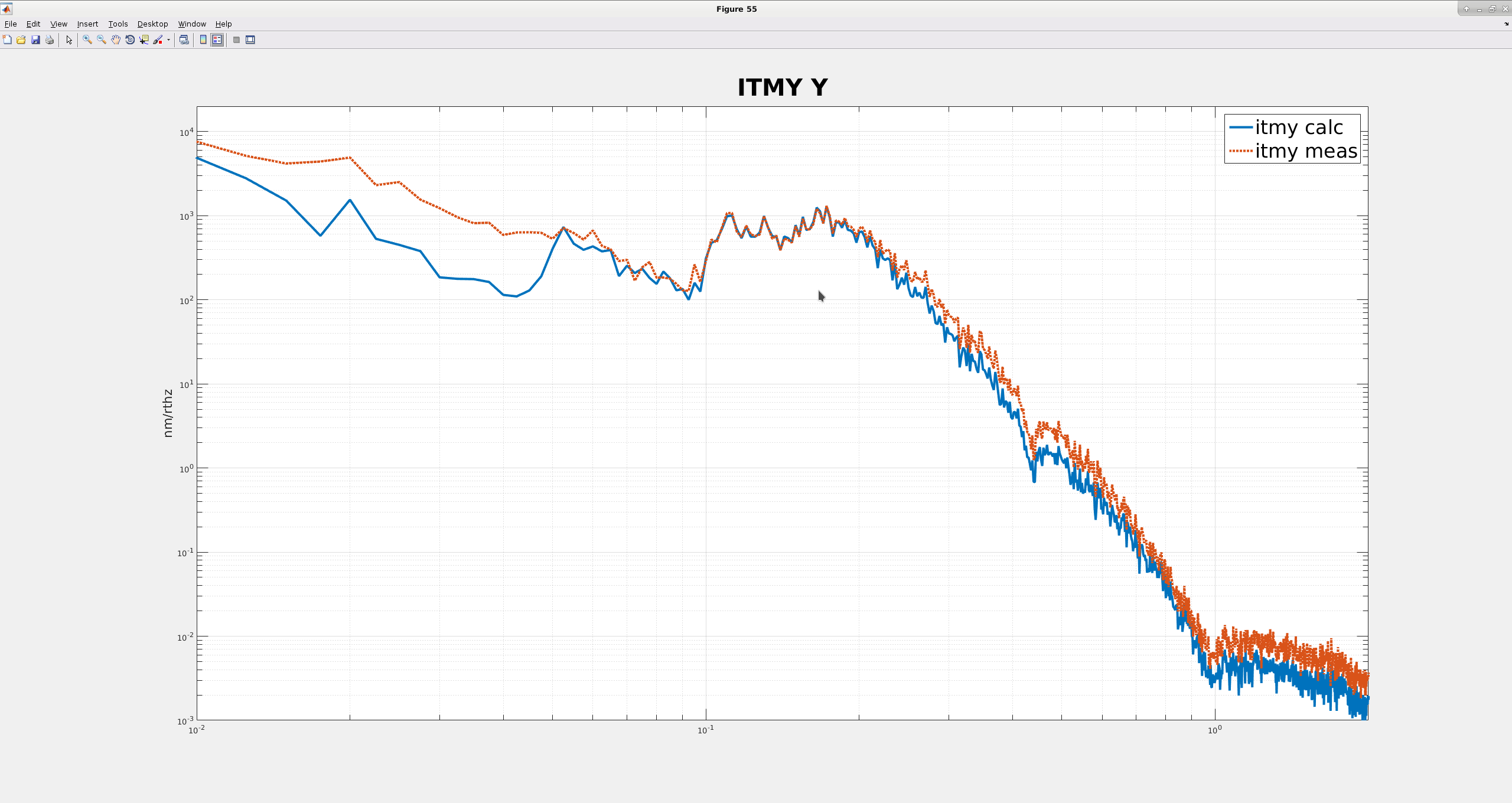
I'm attaching a couple plots of the estimated performance of these blends. I don't include sensor correction in any of these plots as the sensor and filters are common to all chambers, so shouldn't change the results here too much. 

The first plot compares the measured motion of the HAM4 ISI in the Y direction during a time when the sensor correction was off to just the current and new lowpasses * the ground. For the current blend this is a pretty good estimate of the GS13 signal, except below .1 hz, which I expect because this won't include platform tilt. Comparing the gold to the blue line, the new blend is slightly worse at ~.2hz, better above .3 hz. This is probably not valid above 1hz, we'll start being limited by loop gain at some point. May also affect the feedforward design for the HAMs.

I've done this for ITMY as well, in the second plot, and it's a little more complicated, but still fairly accurate. No new blend here, so only comparing the measured ST2 GS13 Y (red dashed) motion to the calculated (blue solid) motion on this plot.

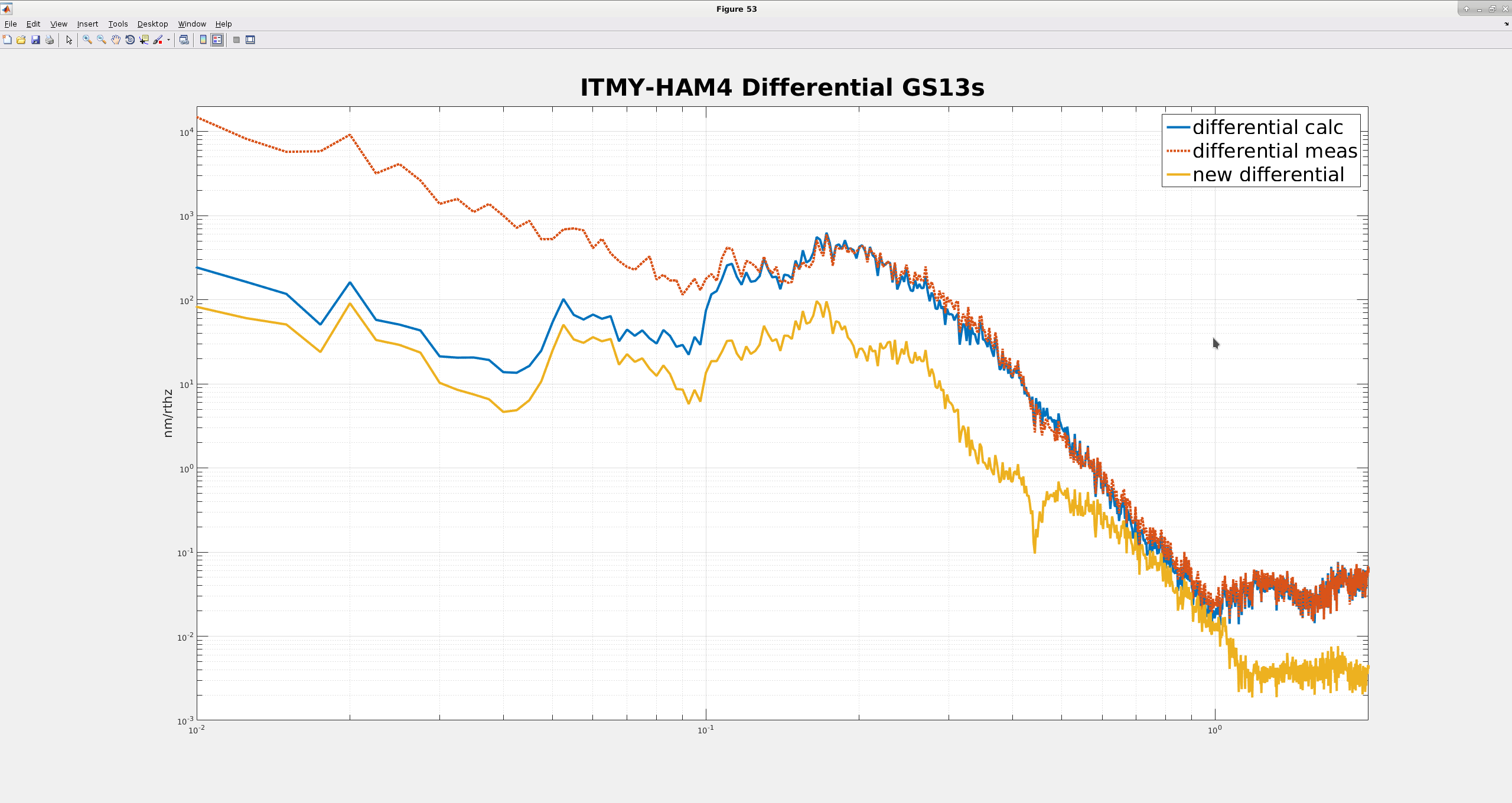
The third plot compares the GS13 measured differential between the ITMY St2  Y and HAM4 Y. The red trace is the measured differential motion, blue is the calculated motion and is pretty accurate above .1hz, below that the GS13s are dominated by platform tilt. The gold trace is the calculated differential motion, and looks pretty good, improving the differential motion by about a factor of 5. I don't think we'll get that kind of improvement, mostly because of tilt, but I think this is encouraging. Cavities like SRCL are not just ISI beamline motion, and I'm not proposing any other changes at this point, but if this will make corner ISI motion more common around the microseism, that should be a good improvement.

Images attached to this comment
LHO General
corey.gray@LIGO.ORG - posted 08:27, Friday 19 July 2019 (50657)
Transition to Day Summary

TITLE: 07/19 Day Shift: 15:00-23:00 UTC (08:00-16:00 PST), all times posted in UTC
STATE of H1: Observing at 115Mpc
OUTGOING OPERATOR: TJ
CURRENT ENVIRONMENT:
    Wind: 16mph Gusts, 13mph 5min avg
    Primary useism: 0.04 μm/s
    Secondary useism: 0.12 μm/s 

Rattlesnake Mountain still on fire/smoking/smoldering.  
QUICK SUMMARY:

H1's been locked for almost 12hrs.  Just had a FERMI & Swift GRBs which we completed a stand down for (TJ addressed those).

LHO General
thomas.shaffer@LIGO.ORG - posted 08:07, Friday 19 July 2019 (50655)
Ops Owl Shift Summary

TITLE: 07/19 Owl Shift: 07:00-15:00 UTC (00:00-08:00 PST), all times posted in UTC
STATE of H1: Observing at 115Mpc
INCOMING OPERATOR: Corey
SHIFT SUMMARY: Exciting fire on rattlesnake mountian, but less exciting shift (that's good). Observing for 11.5 hours, but the wind is slowly picking up again.
LOG:

H1 General
thomas.shaffer@LIGO.ORG - posted 04:01, Friday 19 July 2019 (50654)
Ops Owl Mid Shift Report

Locked for 7.5 hours, wind has died down. There were a few earthquake warnings that showed right on the boarder of the seiplot, I watched the Z_EQ_PEAKMON and decided not to switch.

LHO General
thomas.shaffer@LIGO.ORG - posted 03:05, Friday 19 July 2019 - last comment - 06:23, Friday 19 July 2019(50652)
Fire update

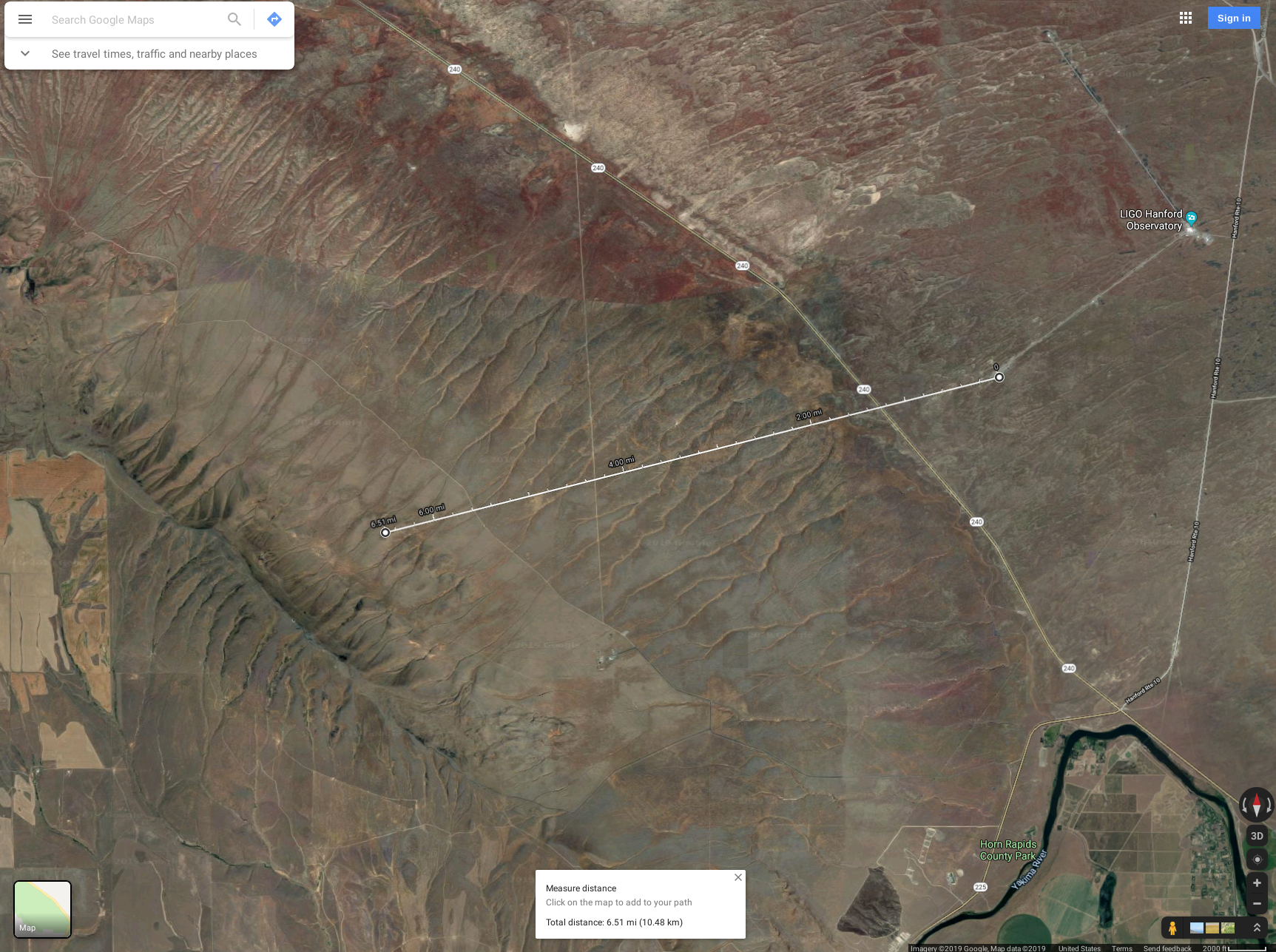
My best guess of the distance from the Y end station is about 6 miles. The direction of travel appears to be South-East mainly along the NW ridge of Rattlesnake Mountain and a bit down into the foothills below (see camera picture).

(From EY camera)

Images attached to this report
Comments related to this report
thomas.shaffer@LIGO.ORG - 04:00, Friday 19 July 2019 (50653)

The fire seems to be staying mainly on the South-West side of Rattlesnake but still spreading to the Southeast. The highways have been reopened according to the advisory page.

peter.king@LIGO.ORG - 06:23, Friday 19 July 2019 (50656)
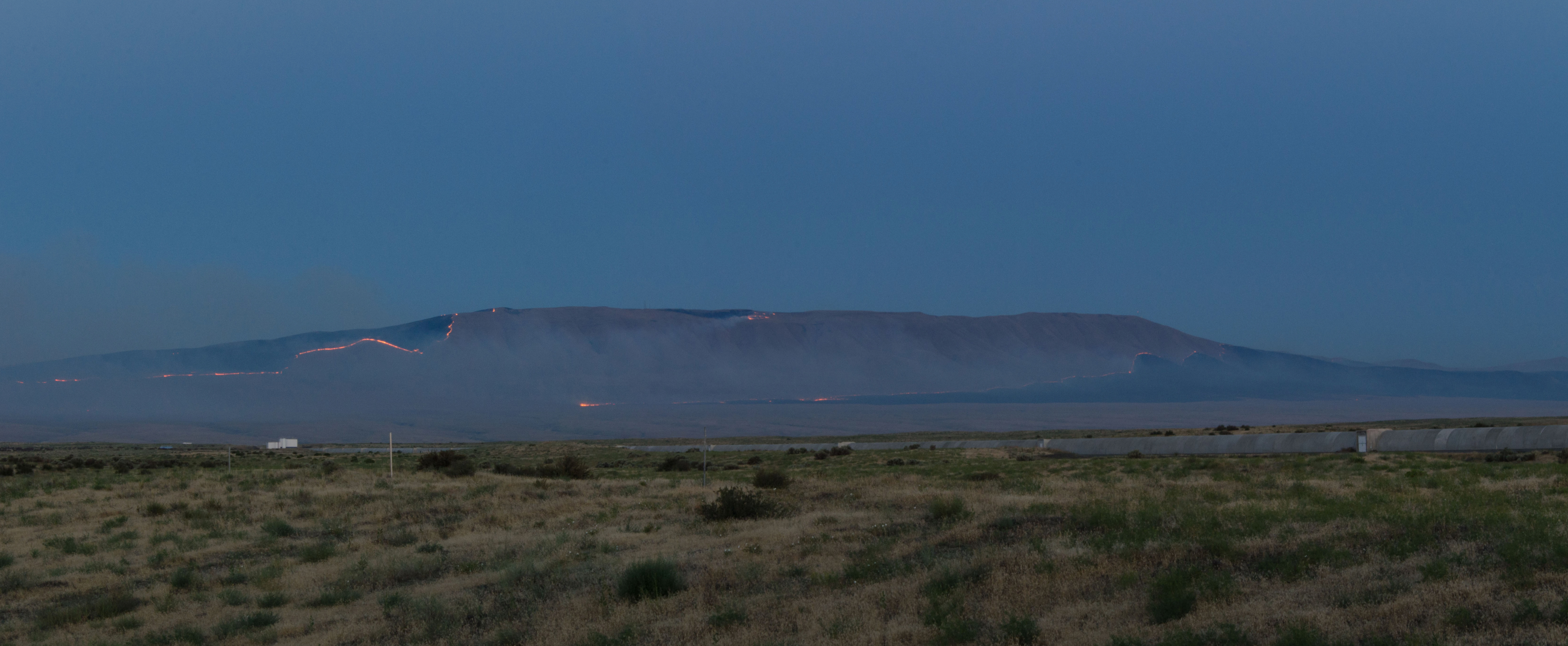
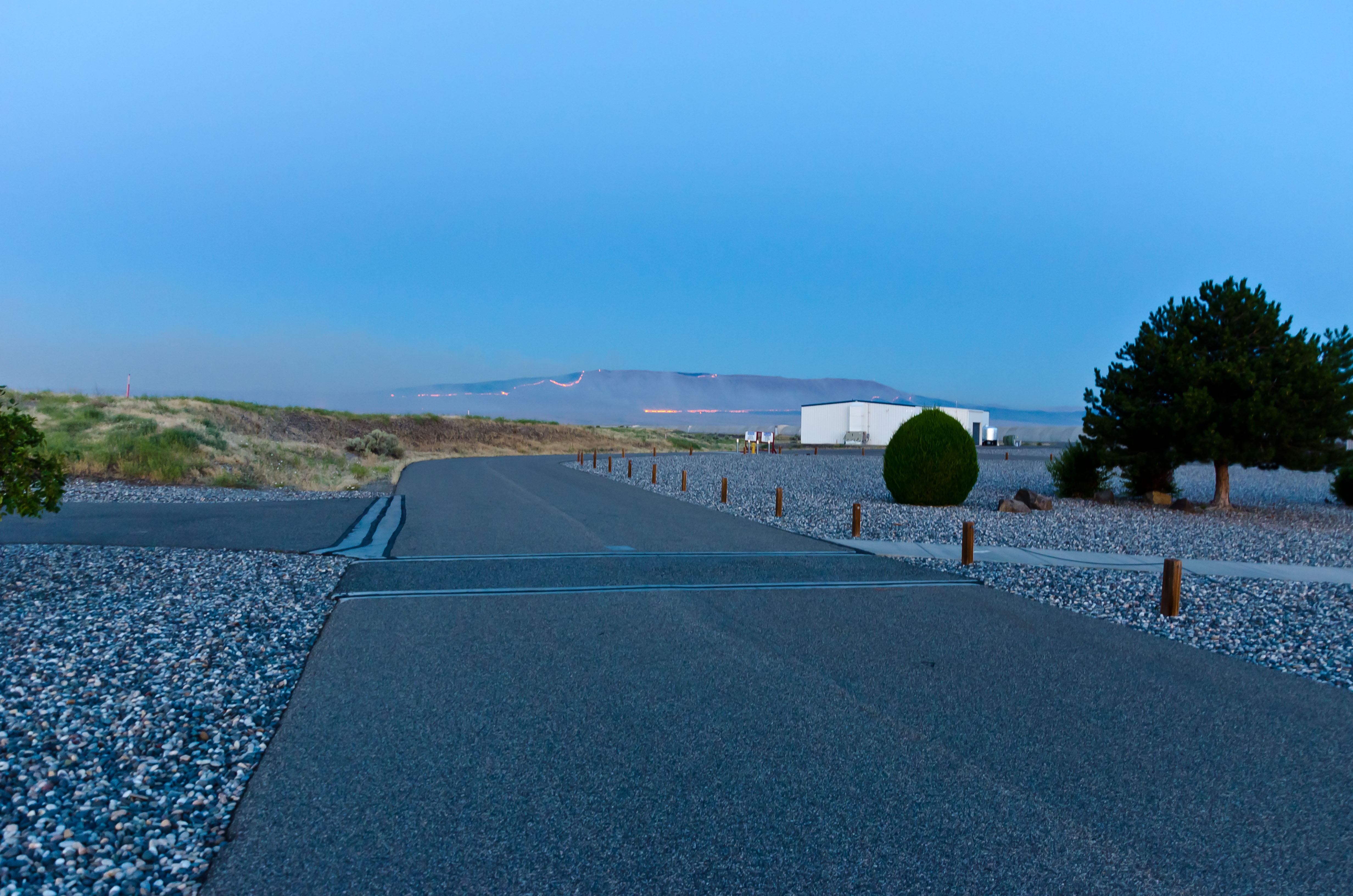
Some shots of Rattlesnake from around the parking lot(s).
Images attached to this comment
H1 CDS
david.barker@LIGO.ORG - posted 02:35, Friday 19 July 2019 (50651)
Fire Dept are running the fire pumps, I'm bypassing the cell phone alarms for the rest of the night

After consultation with the operator.

Bypass will expire:

Fri Jul 19 09:34:00 PDT 2019

For channel(s):

    H0:FMC-CS_FIRE_PUMP_1

    H0:FMC-CS_FIRE_PUMP_2

LHO General
thomas.shaffer@LIGO.ORG - posted 00:11, Friday 19 July 2019 (50649)
Ops Owl Shift Transition

TITLE: 07/19 Owl Shift: 07:00-15:00 UTC (00:00-08:00 PST), all times posted in UTC
STATE of H1: Observing at 114Mpc
OUTGOING OPERATOR: Ed
CURRENT ENVIRONMENT:
    Wind: 32mph Gusts, 19mph 5min avg
    Primary useism: 0.08 μm/s
    Secondary useism: 0.13 μm/s
QUICK SUMMARY: Fire on Rattlesnake mountain, much of highway 240 is closed from Route 10 westward. The wind is gusting up near 35mph, making the ASC FOMs look like they are hard at work to keep this 3.5 hour lock going.

H1 AOS
edmond.merilh@LIGO.ORG - posted 00:04, Friday 19 July 2019 (50646)
Shift Summary - Eve

TITLE: 07/19 Eve Shift: 23:00-07:00 UTC (16:00-00:00 PST), all times posted in UTC
STATE of H1: Observing at 114Mpc
INCOMING OPERATOR: TJ
SHIFT SUMMARY:
LOG:

00:55 after a few failed attempts at relocking and optimizing PRMI with ASC and manually, I'm moving to Initial Alignment

01:18 Begin re-locking

02:09 Switched SEI_CONF to VERY_WINDY_NOBRSXY

02:28 Holding H1 DOWN - I think the wind and the higher uSeism is hindering my re-locking attempts. Going for dinner.

03:42 NLN - Accepted accuracy diffs and one other. See aLog

23:58 handing off to TJ


H1 General
edmond.merilh@LIGO.ORG - posted 20:46, Thursday 18 July 2019 (50648)
H1 back to OBSERVING: 03:42UTC
Images attached to this report
H1 ISC (ISC)
keita.kawabe@LIGO.ORG - posted 18:23, Thursday 18 July 2019 (50645)
One of OAF BRMS channels changed to mointor 48Hz bump

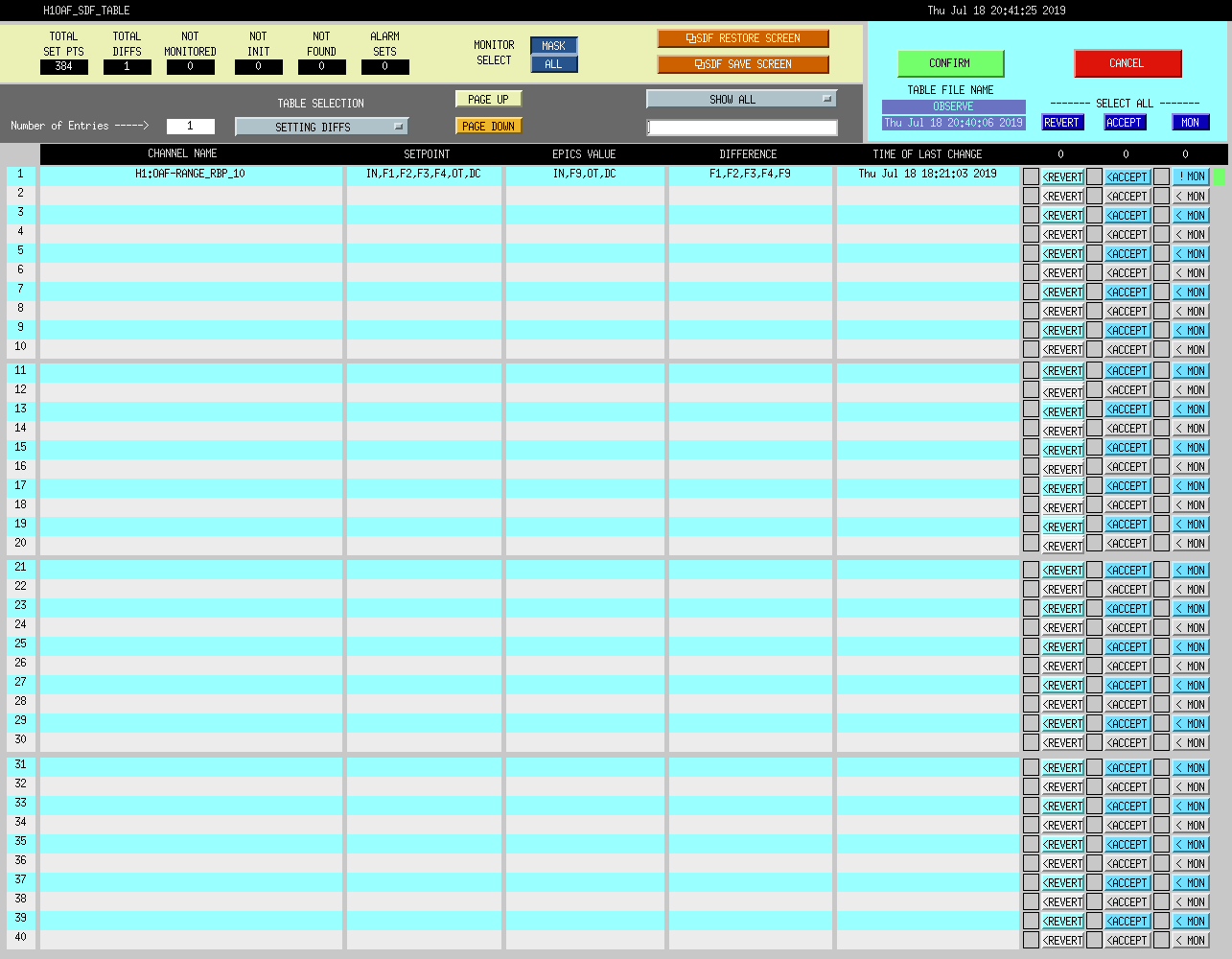
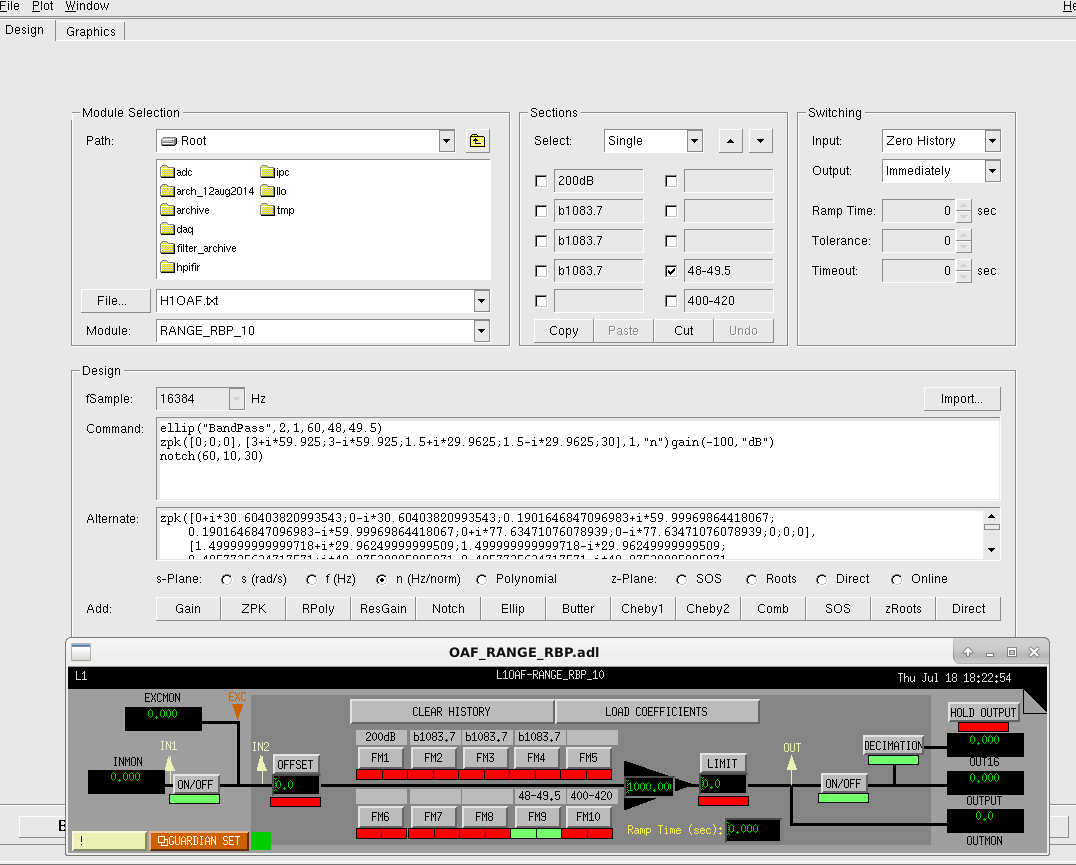
I added 48-49.5Hz bandpass to FM10 of H1:OAF-RANGE_RBP_10 to monitor 48+Hz bump, loaded H1OAF coefficients, disabled 200dB gain and 1083.7Hz bandpasses (FM1, FM2 and FM3) and accepted the SDF diff.

This was/is not used for control room monitor nor for anything else.


Images attached to this report
LHO VE
kyle.ryan@LIGO.ORG - posted 17:46, Thursday 18 July 2019 (50644)
VBOC back up and running

Carlos P., Kyle R.

VBOC's RGA application software was indicating that both of the analyzer's filaments were not working, i.e. were open circuits.  This condradicted my ohmic measurements of the filament pins on the analyzer -> Swapping the RGA's electronics as a troubleshooting comparison revealed a new, unrelated, problem.  The appllication software was unable to "talk" with the newly installed electronics box.  The software version of the appllication software and the firmware on this newly installed electronics should have been compatible -> Long story short, at some point in the past, the wifi on the laptop had been enabled (BAD idea) which, then, allowed the 3-year old (but working) outdated applilcation software to update itself which then required updated "firmware" to be loaded onto the new electronics (...since when has "firmware" been downloadable?)  Anywhoo, this resulted in 4 days worth of wasted time, discovering bugs and working with vendor service techs to wade through workarounds etc.  Ultimately, with Carlos P.'s help, we were able to get the laptop to communicate with the, now updated replacement RGA electronics module. 

I'll send the original electronics back to the vendor to repair the pseudo filament issue. 


H1 General
edmond.merilh@LIGO.ORG - posted 17:32, Thursday 18 July 2019 - last comment - 17:33, Thursday 18 July 2019(50642)
Re-Loaded ISC_LOCK Guardian node 00:32UTC

As per Sheila's instructions

Comments related to this report
edmond.merilh@LIGO.ORG - 17:33, Thursday 18 July 2019 (50643)

I guess I should have mentioned that we just experienced a lockloss @ 00:30UTC

H1 ISC
corey.gray@LIGO.ORG - posted 10:58, Thursday 18 July 2019 - last comment - 00:25, Friday 19 July 2019(50630)
Oddity for ALSy: Camera/video?

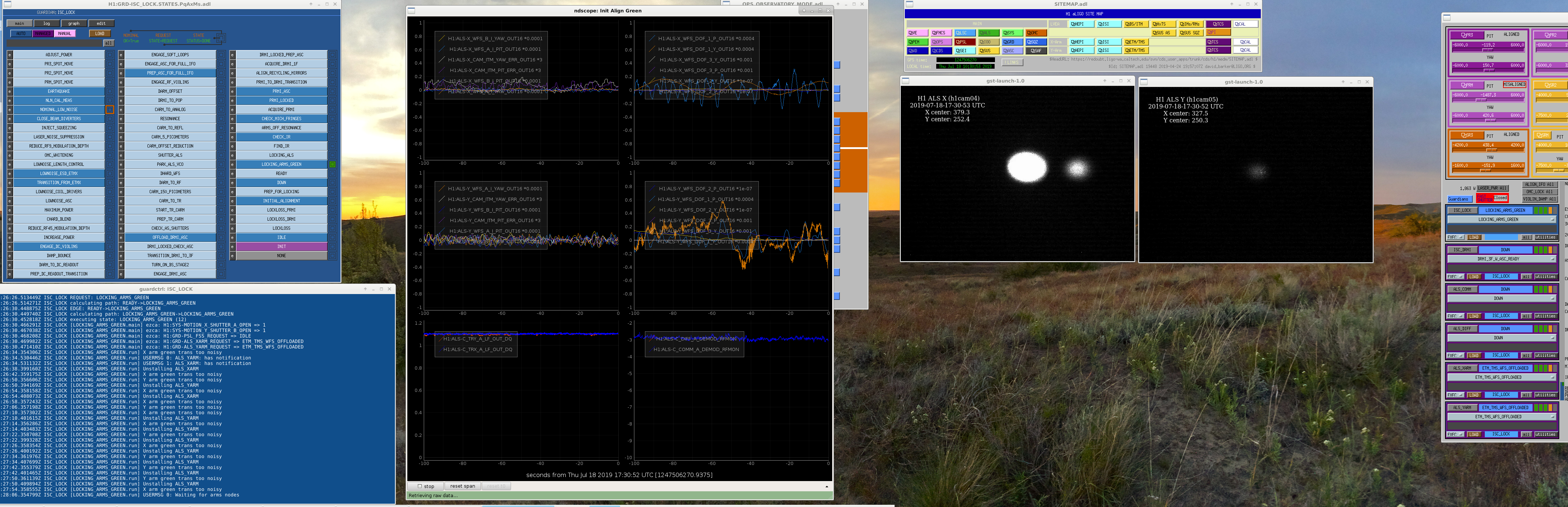
After the Hidalgo, Mexico Earthquake lockloss, ISC_LOCK went for LOCKING_ARMS_GREEN, and it appeared to get there with no problem, but the weird thing I noted was ISC_LOCK thought we were in LOCKING_ARMS_GREEN, and the values for ALS x & y on NDSCOPE both looked nominal (over 1.0 counts), BUT the video spot for ALSy did not look right.

Instead of a bright 0:0 mode for ALSy, we had a very faint spot---and ISC_LOCK & green arm power looked OK!  (see attached screen shot)

I unlocked green Y, tweaked alignment only a little, but it would do the same thing.  I would actually see a nice bright 0:0 mode, but it would then immediately drop in intensity on the video (perhaps in 2-steps). 

ISC_LOCK was happy so I moved on.  Still waiting to see if we can live with this (1st attempt did not lock DRMI, so trying it again).

Images attached to this report
Comments related to this report
corey.gray@LIGO.ORG - 11:55, Thursday 18 July 2019 (50633)

Watching the ALSy video a few more times, it looks as if there are 3 steps down in the power (by my eye watching the video).

corey.gray@LIGO.ORG - 13:17, Thursday 18 July 2019 (50635)

Mentioned this to Sheila and her thought was this might possibly be an issue with the Video for ALSY

This Is A New Issue/Feature!

edmond.merilh@LIGO.ORG - 18:42, Thursday 18 July 2019 (50647)

I found that the auto exposure was set to "ON" and the value slider was all the way down. I turned auto exp "OFF" and turned up the exposur to match that of the X camera. It seems to have stayed through another IA/Locking process(es).

thomas.shaffer@LIGO.ORG - 00:25, Friday 19 July 2019 (50650)

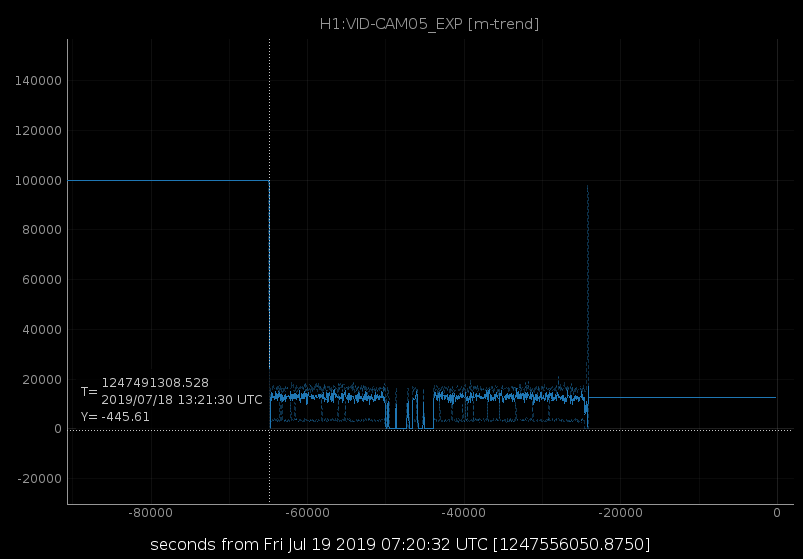
July 18th at 13:20 PDT the auto exposure was turned on, most likely by accident. Ed restored this to the x value, I'll restore it to the previous value of 100000 if we lose lock (I don't know if this is an accepted SDF).

Images attached to this comment
Displaying reports 39781-39800 of 88941.Go to page Start 1986 1987 1988 1989 1990 1991 1992 1993 1994 End