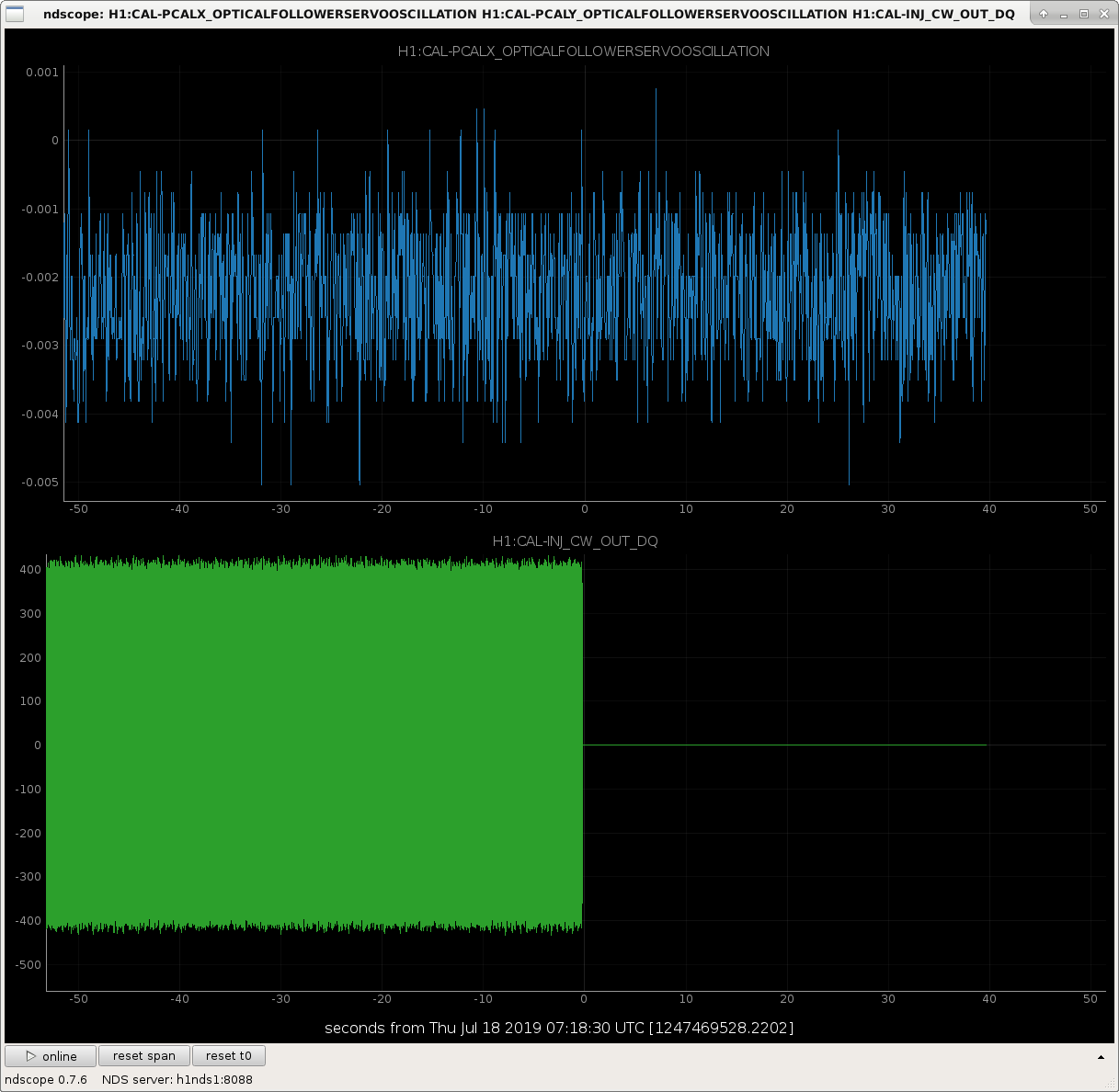
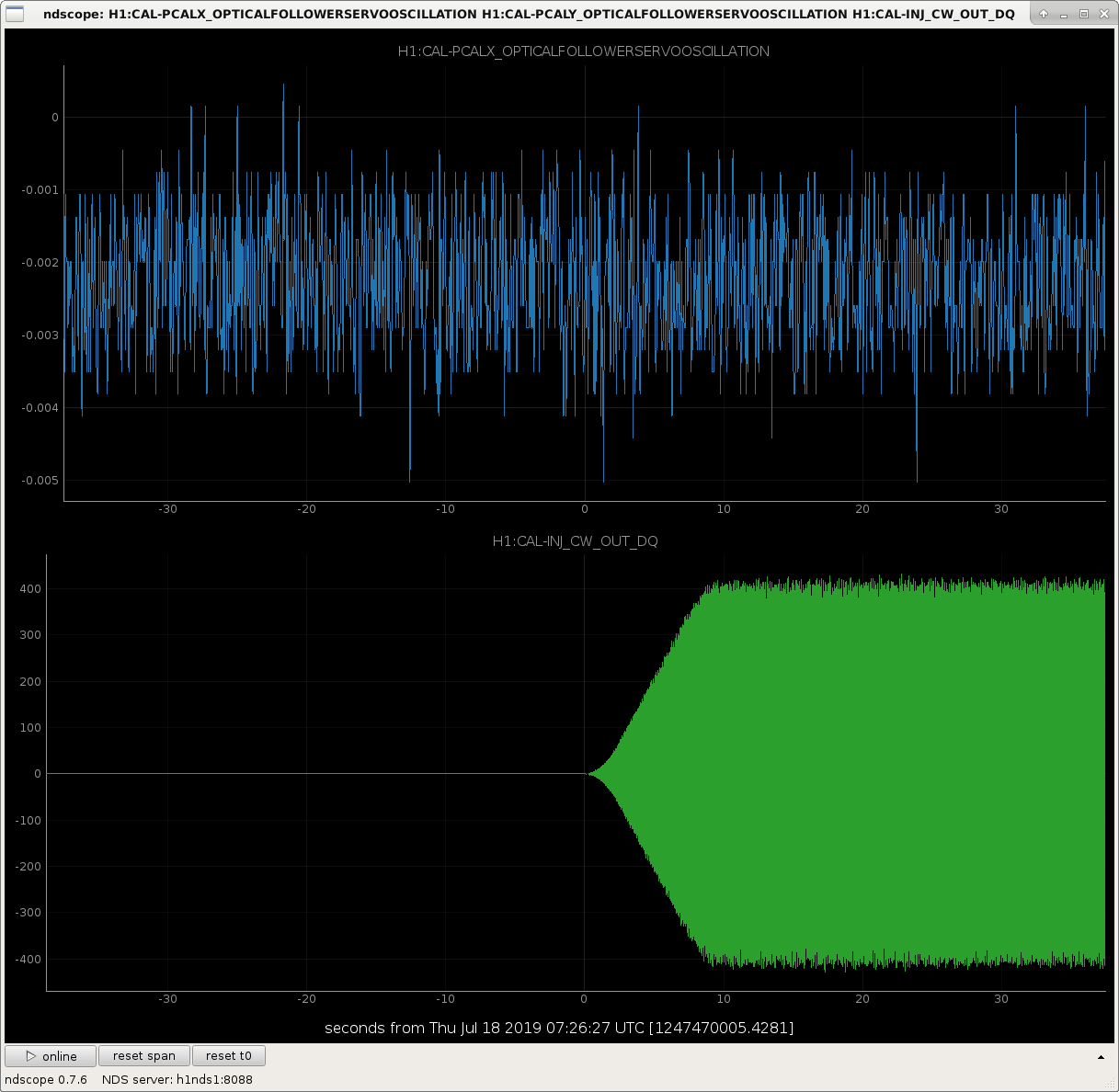
No obvious cause of h1fw1's daqd process restart. There were no retransmissions at the time, I've posted the tail of the log file below.
david.barker@zotws6: tail daqd.log.1563302338
Writing md5sum out to '/frames/full/12474/H-H1_R-1247469184-64.md5' of '2f19c1daf487846a07a5c70770ff6b3a'
Writing md5sum out to '/frames/full/12474/H-H1_R-1247469248-64.md5' of '77d98c0f9593ff3ff10cb40ed82bd1fb'
Writing md5sum out to '/frames/full/12474/H-H1_R-1247469312-64.md5' of '8f02d7933411f8e48cc53c4d67b85061'
Writing md5sum out to '/frames/full/12474/H-H1_R-1247469376-64.md5' of 'fba4ebadf3f0869fee2ef7bb7f8e4cc5'
Writing md5sum out to '/frames/full/12474/H-H1_R-1247469440-64.md5' of '63a8a29431ed93875335934cacff038c'
Writing md5sum out to '/frames/full/12474/H-H1_R-1247469504-64.md5' of '8fbcb24cd2e86f9c4f05a26bc09c109f'
Writing md5sum out to '/frames/trend/second/12474/H-H1_T-1247469000-600.md5' of '8af48e93ba0303e08ca043c3cb1e14c6'
[Thu Jul 18 00:21:01 2019] main profiler warning: 1 empty blocks in the buffer
Have to skip 1124 sequence numbers
New sequence number is 2115540
TITLE: 07/18 Owl Shift: 07:00-15:00 UTC (00:00-08:00 PST), all times posted in UTC
STATE of H1: Observing at 114Mpc
OUTGOING OPERATOR: Ed
CURRENT ENVIRONMENT:
Wind: 6mph Gusts, 4mph 5min avg
Primary useism: 0.02 μm/s
Secondary useism: 0.11 μm/s
QUICK SUMMARY: locked in Observe
TITLE: 07/18 Eve Shift: 23:00-07:00 UTC (16:00-00:00 PST), all times posted in UTC
STATE of H1: Observing at 115Mpc
INCOMING OPERATOR: Cheryl
SHIFT SUMMARY:
Sorry, not nearly as exciting as last night. I'll try to have something better tomorrow. hehe
H1 locked and observing for 7+hours
LOG:
00:04 Sundae out to optics lab
00:43 Sundae back
00:47 Dripta back from Pcal lab
01:38 EQ mode for 5.4 - in Puerto Ayora, Ecuador area
02:31 back to Windy - EQ was a dud
06:55 Handing off to Cheryl
FERMI - UID E344510
Trigger Duration .512
H1 Observing for 5 hours
Standown 15 minutes
INJ_TRANS = EXTTRIG_ALERT_ACTIVE
My mistake about INJ_TRANS node. I initiated INJECT_KILL at 05:26UTC. Will stay there for at least 15 minutes.
05:53 INJ_TRANS back to INJECT_SUCCESS/WAIT_FOR_NEXT_INJECT
M. Ball, J. Driggers, S. Dwyer, J. Kissel We've gathered a standard set of sensing function measurements this week in the nominal IFO configuration. What may be of note -- after yesterday's computer process restart of the h1asc model (LHO aLOG 50567), and during recovery, we re-acquired the IFO *without* the SRC1 Yaw offset we've been running with since May (see LHO aLOG 49393). You'll notice in the plots below, the sensing function has changed shape to something more like a physical spring unlike what we've seen in the past. We lost lock before we were able to explore this further, but we will likely be running with this offset OFF from now on, so it'll be something interesting to keep an eye on (i.e. to see if next week's sensing function is consistent with this week's, and we'll also try actively changing this offset to see if it is yet another knob beyond spot position and ASC gain). Attached is a collection of 4 plots: Page (1): The sensing function (i.e. ratio of PCAL2DARM and DARM Loop Suppression transfer functions), compared against a new MCMC fit to establish this measurement's parameters. Note that although the cavity pole frequency is reported low, this is not the only time it's been low like this (see later, Page (4) comments). Page (2): The same sensing function measurement compared against the *reference* model Page (3): The individual measurements going in to the sensing function. Page (4): a time series trend of the MCMC fit values for the parameters of sensing function measurements throughout O3 up to today. We also began to phase and balance the quadrants of the AS_A_45 WFS (i.e. the error signal for DHARD), using the PCAL calibration line at 17.1 Hz as our "pure longitudinal / DARM" drive, minimizing that line in the I phase. Unfortunately, we lost lock just after measuring the DARM loop suppression and did not get the PCAL2DARM transfer function, so we can't show a plot of how the sensing function changed. However, from our previous work (see LHO aLOG 50498, G1901353), we have found that only the DARM Loop Suppression changes under these ASC-like changes -- and we saw no change. Raw data templates: /ligo/svncommon/CalSVN/aligocalibration/trunk/Runs/O3/H1/Measurements/FullIFOSensingTFs 2019-07-17_H1_DARM_OLGTF_LF_SS_5to1100Hz_15min.xml :: standard measurement of 1/(1+G) 2019-07-17_H1_PCALX2DARMTF_LF_SS_5t1100Hz_10min.xml :: new-ish standard measure of C/(1+G) with PCAL X 2019-07-17_H1_PCALY2DARMTF_LF_SS_5t1100Hz_10min.xml :: standard measurement of C/(1+G) 2019-07-17_H1_PCALX2DARMTF_BB.xml :: new-ish standard measure of broad-band C/(1+G) with PCAL X for testing GDS-CALIB Strain, Start Time: 2019-07-17 20:42:25 UTC 2019-07-17_H1_PCALY2DARMTF_BB.xml :: standard measure of broad-band C/(1+G) with PCAL Y for testing GDS-CALIB Strain, Start Time: 2019-07-17 20:40:19 UTC 2019-07-17_H1_OMCDCPDSUM_to_DARMIN1.xml :: standard measure of the conversion between DARM IN1 error signal in [ct] and (roughly calibrated) DCPD current in [mA] 2019-07-17_H1_ASATuneUp_DARM_OLGTF_LF_SS_5to1100Hz_15min.xml :: standard measure of 1/(1+G), but after modifications of AS_A_45 WFS quadrant phases and gains. processing scripts: /ligo/svncommon/CalSVN/aligocalibration/trunk/Runs/O3/H1/Scripts/FullIFOSensingTFs/ process_sensingmeas_20190717.py :: first three plots plotMCMC_vs_GDSTDCFs.py :: last plot using rev 8028 of function library, /ligo/svncommon/CalSVN/aligocalibration/trunk/Common/pyDARM/src/ sensing.py
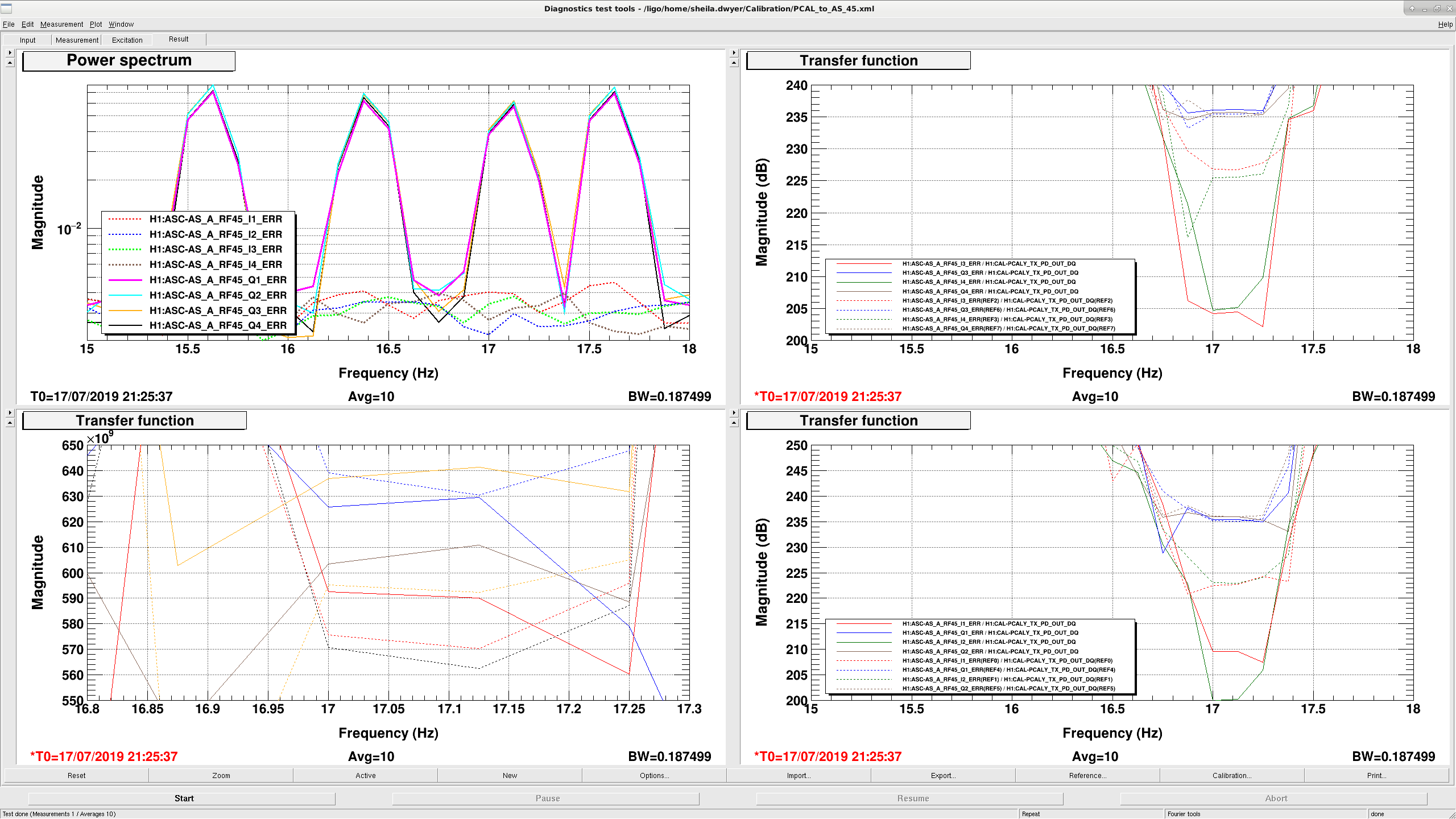
The first attachment here is a screenshot of the changes to AS A 45 phasing and Q gain balancing.
The second screenshot shows how we phased the AS45, the right panels show before transfer functions at the pcal Y line frequency (17.1Hz) before phasing with dashed lines and after with solid lines. The spectrum of the individual quadrants after phasing shows that the calibration lines are now in the Q phase.
A more quantitative statement about how much we reduce the length to angle signals will be added soon....
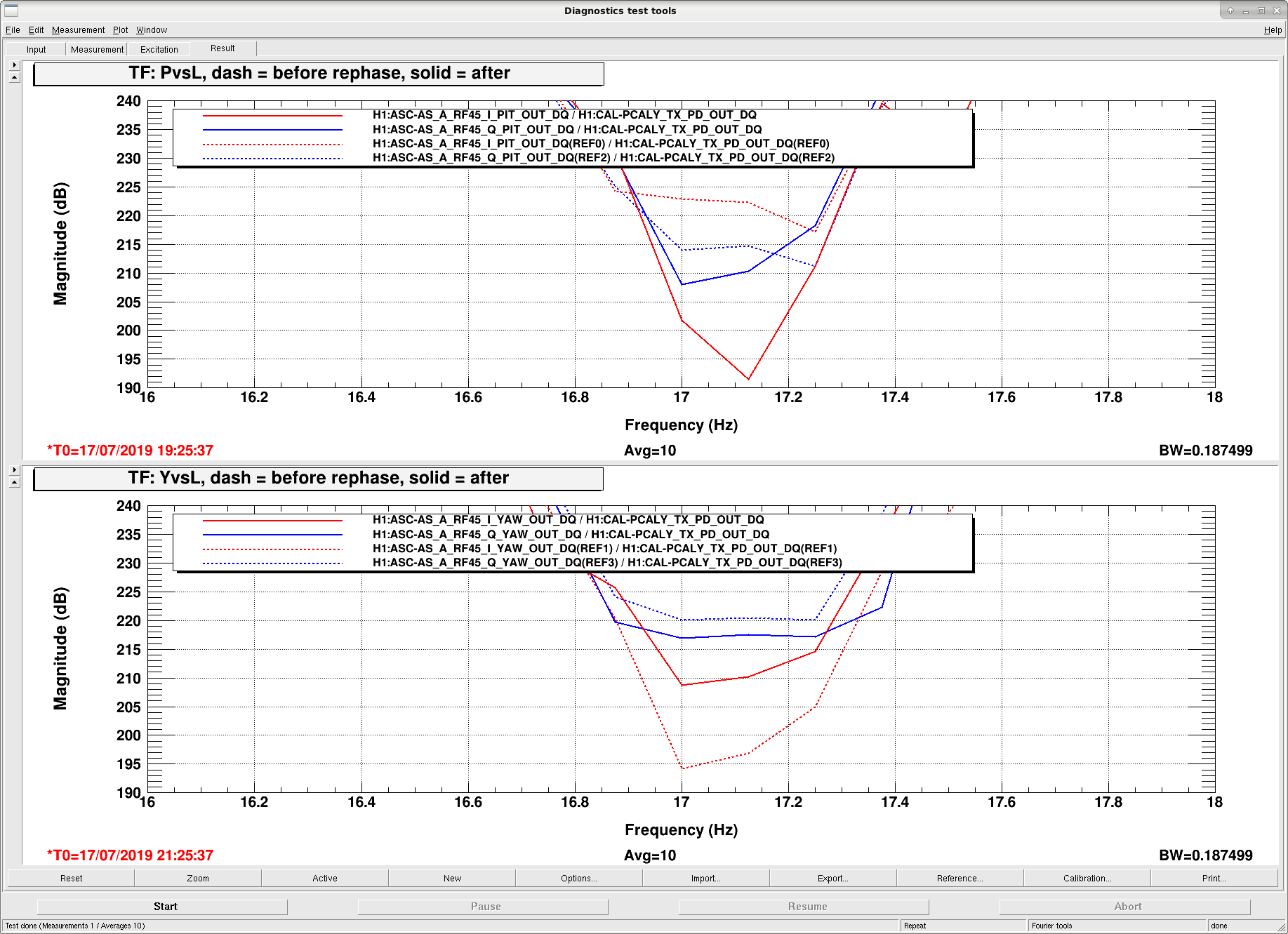
I've finally gotten around to looking at the magnitude of the angular response to the calibration length actuation before and after this AS A rephasing.
In the attached screenshot, the top panel is the AS A RF45 pitch signals versus the Pcal, and the bottom panel is the AS A RF45 yaw signals. Dashed traces are before the rephasing, solid are after. Red traces are the I signals (not used for the IFO), and blue traces are the Q phase which are used for DHARD.
Looking primarily at the blue traces, we see that for a constant length drive (we're assuming that the pcal actuation is (a) constant, and (b) pure length) the Q-phase angular response is lower after we rephased the WFS. However, the ratio isn't very large - we see a 5dB improvement in pitch and only a 3dB improvement in yaw.
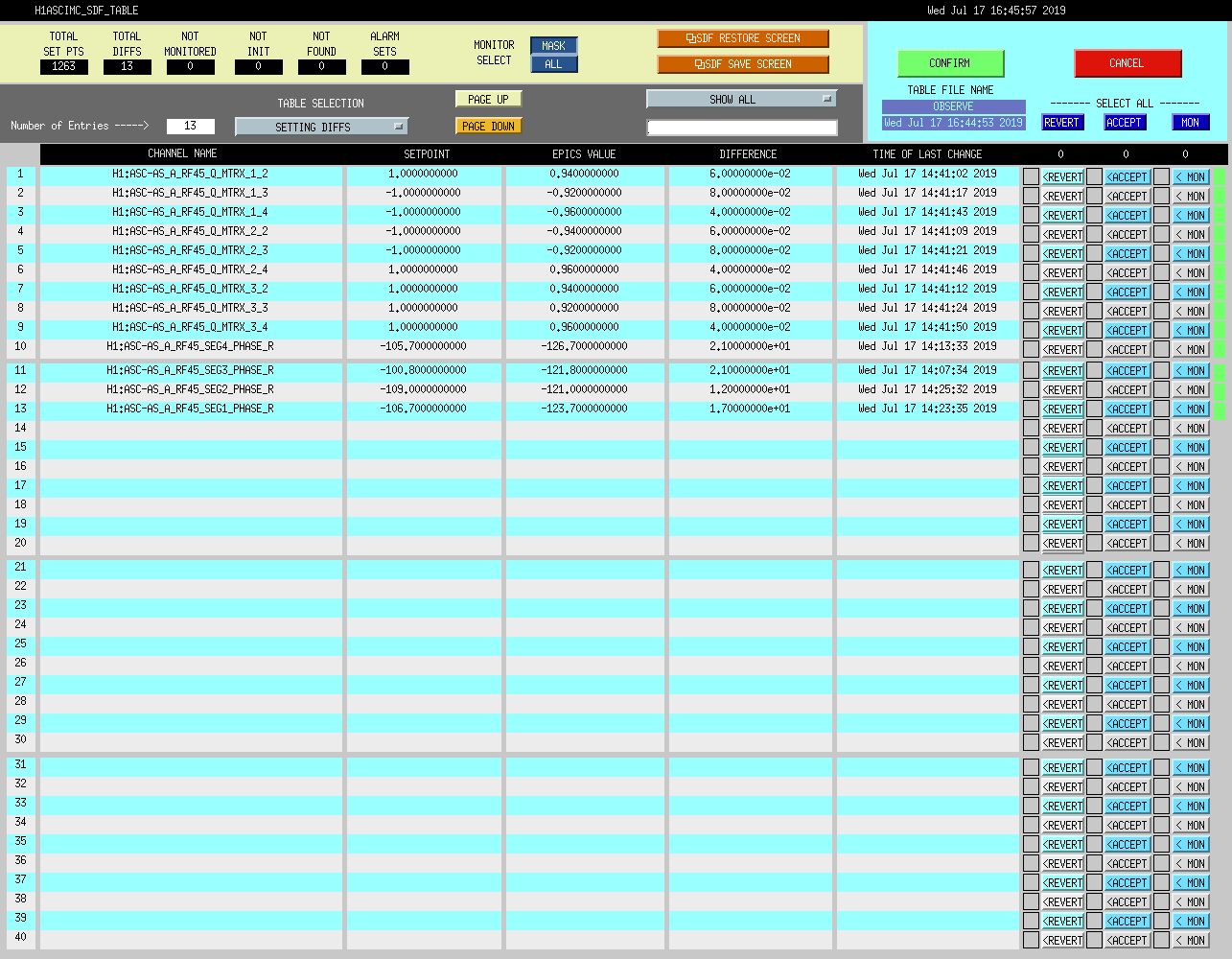
accepted all SDF accuracy diffs (no pics). Also accepted ASC IMC diffs. (see image below)
TITLE: 07/17 Eve Shift: 23:00-07:00 UTC (16:00-00:00 PST), all times posted in UTC
STATE of H1: Aligning
OUTGOING OPERATOR: Corey
CURRENT ENVIRONMENT:
Wind: 19mph Gusts, 17mph 5min avg
Primary useism: 0.06 μm/s
Secondary useism: 0.09 μm/s
QUICK SUMMARY:
Spent some time with hand-off from Corey and de-briefing from last nights adventures in smoke.
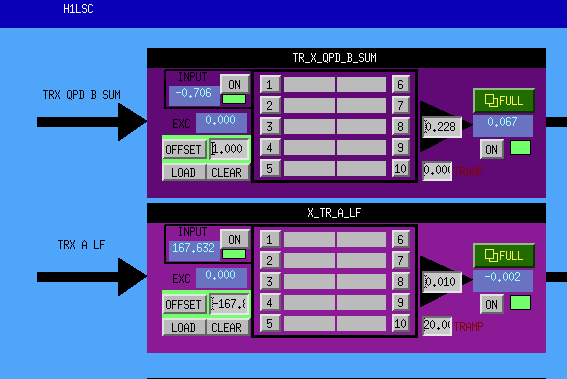
The lock was stalled at FIND_IR as it was yesterday when I came in. In both instances, the StripTool trace H1:LSC-TR_X_NORM_INMON was offset and riding up on the RED trace for MC2. I "zeroed" this value and then re-started the lock sequence which resulted in success past FIND_IR. Jenne also verified that this was inhibiting this step of the lock.
To perform this offset reset go to -> SITEMAP>LSC>OVERVIEW>TR COMM>TR_X(Y)_QPD_B_SUM and reduce the number next to the offset button (to the left) to whatever value will reduce the output (TR_X(Y)_QPD_B_SUM_OUTPUT) to zero. (0.06 or less should be sufficient).
When the offset was noticeable on StripTool, this output value was reading ~ 0.156 which is marginally high but apparently enough to inhibit FIND_IR.
TITLE: 07/17 Day Shift: 15:00-23:00 UTC (08:00-16:00 PST), all times posted in UTC
STATE of H1: Earthquake
INCOMING OPERATOR: Ed
SHIFT SUMMARY:
Started out shift with an earthquake. Then went out of OBSERVING for a Calibration measurement, and calibration work also caused a lockloss. Handing off an unlocked H1 to Ed.
NOTE: Just made it through DHARD_WFS, but if we had trouble with it, Sheila let Niko/us know that we can REVERT RF45 channels in ASC_IMC....but hopefully we are OK with this.
LOG:
Sat in for Corey from around 1:30pm-3:00pm. Here is the log from that time:
20:33 (13:33) Marc to MY -- drop off equipment
20:57 (13:57) Timesh to Optics Lab -- Ncal work
21:01 (14:01) Marc back from MY
21:24 (15:24) Peter, Sundae back from Optics Lab
21:55 (15:55) Dripta to Optics Lab -- Pcal work
The cable covers and traffic cones referenced in alog 50580 have been removed.
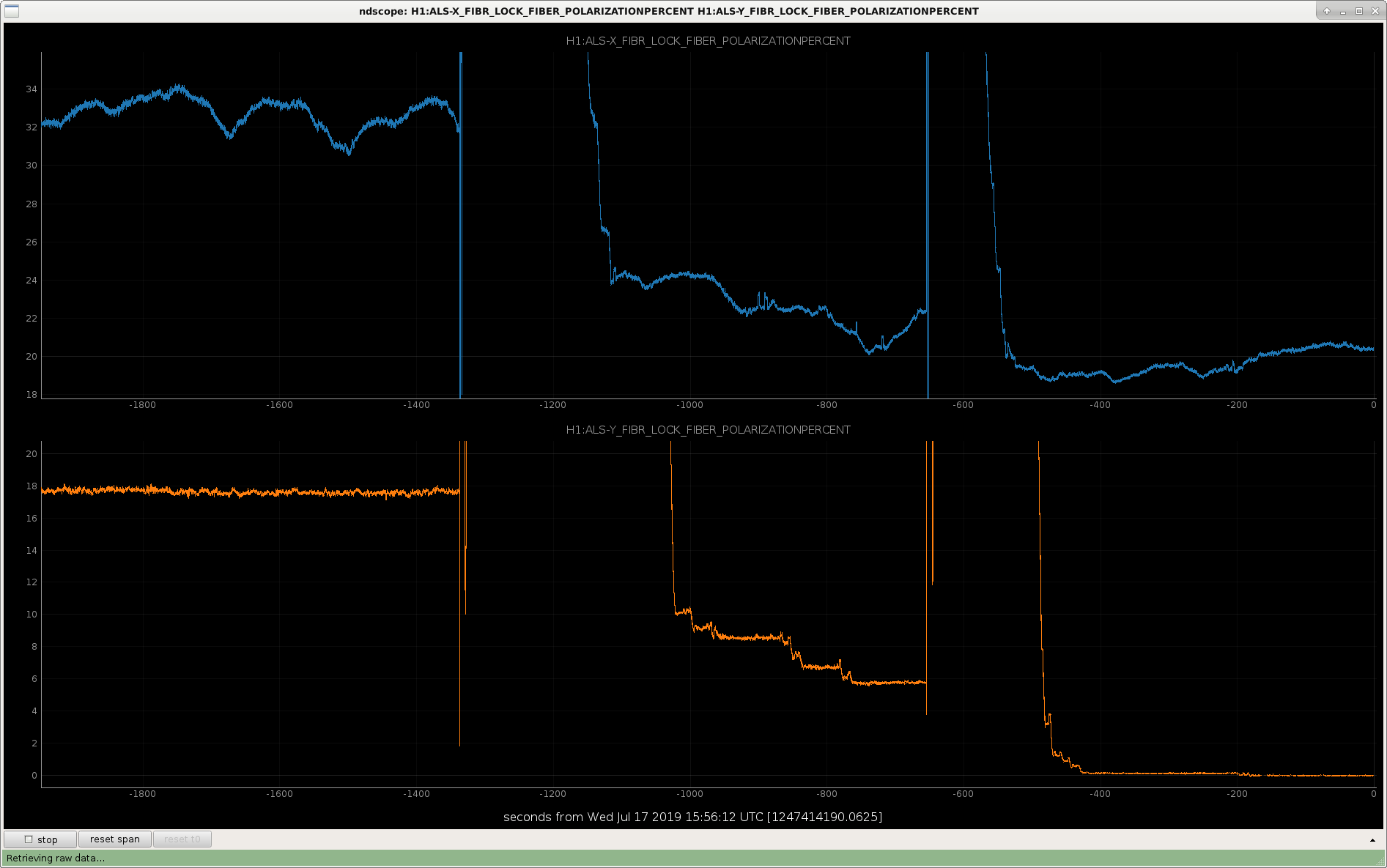
While recovering from a quick earthquake, I took opportunity to tweak the ALS x&y fiber polarizations (see attached).
Powering on the remote control immediately shoots both values to a high value, and then after that I started the usual adjustments.
Adjustment session #2 (power remote control OFF, and then ON. This time I had:
Not sure what going through the procedure twice did (and whether it was worth it). Moving on!
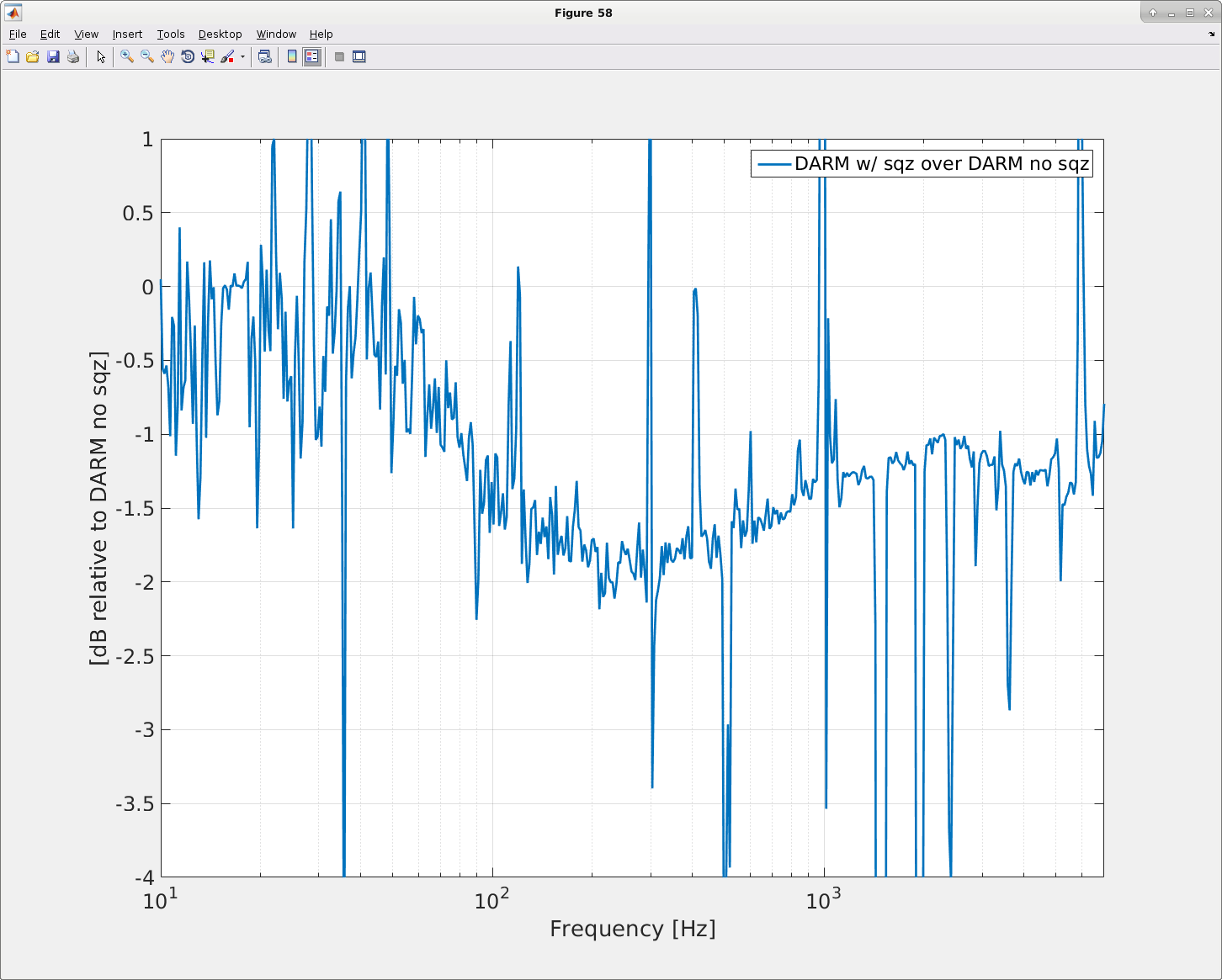
This is a follow up with the data from 50473. Because we had once seen some interesting frequency dependence from the squeezing 50104, I made some measurements last week of the squeezing with different SRCL offsets and phases. The braod bump centered just above 2kHz may be consistent, this could be noise that the squeezer is adding to DARM but it is not present in the correlated noise with no squeezing. There also seems to be a higer level of squeezing at low frequencies for positive SRCL offsets, although I would like to revisit that measurement. It is interesting to compare these measurements with Lee's model of frequency dependent losses in 50589
The first attachment shows the loop corrected DCPD cross correlation for a 6 minute stretch without squeezing in the same lock as the following measurements (almost a day later, but in the same lock). I used the pyDARM model with parameters from April 16th, but scaled the overall loop gain by 0.97 to account for the drop in optical gain.
The second attachment shows the loop corrected DCPD spectra for the series of measurements with different SRCL offsets and squeezing phases. You can see that in some of these measurements I may have caught a glitch (SRCL offset = -100 antisqueezing phaes 182 and srcl offset = 200 squeezing with a phase of 192 are two that seem suspicous for having a glitch.)
The third attachment shows the squeezing level for each of these measurements with the cross correlated noise subtracted. One warning about this, for each SRCL offset I did remeasure the no squeezing spectrum (not expecting them to be differenton the DCPDs), but I did not repeat the cross correlation for each of these measurements. So if the correlated noise is changing with SRCL offset, this plot will be misleading.
Comparing this frequency dependence to what we saw in 50104, there does seem to be a lump around 2.5 kHz which is not in the cross correlation on both sets of data. This could be noise that we are adding with the squeezer, which seems to be at a pretty consistent level for different SRCL offsets and squeezing angles.
The most recent calibration of the SRCL offset that I can find right now is from 2014: 14550 Kiwamu did this calibration during a DRMI lock, although it should be roughly applicable in full lock since we scale the input matrix to keep the ugf constant when we transition to POP. So a SRCL offset of 100 counts is very roughly 0.5 nm offset. I did loose lock once with a SRCL offset of -200, which could have been a coincidence, or due to the offset.
It would be interesting to repeat the measurements at SRCL offset = 200, and to try to measure the cross correlation without squeezing there. I've attached the scripts used, the first script attached contains the times of all of these measurements, the second is for doing the cross correlation. The way these are written they probably only work from the control room, but the only things they are relying on are pyDARM and gwpy.
If anyone notices a funny burnt smell in the control room it's because one of the TVs blew some smoke out last night after an audible pop. It's my suspicion that a cap in one of the power supplies popped. It appeared to be the lower TV. I've notified Bubba, Richard, Carlos and Jeff J.
Richard, Carlos:
Carlos upgraded the computer from the old mac-mini (video2) to a Nuc (nuc20). A new TV is being ordered to replace the failed unit.
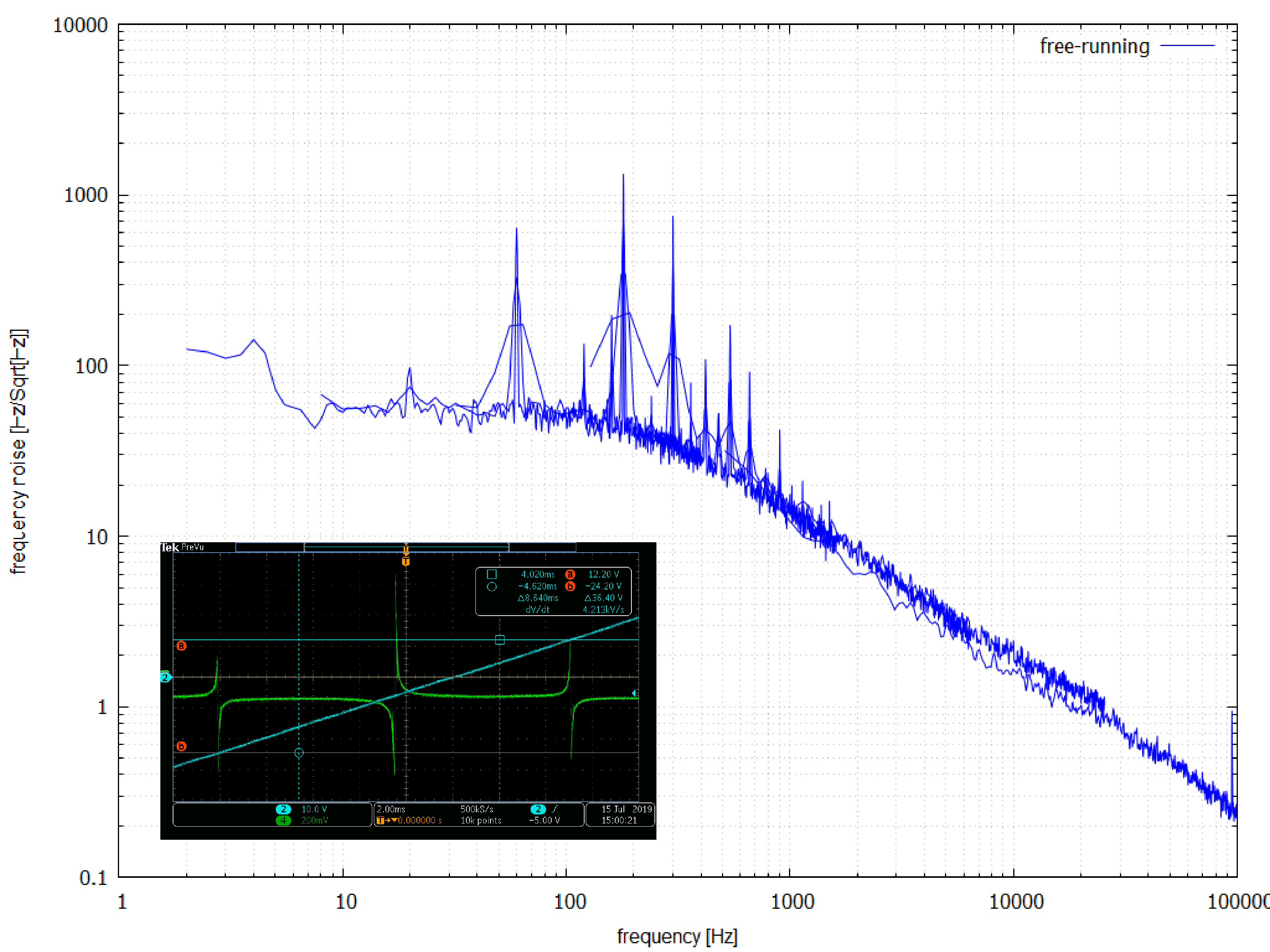
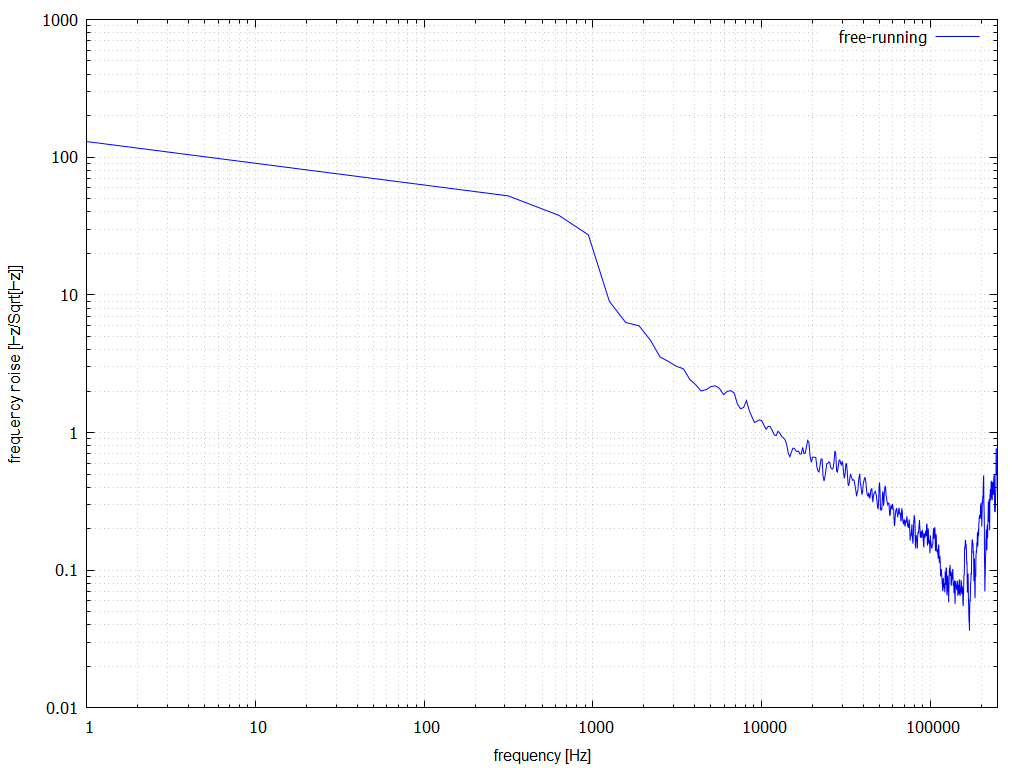
The free running frequency noise of the spare Mephisto 2000NE laser (S/N 7974) was measured.
The laser was locked to a reference cavity using an SR560 with a 0.3 Hz low pass filter
at a gain of 5. The PZT coefficient was measured to be ~1.35 MHz/V.
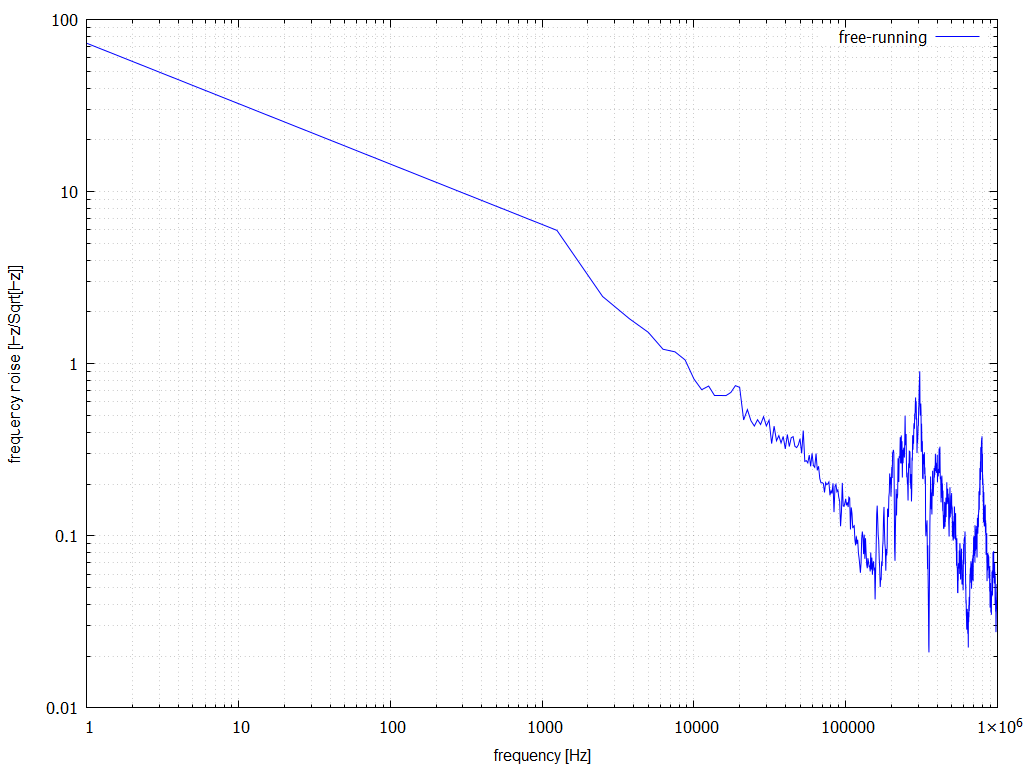
Following on from a remark Daniel made about excess noise, I repeated the measurement of the free running frequency noise of the NPRO out to 250 kHz and 1 MHz (fn2.png and fn1.png respectively). Just beyond 100 kHz we can see that the noise rises again contrary to the expectation where it continues falling off.
M. Ball, S. Dwyer, J. Kissel I've processed sensing function measurements from 2019-07-03 (LHO aLOG 50382) and 2019-07-10 (not aLOGed until now #slpas wrist) in which we measured the DARM loop comparing (a) spot positions on ETMY, (b) increased gain of the DHARD loops, and (c) added theses two new days to previously analyzed comparison between PCALs (LHO aLOG 50446). These studies clearly expose that what the calibration group has been calling a detuned SRC pro-spring for all of O3 is likely all a function of parasitic cross-coupling between angular loops and the DARM length / longitudinal loop. I attach a bunch of plots which show this information. (1) H1_sensingFunction_PCALXvsPCALY_referenceModel_vs_allMeasurements.pdf: And update to LHO aLOG 50446's set of plots comparing measurements of the sensing function using PCALY vs. PCALX as a reference which now includes the most recent 2019-07-03 and 2019-07-10 data. We continue to see that PCALX and PCALY (each divided by separate DARM loop suppressions taken with the same actuator just after) measure the same thing, and again, whatever thing they are measuring is evolving from week to week. I've also added plots of the individual raw measurement, which will become interesting in a moment. (2) 2019-07-11_MCMCTDCFs_vs_CommishEvents.pdf: There have been no commissioning events, but I've added two more weeks worth of measurements to the MCMC fit parameters of the processed PCALY+DARMLS measurement sensing function. This convinces me that (a) we should be a ready to create a new darm loop model, push it to the front-end, and back-propogate the correct for the flaws in the past with DCS, but (b) that there is still time dependence to whatever this feature is -- which begs the question "are we really doing a good job of servo-ing the spots to the same physical location?" (3) 2019-07-03_H1_SpotMove_sensingFunction.pdf: Here's the 2019-07-03 data in which we moved spot positions on ETMY. In these plots, instead of the reference model, I've updated the (python only) model parameters to have a \kappa_C of 0.975, and I've set the "optical spring" frequency to zero. One sees several things here: (a) In the raw measurements, you can see that the only thing changing is the DARM loop Suppression measurement -- the PCAL is remaining consistent -- between spot moves. (b) Changing the position in both pitch and yaw affect the low-frequency end of things. (c) At the final position, more physically centered on the optic, we lose optical gain indicating it's a bad position for losses in the IFO. (d) At the final position, the phase returns to what we would expect of a "normal" detuned spring when the magnitude is still behaving like a spring with finite Q. (4) 2019-07-10_H1_ASCChange_sensingFunction.pdf: Here -- to confirm that this parsitic angular coupling is through the ASC system (perhaps to identify whether it's (i) WFS are sensitive to Longitudinal Motion, or (ii) that there's actual extra angle from the drive) -- we increased the gain of the DHARD P loop, measured the sensing function, then increased the gain of the DHARD Y loop (with DHARD P restored back to normal). (a) again we see only the DARM loop suppression changing (b) Recast as the sensing function, we see that both Pitch and Yaw has an effect; delightfully in opposite directions -- though we can't compare the increase in gain directly in some calibrated absolute sense, given that the loop shapes are so complicated. There's one more old data set I have to process -- on the ETMY spot move day, we measured the L2 and L3 actuation stages during the move to confirm that the ETMX actuation strength. There's no reason for it to have done so, and #spoileralert it didn't, but I'll make the plots eventually just the same for future talks about this. Matt and Sheila are trying their best to form a model of all this cross-coupling, but it's an hefty challenge for even the best of modelers -- which none of us are: radiation pressure, quad pendulum dynamics, spot positions, point absorbers, non-diagonal loops ... it's nasty!
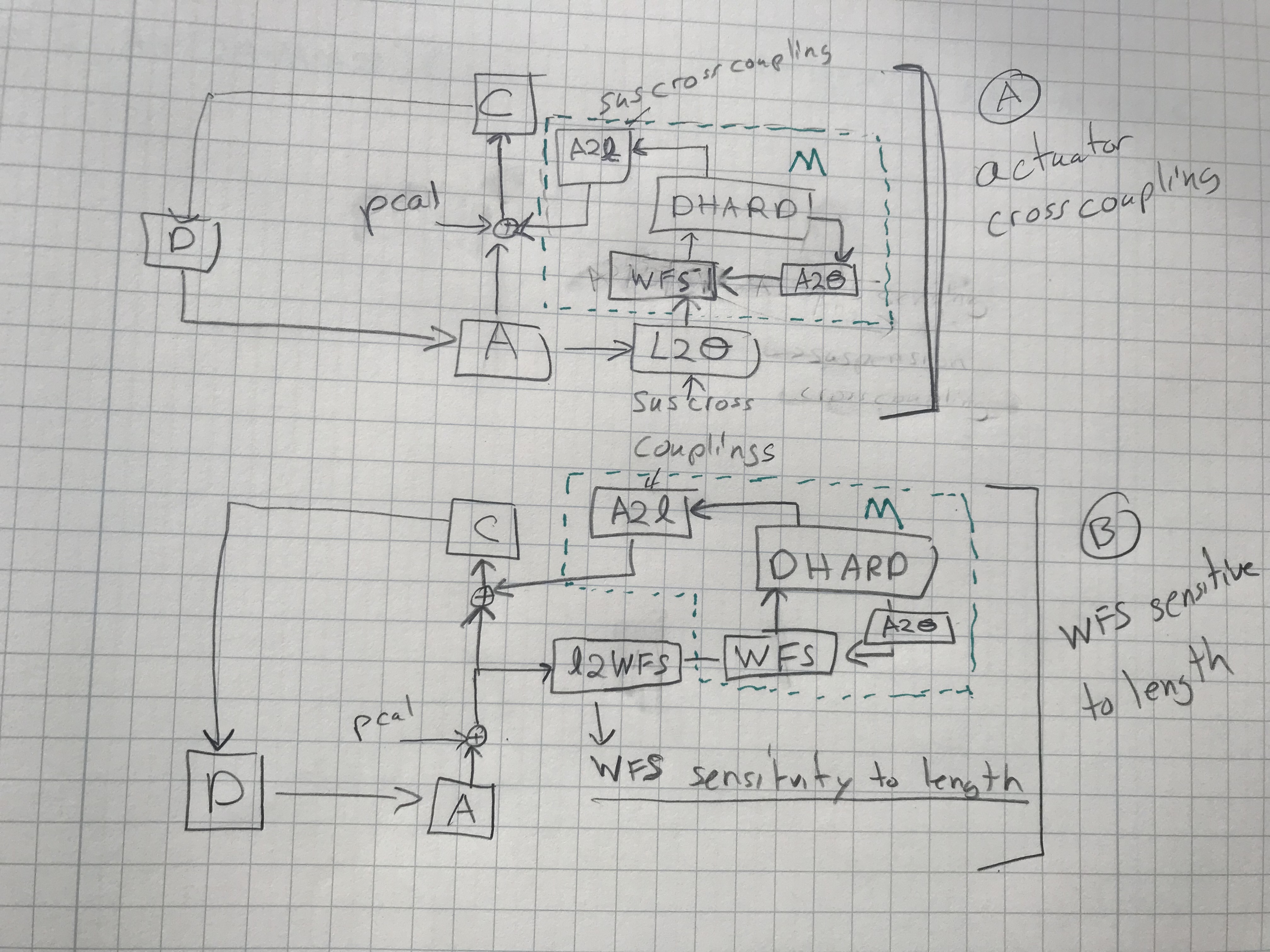
We think that this feature is due to the angular sensor having a sensitivity to DARM rather than due to a cross coupling from length to angle in the suspension. It certaintly doesn't seem to be from pcal miscentering as Jeff said above.
In the attachment the upper block diagram shows the cross coupled loops if the main coupling mechanism from length to angle is in the suspension actuation, the lower block diagram is if the largest cross coupling is due to length sensitivity of the angular sensors.
In both diagrams the open loop gain of the angular loop is G_\theta = WFS*DHARD*A2\theta, and in both diagrams the green dashed box encloses part of the loop with a transfer function: M= WFS*DHARD*A2l/(1-WFS*DHARD*A2\theta) which is part of these diagrams that depends on DHARD gain.
This table has expressions for how the calibration measurements should depend on M:
| angle to length cross coupling in suspension | DARM sensitivity of WFS | |
| DARM closed loop suppresion (1) | 1/[1-D*(A+L2\theta*M)C] | 1/[1-D*A*(1+l2WFS*M)C] |
| pcal to DARM (2) |
C/[1-D(A+L2\theta*M)C] |
C(1+l2WFS*M)/[1-DA(1+l2WFS*M)C] |
|
pum actuation to DARM (3) |
A_pum*(1+L2\theta*M)*C/[1-D(A+L2\theta*M)C] | A_pum*(1+l2WFS*M)*C/[1-DA(1+l2WFS*M)C] |
| sensing function (ratio of 2/1) | C | C(1+l2WFS*M) |
| pum actuation function (ratio of 3/2) | A_pum*(1+L2\theta*M) | A_pum |
For a length to angle cross coupling that occurs before the pcal actuation point (like a suspension cross coupling) the actuation measurement will appear to depend on the ASC gain, but the sensing function will appear to be independent. For a length to angle cross coupling that happens after the pcal injection point (like a length sensitvity of the wave front sensors), the sensing function will appear to depend on the ASC loop gain but the actuation function will seem to be independent, which is what we have seen with these measurements.
Analysis of the ETMX actuation strength with spot moves can be found in LHO aLOG 50601.
Very nice work and a great expedition into the realm of low-frequency MIMO calibration.
M. Ball, J. Driggers, S.Dwyer, A. Helmling-Cornell, J. Kissel Not only did we gather the standard sensing function measurements as planned (LHO aLOG 50379), but we also went in to calibrataion problems exploration mode, trying to better understand what we thought was a detuned SRC optical spring. All measurements are complete for the day, and we used almost exactly 4.0 hours of "CALIBRATION" time in the observatory mode. In addition to the "sensing measurements as a function of ETMY spot position" suite that Jenne covered in LHO aLOG 50380, we also gathered data for the lower two stages of the ETMX actuator as a function of ETMY spot position, to prove ourselves (and eventually you) that the reported ETMX actuator strength was not changing as a function of ETMY spot position -- even though the DARM OLGTF (driven by the DARM actuator, ETMX) was drastically changing as a function of ETMY spot position. Lots more thinking to do. He're all the data files from today's measurements: /ligo/svncommon/CalSVN/aligocalibration/trunk/Runs/O3/H1/Measurements/FullIFOSensingTFs/ Nominal ETMY Spot Positions (-15.7mm PIT, +13.2mm YAW): 2019-07-03_H1_DARM_OLGTF_LF_SS_5to1100Hz_15min.xml 2019-07-03_H1_PCALY2DARMTF_LF_SS_5t1100Hz_10min.xml 2019-07-03_H1_PCALX2DARMTF_LF_SS_5t1100Hz_10min.xml 2019-07-03_H1_PCALX2DARMTF_BB.xml 2019-07-03_H1_PCALY2DARMTF_BB.xml 2019-07-03_H1_OMCDCPDSUM_to_DARMIN1.xml Modified ETMY Spot Positions (-6.1mm PIT, +13.2mm YAW): 2019-07-03_H1_SpotMove_6p1mmPitchOnly_TowardCenterOfOptic_DARM_OLGTF_LF_SS_5to1100Hz_15min.xml 2019-07-03_H1_PCALY2DARMTF_SpotMove_6p1mmPitchOnly_TowardsCenterOfOptic_LF_SS_5t1100Hz_10min.xml Modified ETMY Spot Positions (-6.1mm PIT, +0.0mm YAW): 2019-07-03_H1_SpotMove_0p0mmYaw6p1mmPitch_TowardCenterOfOptic_DARM_OLGTF_LF_SS_5to1100Hz_15min.xml 2019-07-03_H1_PCALY2DARMTF_SpotMove_0p0mmYaw6p1mmPitch_TowardsCenterOfOptic_LF_SS_5t1100Hz_10min.xml /ligo/svncommon/CalSVN/aligocalibration/trunk/Runs/O3/H1/Measurements/FullIFOActuationTFs/ Nominal ETMY Spot Positions (-15.7mm PIT, +13.2mm YAW): 2019-07-03_H1SUSETMX_L2_iEXC2DARM_12min.xml 2019-07-03_H1SUSETMX_L2_PCAL2DARM_6min.xml 2019-07-03_H1SUSETMX_L3_iEXC2DARM_12min.xml 2019-07-03_H1SUSETMX_L3_PCAL2DARM_12min.xml Modified ETMY Spot Positions (-6.1mm PIT, +0.0mm YAW): 2019-07-03_SpotMove_0p0mmYaw6p1mmPitch_H1SUSETMX_L2_iEXC2DARM_14min.xml 2019-07-03_SpotMove_0p0mmYaw6p1mmPitch_H1SUSETMX_L2_PCAL2DARM_8min.xml 2019-07-03_SpotMove_0p0mmYaw6p1mmPitch_H1SUSETMX_L3_iEXC2DARM_10min.xml 2019-07-03_SpotMove_0p0mmYaw6p1mmPitch_H1SUSETMX_L3_PCAL2DARM_10min.xml Further analysis on - the spot-position move from the sensing function, - the sensing function as measured by PCALX, and - actuator measurements as a function of spots to come after the holiday weekend.
Analysis of the sensing function during spot moves can be found in LHO aLOG 50498. Analysis of the ETMX actuation strength with spot moves can be found in LHO aLOG 50601.