Displaying reports 39921-39940 of 88951.Go to page Start 1993 1994 1995 1996 1997 1998 1999 2000 2001 End
Reports until 16:00, Sunday 14 July 2019
H1 General
travis.sadecki@LIGO.ORG - posted 16:00, Sunday 14 July 2019 (50525)
Ops Day Shift Summary

TITLE: 07/14 Day Shift: 15:00-23:00 UTC (08:00-16:00 PST), all times posted in UTC
STATE of H1: Observing at 115Mpc
INCOMING OPERATOR: Niko
SHIFT SUMMARY:  Observing for the entire shift.  Otherwise uneventful.
LOG:

18:40 Kyle to both mids

19:48 Kyle back

20:40 Hugh and guest to Observation Deck

20:53 Hugh and guest back

LHO General
kyle.ryan@LIGO.ORG - posted 11:34, Sunday 14 July 2019 - last comment - 12:58, Sunday 14 July 2019(50526)
Kyle at mid-stations

Continuing logic troubleshooting of new pump installation at Y-mid (no craning, pwr tools, ladders etc.).  I will make a comment to this entry when I leave.

Comments related to this report
kyle.ryan@LIGO.ORG - 12:58, Sunday 14 July 2019 (50527)

Problem fixed!  The new HEPTA PUMP intake valve OPEN position indicator had not been "talking" to the control logic following a change to the relay-based logic that I had made on Friday -> It turns out that the changes made to the logic were good all along but that the valve wasn't opening enough to change the state of the OPEN contacts due to low air pressure 
(air-to-open/spring to close valve).  I increased the air pressure to 60 psi from 40 psi and everything is working.  NOTE that the valve's gate was opening at 40 psi but not enough to close the OPEN contacts.  


1259 hrs. local -> Leaving site now.

H1 General
travis.sadecki@LIGO.ORG - posted 08:14, Sunday 14 July 2019 (50524)
Ops Day Shift Transition

TITLE: 07/14 Day Shift: 15:00-23:00 UTC (08:00-16:00 PST), all times posted in UTC
STATE of H1: Observing at 115Mpc
OUTGOING OPERATOR: Jim
CURRENT ENVIRONMENT:
    Wind: 3mph Gusts, 2mph 5min avg
    Primary useism: 0.01 μm/s
    Secondary useism: 0.06 μm/s
QUICK SUMMARY: Jim had H1 back to Observing 0.5 hours before my shift started. Hopefully the EQs are done for the day.

H1 General
jim.warner@LIGO.ORG - posted 08:03, Sunday 14 July 2019 (50523)
Shift Summary

TITLE: 07/14 Owl Shift: 07:00-15:00 UTC (00:00-08:00 PST), all times posted in UTC
STATE of H1: Observing at 115Mpc
INCOMING OPERATOR: Travis
SHIFT SUMMARY: Down for most of the shift because of earthquakes
LOG:
9:36 lock loss due to 7.3 eq

After eq was able to get arms locked, but DRMI was bad. Initial alignment took forever, not because it wouldn't lock, but because wfs wouldn't go below threshold.

14:35 Back to observing after eq ring down, initial alignment


H1 SEI (DetChar)
jim.warner@LIGO.ORG - posted 02:40, Sunday 14 July 2019 (50522)
Another Earthquake in Timor-Leste, tried ISC_LOCK eq state, lock loss

Went to sei_conf earthquake state at 9:25, and I put ISC_LOCK in the not-oft-used earthquake state at 9:32, which took us out of Observing. Followed by a lock loss at 9:36. Not sure why, because the ground was still moving less that the peak velocities of the previous smaller earthquake.

H1 General
yannick.lecoeuche@LIGO.ORG - posted 00:11, Sunday 14 July 2019 - last comment - 01:48, Sunday 14 July 2019(50520)
Shift Summary - Evening

TITLE: 07/13 Day Shift 23:00 – 07:00 (16:00-00:00), all times posted in UTC

STATE of H1: Observing

INCOMING OPERATOR: Jim

SHIFT SUMMARY: Rode through an extremely sharp 4.0 EQ in West Montana and a 6.6 EQ in Australia. Wind has been consistently peaking at around 20-25 mph for the shift.

LOG:

23:00 (16:00) Start of shift

01:55 (18:55) Quickly switched SEI_CONFIG to EQ mode after noticing a sharp seismic spike (4.0 in Western Montana).

02:06 (19:06) Switching back to WINDY, though it seems ASC is still recovering from the EQ.

06:02 (23:06) Switching to EQ for 6.6 in Australia

07:00 (00:00) End of shift

Comments related to this report
jim.warner@LIGO.ORG - 01:48, Sunday 14 July 2019 (50521)

Switched back to nominal sei_conf state at 8:44

H1 General
yannick.lecoeuche@LIGO.ORG - posted 17:22, Saturday 13 July 2019 (50519)
Lockloss 15 seconds after EX glitch

Yesterday, right after my shift ended, there was an EX glitch that seemed to be ringing down successfully when something happened and we lost lock 15 seconds later. I noticed that the lockloss tool hasn't been able to analyze this lockloss yet, and I thought that it was interesting enough to run the lockloss using my local lockloss tool (maybe this is a common type of lockloss, I'm not sure). Here is the link to the results:


https://ldas-jobs.ligo-wa.caltech.edu/~yannick.lecoeuche/index.cgi?event=1247036507

H1 General
yannick.lecoeuche@LIGO.ORG - posted 16:14, Saturday 13 July 2019 (50518)
Ops EVE Shift Transition

Ops Shift Transition: 07/13/2019, Eve Shift 23:00 – 07:00 (16:00-00:00) - UTC (PT)

State of H1: Locked

Intent Bit: Observing

Weather: 0-25 mph wind

Primary 0.03 – 0.1Hz: 0.01 um/s

Secondary 0.1 – 0.3Hz: 0.1 um/s

Outgoing Operator: Travis

Quick Summary: Observing for 14.5 hours, medium wind

H1 General
travis.sadecki@LIGO.ORG - posted 16:00, Saturday 13 July 2019 (50517)
Ops Day Shift Summary

TITLE: 07/13 Day Shift: 15:00-23:00 UTC (08:00-16:00 PST), all times posted in UTC
STATE of H1: Observing at 114Mpc
INCOMING OPERATOR: Niko
SHIFT SUMMARY:  Uneventful day for interferometry; no GRBs, no candidate triggers, not even any EQs of significance.  200+ people through the control room for the Saturday tour.
LOG:

14:14 Betsy to cleaning area to get C3 covers

14:16 Betsy out

H1 General
travis.sadecki@LIGO.ORG - posted 08:03, Saturday 13 July 2019 (50516)
Ops Day Shift Transition

TITLE: 07/13 Day Shift: 15:00-23:00 UTC (08:00-16:00 PST), all times posted in UTC
STATE of H1: Observing at 116Mpc
OUTGOING OPERATOR: Jim
CURRENT ENVIRONMENT:
    Wind: 7mph Gusts, 4mph 5min avg
    Primary useism: 0.01 μm/s
    Secondary useism: 0.06 μm/s
QUICK SUMMARY:  Lock is 6.5 hours old.  No issues at this time.

H1 General
jim.warner@LIGO.ORG - posted 07:58, Saturday 13 July 2019 (50515)
Shift Summary

TITLE: 07/13 Owl Shift: 07:00-15:00 UTC (00:00-08:00 PST), all times posted in UTC
STATE of H1: Observing at 117Mpc
INCOMING OPERATOR: Travis
SHIFT SUMMARY:
LOG:

7:01 Lockloss as soon as I arrive, no obvious cause

8:34 Back to Observing, only thing I touched was alignment during PRMI, it was back
 

H1 General
yannick.lecoeuche@LIGO.ORG - posted 00:04, Saturday 13 July 2019 (50514)
Shift Summary - Evening

TITLE: 07/12 Day Shift 23:00 – 07:00 (16:00-00:00), all times posted in UTC

STATE of H1: Observing

INCOMING OPERATOR: Jim

SHIFT SUMMARY: Quiet evening, one big EQ and a few GRB’s

LOG:

23:00 (16:00) Start of shift

23:29 (16:29) Hanford Fire Department finished with onsite work

00:05 (17:05) Jeff, Timesh, Krishna out of Optics Lab

01:20 (18:20) Switching SEI_CONFIG to EARTHQUAKE_MODE for 6.1 EQ near Japan

01:46 (18:46) Switching SEI_CONFIG back to WINDY

01:55 (18:55) Kyle back from MY

02:58 (19:58) GRB (E338443). Too long latency

04:10 (21:10) GRB (E338447). Too long latency.

04:14 (21:14) GRB (E338448). Too long latency.

07:00 (23:00) End of shift

H1 General
yannick.lecoeuche@LIGO.ORG - posted 20:11, Friday 12 July 2019 (50513)
Ops Mid-Shift Summary

Quiet shift so far, one 6.1 EQ near Japan. The 48 Hz line has seemed particularly high today (or at least within the last hour). Observing for 15 hours at ~115 Mpc.

H1 CAL (CAL, SYS)
jeffrey.kissel@LIGO.ORG - posted 17:56, Friday 12 July 2019 (50512)
The LIGO Newtonian Gravitational Calibrator Says Hello, Krishna Says Goodbye
L. Datrier, J. Jones,  J. Kissel, R. McCarthy, T. Mistry, K. Venkateswara, D. Bhattacharjee

WP 8276
Final (Prototype) Design T1900357
Hazard Analysis E1900203
ECR E1900004

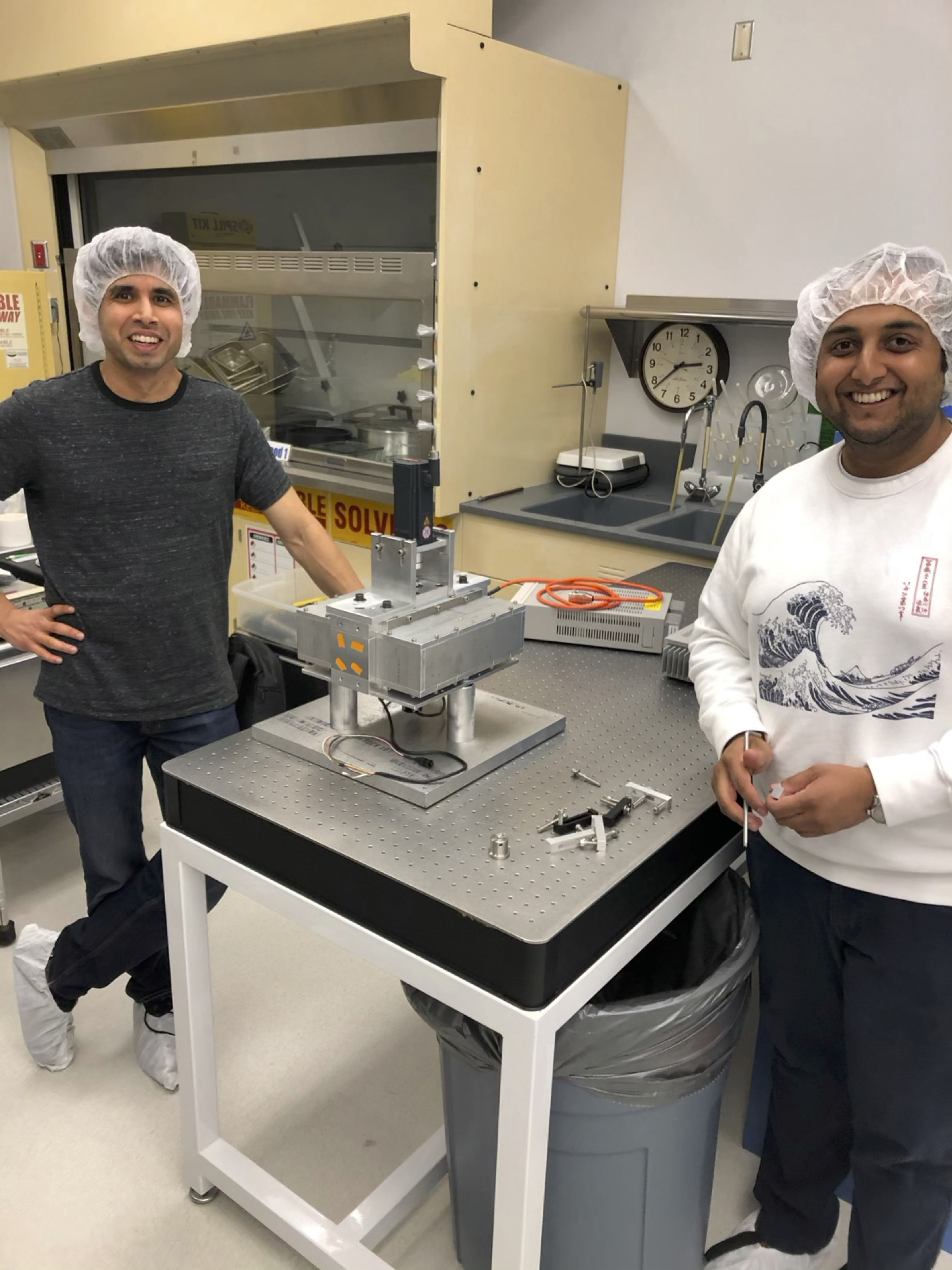
Krishna's swan song with the collaboration has been to deliver a function prototype of a newtonian gravitational calibration system (NCAL, or sometimes GCAL) on site today. With the help and witness of all those mentioned above (and safety approval from the systems team remotely), we were able to safely spin up the fully functional rotor to a maximum frequency the software allowed --  38.13 Hz --  and visually / roughly verified that the rotational encoder reported by the system matched the requested drive frequency at several drive frequencies (roughly 1, 5, 10, 20, and 30 Hz; "roughly" because we used an iphone app with a strobe as our independent measure of the rotation speed, but was still matching the encoder to above 0.1 Hz).

There is still LOADS to do, but today's tests were of great success because:
     (a) a lot more people feel a lot more comfortable with this system from a safety standpoint than before 
     (b) we [primarily Timesh and Kissel] download gobs of information from Krishna
     (c) We managed to get the system fully functional within 2 hours of arriving on site -- a great testament to Krishna's hard work, and all the hard work local and remote LIGO Lab staff have been doing, bending over backwards to push this project forward by leaps and bounds in the past few weeks.
I attach our chicken-scratch notes from the day for future reference.

Thank you to everyone -- you'll be hearing plenty more from this machine as we finish out prototype testing.

For now, the system will remain in the optics lab in the OSB for a week or three, and then we consider readiness for installation and further testing at the X End. 

As of this evening, we've left the system entirely powered off with the motor cable disconnected. We do not expect to be running this system again until Monday at the earliest.
Images attached to this report
Non-image files attached to this report
H1 General
jeffrey.bartlett@LIGO.ORG - posted 16:11, Friday 12 July 2019 (50510)
Ops Day Shift Summary
Ops Shift Log: 07/12/2019, Day Shift 15:00 – 23:00 (08:00 - 16:00) Time - UTC (PT)
State of H1: Locked at NLN
Intent Bit: Observing
Support: N/A
Incoming Operator: Niko
Shift Summary: IFO has been in observing mode for past 11 hours. Went into EARTHQUAKE mode for about 30 minutes for mag 5.9 in the Philippines.
   HFD drive ambulance to Mid-Y (against Ops direction) to check trouble alarm. Kyle escorted them in site truck from Mid-Y to Mid-X.  
   Otherwise it was a good day for observing, with no troubles or problems.
  
 
Activity Log: Time - UTC (PT)
15:00 (08:00) Take over from Jim
15:11 (08:11) Fermi GRB Alert – LLO down, Virgo is up, Trigger Duration 0.016 – 1 hour stand down
16:11 (09:11) Stand down complete – reset INJ_SUCCESS
16:12 (09:12) Vanessa – Going to Mid-X
16:58 (09:58) Sundae – Going into the Optics Lab
17:05 (10:05) Timesh, Krishna, & Jeff K. – Moving NCal equipment into Optics Lab
17:30 (10:30) Jeff J. & Richard – Going into Optics Lab to assist with NCAL run (WP#8276)
18:00 (11:00) LLO – is shutting down control room ahead of hurricane arrival
18:10 (11:10) Jeff J. – Out of Optics Lab
18:14 (11:14) Sundae – Out of the Optics Lab
18:24 (11:24) Kyle – Going to Mid-Y
19:24 (12:24) Timesh, Krishna, & Jeff K. – Out of the Optics Lab
19:53 (12:53) Timesh, Krishna, & Jeff K. – Going into the Optics Lab
21:22 (14:22) Switch to EARTHQUAKE for mag 5.9 earthquake in the Philippines
21:49 (14:49) Switched back to WINDY mode after earthquake passed
22:01 (15:01) Sundae – Out of the Optics Lab
22:29 (15:29) HFD – On site to check trouble alarm
22:38 (15:38) HFD – Driving heavy truck to Mid-Y to check trouble codes (was asked not to)
22:49 (15:49) Jeff k – Reports they have been hammering in the Optics Lab for past half hour
23:00 (16:00) Turn over to Niko



H1 General
yannick.lecoeuche@LIGO.ORG - posted 16:05, Friday 12 July 2019 (50509)
Ops EVE Shift Transition

Ops Shift Transition: 07/12/2019, Day Shift 23:00 – 07:00 (16:00-00:00) - UTC (PT)

State of H1: Locked

Intent Bit: Observing

Weather: 0-10 mph wind

Primary 0.03 – 0.1Hz: 0.01 um/s

Secondary 0.1 – 0.3Hz: 0.1 um/s

Outgoing Operator: Jeff

Quick Summary: Observing for 11 hours

H1 General
jeffrey.bartlett@LIGO.ORG - posted 12:20, Friday 12 July 2019 (50508)
Ops Day Mid-Shift Summary
  IFO is observing with 116.4Mpc of range. Winds are Calm to a Light Breeze. All is normal. 

  Had a Fermi GRB alert (E338415).   
H1 ISC (CAL)
jeffrey.kissel@LIGO.ORG - posted 17:29, Thursday 11 July 2019 - last comment - 10:29, Wednesday 17 July 2019(50498)
Calibration Measurements: Analysis of Measuring Sensing Function Under A2L (ETMY Spot Position) and ASC (DHARD) Changes
M. Ball, S. Dwyer, J. Kissel

I've processed sensing function measurements from 2019-07-03 (LHO aLOG 50382) and 2019-07-10 (not aLOGed until now #slpas wrist) in which we measured the DARM loop comparing 
    (a) spot positions on ETMY, 
    (b) increased gain of the DHARD loops, and
    (c) added theses two new days to previously analyzed comparison between PCALs (LHO aLOG 50446).

These studies clearly expose that what the calibration group has been calling a detuned SRC pro-spring for all of O3 is likely all a function of parasitic cross-coupling between angular loops and the DARM length / longitudinal loop.

I attach a bunch of plots which show this information.
    (1) H1_sensingFunction_PCALXvsPCALY_referenceModel_vs_allMeasurements.pdf: And update to LHO aLOG 50446's set of plots comparing measurements of the sensing function using PCALY vs. PCALX as a reference which now includes the most recent 2019-07-03 and 2019-07-10 data. We continue to see that PCALX and PCALY (each divided by separate DARM loop suppressions taken with the same actuator just after) measure the same thing, and again, whatever thing they are measuring is evolving from week to week.  I've also added plots of the individual raw measurement, which will become interesting in a moment.

    (2) 2019-07-11_MCMCTDCFs_vs_CommishEvents.pdf: There have been no commissioning events, but I've added two more weeks worth of measurements to the MCMC fit parameters of the processed PCALY+DARMLS measurement sensing function. This convinces me that 
        (a) we should be a ready to create a new darm loop model, push it to the front-end, and back-propogate the correct for the flaws in the past with DCS, but
        (b) that there is still time dependence to whatever this feature is -- which begs the question "are we really doing a good job of servo-ing the spots to the same physical location?"

    (3) 2019-07-03_H1_SpotMove_sensingFunction.pdf: Here's the 2019-07-03 data in which we moved spot positions on ETMY. In these plots, instead of the reference model, I've updated the (python only) model parameters to have a \kappa_C of 0.975, and I've set the "optical spring" frequency to zero. One sees several things here:
        (a) In the raw measurements, you can see that the only thing changing is the DARM loop Suppression measurement -- the PCAL is remaining consistent -- between spot moves.
        (b) Changing the position in both pitch and yaw affect the low-frequency end of things.
        (c) At the final position, more physically centered on the optic, we lose optical gain indicating it's a bad position for losses in the IFO.
        (d) At the final position, the phase returns to what we would expect of a "normal" detuned spring when the magnitude is still behaving like a spring with finite Q.
        
    (4) 2019-07-10_H1_ASCChange_sensingFunction.pdf: Here -- to confirm that this parsitic angular coupling is through the ASC system (perhaps to identify whether it's (i) WFS are sensitive to Longitudinal Motion, or (ii) that there's actual extra angle from the drive) -- we increased the gain of the DHARD P loop, measured the sensing function, then increased the gain of the DHARD Y loop (with DHARD P restored back to normal). 
        (a) again we see only the DARM loop suppression changing
        (b) Recast as the sensing function, we see that both Pitch and Yaw has an effect; delightfully in opposite directions -- though we can't compare the increase in gain directly in some calibrated absolute sense, given that the loop shapes are so complicated.

There's one more old data set I have to process -- on the ETMY spot move day, we measured the L2 and L3 actuation stages during the move to confirm that the ETMX actuation strength. There's no reason for it to have done so, and #spoileralert it didn't, but I'll make the plots eventually just the same for future talks about this.

Matt and Sheila are trying their best to form a model of all this cross-coupling, but it's an hefty challenge for even the best of modelers -- which none of us are: radiation pressure, quad pendulum dynamics, spot positions, point absorbers, non-diagonal loops ... it's nasty!
Non-image files attached to this report
Comments related to this report
sheila.dwyer@LIGO.ORG - 17:51, Friday 12 July 2019 (50511)

We think that this feature is due to the angular sensor having a sensitivity to DARM rather than due to a cross coupling from length to angle in the suspension. It certaintly doesn't seem to be from pcal miscentering as Jeff said above.

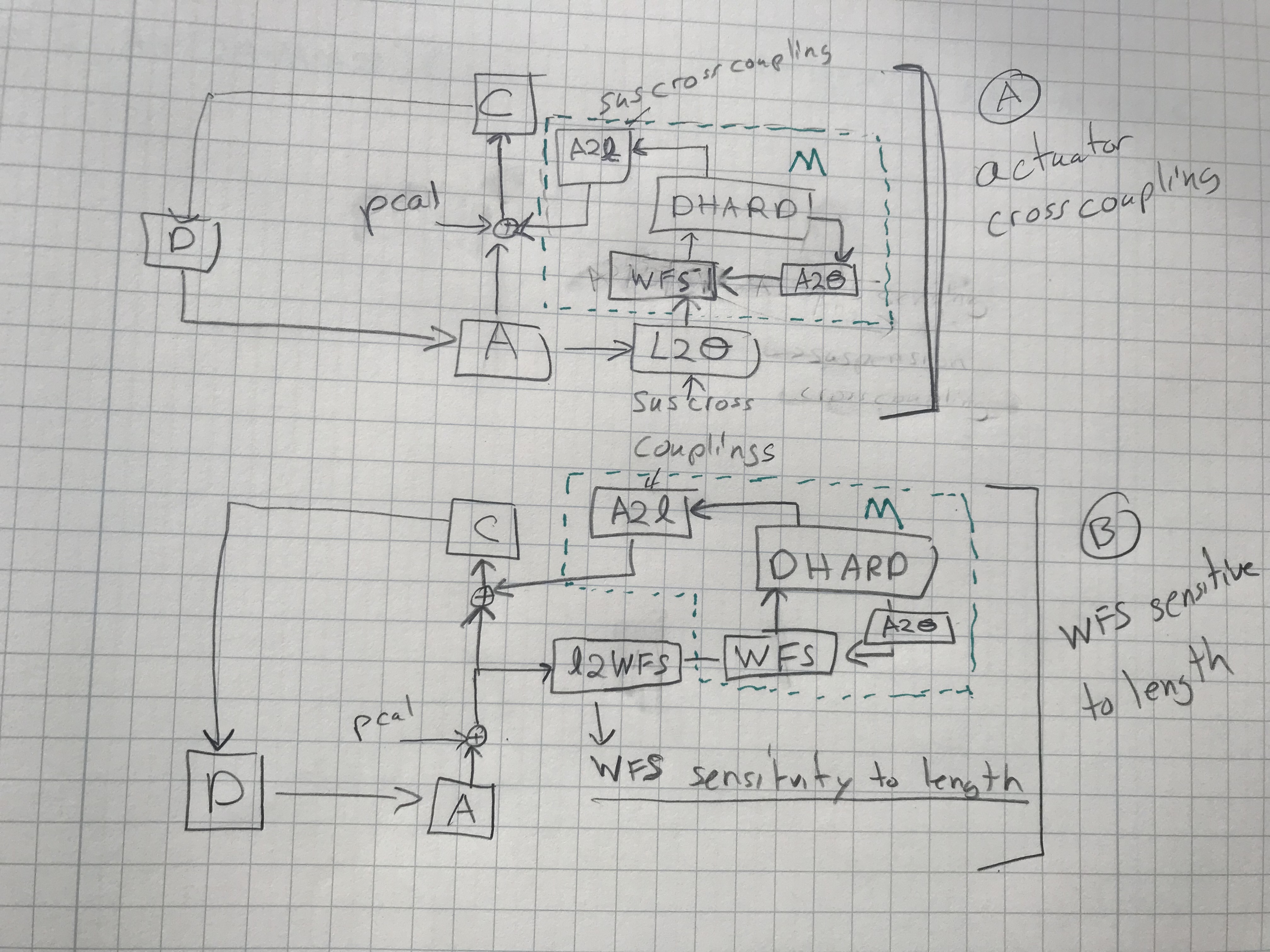
In the attachment the upper block diagram shows the cross coupled loops if the main coupling mechanism from length to angle is in the suspension actuation, the lower block diagram is if the largest cross coupling is due to length sensitivity of the angular sensors.

In both diagrams the open loop gain of the angular loop is G_\theta = WFS*DHARD*A2\theta, and in both diagrams the green dashed box encloses part of the loop with a transfer function: M= WFS*DHARD*A2l/(1-WFS*DHARD*A2\theta) which is part of these diagrams that depends on DHARD gain.

This table has expressions for how the calibration measurements should depend on M:

  angle to length cross coupling in suspension DARM sensitivity of WFS
DARM closed loop suppresion (1) 1/[1-D*(A+L2\theta*M)C] 1/[1-D*A*(1+l2WFS*M)C]
pcal to DARM (2)

C/[1-D(A+L2\theta*M)C]

C(1+l2WFS*M)/[1-DA(1+l2WFS*M)C]

pum actuation to DARM (3)

A_pum*(1+L2\theta*M)*C/[1-D(A+L2\theta*M)C] A_pum*(1+l2WFS*M)*C/[1-DA(1+l2WFS*M)C]
 sensing function (ratio of 2/1) C C(1+l2WFS*M)
pum actuation function (ratio of 3/2) A_pum*(1+L2\theta*M) A_pum

For a length to angle cross coupling that occurs before the pcal actuation point (like a suspension cross coupling) the actuation measurement will appear to depend on the ASC gain, but the sensing function will appear to be independent.  For a length to angle cross coupling that happens after the pcal injection point (like a length sensitvity of the wave front sensors), the sensing function will appear to depend on the ASC loop gain but the actuation function will seem to be independent, which is what we have seen with these measurements. 

Images attached to this comment
jeffrey.kissel@LIGO.ORG - 08:52, Wednesday 17 July 2019 (50602)
Analysis of the ETMX actuation strength with spot moves can be found in LHO aLOG 50601.
evan.hall@LIGO.ORG - 10:29, Wednesday 17 July 2019 (50605)

Very nice work and a great expedition into the realm of low-frequency MIMO calibration.

Displaying reports 39921-39940 of 88951.Go to page Start 1993 1994 1995 1996 1997 1998 1999 2000 2001 End