Robert has started his work, should last around 30min.
Edit: title had wrong time
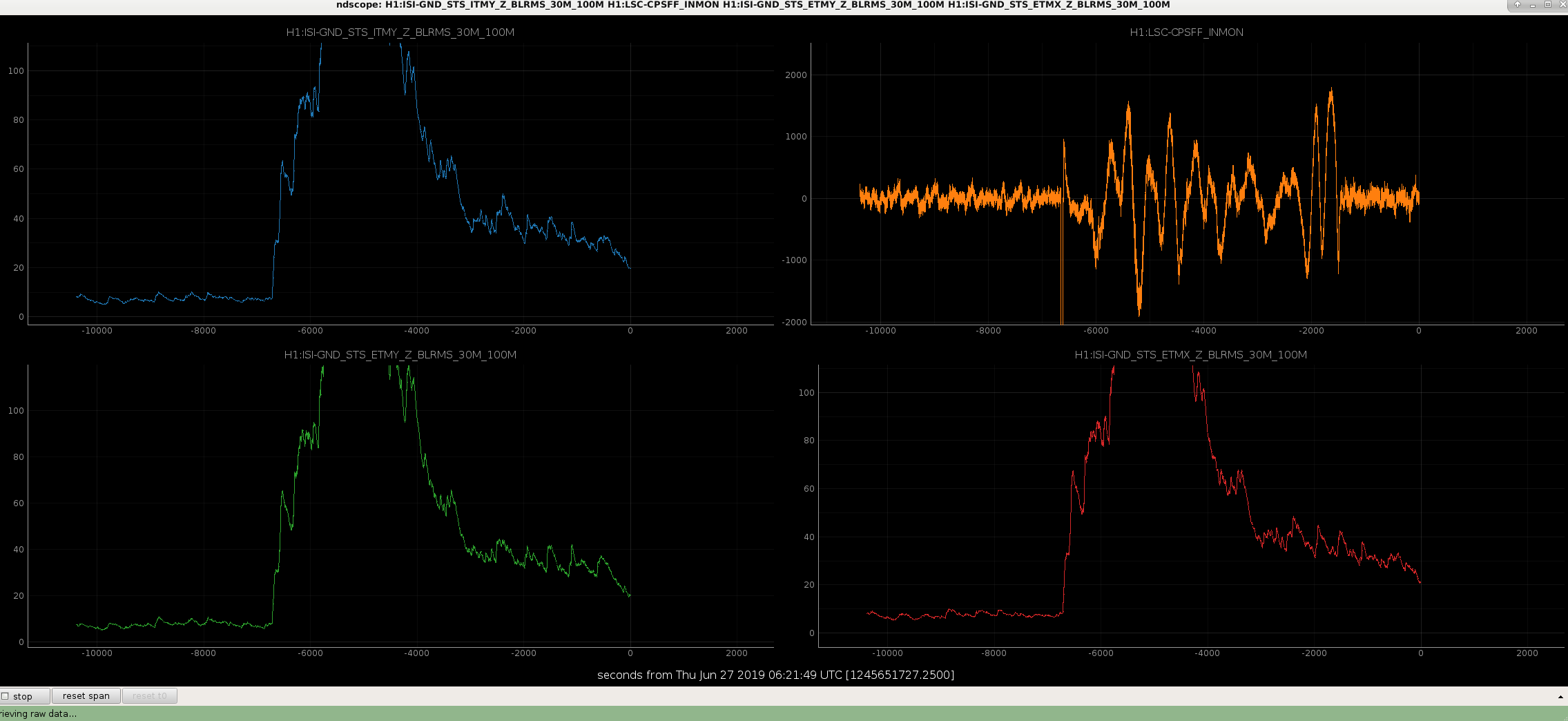
At 1613 UTC I transitioned SEI_CONF to the EARHTQUAKE state for the 6.4mag earthquake in Guam.
Transitioned back to WINDY began at 1711 UTC. Both transitions sucessfully kept the the lock and we made it through the earthquake.
TITLE: 06/28 Day Shift: 15:00-23:00 UTC (08:00-16:00 PST), all times posted in UTC
STATE of H1: Observing at 117Mpc
OUTGOING OPERATOR: Jeff
CURRENT ENVIRONMENT:
Wind: 5mph Gusts, 3mph 5min avg
Primary useism: 0.01 μm/s
Secondary useism: 0.04 μm/s
QUICK SUMMARY: 9.5 hour lock, calm environment.
Good first half of the shift. Other than a couple of glitches, it has been smooth sailing. Locked and Observing for past 4.75 hours. Wind and microseism are low. The range is hovering around 118.5Mpc. All green and clear at this time.
TITLE: 06/27 Eve Shift: 23:00-07:00 UTC (16:00-00:00 PST), all times posted in UTC
STATE of H1: Lock Acquisition
INCOMING OPERATOR: Jeff
SHIFT SUMMARY:
Life in ASC land was a little fuzzy/noisy for locking at the beginning and 2nd half of shift. An alignment appears to have helped get through.
There was a PRM Diff for its M2 coils which were ACCEPTED. Will want to watch this for next time we get to NOMINAL_LOW_NOISE. (see earlier alog)
LOG:
Two Types of Symptoms For Locking Locklosses During This Shift Before Alignment:
Something was not happy in ASC land!
LOCKING NOTES:
3:14 Lockloss
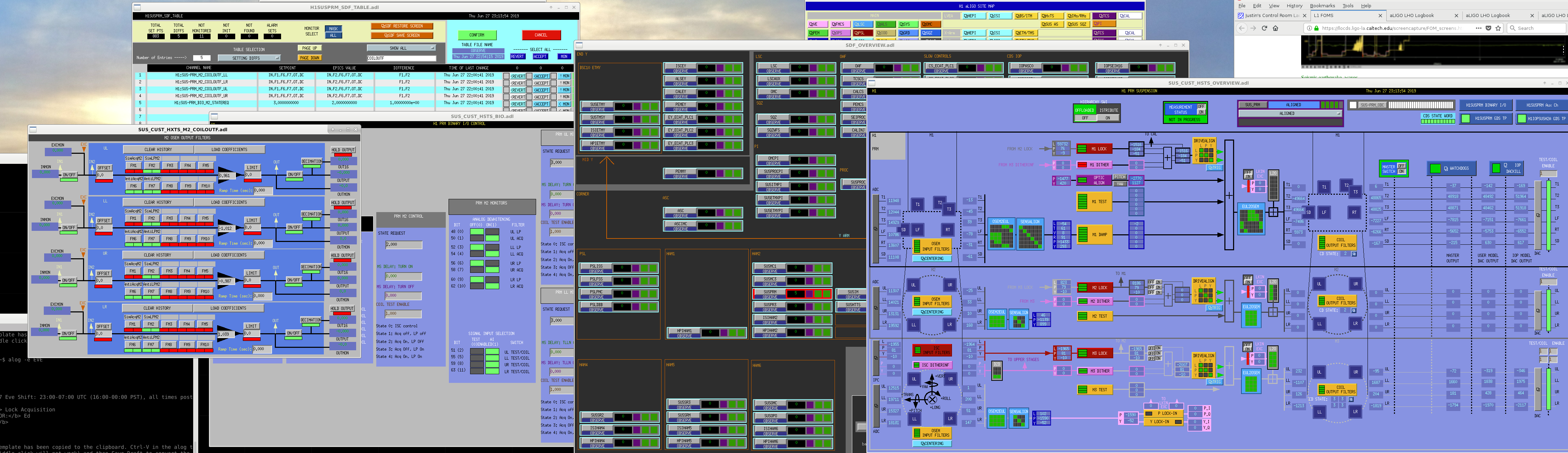
New SDF Diff for PRM: This had to do with Binary IO (BIO) State Request (for Acquire & Low Pass) for PRM.
These were a new set of DIFFS which I had not seen before. I called Keita first (but I woke him up!), and then talked with Georgia. She was familiar with the issue. She mentioned since these were on the M2 stage they are not an issue for us at NOMINAL LOW NOISE since we do not have signals for the M2 coils. So in the interest of returning to OBSERVING & since this won't affect NLN/Observing, screenshot the channels/diffs, and all windows related to this (See Attachment #3, which shows channels with diffs, and all PRM medm windows involved).
Will need to trend these channels and/or go through guardian scripts to see what State Request we normally have for PRM, but I'll leave this for others. Will want to see what happens for the next lock!
6:15 Back to OBSERVING!
3:14 (8:13pm): Lockloss (did not see anything obvious for the lockloss). Relocking so far (no alignment yet).
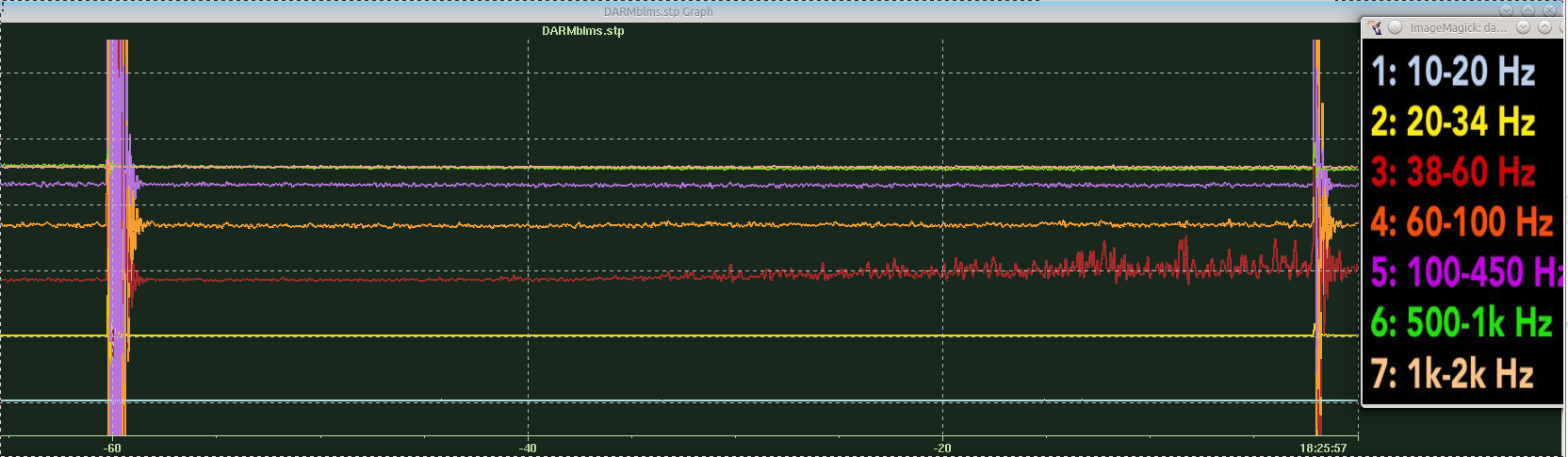
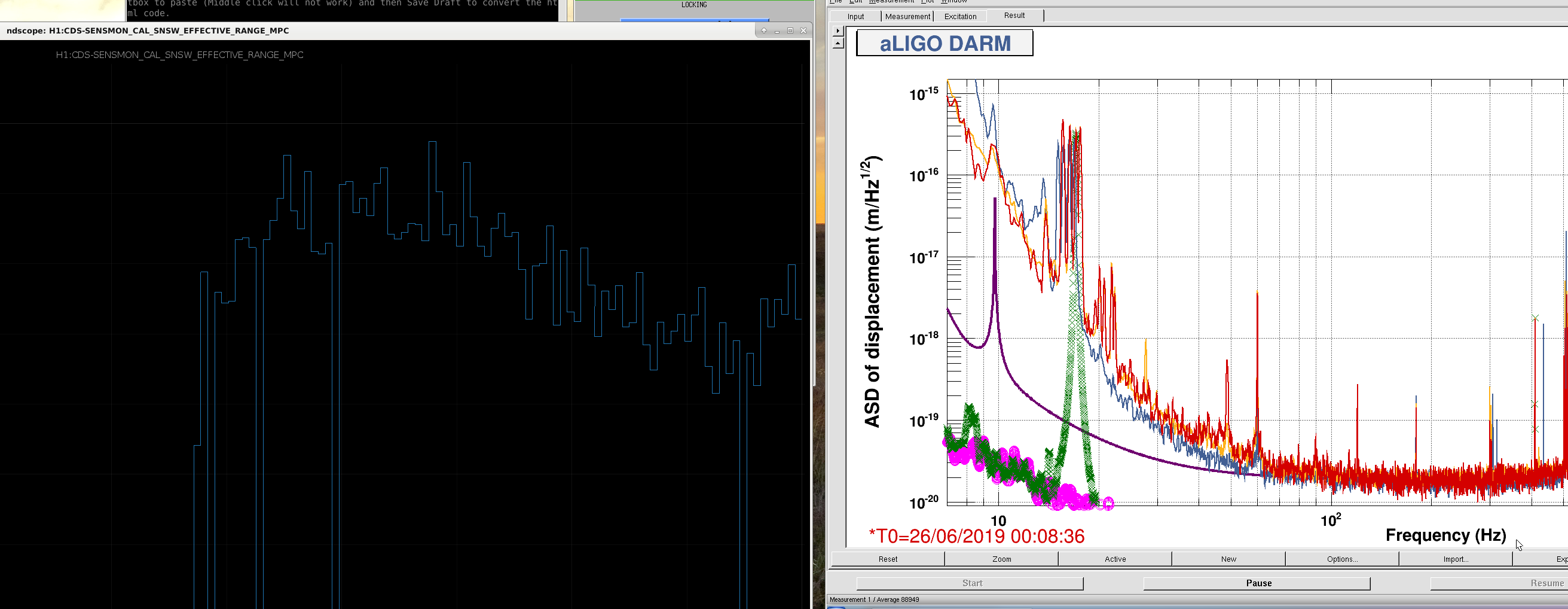
Starting at around 0:50utc, noticed H1 range drop. Drop looks correlated with DARM's 38-60Hz band. And sure enough we see the infamous ~48Hz line getting bigger. Will keep monitoring.
Attachement #1: 38-60Hz line
Here you see this band slowly growing during an hour long stretch where we had no glitches.
Attachement #2: 48Hz line on DARM spectra
Here is a random screenshot when the line was large. (and also a glimps of the range drop over the last 40min.
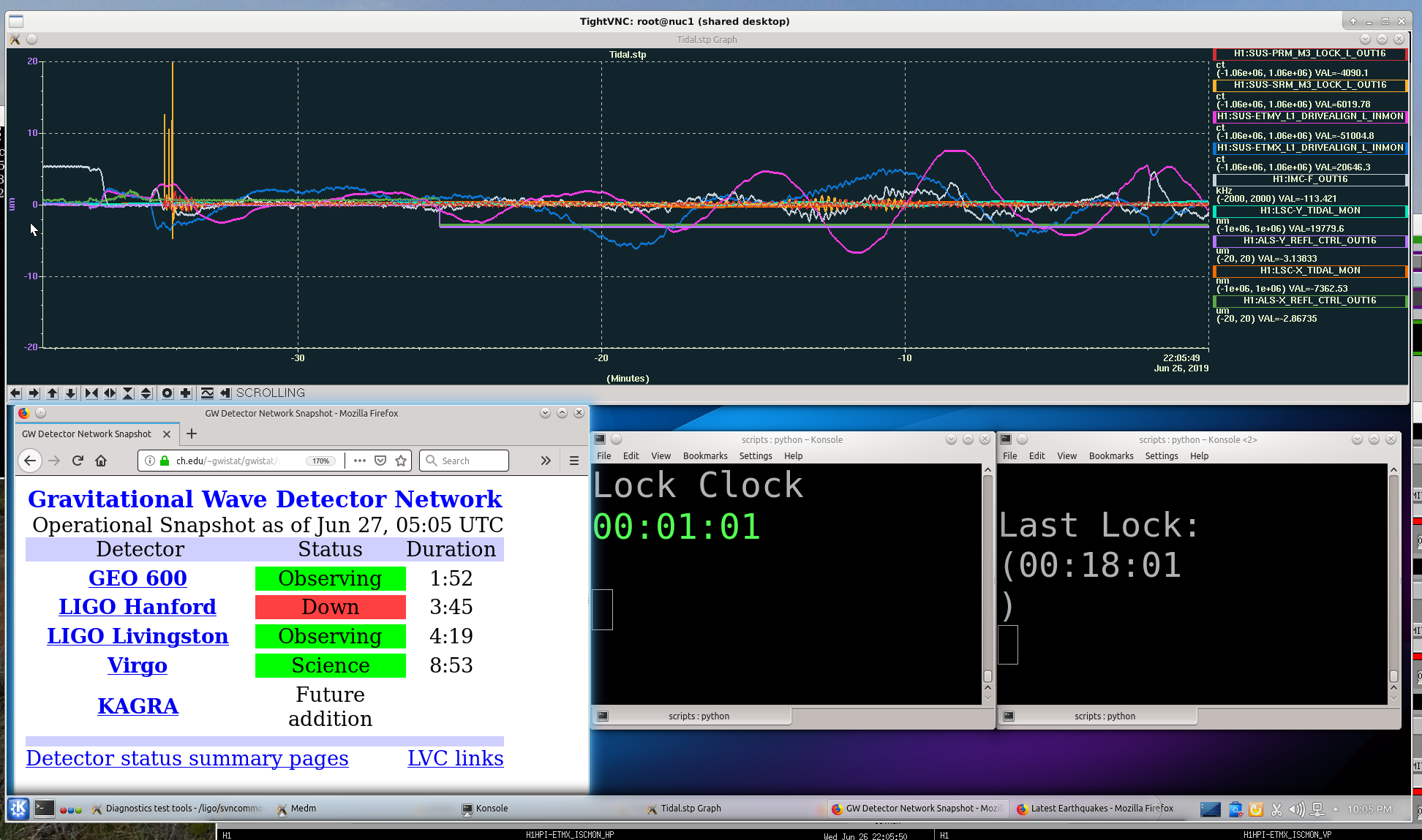
H1 DOWN from 22:10 - 0:08utc
For the locking-H1 TJ handed off, there was a lockloss around the DARM_TO_DCREADOUT state.
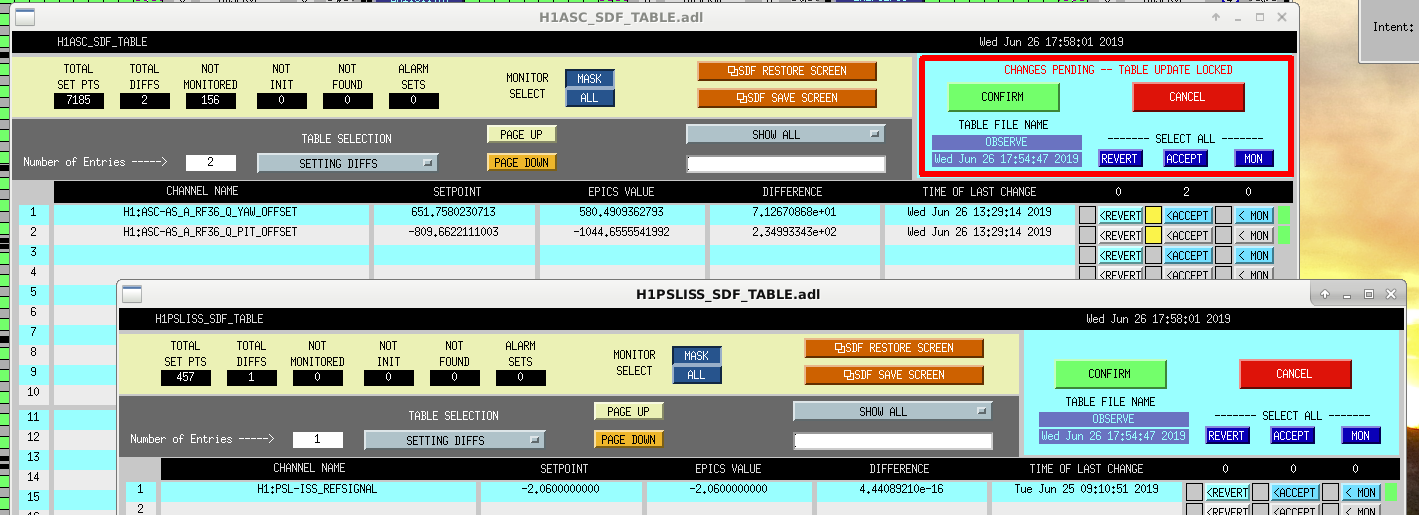
SDF Diffs While at NLN (see this alog on specifics for these recurring Diffs):
Continue to have the PSL ISS Diff: ACCEPTED (per Jason)
Continue to have the ASC RF36 Diff: ACCEPTED (per Keita)
Yesterday I re-ran Craig's SRCL to DARM transfer function and his analysis code which calculates the circulating arm power from the RIN to DARM transfer function. This measurement was done ~10 hours into the lock.
Results:
Arm QPD Gain [DARM m/RIN] Arm Power Inferred [kW]
------------------------------------------------------------------
XA 1.55e-6 183
XB 1.58e-6 188
YA 1.65e-6 195
YB 1.72e-6 204
X arm power = 185 kW
Y arm power = 200 kW
Average arm power = 192.4 +/- 7.9 kW
The fit of arm power RIN to DARM is shown in the attached figure. If we remove the two lowest frequency points we will probably improve the uncertainty on the arm power.
TITLE: 06/27 Eve Shift: 23:00-07:00 UTC (16:00-00:00 PST), all times posted in UTC
STATE of H1: Lock Acquisition
OUTGOING OPERATOR: TJ
CURRENT ENVIRONMENT:
Wind: 19mph Gusts, 14mph 5min avg
Primary useism: 0.05 μm/s
Secondary useism: 0.05 μm/s
QUICK SUMMARY:
Walked in to TJ locking up H1. Unfortunately, it dropped out shortly after while moving up ISC_LOCK. Going to try to lock one more time (& try alignment next).
TITLE: 06/27 Day Shift: 15:00-23:00 UTC (08:00-16:00 PST), all times posted in UTC
STATE of H1: Lock Acquisition
INCOMING OPERATOR: Corey
SHIFT SUMMARY: Just lock at the end of my shift, most likely due to a large gust at the CS. Relocking has been easy, ALS dropped lock as few times as the WFS kicked in though.
LOG:
The cause is currently unknown. There was a large gust of wind at the corner station, but I haven't had the chance to confirm that was it.
After the storm and ALSx issue, ran an alignment, went for locking & finally back to Observing.
NOTES:
Commissioners & Jason: Should We UNMONITOR these? (see 2nd attachment)
Went to Observing
There is usually a high-precision SDF difference immediately after the ISS RefSignal gets adjusted, then doesn't show up until the next necessary adjustment; I'm not sure why it's been popping up more often these last couple days. Despite that, the channel should definitely remain MONITORED, as changes to this channel change how much light is diffracted by the ISS AOM.
PSL ISS Diff: Keep ACCEPTING (per Jason's entry.)
ASC RF36 Offset Diffs: Keep ACCEPTING (per discussion with Keita tonight on 6/27).
[Georgia, Jenne]
Terra called the control room and helped me excite the mode by increasing the gain in the dampining filter for mode 24 (no excitation required). We excited the mode until the PI_ESD_DRIVER_OUT monitors were several thousand counts. Though as we increased the gain we saw some broadband noise around our mechanical modes.
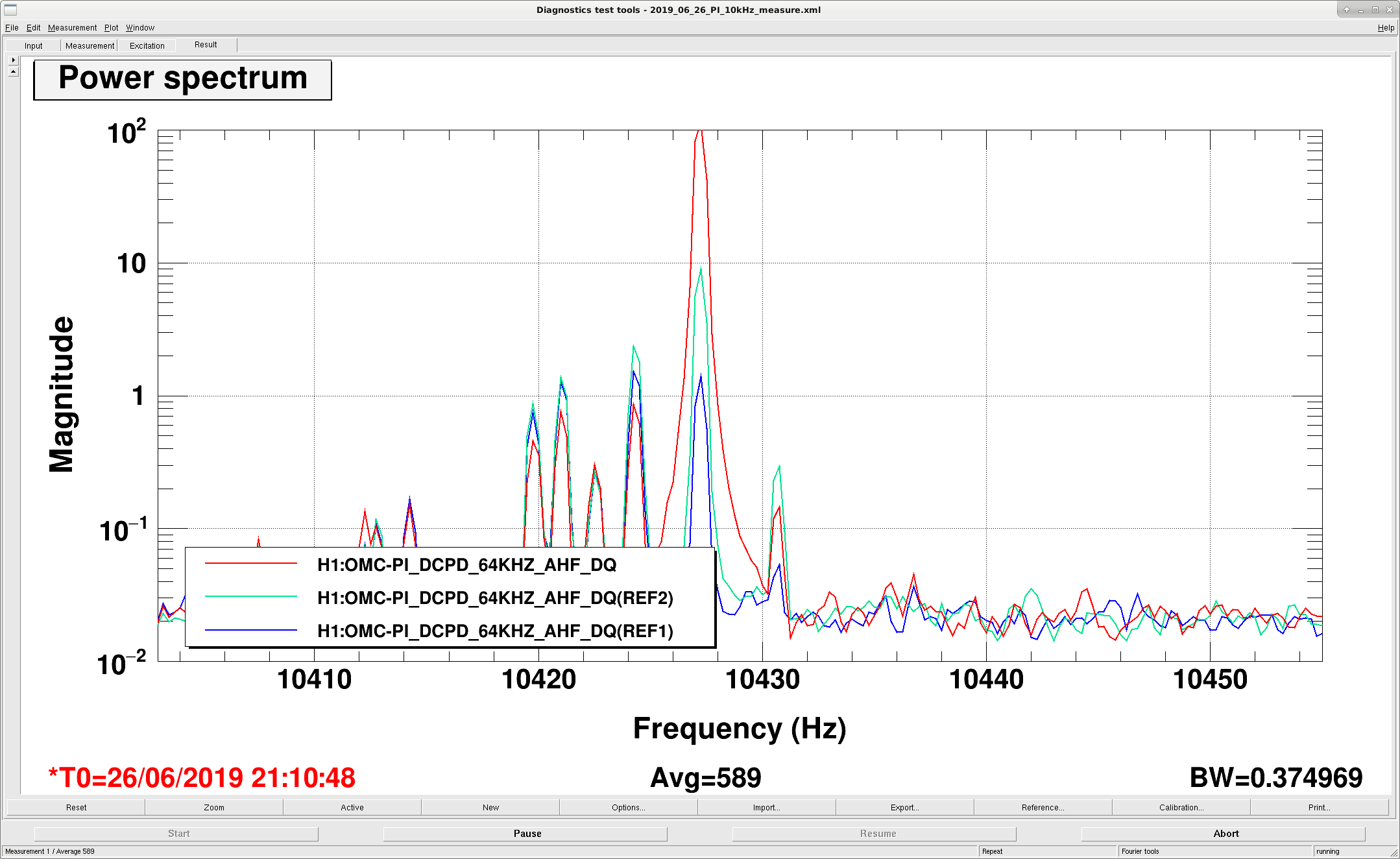
We set the ESD output matrix in the butterfly configuration (diagonal quadrants out of phase) and managed to ring up the slightly-lower-frequency 10.428 kHz mode (see first attachment, red is with the mode rung up). We then switched to the drumhead configuration (diagonal quadrants in phase), and managed to ring up the same mode again. So as yet we have not distingushed which mode this really is.
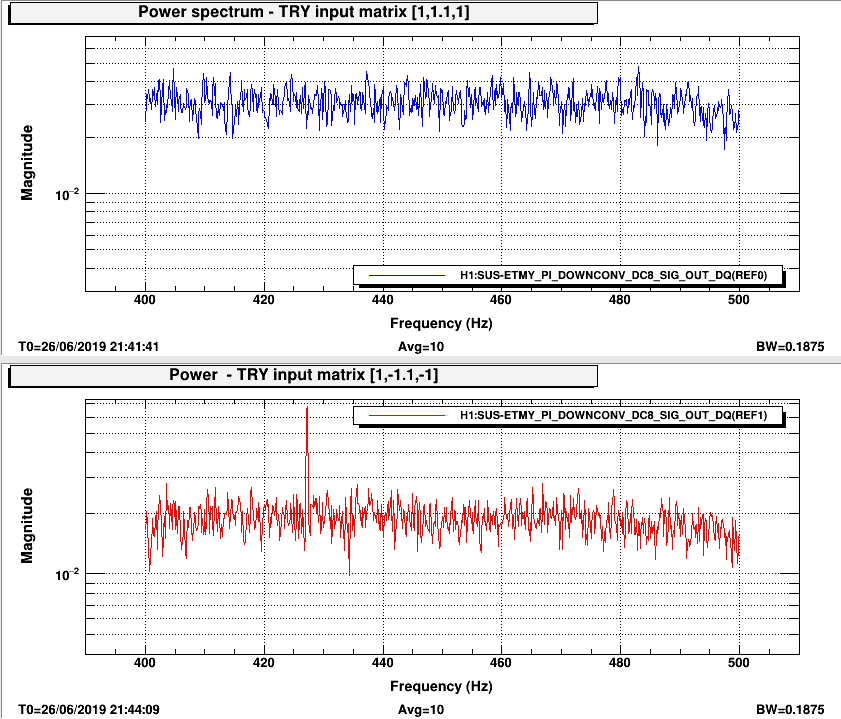
They saw something similar at LLO, and looked at the downconverted transmon QPD signal to distinguish between the two modes. During the first round of excitations I had the TR_Y QPD input matrix in the drumhead configuration (all quadrants added together). For the second round of excitations we switched the matrix to a pringle-mode. I will need to look back at the data and see if we saw our down-converted excited mode in the QPD.
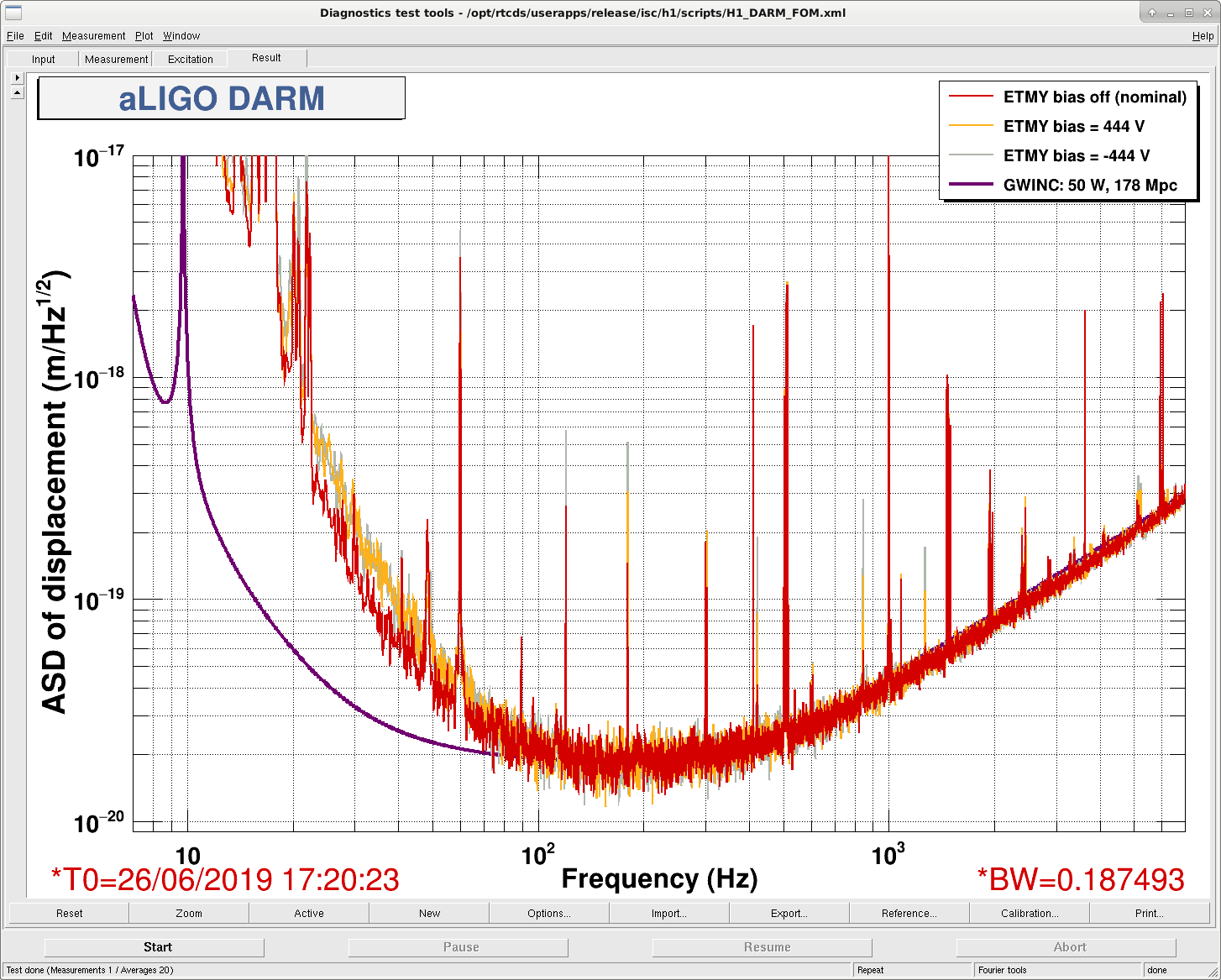
Second attachment is the broadband noise with the ETMY ESD bias on, as noted by Jenne above.
The beams on the TransMon QPDs are so off-center that it might be hard or not possible to identify the modes using them. On each QPD (A & B) the lowest light segment has about 20x less light on it than the highest light segment. I think you'll need to center the beams on the QPDs to use them as a diagnostic.
I had a look anyway, and only see the downconverted mode when the Transmon QPD input matrix is in the pringle configuration, suggesting that the 10.427 kHz mode is a flower mode of ETMY. (I'm not sure if this is using only one QPD or some combination of both, it's not obvious to me from the PI screen.)
We didn't manage to ring up the 10.4305 kHz mode with our ETMY excitations, perhaps it is on a different test mass?
The last plots in this thread could be misleading. Slawek has pointed out that the QPDs should see the second order optical mode, but the linewidth we saw was too narrow for this... Maybe some electronic cross-talk?
Back to Observing 1758 UTC