On Tuesday June 11th I took squeezing measurements at different nonlinear gains on the homodyne. The overall message is that the level of squeezing seen on the homodyne is consistent with expectations for the level of nonlinear gain we have, and there isn't a meaningful constraint on the phase noise level from this data.
Green power measurements:
Before getting started with squeezing measurements I checked green power levels with a good power meter and updated some calibrations. I measured 23mW coming out of the SHG, and 1.45mW onto SHG power monitor diode, so I updated the responsivity of the SHG power diode from 0.431 to 0.297A/w, and changed the pick off mirror reflectivity to 6.3% from 4.7%, that the the reported power is more acurate. Before the pickoff for the SHG fiber launch diode (after AOM, Farady, EOM, PBS) I measured 19mW of green, and 18.6mW into the fiber. I measured 0.83mW on the launch diode itself and updated the reponsivity to 0.21A/W, and the pick off ratio to 4.4%. In reflection off the unlocked OPO, I measured 6.3mW at the bottom periscope mirror, and 3.4mW at the REFL diode. I did not update the calibration of the REFL diode since it was already pretty close. I also spent some time adjusting the alignment and polarization into the pump fiber on ISCT6, I was only able to make a small improvement by walking the alignment. I decided to check the coupling efficiency into the first fiber by measuring the power (with clean new fiber power meter attachment) at the patch panel, the transmission was 87%, while the transmission of the whole green fiber chain is 19%
Homodyne balancing:
The first time I did the homodye balancing (49786), I did it by adjusting the beamsplitter angle to bring the difference current to zero when both diodes were well aligned. When I measured the visibility I noticed that the visibility was different in the two arms of the homodyne, which made me suspect that the balancing wasn't great. This time I started out by trying to make the current in the two paths equal (measuring each while the other was blocked) and found that this did not do a good job of balancing the difference photocurrent at all. I found that I had to make the DC power measured while eah detector was blocked fairly imbalanced to get a good zero difference current. This seems like an offset problem with the way I was measuring the difference current, but it isn't because zeroing the difference current results in a flatter shot noise spectrum. While all of that is a little puzzling, the intensity noise cancelation seems to be good enough. I ended up with a slightly better shot noise spectrum on June 10th than on the 11th, but the data on the 11th is good enough to get a measurement of the squeezing level. In the configuration used for these measurements, I measured a homodyne visibility of 98% in one arm (the one that results in positive voltages) and 96% in the negative arm.
Results:
The first attachment shows the squeezing and anti squeezing measurements, in the order they were taken. The shot noise spectrum here was taken at the begining of all the measurements, I retook it at the end of all the measurements and it hadn't changed. I looked back at the variation in the power level on the homodyne throughout all the measurements, and I don't think it is large enough to cause any real confusion. (It also wouldn't cause a systematic bias in the results, because I took the nonlinear gains out of order and the power drifted up and down, the changes in shot noise level would be pretty random). The squeezing and anti squeezing level was estimated by taking the median of each trace, shown with dashed lines.
I used some code from pyDARM and some off the web to try an MCMC fit of this data for total efficiency (eta) and phase noise. With this homodye visibilty we expect the known losses to come to 10%. If I allow the total efficiency to go from 0 to 1, the fitting results in unrealistically low losses, near 5%, and phase noise of a few hundred miliradians, which seems to large. The second attachment shows the fitting results with eta restricted to the range 0 to 0.9, which gives more reasonable results. The fit does predict consistently lower anti squeezing than we measured, which I don't think is due to fluctuations of the shot noise level.
Fermi alert. TRIGGER_DUR is 0.016 s. Latency is 3.19 s. Will begin standown.
TITLE: 06/21 Eve Shift: 23:00-07:00 UTC (16:00-00:00 PST), all times posted in UTC
STATE of H1: Observing at 118Mpc
OUTGOING OPERATOR: Patrick
CURRENT ENVIRONMENT:
Wind: 12mph Gusts, 10mph 5min avg
Primary useism: 0.01 μm/s
Secondary useism: 0.12 μm/s
QUICK SUMMARY: Lock is 10.5 hours old with 21 minutes in Observing due to Commissioning effort earlier today.
TITLE: 06/21 Day Shift: 15:00-23:00 UTC (08:00-16:00 PST), all times posted in UTC STATE of H1: Observing at 118Mpc INCOMING OPERATOR: Travis SHIFT SUMMARY: Remained locked entire shift. Out of observing while Georgia and Robert worked on commissioning from 20:05 UTC - 22:37 UTC. Chris used a forklift near the OSB from 17:08 UTC - 17:20 UTC. LOG: 16:28 UTC Sundae to optics lab 17:08 UTC Chris starting forklift 17:20 UTC Chris done moving forklift 20:05 UTC Changed to commissioning for Robert and Georgia 20:51 UTC Gerardo to mid Y and mid X 21:32 UTC Sundae out of optics lab 22:01 UTC Gerardo back 22:37 UTC Robert out of LVEA 22:37 UTC Back to observing
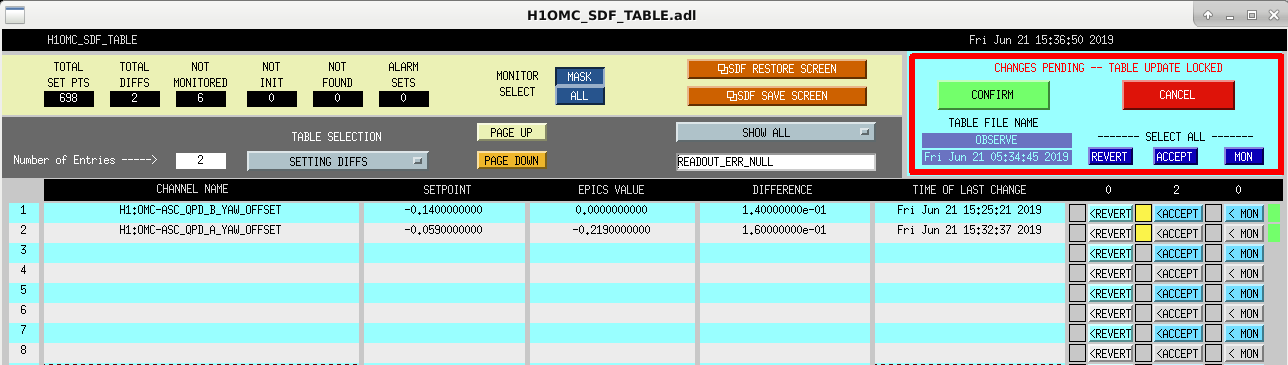
In our commissioning window this afternoon I walked the offsets on the two OMC QPDs to try and find a place which gave us better optical gain. I did not end up changing the pitch offsets, however I found a slightly better alignment in yaw, increasing kappa_c by ~0.006. The new offsets were accepted in SDF (first attachment).
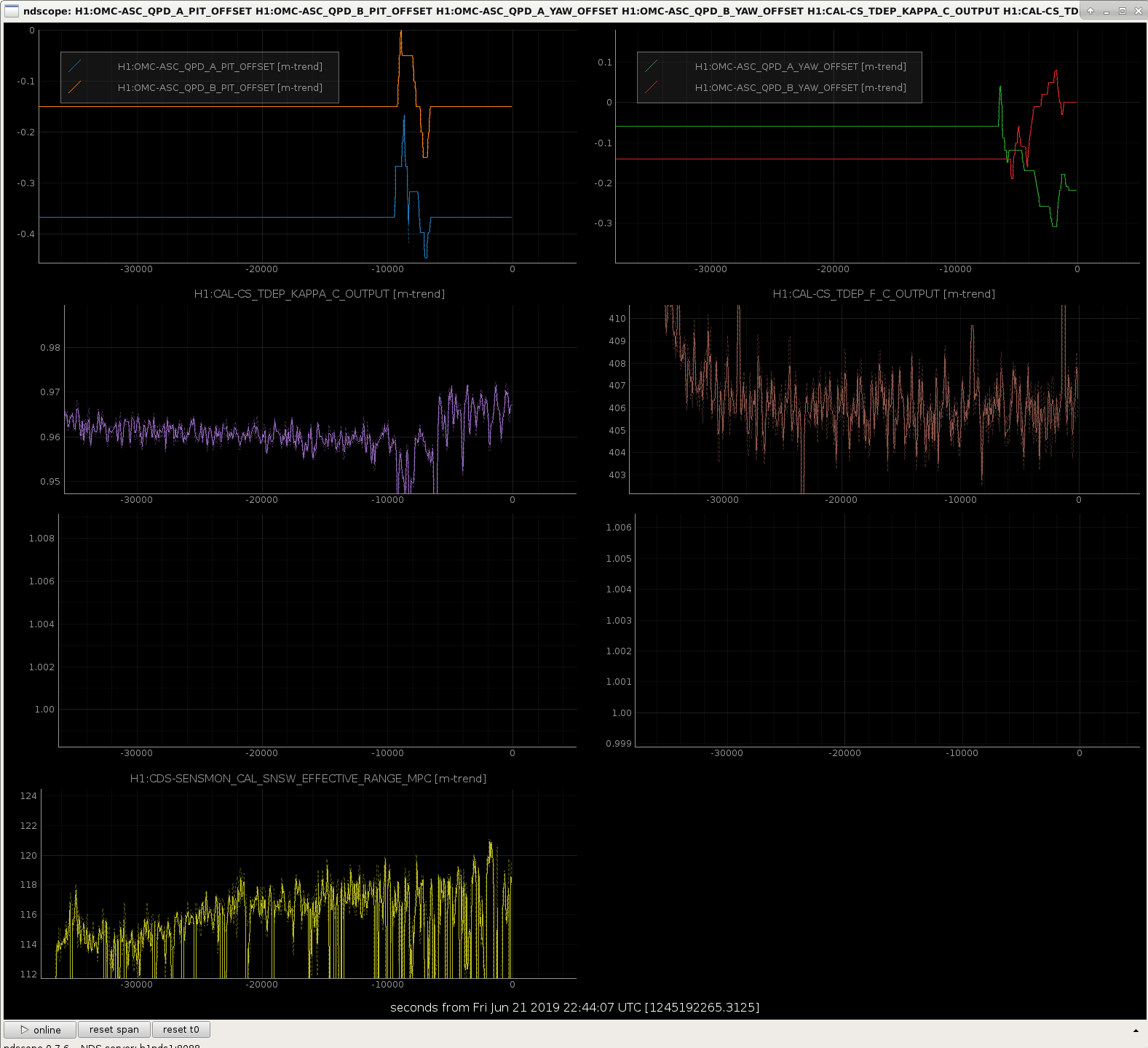
The second attachment shows the QPD offsets (first row), Kappa_c and cavity pole (second row) and the BNS range (final row), showing the imporvement in kappa_c after the walk. (Note before we powered up to 37W Kappa_C was sitting around 0.984). Also worth noting is our range has been increasing over the duration of this lock, I'm not sure why.
I had originally planned to do the noise budget output jitter measurements in this same commissioning window but ran out of time.
TITLE: 06/21 Day Shift: 15:00-23:00 UTC (08:00-16:00 PST), all times posted in UTC
STATE of H1: Observing at 114Mpc
OUTGOING OPERATOR: Niko
CURRENT ENVIRONMENT:
Wind: 6mph Gusts, 5mph 5min avg
Primary useism: 0.01 μm/s
Secondary useism: 0.10 μm/s
QUICK SUMMARY: No issues.
TITLE: 06/21 Owl Shift 07:00 – 15:00 (00:00-08:00), all times posted in UTC
STATE of H1: Observing
INCOMING OPERATOR: Patrick
SHIFT SUMMARY: 6.2 EQ NE of New Zealand knocked us out of lock around 09:24 (01:51). After initial alignment and a few locklosses, was able to relock and go to Observing. Observing now for 2.5 hours.
LOG:
07:00 (00:00) Start of shift
08:21 (01:21) Switching to EQ mode for 5.3 NE of New Zealand.
08:36 (01:36) Switching back to windy. Experienced a glitch as the nodes arrived (maybe correlated).
08:51 (01:51) Switching to EQ mode for 6.2 from same area as previously.
09:25 (02:25) Lockloss due to EQ, had a much greater effect than the EQ Response estimate indicated
10:39 (03:39) Sufficient ringdown to try locking, but it looks like the beam is clipping on the ALS-Y camera. Starting initial alignment
11:03 (04:03) Finished initial alignment (still see some clipping though). Relocking
11:30 (04:30) Two similar locklosses so far from DRMI_LOCKED_CHECK_ASC (maybe because EQ was still ringing down)
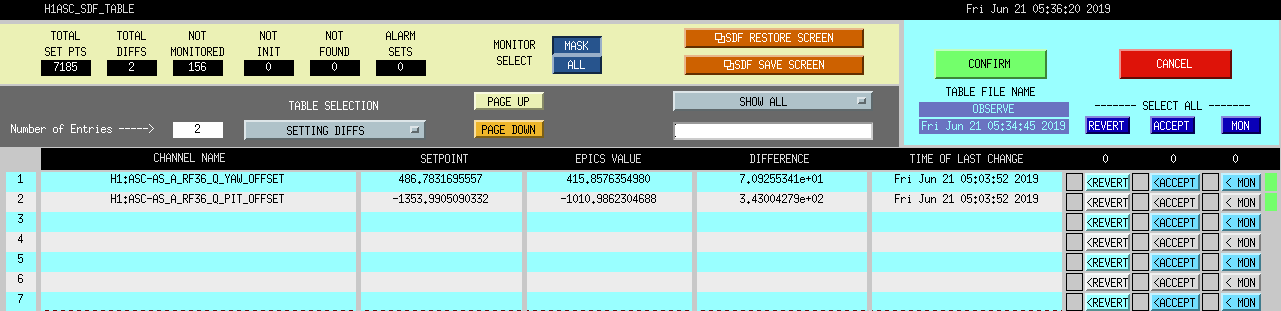
12:36 (05:36) At NLN, accepting sdf changes and entering Observing
15:00 (08:00) End of shift
Accepting the following SDF changes to get to Observing
Lost lock due to a 6.2 earthquake NE of New Zealand. Once everything had rung down, I noticed on the ALS-Y camera that there appeared to be slight beam clipping. Did an initial alignment, currently re-locking.
Ops Shift Transition: 06/21/2019, Owl Shift 07:00 – 15:00 (00:00-08:00) - UTC (PT)
State of H1: Locked
Intent Bit: Observing
Weather: 0-20 mph wind, light rain
Primary 0.03 – 0.1Hz: 0.01 um/s
Secondary 0.1 – 0.3Hz: 0.1 um/s
Outgoing Operator: Jeff
Quick Summary: Locked and observing for 3.5 hours. Wind was up during the day but has calmed down for now.
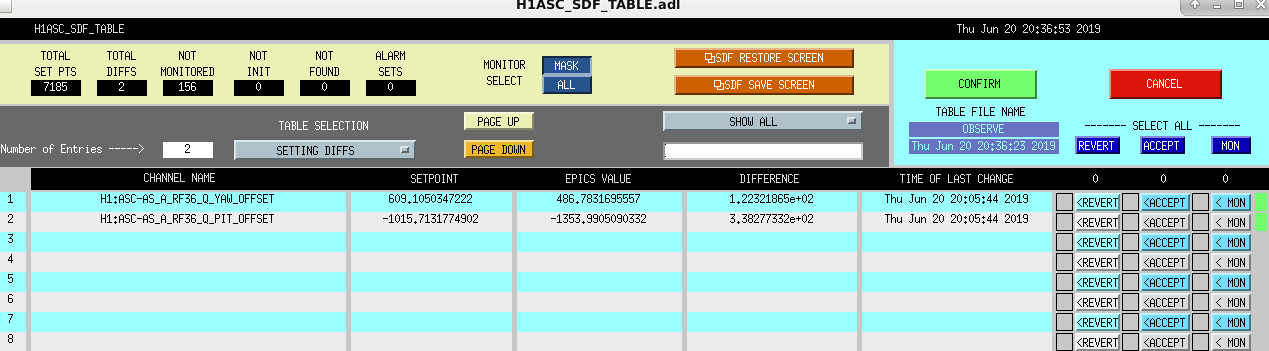
Over the past hour the winds have subsided into the teens and 20s, with only a few gusts getting into the high 20s. Conditions have settled down enough to relock the IFO. Accepted the two ASC SDF Diffs and am back into Observing.
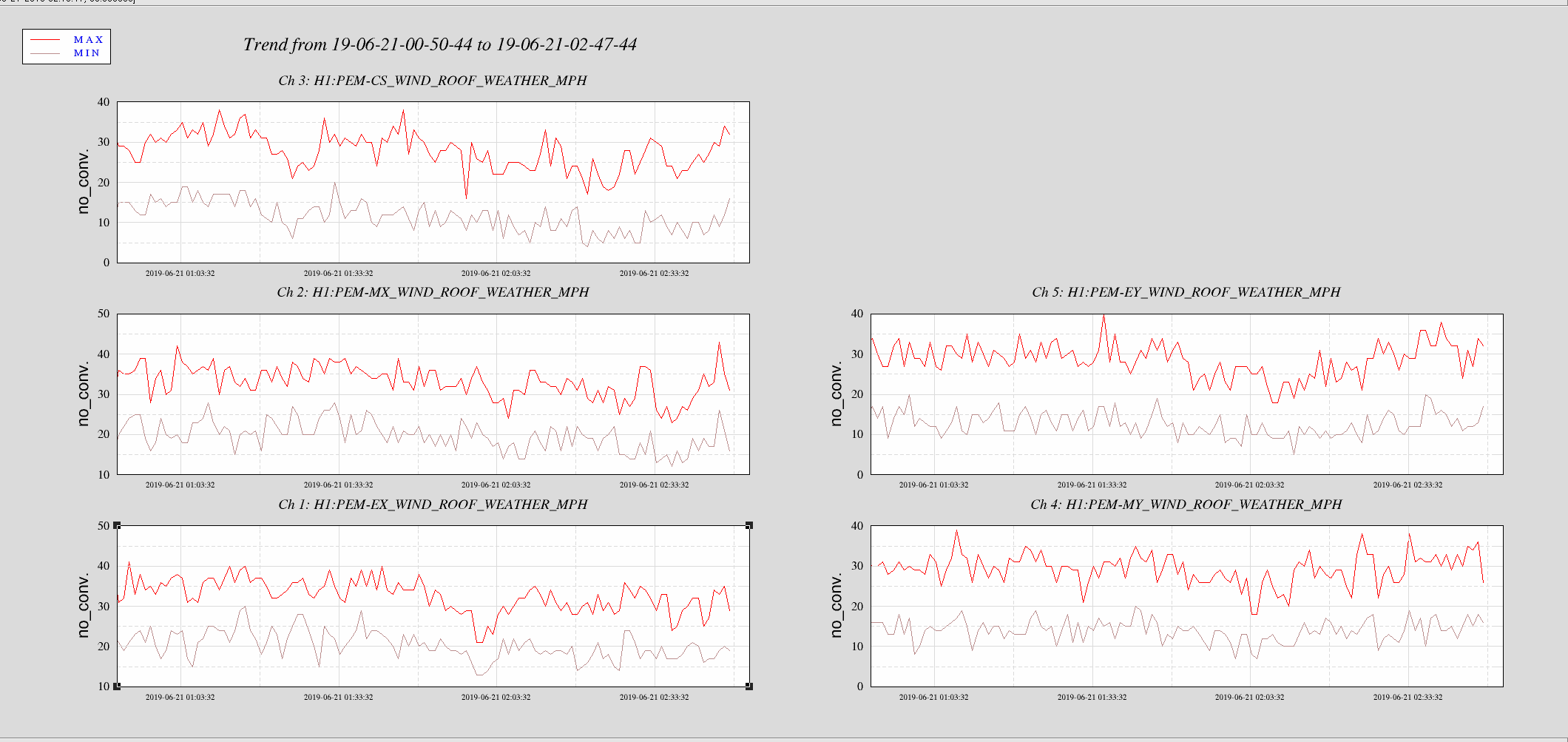
The first half of the shift is a rerun of last nights evening shift. Lost lock at 00:59 (17:59) probably due to strong wind gusts. No luck relocking in the current conditions. Posted below are wind plots for the past two hours. With base line winds in the mid to upper 20mph and gusts approaching the 40mph range, I do not hold out much hope for relocking until these subside.
Sheila, Georgia
Yesterday we re-ran the noise budget templates for the following noises:
Only the frequency noise changed dramatically since the old noise budget, it is significantly lower now - presumably due to the increase in CO2_X power.
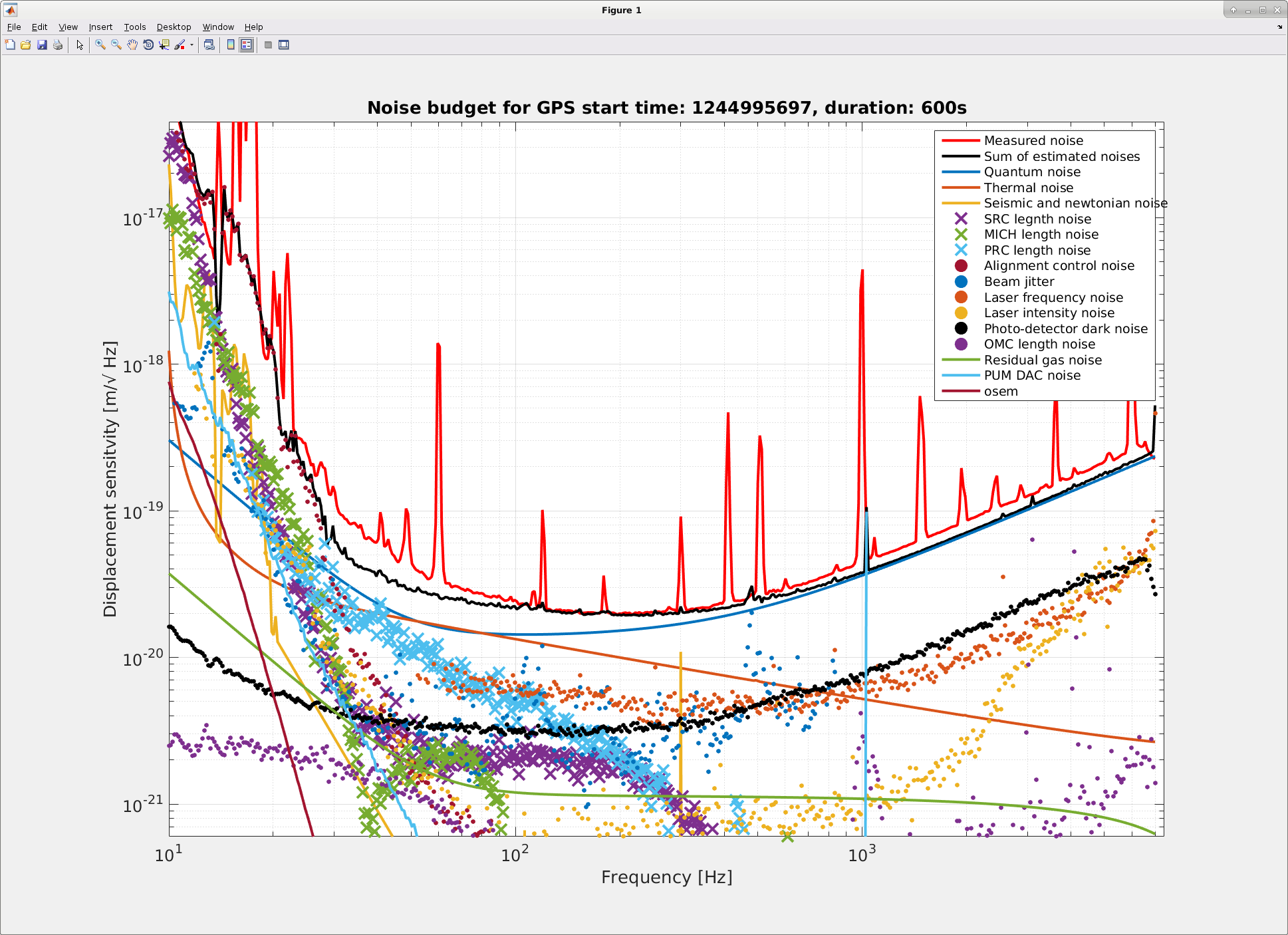
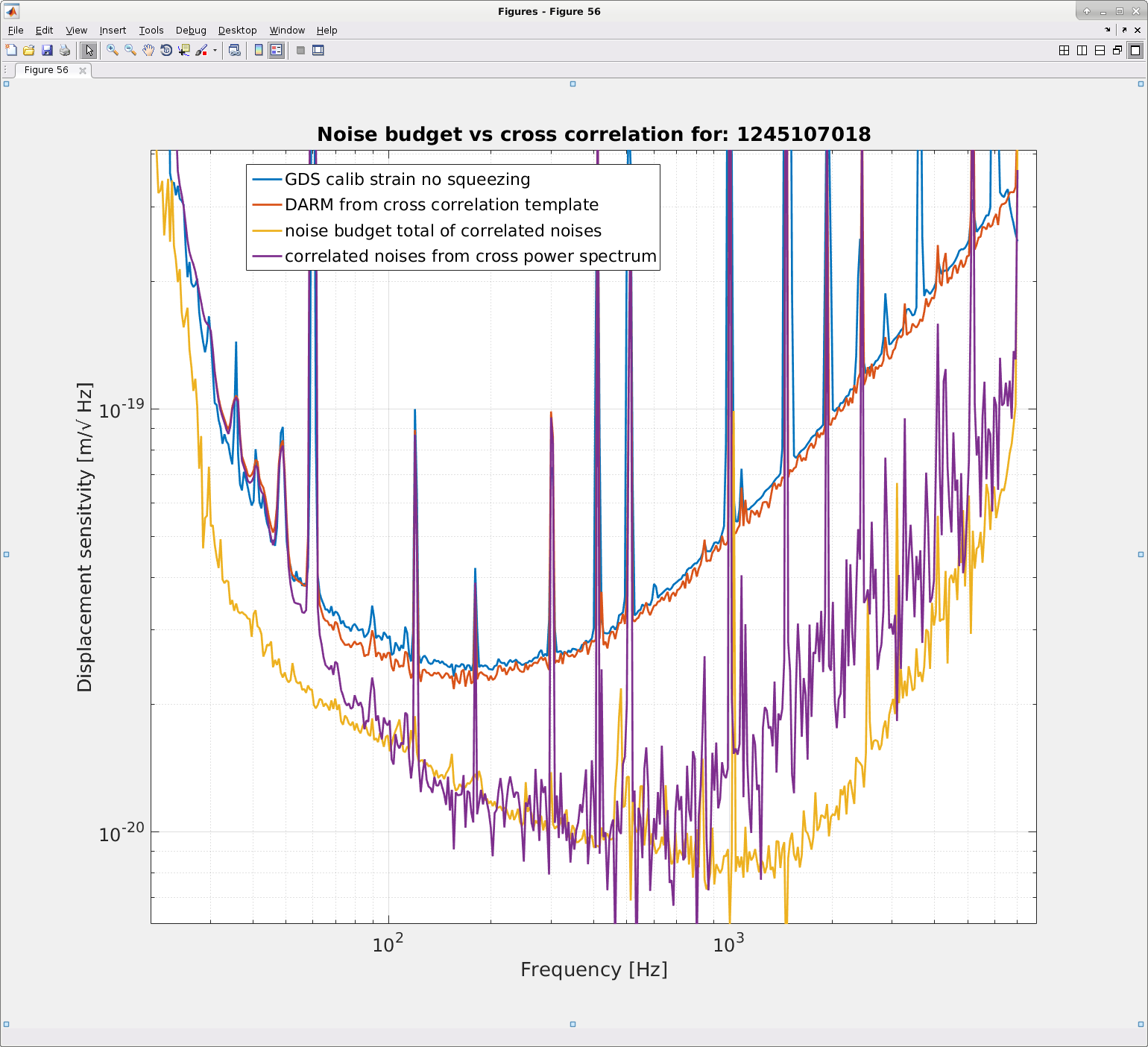
The updated noise budget, for a time when squeezing is injected, is shown in the first attachment. We are clearly underestimating our shot noise above a few hundred Hz, though between 10 and 300 Hz we estimate the noise well.
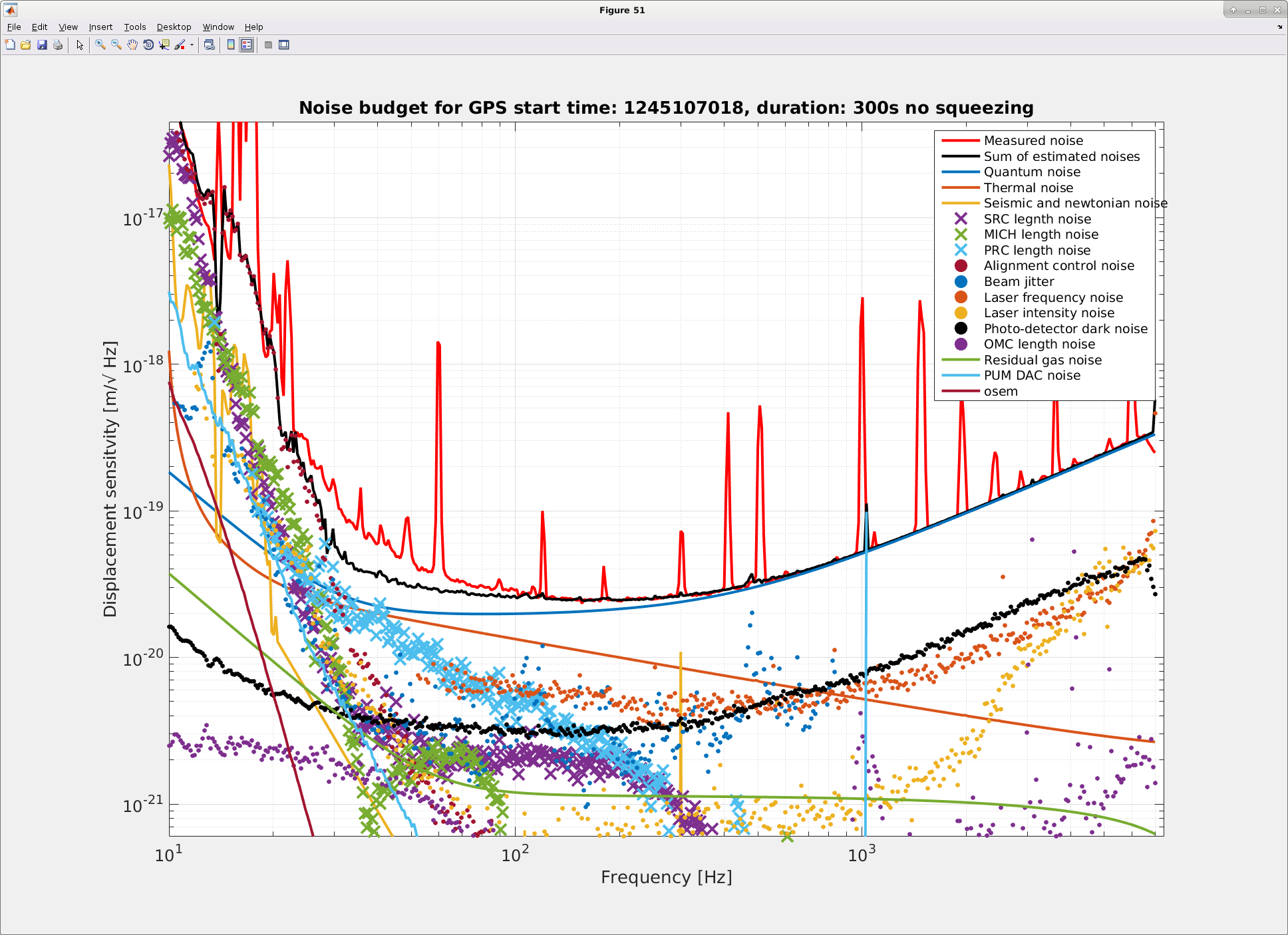
To look further into shot noise, today we let the ifo run for 10 mins without injecting squeezing. The noise budget for this time is shown in the second attachment. Without squeezing on our shot noise is correct at all frequencies.
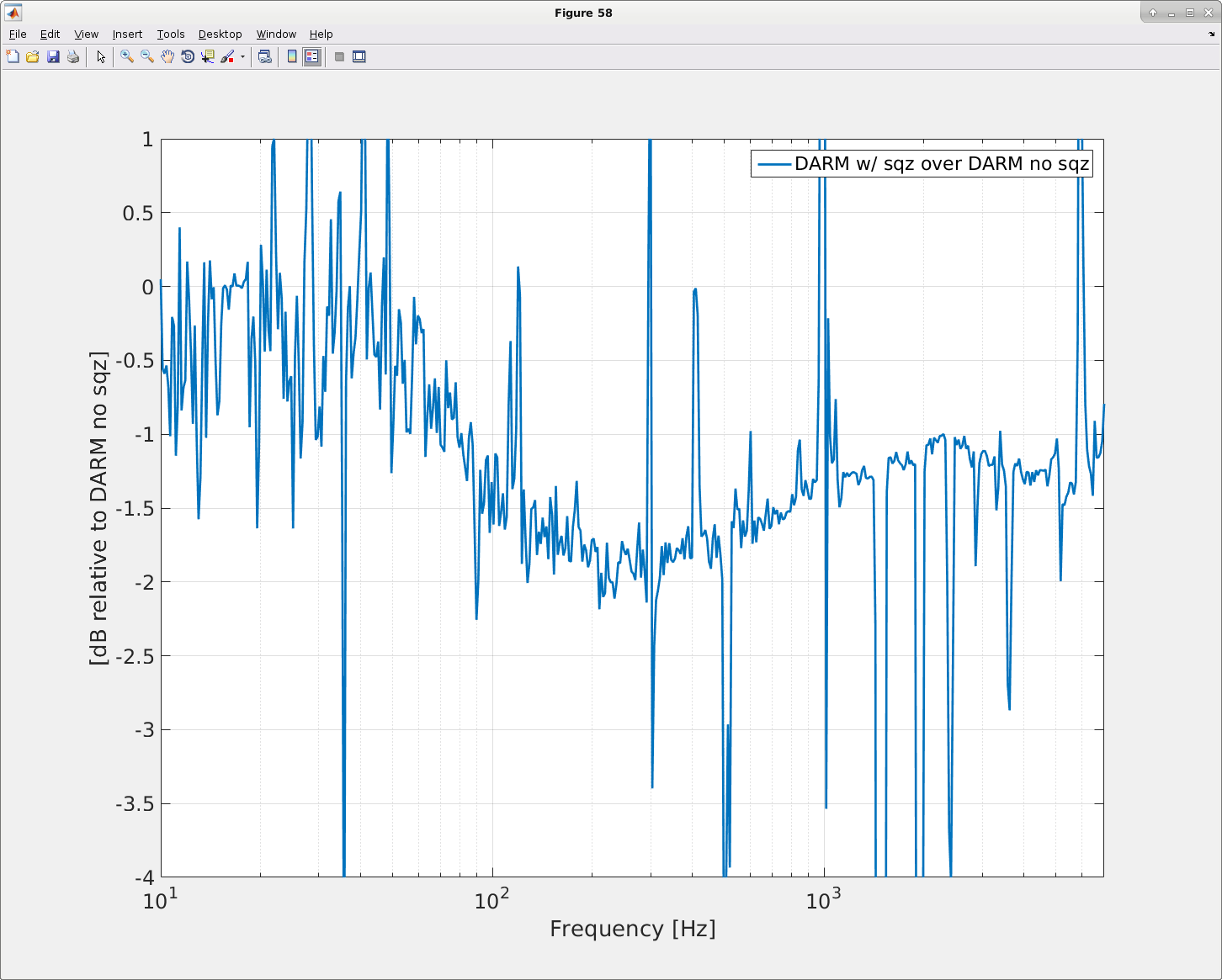
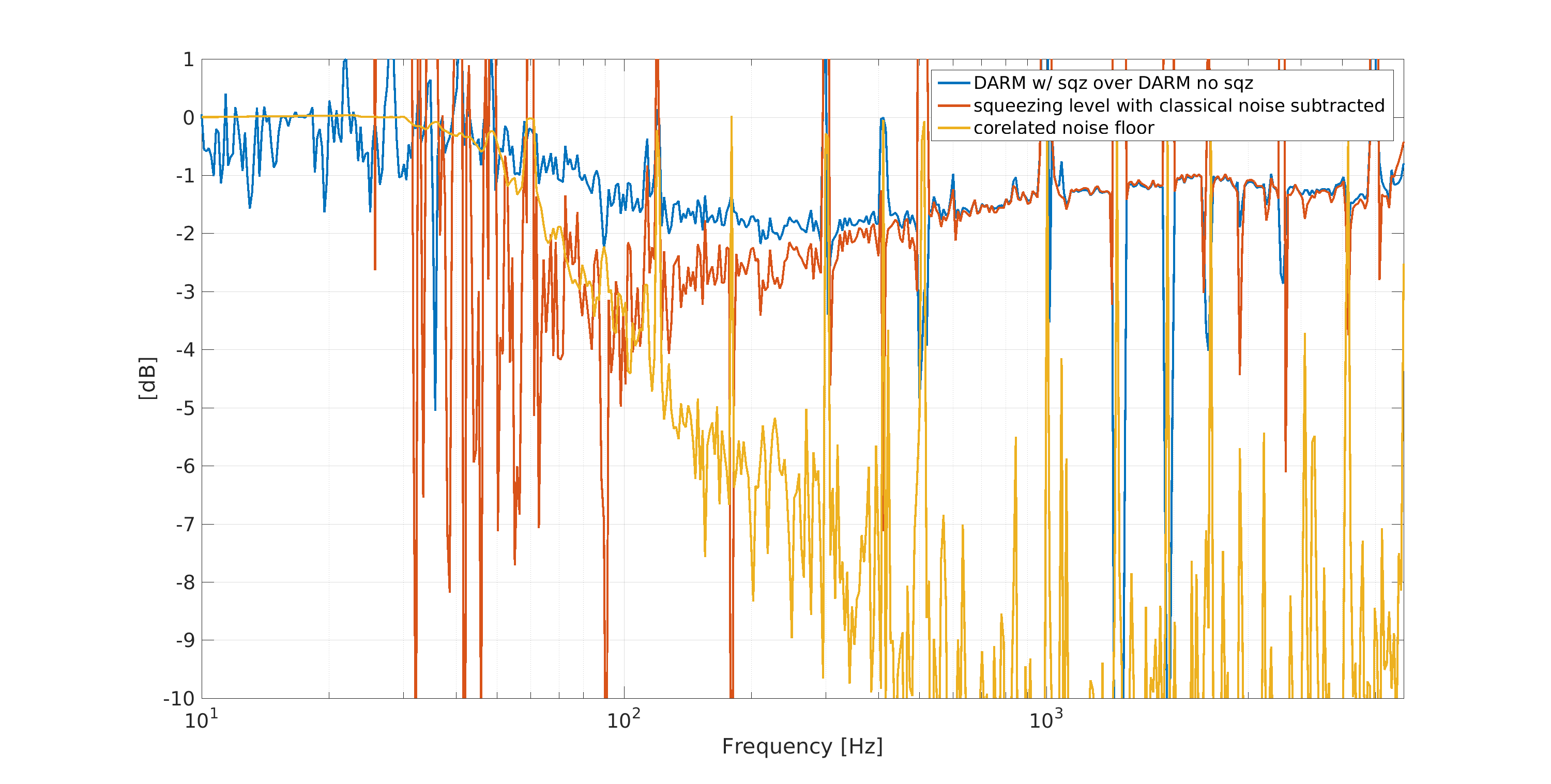
In the first noise budget we assume a constant (frequency independent) squeezing level, calculated from the DCPD BLRMS, which reported 2.9 dB of squeezing. The third attachment compares DARM with squeezing and DARM without squeezing. Squeezed-DARM sits ~2dB below normal shot noise at 200Hz, but only 1dB at 2kHz. This frequency-dependence was attributed to bad frequency noise in the past, but is still present with improved frequency noise. Perhaps we need to look at whether we have a SRCL offset?
We ran the DCPD cross-correlation template during our time without squeezing, to see if this worse sensitivity at high frequency is due to classical noise that is not in the noise budget. The fourth attachment shows correlated noise based on the noise budget (removing the shot noise and dark noise from the unsqueezed noise budget) in yellow, and the correlated noise from the DCPD cross correlation template in purple. We seem to be under-estimated our cross correlated noise by a factor of ~2 at 2kHz. (The discrapancy between DARM from the noise budget and DARM from the cross-correlation template is the difference between the GDS calibration and the CAL-DELTAL_EXTERNAL calibration). This is not enough to explain our mismatched shot noise.
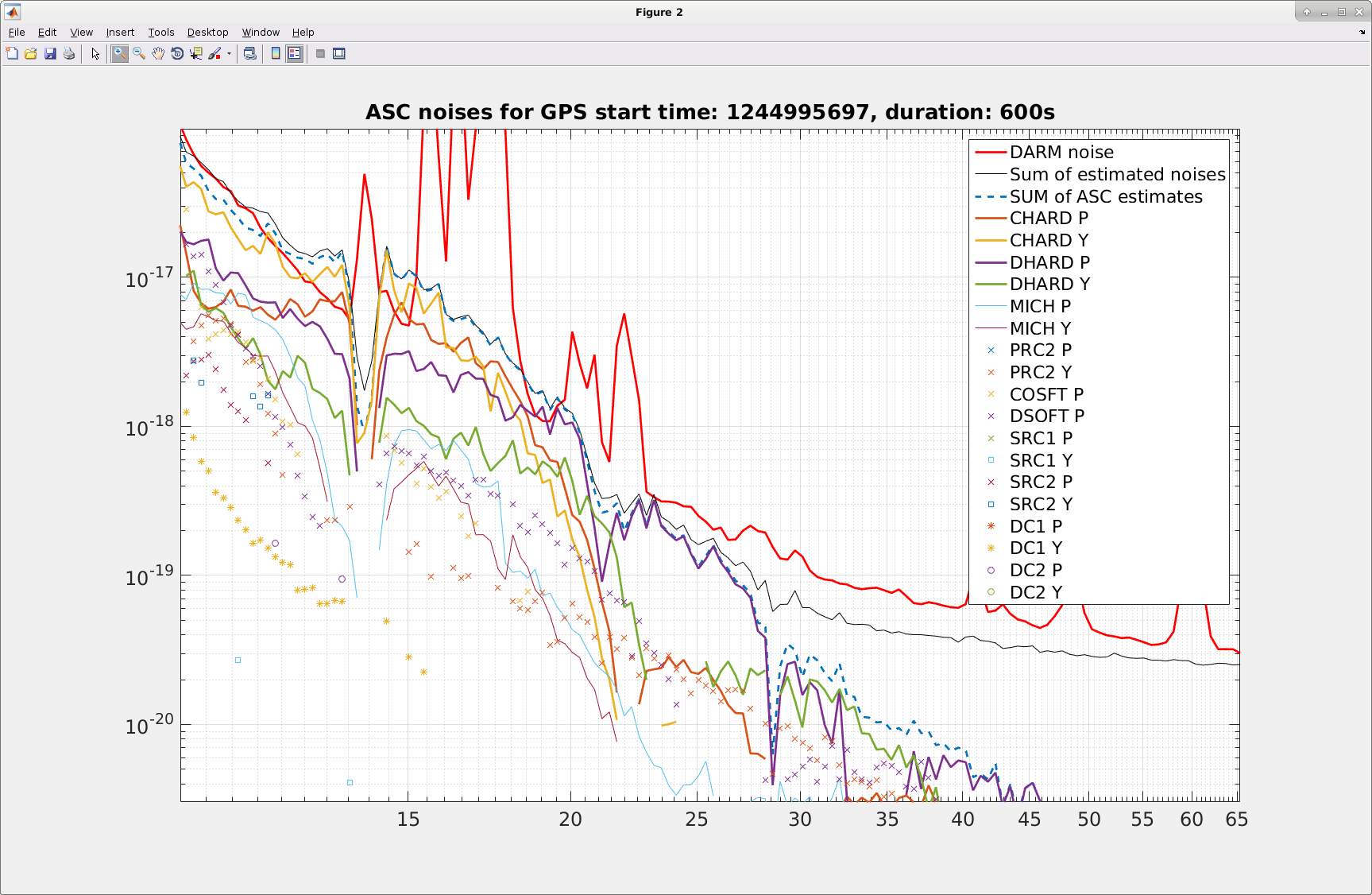
The fifth attachment is the updated ASC noise budget. We are over estimating our noise a bit between 10 and 20 Hz, one explanation could be that the noise budget templates we use to measure coupling functions were run yesterday when the wind was high, while the Measured Noise trace is from the previous lock, which had lower ground motion. We also want to check the PUM DAC noise.
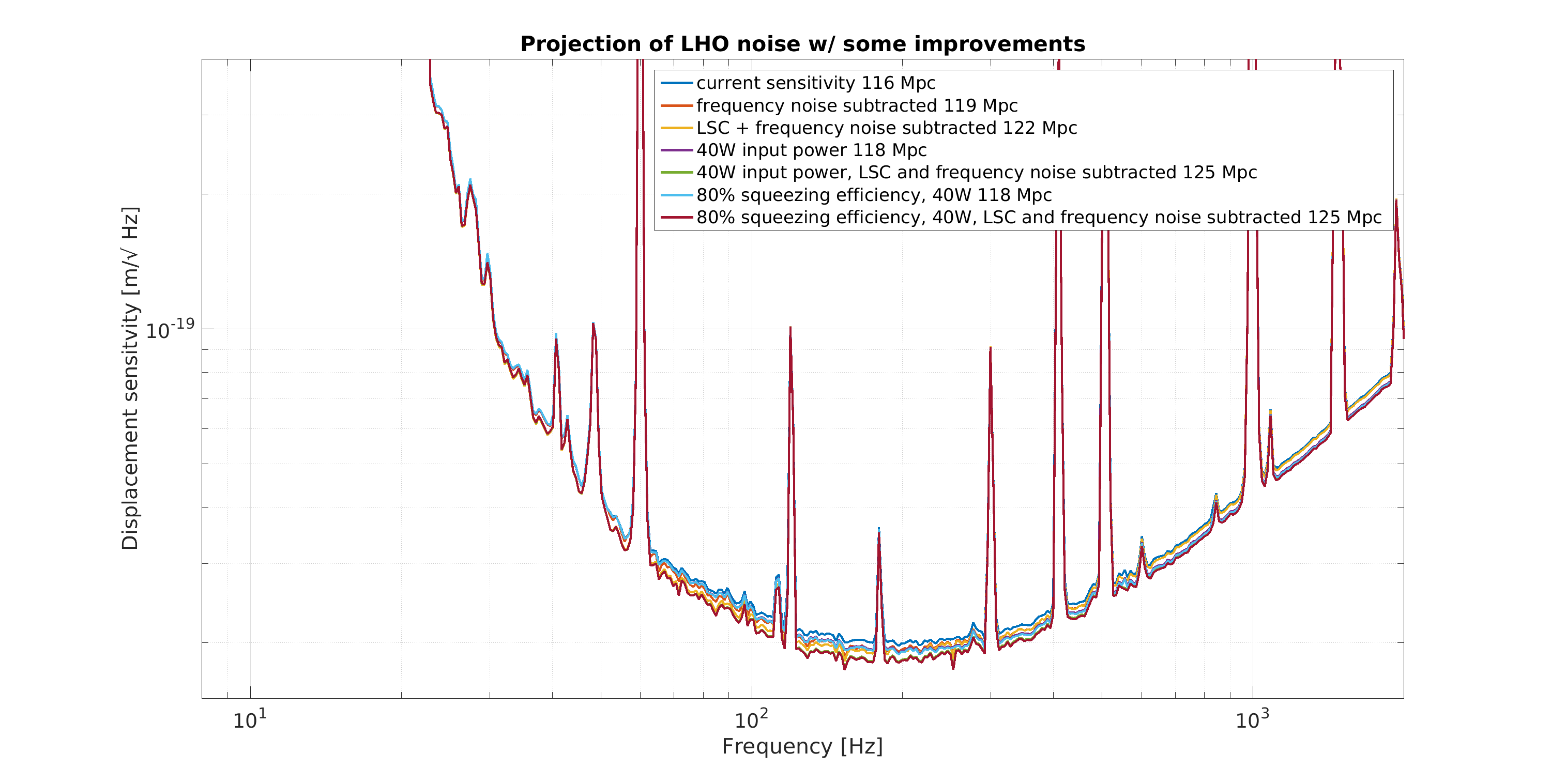
I'm attaching a couple of other figure that were generated when Georgia ran this noise budget that might be useful for reference. The first is the same as Georgia's third plot, but also shows the frqeuency dependence with an attempt at subtracting the correlated noise. This is the correlated noise from the online cross correlation, so the calibration issue shown in Georgia's 4th plot is impacting the subtraction. We did some follow up measurements for this frequency dependence that are shown in 50591 there I did the cross correlation offline which should avoid the calibration issues (or, would have a different calibration issue, in the offline one the subtraction will be limited by the accuracy of the DARM loop model, not by the discrepancies between the online and offline calibration).
The second attachment shows some projections, the ones that involve squeezing should be interpreted with caution.
/ligo/gitcommon/NoiseBudget/simple-noise-budget/restructured_nb/IFO dropped out of Observing from 23:48 (16:48) to 23:56 (16:56) due to power issue with the TCS-Y CO2 laser. TCS-Y was search for a new power and temperature level. Back to Observing when TCS-Y found good power/temperature level.
Georgia, Sheila
We were out of observing for about 10 minutes starting at 22:57 UTC. Our plan was to go back to observing without squeezing for a few minutes to get a no squeezing quiet time to use with the noise budget injections that Georgia did yesterday. We attempted to go to observing using the instructions here: ops wiki but we found that we could not go back to observing because SQZ_MANAGER was not OK. We could not tell why it wasn't OK, it seemed to be in the nominal state and was returning True.
We spent a few minutes trying various things but eventually found that we had enough data so we just set the squeezing back to normal and went back to observing.
The quiet time without squeezing starts at 1245107028 just after a large glitch, and there is 6 minutes of quiet time.
SEI_CONF transition to EQ.
Transitioned back to WINDY around 21:00. Forgot to log the exact time since Hugh just fixed the SDF issue so we no longer drop out of Observe and I don't have a Verbal timestamp.
The SDF issue dropping us out of observing was the ETMX ISI Stage1 X Y Z CPS T240 & L4C BLND NXT filters. ETMY/ITMY & ITMX all had these filter banks Not Monitored. These ETMX channels were switched to Not Monitored.
For longer term study, I've opened FRS Ticket 13123.
Travis's 4-word aLOG claimed the 50000th aLOG and thus we honored this amazing achievement with the attached LHO Paper Plate Award! "This award goes to Travis Sadecki for his 5 words in the 50,000th aLOG (LHO aLOG 50000)." A truly astounding achievement. Who will claim the 100000th aLOG???
Transitioned to SEI EQ mode which kicks us out of Observing. Went back to Observing after transient SDFs cleared themselves.
Tagging @DetChar and SEI for data in seismic's sensor correction configuration transition studies. @DetChar -- the operators have been dilligently logging when they're transitioning from our nominal seismic sensor correction configuration to our earthquake configuration. Can y'all take a look at these times thus far in O3 and make and quantitative statements about how the change in configuration impacts the IFO and the searches? Similar question about the actual *transition,* with an eye towards answering the question "do we need to take the IFO out of observation ready to make the switch, or can we treat it like violin mode damping?" In order to facilitate this study, I'll take a moment to peruse past aLOGs and make sure DetChar and SEI have been tagged.
For longer term study, I've opened FRS Ticket 13123.
I tried to import IIRational.v2 into an ipython notebook on a control room workstation without doing any install, and got an error (see attached).
To fix this Laurence helped me to download and pip install IIRational v2 in my local directory, basically following Jenne's procedure above but in my Downloads folder... That seems to have done the trick. Not sure why I had to do that though.