Displaying reports 40321-40340 of 88907.Go to page Start 2013 2014 2015 2016 2017 2018 2019 2020 2021 End
Reports until 00:04, Thursday 20 June 2019
H1 General
yannick.lecoeuche@LIGO.ORG - posted 00:04, Thursday 20 June 2019 (50077)
Ops OWL Shift Transition

Ops Shift Transition: 06/20/2019, Owl Shift 07:00 – 15:00 (00:00-08:00) - UTC (PT)

State of H1: Locked

Intent Bit: Observing

Weather: 10-25 mph wind, cloudy

Primary 0.03 – 0.1Hz: 0.01 um/s

Secondary 0.1 – 0.3Hz: 0.1 um/s

Outgoing Operator: Jeff

Quick Summary: Locked and observing for half an hour. Wind has been high throughout the day, preventing lock, but according to Jeff it should be winding down.

H1 AOS
jeffrey.bartlett@LIGO.ORG - posted 00:01, Thursday 20 June 2019 (50076)
Ops Evening Shift Summary
Ops Shift Log: 06/19/2019, Evening Shift 23:00 – 07:00 (16:00 - 00:00) Time - UTC (PT)
State of H1: Locked at NLN
Intent Bit: Observing
Support: N/A
Incoming Operator: NIKO
Shift Summary: Switched SEI_CONF to EARTHQUAKE for incoming mag5.9 EQ from Tonga. The effects of the quake were less than expected. However, I switched modes, while locking, and with winds gusting well in the 35mph range. The IOF did not lose locking during this period.
 
   Around 04:00 (21:00) with the wind gusts mostly below 25mph tried to relock. The lock was breaking at LOCKING_ALS as the X-Arm took a dive towards zero power. Tried running the one click Initial Alignment. This appears to stall at the start of the green locking sequence, (probably due to O.E.). Bailed on automation, and ran the Initial Alignment by hand. This work with little intervention.
  At 05:08 (22:08) started relocking. Had trouble with DRMI_1F. Has to run CHECK_MITCH_FIRNGES a few times to get the BS pointed correctly. After this relocking went smoothly. Arrived back at NLN and after clearing a couple of ASC SDF Diffs was back into Observing at 06:25.   
 
Activity Log: Time - UTC (PT)
23:00 (16:00) Take over from Patrick
23:16 (16:16) Kyle – Back from Mid-Y
23:43 (16:43) Peter & Sundae – Going into the Optics Lab
23:55 (16:55) Switch SEI_CONF to EARTHQUAKE for mag5.9 from Tonga
00:09 (17:09) Lost lock at TRANSITION_FROM_ETMX
00:26 (17:26) Switch SEI_CONF back to WINDY after EQ passed
02:10 (19:10) Peter & Sundae – Out of the Optics Lab
04:30 (21:30) Start Initial Alignment
05:08 (22:08) Start Locking
06:25 (23:25) Arrive at NLN and back into Observing
07:00 (00:00) Turn over to Niko

 

H1 General
jeffrey.bartlett@LIGO.ORG - posted 23:40, Wednesday 19 June 2019 (50075)
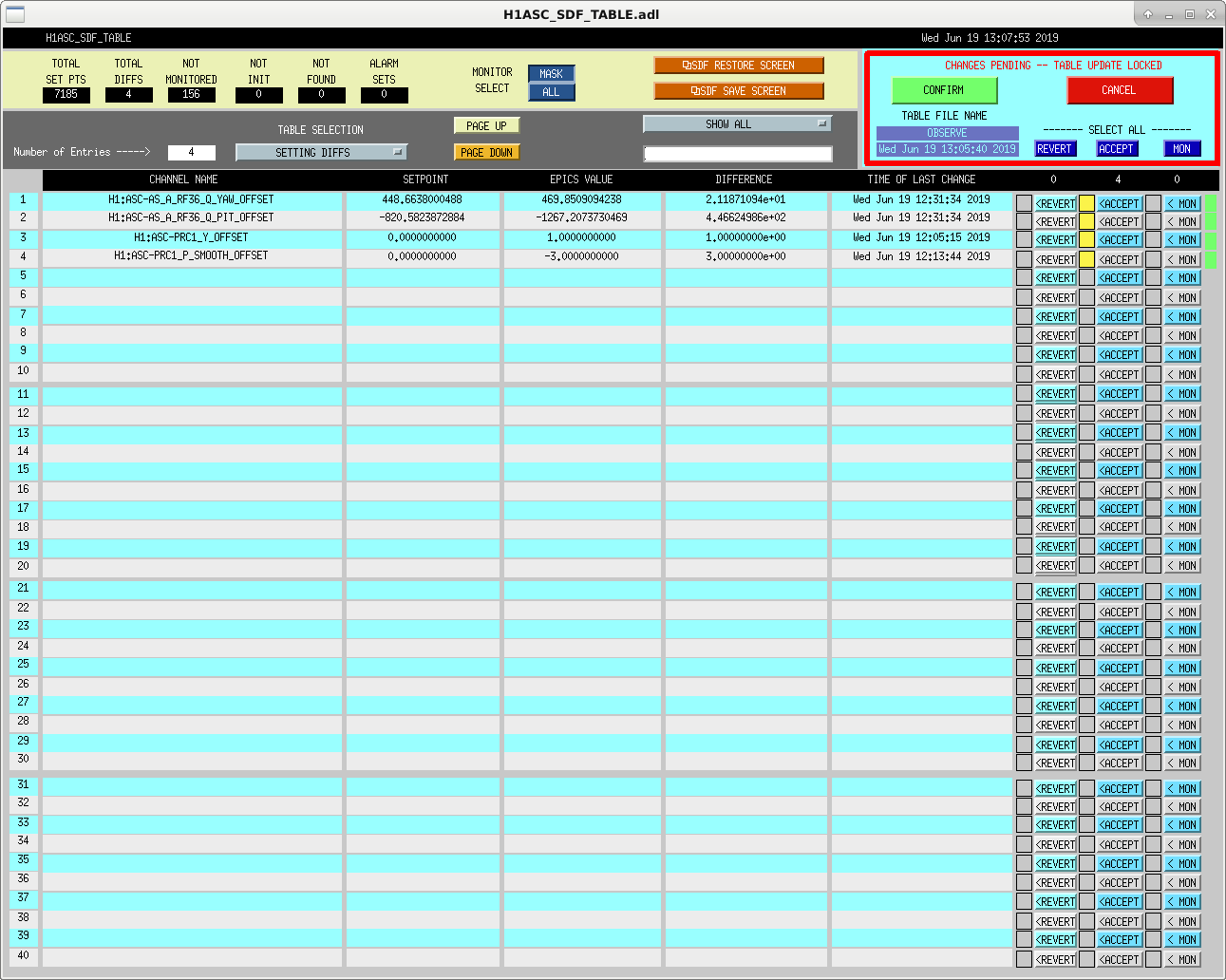
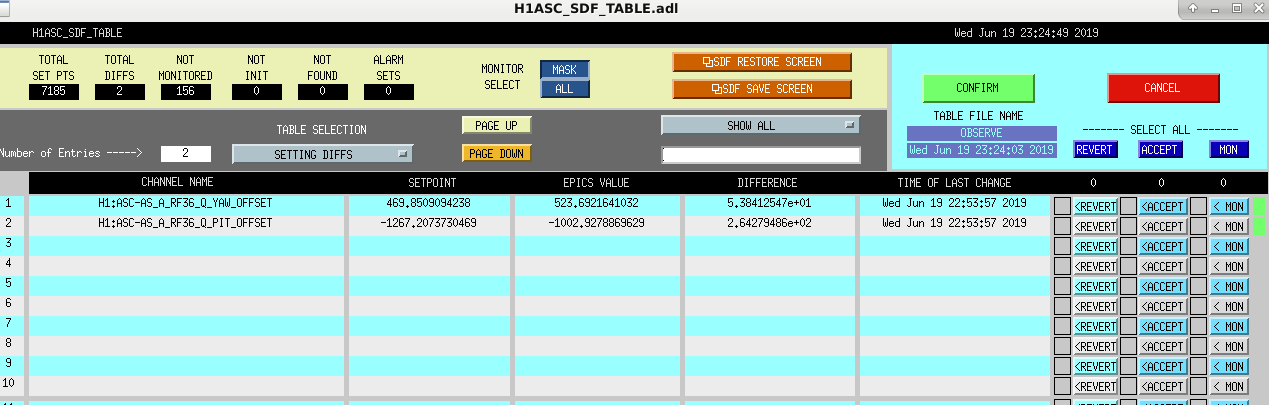
Accept ASC SDF Diffs
   Accepted the two ASC SDF Diffs listed below, in order to get back into Observing. 
Images attached to this report
H1 General
jeffrey.bartlett@LIGO.ORG - posted 20:46, Wednesday 19 June 2019 (50074)
Ops Evening Mid-Shift Summary
   The IFO has been down for the first half of the shift. The high winds continue with base line speeds in the mid-20mph range. There are continual gusts into the mid to upper 30mph range. The forecast calls for the winds to subside later in the evening. 

   The first half of the shift saw three earthquakes of mag 5 and larger. Went into EARTHQUAKE mode for the mag5.8 from Vanuatu. Was able to switch earthquake states while the IFO was locking without apparent problems. 

   Will try running an initial alignment and relocking when the winds lay down a bit.     
Images attached to this report
H1 OpsInfo (ISC, OpsInfo)
sheila.dwyer@LIGO.ORG - posted 17:47, Wednesday 19 June 2019 (50073)
PRMI ASC available

Georgia, Sheila, Patrick

Twice today we had locklosses for environmental reasons, and while Patrick was relocking we had the chance to try out the PRMI ASC.  We fixed some bugs and the guardian path through PRMI ASC should now be working.  It is still an optional path, so in ISC_LOCK if operators think that they would like to do PRMI they have the choice between the way things used to work (select PRMI_LOCKED, align by hand) and selecting PRMI_ASC, which will run the PRMI ASC (MICH and PRM loops), and wait for it to converge, and offload the ASC to the sliders.  If you select nominal low noise the guardain will then move on to DRMI. 

H1 PEM (SEI, SYS)
laurence.datrier@LIGO.ORG - posted 17:40, Wednesday 19 June 2019 (50072)
BNS range and duty cycle if wind-independent for O3

Laurence Datrier. Sheila Dwyer

A follow-up to alog 49682

We convolved our results for BNS range and duty cycle as a function of wind speed with wind speed frequency for O3 (data from 1st April 2019 to 2nd June 2019). We compare the average BNS range and duty cycle to the range if we were independent of the wind. In order to do this we approximated the DC and BNS range if wind-independent to wind values before there is a significant decay (usually 10th to 15th percentile). This is done for 1min max trends for the wind, and 30min max trends.

Trend Average BNS range (Mpc) Average wind-independent BNS range (Mpc) Improvement (Mpc) % improvement on detection rates (based on volume) Average duty cycle Average wind-independent duty cycle
1min max 109.31 109.85 0.54 1.48% 75.15% 84.73%
30min max 109.31 110.23 0.93 2.50% 75.61% 83.66%


H1 General
jeffrey.bartlett@LIGO.ORG - posted 16:14, Wednesday 19 June 2019 (50071)
Ops Evening Shift Transition
Ops Shift Transition: 06/19/2019, Evening Shift 23:00 – 07:00 (16:00 -00:00) - UTC (PT)
State of H1: Unlocked
Intent Bit: Environmental
Weather:   Sikes are partly cloudy as a frontal system works its way through the area. Base line winds are ranging from 15 to 25 mph. Gusts are up to 40 plus. There is a slight change of rain overnight. Temperatures are forecast from the upper 70s to the mid 50s during the evening.
Primary 0.03 – 0.1Hz: 0.6um/s
Secondary 0.1 – 0.3Hz: 0.1mu/s
Outgoing Operator: Patrick
Quick Summary: The commissioners are working on relocking the IFO. This is proving difficult due to the high and gusty winds.  


H1 PSL (PSL)
patrick.thomas@LIGO.ORG - posted 16:14, Wednesday 19 June 2019 (50070)
Weekly PSL Chiller Reservoir Top-Off
FAMIS 10514

The level appears close to the max line, so I did not add any water.

The bottom left canister is yellowed.

There are no errors on the diode chiller.
LHO General
patrick.thomas@LIGO.ORG - posted 16:02, Wednesday 19 June 2019 (50069)
Ops Day Shift Summary
TITLE: 06/19 Day Shift: 15:00-23:00 UTC (08:00-16:00 PST), all times posted in UTC
STATE of H1: Lock Acquisition
INCOMING OPERATOR: Jeff
SHIFT SUMMARY: Second day of NSF review. Calibration measurements and noise budget.
LOG:

15:15 UTC NSF reviewer through gate
15:17 UTC NSF reviewer through gate
15:21 UTC NSF reviewer through gate
15:27 UTC Karen leaving mid Y
15:47 UTC Peter to optics lab
Jenne leading tour in control room
16:32 UTC Jenne leading tour out of control room
17:30 UTC Transitioned from WINDY to EARTH_QUAKE for 6.5 magnitude earthquake in Papua New Guinea
Lock loss
17:35 UTC Peter back
17:49 UTC Georgia and Sheila testing PRMI
18:07 UTC Restarted video0
19:35 UTC SEI_CONF back to WINDY
20:05 UTC NLN
20:08 UTC Observing
20:08 UTC Sundae to optics lab
20:31 UTC Apollo through gate
20:34 UTC Running CAL measurements
21:10 UTC Peter to optics lab
21:25 UTC Done CAL measurements
21:37 UTC Georgia running noise budget
22:29 UTC Kyle to mid Y
22:36 UTC Lockloss
LHO General
patrick.thomas@LIGO.ORG - posted 13:09, Wednesday 19 June 2019 (50068)
Observing
20:08 UTC Accepted attached ASC SDF differences.
Images attached to this report
LHO VE
kyle.ryan@LIGO.ORG - posted 12:12, Wednesday 19 June 2019 - last comment - 12:40, Wednesday 19 June 2019(50066)
Scroll pump tip seal wear dust particulate

Attached is an image showing two years worth of scroll pump tip seal (PTFE) wear accumulation in the scroll pump used to back our VBOD RGA turbo.  Unlike our typical scroll pumps which experience viscous flow from time to time, either as the result of rough pumping a volume from atmosphere or from an introduced ballast purge, this pump has never experienced viscous throuput. 

The "amount" of wear (dust) is normal and is a function of run time.  Of interest here is the degree of accumulation and not the degree of generation. 

Note that this dust would be "blown" out of the exhaust port if/when this pump were to pump a viscous load :)

Non-image files attached to this report
Comments related to this report
chandra.romel@LIGO.ORG - 12:40, Wednesday 19 June 2019 (50067)

We fix one problem and create another. Might be worth pumping air through the RGA scroll from time to time.

H1 CDS
david.barker@LIGO.ORG - posted 10:31, Wednesday 19 June 2019 (50064)
Restart of mx_stream process on h1seiex and h1susex has not stopped CRC events

Tuesday afternoon I restarted the mx_stream process on h1susex (14:56 PDT) and h1seiex (14:57 PDT). Since that time we have had two h1seiex DAQ-CRC error events.

BTW: I'm detailing this problem on this wiki page

H1 CAL (CAL)
aaron.viets@LIGO.ORG - posted 08:12, Wednesday 19 June 2019 - last comment - 15:02, Monday 16 September 2019(50061)
SRC detuning time dependence investigations
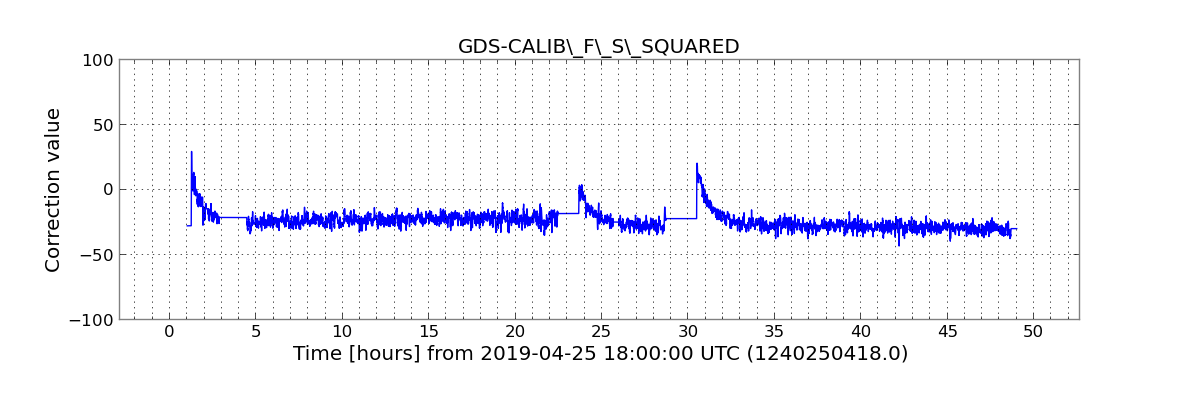
This is a continuation of the investigation in this aLOG comment: https://alog.ligo-wa.caltech.edu/aLOG/index.php?callRep=49620

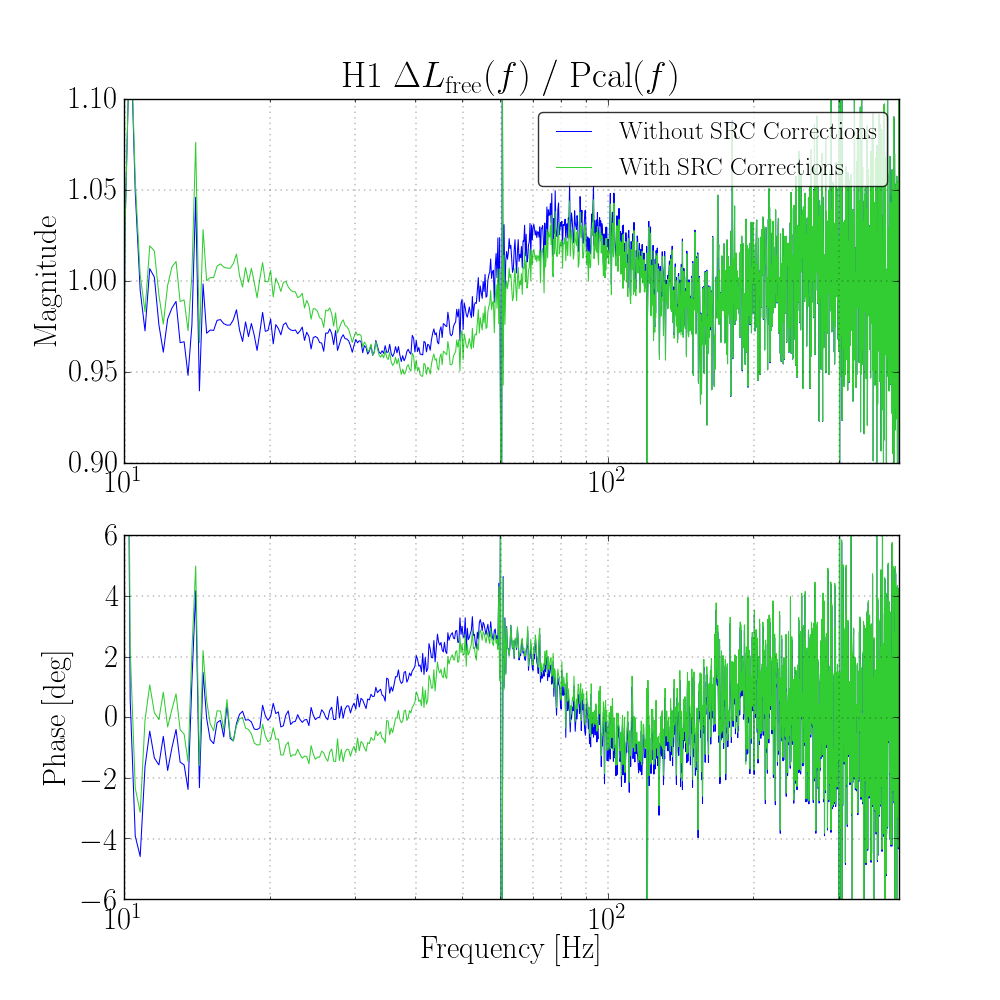
I've plotted 48 hours of data beginning at 19:00 UTC on April 25, 2019.  The goal was to capture the SR3 change noted here: https://alog.ligo-wa.caltech.edu/aLOG/index.php?callRep=48787.  There is no obvious noteworthy change in the spring frequency or quality factor seen in this plot, only the usual changes in the few hours at the beginning of each lock stretch.  The last plot shows trends of DeltaL / Pcal for the same 48-hour period, comparing C00 to a calibration that additionally corrects for time dependence in fs and Q, as well as kappa_PUM and kappa_UIM.  It is consistent with the result of the previous aLOG comment, showing that compensating for more time dependence consistently improves calibration accuracy.
Images attached to this report
Comments related to this report
jeffrey.kissel@LIGO.ORG - 10:32, Wednesday 19 June 2019 (50065)ISC
Quick trend comparing SRC spring freqnuency against BNS range and DRMI power levels.
This will be done much more carefully ... soon.
Non-image files attached to this comment
aaron.viets@LIGO.ORG - 10:15, Wednesday 10 July 2019 (50480)
[J. Kissel, A. Viets]

At Jeff's request, I made time series plots of the SRC optical spring squared frequency with several front-end channels on the same plot, to see which are highly correlated.  Additionally, I've listed (in the same order as the plots) the Pearson correlation coefficients between fs^2 and each other channel.  Note that the correlation is reduced by two effects: first, fs^2 is not computed during lock loss and therefore remains constant, and second, noisy fluctuations (on ~2 minute time scales for fs^2, since that is about how much input data is used to compute each output value) are probably not correlated.

Channel Name                                               Name in Plot                 Correlation Coefficient            Description

H1:LSC-TR_Y_NORM_INMON                        TRY                                -0.07759334                           arm cavity power, normalized to power when the Y arm is locked alone
H1:LSC-TR_X_NORM_INMON                       TRX                                -0.07641386                           arm cavity power, normalized to power when the X arm is locked alone
H1:LSC-POPAIR_B_RF90_I_NORM_MON      POP90                           0.00209429                            45 MHz sidebands inside PRC
H1:LSC-POPAIR_B_RF18_I_NORM_MON      POP18                            0.05289885                            9 MHz sidebands inside PRC
H1:LSC-PR_GAIN_OUT16                              PRG                               -0.0719822                              power recycling gain
H1:LSC-POP_A_LF_OUT16                            POP DC                         -0.09153975                            power inside the PRC
H1:LSC-REFL_A_LP_NORM                           REFL DC                        0.01795835                             power reflected off of the input to PRM
H1:IMC-MC2_TRANS_SUM_OUT16              IMC TRANS                    -0.08331603                           power transmitted from the IMC

By eye, the power recycling gain, the power in both arm cavities, the power in the PRC, seem to be consistently negatively correlated.  So it would appear that the SRC's optical spring frequency is related in some way to the power circulating in the detector.  Note the physical meaning of fs^2 as we have defined it: a positive value indicates an optical anti-spring, and a negative value indicates an optical spring.  Based on these results, more power in the detector => optical spring is less "anti" and more "pro."
Images attached to this comment
aaron.viets@LIGO.ORG - 08:08, Thursday 08 August 2019 (51124)

The original aLOG entry shows that correcting for time-dependent systematic errors in the sensing function assuming a model with SRC detuning improves calibration accuracy at the lowest Pcal line frequency.  Given that we now believe the primary cause of low-frequency time-dependent systematic errors in the sensing function is a parasitic coupling of angular motion sensing to DARM rather than SRC detuning (see G1901353 and LHO aLOG 50992), I wanted to investigate whether correcting for SRC detuning could lead to an overall improvement in calibration accuracy.  The short answer is "Well, close to the lowest Pcal line, yes, but not reliably at other frequencies."  I used four Y-end Pcal broadband injections (RX channel), and plotted DeltaL / Pcal from 10-400 Hz for two calibrated data sets: one that corrected for all modeled time-dependence except SRC detuning (spring frequency f_s and quality factor Q), and one that additionally includes time-dependent corrections for SRC detuning.  In order to get a measurement of all time-dependent correction factors, I started the gstlal calibration pipeline ~1 hour before the broadband injection, since the calibration lines are turned off during the injections.  The dates and associated aLOGs are listed below in the same order as the plots:

Images attached to this comment
aaron.viets@LIGO.ORG - 18:23, Tuesday 13 August 2019 (51251)

Text files with the data of the plots in the previous comment can be found in the calibration SVN in this directory:

aligocalibration/trunk/Runs/O3/H1/Measurements/FullIFOSensingTFs/

with names like

H1_With_SRC_Corrections_over_CAL-PCALY_RX_PD_OUT_DQ_[GPS_START_TIME]-[DURATION].txt

for data corrected for "SRC detuning" time dependence and names like

H1_Without_SRC_Corrections_over_CAL-PCALY_RX_PD_OUT_DQ_[GPS_START_TIME]-[DURATION].txt

for data that is not.

jeffrey.kissel@LIGO.ORG - 15:02, Monday 16 September 2019 (51975)
Since there is now precedent, I've moved and committed the above mentions "DCS analysis of broadband injections" text files in to the DCS_BB_plots/ directory, e.g.
    /ligo/svncommon/CalSVN/aligocalibration/trunk/Runs/O3/H1/Measurements/FullIFOSensingTFs/DCS_BB_plots/
        H1_Without_SRC_Corrections_over_CAL-PCALY_RX_PD_OUT_DQ_1244406526-120.txt
        H1_Without_SRC_Corrections_over_CAL-PCALY_RX_PD_OUT_DQ_1246226240-120.txt
        H1_Without_SRC_Corrections_over_CAL-PCALY_RX_PD_OUT_DQ_1247431237-120.txt
        H1_Without_SRC_Corrections_over_CAL-PCALY_RX_PD_OUT_DQ_1248718240-120.txt
        H1_With_SRC_Corrections_over_CAL-PCALY_RX_PD_OUT_DQ_1244406526-120.txt
        H1_With_SRC_Corrections_over_CAL-PCALY_RX_PD_OUT_DQ_1246226240-120.txt
        H1_With_SRC_Corrections_over_CAL-PCALY_RX_PD_OUT_DQ_1247431237-120.txt
        H1_With_SRC_Corrections_over_CAL-PCALY_RX_PD_OUT_DQ_1248718240-120.txt
LHO General
patrick.thomas@LIGO.ORG - posted 08:07, Wednesday 19 June 2019 (50062)
Ops Day Shift Transition
TITLE: 06/19 Day Shift: 15:00-23:00 UTC (08:00-16:00 PST), all times posted in UTC
STATE of H1: Observing at 113Mpc
OUTGOING OPERATOR: TJ
CURRENT ENVIRONMENT:
    Wind: 21mph Gusts, 16mph 5min avg
    Primary useism: 0.07 μm/s
    Secondary useism: 0.08 μm/s 
QUICK SUMMARY:

No immediate issues.
LHO General
thomas.shaffer@LIGO.ORG - posted 08:00, Wednesday 19 June 2019 (50057)
Ops Owl Shift Summary

TITLE: 06/19 Owl Shift: 07:00-15:00 UTC (00:00-08:00 PST), all times posted in UTC
STATE of H1: Observing at 116Mpc
INCOMING OPERATOR: Patrick
SHIFT SUMMARY: Normal recovery after the earthquake rang down, and then we have been locked for 4.5hrs since.
LOG:

H1 General
thomas.shaffer@LIGO.ORG - posted 04:37, Wednesday 19 June 2019 (50060)
Ops Mid Shift Report

Winds have picked back up to 30mph. 1.5hour lock. We dropped Observing briefly due to the squeezer losing lock, but it relocked quickly.

H1 General
thomas.shaffer@LIGO.ORG - posted 03:18, Wednesday 19 June 2019 (50059)
Observing 1017 UTC

After the EQ calmed down, I ran an initial alignment and then it relocked. Accepted a few ASC and LSC SDFs.

Images attached to this report
LHO VE
chandra.romel@LIGO.ORG - posted 17:11, Tuesday 18 June 2019 - last comment - 09:02, Wednesday 19 June 2019(50024)
LN2 Dewar fill line upgrade

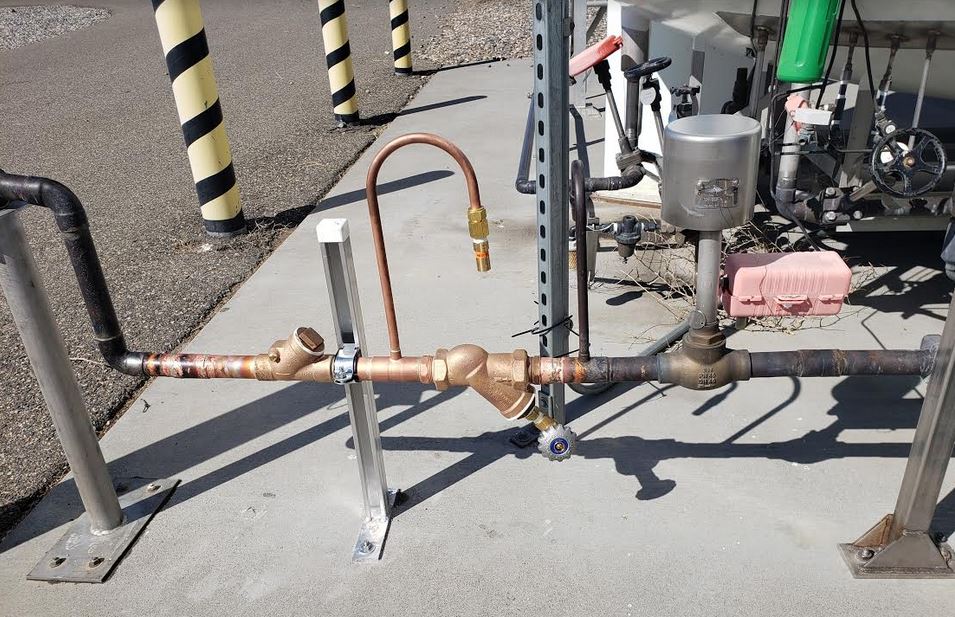
Contractor spent the day installing new components on all eight liquid nitrogen Dewar fill lines to bring skids up to industry standard. Components include check valve, pressure relief valve, strainer, and drain valve. At their recommendation, a support stand was installed and anchored into concrete upon hammer drilling holes. Corner and end station skids were completed before noon to minimize impact on observing.

Check valve = Nibco class 200 bronze T-453-B 1.5"

Drain valve = Rego Goddard T9454 1/2" F.NPT with BK9450R stem

Strainer = Mueller Steam Specialty LF352 1.5" with non-standard 100 mesh for cryogenic application

Pressure relief valve = rated for 350 psi

Picture of CP1 skid attached.

Note:  the existing pressure relief valve just upstream of the control module safety valve on all skids, except CP1 skid, was removed to accommodate stack up length of new components

Images attached to this report
Comments related to this report
chandra.romel@LIGO.ORG - 09:02, Wednesday 19 June 2019 (50063)

Worth noting that contractor purged pipe with gas N2 while brazing to prevent scaling on the inner surface.

The new strainer mesh is intended to prevent debris from entering the system, but does not filter ice. Contractor recommends cleaning it 2x/yr.

Displaying reports 40321-40340 of 88907.Go to page Start 2013 2014 2015 2016 2017 2018 2019 2020 2021 End