TITLE: 06/10 Eve Shift: 23:00-07:00 UTC (16:00-00:00 PST), all times posted in UTC
STATE of H1: Commissioning
OUTGOING OPERATOR: Patrick
CURRENT ENVIRONMENT:
Wind: 10mph Gusts, 7mph 5min avg
Primary useism: 0.02 μm/s
Secondary useism: 0.14 μm/s
QUICK SUMMARY: H1 is locked, in Commissioning, Jenne and Georgia, and Patrick is finishing up some measurements
It seems like the online lockloss code isn't running - many of the locklosses in the last several days have failed.
DQ Shift: LHO during June 3rd, 2019 0:00 UTC - June 9th, 2019 23:59:59 UTC (1243555218-1244160017) https://wiki.ligo.org/DetChar/DataQuality/DQShiftLHO20190603 Whistles continue to show up most days when strong ground motion is present, especially in 0.03-0.1 Hz band. Previous studies have tied this to greater variance in the VCO frequency when ground motion is present. Whistles (RF beatnotes) hurt some transient analyses and would be a good thing to get fixed. There were two observed instances of Parametric Instability modes Thursday and Friday (see alogs 49698 and 49743). The first of these caused a lockloss and a very fake but very spectacular-looking temporary increase in the reported binary neutron star inspiral range. The 48 Hz line and its harmonics showed up prominently in first half of UTC day Thursday. 96 Hz in particular showed up prominently in the omicron gltichgram and had a modest observed impact on coherent WaveBurst online background. On Friday, around 40 squeezer channels were added to the H1 configuration file used for omega scans and omicron trigger production. Any new appearances of squeezing channels in hveto or scans therefore might be the result of a new configuration in detchar tools rather than a change in the instrument. Hveto roundup: LSC-POP_A_LF and LSC-REFL_A_LF are, as ever, the most prominent hveto winners as witnesses of loud glitching and whistles. Some deeper cuts are significantly correlated with low frequency noise, however, including H1:LSC-POP_A_RF9_Q_ERR_DQ as Round 2 on June 5th, H1:LSC-REFL_A_RF45_Q_ERR_DQ as Round 2 on June 6th and H1:ASC-SRC2_Y_OUT_DQ as Round 3 on June 8th. Overall weekly duty cycle was 79.4%, including 100% observing Saturday. ~108 Mpc characteristic range at the start of the week increased to ~114 Mpc by the weekend.
Commissioning since 17:00 UTC. Jenne working on higher power. Sheila working on squeezer.
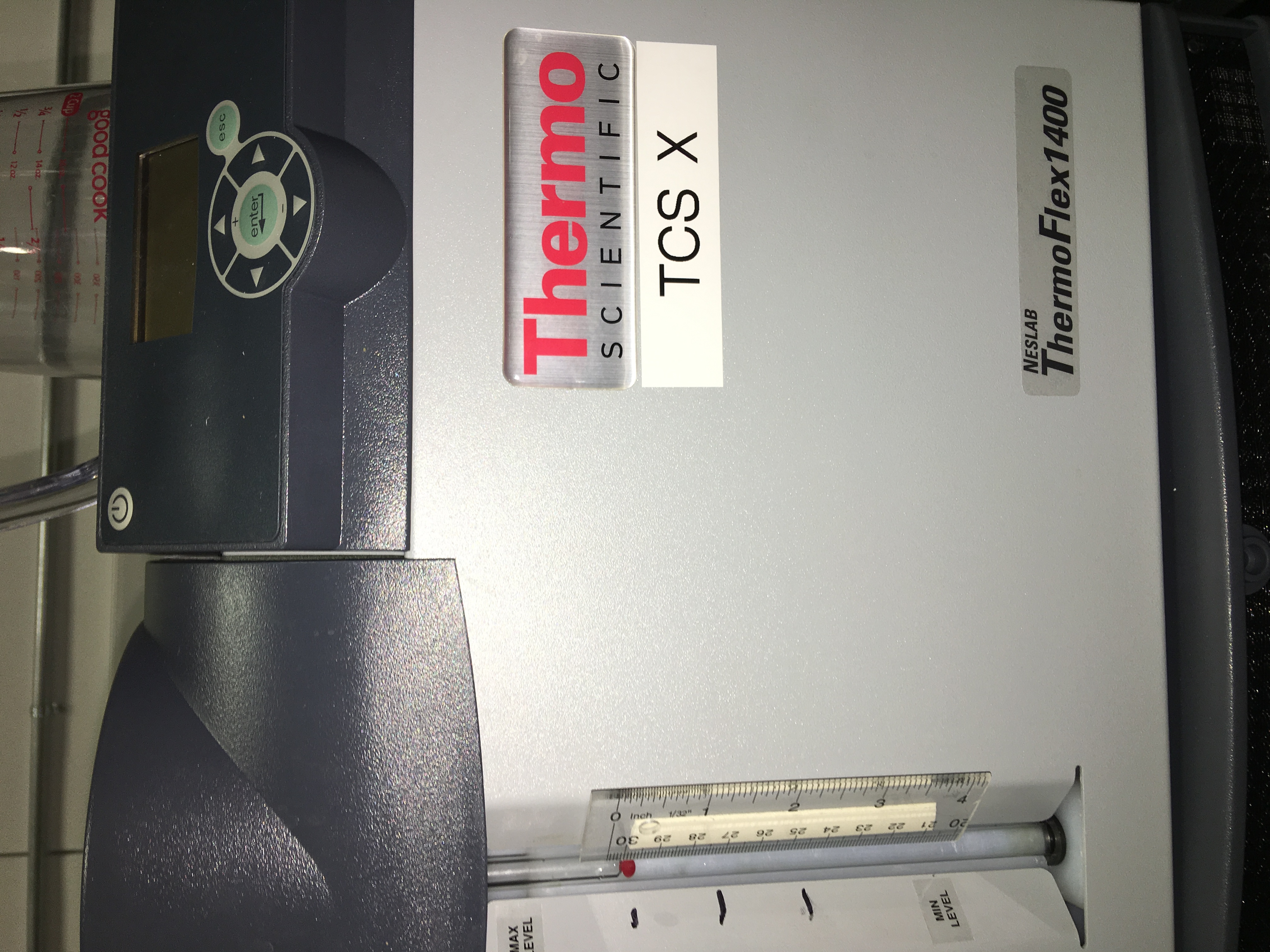
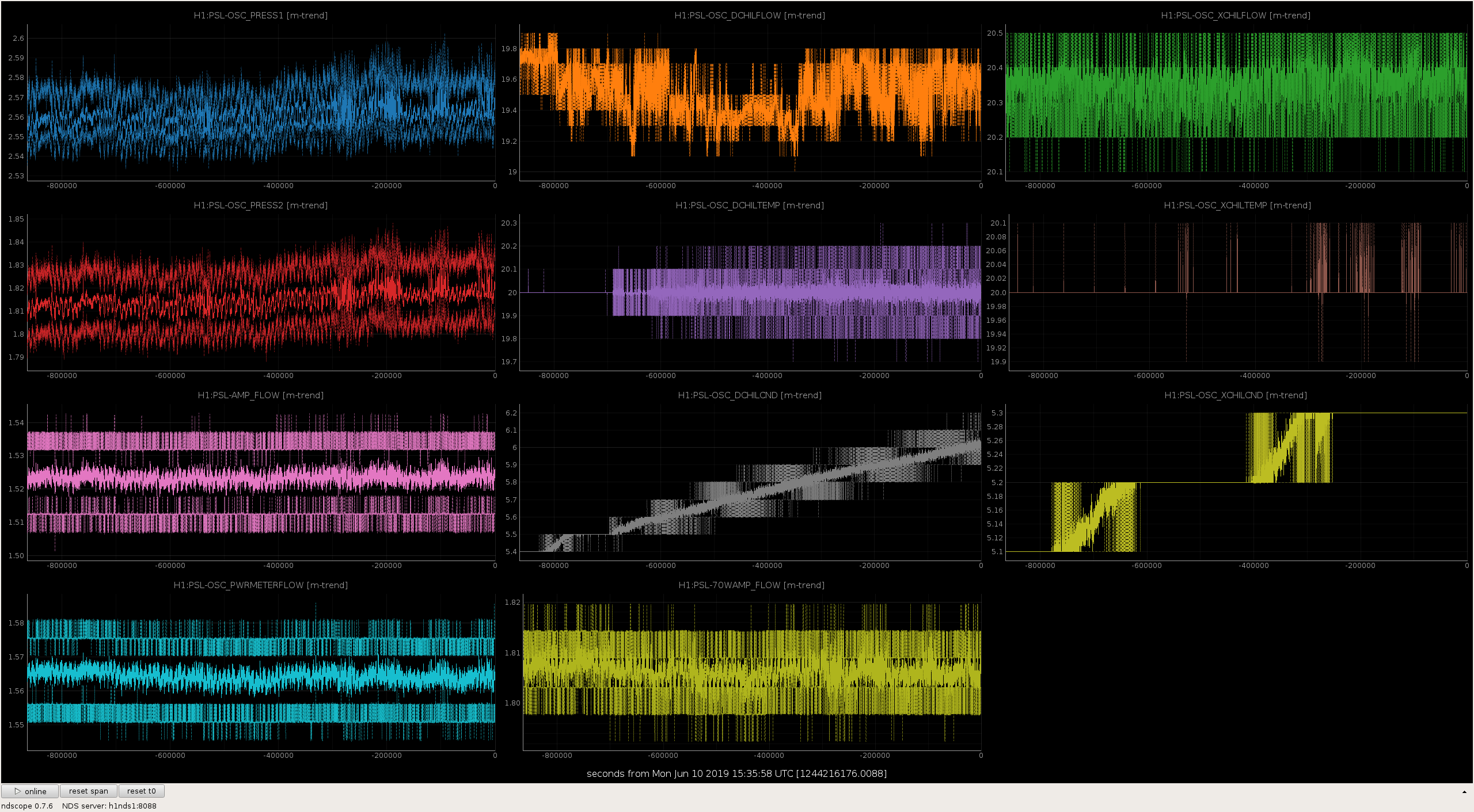
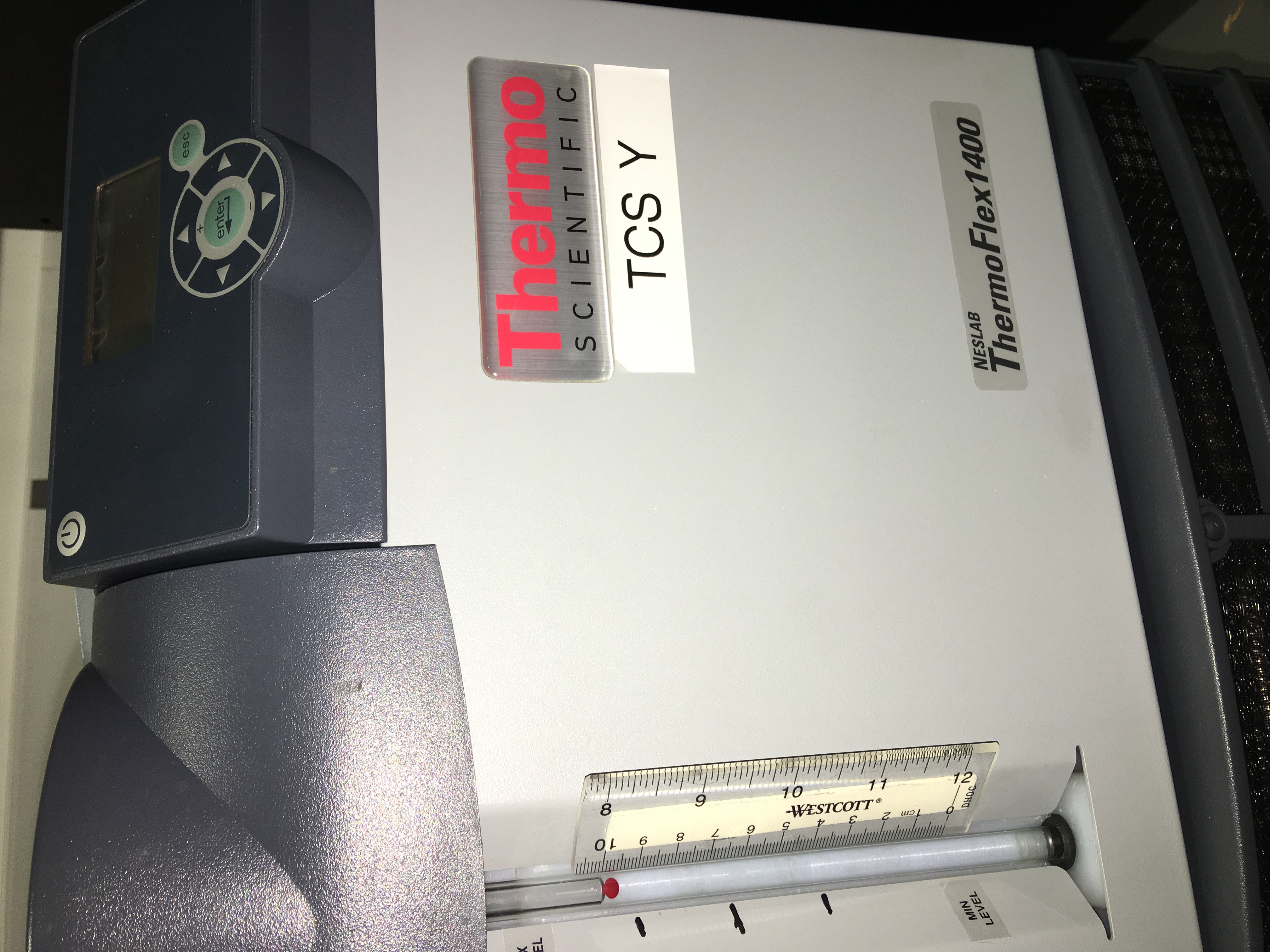
Chiller levels were ok. No leakage of any sort observed. Log updated.
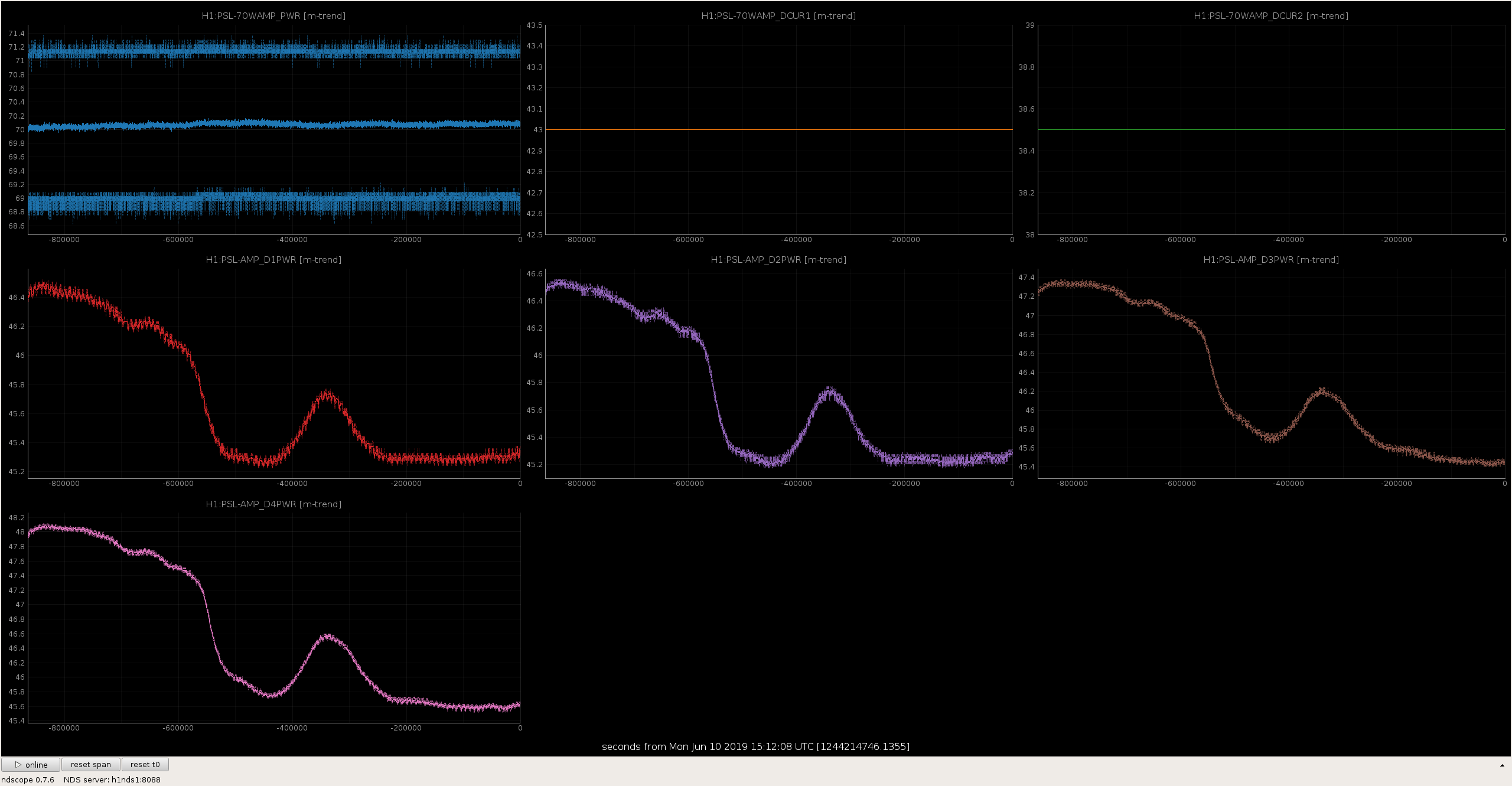
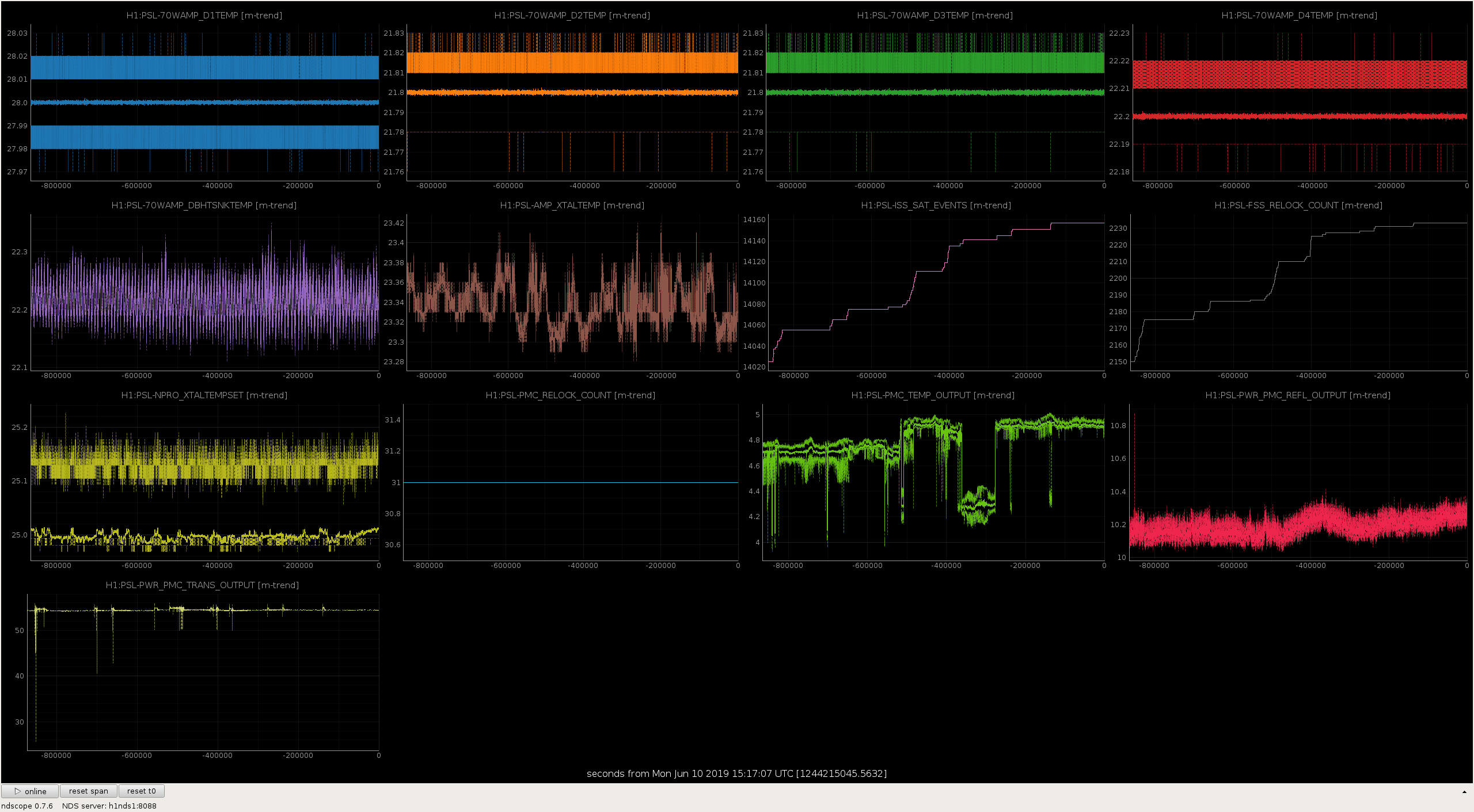
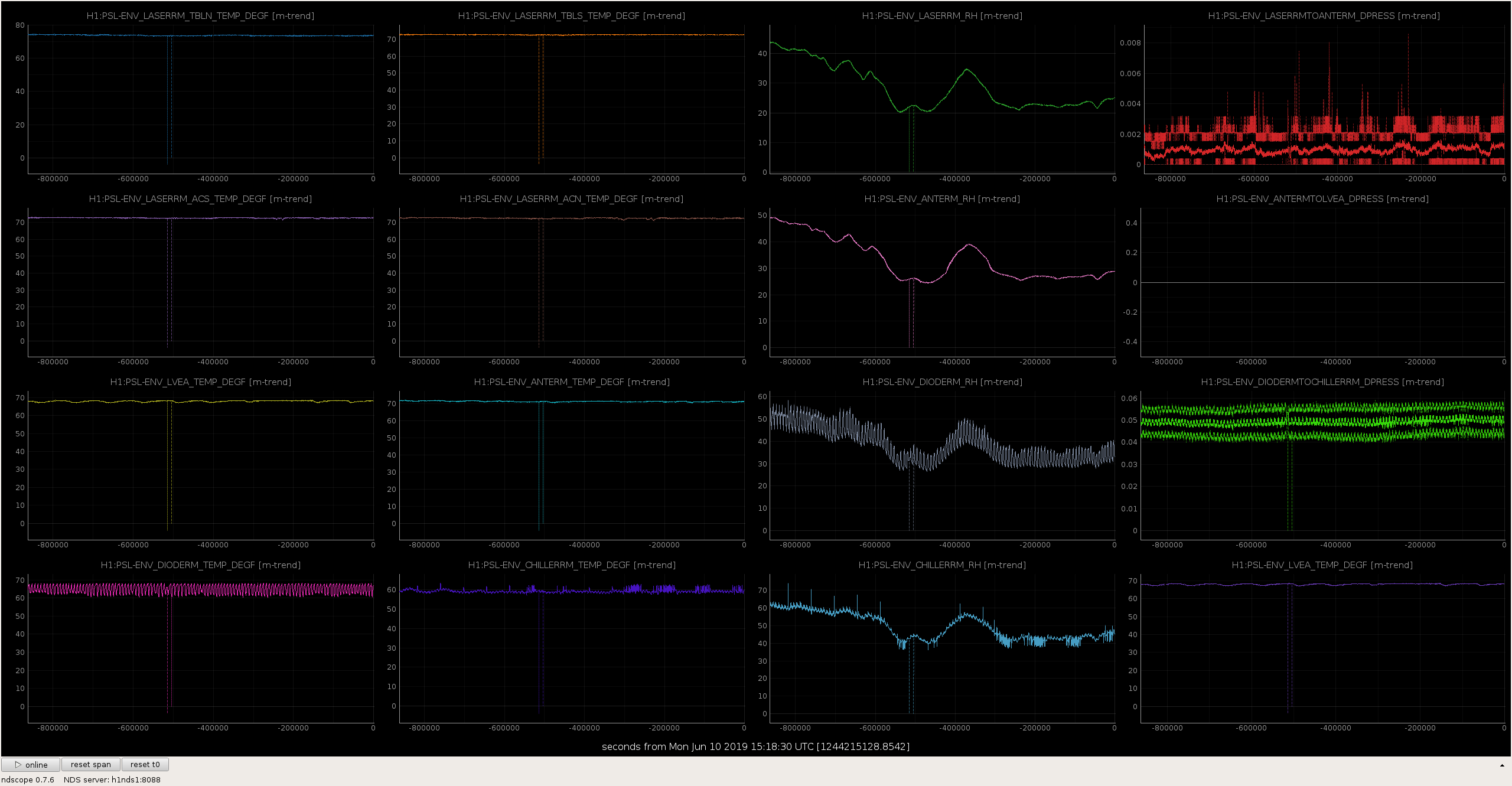
All plots seem nominally ok. There was a notable drop in Diode power trends, especially in D4 which are classically tracking rel humidity levels.
TITLE: 06/10 Day Shift: 15:00-23:00 UTC (08:00-16:00 PST), all times posted in UTC
STATE of H1: Observing at 116Mpc
OUTGOING OPERATOR: Jim
CURRENT ENVIRONMENT:
Wind: 4mph Gusts, 3mph 5min avg
Primary useism: 0.02 μm/s
Secondary useism: 0.11 μm/s
QUICK SUMMARY:
No issues.
TITLE: 06/10 Owl Shift: 07:00-15:00 UTC (00:00-08:00 PST), all times posted in UTC
STATE of H1: Observing at 115Mpc
INCOMING OPERATOR: Patrick
SHIFT SUMMARY:
LOG:
Couple of small earthquakes and a GRB. Nothing else happened.
TITLE: 06/09 Eve Shift 23:00 – 07:00 (16:00-00:00), all times posted in UTC
STATE of H1: Observing
INCOMING OPERATOR: Jim
SHIFT SUMMARY: Quiet shift with a few GRB’s and little seismic activity.
LOG:.
23:00 (16:00) Start of shift
23:01 (16:01) GRB (E335781). Following the new GRB protocol, no stand down required
04:03 (21:03) GRB (E335810). No stand down required
06:39 (23:39) GRB (E335818). Stand down required (not that there’s any work going on), going to wait ~45 minutes since VIRGO just recently relocked.
07:00 (00:00) End of shift
Quiet night, no seismic activity, low wind. Locked for 25 hours.
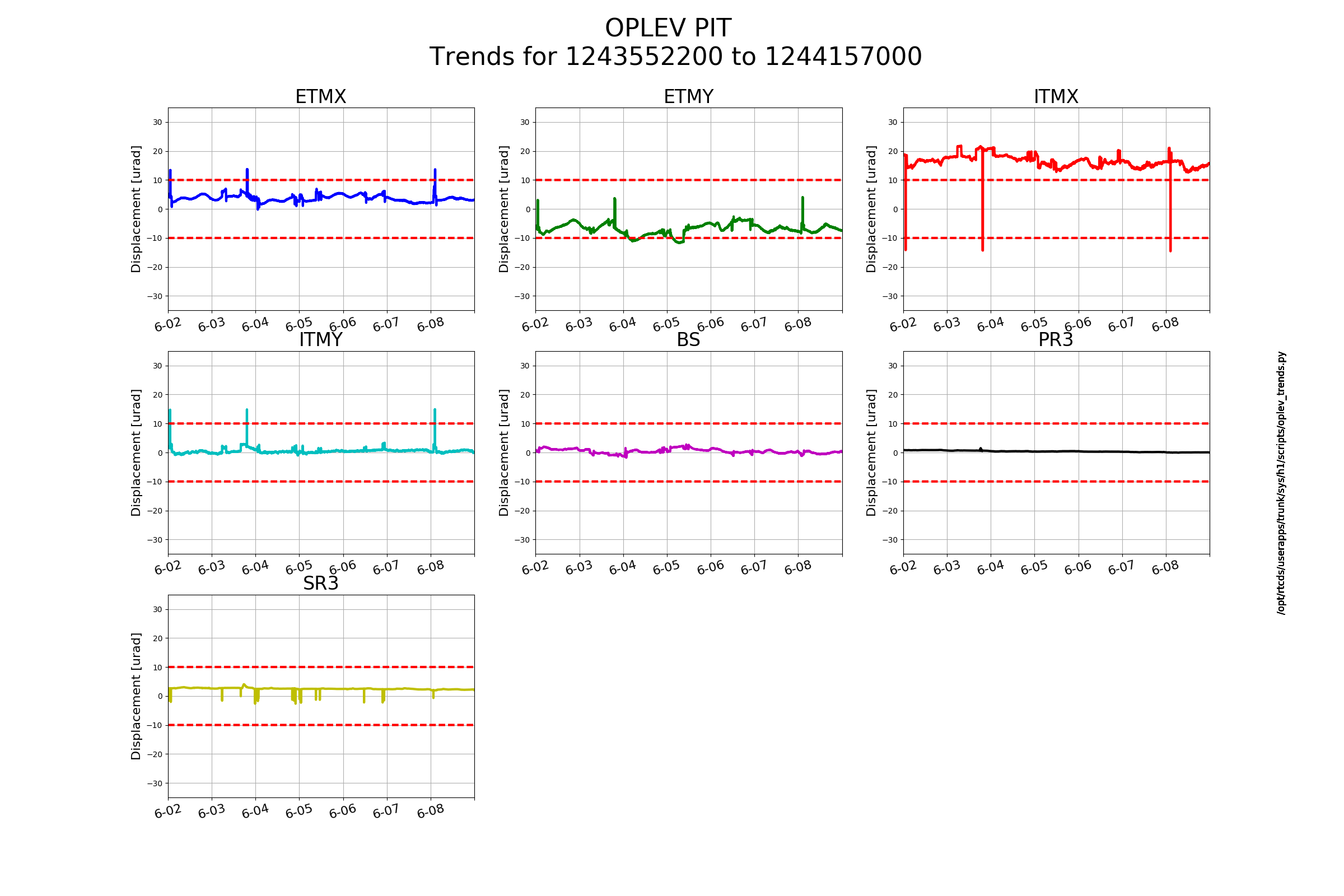
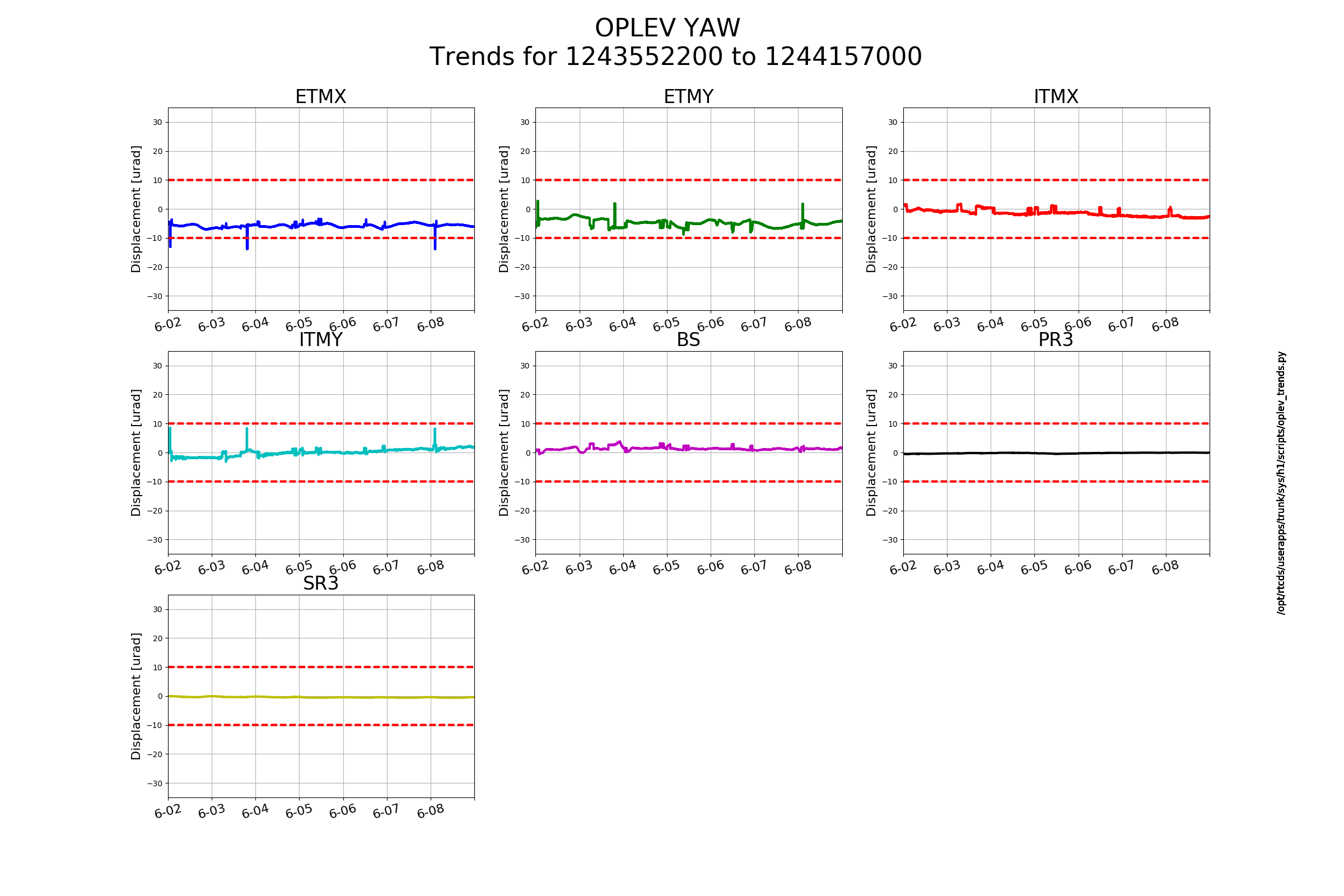
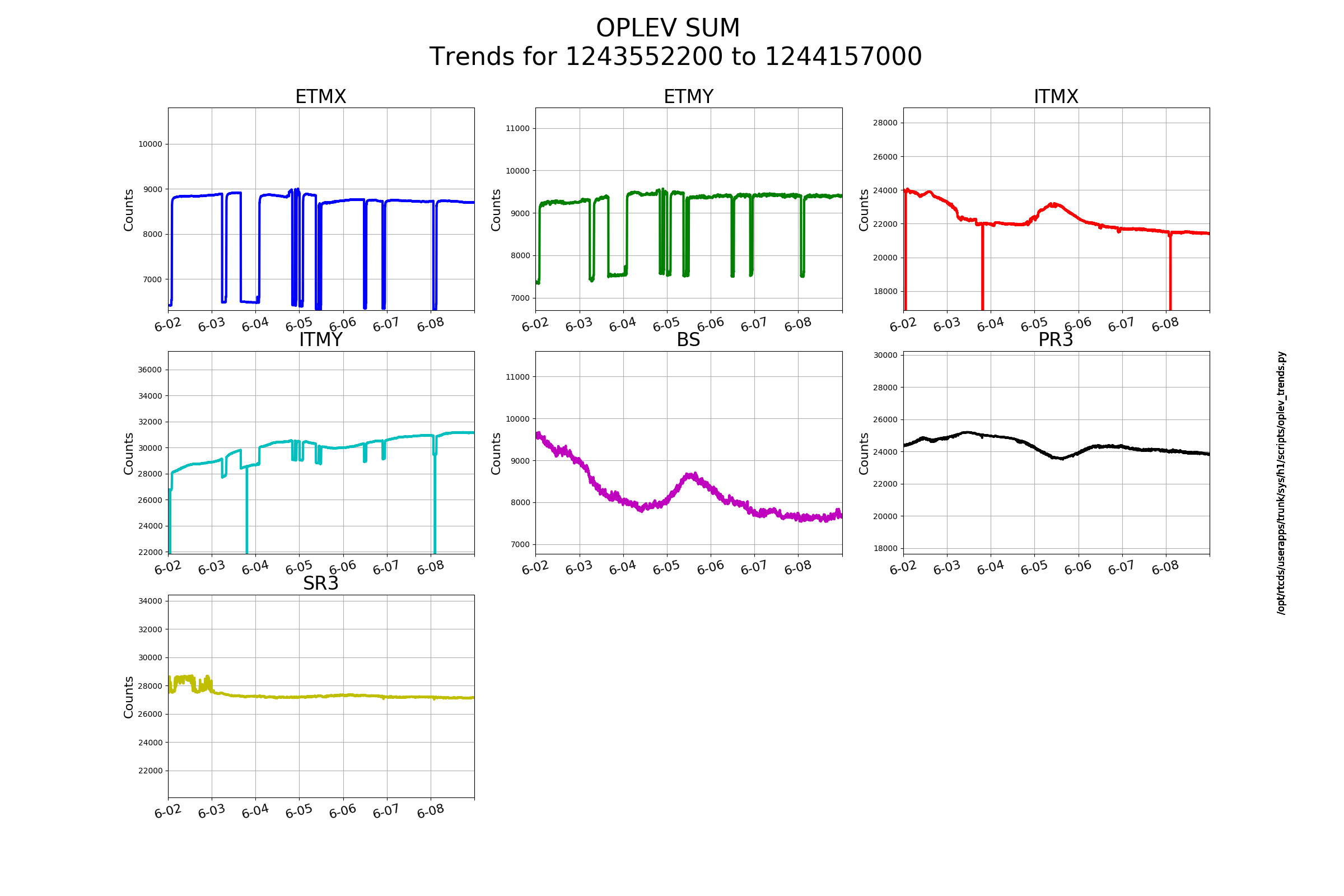
ITMX pitch is centered around 15 urad, and ETMY pitch has dropped below -10 urad twice in the last week.
Seems like the PSL is working fine
PMC:
It has been locked 12 days, 5 hr 45 minutes (should be days/weeks)
Reflected power = 10.25Watts
Transmitted power = 54.49Watts
PowerSum = 64.74Watts.
FSS:
It has been locked for 0 days 22 hr and 54 min (should be days/weeks)
TPD[V] = 5.138V (min 0.9V)
ISS:
The diffracted power is around 2.2%
Last saturation event was 0 days 22 hours and 54 minutes ago (should be days/weeks)
Possible Issues:
Ops Shift Transition: 06/09/2019, Eve Shift 23:00 – 7:00 (16:00-00:00) - UTC (PT)
State of H1: Locked
Intent Bit: Observing
Weather: 15 mph wind, sunny
Primary 0.03 – 0.1Hz: 0.01 um/s
Secondary 0.1 – 0.3Hz: 0.08 um/s
Outgoing Operator: Patrick
Quick Summary: Locked and observing for 20 hours. No significant seismic activity today.
TITLE: 06/09 Day Shift: 15:00-23:00 UTC (08:00-16:00 PST), all times posted in UTC STATE of H1: Observing at 113Mpc INCOMING OPERATOR: Niko SHIFT SUMMARY: Remained locked and in observing entire shift. LOG: 16:01 UTC GRB (E335756) Confirmed with LLO Fermi sub threshold 581776014 rel 2 ignored 21:14 - 22:51 UTC Chris on site
Have remained locked and in observing. No issues.
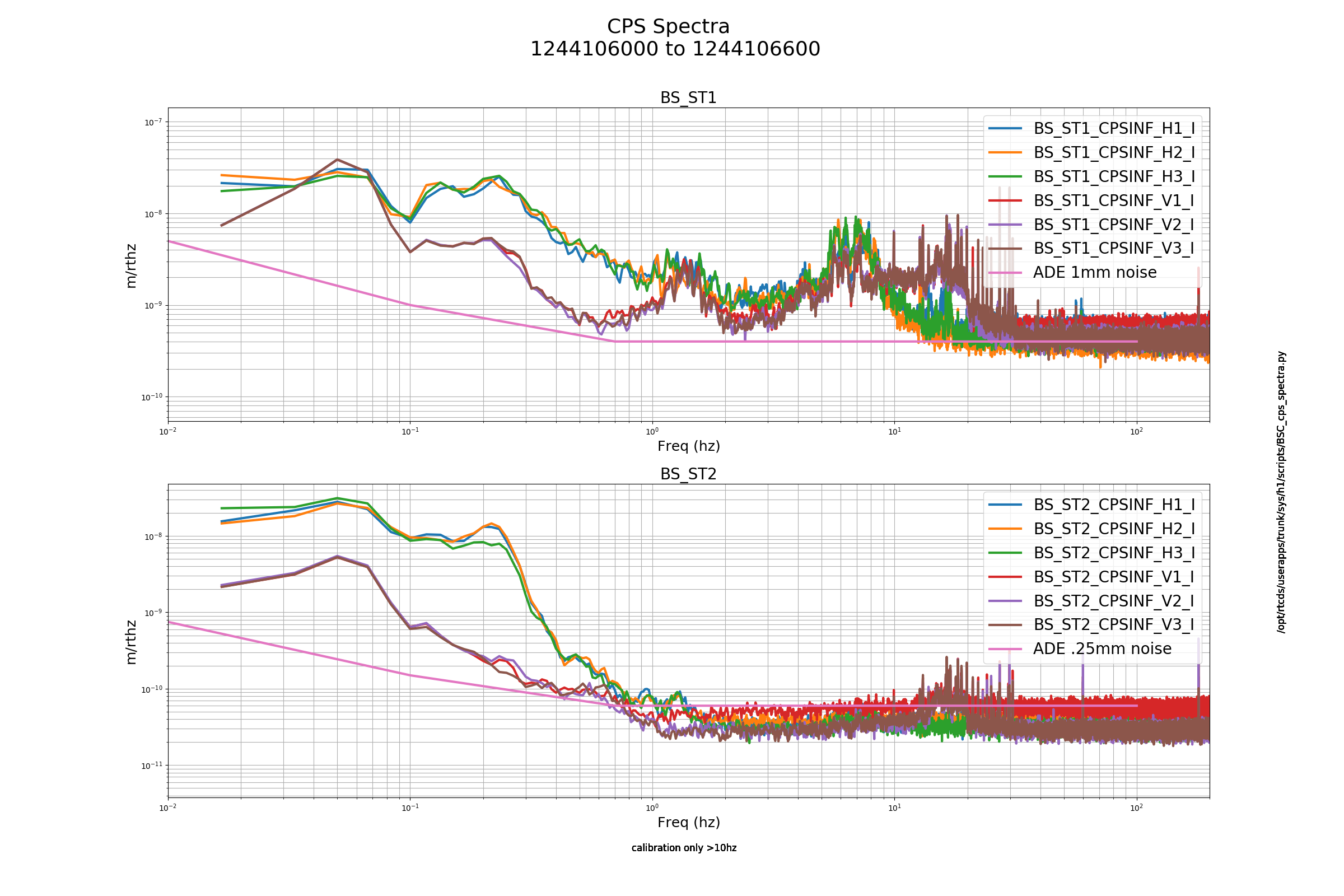
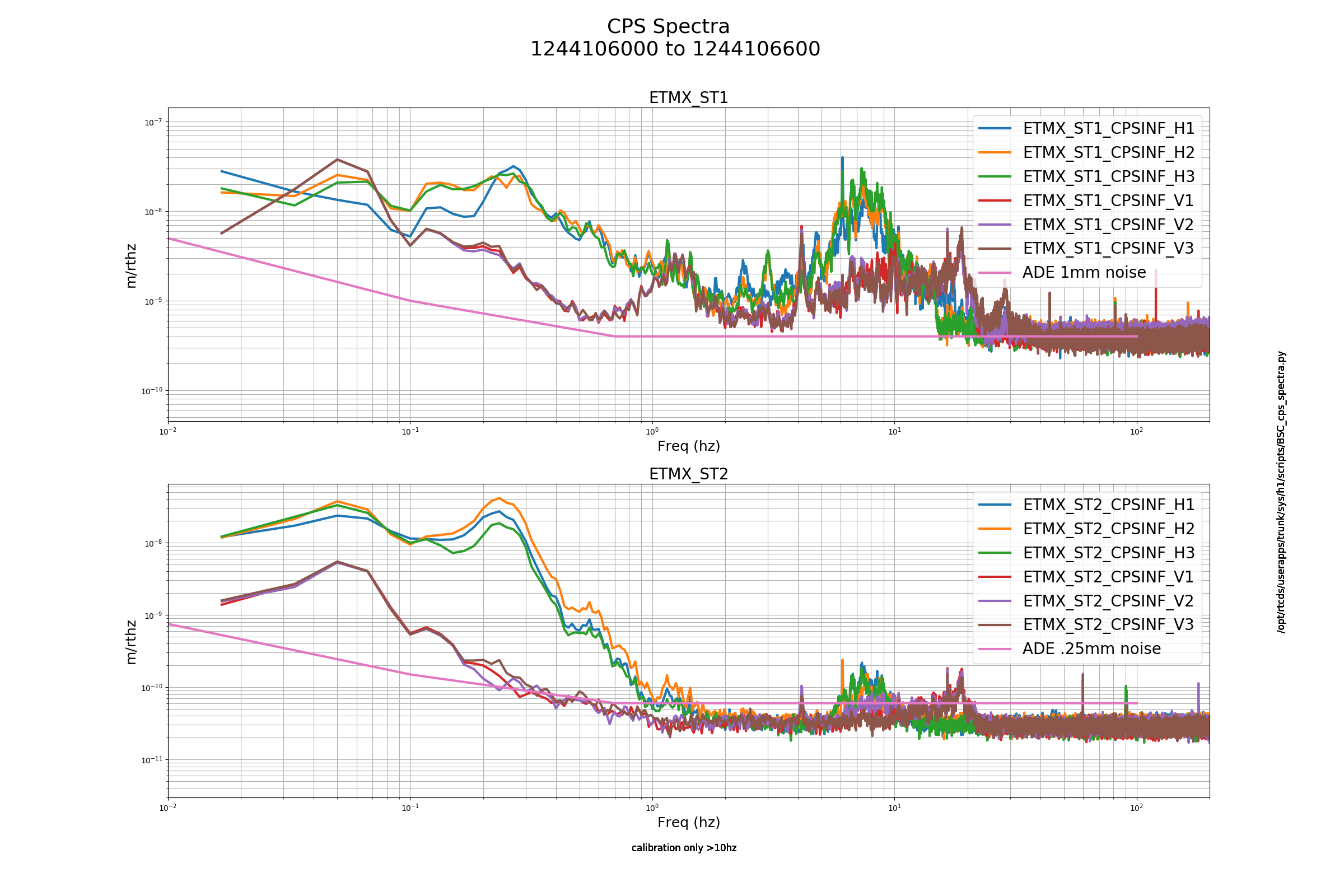
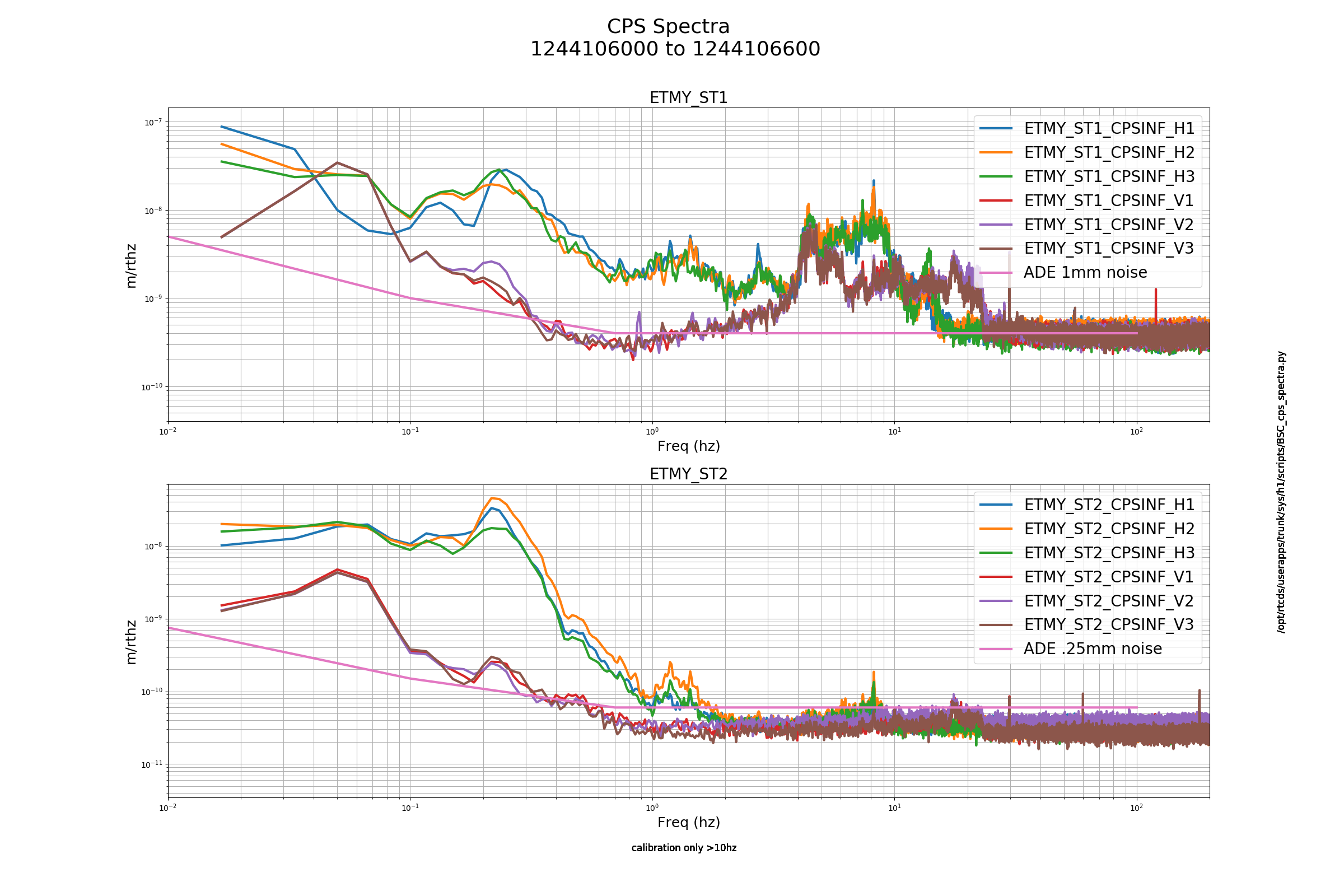
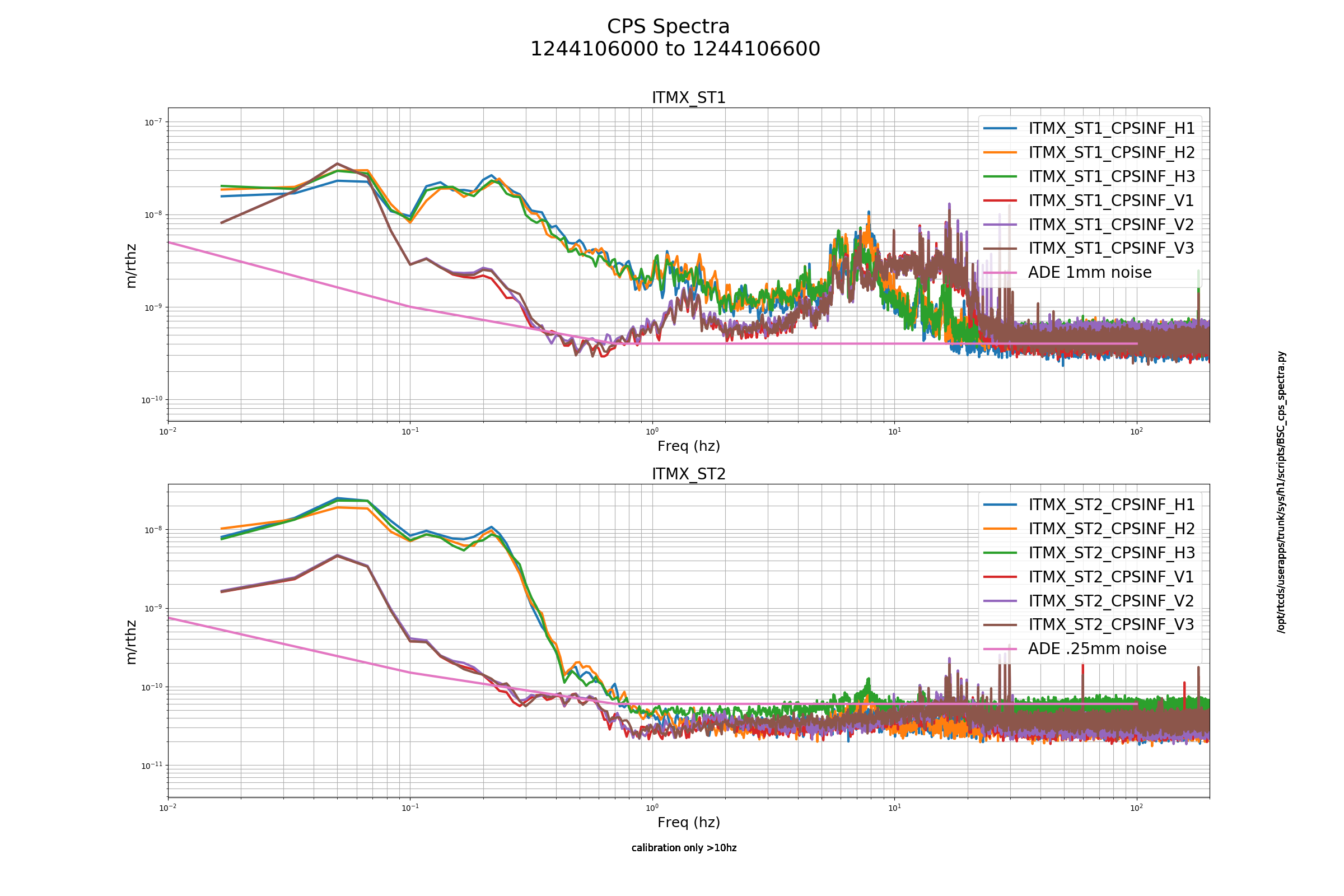
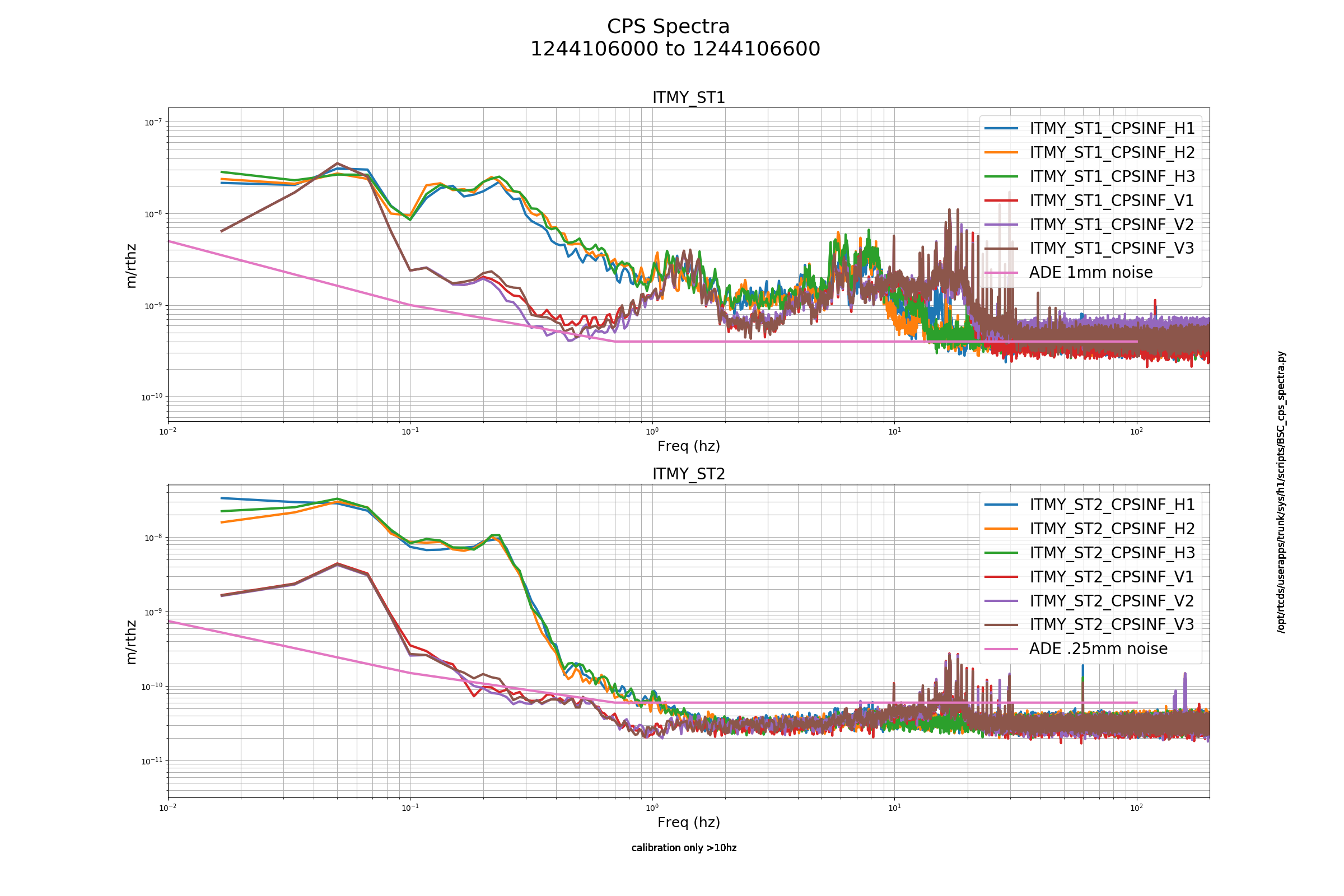
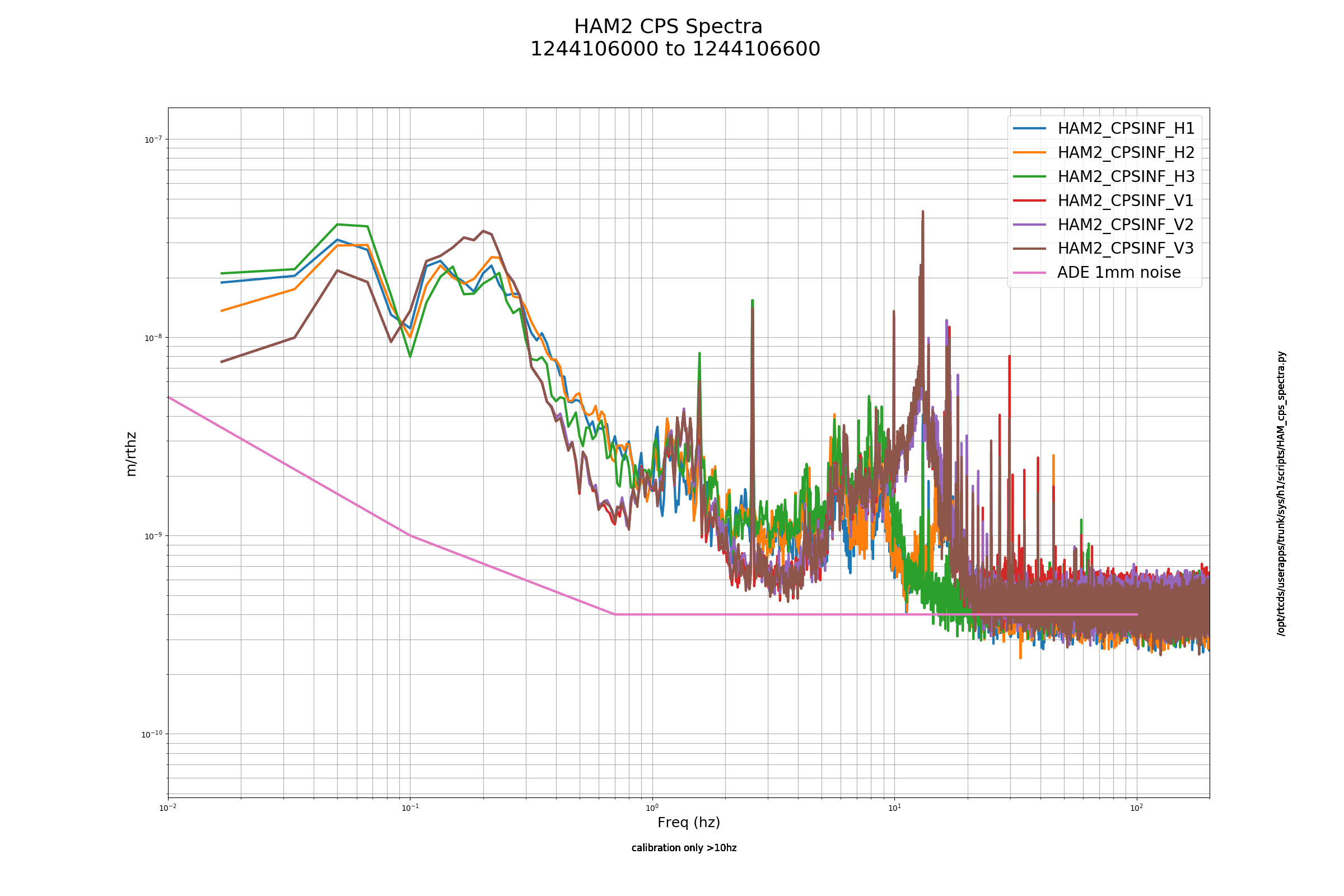
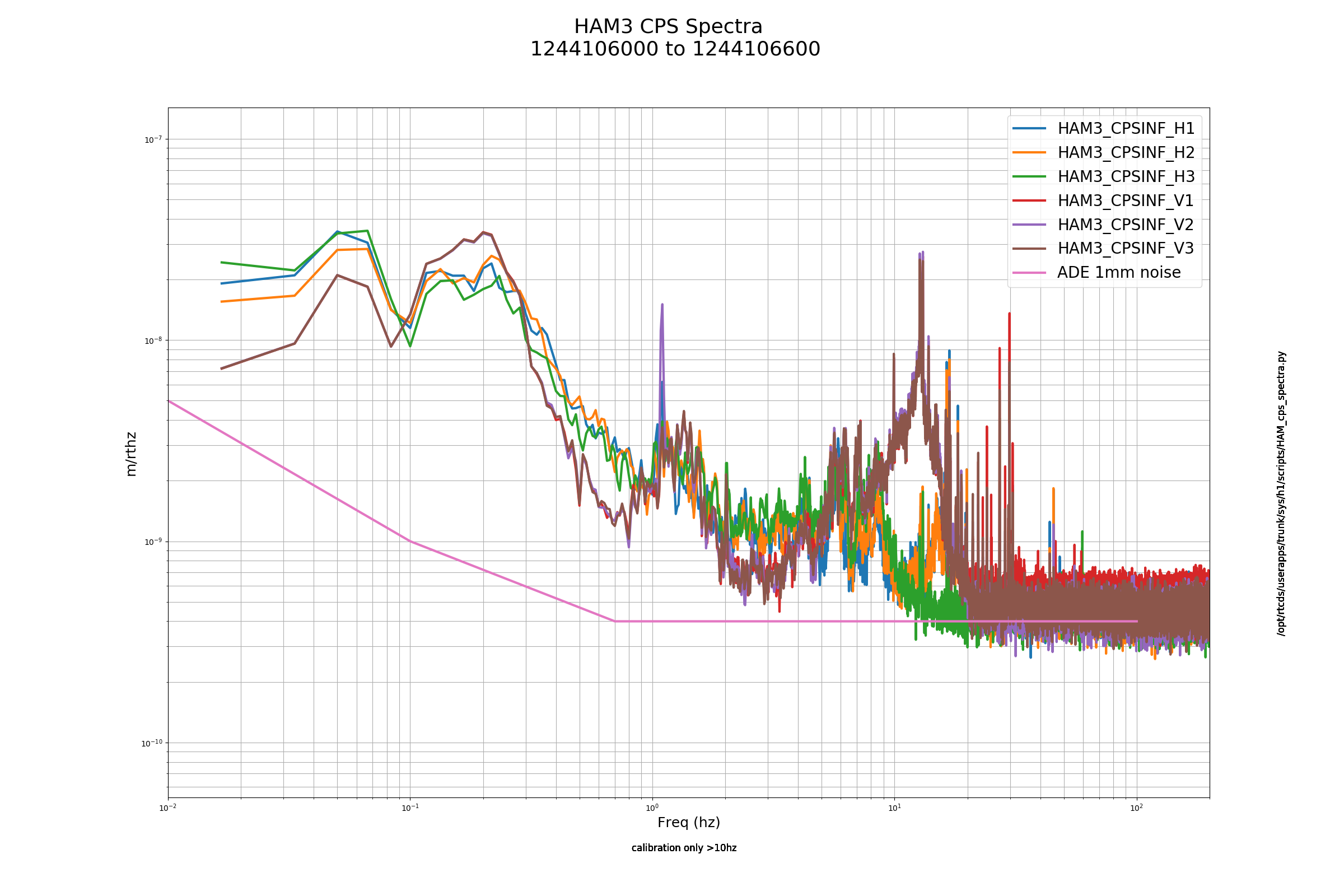
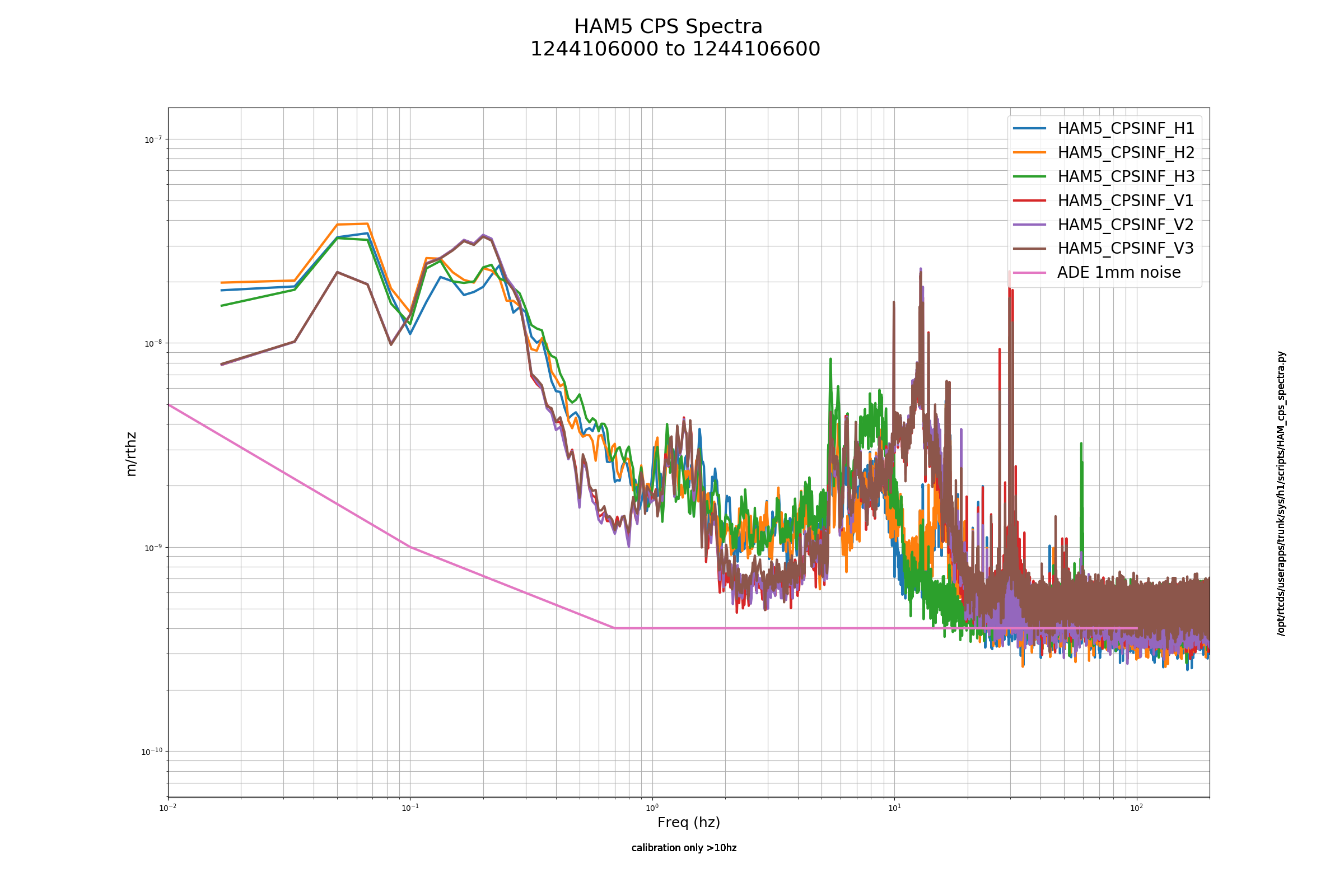
FAMIS 12851 BS_ST2_CPSINF_V1_I appears elevated.
FRS 13075
TITLE: 06/09 Day Shift: 15:00-23:00 UTC (08:00-16:00 PST), all times posted in UTC
STATE of H1: Observing at 115Mpc
OUTGOING OPERATOR: Corey
CURRENT ENVIRONMENT:
Wind: 5mph Gusts, 3mph 5min avg
Primary useism: 0.01 μm/s
Secondary useism: 0.06 μm/s
QUICK SUMMARY:
No issues.
J. Kissel, J. Driggers, E. Merilh
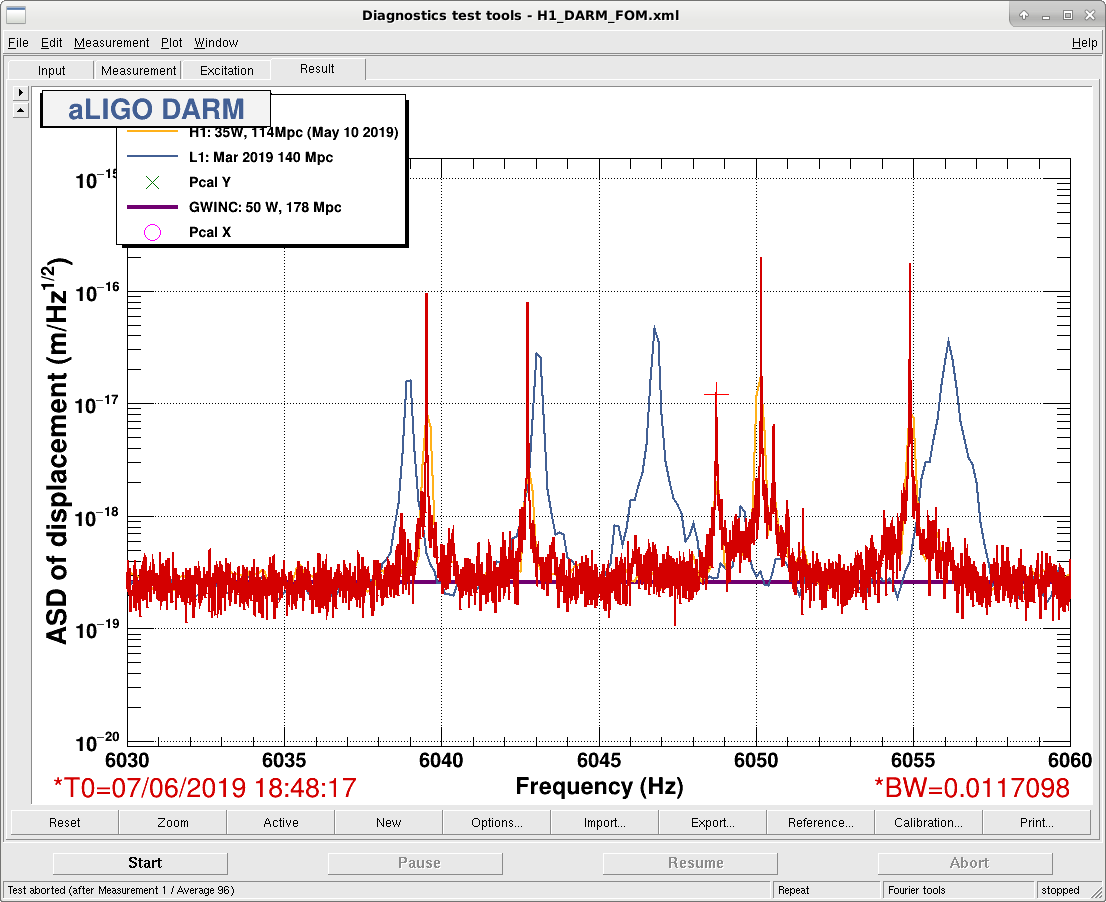
While watching the wall spectrum during a tour, we began to notice a 6 kHz line appear to be increasing in amplitude in the last part of the lock stretch with ended 2019-Jun-07 20:51 UTC. Upon a bit more of a zoom, it's actually 5 prominent lines at
6039.5 Hz
6042.7 Hz
6048.7 Hz
6050.1 Hz
6054.8 Hz.
Unclear if these growing lines were the cause of the lock loss (or the agressive amounts of wind that has suddenly kicked up), but it's worth a note in case we see this happen again.
This is the standard wall trace, so red is live H1 DELTAL_EXTERNAL, yellow is the same, but a reference trace from 2019-May-10, blue is a reference trace from L1 (2019-Mar), and purple is the 50W (without squeezing) GWINC model.
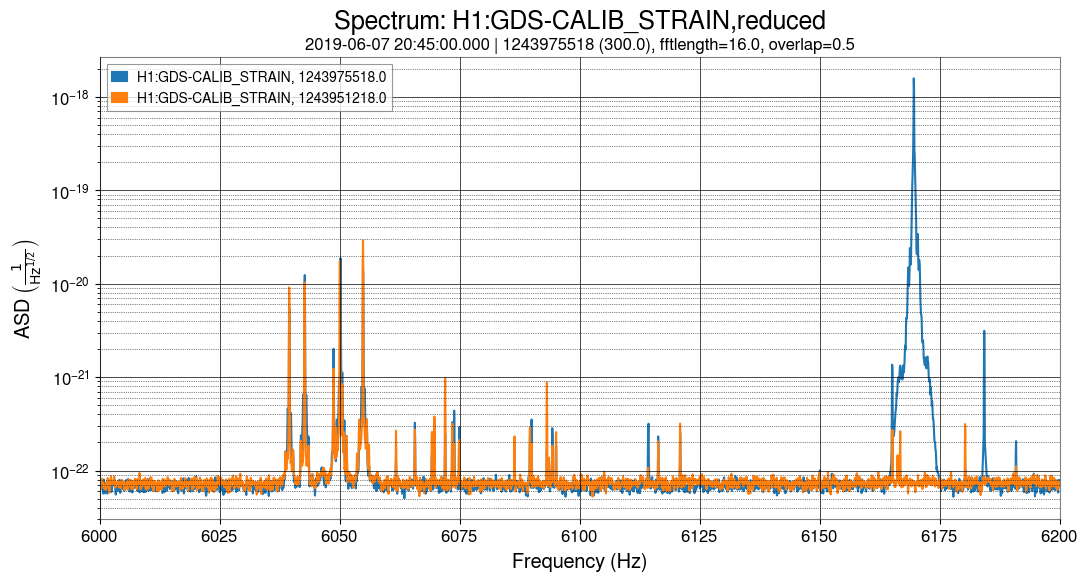
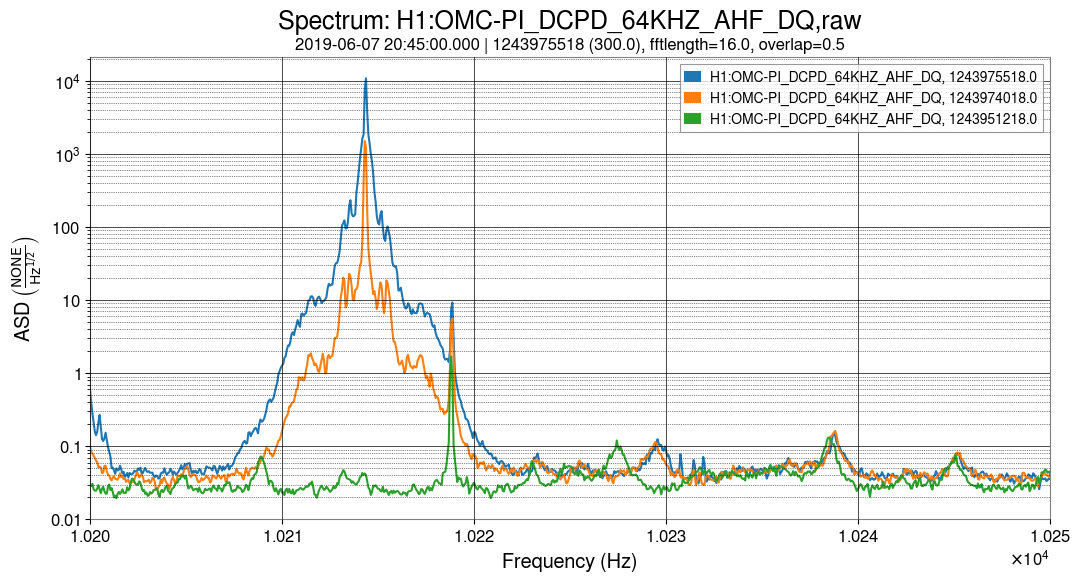
The five lines are actually there earlier in the lock - the line that is ringing up is a bit higher (plot 1). It seems to be aliased down from 10,214 Hz (plot 2). This looks like another PI ringup, at a slightly lower frequency than the one yesterday (alog 49704).
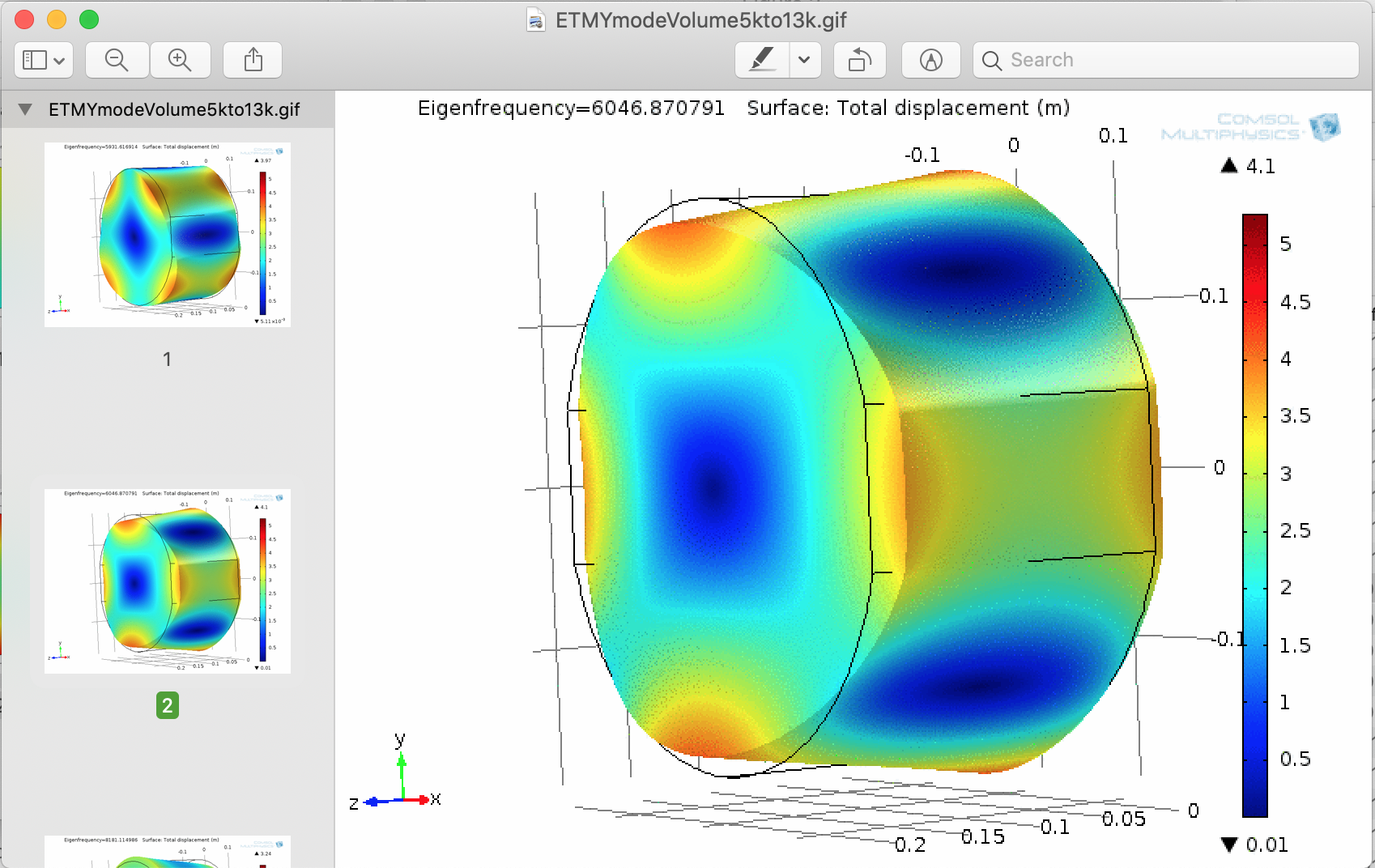
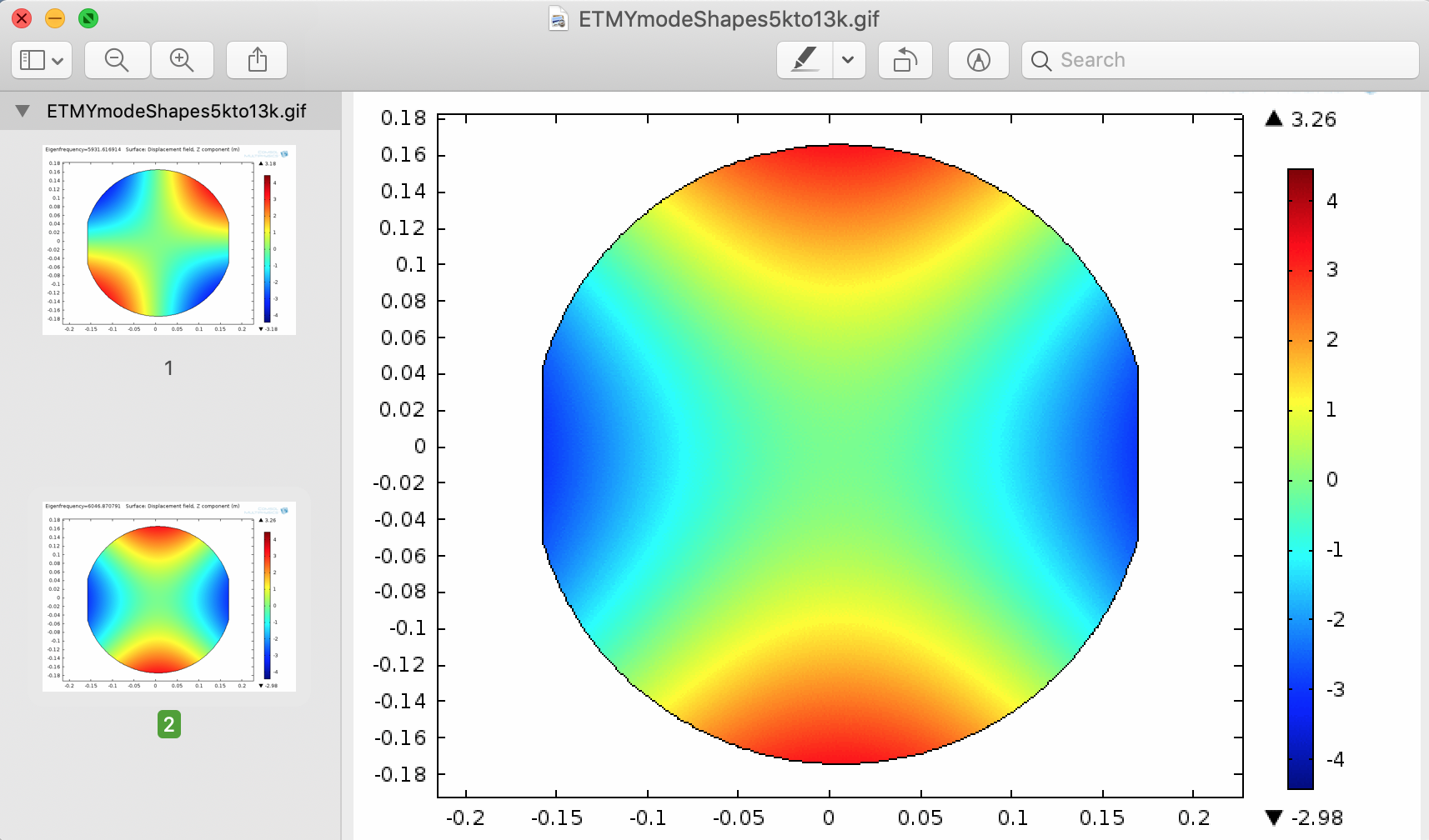
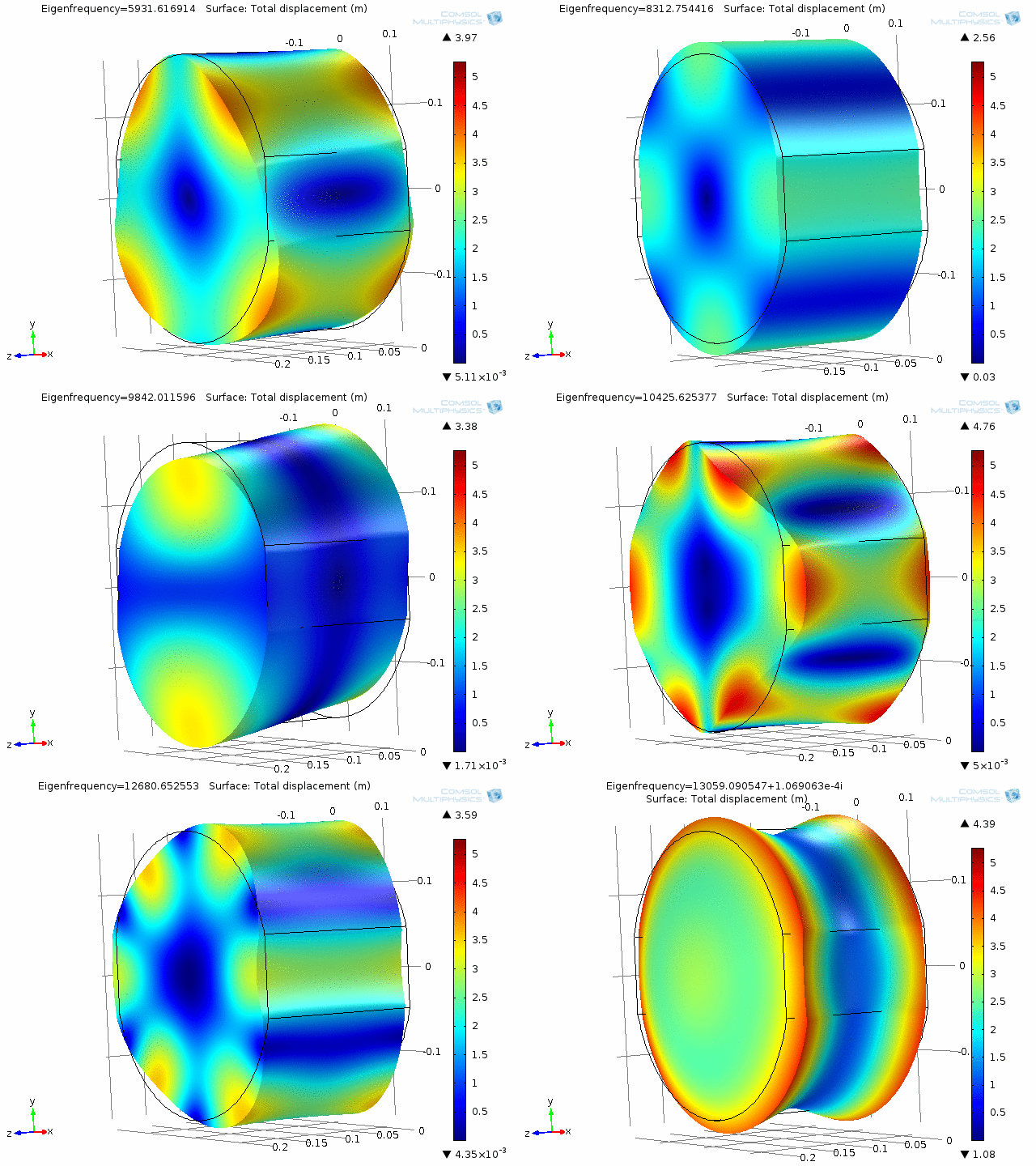
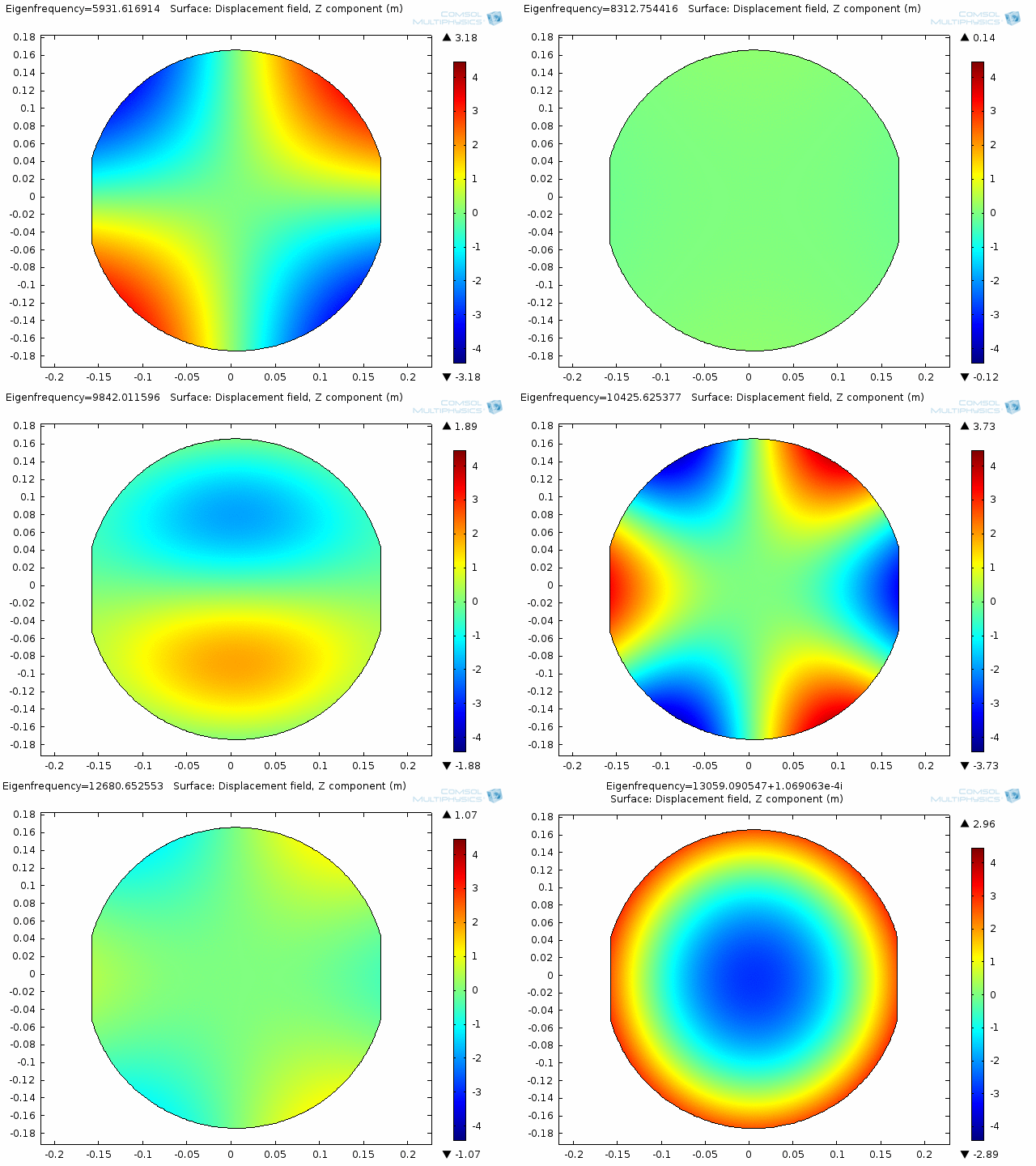
These are the second butterfly shape mechanical resonant modes of the optics (one for each test mass and some other things I'm not so sure about) see images from comsol simulation attached, the previous mode visible in the thumbnail is the first butterfly mode at 5.93kHz. They are always visible in DARM and modes like these breath up and down by as much as an order of magnitude. They can be rung up with the ESDs. It looks like you have different bandwidth which may be confusing when assessing if they are rung up. If they ring up significantly they will be visible in the 3-8kHz BLRMs on the PI summary page. As Andrew pointed out the mode that does ring up is dominant in the 8-12kHz band on the summary page.
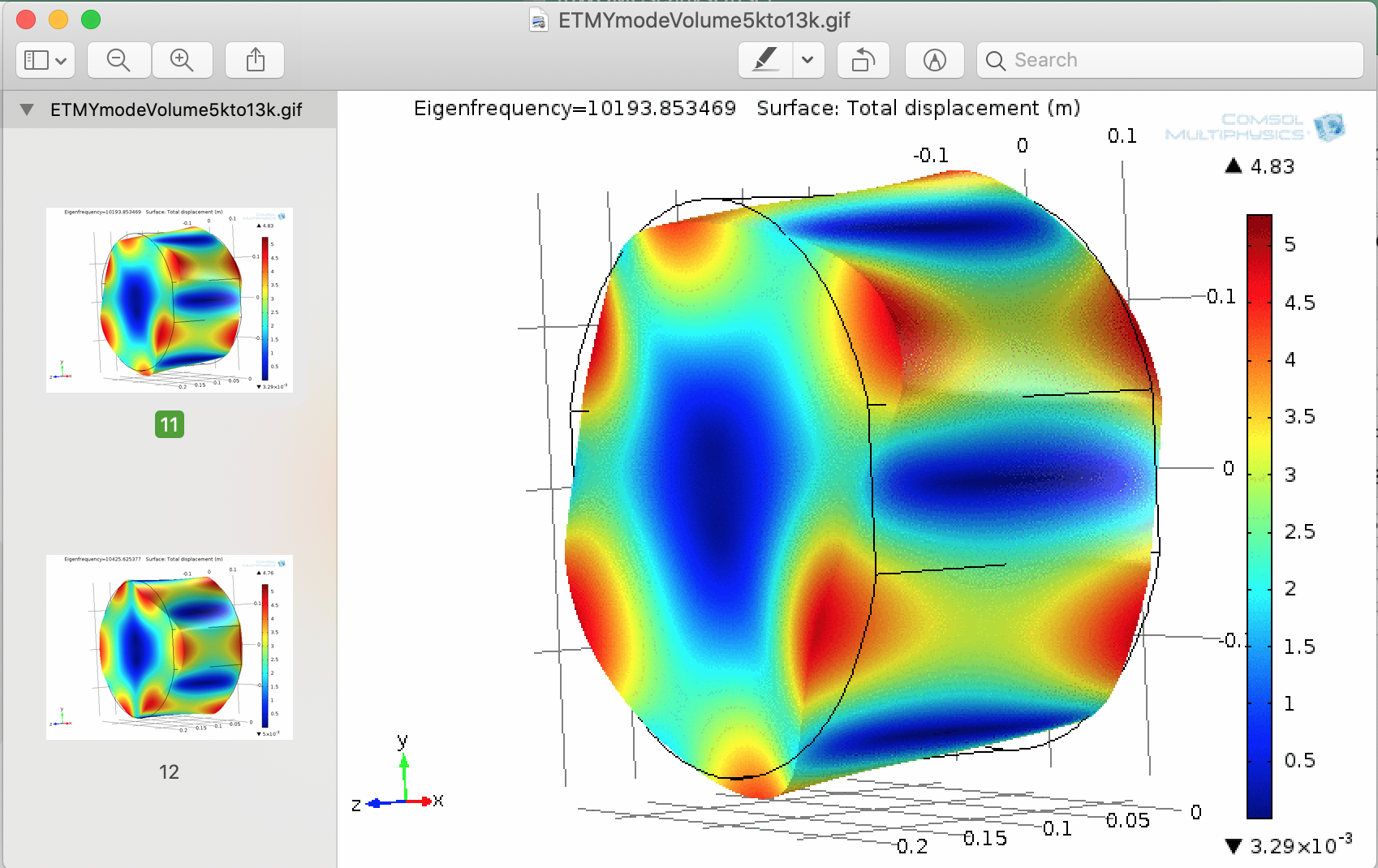
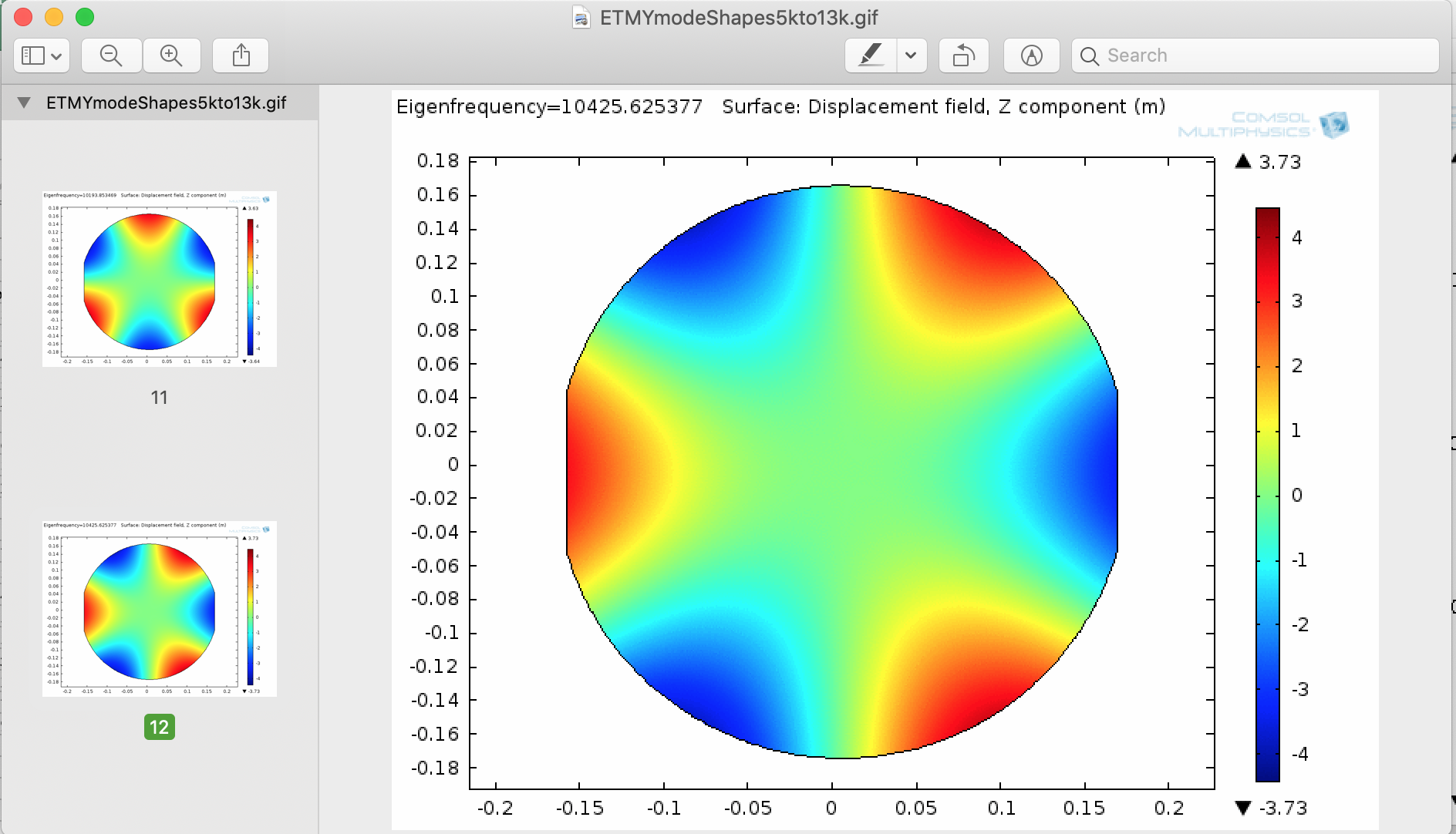
There are two modes of the same mode shape (rotated) in the simulation of the mechanical modes of the test mass at 10426Hz and 10194Hz. This mode is what I thought was the less likely mode of the two that are close to frequency of the first observed instability. These modes should not overlap with HG11 or LG10 type optical modes. However if the beam is not perfectly in the middle of the optic then I think the simulated coupling will increase. I attach gif animations from the simulation so all the modes 5-13Khz can be seen. Also the mode shape a surface deformation for the 10194Hz mode are attached as static figures.