
edmond.merilh@LIGO.ORG - posted 15:19, Friday 07 June 2019 (49748)
H1 back to Observing: 22:19UTC
J. Kissel, J. Driggers, E. Merilh

While watching the wall spectrum during a tour, we began to notice a 6 kHz line appear to be increasing in amplitude in the last part of the lock stretch with ended 2019-Jun-07 20:51 UTC. Upon a bit more of a zoom, it's actually 5 prominent lines at
    6039.5 Hz
    6042.7 Hz
    6048.7 Hz
    6050.1 Hz
    6054.8 Hz.
Unclear if these growing lines were the cause of the lock loss (or the agressive amounts of wind that has suddenly kicked up), but it's worth a note in case we see this happen again.
This is the standard wall trace, so red is live H1 DELTAL_EXTERNAL, yellow is the same, but a reference trace from 2019-May-10, blue is a reference trace from L1 (2019-Mar), and purple is the 50W (without squeezing) GWINC model.
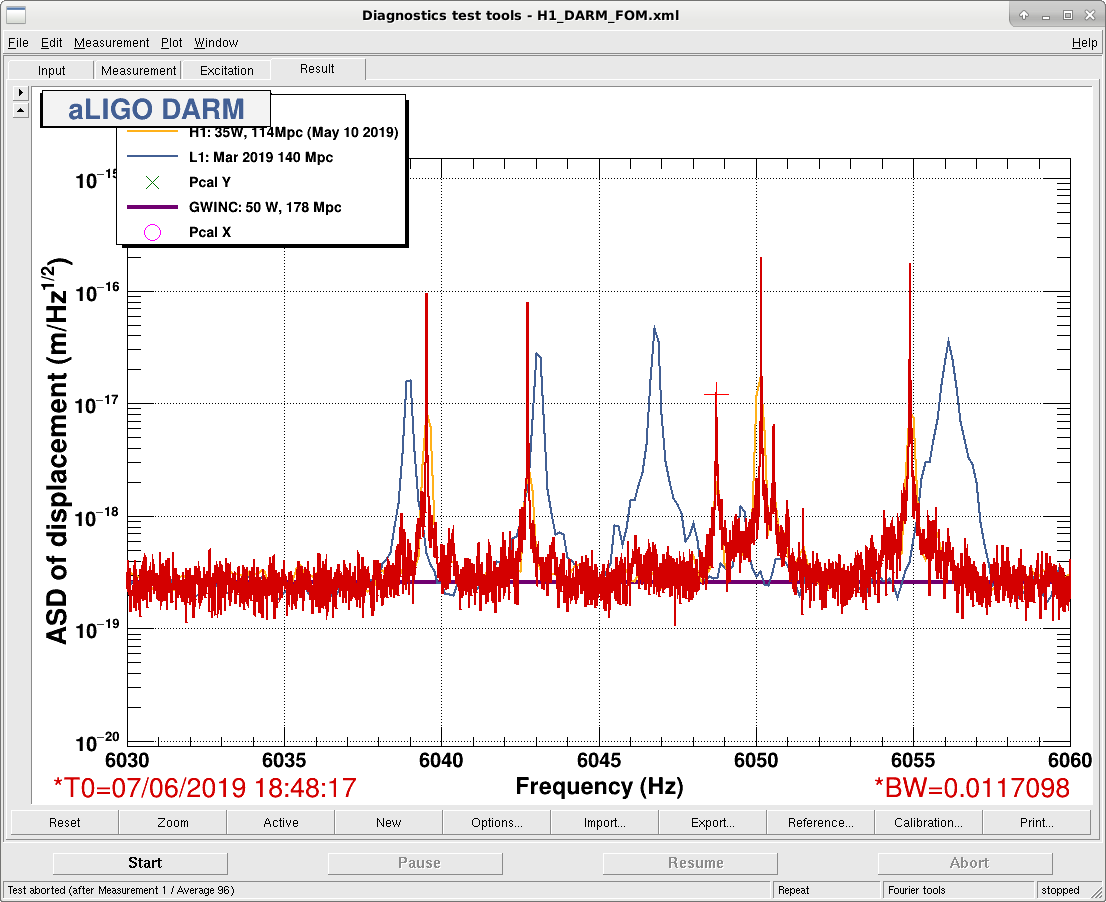
The five lines are actually there earlier in the lock - the line that is ringing up is a bit higher (plot 1). It seems to be aliased down from 10,214 Hz (plot 2). This looks like another PI ringup, at a slightly lower frequency than the one yesterday (alog 49704).
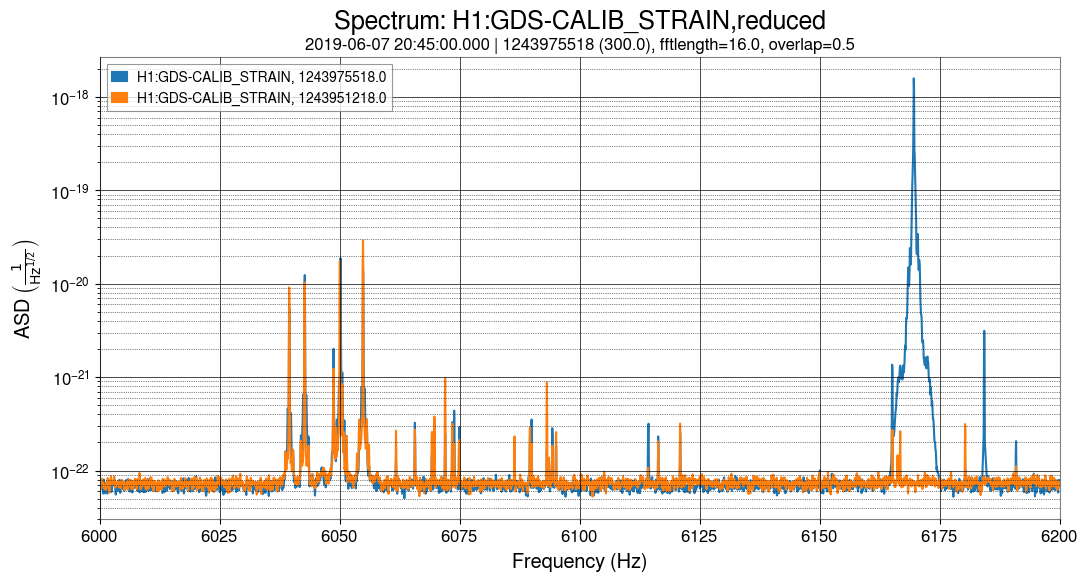
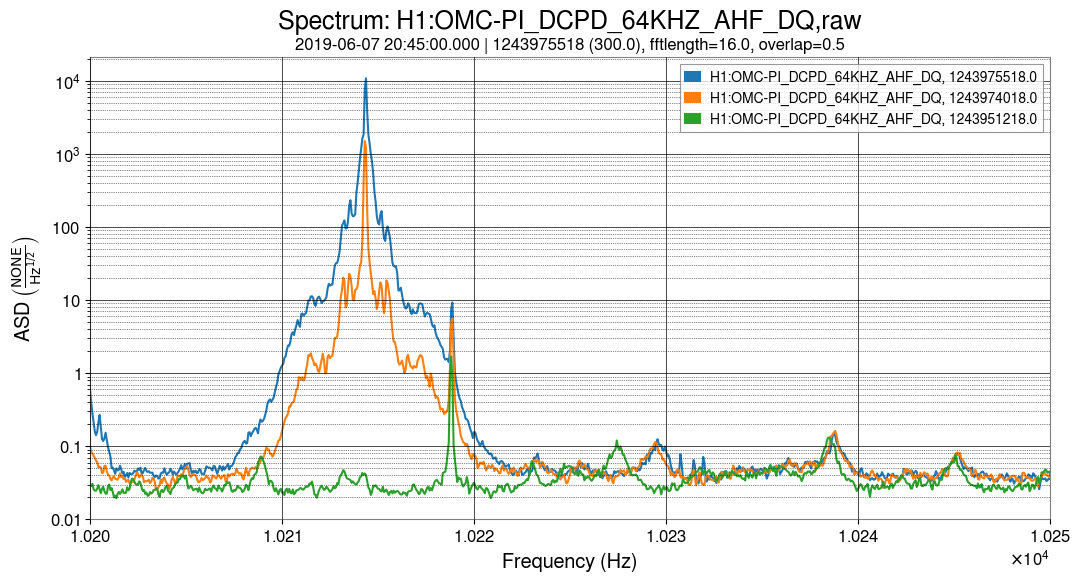
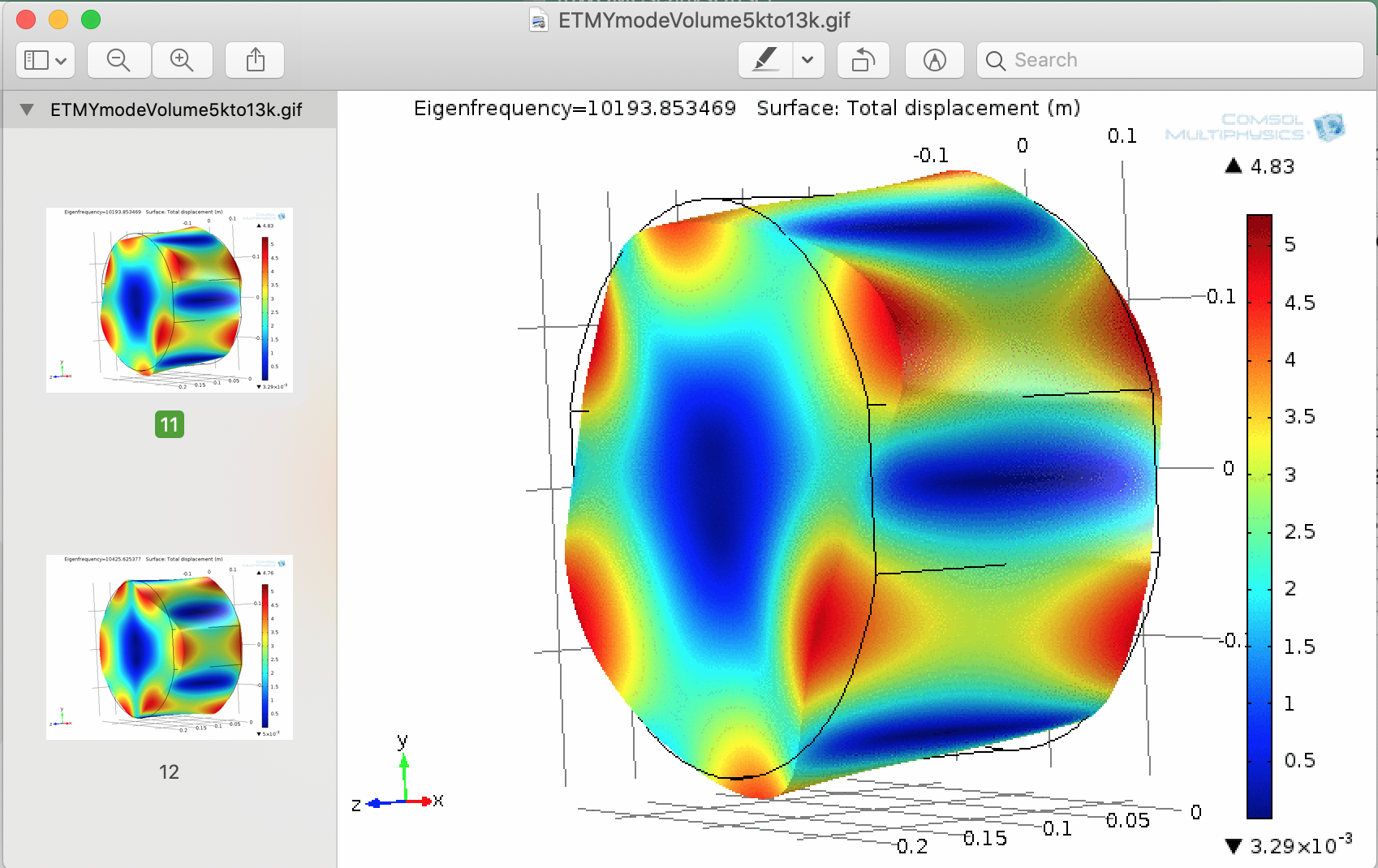
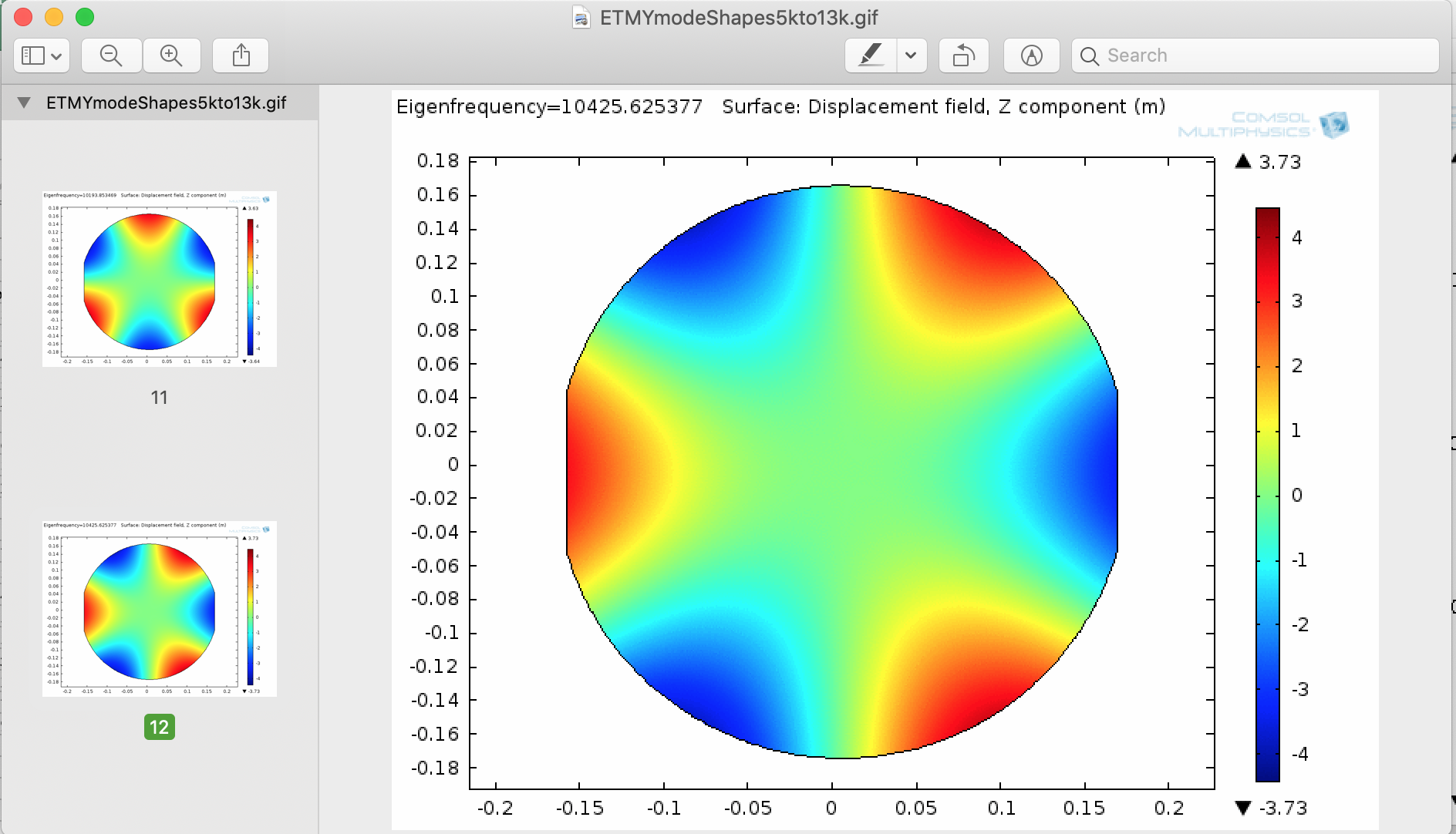
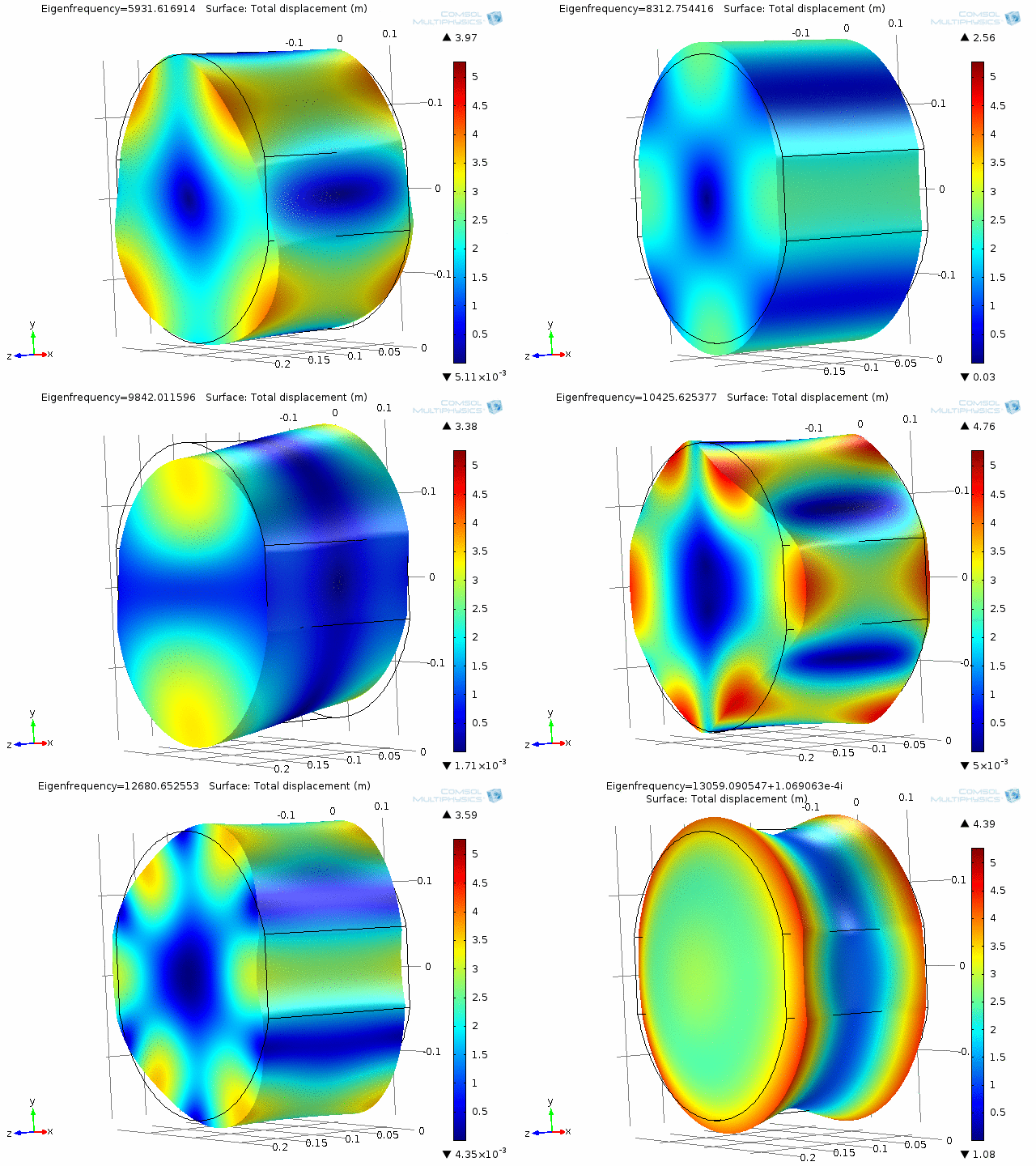
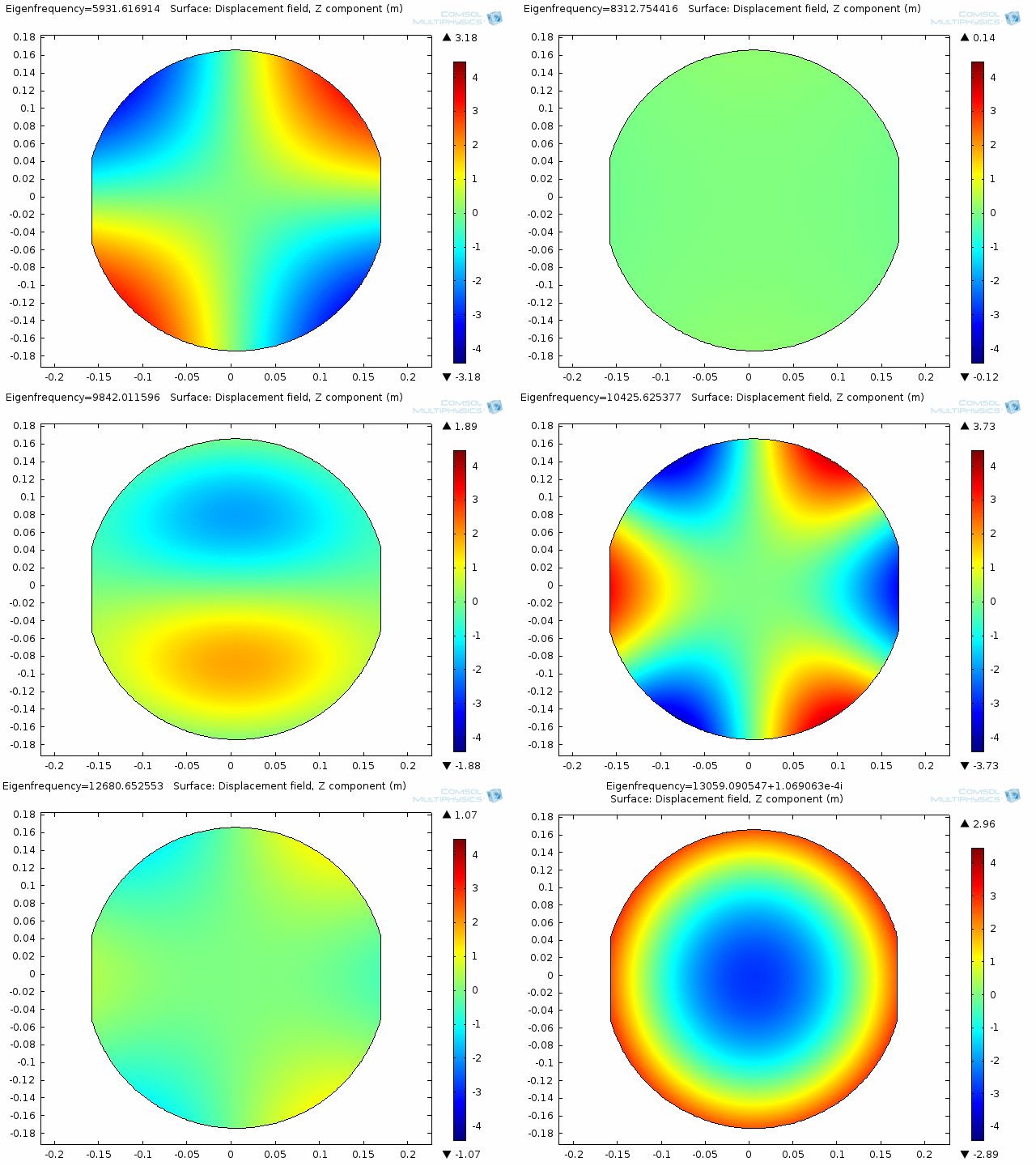
These are the second butterfly shape mechanical resonant modes of the optics (one for each test mass and some other things I'm not so sure about) see images from comsol simulation attached, the previous mode visible in the thumbnail is the first butterfly mode at 5.93kHz. They are always visible in DARM and modes like these breath up and down by as much as an order of magnitude. They can be rung up with the ESDs. It looks like you have different bandwidth which may be confusing when assessing if they are rung up. If they ring up significantly they will be visible in the 3-8kHz BLRMs on the PI summary page. As Andrew pointed out the mode that does ring up is dominant in the 8-12kHz band on the summary page.
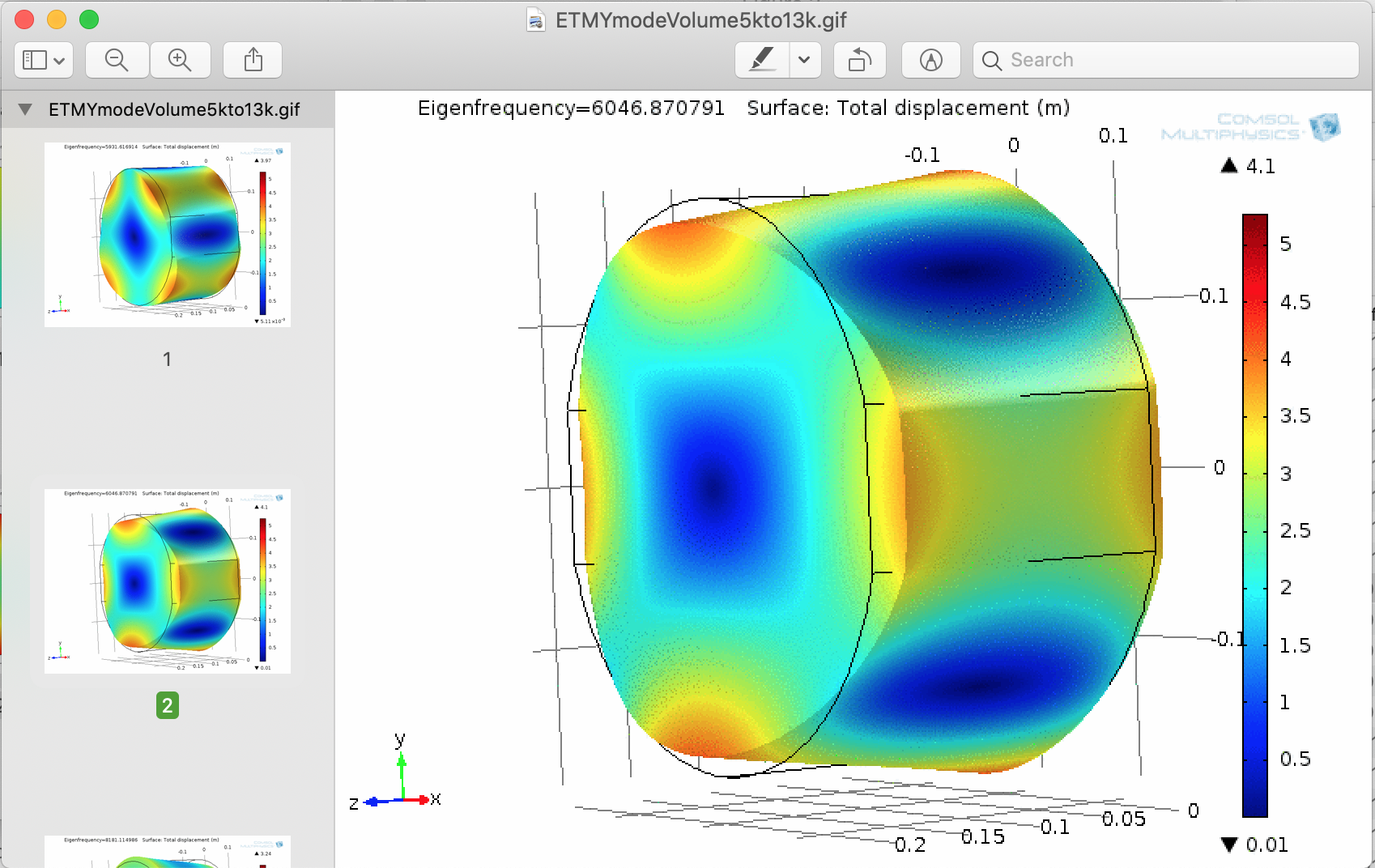
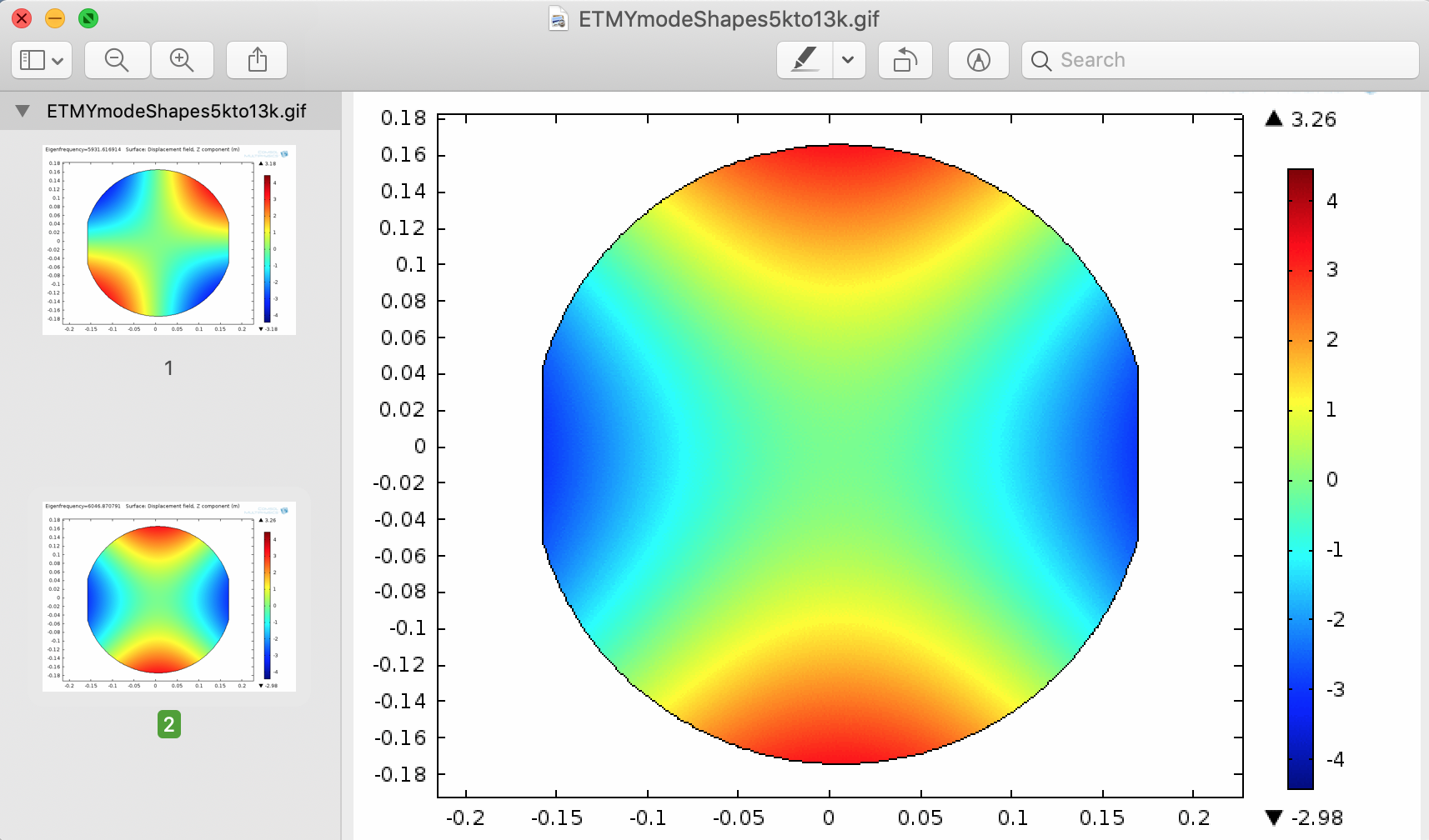
There are two modes of the same mode shape (rotated) in the simulation of the mechanical modes of the test mass at 10426Hz and 10194Hz. This mode is what I thought was the less likely mode of the two that are close to frequency of the first observed instability. These modes should not overlap with HG11 or LG10 type optical modes. However if the beam is not perfectly in the middle of the optic then I think the simulated coupling will increase. I attach gif animations from the simulation so all the modes 5-13Khz can be seen. Also the mode shape a surface deformation for the 10194Hz mode are attached as static figures.
I've looked at some data comparing DARM before and after the changes we made this tuesday.
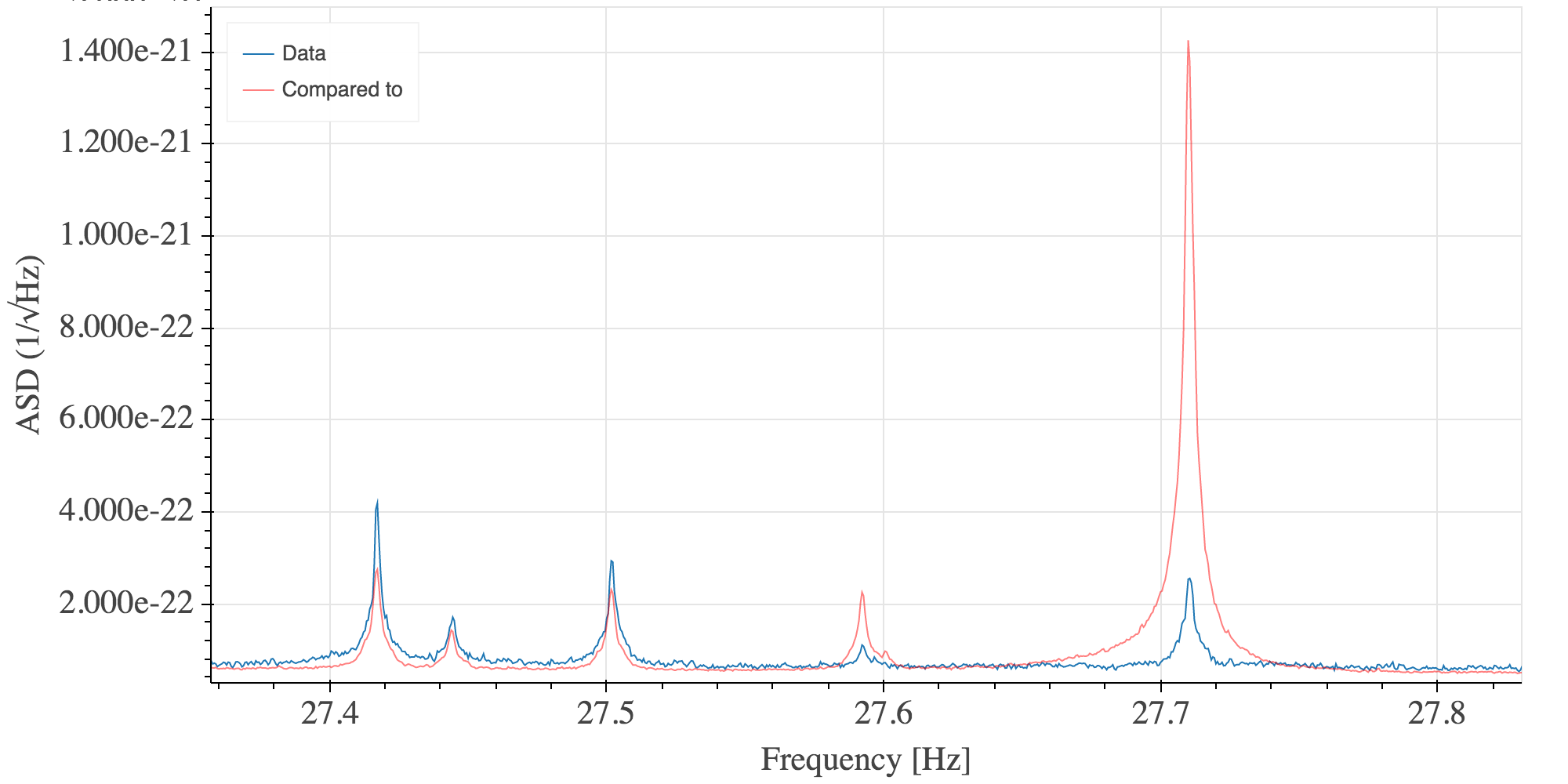
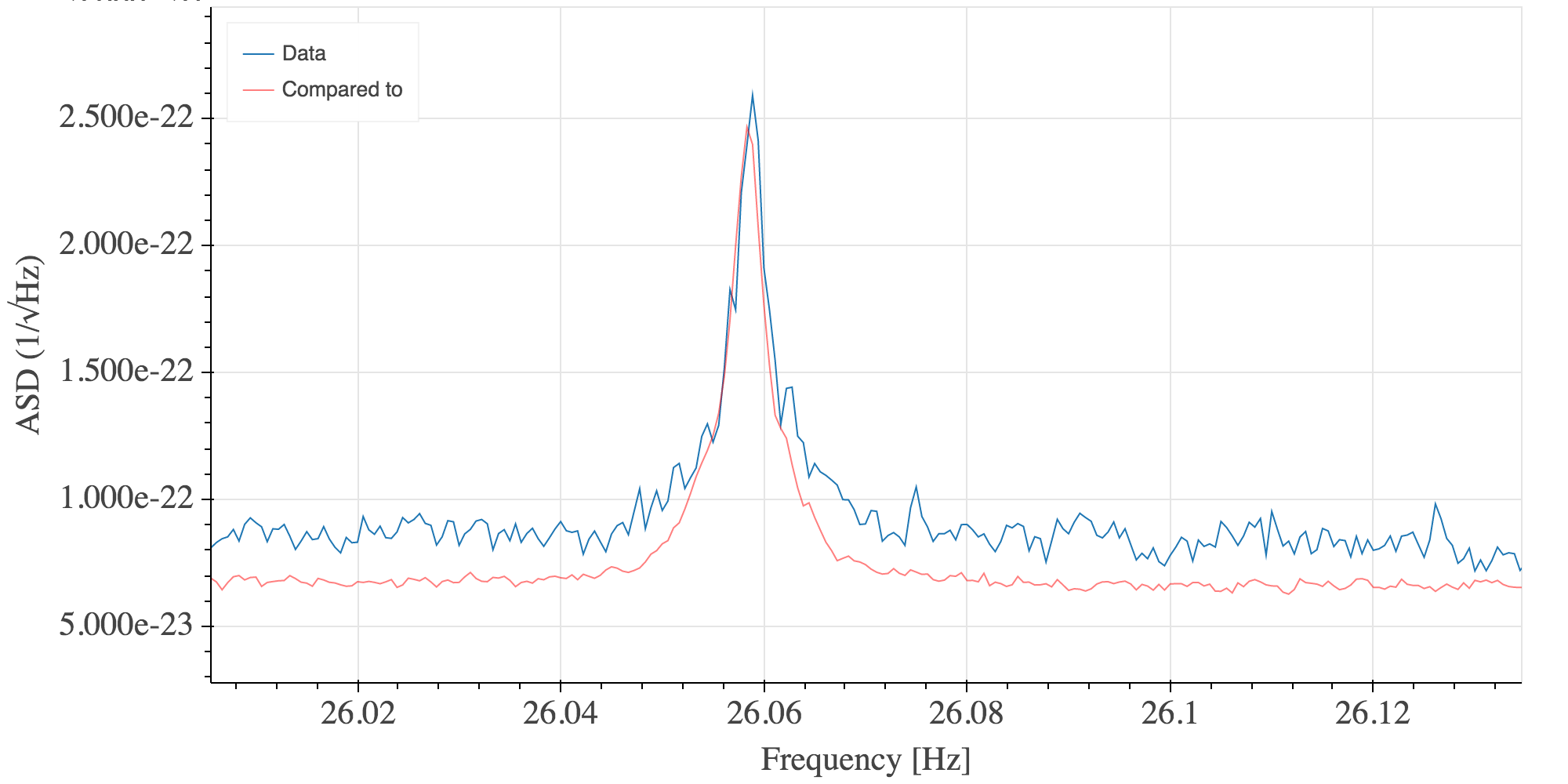
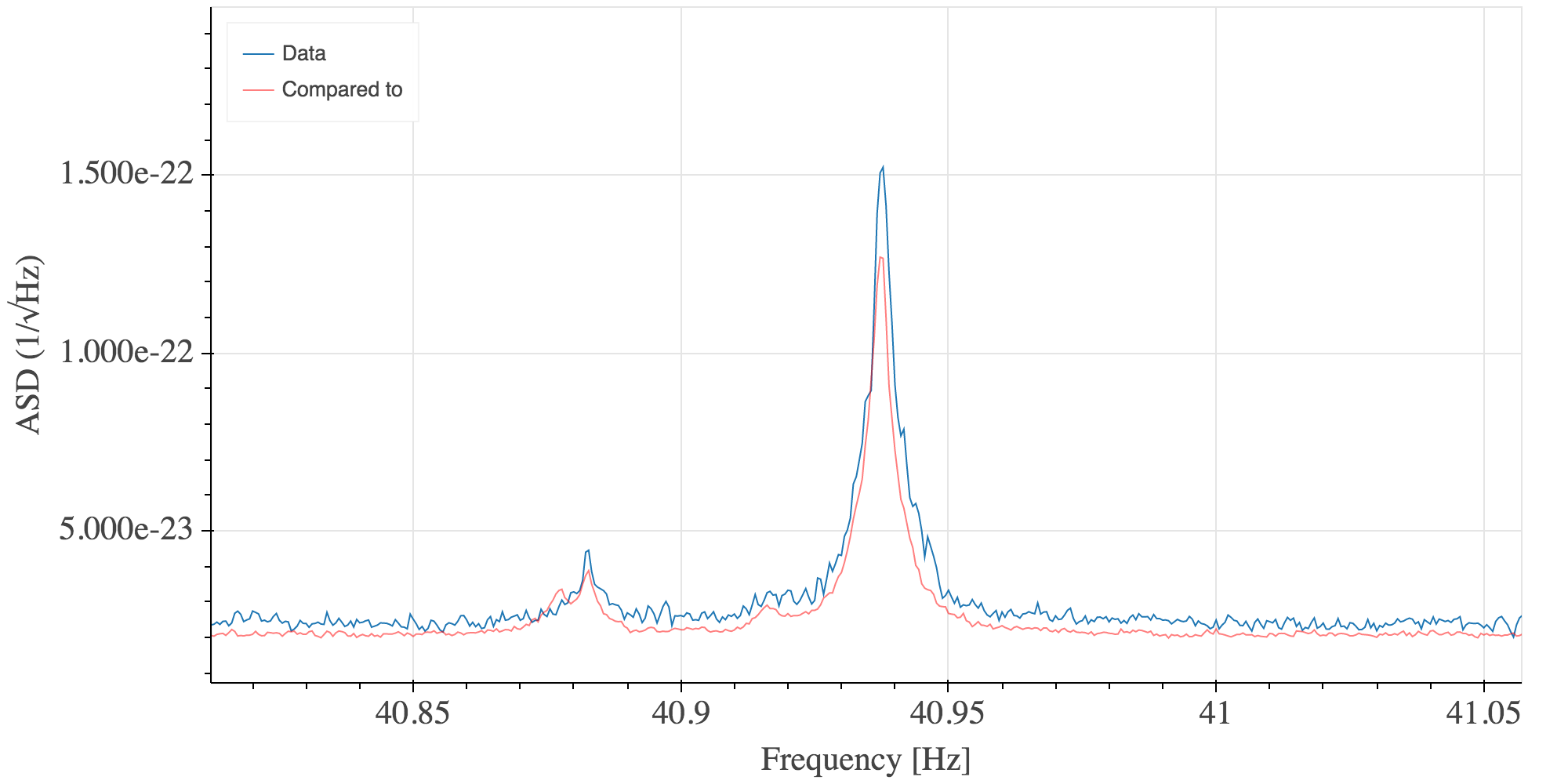
The attached images show the comparisons, where the blue line is after the changes and the red line is before the changes (the noise floor is a little bit higher due to some unrelated noise problems which were present after the maintenance). The 27.71 Hz feature looks much better, although it is not completely damped. The Q of the line seems to have increased. The line at 27.59 Hz has also decreased, but the lines at 40.87 and 26.06 Hz look very similar as they did before.
Here's a look at a 0.002 Hz ASD of MICH, PRCL, and SRCL starting at 2019-Jun-07. Using the table of ID'd modes from LHO aLOG 49643, I went through and made a comparison to see what lives were.
Here's a key to the table values:
    - " N " -- not visible
    - " Y " -- visible
    - " Y* " -- visible with the highest SNR of the three
     - (blank)  -- not visible in any of the ASDs


    Optic  Freq    MICH   PRCL  SRCL
    BS     17.79
    MC1    27.39
    PR2    27.41     N      Y*     Y
    MC3    27.42
    SRM    27.45
    SR2    27.50     N      N      Y*
    PRM    27.59     Y      Y*     Y
    SR3    27.71     N      N      Y*
    MC2    27.74
    PR3    28.21     N      Y*     Y

    Optic          MICH   PRCL  SRCL
    BS     26.06
    MC1    40.81
    PRM    40.87
    SRM    40.88
    SR2    40.91
    MC2    40.91
    PR2    40.94     Y      Y*     Y
    MC3     --
    SR3    45.32     N      Y      Y*
    PR3    46.09

I'm surprised how mouch *more* stuff is in these ASDs that look like SUS resonances...
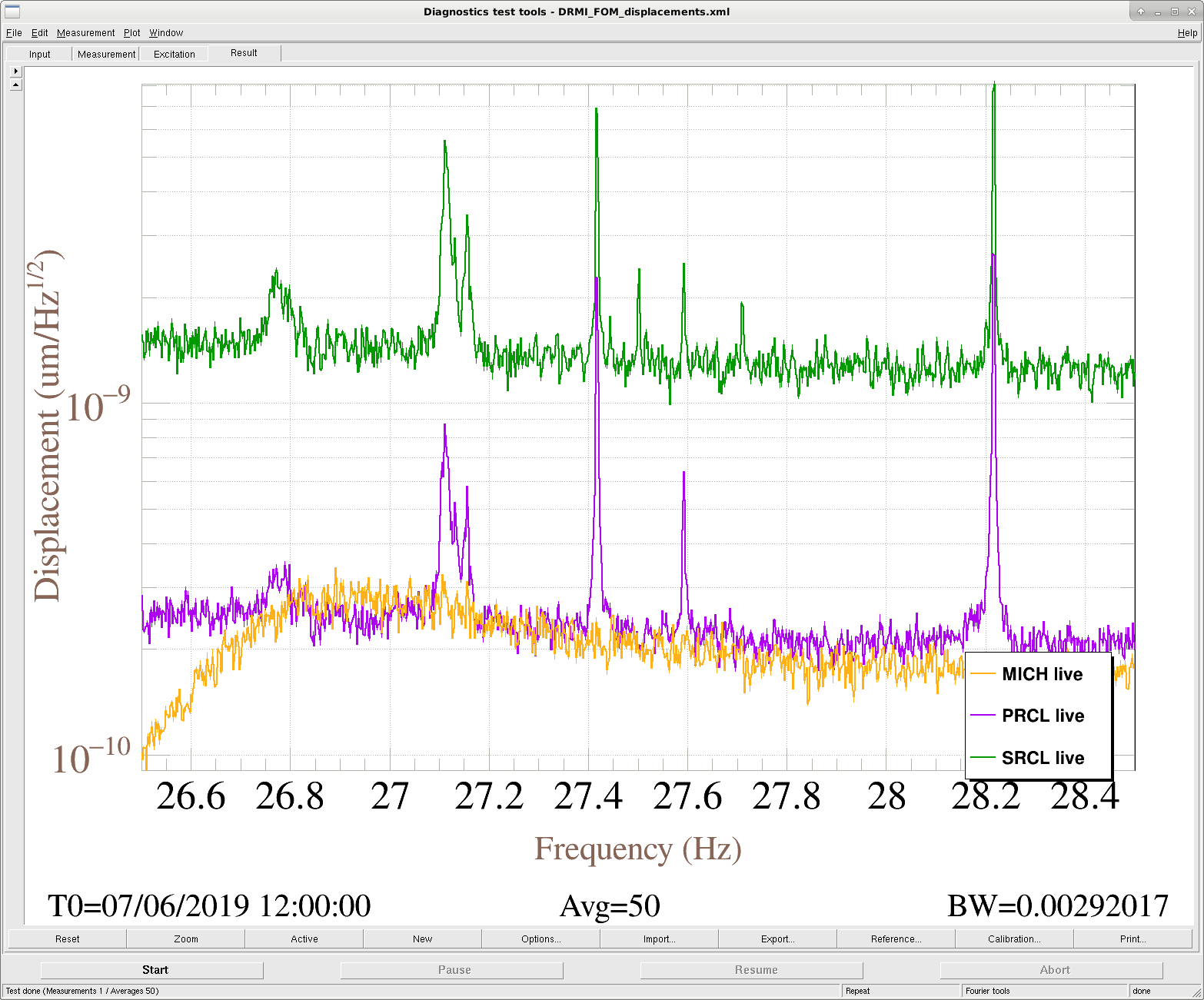
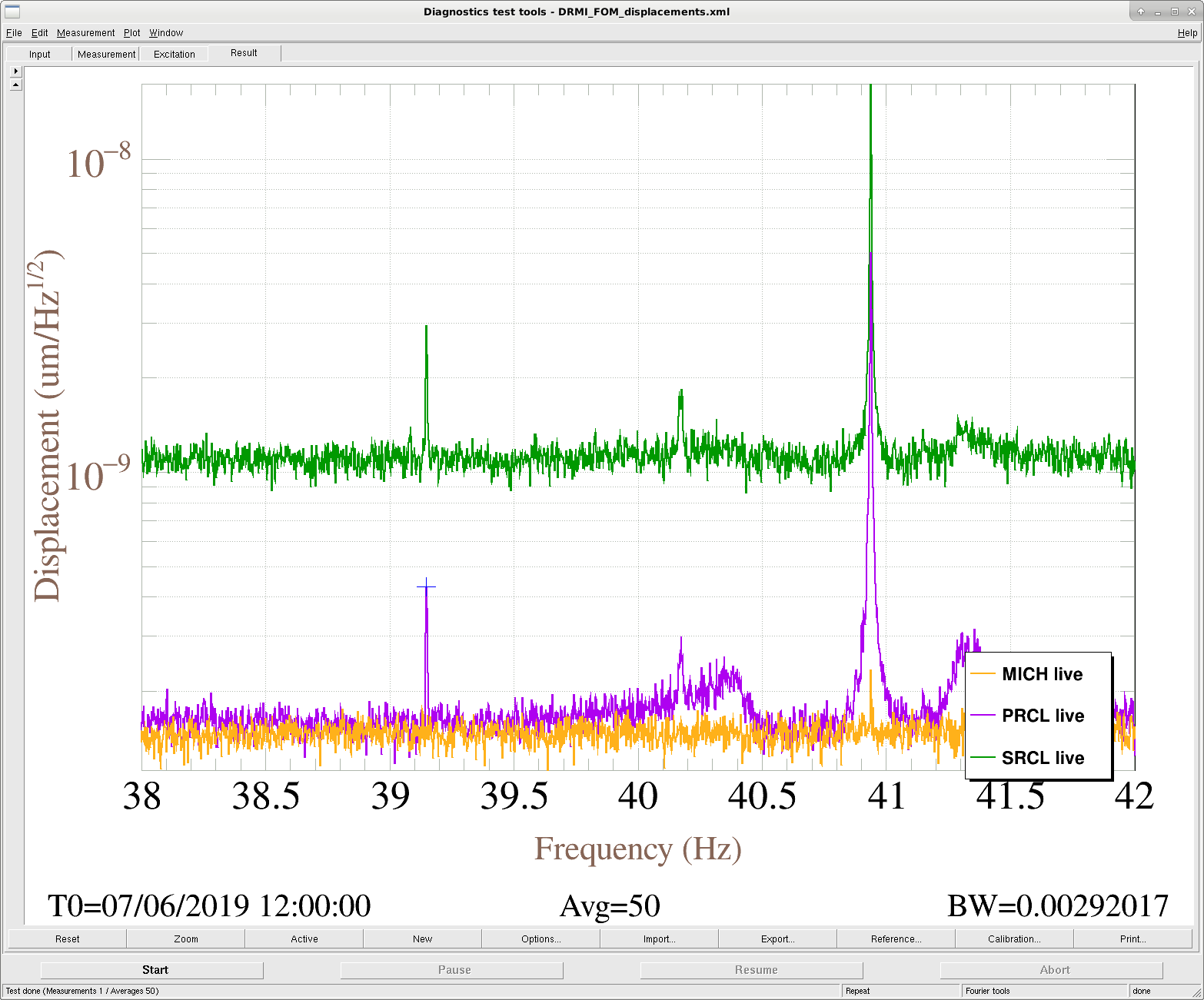
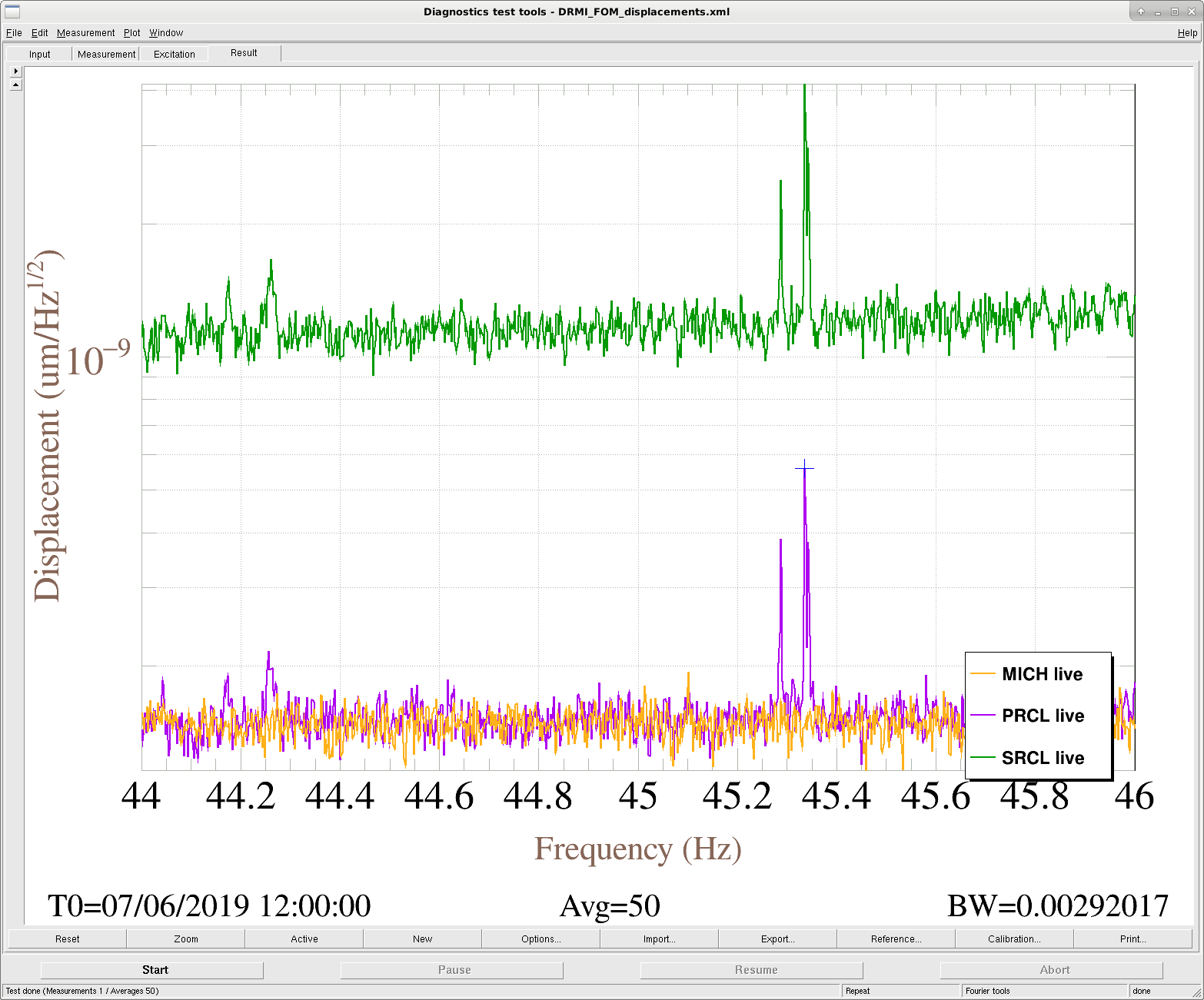
Translating into optics, using the inventory in LHO aLOG 49643, and comparing against expectations from the above cited LHO aLOG 49649:

- The impact of SR3's highest vertical mode (aka "bounce" mode or V3) at 27.71 Hz in DARM has been drastically reduced after updating the band-stop filters in the top M1 OSEM damping loops.
- PRM's highest vertical mode (bounce, V3) at 27.59 Hz has already been reduced, (though not as significantly as SR3) from simply turning ON the band-stop filters in the top M1 OSEM damping loops that were present but OFF.
- The changes in filtering for PRM and BS highest roll (R3) modes at 40.87 and 26.06 Hz had little-to-no effect.

LLO has proposed using DRMI LSC signals as error signals for new damping loops -- see LLO aLOG 45255 -- these are under investigation (see above).
It recovered in less than a minute.
17:49 Back to Observing
TJ, Ed, Sheila
We started a step up in the ring heater power for ETMY (while in observing) to see if we can identify which optic the PI mode that rung up Thursday morning (49698 and comments).
To do this step I added both the ETM ring heater guardians to the list of excluded guardians in GRD_IFO, so that we can use them to speed up the ring heater steps. When I loaded IFO_GRD we were momentarily taken out of observe.
I took the TCS_ETMY_RH_PWR guardian to RESET, but had trouble entering a number in the H1:TCS-ETMY_RH_INVERSE_FILTER_IN field, TJ helped me figure out that I was just confused by a strange feature of the MEDM screen. We stepped the requested power from 0.2W to 1.2W for ETMY at 16:53 UTC on June 7th.
Note: The most recent summary of test mass mode identifications I know about is the attachment Georgia pointed me to on this alog from Terra (45812), which was after the test masses were replaced. The only 10400 mode which isn't identified there is ETMX, so that might suggest that the mode that rang up Thursday (at 10430.5 Hz) could be on ETMX, or is not a drumhead mode. We initially suspected ETMY since there is more power in the Y arm, and ITMY has not been replaced since the mode identification that Carl linked in his alog.
TITLE: 06/07 Day Shift: 15:00-23:00 UTC (08:00-16:00 PST), all times posted in UTC
STATE of H1: Observing at 111Mpc
OUTGOING OPERATOR: Corey
CURRENT ENVIRONMENT:
Wind: 5mph Gusts, 3mph 5min avg
Primary useism: 0.01 μm/s
Secondary useism: 0.13 μm/s
QUICK SUMMARY:
GRB alert on shift change from FERMI - it was an ignore with a Rel number of 2
Incoming EQ from Canada on VERBAL: USGS reported 4.0 from Homer Alaska. It barely made a bump in BLRMS. Switching back to Windy ISI config after this entry.
15:23 SEI_CONFIG reset to nominal WINDY ISI config
TITLE: 06/07 Owl Shift: 07:00-15:00 UTC (00:00-08:00 PST), all times posted in UTC
STATE of H1: Observing at 113Mpc
INCOMING OPERATOR: Ed
SHIFT SUMMARY:
Mostly straightforward shift other than the one lockloss which had a very wonky alignment which required handling. (see alog)
LOG:
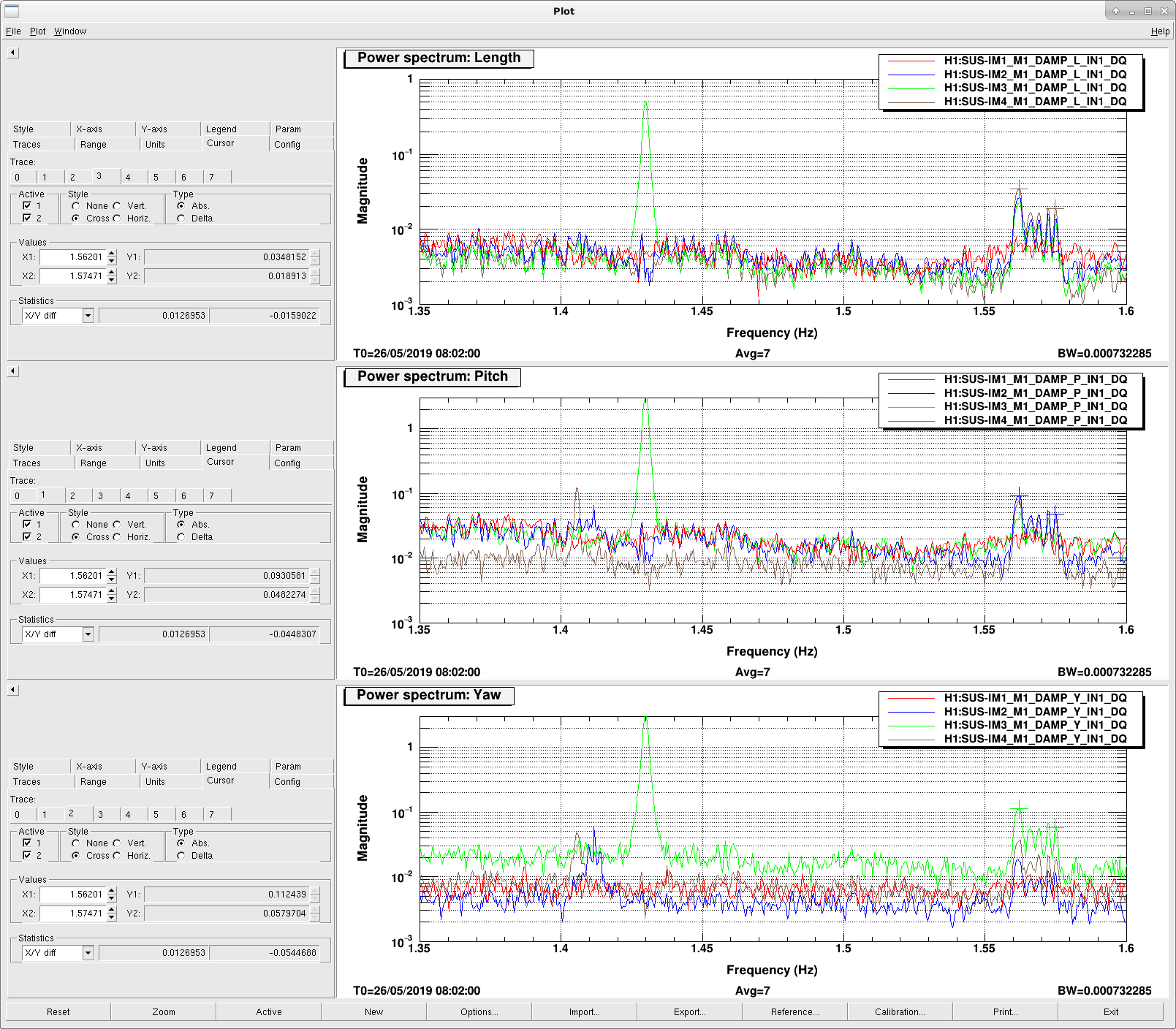
On May 26th, an earthquake cause all 4 IMs to trip, and they were free-swinging for more than an hour (which is rare), which has allowed me to measure some of their resonant frequencies.
The YAW peak between 0.7 and 0.72 is so unusual in IM3, that I'm posting the power spectra now, before collecting sll of the numbers for all the peaks.
Plot spans 0.64Hz to 0.8Hz, and the important features to note are:
I don't yet know what is causing the exaggerated YAW peak in IM3, but it's so unusual, I felt it needed it's own alog.

IM3 peaks, at 1.43Hz
H1 was in a very sad state somethin' fierce when I came upon it after just having made my lunch! So it was unattended for about 18min.
Wouldn't ya know it. As soon as I leave to make "lunch", H1 breaks lock (after almost 24hrs!). I didn't catch this until about 18min later after making a meal--I shoulda kept an eye on H1 with my phone!).
ALS were in lala land, so I've been working on them, and now going for PRMI. Actually, PRMI looks horrible. Will try CHECK MICH FRINGES, but may have to do an alignment. :0/
Will see how it goes!
Apparently this occurred at 20:20 UTC. I had muted Verbal Alarms while Amber was in the control room recording and interview with a TV reporter and forgot to UNmute. Apologies for that one. The SDF diff that occurred is still a bit of a mystery and perhap[s be UNmonitored?
20:30 Accepted diff and returned to OBSERVING
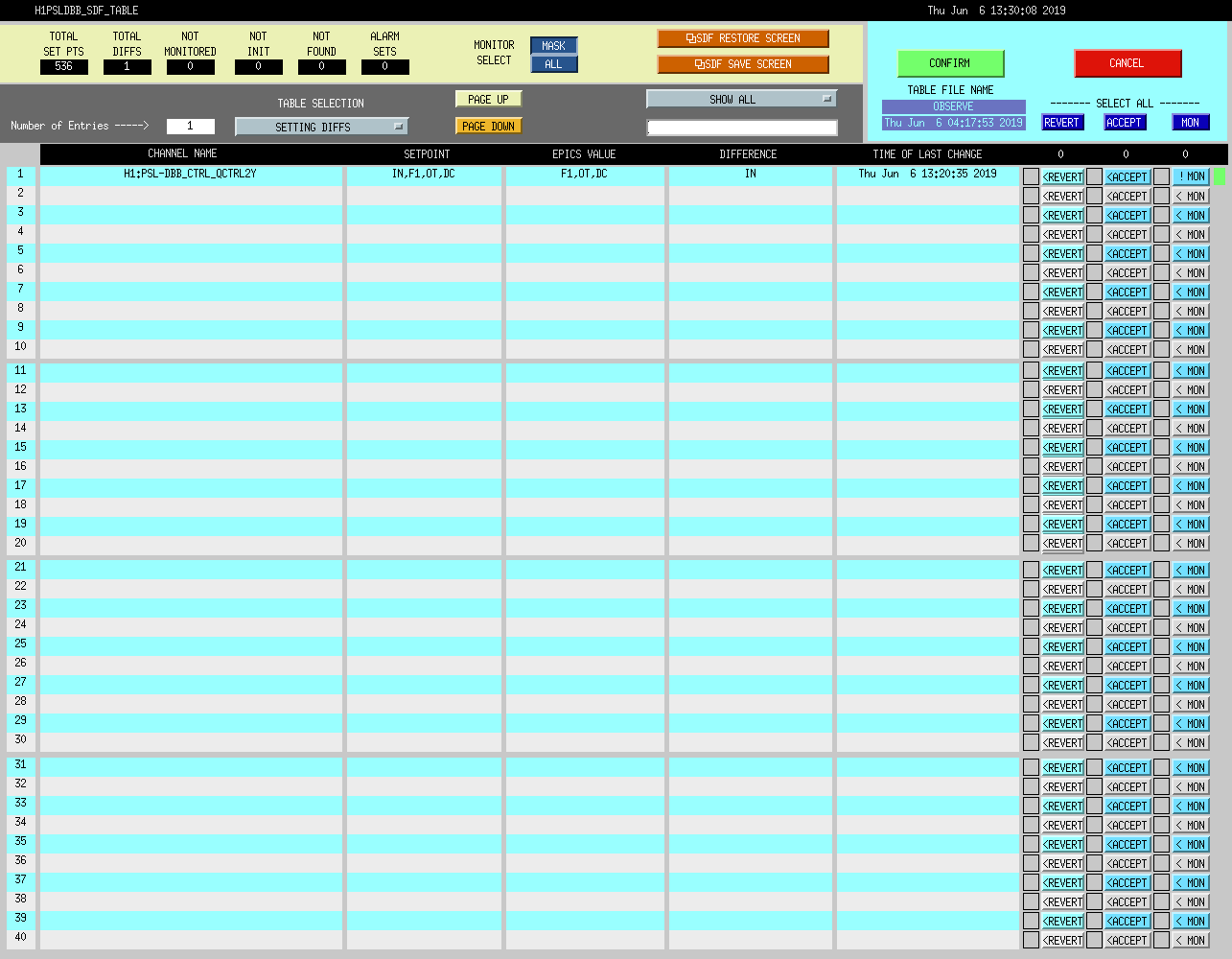
The DBB is offline, not to mention physically no longer on the table.
Since the DBB is not a part of H1 operations, should we UNMONITOR? (Why did this change during OBSERVING?)
Yes, I think the DBB should be unmonitored. I don't know why it would have changed while we were in observe though.
Entered FRS ticket 13107 for this.
First saw it on the YAW Control strip tool in front of me (1st attachment), but then saw it in the 40min Strip tool as well. It is mostly gone, but can still faintly see it.
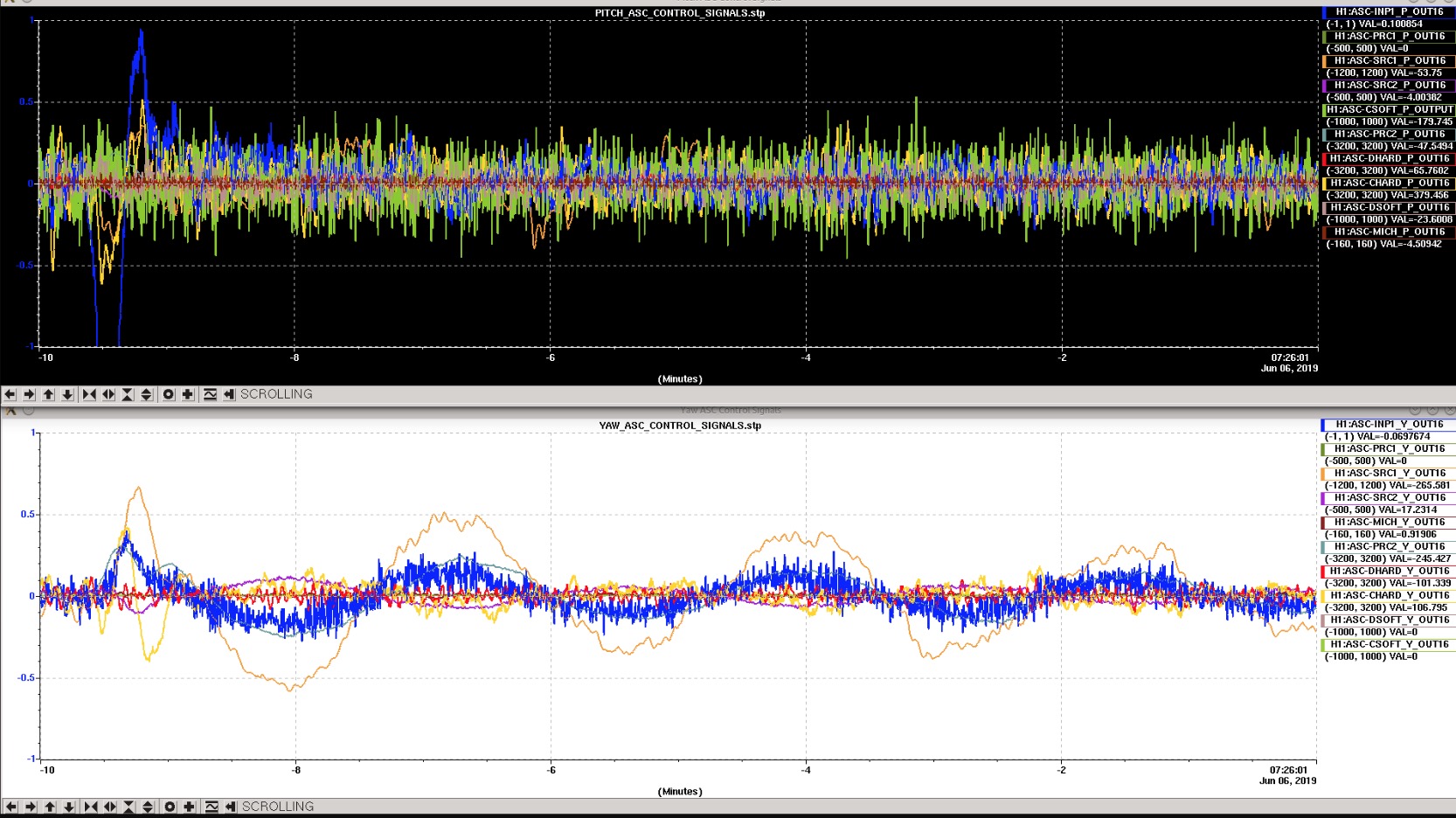
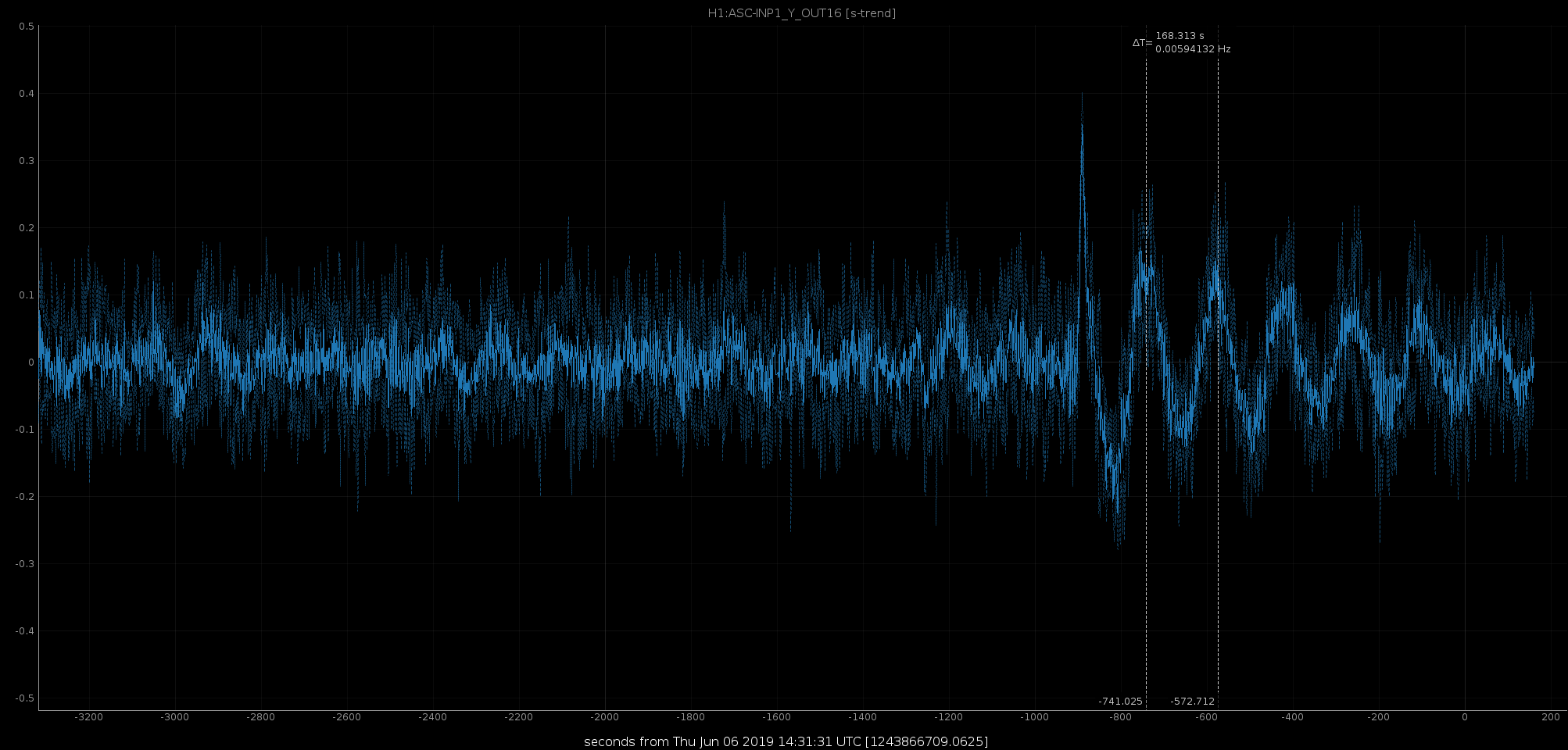
W went out of observing very briefly to remove some gain from the ADS yaw loops, who's gain we had increased yesterday. It looked as though this oscillation could be a cross coupling between the ADS and SRC2 loops. Several times yesterday we noted that the SRC2 loops are bringing their error signals to 0 very slowly, so we might need to increase these gains.
Since the gain reduction seems to have gotten rid of the oscillation, I've edited the guardian to keeps the ADS gains lower for now.
The next time the interferometer looses lock, loading ISC_LOCK should make these changes happen.
LOAD was executed at 10:58utc on June 7th.
Noticed a new message (other than Violin Damping) which says: ALS_YARM: Stolen (by: User)
I reckon this must have been me when I had to touch up the Y-arm when I was trying to relock. Not really sure what I could have done differently to steal that node.
"Stolen by USER" will show up on a manager node when one of its subordinates has a new manager. In this case, it is USER. User means that someone had manually clicked on the medm to manage that node. I will change this node to be managed by ISC_LOCK as ALS_XARM is, otherwise we may run into some stalling when there is a lock loss.
I wonder when/how this happened. I don't think I changed the MODE (from ALS_YARM being MANAGED). I did select UNLOCKED for it....would that have been the reason? Hmmmm.
That shouldn't have been the reason. My guess is an accidental clicking of the MANAGE button from the "all states" screen is what happened.
Lockloss at 8:16 (lockloss file)
Reverted to 35W per Sheila's alog and noted in my earlier "Back to Observing" alog. Here is the "Operator Play By Play" for locking.
NOTE: This is after two new states:
Play By Play Notes:

Additional NOTE: I wasn't sure whether to mark downtime as "locking" or "commissioning". I did a little bit of both, but mostly "commissioning", because I had to undo some high power stuff and then had to deal with new procedure for ISC_LOCK from Tues work.
10:04 Back to OBSERVING
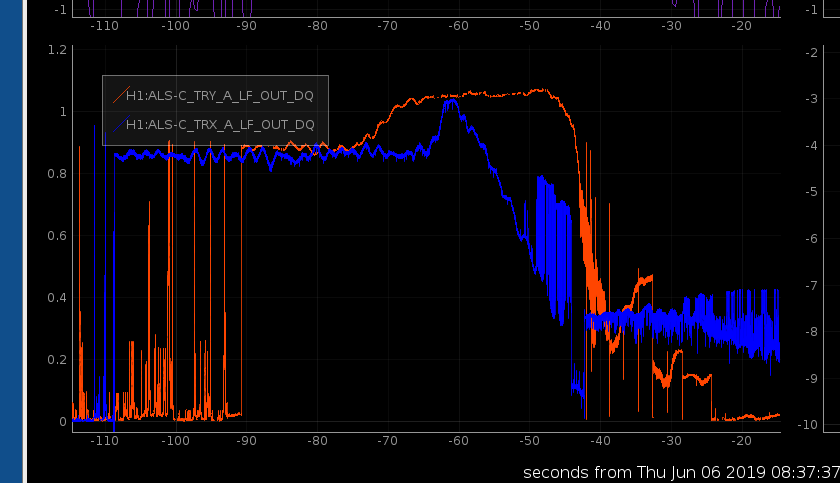
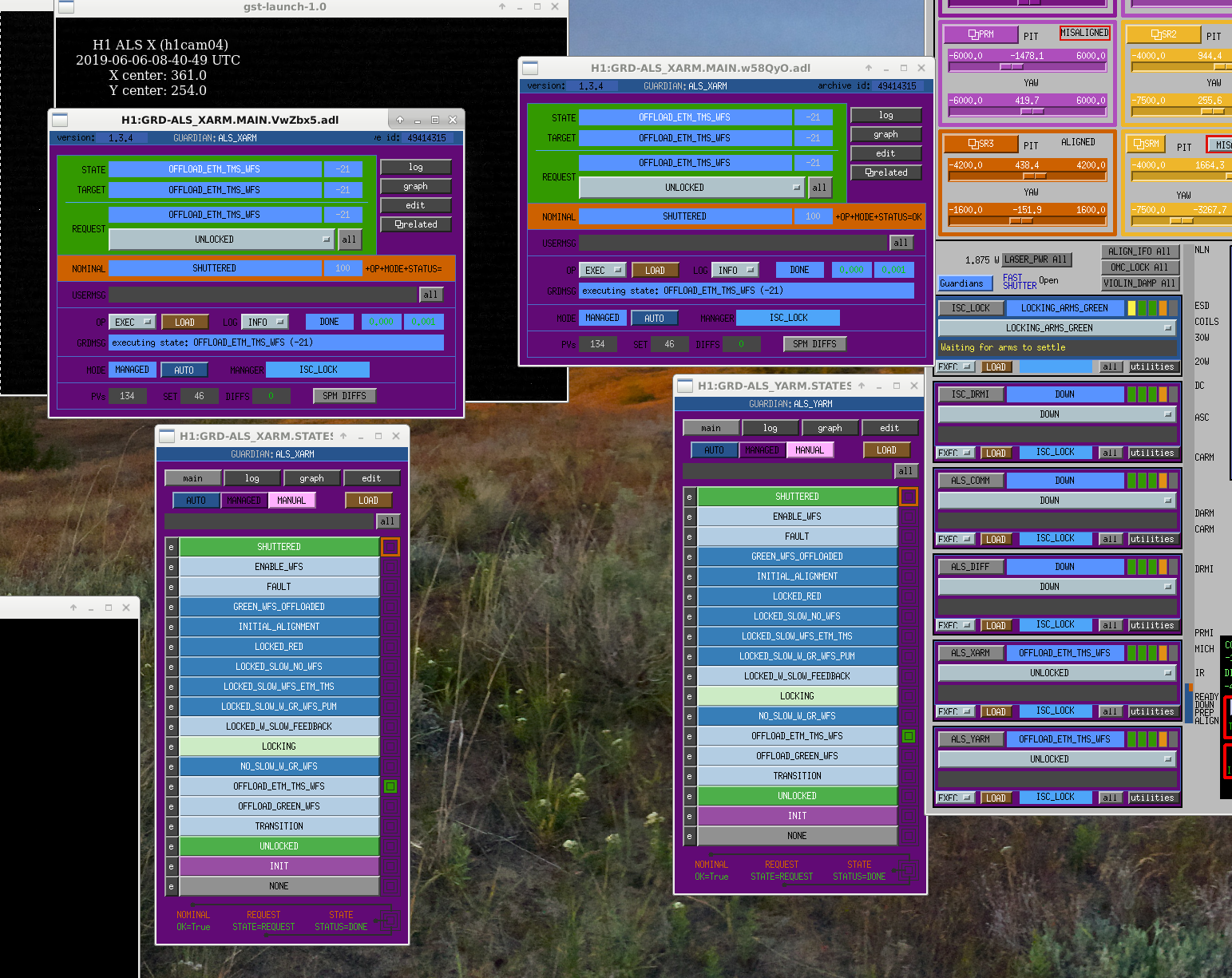
In regards to the ALS_X/YARM in UNLOCKED, on the main guardian screen for a node, there is a Request area below State and Target. This area has 2 fields, an EPICS readout and a state selector. The state that the state selector reads is not an accurate way to judge what state we are in, hence the EPICS readout right above it. There are only so many states that can fit on the state selector, so if a state is requested from a manager that is not in the selector, it will not be able to show it there. Recent changes have added new states to this node, most likely pushing Unlocked off of the state selector.
Hopefully this clears it up a bit.
Thanks for the explanation, TJ!
I really wanted to note/document what I saw because it was different from what I had been used to & so it had me scratching my head a little. But I do remember there were changes made on Tuesday. Anyway, I've had experience with the new way it works now and think I have it down. THANKS!