TITLE: 06/02 Day Shift: 15:00-23:00 UTC (08:00-16:00 PST), all times posted in UTC
STATE of H1: Unlocked
INCOMING OPERATOR: Jim
SHIFT SUMMARY: As I was handing off to Jim we lost lock. Not sure of the cause, but we could see ASC start to buildup for ~20sec before it lost it.
LOG:
Locked for 6.5 hours, calm environment.
TITLE: 06/02 Day Shift: 15:00-23:00 UTC (08:00-16:00 PST), all times posted in UTC
STATE of H1: Observing at 111Mpc
OUTGOING OPERATOR: Travis
CURRENT ENVIRONMENT:
Wind: 9mph Gusts, 7mph 5min avg
Primary useism: 0.02 μm/s
Secondary useism: 0.08 μm/s
QUICK SUMMARY: Travis recovered form a ~6 mag eq in Tonga over an hour ago.
TITLE: 06/02 Owl Shift: 07:00-15:00 UTC (00:00-08:00 PST), all times posted in UTC
STATE of H1: Observing at 110Mpc
INCOMING OPERATOR: TJ
SHIFT SUMMARY: Lockloss due to EQ. Ran initial alignment and relocked without issue.
LOG:
10:44 Transitioned to SEI to EQ mode for Tonga quake
11:20 Lockloss due to Tonga EQ
13:42 Back to Observing
TITLE: 06/02 Owl Shift: 07:00-15:00 UTC (00:00-08:00 PST), all times posted in UTC
STATE of H1: Observing at 97Mpc
OUTGOING OPERATOR: Jim
CURRENT ENVIRONMENT:
Wind: 8mph Gusts, 5mph 5min avg
Primary useism: 0.01 μm/s
Secondary useism: 0.08 μm/s
QUICK SUMMARY: Lock is 28+ hours old. No issues to report.
TITLE: 06/02 Eve Shift: 23:00-07:00 UTC (16:00-00:00 PST), all times posted in UTC
STATE of H1: Observing at 106Mpc
INCOMING OPERATOR: Travis
SHIFT SUMMARY: Nothin' doin'
LOG:
Couple of GRBs, nothing else happened.
TITLE: 06/01 Day Shift: 15:00-23:00 UTC (08:00-16:00 PST), all times posted in UTC
STATE of H1: Observing at 111Mpc
INCOMING OPERATOR: Jim
SHIFT SUMMARY: Quiet shift, 20hr lock. SQZ manager is still reporting "green power stabilization railed".
Still locked for 17.5hrs, range around 110Mpc.
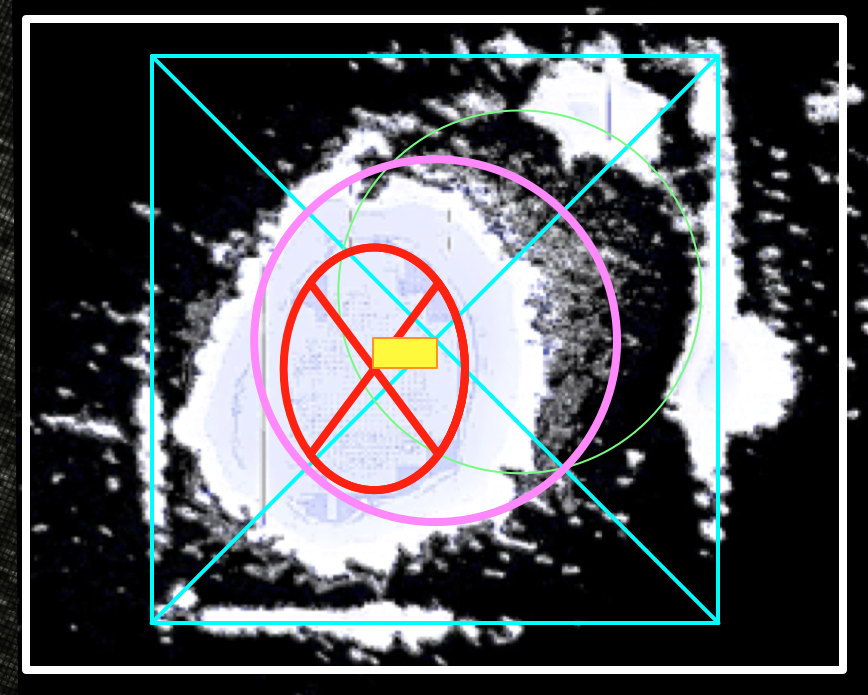
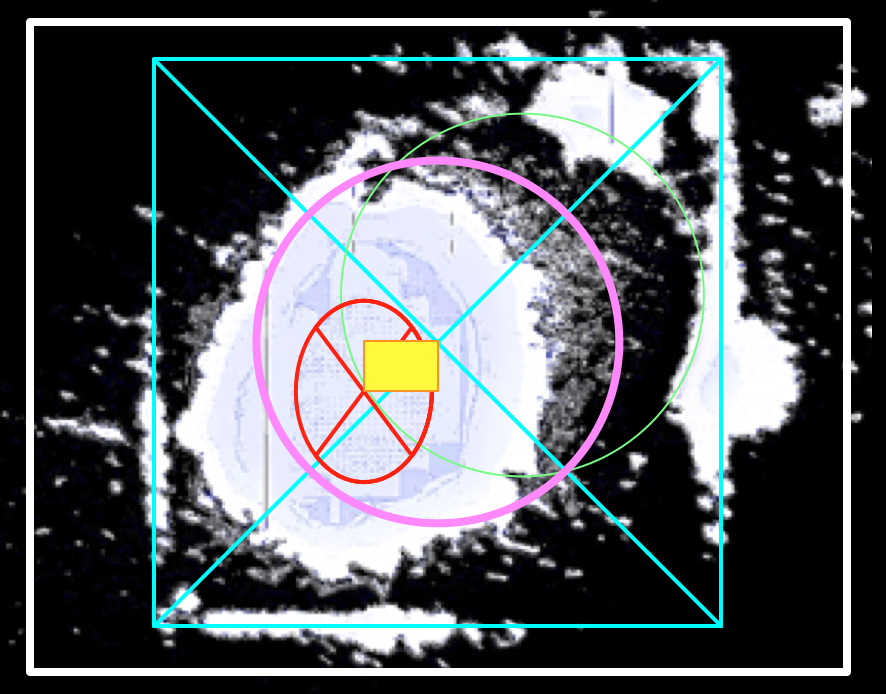
I've recorded the beam spot center on CW1 at 2W and 35W, and see a shift of the beam in power up of 1.0mm to 1.3mm in the +X direction, and 0.9mm to 1.8mm in the -Z direction.
At 2W, the center of the beam spot has been consistently hovering around 2mm +/-0.5mm in the +X direction (left of center in the image), and within +/-1mm in the Z direction. The first image shows the beam at 2W, and the beam spot is at 1.8mm +X, 0.4mm +Z.
At 35W, I measured the beam two ways.
In All Images:
TITLE: 06/01 Day Shift: 15:00-23:00 UTC (08:00-16:00 PST), all times posted in UTC
STATE of H1: Observing at 109Mpc
OUTGOING OPERATOR: Travis
CURRENT ENVIRONMENT:
Wind: 7mph Gusts, 5mph 5min avg
Primary useism: 0.01 μm/s
Secondary useism: 0.08 μm/s
QUICK SUMMARY: Calm environment, 12 hr lock.
TITLE: 06/01 Owl Shift: 07:00-15:00 UTC (00:00-08:00 PST), all times posted in UTC
STATE of H1: Observing at 109Mpc
INCOMING OPERATOR: TJ
SHIFT SUMMARY: Lock is 12+ hours old. No issues to report.
LOG:
7:48 GRB alert
TITLE: 06/01 Owl Shift: 07:00-15:00 UTC (00:00-08:00 PST), all times posted in UTC
STATE of H1: Observing at 107Mpc
OUTGOING OPERATOR: Jim
CURRENT ENVIRONMENT:
Wind: 10mph Gusts, 9mph 5min avg
Primary useism: 0.01 μm/s
Secondary useism: 0.10 μm/s
QUICK SUMMARY: Observing for 4+ hours. No issues to report.
TITLE: 06/01 Eve Shift: 23:00-07:00 UTC (16:00-00:00 PST), all times posted in UTC
STATE of H1: Observing at 107Mpc
INCOMING OPERATOR: Travis
SHIFT SUMMARY:
LOG:
1:30 Commissioning ended, DRMI was no good after recovering so I did an alignment
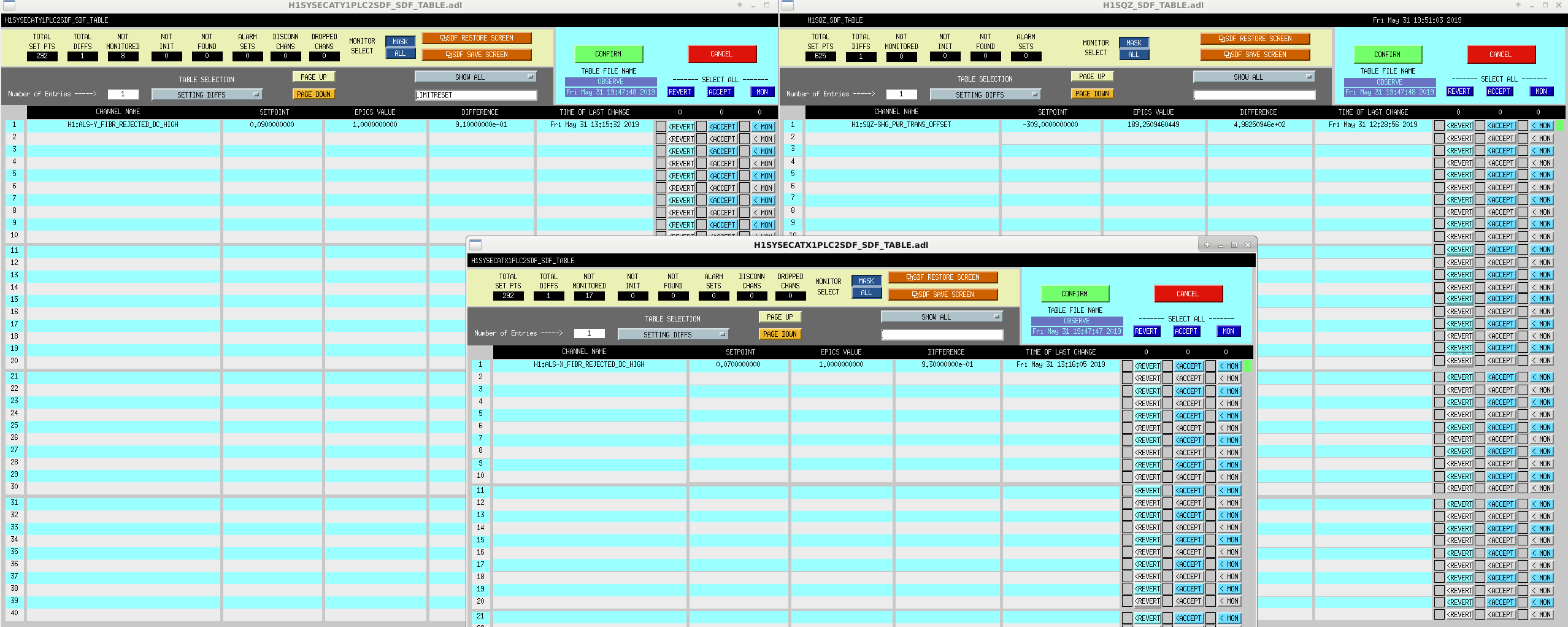
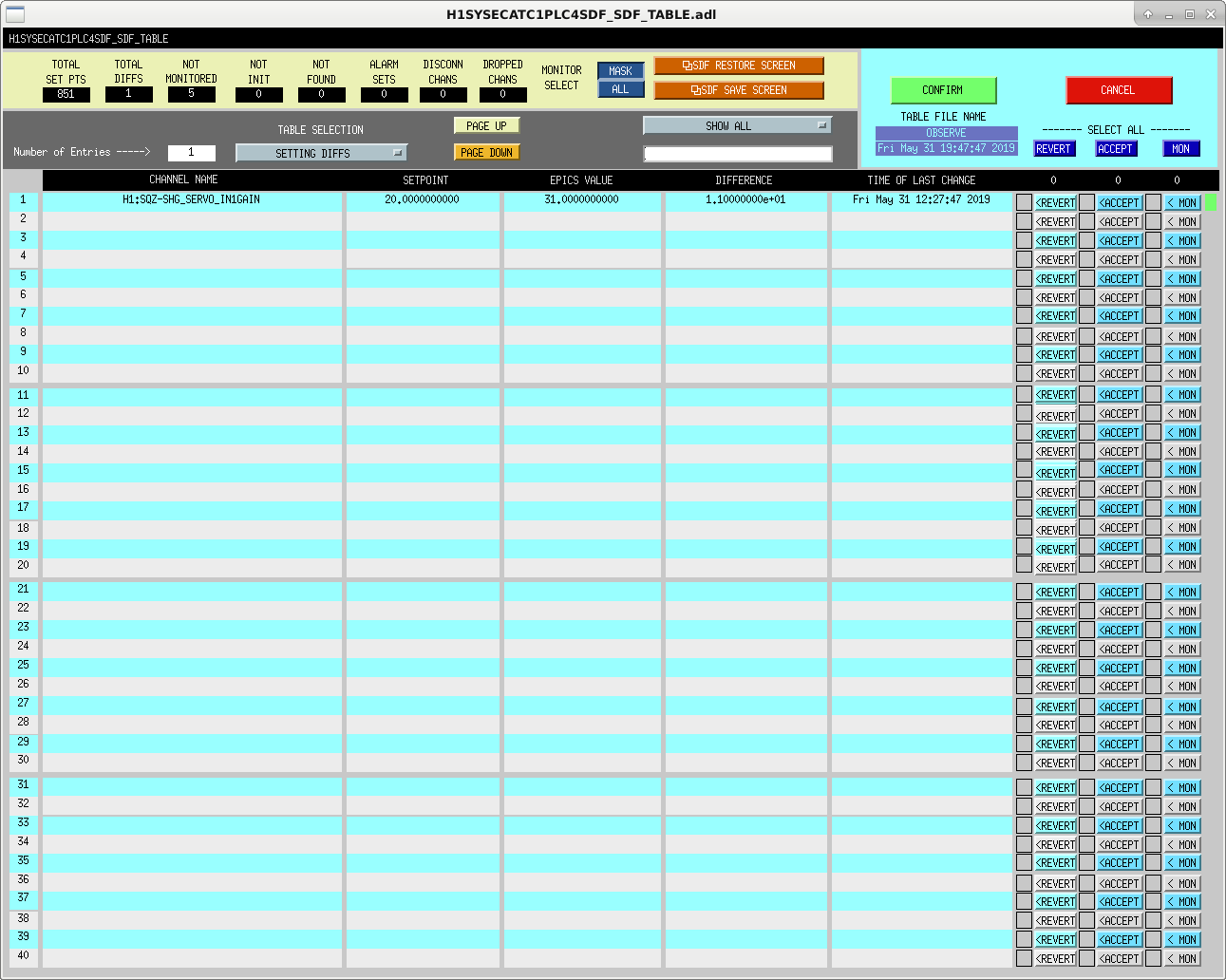
3:00 Observing, some SDF stuff for ALS and SQZ came up
ALS and SQZ diffs on getting to NLN tonight.
[M. Wade, A. Viets]
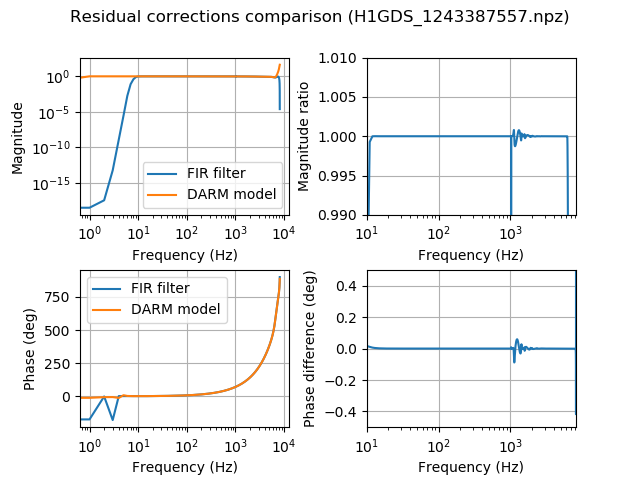
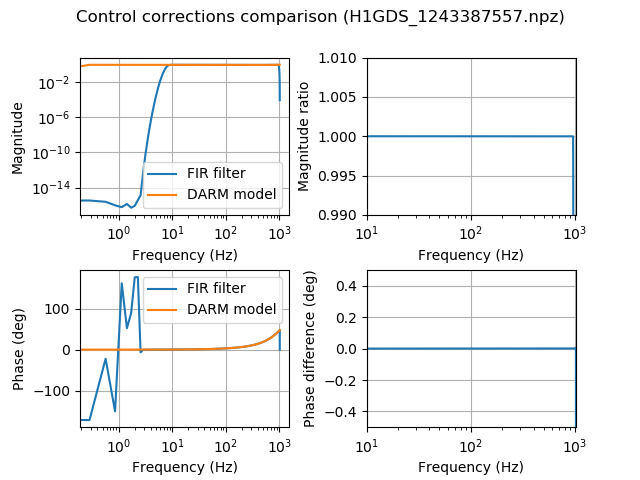
I have produced new filters for the GDS calibration pipeline, nearly identical to those discussed in LHO aLOG 48546. The only difference is that they do not contain an additional high-pass filter for the actuation path. The reason for this is related to the first bug fix noted in gstlal-calibration-1.2.10. These filters will be run on the testing DMT, where gstlal-calibration-1.2.10 has also been installed, to see that everything is working as expected before they are used in the production pipeline.
The filters are found in the calibration SVN, revision 7671, in this location: aligocalibration/trunk/Runs/O3/GDSFilters/H1GDS_1243387557.npz
Bode plots of the filters compared to the frequency domain model are attached.
Jenne, Sheila
Travis said that he had some locklosses because of the DRMI ASC (only BS so far in O3), and since we saw the same thing this afternoon, we tried to work on the DRMI ASC.
We found that our old ASC loops were fine for INP1, PRC2, and SRC2, and that we can increase the gain of SRC2 so that both pitch and yaw have a gain of 60 (factor of 6 increase for Pit, factor of 3 increase for yaw). We found that the 45Q signals we had been using for the beamsplitter had almost no response, especially in yaw. We also found that the AS72 signals we used to use for SRM were not near a zero crossing for a good alignment. We weren't able to find a good error signal for the beam splitter.
We have reverted the guardian, but left our new input matrix commented out. Operators who have trouble over the weekend with DRMI ASC can try running initial alingment.
Yesterday morning, JeffB got SDF diffs when he switched the seismic configuration to the earthquake state. Tuesday, I had increased the ramp time used to switch the sensor correction from 15 to 30 seconds. When I did this, I didn't realize that TJ had hard coded a 15 second ramp into the new sensor correction guardians, in fader.py. Because commissioners are commissioning, I was able to go and fix this in the guardian and do a couple quick tests, so the ramp times are back to 30 seconds. I've also reverted the affected epics values (33 tramps) for all of the platforms. It would be good to do a couple transitions when the SDF overview isn't so red and green to make sure, but I think we should be able to transition between seismic states without dropping out of observe, again, now.
TITLE: 05/31 Day Shift 15:00 – 23:00 (08:00-16:00), all times posted in UTC
STATE of H1: Locking
INCOMING OPERATOR: Jim
SHIFT SUMMARY: Began the shift locked and Observing. Started commissioning around 18:00 UTC. Lost lock a little after that, and then started commissioning work on some early locking steps.
LOG:
15:00 (08:00) Start of shift
16:26 (09:26) Fil to H2 room
16:37 (09:37) Chris back from MY
18:04 (11:04) Going out of Observing to Commissioning
18:28 (11:28) Gerardo to LVEA -- take picture of HAM6
18:30 (11:30) Pep to E-bay -- move magnetometer
18:33 (11:33) Pep back from E-Bay
18:40 (11:40) Gerardo out of LVEA
18:47 (11:47) Gerardo to LVEA -- take measurements
19:05 (12:05) Gerardo out of LVEA
19:13 (12:13) Gerardo to LVEA -- continue measurements
19:23 (12:23) Gerardo out of LVEA
20:00 (13:00) Kyle to MX, MY -- take measurements, photos
20:02 (13:02) Pep to LVEA -- move magnetometer
20:06 (13:06) Pep back from LVEA
21:33 (14:33) Kyle back from MX, MY
23:00 (16:00) End of shift
Main message: I've made another change to the squeezer laser current, which will hopefully give us a week or two without mode hopping, but it seems that we need to start planning on changing out the squeezer laser.
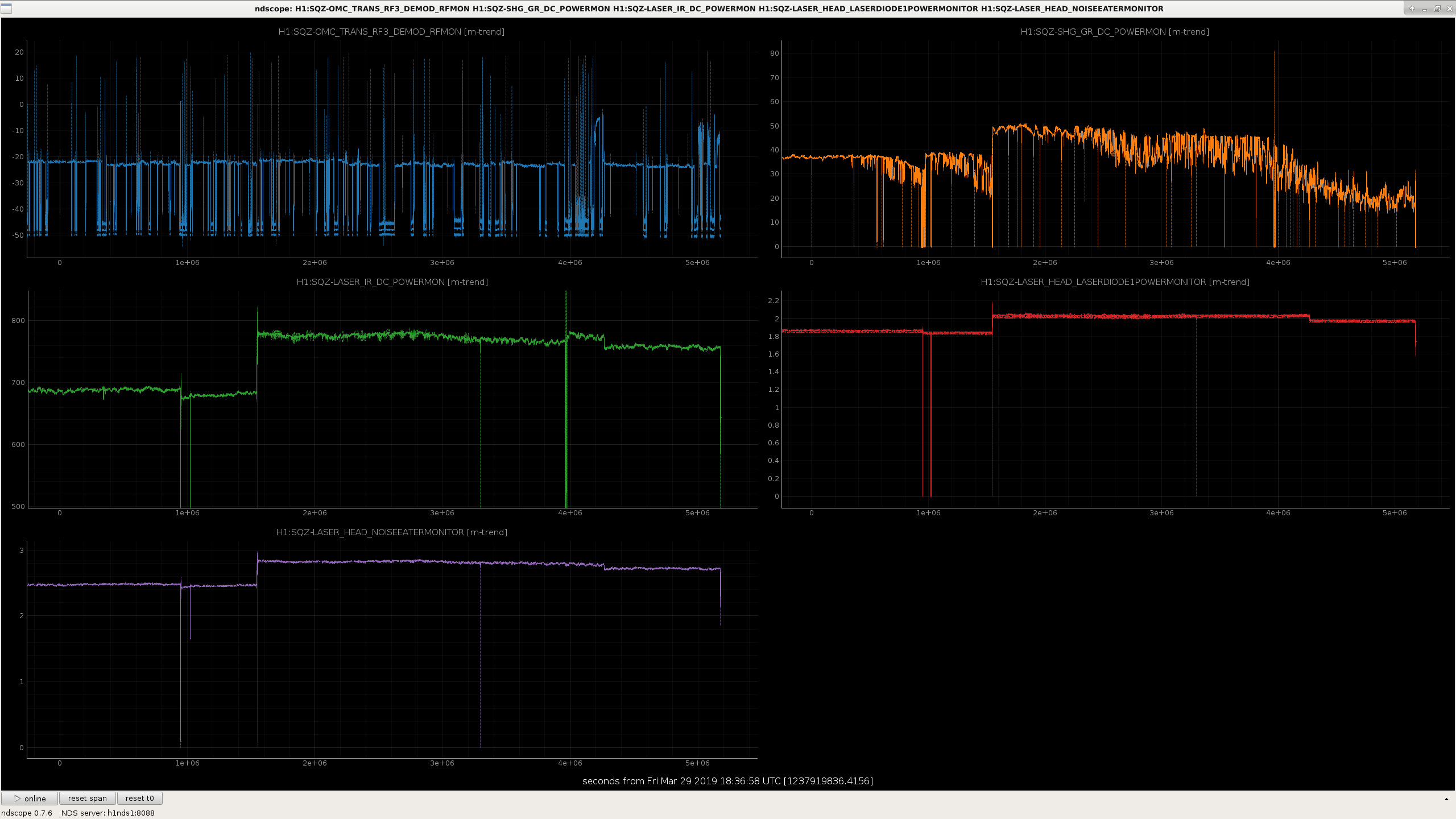
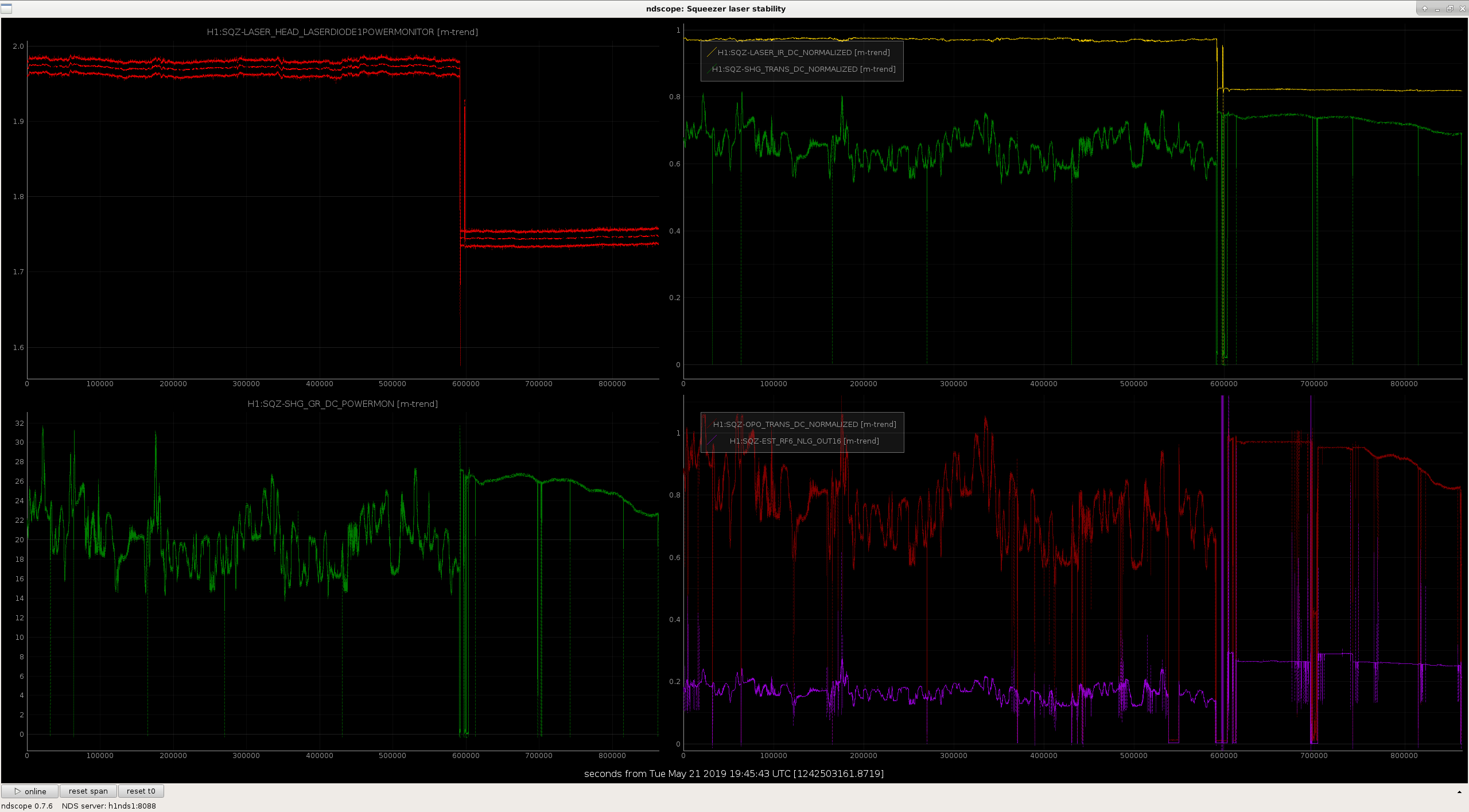
The first attachment shows a 60 day trend of the squeezer laser power, and the green power produced by the SHG degrading as the laser mode hopping becomes worse. Jeff B and I had made a small adjustment to the laser current last Friday, 49327 but this step was not large enough to fix the problem.
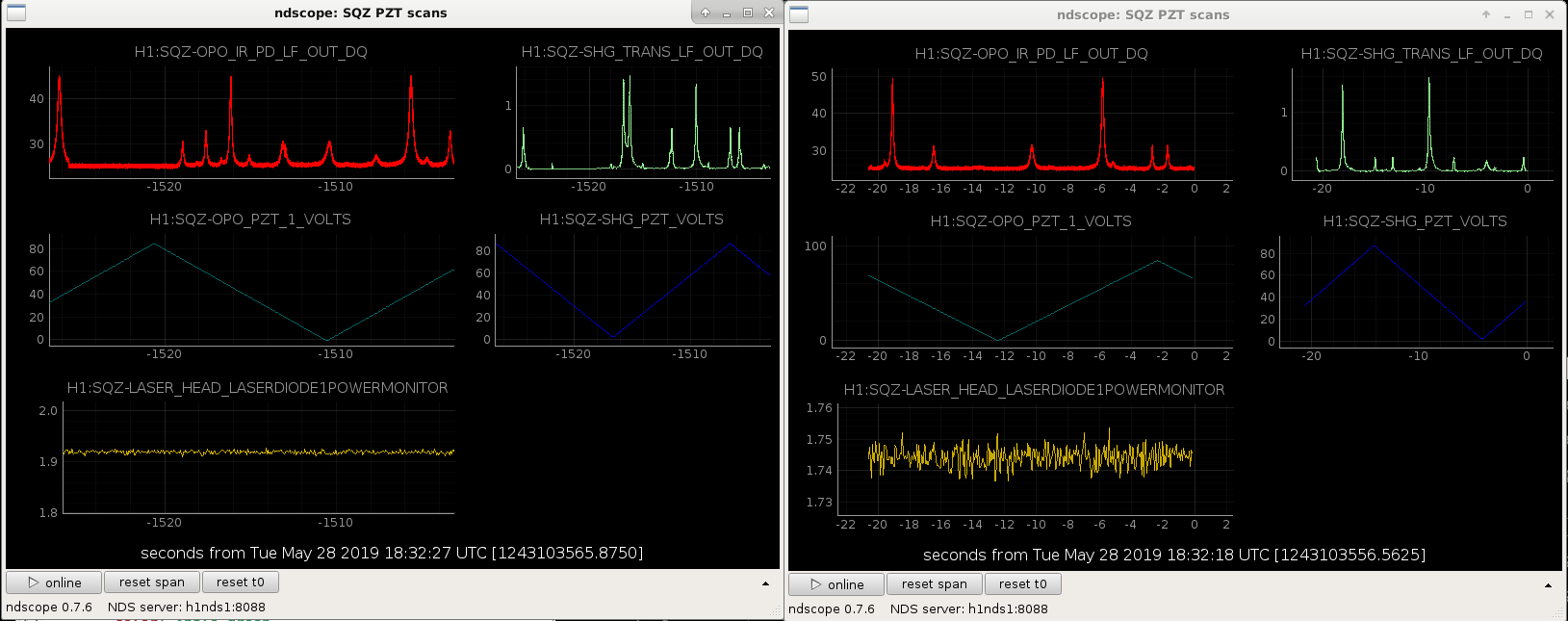
We have potentially three ways to quickly see that the laser is multi-mode, SHG scan, OPO scan, and by looking at the beatnote. Today it seemed like the OPO and SHG scans are both useful, but I could not tell the difference between the two current settings by looking at the beatnote. The second attached screenshots shows the SHG and OPO scans before and after lowering the laser current from 2A according to the laser controller to 1.857A on the laser controller. The readbacks for the laser current are consistently lower (shown in yellow in the screenshot) than the front panel readbacks. While watching both of these scans with the laser current set to the multi-mode value, I tried blocking the two main paths to see if that would change the behavoir. (While watching the SHG scan, I blocked the path which goes to the seed, clf and beatnote, saw not change in mode hopping in SHG scan. Then I blocked the SHG while watching seed scan of OPO, no change). So if the problem is due to laser feedback it is from a problem upstream of the split between the two paths, I looked through this path two weeks ago during Tuesday maintenance and again today.
This new current setting is low, which may mean that we cannot engage the noise eater with this setting. I changed the diode current nominal level to reflect the change.
A few more comments on the squeezer today:
Because the ref cav transmission was increased, there is now much more light coming to the squeezer fiber from the PSL, so I've increased H1:SQZ-FIBR_TRANS_DC_HIGH. I increased the limits on this PD, I do not think that we are in danger of saturating the beatnote diode which was why Daniel had enforced the limits in the first place (right now we have -3dBm of RF and half a mW of DC power).
The beatnote strength was initially decreased to -20dBm after I changed the laser current despite the increase in power from the PSL. I went back to the table and adjusted the alignment of the beam onto the beatnote diode, which brought the beatnote back up to -3dBm. Nutsinee had once before made a comment that changing the current on the squeezer laser seemed to change the downstream alignment, this could be consistent with that happening.
It seems that the SHG power servo has mostly been sitting at its rails for more than a week. For today I have reset the set point, so it is running. I also added a notification to the squeezer guardian that would at least tell the operators that it is railed. I think that this power stabilization would work more reliably if the laser were not running multi-mode.
The first attachment shows that the SHG power fluctuations which have been characteristic of the squeezer laser mode hopping have not returned (yet) after Tuesday's current change. The green power produced by the SHG has been dropping, along with the IR power transmitted by the SHG, but more slowly.
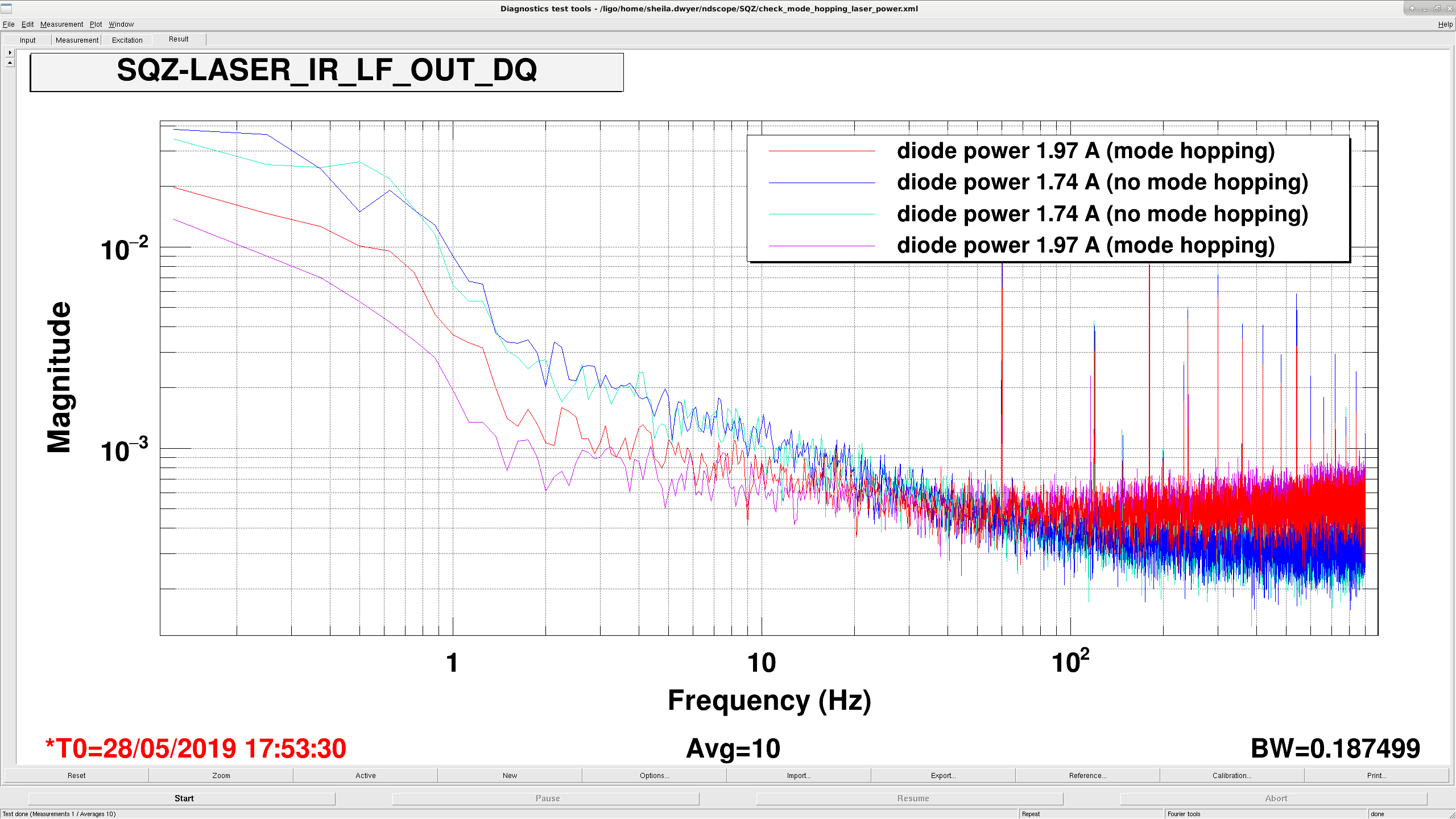
Keita suggested looking at the intensity noise out of the laser might be a usefull way to diagnose mode hopping while the cavities are blocked. The second attachment shows a spectrum from the laser power monitor diode, which is after the EOM. It does have a change in the spectrum for the low and high current times.