TITLE: 05/24 Eve Shift: 23:00-07:00 UTC (16:00-00:00 PST), all times posted in UTC
STATE of H1: Observing at 106Mpc
INCOMING OPERATOR: Ed
SHIFT SUMMARY:
H1 has been locked for 33+hrs.
useism has leveled off after taking a step up earlier today (in between 50th & 90th percentiles).
LOG:
TCSy started out the shift around at around a level of 9.5cm & at the end of the shift it was still at 9.5cm. Since I was there, I topped it off with ~210mL to get it to 10.1mL.
TCSx looked fine, so no change made.
TITLE: 05/25 Owl Shift: 07:00-15:00 UTC (00:00-08:00 PST), all times posted in UTC
STATE of H1: Observing at 106Mpc
OUTGOING OPERATOR: Corey
CURRENT ENVIRONMENT:
Wind: 4mph Gusts, 3mph 5min avg
Primary useism: 0.02 μm/s
Secondary useism: 0.25 μm/s
QUICK SUMMARY:
h1 is approaching 30hrs for this lock. useism has shown an increase over the last 6hrs, where we are clearly aboe the 50th percentile.
The 1kHz line on the gravitational strain spectrogram does not look as pronounced now 4hrs later.
Gerardo M., Kyle R.
The mounting method used by our yet-to-be-installed, next generation, Main Turbo Pumps (Pfeiffer) utilize a mounting bracket that is integral to a vacuum spool that connects to the turbo pump's inlet flange. The fabrication of the initial units did not observe acceptable vacuum weld norms and had been rejected. Today we removed the rejected unit from the Y-mid Turbo Pump and installed the revised version of this part.
Kyle R.,
Using a calibrated leak detector as a backing pump to the spinning turbo pump, I sprayed an audible flow of helium slowly around the periphery of both flanges of this new part and found no leak(s). The helium baseline remained in the low 10-10 torr*L/sec during testing.
NOTE: This Pfeiffer Main Turbo Pump Station is free standing in the VEA and is not connected to the Beam Tube. Also, we operated the overhead crane in the Y-mid VEA sporadically between 1417 - 1543 hrs. local time
TITLE: 05/24 Eve Shift: 23:00-07:00 UTC (16:00-00:00 PST), all times posted in UTC
STATE of H1: Observing at 107Mpc
OUTGOING OPERATOR: Jim
CURRENT ENVIRONMENT:
Wind: 20mph Gusts, 16mph 5min avg
Primary useism: 0.03 μm/s
Secondary useism: 0.21 μm/s
Rainstorm was hovering over Rattlesnake, but have not seen approaching EY (via camera) yet. (winds are picking up a little)
QUICK SUMMARY:
As with some shift changes before, walked in to see H1 out of OBSERVING--Jim was monitoring the SQZ recovering from being unlocked (as we both said our "hellos", all the SDF diffs disappeared as the SQZ relocked itself...and Jim returned us to OBSERVING). Lock is currently 10min approaching 26hrs with a current range of 105Mpc (I see Robert watching the DARM spectra, walking outside a few times, and mentioning glitches. We do see wind gusts getting up to almost 30mph!
Gerardo just reported he is ending his work at EY, but Kyle is still down there (this is prep work [w/ some crane use] for a Turbo Pump to be installed at a time tbd).
TITLE: 05/24 Day Shift: 15:00-23:00 UTC (08:00-16:00 PST), all times posted in UTC
STATE of H1: Observing at 58Mpc
INCOMING OPERATOR: Corey
SHIFT SUMMARY:
LOG:
22:54 SQZ unlocked, dropped us out of OBSERVE, then relocked after a minute or two, back to observing
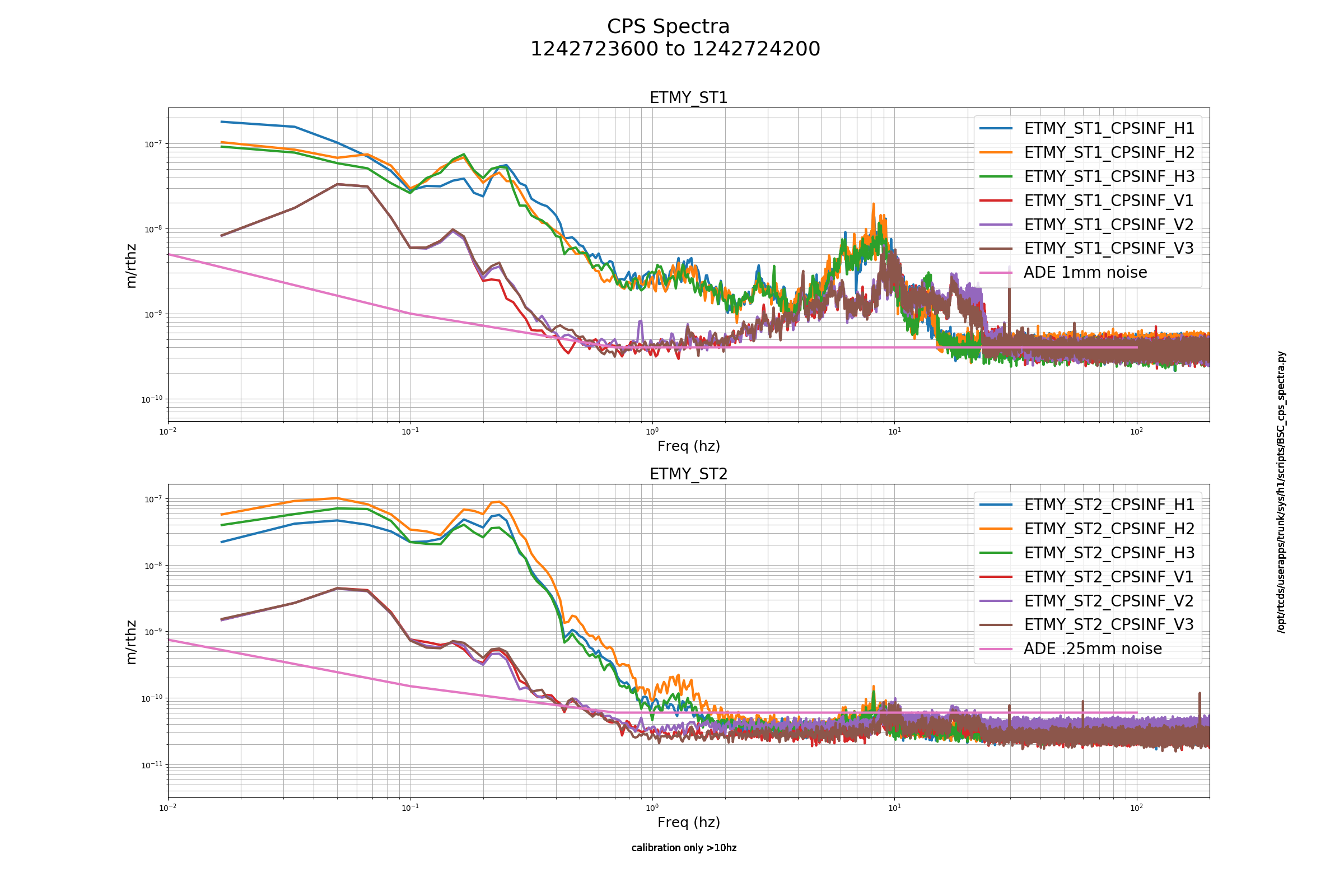
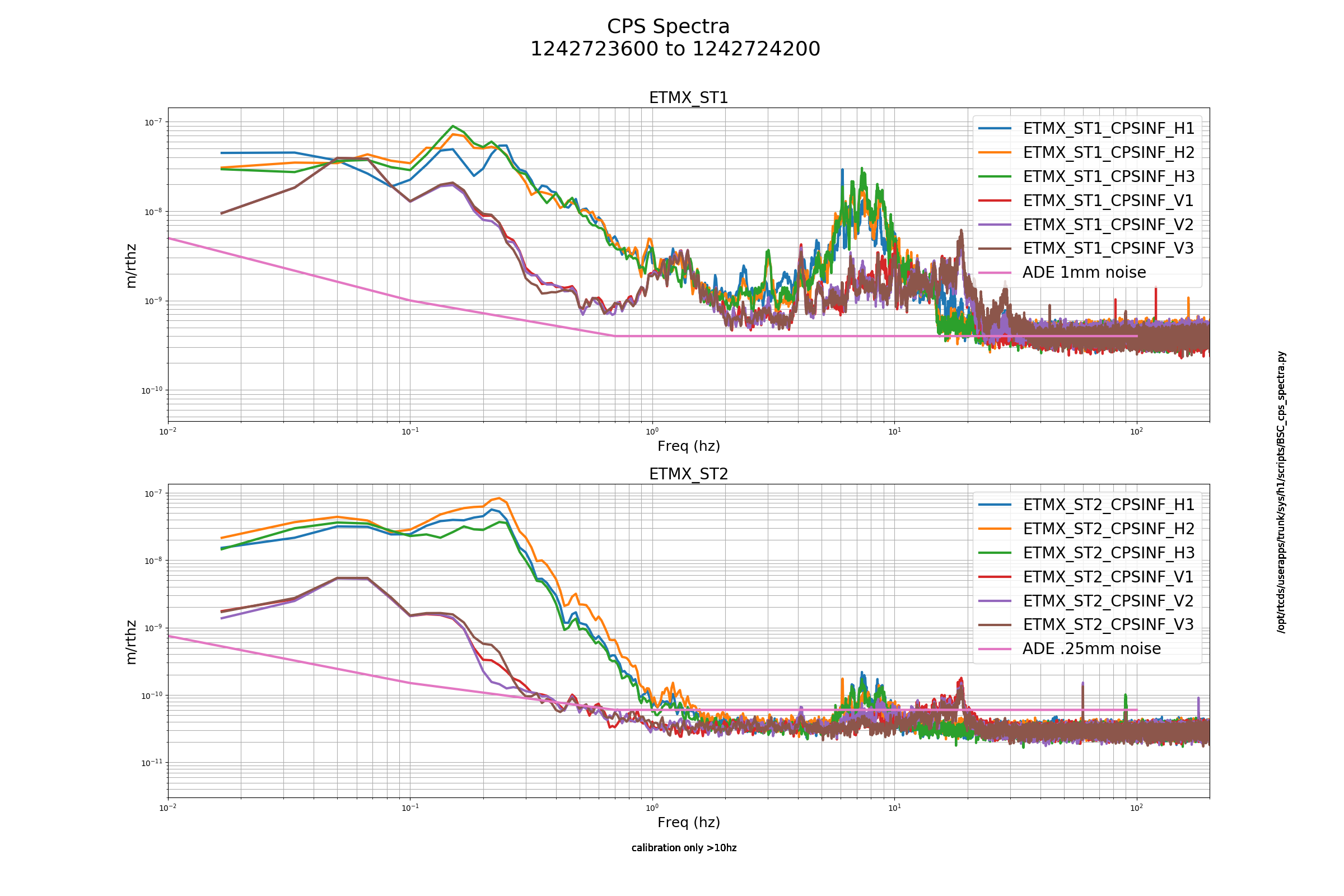
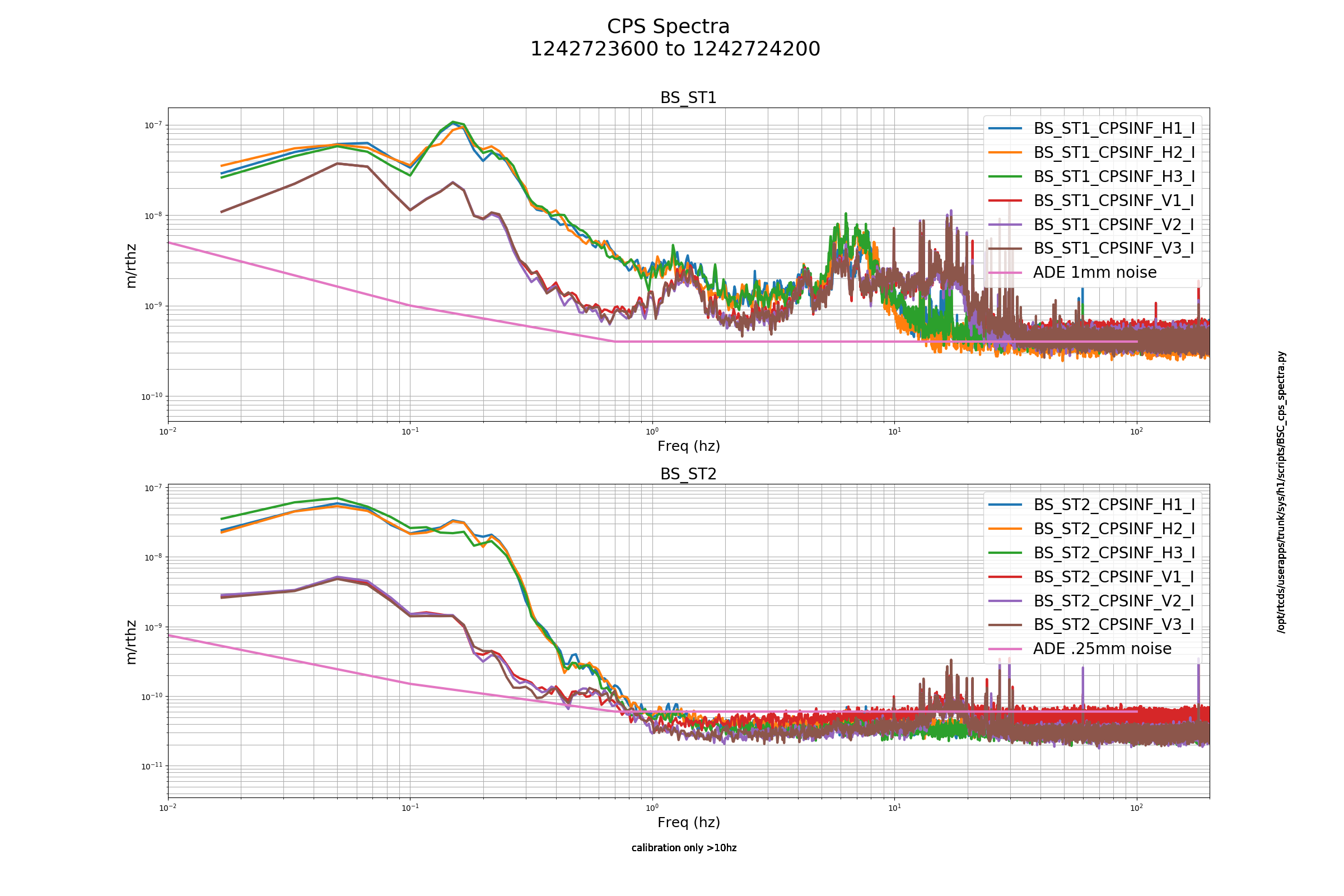
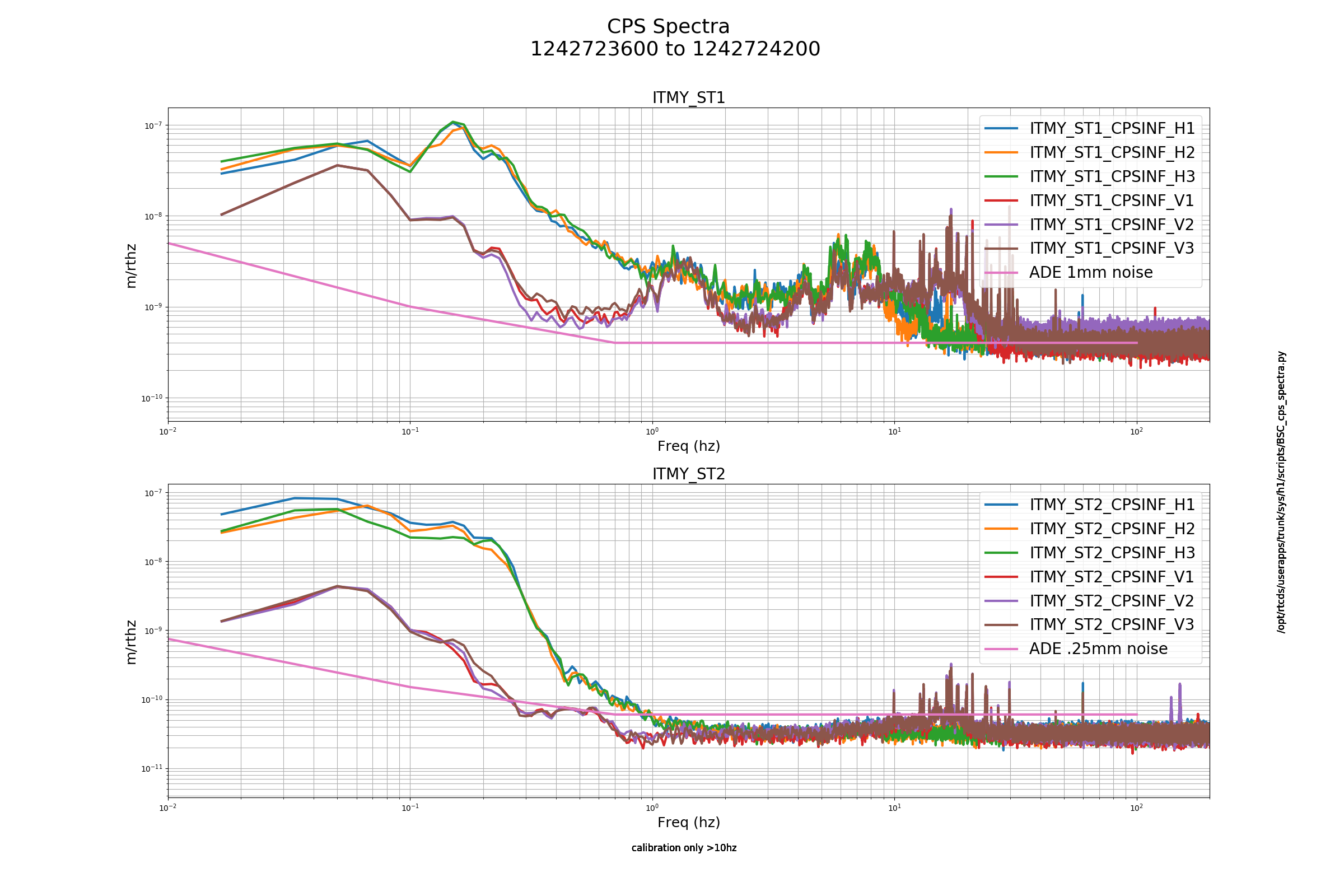
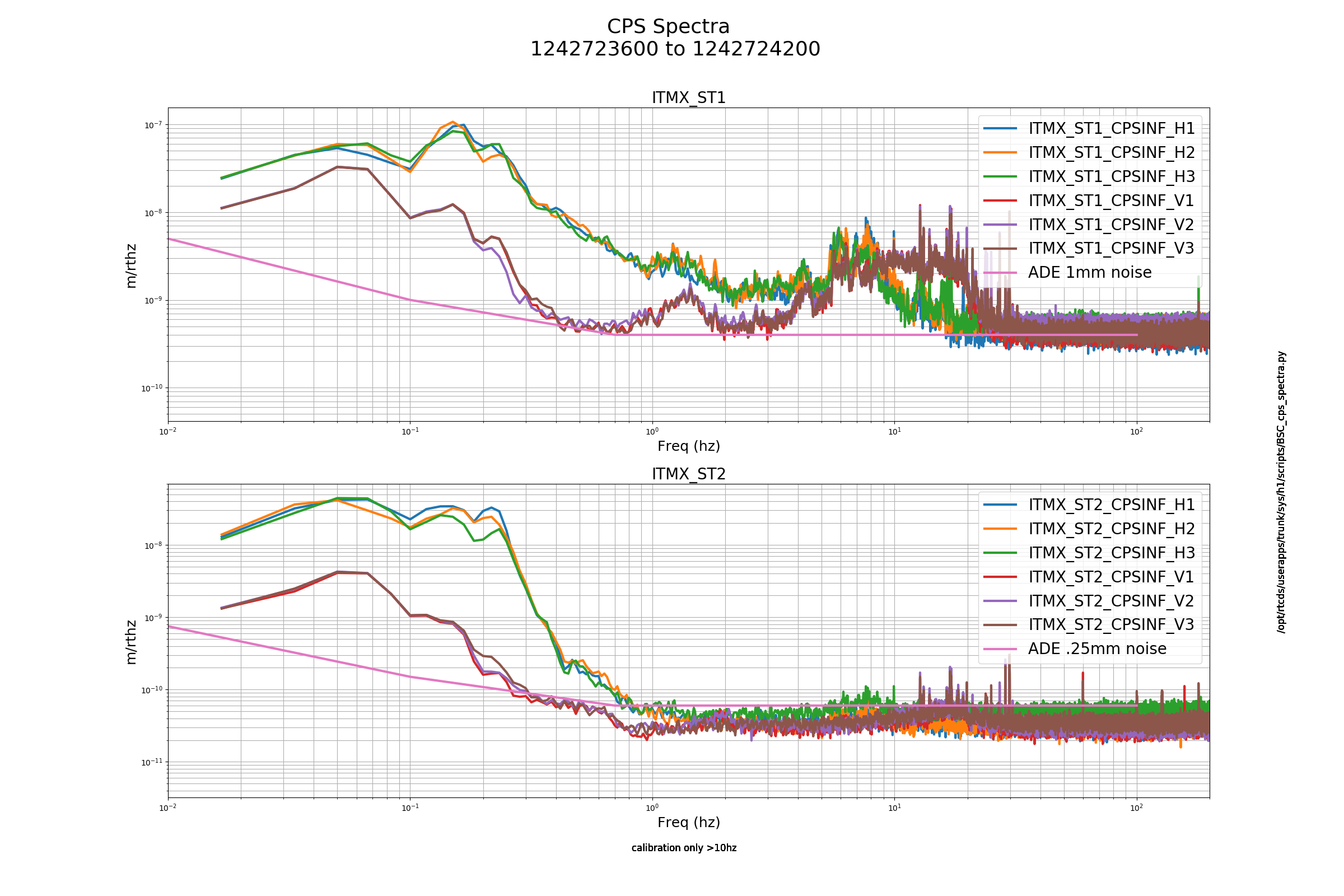
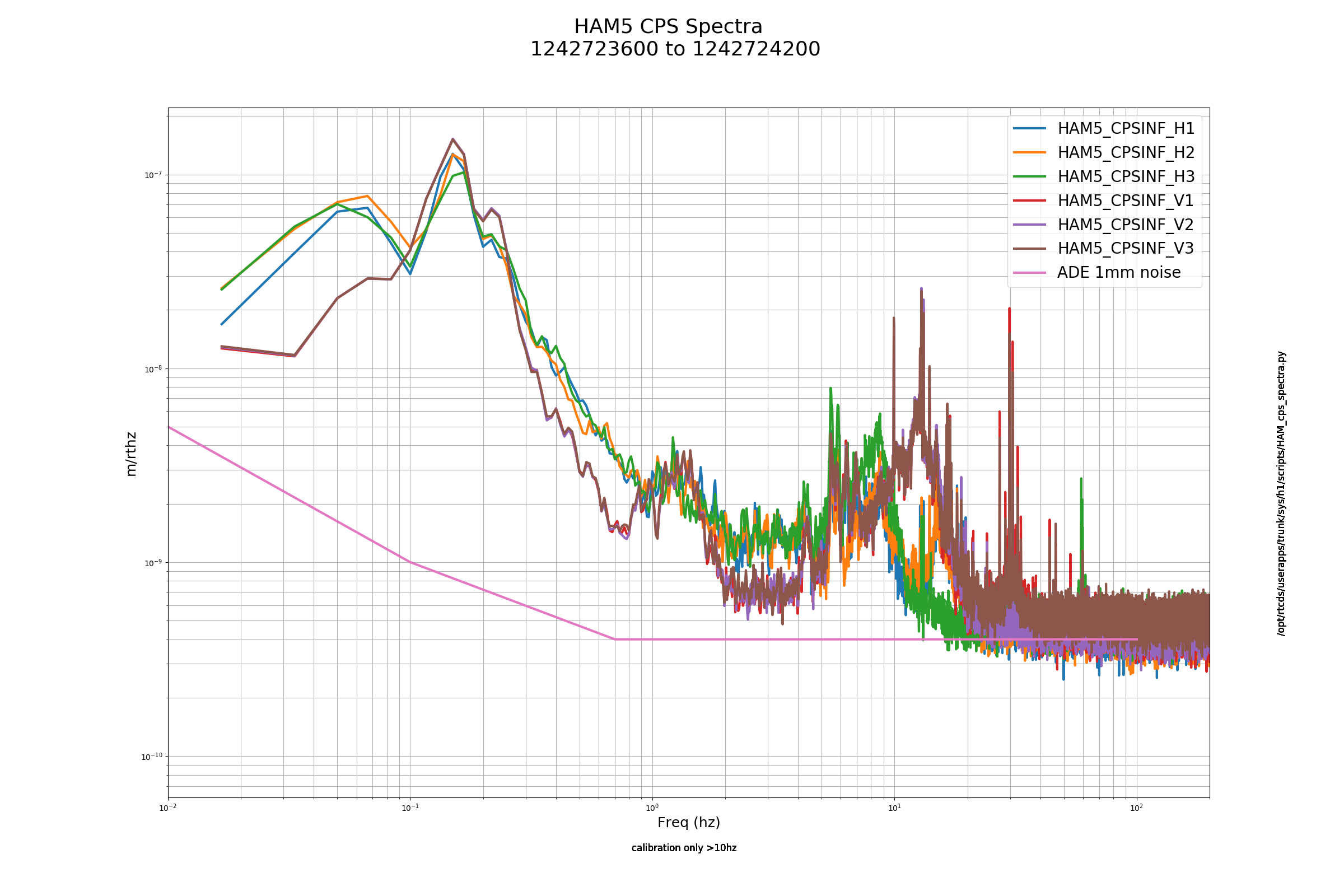
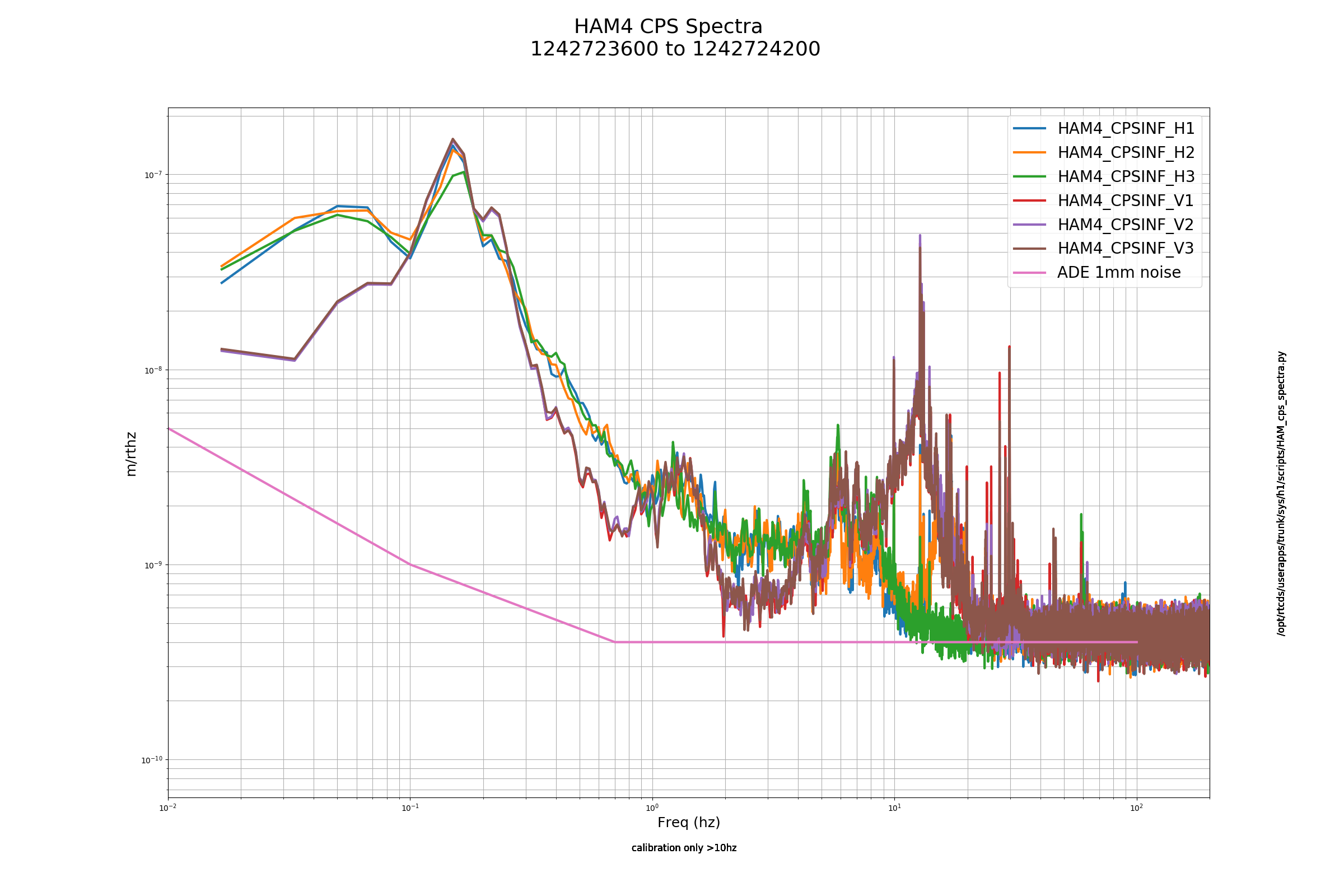
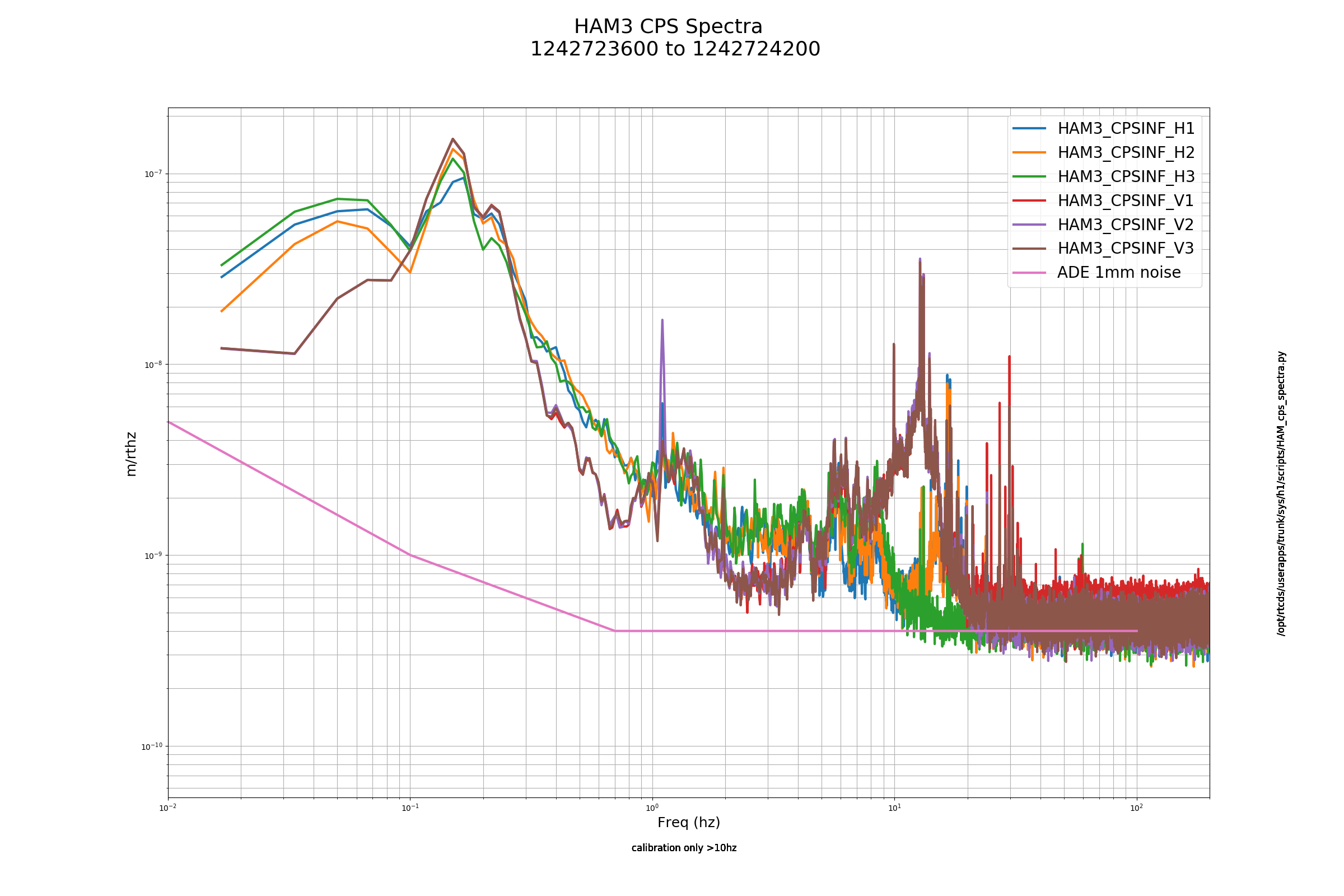
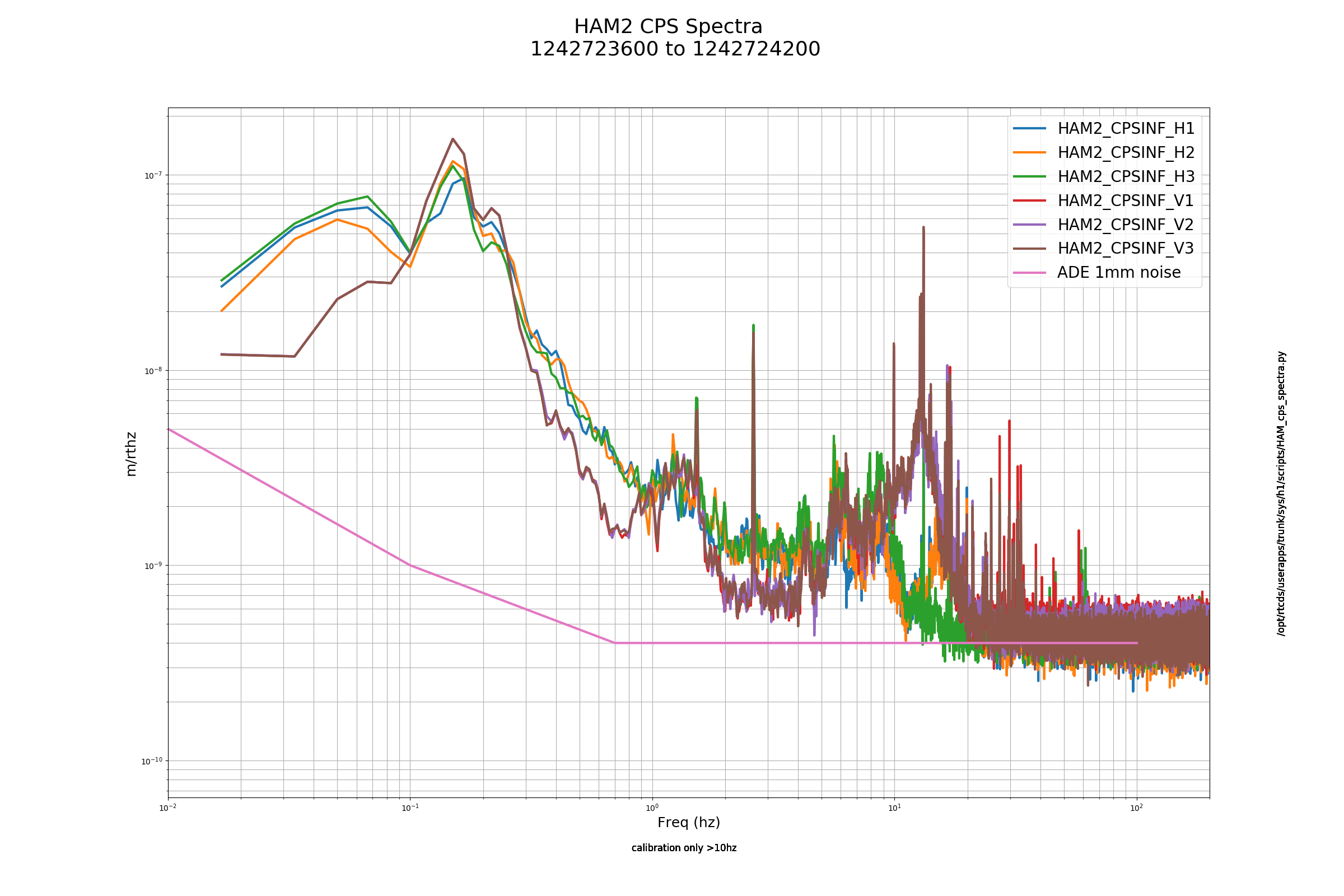
All seem to be within spec.
These plots have an updated calibration. Previously, my script had just used a static gain on 1e-9 to get m/rthz, which is wrong. The cps actually need a .14hz pole and 1.4hz zero to be calibrated to nm, with a gain of 3 for the coarse cps and .7 for the fines. Applying this calibration in python has proved more than my meager abilities for now, so I've just applied the gains to get the calibration right above 10 hz, as noted on the plots. I'll try to figure out the rest down the road.
TITLE: 05/24 Owl Shift: 07:00-15:00 UTC (00:00-08:00 PST), all times posted in UTC
STATE of H1: Observing at 104Mpc
INCOMING OPERATOR: Jim
SHIFT SUMMARY:
Quiet shift. Handingoff Locked H1 to Jim
LOG:
1 hr standown begins.
1 hr standown expired
TITLE: 05/24 Owl Shift: 07:00-15:00 UTC (00:00-08:00 PST), all times posted in UTC
STATE of H1: Observing at 109Mpc
OUTGOING OPERATOR: Travis
CURRENT ENVIRONMENT:
Wind: 15mph Gusts, 12mph 5min avg
Primary useism: 0.04 μm/s
Secondary useism: 0.16 μm/s
QUICK SUMMARY:
H1 locked and Observing.
TITLE: 05/24 Eve Shift: 23:00-07:00 UTC (16:00-00:00 PST), all times posted in UTC
STATE of H1: Observing at 109Mpc
INCOMING OPERATOR: Ed
SHIFT SUMMARY: Lock is 9.5 hours old. No issues to report.
LOG:
Porcupine spotted on back patio. We also saw it last evening.
TITLE: 05/23 Eve Shift: 23:00-07:00 UTC (16:00-00:00 PST), all times posted in UTC
STATE of H1: Observing at 114Mpc
OUTGOING OPERATOR: Jim
CURRENT ENVIRONMENT:
Wind: 15mph Gusts, 13mph 5min avg
Primary useism: 0.03 μm/s
Secondary useism: 0.18 μm/s
QUICK SUMMARY: Lock is 1.5 hours old. No issues were conveyed.
TITLE: 05/23 Day Shift: 15:00-23:00 UTC (08:00-16:00 PST), all times posted in UTC
STATE of H1: Observing at 112Mpc
INCOMING OPERATOR: Travis
SHIFT SUMMARY: Difficult locking today
LOG:
15:50 lockloss becaue I went to LARGE_EQ, instead of EARTHQUAKE
The rest of the day was spent trying to relock, ASC was difficult for no identifiable reason
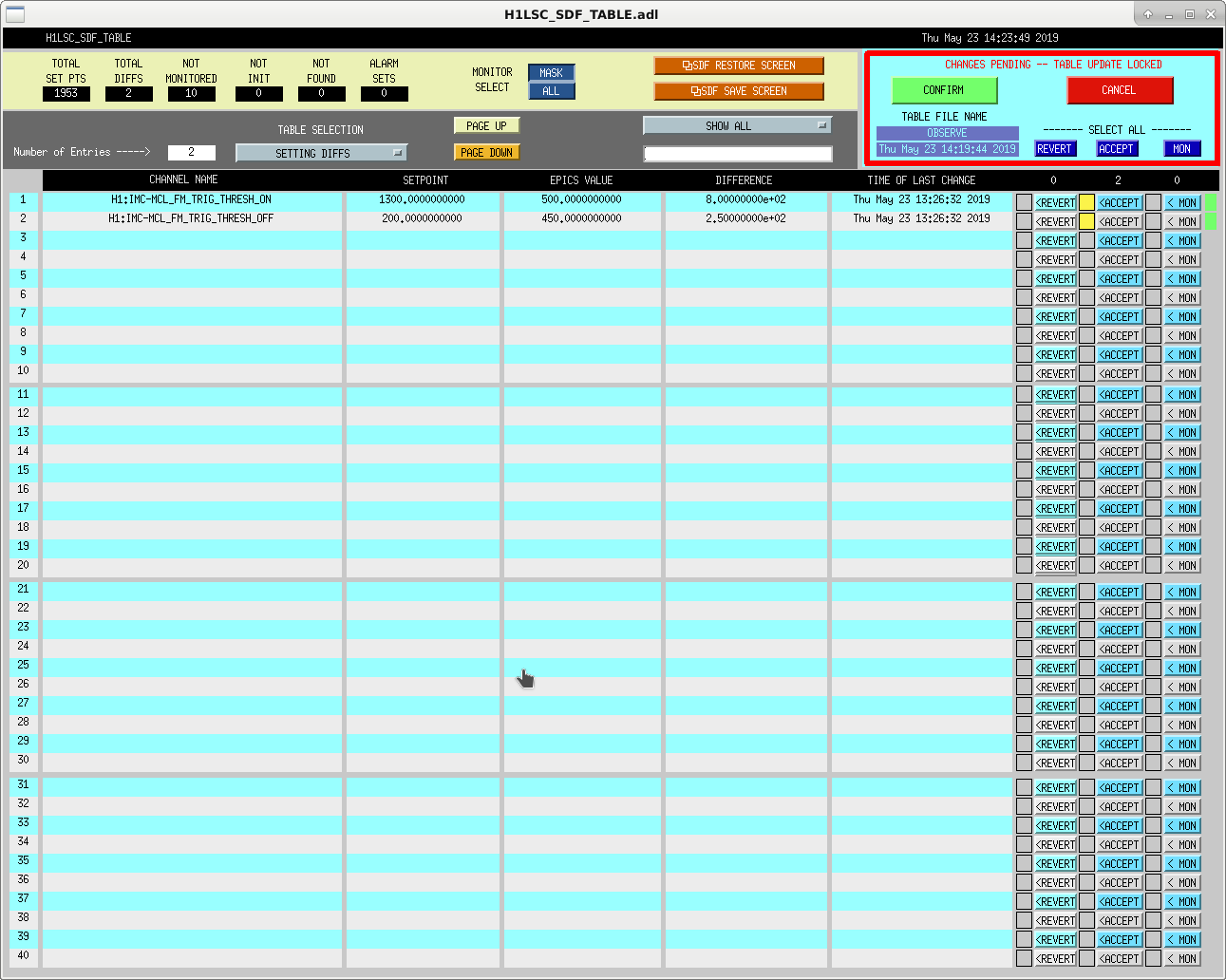
Just had some unexplained sdf diffs show up after the last re-locking. 2 trigger thresholds in IMC MCL, which were changed about the time of the last lock loss, which did not have an obvious cause. No idea if these are relevant or what caused the change.
I think these are triggers for turning on the IMC MCL boost. They're set in the IMC_LOCK down state, and the thresholds are set depending on the input power into the IMC. For some reason we're stuck with the 2W trigger thresholds, probably when we lock again we'll have another SDF difference undoing this.
I don't think this is a problem, or related to our locklosses, since the IMC is controlled by LSC-MCL (not IMC-MCL) for everything after the LOCKING_ALS state.
[Gabriele, Marek]
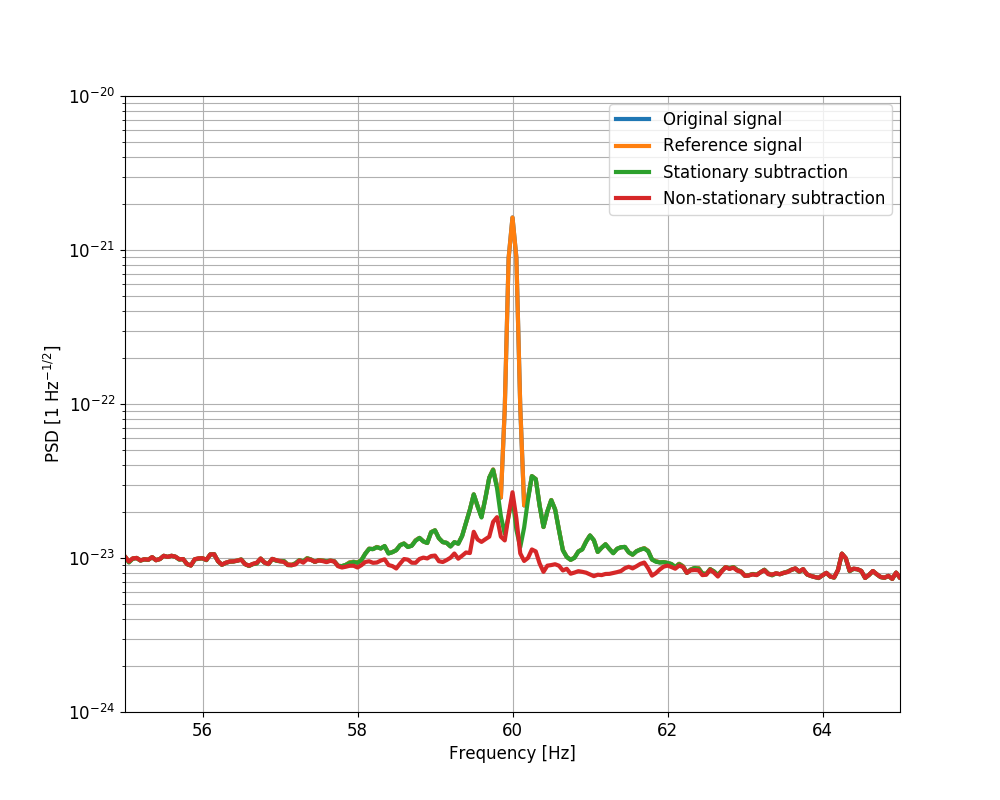
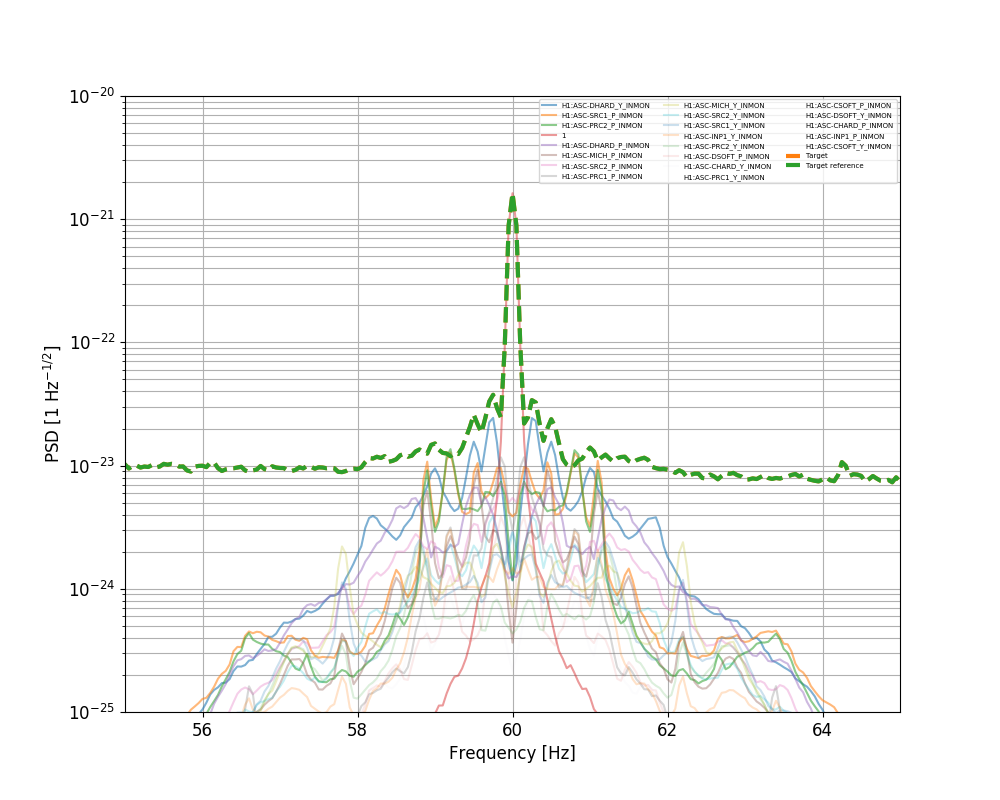
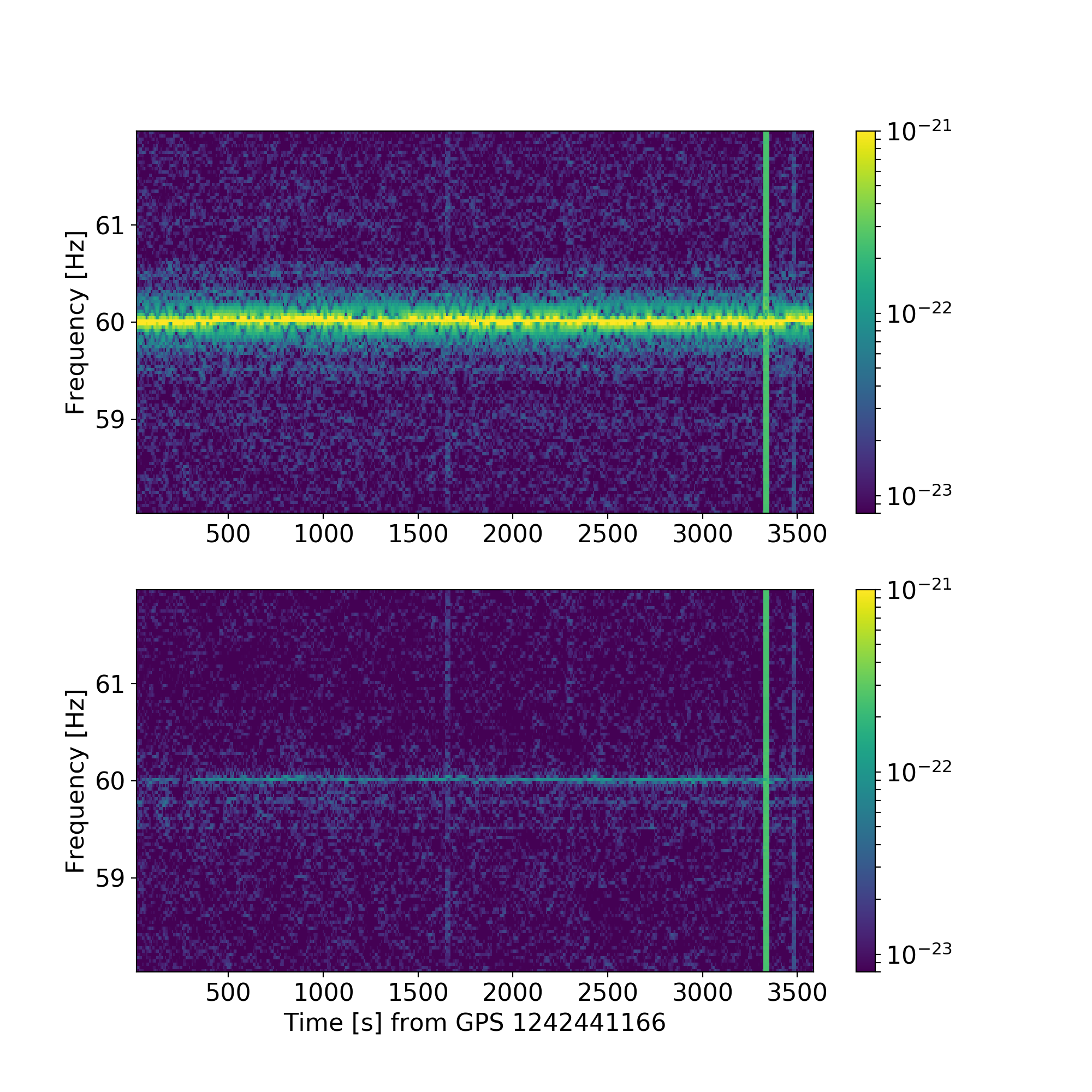
The 60 Hz line is quite large and accompanied by sidebands that spread over a 4 Hz band around the line. Those sidebands look like modulation of the 60 Hz line by IFO motion.
We used the machinery of non-stationary noise subtraction to see if we could subract the broad noise around the line. Details in the links below [1-3].
We used H1:GDS-CALIB_STRAIN for the sensitivity and H1:PEM-CS_MAINSMON_EBAY_1_DQ to measure the 60 Hz line. Then we used all ASC input error signals to describe the modulation.
The algorithm builds a parametric description of the modulations. The result is shown in the first plot attached below (blue and orange are equal and are the h(t) signal before subtraction, green is the best subtraction with only the linear coupling of the PEM mains monitor, red is the best subtraction when including non-stationary modulation due to ASC signals).
The second attached plot shows each contribution: apart for the reference signal, each trace corresponds to the PEM mains monitor modulated with one of the ASC signals with optimal time-domain filter.
[1] NonSENS code https://git.ligo.org/gabriele-vajente/nonsens
[2] Subtraction of non-stationary noise couplings https://dcc.ligo.org/LIGO-T1800525
[3] Non-stationary / non-linear noise subtraction https://dcc.ligo.org/LIGO-G1900397
A long time ago I came up with some blend filters to try to improve the 1-10 hz HAM RX/RY motion, to try to reduce SRCL. We ran the filter for about a week last October, but I've been having trouble trying to find good data to compare to the current configuration. Sam Cooper has a document comparing the differences and some of the motivation for finding a better filter at https://dcc.ligo.org/DocDB/0159/T1900107/001/main.pdf. I've switched HAMs 4&5 RX&RY blends to this filter to get some data overnight (or weekend). I made the transition while Corey was locking the IFO, and it's running fine for now. I've accepted the differences in SDF, so this shouldn't prevent us from going to OBSERVE.
The new blends are called "between_350" on the HAM ISI blend screens. If there is some issue where SRCL motion is bad, the old filters are called "notch_rolloff". If there are any questions or anyone needs help reverting over the weekend, give me a call.
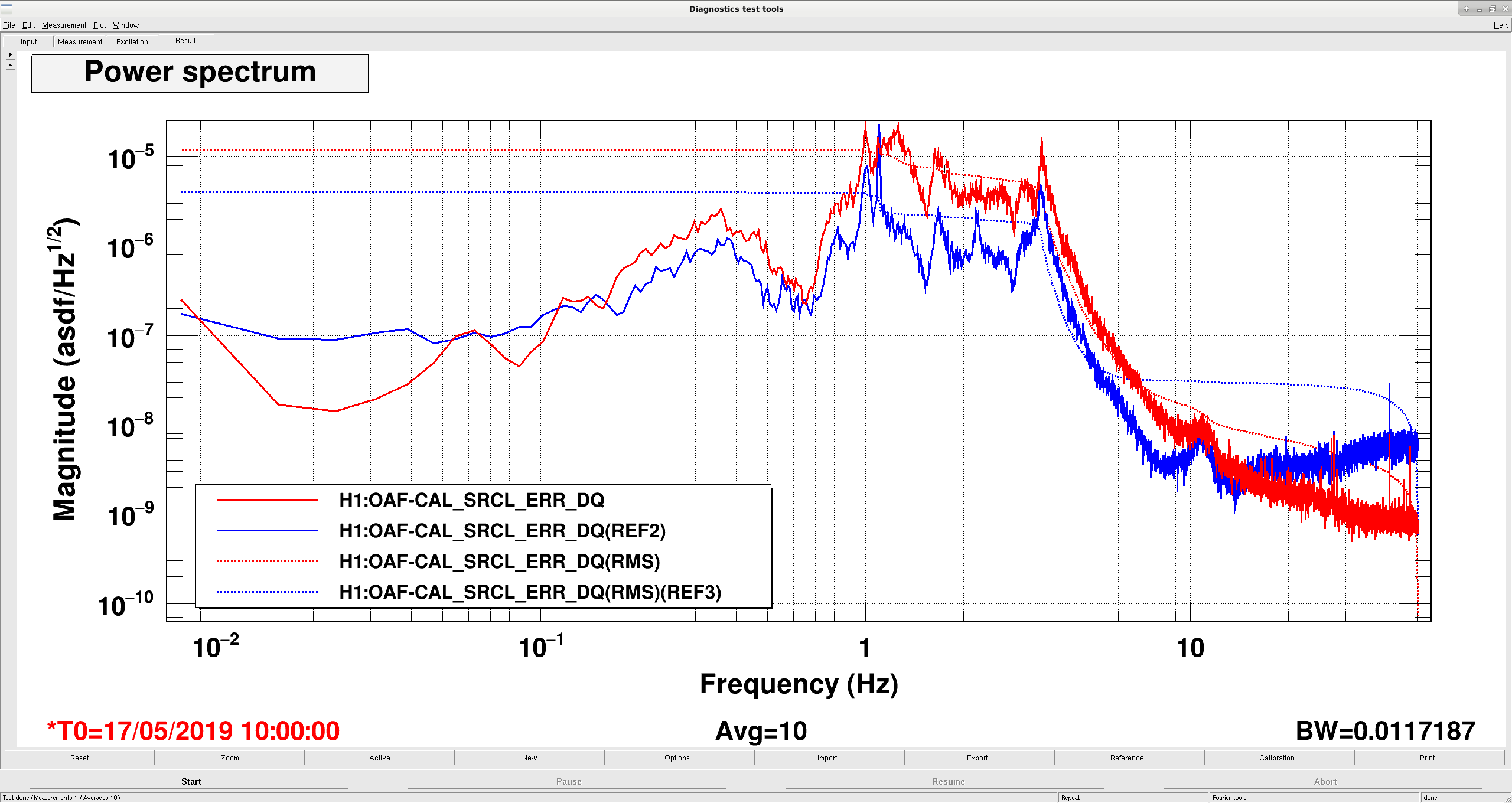
Some initial data, looks like the blend filters do improve SRCL. Attached plot shows SRCL err from a lock after switching the blends (blue) and a segment from a NLN segment last night before the switch (red). Microseism hasn't changed much, but it is windier now than it was last night, but still the SRCL rms is about half of what it was. The magnitude units are wrong because I'm not sure of the dewhitening filter gain but the filter is shaped with 2 poles at 1 hz and 2 zeros at 100hz. Also the blue traces where taken around DC readout, while the red are from the IFO in NLN, so the blue is missing some high frequency cut-offs making the >10hz noise worse on the blue trace.
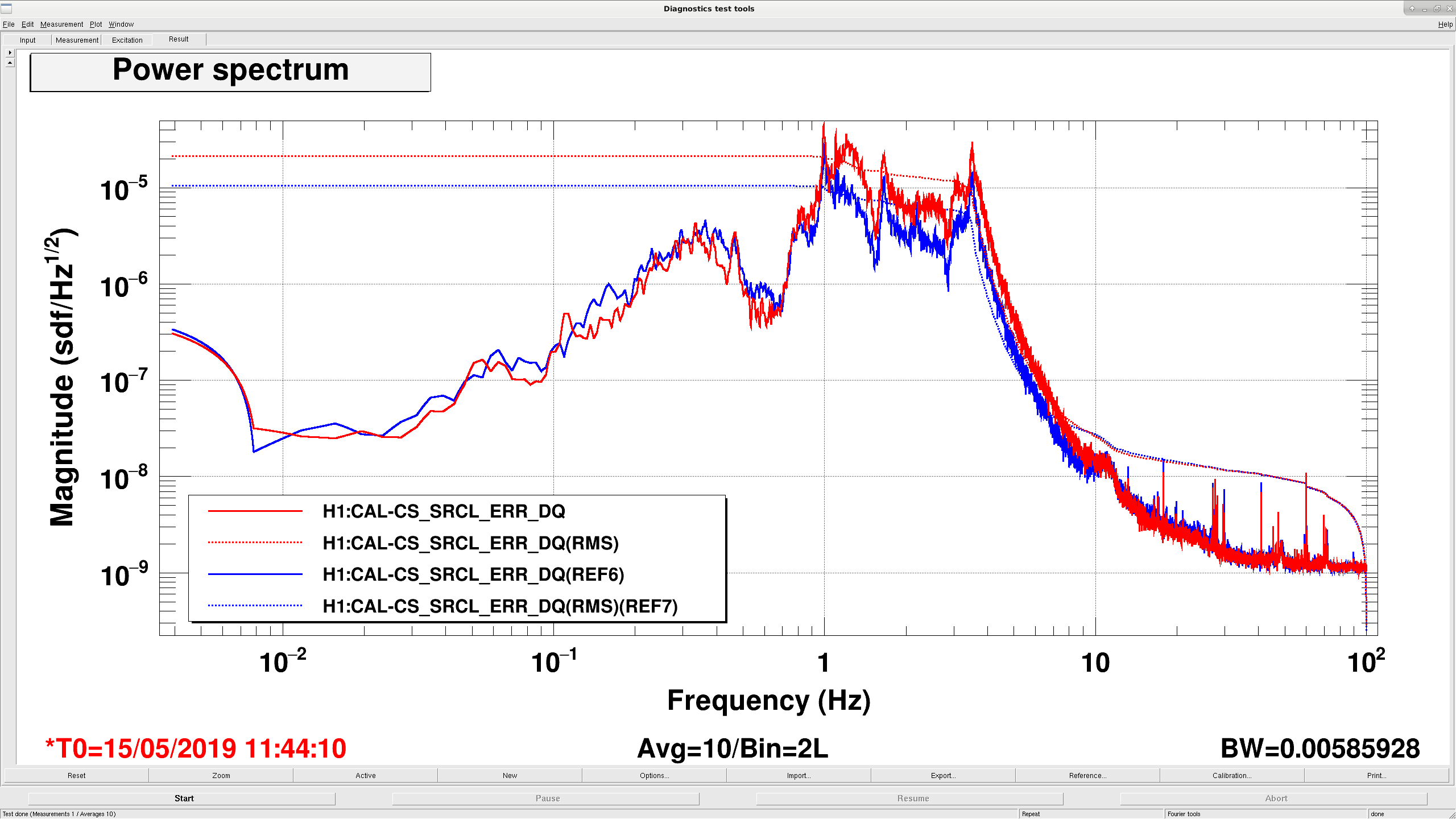
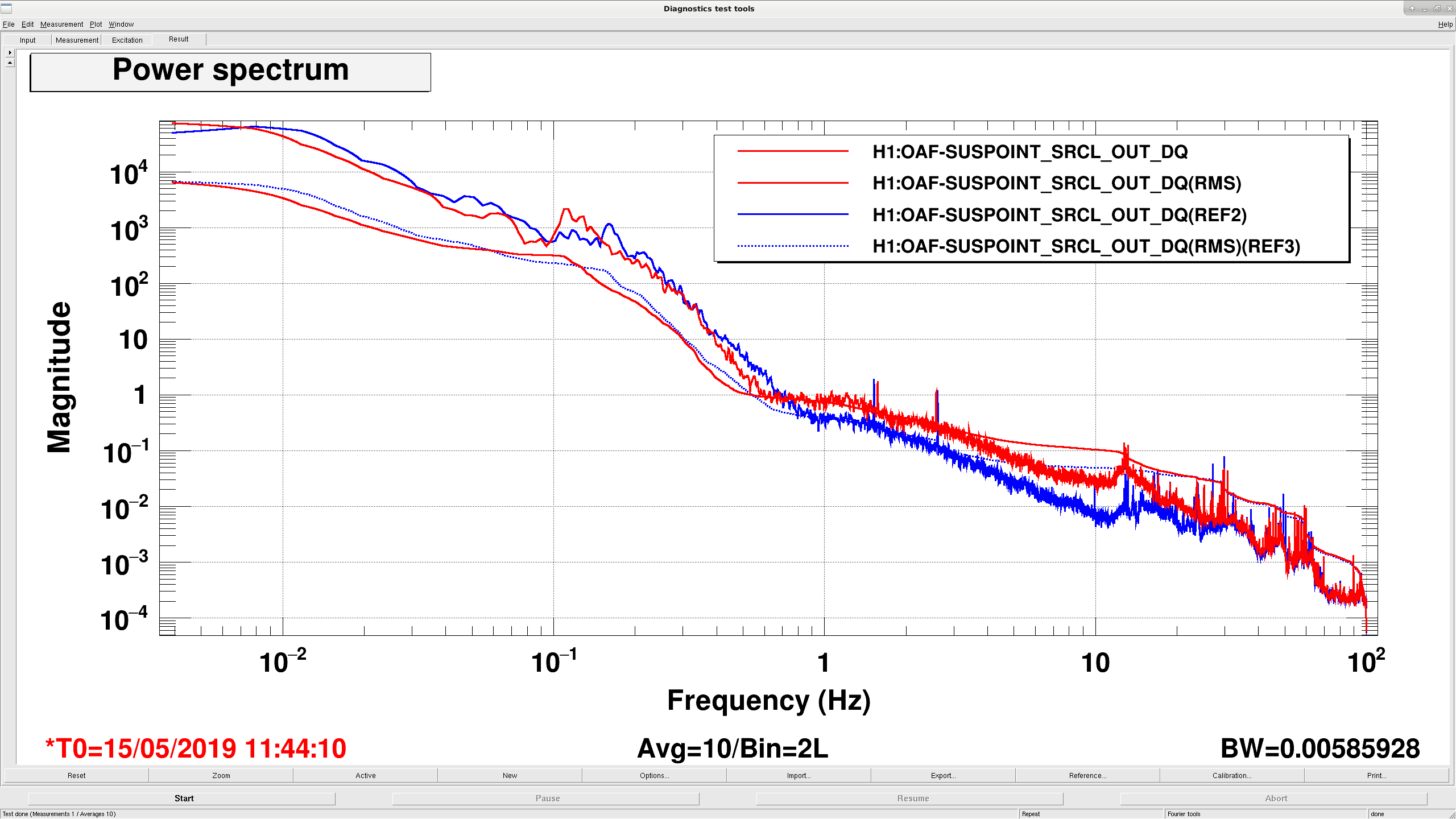
I'm attaching some plots comparing two NLN SRCL asds, first plot is the SRCL ERR, blue is with the new blends, red is the old blends. The new blends are about a factor of 2 better rms between 1 and 10 hz for the SRCL error. I would like to try adding some notches to the blend to see if we can do any better, but this seems like a solid improvement.
The second plot is SRCL suspoint, which uses projections of the ISI GS13s to each relevant suspensions top mass to estimate the SRCL cavity length. This channel combines the suspoint motions of the BSCs and both HAMs, so is not purely deteremined by the improved motion on HAMs 4&5. Again, red is from a lock with the old blends, blue is with the new blends. This also shows a good improvement over the 1-20hz band, with some worse performance below 1hz, but not too bad.
Attached is a comparison of the RX HAM4 blend changes at LHO during May vs the nominal L1 blend filter. The current filter for LHO is the purple one.
We see that LHO has now more isolation than LLO between 1.5-8Hz, but less roll-off above 8Hz. It would be interesting to understand how this difference in the filtering affects the suspoint motion at both sites, as a follow up from 46407.