Perhaps due to the rain that started, the h1ecatx1 Beckhoff computer has lost communications with the Wind Sensor 1,2 modules. Both are now in the INIT NO_COMM state. I was unable to transition them to other states like PreOp, Safe-Op or Op, so it appears to be a cable issue. - The error happened at 1:58PM PDT according the TwinCAT System Manager log
I just noticed that the h1calcs model is using its safe.snap file as its SDF reference and not OBSERVE.snap.
Looking at trends and logs, it appears that the following has happened (all times local):
Fri 05apr2019 16:01: switch_SDF_source_files.py was modified to add calcs to the exclude list, so guardian is not controlling its sdf reference
Tue 16apr2019 10:52: h1calcs model restarted, OBSERVE.snap reference set.
Wed 08may2019 00:40: h1calcs model restarted (Dolphin crash), safe.snap reference set (this is the current state).
There are differences between safe.snap and OBSERVE.snap (see attached text file).
Keita is in contact with the calibration group on this issue.
H1's back to OBSERVING after being down ~29hrs! (~4hrs commissioning & ~25hrs due to H1 issues noted below).
Primary issues were related to: ASC & IMC (MC1 & MC3) glitches. Sheila will post summary about ASC & general locking for operators. IMC glitches have been posted via Cheryl's alog+subentries and Betsy's alog this morning.
This morning I spent some time looking for more MC1 and MC3 glitches, reported by Cheryl, Jenne, Sheila yesterday https://alog.ligo-wa.caltech.edu/aLOG/index.php?callRep=49257
The summary from Tuesday forward is that -
It's not obvious that these glitches are continuing. We scanned back a week and did not see any such glitches prior to their start at 5am local Wed.
Also, they do not appear on PR2 (PRM and MC2 are hard to see due to all of the actuation on them which causes the signal to jump around.)
(Betsy, Fil, Marc)
Its now been more than 4 hrs of IFO lock and I have been keeping an eye on the MC1 and MC3 for any glitches: none so far.
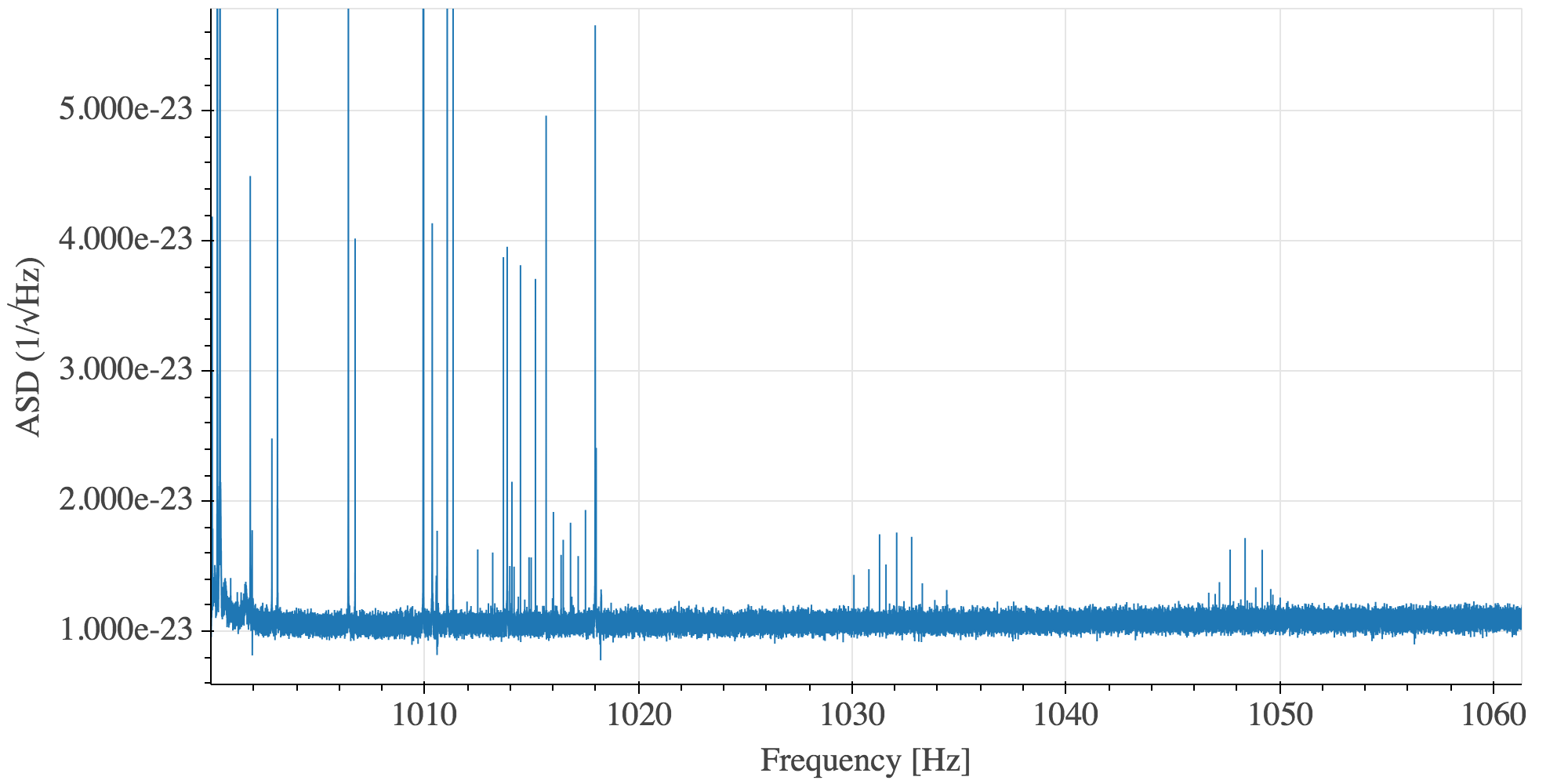
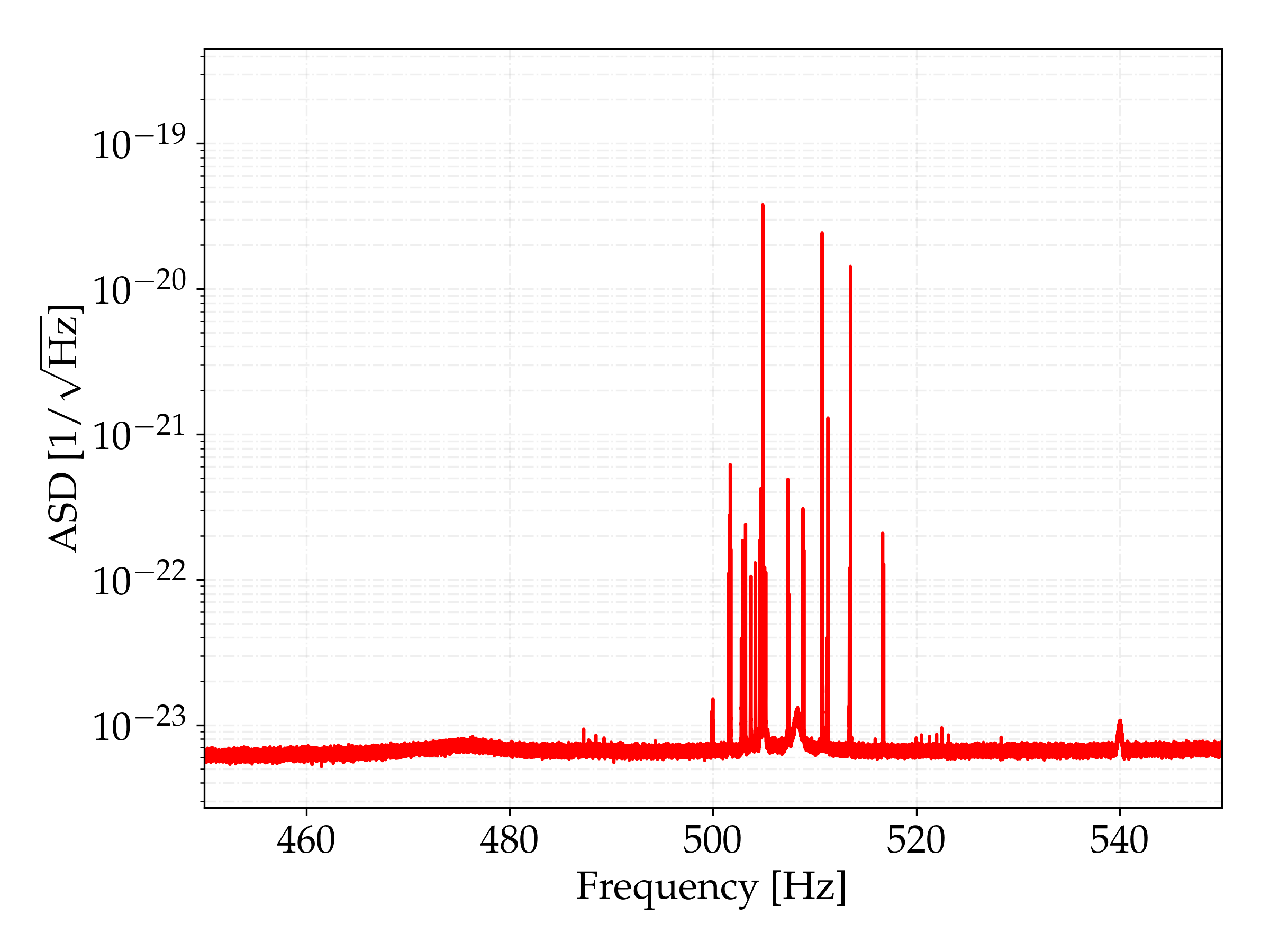
I've created average spectra from days May 8, 9, 10, 11 and 12. You can see the plots in this link: https://ldas-jobs.ligo-wa.caltech.edu/~pep.covas/O3/MaySecondWeek/H1_clean-epoch_amp-wght/
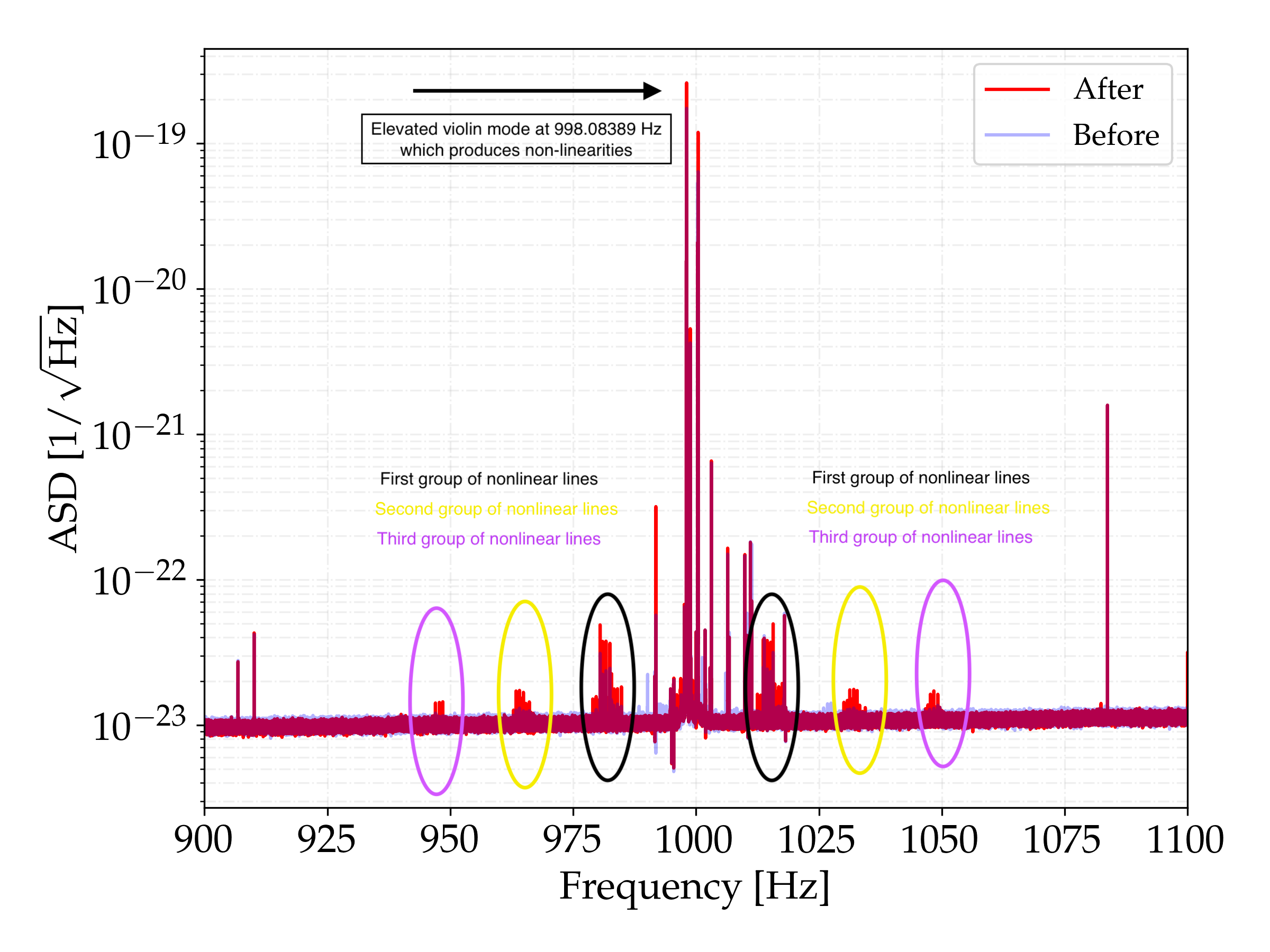
One interesting new feature is around the 2nd order violin mode harmonics. Many new lines have appeared around the frequency 998.083889 Hz, which is a violin mode of ITMX which has been more excited than usual.
The first attachment shows a comparison with a previous week where this mode was not as excited (the second one is a zoom). You can see that 3 groups of lines have appeared on each side of this violin mode. Each of these groups of lines contains lines which are exactly located at frequencies which are a combination of the violin mode and one of the four calibration lines (15.6, 16.4, 17.1, 17.6), like 998.083889 - 17.6 Hz or 998.083889 + 15.6 Hz (all of these lines show values of bicoherence close to 1). In a previous alog (https://alog.ligo-wa.caltech.edu/aLOG/index.php?callRep=48161) this behaviour was already noticed, but now it seems that more than one group of nonlinear lines is created around the violin mode. The extra groups of lines are also located at nonlinear frequencies like 998.083889 - 2*17.6 Hz or 998.083889 + 3*15.6 Hz and also show values of bicoherence close to 1 (bicoherence between a calibration line and the previous group of nonlinear lines). I'm not sure if these extra lines are created due to a trilinearity (e.g. ASD(f1)^2 * ASD(f2) -> ASD(2*f1+f2) ) and higher order features or due to a bilinearity between the firstly created new nonlinear lines (closest group to the violin mode) and the calibration lines.
In the third image you can also see some lines around the first violin mode harmonics which are due to nonlinearities, as noticed in the past, although only one group at each side of the mode can be seen.
In order to prevent this (which is highly contaminating the spectrum and impacting CW searches), we should try (if possible) to better damp the violin modes as soon as they are increased above "nominal" values, decrease the amplitude of the calibration lines or improve the behaviour of the DACs when driving near saturation (https://alog.ligo-wa.caltech.edu/aLOG/index.php?callRep=48357).
TITLE: 05/16 Day Shift: 15:00-23:00 UTC (08:00-16:00 PST), all times posted in UTC
STATE of H1: Lock Acquisition
OUTGOING OPERATOR: Cheryl
CURRENT ENVIRONMENT:
Wind: 6mph Gusts, 4mph 5min avg
Primary useism: 0.02 μm/s
Secondary useism: 0.14 μm/s
QUICK SUMMARY:
H1 is down in the READY state due to problems (i.e. alignment issues, IMC SUS OSEM glitches, etc.). The OBSERVATORY MODE tool was in the "locking" state, so I transitioned it briefly to "COMMISSIONING" since [I thought] H1 is still set for higher power operations [heard this was backed out], but then second-guessed that since we really are having overall issues with H1 and will be taking us to the CORRECTIVE MAINTENANCE state (one should feel free to file an FRS....I can possibly do that). Let's stay in the CORRECTIVE MAINTENANCE state and mark this down time until we get back to OBSERVING. Waiting for reinforcements to arrive.
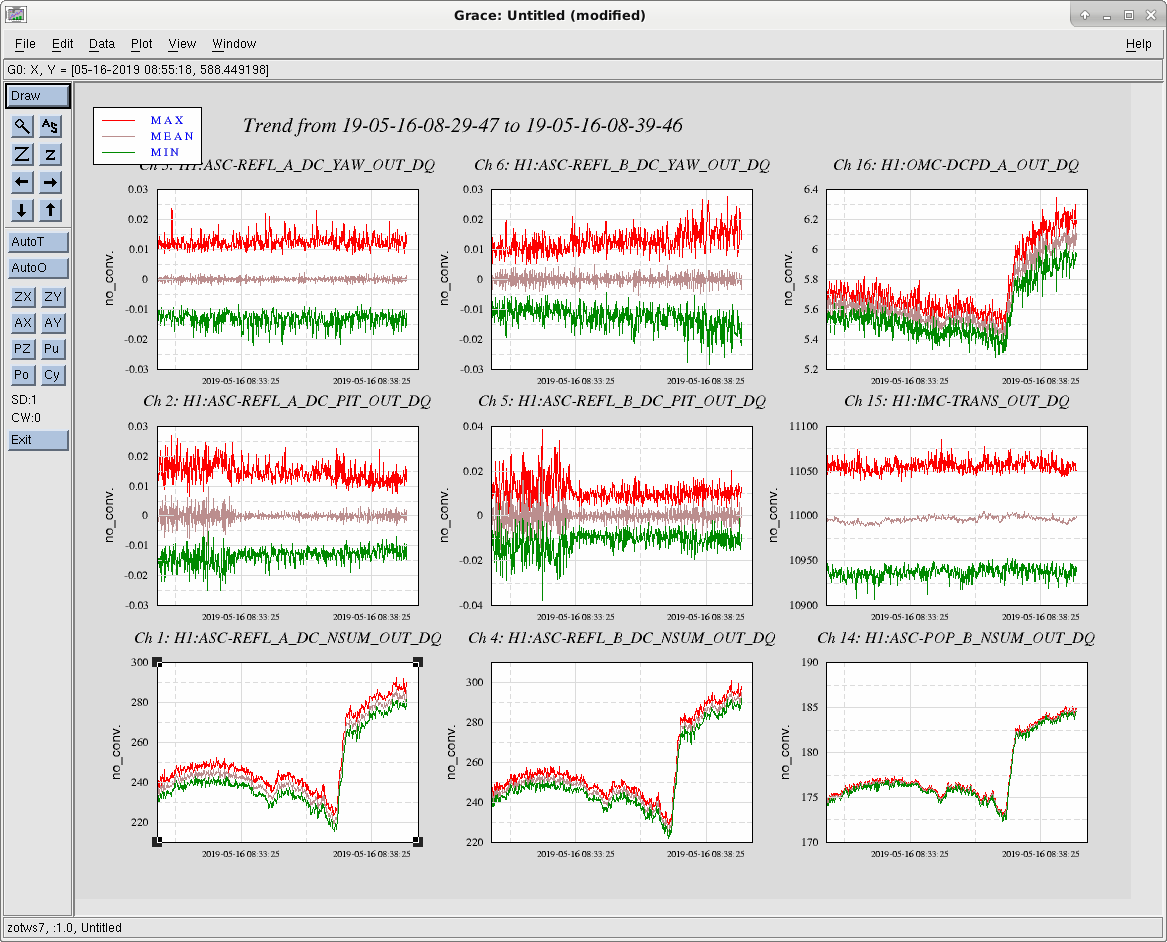
Cheryl posted an alog about possible noisy REFL signal.
I got on the LIGO Virgo Control Rooms teamspeak channel to apprise other operators of H1's status/plans.
Going through Shift Checklist items and wanted to mention we still have:
Reverse Osmosis (RO) MAJOR alarm (Dave contacted Bubba regarding this last night).
TITLE: 05/16 Owl Shift: 07:00-15:00 UTC (00:00-08:00 PST), all times posted in UTC
STATE of H1: Lock Acquisition
INCOMING OPERATOR: Corey
SHIFT SUMMARY: Instability causing lock loss
LOG:
TITLE: 05/16 Owl Shift: 07:00-15:00 UTC (00:00-08:00 PST), all times posted in UTC
STATE of H1: Lock Acquisition
OUTGOING OPERATOR: Ed
CURRENT ENVIRONMENT:
Wind: 7mph Gusts, 4mph 5min avg
Primary useism: 0.02 μm/s
Secondary useism: 0.14 μm/s
QUICK SUMMARY: Georgia was here when I arrived, and worked on locking (this entry was made a bit after my arrival)
Cheryl, Georgia
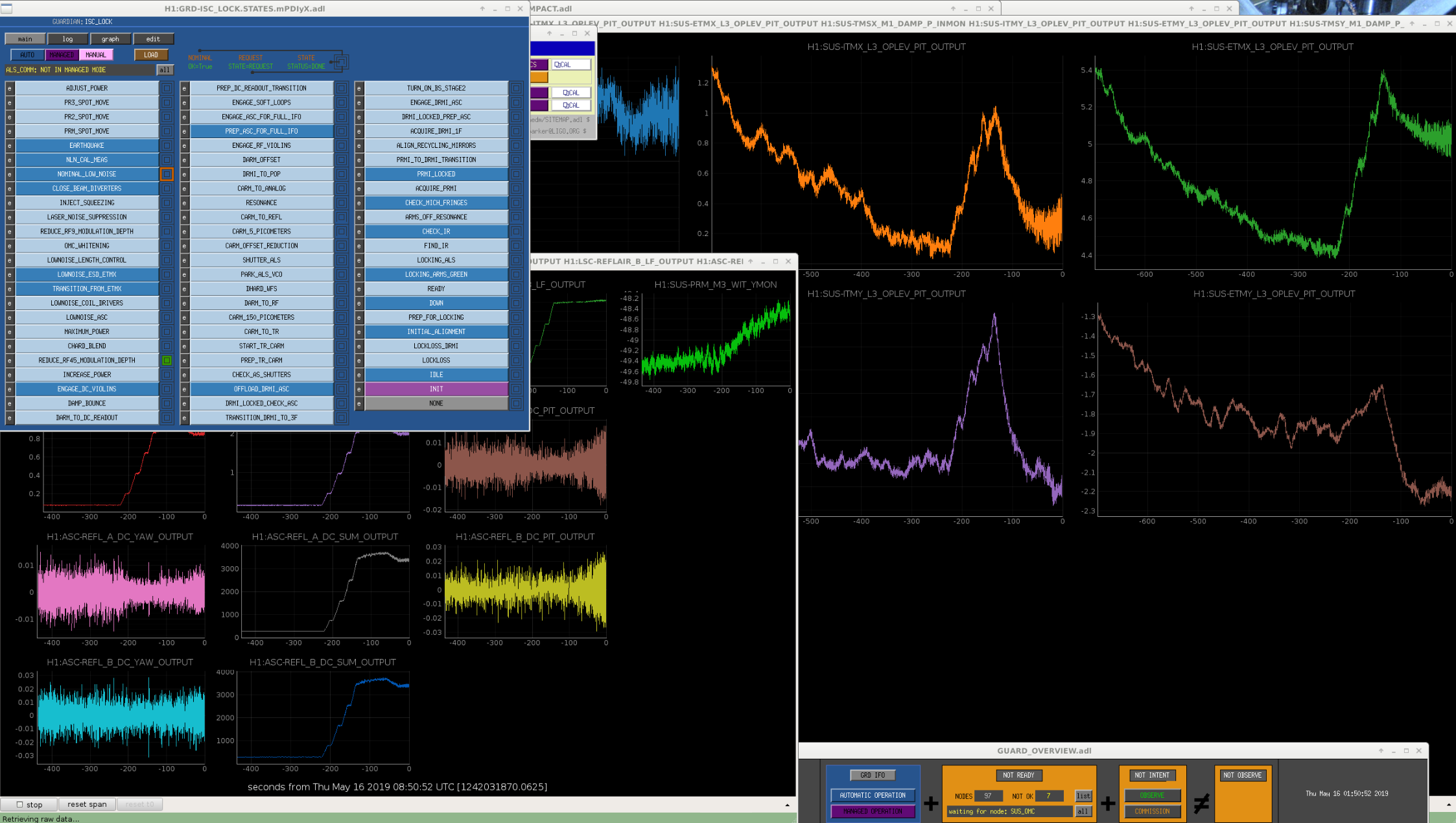
We have had several ASC locklosses this evening from the INCREASE_POWER state, where we first power up from 2W to 20W. There is a 0.5 Hz instability in pitch, it looks like it shows up in the corner before the arms, but it really dominates everything so it's hard to tell.
We tried undoing the new phasing of AS_A_RF72 (SRC1 sensor), didn't help. I tried undoing the gain increase of INP1_P, still rung up. I switched the 0.5 Hz notches back on the DC yaw centering loops, also didn't help. I tried going through INCREASE_POWER by hand and we had a fast lockloss at 5W... I'm not sure why this is a problem now and I'm really stumped as to how to fix it.
We've also had intermittent problems with the OMs saturating when the WFS are turned on in DRMI, and have had to clear their histories by hand a few times.
I'm bypassing the RO alarms for tonight, I've contacted the control room and Bubba.
Bypass will expire:
Thu May 16 08:21:32 PDT 2019
For channel(s):
H0:FMC-CS_WS_RO_ALARM
TITLE: 05/15 Eve Shift 23:00 – 07:00 (16:00-00:00), all times posted in UTC
STATE of H1: Locking
INCOMING OPERATOR: Cheryl
SHIFT SUMMARY: Lots of locklosses while trying to test out taking the power to 40W. It seems like there is some unrelated ASC issue that is making us lose lock within a few states of ENGAGE_SOFT_LOOPS.
LOG:
23:00 (16:00) Start of shift
23:20 (16:20) Lockloss from ENGAGE_ASC_FOR_FULL_IFO
23:43 (16:43) Lockloss from ENGAGE_SOFT_LOOPS
23:44 (16:44) Commissioners starting initial alignment/pico-ing
00:18 (17:18) Initial alignment done, relocking
00:48 (17:48) Lockloss from PREP_DC_READOUT_TRANSITION
01:17 (18:17) Lockloss from INCREASE_POWER
01:44 (18:44) Lockloss from DARM_TO_DC_READOUT
02:06 (19:06) Lockloss from ENGAGE_SOFT_LOOPS
02:20 (19:20) 5.7 earthquake near Papua New Guinea
02:36 (19:36) Lockloss from OFFLOAD_DRMI_ASC
02:49 (19:49) Lockloss from OFFLOAD_DRMI_ASC
Sheila, Georgia, Jenne
Today we took some commissioning time to try to increase the input power. The increase in input power went fairly well, but we had many locklosses due to problems unrelated to power up, more likely related to Tuesday maintence. In total we spent about 3-4 hours today commisioning, although the observatory mode was set to commisioning the entire time.
Increasing power:
Other problems:
most of our locklosses today were unrelated to powering up, we lost lock twice for reasons that were related to our commissioning efforts, the rest of our many locklosses seem to be related to other problems. We have had MC1+3 T2 osem glitches 3 times today, 49257 the first two times caused locklosses, and the third time we were able to stay locked.
We also have had many similar locklosses in the states where we engage ASC and transition to DC readout before powering up. We don't understand this, and the problems seem to have started yesterday.
Here are the locklosses from our attempts to power up to 40W that day:
first attempt: 1241979858 lost lock due to MC1 glitch
2nd: 1241988915
3rd: 1241995833
4th and final: 1242014355
TITLE: 05/15 Day Shift: 15:00-23:00 UTC (08:00-16:00 PST), all times posted in UTC
STATE of H1: Aligning
INCOMING OPERATOR: Niko
SHIFT SUMMARY:
Most of today has been devoted to commissioning hours with high power work (going up to 41W up from nominal 35W). There have also been more glitches with MC1 & MC3 today (leading to power cycles of boxes in the rack).
LOG:
Ops Shift Transition: 05/15/2019, Eve Shift 23:00 – 7:00 (16:00-00:00) - UTC (PT)
State of H1: Locking
Intent Bit: Commissioning
Weather: ~10 mph wind, cloudy
Primary 0.03 – 0.1Hz: 0.02 um/s
Secondary 0.1 – 0.3Hz: 0.1 um/s
Outgoing Operator: Corey
Quick Summary: Re-locking after dropping out from REDUCE_RF9_MODULATION_DEPTH. Commissioning work going on at 40W.
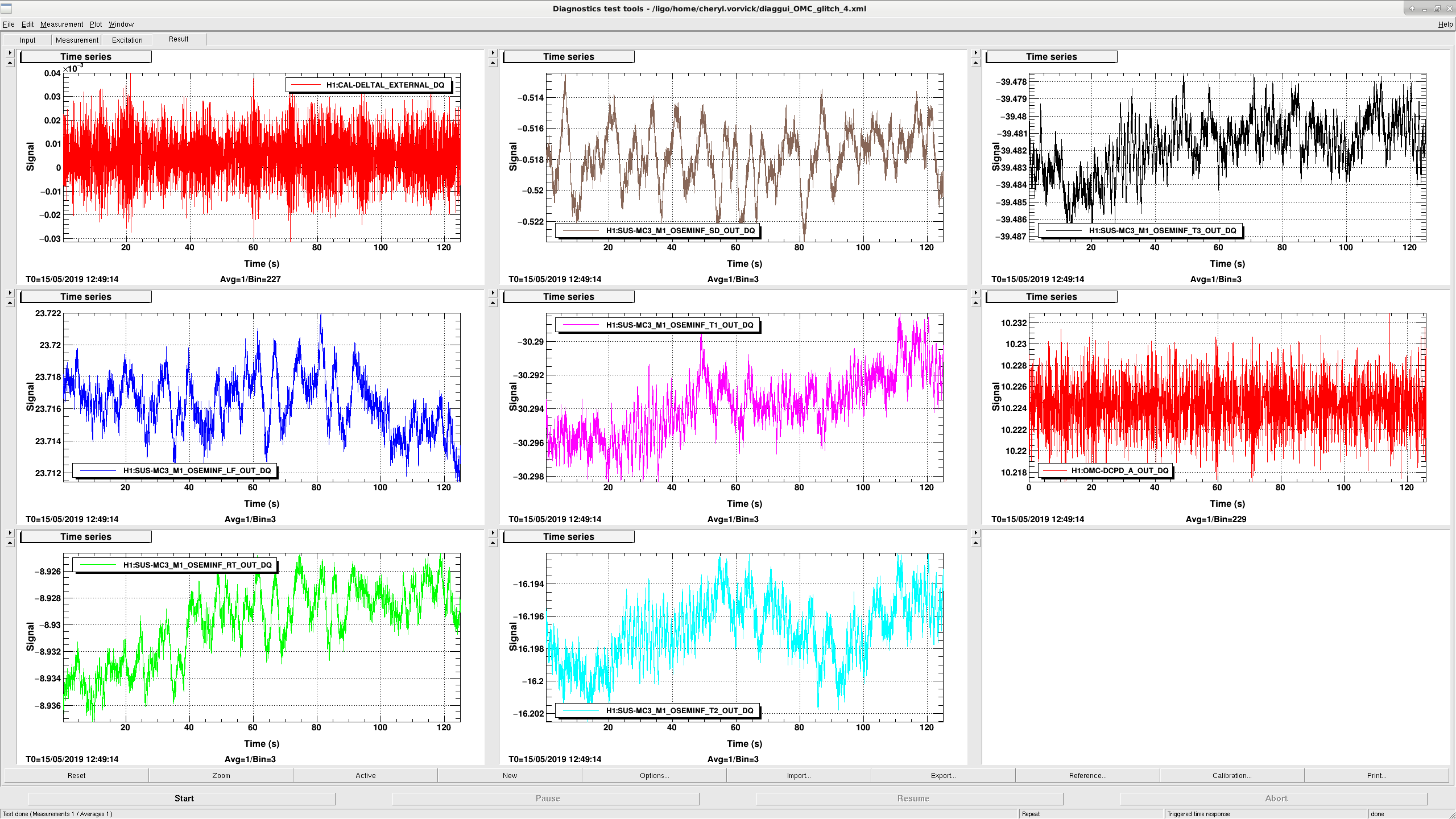
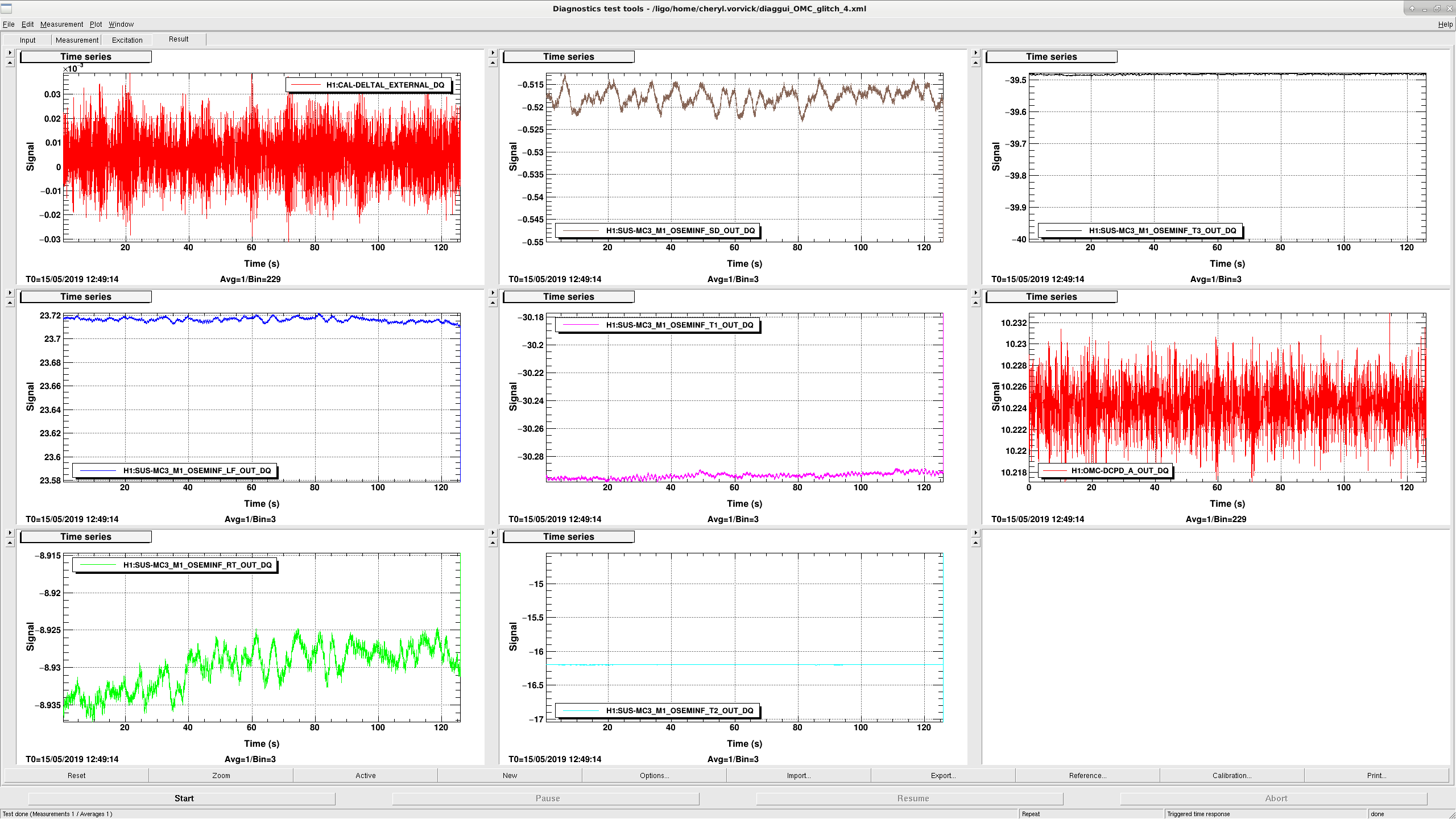
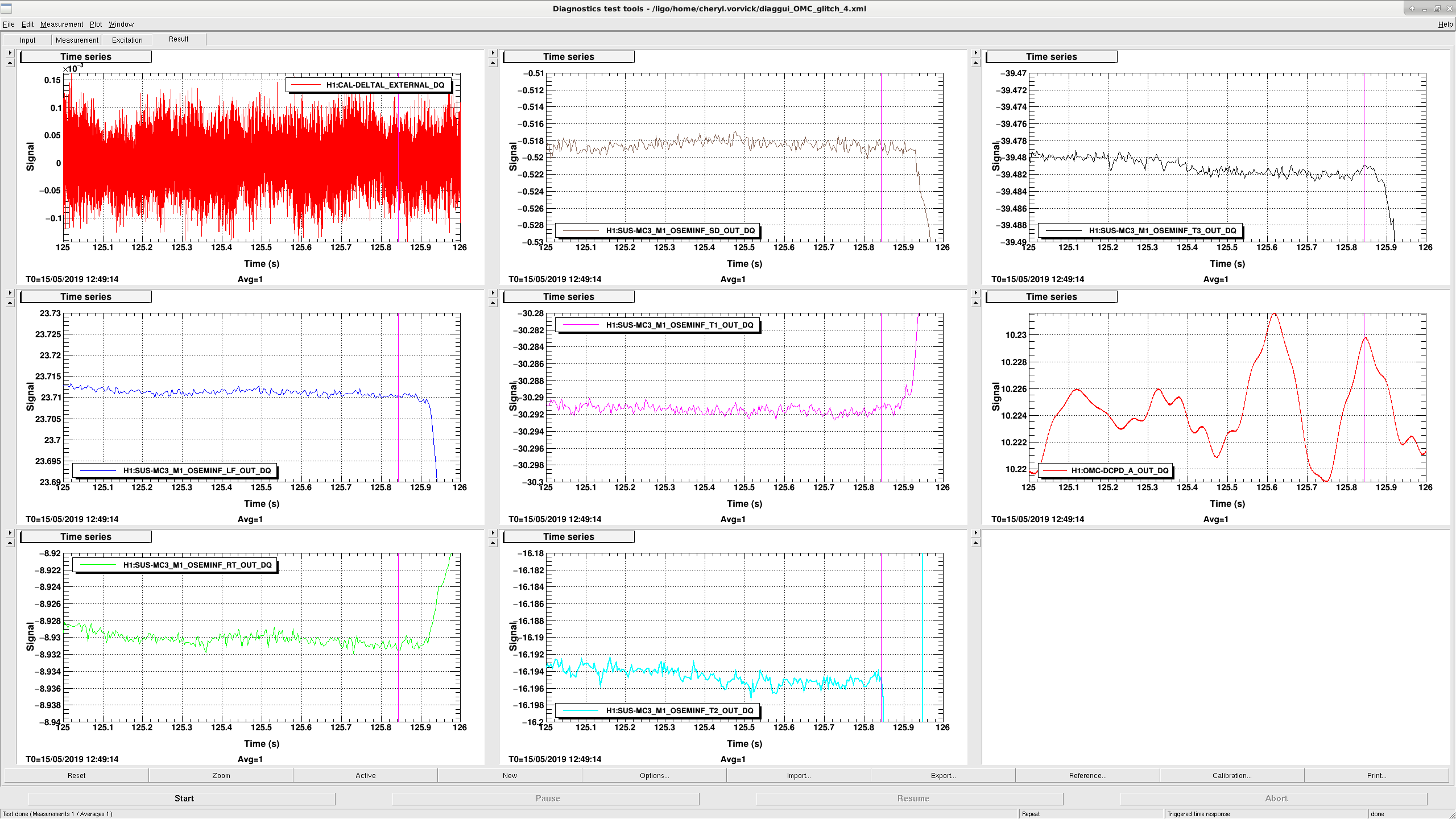
The LockLoss at 12:51:54 UTC was preceded by 4 seconds, by a Verbal Alarm for MC3, at 12:51:54 UTC.
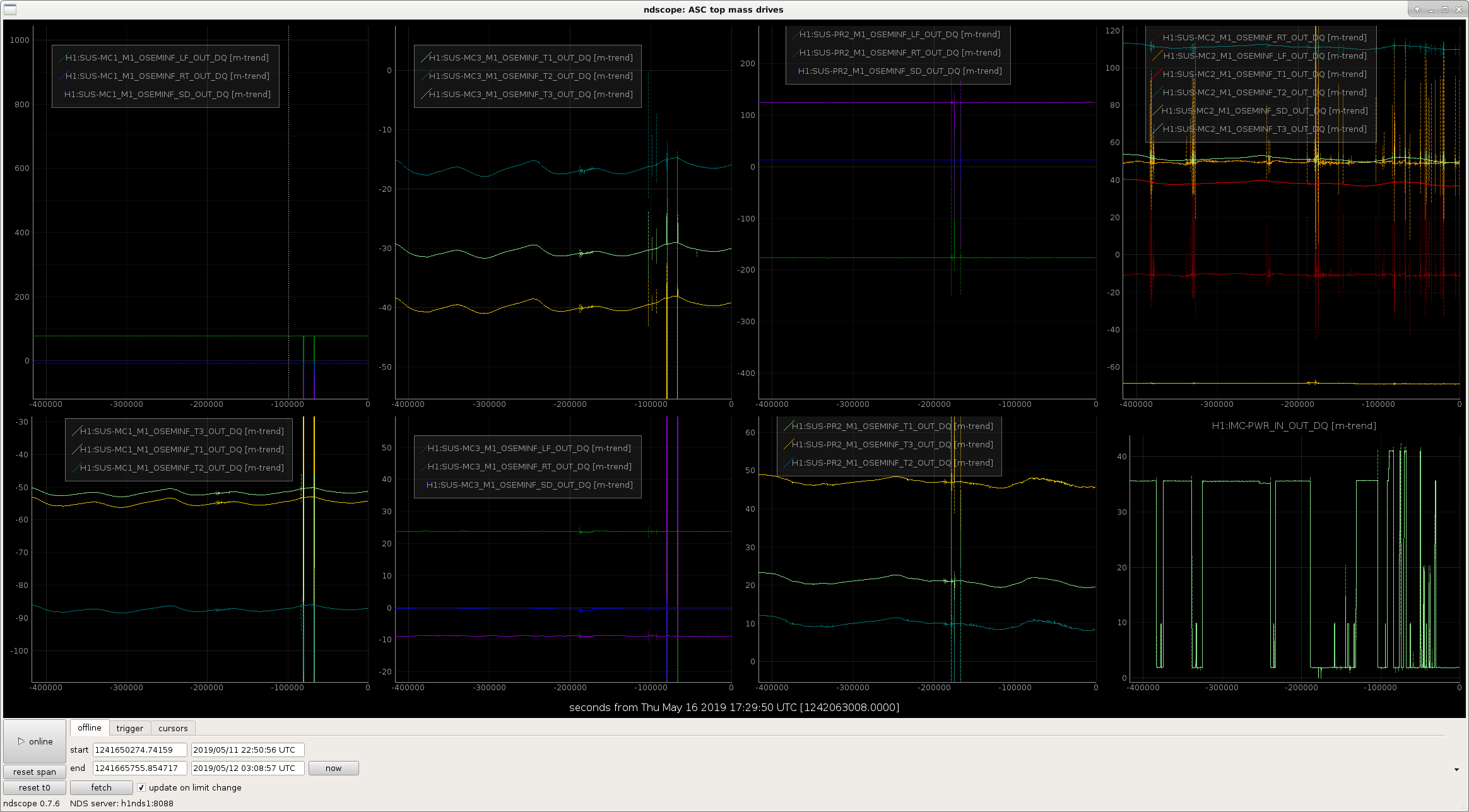
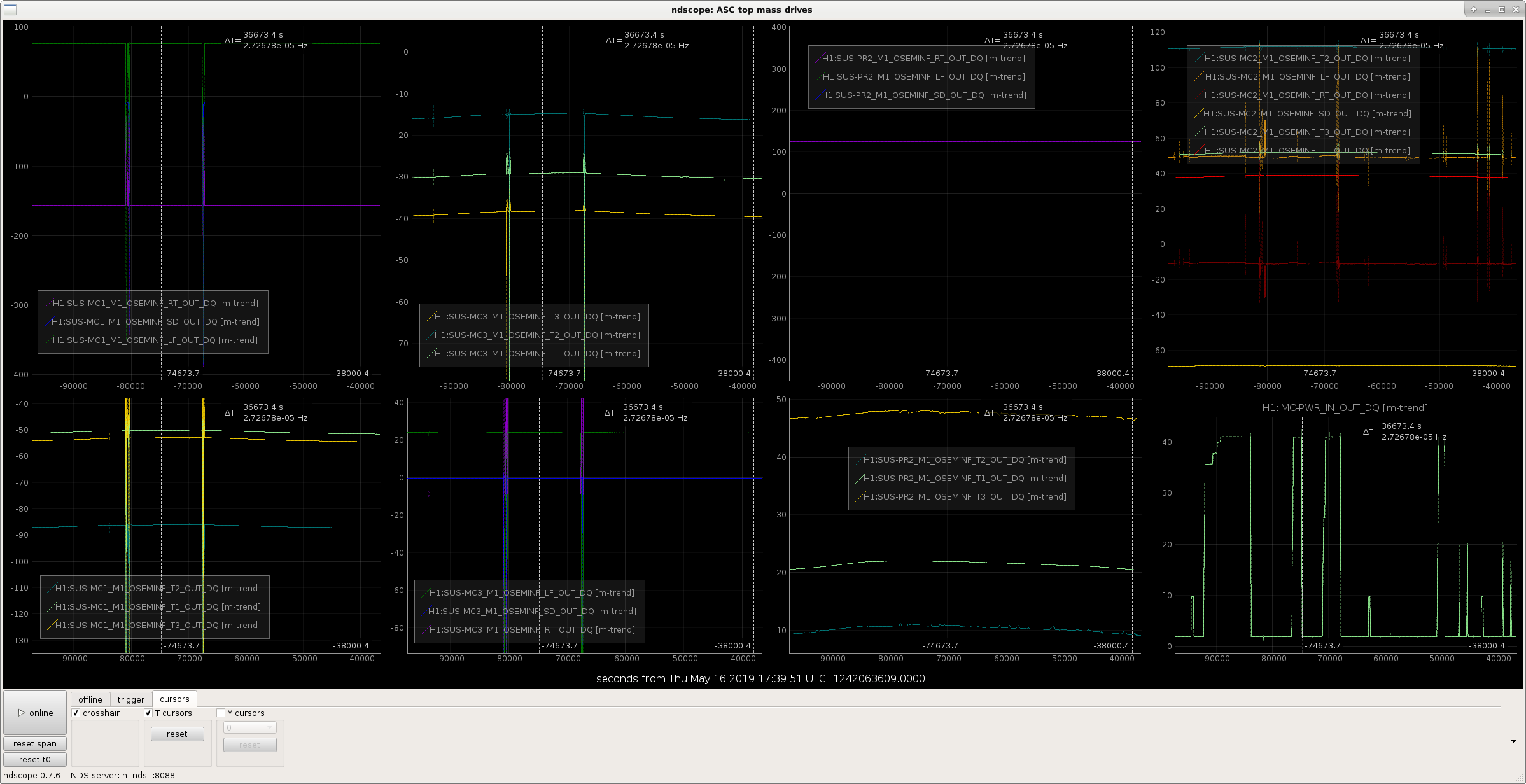
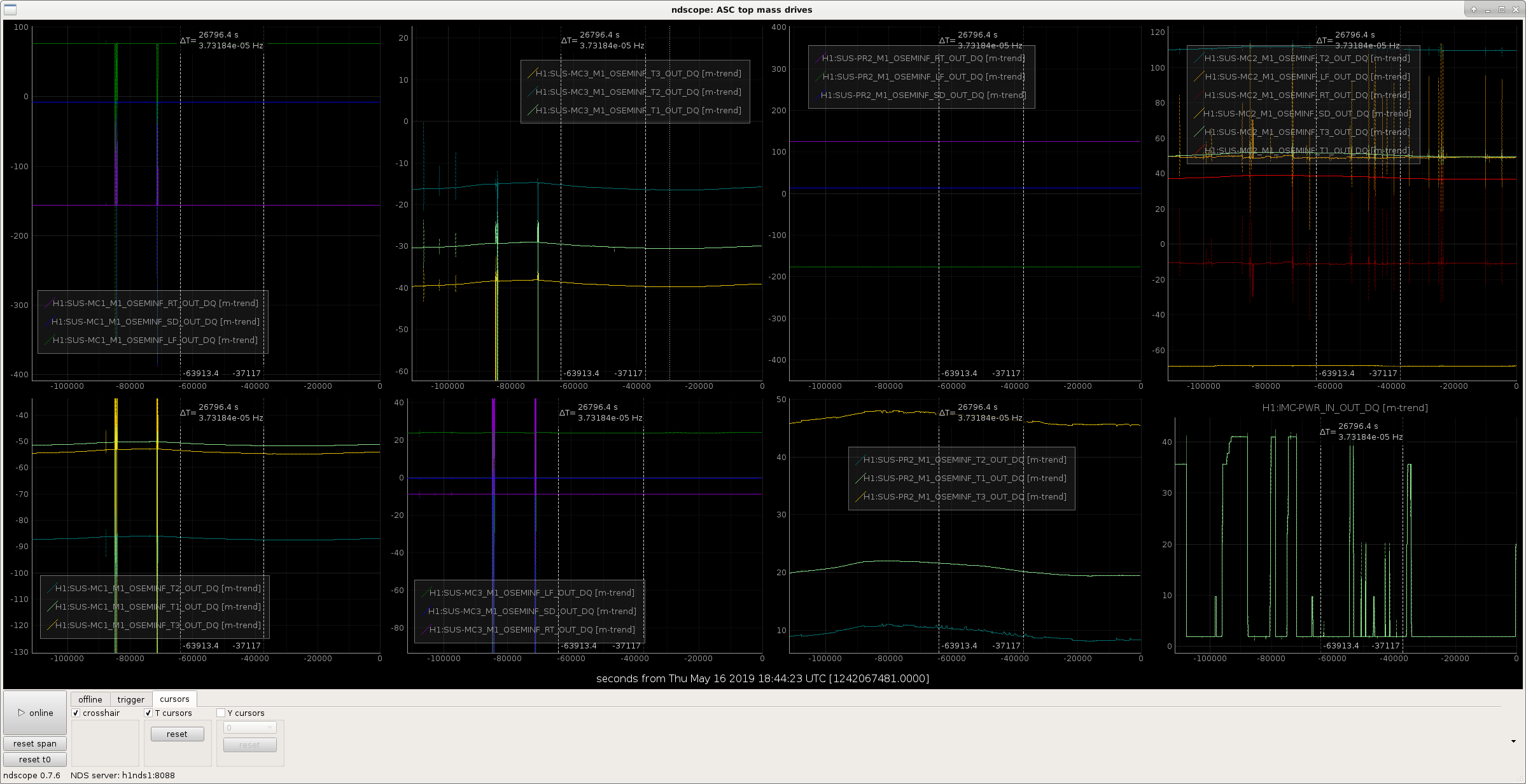
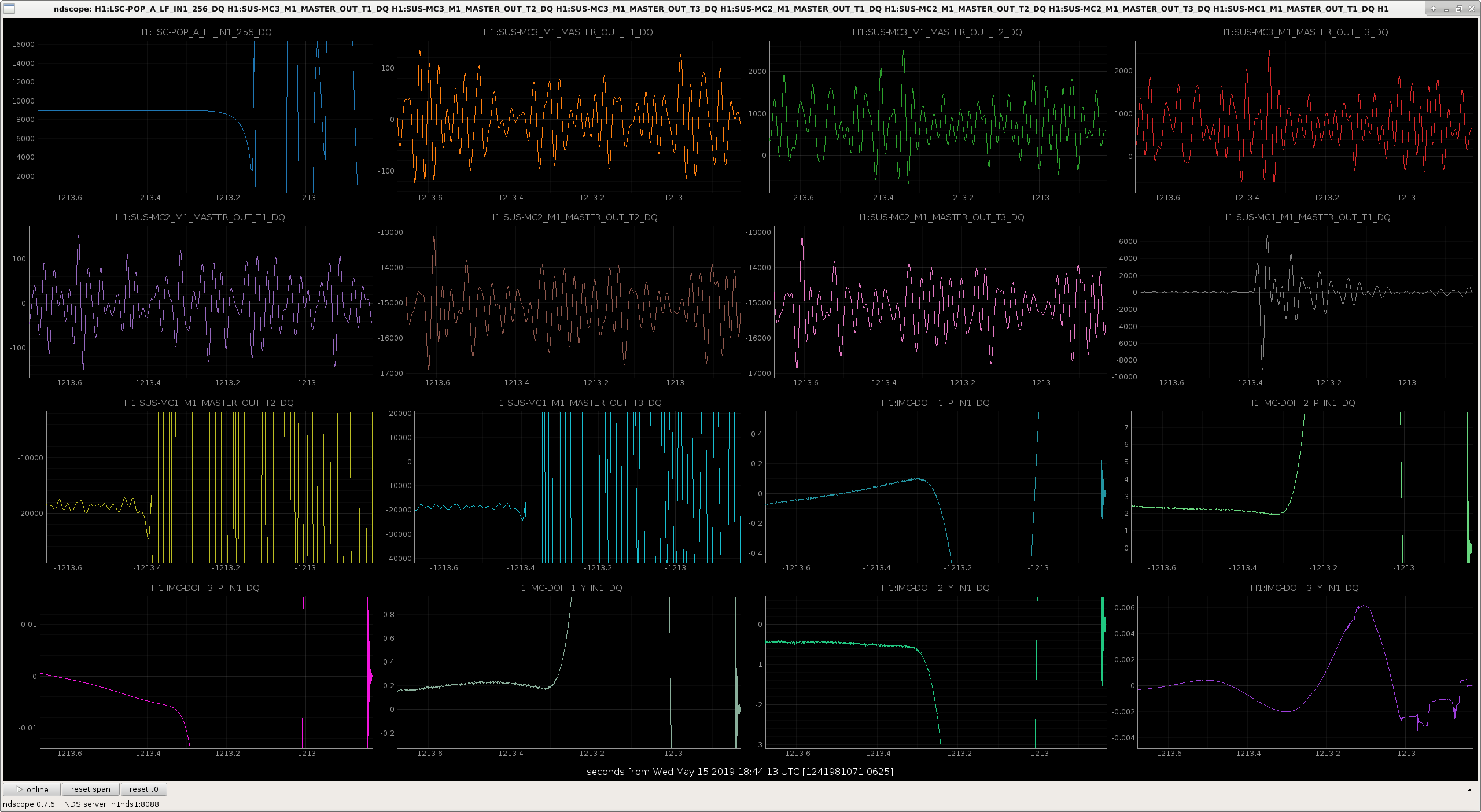
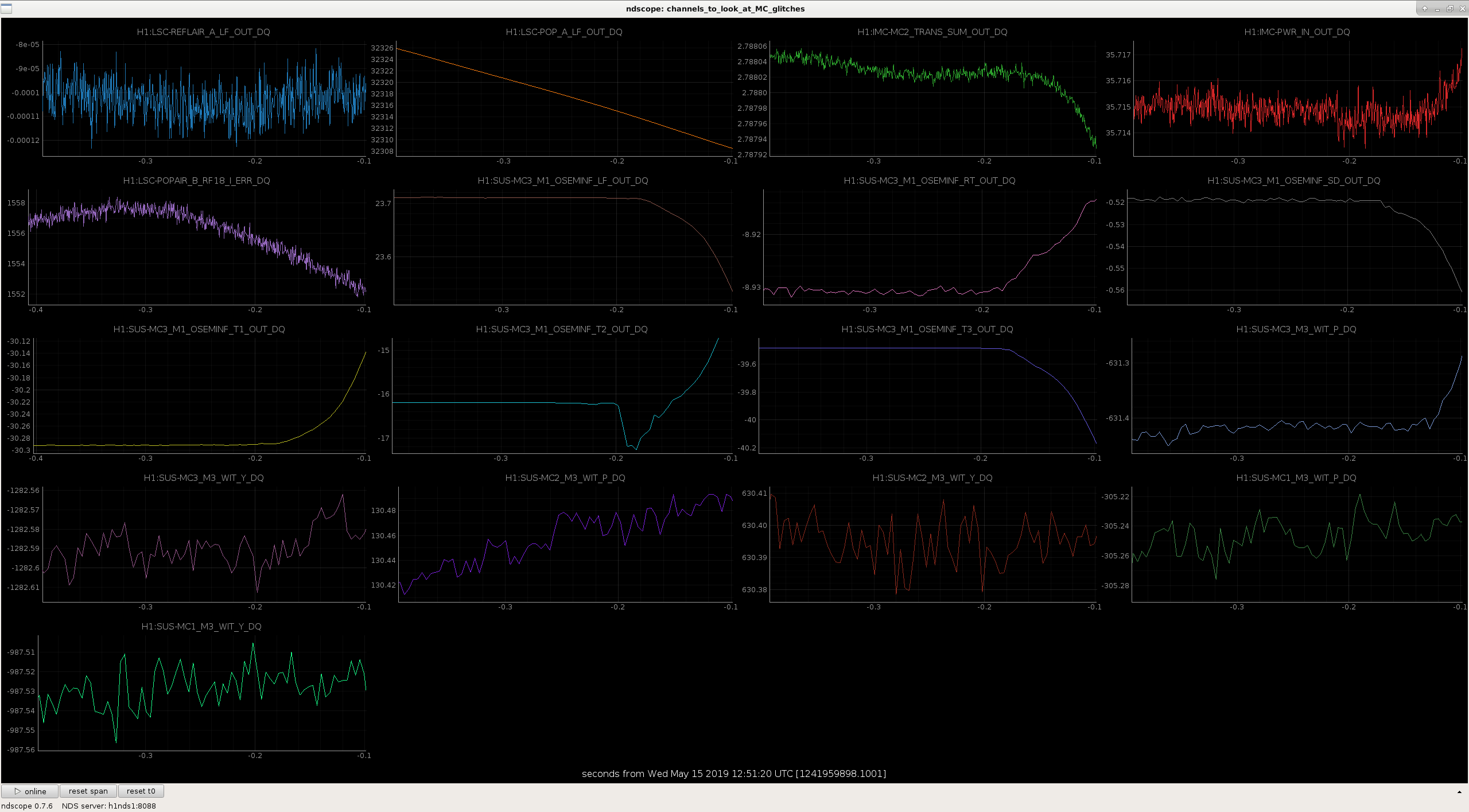
Attached is a time series of the MC3 M1 OSEMS, and the H1:SUS-MC3_M1_OSEMINF_T2_OUT_DQ starts to glitch at 125.84 seconds into the plot, while the other MC3 M1 OSEMS, and Cal Delta and OMC DCPD A, are unaffected.
Other MC3 M1 OSEMS glitch next, then LockLoss.
Attachments:
While Relocking, DRMI lost lock and that also gave a Verbal Alarm for MC3.
Very interesting, good find Cheryl.
It's also in the drives, but only on MC3. So, it looks like it's something with the MC3 suspension, since if it was a glitch coming from the WFS it should show up on all of the IMC suspensions.
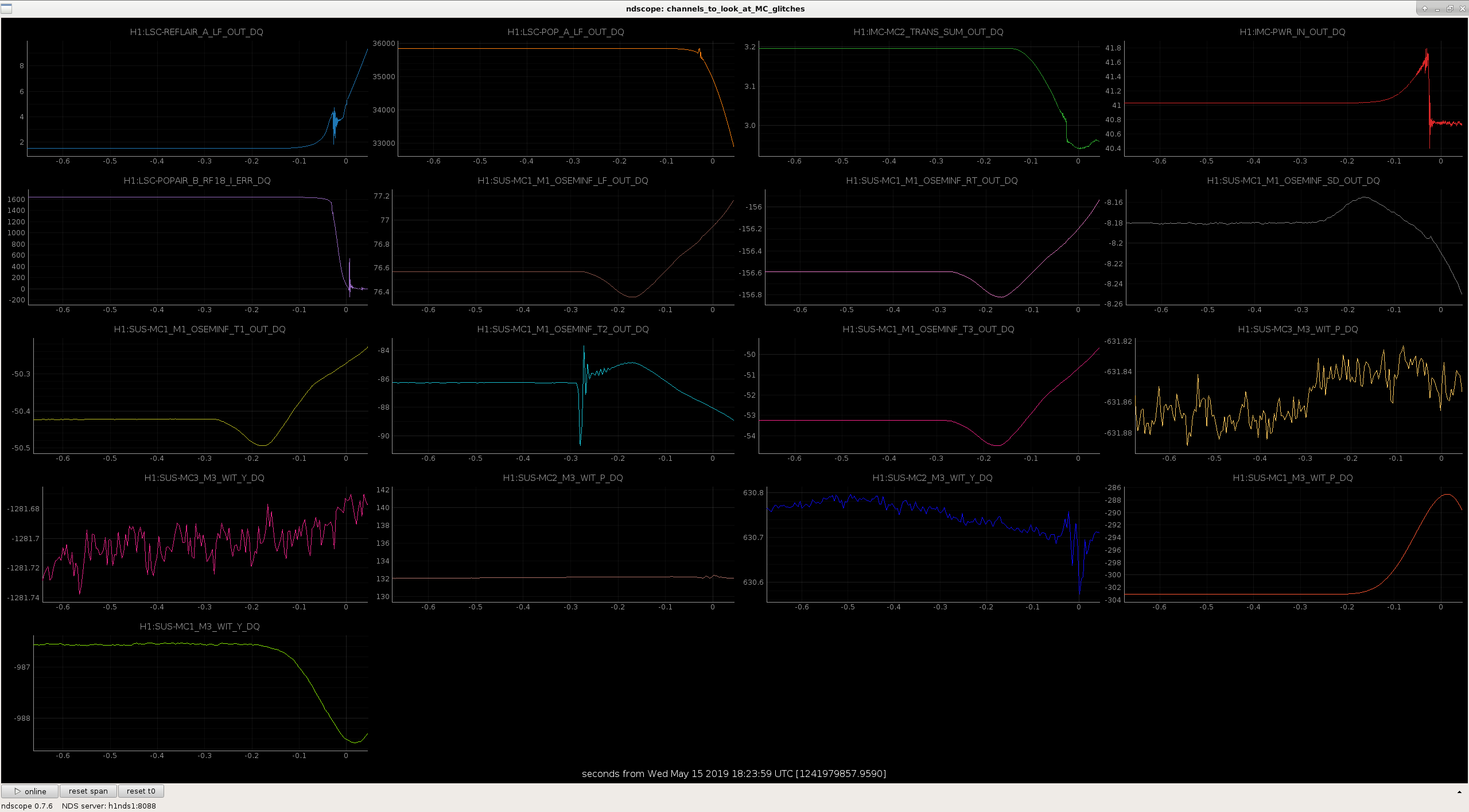
This happened to Sheila and me again this morning, as we were trying to finish up going to low noise at 40W, but this time it was MC1's T2 and T3. The WFS don't see anything until after the glitch, so this confirms my earlier suspicion that it is not coming from the WFS.
If MC1 and MC3 are served by the same coil driver box, it sounds a lot like it might be glitching on us.
The following units were power cycled during a lockloss:
SUS-C4 U41 S1001089 Coil Driver (MC1)
SUS-C4 U40 S1000242 Coil Driver (MC1/MC3)
SUS-C4 U39 S1001084 Coil Driver (MC3)
SUS-C4 U30 S1108081 AI
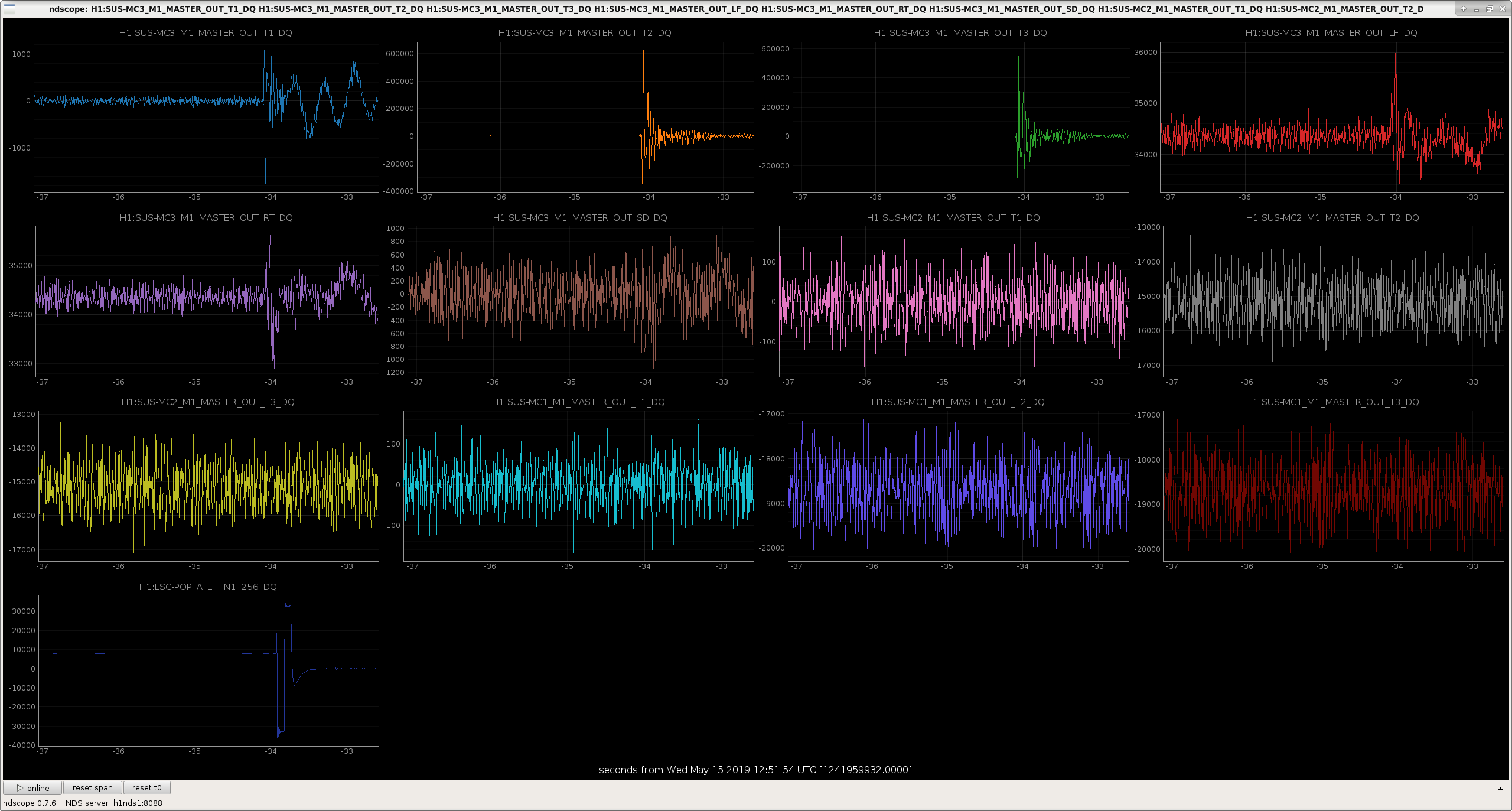
Attached are screenshots from both of these locklosses. The first screenshot shows all the top mass osem readbacks, in most of them the glitch show up slowly because it is going through the damping loops and the mechanical response of the suspension, but the glitch in T2 is much faster which indicates it is a problem with that sensor in both locklosses (MC3 T2 in Cheryl's low noise locklosses, MC1 T2 in th recent lockloss at 40W input power).
The AA (S1105215) chassis was power cycled yesterday afternoon after a lockloss.
Sheila, Hugh (remotely), Niko, Georgia
After an epic battle to reacquire lock (see Niko, Sheila, and Jenne's posts about alignment references and DC centering loop notches), we found a couple of strange SDF differences.
The GS13's for HAM3 and HAM4 were in a non nominal state, with filter differences for H1:ISI-HAM[3,4]_GS13INF_[dof] for each degree of freedom (H1 H2 H3 V1 V2 V3). The Gain and DWH (de-whitening) filters were on when we reached nln, where nominally they are off. Hugh told us how to fix the problem (sitemap -> ISI -> HAM3 -> Commands -> GS13 !HI). Doing this did not break the lock.
We're not sure how we ended up in this state, maybe after the large earthquake today things were not quite returned to normal?
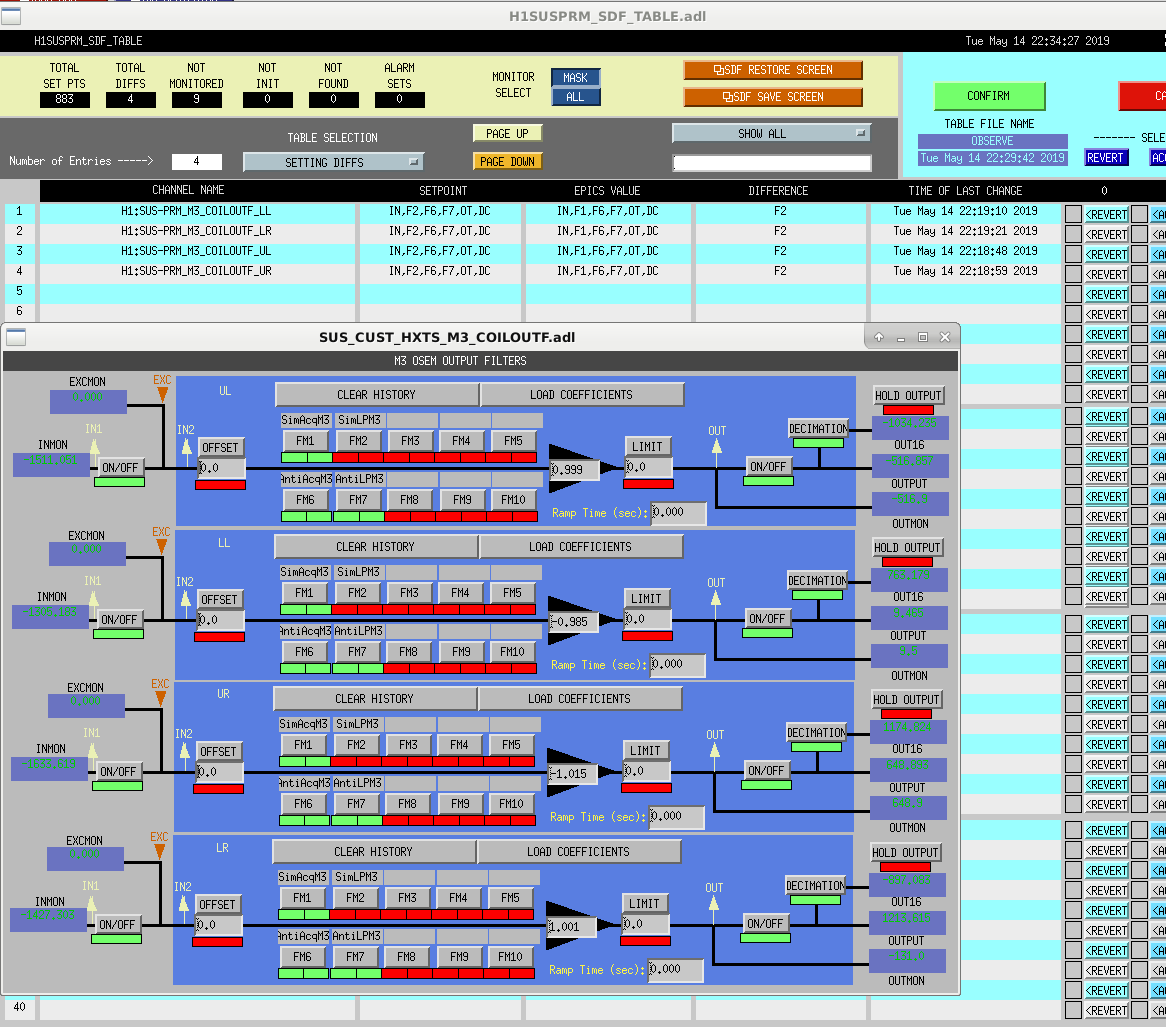
The SDF reported differences with PRM M3 (see attachment), but we found the filters were correct given the state of the coil drivers. Time machining to the last lock, we don't think there was really a difference.
Pretty sure I am to blame for HAM3 & HAM4 SEIs. :-/
Here's what I recall for SEI Land:
After seeing Georgia's alog about HAM3/4, immediately figured this probably due to me. Talked with TJ since he was in the area, and he (& also) Hugh mentioned this is probably due to my not hitting the Recover EQ button (which addresses GS13s). TJ said I could have perhaps taken HAM3/4 to a correct state "by hand", but I did not know how to do it.
Anyway, it's another learning experience.
The recovery script includes a step to put all of the GS13s in low gain which is unnecessary. This means that because HAM3&4 were already isolated when Corey pushed the recovery button, the other chamber guardians handled the sensor gains properly, but HAM3&4 were switched to low gain, and never set correctly by the guardians. I've taken those lines out of the script so this shouldn't happen again.
M. Pirello, D. Gustafson
We installed new v3 Baluns on the following signals in the CER:
ISC-C3(37-1) 40Mhz TCS AOM Return exchanged v1-117 with v3-S002
ISC-C3(33-4) 158.8Mhz Fiber Beat Note Return exchanged v1-193 with v3-S003
ISC-C3(33-5) 79.4Mhz SQZ VCO Return exchanged v1-151 with v3-S004
ISC-C3(33-6) 203.125MHz SQZ VCXO Return exchanged v1-052 with v3-S005
ISC-C4(39-3) 79.4MHz PSL VCO Return exchanged v1-093 with v3-S010
These are all return signals, the impact should be minimal. Work was completed per WP8150
Balun status can be seen here E1900100.
Continuing the Balun exchange program:
We installed new v3 Baluns on the following signals in the CER:
ISC-C4(39-1) 79.4MHz "ALS DIFF VCO Return" exchanged v1-102 with v3-S006
ISC-C4(39-2) 79.4MHz "ALS COMM VCO Return" exchanged v1-094 with v3-S068
ISC-C4(26-2) 45.5MHz "PEM Readback for Antenna Demod" exchanged v1-055 with v3-S009
ISC-C4(19-8) 9.1MHz "PEM Readback for Antenna Demod" exchanged v1-147 with v3-S116
Work was completed per WP8190. WP was modified to reduce impact to the IFO during this weeks maintenance, we did not touch squeezer.
Continuing the Balun exchange Program:
We installed new V3 baluns on the following 45MHz signals in the LVEA:
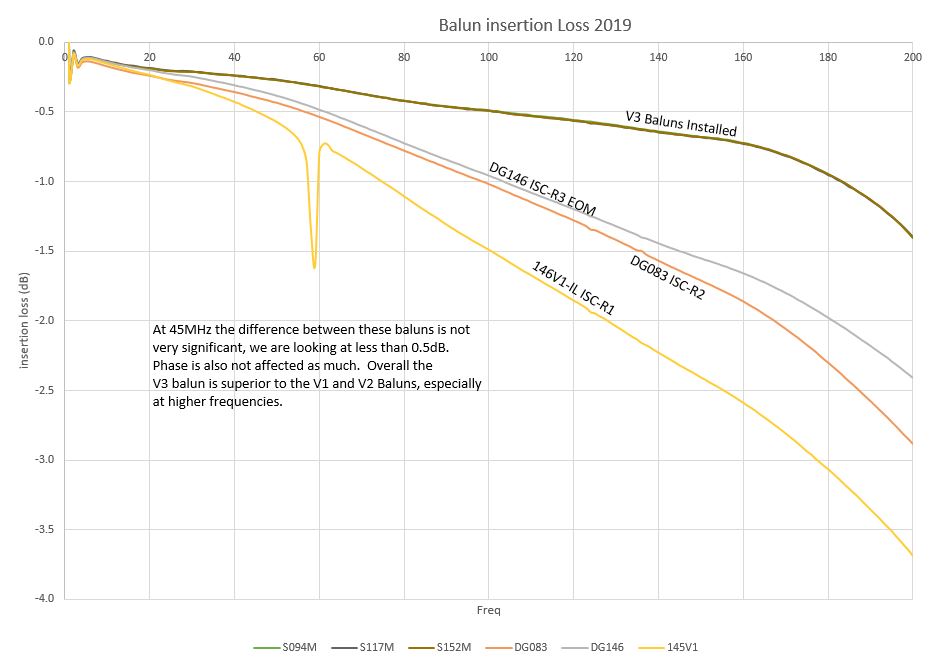
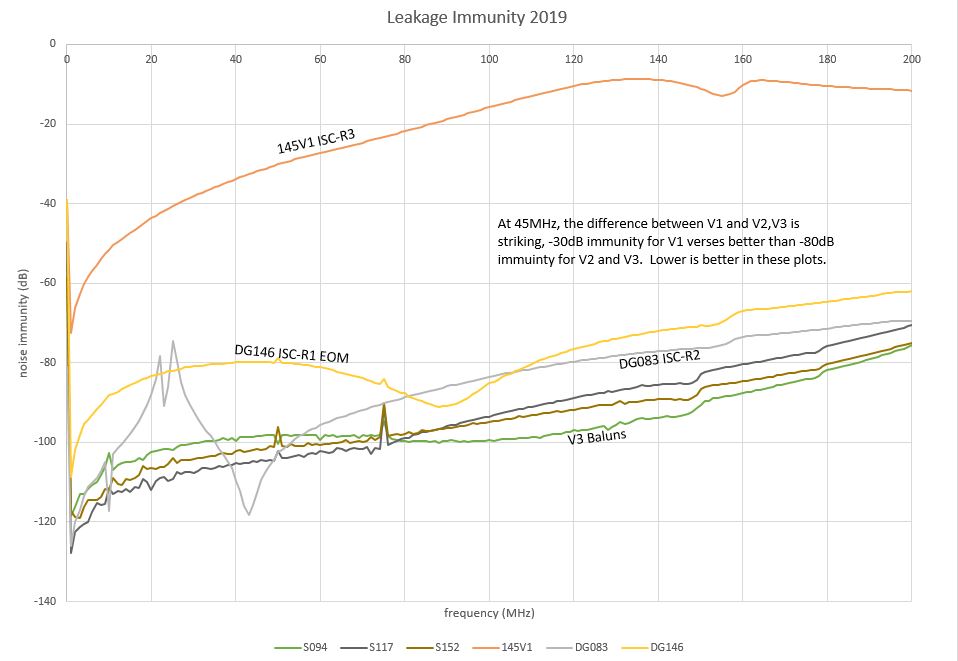
ISC-R1 (41-6) 45MHz Auxiliary Modulation (EOM Driver) exchanged v2-DG146 with v3-S152
ISC-R2 (41-2) 45MHz Distribution exchanged v2-DG083 with v3-S094
ISC-R3 (41-3) 45MHz Distribution exchanged v1-145 with v3-S117
Work was completed per WP8200, balun status can be seen here E1900100.
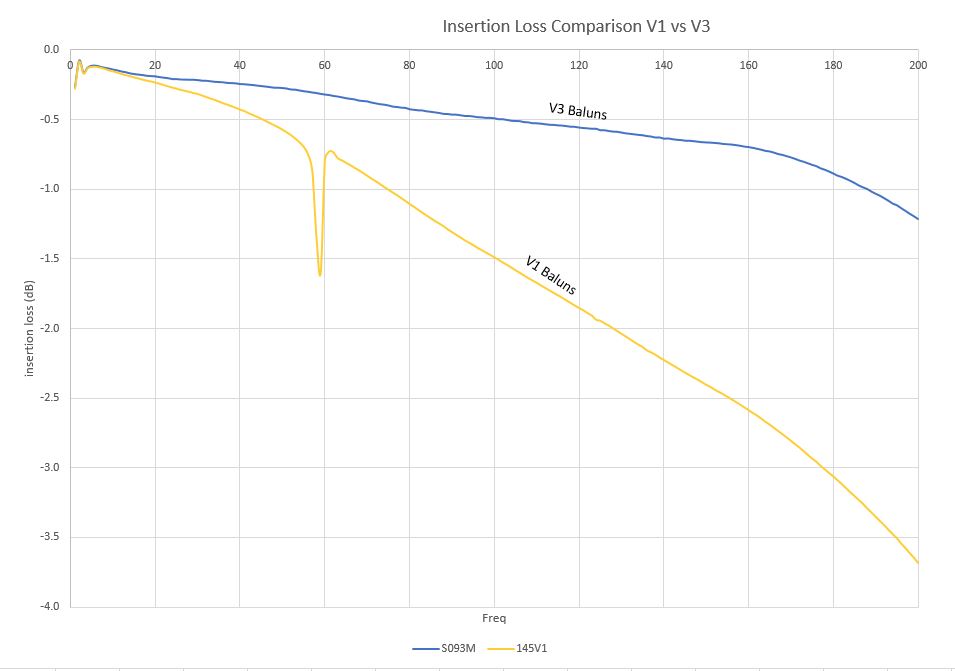
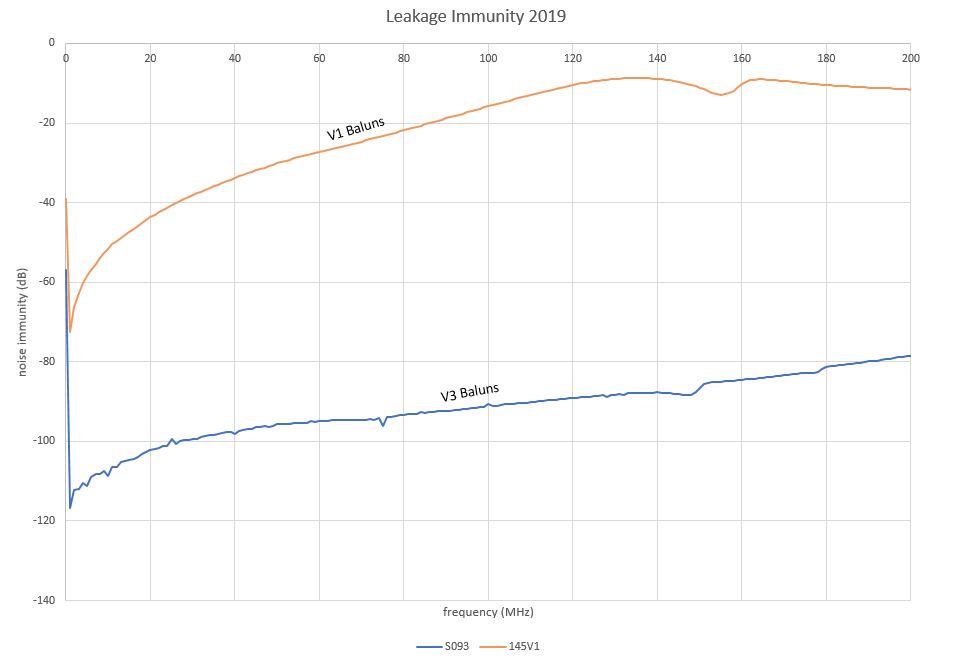
I have attached Insertion Loss and Leakage scans from the old baluns as well as the new ones.
M. Pirello, D. Gustafson
Continuing the Balun exchange Program:
We installed new v3 baluns on the following signals at the PSL racks and at HAM6:
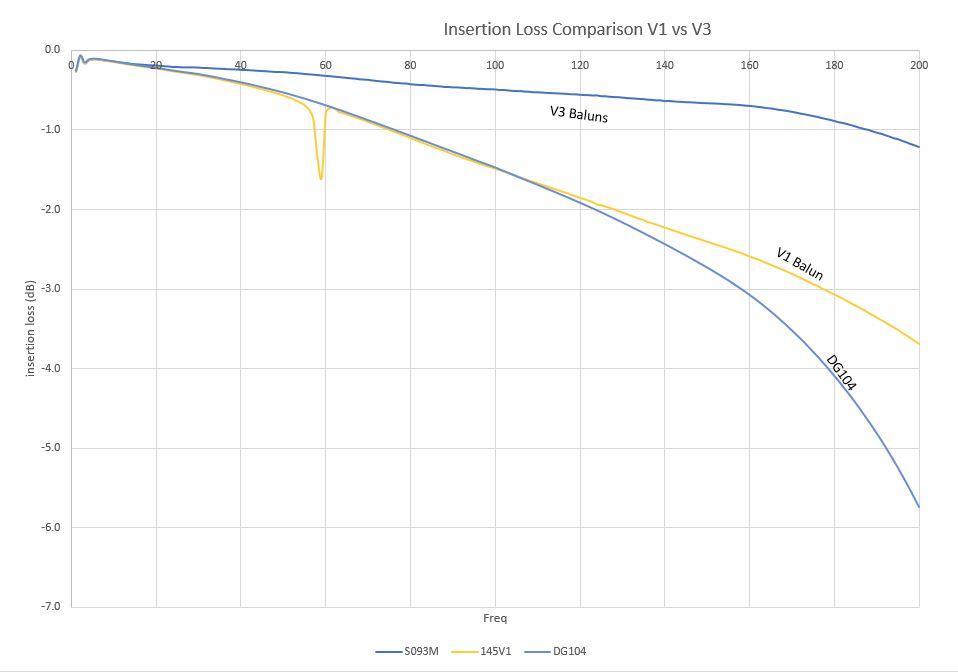
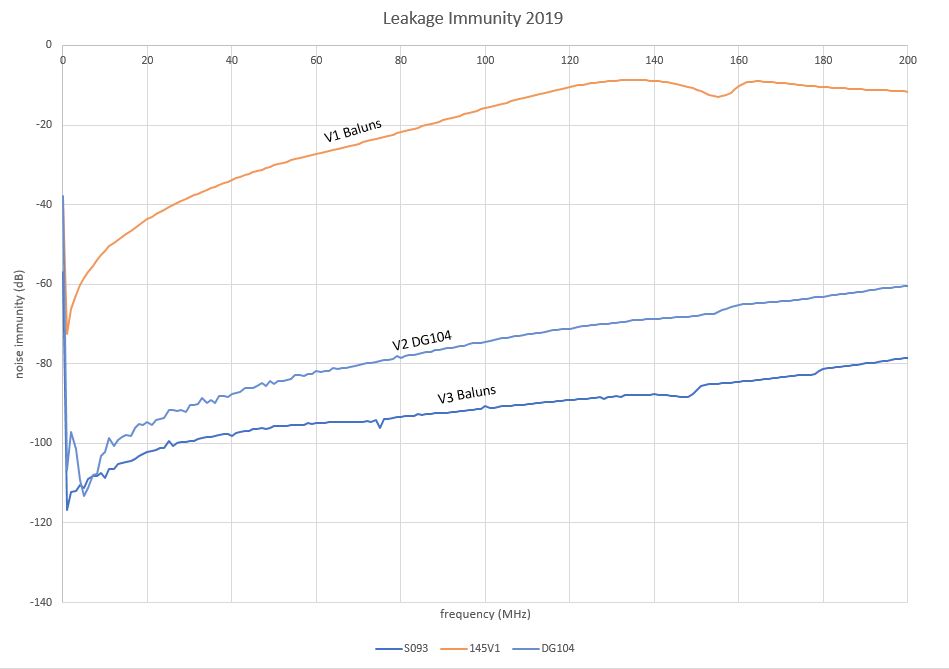
PSL-R2 (18-2) ISS AOM 80MHz exchanged DG-104 with v3-S069
ISC-R3 (41-2) Distribution 4th Harmonic exchanged v1-053 with v3-S160
ISC-R3 (41-4) Distribution 8th Harmonic exchanged v1-091 with v3-S040
ISC-R3 (39-4) Distribution 42.2MHz exchanged v1-125 with v3-S060
Work was completed per WP8215, balun status is in the same place it was last week, E1900100.
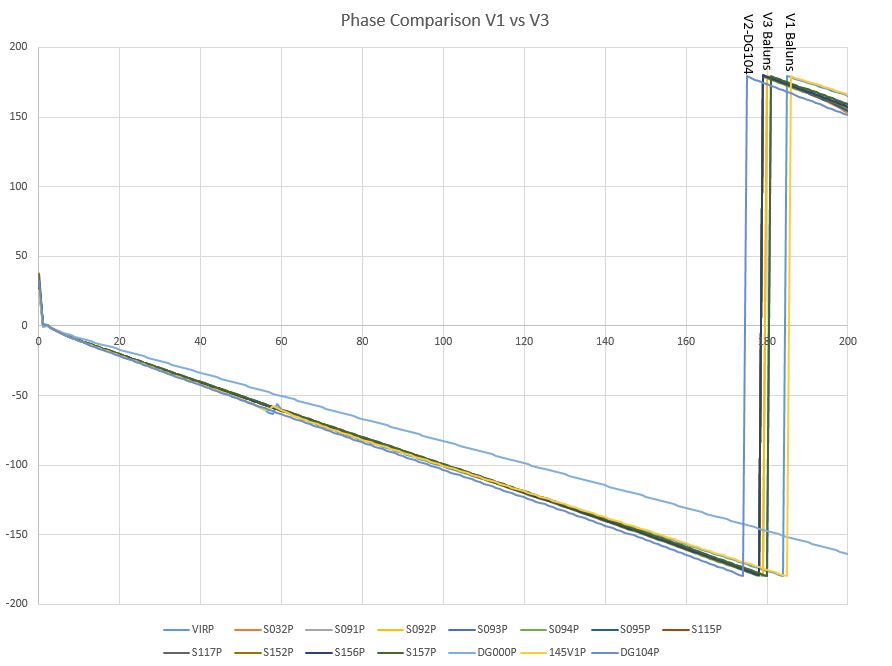
Attached is a comparision between the balun modified by hand (DG-104), and the new v3 balun which replaced it.
M. Pirello, P. King, D. Gustafson
Continuing the Balun exchange Program:
We installed new v3 baluns on the following signals at the PSL racks:
PSL-R2(17-1) FSS Modulation exchanged v1-043 with v3-S157
PSL-R2(17-2) FSS exchanged v1-014 with v3-S093
PSL-R2(17-4) PMC Modulation exchanged v1-021 with v3-S115
PSL-R2(17-5) PMC exchanged v1-050 with v3-S156
PSL-R2(17-6) Injection Locking exchanged v1-084 with v3-S095
ISC-R1(41-2) Distribution JAC Future exchanged v1-159 with v3-S092
** On the last one, the labels on the feed through may be more correct than the DCC. I followed the cable path to the ALS VCO for the PSL.
If it is the ALS VCO, Peter told me that it is possibly 80MHz and in this case the difference between V1 and V3 is about 0.75dB more power, and no measurable difference in phase. The PSL signals being under 45Mhz should be less than 1 degree difference in phase, and less than 0.25dB difference in power.
Work was completed per WP8208, balun status is in the same place it was last week, E1900100.
I have attached insertion loss and leakage scans of v1 vs v3 baluns.
We checked the ISC-R1 (41-2) Balun and determined this signal is the REFL_B demod, 9MHz. There should be very little phase & power difference between V1 and V3 baluns at this frequency.
M. Pirello, D. Gustafson
Continuing the Balun exchange Program:
We installed new v3 baluns on the following signals at the end stations.
EX-ISC-C1 (41-5) Return PLL Beat Note 39.5MHz exchanged v1-176 with v3-S050
EX-ISC-C1 (41-6) Return ALS Laser VCO 79.4Mhz exchanged v1-049 with v3-S042
EX-ISC-R1 (41-1) ALS Laser VCO 71MHz exchanged v1-189 with v3-S114
EX-ISC-C1 (41-5) Return PLL Beat Note 39.5MHz exchanged v1-137 with v3-S041
EX-ISC-C1 (41-6) Return ALS Laser VCO 79.4Mhz exchanged v1-199 with v3-S155
EX-ISC-R1 (41-1) ALS Laser VCO 71MHz exchanged v1-039 with v3-S059
Work was completed per WP8222, balun status is in the same place it was last week, E1900100.
M. Pirello, D. Gustafson
Continuing the Balun exchange Program:
We installed new v3 baluns on the following signals at the Squeezer
ISC-R3 (39-1) 80MHz SQZ EOM (OPO) exchanged v1-178 with v3-S082
ISC-R3 (39-2) 35.5MHz SQZ EOM (SHG) exchanged v1-060 with v3-S089
ISC-R3 (39-3) 200MHz SQZ EOM (CLF) exchanged v1-166 with v3-S031
SQZ-R1 (41-1) 80MHz OPO Demodulation exchanged v-122 with v3-S084
SQZ-R1 (41-2) 35.5MHz SHG Demodulation exchanged v1-020 with v3-S033
SQZ-R1 (39-3) 71MHz SQZ VCO Laser Locking exchanged v1-190 with v3-S083
Work was completed per WP8230, balun status is in the same place it was last week, E1900100.
** The 200MHz SQZ EOM CLF signal may require a slight phase change, about 8 degrees difference and 2dB more power with the V3.
M. Pirello, D. Gustafson
Continuing the Balun exchange Program:
We installed new v3 baluns on the following signals at the Squeezer and the PSL racks:
SQZ-R1 (41-3) 3.125MHz SQZ Angle Demodulation exchanged v1-171 with v3-S108
SQZ-R1 (41-4) 3.125MHz SQZ Angle Demodulation exchanged v1-145 with v3-S109
SQZ-R1 (41-5) 6.25MHz CLF Demodulation exchanged v1-183 with v3-S085
ISC-R1 (41-1) 71MHz Distribution exchanged DG-02 with v3-S086
ISC-R1 (41-3) 15th Harmonic Modulation exchanged DG-01 with v3-S058
TCS-MEZ (41-1) TCS exchanged v1-153 with v3-S079
Work was completed per WP8240, balun status is in the same place it was last week, E1900100.
M. Pirello, D. Gustafson
Continuing the Balun exchange Program:
We installed new v3 baluns on the following signals at the field racks near the PSL:
ISC-R2 (41-1) 9MHz Distribution exchanged v1-047 with v3 S019
ISC-R2 (41-3) 2nd Harmnonic Distribution exchanged v1-098 with v3-S019
ISC-R2 (41-4) 3rd Harmonic Distribution exchanged v1-157 with v3-S015
ISC-R2 (41-5) 10th Harmonic Distribution exchanged v1-179 with v3-S016
ISC-R2 (41-6) 15th Harmonic Distribution exchanged v1-074 with v3-S132
ISC-R1 (41-4) 24MHz MC Distribution exchanged v1-040 with v3-S017
ISC-R1 (41-5) 9MHz Main Modulation exchanged v1-033 with v3-S018
Work was completed per WP8244, balun status located at this link: E1900100. This concludes all "known" balun work at the corner station. We are sprinting to next week where we intend to replace the remaining twelve v1 baluns at the end stations.
M. Pirello, D. Gustafson
Continuing the Balun exchange Program, we installed new v3 baluns on the following signals at both end stations:
EX
ISC-R1 (41-2) 24.4MHz Modulation exchanged v1-022 with v3-S074
ISC-R1 (41-3) 24.4MHz Demodulation exchanged v1-184 with v3-S131
ISC-R1 (41-4) Not Connected exchanged v1-064 with v3-S078
ISC-R1 (39-1) 24.4 WFS A Demod exchanged v1-077 with v3-119
ISC-R1 (39-2) 24.4 WFS B Demode exchanged v1-026 with v3-S076
ISC-R1 (39-3) 71 CPS Timing Fanout exchanged v1-059 with v3-S020
EY
ISC-R1 (41-2) 24.4MHz Modulation exchanged v1-127 with v3-S073
ISC-R1 (41-3) 24.4MHz Demodulation exchanged v1-118 with v3-S011
ISC-R1 (41-4) Not Connected exchanged v1-013 with v3-S012
ISC-R1 (39-1) 24.4 WFS A Demod exchanged v1-126 with v3-S075
ISC-R1 (39-2) 24.4 WFS B Demod exchanged v1-161 with v3-S013
ISC-R1 (39-3) 71 CPS Timing Fanout exchanged v1-191 with v3-S135
Work was completed per WP8255, balun status located at this link: E1900100.
** In the process of walking through the LVEA we found 4 more Baluns hidden among the TCS and SUS racks which need upgrading. We were able to upgarde one of these with this Tuesday, and will finish the remainder next maintenance day.
SUS-R3 (40-1) CPS HAM 71MHz exchanged v1-011 with v3-S113
This additional work was started per WP8261
M. Pirello, H. Radkins
The final three baluns were exchanged at the corner this morning for a total of 64 baluns replaced over 14 weeks.
TCS-R2 (41-1) 71Mhz CPS Timing exchanged v1-088 with v3-S144
TCS-R2 (41-2) N/A Empty signal with Balun exchanged v1-081 with v3-S001
TCS-R1 (41-6) TCS Signal from Mechanical Room exhcnaged v1-143 with v3-S045
All work finished per WP8261. This completes work done per FRS9794 and ECR-E1700404 at LHO.