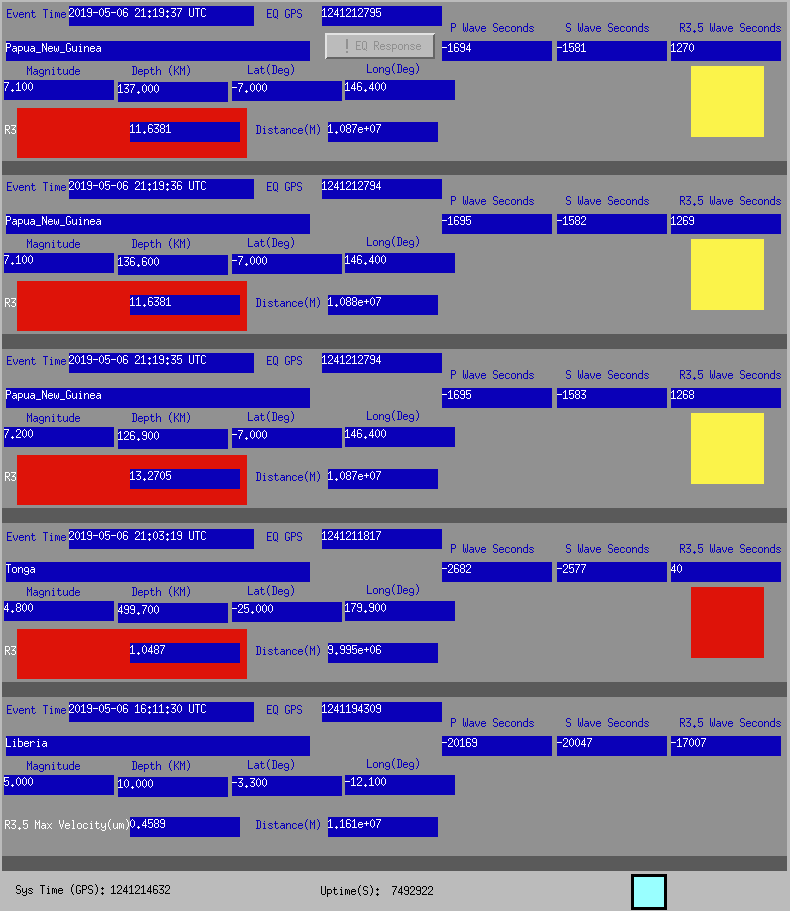
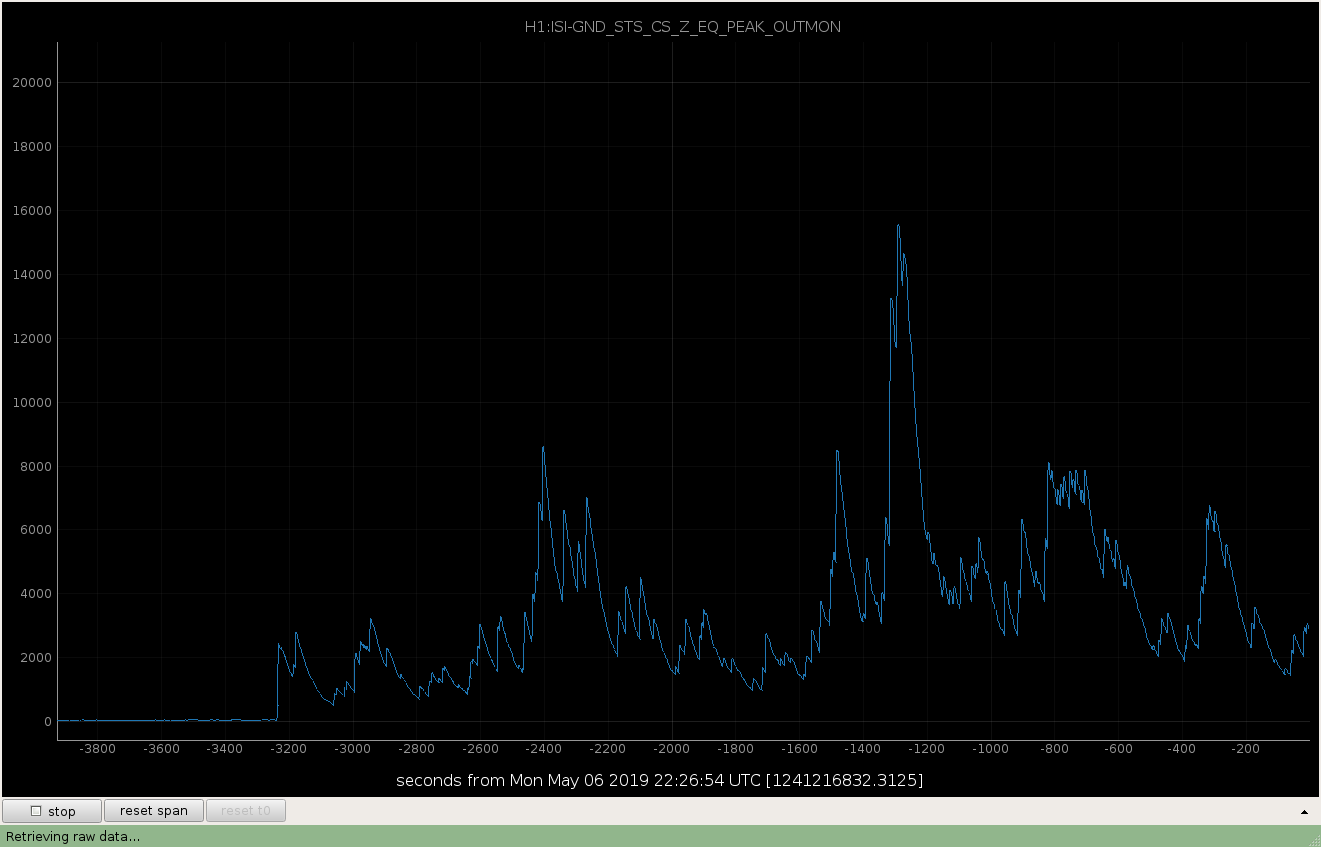
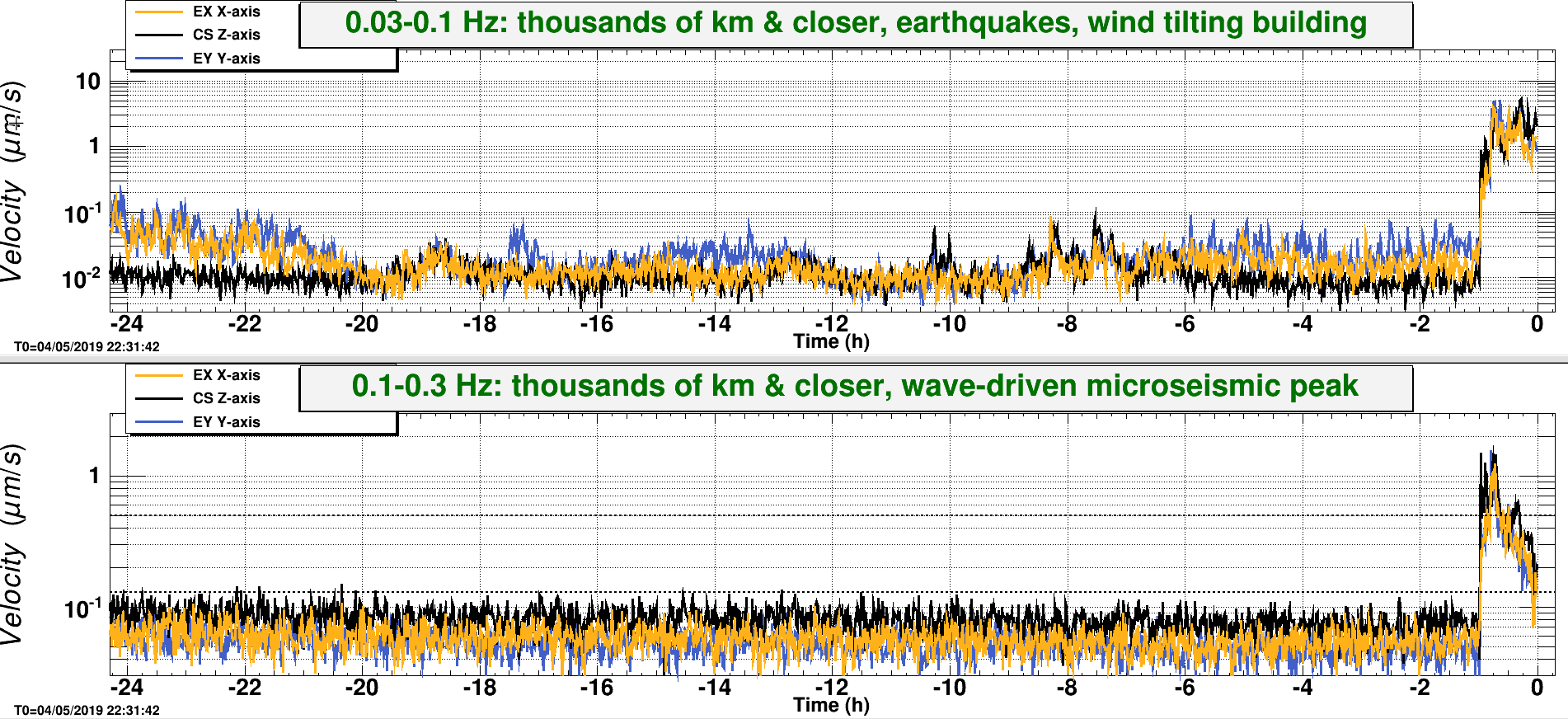
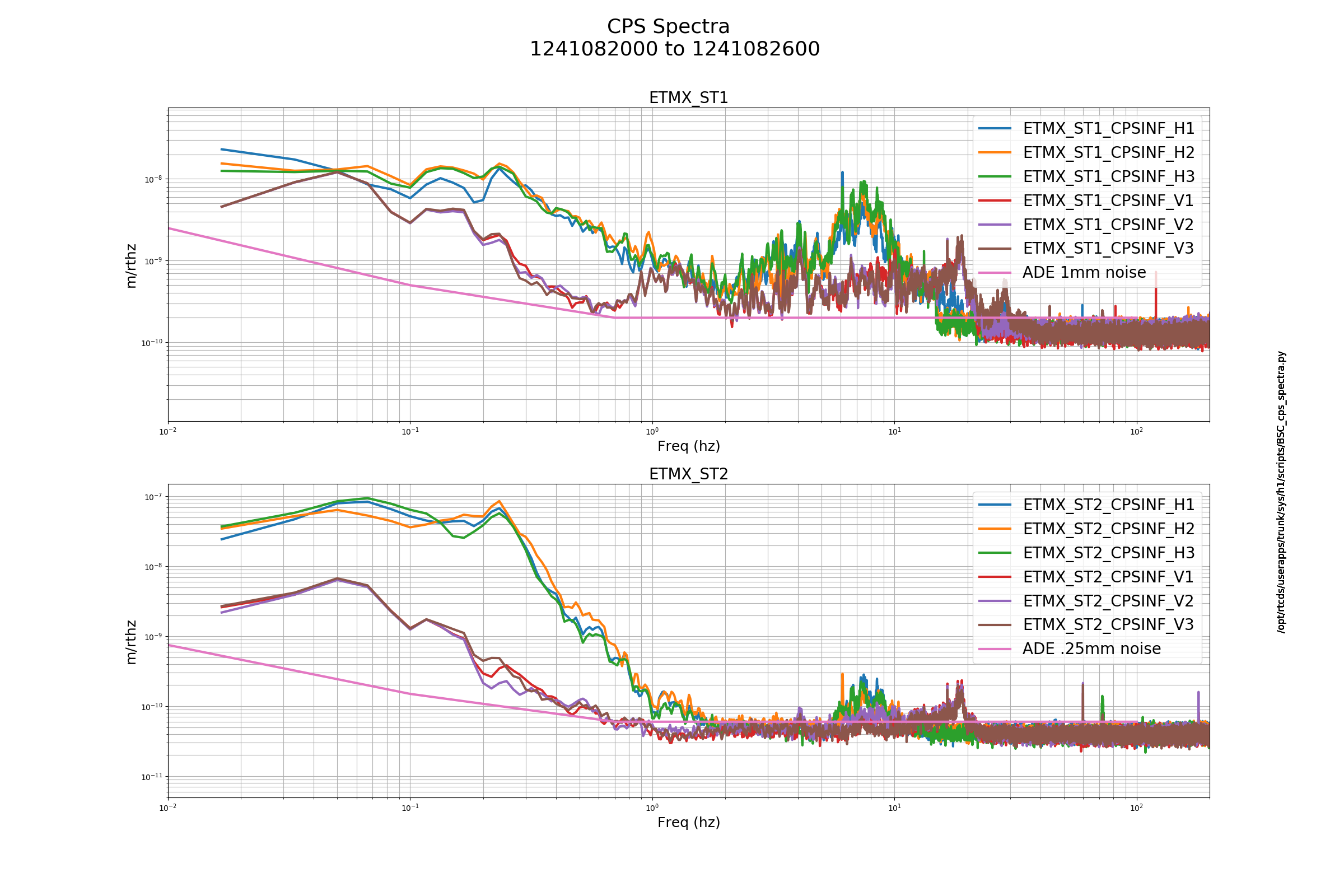
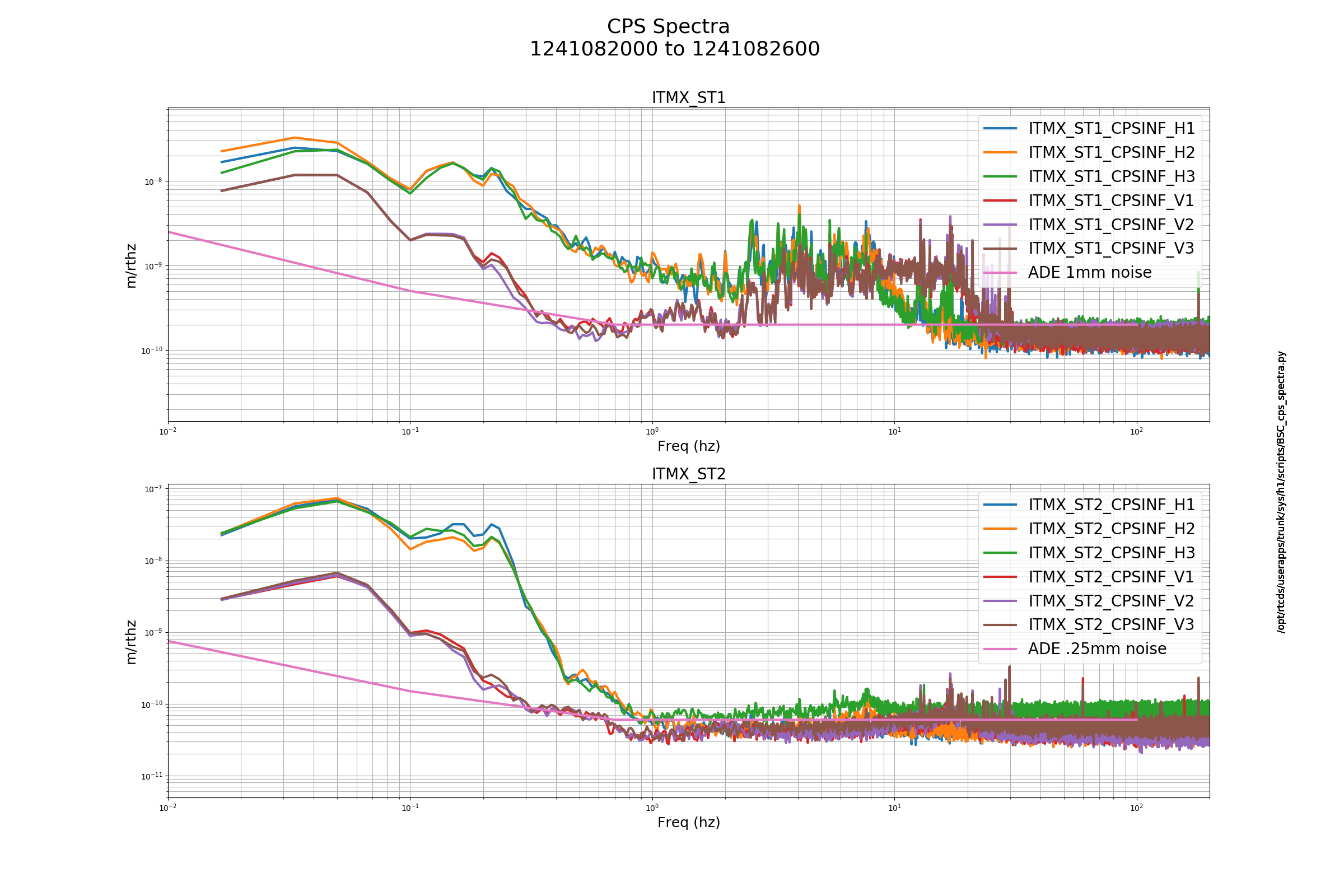
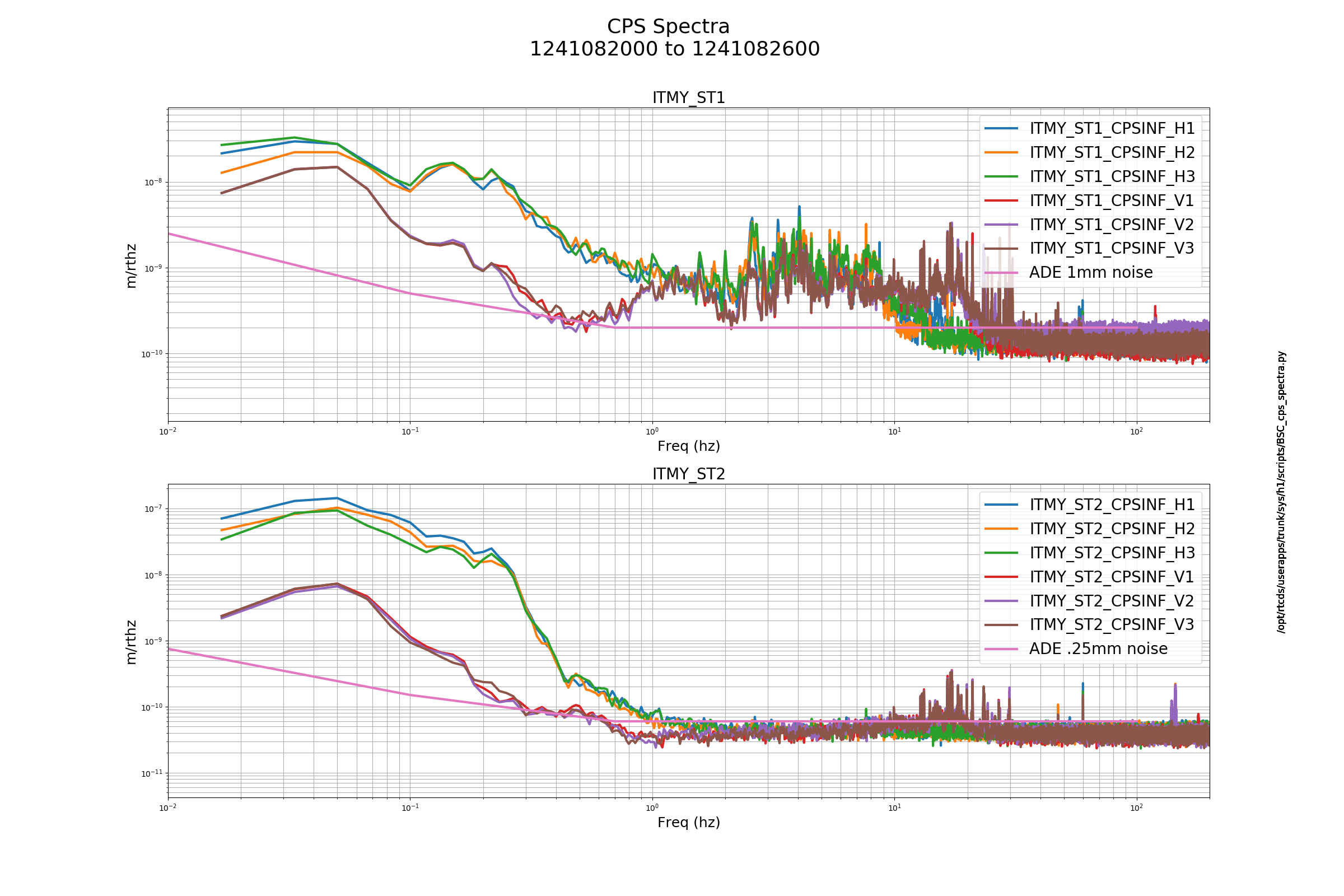
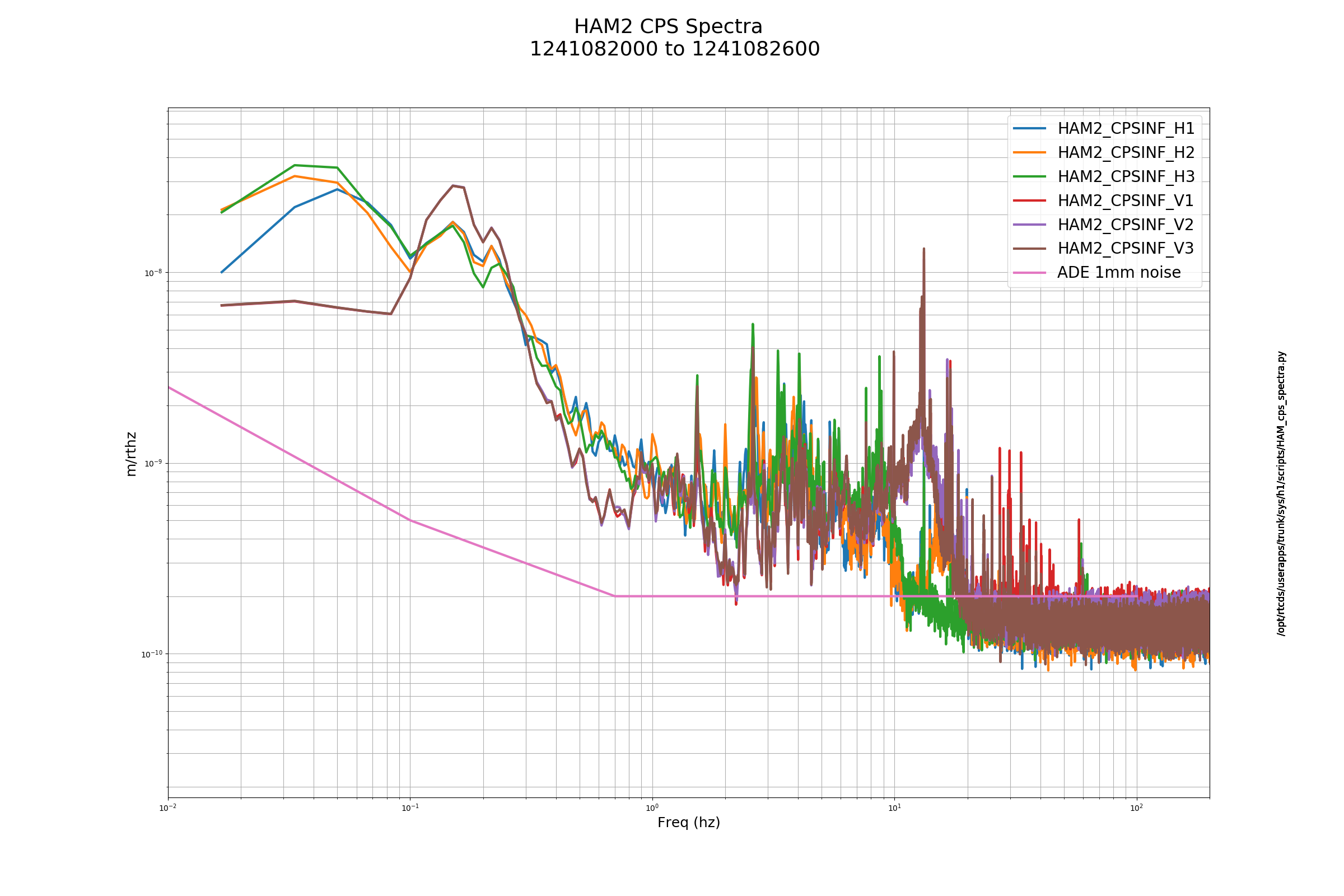
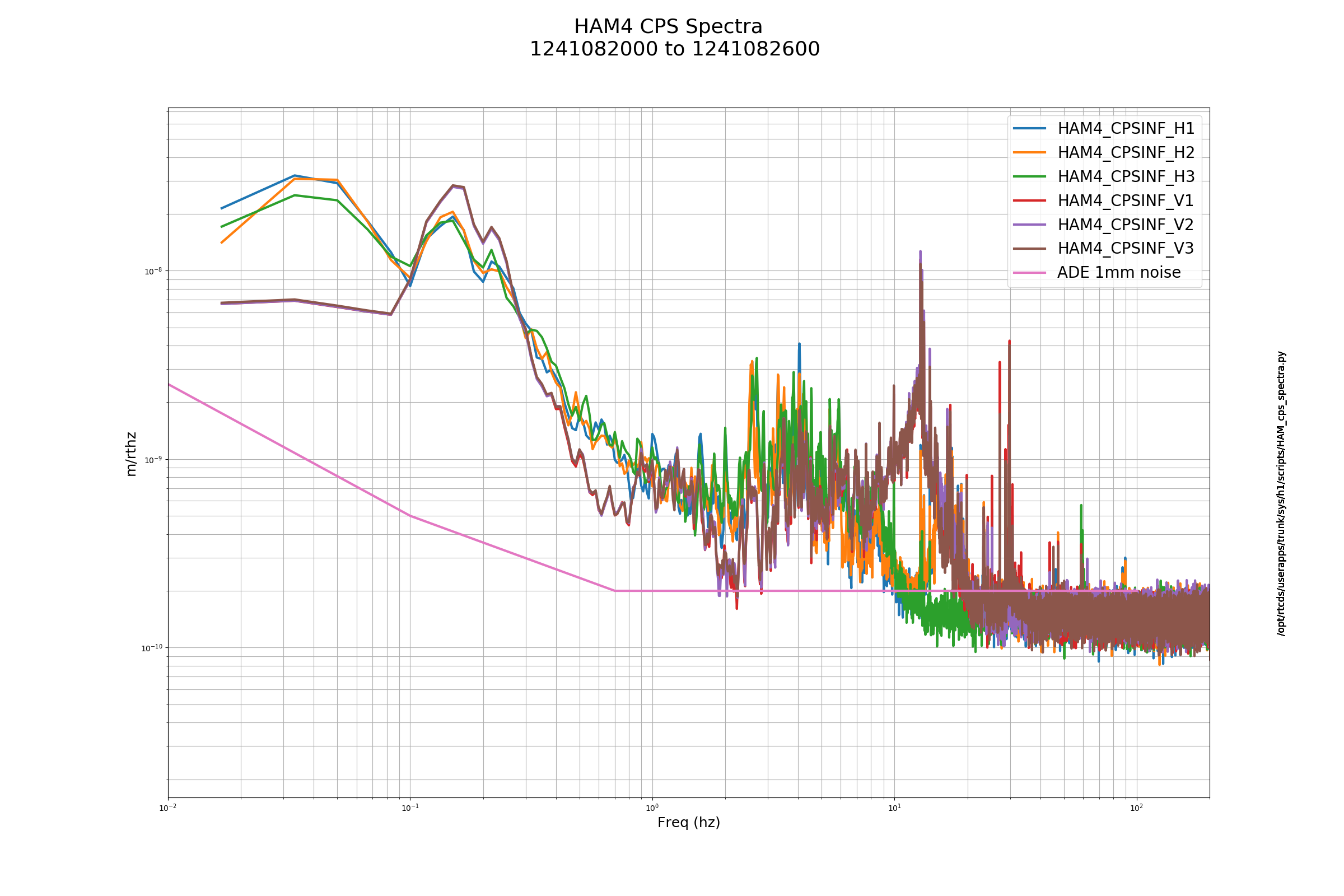
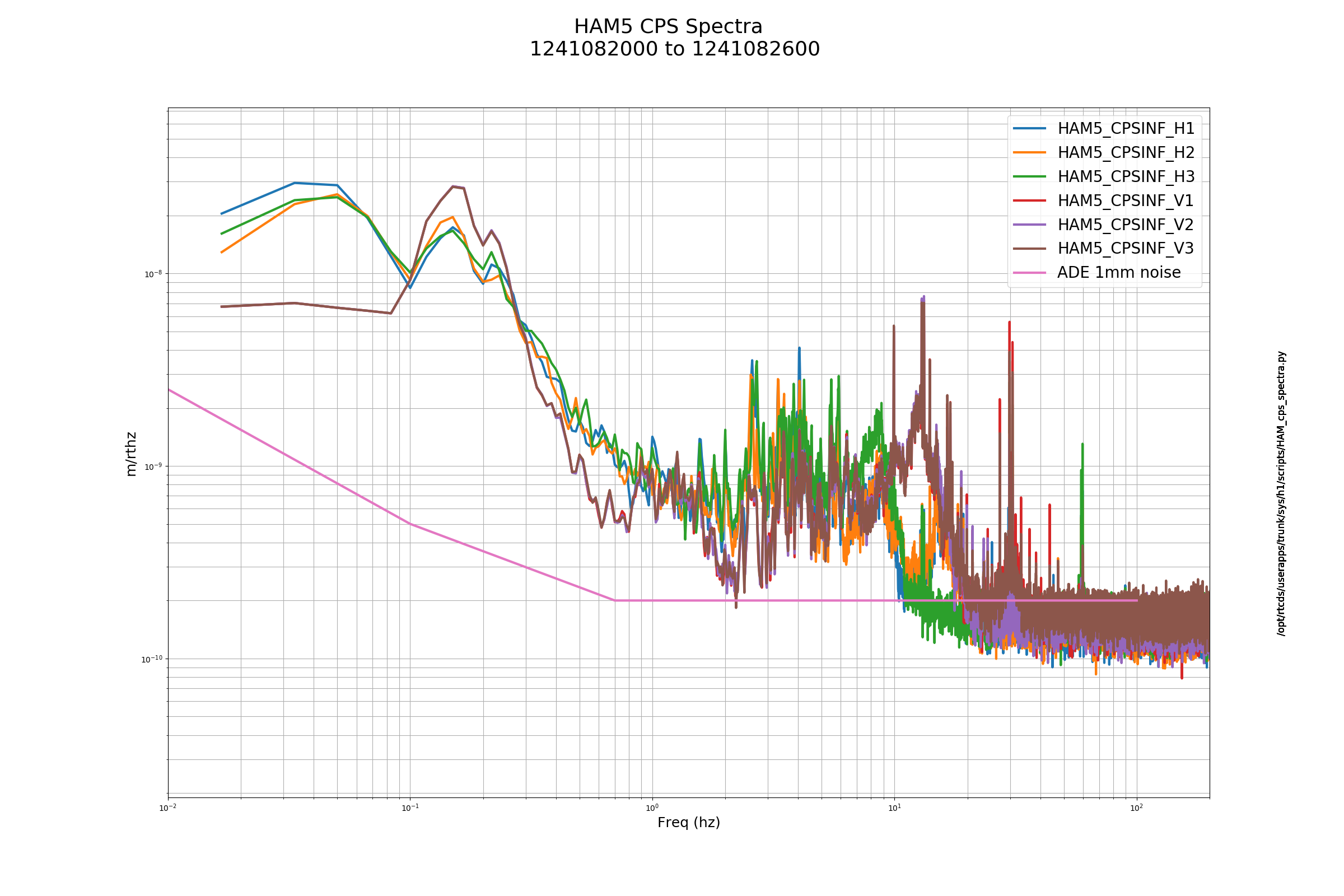
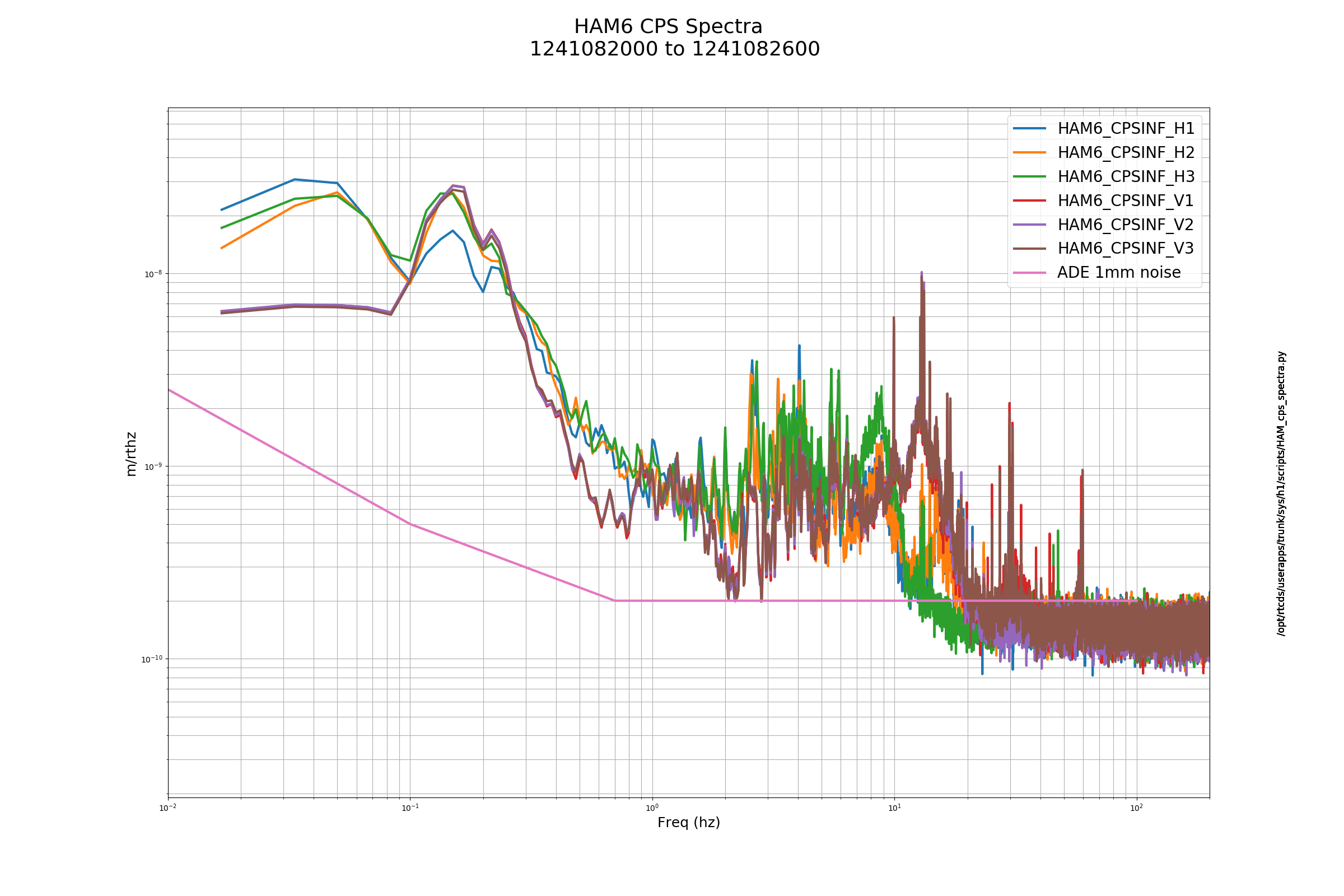
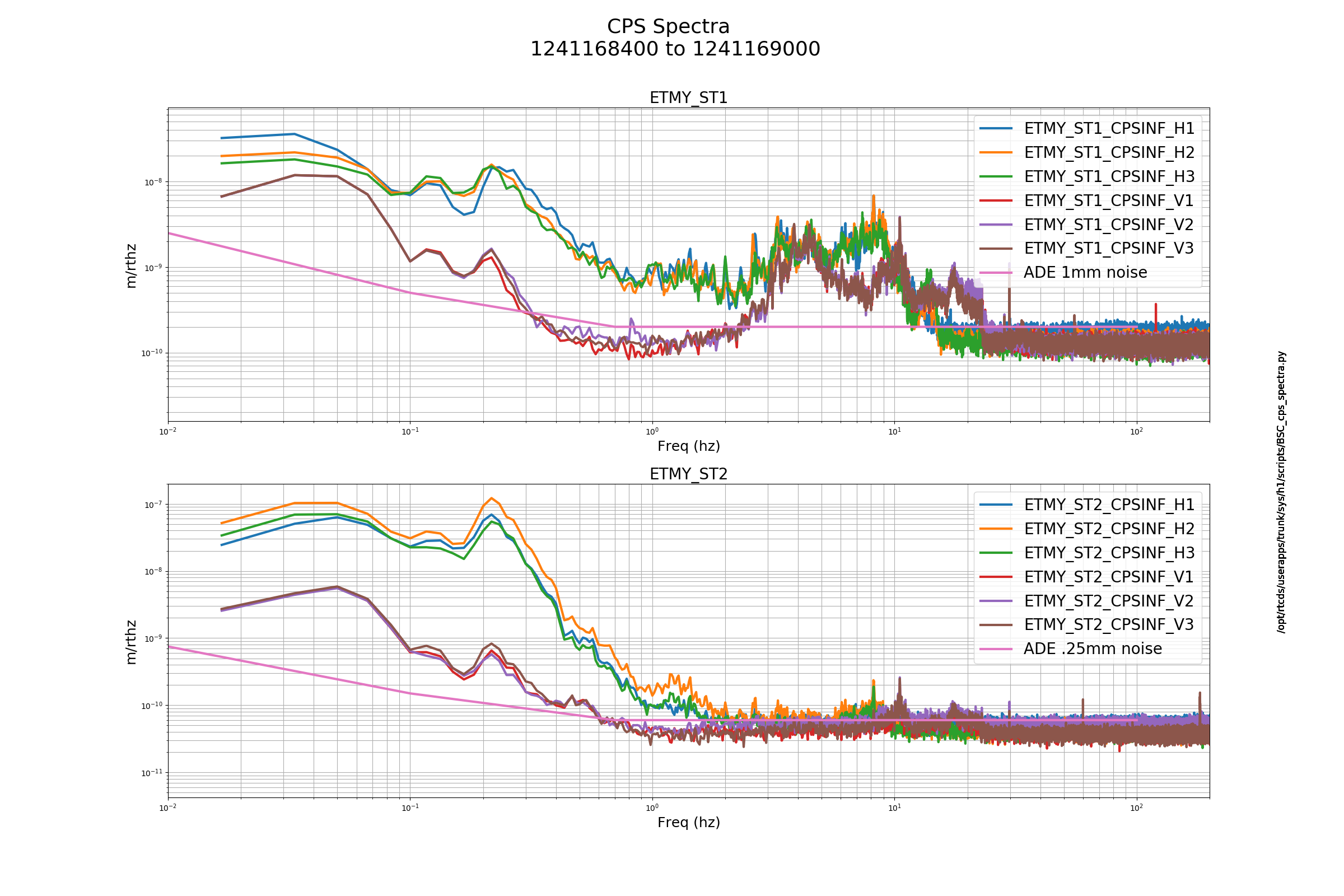
21:25 Incoming EQ from Papua New Guinea area - 7.2 H1 rde
21:35 SEI_CONF switched to EARTH_QUAKE - Peak Outmon exceeding 3000 cts
21:35 Jenne set ADS gain to 0
21:43 Lockloss - Seismon was reporting that R wave still 1300 secs in the future and P/S waves were already 1300 secs in the past.
21:47 H1 to DOWN
22:03 switched SEI_CONF to LARGE_EQ_NOBRSXY
22:12 looks like the worst is past - nothing tripped
22:!3 Daniel and Cheryl out to LVEA
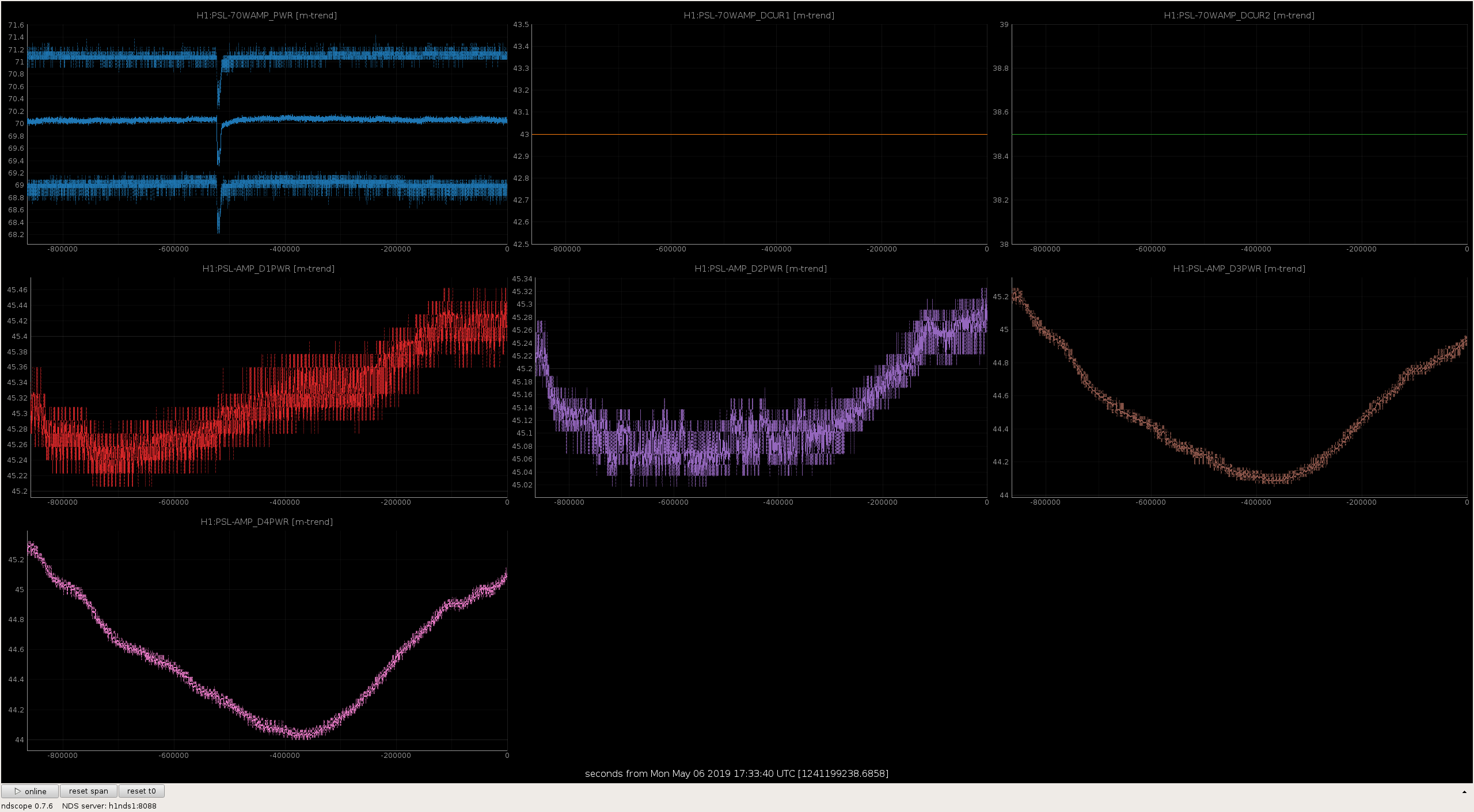
WP8199 h1tw1 raw minute trend files offload (SSD to Spinning Media)
Dave:
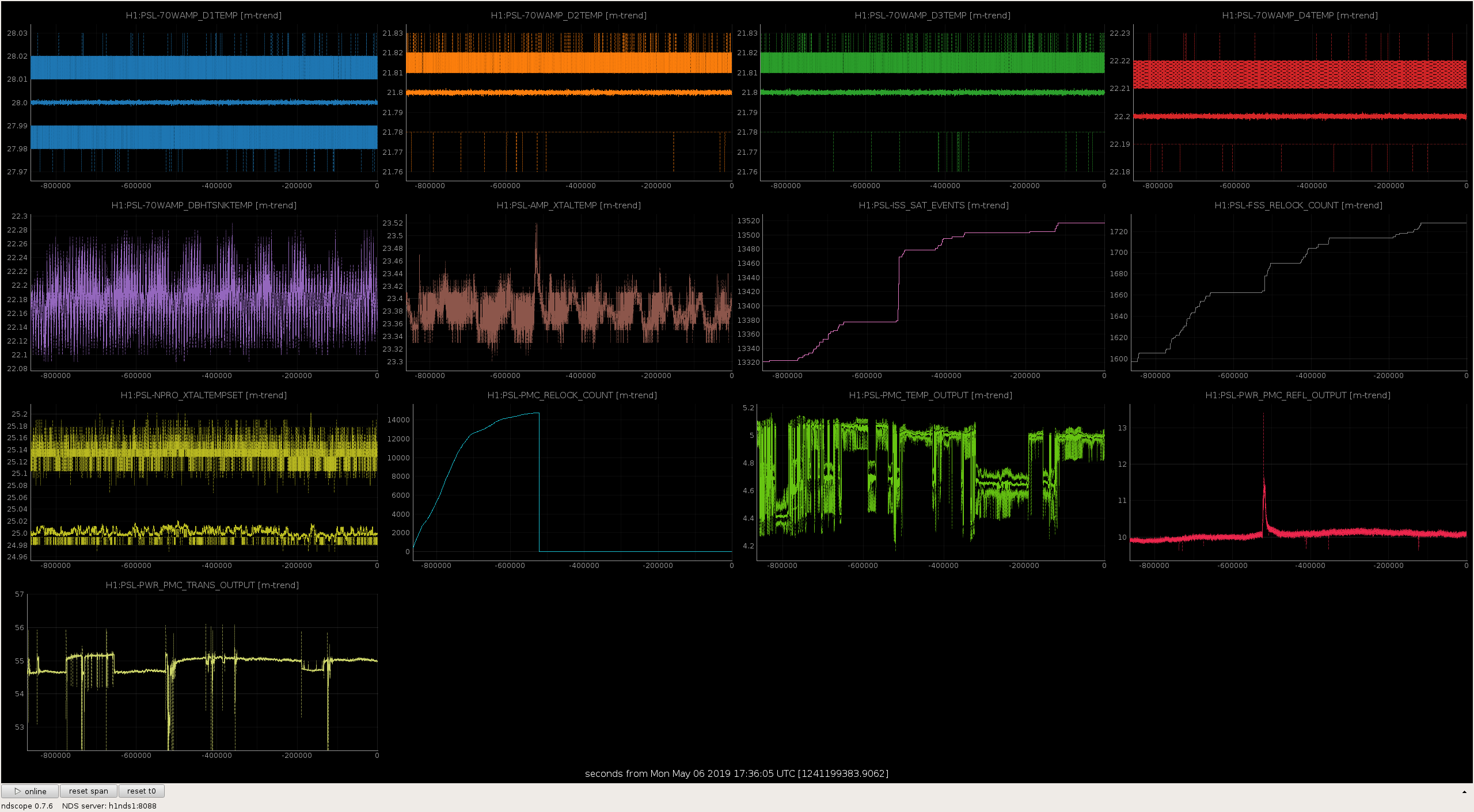
As part 1 of the offload, I have frozen h1tw1's raw minute trends prior to offloading them. These cover the time period 17dec2018 - today. To permit h1nds1 to serve these data from this temporary location until such time as they have been copied, I added this location to its daqdrc file and restarted h1nds1's daqd at 13:52 PDT.
DQ shifter Kentaro Mogushi, LHO fellow: Pep Covas
The full report can be found on the detchar wiki:https://wiki.ligo.org/DetChar/DataQuality/DQShiftLHO20190429
Below I summarize the main highlights of this shift:
The current beam path on IOT2L goes first through an uncoated optics which dumps most of the power. According to alog 6301 and T1600107 the reflected beam is about 3%. The reflected beam is then about 60mW with 1.85W unlocked and maybe about 20mW at 35W locked.
Next a halfwave plate and polarization wedge are used to attenuate the beam further. In the current setup we are attenuating by about ~5. In order to increase the power on the IMC REFL photodetector by ~10 and keep the power in the wavefront sensors roughly the same, we would need to adjust this ratio to 1. Alternatively, we could simply remove the the polarization wedge and use the halwaveplate to give us s-polarization.
Downstream of the power adjustment, half the light is split towards the IMC REFL photodetector, whereas the other half is divided between the 2 wavefront sensors and a camera. The camera path takes about 5% of the light. We would need to replace this beamsplitter with a 90:10, which would reduce the light towards the wavefront sensors by 5. This setup would effectively increase the IMC REFL PD power by ten and double the power in the wavefront sensor path.
A trigger photodetector needs to be installed as well.
Nothing to see here. (unusual that is)
1 hour standown on all IFO related activities
checked INJ_TRANS is in EXTTRIG_ALERT_ACTIVE
Restarted the CW injection at 17:05 UTC. Dave and I have been working to configure the CW injection closer to how LLO does it, via monitoring with monit and start/stop via systemd. I tested the systemd start of the psinject. It started up, showed as running in monit. The only thing I noticed was that the systemctl command tool several minutes to finish (after the psinject process was running).
The main difference we have between LLO and LHO with regards to monitoring and control is that we do not yet have auto restarts enabled.
17:08UTC Also, CW injections are back up and running.
16:55UTC Kyle moving forklift from LVEA large access area. THis activity is being coordinated with Jenne's PRCL FF measurements. These activities should take ~10 minutes.
17:02UTC Kyle still moving lift truck but is out of the nominal noise zone as stated in the acceptable/not acceptable while in Observation document.
TITLE: 05/06 Day Shift: 15:00-23:00 UTC (08:00-16:00 PST), all times posted in UTC
STATE of H1: Observing at 105Mpc
OUTGOING OPERATOR: Corey
CURRENT ENVIRONMENT:
Wind: 6mph Gusts, 3mph 5min avg
Primary useism: 0.02 μm/s
Secondary useism: 0.10 μm/s
QUICK SUMMARY:
TITLE: 05/06 Owl Shift: 07:00-15:00 UTC (00:00-08:00 PST), all times posted in UTC
STATE of H1: Observing at 111Mpc
INCOMING OPERATOR: Ed
SHIFT SUMMARY:
H1 keeps on rollin': 28.5hr lock and counting.
LOG:
Laser Status:
Front End Power is 32.34W (should be around 30 W)
70W Output Power is 69.23W
Front End Watch is GREEN
70W Watch is GREEN
PMC:
It has been locked 5 days, 19 hr 44 minutes (should be days/weeks)
Reflected power = 10.09Watts
Transmitted power = 55.0Watts
PowerSum = 65.09Watts.
FSS:
It has been locked for 1 days 4 hr and 0 min (should be days/weeks)
TPD[V] = 3.932V (min 0.9V)
ISS:
The diffracted power is around 2.2%
Last saturation event was 1 days 4 hours and 0 minutes ago (should be days/weeks)
Possible Issues: Nothing to report
Nothing out of sorts here.
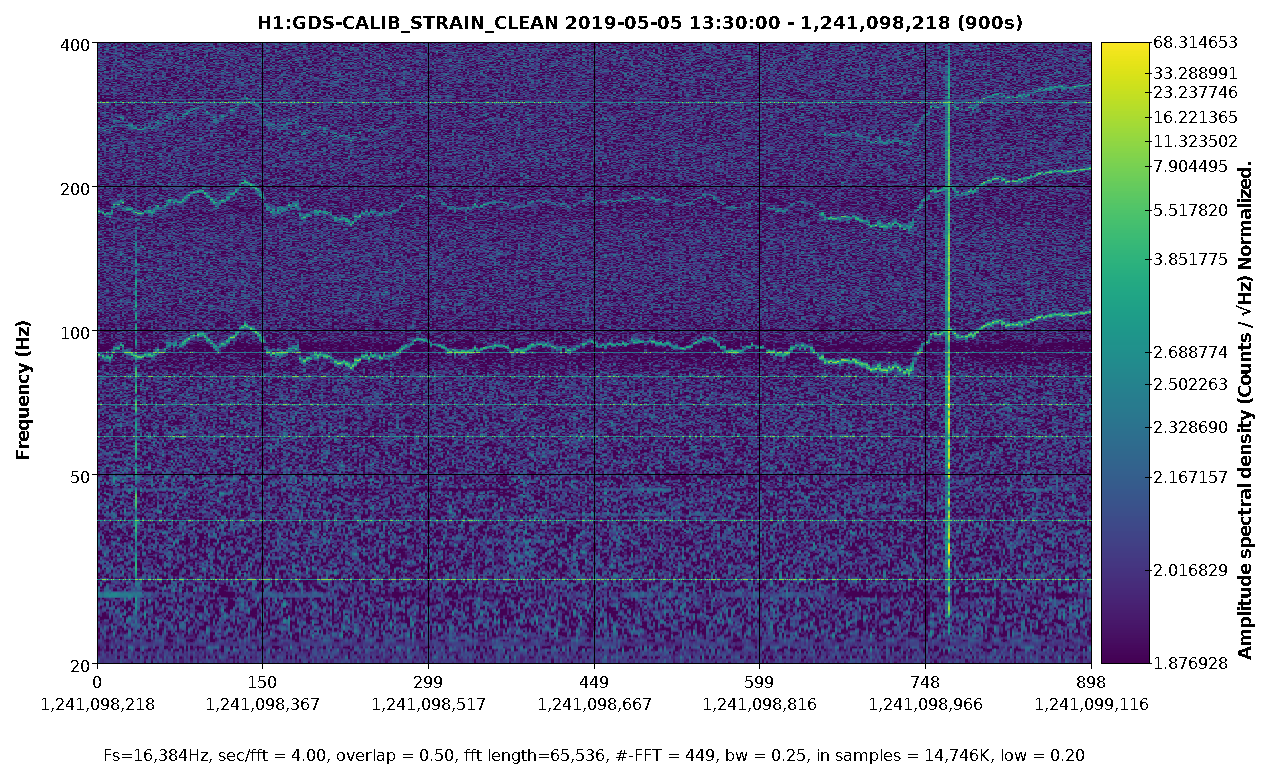
SUMMARY: Have been locked for almost 4hrs and in the last hour noticed our range slowly taking a dip in range over a 30min span (went from 112Mpc down to 102Mpc!). Cause for the dip was a noticeable line on DARM which was sweeping between 65-120Hz (along with a few of its harmonics). It's gone now.
TIME Of Event: 13:27 - 14:02utc Stopped abruptly at 14:02.
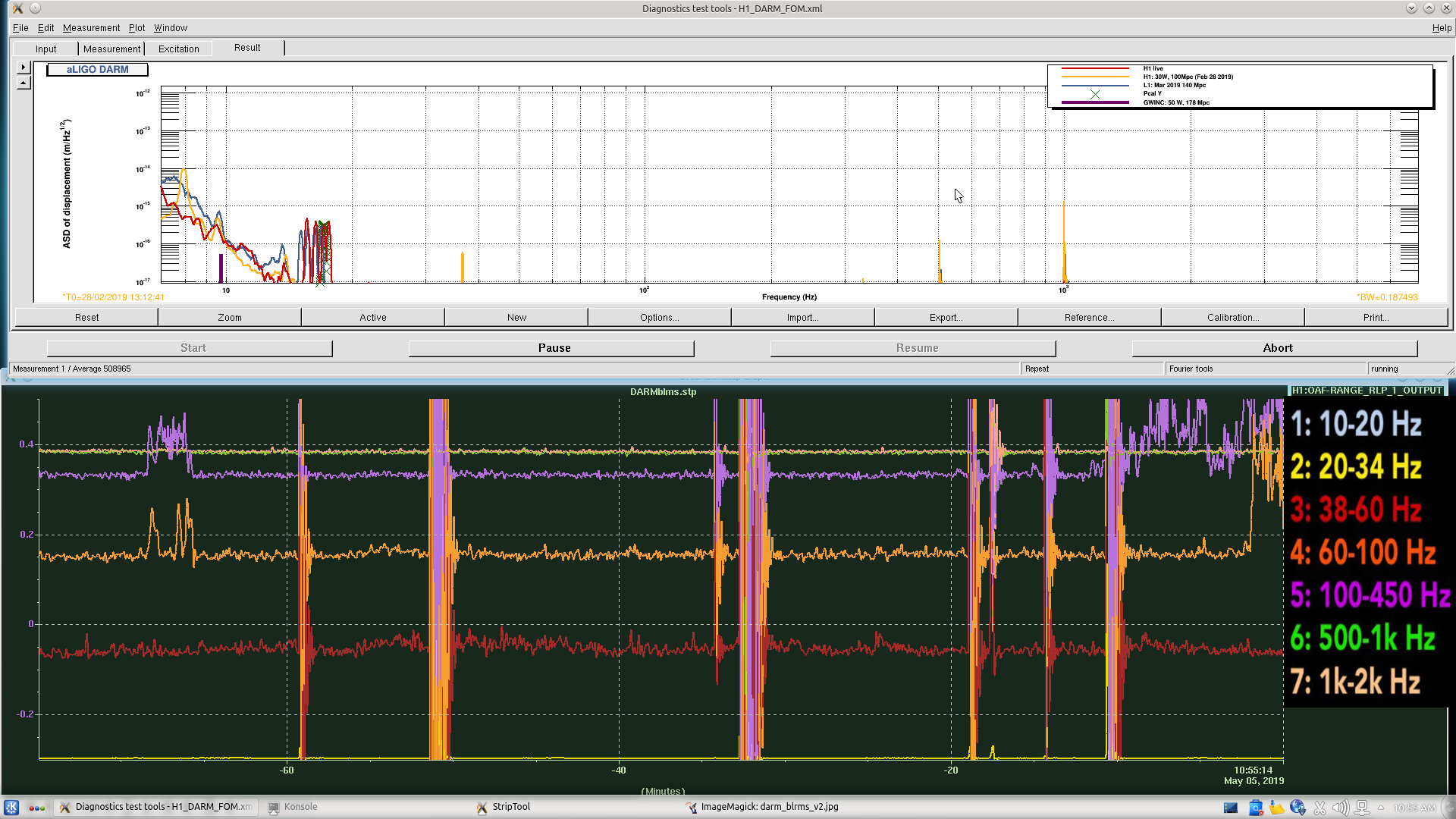
DARM BLRMS Striptool really show the effect. H1 had a normal glitch and right after the glitch the the 60-100Hz band remained elevated. 100-450Hz band would go up a little due to the harmonic, but when the fundamental swept above 100Hz, then the 100-450Hz band became the noisiest. (nuc6 Note: 100-450Hz has been off-scale on this StripTool, so I increased the vert axis and saved the file).
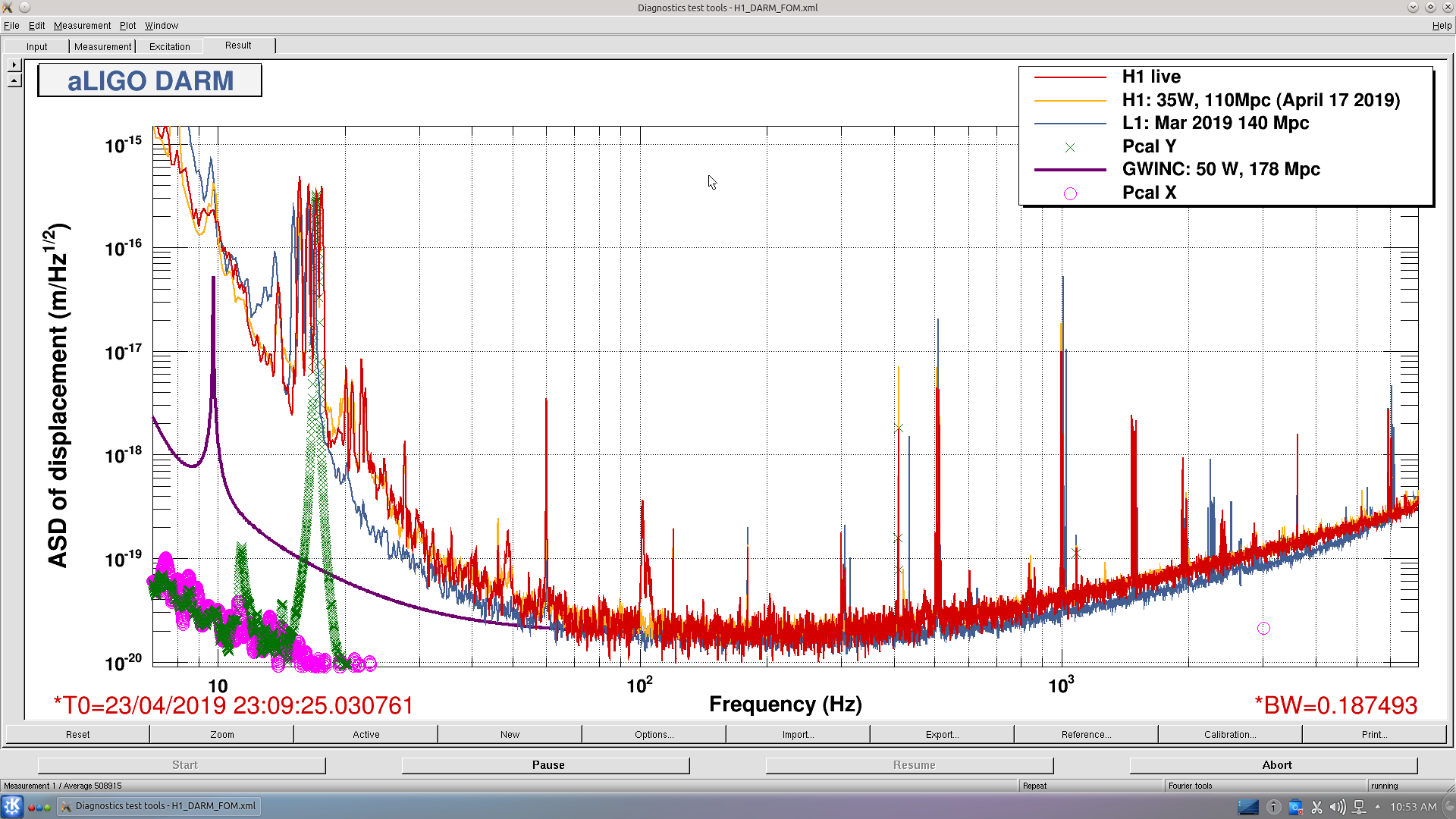
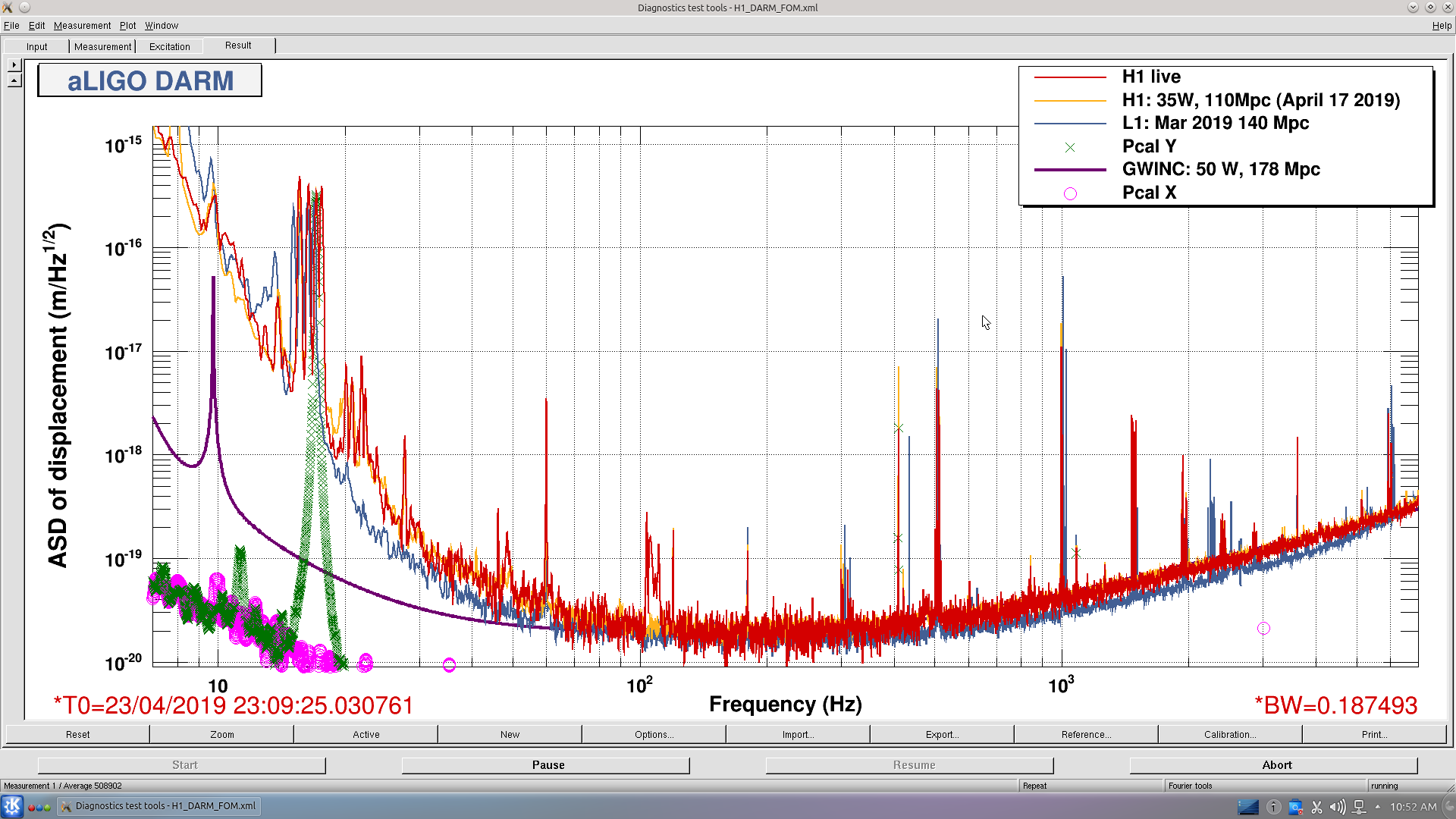
I took power spectra of a quiet time (blue) & during this noisy time (red) & you can clearly see the fundamental and it's harmonics. But like I said, it was noticeably sweeping across DARM (I seriously looked at the CDS Overview for any excitations, but everything looks green in here!).
Attached is a screenshot showing the power spectra, DARM BLRMS StripTool, & the BNS Range.
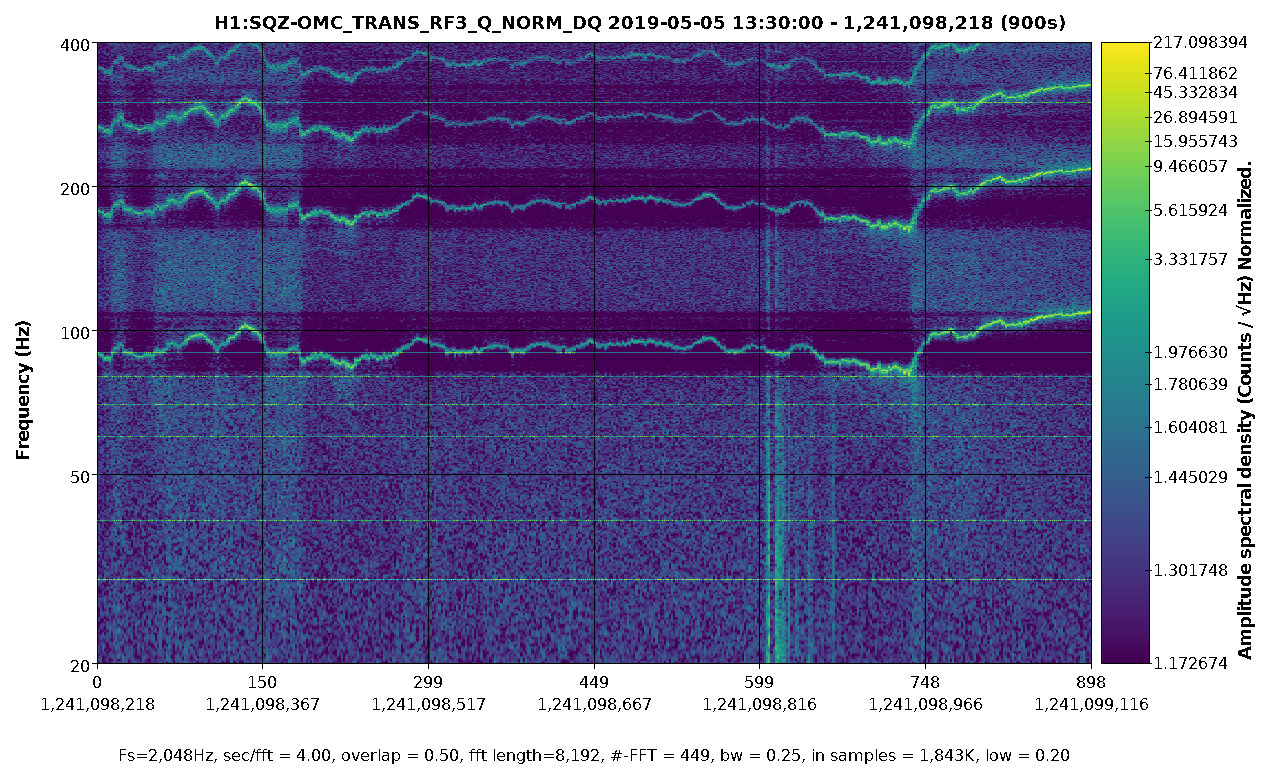
This is the squeezing wandering line again. See alog 48892. For today, h(t) and the relevant SQZ channel are shown below.
It looks like Jenne recommended that the noise eater be turned back on because the squeezer wouldn't lock (alog 48985). It's not clear whether it can be turned off when the wandering lines appear - maybe she can clarify.
Oh wow, thank you for the quick reply‘s this morning! And I agree maybe we can wait for Jenne to give us input about the Noise Eater.
I'm seeing this as well. Noise eater (squeezer) is currently ON.
Patrick was having a problem with the TTFSS on the squeezer not locking on Saturday night, so I (in the absence of other ideas) suggested turning on the noise eater to see if that would help, thinking that maybe the noise that it is supposed to suppress was a bit high, and that was causing problems for the TTFSS. Turning the noise eater on seems to have let the TTFSS lock, and Patrick was able to get back to Observe.
In hindsight, probably it would have been better to have Patrick turn the noise eater back off once the squeezer was locked.
Also, Daniel mentioned today that it's not clear that the noise eater should do anything to help the TTFSS, so maybe there was something unrelated going on? In any case, we should run with the squeezer's noise eater off (which it currently is).
SUMMARY: Wish I could say I actively curred H1's issue tonight, but all I can say is my breakfast got us back to OBSERVING after ~4hrs of being DOWN.
Below is a summary of with highlights in bold.
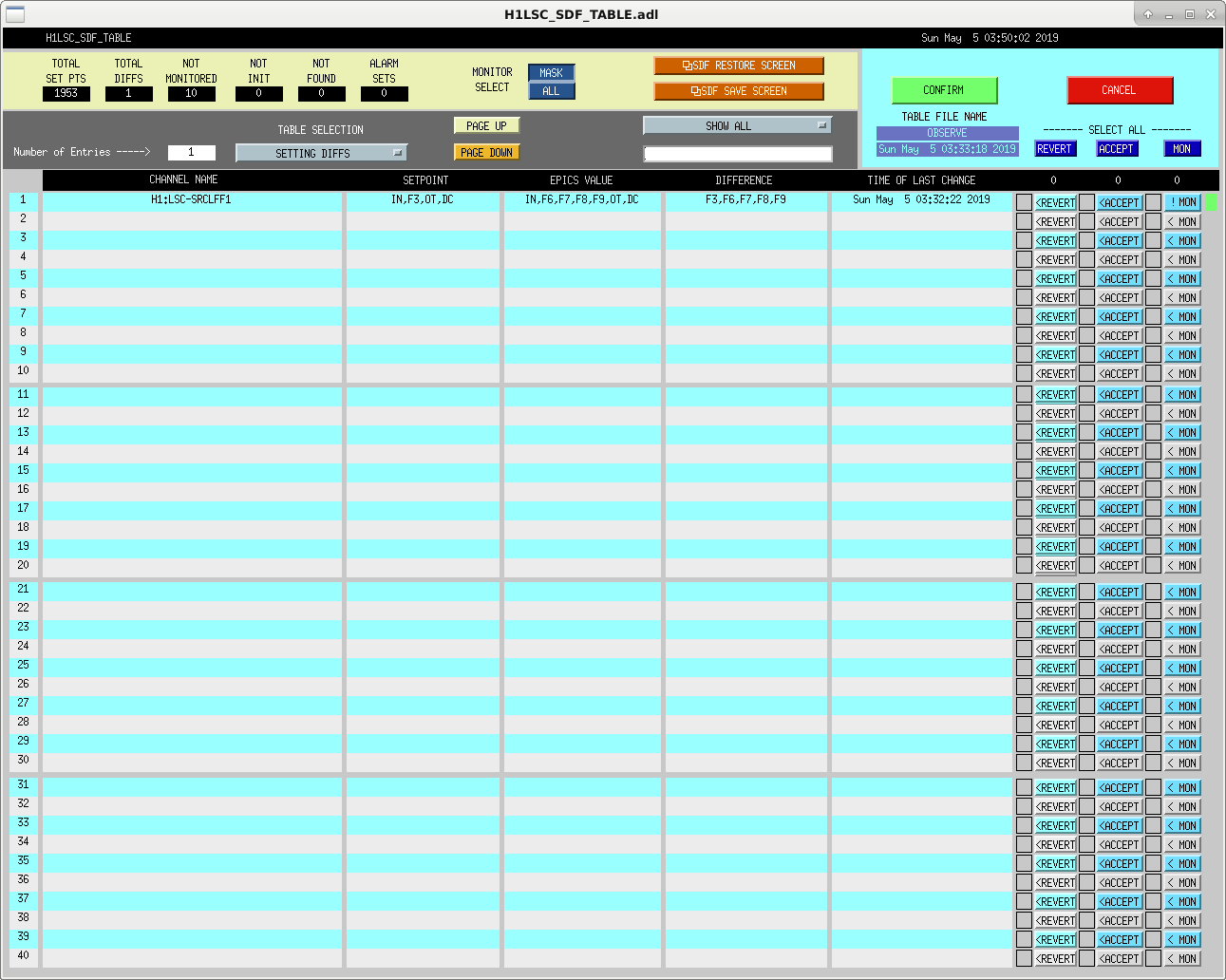
The SRCL FF is fine the way it is with the many filters engaged. On Thursday (alog 48950) I had reverted to the setup where only FM3 was engaged, since it seemed a teensy bit better, which is why Corey saw this diff. But, I had only changed the filters by hand - I forgot to change the guardian code to reflect this revert, so the next time we acquired lock, guardian turned on all of the newer filters. This isn't a much worse feedforward than using only FM3, so it's fine that we ran this way during the weekend.
To find these filter banks, go to the LSC Overview screen, then on the left side, about 2/3 of the way down the screen there is a small button called IFO_FF, as well as a little matrix next to it. Those are the feedforward settings.
Since we are unlocked for the earthquake, I reloaded the ISC_LOCK guardian to use only the Feb28 FM3 for SRCLFF, and accepted this in both the safe and observe snap files, so hopefully no diffs will come up next time we try to go to observing.