Time to start the observation run restart reports for O3. Reminder of colour scheme: red=unexpected restart, purple=restart to fix unexpected problem, green=planned restart.
Monday 01apr2019: No restarts
Tuesday 02apr2019:
2019_04_02 11:48 h1edc
2019_04_02 11:52 h1broadcast0
2019_04_02 11:52 h1dc0
2019_04_02 11:52 h1fw0
2019_04_02 11:52 h1fw1
2019_04_02 11:52 h1fw2
2019_04_02 11:52 h1nds0
2019_04_02 11:52 h1nds1
2019_04_02 11:52 h1tw0
2019_04_02 11:52 h1tw1
2019_04_02 11:52 h1tw3
2019_04_02 12:03 h1guardian1
Maintenance day, installed external edcu for first time (h1edc), DAQ restart for this and Beckhoff slow controls work. Rebooted guardian machine to commence O3 from clean restart.
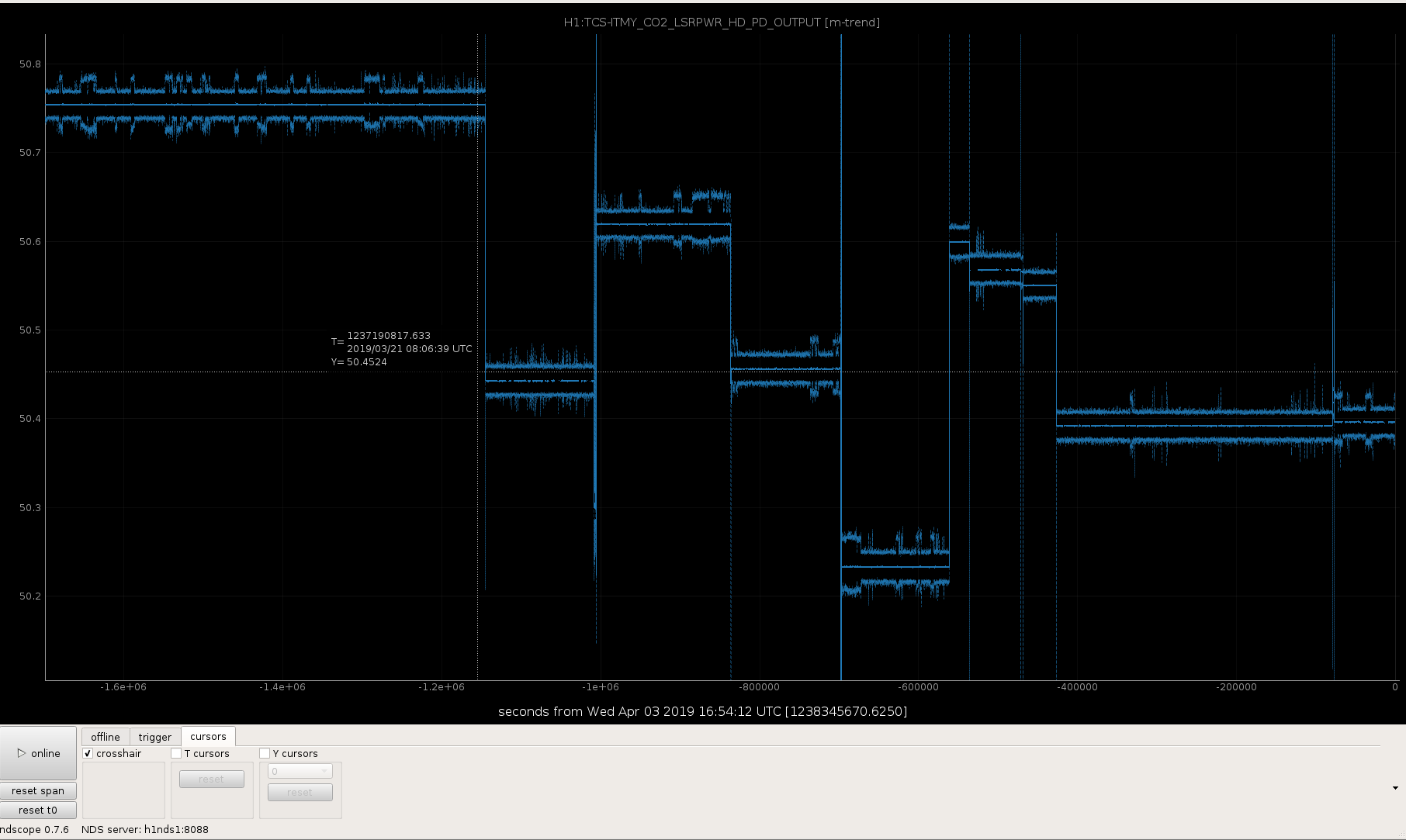
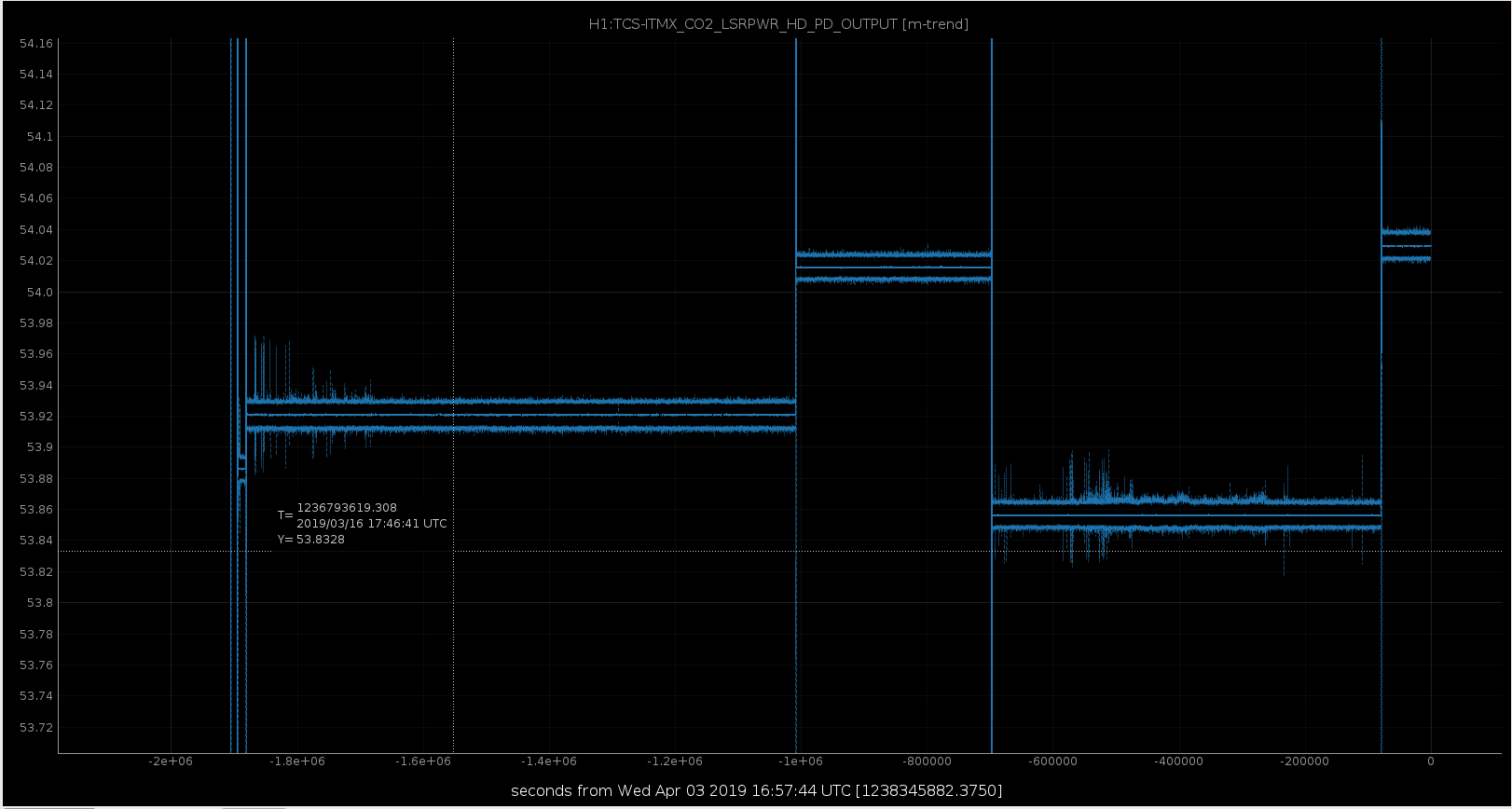
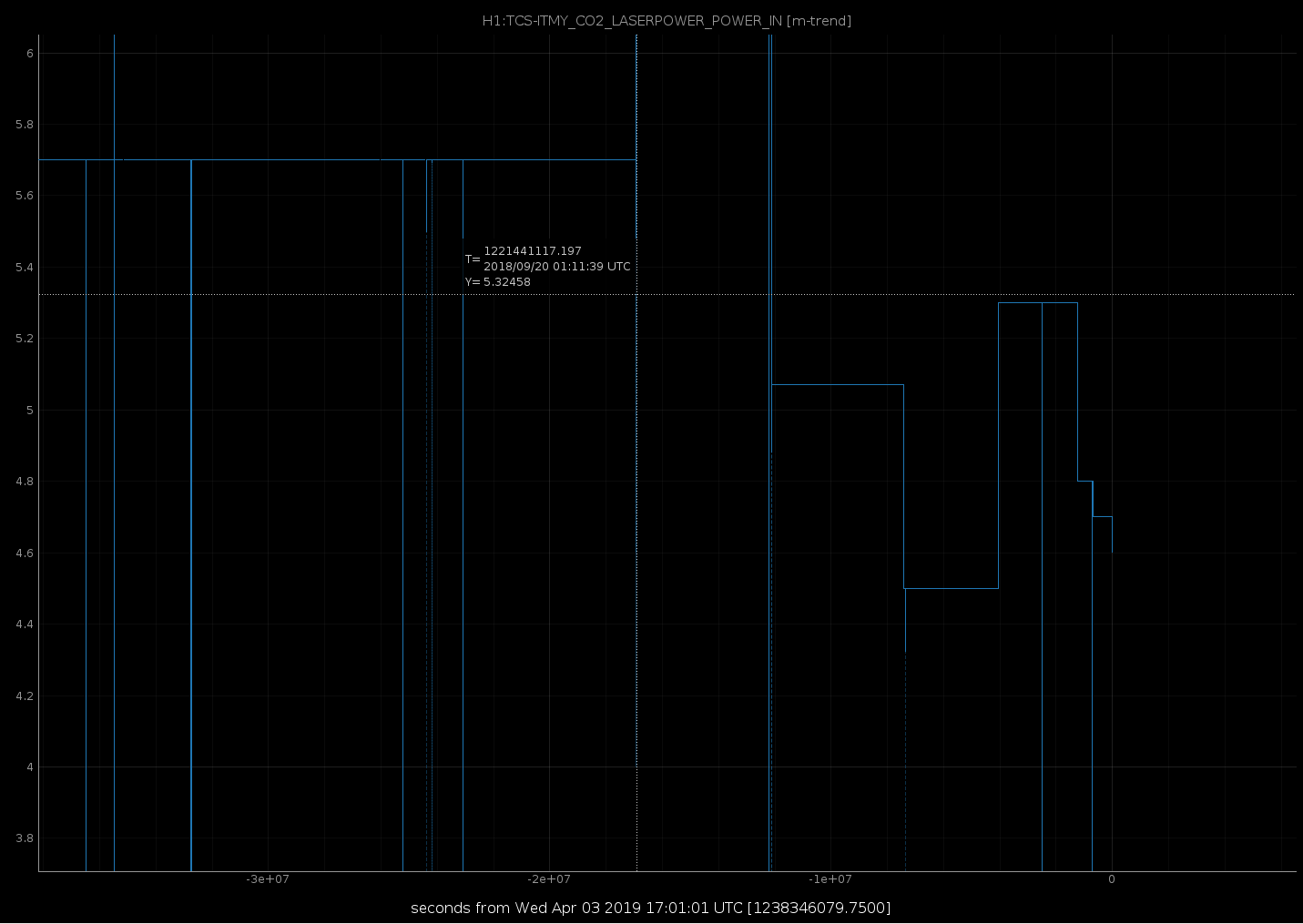
The power guardian couldn't get to the requested power, this is normally solved by slightly adjusting the "power in" (H1:TCS-ITMY_CO2_LASERPOWER_POWER_IN) in the calibration. I changed this from 4.7 to 4.6
I'm not sure why we have to change this as frequently as we do. X hasn't been changed since Aug 2018, where as Y was changed on: March 26, 20, Feb 16, Jan 7. I thought that the laser power maybe changing more for the Y, but this doesn't seem to be the case either. I worry that something on table is changing causing the power in to be different.
16:34UTC Lockloss occurred. Under Jeff K's advisement I will lock ALS and turn of BRSY for this activity.
Operators at Virgo and LLO were informed in the TS channel via voice and text.
Sheila would like to try locking despite the work going on.
M. Wade
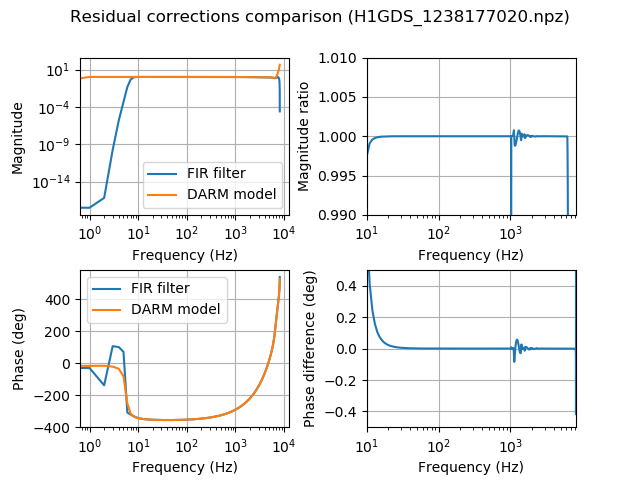
I made new GDS calibraiton filters based off of the currently running O3 calibration model. The new filters use the following parameters file (discussed in 48130):
trunk/Runs/O3/H1/params/modelparams_H1_20190401_ER14_095A.py
The new filters are located in
trunk/Runs/O3/GDSFilters/H1GDS_1238177020.npz
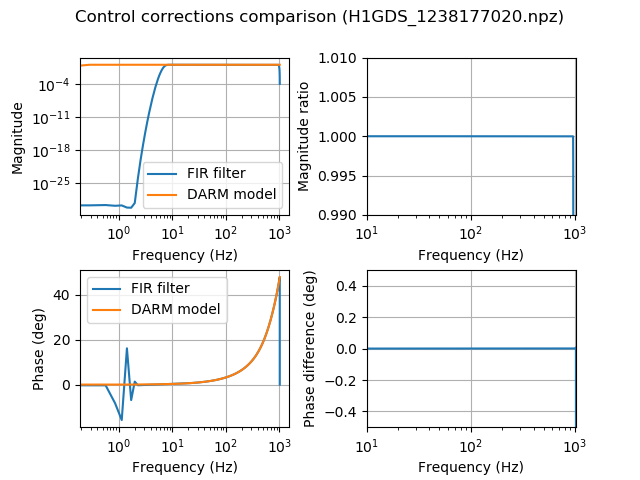
I'm not fully happy with these filters yet, because, while the filters themselves are self-consistent with their underlying models (see first two attached plots), using these filters to calibrate some data results in h(t) that is inconsistent with the overall response function in pyDARM at the expected level. As a reminder, the GDS calibration pipeline ingests the CAL-DELTAL_RESIDUAL and CAL-DELTAL_CTRL* channels, applies corrections to these channels (which are the filters referred to here), nominally also computes and applies time-dependent correction factors to the calibration (but the application of these factors is turned off at the moment), and then combines these products to form h(t).
The tests I have performed on these filters involved calibrating data (offline, using the new filters) during observing time from yesterday (GPS times 1238246061-1238246561). I then took the transfer function of h(t) to DARM_ERR to find the response function from this data and compared this to the response function from pyDARM. The third attached plot shows the results of this test. I've also attached a plot (fourth plot) of the ratio of the ASD from the GDS data calibrated with these new filters and the ASD from CALCS data at the relevant time. This ratio of ASDs shows that the new filters will result in a worse agreement to CALCS than what is currently running (see summary pages from today). I'm currently digging into both of these issues (1 - why the response function derived from GDS data with these filters is not as expected and 2 - why we don't get *better* agreement with calcs, which is what I would expect).
TITLE: 04/03 Day Shift: 15:00-23:00 UTC (08:00-16:00 PST), all times posted in UTC
STATE of H1: Observing at 111Mpc
OUTGOING OPERATOR: Patrick
CURRENT ENVIRONMENT:
Wind: 12mph Gusts, 9mph 5min avg
Primary useism: 0.03 μm/s
Secondary useism: 0.21 μm/s
QUICK SUMMARY:
TITLE: 04/03 Owl Shift: 07:00-15:00 UTC (00:00-08:00 PST), all times posted in UTC STATE of H1: Observing at 109Mpc INCOMING OPERATOR: Ed SHIFT SUMMARY: After a long initial alignment, relocked and remained in observing. LOG: 07:25 UTC H1:LSC-TR_Y_NORM is continuously oscillating in find IR. 07:28 UTC Starting initial alignment. Adjusting ALS fiber polarization. 07:35 UTC Giving up on fiber polarization. Can not get less than 20%. Had trouble with Y arm green alignment, but got it to initial alignment after adjustments to ETMY and TMSY. 08:36 UTC Done initial alignment. 09:18 UTC Observing. 14:24 UTC Karen driving to VPW.
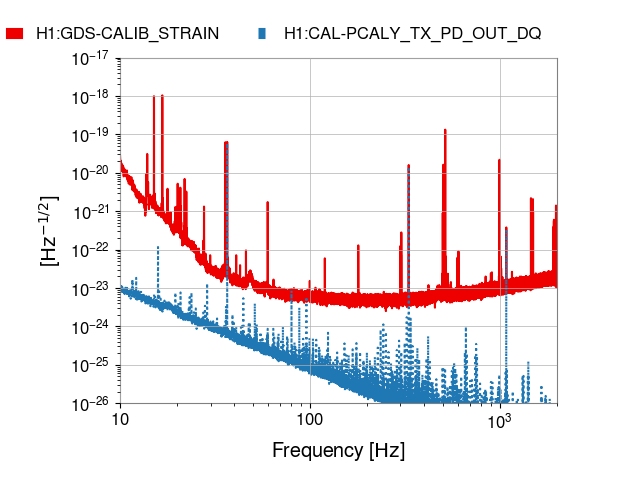
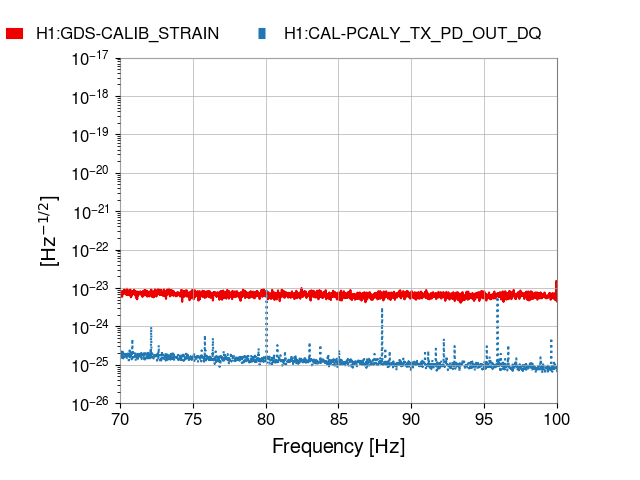
Summary: Pcal Y seems to have a bad comb structure that is likely producing contaminating lines in h(t). The behavior of this Pcal is not similar to Pcal X or either of LLO's Pcals. I urgently suggest a check is done on H1 Pcal Y to remedy the situation. Details: I was concerned that H1 low-frequency spectrum is so much more contaminated with lines than L1, so I started looking at some easy to check things, like the Pcal. Looking at summary pages, you see things like Figure 1 H1 Pcal Y. Compare that with figure 2 (H1 Pcal Y) or 3 and 4 (L1 Pcal X and Pcal Y). Comparing H1 Pcal Y spectrum to GDS-CALIB_STRAIN, I find that many lines are very close to the noise floor. This is very concerning for long duration searches (CW and Stochastic). Figure 5 is a broad band spectrum comparison Figure 6 is a zoom on 10 - 200 Hz Figure 7 is a zoom on 70 - 100 Hz I don't think this is due to clipping on Pcal periscope because this is on the transmission module PD (so, light that actually reaches the ETM). I hope it is not that hard to solve this issue.
J. Kissel for R. Savage & N. Lecoeuche In fact, this problem has been going on for quite some time now: see for example its first discovery LHO aLOG 47372 and FRS Ticket 12491. We think this is indicative of the PCAL Y laser heading out to the pasture. An attempt to reduce the non-linear intensity noise was made on March 11 (see LHO aLOG 47444). Rick and team will be going down to the Y end station today to attempt to address the issue. We were hoping that a tune-up will help, but we have several back-up options: (1) The optical plant is much more stable than it used to be, and specifically the optical spring is stable, and a factor of 2 lower frequency than it in O2. Thus, we can consider turning off the 7.93 Hz calibration line. (2) Further, there have been some R&D efforts in the LSC to monitor the optical spring with the higher-frequency actuator reference line (currently at ~35 Hz), see appendix A of T1700106. (3) Finally, we can also divert to using the X-end pcal system, but that will take a good bit of effort "transferring" the standard through measurement, and our measurement analysis code will likely be confused for a day or three while we figure out where all the hidden sign bugs are. (Examples of us clearing out the bugs include 48131 and 47574)
@Jeff, Rick, and Niko, thanks for working on this quickly! Hopefully it can be resolved fast so that groups don't have to reject too much data. I wonder if some contamination might also be linked to Pep's study on bi-linear couplings (see LHO aLOG 48161). It might also be worth checking the Pcal spectrum to see if the noise seen in Pep's study is linked to this as well. Maybe that also will further clean up the Pcal PD spectrum...?
Mostly fixed by hardware adjustments on the Y-end Pcal (see LHO aLOG 48206). We should keep a watchful eye on this during O3.
In observing since 09:17 UTC. Microseism has continued to trend down. I forgot to set the gain for damping ETMX violin mode 9 at the beginning of the lock. Just did so.
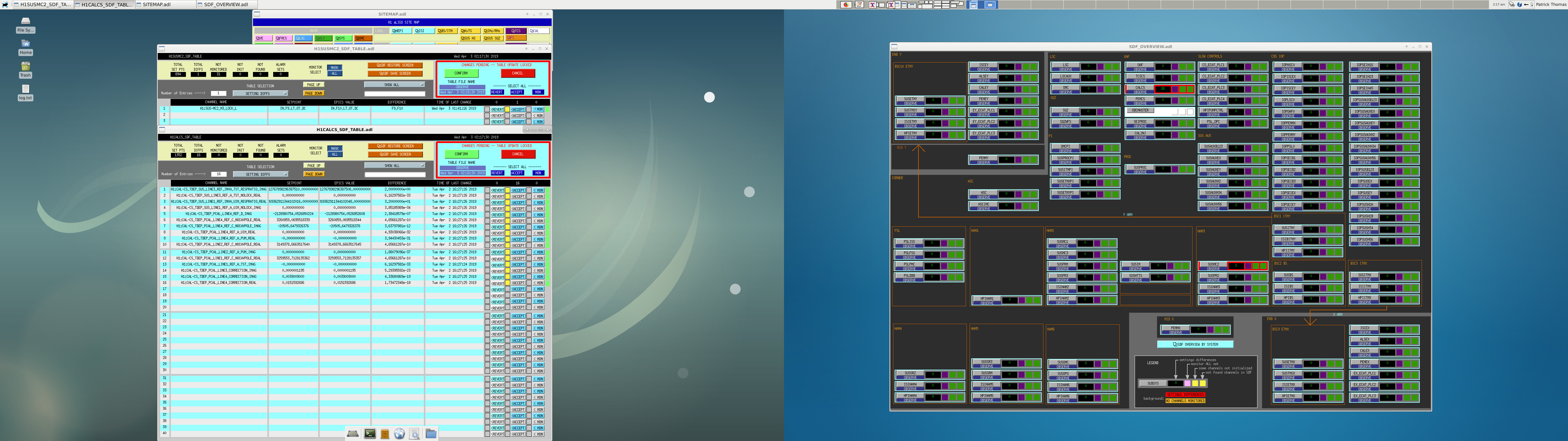
09:17 UTC Observing Accepted the unknown attached SDF differences.
TITLE: 04/03 Owl Shift: 07:00-15:00 UTC (00:00-08:00 PST), all times posted in UTC
STATE of H1: Aligning
OUTGOING OPERATOR: Cheryl
CURRENT ENVIRONMENT:
Wind: 7mph Gusts, 6mph 5min avg
Primary useism: 0.02 μm/s
Secondary useism: 0.26 μm/s
QUICK SUMMARY:
Running initial alignment.
TITLE: 04/03 Eve Shift: 23:00-07:00 UTC (16:00-00:00 PST), all times posted in UTC
STATE of H1: Lock Acquisition
INCOMING OPERATOR: Patrick
SHIFT SUMMARY: locked for around 6 hours
LOG:
There was a break in Observe due to Operator caused channel display in SDF.
Attached are some spectra of the CLF/LO error and control signals.
For the CLF the error signal is limited by slew rate problems below 500 Hz, and the control signal and the RF6_I channel are limited by slew rate and digitization noise below 50 Hz, respectively. The black curve was measured with 16 dB more fast gain, indicating that the ugf is around 1 kHz at the nominal gain setting.
The LO signals suffer from a similar misery. The error signal is mostly worthless. The control signal and the OMC_TRANS_RF3_I look reasonable down to ~20 Hz and ~70 Hz, respectively.
We should apply the same fix as we did for the IMC/REFL_SERVO boards.
[Jenne, Keita]
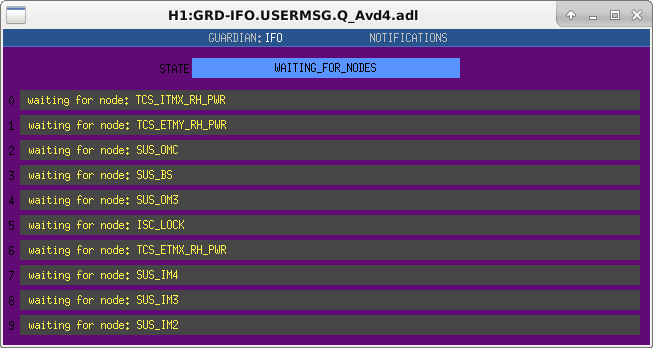
When we had arrived at NomLowNoise, we had lots of notifications that sub guardians weren't in their nominal states. It turns out that guardians that aren't regularly touched during the lock acquisition sequence (like many of the auxiliary suspensions) had come back from the guardian reboot with the request set to the NONE state, although the actual state was in the nominal (ex. suspensions were actually aligned, but the request was none, so the guardian wasn't reporting OK). I manually requested the nominal state for everything in the notification list (first several of which are in the attached screenshot).
To help speed up this process, there is a SUS_CONFIG node. This node can put all suspensions to ALIGNED, or just corner sus's, etc.
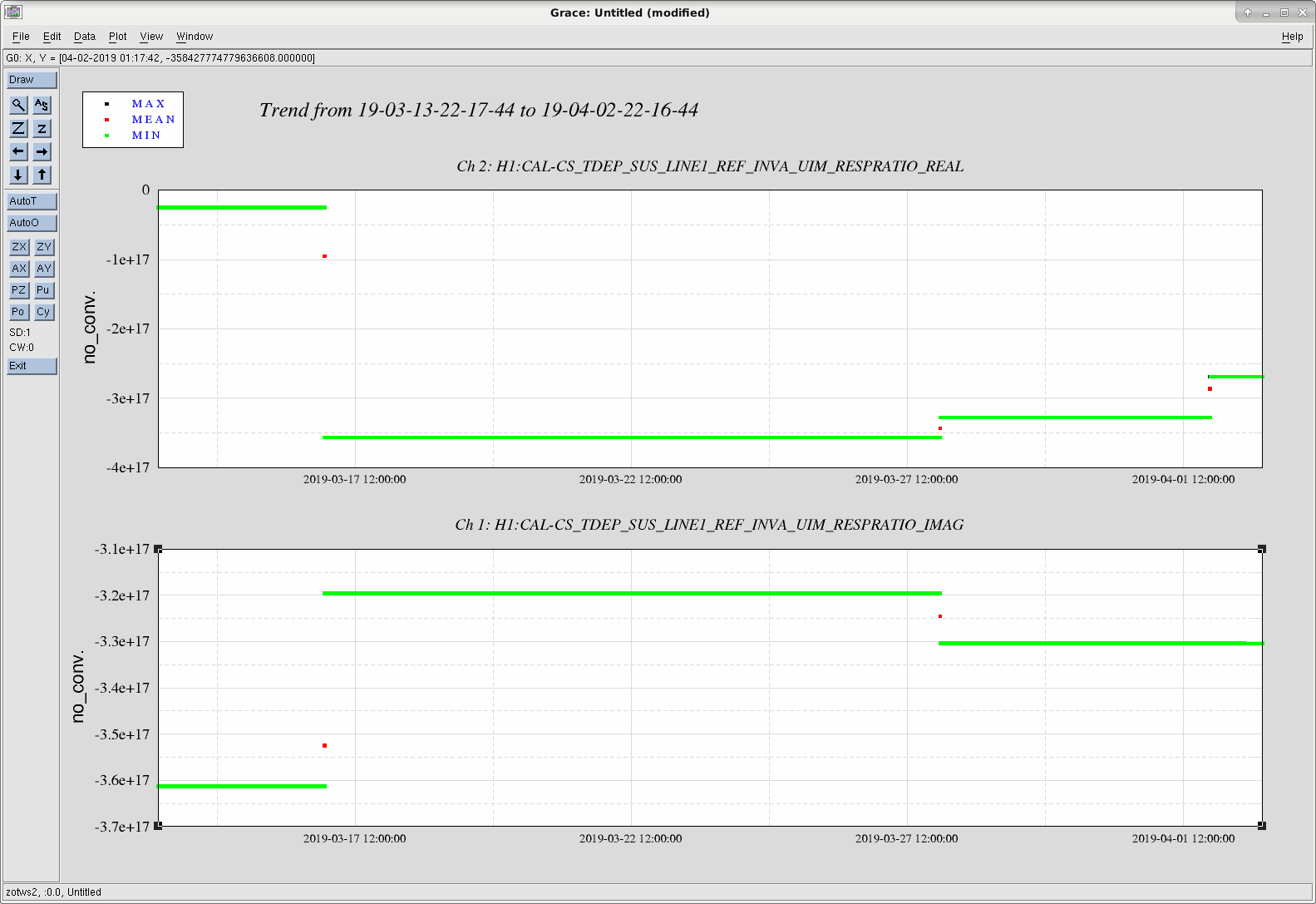
After lots more digging and checking of calculations, I discovered that the problem with kappa_UIM from yesterday (see alog 48129) was just that the EPICS record for the calculation of that kappa wasn't actually written to the front end system properly. The summary is that with the fix of the time slip of the replica oscillators, and pushing the updated EPICS values, all of our kappas should come out sensible starting with our next lock. If needed, one could re-create our kappa_UIM for yesterday's locks using the correct epics value from the .txt file that is created when the write was attempted.
In the attached screenshot you can see the real and imaginary parts of this epics record, and several steps when we've been updating the calibration epics records over the last few weeks. However, you can see that when we pushed things again yesterday, the real part of this one changed, but the matching imaginary part did not see a matching step change.
I have now added a checking functionality to the writeEPICS function that is used to actually set these epics values in the front end. After it has tried to do the epics write, it sleeps for 1 second, then reads each epics value and compares that to the value it wanted to write. If the ratio of those values is not equal to 1, it will print an error to the terminal.
If I use the correct value that should have been in there yesterday and hand-calculate kappa_UIM, I get a value of 1.03, which is a perfectly sensible value (especially since the other 2 stages have kappas around 1.05). If the GDS pipeline reads the reference values from the .txt file that is saved, they would have gotten the correct value, and should have calculated the correct values for the kappas. However if GDS reads from the front end epics values, they would have picked up the wrong value and would also have seen poor calculated values for kappa_UIM at LHO.
As for this few percent discrepancy, one thing we've been wondering is why the actuator strengths are different from the reference values (i.e., why are the kappas not all unity?). Earlier today I calculated the kappa values for the actuator assuming that the sensing function and open loop gain are time-independent (not a valid assumption, but was part of finding the epics write error). By making this assumption, I only need to use the measured data from the suspension demodulation line, and don't use the measured data from the Pcal demodulation line. When doing this, I calculate kappa values of 1.005, 1.002, and 0.98 for tst, pum, and uim, respectively. So, that must mean that some of the extra discrepancy from the reference time (reported values of 1.05 rather than 1.005, for example with the test mass) must be coming in from the pcal demodulation measurement.
There are 2 assumptions that we make when calculating these kappa values: That the actuation function of the photon calibrator does not change with time, and that the slope of the response function also does not change with time. This second assumption probably is less important if the pcal and sus lines are close in frequency (as they are for LHO's test mass, and as they are for all of LLO's lines), but our PUM and UIM suspension lines are ~20 Hz lower than the Pcal line. We should check both of these assumptions to see how they may have changed since the reference time.
Looking at the IFO plant between 2019-03-31 measurement and 2019-03-27 measurement, we see changes of the order of ~10%. For example, the values of DARM_IN1/PCAL in the transfer function measurments,
/ligo/svncommon/CalSVN/aligocalibration/trunk/Runs/O3/H1/Measurements/FullIFOSensingTFs/2019-03-31_ConCat_H1_PCAL2DARMTF_A_PCALYRX_B_DARMIN1_tf.txt
/ligo/svncommon/CalSVN/aligocalibration/trunk/Runs/O3/H1/Measurements/FullIFOActuationTFs/2019-03-27_H1SUSETMX_L2_PCAL2DARM_A_PCALYRX_B_DARMIN1_tf.txt
differ by 10% (at 36.7 Hz the ratio is 0.9 and at 331.9 Hz the ratio is 1.1). If I look at the current (today) DARM_IN1/PCAL ratios at 36.7 Hz and 331.9 Hz it matches well with 2019-03-31 measurement. So if the 2019-03-27 measurement is used for actuation function(s) estimate and 2019-03-31 measurement is used for sensing function measurement, then kappas for sensing would be okay (close to 1) but for actuation would be not one (and may be incorrect).