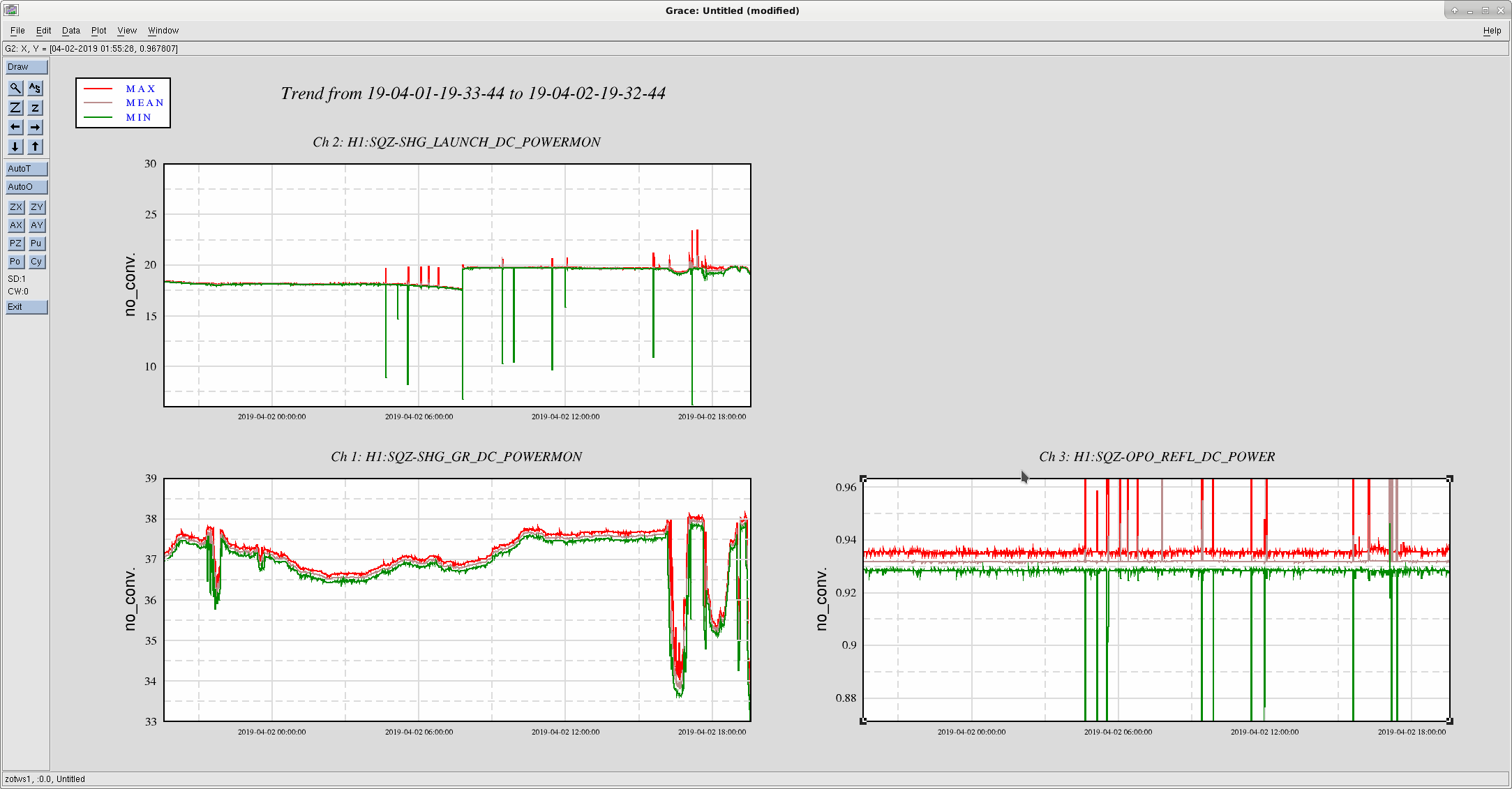
So far OPO crystal temp of 33.337C is a good place for .945 mW requested power at OPO refl when locked. The measured NLG is 2.145.
----------------------------------------------
Our laser is running multimode again. The controller has been adjusted to move away from the multimode region on March 12 (alog47481). Last time our laser tripped and this time I opened the table to clean up and take some close out photos. I wonder if the laser is some how very sensitive to temperature. For now I'm just going ot leave it and see if it will stop multimoding after the temperature has settled down. With our intensity stabilization servo on I don't think we are suffering noise wise.
To the best of my knowledge all those who were working in (l)vea's have reported clean sweeps.
During the sweep of the LVEA we moved the Input arm and output arm cranes to the proper parking spot.
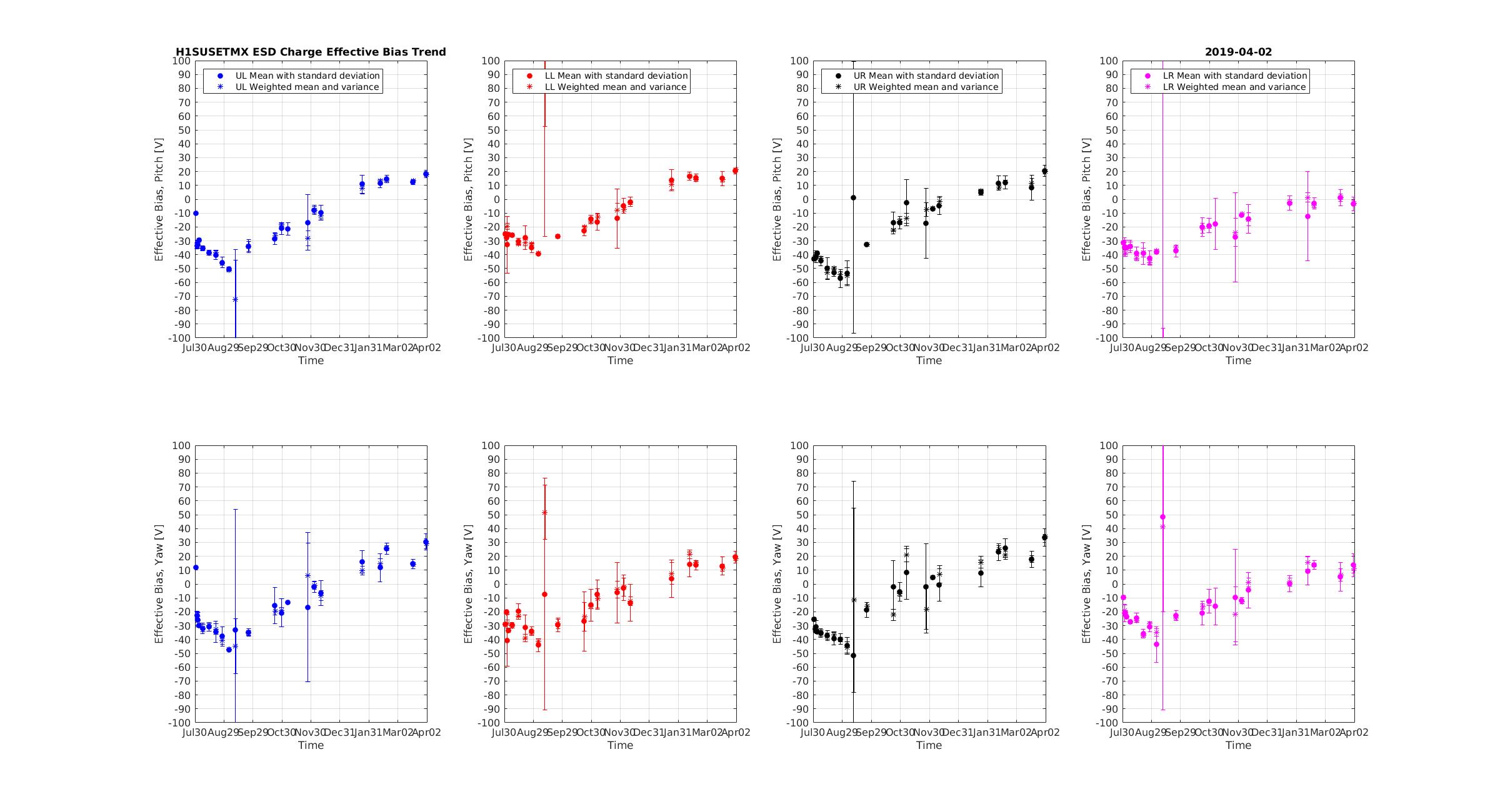
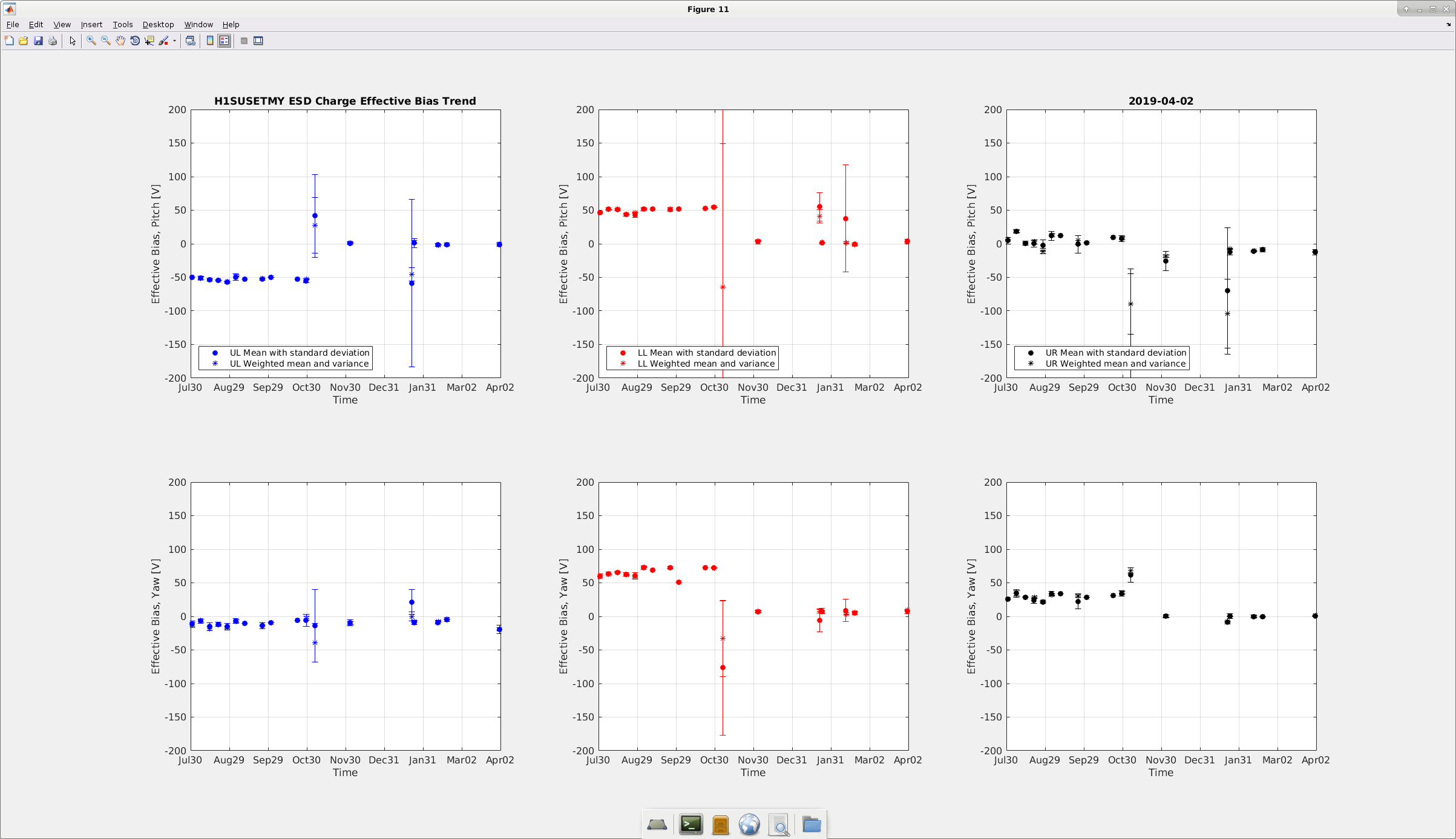
Charge measurements were performed today on the suspensions during the maintenance time and the results for the ETMX and ETMY are attached below.
For the ETMX, the effective bias (for pitch) for all 4 quadrant looks to be within +-20 V, however for the Yaw it looks to be slightly higher for the 1st and the 3rd quadrant, i.e. approximately 30V and 35V respectively. The 2nd and 4th quadrant (Yaw) is within +-20V.
For the ETMY, the effective bias for the three quadrants is within the permissible limits and trending towards zero.
After the measurements were finished, all the values were restored to it's original. The alignment sliders (for both ETMX and ETMY) were set back to it's original position and the amplitude for the L3 calibration line was set back to 0.55 (only for ETMX, as ETMY was zero by default). Once again, SDF showed that the biased voltage (ETMX) was turned OFF - which I have turned it back ON.
WP 8105
Installed new UPS in the CER mezzanine. Unit was left powered off. Cabling to the CER network switch still needs to be terminated.
Looked at reported communicated issues with EX wind fence electronics, alog 48054. Looked at power, communication cabling and found no issues. Power cycling the Beckhoff hub cleared communication errors. Will monitor and possibly replace hub if issue repeats.
F. Clara, R. McCarthy, D. Sigg
The DMT Nat box (old Sun 2200) Had been successfully replaced by a new Edge Router and all connections had been tested. clossing the WP 8138
J. Oberling, E. Merilh
FSS RefCav Beam Alignment Tweak (WP 8148)
Ed tweaked the beam alignment into the FSS RefCav this morning. When we started the TPD voltage was ~3.1V, when complete the TPD was ~4.2V. This closes LHO WP 8148.
PSL Power Watchdog Reset (FAMIS 10704)
Both PSL power watchdogs were reset at 17:54 UTC (10:54 PDT). This completes FAMIS 10704.
Slow Controls Improvements:
It is now possible to turn off the end station VCOs, when they are not used. Follow these steps:
In order to turn the VCOs on again:
It is curtained off. Please do not enter this area without protective eyewear.
18:32 Squeezer Bay is now LASER SAFE
The LVEA is now LASER SAFE. There may be an issue with the paging system having been turned off. Looking into it.
The LVEA was transitioned to LASER SAFE. This is under work permit #8149. The TCSY enclosure left door was found unlocked. Situation remedied.
New Verbal alarm "Please run PEM script" caused a bit of confusion. Philippe cleared this up and had me run Do_Mag_Injection.py. This script will take ~6 min to run.
15:12 Ran Do-Mag_Injection.py script
injections finished ~15:20
TITLE: 04/02 Day Shift: 15:00-23:00 UTC (08:00-16:00 PST), all times posted in UTC
STATE of H1: Preventive Maintenance
OUTGOING OPERATOR: Patrick
CURRENT ENVIRONMENT:
Wind: 15mph Gusts, 11mph 5min avg
Primary useism: 0.06 μm/s
Secondary useism: 0.24 μm/s
QUICK SUMMARY:
Maintenance Day
ISI_CONFIG has been changed to SC_OFF_NOBRSXY
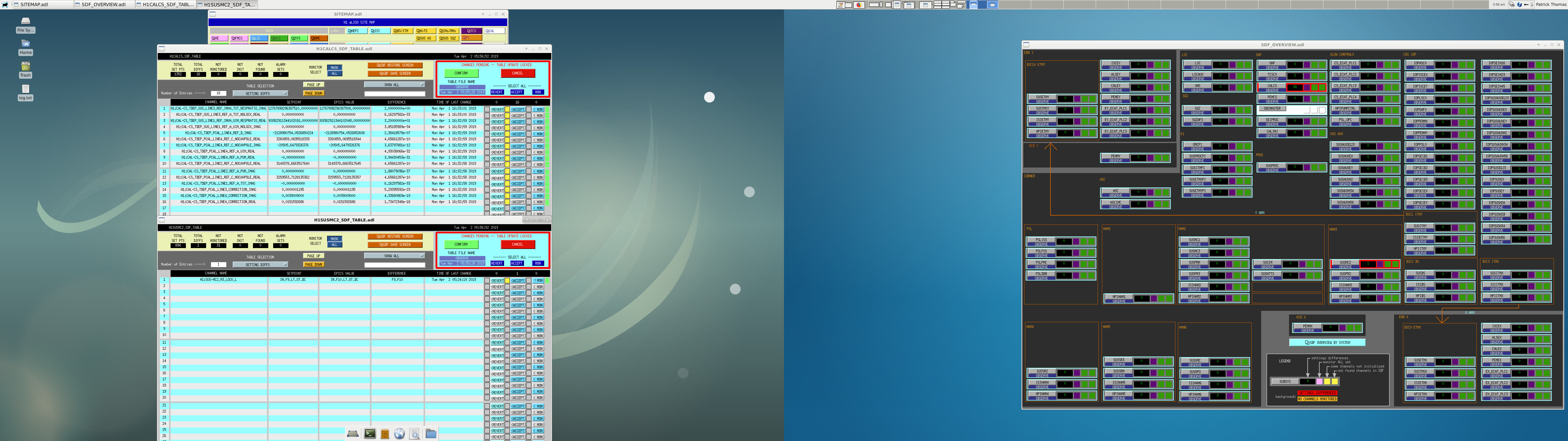
TITLE: 04/02 Owl Shift: 07:00-15:00 UTC (00:00-08:00 PST), all times posted in UTC STATE of H1: Preventive Maintenance INCOMING OPERATOR: Ed SHIFT SUMMARY: - Why do filters 9 and 10 for H1:SUS-MC2_M3_LOCK_L keep switching between each lock? (see SDF differences for each observing alog) - Why was there an SDF difference for H1:LSC-OUTPUT_MTRX_11_9? Did someone change some code during the last lock before my shift? - Why are there always SDF differences for the H1CALCS channels? - Why the trouble with the ALS X arm? LOG: 07:59 UTC Observing 09:25 UTC Lock loss. Relocking. Not getting X arm ALS to lock above ~.9. Tried clearing wfs. Tried unlocking and moving ETMX to get higher flashes. No flashes going over ~.9. Tried moving TMSX. Got higher flashes almost to 1. Set back to LOCKED_SLOW_W_GR_WFS_PUM. Locked around 1 then fell off after about ~30 sec. Moved TMSX in pitch while leaving it locked. Brought up to over 1. Moved on. Stopped at LOCK_PRMI to adjust PRM and BS. Signals look good at DRMI_LOCKED_CHECK_ASC. Moving on. 10:22 UTC Observing 10:30 - 10:47 UTC Stepped out of control room 11:27 UTC Lock loss. Relocking. More trouble with the ALS X arm transmission slowly falling, coming back, then falling again. Starting initial alignment. 12:17 UTC GRB notification (E328668). Not locked, ignoring. 12:20 UTC Done initial alignment. 12:57 UTC Observing.
12:57 UTC Observing Accepted the unknown attached SDF differences.
11:27 UTC No immediately obvious cause.
S. Dwyer, J. Driggers, J. Kissel, L. Sun,
While Sheila spent the day perusing and debugging
^/trunk/Common/pyDARM/src/
actuation.py
in hopes to find the remaining problems with the time-independent path of DELTAL EXTERNAL that continues to plague us (see LHO aLOG 48102 for the latest on that),
Lilli created a DARM loop model that replicates what works in CAL-CS,
^/trunk/Runs/O3/H1/params/
modelparams_H1_20190401_ER14_095A.py
-- see LHO aLOG 48115 for more details.
Once Jenne was convinced that the replica SUS oscillators were a major problem with the computation of the time-dependent correction factors (see LHO aLOG 48129),
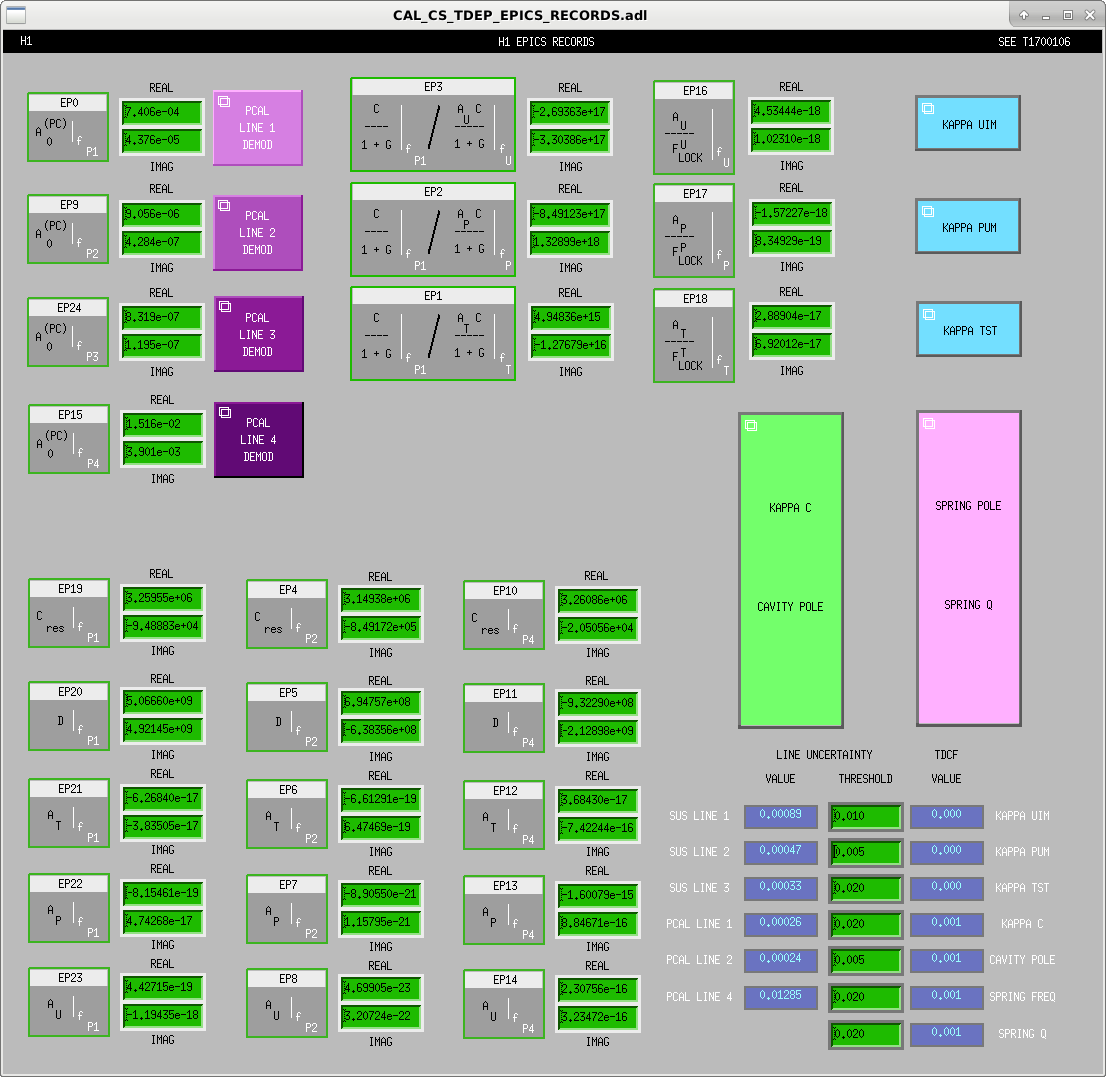
I figured that we should update the Reference Time Model Parameters at Calibration Line Frequencies a.k.a "EPICS records" in front-end such, regardless of whether things are perfect, the time-dependent correction factors are at least functional and their parameter values are close.
I generated the EPICs records with
^/trunk/Runs/O3/H1/Scripts/CALCS_FE/
createEPICS_for_20190401.py
which is calling the above mentioned model, and a few functions inside
^/trunk/Common/pyDARM/src/
computeDARM.py
which I've updated to write with 16 significant figures. ***
Attached are the results and a screenshot of the new EPICs records.
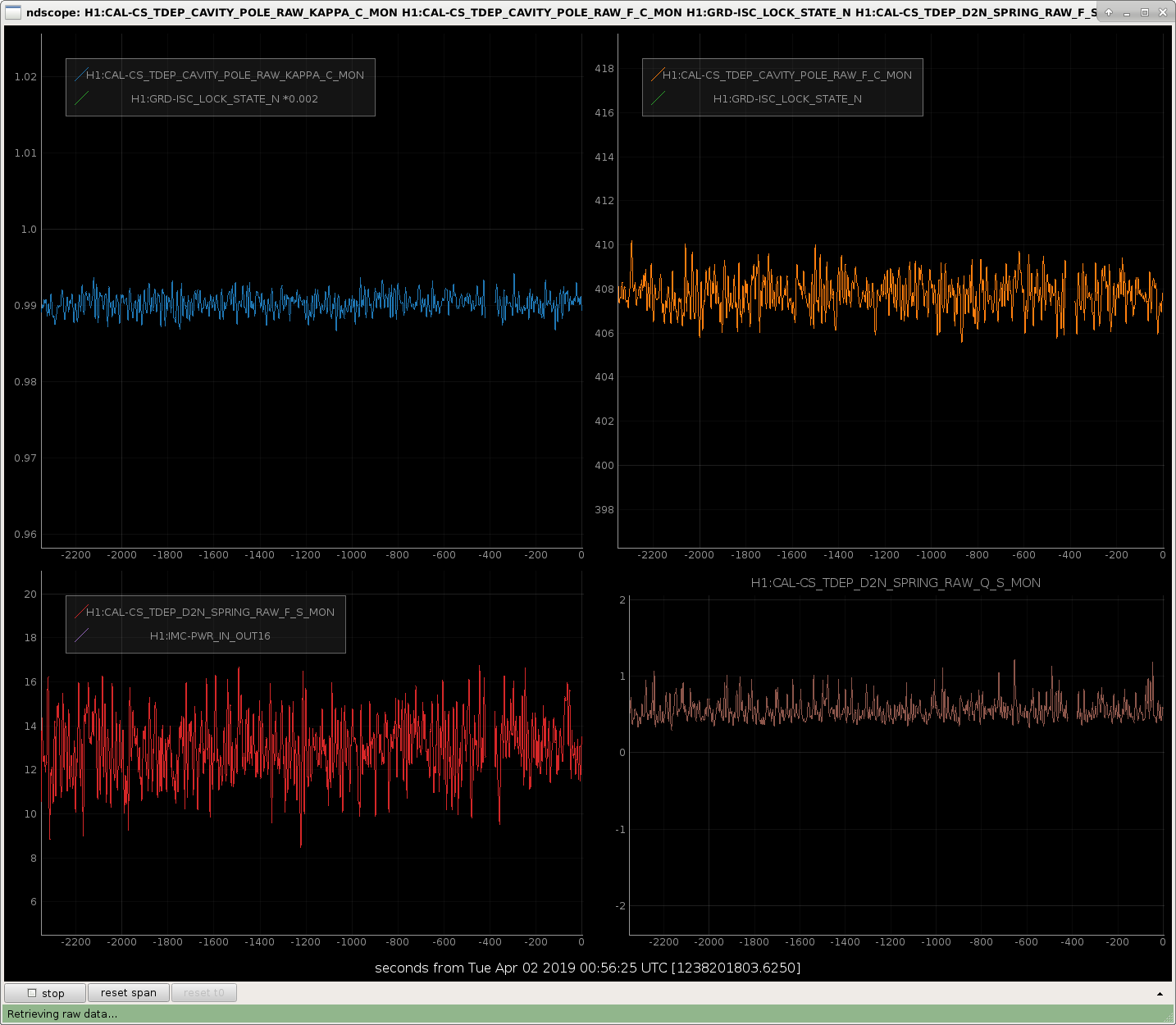
Further, I attach a time series of the time-dependent correction factors. One can see
- The values are
kappa_C = 0.99 virtually spot on with the reference model
f_cc = 404 Hz virtually spot on with the reference model
f_s = 13 Hz # bogus because calculation is for anti-spring
Q_s = 0.5 Hz # bogus because calculation is for anti-spring
kappa_T = 0.591 wrong, don't yet know why
kappa_P = 1.054 5%... coincident with what's needed to fix the PCAL2DELTAL TF? Don't understand why, could be coincidence
kappa_U = 1.051 5%... coincident with what's needed to fix the PCAL2DELTAL TF? Don't understand why, could be coincidence
- the time-series of the past 3000 seconds indicate what we've see that these TDCFs are just as stable as the IFO, confirmed by broad band injections (see LHO aLOG 48098)
These time-dependent correction factors are still not actually correcting anything, so the systematic error we claim still remains -- 1% / 5 deg. Again, see LHO aLOG 48102.
The EPICs records have been accepted into both the safe.snap and OBSERVE.snap files, and have been committed to
^/trunk/Runs/O3/H1/Results/CALCS_FE/
epicsrecords_model-H1_20190401_created-20190401.txt
*** We tried to reduce the number of significant figures of the EPICs records such that we wouldn't constantly have to battle the floating point precision comparison with SDF, this we are now writing the records to EPICS with the lines
subprocess.call(['caput',IFO+':'+chan+'_REAL','{:0.16e}'.format(chan_real)])
subprocess.call(['caput',IFO+':'+chan+'_IMAG','{:0.16e}'.format(chan_imag)])
to limit the write to EPICs to 16 significant figures, i.e. the limit of floating point precision. However, differences still have shown up when the .snap file is compared against the running values. We *can* limit the precision of these numbers further, but we want to make sure that limiting the precision on these numbers won't impact the precision of the finally computed time-dependent correction factors.
Quick correction to Jeff's alog:
In the values of kappas that he quotes, kappa_TST is near 1.05 (good), and kappa_UIM is the one that is pretty far off at 0.591.