Displaying reports 42821-42840 of 88658.Go to page Start 2138 2139 2140 2141 2142 2143 2144 2145 2146 End
Reports until 06:45, Saturday 02 March 2019
H1 CAL
aaron.viets@LIGO.ORG - posted 06:45, Saturday 02 March 2019 (47244)
GDS calibration pipelines restarted to pick up gstlal-calibration-1.2.8

[M. Wade, G. Mendell, A. Viets]

I restarted the primary and redundant GDS calibration pipelines around GPS time 1235572363 to pick up gstlal-calibration-1.2.8, which Greg installed yesterday on h1dmt0 and h1dmt2 (see LHO aLOG 47234).  Everything appears to be running normally.

H1 ISC (ISC)
craig.cahillane@LIGO.ORG - posted 04:31, Saturday 02 March 2019 - last comment - 08:36, Monday 04 March 2019(47243)
9 MHz RIN to DARM as a function of DARM offset
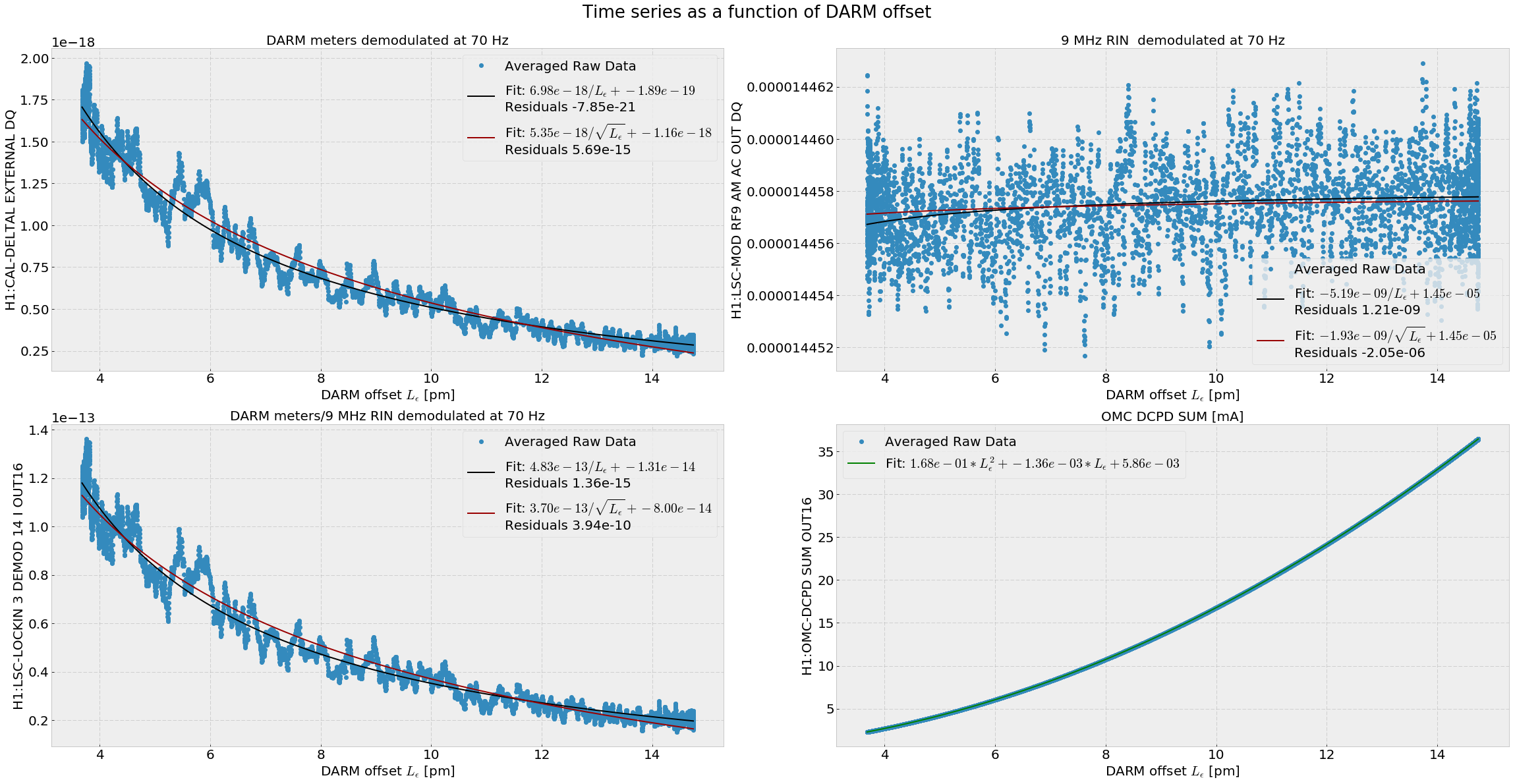
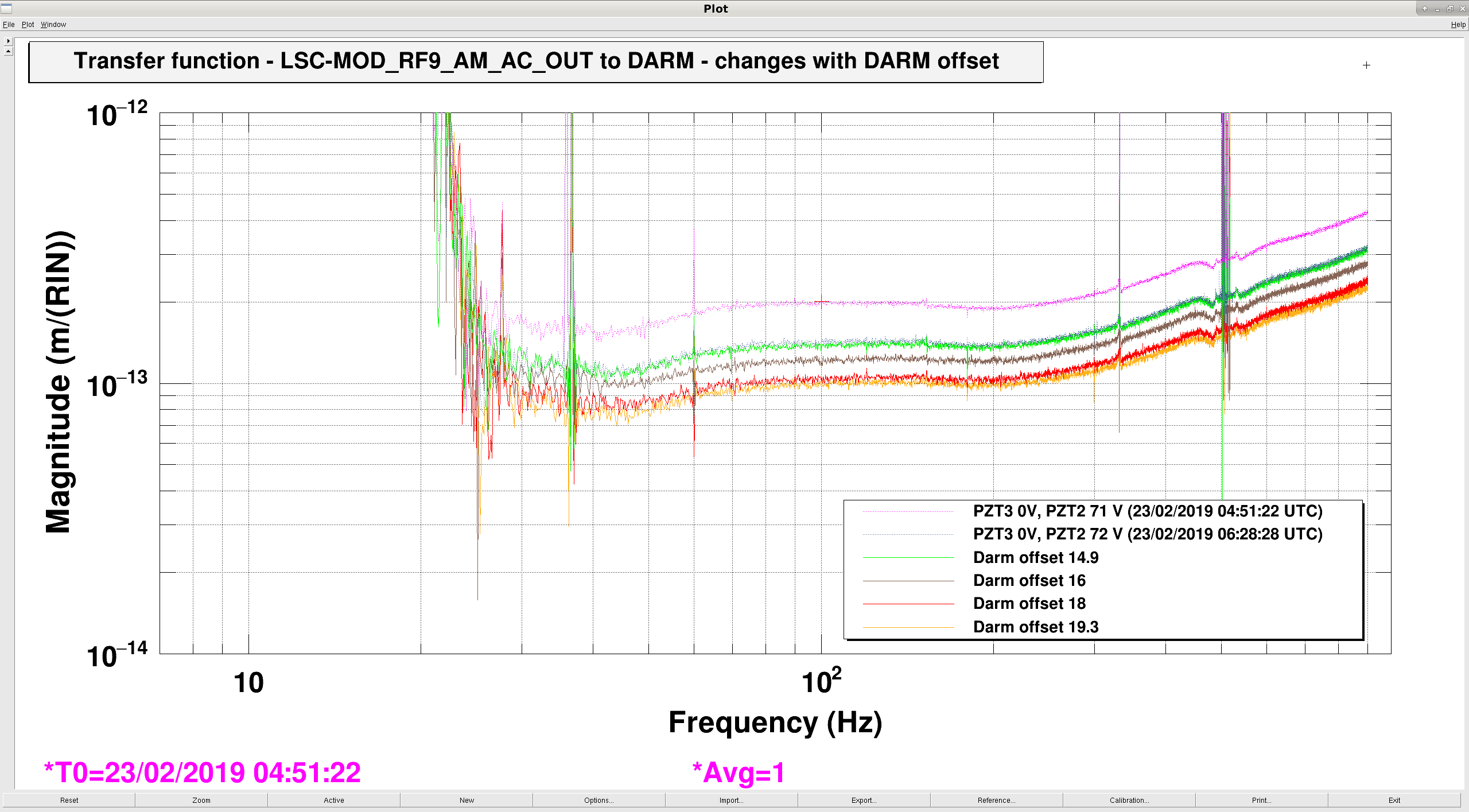
A while ago Georgia and I moved the DARM offset and found that the 9 MHz RIN to DARM coupling decreases with increasing DARM offset.
Two days ago, I swept the DARM offset from 4 pm to 14.7 pm while a 70 Hz 9 MHz RIN line was on and present in DARM.  I then demodulated the line in software, plotted it as a function of DARM offset, and compared a few models to the data.  

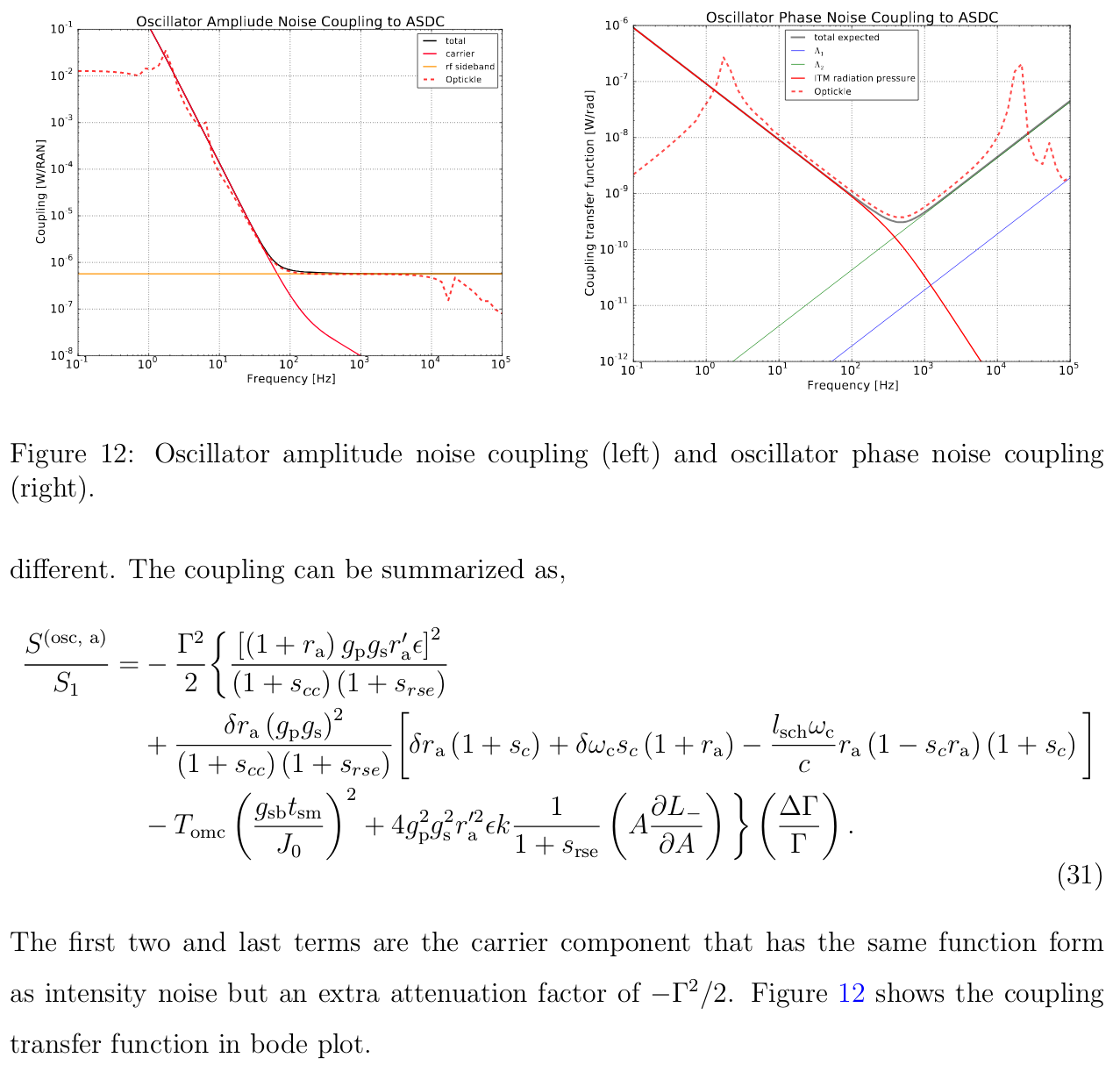
It seems that 9 MHz RIN to DARM coupling falls like 1/DARM offset.  This rules out couplings like those explained by Kiwamu in attachment 4, which increase with increased DARM offset.
Images attached to this report
Comments related to this report
gabriele.vajente@LIGO.ORG - 08:36, Monday 04 March 2019 (47262)

The 1/DARM_offset of 1/sqrt(DCPD) coupling can be explained by considering a CONSTANT amount of 9MHzHOM coupling to the DCPDs, while the optical gain scales with the offset, such that the same amount of 9MHz RIN at the DCPD is interpreted as a different noise level in m/rHz.

H1 ISC (ISC)
craig.cahillane@LIGO.ORG - posted 03:49, Saturday 02 March 2019 - last comment - 15:30, Saturday 02 March 2019(47242)
Locking notes
Dan, Alexei, Georgia, Craig

- FSS was refusing to lock after the 1 AM lockloss tonight, or losing lock soon after acquiring.  The problem went away by itself after about 30 minutes.

- Still dealing with 1 Hz ASC oscillation in full lock causing PRG and POP18 dippiness.  Likely DHARD.

- Lost lock three times at RESONANCE.  We were losing after increasing the DHARD gains.  Possible bad alignment heading into RESONANCE, I touched up the corner alignment and this help get through the fourth time.

- Lock lock from 1 Hz ASC oscillation during power up twice.
Comments related to this report
sheila.dwyer@LIGO.ORG - 15:30, Saturday 02 March 2019 (47246)

If you are still having trouble with a 1 Hz instability in DHARD P, you could try reverting the change to the DARM loop that was made yesterday.  The boost shouldn’t make DARM unstable, but DHARD does seem to be cross coupled with Darm.

The changes that Jenne and I made only happen in the state Lownoise ASC, so they would not be causing problems during power up.

If you do decide to try reverting the changes to DHARD P, you can search the guardian for “March 1” to find all the changes.

H1 ISC
craig.cahillane@LIGO.ORG - posted 01:25, Saturday 02 March 2019 - last comment - 11:58, Saturday 02 March 2019(47241)
PCAL to DARM BB Injection indicates front-end calibration overestimating range
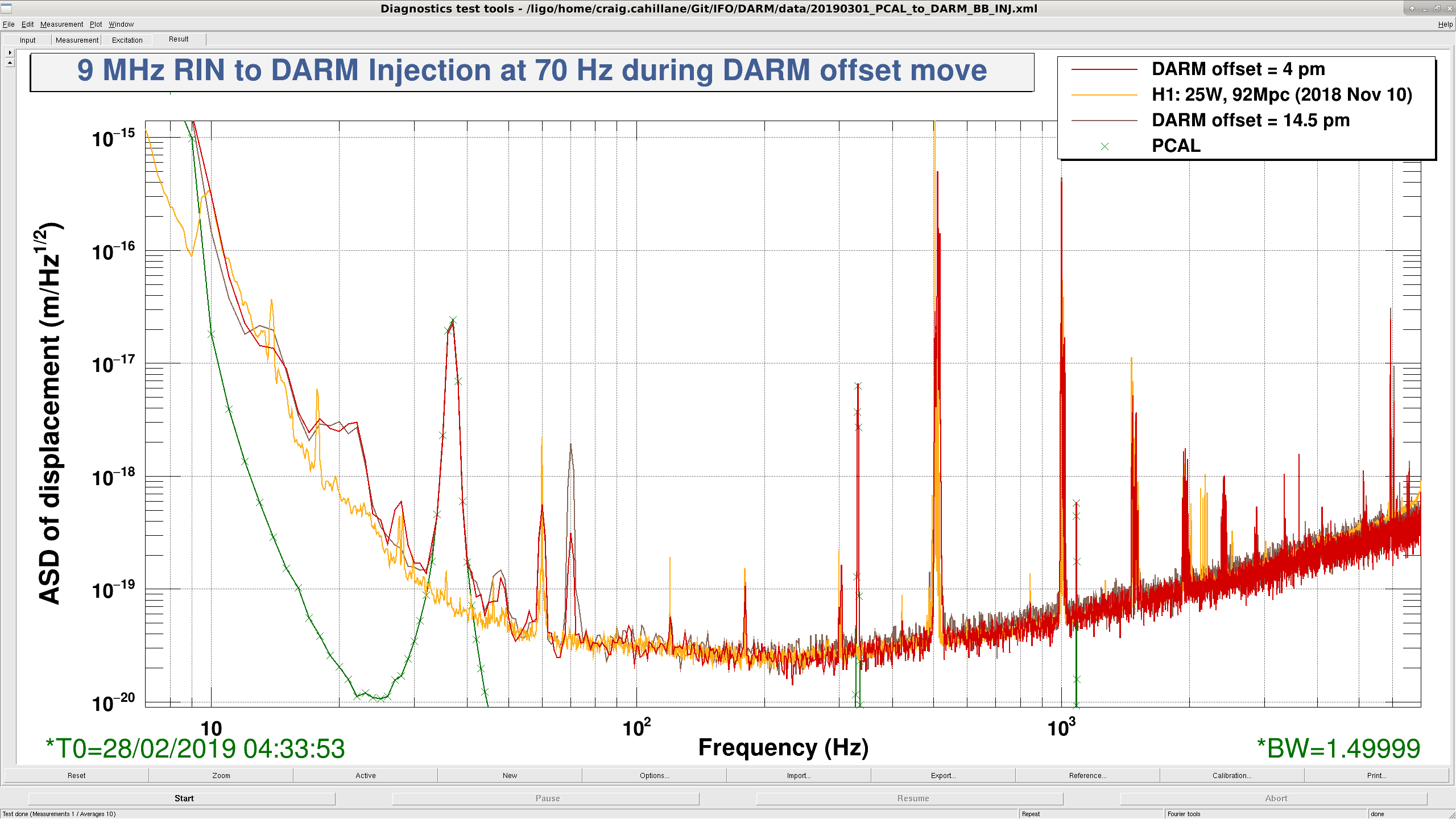
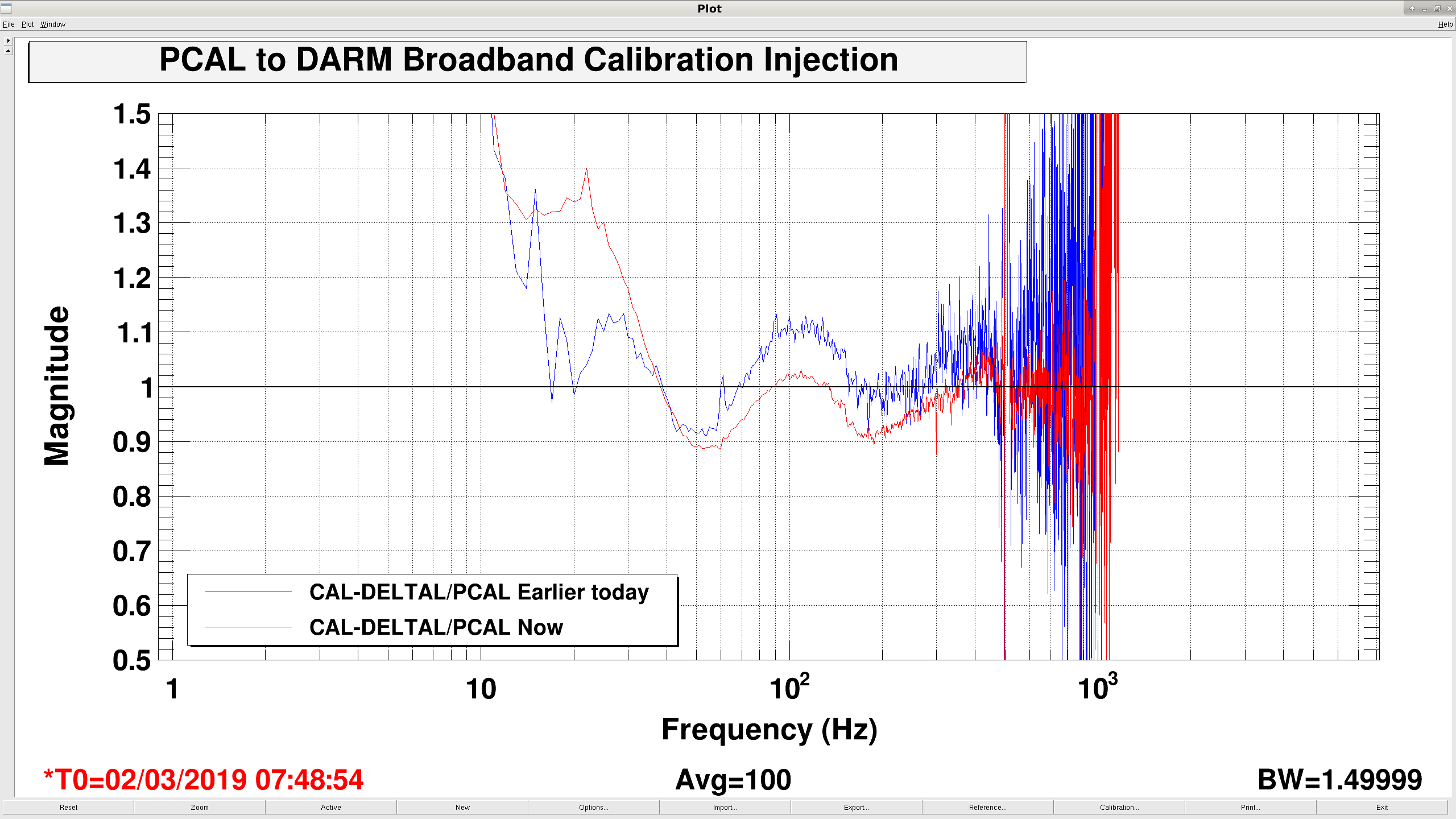
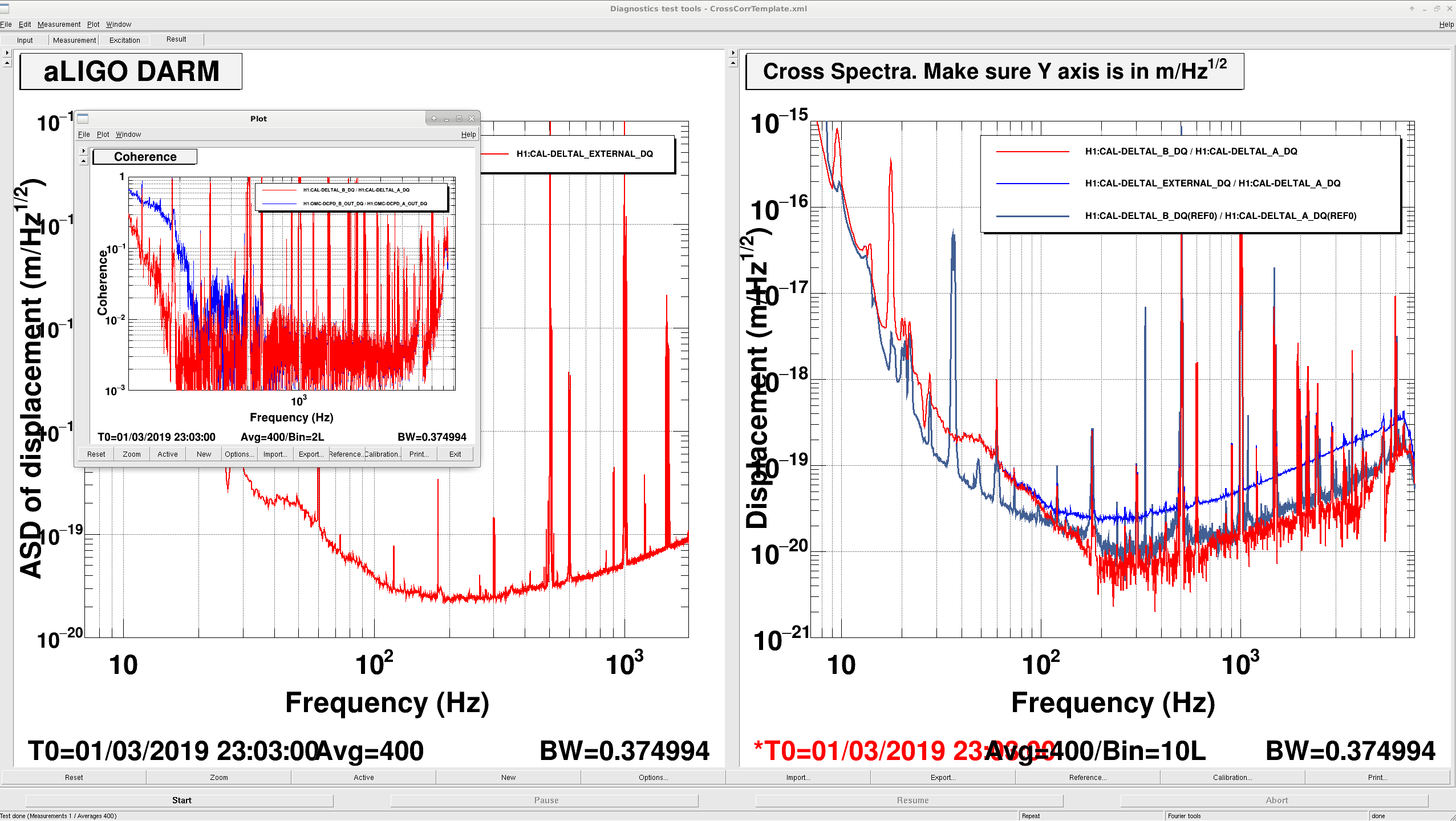
I took a PCAL to DARM broadband injection earlier this evening, and when I did I noticed that the front end CAL-DELTAL_EXTERNAL calibration was not great in the bucket.  We were underestimating DARM meters by 10% at 70 Hz.  
I spent a long time playing around with front end calibration gains in an effort to improve the front end calibration.  I was largely unsuccessful, as we lost lock before I could find a reasonable calibration.  

Things are mostly within 10% now, but still underestimating DARM meters at 70 Hz by about 8%.

The calibration from this afternoon (after Stefan played with these gains) is in red in the plot below, while the one now is in blue.  

Cal settings                           This afternoon     Now
----------------------------------------------------------------
H1:CAL-CS_DARM_ANALOG_ETMX_L1_GAIN     1                  3
H1:CAL-CS_DARM_ANALOG_ETMX_L2_GAIN     1.65               1.3
H1:CAL-CS_DARM_ANALOG_ETMX_L3_GAIN     1.24               1.2
H1:CAL-CS_DARM_ERR_GAIN                1.175              1.175
Images attached to this report
Comments related to this report
stefan.ballmer@LIGO.ORG - 11:58, Saturday 02 March 2019 (47245)

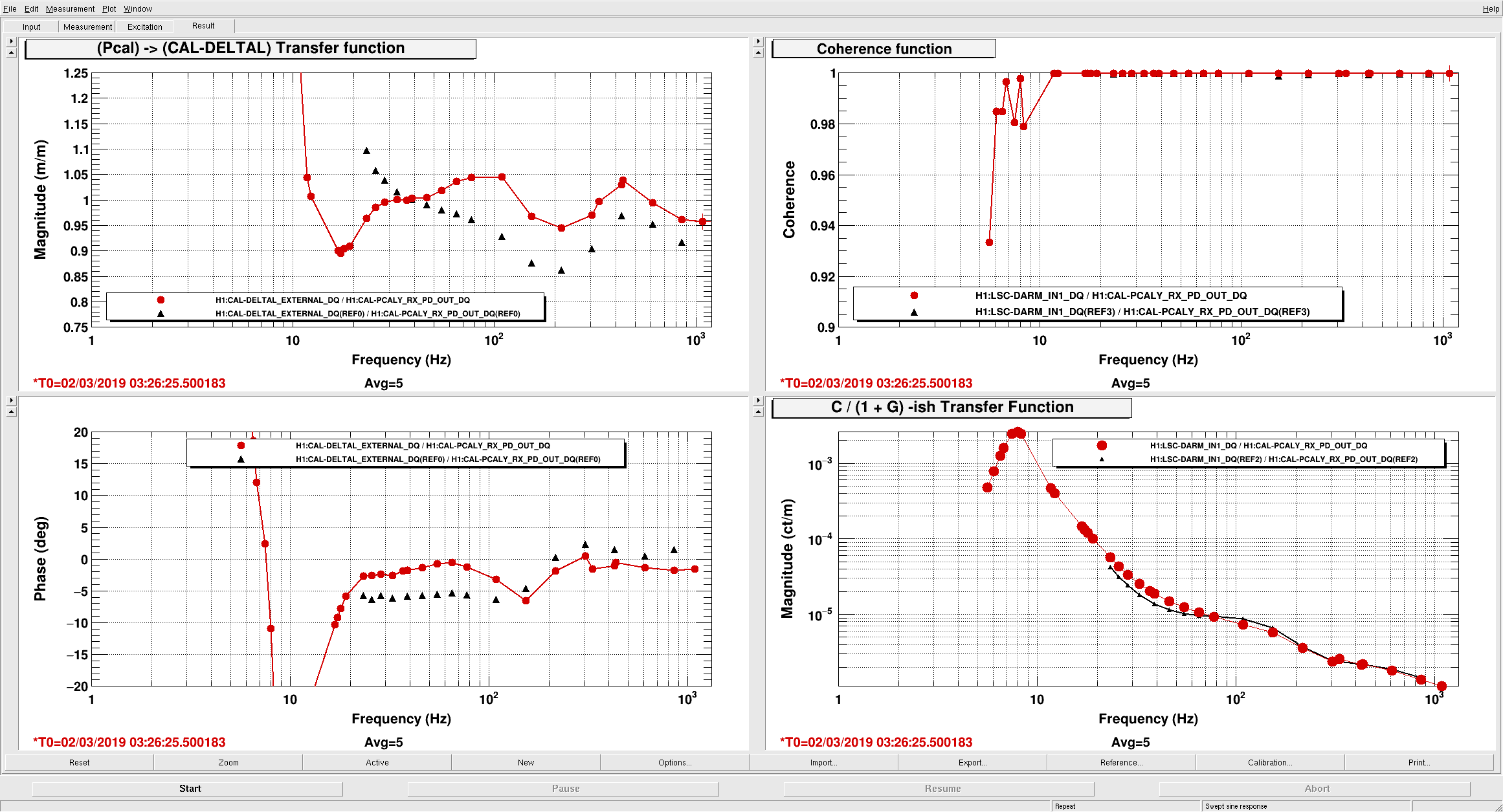
Here are the afternoon values, including a PCAL sweep:

Calibration gains at GPS 1235532403, Mar 02 2019 03:26:25 UTC :
H1:CAL-CS_DARM_ERR_GAIN = 1.11
H1:CAL-CS_DARM_ANALOG_ETMX_L3_GAIN = 1.073
H1:CAL-CS_DARM_ANALOG_ETMX_L2_GAIN = 1.0
H1:CAL-CS_DARM_ANALOG_ETMX_L1_GAIN = 1.0
 

Attached is the PCAL sweep done with these values. It lives here:
/ligo/svncommon/CalSVN/aligocalibration/trunk/Runs/O3/H1/Measurements/FullIFOSensingTFs/2019-03-01_H1_PCAL2DARM_TF_5t1100Hz_8min_AFTER_CHANGE.xml

Note that is was within 5%, underestimating the range contribution at 80Hz, but overestimating it at 200Hz. Usually 80Hz is more critical for the range, so I would expect the actual range larger than the reported range. The reported range for this was around 104 Mpc.

The values Craig reported were an attempt to even out the frequency-dependent response, but we lost lock during the process. Since these values make more sense that what Craig mentions above, and gave <5%  errors, I set them back to their values from GPS 1235532403,  Mar 02 2019 03:26:25 UTC.

I should also say that this measurement was done after Rick's work (alog 47215)


Images attached to this comment
H1 ISC
jenne.driggers@LIGO.ORG - posted 20:16, Friday 01 March 2019 (47232)
Musings on DHARD

I've started looking again at DHARD, after Sheila's noise budget that shows that DHARD is contributing more than a passive coherence test will indicate (which also means that we cannot get the full impact of DHARD out of DARM with the offline cleaning pipelines). 

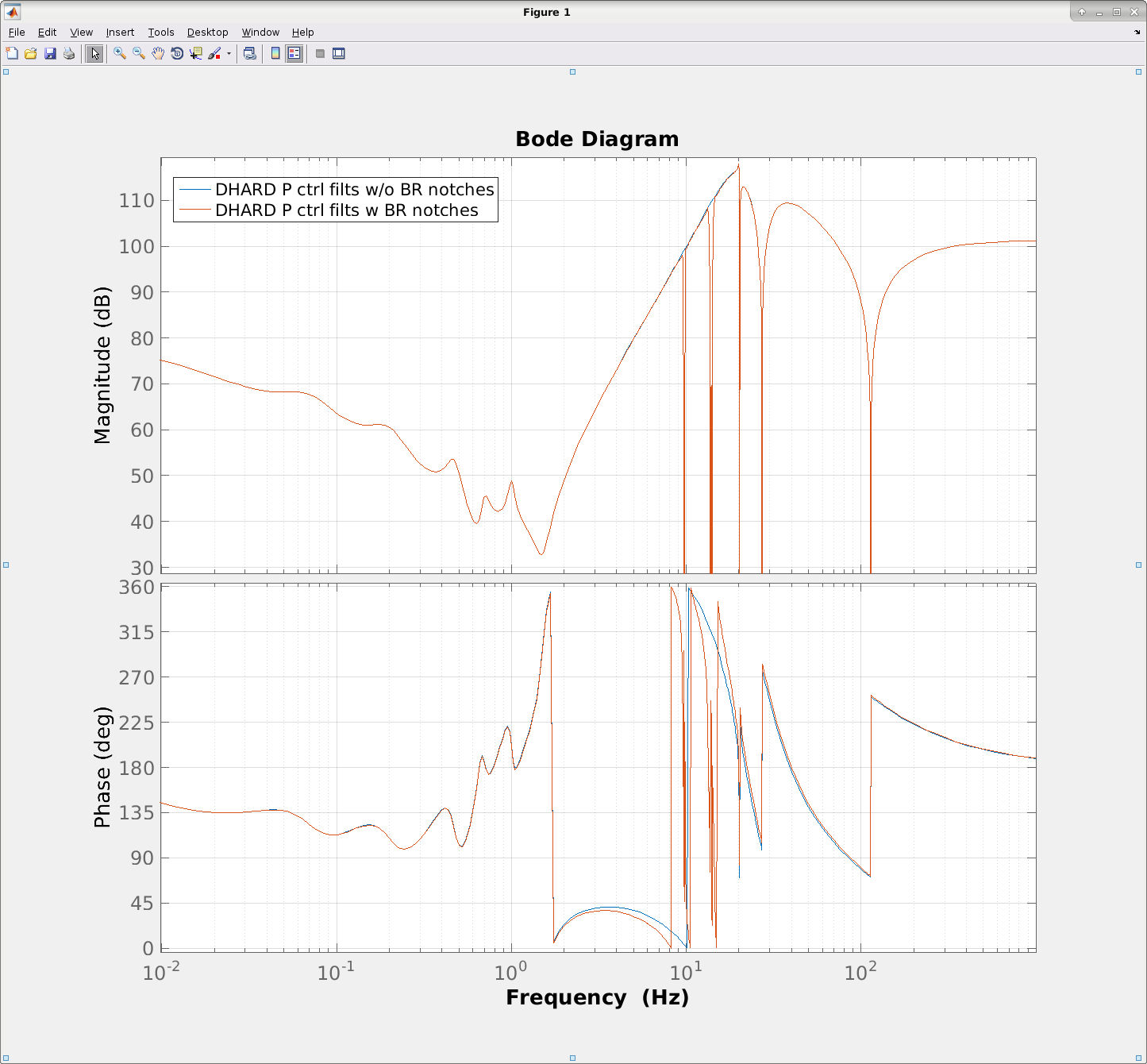
Sheila points out that one of the first things that we should do (and should have done several weeks ago when DHARD was causing us so much trouble) is take out the bounce and roll notches in the L2 stages of our quads.  We now have the bounce roll dampers, and we've been able to take the equivalent notches out of the DARM loop, so we shouldn't need to actively notch those modes.  This will win us quite a bit of phase below 10 Hz.  See the first attachment for a plot of our control filters with and without the bounce roll notches.

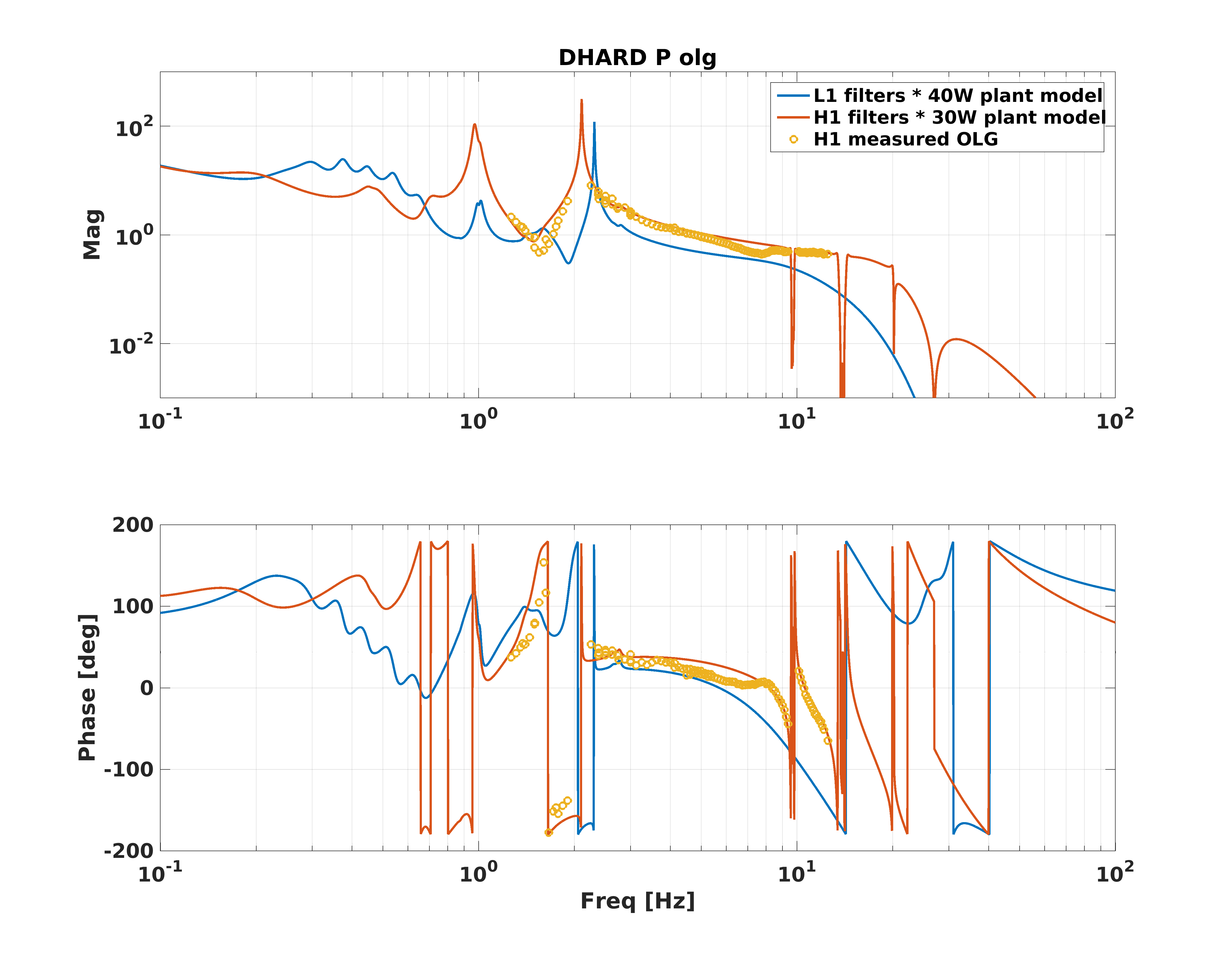
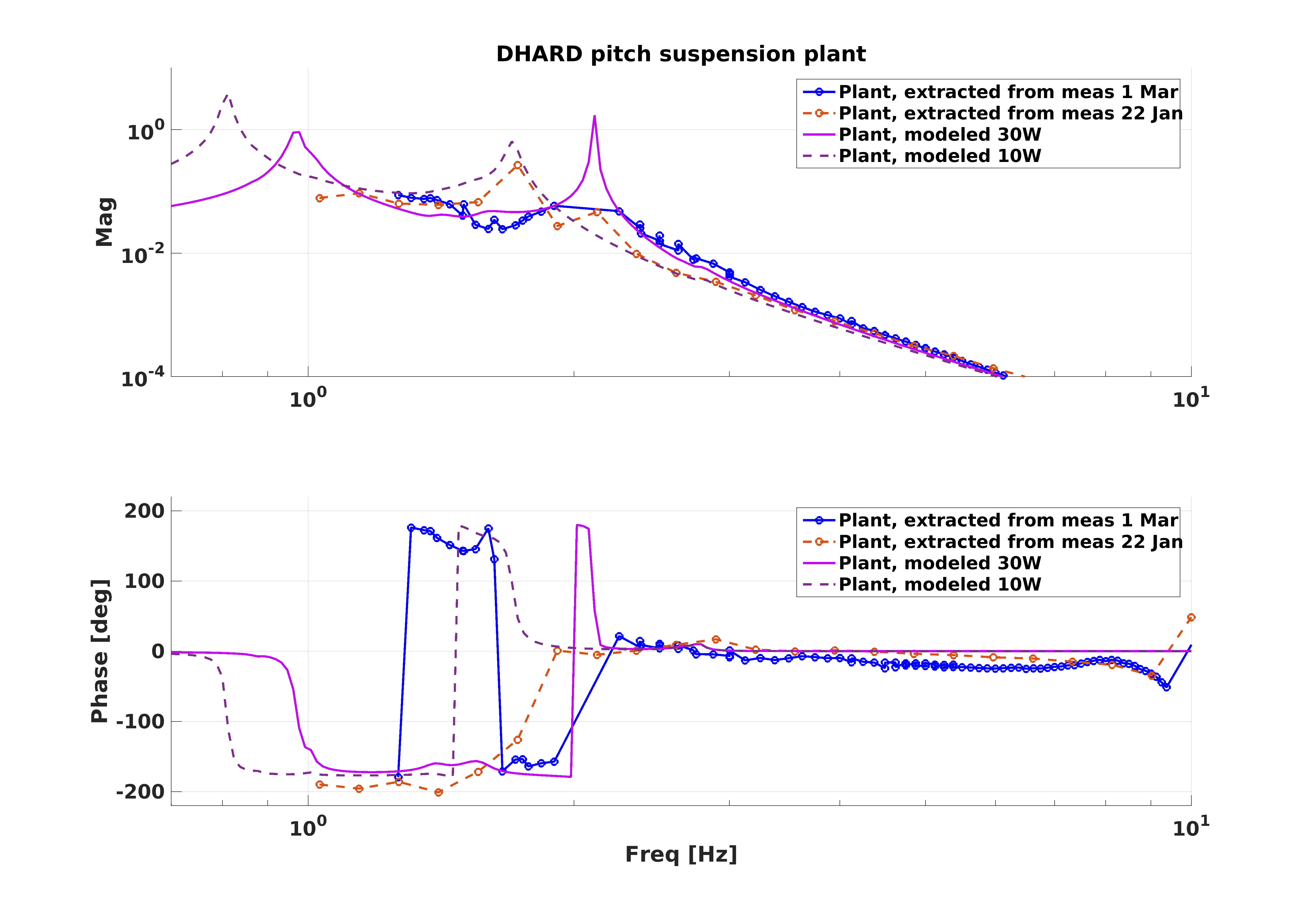
I measured DHARD this morning (shown in second attachment), with the notable changes from last time of new spot positions, and extra boost in DARM loop.  It seems like we're much better off, and don't seem to have the non minimum phase problem.  See the third attachment for an extraction (undoing the control filters) of the DHARD_P plant, as measured in late January and today.  I show different plant models though, since today's measurement much better matches the 30W model, even though we are definitely using active radiation pressure compensation to make our plant look like 10W.  More thinking to be done on this.

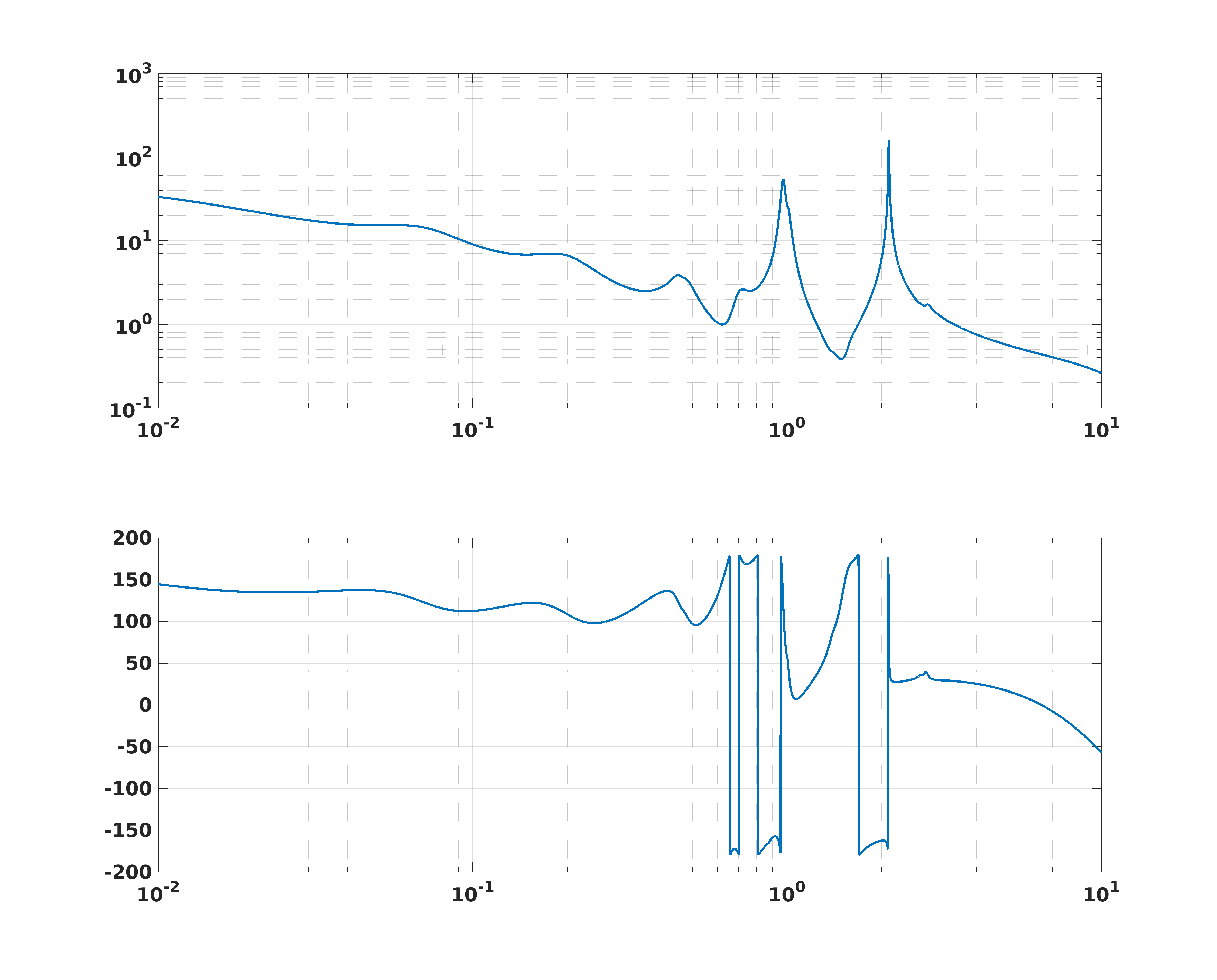
In the 4th attachment I show my measurement, manipulated to remove the bounce and roll notches, removing the gentle cutoff, and adding in the hard cutoff.  I'm happier using these manipulations of my measurement, to ensure that I'm looking at what the situation would *really* be, since we don't match any of the models precisely. I reduce the gain by a factor of 2 in the final proposed OLG shape with the hard cutoff.

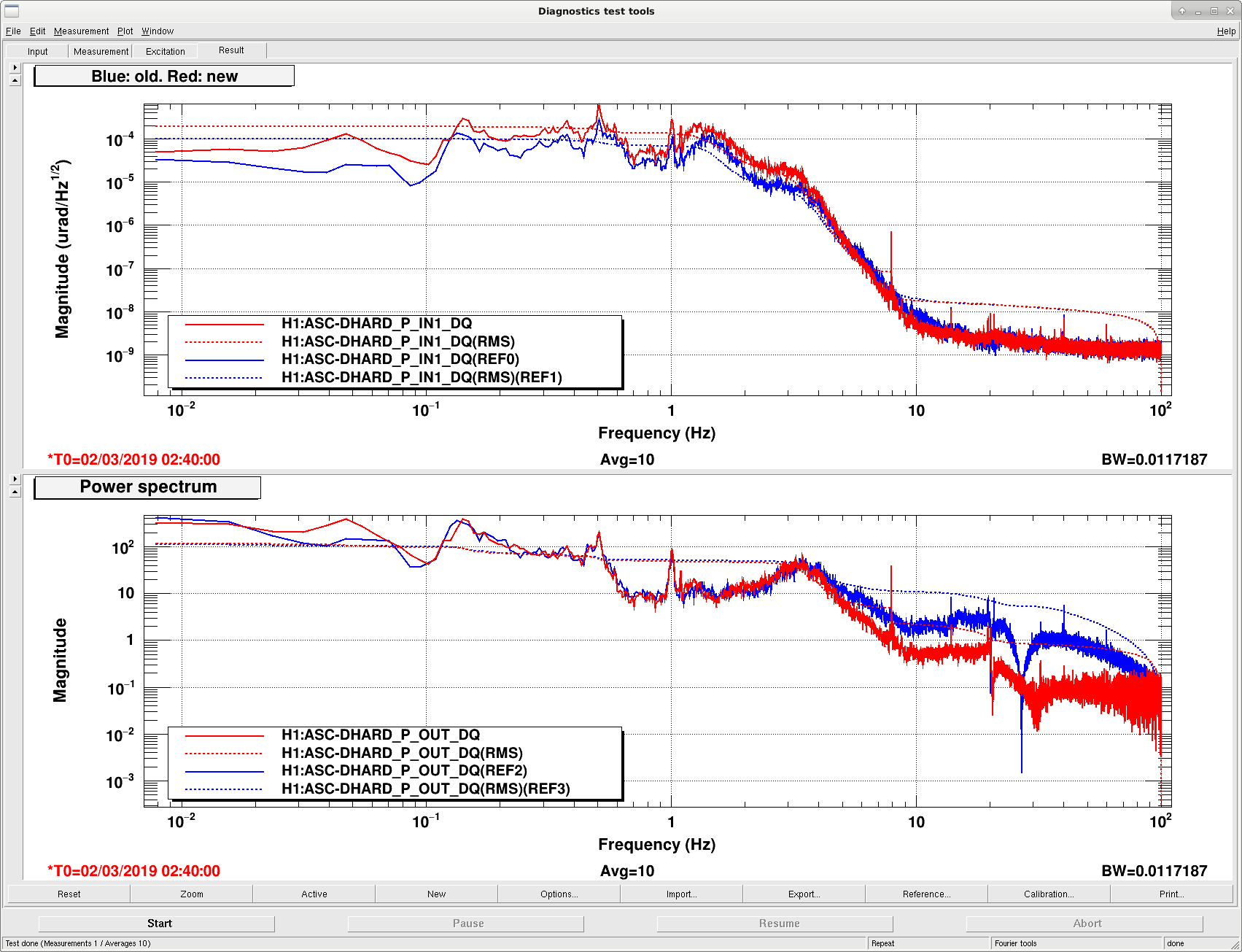
The last attachment shows the error and control signals before and after we implemented these changes.  The residual motion RMS increases by about a factor of 2, but we can afford that and still be moving less than about 1 nrad RMS.  You can see that the control signal is much reduced at higher freqs.  We did see that a roll mode of one of the quads started ringing up, so our new plan is to instead using the roll-only notch filters.

Sheila has put these changes into the guardian.  We could definitely see an improvement in the DARM spectrum, although we've had some small earthquakes giving extra ground motion, so the range impact isn't quite quantified yet.  We didn't get as much range improvement as we hoped for, but that seems consistent with Sheila's noise budget from the other day that DHARD Yaw is more impactful.  So, that's next up!


Images attached to this report
H1 CAL (CAL)
richard.savage@LIGO.ORG - posted 19:13, Friday 01 March 2019 - last comment - 19:13, Friday 01 March 2019(47215)
Yend Pcal work on Tuesday Feb. 26

NikoL, RickS

First, we re-installed the transmitter module shutter (Lasermet S/N 1258) that had been repaired by Filiberto and RichardM).

Then, we proceeded to investigate the clipping that had been reported based on observation of peaks in the Pcal Rx sensor signal ASD displayed in the control room.

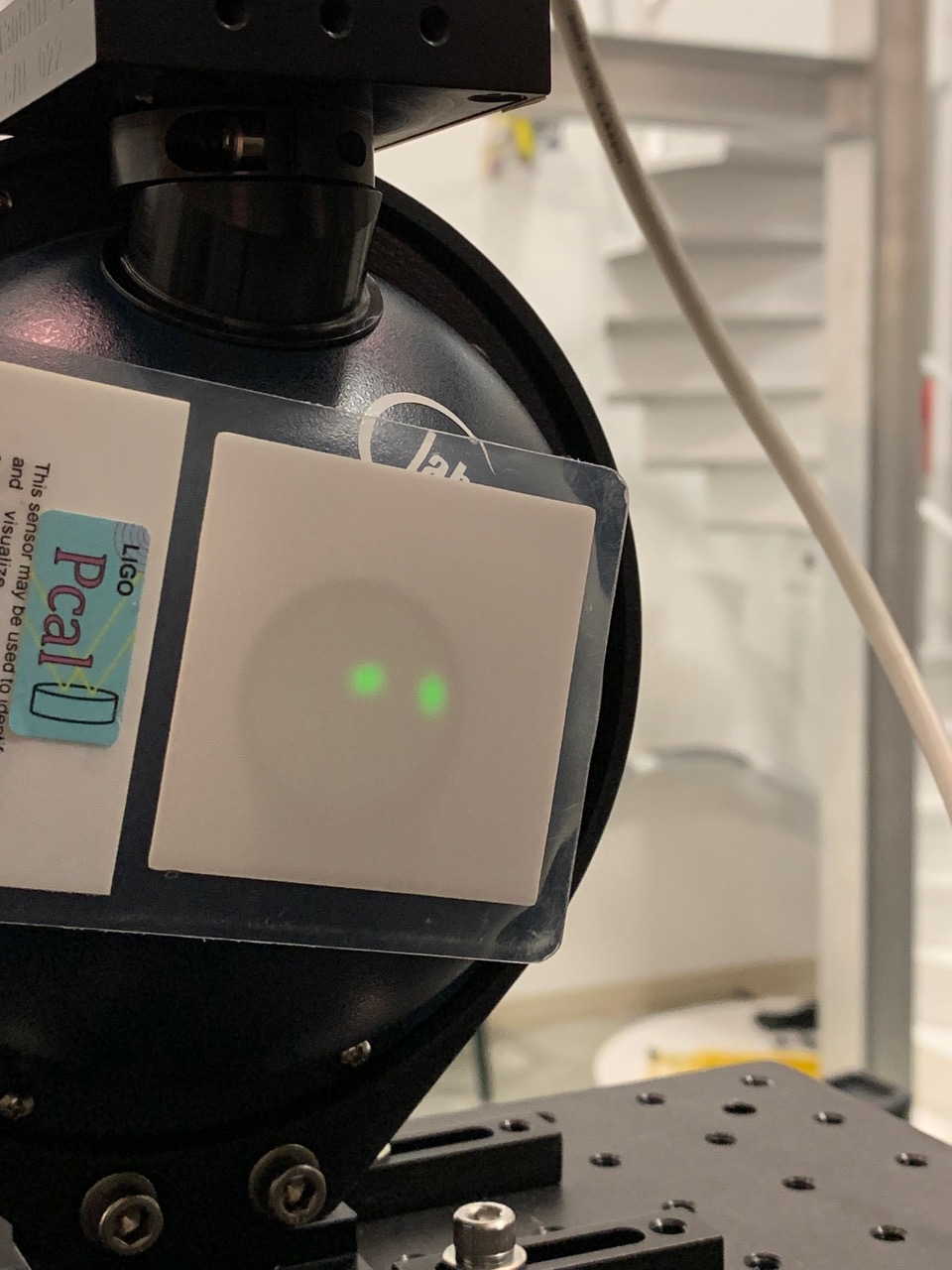
We found that the outer (lower) Pcal beam was WAY off center (beam to the right in the first attached photo) at the Rx module power sensor.  Since doing in-chamber alignment of the Pcal beams at all four end stations, this is the first time we have seen significant beam movement at the Rx power sensor.

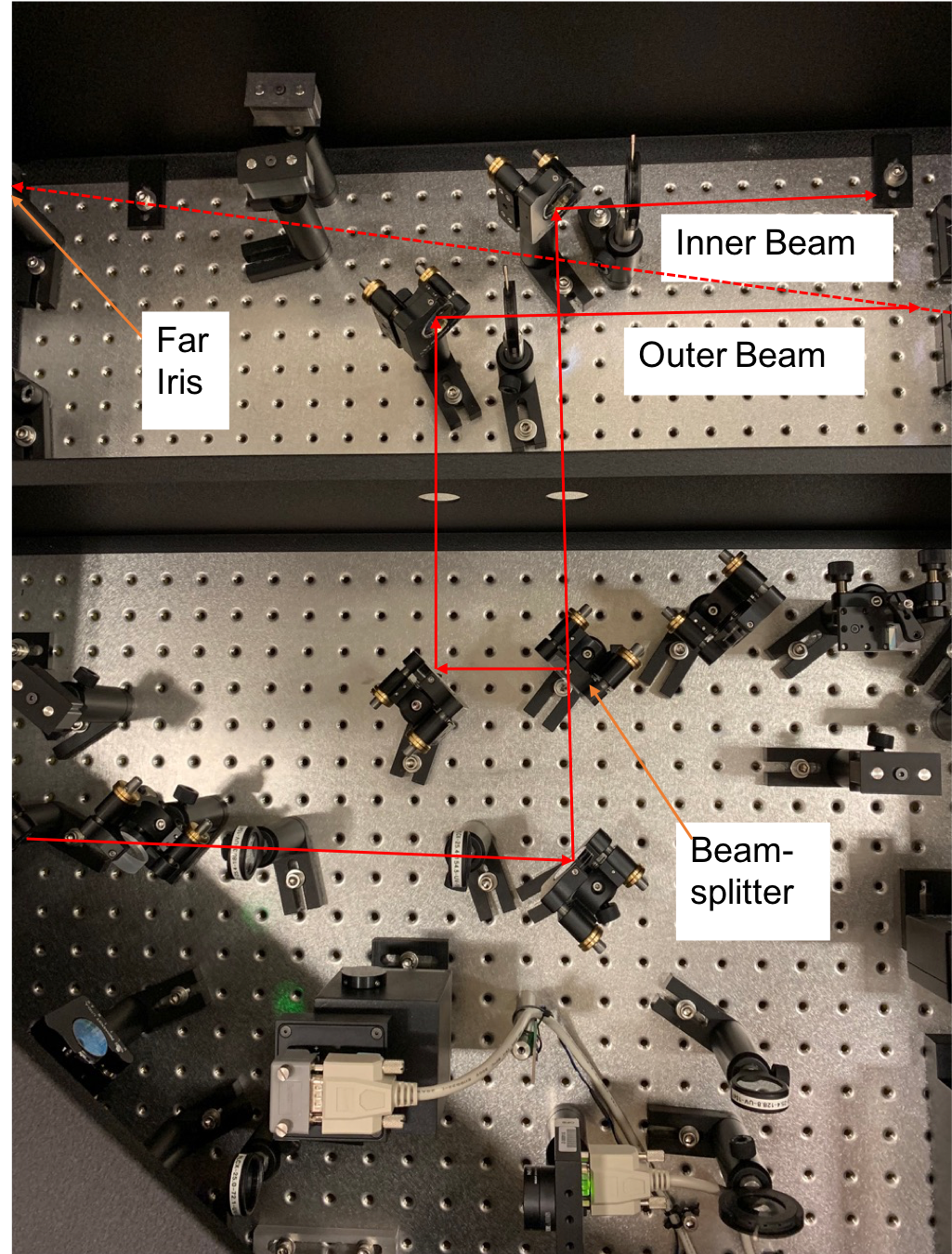
Inspection of the alignment irises revealed that the Outer Beam  pointing was also significantly off (several mm left of center) on the far iris (see second attached image), with the temporary, kinematically-mounted retro-reflecting mirror in place (fourth attached image shows optical layout in Tx module).

Given that the inner beam had not moved at the Rx sensor, and that the pointing was off in the Tx sensor, it seemed that either the beamsplitter or one of the two downstream mirrors that direct the Outer Beam out of the Tx module had moved.

The attached video shows that the BS mount moves significantly, and much more than expected, in response to rocking forces applied at the top of the mirror mount.

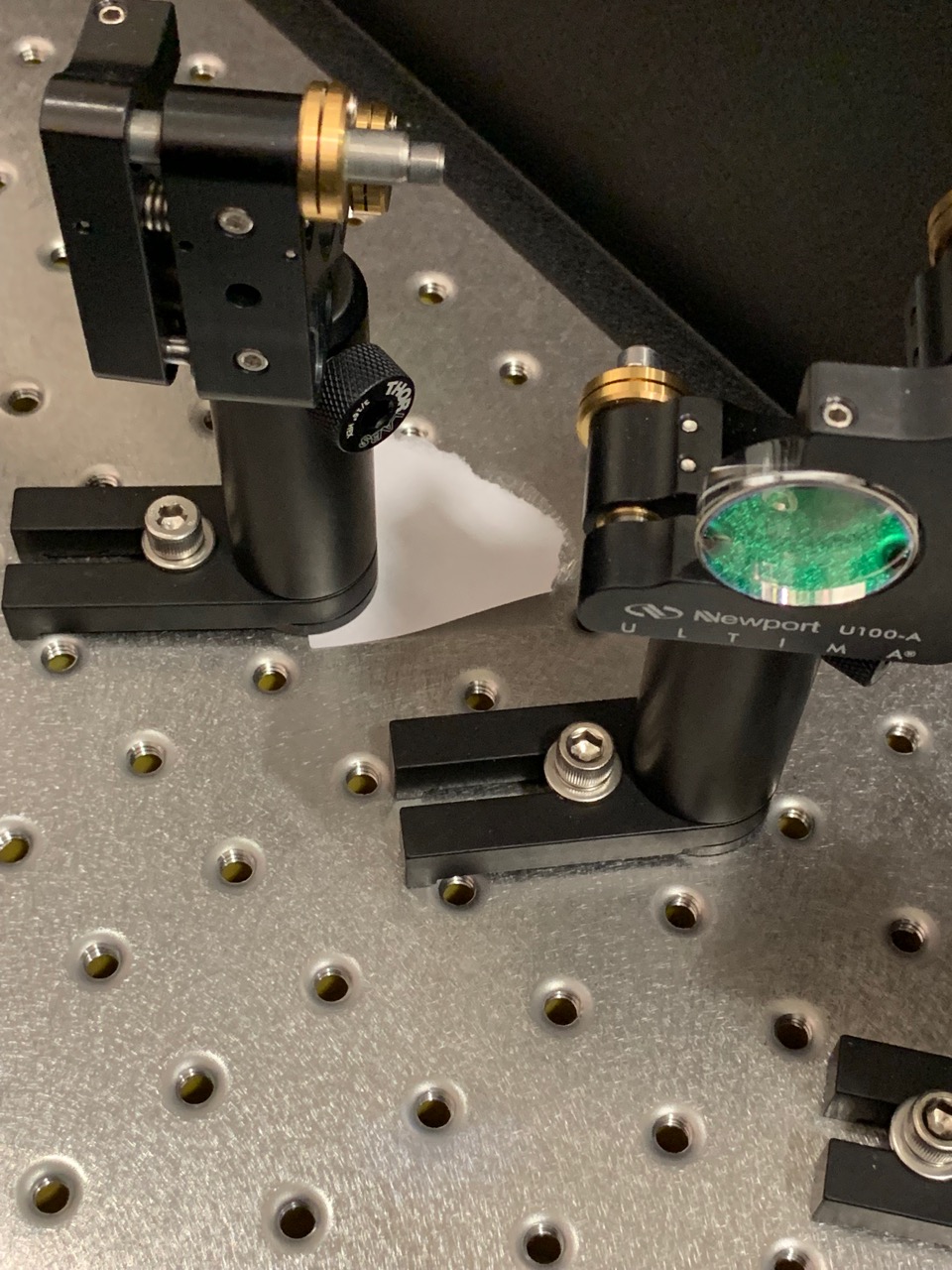
Either there are issues with this particular mount, or this type of mount has design flaws.  Or maybe it is the way we are suing them (over-tightening?).  The third attached image shows that a piece of paper could be slid under the back of the base, indicating that the base is only contacting the breadboard one edge.    I've discussed this briefly with Stephen Appert and we plan to investigate this flaw and possible solutions with the SYS group.

We adjusted the beamsplitter to re-center the Outer Beam on the Rx power sensor aperture (see fifth image below, with both beam incident on the Rx power sensor aperture), fine-tuned the alignment onto the Far Outer Beam iris in the Tx module, then proceeded with a standard end station Pcal calibration measurement suite.  The scanned log of the measurements is in the attached .pdf file.

Current results are in good agreement (with a few hundredths of a percent) with the mean of the previous Yend measurements.

Sensor Dec. 13 Jan. 15 Jan. 29  Feb. 26 Feb 26 / mean of prev. meas.
Tx (V/V) -0.480810 -0.480448 -0.480937 -0.480805 1.00015
Rx (V/V) -0.715832 -0.715410 -0.716157 -0.715337

1.00028

Images attached to this report
Non-image files attached to this report
Comments related to this report
stephen.appert@LIGO.ORG - 12:44, Friday 01 March 2019 (47220)

As mentioned in T1300659 the ID of this rocking transmitter module post holder is:

The receiver module also utilizes this type of post holder, but in 2" height (p/n UPH2).

H1 ISC
peter.fritschel@LIGO.ORG - posted 18:17, Friday 01 March 2019 - last comment - 18:37, Friday 01 March 2019(47235)
DARM residual motion & DARM offset calibration

Because we were curious, we looked at the residual DARM motion when locked in low-noise, and looked at the effect of the PUM boost filter that was added earlier this week (47164). I used H1:CAL-DELTAL_RESIDUAL_DBL_DQ, but had to remove the effect of the detuned SRC optical spring that was being applied in the CAL model. The attached PDF shows the calibrated residual spectra for 3 cases:

'resG' was an existing filter, but wasn't being used until now. It contains a couple of resonant gain filters (0.45 Hz, 1 Hz, 0.15 Hz), and an integrator below 0.5 Hz (which we just added). It also had a bandstop filter at 332 Hz (PCal line), but we removed that because it is already notched in another filter. Engagement of 'resG' has been added to the guardian.

There is no obvious benefit to the reduction in DARM residual from the new filters, but they just seem like a good idea. The residual from the test mass violin modes is not captured in these spectra, but looking at the time series we can see that their amplitude is about the same level as this DC-10 Hz stuff. The nominal DARM offset is 11 pm, so the fractional residual is about 5e-16/1e-10 = 5 ppm.

Non-image files attached to this report
Comments related to this report
stefan.ballmer@LIGO.ORG - 18:37, Friday 01 March 2019 (47236)

Calibrated DARM offset in READOUT_X0_OFFSET
===========================================

Peter, Stefan

Measuring the transfer function from OMC_DCPD_SUM_DQ to DELTA_RESIDUAL_DBL_DQ we can cast SUM mA into DARM m.
Above the whole radiation compensation business, and below the cavity pole (i.e. at 80Hz) that gain is m=2.73e-13meter/mA.
The set point for the OMC is d=20mA.

Thus, the DC offset is given by 2*d*m = 10.92pm.

We updated the fringe length H1:OMC-READOUT_XF_OFFSET from 14 to 10.32. This guarantees that H1:OMC-READOUT_X0_OFFSET is now calibrated in pm.
The guardian and SDF were updated to reflect that change.


H1 CDS (CAL, CDS, DCS)
gregory.mendell@LIGO.ORG - posted 17:15, Friday 01 March 2019 (47234)
Updated DMT production computers to gstlal-calibration-1.2.8

As per WP 8104 and SCCB issue 82, I have updated the DMT production computers to gstlal-calibration-1.2.8. For example, this allows pcal correction factors that are applied to GDS strain to be updated from the front end for ER14. See: https://git.ligo.org/sccb/requests/issues/82.

I have not restarted the DMT calibration code. No changes have taken place yet.

When H1 is down, I have asked Aaron Viet to restart the DMT calibration code and put in an alog. This should not affect FOMs in the control room.

(More DMT/GDS updates are scheduled for next Tuesday maintenance, on March 5, as per WP 8106.)


H1 CDS (CDS, DAQ)
jonathan.hanks@LIGO.ORG - posted 16:59, Friday 01 March 2019 (47233)
Rack mounted new daq computers

Dave and Jonathan.

We rack mounted 3 of the new daq machines.  These will eventually be replacements for h1dc1, h1fw1, h1nds1.  We have the I/O cards in the machines, along with power and network cables run to the machines, but not yet plugged in.

We also pulled two older sun x4600 from the racks.  These where decommissioned VM hosts.  Pulling them frees up rack space for some computer moves that will take place in prior to the observing runs.

LHO General
thomas.shaffer@LIGO.ORG - posted 16:00, Friday 01 March 2019 (47230)
Ops Day Shift Summary

TITLE: 03/01 Day Shift: 16:00-00:00 UTC (08:00-16:00 PST), all times posted in UTC
STATE of H1: Commissioning
INCOMING OPERATOR: None
SHIFT SUMMARY: Commissioning all day. After 2 lock losses around DHARD_WFS (much like yesterday), but with a seemingly well aligned IFO, Jenne suggested we run the wfsreliefpast.py script from a time last lock. Seemed to work, even though DRMI didn't seem as well aligned. So it goes. The range reads 99.5Mpc as I write this, fantastic work commissioning crew!
LOG:

1630 Kyle to MY
1644 Vanessa to MX
1740 Chandra to MY
1824 Nutsinee to LVEA ISCT6
1918 Nutsinee out

2330 Kyle at MX

H1 ISC
stefan.ballmer@LIGO.ORG - posted 15:27, Friday 01 March 2019 (47228)
OMCmatrix set up - cross-correlation plots

Following alog 47217 we set the DCPD input matrix.

- Added a gain of 0.977 to FM10 on DCPD_A. This matches the shot noise level in PDA and PDB

- Then the signal ratio g=PDA/PDB was measured to be g=1.021. Base on that, using the script in alog 47217, the matrix was calculated to be

  1.01039   0.98961
  0.98961  -1.01039
 

This matrix was loaded and committed to SDF, as was FM10.

I verified that the coherence of PDA-PDB agrees with DELTA_A-DELTA_B, i.e. the mixing and un-mixing of the signals indeed does not introduce a error.

Attached is a x-power measurement. Note that there is evidence for correlated noise at higher frequencies. I suspect that comes from glitches.

(The stuff at lower frequencies was an injection.)

Images attached to this report
H1 ISC (ISC)
rich.abbott@LIGO.ORG - posted 15:25, Friday 01 March 2019 (47227)
Yet More OMC Grounding and Shielding
Filiberto, Peter, Rich

The analysis of the OMC grounding and shielding is complete as far as it can be diagnosed with HAM6 closed.  There is only one area associated with the OMC PZT cable that needs to be scrutinized but it is inside the vacuum system.  The attached PDF has been carefully boiled down to the simplest form possible to explain the current situation.

The highlights are:
1.  A 25 pin breakout board was added to the QPD cable to break a ground loop that became apparent during this analysis.  There has been no observable benefit to this change, so at some point it might be that it is removed and the system restored to normal.
2.  The shield of the PZT cable is grounded in the vacuum system somewhere.  This does not create a ground loop per se (see attached diagram to see why), but it's not deliberate, and should be investigated next time HAM6 is open.
3.  There is a break somewhere in the shield of the PZT cable inside the vacuum system.  We don't know how big this gap in shielding is, but it does exist.  This needs to be identified next chamber opening.

I will alert Betsy to the need for these investigations to be added to the "when vent" category of tasks associated with HAM6
Non-image files attached to this report
H1 SEI (OpsInfo)
jim.warner@LIGO.ORG - posted 15:11, Friday 01 March 2019 (47224)
How should LHO respond to earthquakes?

I have noticed a few times that the Big Red Button on the ISI_CONFIG screen is a little too appealing, and the button has been used at times when it maybe shouldn't have. The original intent of that button was to put the platforms in the safest possible state before or during a Montana sized (as in the 5.8 magnitude in Montana during July of O2) earthquake. The earthquake last night tripped ISI's, but probably wouldn't have tripped HEPI. So, I've changed the script the button runs to just take the platforms down to damped, leaving HEPI on. This should save some recovery time in the future. 

Because seismon doesn't give a good prediction of what surface velocities we should expect, the verbal notification only gets triggered if the earthquake is above a 6. So what should we do when we get a verbal notification? It depends, every earthquake is unique, but generally the smaller and further away the earthquake is, the response should be less dramatic. I discuss a few cases here.

1. Really, really bad earthquakes like the 5.8 in Montana, very close. Something like that will be onsite before seismon will see it.

Response: do nothing, wait for things to settle down before trying to recover.

2.Really bad farther away like 7-8+ in Mexico or Alaska, large and on the order of 5-6000 km away. 

Response: Put the platforms in as safe a state as possible, we will probably get a couple minutes early warning,. The Big Red Button will start this, but if the earthquake is big enough, or close enough, the added step of turning HEPI off may be help. But if the ISIs are already damped, it may not be any worse to just let HEPI trip on its own.

3. The 7 in Peru last night is kind of an edge case, about 8000 km away.

Response: Probably put the SEI_CONF guardian in the LARGE_EQ_NOBRSXY state. This won't save a lock, but this should keep ISI's from tripping, especially if the earthquake is much farther away than 8000 km. The Peru earthquake tripped ISIs, but I can't say for sure that changing just the sensor correction state wouldn't have prevented that. But, being on a different continental plate reduces the effect on we see here, I believe similar sized earthquake a bit further north in Central America would have been worse for us.

4. Magnitude 6-7 more than 8000 km away. These are common, sometimes we ride them out and they don't present any risk to the IFO.

Response: Nothing, or try the SEI_CONF EARTH_QUAKE state. Again, smaller and farther away require less response. We generally don't even see 4-5 magnitude eqs over 8000 km away.

I haven't had many chances to test it, but there is some fancy new code in the seismic models that we hope will allow us to stay locked through earthquakes like this. Because most of the ground motion is common ground motion during an earthquake is common mode, the new code uses the corner and end station seismometers to calculate this common motion, and the models subtract this out of the sensor correction signal. In SEI_CONF, this should be the EARTH_QUAKE state. I haven't had a chance to test this during any earthquakes, and it will probably help only during moderate or low microseism times. 

H1 ISC
sheila.dwyer@LIGO.ORG - posted 01:47, Friday 01 March 2019 - last comment - 15:11, Friday 01 March 2019(47209)
improving DHARD noise could give us O(10Mpc)

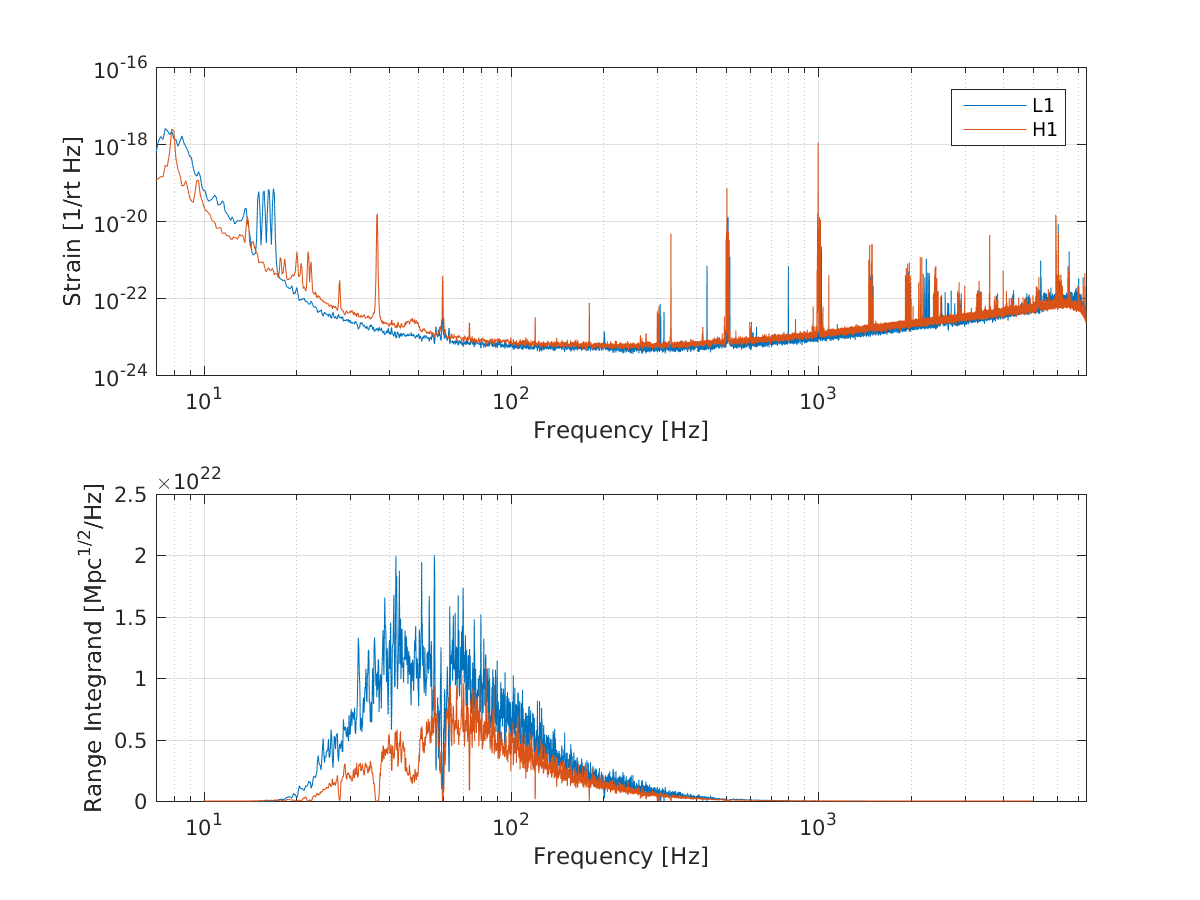
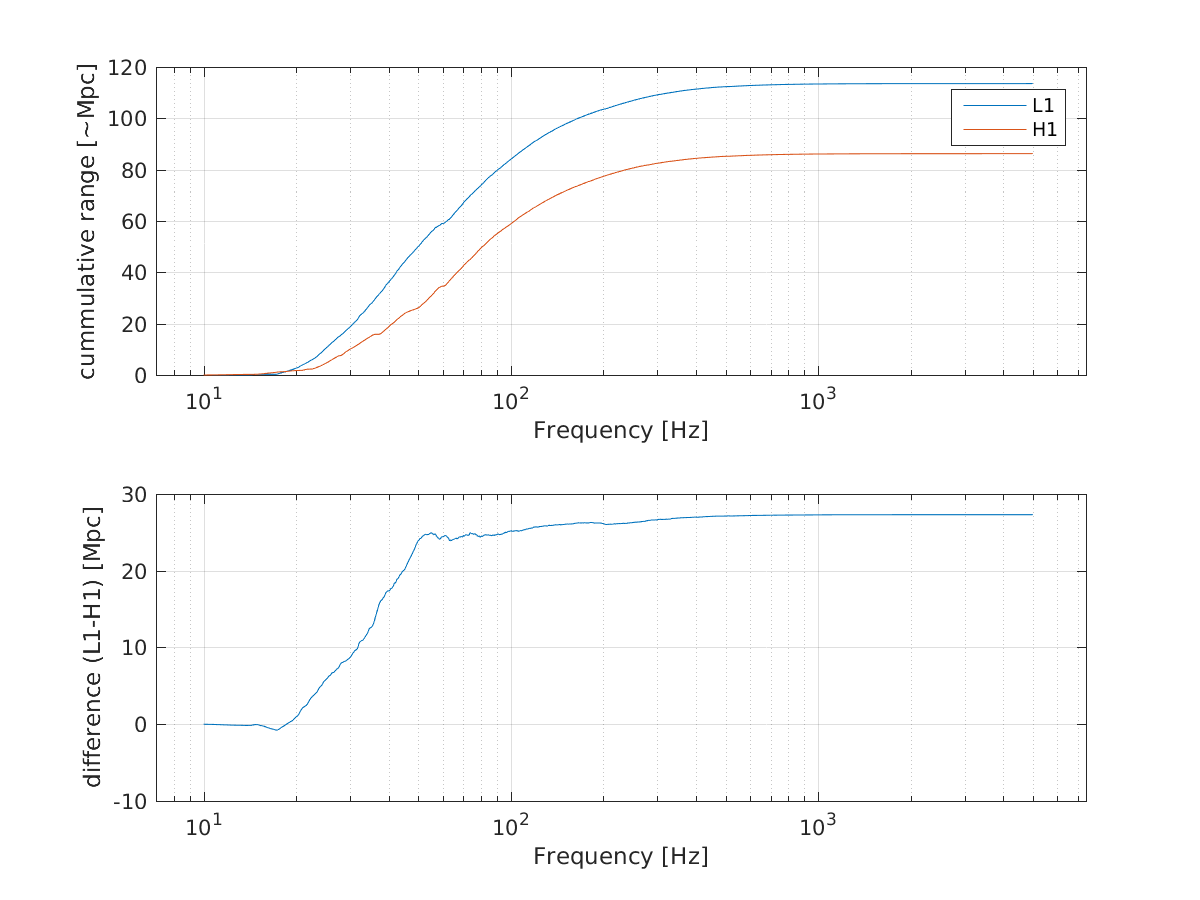
I had a quick look at the range integrand tonight, at a time last night when both L1 and H1 had fairly good ranges according to sensmon (L1 was nearly 140Mpc, H1 was nearly 100Mpc).  I used some code that gives an approximation of the range integrand, the absolute scale is wrong so that the total ranges I calculate are underestimated. The first attachment shows the sensitivity of L1 compared to H1 and in the lower plot the range integrand.  The second plot shows the cumulative range for both interferometers and the difference. 

From the second attachment you can see that we can gain ~20 Mpc by improving our noise from 40-20Hz.  In the first attachment you can see that the shoulders on the 60Hz lines are costing us. 

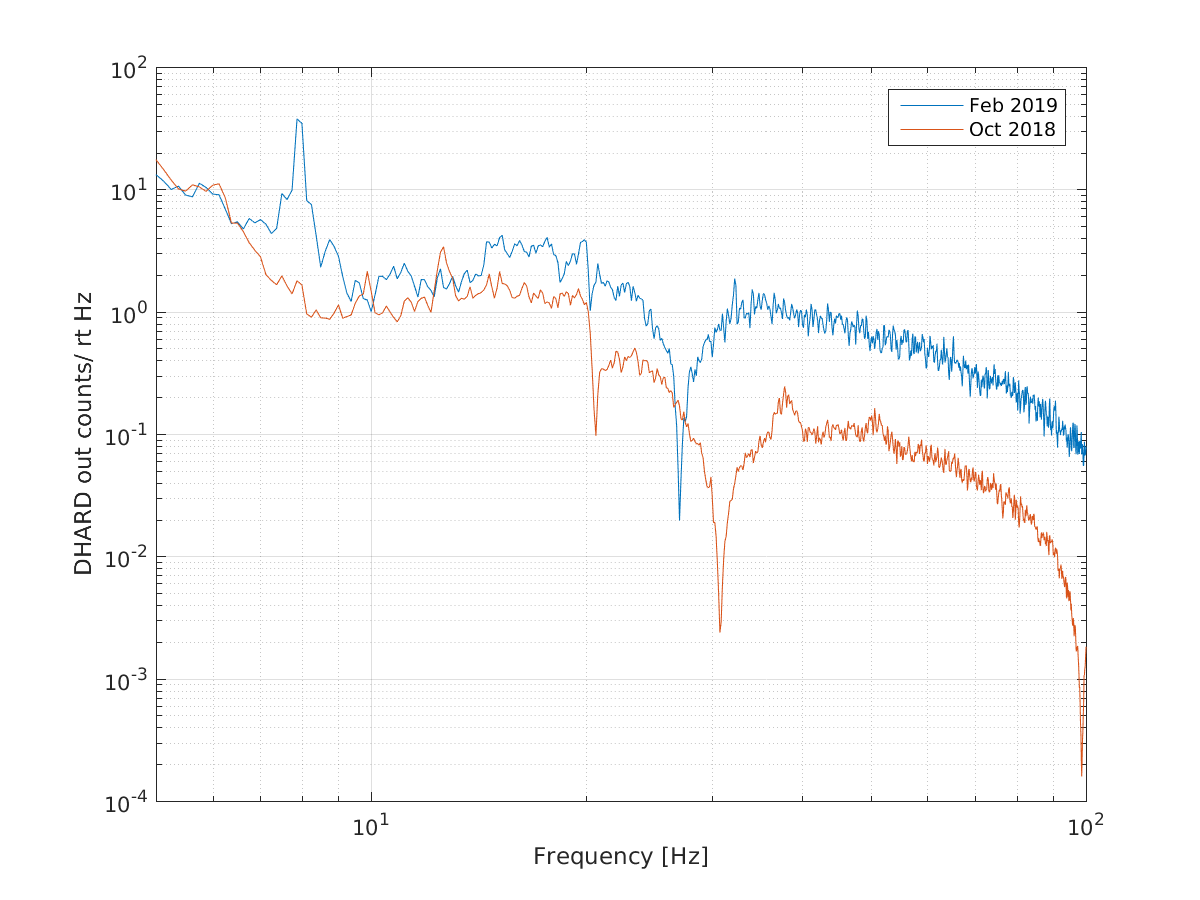
Last night I posted an incomplete ASC noise budget that shows that DHARD P+Y are both making large contributions to the DARM noise in this band. 47176  Since this is the band that we need to improve I started to look at why this noise is worse.  The third attachment shows a comparison of the DHARD P control signals from October 25th and last night, you can see that the control signal is about a factor of 10 larger in the band where it limits DARM than it was in October.  The RPC output is not included in this plot or in the noise budget that I posted last night, but it is too small to matter. The 4th attachment shows a comparison of the filters we were using in October; in addition to the filter change we are now using a gain of -42 instead of -30 in October.  

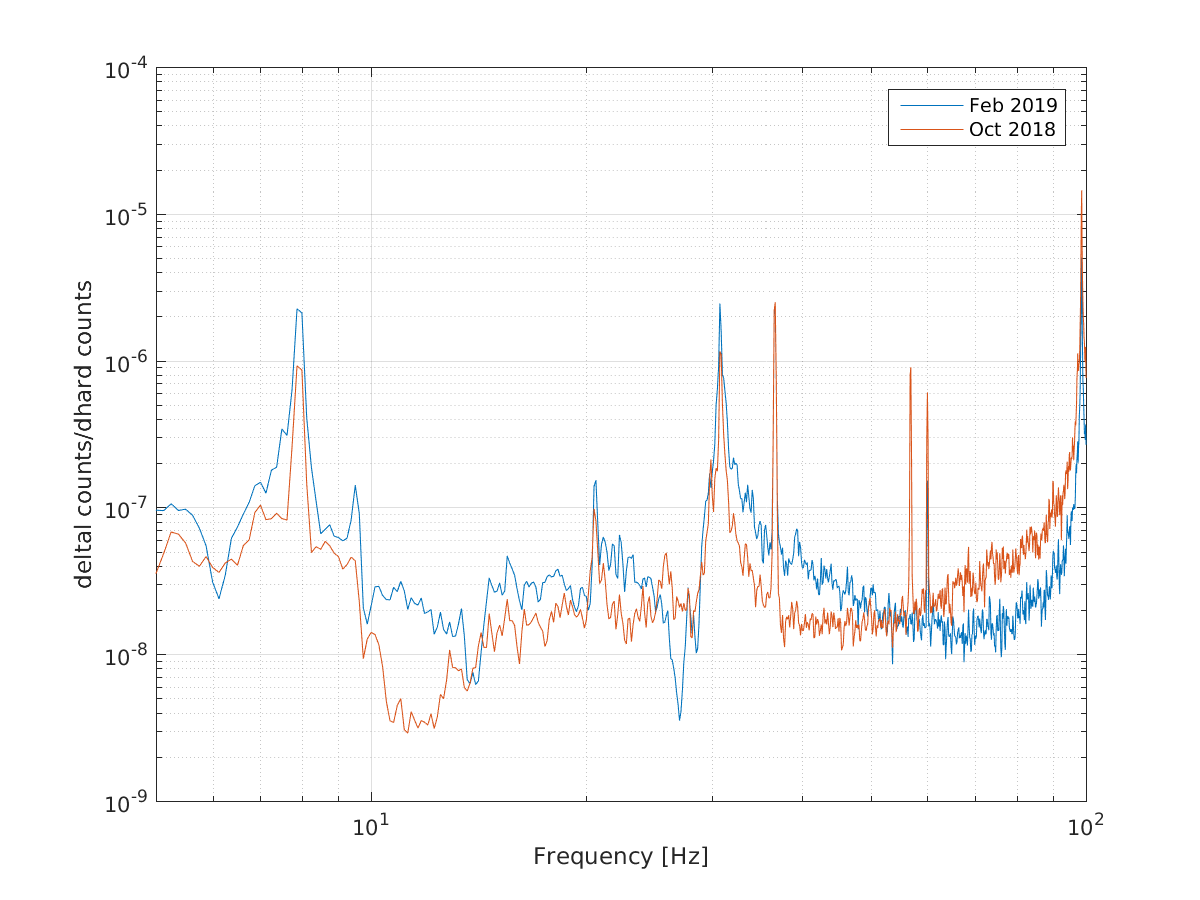
The last attachment shows a comparison of the coupling (DARM uncalibrated ASD/DHARD out ASD), you can see that the coupling hasn't changed much since October and most of the difference in noise is due to the loop shaping.  We have had many problems with the stability of the DHARD loop, which have been written about in several alogs, which is why the gain of this loop has increased, and the cut offs have become less aggressive.  It has been a while since we measured DHARD, so we were planning to try to get a good measurement before the earthquake hit. 


Images attached to this report
Comments related to this report
gabriele.vajente@LIGO.ORG - 15:11, Friday 01 March 2019 (47226)

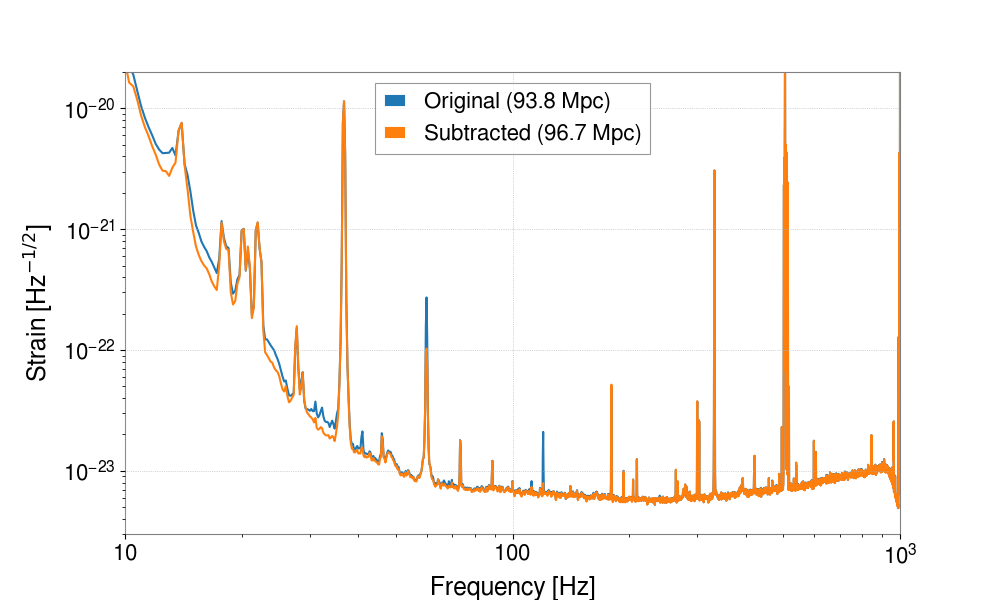
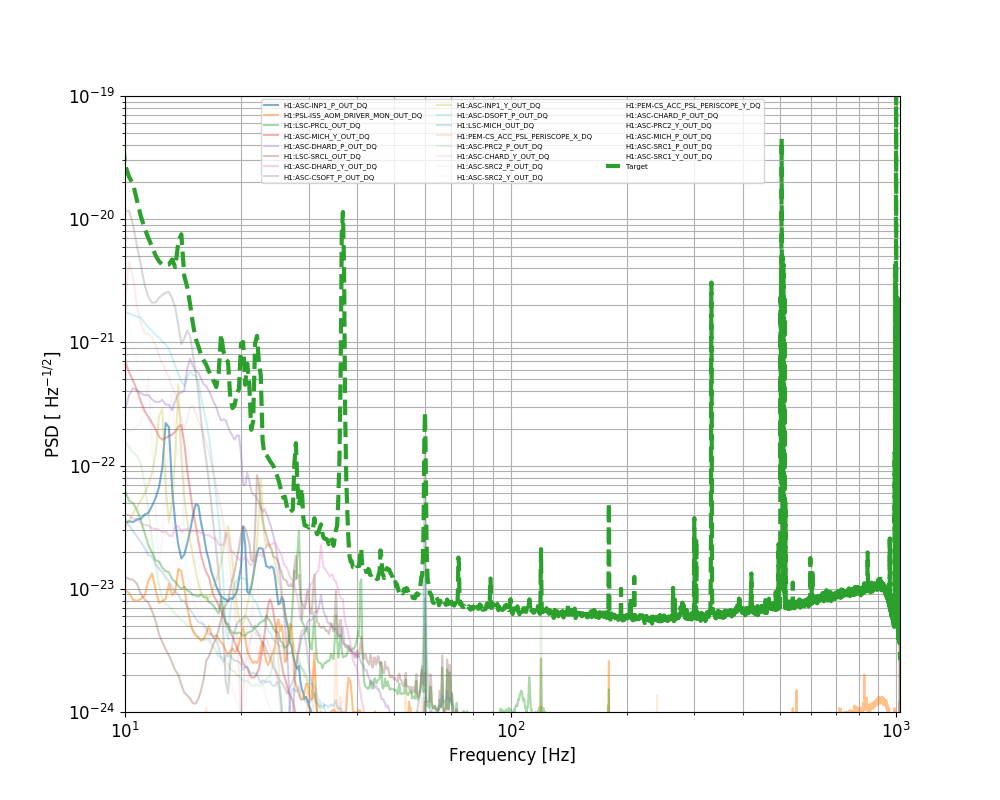
I ran a linear noise subtraction (T1800552T1800552) using all ASC signals, MICH/SRCL/PRCL and ISS signals. I used 600 seconds starting from GPS 1235390418. The first plot shows that the noise subtraction is effective at low frequencies, and improves the range from 93.8 MPc to 96.7 MPc (estimated using gwpy and GDS-CALIB_STRAIN). So 2.9 MPc more, no quite O(10 MPc) as Sheila expected.

The second plot shows the main contributions.

Images attached to this comment
H1 DetChar (ISC)
peter.fritschel@LIGO.ORG - posted 17:43, Thursday 28 February 2019 - last comment - 20:14, Friday 01 March 2019(47202)
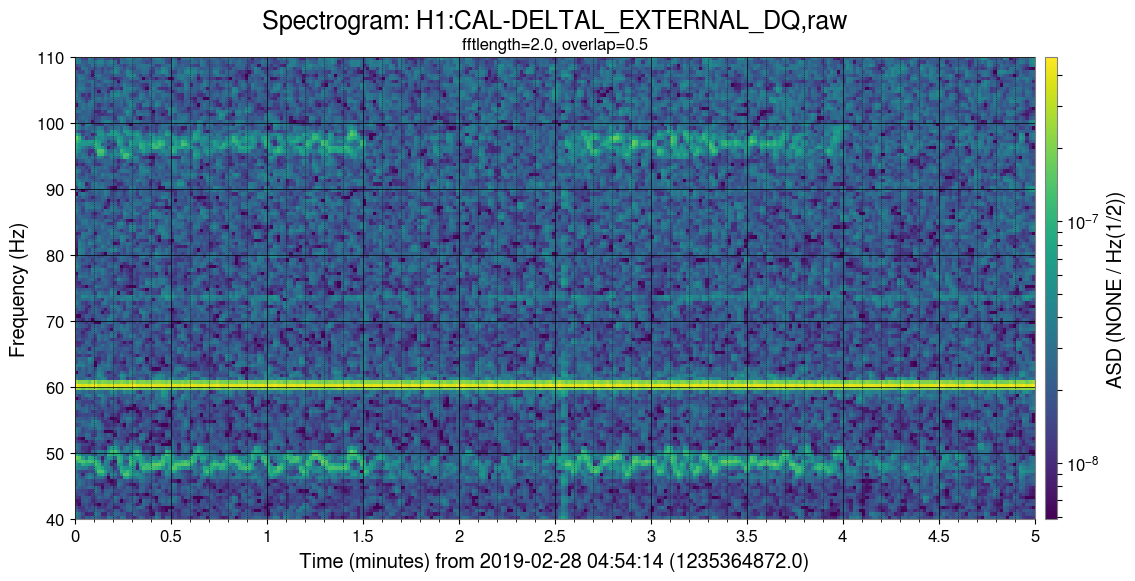
Broad noise peaks at 48 Hz & 96 Hz: where do they come from?

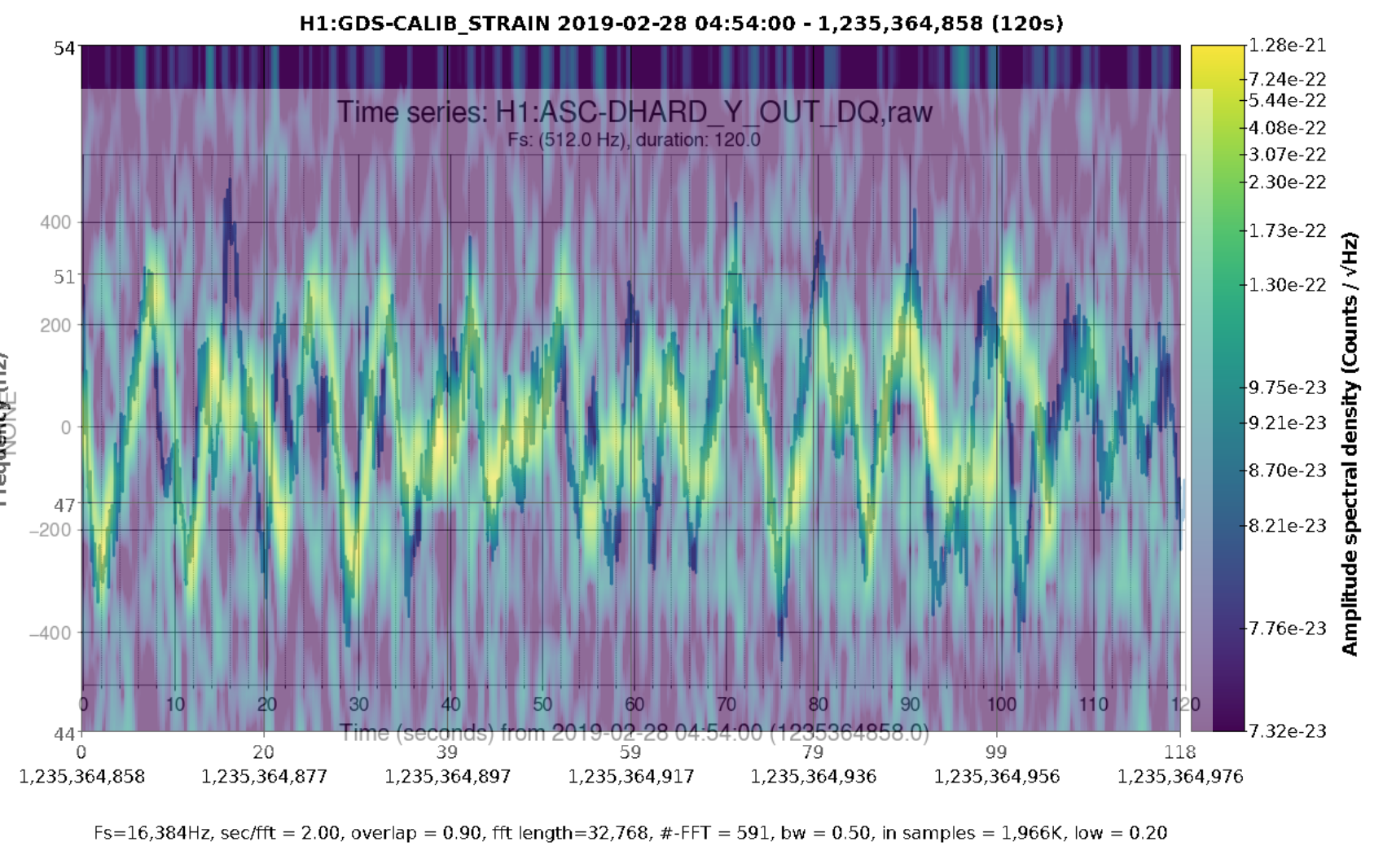
There is a broad noise peak at 48 Hz and its harmonic (96 Hz) that comes and goes in DARM. We do not know the cause, and I am posting this in hopes that DetChar can look into it. The attached pdf shows the DARM spectrum over ~10 minutes, but the spectrogram shows that the broad spectral feature is actually a narrower line that is wandering in frequency by several Hertz, at a time scale of 5-10 seconds. We know that these peaks can appear with or without the squeezer injection.


Images attached to this report
Non-image files attached to this report
Comments related to this report
joshua.smith@LIGO.ORG - 18:43, Thursday 28 February 2019 (47205)DetChar

Hi Peter, this is what we once found about 48Hz. We can check tomorrow if this is still the situation. 

joshua.smith@LIGO.ORG - 12:05, Friday 01 March 2019 (47219)DetChar, ISC

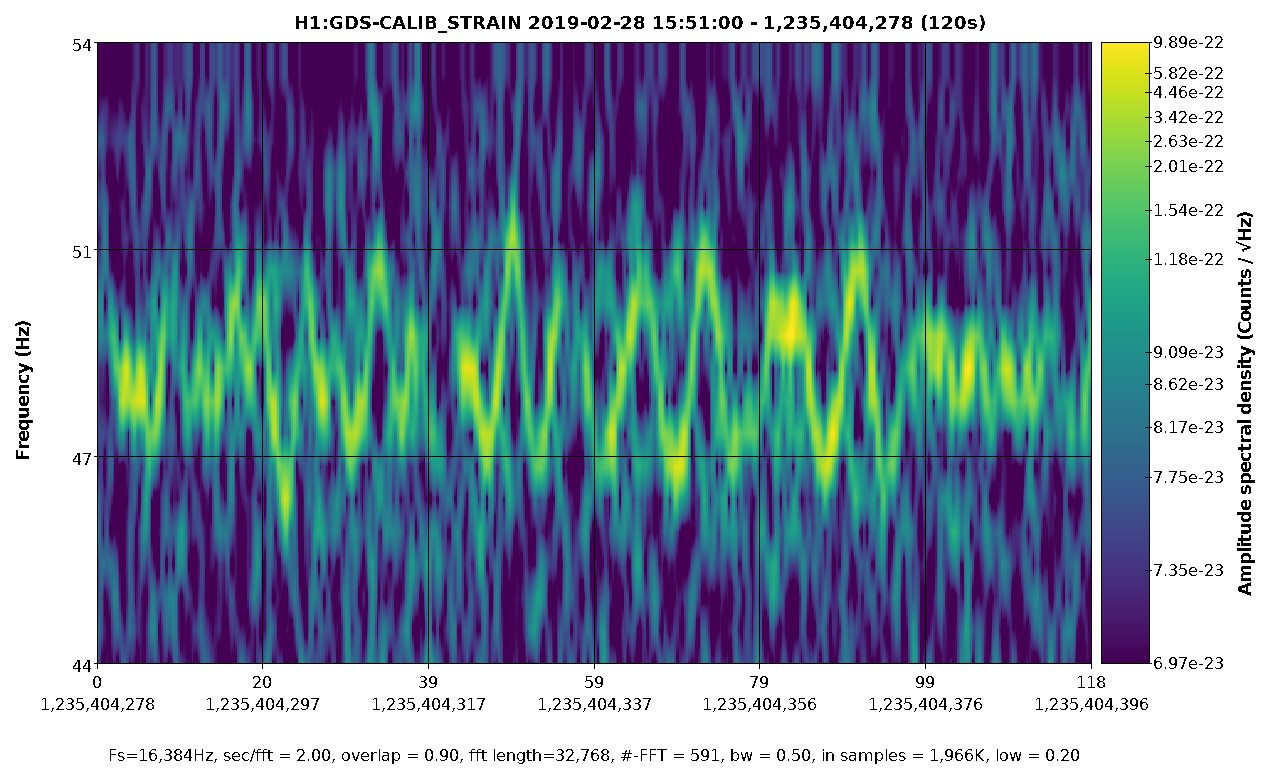
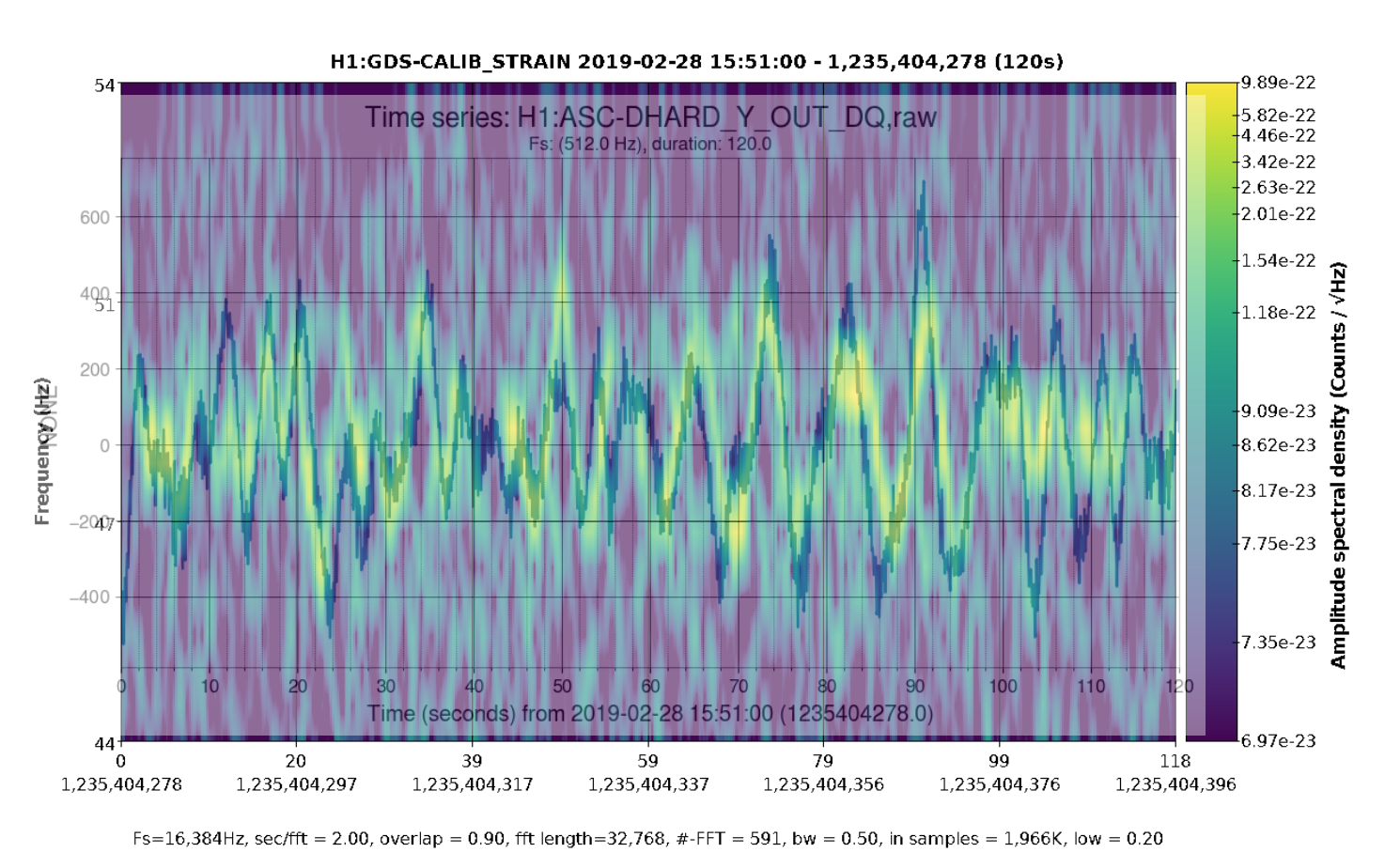
The tank motion mechanism reported back then by Jeff doesn’t seem to be related to the current 48 Hz and 96Hz frequency-modulated lines. The frequency track of the fast moving ~48 Hz line resembles alignment signals such as DHARD Y but we haven’t exhaustively checked other signals. We also don’t have a good clue for the origin of the line and Bruco didn’t find coherence. Fig 1 shows a strong zoom of the line, it oscillates in frequency with a roughly 10s period and 4 HzPkPk amplitude. Fig 2 shows the same with DHARD Y overlayed. Fig 3 shows Peter’s time from above with DHARD Y. 
Images attached to this comment
stefan.ballmer@LIGO.ORG - 20:14, Friday 01 March 2019 (47237)

I am wondering whether we can explain this as a whistle with untypically small frequency motion. Do we happen to have VCO and RF frequencies ~48Hz apart?

H1 SQZ (SQZ)
nutsinee.kijbunchoo@LIGO.ORG - posted 10:05, Thursday 28 February 2019 - last comment - 15:27, Friday 01 March 2019(47184)
Two out of four acoustic peaks gone

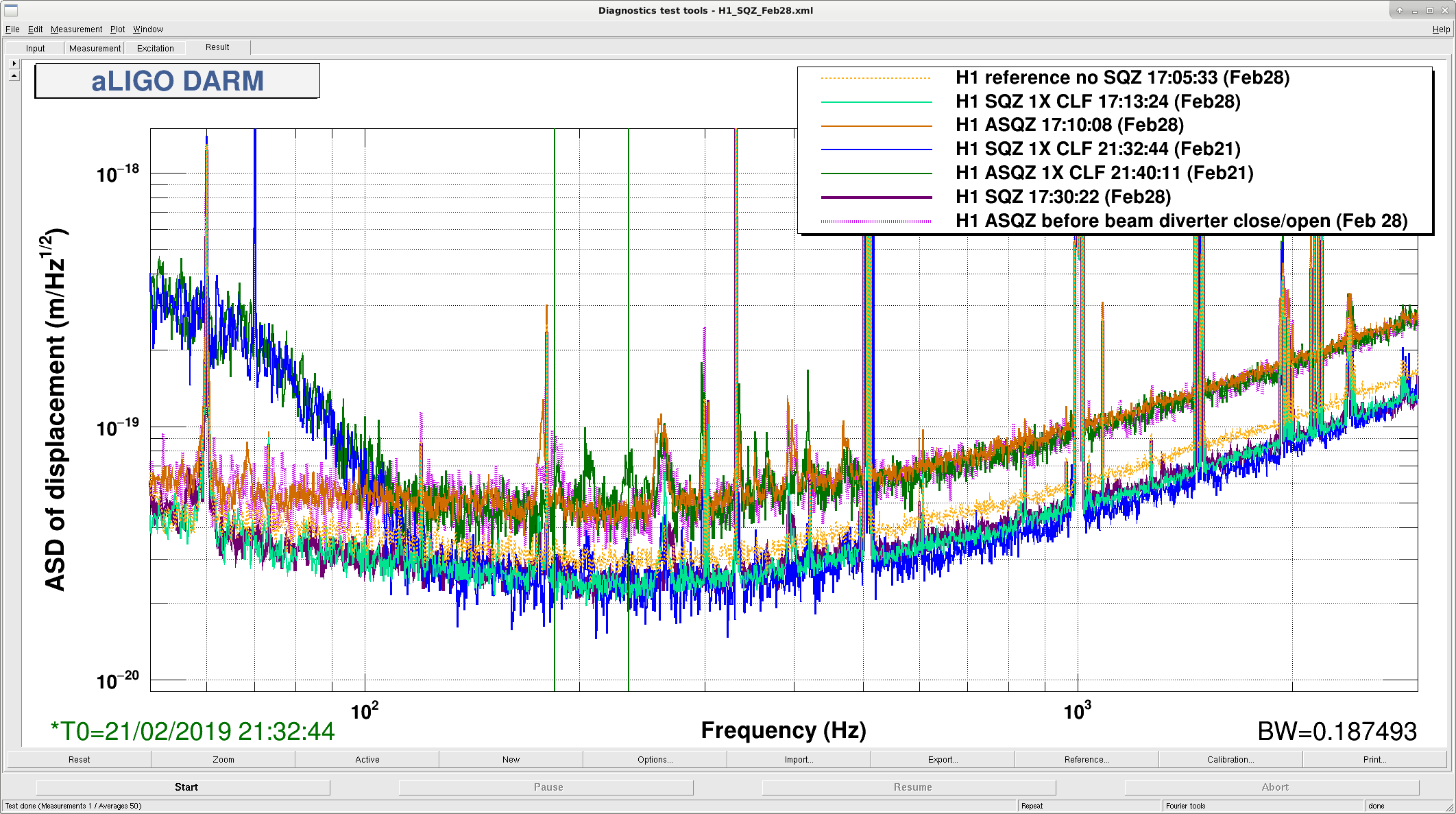
The peaks at 206Hz and 234Hz are gone. I guess the PBS did something good. The other two lines are still persistent. One at 177.7Hz got worse after I closed and reopened the beam diverter after a long lock (orange trace for ASQZ, cyan for SQZ). Compare to purple trace that I took right when I got in the control room. The line at 262Hz got worse after the beam diverter closed/opened but got better after sometime passed (dark purple). Maybe this suggests something mechanical? The next thing to do is to check the coherence with accelerometers.


Note that I kept the phase the same as last sqz measurement and I didn't optimized the nlg before I took this measurement (temperature setting was the same as last time).


Images attached to this report
Comments related to this report
chris.whittle@LIGO.ORG - 15:27, Friday 01 March 2019 (47229)SQZ

You could try taking another spectrum with the noise eater turned off. At LLO we found the noise eater was adding a peak at ~200Hz to our CLF (aLOG 43780).

H1 ISC
sheila.dwyer@LIGO.ORG - posted 23:25, Wednesday 27 February 2019 - last comment - 02:17, Tuesday 05 March 2019(47176)
starting noise budget, DHARD noise is high

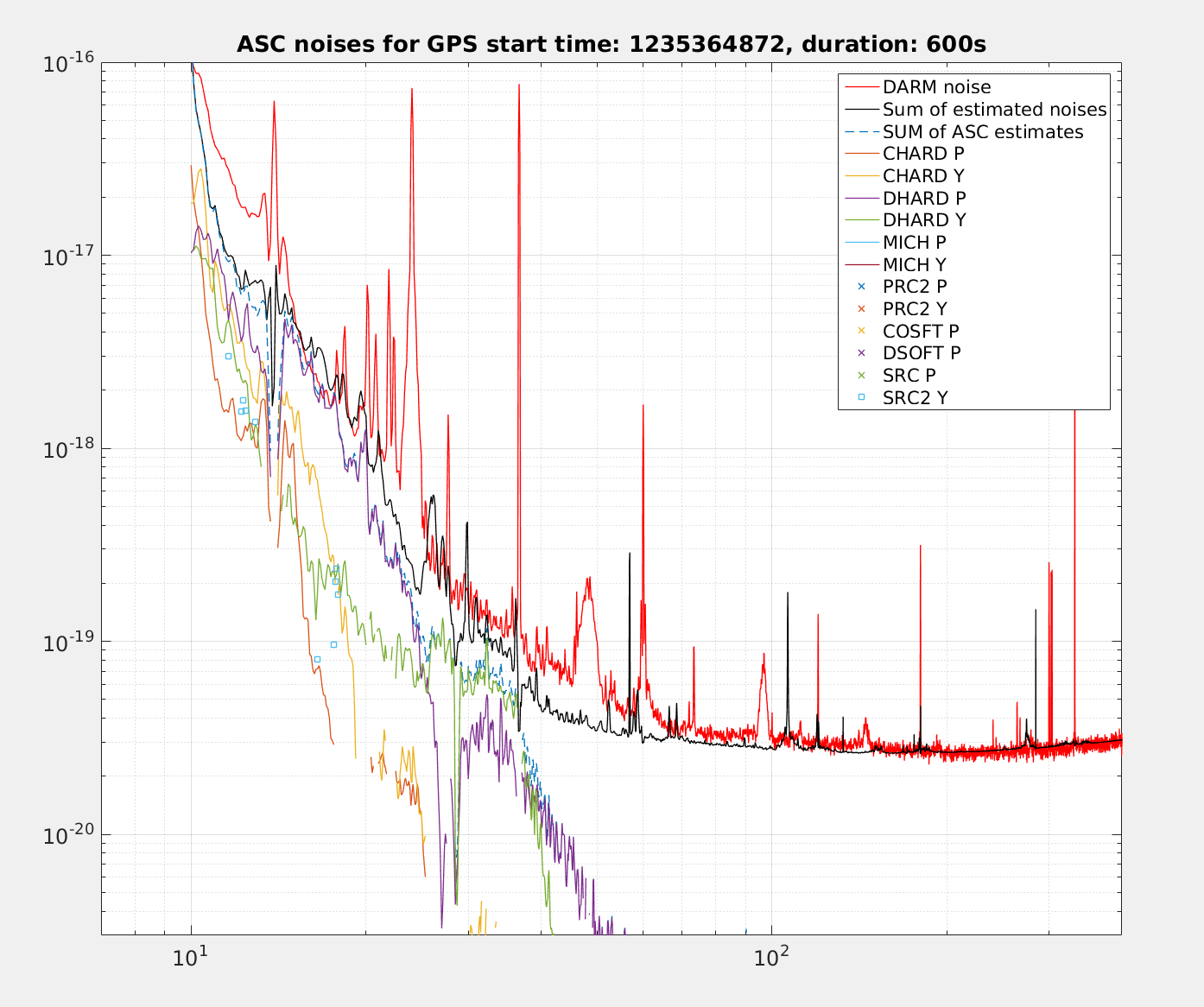
We got a few noise budget injections done in this lock before we lost lock.  We will post a more complete noise budget once we have some more of the excitations done, a partial noise budget for the ASC noise contributions to DARM are attached. 

The other interesting thing that we found was that MICH is only about a factor of 3 below DARM from 60-80Hz.  

After we lost lock we needed to redo initial alignment, this might require realignment on ISCT1 since Jenne updated the initial alignment references for our new spot positions. 47168

Images attached to this report
Comments related to this report
craig.cahillane@LIGO.ORG - 01:46, Thursday 28 February 2019 (47177)
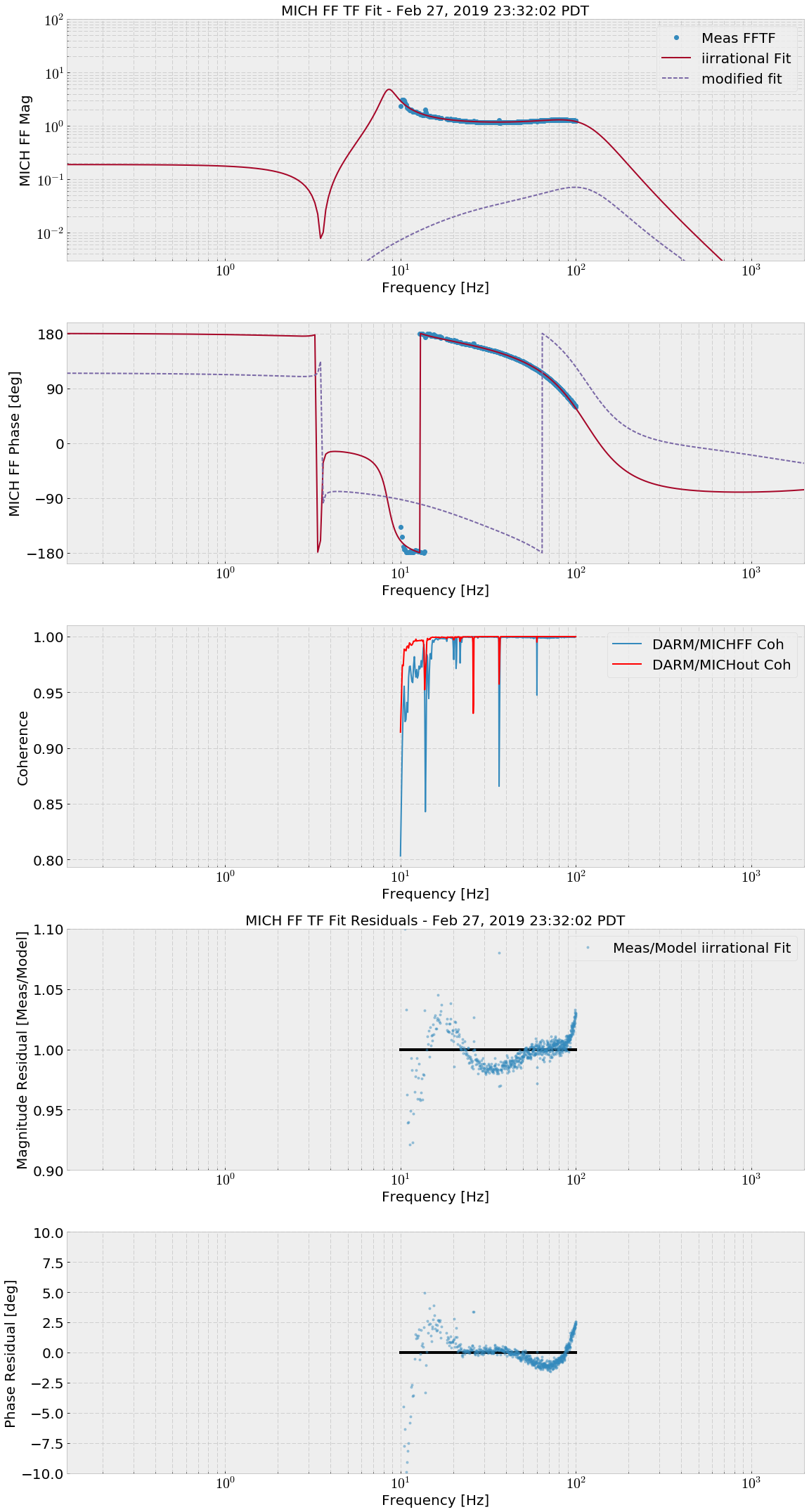
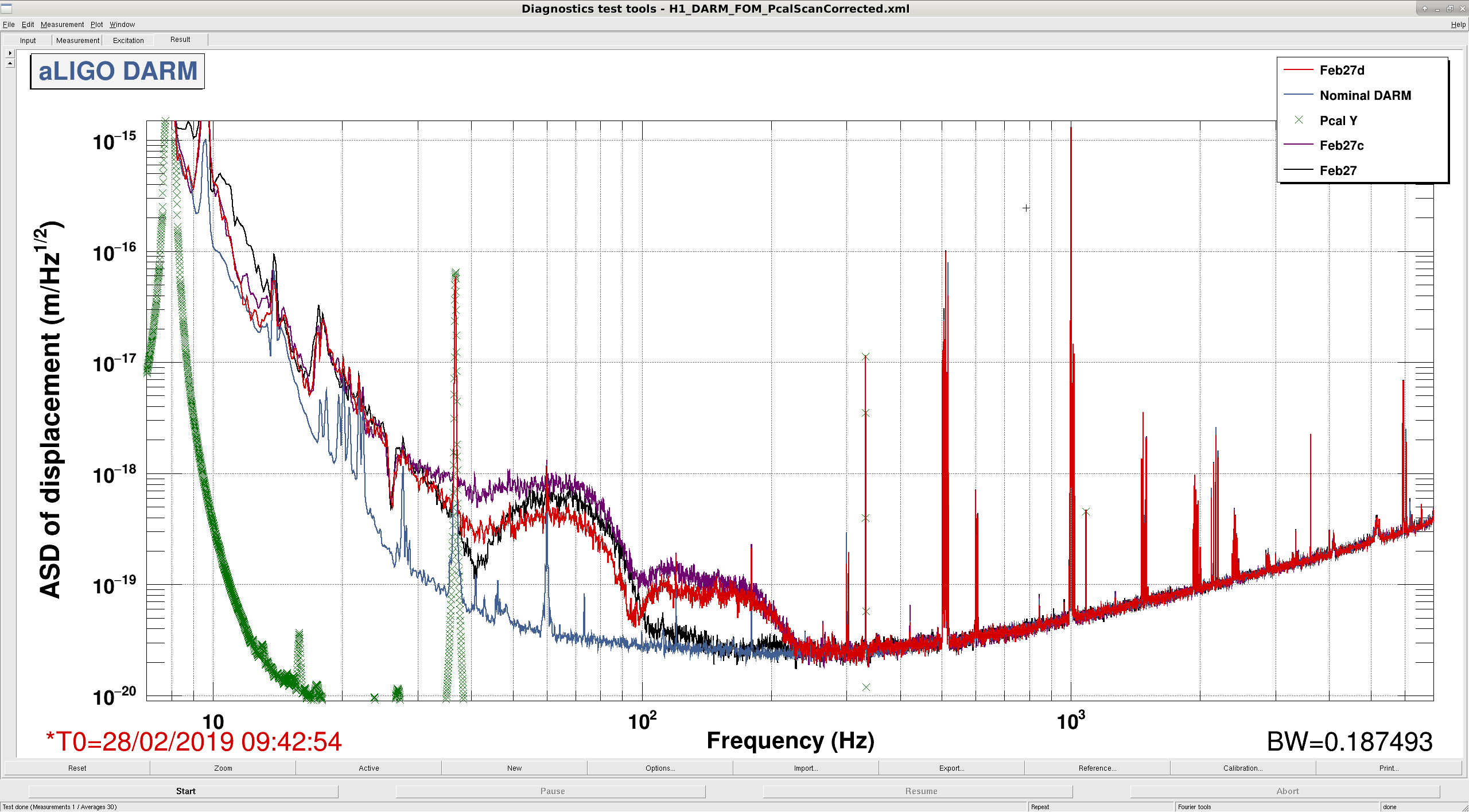
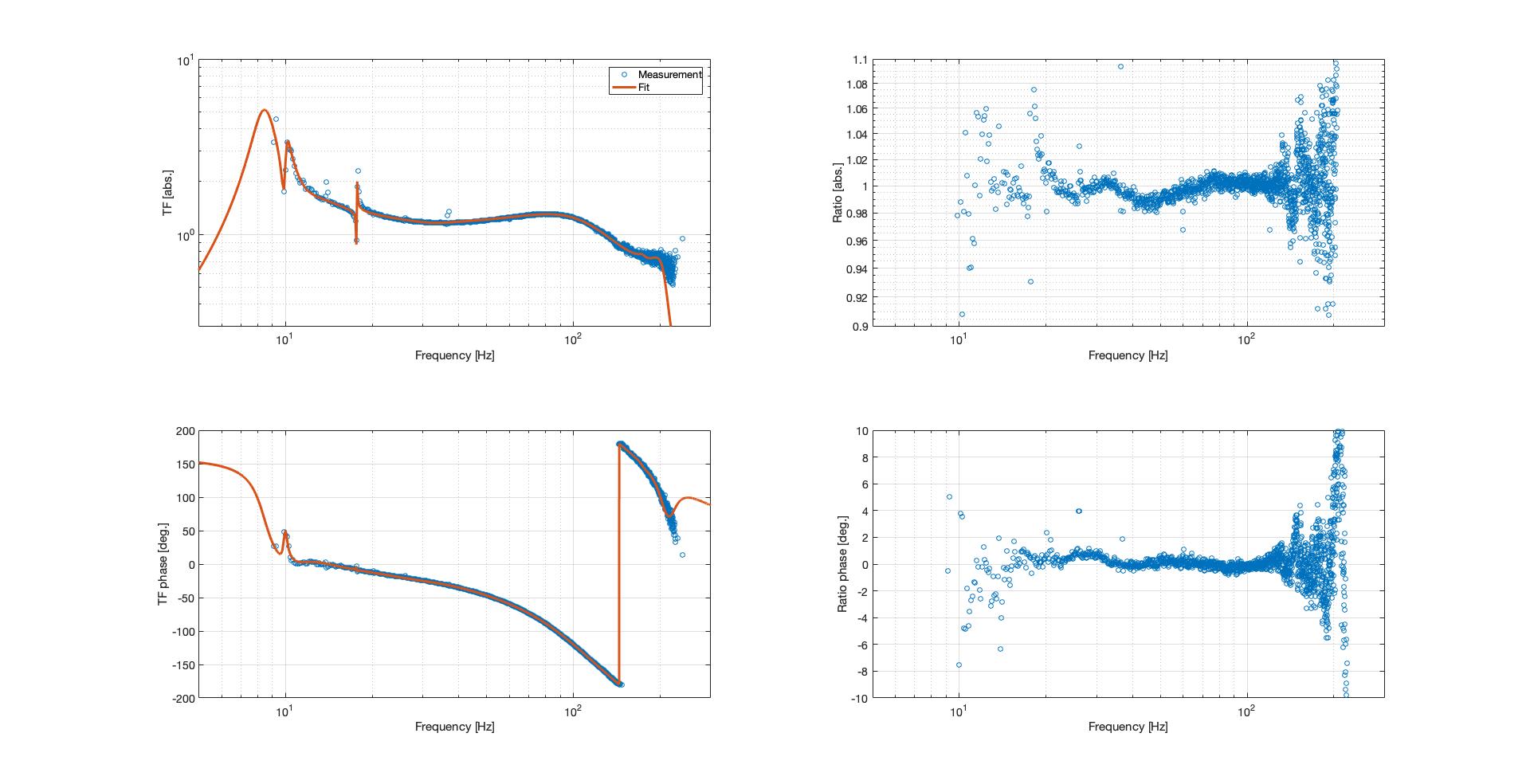
Redid the MICH FF and added another filter, Feb27c, to MICHFF FM8.  Filter shown in the plot.  Feel free to try it in the morning.  

Feb27c takes advantage of Danny's beamsplitter suspension resonance measurement.

So far the best known feedforward is Feb27, in FM6.  Feb27b gave worse noise than Feb27.

Feb27c also gave worse noise than Feb27.  The problem is the ~1 degree phase mismatch around 70 Hz in the MICHFF TF fit.

Also some Feb27d was made and is sort of better at 70 Hz but is worse at 100 Hz.  Leaving this one on for now.
Images attached to this comment
gabriele.vajente@LIGO.ORG - 12:35, Thursday 28 February 2019 (47192)

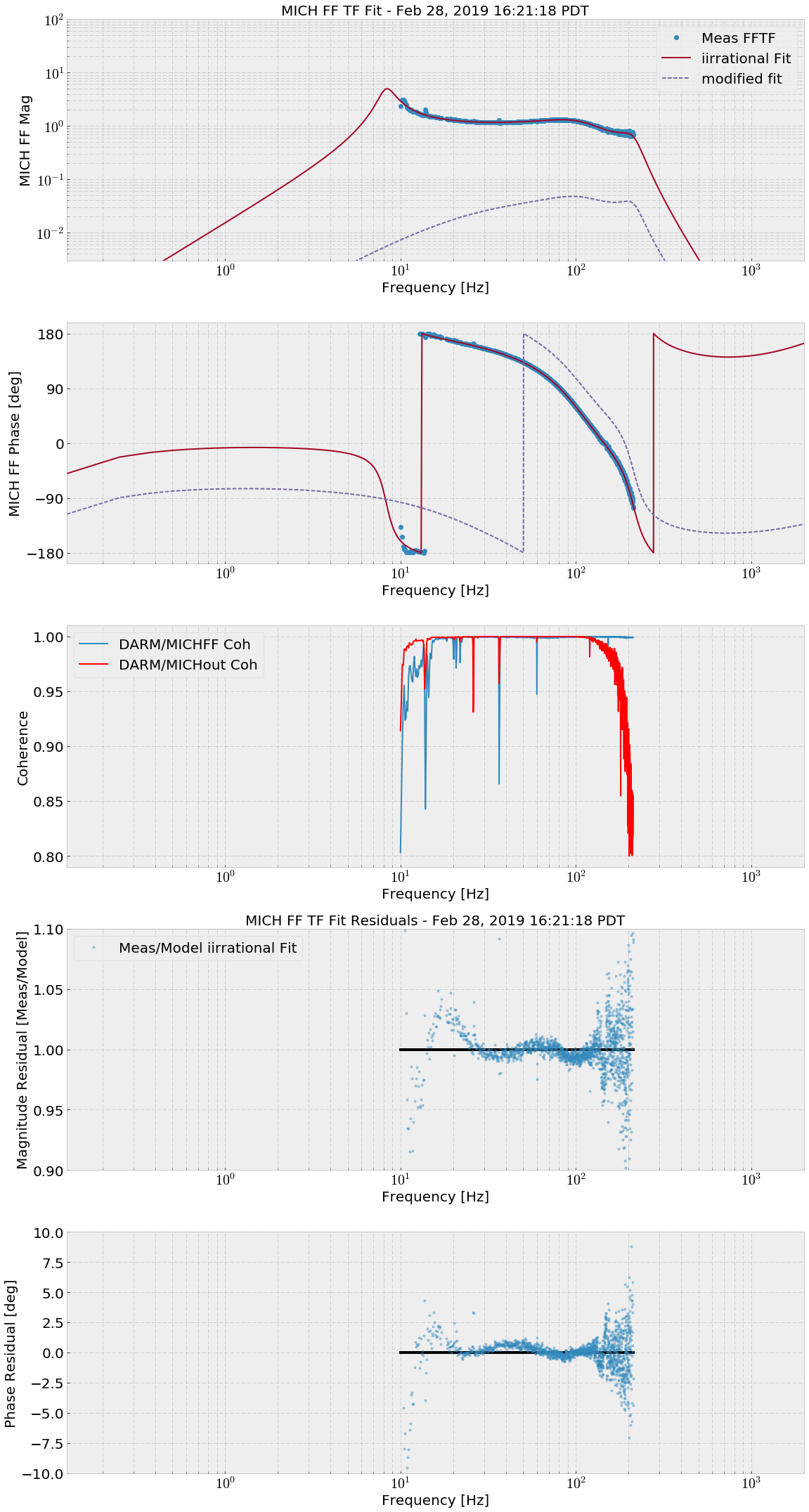
Here's a fit to the MICH FF which might have a better residual.

zpk([1030.2733+i*950.7986;1030.2733-i*950.7986;-94.6683+i*1386.0676;-94.6683-i*1386.0676;-38.9617+i*1095.7877;-38.9617-i*1095.7877;-47.1472+i*199.6596;-47.1472-i*199.6596;-15.1585;-0.025039+i*111.0189;-0.025039-i*111.0189;8.3412;-10.6324+i*71.093;-10.6324-i*71.093;-0.91023+i*62.1857;-0.91023-i*62.1857],[-5.0157+i*52.8173;-5.0157-i*52.8173;-1.2463+i*63.023;-1.2463-i*63.023;-13.5628+i*70.3543;-13.5628-i*70.3543;-0.0019152+i*111.1789;-0.0019152-i*111.1789;-48.6805+i*199.3746;-48.6805-i*199.3746;-335.845+i*587.6419;-335.845-i*587.6419;-37.2718+i*1094.6672;-37.2718-i*1094.6672;-88.2415+i*1288.8722;-88.2415-i*1288.8722],1)

Gain at 100 Hz: 1.24488138312429 (complex = -0.625528556960358 -      1.07631021665528i)


Images attached to this comment
craig.cahillane@LIGO.ORG - 18:49, Thursday 28 February 2019 (47204)
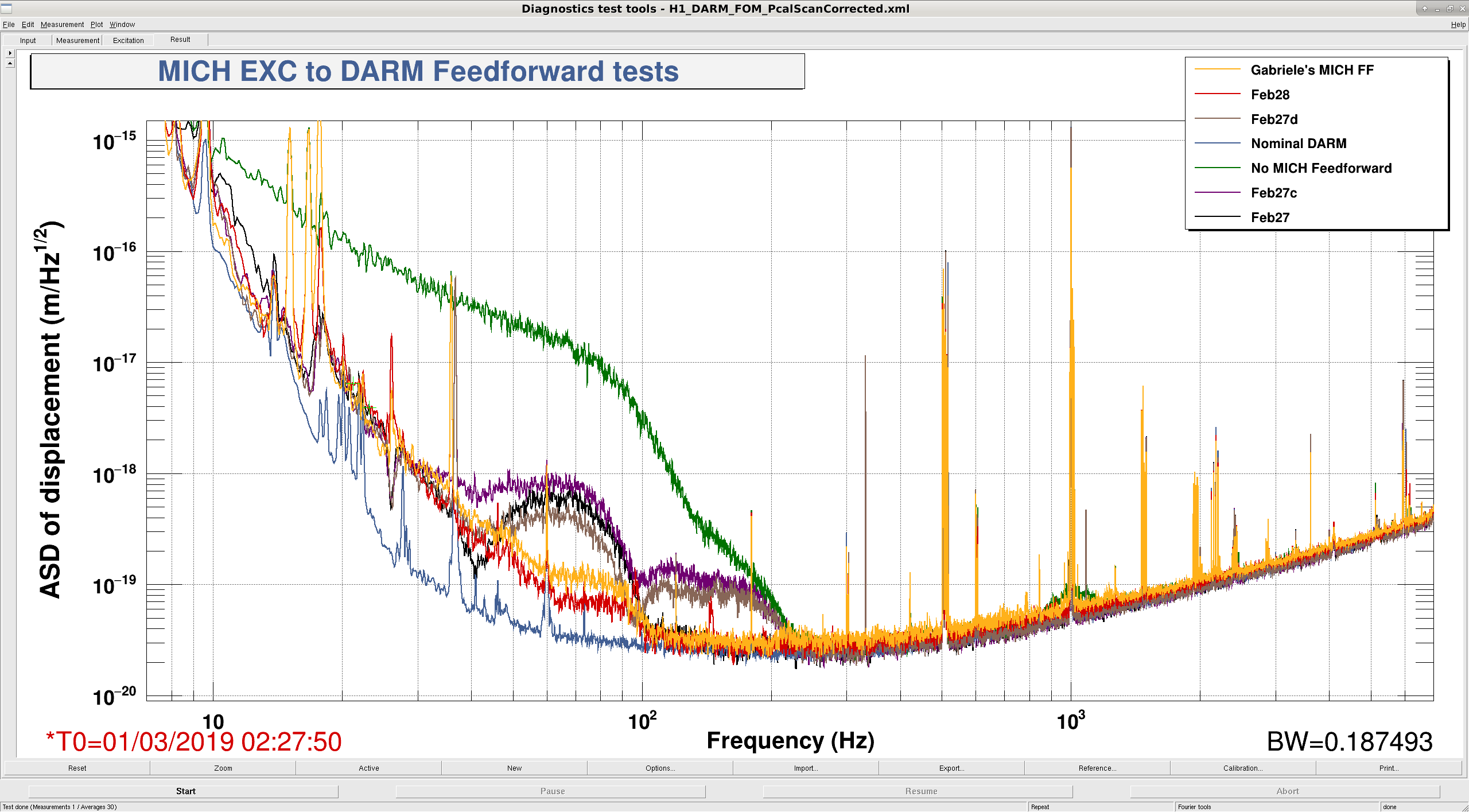
Tried Gabriele's filter in FM1 (copied below, scaled by -0.21415 gain, the one above does not agree with foton), as well as a new FF from me, called Feb28 in FM3 and plotted below.
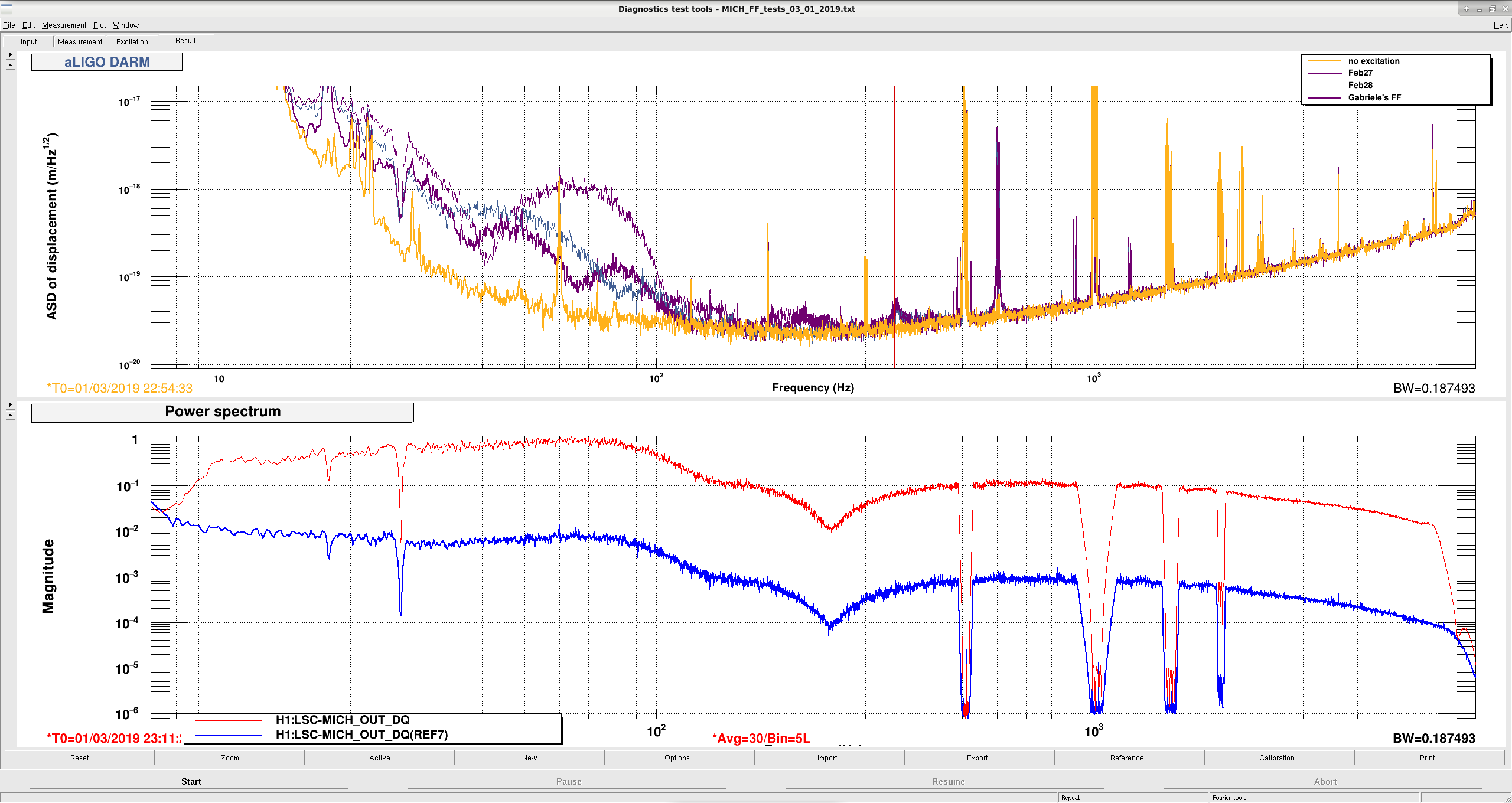
Reran the injection test from last night.  Both Gabriele's FF and Feb28 are much better than yesterday's MICH FF.  These tests were done at the beginning of a lock, prior to complete thermalization taking place.  Unclear if this matters to the FF quality.


Gabriele's FF
zpk([1030.2733+i*950.7986;1030.2733-i*950.7986;-94.6683+i*1386.0676;-94.6683-i*1386.0676;
    -38.9617+i*1095.7877;-38.9617-i*1095.7877;-47.1472+i*199.6596;-47.1472-i*199.6596;-15.1585;
    -0.025039+i*111.0189;-0.025039-i*111.0189;8.3412;-10.6324+i*71.093;-10.6324-i*71.093;
    -0.91023+i*62.1857;-0.91023-i*62.1857],

    [-5.0157+i*52.8173;-5.0157-i*52.8173;-1.2463+i*63.023;-1.2463-i*63.023;-13.5628+i*70.3543;
    -13.5628-i*70.3543;-0.0019152+i*111.1789;-0.0019152-i*111.1789;-48.6805+i*199.3746;
    -48.6805-i*199.3746;-335.845+i*587.6419;-335.845-i*587.6419;-37.2718+i*1094.6672;
    -37.2718-i*1094.6672;-88.2415+i*1288.8722;-88.2415-i*1288.8722],
-0.21415
)
Images attached to this comment
daniel.vander-hyde@LIGO.ORG - 15:58, Friday 01 March 2019 (47231)

Measured MICH with the different feedforward filters after 3 hours into a lock. Both filters are better than Feb27. I switched out Feb27 with GabFF and used it to update MICH in the the noise budget.

Images attached to this comment
craig.cahillane@LIGO.ORG - 22:01, Friday 01 March 2019 (47238)
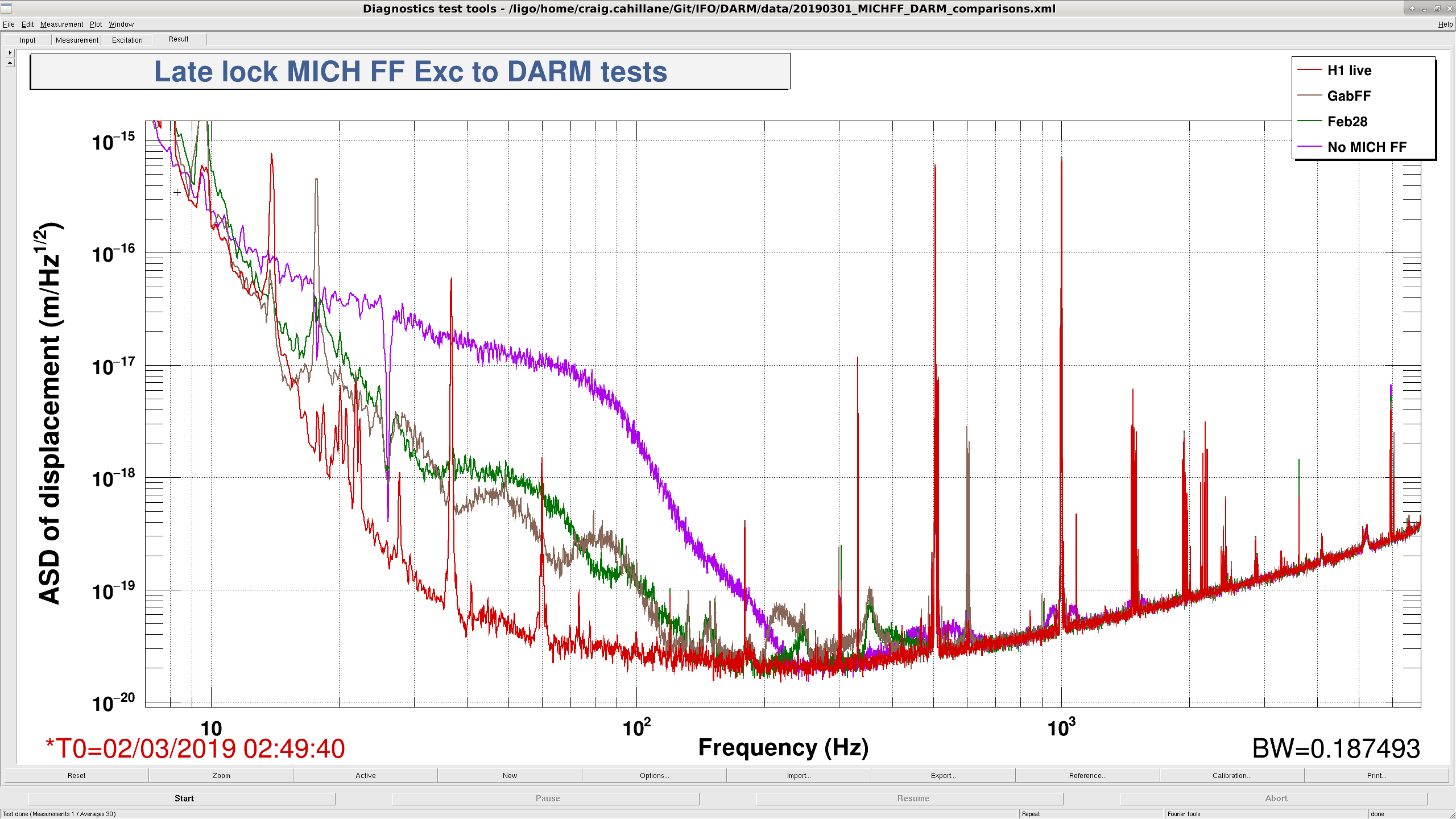
We re-reran the MICH coupling later in the same lock.  Danny said his test above had a slightly different excitation for each filter. 
Both GabFF and Feb28 are much worse.  GabFF seems to be the better filter now.  The overall frequency coupling is changed as well.  
It seems that further thermalization changed the feedforward even further, spoiling the linear noise cancellation.  

MICH to DARM length noise is projected to be only a factor of 3 below DARM with these levels of feedforward.  We may need to make early/late lock MICHFF filters.
Images attached to this comment
Displaying reports 42821-42840 of 88658.Go to page Start 2138 2139 2140 2141 2142 2143 2144 2145 2146 End