PeterK, RickS with help from Patrick, Filiberto, Mark, et al.
After Peter swapped in the spare chiller pair (Crystal and Diode), and moved the hardware for reducing the pressure of the Crystal chiller loop (valve and fittins), we had a small leak at the supply side of the Crystal chiller. We found that two of the SS 3/4 straight pipe thread fittings were seized, and we were were thus unable to eliminate the leak.
We were forced to switch back to the Crystal chiller that was operating earlier today (it was the Diode chiller that failed). However, after plumbing it in, we found that the controller failed to initialize.
We swapped in the controller from the spare Crystal chiller, the one with the seized water fittings, and we now seem to be back in business.
The PSL is back on-line, servos are locked, etc.
We need to a) order the supply side output connector for the spare crystal chiller from Termotek and b) order a replacement controller for the original chiller (that is now in service), and c) make sure we have enough spare parts - controllers, etc.
TITLE: 02/12 Day Shift: 16:00-00:00 UTC (08:00-16:00 PST), all times posted in UTC
STATE of H1: Preventive Maintenance
INCOMING OPERATOR: None
SHIFT SUMMARY:
Today was a full Maintenance Day with LHO Site opening up after being closed for last 3-days due to snow. Notable items:
LOG:
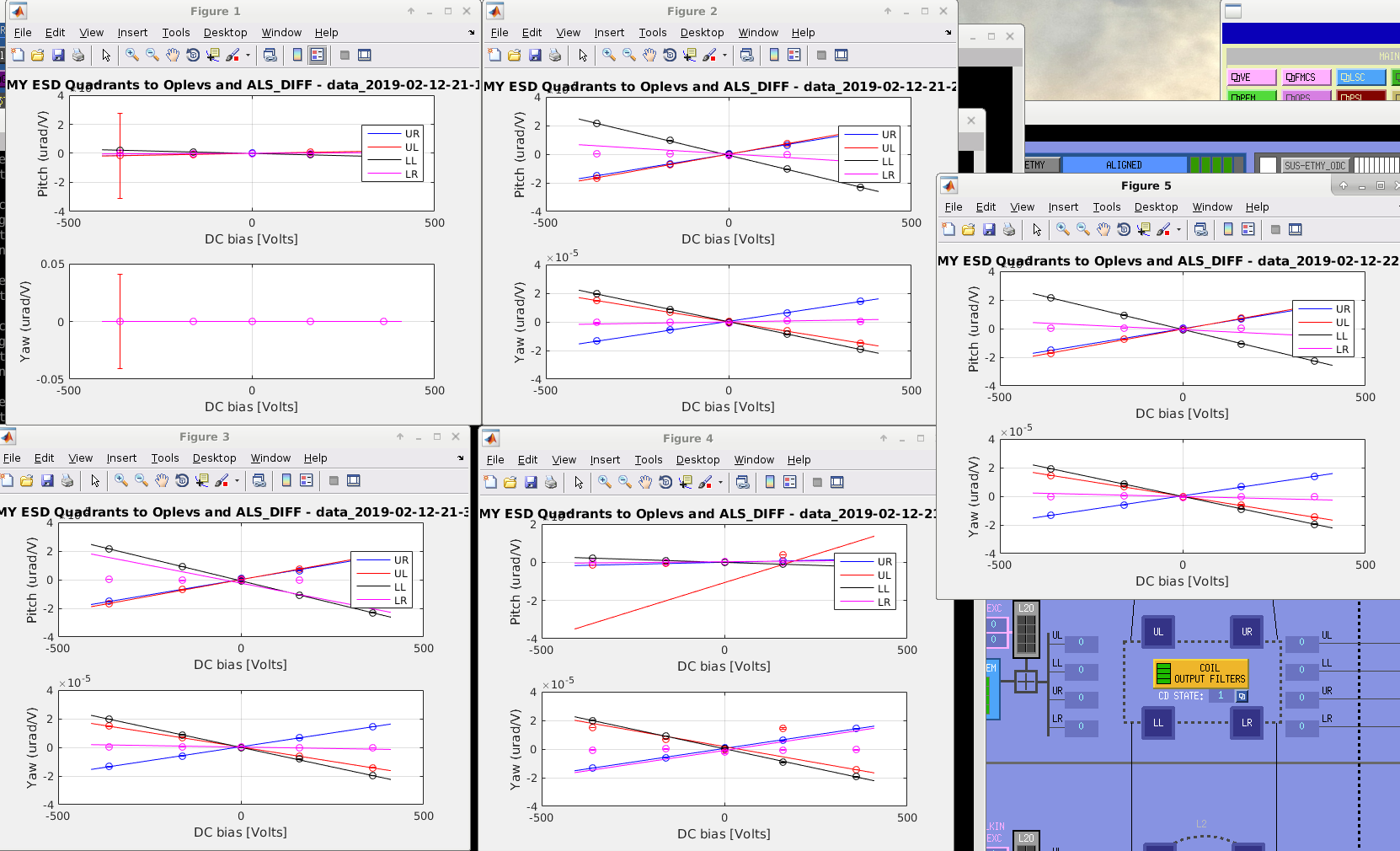
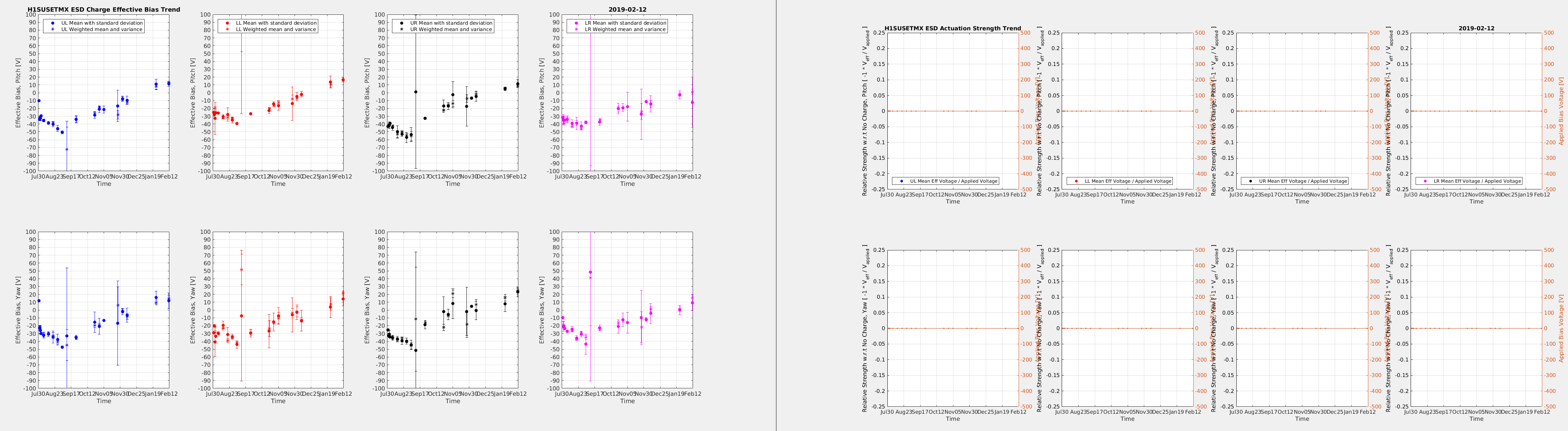
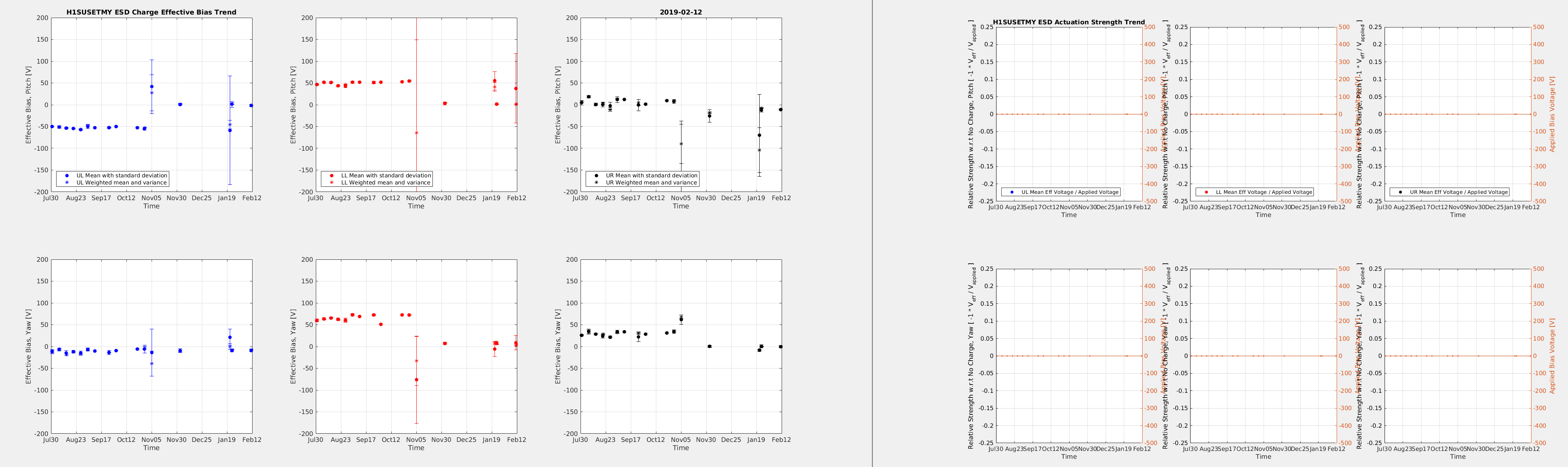
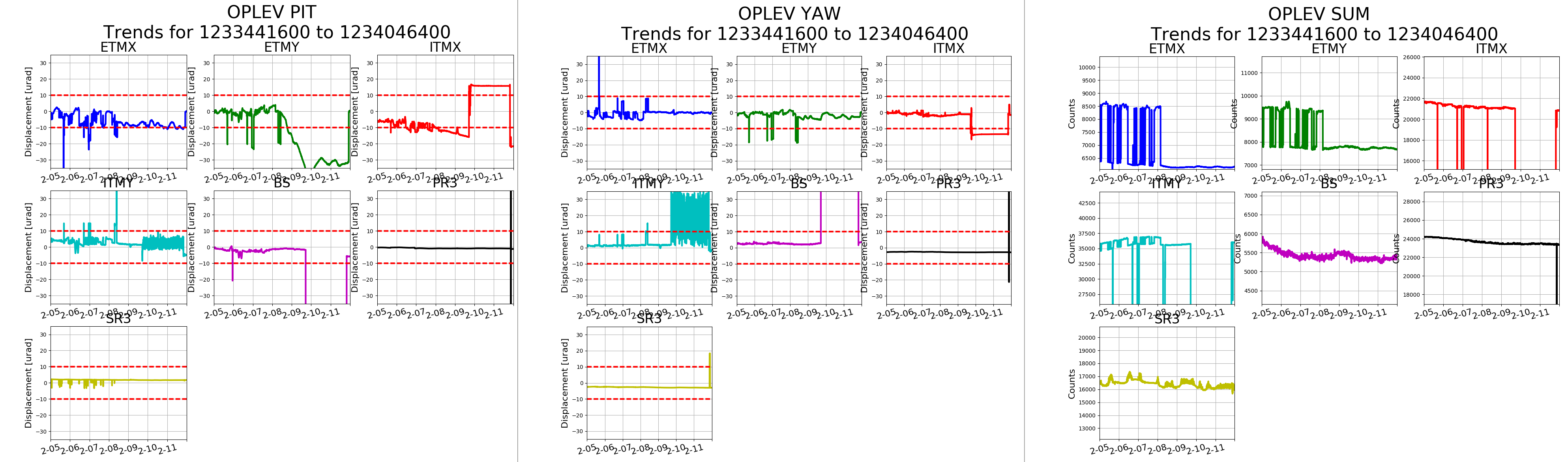
Attached are trends.
Notes:
Notes on the procedure/measurements:
Here are the original Slider Values (which I returned to after the measurement):
ETMx:
ETMy:
Laser Status:
Front End Power is 31.53W (should be around 30 W)
70W Output Power is 71.57W
Front End Watch is RED
70W Watch is GREEN
PMC:
It has been locked 0 days, 0 hr 44 minutes (should be days/weeks)
Reflected power = 10.69Watts
Transmitted power = 53.62Watts
PowerSum = 64.31Watts.
FSS:
It has been locked for 0 days 0 hr and 42 min (should be days/weeks)
TPD[V] = 2.033V (min 0.9V)
ISS:
The diffracted power is around 2.7%
Last saturation event was 0 days 0 hours and 33 minutes ago (should be days/weeks)
Possible Issues:
PSL chiller was swapped today, so it had come back recently when this report made.
The spare chiller (Gromit) was swapped in, after some plumbing adjustments. Laser is back up. The current flow rates look about the same as before. Not so sure about the water pressures. The valve at the back of the crystal chiller needs to be adjusted to where it was. Fil, Patrick, Peter
Richard, Corey, Dave:
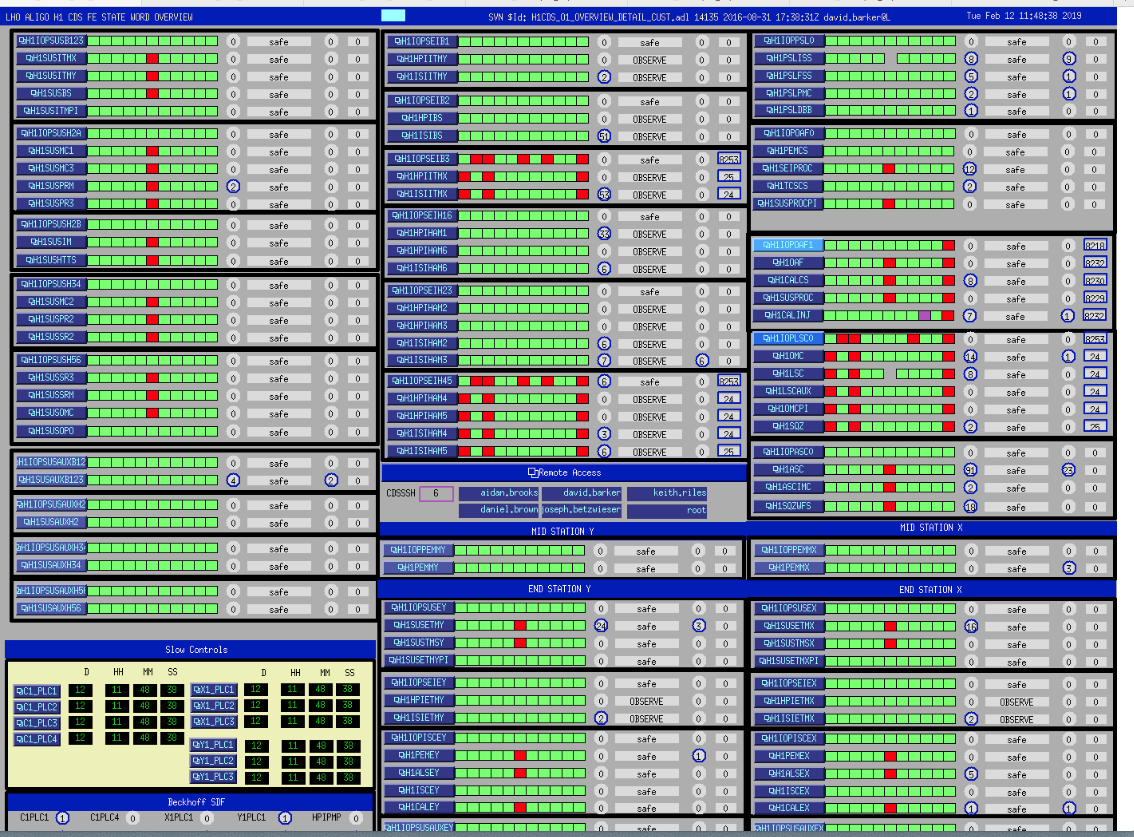
We have just had timing errors on three front end computers (h1lsc0, h1seib3 and h1seih45). There is no immediately obvious connection between these three FECs.
All 3 FECs still see their IOChassis.
I've captured the diagnostics and am in the process of restarting the models.
here is the overview before anything was restarted. Because I'm restarting h1ioplsc0 (timing master) I'll restart all models on h1oaf1 (timing slave).
Opened FRS12311
Restarted (using startWorld.sh) models on the following FECs in the following order
h1seib3
h1seih45
h1lsc0
h1oaf1
All looks good now, handing over to Corey to complete the recovery.
BTW: there was an excitation running on h1calinj, perhaps it should be restarted.
WP 8089 was approved by Keita, Jeff, and Dave over email, and the DMT production computers have been updated to gds-2.18.14.
All dmt production machines have been restarted and seem to be running normally. Included in the update/restart was a reconfiguration of the ODC-based segments to use equivalent GRD channels (the GRD channels still need to be added to the broadcaster list) and the addition of a DQ vector bit indicating an overflow in the ETMX ESD DAC.
TITLE: 02/12 Day Shift: 16:00-00:00 UTC (08:00-16:00 PST), all times posted in UTC
STATE of H1: Preventive Maintenance
OUTGOING OPERATOR: None
CURRENT ENVIRONMENT:
Wind: 5mph Gusts, 4mph 5min avg
Primary useism: 0.10 μm/s
Secondary useism: 0.54 μm/s
QUICK SUMMARY:
"LHO Site Open" with a suggested arrival time of 10am, but please exercise caution with travel.
Tuesday Maintenance is still on:
Richard, Dave:
We restarted all the models on h1susb123 (h1sus[itm[x,y,pi], bs], h1iopsusb123) to clear the DAC drive issue.
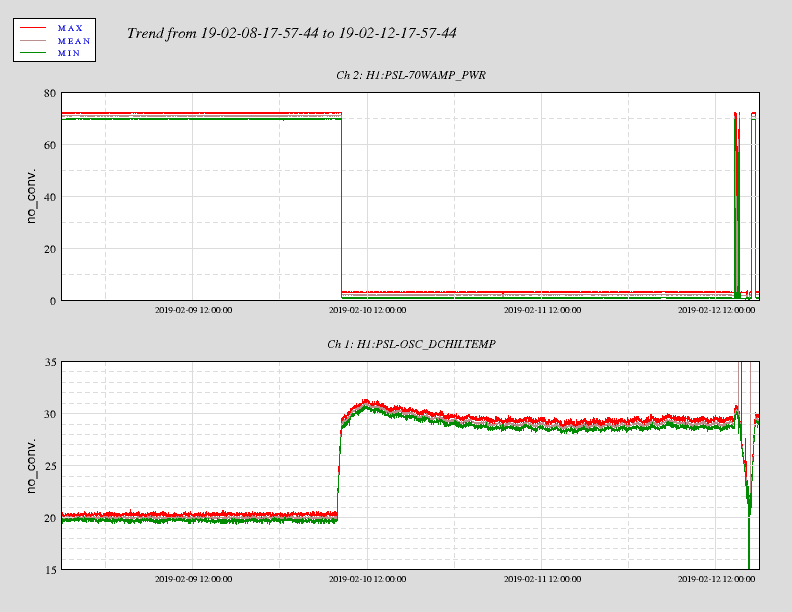
The laser has since tripped since being brought back. Attached is a plot of the laser power and
diode chiller temperature. It looks like the loss of cooling capacity coincides with the laser
tripping. Even with no heat load, the water temperature of the diode chiller has not come down
in the last 30-40 minutes.
Prepping to sub in the spare chiller.
This looks very familiar to the failure that occurred at LLO last week with the a failure of the controller operating the hot gas valve bypass. If the chiller is still on, have a feel of the hot gas valve line and see if its scorching hot like we found it to be here. This was because the hot gas valve solenoid would just stay constantly on, thereby heating up the water and throwing the DB overtemp fault.
Note I have found out from Technotrans that we can not just swap controllers between chillers, even chillers of the same model. The are software coded for a unique S/N of a chiller.
I am currently in the process of getting spare controllers for LHO, so if LHO can provide me with a list of the S/Ns of the chillers they want to have a spare controller for (I only asked for two controllers) I can pass that info on to my technotrans spare parts rep.
In an email from Jeff this morning:
All, Thanks to efforts of the advance team for the last two days, the LIGO Hanford site is now open. Employees electing to work on site should use caution and judgment in safe routes of travel. As start times have been delayed to 9:00 am and 9:30 am for DOE Hanford site workers, given the heavy traffic that entails, it is strongly advised to plan arriving from 10 am. Also, please note that ice and snow, along with snow-covered ice, are present even in cleared areas, and that personnel are advised to walk carefully in the parking lots and on the walkways between buildings. Best Regards, Jeff Jones
[Rana, Jamie]
We spent the evening trying to get more measurements of the 9MHz RIN situation, basically redoing what was done in LHO log 46586. We went to ITMY single-bounce and locked OMC on carrier, then went to PRMI and locked OMC on 9MHz. I'll post plots tomorrow.
FYI the OMC and PRMI configurations might be a little bit funky. We didn't get to reset everything yet to get back to low noise, just in case any one tries to brave the snow to get back out here.
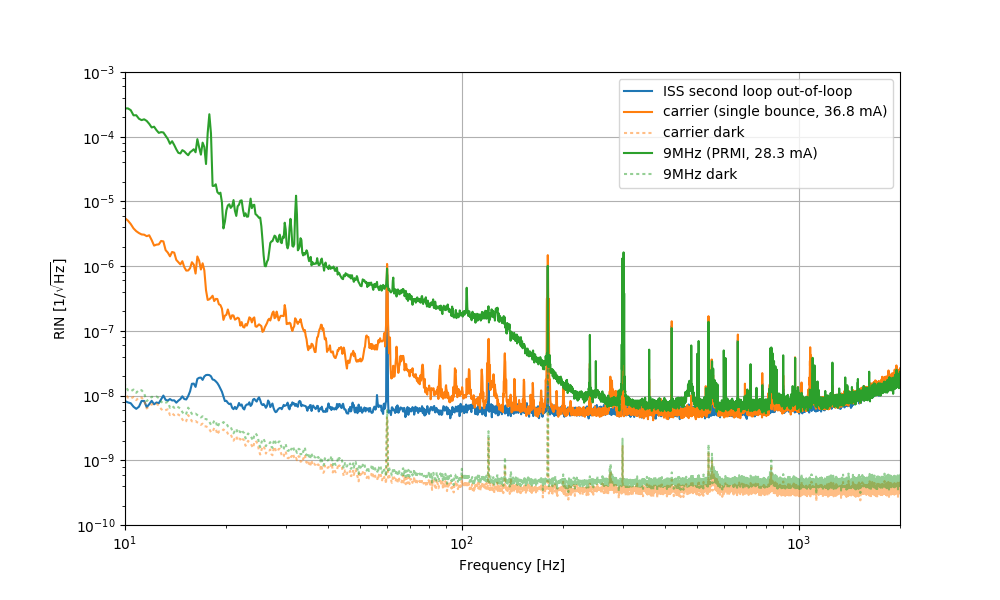
Friday night Rana and I re-measured the relative intensity noise (RIN) in the carrier and 9MHz sideband at the OMC DCPD. We believe we got a lower noise measurement (first attachment) than what Craig and Koji measured previously (LHO 46586) by:
For the carrier measurement used single bounce off of ITMX with 25W input, and for the 9MHz used PRMI (where the 9MHz sideband is largest) with 35W input.
We don't see any excess RIN in the 9MHz above 300 Hz.
1233733816 carrier measurement 1233738050 9MHz measurement 1233738400 dark noise measurement
1) the carrier RIN in your plot at 30 Hz is in the 1e-7 region. Do we believe this excess above the ISS second loop measurement and above the noise floor? Or is it OMC length noise?
I’m asking because a RIN of 2e-7 is what we need to be limiting DARM, see https://alog.ligo-wa.caltech.edu/aLOG/index.php?callRep=46759
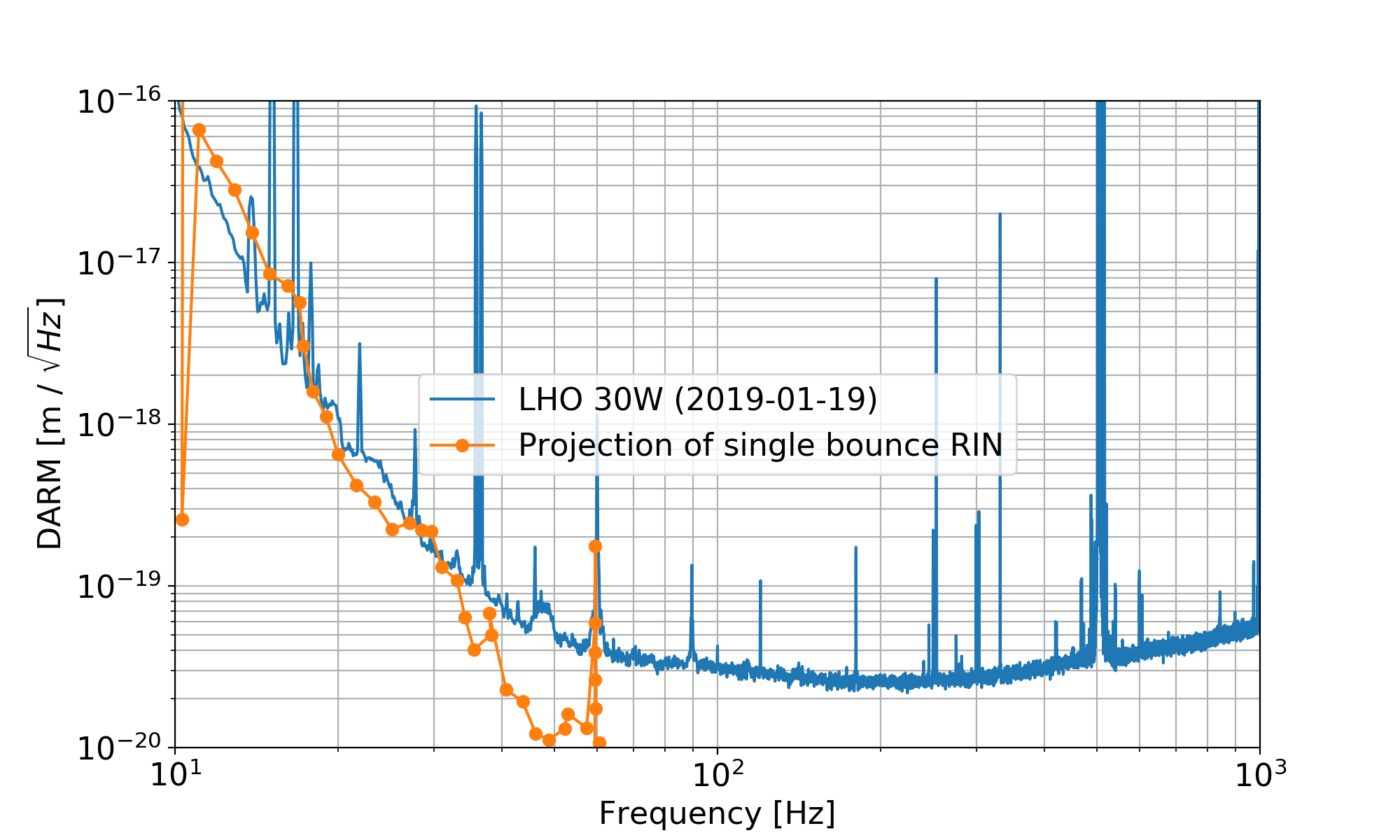
If we believe the carrier single bounce RIN measured by Jamie and Rana, and use the radiation pressure intensity noise coupling (based on 8% power imbalance and matching Craig's measurement in 46817), we get something pretty close to the DARM noise:
2) same question for the excess SB RIN? Is that PRMI control noise?
For 35W input power, the ISS inner PD shows 27.3mA, whereas the outer shows 29.7mA.
Note I think it's possible that we were looking at the 45MHz sideband in the PRMI lock, rather than the 9MHz sideband. We will attempt to retake this measurement once the IFO is recovered.
it seems that the OMC length lock is not strong enough to measure low RIN - this is why the increase of the OMC length dither decreases the RIN.
Most of the low frequency peaks are due to acoustics - we were using the QPDs for OMC-ASC instead of angular dither.
Peter called in to diagnose PSL over the phone.
I first pressed "reset" in the STATUS screen where "INTERLOCK OK" was red.
Then I turned on the NPRO, and then 70W amplifier, but the NPRO tripped after a while.
I pressed reset in the STATUS screen again, turned on NPRO, waited for a while without turning on 70W amplifier, and the NPRO tripped again.
In CHIL_DIAG screen, Diode Chiller temperature was 30.7C though the set point was 20C. Xtal chiller was good. (First attachment.)
I left PSL off, turned off auto locker for PMC, FSS and ISS. (Second attachment.)
When I got back to STATUS screen, Interlock OK was not red, but DB heatsink overtemp in Frontend section was red. (Third attachment.)
Peter will investigate tomorrow.