Displaying reports 43601-43620 of 88618.Go to page Start 2177 2178 2179 2180 2181 2182 2183 2184 2185 End
Reports until 08:09, Monday 14 January 2019
H1 General
cheryl.vorvick@LIGO.ORG - posted 08:09, Monday 14 January 2019 (46392)
OPS Morning Summary:

TITLE: 01/14 Day Shift: 16:00-00:00 UTC (08:00-16:00 PST), all times posted in UTC
STATE of H1: Commissioning
OUTGOING OPERATOR: None
CURRENT ENVIRONMENT:
    Wind: 9mph Gusts, 8mph 5min avg
    Primary useism: 0.09 μm/s
    Secondary useism: 0.37 μm/s
QUICK SUMMARY:


H1 PSL (IOO, PSL)
cheryl.vorvick@LIGO.ORG - posted 05:16, Monday 14 January 2019 (46390)
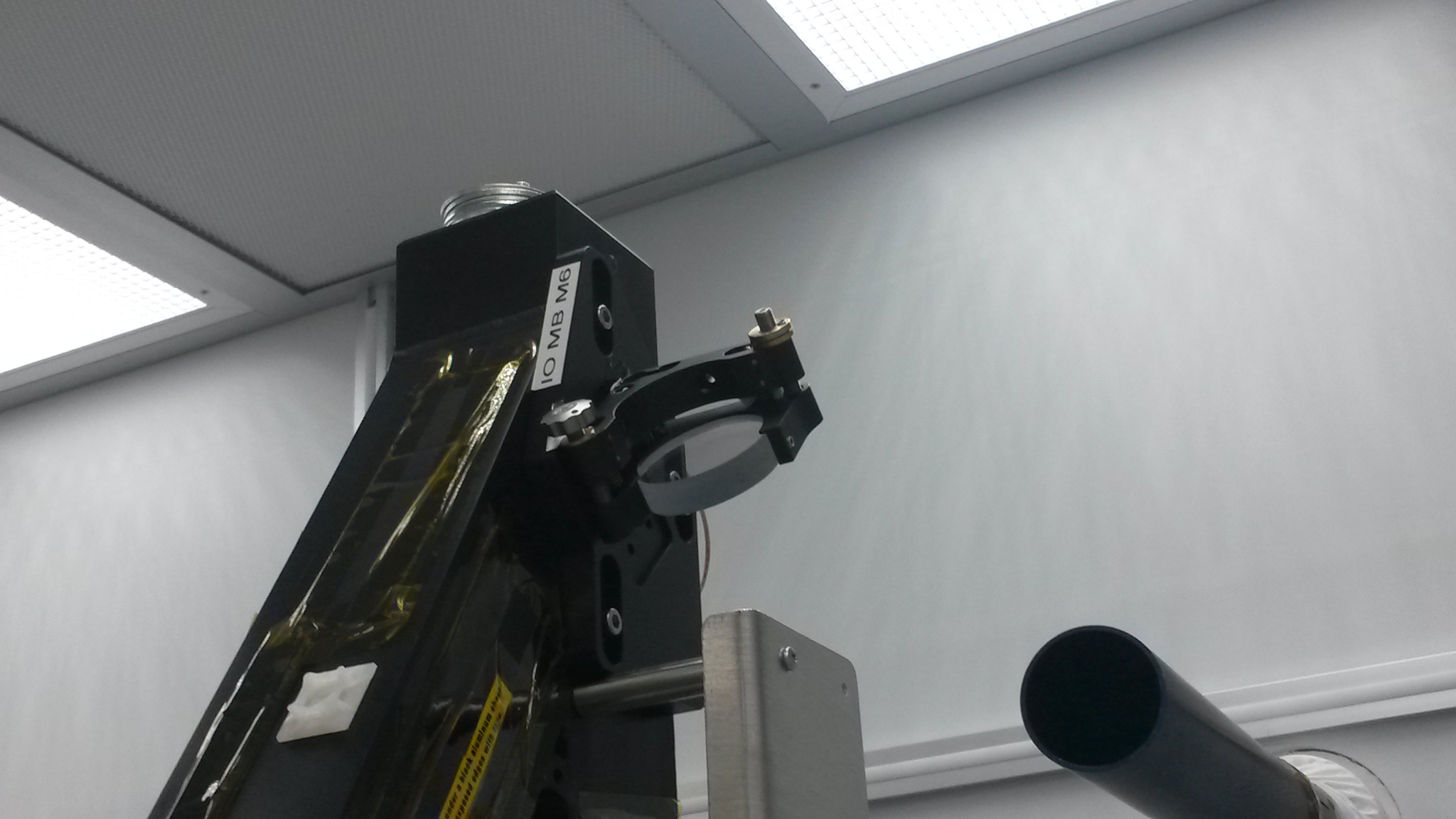
current PSL periscope pictures, as of 8 Jan 2019
Images attached to this report
H1 PEM
robert.schofield@LIGO.ORG - posted 19:45, Sunday 13 January 2019 (46388)
Proposed locations for large magnetic injection coils

We are planning on installing 7 large magnetic injection coils that can make large enough fields to show up broad-band in DARM. Previously we have been limited to comb injections; this was fine when the coupling was dominated by permanent magnets with simple power function coupling. But now we are dominated by coupling to cables and connectors and the coupling functions are not as simple, so we want to probe more of the spectrum with broad band injections.

We were happy with the prototype (https://alog.ligo-wa.caltech.edu/aLOG/index.php?callRep=43406), so we are going ahead and planning the next locations. The figure shows the proposed locations, which include the preferred order of installation.

Non-image files attached to this report
H1 ISC
thomas.vo@LIGO.ORG - posted 18:32, Sunday 13 January 2019 - last comment - 23:20, Sunday 13 January 2019(46387)
Locking

Robert, TVo

Notes for the morning crew:

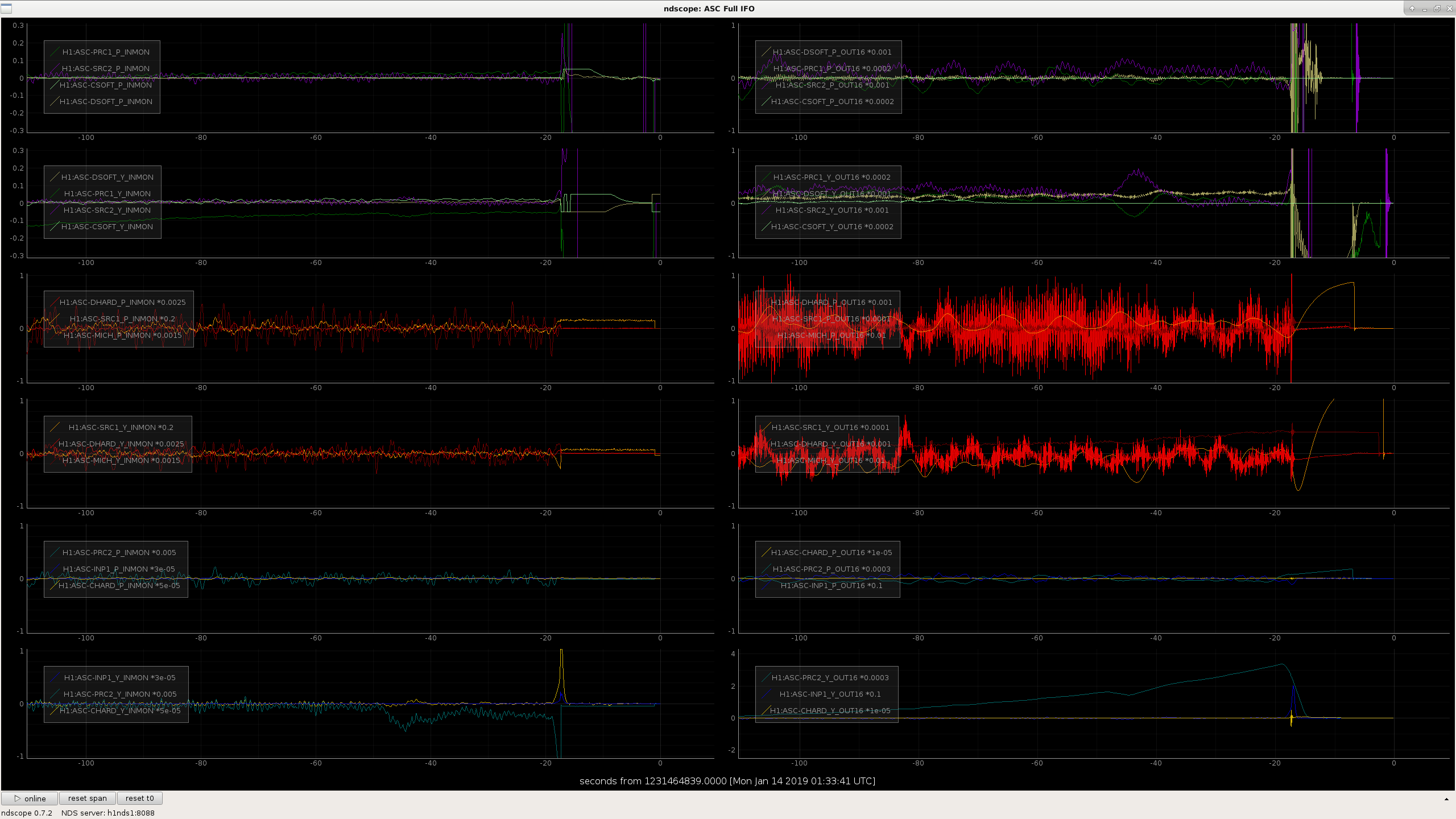
The interferometer needed some alignment work in order to lock reliably but after a full initial alignment, we were able to get up to Engage_ASC_FOR_FULL IFO pretty easily.  Still some ALS glitches in the X-ARM but not so bad that we were losing lock before shuttering.  The stopping point for tonight seems to be the engage soft loops, when initializing them PRC2 yaw gets pushed very far off until we lose lock so maybe the dither frequency change needs to get a little more tuning before we can move on.

Images attached to this report
Comments related to this report
georgia.mansell@LIGO.ORG - 23:20, Sunday 13 January 2019 (46389)

Oh no, I'm sorry blush! One thing that springs to mind that could be wrong is the YAW5 signal gain (before the phasing) used to be 2 and I changed it to 1 for the new line frequency but didn't implement the new line in guardian. 

Otherwise reverting the YAW4 frequency, bandpass filter, and gains in PREP_ASC, and final clock gain and I quadrature signal gain LOWNOISE_ASC should put you in the last configuration we locked in...

H1 ISC (ISC)
craig.cahillane@LIGO.ORG - posted 02:46, Sunday 13 January 2019 - last comment - 18:32, Wednesday 16 January 2019(46386)
Calibration of True Input Power
I have been wondering about the true input power, i.e. the input power incident on PRM, ever since the SRCL dither arm power measurement turned out so low.  

Conclusion
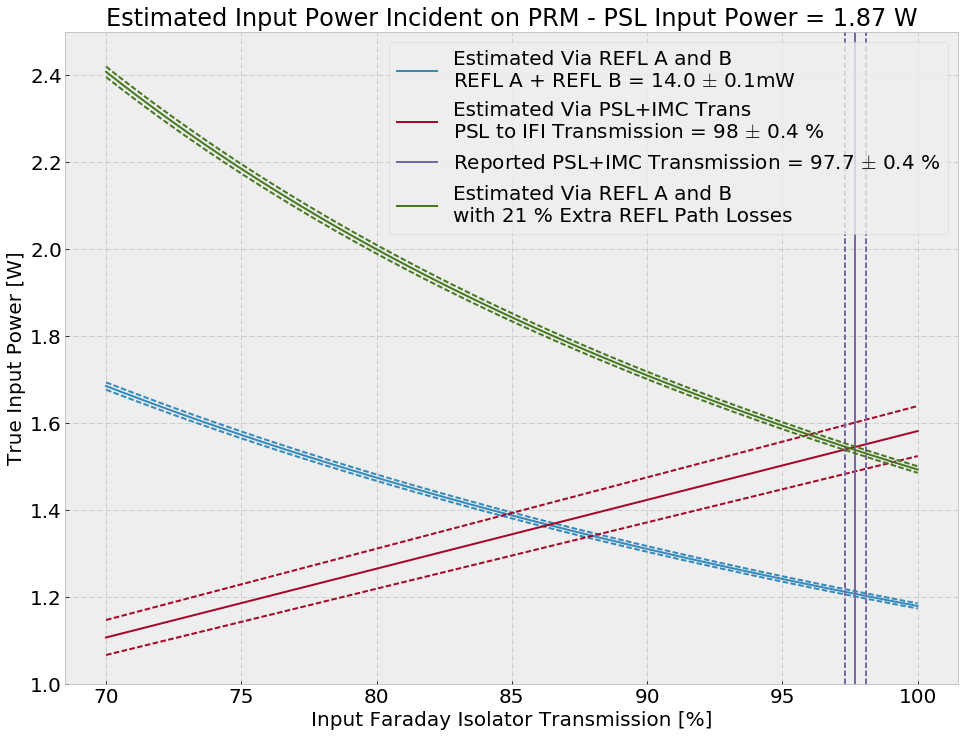
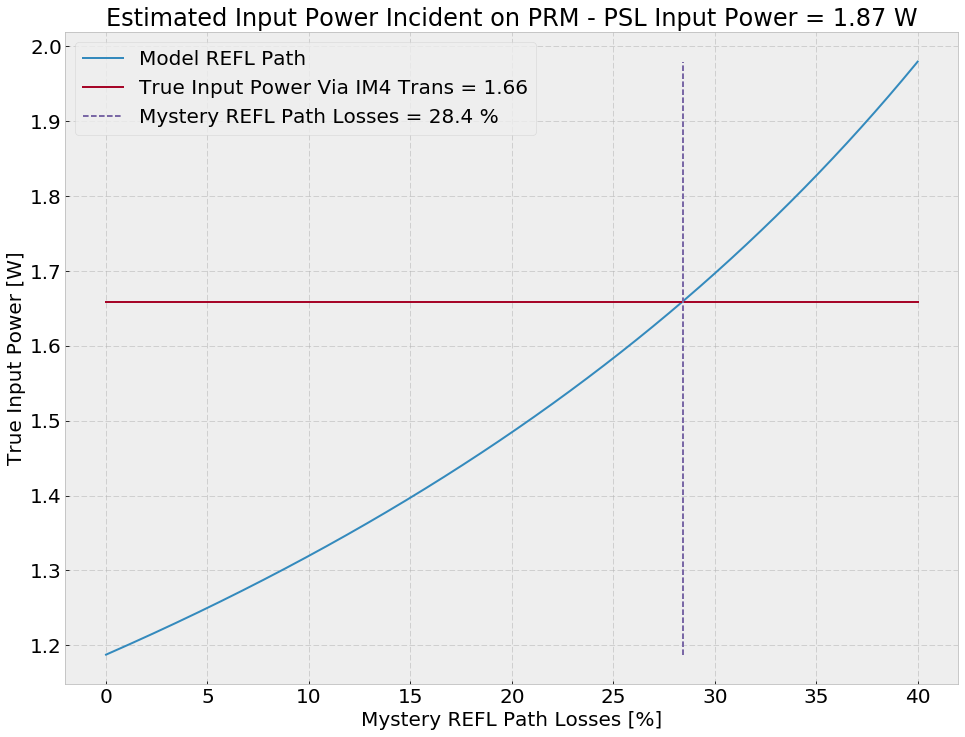
With an input power of 1.87 watts according to the PSL photodiode, we probably have around 1.55 watts incident on PRM, assuming an addition 21% unaccounted losses in the REFL A/B LF PD path.

Power Measurement Methods
I aligned PRM and the input optics, and misaligned the rest of the corner with 1.87 W reported from the PSL input power PD going into the IMC.

IM4 Trans
The easiest way would be to get Pinput would be via IM4 TRANS.  IM4 TRANS is calibrated into microwatts, IM4 (aka SM2) transmission is reported to be 2400 +- 200 ppm, and there's what I think is a 90:10 BS (ROM LH1) allowing 10% of the light going to IM4.  However, if we turn the crank here we end up with only 0.2 W, which is not possible.  This means that IM4 TRANS is not calibrated correctly, or the IM4 transmission path is actually around 8 times less transitive that I though.

REFL A/B LF
We believe that the REFL A/B LF PDs are correct based on the calibrated CARM shot noise.  We can use them to calibrate the correct input power.  The main issue here is if we use the REFL optical path (4 50:50 beamsplitters, 1 90:10 beamsplitter, one input faraday isolator, and one PRM) and assume no losses, we only get 1.19 W of true input power on the PRM.  This could be the case, but it's more likely that there are some unaccounted for losses on the REFL path.

PSL and IMC Transmission
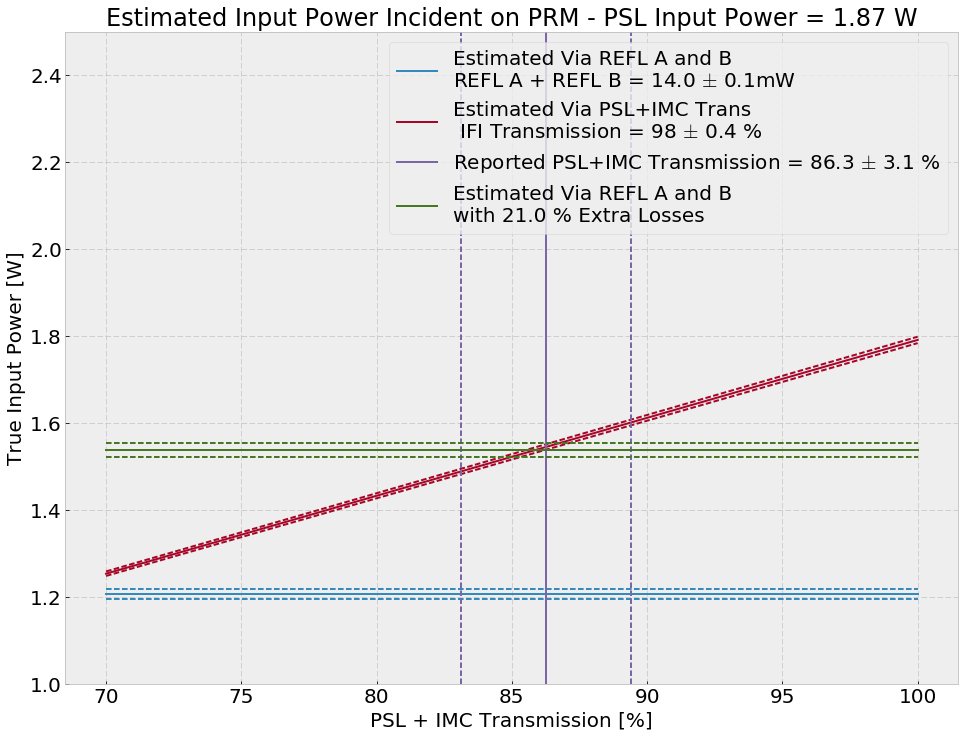
If we trust the old numbers from P1500076 on the PSL and IMC transmission, we can make an estimate of the true input power.  We find that by varying the PSL and IMC transmission, we cannot reasonably recover the REFL A/B power levels we see.


PD Powers and Optic Transmissions Assumed
# Most taken from P1500076

# PD calibrated powers
PSL_INPUT = 1.87 # W
REFL_A = 7.3e-3 # W
REFL_B = 6.72e-3 # W
IM4_TRANS = 50.24e-6 # W

# PD uncertainties
dREFL_A = 0.04e-3
dREFL_B = 0.03e-3
dREFL_SUM = np.sqrt(dREFL_A**2 + dREFL_B**2)

# Transmissions
T50 = 0.5
T10 = 0.1
T_PSL = 0.953 # +- 0.013 PSL to MC1 transmission
T_IFI = 0.977 # +- 0.004 https://dcc.ligo.org/DocDB/0119/P1500076/003/Mueller16rsi-AdvIO3.pdf
T_IMC = 0.92  # +- 0.031
IMC_ModeMatching = 0.984 # 0.001
T_PSL_to_IFI = T_PSL * T_IMC * IMC_ModeMatching
T_IM4 = 2400e-6 # +- 200e-6 E070092
T_PRM = 0.031 #

# Trans Uncertainties
dT50 = 0.01
dT10 = 0.01
dT_PSL = 0.013
dT_IFI = 0.004
dT_IMC = 0.031
dIMC_ModeMatching = 0.001
dT_PSL_to_IFI = np.sqrt( T_PSL_to_IFI**2 * ((dT_PSL/T_PSL)**2 + (dT_IMC/T_IMC)**2 + (dIMC_ModeMatching/IMC_ModeMatching)**2) )
dT_IM4 = 200e-6
Images attached to this report
Comments related to this report
craig.cahillane@LIGO.ORG - 14:47, Monday 14 January 2019 (46403)
This calibration is now implemented in H1:IMC-IM4_TRANS_{SUM,PIT,YAW} FM10.
daniel.sigg@LIGO.ORG - 17:31, Wednesday 16 January 2019 (46485)

The IM4_TRANS is no longer calibrated in µW due to a gain change in the whitening. The calibration dates back to alog 9716, where the whitening gain was 36dB. It is 18dB now, so the "µW"-readbacks are 18dB too low.

We added NSUM channels to the IM4 and MC2 Trans QPDs to facilitate an additional calibration of the incident power onto these mirrors.

craig.cahillane@LIGO.ORG - 18:32, Wednesday 16 January 2019 (46491)
With this additional 18 dB of whitening gain, we can calibrate true power input the simple way using IM4 TRANS:

Requested Laser Power = 2 W
PSL Reported Power    = 1.87 W
T_IM4                 = 2400 ppm
True Input Power      = 1.66 W


If we let T_IFI = 0.977, T_PSL = 0.953 and IMC_ModeMatching = 0.984, then T_IMC = 0.968.

And the mystery REFL path losses are 28.4% (see attachment).
Images attached to this comment
H1 ISC (ISC)
georgia.mansell@LIGO.ORG - posted 02:11, Sunday 13 January 2019 (46385)
Locking tonight - mostly dither line moving

Dither loops

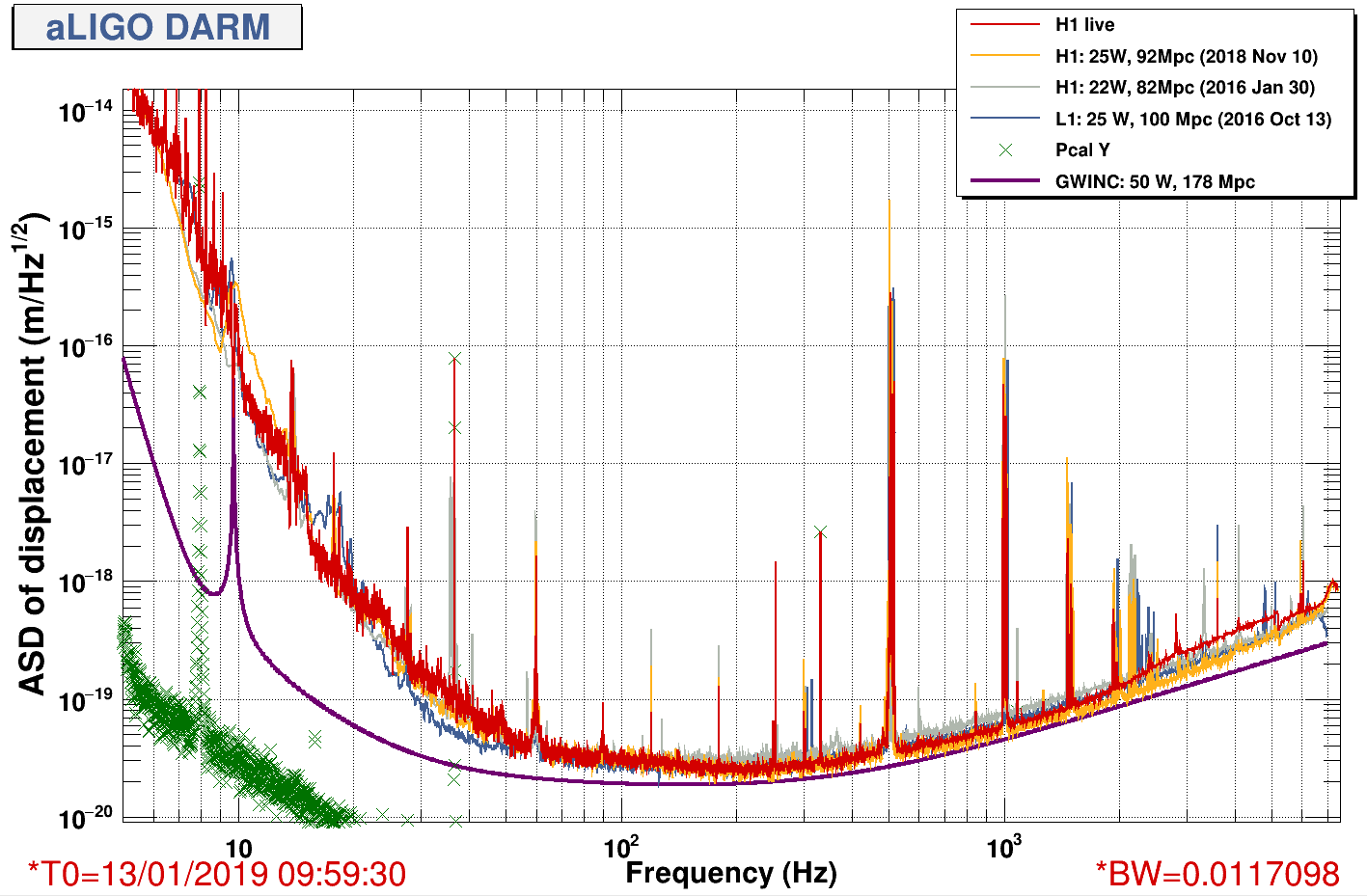
I have moved the dithers of the soft loops (PIT4, PIT5, YAW4, YAW5) to lower frequencies (6-10Hz), I've yet to move PIT3 and YAW3. 

I have tested lock reacquisition with the PIT loops at their new dither frequencies, but not yet with the YAW. In addition I've moved Dan Brown's dither monitor lines. See first attached screenshot of DARM spectrum tonight, note the high frequency noise is bad as the ISS second loop is off currently. The current oscillator frequencies are summarised in an updated table below (amplitudes are for NLN, for acquisition in PREP_ASC, the amplitudes are all 1600).

  PIT3 PIT4 PIT5
f (Hz) 19.7 9.12 6.9
A (cnts) 10 150 150
LO actuator IY EX EY
Demod actuator PRM IX/EX IY/EY


  YAW3 YAW4 YAW5 YAW1 YAW2 YAW9 YAW10
f (Hz) 18.4 8.65 6.46 8.25 7.55 7.3 6.1
A (cnts) 15 100 100 25 25 25 25
LO actuator IY EX EY PRM PR2 DSOFT DHARD
Demod actuator PRM IX/EX IY/EY - - - -

Method

I switched the LOs of these loops one-by-one, at NLN. Allowing the original loops with ~20Hz dithers to converge before turning off the inputs and tuning the loops for a lower LO frequency. I tuned the clock gains so the lines are visible over the DARM noise, made bandpasses for the signal path (previous lines are all in FM6, new lines in FM4), lowered the gains (since the DARM noise is much higher at low frequency).

I tried re-phasing the loops by adjusting the A2L gain of the test mass the dither is applied to, and checking all the signal was in the I path, however the old phases seemed just fine. 

I've left the change in frequency of YAW5 out of the guardian for now since it seems slower to converge than the old loop and I didn't want to cause problems for future commissioners, so on the next lock there'll still be a line at 21.9Hz from that one (as well as the PIT3 and YAW3 lines). 


TCS y chiller flow

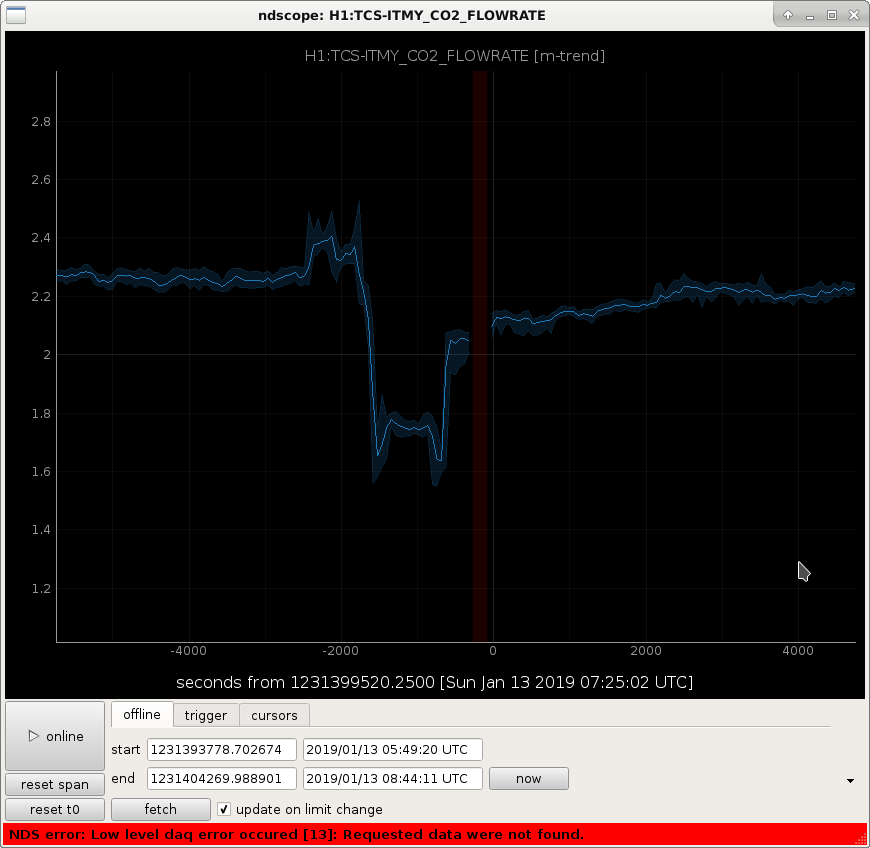
We got a verbal alarm that the TCS Y chiller flow was low. Seconds screen shot is of the flow rate channel around the time of the alarm. We didn't go check for leaks or anything.

A new ALS x-arm problem

We had some problems locking the x arm in green. When the ALS_XARM guardian said the arm was locked the transmitted power was extremely noisy and the transmission camera looked like it was possibly rapidly mode hopping. We struggled with this for a while, eventually with better arm alignment we managed to lock with no problem (coincidence?).

Images attached to this report
H1 ISC (ISC)
craig.cahillane@LIGO.ORG - posted 00:50, Saturday 12 January 2019 (46384)
MICH FF retuned, 1 Hz slow instability, CARM OLG around FSR
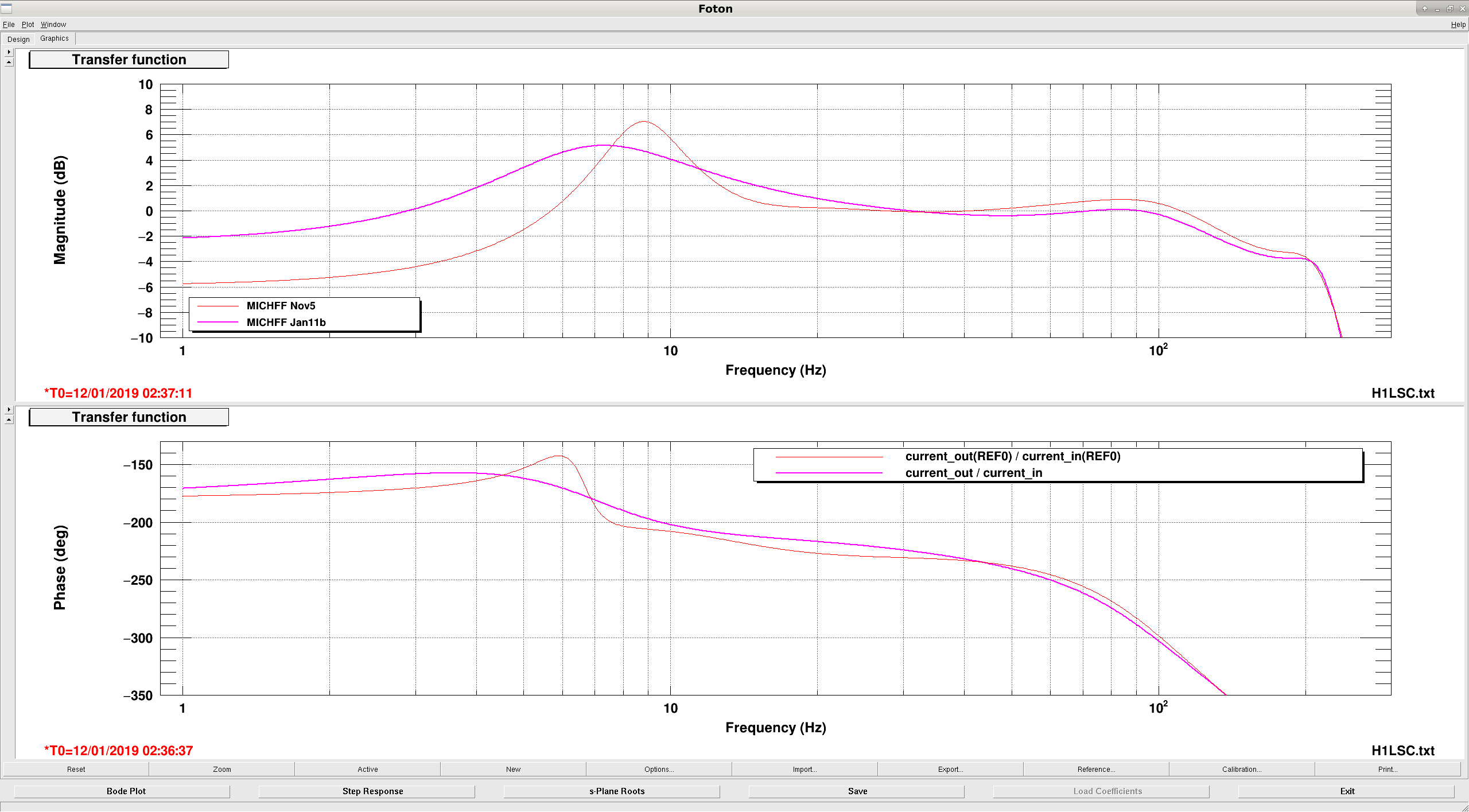
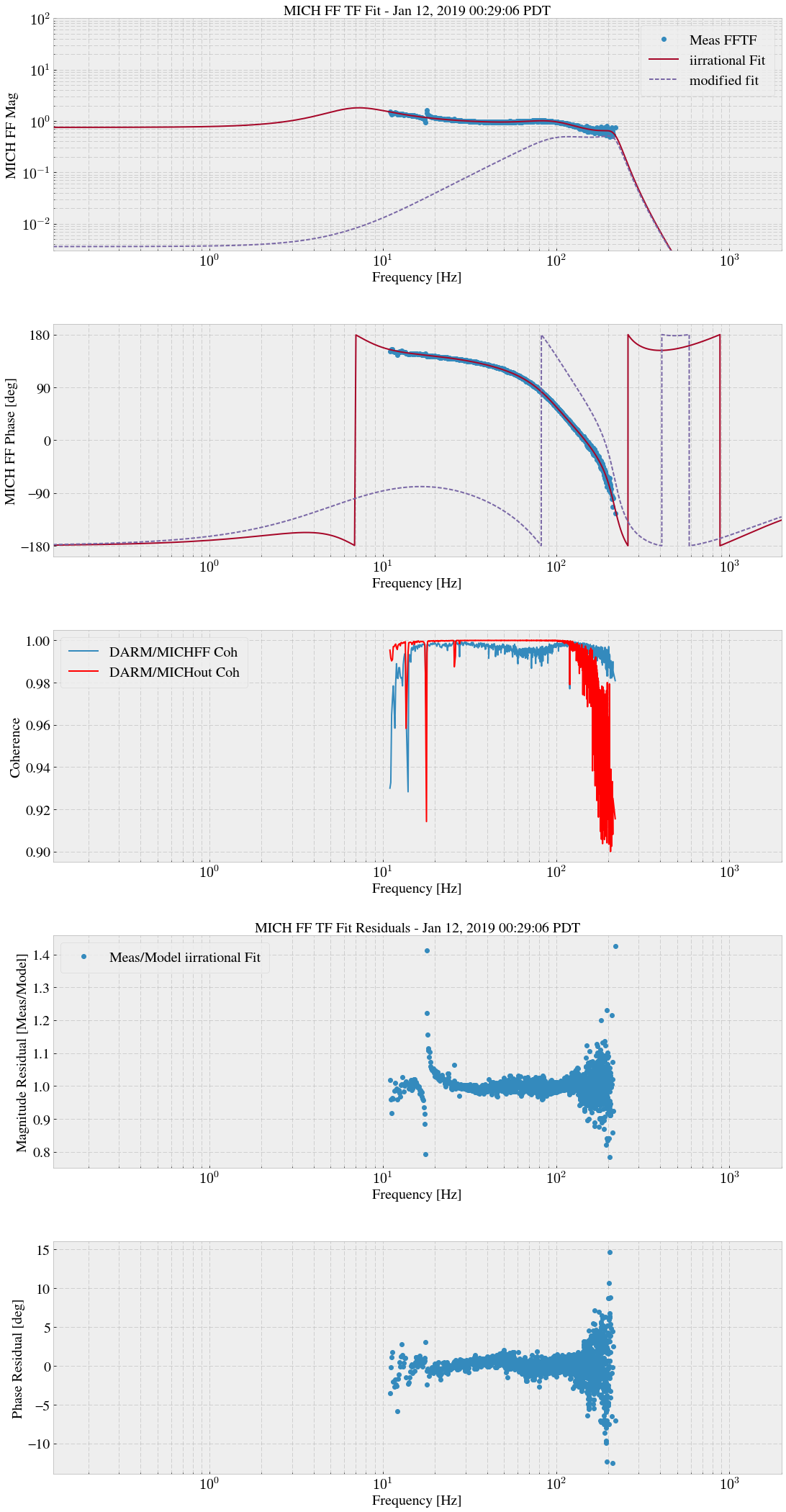
We switched DARM actuation from ETMY L2 and L1 stages to ETMX L2 and L1.  This caused a change in the MICH FF which has remained untuned while the IFO has been unstable.  Today we were stable enough to tune MICH FF again, winning a factor of 10 lower MICH to DARM coupling and improving the low frequency DARM noise.  
The new FF is saved as Jan11b in the MICH FF FM3, and gets engaged by guardian in LOWNOISE_LENGTH_CONTROL.

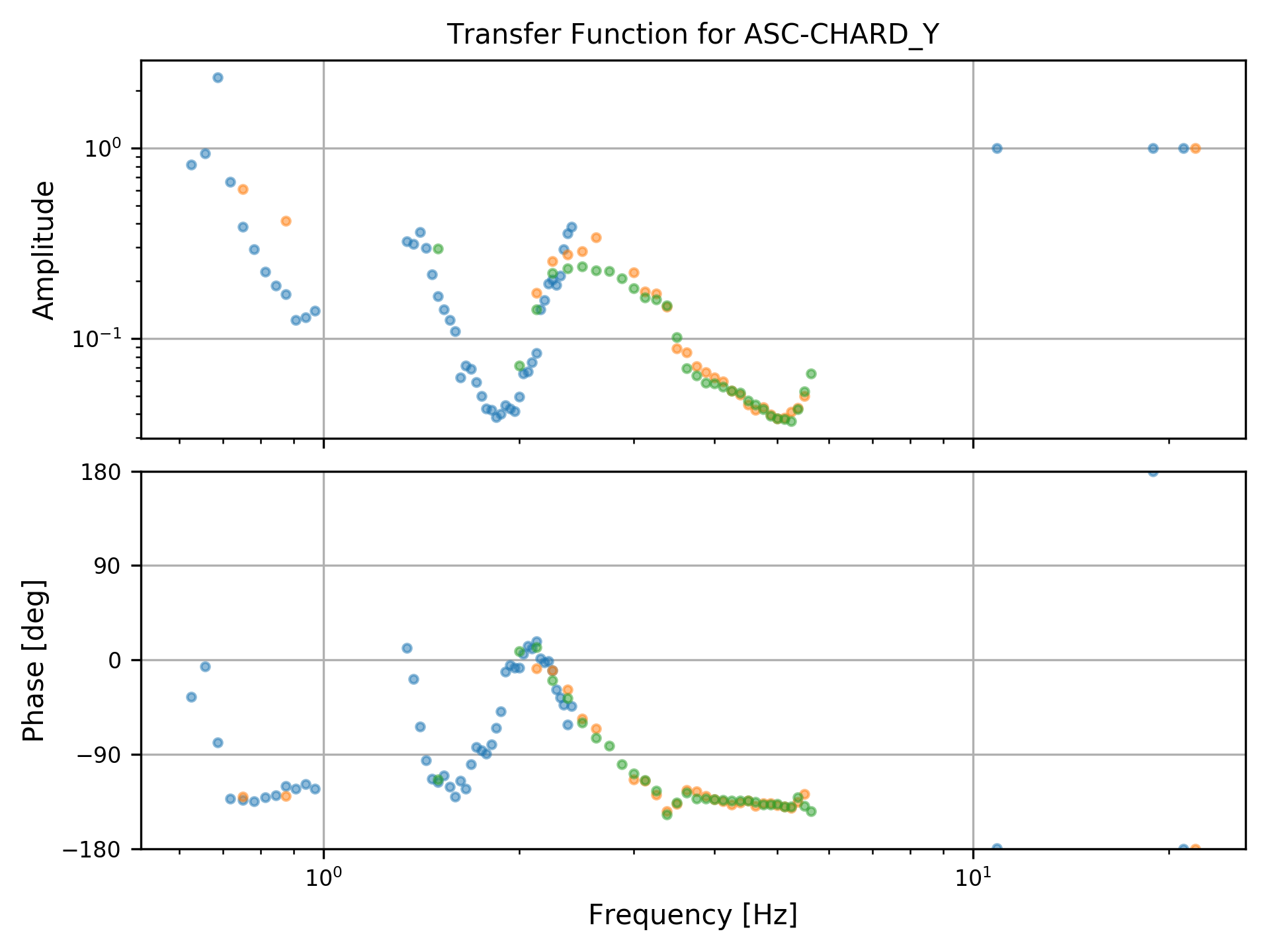
Georgia and I got back up to NLN.  Georgia started moving the ASC dither lines to lower frequency, but was unable to finish due to a 1 Hz very slow ringup in our yaw loops.  I killed the lock by increasing both the CHARD P/Y digital gains by a factor of 2 in an attempt to save the lock.
Georgia has since moved the ASC dither lines back for acquisition tomorrow.

Lost lock once while trying to get back through ENGAGE_SOFT_LOOPS again.  After this lockloss I measured the dark noises of REFL A, REFL B, IMC REFL, and the IMC and Common Mode Servo Boards.  Left the SR785 plugged in to the CMB.

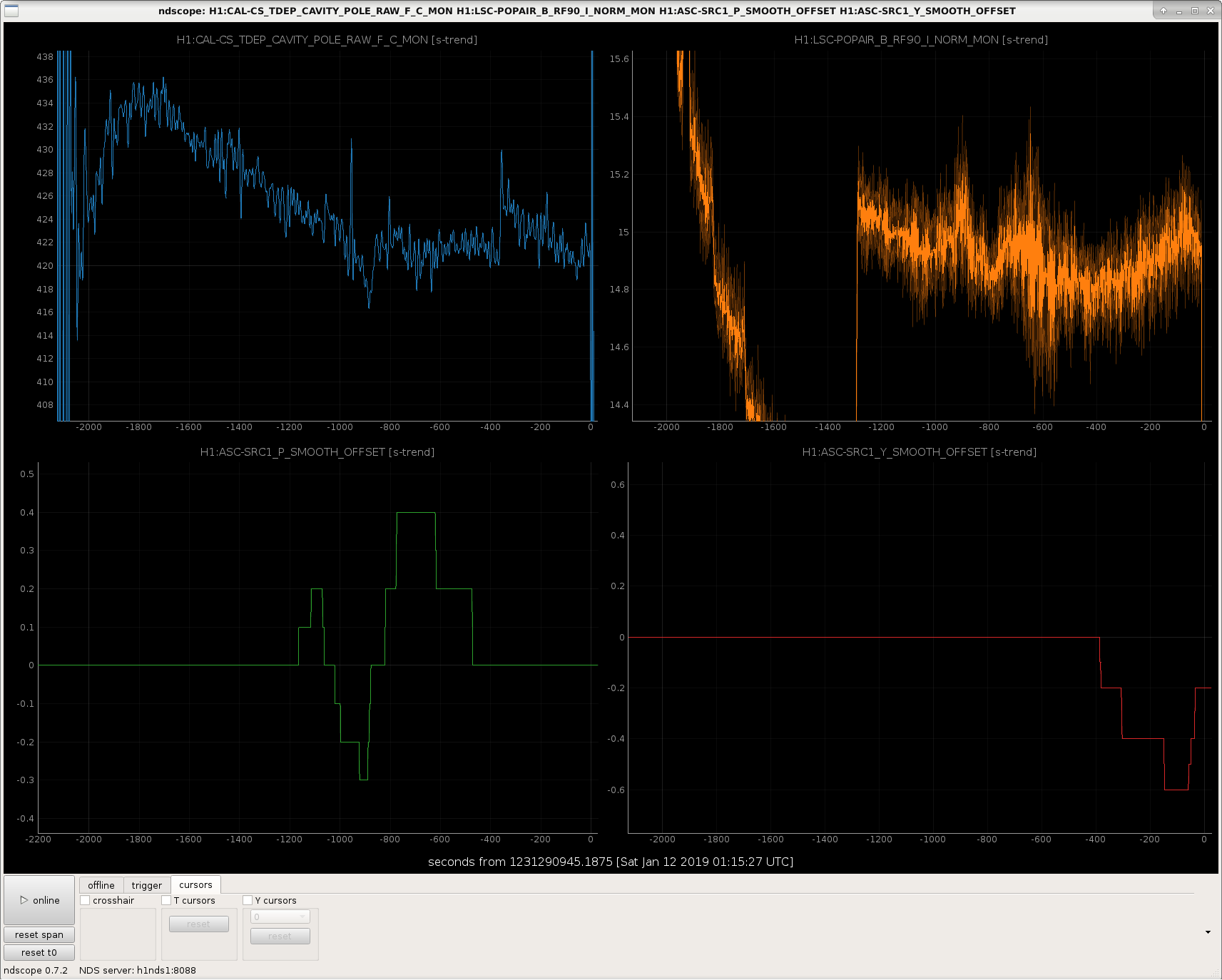
During the ~hour lock at NLN 30 W, I measured the CARM loop around the FSR, in a repeat of a measurement Evan took three years ago, intending to measure our CARM pole this way.  My measurement is lopsided in magnitude, where Evan's was symmetric, but both exhibit the familiar overcoupled cavity phase rotation.  Further modeling required.
Images attached to this report
Non-image files attached to this report
H1 AOS (AOS)
daniel.vander-hyde@LIGO.ORG - posted 21:06, Friday 11 January 2019 - last comment - 22:10, Friday 11 January 2019(46382)
ISS second loop coupling into DARM

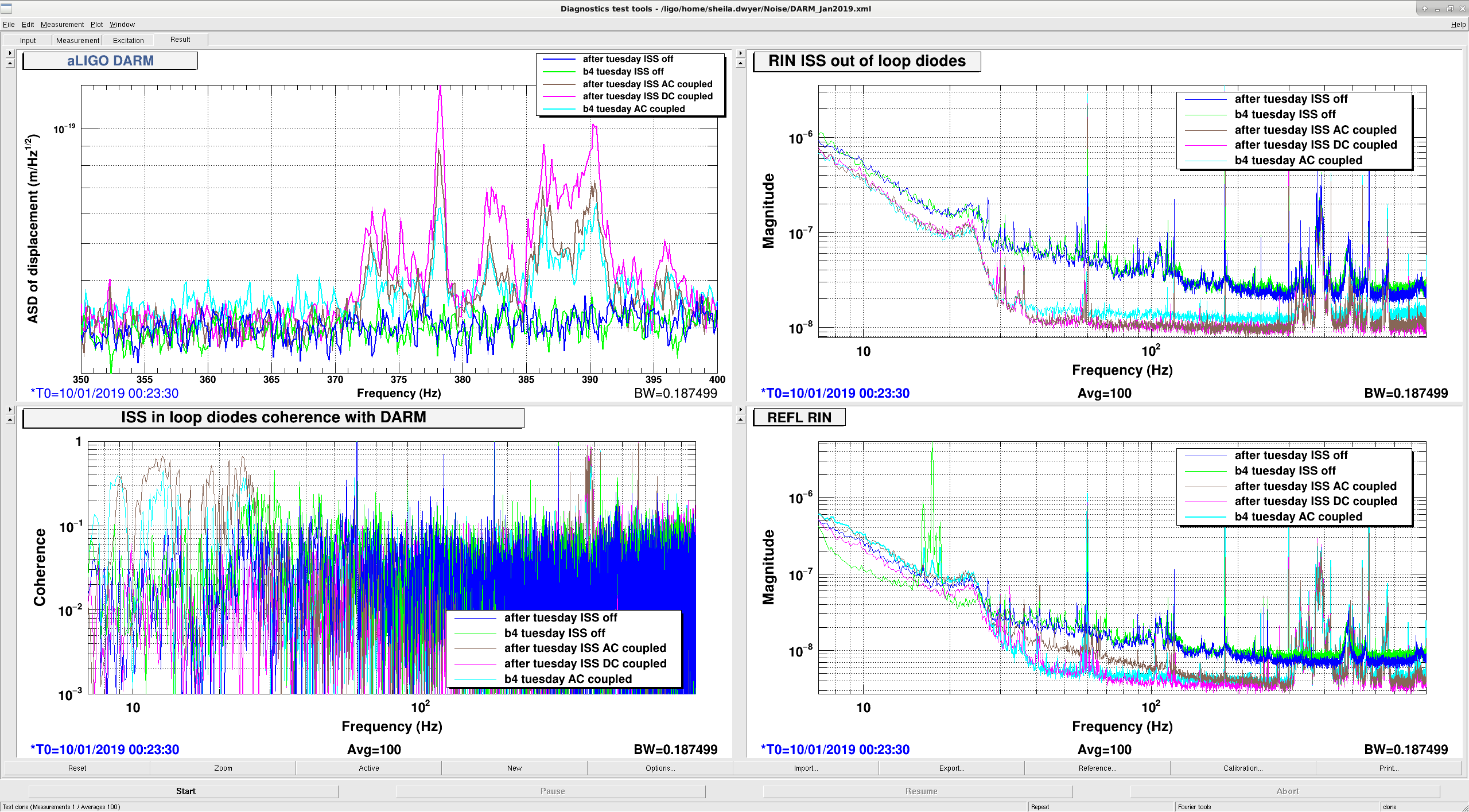
Sheila, Danny 

Images attached to this report
Comments related to this report
daniel.sigg@LIGO.ORG - 22:10, Friday 11 January 2019 (46383)

The ISS array probably needs re-centering. The QPD position is different, see alog 46277.

H1 CAL (CDS)
jeffrey.kissel@LIGO.ORG - posted 17:55, Friday 11 January 2019 - last comment - 18:19, Friday 11 January 2019(46379)
First Look at Time-Dependent Correction Factor Front-End Gate / Median / Average Functions
J. Kissel

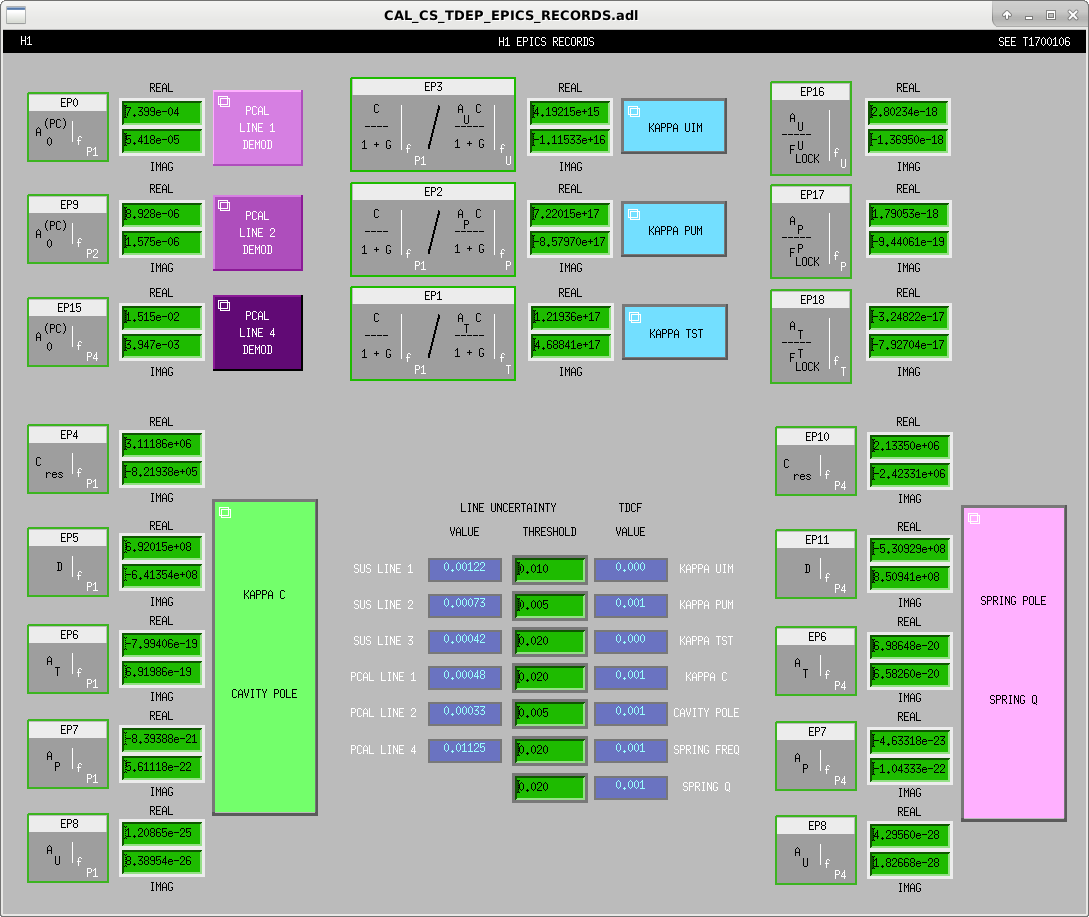
Chugging down the front-end calibration's time-dependent correction factor to-do list, I used todays locks to tune the uncertainty thresholds and then watch the performance of the gating, median-ing, and averaging (GMA) that's a replica of what the GDS pipeline had done during O2. The message: I'm not satisfied.

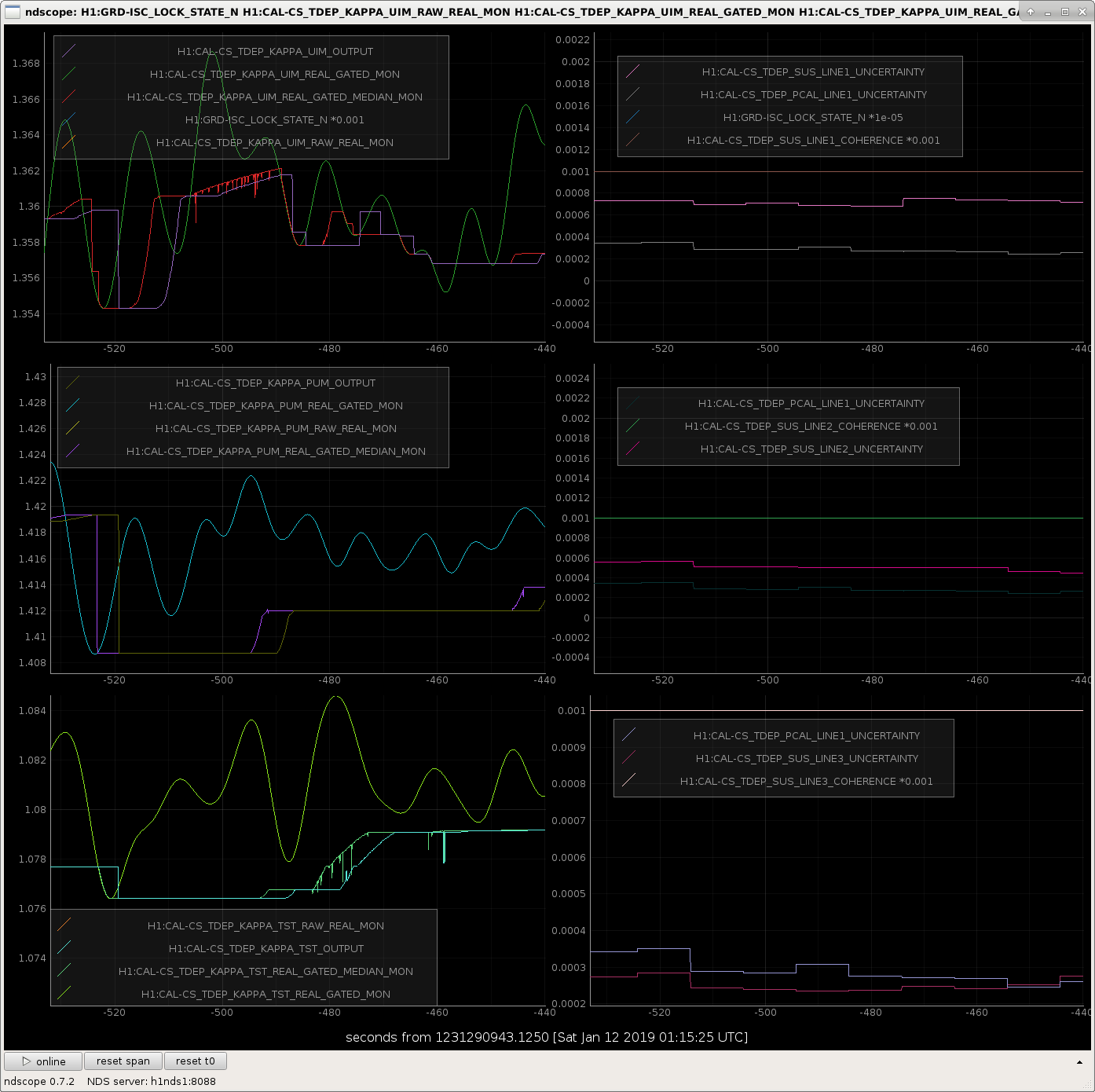
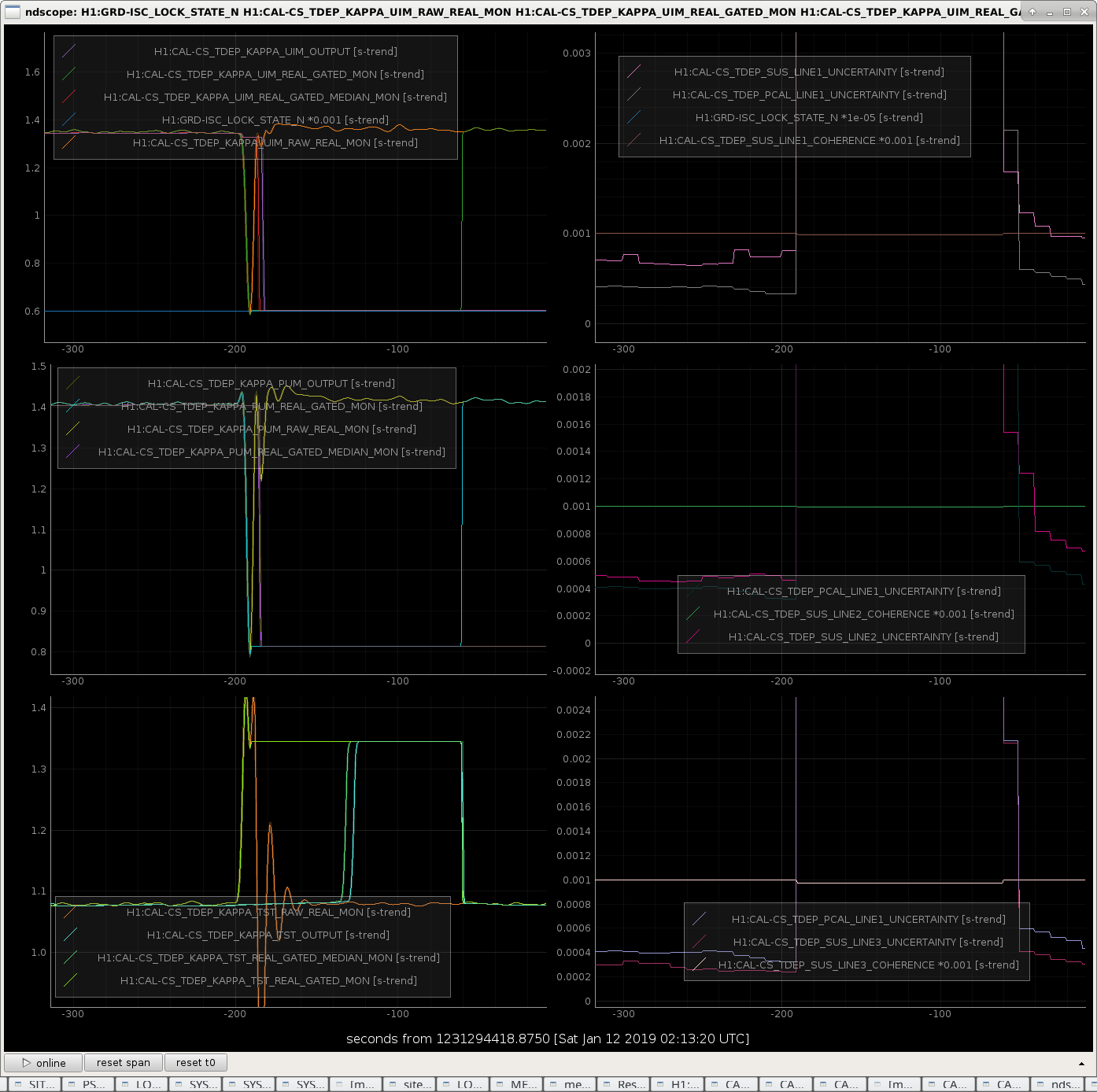
Check out the attached ndscope traces of the three actuator kappas during one of this evening's nominal low noise lock stretches.
On the left column, in three plots (one for each UIM, PUm, and TST kappa), I show the raw input to the GMA system, the output of the gating, the output of the median-ing, and the output of the averaging, which we hope to eventually send off to correct DELTAL_EXTERNAL and to create CFTD_DELTAL_EXTERNAL. On the right, I show the calculated uncertainty of both the respective SUS_LINE and PCAL LINE used to derive the actuator kappas.

Observations: 
- The uncertainty is low; in the 0.05 % level (we could probably reduce the amplitude of the calibration lines by a factor of ~2.)
- The raw signal wobbles around smoothly with a 10 second period, reflective of the 0.1 Hz low pass used on the output of the DEMODs.
- Given that at the time I show, the live uncertainty is passing the tuned threshold, the raw signal and the gated signal are identical. Good!
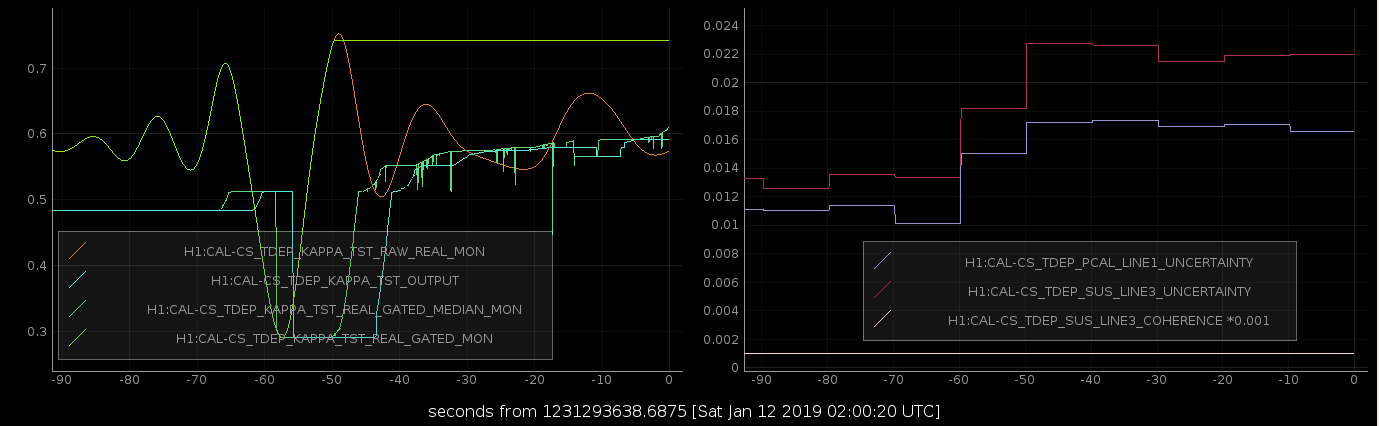
- Things start getting fishy once the signal is passed through the median function, stuff that looks like digital hair on what should otherwise be smooth portions, and there is an overall stair-step nature to it. I forget if we've studied whether (a) the O2, GDS/DCS produced, median-ed time series looked this step-like, and (b) if the application of step functions at the 0.1% level caused any high-frequency noise or glitch problems. There also appears to be a significant offset between the raw and gated value vs. the median-ed value.
- Finally, with the final, gated, median-ed, and averaged output, there's a lag between it and the input, only-gated-median-ed time series. At least the digital hair has been smoothed out...

Plenty of things to think about before I understand it enough to be happy about trying to apply these factors to DELTAL_EXTERNAL.
Images attached to this report
Comments related to this report
jeffrey.kissel@LIGO.ORG - 18:05, Friday 11 January 2019 (46380)
And another glimpse as we lead up to nominal low noise, which better shows the functionality of the gating, but also the weirdness of the median-ing function all for the kappa_TST, whose uncertainty thresholds are 0.02 and 0.02 for SUS and PCAL lines, respectively. At t= -50, the PCAL line goes above threshold, and thus holding the output of the gate at the last best good value. Then at t = -48 through t = 0, you see digital hair on the median output.
Images attached to this comment
jeffrey.kissel@LIGO.ORG - 18:19, Friday 11 January 2019 (46381)
And during a big glitch...
Images attached to this comment
H1 ISC
jenne.driggers@LIGO.ORG - posted 17:25, Friday 11 January 2019 (46361)
Friday AM locking
Images attached to this report
LHO General
patrick.thomas@LIGO.ORG - posted 16:33, Friday 11 January 2019 (46377)
Ops Shift Summary
Prior to shift: Richard and Peter in PSL enclosure

15:56 UTC Karen to optics lab
16:02 UTC Vanessa to mid X
16:18 UTC Peter to optics lab. Karen to mid Y.
17:11 UTC Karen leaving mid Y
18:44 UTC Travis to optics lab, looking for gold mirrors for solder test
18:59 UTC Travis back
19:33 UTC Peter back
19:42 UTC Nutsinee to ISCT6

Lockloss, notification: 'PSL_FSS: PZT MON is high, may be oscillating'. Jason and Peter investigating.

20:38 UTC Nutsinee back
20:45 UTC Peter and Jason to PSL anteroom
20:52 UTC Peter and Jason back, turned off lights in PSL enclosure. Lights left on in PSL enclosure from this morning raised the temperature out of the FSS range. FSS needs to be locked manually until the temperature comes back to normal.
22:16 UTC Peter to optics lab
22:22 UTC Fire department to end X to check on RFAR
22:30 UTC Gerardo to Y2-8
Nutsinee to ISCT6
22:49 UTC Robert to end X to change measured voltage signal
23:34 UTC Peter back
23:39 UTC Gerardo back
23:55 UTC Robert back
00:08 UTC Nutsinee back
H1 ISC
daniel.sigg@LIGO.ORG - posted 15:42, Friday 11 January 2019 (46374)
Transmitted Power Comparison

A direct comparison between the transmitted arm powers between O2 and now. The input power during O2 (8/1/2017) was 28W, whereas it is 30W now.

ETM Transmission
Mirror O2 Now Change
ETMX 3.6 ppm 3.9 ppm +8%
ETMY 3.6 ppm 3.8 ppm +6%

The errors for the transmission coefficients are listed as ±0.2 ppm.

Transmission QPD Sum
Channel O2 Now Change Corrected
for
Transmission
H1:ASC–X_TR_A_NSUM      106k      147k 1.38 1.28
H1:ASC–X_TR_B_NSUM 141k 194k 1.38 1.27
H1:ASC–Y_TR_A_NSUM 144K 211k 1.47 1.39
H1:ASC–Y_TR_B_NSUM 153K 225k 1.47 1.39

The average power increase between the two arm cavities is 1.33. Or a factor of 1.24, if corrected for the input power. This isn't compatible with our observed increase in the power recycling gain by factor of about 1.5 (from ~30 to ~45). There is also a fairly large imbalance between the two arms, indicating there may be an inaccuracy in the optical transmission data? or?

H1 SQZ (SQZ)
nutsinee.kijbunchoo@LIGO.ORG - posted 15:30, Friday 11 January 2019 (46376)
SQZ laser temperature knob found locked and away from nominal

The green power out of the SHG became lower around noon and I noticed that the temperature knob on the laser box has been locked. I left it unlocked the last time I adjusted it because the knob was too sensitive. By locking the knob the temperature was changed by .05 degree C. That was enough to put us in the multimode region. Again, 

PLEASE DO NOT TOUCH ANY KNOBS ON THE SQZ LASER CONTROLLER BOX. 

The setting has been reversed back and temperature knob was left unlocked.

H1 General (DetChar)
laura.nuttall@LIGO.ORG - posted 15:18, Friday 11 January 2019 (46375)
Scattering gone...but whistles are back

I took at look at the 3.5hr lock earlier today (1231211560 - 1231224532) and do not find evidence of scattering in GDS-CALIB_STRAIN which had been present in locks prior to the DARM actuation being moved entirely to ETMX. 

I do however see whistles (the last time we saw these was back in October); hveto finds them dominating in rounds 1 and 2. Looking at individual whistles they can be seen in SRCL_IN1, SRCL_OUT, POP_A_RF45_I, POP_A_RF9_Q, REFL_A_RF45_I, REFL_A_RF9_Q and REFL_B_RF45_I/Q_YAW. We usually blame something beating with the IMC VCO for whistles, so I took all the trigger times from hveto's round 1 and 2 winners and found the IMC VCO frequency at these times. Note, not all the triggers will be whistles, but the majority will be. The attached histogram shows the IMC VCO frequencies at the time of the whistles. I also took a look at the ALS_COMM and DIFF VCOs at these times and found they were not changing at the time of the whistles.

I also took a look at the IMC VCO frequency ranges for the last few locks, just to see if it had shifted significantly. It has not. Since 10th Jan the IMC VCO frequency has been centred ~78.96MHz, but whistles only appeared in the last lock....

Images attached to this report
H1 PEM
robert.schofield@LIGO.ORG - posted 14:44, Friday 11 January 2019 (46373)
New DARM peaks coherent with HAM2 ISI

The figure shows that there are new peaks in DARM that appeared between the last good lock before last Tuesday, Jan 8, and the first good lock after Tuesday. These peaks are coherent with HAM2 ISI. But the motion of the ISI doesn’t appear to have increased, suggesting that the coupling increased. One possibility is increased clipping from an alignment change.

Non-image files attached to this report
H1 SEI (PEM)
hugh.radkins@LIGO.ORG - posted 14:17, Friday 11 January 2019 (46372)
Lost Anemometer H1:PEM-X_FENCE_WIND_SPEED_1_MPS at EndX

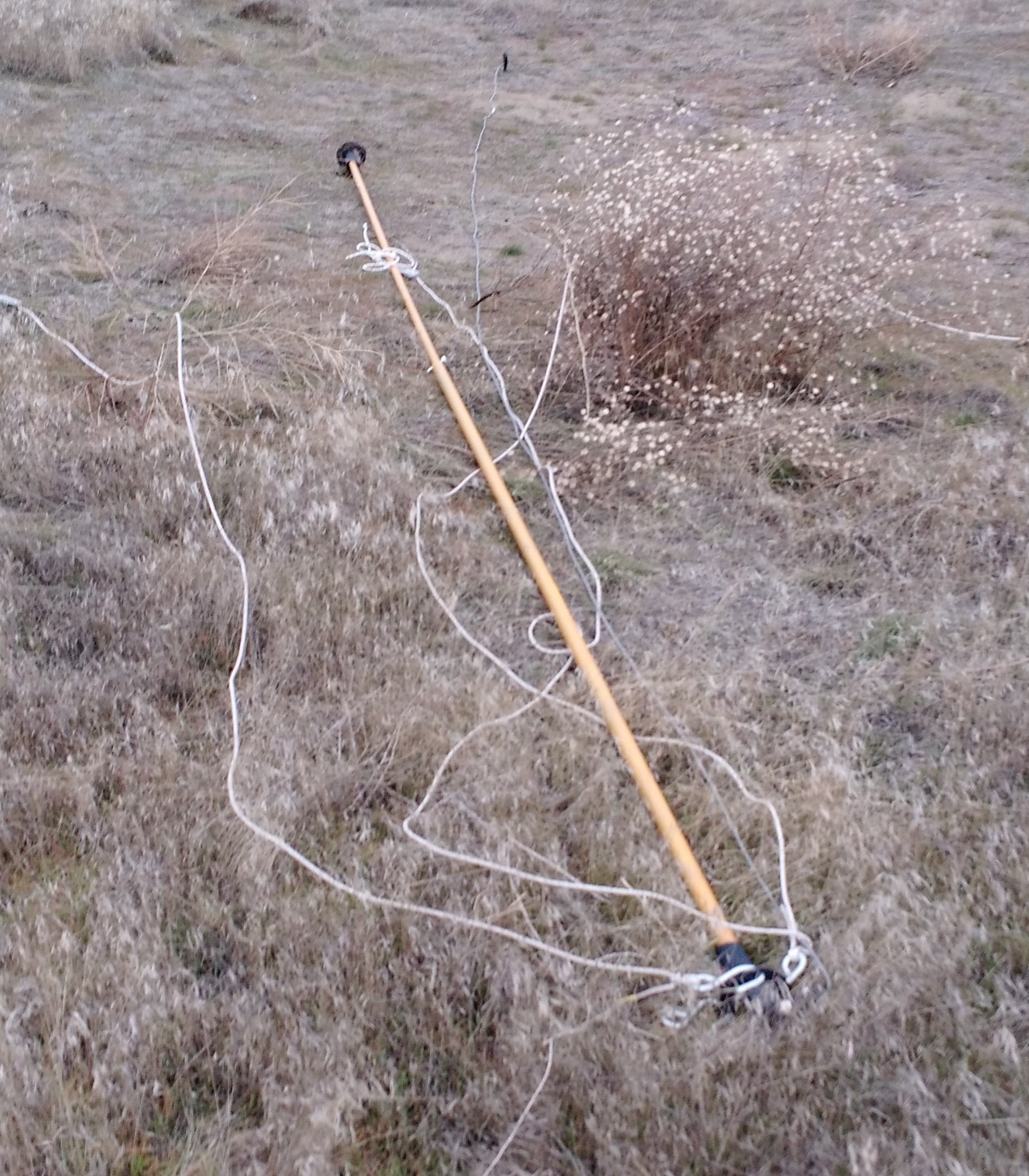
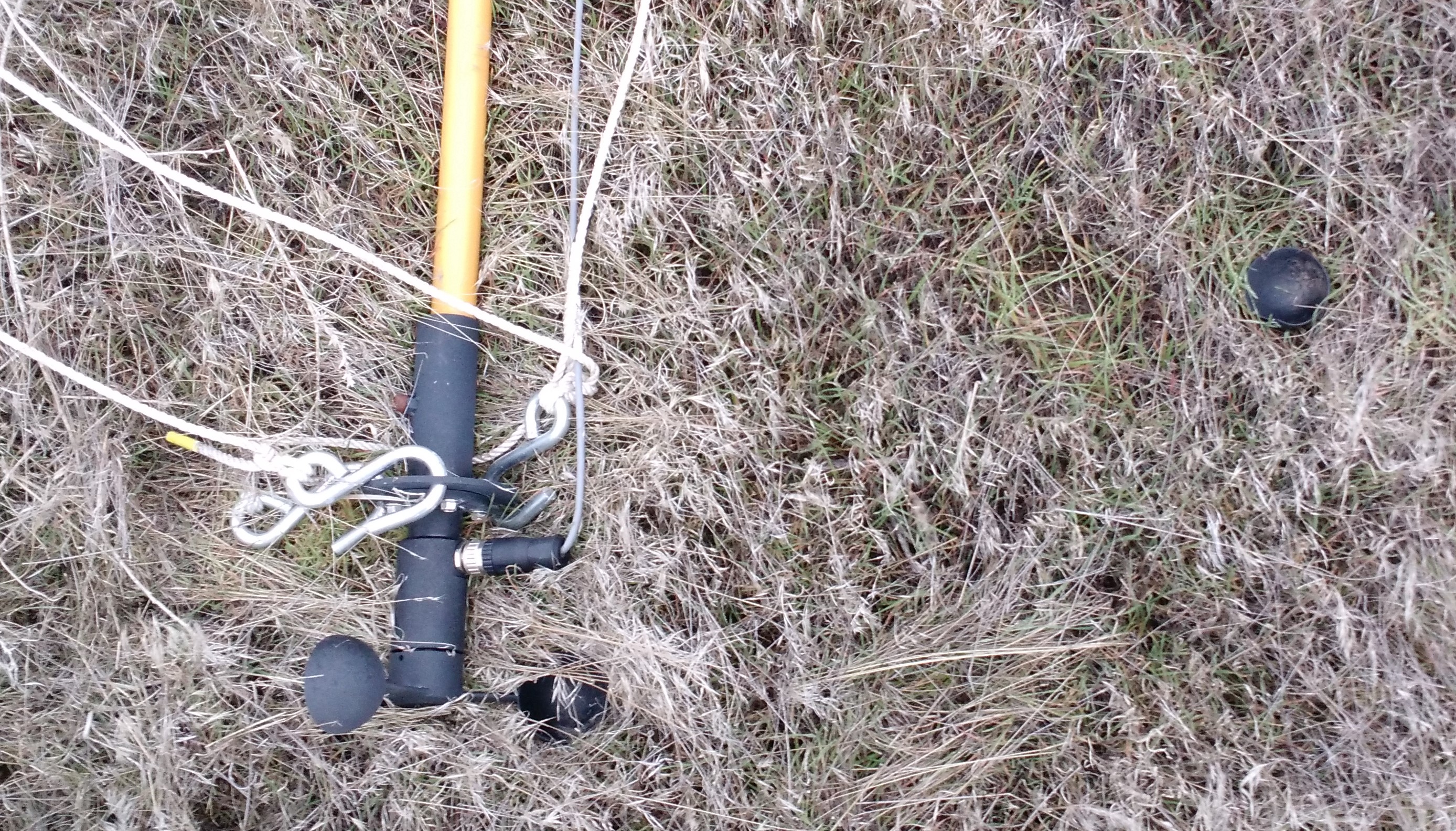
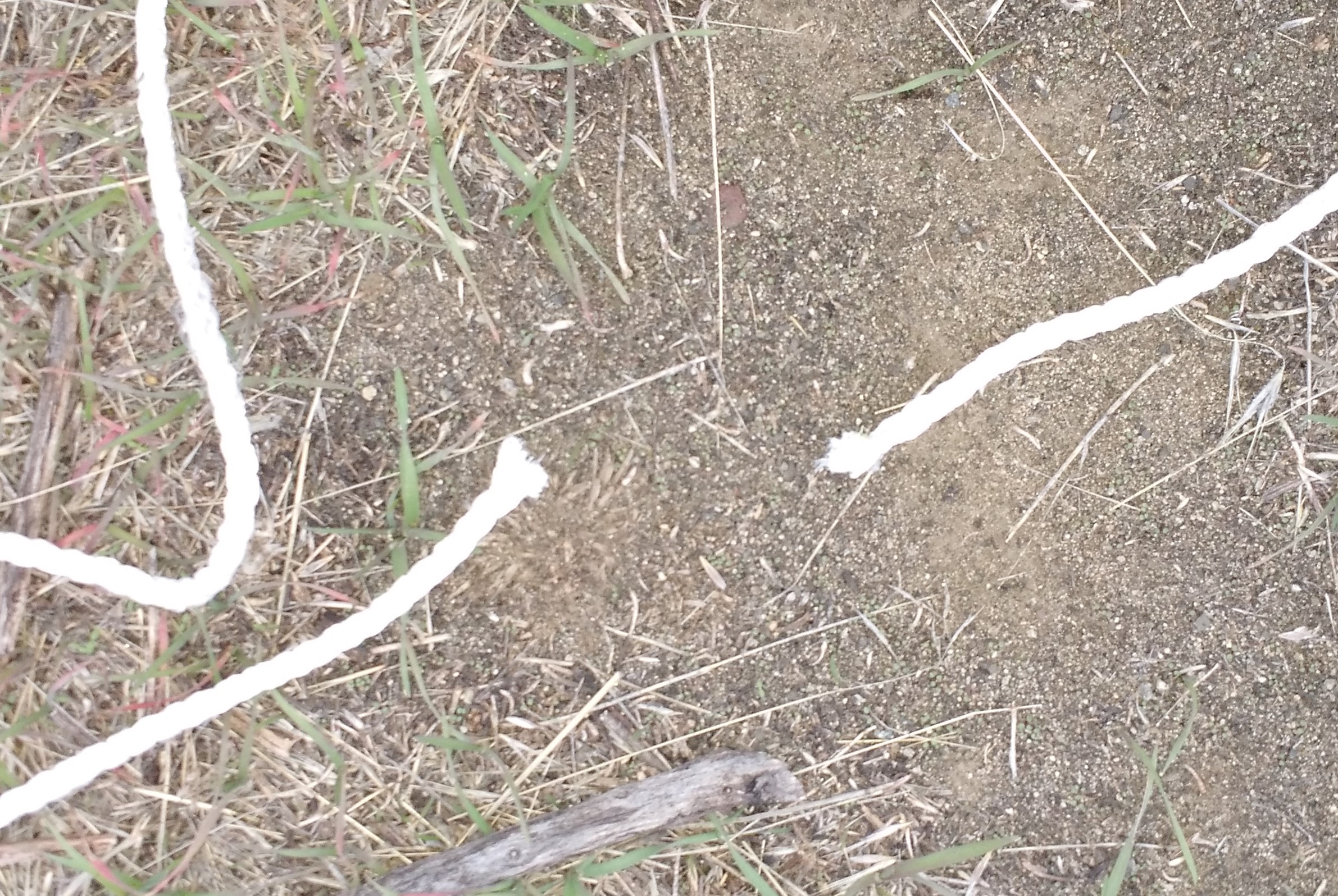
Over the holidays, this sensor went flat.  Investigation found guy line rope had parted where it turns through the ground anchor eye.  One cup was broken and the rotating shaft looks to be bent now too; I'd say it isn't likely repairable.  Photos attached.

On Tuesday, I'll replace it with my last unit available and also move it.  Additionally, I'll add chafe protection to all the guy lines.  Guys will be wire when they get to a permanent location.

Images attached to this report
Displaying reports 43601-43620 of 88618.Go to page Start 2177 2178 2179 2180 2181 2182 2183 2184 2185 End