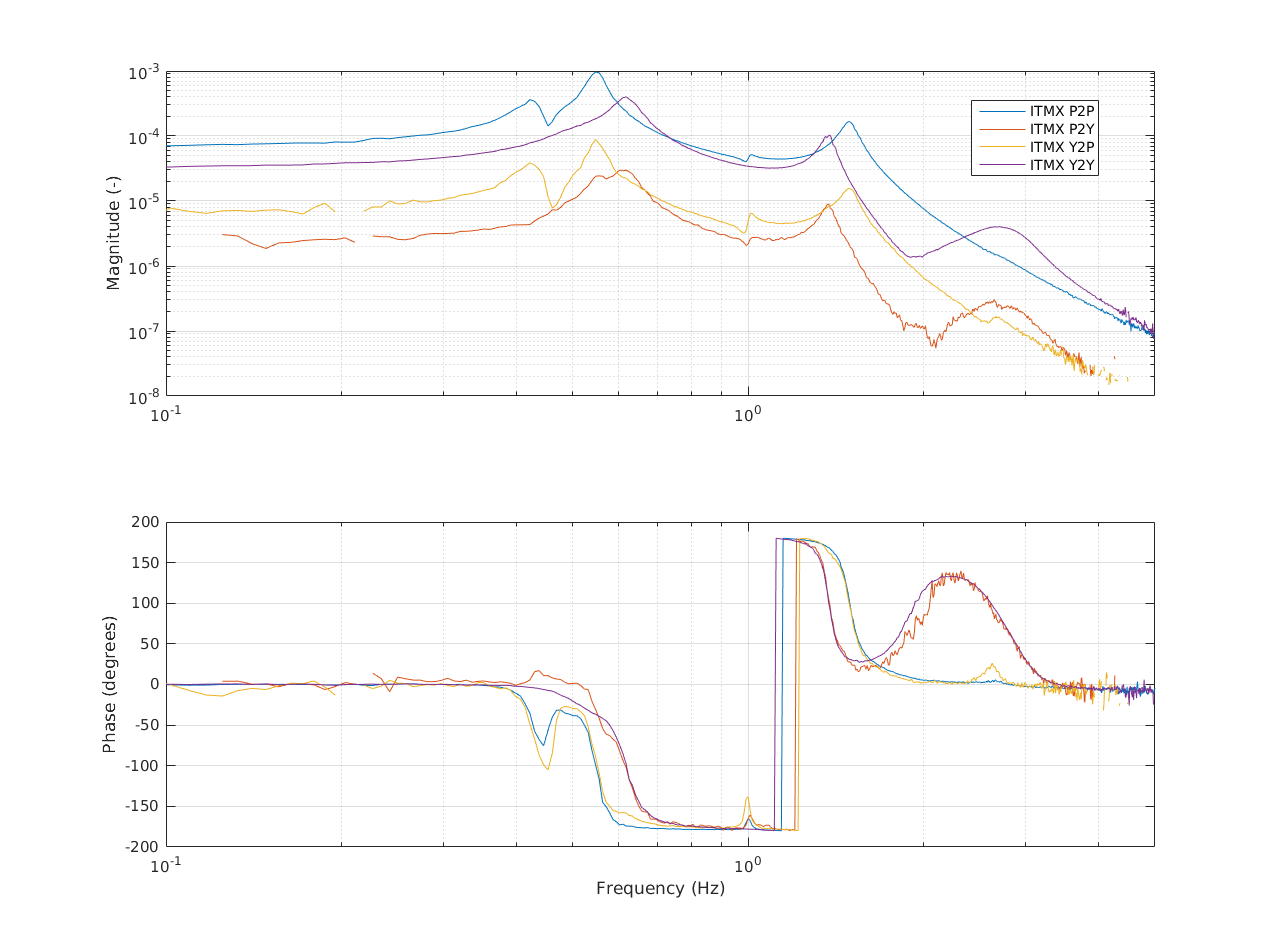
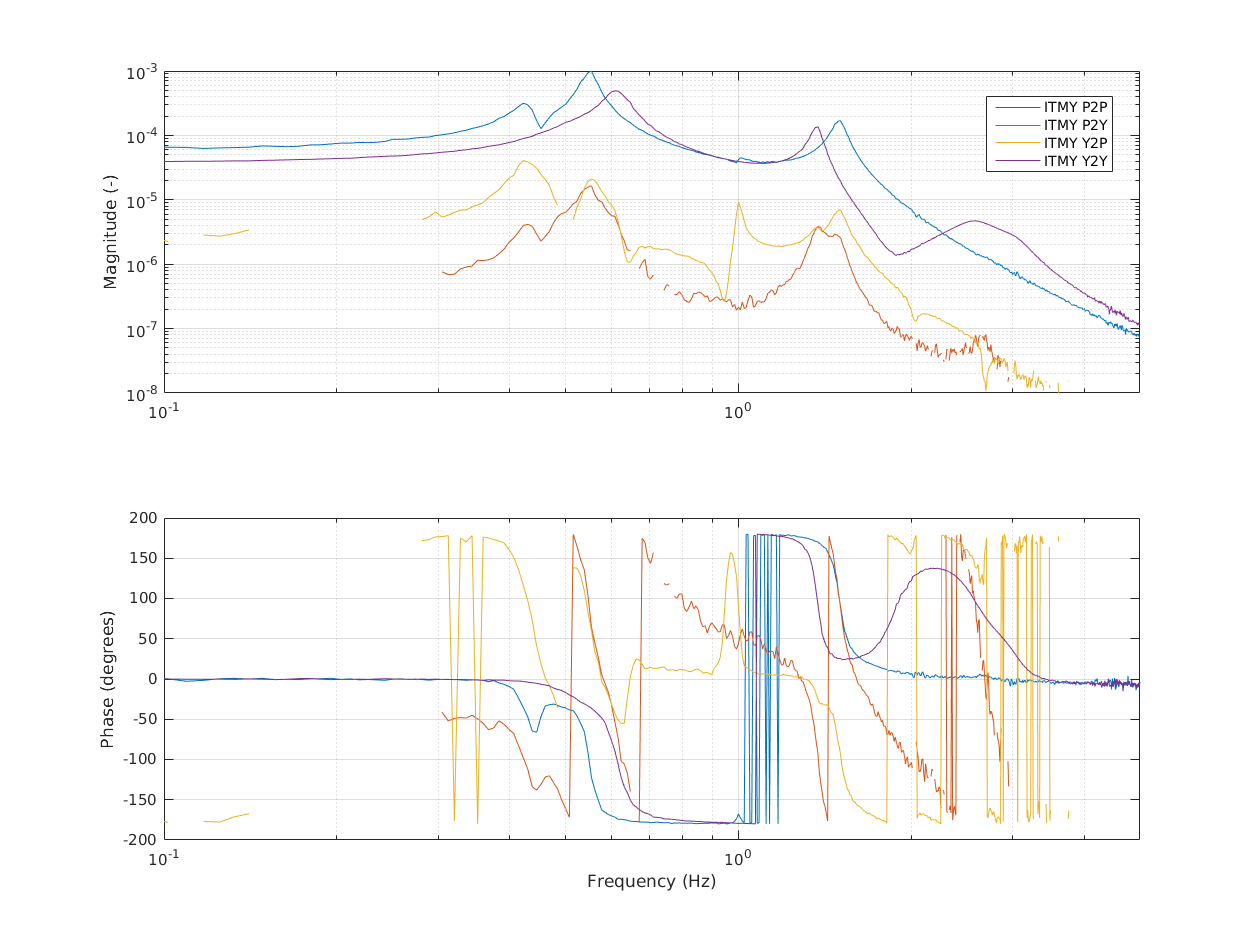
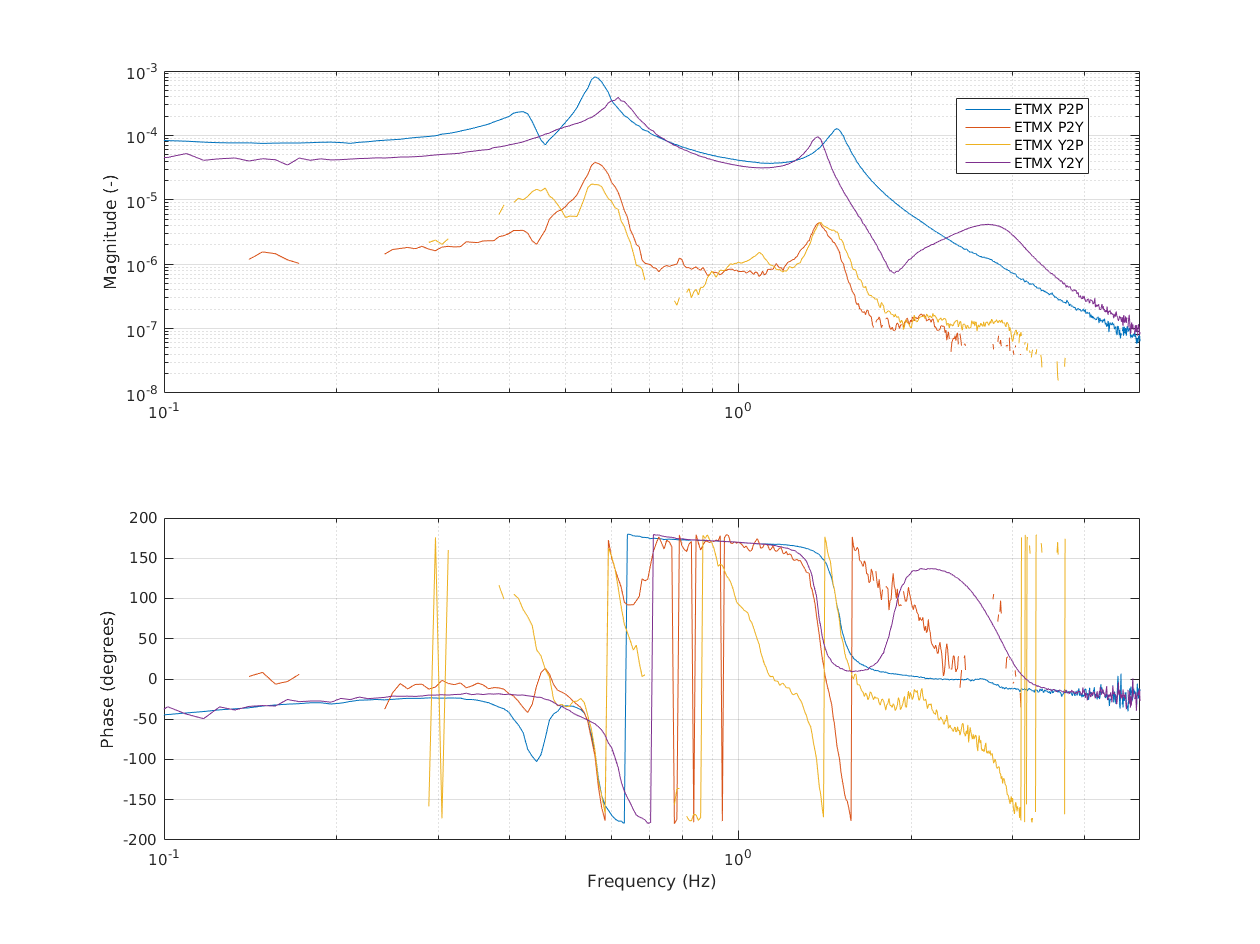
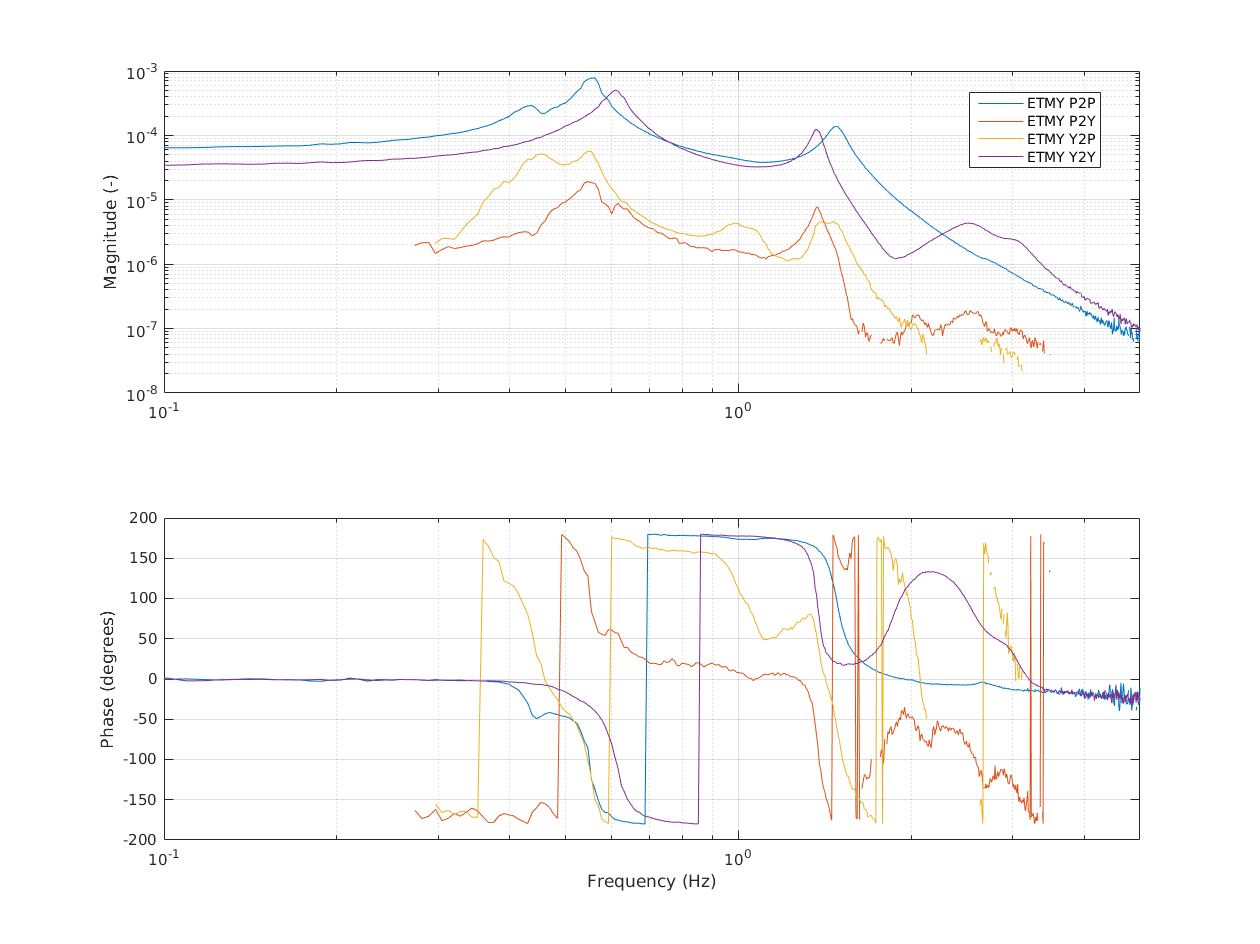
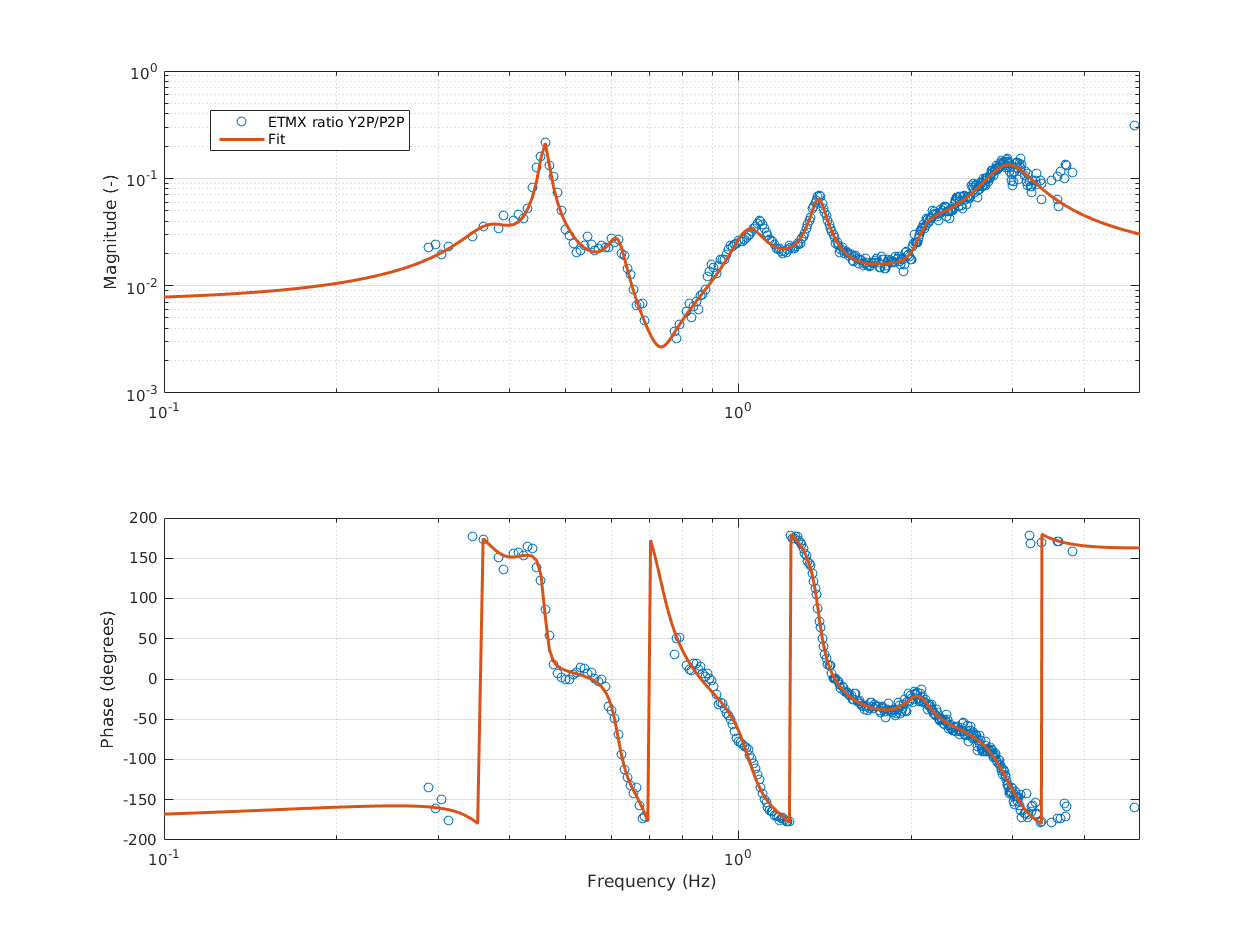
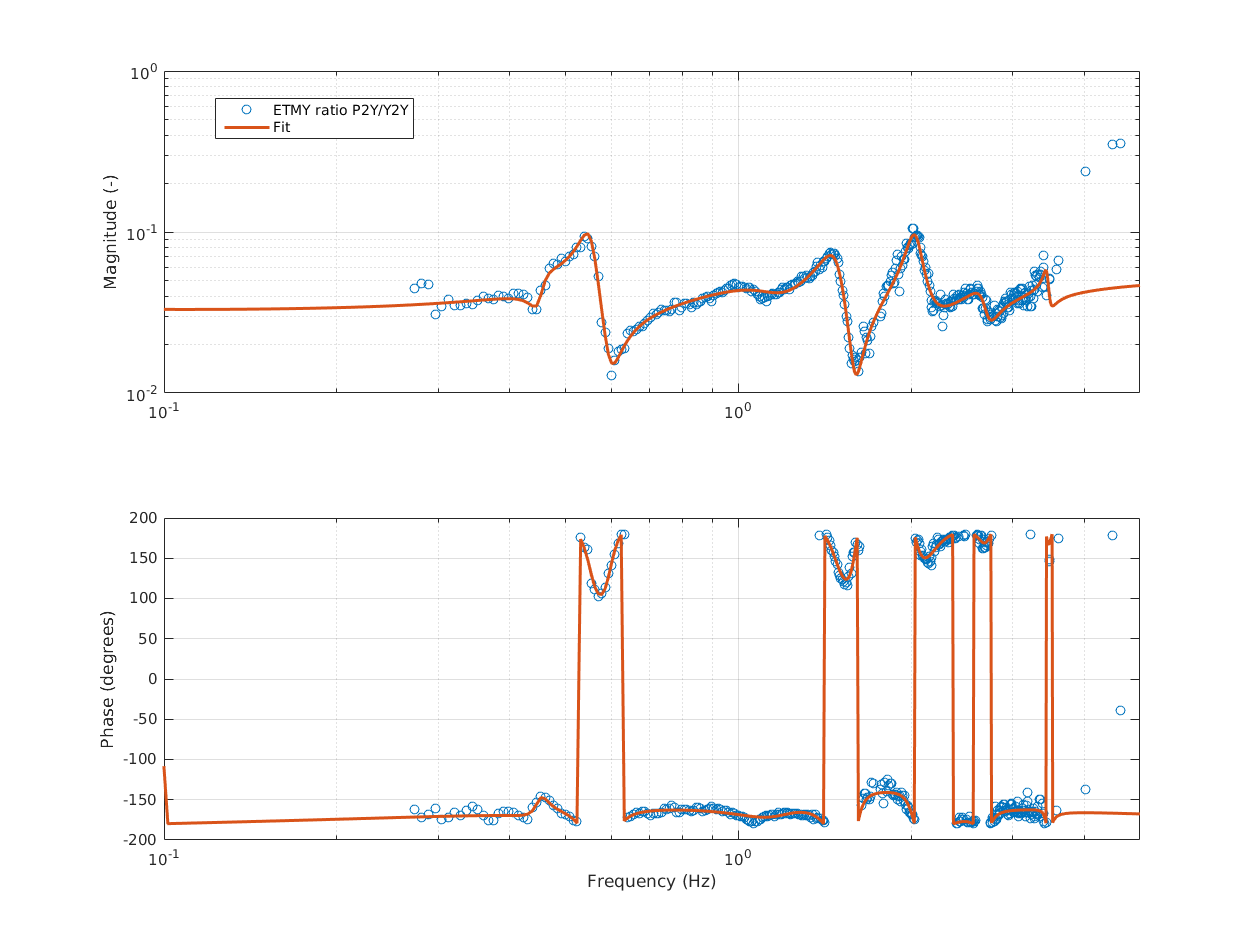
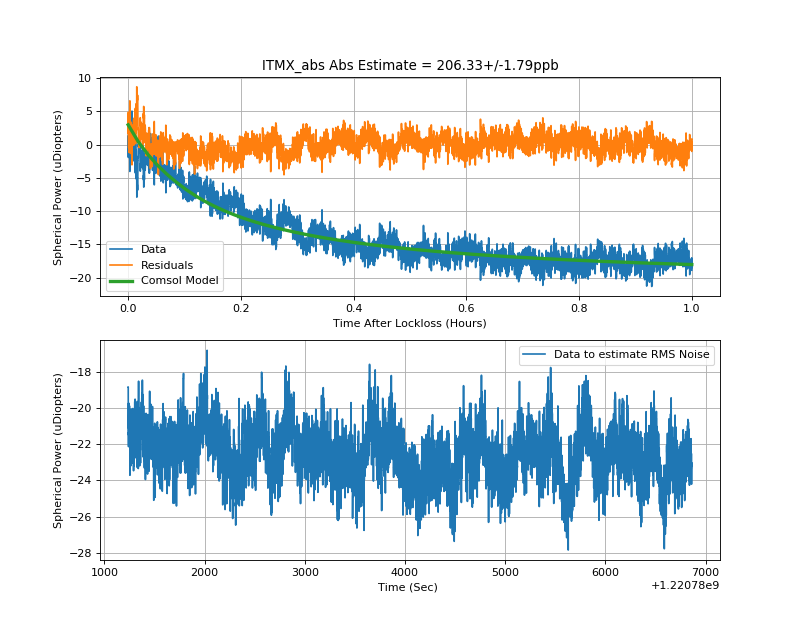
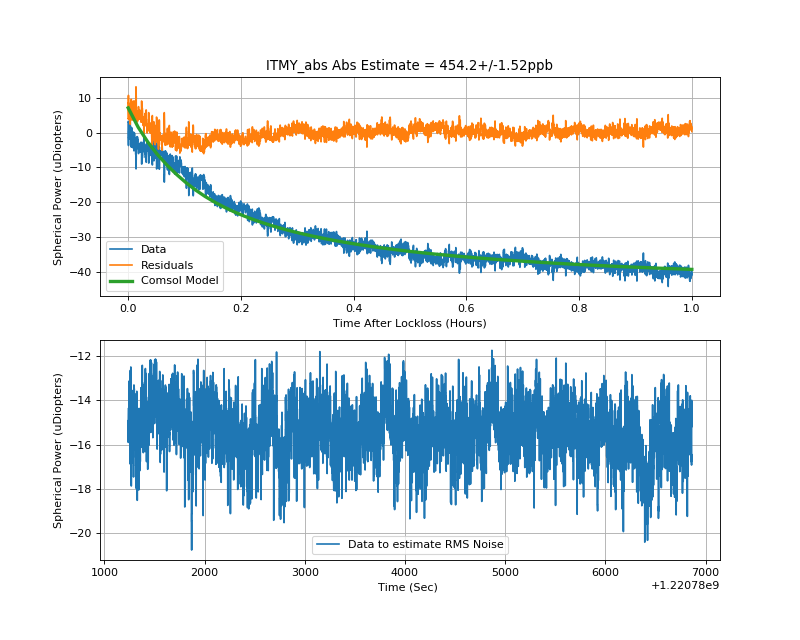
[ Alexei, Dan Brown ]
The jupyter notebook for all the relevant calculations is on the LIGO git.
I noticed an odd shape of the second order resonance (can be seen in single_fit.png) in the OMC scans related to the SR3 heater testing. This shape was very consistent between scans and only seemed to show up on the second order mode. Recent beam scan measurements [ alog 41683 ] have shown that the beam could be significantly astigmatic, thus influencing the shape of the second order resonance.
To test out the hypothesis I tried to fit two lorentzians to the second order peak (corresponding to the TEM02 and TEM20 modes).
The following model was considered
model = a1 * L(t,fwhm,t0-df) + a2 * L(t,fwhm,t0+df)
Where
L(x,fwhm,x0) = 1 / (2 * pi) * fwhm / ( (x-x0)^2 + (0.5 * fwhm)^2)
is the lorentzian function
The fit was performed by using Nelder-Mead to vary [ fwhm, a1, a2, t0, df ] to minimise [ sum(abs(data-model) ]. The resulting fit seems good as can be seen on double_fit.png and double_fit_residual.png.
The model returns the power of the second order modes as
P_20 = a1 * 2 / (pi * fwhm)
P_02 = a2 * 2 / (pi * fwhm)
Numerically the values are P_20 = 0.21 and P_02 = 0.09, which correspond to a mismatch of 13.7% [ using (P_20 + P_02) / P_00 ], where P_00 was measured separately as 2.17 from the same scan.
Note that the naive way of measuring mismatch [ P_2/P_00 ] gives 10.7% or 13.2% if the correction factor of 1.23 from [ alog 41679 ] is applied, where P_2 = 0.233 is the maximum value of the second order peak.
Using the expression for the power loss of due to mismatch from an astigmatic beam [Eq 21 in T1800165-v2 ] we get 13.9% of power loss.
The full description of the shape of the second order peak also has to include the contribution from the TEM_11 mode, which resonantes between the TEM_20 and TEM_02 modes. This can be modelled by adding
another lorentzian. The model is now
model = a1 * L(t,fwhm,t0-df) + a2 * L(t,fwhm,t0+df) + a3 * L(t,fwhm,t0)
Where Nelder-Mead tries to minimise the sum of the residual between the model and the data by varying [ fwhm, a1, a2, a3, t0, df ].
The resulting fit is only marginally better, which can be explained by the fact that the allignment loops for the OMC were closed (TEM_11 amplitude mostly couples through misalignments).
The resulting mode intensities are given by
P_20 = 0.199
P_02 = 0.0824
P_11 = 0.0252
The mismatches are
(P_20+P_02) / P_00 = 12.9%
1-sqrt( (1 - 2 * P_20 / P00) * (1 - 2 * P_02 / P00) ) = 13.0%
So accounting for the TEM_11 peak drops the mismatch by about 1%.
Special care has to be taken with the fitting as I've found the results can vary wildly depending on the minimizing routine used and the initial conditions of the fit. I don't have enough faith in these fitting algorithms for them to be able to
work robustly without oversight.
It looks like one can extract information about the astigmatism of the beam going into the OMC from OMC scans (contrary to what I may have claimed before) by carefully fitting lorentzians to the measured second order peak.
This may be useful in hunting down and remedying the unkown source of the astigmatism that has been plaguing us.
Sheila, TVo
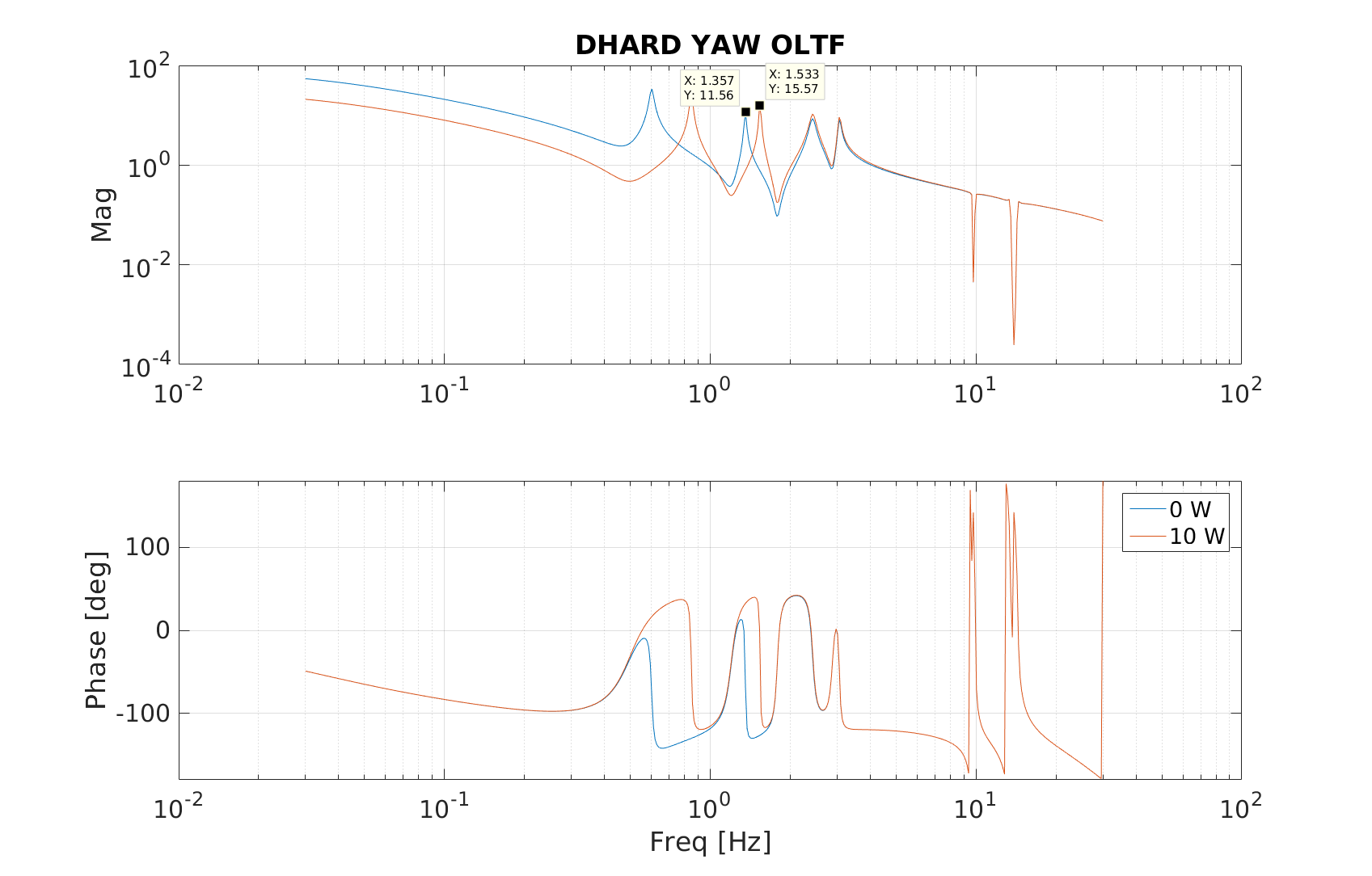
We noticed that the boost filter would cause the IMC to oscillate so we checked the OLTF again and found the UGF at 4 kHz, so we added +15 db to the servo gain and found a new UGF of about 30 kHz. This is probably due to the new EOM changing the modulation depth.
This seems high. The modulation depth is estimated to be only 3 times lower.
Yeah it did seem odd, but we reduced the gain by 4db here previously. So in the end it's about +11db which is close to what we'd expect from the EOM swap, maybe.
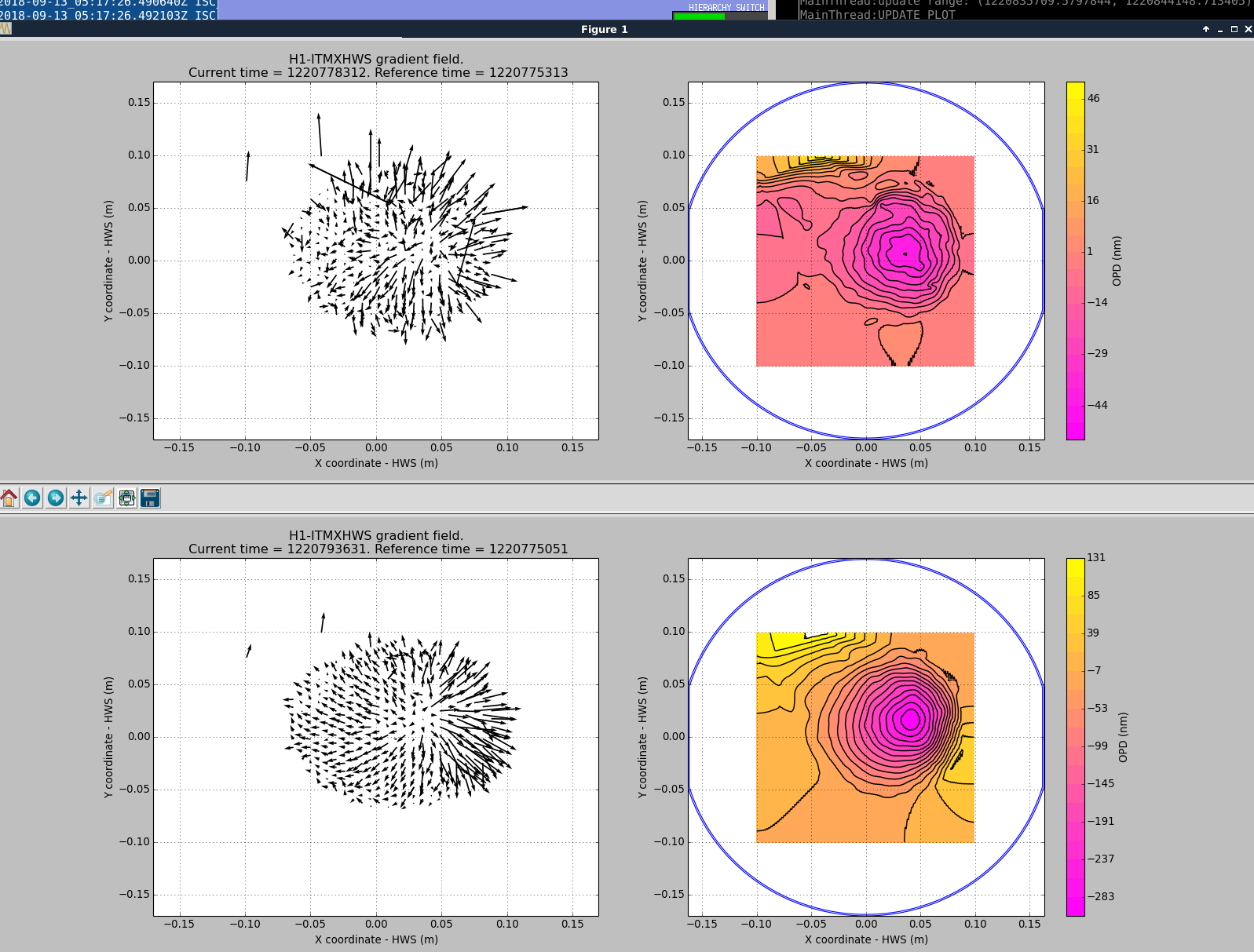
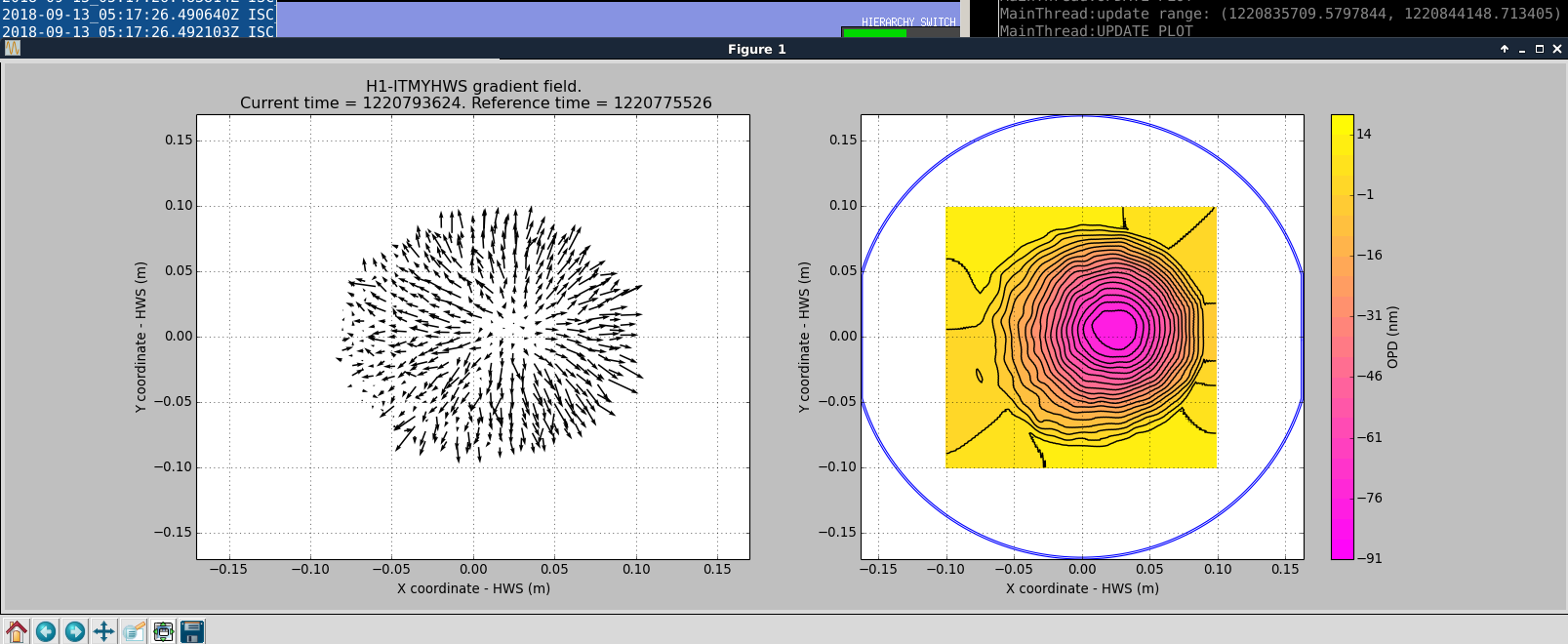
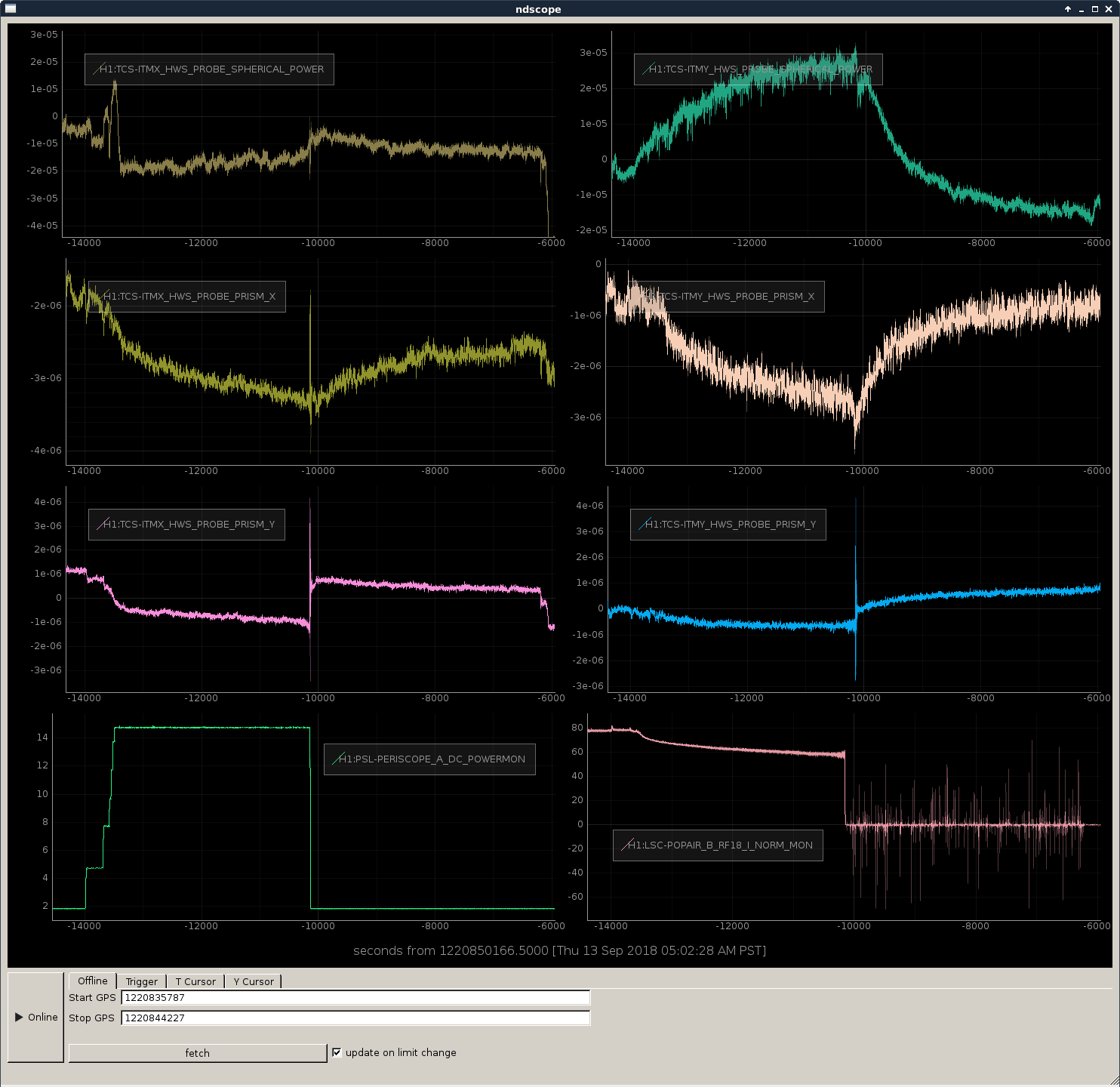
ETMY HWS running tonight for noise measurements. RH coming on at 2W around 11:30PM tonight for 8 hours.
Full report tomorrow.
Betsy, Travis, Gabriele
This afternoon Gabriele was kind enough to help us take the in-air violin measurements on the ETMXQUAD sus. We set up all of the in-chamber equipment (HeNe laser/QPD setup) and adjusted them to sight across one fiber at a time, while Gabriele ran the spectrum analyzer.
We were able to obtain data from the first 3 harmonics of the v-modes on 2 of the fibers (took about 2 hours). Tomorrow we will proceed with the other 2 fibers. More to come...
WP 7592
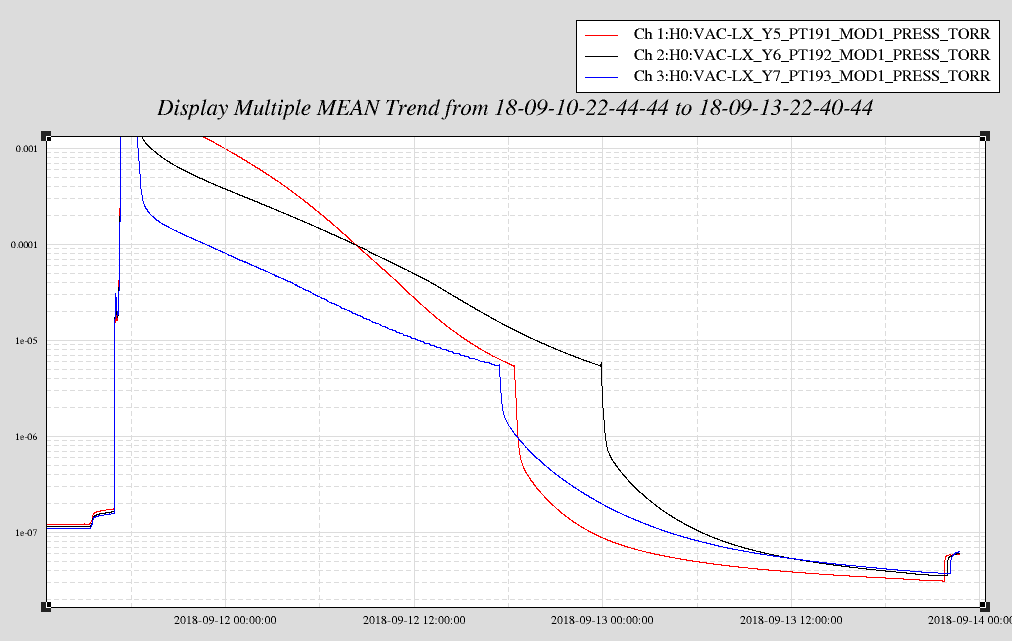
Newly replaced PT110 Inficon Gauge BCG450 was found to have one set of faulty contacts. This is preventing the HV power supplies interlock from enabling and turning on the HAM6 HV power supplies. Faulty contacts were bypassed.
Also to note: I enabled and set the pressure/HV interlock CoE parameters for PT170 and PT110 to 1e-5. This had not been done when they were installed. Both are new BCG450 gauges.
ISCT6 enclosure was moved to final location, alog 42101. Cables had to be be redressed to clear one of the clean room legs. Two of the picomotor cables ISC_182 and ISC_183 were too short,cable extensions were added.
TITLE: 05/23 Day Shift: 15:00-23:00 UTC (08:00-16:00 PST), all times posted in UTC
STATE of H1: Planned Engineering
INCOMING OPERATOR: None
SHIFT SUMMARY:
LOG:
15:14 APS on site
15:29 HFD on site for hydrant testing
15:30 Marc and Hugh out to vault/LVEA
15:35 Jeff B out to LVEA to investigate TCS water leak
15:54 Richard out to LVEA
16:01 Jason out to LVEA to investigate TCSY leak
16:20 Jason back
16:23 Karen servicing Y arm
16:24 Dan and Marie out to Squeezer Bay
16:25 Peter out to PSL enclosure
16:30 Richard back
16:35 Chandra into LVEA to valve in RGA
16:37 Fil out to LVEA for HAM6 cabling
16:38 Mark and Tyler to EX to remove arm from BSC
16:50 Jason out to PSL enclosure
16:51 Dan, Marie and Alexie out to EY
17:00 Chandra back
17:15 Aiden out to EY
17:53 Marc and Hugh back and done
17:56 Jeff B back
18:00 Jason and Peter back
18:24 Jeff B out to transition the LVEA to LASER hazard
18:30 Cheryl and Jeff J out to PSL enclosure
18:43 Travis to Optics lab
18:50 Travis out
20:59 Aiden, Aiden, Marie, and Alexie out to EY
21:25 Cheryl back
22:02 Jeff B out to HAM6 to reset dust monitor and mechanical room to check on TCSY chiller
22:09 Kyle and Gerardo to MY
22:12 Jeff B back
22:24 Marc to MX
22:25 Amber in CR with tour
22:27 Chandra out to MY
22:57 Marc back
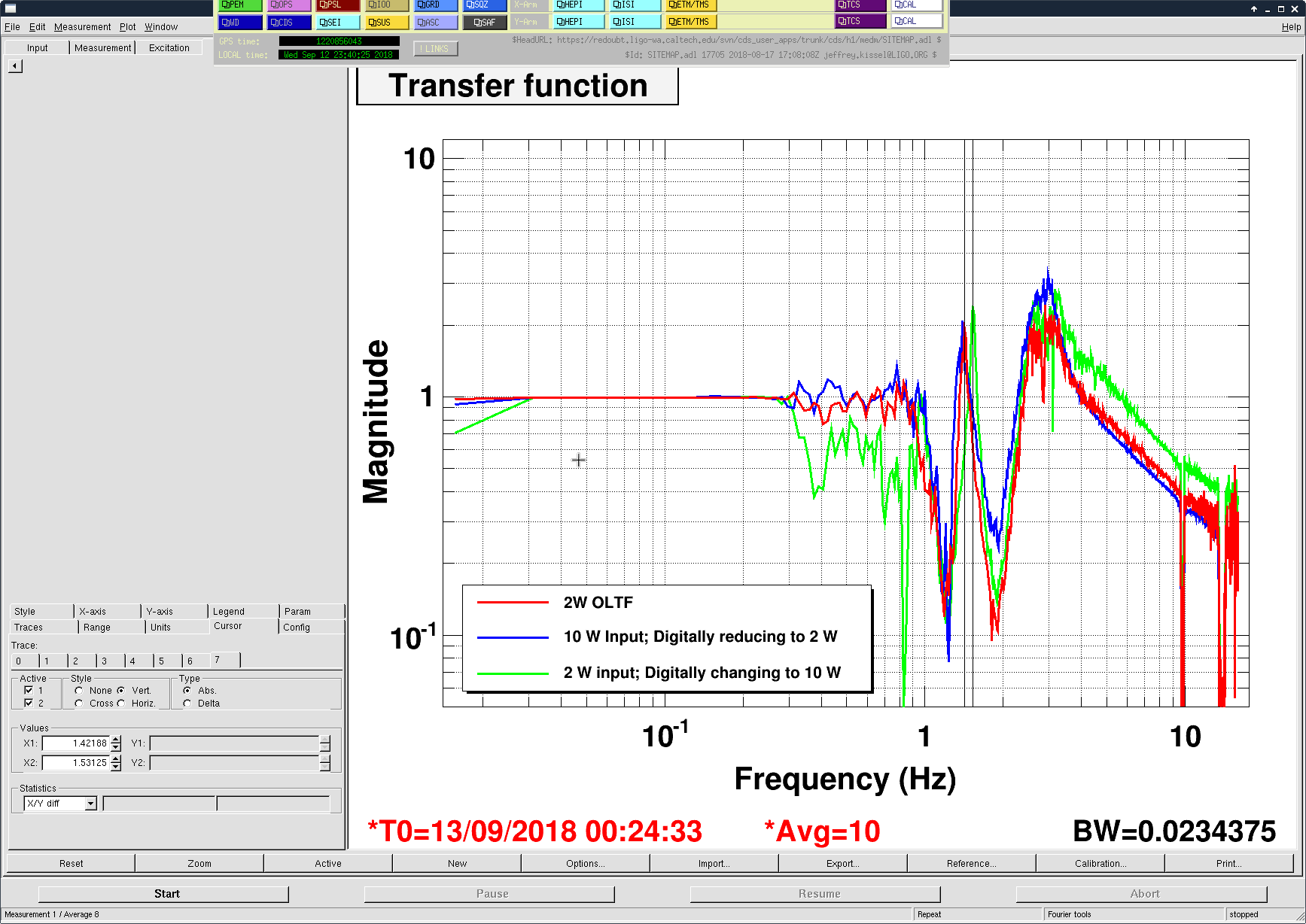
Transfer functions of the ISS were made for various gain slider settings from 0 dB to 21 dB.
It was quite noticeable that once the gain was increased beyond 16 dB, the loop started
oscillating. However in the power noise spectra there are a number of features (spikes and
broad peaks) that were not present before. These are not caused by the noise eater as they
are present when the noise eater is on or off. The broad peaks are not present in the
spectrum when the light is blocked. So they may be caused by scattered light.
More measurements and characterisation is necessary.
Jason / Peter
Richard, Dave: Due to ongoing fire pump work, these alarms have been silenced to cell phones for the remainder of the afternoon.
Bypass will expire:
Wed May 23 17:41:13 PDT 2018
For channel(s):
H0:FMC-CS_FIRE_PUMP_1
H0:FMC-CS_FIRE_PUMP_2
bypass removed
All BSC spectra are nominally ok.
All HAM spectra are nominally ok.
The LVEA is LASER HAZARD
Hugh R., Marc P.
Today we worked on the STS-2 Seismometer in the vault. Hugh looked at the seismometer to make sure that it was unlocked and connected correctly. We disconnected the green field box and returned to the LVEA to test it with the working seismometer near HAM2. The field box tested good and was returned and reconnected to the system at the vault. Hugh was concerned that we were using two cables out of the field box and asked if we could check where the other cable was going. We followed the 2nd cable back to the electronics fridge where we discovered that the end of that cable was corroded and possibly shorted internally. We disconnected the bad cable, and made sure that the other cable had good power and signal before closing everything up.
Hugh will attach the results on this ALOG.
Attached are comparison spectra between the Vault STS2 and the SEI ITMY STS2 sensor in the LVEA used for SEI Sensor Correction.
Also see on the image are the calibrations applied to the vault signals. The gain on the SEI signals are 6.4e-14; the vault signals have a factor of 10 applied somewhere...
Anyway, the signals compare pretty well.
In the vault, the seismometer looked pretty well level and the lock/unlock mechanism seemed to engage and disengage. The mass centering was pretty good with all <2V and maybe just one that was still above 1V. It appears that the cable supplying the power was shorting out the host box. It seemed the mass centering attempts did nothing while that cable was connected. When the STS host box was cabled in the typical way for our field deployments, all worked fine.
Robert of course needs to sign off but this plot should give him relief.
After a bit of hunting for times that the appropriate modes were rung up, Betsy and I were able to take ASDs for the new ETMx bounce and roll modes. Screenshot of the ASDs attached. The values we'll use to tune the BRDs are as follows:
Bounce: 9.69727 Hz
Roll: 13.7749 Hz
Yesterday, Travis and I worked on finishing the reaction chain cabling now that the ESD connection is back to working. We also fixed the noisy signal on the L2 UL OSEM by swapping the short quadrapus cable D1002524 that connects to all 4 L2 (PenRe) AOSEMs.
D1002524 s/n 904 was removed and 905 was installed. Note, there are no more spares at LHO of this type of cable. Will look into getting spares.
While at it, we swapped 2 AOSEMs which had open light voltages which decayed down to 15k (from 30k).
We then aligned the L2 AOSEMs to the flags on the PUM, in a few iterations.
We made a few more alignment tweaks to both chains and then ran a series of transfer functions to make sure all 8 masses were fully suspended and free from mechanical interference.
Details of this were posted by Travis on the original alog associated with the L2 UL signal, below.
Integration issue generated, see Bug #929.
travis.sadecki@LIGO.ORG - 16:23, Tuesday 22 May 2018 (42127)
Betsy and I swapped the quadrapuss cable to the L2 (PUM) AOSEMS. This seems to have fixed the noise issue that had been plaguing the UL OSEM for several years. See attached spectra for comparison.
After swapping the cable, we noticed that the 2 lower AOSEMs at the L2 stage (LL and LR) had low OLV values, so we decided to swap these as well. We also took OLV values for UL and UR that were not replaced, but are dying of natural causes.
| Old S/N | New S/N | Old OLV | New OLV | Old Gain | New Gain | |
| LL | 270 | 332 | 18726 | 18050 | 1.602 | 1.662 |
| LR | 483 | 473 | 25518 | 18150 | 1.176 | 1.653 |
| UL | N/A | N/A | 17934 | 21300 | 1.673 | 1.408 |
| UR | N/A | N/A | 25124 | 20600 |
1.194 |
1.456 |
These new open light current compensation values have been accepted into the SDF system. H1:SUS-ETMY_L2_OSEMINF_UL_OFFSET -9000 H1:SUS-ETMY_L2_OSEMINF_LL_OFFSET -12291 H1:SUS-ETMY_L2_OSEMINF_UR_OFFSET -10612 H1:SUS-ETMY_L2_OSEMINF_LR_OFFSET -10163 H1:SUS-ETMX_L2_OSEMINF_UL_GAIN 1.408 H1:SUS-ETMX_L2_OSEMINF_LL_GAIN 1.662 H1:SUS-ETMX_L2_OSEMINF_UR_GAIN 1.456 H1:SUS-ETMX_L2_OSEMINF_LR_GAIN 1.653
This morning, a leak sprung on the TCSy CO2 table. One of the dry break fittings on the supply manifold lost its seal and dumped just about the entire contents of the chiller onto the table. With a quick initial assessment, I don't see any optics that were contaminated (the water manifolds are in the SE corner of the table, away from the optics). Jeff Bartlett is currently cleaning up the water and repairing the broken fitting; if he can find a spare it will be replaced, if not it will simply be capped as it was an unused port on the manifold.
Edited to add: I took a couple quick pictures of the broken fitting, see attached.
Filed FRS 10736.
Installed plug as replacement for leaking dry break fitting. Refilled the chiller with lab water and restarted the system. Observed no leaks on the table. Could not find a replacement dry break fitting. If TCS does not have spares, will order several pairs.
J. Oberling, P. King
Today we worked on recovering the PSL ISS, and began by re-installing the ISS AOM. The AOM mount was moved to a place where the beam was ~1mm in diameter (unfortunately I forgot to take pictures, will take some tomorrow and upload as a comment) and installed the AOM. The mirror that sits downstream of the AOM and reflects the 1st order diffracted beam into a beam dump was also re-installed and aligned. A power meter was placed in this beam path and the alignment of the AOM tweaked to maximize the power in the 1st order beam. We then adjusted the ISS offset to find the point where the AOM was diffracting ~2W; this was found at an offset of 8.0. The offset was then set to 0, and increased to 20 in steps of 1; a power reading for the 1st order beam was taken at each step. This allows for calibration of the diffracted power graph on the ISS MEDM screen. Peter has the data and is analyzing it.
The beam from the PMC to the ISS box had to be re-aligned, as we had not re-aligned this path since moving the ISS box to accommodate the damping bars for the new PMC. This complete, we then roughly aligned ISS PDB. The PD assembly was then removed from the ISS box so we could re-install ISS PDA (recall that PDA had been removed from the ISS box and installed in place of IO_AB_PD3 prior to O2). With PDA back on the PD assembly, this was installed back in the ISS box, and both PDs aligned. They both now read ~10.0 V. Next step on the ISS (for tomorrow) is to get the loop to close and measure TFs to optimize its operation.
Attached is the calculated fit to the percent diffracted power versus offset slider setting.
Ihe fit is close to a parabola p(x) = 113.18 x^2 - 82.3309 x + 15.0625.
The power measured in front of the AOM was 67.8 W, and after the neoVAN amplifier was
69.8 W. The power in front of the AOM was used in calculating the percentage diffraction.
I went ahead and changed the coefficients in the ISS MEDM screen that calculates the percentage diffraction.
Set the reference level to be -1.89 and closed the loop without any problems.
The offset slider is currently set to 8.00. Please do not mess with this value. Only the reference level
(labelled REFSIGNAL) and the gain slider should be adjusted. At the time of making this log entry the gain
setting has not been determined as that will require a few transfer function and noise measurements.
The promised pictures. The 1st is the ISS AOM installed in its new location. The 2nd is the mirror that directs the 1st order diffracted beam from the AOM into a beam dump (bottom-left of picture); the power meter shown was used for alignment of the AOM.
Filiberto C., Daniel S., Marc P.
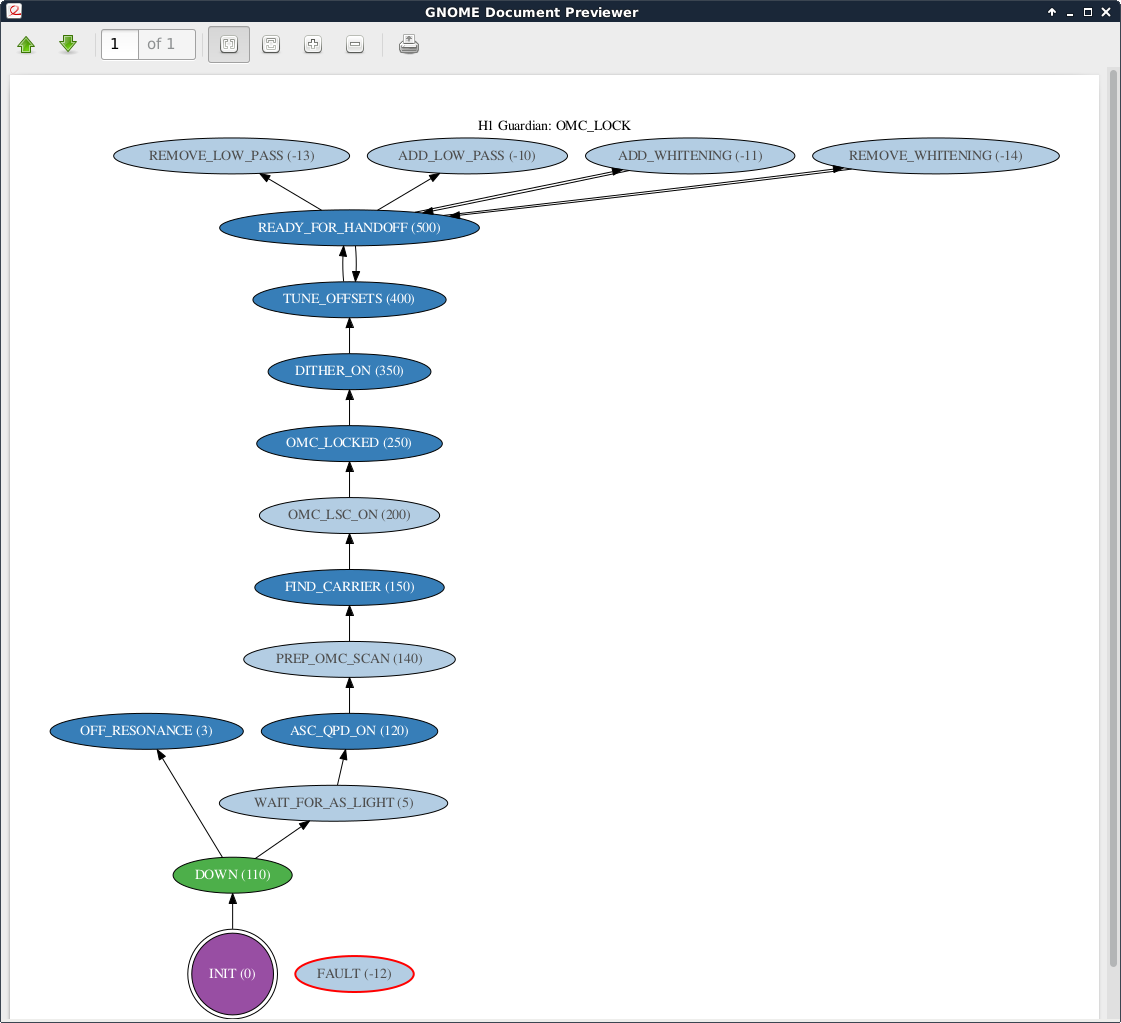
Today we successfully applied E1600252v2 to the OMC DCPD ISC Split Whitening Chassis S1101627. This change better accommodates the violin modes of the main LIGO optics in the vicinity of 500Hz that have a tendency to saturate the whitening chain's filters. The new filter replaces a 1Hz-10Hz zero-pole, with a 50Hz-500Hz pole-zero on the second filter channel. LLO had already completed these changes August 2016, ALOG.
Updated the DCPD whitening filter at stage 2 to a nominal zpk([50],[504],-1, "n"), ie., zero at 50 Hz, pole at 504 Hz, gain of -1. This may effect the calibration.
Re-terminated the pins for the ERM pigtail connector. See alog 41891 for LR and Bias failing HI-POT test. All pins were tested for the following:
1. Checked no shorts between inner pin and connector body.
2. Tested all segments (LR, UR, BIAS, UL, and LL) were not shorted to each other.
3. Performed HI-POT test to 1kV for each pin, all passed.
4. Connected all cabling in-chamber and repeated HI-POT test on air-side. All passed (UR only tested to ~800V).
R. Abbott, F. Clara, T. Sadecki, B. Weaver
Followed procedure E1800147-v2 for re-termination of connectors.
Completed continuity tests for ETMX ESD from air-side flange to optic. All air-side cabling from feedthrough to rack were labeled.