Betsy, Slawek, Sebastien
AMD1 and AMD2 have been installed in the ITMX and ITMY test masses. The install went well, and the epoxy curing passed the dynamic test. 24h of curing is required before moving to the next AMDs. Tomorrow, we will continue the work and install AMD3 and AMD4 in both chambers.
PT-245 has been noisy of late (see attached). Hopefully the electronics aren't finally succumbing to the hot ambient surroundings after all of these weeks?
Current work on site:
Details Site Activities:
Locked ISIs: HAM4, HAM5, BSC1/ITMY, BSC3/ITMX, BSC9/ETMX
I put SR2 into Damped, which so far has allowed it to remain in this state even when HAM4 ISI trips.
WP 7527
Ham 6 PZT HV power supply is powered on. The vacuum pressure interlock has been bypassed.
(Corey, Niko)
This refers to FRS Ticket #9647.
We needed to make a modification to the HAM5 OFI Baffle (D0902845) by using a nibbler tool (desired modification is attached & labeled as "OFIREFLBAFFLE(MODS)". This tool was to be used to "nibble"-cut into 18 Guage (0.048" thick) stainless steel of a baffle part. I was working in HAM5 with Keita on another task so I recruited Niko to tackle this job. I helped him get set up and I tried one cut (each cut made about 3-4mm wide x 1-2mm long cut....needless to say it would be a slow process), and it was do-able, but hard.
Eventually Niko found it to get harder and harder as he went. We are thinking the tool was degrading. He made something on the order of 0.5 - 0.75" worth of total cutting progress (photo#1 attached). I wanted to give it a try & yes, it was really tough & could not make any progress....but on a final attempt I tried to manhandle it and manage one cut. However on the next cut, the cutting part failed/broke (photo #2 attached).
So perhaps another option can be tried? Keita said Gerardo used shears on a similar type of material...but would go through several shears to complete the job.
Ask Bubba about a "skinny wheel" abrasive cut. Follow up with a clean hand file.
Striptool with the white background and red trace is now looking at the channel H0:VAC-MY_CP3_TE202A_DISCHARGE_TEMP_DEGC.
Overall:
Fil, Georgia
Conclusion:
We believe that the ETMY LR ESD quadrant is disconnected somewhere in-chamber.
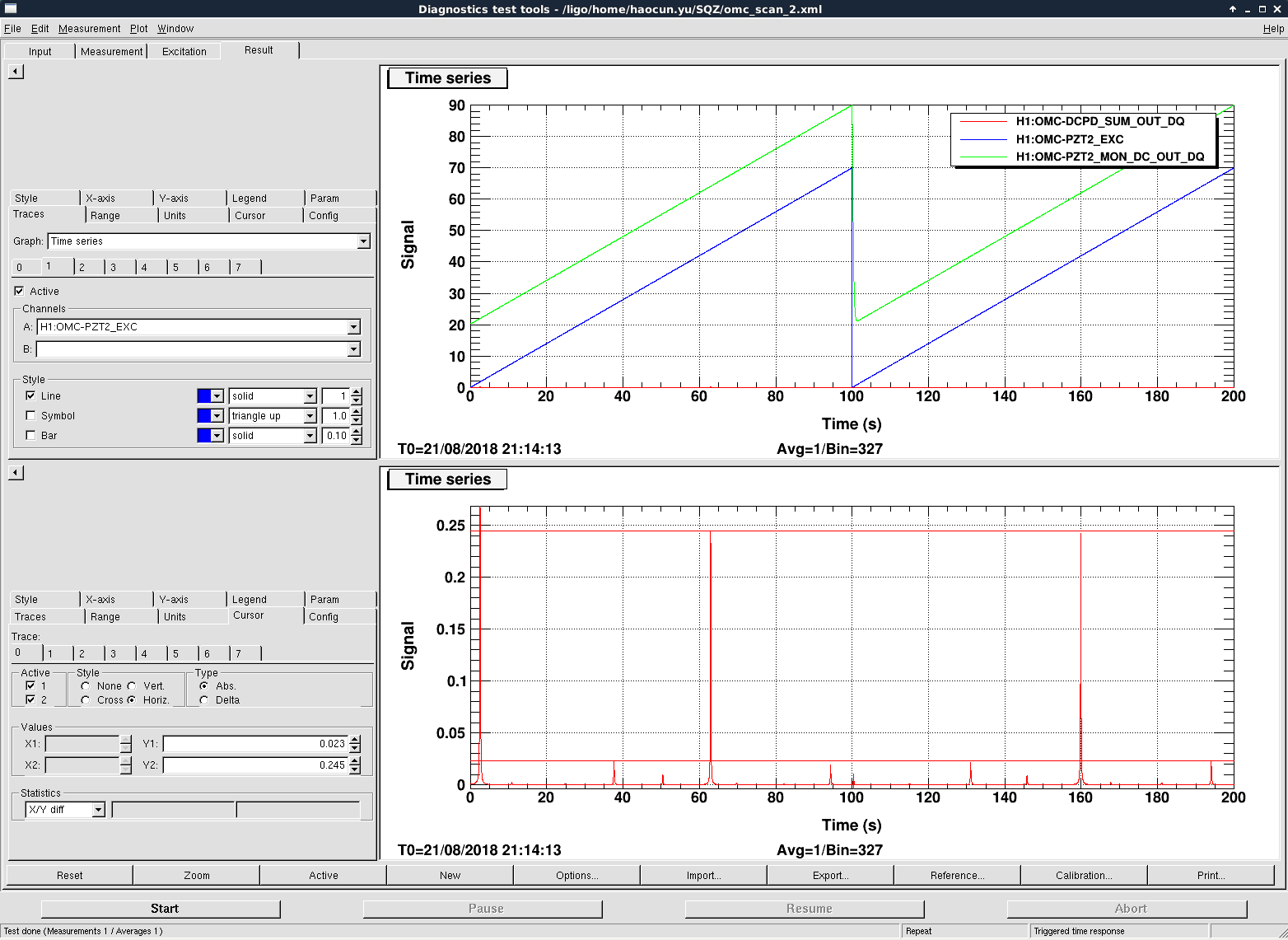
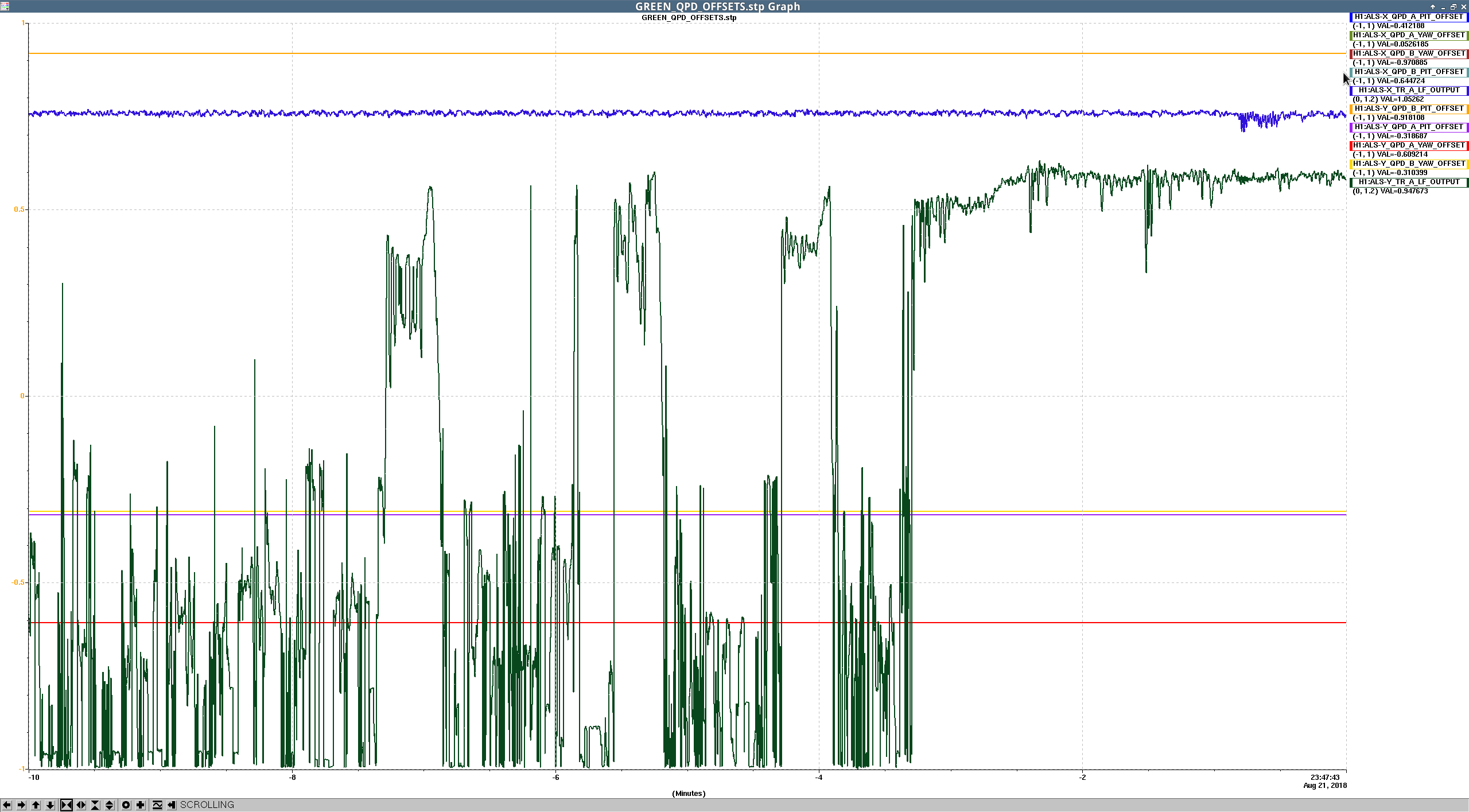
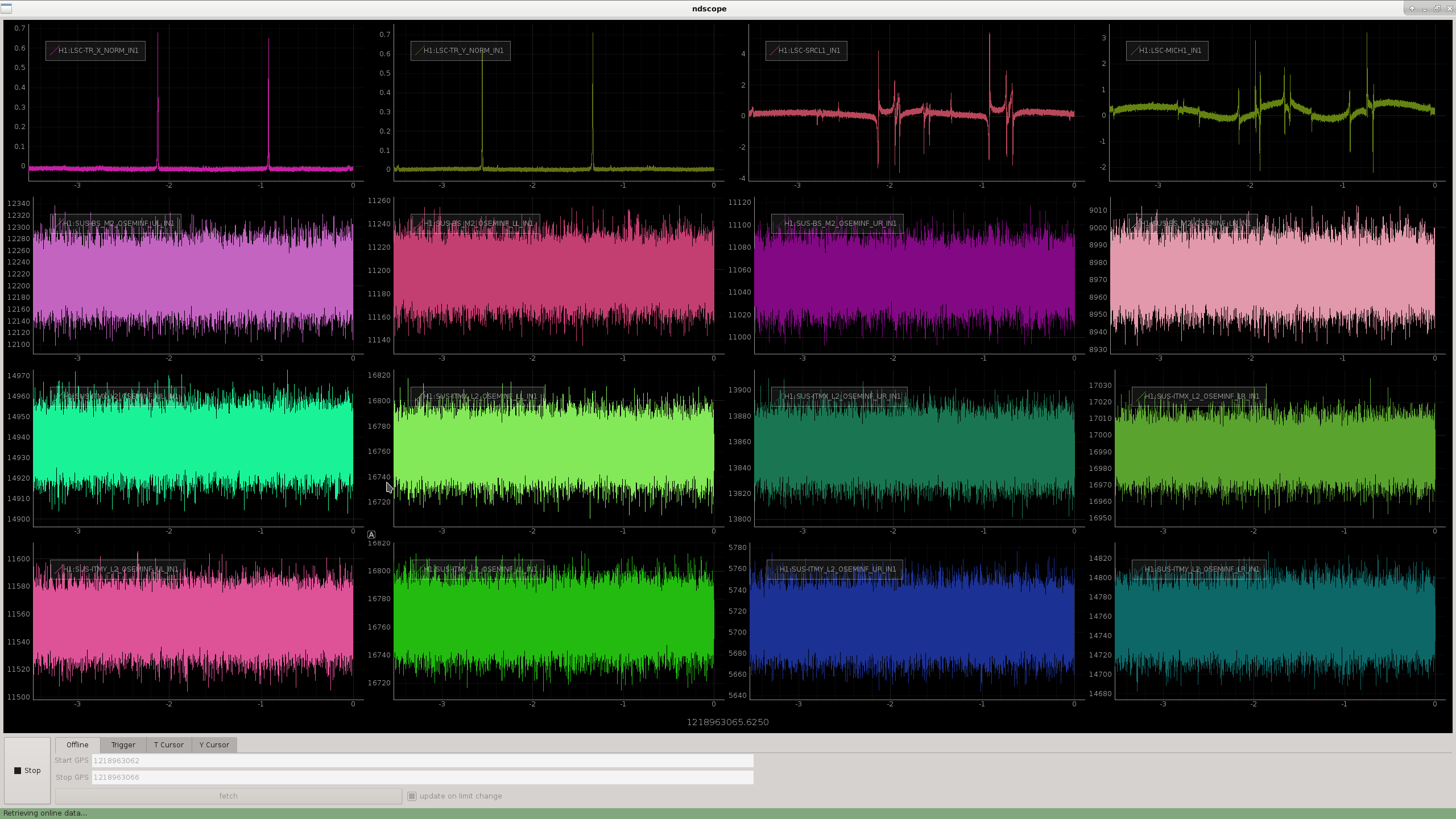
After problems with ESD-optical lever charge measurements, I tried to confirm that we are actually driving the LR quadrant by driving the individual ESD quadrants with a 4.3 Hz sine wave (30000 counts amplitude, with 100000 counts on the bias) and looking for the response on the optical lever pitch and yaw. A response was seen while driving the other 3 quadrants, but not the LR quadrant (see attached screenshot).
Fil and I went down to EY to check all the electrical connections outside the chamber. Between the HV chassis and the chamber feedthrough there is a resistor box and a pigtail connector. Everything outside the chamber is working as it should.
- We checked the connections in the resistor box, some connectors were loose but everything was connected. (Note the resistors in the box are actually bypassed, as their function (to limit current to the ESD electrodes) is now done inside the chassis. The box remains as an elaborate SHV-SHV connector.
- We drove the LL quadrant, with this signal hooked up to the LL, UL and LR quadrants at the resistor box, and only saw a response in LL and UL, confirming that we are driving up to the pigtail.
- We reseated the pigtail connector, repeated the above test, and saw nothing while driving the LR quadrant.
- Finally, we replaced the pigtail with a spare, and again saw nothing while driving the LR quadrant.
FRS ticket filed; ticket number 10543.
We have seen this type of behavior before. If it's the same issue as seen at LLO, the problem is associated with the last connection in the ESD chain right at the union of the coaxial Accu-Glass cable coming ultimately from the vacuum flange, to the thin biomedical wire used to actually make the connection to a segment of the ESD. The issue relates to the fact that the connectors were not assembled correctly somewhere in the distant past. When the two sides of the connector are mated together, either the pin or the socket of one connection is forced back into the connector instead of forming a socket-pin connection. This was due to the use of the incorrect PEEK backing part inside the connector. The recipe for a complete fix of this issue is to take apart the connector next to the optic and re-terminate it in-situ with the proper backing part. Not for the faint of heart, but Carl Adams at LLO has already done this. Alternatively, there is always the temptation to wiggle the connector around until things make contact again. For worst results, try that.
Relevant drawing for the ESD wiring chain: D1400177, which admittedly starts from pg 15 (plus monitor stuff on pg 11) of the QUAD ETM wiring diagram D1002741-v9. Translating between Georgia and the drawing, the "pigtail" referred to above is the chamber side of HV Coax Bundle on pg 5 that emanates from the Strathclyde high voltage driver output. Further, the drawing indicates that A pasternack PE9337 SHV barrel should be used for the connection between this UHV bundle and the 5-way coax connection to the chamber feed through (since v4 of the drawing), but as indicated above, we've instead by-passed the resistors in the current limiting assembly, D1201288, shown way back in v3 of D1400177-v3) (which, naturally, incorrectly points to D1500164, an accelerometer dog clamp).
On the first try Corey and I found that the height of the beam dump is too high. The bottom of the black glass is about the same height as the center of ZM2, which is about 8.125" (first attachment, the beam dump was placed right next to ZM2 so it's easy to see the height).
This turned out to be some mixup of which variety of d1400171 should be used. What we received are (yet to be captured in DCC but) two 4" posts, giving us 8" at the bottom of the V-dump holder, and 1/8" is added by the V-dump holder itself.
We talked to Stephen, Betsy and Calum, and we decided to go with Corey's suggestion to stack up 5 pieces of V-dump holder D1000972 as a 2.5" spacer (so we use total of 6 V-damp holder). Together with 4" post, the top of V-damp holder becomes 7" high, and the black glass sticks out by about 2". It's 1/8" lower than ideal but that's not a big deal (2nd attachment, again the beam dump is misplaced intentionally).
Corey and Sheila looked at ZM2 and the new beam dump from behind OFI to check that the eddy current damper bracket and the cage are occulted by the black glass while the entire 2" optic is visible. We also made sure that the beam dump won't block the main beam path between ZM2 and the septum window.
More pictures will be posted by Corey and/or Sheila.
Additional notes for this install (with a MacGyver-ed Beam Dump Assy [vs. the planned D1700347-assy]):
Attached Photos:
PT-243 tripped today. APS has been working in that area and setting a trend where cold cathode gauges keep tripping in the areas where they are working. The new theory is their high power walkie talkies are causing interference with gauging.
CP4 doesn't seem to want to ramp down. It bottoms out at 118C and then starts the climb, holds at targe temp, and repeat. Another call into MCE to debug.
Tomorrow Ken will turn the additional 10 kW heater OFF.
J. Kissel, T. Shaffer ECR E1700423 IIET Ticket 9614 TJ and I went in to HAM4 this morning and replaced the Z-skin (D1003301) on the SR2 scrapper baffle (D1200922) in order to increase the aperture for the Hartmann Wafefront Sensor path's reflection pick off from SR3 (see above ECR cited above for motivation). Pictures attached. - 3868: The "big picture" of where this baffle lives in HAM4 - 3865: The "before" picture showing the previously HWS-limiting aperture (no flash) - 3867: The "after" picture showing the new bigger aperture (no flash) - 3871: The "after" picture showing the new bigger aperture (with flash) - 2018-05-01_SR2ScrapperBaffle_ApertureSwap.pdf: An attempt to line up the pictures to demonstrate the aperature increase We've elected not to re-B&K hammer the baffle after re-assembly since - the original results from this upgraded baffle showed that all resonances were sufficiently damped by the plethora of viton washers built into the design (LHO aLOG 39750), and - the more primitive "whack it with a wrench, see if it dings" test showed similar results. Note: we were able to lock up the entire ISI going in (with only the South / -X door open), so we did not lock the SR2 suspension. How to? - Lock the A & B lockers on the South side (A = -X/+Y, B = -X/-Y), - Put on your chamber booties, and step up onto Stage 0, grabbing the chamber for support not the ISI. - Slip by the table towards the west, +Y, beam splitter, then lay down in the tube reaching for locker D (D = +X/+Y) to lock it (The table is now locked quite well, but still be careful) - Continue to slip around around the table, using Stage 0 to climb down into the cavity between the North door and the chamber - Squat down and lock the final, C, locker (C = +X/-Y) It goes without saying that you should be watching all parts of you as you slip around -- don't touch optics on the table, or viewports, and slide your feet around when on ST0 so as to not squash cables and/or cause ground loops. We unlocked the ISI as we left the chamber in the reverse order from above.
The access system at EY was taken down to allow APS contractor to continue with their work. The entry door to the change room is now unlocked.
Chandra, Dave:
PT423 is tripped today, cell phone alarms have been silenced until 17:23PDT.
Yesterday morning Mark, Tyler, Chris installed HAM 6 N/S doors. Yesterday afternoon they removed HAM 5 N/S doors and loosened bolts on HAM 4 S door. Kyle removed all but four bolts on BSC 1,3 biergarten side doors. This morning Mark, Tyler, Chris removed HAM 4 S door and two BSC doors. Champs!
Gerardo and I opened GV 1,2 for oplev access. We slowly opened the gates by ramping up to 500 rpm and back to zero several times.
Purge air is currently flowing through XBM, YBM, and OMC ports to help flow dry air from several directions.
Current work and plans for the day:
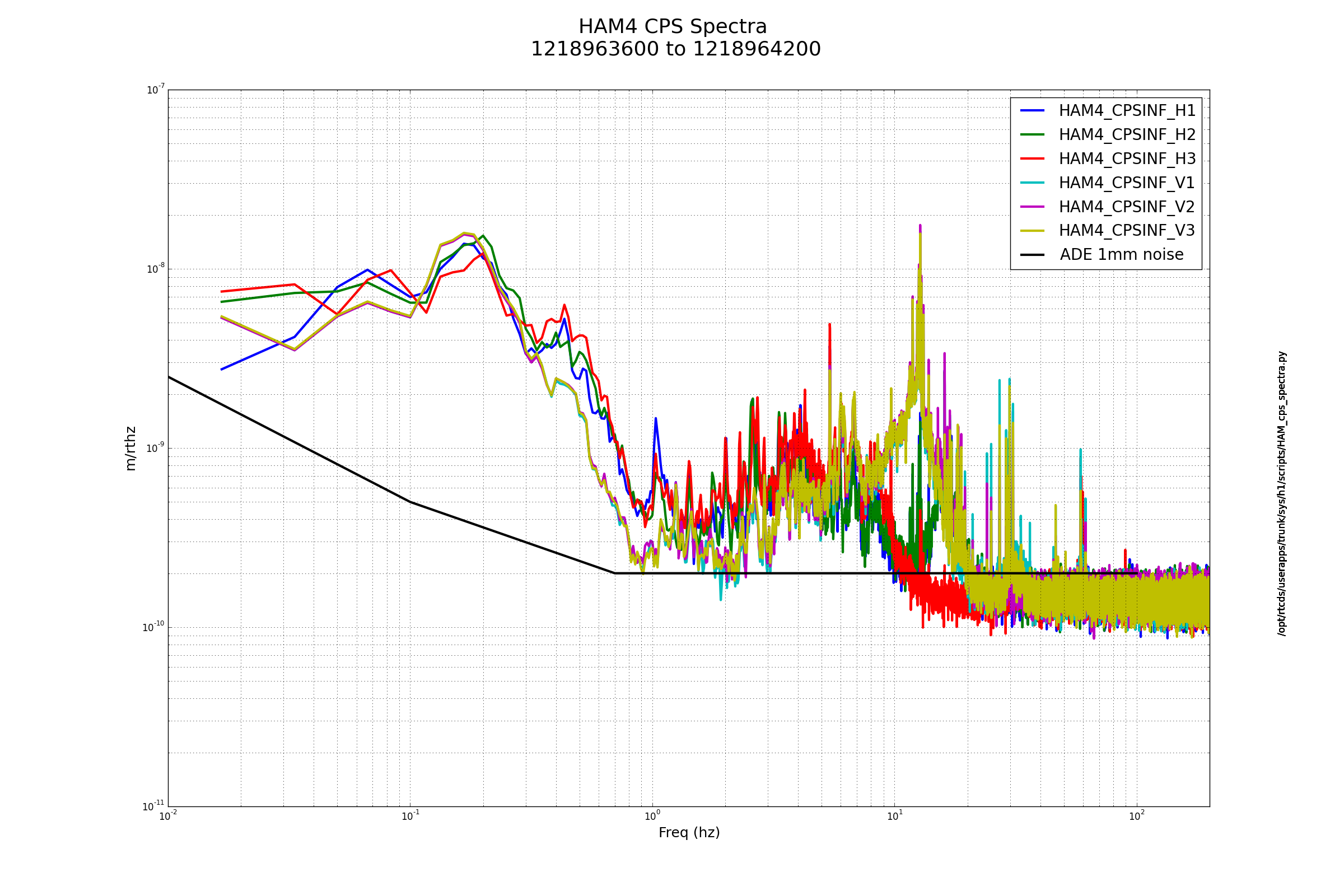
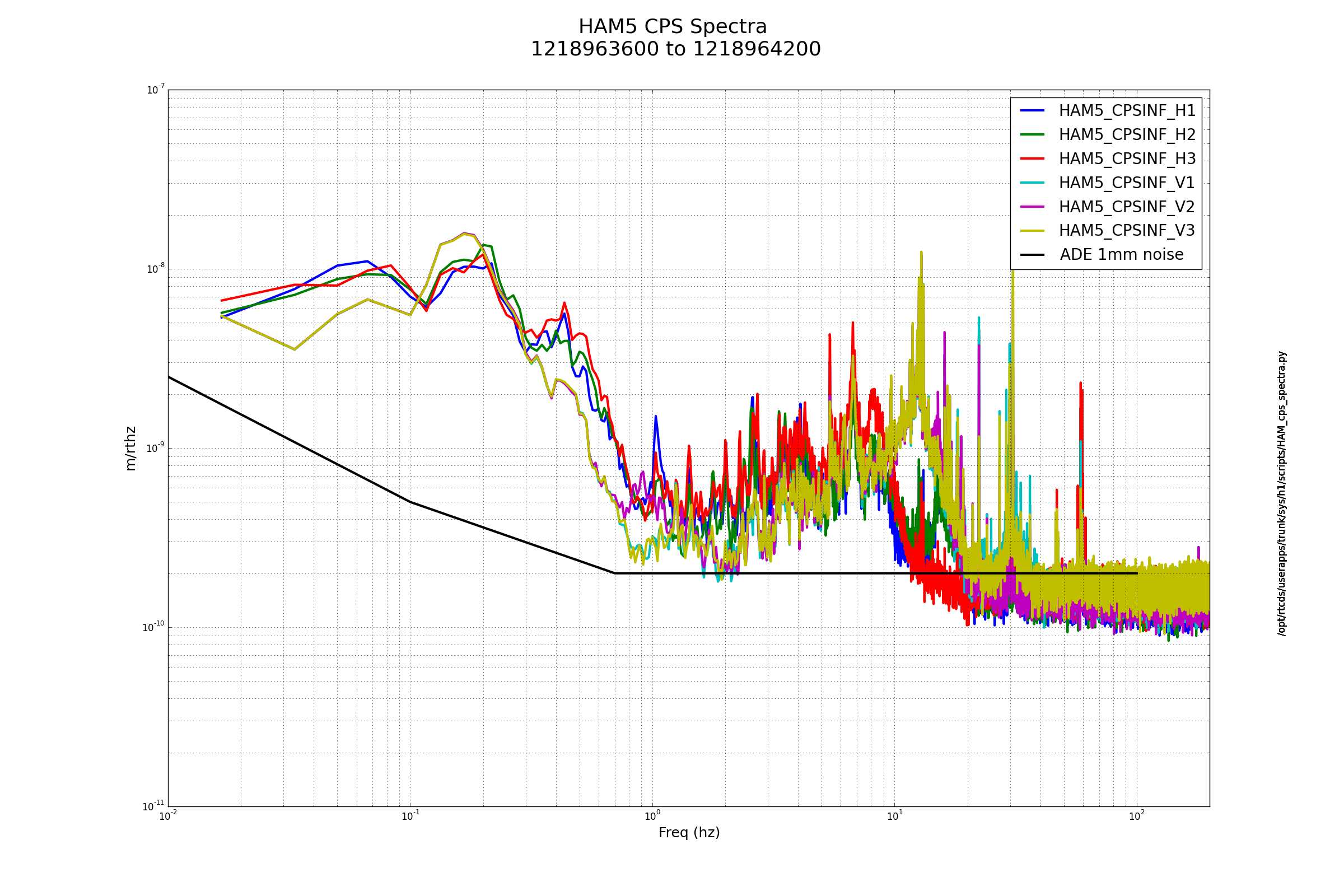
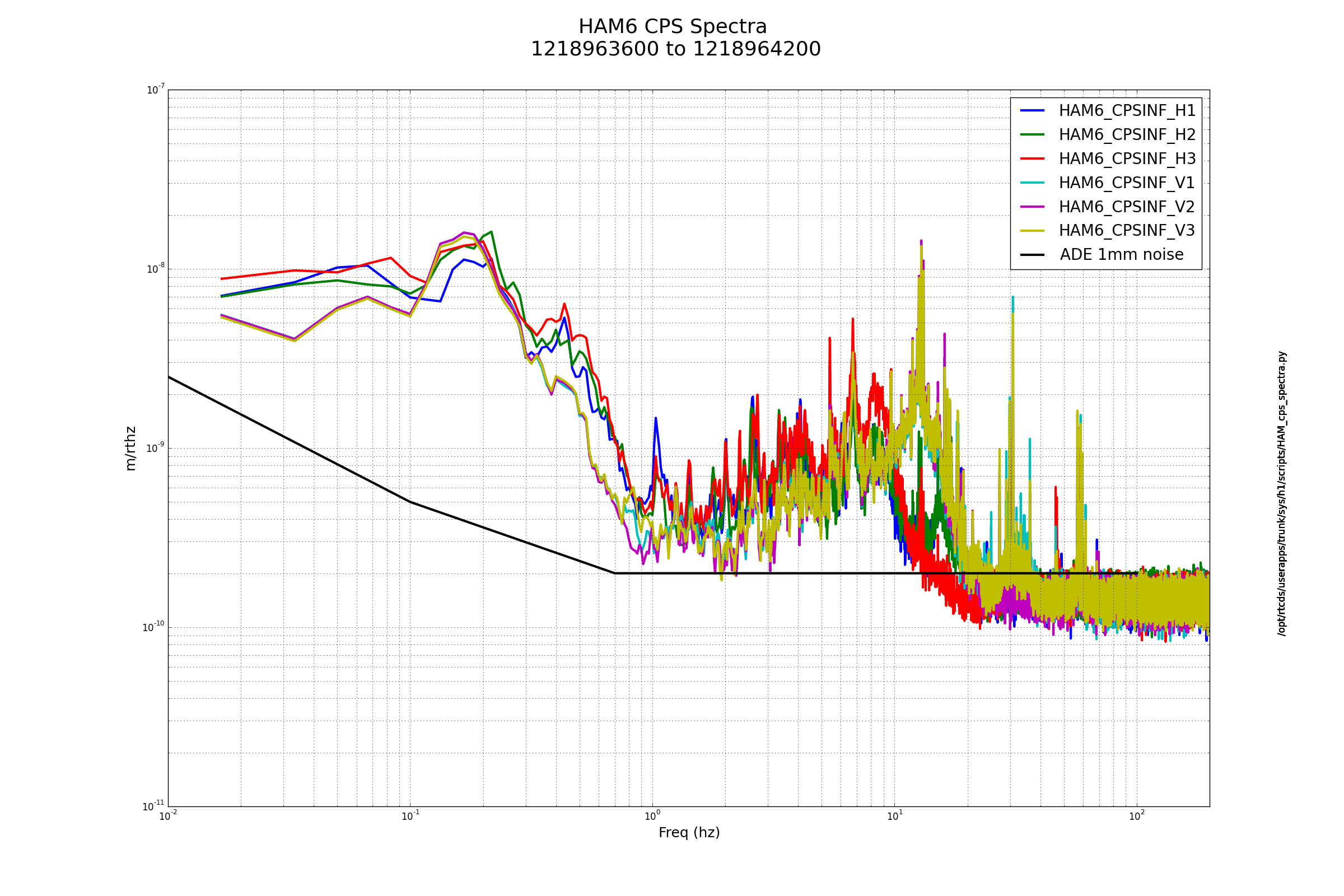
Both yesterday and today HAM2 ISI tripped, with no obvious reason. Both times I looked at the camera, and did not see any work around the chamber. Yesterday the HAM3 ISI tripped at the same time. Both happened while doors were being taken off / put on in the HAM4/5/6 area. Snapshot shows today's HAM2 ISI trip, and yesterday's HAM3 ISI trip.
Had forgot to log this earlier
Measured dew point just before venting was -28C.
Yesterday, I measured particle counts just inside the door to BSC1 just after I exited and while Slawek was still in-chamber. The counts were
1.0um = 200
0.7um = 50
all else under 50.