Prior to shift: Verbal alarms is crashed Jamie working on guardian 14:47 UTC Jeff B. to end X to reset dust monitor 15:28 UTC Jeff B. back from end X 15:37 UTC Let Advanced Protection Services (APS) through gate 15:48 UTC Peter to PSL enclosure 15:59 UTC Let visitor through gate to see Chandra 16:04 UTC Let Advanced Protection Services (APS) through gate 16:38 UTC Robert to end X to change a setting on electric field injection 16:43 UTC Sheila and Nutsinee to HAM6 to run a beam scan on the squeezer beam 17:05 UTC Robert back from end X 17:12 UTC Greg G. to LVEA 17:24 UTC Robert and Georgia to end X, inchamber work on EFI, check cyropump baffles 17:30 UTC Ed to optics lab, LVEA for property inventory 17:37 UTC Gerardo to LVEA to retrieve power supply to take to end Y 18:03 UTC Peter done in PSL enclosure 18:55 UTC Terry to HAM5 to give equipment to Sheila 18:55 UTC Gerardo to end Y to check on status of HV NEG pump bake 18:59 UTC Robert and Georgia back from end X 19:06 UTC Ken to end X to work on the ceiling above the outside door 20:02 UTC Ken done at end X 20:06 UTC Marc and Elizabeth to LVEA to look for equipment for property inventory 20:14 UTC Marc and Elizabeth done 20:14 UTC Let visitor through gate to see Chandra 20:24 UTC Ed and Elizabeth to end Y for property inventory 20:49 UTC Ed and Elizabeth back from end Y 20:55 UTC Nutsinee back to HAM6 20:56 UTC Elizabeth to LVEA to look for coil of wires 20:58 UTC Corey and Hugh to HAM5 area to prep for vent next week 21:09 UTC Elizabeth back from the LVEA 21:09 UTC Sheila back to HAM6 22:25 UTC Hugh back 22:47 UTC Corey back
I have just completed a full round of model code compilation. This is just a "make" not a "make install" so no target/DAQ/GDS files have been modified.
Before the builds I backed up the H1.ipc file and emptied the file. After the build was completed, I reverted the original H1.ipc file back in case we restart any systems this weekend.
I wrote a script to compare the new DAQ-INI files with what are currently being used. Of the 107 models, 11 have different INI files. This indicates their code has been changed since the last H1 build (calcs, susauxb123, susauxex, susauxey,susauxh34, susetmx, susetmy, susitmx, susitmy, susitmpi, susprocpi)
I'm reviewing these models to see what has changed.
As per Chandra's request:
CP4_TE253A Rate-Of-Change channel has been removed from alarms.
CP4_TE253A (low,high) levels have been changed from (0,150) to (100,200) degC
As per Ryan's request, Kyle's contact email address has been changed to his new caltech.edu one.
h1susauxb123 and h1pemmx front end systems are both running RCG3.4.2/Gentoo3.0.8 with no current issues.
The problem of the models not starting automatically on reboot has been resolved.
There have been some occasional DAQ issues seen when h1susauxb123 models were started/stopped. Specifically: sometimes when the models are stopped the DAQ data from h1seih16 were glitched (running start_streamers.sh on susaux123 clears this). During some starts of the code the DAQ status for the models h1susopo and h1ascimc were flashing between 0x0 and 0x2000. This was when the susaux models were not starting correctly, has not been seen since.
One surprise, after recompiling h1susauxb123 the resulting DAQ-INI file was different. The file h1susauxb123.mdl has not been modified since 2015, so I suspect some of the common mdl files used by this model have been modified recently.
PeterK, JasonO, RickS
Yesterday afternoon and evening we realigned the beam path from the 70-W amplifier to the PMC, addressing the discrepancy in optical component mounting heights - 10 cm vs. 4". All components for mounting lenses (lens mounts, rails, etc.) and the new Faraday Isolator located between the Front End and the 70-W amplifier were designed for a fixed optical height of 10 cm. Almost all mirror mounting components, the 70-W amplifier, and the PMC were designed for a fixed optical height of 4". The difference of ~1.6 mm is significant.
After the first turning mirror downstream of the 70-W amplifier and up to the last two turning mirrors (with PicoMotors) directing the beam into the PMC, we set the beam height at 10 cm. Thus, the beams are obviously below center on all turning mirrors.
We removed the high-power AOM for the ISS and spent a few hours tweaking the modematching to the PMC.
Currently, the PMC visibility is about 75%. We suspect that the alignment through the 70-W amplifier needs to be adjusted.
We left the system with the new PMC running at full power (about 70 W) and the PMC output power directed to the water-cooled beam dump directly downstream of the PMC.
We are modifying some of our alignment flags, designed for 4", to the 10 cm beam height.
Calibration of the field meter does not need knowledge of the input capacitance. With the calibration plates, the electic field on the sense plate is simply E(cal)= V(cal)/d where d is the calibration-sense plate separation. If you want to improve the accuracy you will need to account for the thickness of the copper disk on the sense plate and a few percent error due to the fringing field. The current sensitivity curves are pretty close to the ones measured in the prototype. How did you handle the factor of 2 due to the two plates on each coordinate and the output which is the difference?
We were a little confused about how to calibrate the EFM. It's not such an easy problem as it first seems.Calibration Plate Voltage to Electric Field TF
V_cal refers to the potential difference between the calibration plate and ground. Ground is connected to the body of the EFM. The sensor plate is kept isolated and should be at voltage V_sense = V_cal * d2/(d1 + d2) where d1 is the distance between the cal plate and sensor plate, and d2 is the distance between the sensor plate and the body. If we assume that the electric field E_cal is constant over the entire EFM, then I think we ought to be using the total distance d = d1 + d2 between the calibration plate and body for E_cal = V_cal/d. d1 = 1/2 inch = 1.27 cm, and d2 = 5/8 inch = 1.59 cm, so d ~ 2.86 cm and E_cal/V_cal = 1/d ~ 35.0 (V/m)/V using this method. However, we became concerned about the geometry of the EFM affecting this result. There is a copper disk which connects the sensor plate to the sensor pin, and there are a bunch of large screws between the sensor plate and the body. We decided to compute an "effective distance" using the capacitances we measured between the cal and sense plates (~11pF), and the sense plate and the body (~19pF) via E = Q/(2 A e0), where A is the area of the plates (~0.01 m^2), e0 is the vacuum permittivity, and Q is the charge on the cal plate. Q = C V, so we can recover E/V = C/(2 A e0) = 1/d, so our effective distance d = (2 A e0)/C, where C is the total capacitance between the cal plate and the body (~7pF). Using this method, E/V ~ 38.9 (V/m)/V, not much different than our result from 1/d. This is the number we used to calibrate from V_cal to E_cal. I don't know what value was used for the initial prototype.Differential Amplifier Factor of Two
We did not account for this. We did not understand that the EFM body was grounded, so that the body absorbs the E_cal field by inducing charge on its near face. In the presence of a large external electric field both sense plates will have voltage induced, so we will get twice the response from the EFM differential amplifier circuit. We measured a TF from V_cal to V_out where V_out is the voltage output of the EFM differential amplifier circuit, and got V_out/V_cal ~ 0.8 from 5 kHz down. This should be multiplied by 2 for the V_out/V_external TF.Corrected Plots
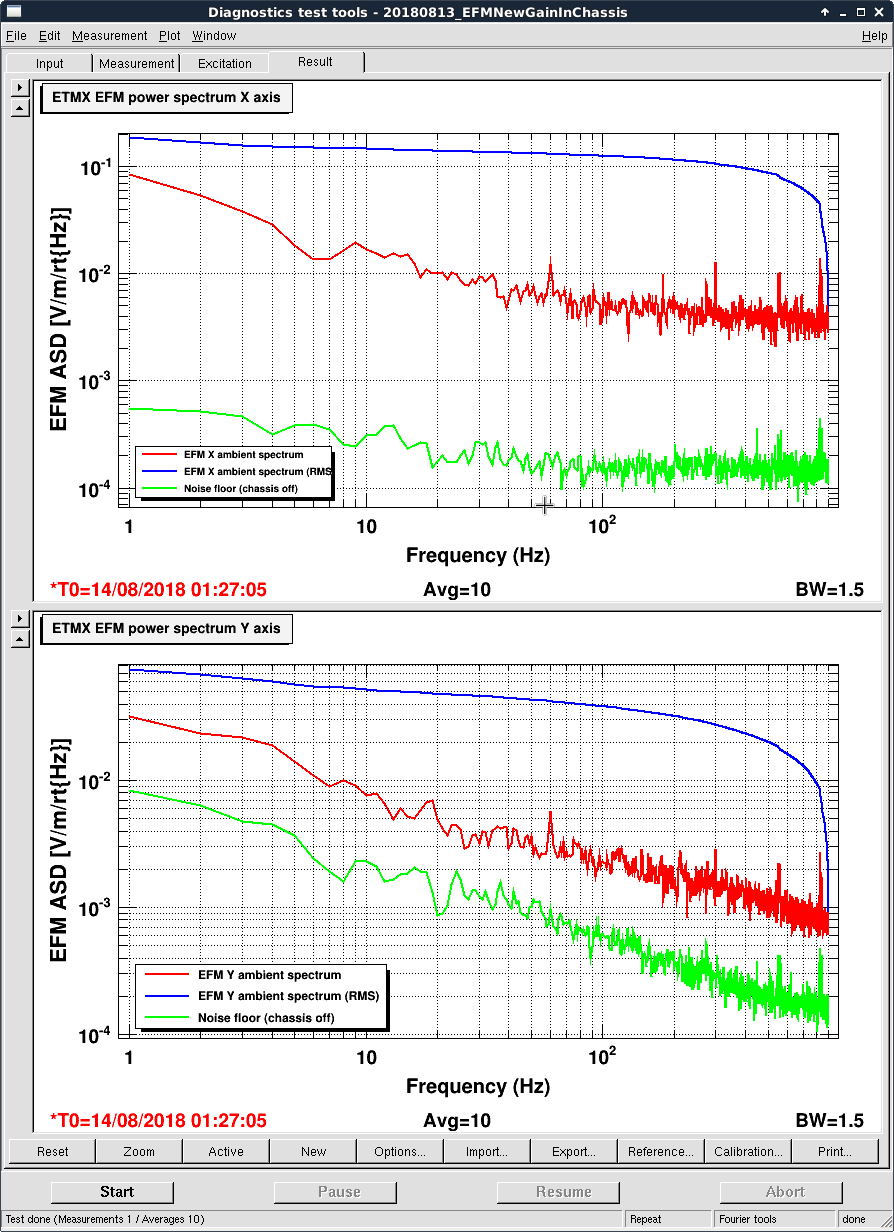
Plot 1 is the newly calibrated ambient electric field ASDs recorded by the EFM. Plot 2 is the V_out/V_cal TF.
We (the EFM calibration team) never understood that the sensor plates are virtually grounded by the op-amp inside the EFM until we saw Figure 2 of T1700103. This is why we kept insisting that E = Vcal/d should use d = distance between calibration plate and the EFM body: we thought that the sensor plate was an floating conductor. I fixed our calibration to account for the grounded sensor plates. If I use E = Vcal / d where d is the distance between the cal and sensor plates (d ~ 1/2 inch ~ 1.27 cm), I get. If I account for the copper plate and fringing fields by using our measured capacitance between the calibration plate and sensor plate (C ~ 14.7 pF), I get
(Area A of the plates is ~ 0.01 m^2). This is the E/V calibration I used for the plots below. Also included was our cal volts to EFM output volts measured calibration value of 0.8 V/V. This was multiplied by two to account for the differential response of the EFM to external electric fields, and inverted to give
. Unfortunately, with this corrected calibration our prototype EFM spectrum is worse than we originally thought. In fact, it's worse than your final prototype spectrum from T1700569 by about a factor of two. I am not sure why this should be the case. Rich's LT Spice model has a output voltage noise floor of about 200 nV/rtHz at 200 Hz upward. In your Figure 2 of T1700569, you report a Vn of 110 nV/rtHz, so maybe this result is correct.
The calibration is simpler than you make it. With the cube grounded and the calibration plates mounted on the sense plate, the electric field induced on the sense plate is E = V(cal)/d (with small correction for fringing and the copper plug). If you want to make a model for the calibration to predict the sensitivity that is more complicated and requires knowledge of the capacitances and the potentials between the sense plate and the cube.
Craig, you refer to T1700103 figure 2 to understand the virtual ground. This is not the correct schematic for the implementation of the EFM that was recently built. Each EFM input is simply 10^12 ohms to ground (in parallel with the sense plate capacitance). There is no virtual ground provided actively by the operational amplifier.
Final note on the EFM calibration. Conclusions:After a discussion with Rai and Rich we determined the correct calibration is
where
is the driven voltage on the cal plate,
is the induced voltage on the sense plate, and
is the distance between cal and sense plate. We need to know the voltage induced on the sense plate. To do this I simulated the circuit in the first picture. Again, we measured the capacitance between the cal and sense plate to be 14.7 pF, while the capacitance between the sense and body was 19 pF. I found
above 10 mHz. Solving for
gives the result above. The final plot is the correctly calibrated ambient electric field spectrum.
I am very sorry for having generated all this confusion. The sense plate is not a virtual ground, that was the case in earlier circuits. In this
circuit the proper formulation for the electric field on the sense plate from the calibration plate is
V(cal) - V(sp) V(cal) C(cal-sp)
E(cal) = ---------------- = ---------------------------------- So, the calibration field is smaller than in the case for the sense plate held
d(cal-sp) d(cal-sp)(C(cal-sp)+C(sp-allelse))
at ground potential which makes the field meter more sensitive. Which is what you found. The error is purely mine and not Rich Abbott's or any
of the people in the electronics group. It comes from my not thinking about the calibration again after the circuit was changed from one type
to another in my lab.
Terry M, Sheila D, Nutsinee K, Daniel B, Thomas V, Alexei C
This morning Terry and I went to HAM6 to co-align the squeezer beam to the single bounce beam that we had aligned last night. This went pretty smoothly using the OFI pico. The attached screenshot shows the OM alignment based on offloading the AS centering loops with the single bounce beam, and the ZM alignments needed to get the OPO seed beam onto the AS WFS. We also measured the power in our seed beam right after the beam diverter and arriving on the other side on HAM6, we found 67% of the power injected into HAM5 returning to HAM6, but we need to recheck the offsets on the power meter for this measurement. This allowed us to get some decent OMC mode scans using the OPO beam. Thomas and Dan are writing alogs with results from those scans, the main message is that our results from the beam profile (mode matching of about 80%, we aren't able to fix it using the translation stage) are confirmed by the OMC scans.
Having this co-alignment fixed means that we are finished using the PSL beam in HAM6, and should not need it again before we put the doors on.
Our first OMC scans with the seed were noisy, so Terry Nutsinee and I went back to HAM6 after lunch and reduced the green power from 3mW in reflection to 0.3mW, and increased the analog gain on the OPO servo board from -3dB to 17 dB. We also increased the temperature from 43.25C to 43.35 C to compensate for the lower green absorption in the crystal.
Details of co-alignment:
OM1 P 51 Y -265 OM2 P -225 Y -458 ZM1 0 P 0 Y ZM2 0 P 0 Y
SRM 1845 P -2461 Y (alignment that we found with SRX last night) squeezer beam 6 mm in - x direction from IFO beam at entrance to chamber near OM2 structure.
SRM 1933 P -2239 Y (alignment from Feb 8th) squeezer beam move about 45 degrees -x side higher than ifo beam, still about 6 mm distance.
Moved OFI pico down from -1898 to -3619 counts, yaw +1100 counts (to end at -1200 coutns). Beams overlap entering HAM6, at OM1 sqz beam is too high by 2 mm. Tried moving SRM P to 1845, saw beam get closer at OM1, undid SRM move, moved ZM2 P to +350 (counts not urad), beams look overlapped on card at OM1, moved ZM2 to 950 counts to overlap at OM2.
Measured beam entering HAM6, 0.30 mW, closed beam diverter measured beam arriving on SQZT6, 0.445 mW. 26.5 mW of seed out of fiber collimator.
SAES Getters reps, Yev and Russ, were on site today to commission the newly installed prototype HV1600-10 NexTorr NEG pump on BSC6 at EY. We first collected a baseline RGA scan (RGA also mounted to BSC6) with main volume at ~5e-7 Torr. Then we activated the pump but made the mistake of not valving it out first. The RGA was running and captured the damage, including scans during activation and after closing the isolation gate valve. It was valved into the main volume for about a minute, and unexpectedly released some non-vacuum friendly gases during that period. We continued activation by pumping with hung turbo+pump cart on NEG housing, heating up to 500C, with a 60 min. ramp up and held for another ~one hour (because we had the luxury over a long lunch filled with meetings). We let it cool down to 200C (<1hr) and then switched to conditioning mode for nominal operation of 180C. NEG is running overnight. We will valve it into main volume tomorrow. The 10 l/s ion pump is also on. The pressure response is immediate and non-negligible when the ion pump is turned OFF.
This morning I increased the variac on CP4 GN2 heater to 50%. Temperature increased to 148C, but fluctuates a lot. Attached is 8 hr plot. Tomorrow I will ramp up another 5%. Bottom temperature on bake oven is still 102C and heater output is 23%.
I've installed a lens in front of GigE2, and I needed to modify the mount for GigE1, and in doing so it's position has changed. Both cameras are blocked by razor-blade beam dumps, while major alignment on the table is in progress.
Disconnected the shield on pin 13 of the ALS diagnostic cable. This was causing the ALS interlock and monitoring from operating correctly.
TITLE: 04/19 Day Shift: 15:00-23:00 UTC (08:00-16:00 PST), all times posted in UTC
STATE of H1: Planned Engineering
INCOMING OPERATOR: None
SHIFT SUMMARY:
LOG:
15:00 Christina noted on the EX camera, cleaning.
15:30 Sheila and Terry headed to Ham6
16:00 APS on site
16:24 Jeff K tour out to LVEA
16:39 Jeff B out to LVEA and then to Ends
16:45 Fil into CER
16:57 Access tech to EX
17:07 Chandra to EY with guests
17:12 Terry back
17:20 Peter and Fil to EX to do ALS interlock work
17:38 Gerardo out to LVEA - looking for viewport protector
17:41 Karen leaving EY
17:59 Fil and Peter back
18:14 Fil out to LVEA - PSL closet for access system
18:24 Jeff B back
18:34 Gerardo to EY
18:47 Sheila called to say the Squeezer
18:55 Tour group into CR
19:40 HANFORD EMERGENCY 'TAKE COVER' DRILL MESSAGE received
19:43 Peter out to PSL enclosure
20:07 DRILL MESSAGE TERMINATED
20:35 Visitor for Chandra on site
20:48 Jaime doing some Guardian re-boots
20:50 Jason ad Rick out tp PSL enclosure
20:51 Corey to end stations for inventory
20:52 Sheila out to HAM6
21:12 Corey heading back
21:20 Betsy ad Travis heading out to EX
21:25 Chandra,et al, back out to EY
21:33 Gerardo out to HAM6
21:35 Cheryl out to PSL encosure
21:42 Gerardo back
21:48 Fil out to LVEA to install network switch in PSL closet
21:54 Georgia and Niko out to EX
22:19 Sheila and Terry going out to HAM6
22:22 Niko and Georgia back
22:39 Travis and Betsy back
While I am testing RCG3.4.2, please do not do any front end model code development. Some shared files on the /opt/rtcds/ file system as incompatible between the two RCG versions. If models need to be changed, I can quickly revert the system back to RCG3.2
As a precursor to H1's upgrade to RCG3.4.2, I have selectively upgraded h1pemmx.
The procedure was:
Clone x1boot1 disk
Install in h1boot-backup and rename this as h1boot1
Make necessary X1 to H1 modifications, remove DTS changes
Install RCG3.4.2 using Rolf's and Keith's Release Notes (DCC-T1700552)
Take h1pemmx out of h1boot and add it to h1boot1
I now have h1pemmx models (h1ioppemmx, h1pemmx) running under 3.4.2. DAQ data looks good. Testpoints look good. Excitations look good.
There is a problem getting everything running on startup. I'll transition a corner station SUS-AUX model to work on this so I don't have to commute 2km.
[Craig Niko Georgia]
Conclusions:
- We have taken electric field spectra with the foil door off, foil door on, and a foil house built around the EFM. Spectra coming soon.
- We also applied a DC voltage to the calibration plates and looked at the decay time at the output of the EFM, which should give us a confirmation of the EFM resistor (should be 1 TOhm)
We went back to end-X to take more electric field meter (EFM) data. We wanted to find out whether the low frequency slope shown in our previous log post is due to sensor noise or fields within the chamber. We were also interested in confirming the dependence of the 60 Hz and 30 Hz peaks on the presence of the foil door. We made a foil house for the EFM which attached to the rod, and were careful not to ground the sensor plates (picture 1). The soft door cover was on for all these measurements. These three spectra will be posted shortly.
We also used a voltage calibrator to apply a DC voltage to the calibration plates, and measure the decay time of the voltage out of the EFM. The reason we checked this was to confirm the 1e12 Ohm resistor. The time constant of the RC circuit formed by the capacitance of the calibration-sensor plate (~7.6 pF), and the 1e12 Ohm resistor should be 7.6 seconds.
- Note that we were using larger spacers between the sensor plates and calibration plates as we (embarrassingly) lost track of the old ones, and so cleaned up and used the spacers from the first EFM, the capacitances were measured to be 7.8 pF from calibration plate to +X sensor plate, and 7.5 pF from calibration plate to -X sensor plate.
- We applied 3V DC continously to the calibration plates.
- The decay is shown in the 2nd photo, the two traces are the positive and negative x outputs (generally we do a differential measurement, this is not a very fancy scope). The decay time looks to me to be about 12 seconds (though it’s hard to tell since I can’t tell when exactly the voltage was applied, Crag can correct me here...), so perhaps our resistance is larger than expected.
Here are the results from the measurements Georgia described.
A couple of notes:
1) Our overall EFM noise is lower today than yesterday.
2) The EFM ambient electric field noise below 100 Hz still follows f^{-1.5}. It seems like it is sensor noise, but the LT Spice model disagrees.
3) Our different foil configurations did not affect the overall noise floor, only the height of the 60 Hz line and some (probably acoustic) resonances.
4) The estimated displacement noise in plot 2 relies on many assumptions (zero charge on test mass, true measurement of ambient electric fields near the test mass, correct calibration from volts to electric field) and is posted for discussion purposes.
Some differences from my last ambient electric field post alog 41483:
1) Included Rich's LT Spice model of the EFM circuit noise.
2) Updated the calibration from calibration volts to electric field. Estimated |E/V_Cal| ~ 38.9 (V/m)/V, based on the series capacitance between the calibration plate and the sensor plate (~11 pF), and the sensor plate to the grounded EFM body cube (~19 pF). This explains the increased EFM noise from alog 41483. Before I used |E/V_Cal| ~ 5 (V/m)/V, which I now believe is incorrect.
EDIT: After some notes from Sheila and Aaron Buikema, Plot 2 as it is is definitely untrustworthy. It relies on the force coupling F = q E, where E is the ambient electric field and q is the charge on the test mass. If the total charge on the test mass is 0, then F = 0, even with the ESD bias inducing a polarization on the test mass.
Reading the results of the RC decay experiment and the observation of a ~12 second time constant instead of the anticipated 7.6 seconds, I think the more likely conclusion is that the capacitance is larger than anticipated. In an ideal world, the 10^12 ohm resistor has a 10% tolerance from the manufacturer. Poor cleaning could certainly decrease the value of the resistor, but it seems unlikely that the resistor would be almost 60% higher in resistance. I wonder if the assumed capacitances are accurate? Was the 3V stimulus removed such that the calibration plate was no longer attached to the voltage source, or was the voltage stepped from 3V to 0V leaving the source still attached? I have a picoammeter here at Caltech and I will try to establish the accuracy of the resistors.
In answer to your questions Rich - I'm not sure how reliable the capacitance measurement is. We measured this a couple of times with the tweezers in chamber, and the capacitance didn't fluctuate between measurements, but I don't have a sense of the reliability of these things. We left the source attached and stepped between 3 V and 0 V charging and discharging the capacitor. It would be interesting to confirm the resistance in the lab there.
ISI code change to ramp DAC drive down when watchdog trips and not instantaneously go to zero volts. Dave composed this and I added in red text. Hugh and Dave. 10 April 2018 WP7462 to implement ECR E1800026 addressing II 9889 with details explained by Stocks & Lantz in T1800031. Summary: we attempted to test the new ISO_RAMP code, but were unable to reach that point due to filter modules outputting very large signals. We abandoned the test and restored the code and hardware back to its original configuration. ---------------------------------------------------------------------------- Hugh elected to test the new code on h1isietmy. Using the latest isi/common/models/isi2stagemaster.mdl (r17117) which uses the new isi/common/models/cushion_DOF.mdl (r17116) and the associated C code isi/common/src/RAMP_ISO_OFF.c (r17084) we compiled and installed h1isietmy. Following a C code review by Jonathan, it was expected that the model would have problems if the ramp time is zero of a divide-by-zero nature. Our first test was to execute the if-conditional block which would run the divide-by-zero lines. While Hugh was manually causing watch dog trips, he noticed that the ISI DAC channels were negatively railing to -10.0 Volts. This was tracked to ST1 and ST2 OUTF filters having a railed output of 1.0e+20 with a zero input. These filter modules have two filters installed: Comp and Sym. We found that the Sym filter (a simple gain stage) was causing the output to shoot to rail on WD trip. It was not obvious to us why this was happening. The rail could be removed by clearing the FM history, and could be prevented by turning off the Sym filter. Are you sure? Hugh's not sure if we ever prevented it... After further setup work Hugh discovered that ST[1,2] RZ T240SUBTRACT_Z filter modules were also railing at 1.0e+20. Due to the violent motion being caused by the ISI DAC outputs instantaneously driving to -10.0V each time the watchdog was tripped, we needed to stop the DAC output from driving the DAC cards. Our first attempt was to SWWD trip the output of the h1iopseiey model. However, the ISI code and/or guardian monitors this and this prevented our test from proceeding. Could not get the guardian to run with IOP(software WD) tripped. We eventually had to go to EY and power off the anti-imaging (AI) chassis for the ISI DAC. We could then green up all the software watchdogs and still be sure that no sudden motion was being driven to the seismic stack. Hugh spent a further hour trying to get the isolation ramp code to be executed, but was being thwarted by the misbehaving filter modules. Same drive to 1e+20 counts & -10Vs. We decided to abandon the tests as maintenance time was running out, and to revert the code back to what it was. I reverted the svn version of isi/common/models/isi2stagemaster.mdl from r17117(05apr2018) to r16398(31oct2017), and isi/common/models/isihammaster.mdl from r17118(05apr2018) to r16422(06nov2017). Thank you Dave! I rebuilt h1isietmy and we were happy to see the DAQ INI file return to its original content. We verified the checksum of the INI file was as it was originally. When the model was restarted, the DAQ-ini-mismatch error was cleared, so no DAQ restart was needed. Hugh then damped ISI-ETMY with no re-occurance of the 1.0e+20 FM outputs. Finally, using the ISI Guardian (no SEI Manager) the stages isolated stabily.
As far as the code problem--Don't have it to look at now since Dave reverted but I suspect some X Y Z etc DOF wires got crossed. Don't know if that addresses the railing FMs but it would not help.
I'm trying to reproduce the issue on our test-stand but I can not.
First test shows the behavior is what I expect - I set the filter module for stage 1, X, to just be a constant (100), gain =1, and turn the filter modules off so that the output of the filter is 100.
Then I trip the watchdog and compare the signal at the filter output to the signal at the output of the ramp stage. I do this 2 times, first with a ramp time of 0, and once with a ramp time of 0.1 sec. In the two attached plots one can see that the red filter module output drops immediately to 0, while the ramp output (blue triangles) either drops immediately to 0 or ramps to 0 in 0.1 seconds. I do not see a big glitch. I wonder what the heck is going on - will follow up with Hugh ASAP.
-Brian
Hey Brian,
We never even got to try the smooth ramp as we could not get the system isolated. We did not think to try a fake isolation state as I think you are indicating.
Hi Hugh, I did a quick test just now. In the isi2stagemaster model, I went through both stage 1 and stage 2 paths to ensure that there were no "crossed-wires." That is, I went through each dof in the isolation bank and ensured that an input signal appeared as it should in the final output of each stage (a 1 count offset in ST1 X appeared as solely a 1 count output in ST1_OUTF H1, etc). (note - we set the cart2act matrix to be the identity matrix for our convenience in this test - so X goes to H1, etc) For the stage 1 path I ensured this also held true for the ST1_ST2_DRIVE_COMP. This indeed held true in the updated model, the one with the changes Brian and I made. Thus we think that the problem lies elsewhere, possibly in the way that the model was started on the H1 machines; it is my understanding that IOP model was not restarted after grabbing the updated model from the svn. However, if you have any further suggestions for us to investigate, please send them our way.
due to INI file mismatch, DAQ data from h1susauxb123 is currently not correct. I'll revert it back to RCG3.2 soon.
h1susauxb123 is now back at RCG3.2 with good DAQ data. Due to the recent model changes, I did not perform a new rebuild against 3.2 as this would require a DAQ restart. Instead I restored the target directory, the DAQ-INI and the GDS-PAR files from archive. I restored the 3.2 version of awgtpman as well.
While h1susauxb123 was being reverted, DAQ data from h1seih16 was again invalid for a few minutes.