Displaying reports 46941-46960 of 86411.Go to page Start 2344 2345 2346 2347 2348 2349 2350 2351 2352 End
Reports until 11:46, Tuesday 20 February 2018
H1 DCS (CDS, DCS)
gregory.mendell@LIGO.ORG - posted 11:46, Tuesday 20 February 2018 (40607)
DMT test box patched and rebooted

The h1dmt3 DMT box at LHO has been patched via yum update and rebooted. This is the DMT test box, and this update should have no impact on the control room.

H1 General
edmond.merilh@LIGO.ORG - posted 10:38, Tuesday 20 February 2018 - last comment - 10:59, Tuesday 20 February 2018(40605)
EY is now LASER HAZARD

Rick, Travis

Some temporary Pcal work is happening. Transition back to SAFE when work is complete.

Comments related to this report
edmond.merilh@LIGO.ORG - 10:59, Tuesday 20 February 2018 (40606)

Back to LASER SAFE

H1 CDS
patrick.thomas@LIGO.ORG - posted 10:17, Tuesday 20 February 2018 (40604)
Conlog crashed, restarted, updated channel names
Appears to have crashed Saturday on an invalid json value.

Still 750 channels not connected. Seem to be end X Beckhoff channels. Can connect to at least one of them from zotws12 but not conlog-master.
LHO VE
chandra.romel@LIGO.ORG - posted 08:44, Tuesday 20 February 2018 (40602)
CP4 pressure

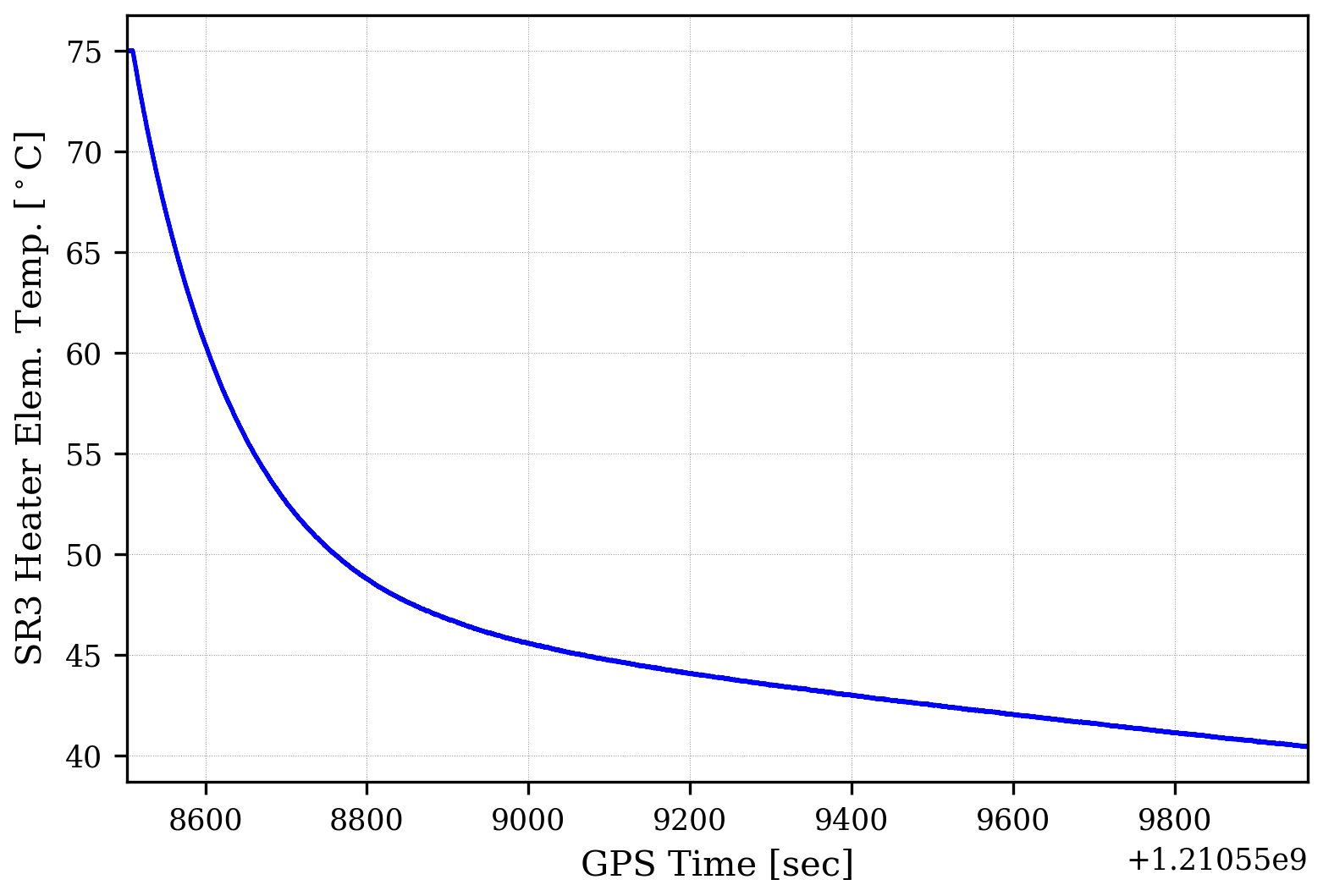
CP4 pressure trend over 7 days. We will lose trending of PT-245 after the bake starts (later this week?). Will try to estimate water content from curve later.

Images attached to this report
H1 General
edmond.merilh@LIGO.ORG - posted 08:11, Tuesday 20 February 2018 - last comment - 12:23, Tuesday 20 February 2018(40600)
Shift Transition - Day

TITLE: 02/20 Day Shift: 16:00-00:00 UTC (08:00-16:00 PST), all times posted in UTC
STATE of H1: Planned Engineering
OUTGOING OPERATOR: None
CURRENT ENVIRONMENT:
    Wind: 7mph Gusts, 5mph 5min avg
    Primary useism: 0.02 μm/s
    Secondary useism: 0.19 μm/s
QUICK SUMMARY:

ISI config is in Large EQ mode since Friday Feb 16th. I will leave it this way until Jim gets here. Work being done at both ends so BRS turned of seems like a good way to let it be fo now.

Comments related to this report
edmond.merilh@LIGO.ORG - 09:13, Tuesday 20 February 2018 (40603)

PSL is tripped

peter.king@LIGO.ORG - 12:23, Tuesday 20 February 2018 (40609)
Actually the laser is off to facilitate work involving the 70W amplifier.
H1 SYS (SYS)
rainer.weiss@LIGO.ORG - posted 22:34, Monday 19 February 2018 (40597)
Calibration of electric field meter and some suggestion for further measurements
Jeff Kissel will make the log entry on the electric field meter. The calibration of the field meter is Volts/(Volts/meter) =2.1 x 10^-2 flat from 10Hz to 20KHz.

The confusing results that Betsy, Sheila, Jeff and I got this afternoon may be due to the vibration and acoustic sensitivity of the electric field meter. Suggest further measurements with the worst acoustic and vibration sources turned off. Also the meter has a
common mode sensitivity to the battery voltage. I never connected the battery box to the neutral (white terminal). It would be good to connect the battery box itself to the lead coming from the field meter that attaches at the white terminal with a clip lead. If there is not a significant change in the low frequency noise, suggest turning off the ISI and other instrumentation in the chamber. That is if you have the time to further investigate where the low frequency noise originates.
H1 General
betsy.weaver@LIGO.ORG - posted 10:00, Monday 19 February 2018 (40595)
Arm tumbleweed status

Kissel checked and confirmed that the Y-arm is passable this morning. As well, we see Mark baling along the X-arm. He are just now heading past the mid station and headed to the end.  Thanks Mark!

Lots of people on site this morning.

H1 SQZ (SQZ)
sheila.dwyer@LIGO.ORG - posted 20:51, Sunday 18 February 2018 (40500)
OPO escape efficiency before/after M1 swap

We have measured the escape efficiency of our OPO by injecting 1064nm light into the input/output coupler to measure intracavity losses, we did this both before and after swapping the input coupler.  Our final result for escape efficiency is 98.63+/- 0.03%, which means that we have 85+/- 36ppm of losses in addition to the transmission of M1+M2 in the cavity. 

Set up

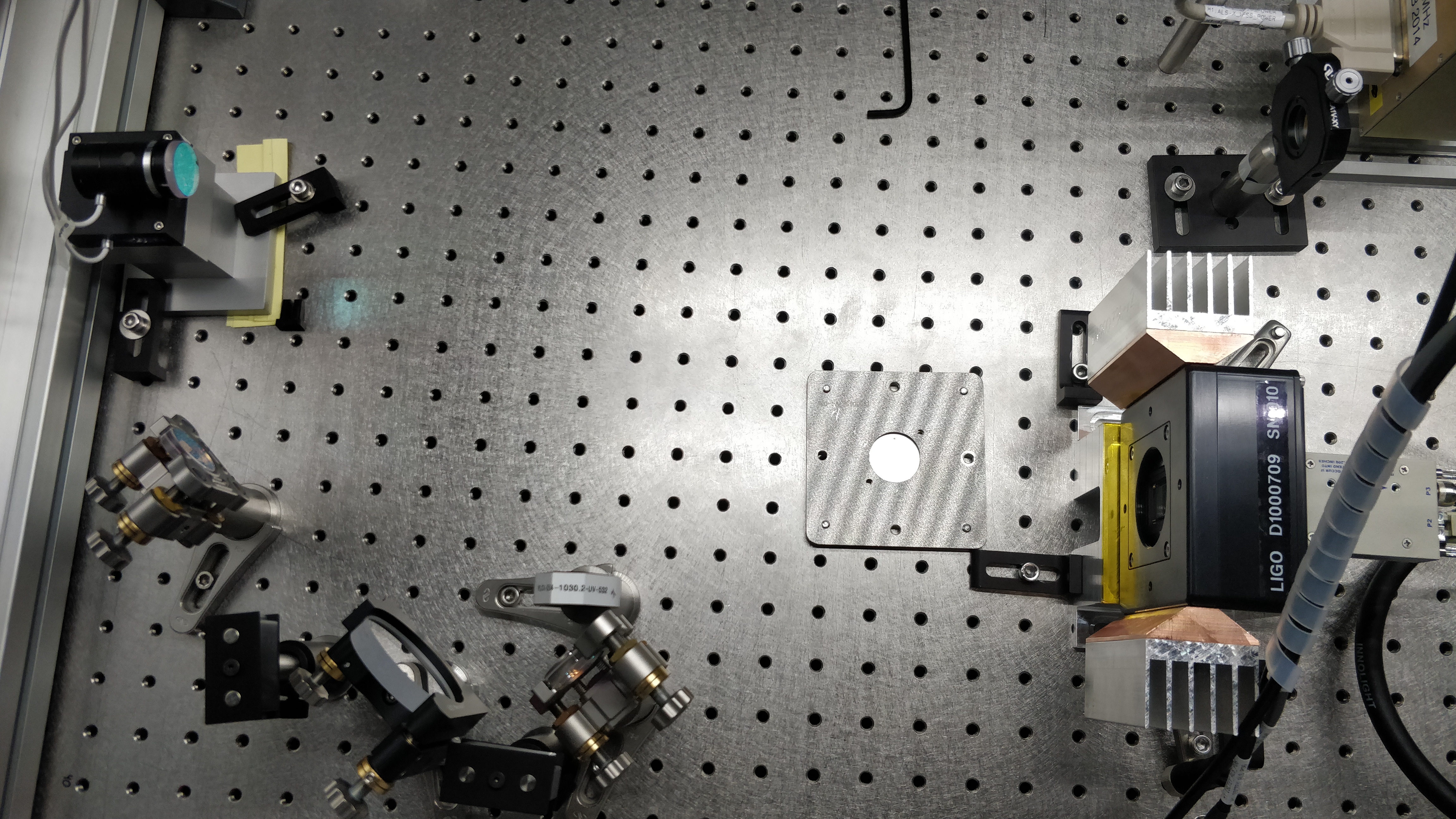
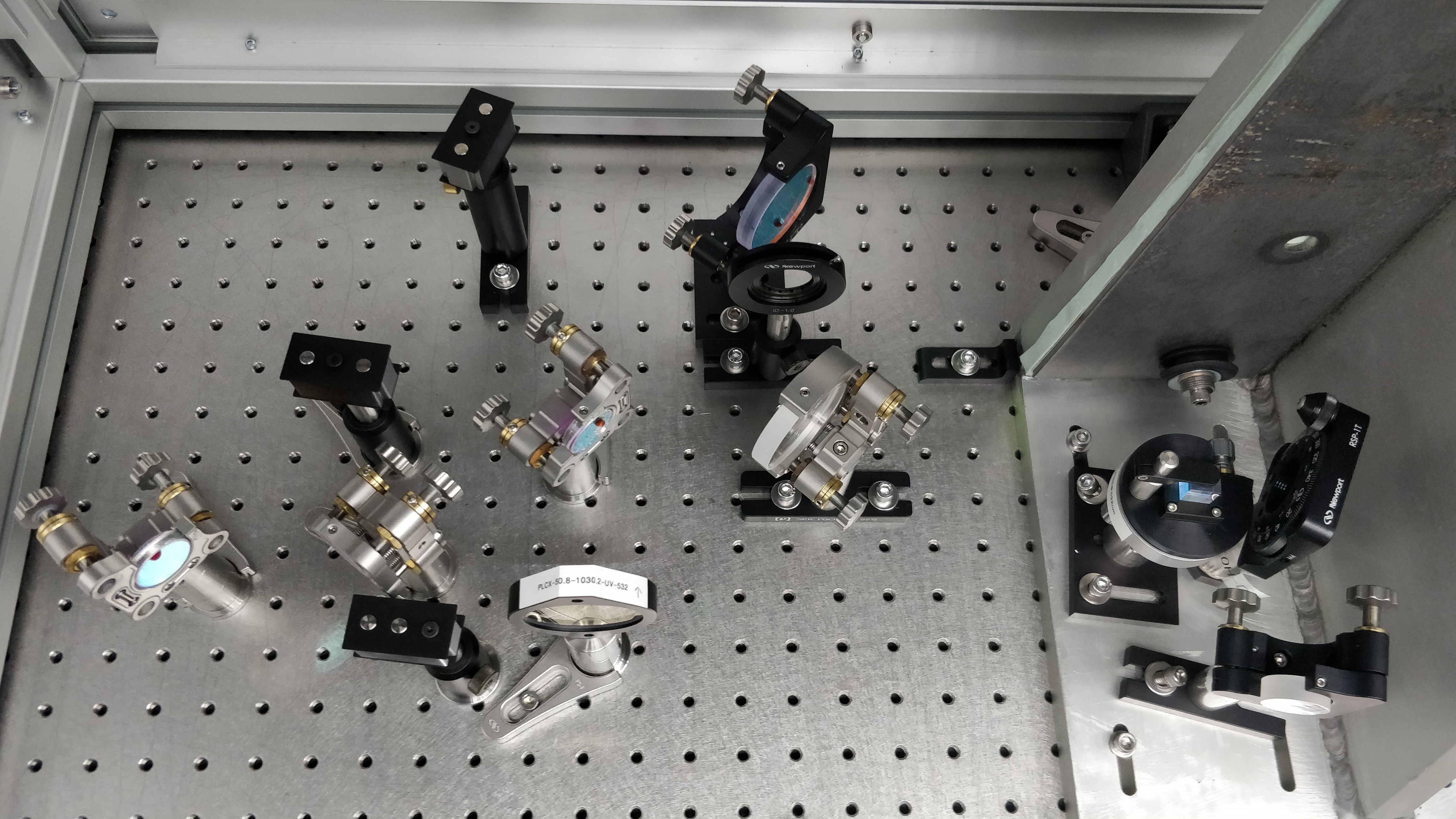
We set up a new optical path to couple 1064 into the OPO input/output coupler to make an escape efficiency measurement.  On the optical table, we set up a Thorlabs fiber collimator F220FC-1064 (f=11.17mm), which has a waist of 437um at 1.13meters behind the collimator.  The attached photo shows how we modified the squeezing output path and the green pump injection path to inject this.  We left the -75mm ROC lens that was already placed and adjusted for the green mode matching in place, and added the ROC +150 lens for the translation stage temporarily at the edge of the platform to mode match this beam into the OPO.  We had a different mode matching solution for the first set of measurements (taken before the M1 swap), but decided to try to improve the mode matching for the final measurements.

Measurements:

We scanned the cavity using the PZT on M2, and made a fit for the voltage applied to the PZT vs cavity length using the transmitted 00 peaks, in the same way we did for 40362 Both before and after swapping M1, we recorded data as the PZT scanned over 4 FSRs, so the results here are the mean and standard error of the 4 measurements.  We estimated our mode matching using the peak heights (peak 00/(peak00+peak20)).  The reflected power on resonance over off resonance is corrected to account for this mode mismatch assuming that there is a signal on the PD from order modes equal to V_{off resonance}*(1-mode matching) that contributes to the measured voltage both on and off resonance. This gives us an estimate of the round trip losses other than input coupler transmission, including the transmission of M2 who's reflectivity was measured to be 0.99818636 in E1800011.  (Fabrice tells us that the mirrors installed in the H1 OPO before the M1 swap were  serial numbers 37, 11, 6 , 8 for M1 to M4 respectively in E1800011).

The escape efficiency is given by ln(R_{m1})/ln(R_m1*R_loss) where Rloss includes all losses and transmissions other than R1.  R_{m1}=0.87298077 before the swap, after.  For reference I've also included the maximum possible escape efficiency before and after the swap, is the m2 transmission was the only contribution to Rloss. 

  mode matching reflected power dip on resonance estimated dip with mode mismatch corrected round trip loss (other than M1 transmission) intracavity loss (excluding M2+M1 transmissions) escape efficiency escape efficiency with no intracavity loss
Before swap of M1

90.4+/-0.1%

94.8+/-0.1% 94.2+/-0.1% 2010+/-45 ppm 201+/-45 ppm 98.54+/-0.03% 98.68%
After swap of M1 96.3+/-0.1% 94.8+/-0.1% 94.6+/-0.1% 1900+/-36 ppm 85+/-36 ppm 98.63+/-0.03% 98.68%

More on mode matching correction

We tried to check that the correction for higher order modes reliable by taking one set of data where we intentionally misaligned the input beam, and attempted to correct for both the mode mismatch and misalignment higher order modes.  This gave us an inconsistent answer, which is why we were motivated to improve out mode matching for the final measurement.  I don't understand what is wrong with the higher order mode correction, that requires some more thought.

In the end, our losses are dominated by the transmission of M2, so this measurement gives us rather large uncertainty on the other losses in the cavity.  We can be confident that the escape efficiency is close to the best possible for the selected transmissions. 

After finishing this Friday we restored the green injection path, and worked on some of the remaining items on the VIP platform.  There is some remaining work to be done on the VIP before balancing it.  

Images attached to this report
Non-image files attached to this report
LHO VE
chandra.romel@LIGO.ORG - posted 21:10, Friday 16 February 2018 - last comment - 06:43, Saturday 17 February 2018(40592)
CP4 area looking good

Kyle and I finished removing the GV12 annulus tubing (except for gate annulus, which is double-valved out under vacuum), installing blanks, cleaning up loose ends and preparing the area for Tuesday morning. Both of us are leaving the site now.

Comments related to this report
john.worden@LIGO.ORG - 06:43, Saturday 17 February 2018 (40593)

Recent 12 hours of pressure at CP4.

Images attached to this comment
H1 SUS
jeffrey.kissel@LIGO.ORG - posted 17:35, Friday 16 February 2018 (40591)
Template for Checking ITMY M0/R0 OSEM Health for Upcoming Vent
J. Kissel
FRS Ticket 9683
WP 7358

As we gear up for a quick corner station vent to fix H1 SUS ITMY (LHO aLOG 40587), I post a template that we can use to assess whether all top mass OSEMs are bug-free within 30 seconds. The R0 RT problem (see details in, e.g. LHo aLOG 40555) is clearly visible (Red Trace in upper left corner, brown trace in lower right coner of plot 1; Middle Green trace in plot 2) -- noise floor is an order of magnitude above all other OSEMs, and has a ton of high frequency combs. Hopefully, once the short is fixed, this will disappear, and R0 RT will look like every other OSEM, with a flat noise floor from 10 to 1000 Hz, at a level of ~5e-11 [m/rtHz].

The template also lives here:
/ligo/home/jeffrey.kissel/Templates/H1SUSITMY_M0R0_OSEM_ASDs.xml
Images attached to this report
Non-image files attached to this report
H1 PSL
jason.oberling@LIGO.ORG - posted 17:34, Friday 16 February 2018 - last comment - 04:55, Tuesday 20 February 2018(40590)
DBB Measurements Prior to 70W Amplifier Install

This afternoon I tweaked up the DBB and took a round of measurements prior to the 70W amplifier install.  Something appears to be not quite right with this NPRO laser.  Both the frequency and pointing noise measurements show a very large peak between 100 Hz and 500 Hz, with the peak being somewhere in the neighborhood of 260ish Hz.  This looks similar to the peak from Peter's NPRO measurements from this morning.  We'll have to look into this first thing on Tuesday morning.  Perhaps our decision to keep the old NPRO power supply installed was not a wise one, as there can sometimes be odd behavior when using a NPRO with a different power supply.  Swapping in the new power supply is fairly painless, so this will be easy to check, although we will then lose the ability to remote start the NPRO laser, and therefore the PSL as well.

Non-image files attached to this report
Comments related to this report
peter.king@LIGO.ORG - 04:55, Tuesday 20 February 2018 (40598)
I dug up the acceptance test results for this laser (T1500521) and the same peak is present when the
power supply that came with the laser was used.  So it is not likely to be solely due to the different
power supply.
H1 CDS
david.barker@LIGO.ORG - posted 16:44, Friday 16 February 2018 (40589)
couple of issues related to upgrading userapps to svn1.8

We fixed a couple of issues resulting from the update of userapps to 1.8 today.

1. Several files were found to be not executable in the new userapps, but were in the old. Problem was that the files did not have the executable bit set in the repository. This was changed and the working directory updated.

2. Several data-like files were missing in the new userapps. These files were not in the repository. We made the decision that since in this case these files are small and critical we went ahead and added them to the repo and updated userapps to get them.

The first issue prompted me to write up a wiki on  how svn handles file permissions

H1 ISC
daniel.sigg@LIGO.ORG - posted 16:02, Friday 16 February 2018 (40588)
ISCT6 Moved

Corey Terry Nutsinee Daniel

We moved ISCT6 from the squeezer bay close to its final position next to HAM6. To allow for work in the chamber the table is positioned about 1m back from its final position and outside the clean room. All three rear panels have been replaced with temporary blanks. The panel on the left will have to be swapped back with panel 1 eventually to get the AISAIR beam path onto the table. Still to do: Drill mounting holes into two new blank rear panels.

LHO General
corey.gray@LIGO.ORG - posted 16:00, Friday 16 February 2018 (40573)
DAY Operator Summary

TITLE: 02/16 Day Shift: 16:00-00:00 UTC (08:00-16:00 PST), all times posted in UTC
STATE of H1: Planned Engineering
INCOMING OPERATOR: None
SHIFT SUMMARY:

It was decided the corner station will be vented on Tues.  7.5 Magnitude EQ from Mexico ended the shift.  Sheila is still in the Optics Lab doing Squeezer measurements.
LOG:

H1 General
betsy.weaver@LIGO.ORG - posted 15:43, Friday 16 February 2018 (40587)
Short corner vent work planned for next TUES-WED - fix ITMY R0 short

In light of the error made in catching the short on 1 cable of the ITMY reaction chain suspension during chamber closeout last month (see Kissel's alog 40555), we are venting the corner volume for a very short period next TUES-WED (20-21st).  Kyle and Gerardo will perform a slow vent and then Gerardo and I will attempt a fix at the feedthru, checking Kissel's spectra template for confirmation of fix.  If that does not fix it, we are working through plans and preps to pull the door to the chamber and make the fix from the inside. 

The large cleanroom in the biergarden has been turned on by Mark D in prep for this activity and will remain on during the weekend.

During this vent activity, please stand down on the following:

- HAM6 In-chamber work

- Transitioning to Laser Haz


H1 SQZ (SQZ)
sheila.dwyer@LIGO.ORG - posted 12:52, Thursday 01 February 2018 - last comment - 11:11, Sunday 18 February 2018(40362)
VIP aligned for 1064 and 532 before M1 swap

Sheila, Nutsinee, Terry,

This is an update on the progress so far on the VIP. We have aligned and mode matched both the CLF/seed 1064 path and the 532 pump path to the OPO, and are ready to think about swapping M1 for the higher green reflectivity version.  

Images attached to this report
Comments related to this report
nutsinee.kijbunchoo@LIGO.ORG - 17:22, Tuesday 06 February 2018 (40434)

Here's the green data (+PZT calibration). Note that the data hasn't been corrected for dark current. 

  • I did the same trick Sheila did (poly degree 2 fit to the time vs. FSR plot) to rescale the voltage applied to the PZT driver so the relationship between resonance peaks and frequency is linear.
  • The mode matching calculated from transmitted power is 66% +/-1%  
  • The dips in reflected power are 75.6% +/-0.4% of the power off resonance. Higher order modes has not been taken into account.
  • The PZT driver (Thorlabs MDT694) has an external input gain of 15V/V. This results in 22V per FSR, or 40V/um.
Images attached to this comment
nutsinee.kijbunchoo@LIGO.ORG - 11:11, Sunday 18 February 2018 (40594)

I corrected the green data for dark current as Sheila suggested. The mode matching calculated from transmitted power is now 73.5%. The dips in reflected power are 78.8% of the power off resonance. Higher order modes has not been taken into account.

Images attached to this comment
Displaying reports 46941-46960 of 86411.Go to page Start 2344 2345 2346 2347 2348 2349 2350 2351 2352 End