I adjusted the temperature at E X after the chamber was closed up and the purge air compressors were turned off. The temperature at both end stations is set at 65 degrees F.
Gabriele, Georgia, Sheila, Craig
After the model changes yesterday, and after relocking the mode cleaner after today's work inside the PSL, we worked on a script to measure the spot positions in the IMC. Jenne had started a script for this, but since we needed to make the model changes we edited it today.
We are currently running the measurement, the script is at userapps/isc/common/scripts/decoup/a2l_min_IMC.py
It runs 6 dither lines on pit and yaw for MC1, MC2, and MC3.
The spot positions from this measurement are:
alpha =
0.0573 0.1809 0.0549 -0.0706 0.0200 0.1241
measurements =
'MC1 P' 'MC2 P' 'MC3 P' 'MC1 Y' 'MC2 Y' 'MC3 Y'
mis-centering (mm) =
2.4169 7.6333 2.3162 -2.9808 0.8459 5.2365
In this coordinate system positive distances are closer to the upper right osem than the center of the optic. Script is attached.
Operated GV12's VFD motor in the OPEN stroke three times throughout the day today following 0-300 rpm, stop, wait a few hours, repeat process.
In addition to the work logged by Keita here and here, and the cooling work logged by Jeff here, we performed the following:
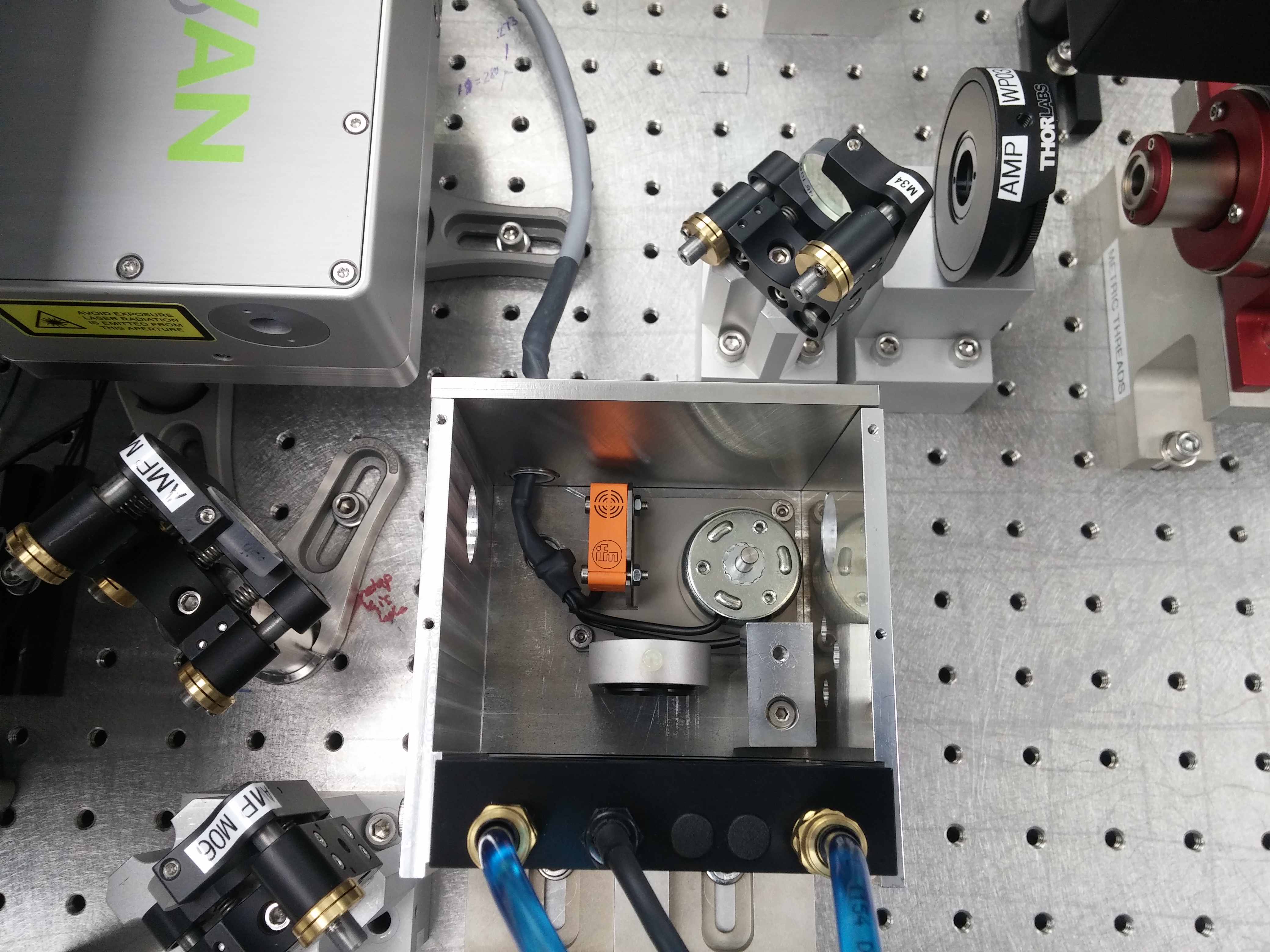
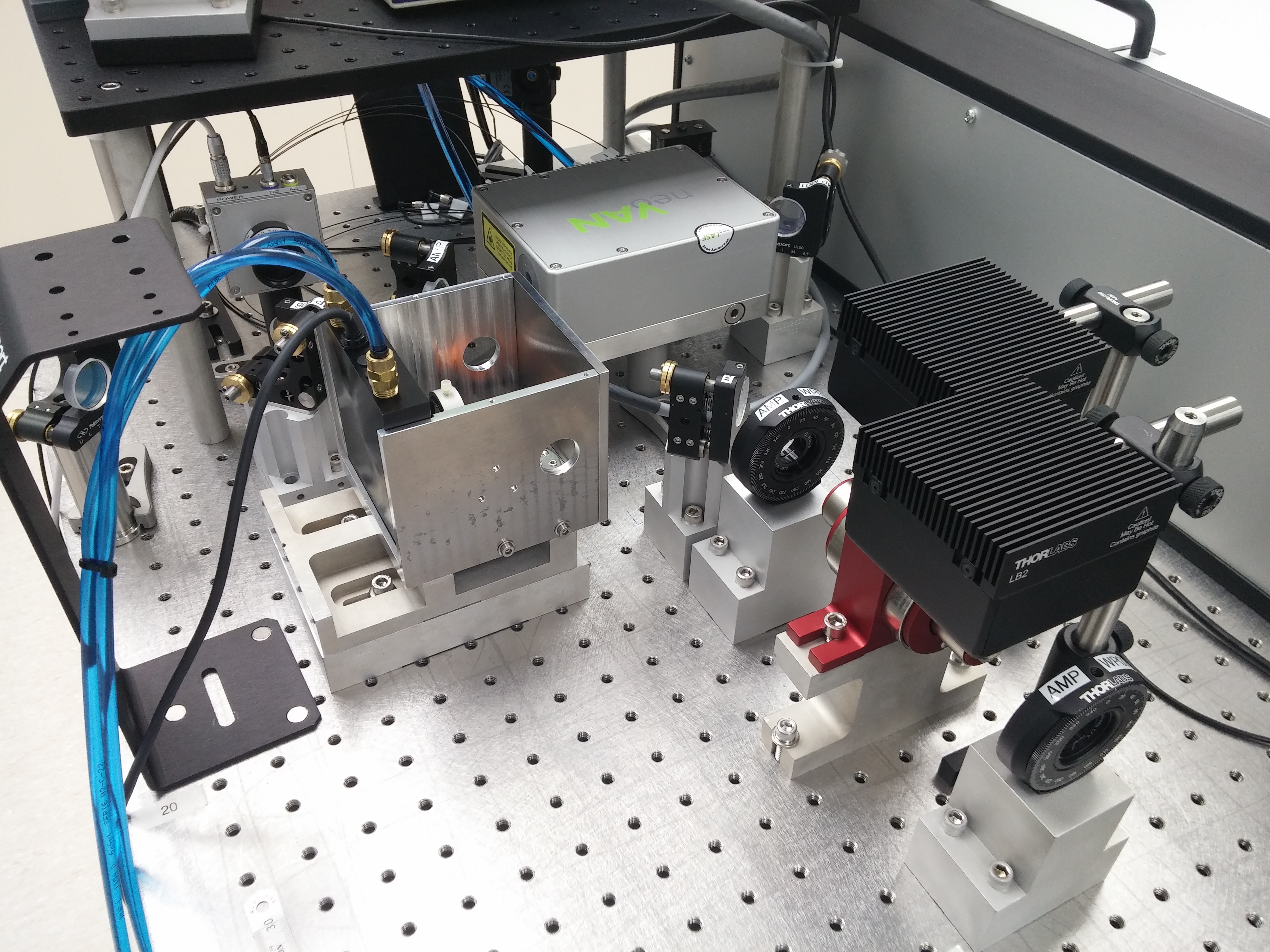
-Physically installed the 70W amplifier external shutter. The shutter has not been connected electrically yet, we will do that once we can turn the laser and PSL Control Box OFF. Since the shutter is not connected electrically, the shutter flag was temporarily removed (as the shutter's default position is CLOSED). Once the shutter has been connected electrically and proper operation confirmed, the shutter flag will be reinstalled. See attached pictures.
-Removed the power supply cable for the existing IO_AB_PD3, as the connector is needed for the new power cable for the large-area PD that will be installed as the new IO_AB_PD3.
-As part of the bullseye PD installation, we had to swap the HR mirror that directs a pick-off beam into the PD for the 70W amp power watchdog with a beamsplitter. As a result of this, we re-calibrated the watchdog PD for proper watchdog operation.
-Had Bubba look at the Laser Room door. Over the last several weeks the door has become difficult to move; it is likely we need to have the manufacturer take a look at it.
(Kyle R, Gerardo M)
Removed o-ring valve from housing for NEG pump PT-191, replaced it with a new metal seal valve. Aux cart will be left running overnight pumping on the new volume only, will continue working on it tomorrow.
We reinstalled the bull's eye detector on PSL.
Caveat: When the power on the detector was too much, three segments of the outer ring railed at ADC (i.e. -32k counts), but the center segment only reached -30k or so (attached), it's not like the power on the central segment was smaller than the others, it was quite contrary. Maybe there was some analog problem going on.
We installed an ND filter to reduce the power, plus RG850 to make sure that no pump light reaches bull's eye.
Right now the center segment is at -23k counts, ring segments are about 10k each. Calibration of the sensor will be worked on by Thomas and Georgia.
As was reported in alog 42311, last week ALS path power on the ISCT1 was found to be much lower than it used to. Suspicion was that the power was throttled on the PSL table intentionally, which turned out to be the case. We went to the PSL room today to increase the power.
Before we started working, ALS path power on the PSL table was about 180mW. Rick adjusted HWP right after the PMC to minimize the rejected beam on the polarizer, and the power in the ALS path increased to ~900mW.
Main path power after EOM was 39.5W and H1:PSL-PWR_PMC_TRANS_OUTPUT was displaying 42.7 W (and H1:PSL-PWR_PMC_REFL_OUTPUT 18.9W, which is pretty bad BTW) , which we can use to calibrate things later. For now PSL rotator calibration as well as H1:PSL-EOM_A_DC_POWERMON calibration are both totally bogus.
After this we've done many things including but not limited to bull's eye reinstallation, and somehow the alignment into PMC got even worse (right now PMC transmission is only 20W). Jason says we need to realign into PMC.
I'll tweak the beam alignment into the PMC at the first opportunity, likely in the morning before commissioning activities start in earnest.
Pumped out the gas out of the 3 NEG pump housing on top of the OMC tube, PT-191, PT-192 and PT-193. There was no issues pumping down the volume on all 3 NEG pumps. All 3 NEG pumps were valved into the main volume, PT-193 was first then PT-192, and PT-191 was last.
Unfortunately soon after the aux cart was decoupled from the PT-191 the pressure started raising (NEG was isolated from the aux cart via both of its valves), an indication of a leak somewhere. We decided to isolate PT-191 from the rest of the vacuum system until we can resolve that issue, PT-192 and PT-193 remain valved in.
Replaced pump had been in operation since Oct. 2002.
TITLE: 06/05 Day Shift: 15:00-23:00 UTC (08:00-16:00 PST), all times posted in UTC
STATE of H1: Planned Engineering
INCOMING OPERATOR: None
SHIFT SUMMARY:
PSL work took up most of the day. LVEA is laser SAFE for primarily VAC work.
Nuc5 (seismic trends) had Sleep/power manager feature enabled after Maintenance reboot.
LOG:
Spun turbo up this afternoon, backed by QDP80. Pressure currently at 2.6e-5 Torr.
Installed fitting for EX MTP scroll so we can quickly transition tomorrow. Closed the 10" GV during this installation, so pressure rose for a few minutes.
To prepare for tuning the contrast defect, I turned both 50W CO2 lasers on today, both have a beam dump inserted at the bottom of the periscope so they're currently not being injected into the chamber. As soon as we transition to laser hazard, I will remove the dumps.
The guardian is now running these lasers and found a decent lock point for the chiller and pzt servo so that's good. One thing that was confusing was that the laser power readback was going negative at the ADC which historically never happens, Dave Barker helped me track it down to an AA chassis that was switched off in the TCS racks. Why someone would turn them off is confusing but also why we still got signals at the ADC even though the AA is off is equally confusing.
WP 7624
Cabling for HAM5 picomotor is now connected. Cable runs from controller chassis in ISC-R5 to HAM5 flange.
FRS Ticket to remember to test this picomotor/cable for functionality when we have beam: https://services.ligo-la.caltech.edu/FRS/show_bug.cgi?id=10826
Rick, Jason, & Jeff B.
This morning we ran a test on the PSL 70w cooling circuit to see if we could lower the flow rate and thereby reduce the line pressure (and turbulence noise) while maintaining proper cooling of the laser.
Setup: Connected two thermocouples, one to the supply line and one to the return line of the 70w amp. Allowed both temperatures to stabilize. Then swapped the leads between the two meters to discover if there was any difference between the two. No difference in the base line readings were noted between the meters.
Test: Recorded the base line temperature, pressure, and flow rate of the 70w amp. Next, using the 70w amp cooling circuit’s pressure regulator, lowered the flow rate by ~ 27% (did not want to drop the flow any lower without talking to the manufacture) and observed the changes in the supply and return line temperatures over a 40 minute period.
After the test, removed the thermocouples and returned the flow rate back to the manufacture’s specification.
|
Elapsed time |
Flow Rate |
Supply Pressure |
Supply Temp C |
Return Temp C |
|
0 |
2.2lpm |
56psi |
20.8 |
21.8 |
|
|
|
|
|
|
|
2 |
1.6lpm |
53psi |
20.9 |
21.9 |
|
5 |
|
|
20.8 |
21.9 |
|
10 |
|
|
20.8 |
21.9 |
|
15 |
|
|
20.9 |
22.1 |
|
20 |
|
|
20.9 |
21.9 |
|
25 |
|
|
20.9 |
21.9 |
|
30 |
|
|
20.9 |
22.0 |
|
35 |
|
|
20.9 |
22.0 |
|
40 |
|
|
20.8 |
22.0 |
Conclusion:
While hardly an exhaustive study, the data shows there appears to be room to turn down the water flow in the 70w amp circuit and still maintain proper cooling of the laser. Before lowering the flow rate in the 70w amp, we needed to: (1) Run this same study over a much longer time to guarantee the cooling circuit temperature will stabilize at an acceptable level, and (2) Speak with the manufacture of the laser to ensure there are no issues with a reduced water flow.
If the noise data shows an improvement at these lower flow and pressure levels, we should look into the possibility of similar changes to the frontend and the external shutter cooling circuits. These two cooling circuits are currently running at 1.8lpm and 1.7lpm so there may not be much noise advantage to flow reductions. However, these two circuits are running at 64psi line pressure. As some of the fittings on these circuits are rated at a max 75psi, lowering the line pressure by 10 to 15% would have several benefits.
There are several more tuning changes planned for the PSL chiller circuits, which will be rolled in as time and opportunity allow. Lowering flows and pressures in these cannot but help to lower the cooling system noise in the PSL.
No difficulty unlocking except for the access restrictions from ISC tables and laser assemblies. Signs have been changed; please be mindful of the suspended parts.
Running Range-of-Motion tests; will report shortly.
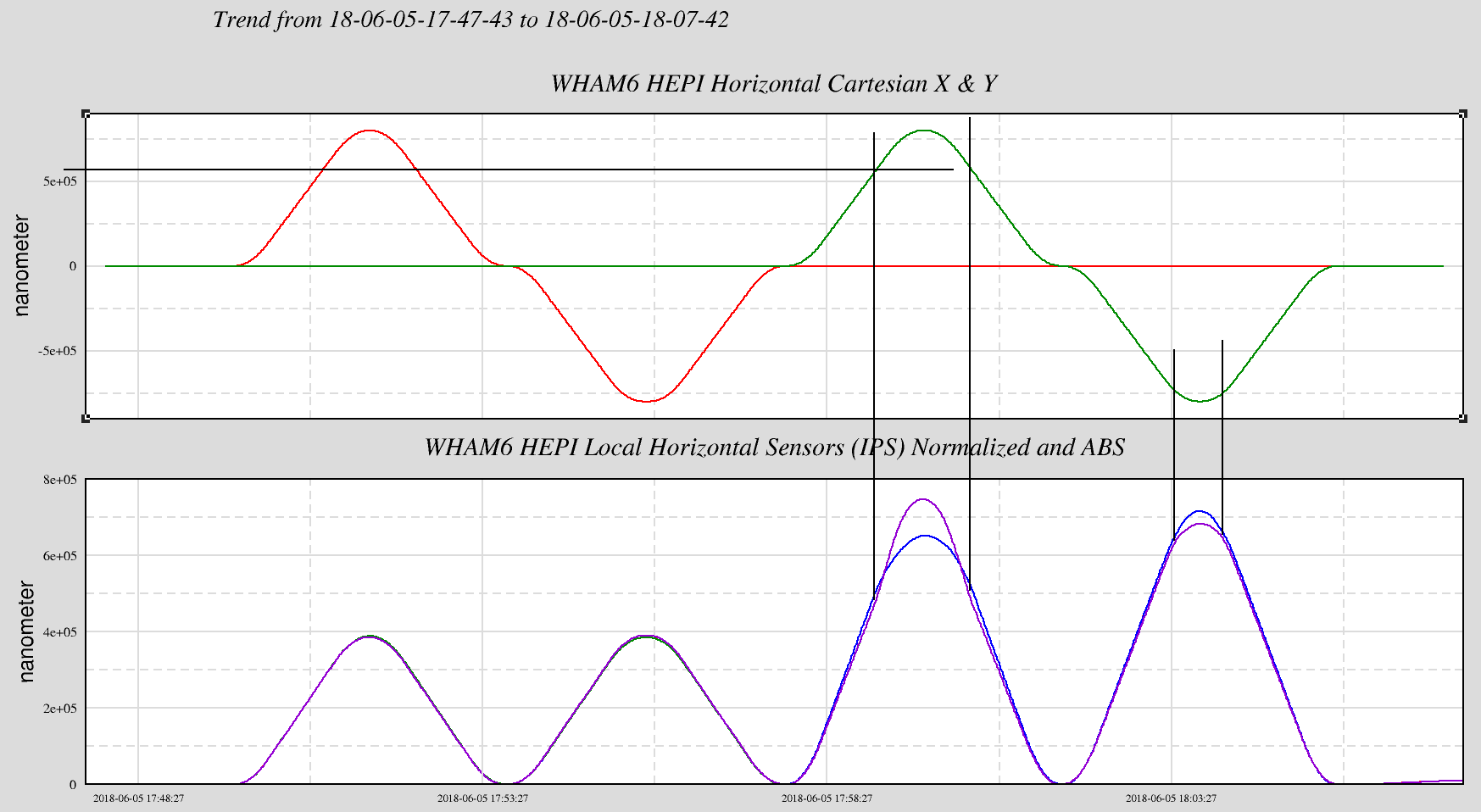
For HAM6 X & Y motion, see the first attachment. It looks like the X motion is clear to 0.8mm but the Y direction is showing some interference around +560um and -730um. Yes this bothers me but it is more than enough range for operations.
For the Z stroke, see the second attachment. You see some separation of the local sensors around 380 microns but that does not seem as bad as the separation at -460. The platform tripped during the minus stoke and this was from the actuator drive railing. Again, more than enough range for normal operation but I should investigate and mitigate at a low priority. When Isolated, the HAMs should never move that much (except HAM1 which does have AC isolation.)
As far as the current running position relative to the long term locked position, all are within a few micro units except X which is about 9um from the locked position. Putting the isolated position at the locked position increased the output drives which we like to keep low. I doubt anyone will notice the difference between the long term locked position and the current isolated position; but, if anyone needs to shift the position, it can be done. At worst, we'll need to put some turns on the big springs.
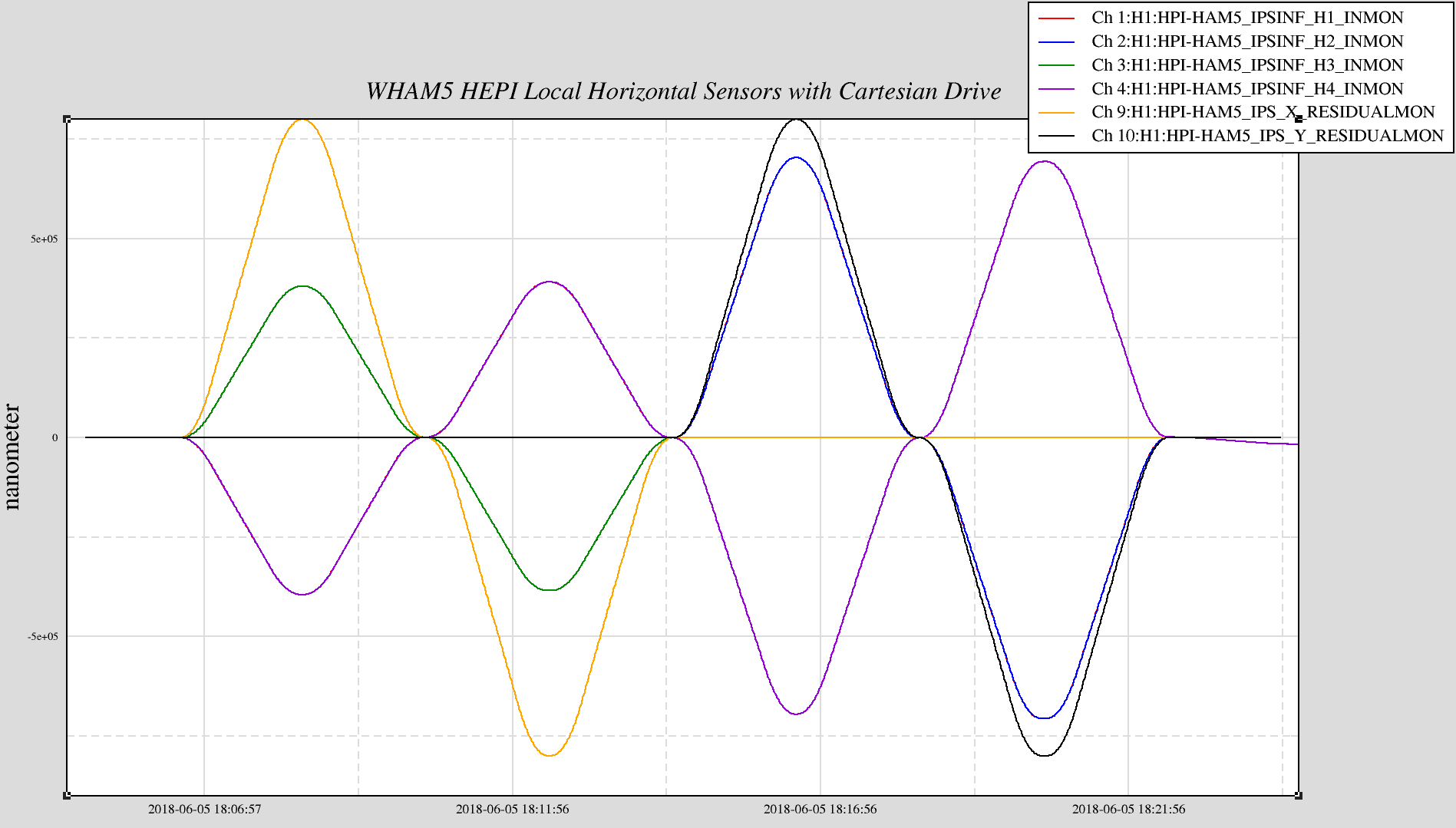
For HAM5 see the attachments: The horizontal local sensors show near perfect overlay supporting the assessment that there is no interference. The second plot shows the verticals and it is evident that there is some interference around the -700 micron point. More than good enough for nominal operations.
Brrr!