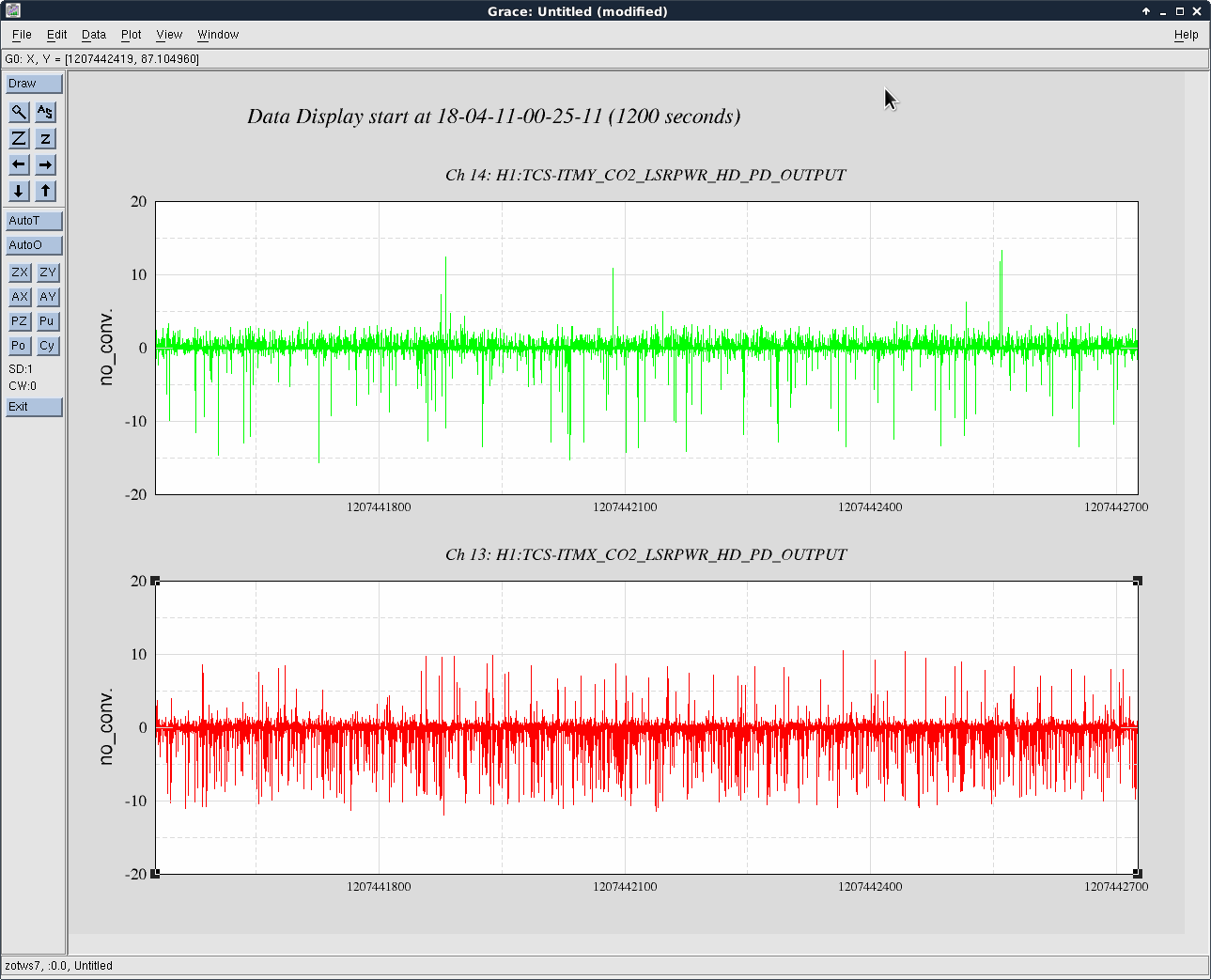
I restarted the h1lsc0 models today. Dave Barker is trending the timing information and state word and may have more to add. But at this point we suspect it is likely a glitch in the IRIG-B as seen yesterday. The system was not responsive via the network via ssh or EPICS CA. The MEDM screen on the control room wall showed everything green, but trying to view the medm screen from another computer (a new connection) failed with the channels not connecting. Going to the console showed that the repeated error 'nf_conntrack: table full, dropping packet'. The system was set to track 64k connections. I changed the limit (until reboot) to 100,000. At that point new connections could be made and the medm screens went red with IPC. I am suprised by this behavior, I would have though the IPC bit would have gone bad on the other machines irregardless of the state of the lsc machine. At this point I killed all the models and restarted them. Then TJ and I went through and cleared all the IPC errors through the site after verifying that they where related to h1lsc0. Reviewing the dmesg output and filtering out nf_conntrack errors showed an ADC TIMEOUT on h1lscaux, h1omc, h1sqz, h1omcpi, h1lsc at 7246965.68s since boot.
Ran the checks for the STS & T240 masses (& will close FAMIS #6094).
STSs: Fine & within range (same as last month).
T240s: Now ETMy* HEPI is on its stops in prep for EY vent, and with that said, had the following masses out of range:
Averaging Mass Centering channels for 10 [sec] ...
2018-01-04 10:17:17.353721
There are 13 T240 proof masses out of range ( > 0.3 [V] )!
ETMX T240 1 DOF X/U = 0.42 [V]
ETMX T240 1 DOF Z/W = 0.396 [V]
ETMX T240 2 DOF X/U = -0.445 [V]
ETMX T240 2 DOF Y/V = -0.88 [V]
ETMX T240 3 DOF X/U = 0.318 [V]
ETMX T240 3 DOF Y/V = 0.435 [V]
ETMX T240 3 DOF Z/W = 0.327 [V]
* ETMY T240 3 DOF Z/W = 0.413 [V]
ITMX T240 1 DOF X/U = -0.412 [V]
ITMX T240 2 DOF Z/W = 0.33 [V]
ITMX T240 3 DOF X/U = -0.438 [V]
ITMY T240 3 DOF X/U = -0.648 [V]
ITMY T240 3 DOF Z/W = -1.08 [V]
PDF of pictures attached:
Cheryl, TVo, Keita, Jenne
Summary: The IMC is aligned and flashing. The IMC REFL path on IOT2 is aligned. The IMC trans path that comes from the transmission through IM1 is coming out of the viewport and light pipe, but not hitting the top periscope mirror by about 2 inches to the right as you're looking at the viewport from the IOT2 door (this is consistent with our having moved this beam farther from clipping on the edge of the viewport as noted in alog 39804).
To do this:
We're not yet really seeing any signal on H1:IMC-I_OUT, but the LSC computer seems to maybe be bad again, so I'll leave locking as an exercise for tomorrow. No checking of analog electronics has been done tonight (by me, at least).
Still to do: We need to move the IMC Trans periscope on IOT2 a few inches toward the PSL enclosure, and will have to redo (move) that whole optical path to match. Also being left as an exercise for the morning. Until this is done, we won't have the nice trans camera to see the shapes of our flashes. However, just looking on a card, we're mostly flashing 00, 01, and 10 modes, so everything should be pretty smooth going tomorrow.
GGrabeel, TVo
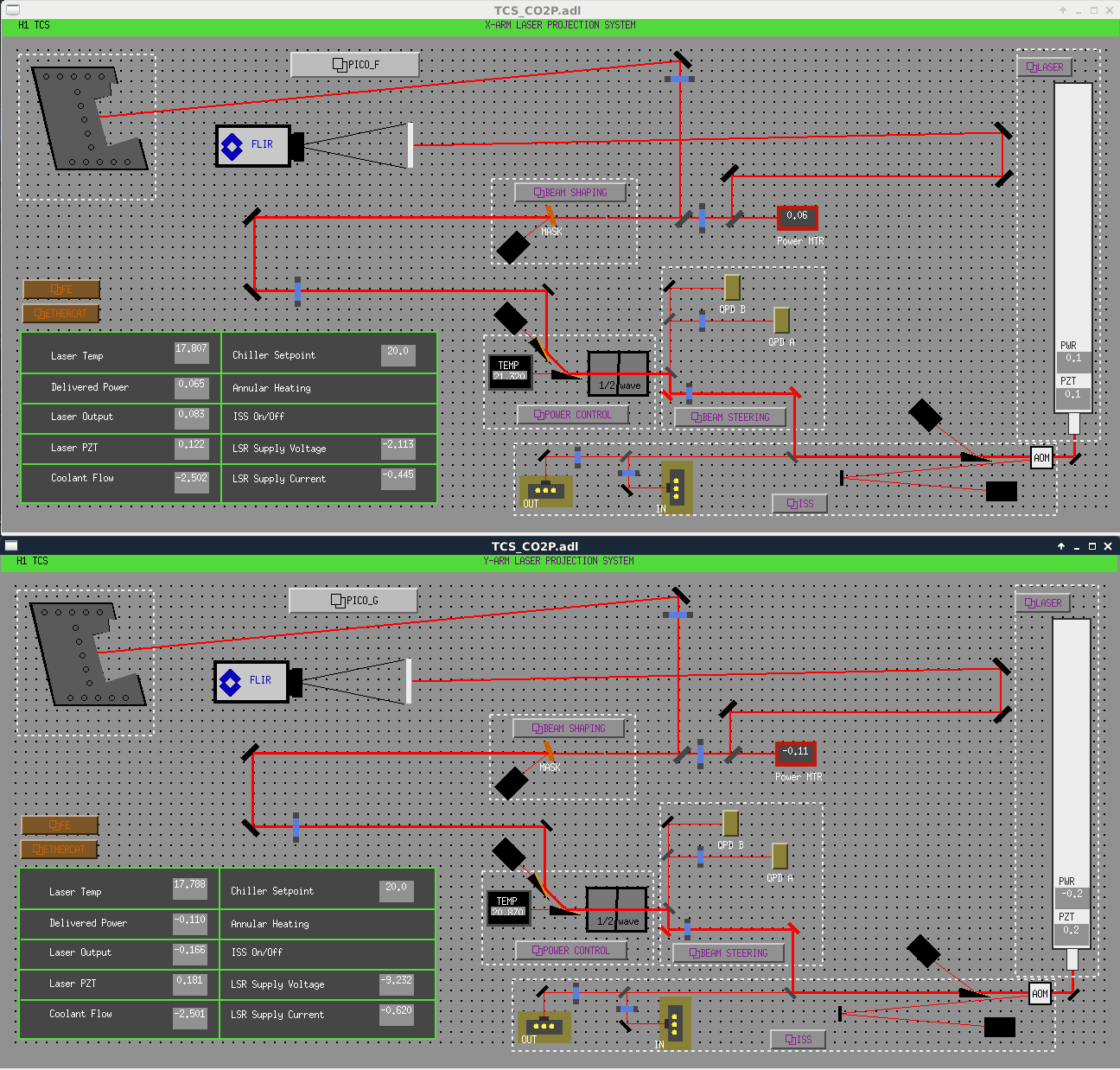
Topped off the chillers and started them back up this afternoon. They immediately faulted out, due to a set-point error. I set them to run in manual while I checked for leaks, there were no apparent leaks. TVo found the problem in EPICS where an integrator on a control loop was causing the set point to steadily increase (It was up to about 500,000 degrees Celsius I think). After turning off some inputs and filters we were able to get the more reasonable value of 21 degrees Celsius. The chillers will continue to run and be re-checked tomorrow.
This morning I noticed a large puddle of water under the TCS-X chiller. Water level looked OK in the site glass.
J. Kissel, R. McCarthy, P. Fritschel FRS Ticket 5063 Prior LHO aLOGs 13556, 14357, and 21481 In perusing the list of closed FRS tickets after the Sep-Dec 2017 vent, Peter found that the above mentioned FRS ticket 5063, "H1 SRM osems (LF RT SD and T3) have excess noise" had been closed without supporting data. Richard clearly states in the most recent comment that the problem was a prominent screw head grounding against the chamber in-vacuo, but just didn't get the chance to post the data. Attached is the supporting data. Where, in the past, SRM had shown prominent features and combs originating from large peaks around 1700 Hz and 1900 Hz, there are no such features visible in any of the OSEMs on SRM. For random comparison, I show SR3 top mass OSEMs as well.
J. Kissel
I've taken standard rubbing-check, top-mass to top-mass transfer functions for all suspensions in HAM2 and HAM3, now that we're down to about 1e-6 Torr (which is sufficient a vacuum that the suspension positions won't change further from buoyancy). Good news: All suspensions are free of rubbing after pumpdown, including MC1, MC2, MC3, IM1-4, PRM, PR2, and PR3.
Data files are listed below. Detailed results will be processed and posted in due time.
/ligo/svncommon/SusSVN/sus/trunk/HSTS/H1/MC?/SAGM1/Data/2018-01-03*.xml
/ligo/svncommon/SusSVN/sus/trunk/HSTS/H1/PR?/SAGM1/Data/2018-01-03*.xml
/ligo/svncommon/SusSVN/sus/trunk/HLTS/H1/PR3/SAGM1/Data/2018-01-03*.xml
/ligo/svncommon/SusSVN/sus/trunk/HAUX/H1/IM?/SAGM1/Data/2018-01-04*.xml
As a teaser / proof, I attach screenshots of each M1 Pitch to M1 Pitch transfer functions for the Triples.
Detail results for IM1, IM2, IM3, and IM4, plus the collection are attached. This detailed analysis confirms that they're free of rubbing.
Detailed results for PR3. Note that these latest transfer functions were taken *after* the repaired T3 LF RT SD Top mass coil driver has been re-installed (See LHO aLOG 39946). Everything looks good. This should be enough evidence to close out FRS Ticket 9497. The only that catches one's eye are the apparent extra L resonances in the Yaw to Yaw transfer function. We've seen such features before, and we usually attribute it to the benign effect of poor common mode subtraction in the LF and RT OSEMs. In other words, Yaw is a differential measurement of the horizontal rotation about the vertical center of mass, and it has been polluted by the common mode horizontal measurement which contains Longitudinal. If (a) the sensors / flags are laterally misaligned, (b) the sensor gains are not well matched, or (c) the suspension rotates about an axis that is misaligned with the cage location of the OSEMs, then you would see such an effect as we see. I'd say all are plausible, and again all are benign.
Bubba and Bailey are in-process of sweeping the LVEA and transitioning to laser hazard, and opening the main PSL light pipe so we can work on IMC alignment.
Finished! We have light!
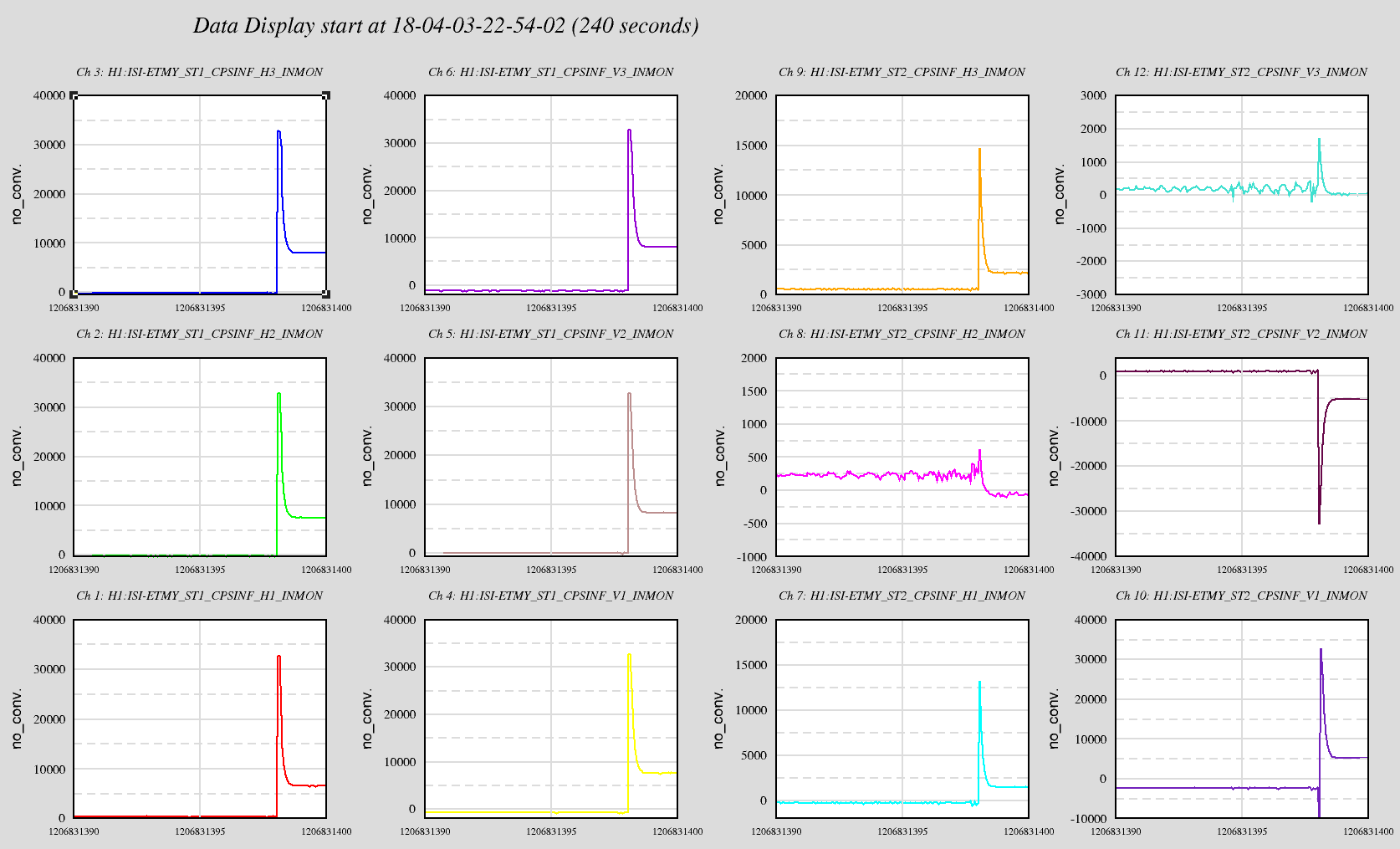
We've known for a while that HEPI trips kick the suspensions prett badly. One of the things SamC found looking at earthquakes, is that during very large earthquakes, HEPI is often the first platform to trip. Hugh and I have used the post-vent time to minimize the differences between the free hanging HEPI positions and the target positions, by tweaking the springs. I used ETMY to test if this reduced the kick to the quad and it seems to be pretty good. The first plot shows the ETMY ISI T240s and the IPS cart locations during a trip before (blue traces on all plots) and after we reduced the offsets (red on all plots). Before offloading, the HEPI trip immediately tripped the ISI and kicked everything around quite a bit. After, the ISI actually stayed isolated until the T240s saturated, some 30+ seconds later, and even then the kick to the table wasn't that violent. The quad sees pretty much the same thing. Before, the suspension gets a pretty kick from the HEPI trip, but after the quad barely sees any motion at all.
This may not reflect what we see during an earthquake, but I don't see how this could make things worse. We'll need to monitor this for a little while because HEPI seems to be prone to drifting more that the ISIs, and we don't really know how much it drifts long term.
All models on h1lsc0 froze up at 15:21 PST due to an IRIG-B timing error on the h1ioplsc0 model. The dmesg logs suggests this is a repeat of the problem seen on Friday 22nd December 2017 which also required a full model restart.
Looking at minute trends, the IOP IRIG-B signal went from 13 uS to 202,710 uS at 15:21:42 PST, later it jumped up to 732,404 uS at 15:30:42 PST. After restarting the model, it returned to 13uS.
On Friday Dec 22 2017 at 09:44:42 PST this signal jumped to 296,598 uS until it was reset 13 minutes later (no subsequent jump into the 0.7 S region).
h1lsc0's dmesg logs for the two events are:
...
Following the restarts, I green'ed up the overview by diag-resetting all models to clear any IPC errors and cleared the DAQ accumulated CRC errors on h1lsc0. The only remaining RED item is the DAQ EDCU, which is unable to connect to two corner station Beckhoff Slow Controls channels following yesterday's code change of h1ecatc1plc3. The two channels are:
this will require restarting the DAQ to use the latest INI files to clear.
This afternoon I removed the lock from and re-enabled the PSL/IOO rotation stage, as stated in LHO WP 7263, for commissioning of the IMC prior to alignment activity in HAM6. This completes WP 7263.
TITLE: 01/03 Day Shift: 16:00-00:00 UTC (08:00-16:00 PST), all times posted in UTC
STATE of H1: Planned Engineering
INCOMING OPERATOR: None
SHIFT SUMMARY: Starting to hook up the tables and cables from the CS vent, and prep at EY for its vent. SEI crew is has been working on HEPI at HAM4 and EY. Jeff K has ran measurements and cleared all of the large suspensions in HAM2/3 (ie. MC's & PR's). We will be going laser hazard shortly and commissioning work will begin on the IMC.
LOG:
Today I restarted the PSL after it was purposefully shutdown for the duration of the holiday break. The HPO and 35W FE restarted with no issues, but I did run into an issue while injection locking the two lasers; the injection locking was very unstable. To ensure the system was at thermal equilibrium I let it warm up for the morning and roughly half of the afternoon before investigating the instability. By 20:00 UTC (12:00 PST) the injection locking had become more stable, but was still having occasional relocks. I lowered the ILS gain voltage from 1.0 V to 0.5 V (this is actually a gain increase) and things became more stable. I also noticed that the SR560 used to boost the low frequency gain of the ILS servo was saturated; I could not get it to clear at the time. Checking on things again at 22:00 UTC (14:00 PST), the injection locking had stabilized further. As a double check I looked at the PDH error signal for the injection locking and saw no issues there; this required me to unlock the ILS to see the error signal. Upon relocking the ILS things looked much more stable, and at about this time I also noticed that the SR560 was no longer saturating. I turned on the TFIN for the ILS (the signal path we use to boost the ILS low frequency gain) and the signals looked much better. I left it in that state to continue to warm up for the rest of the afternoon. As of 23:54 UTC (15:54 PST), the system looked stable and operating normally. At this point in time I re-enabled the power watchdogs.
I re-enalbed the PMC, FSS, and ISS at ~23:00 UTC (~15:00 PST). All 3 came back without issue. I will continue to monitor the system, but as of right now everything appears to be running normally.
I also took this opportunity to do the weekly PSL FAMIS tasks during the morning.
HPO Pump Diode Current Adjustment (FAMIS 8455)
With the ISS still OFF, I adjusted the pump diode operating currents and temperatures this morning as part of the PSL restart. The changes are summarized in the below tables and a screenshot of the PSL Beckhoff main screen is attached for future reference.
| Operating Current (A) | ||
| Old | New | |
| DB1 | 53.7 | 53.9 |
| DB2 | 55.4 | 55.6 |
| DB3 | 55.4 | 55.6 |
| DB4 | 55.4 | 55.6 |
| Operating Temperatures (°C) | ||||||||
| DB1 | DB2 | DB3 | DB4 | |||||
| Old | New | Old | New | Old | New | Old | New | |
| D1 | 26.5 | 26.0 | 19.5 | 20.0 | 20.5 | 21.0 | 22.0 | 21.5 |
| D2 | 26.5 | 26.0 | 19.0 | 19.5 | 24.5 | 25.0 | 19.5 | 19.0 |
| D3 | 26.5 | 26.0 | 20.0 | 20.5 | 24.5 | 25.0 | 21.0 | 20.5 |
| D4 | 26.5 | 26.0 | 18.0 | 18.5 | 21.5 | 22.0 | 19.5 | 19.0 |
| D5 | 26.5 | 26.0 | 18.0 | 18.5 | 25.5 | 26.0 | 21.5 | 21.0 |
| D6 | 26.5 | 26.0 | 18.5 | 19.0 | 20.0 | 20.5 | 21.5 | 21.0 |
| D7 | 26.5 | 26.0 | 19.0 | 19.5 | 21.0 | 21.5 | 21.5 | 21.0 |
At the time of adjustment the HPO was outputting ~154.5 W; this was at roughly 18:30 UTC (10:30 PST). This completes FAMIS 8455.
PSL Power Watchdog Reset (FAMIS 4586)
I turned on both PSL power watchdogs at 23:54 UTC (15:54 PST). This completes FAMIS 4586.
As we prepare to align the IMC and IOT2, we may want to increase the laser power injected into the vacuum from the few hundred mW that we've been at for a few months up to a couple Watts. There was some concern that we want to ensure that we're not going to harm anything in HAM6, since it is still at atmosphere and the trigger PD for the fast shutter is not currently plugged in. There shouldn't be any problem however. I have got the ITMs, PRM and SRM misaligned so that we're not getting any PRMI flashes and no beam is going to HAM6. Please leave the ITMs, PRM and SRM misaligned.
Even if the PRMI were to flash, nothing in HAM6 is aligned, so there should be no beam on any PDs or on the OMC. Also, the PDs would be able to handle that much power, vacuum or atmo. Given the gross misalignments, the likelihood of the OMC resonating is vanishingly small.
With the recycling mirrors misaligned but the ITMs aligned (so just transmission through optics, no resonant flashes) the max amount of power going to HAM6 is 3mW for every 1W of injected light (3% transmission through PRM, 25% for 2 BS passes, and 35% for the SRM). We do not intend to go higher than 1W or 2W, which would put about 6mW at HAM6. However, it is conceivable that the rotation stage could let up to ~50W into the vacuum, in which case we'd have 130mW of light at HAM6. Not insignificant, but still should be fine.
So, we are software ensuring that no beam is going to HAM6 while we use about 2W of PSL power, but even if some of the optics get re-aligned it'll all be fine.
Before going to high power with PRM misaligned, one needs to check that the reflected beam still hits the beam dump on top of HAM2.
BTW: the network filter connection tracking problem seen on h1lsc0 today was also seen on h1oaf0 in November 2016.
alog: Link
The EDCU is configured to read two EPICS channels from the h1ioplsc0 model via channel access (H1:FEC-7_STATE_WORD and H1:IOP-LSC0_ADC_DT_OUTMON). Of the two, the latter should be constantly changing and would show if it froze to a single value. Trending this channel shows that the EDCU did not lose its connection to h1ioplsc0 this morning, but the hourly autoburt could not connect at 10:10 PST. The autoburt could however connect to the user models on h1lsc0 at this time (only the IOP model was disconnected).