Big thanks to Jon, TJ, TVo and Jason for a 6-hour effort.
Today was a big day aligning things on HAM4. We got the main alignment laser set up using the gooseneck mounts and corner cubes. We got the new 4" HWSX STEER M1 mirror mount installed, replacing the old mount and shifting the pedestal in +Y direction by approximately 20mm.
Unfortunately, we ran into two problems with the DCBS mirror mount replacement. Firstly, the pedestals were machined for 2" Sisikyou mounts (which we were to recover from the HAM IS OPLEVs). However, these turned out to be a different (non-Siskiyou) mirror mount which placed the optic about 7-10mm higher than desired. Additionally, it turns out that the X and Y HWS arms are are slightly different beam heights. The result of these two issues put the Y-arm DCBS about 10mm higher (borderline usable) than desired and the X-arm was about 20mm higher (not usable). We're going to have to remachine them. I'll post images and full details tomorrow.
Good news: the Y-ARM DCBS can now easily tilt its reflection down cleanly into the HWS SCRAPER baffle. Also, the alignment of the DCBS can be done in future with a simple laser on confined to HAM4, rather than the whole ITMY, BS, SR3, PR3 procedure we did today.
Major activity of the day was HWS work at HAM4 (with alignment work for this at HAM2 & BSC1/2). [Aidan, Jon, Thomas V, TJ, Jason]
Day's Activities:
The aLIGO Beamsplitter and ITM elliptical baffle alignment procedure was attempted along the ITM-Y to SR3 path. The alignment beam was centered at ITM-Y. Some rework of the tooling is required, so the error in centering at the ITM for this measurement is estimated to be less than 2.5 mm - corresponding to the alignment beam radius. There was no target at SR3, so we tilted the alignment laser to center the spot on the Beamsplitter Baffle alignment tool D1200901 just to see what it looked like there. Upon removal of the alignment tool, the beam was seen to be about half way between center and edge of the SR3. High and right as viewed from ITM-Y. An error of ~ 66 mm at SR3 would correspond to 13 mm of error of the BS HR baffle position - assuming the alignment spot was well centered at the BS target and ITM-Y Some useful numbers: SR3 diameter: 265 mm Distance from ITMY to BS HR 5,167 mm Distance from BS HR to SR3 19,432 mm Alignment spot size at ITMY 5 mm diameter Alignment Procedure draft https://dcc.ligo.org/E1700341-v1 GariLynn Billingsley Jason Oberling October 12, 2017
This morning I completed the weekly PSL FAMIS tasks.
HPO Pump Diode Current Adjust (FAMIS 8444)
With the ISS OFF I adjusted the operating currents of the HPO pump diode boxes. The changes are summarized in the below table; a screenshot of the PSL Beckhoff main screen is attached for future reference.
| Operating Current (A) | ||
| Old | New | |
| DB1 | 50.7 | 50.9 |
| DB2 | 53.1 | 53.3 |
| DB3 | 53.1 | 53.3 |
| DB4 | 53.1 | 53.3 |
I did not adjust the operating temperatures of the DBs. The HPO is now outputting 154.4 W and the ISS is back ON. This completes FAMIS 8444.
PSL Power Watchdog Reset (FAMIS 3672)
Both PSL power watchdogs were reset at 15:49 UTC (8:49 PDT). This completes FAMIS 3672.
Per Workpermit 7158
1. Remove PR3 baffle [TJ]
2. Wipe down goosenecks and assemble them with corner cubes [Jason]
3. TVo finds out channels to use to steer BS and SR3
The order of operations will be as follows:
1. Jason into BSC1 to align laser to ITMY
2. TJ into HAM5 to guide Jason into aligning laser to cross-hairs on SR3
3. TJ removes cross-hairs from SR3 and transfers to PR3 in HAM2. Close HAM5 cover.
4. TJ guides TVo (on computer) to steer BS so alignment laser is centered on PR3 cross hairs. Close HAM2 cover
5. Jason attaches first gooseneck to BS TMD and centers the corner cube on the BS reflection beam with iris mostly closed.
6. Jason attaches second gooseneck onto BS TMD and centers the corner cube on transmission through BS (heading to ITMX).
7. Aidan [HAM4 South] guides TVo to adjust SR3 alignment so main laser is aligned to the center of SR2.
8. Aidan replaces and aligns HWS STEER M1 making sure optic is in the correct position. Jon [HAM4 North] guides alignment to HWSX STEER M2
9. Jon remove 2” Siskioyu mount from HAM4 ISI OPLEV
10. Jon installs replacement DCBS mount on HWSX and aligns reflection halfway down the scraper baffle. Make sure laser is centered on the DCBS
11. Jon repeats step 9 for the HWSY path. Laser might be 6mm low from center on DCBS but beam is still about 2-3 beam diameter from the edge.
12. Jason removes corner cubes from BS
13. TJ removes cross-hairs from PR3 and reinstalls baffle.
Meeting Highlights:
I happened to notice on the laser MEDM screen that the NPRO power monitor is significantly off. No corresponding drop
in the output power of the front end though.
Just checked the gain for the channel that monitors the NPRO power. For (currently) unknown reasons the gain changed
from -1.013e-3 to -6.24e-4. Maybe this was the result of a BURT restore to an out of date value?
I took the liberty of changing the gain back to the old value.
The Faraday rotator (SN002) was removed from HAM5 since it was thought that it would used for the
output Faraday isolator rebuild.
We noticed that there are two damage marks on the TGG crystal. Perhaps consistent with a
tool impact at some stage due to the strong magnetic field. In addition the TGG crystal is not
epoxied in place and is loose just like the one in SN003.
Given the above, the output Faraday will be rebuilt using SN003.
Gerardo / Peter
Removal of OFI components:
Along with the rotator SN002 we disconnected cables for the 3 AOSEMs, removed all AOSEMs, also locked the suspension blades down.
Came into the Control Room at 8:45am(after the GW170817 press conferences)
Day's Activities:
I parked this here for us to see and for a viable link from the wiki page.
Laser Status:
SysStat is good
Front End Power is 35.93W (should be around 30 W)
HPO Output Power is 154.0W
Front End Watch is GREEN
HPO Watch is GREEN
PMC:
It has been locked 2 days, 18 hr 41 minutes (should be days/weeks)
Reflected power = 23.4Watts
Transmitted power = 48.02Watts
PowerSum = 71.42Watts.
FSS:
It has been locked for 0 days 13 hr and 45 min (should be days/weeks)
TPD[V] = 2.632V (min 0.9V)
ISS:
The diffracted power is around 3.0% (should be 3-5%)
Last saturation event was 2 days 18 hours and 40 minutes ago (should be days/weeks)
Possible Issues:
PMC reflected power is high
Corner Station signals are a bit all over, but I reckon this is to be expected with open chambers.
End Stations holding steady.
I wouldn't directly attribute the behavior of the HEPI Pumps to open chambers. Indirectly though, the open chambers are giving us an opportunity to work on the tables but that work will necessarily or at least likely disrupt the HEPI control loops causing them to trip (same reason we typically lock the ISI) causing the positions to change and additionally limiting work (not allowing people walk on the HEPI structure.) So we have locked the HEPI structures (as close as I could to past controlled positions) and in so doing provided an opportunity to do some very invasive maintenance--change the 'oil' filters. Invasive as the system is down for weeks as we recirculate the fluid to bleed introduced air out of the system and capture any possible foreign debris that was inadvertently introduced. The PUMP signatures being 'all over' is this regimen of slowly circulating the fluid to clean the system after the filter change. This will continue for a few more weeks.
I added 375mL of water to the Xtal chiller. It had been in alarm.
No issues. ISI locked cleanly and 3 CC wafers collected for study. ISI damping and other chores on deck.
I popped into HAM2 and made this adjustment. Below are before and after pictures.
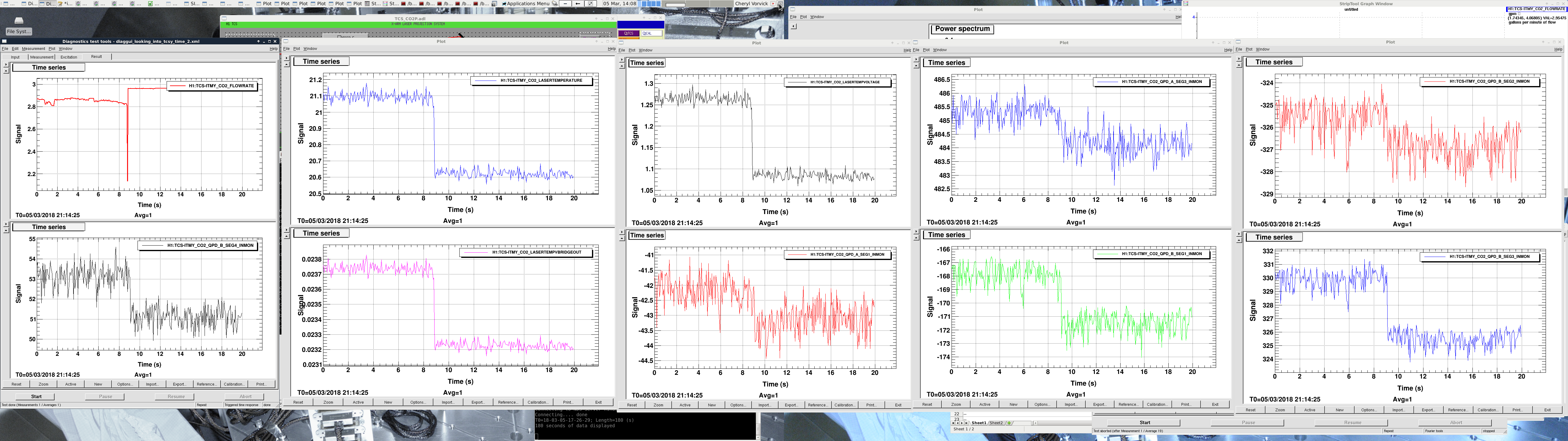
The various temperature fluctuations appear to be caused by the large outdoor temperature swings we had last week.
Some time ago the transmission and polarisation rotation caused by the Faraday rotator was measured to be
98.8% and 15.6 degrees respectively. At that time the TGG crystal was located towards one end of the
Faraday rotator - the "output" end. (see F1.jpg)
After some effort in aligning the Faraday isolator we found that we could get good transmission but not
good isolation and vice versa. Comparing the Faraday isolator with the unit installed in HAM5 revealed that
the TGG crystal is located in the middle of the magnet assembly. Looking at the unit being worked on revealed
that the TGG crystal was loose within its holding cylinder. Why and when it came loose is not obvious. The
crystal was pushed more towards the centre of the Faraday rotator and the polarisation rotation angle was
re-measured.
The new measurements suggest a transmission of 99.5% and a polarisation rotation angle of 46.1 degrees.
(see F2.jpg). The angle plotted in both cases is the angle of rotation of a half waveplate.
Anecdotally when the TGG crystal was pushed towards the centre, without any time spent optimising the
alignment we observed fairly good transmission and an isolation ratio of 30 dB.
At present there is some confusion as to whether or not the TGG crystal is meant to be epoxied in place
or is held into place by what is rumoured to be a paramagnetic holder. In either case the holding mechanism
failed.
Koji / Gerardo / Peter
Betsy, Hugh, TJ
Last week Betsy put the heater on the table and today Hugh checked it's vertical center with an auto-level. Some washers were added to get it as close to center as possible, which ended up around 0.4mm high. Betsy and I then had to wiggle the assembly into place, and rotate the entire gold ceramic holder to allow the screws on the outside to clear the OSEM brackets. The heater is currently sitting ~6mm away from the back of the SR3 optic and it is plugged into the feed through.
Picture attached.
Here are a few more pics. As TJ notes, the ROC front face is 5-6mm from the SR3 AR surface. It is locked down in this location.
Note, we followed a few hints from LLO's install:
https://alog.ligo-la.caltech.edu/aLOG/index.php?callRep=25831
Continuity checks at the feedthru still need to be made. Will solicit EE for their help.
Initial continuity test failed. Found issues with in-vacuum cable, power pins not pushed in completely. Pins were pushed in until a locking click was heard.
Reading are:
Larger Outer Pins, Heater: 66.9Ω
Inner pair (left most looking at connector from air side), thermacouple: 105Ω
Found center of SR3(-X Scribe) to be 230.2mm above optical table. By siting the top and bottom of RoC Heater, found center to be at 231.4mm. Removed available shim to put center of RoC Heater at 229.6 for 230.2-229.6=0.6mm below perfect.
Hugh's comment reminded me that to get the heater to fit, Betsy and I added a 1mm washer to raise the height of the assembly. In total we have 4mm of washers (2x1.5mm & 1x1mm).
I conducted measurement of quantity 6 of [D1600104 SR3 ROC Actuator, Ceramic Heater Assy] at CIT on 4 March 2016. Dirty state before baking. The serial number of the heater assy installed in LHO HAM5 is S1600180 - see https://ics-redux.ligo-la.caltech.edu/JIRA/browse/ASSY-D1500258-002 S1600180 Resistance = 66.8 Ohms on 4 March 2016. There is good agreement between the as-installed and pre-bake measurements.