Daniel, Sheila, Terry, Nutsinee
We locked the thing!
Below are some of the relevant information:
Broad Band PD at SHG transmitted (Design document: https://dcc.ligo.org/LIGO-T1100467)
Responsivity (1064) = 0.1A/W
Transimpedance = 2kOhms
Calculated power hitting the PD = 10mW
EOM1 (Newport 4004 Broad Band Phase Modulator)
Modulation response = 15 mrad/V @1000nm
Drive voltage = 1.5Vp (1Vrms)
Modulation Depth = 22.5 mrad
Other values:
Measured transmitted DC level = 2V
Measured RF power envelope (peak-peak) = 8mV
Measured PDH error signal (peak-peak) = 40mV
FSR of the SHG cavity = 3GHz (cavity length ~2.5cm, KTP crystal index of refraction = 1.80302 gives 2.75 cm extra path length. This 3GHz number was also found buried in SURF report by Nathan Zhao)
Finesse = 89.75 (used r=0.9, value for the input coupler) I mistyped the % earlier. Finesse is just a number, not percentage.
Calculated Linewidth = 30MHz
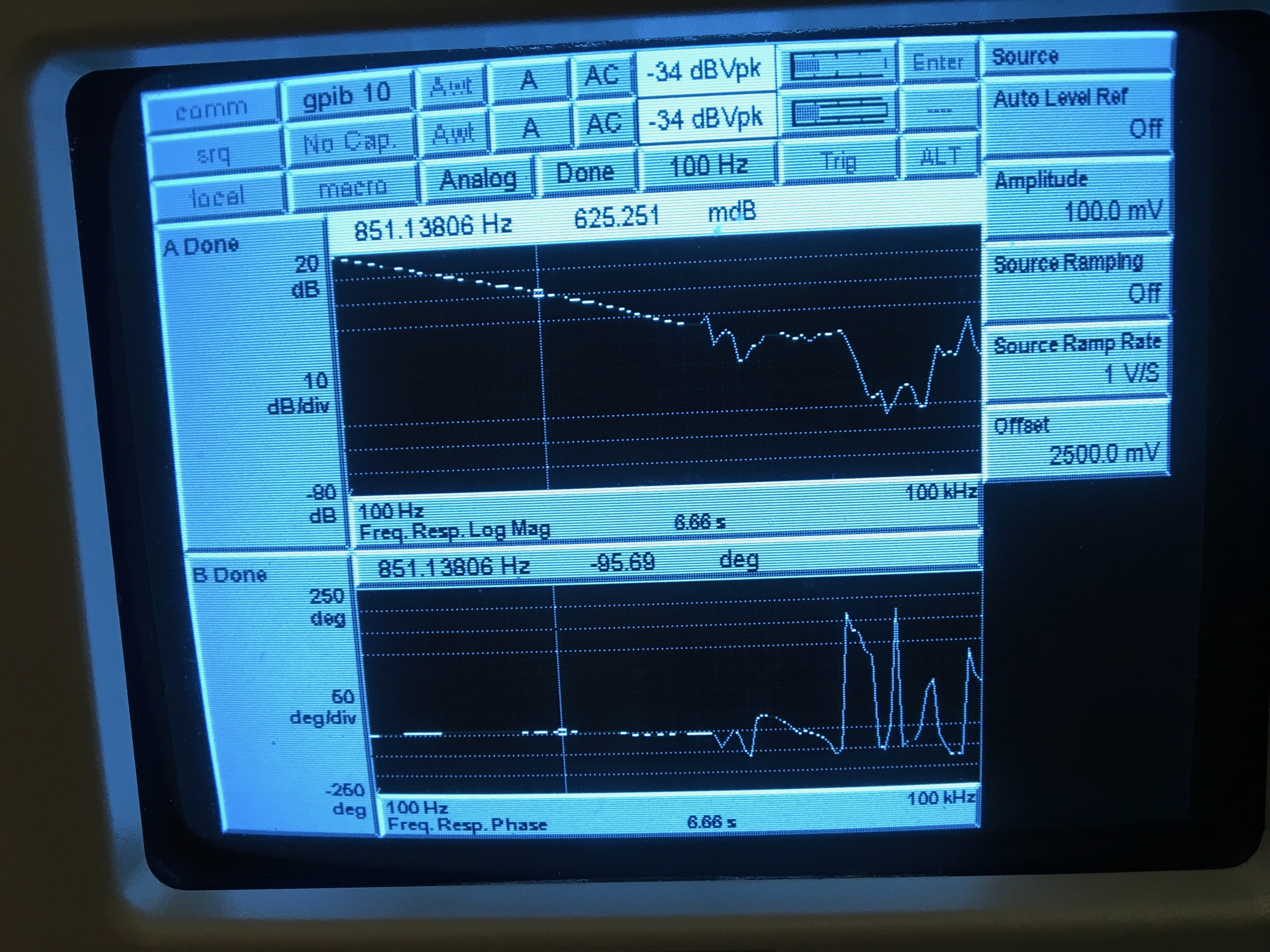
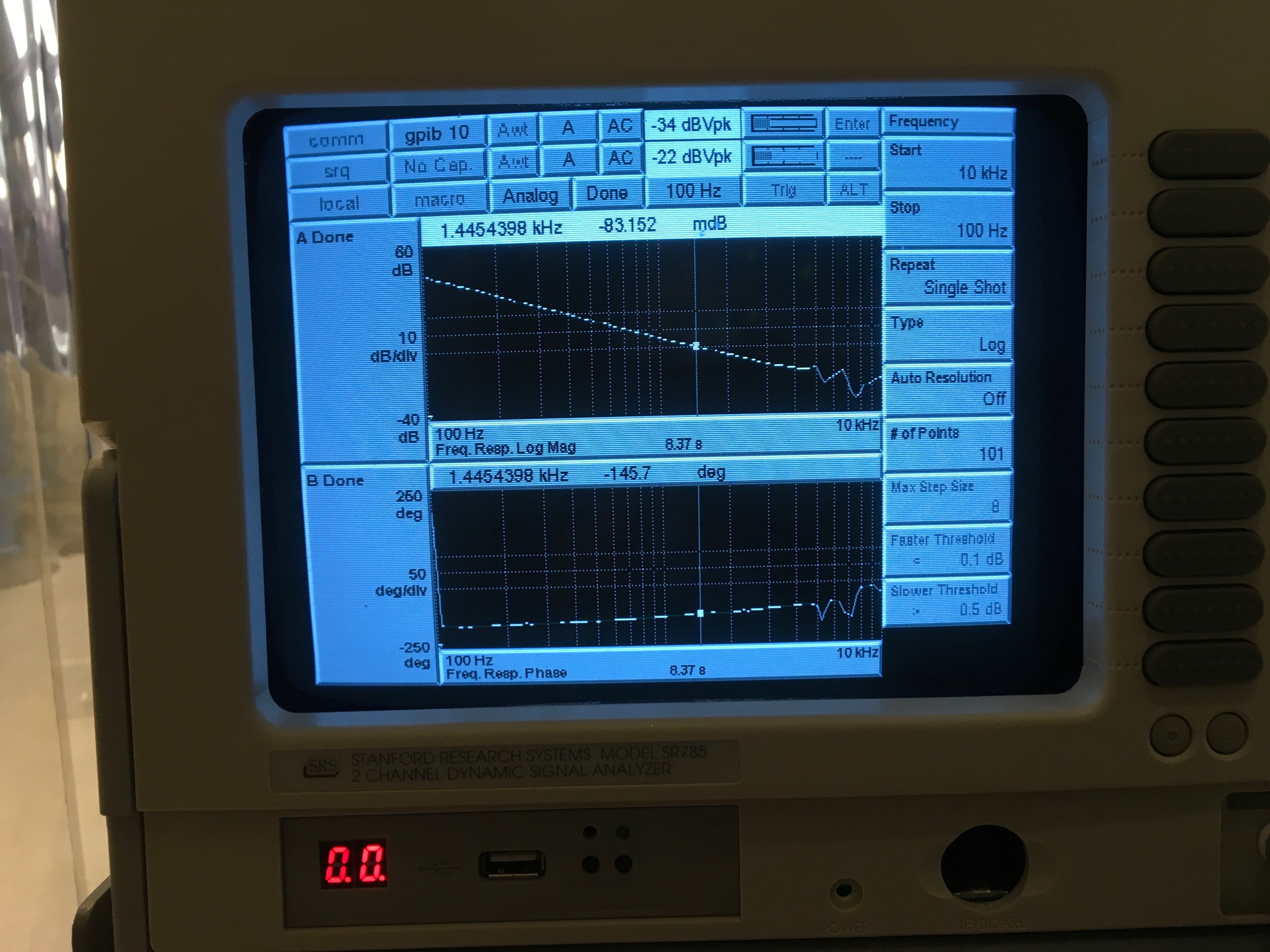
Open-loop gain transfer function
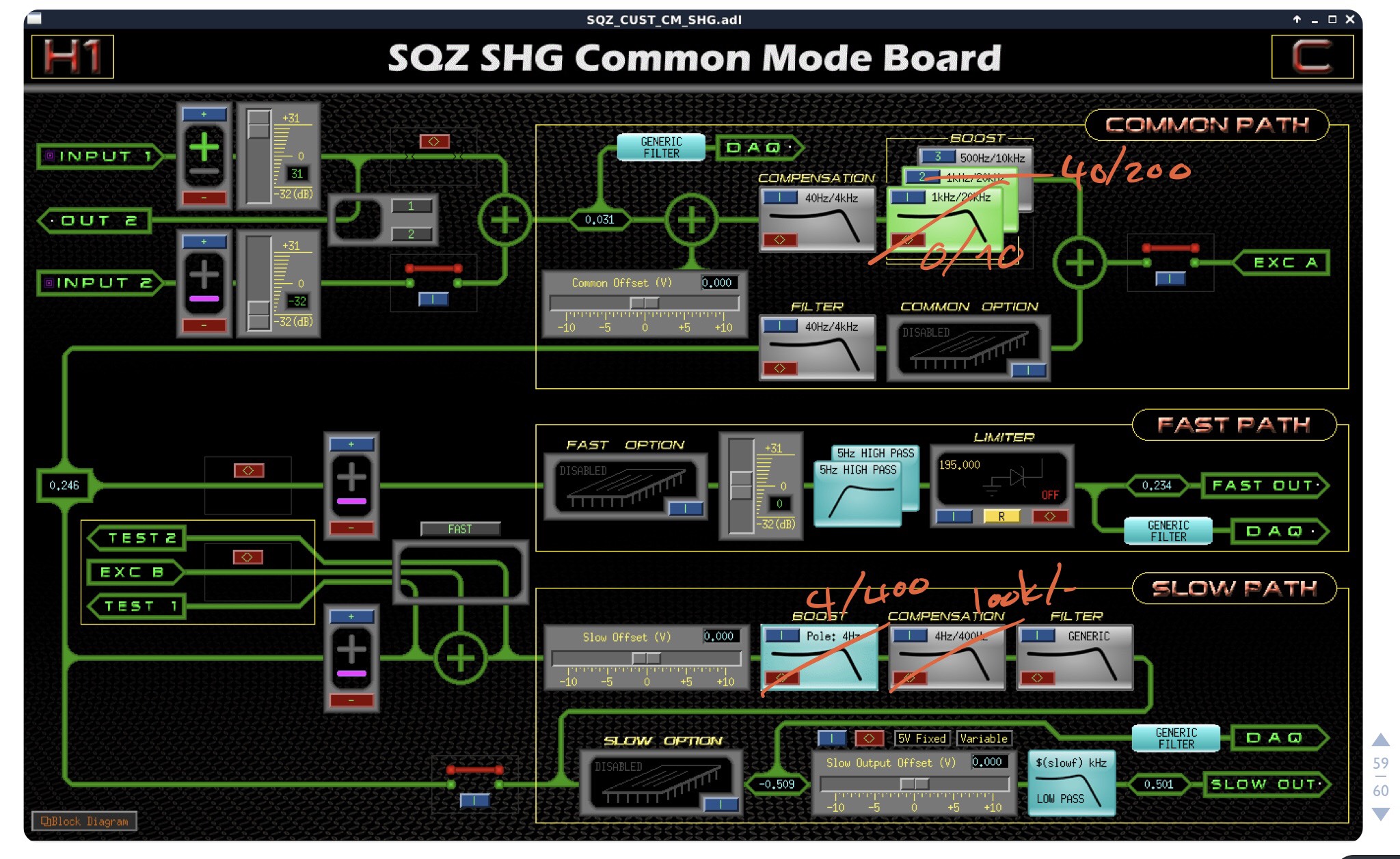
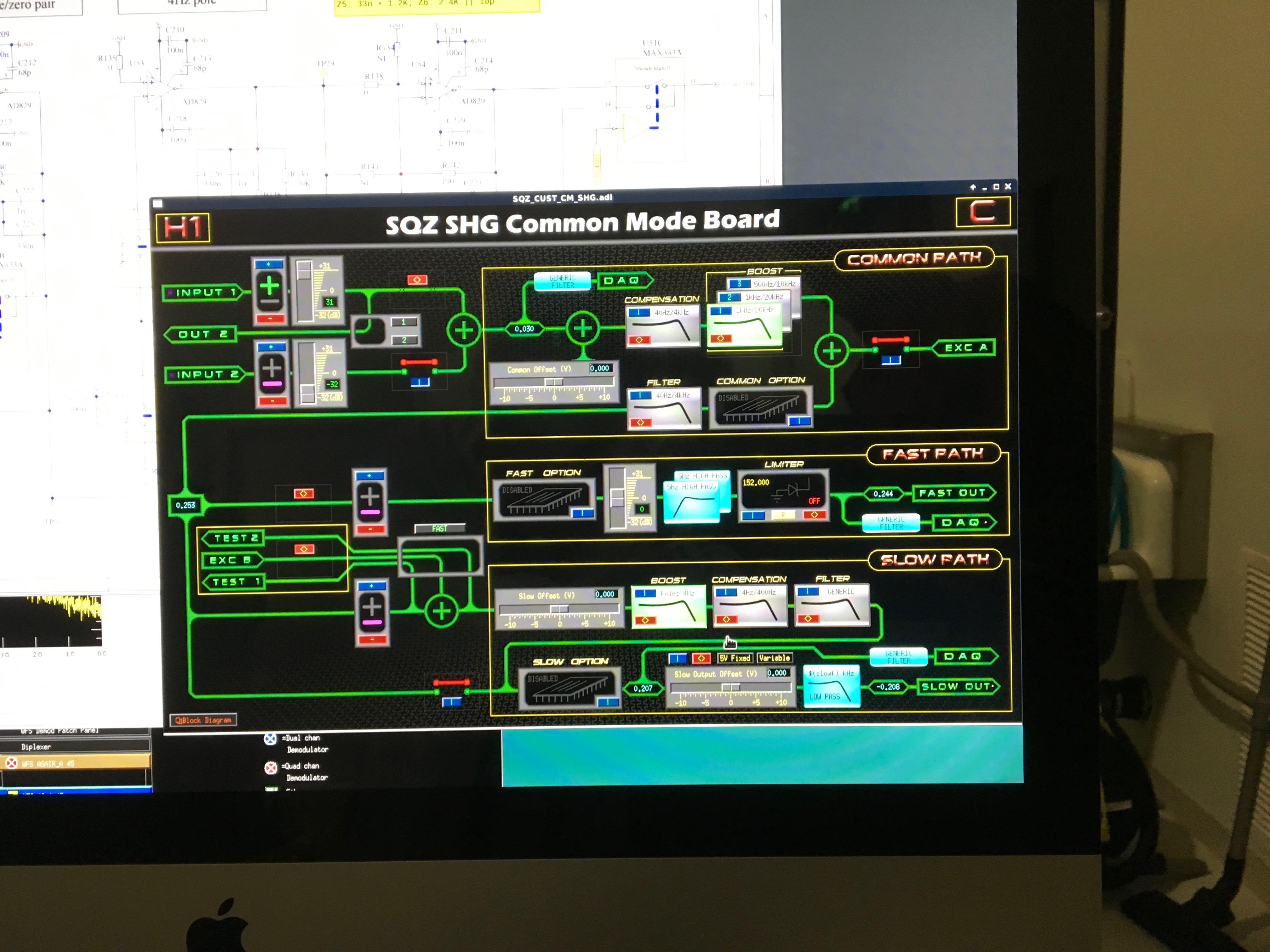
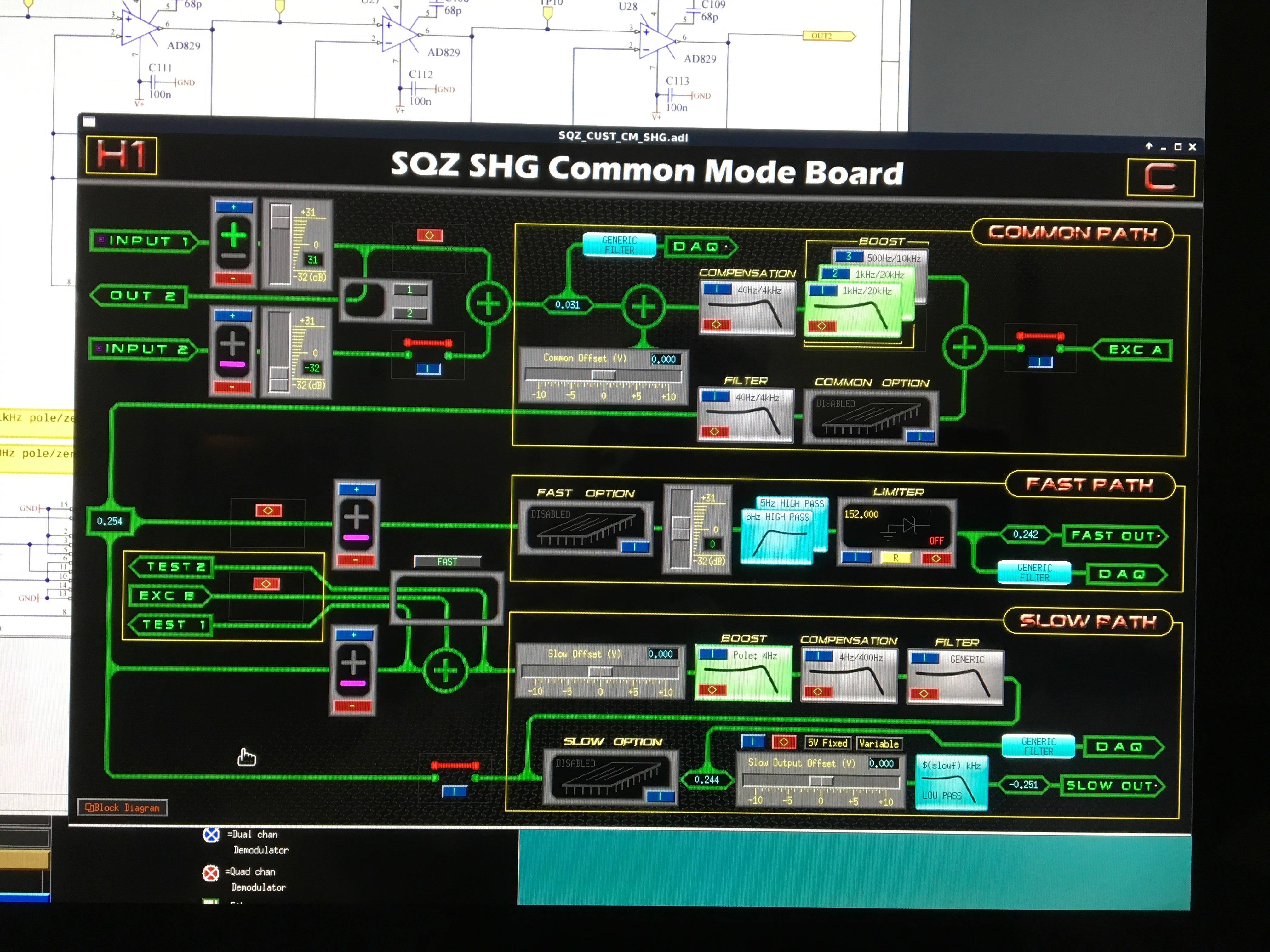
The boost labels on the medm screen are still wrong. That's due to be fixed.
The first boost in the common path is actually 0/10 (pole/zero) and the second boost is 40/200
The "boost" in the slow path is actually "compensation" (4/400) and the "compensation" is just a pole at 100kHz with no zero.
TF WITHOUT common path second boost engaged has UGF at ~850Hz
TF WITH common path second boost engaged has UGF at ~1.5kHz
Other stuff worth mentioning
TravisS, DarkhanT, EvanG, RickS
Late yesterday afternoon, we transitioned to Laser Hazard at Yend (removing Bubba's Lock and Tag on the Pcal power supply after consulting with him).
After orienting the ETM to the pre-vent location on the QPD, we went into the manifold and inspected the Pcal beam positions on the perisocpe relay mirrors. They looked pretty good on a cursory inspection. Both beams were also found to be centered on the Receiver module power sensor. Evan and I centered the beam positions on this sensor before the vent.
Then, using the Working Standard, we measured the beam powers before entering the vacuum enclosure, inside before impinging on the ETM, inside after reflecting from the ETM, and outside at the Receiver Module. These data, once digested, should allow us to determine where the approx. one percent optical loss between Transmitter and Receiver modules is occurring and thus reduce the Pcal uncertainty slightly.
We then transitioned back to Laser Safe, re-installing Bubba's lock and tag on the Pcal power supply. Note that the green light supply is not locked out, but the key is removed.
At the next opportunity, we plan to install the Pcal ETM target on the suspension structure and investigate the alignment in more detail.
There was a slight temperature increase, ~1 degree F.in the VEA late yesterday. Part of this can be attributed to increased activity (both personnel and clean rooms running)and partly due to the increase in temperature in the mechanical room adjacent to the VEA which houses the purge air compressors. The temperature in that room increased to 86 degrees F and some of that warm air likely migrated to the VEA. I went down to the end station late yesterday and checked the glycol level/pressure, which normally operates at 30psi and that pressure was down to ~24psi, not enough to make a temperature excursion of 1F. I topped off the glycol bringing the pressure up to 30psi. I also increased the air flow of the supply fan from 60% to 80%. This is a common practice when we fire up clean rooms in the L(VEA)s. I will continue to monitor the temperature and make further adjustments as needed. Current set point in the VEA is 65F-current temp is 65.6F.
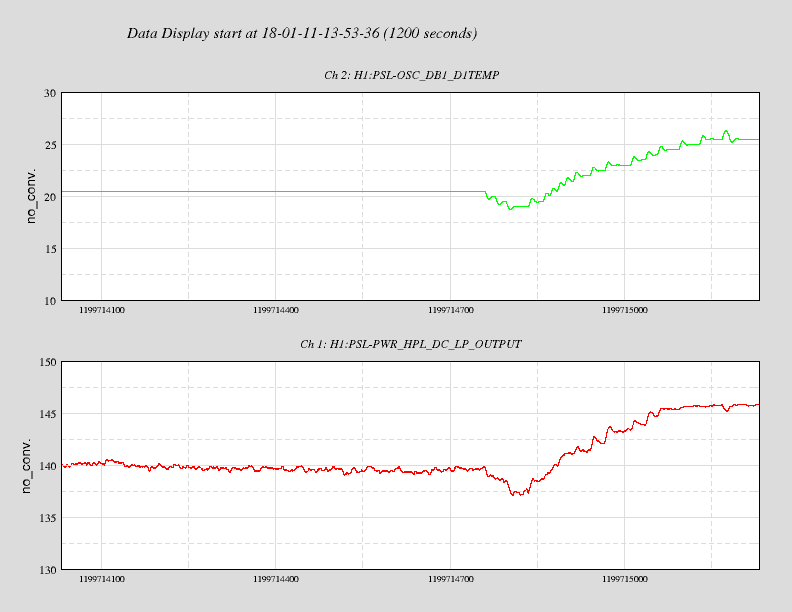
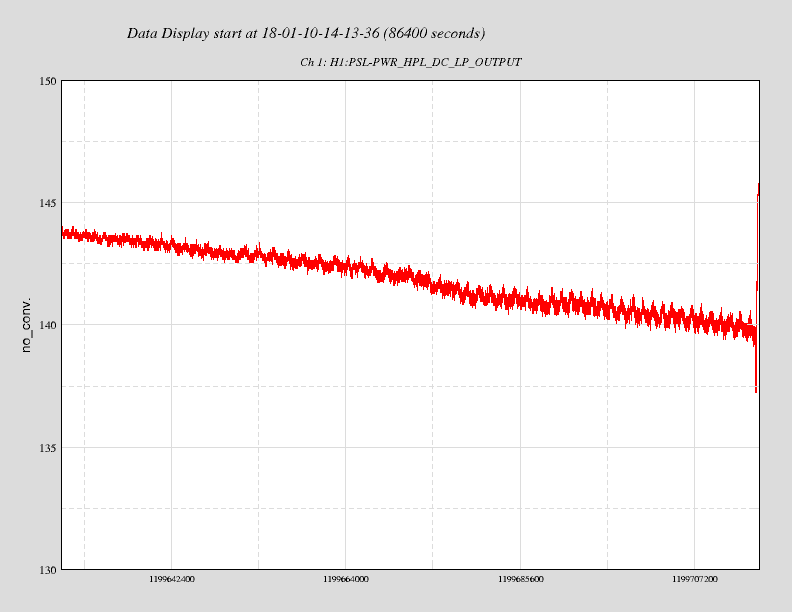
Over the past day the output of the oscillator has slowly declined (~5W). I adjusted the diode box temperature, rather than the diode current, to compensate. We gained some output power back. It might be that the oscillator can be nursed in a better way by tuning the temperatures of the individual pump diodes of diode box 1 but that will take some time.
(Chandra, Gerardo)
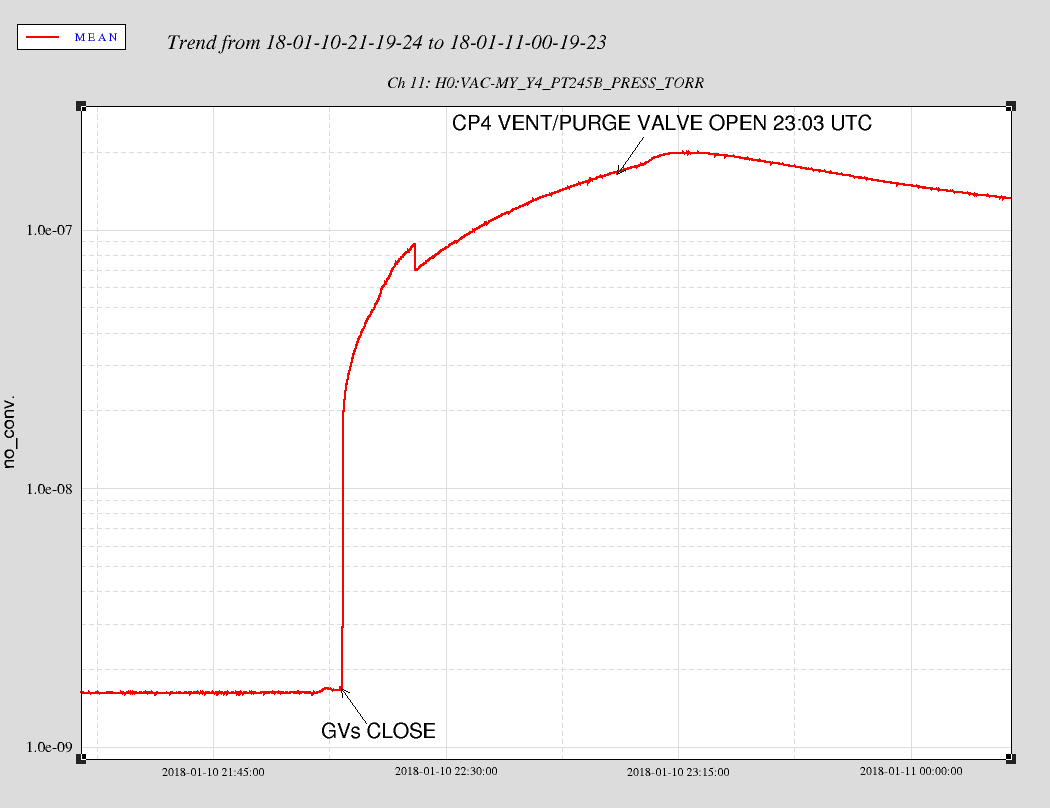
Hard closed GV11 and GV12, this was done in preparation for CP4 bake, at 23:03 utc a small 75 l/s ion pump was coupled to CP4 vacuum volume to remove H2.
Something to note, during the closing of the gate valves, GV11 made a loud noise, visible on some of the local seismometers, also the annulus system for this gate valve responded by going up on current, went from 1 light to 6 lights. GV12 did not make any noise and its annulus system did not show any changes.
To couple the new ion pump to CP4 we followed the steps listed on WP#7270.
We suspect the sharp step in pressure is from a voltage change in CC gauge when disengaging switches at valve gate pins (for LOTO).
(Bubba, Gerardo)
Removed and replaced the rubber stopper size 1 from HAM6 north door annulus, replace it with a size 0. Pumped down on system with an aux-cart and pressure as of 19:00 utc was at 8.0x10⁻⁶ torr, aux cart will remain on until tomorrow.
Today at 19:15 utc, after isolating annulus system for HAM5, the aux cart was turned off, but the rubber stoppers remain on HAM6 north and south flanges. Pressure before turning off the cart was at 8.0x10⁻⁶ torr.
WP7278
Daniel, Sheila, Dave:
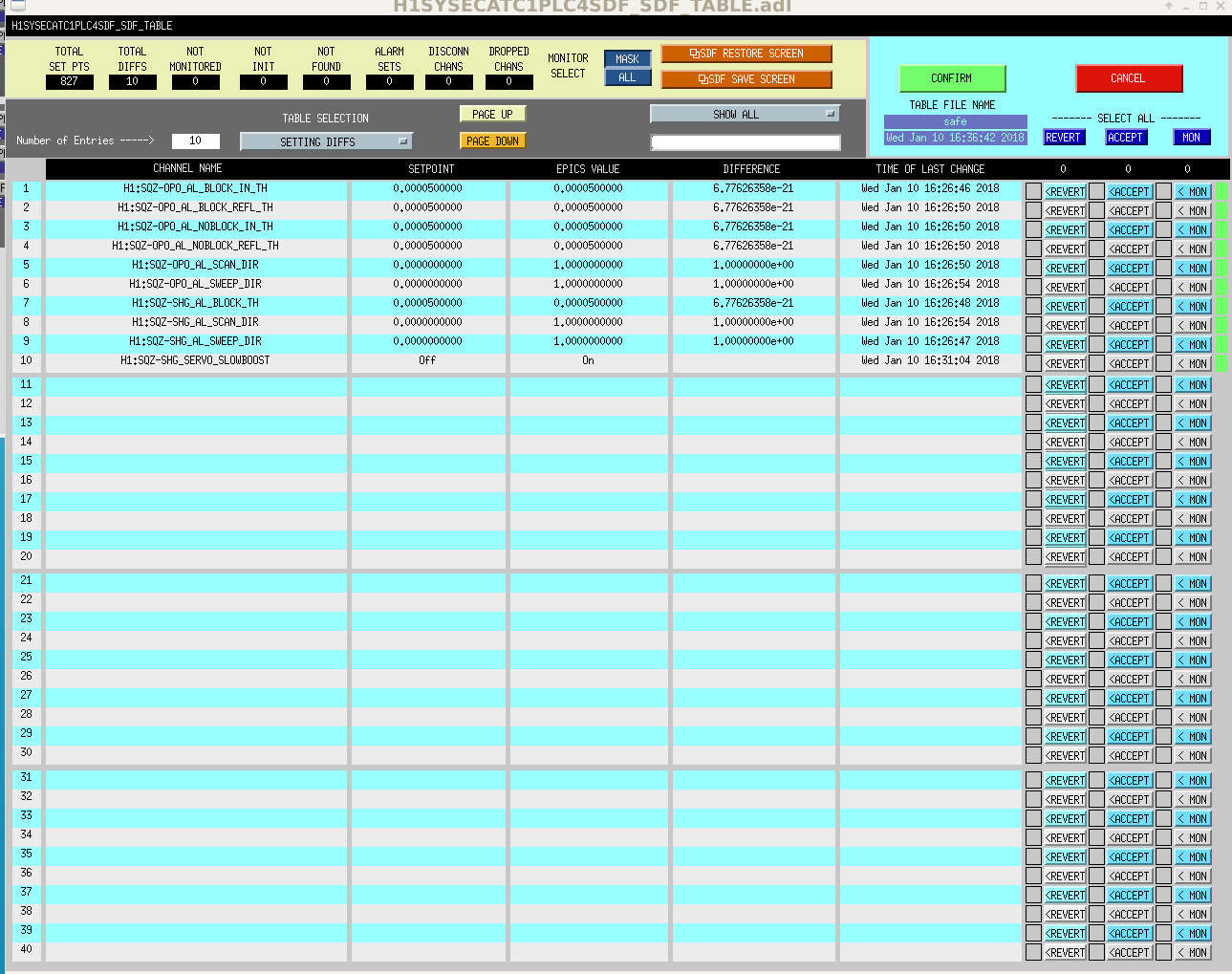
By following Jonathan's wiki instructions, I have created an SDF for the new Squeezer Beckhoff Slow Controls (h1ecatc1plc4). I used the next available DCU_ID and CPU_ID (1036 and 13 respectively). The system was built and started on h1build.
I have added the system to the SDF Overview MEDM. It is configured to use its safe.snap reference, which was created by listing all the non-readonly channels in the h1ecatc1plc4 autoBurt.req file. As a starting point, all channels are being monitored by SDF.
This work-permit will remain open until the next DAQ restart, at which point the new SDF channels will be trended (H1EDCU_SDF.ini already has the additional channels added).
I am seeing some channel in the difference list with vanishingly small differences (e.g. 6.7e-21), I'll work with Jonathan on resolving these. Difference list is attached.
The LVEA has transitioned to LASER SAFE. The PSL shutter has been locked closed.
FAMIS 6557 Added 150 mL H2O to the H1 PSL crystal chiller. The H1 PSL diode chiller fault light is not lit. The canister filters are white and clear of debris.
TITLE: 01/10 Day Shift: 16:00-00:00 UTC (08:00-16:00 PST), all times posted in UTC STATE of H1: Planned Engineering LOG: 15:41 UTC Mark and Tyler to LVEA 16:15 UTC Terry to squeezer bay, turning laser on, laser hazard at height 16:22 UTC Vanessa and Karen leaving end Y 16:29 UTC Reset BS HEPI WD 16:30 UTC Mark and Tyler out of LVEA, to end Y for BSC arm installation 16:47 UTC Jenne in CR working on IMC, need HAM2,3 16:50 UTC Daniel and Ed pulling squeezer chassis 1 and 2 in CER 17:02 UTC Jeff B. to cleaning area 17:17 UTC Travis to end Y to help with BSC arm installation 17:22 UTC Gerardo and Bubba to LVEA to plug HAM6 annulus 17:22 UTC Jeff B. back 17:26 UTC Filiberto to mezzanine to connect TCS laser to Beckhoff safety system 17:36 UTC Betsy to end Y 17:42 UTC Visitor through gate to see Chandra 17:48 UTC Gerardo and Bubba done. Aux pump cart left pumping on annulus system for HAM5,6 18:04 UTC Ed done in CER 18:12 UTC Gerardo to mid Y to prep for CP5 ion pump install 18:27 UTC Keita to end stations to post ALS laser SOPs 18:33 UTC Betsy back from end Y 18:39 UTC Daniel and Sheila in squeezer bay 18:49 UTC Filiberto and Elizabeth to HAM5,6 to pull squeezer cabling 18:50 UTC Betsy to LVEA to get part to take to end Y 19:22 UTC Keita done posting ALS laser SOPs 19:40 UTC Jim to end Y to lock ISI 19:41 UTC Karen to H2 building 19:42 UTC Filiberto done, had unplugged SRM top suspension cable 19:50 UTC Marc and Ed to CER to find lid 19:55 UTC Marc and Ed back, to H2 building to find lid 20:00 UTC Marc and Ed back, taking lid to CER 20:03 UTC Ed and Marc done 20:03 UTC Travis back. BSC arm is on. Jim locking ISI. 20:34 UTC Filiberto to LVEA squeezer racks 20:40 UTC Elizabeth to mid Y 20:47 UTC Sheila, Daniel, Terry, Nutsinee out of squeezer bay for lunch 21:10 UTC Karen to end Y then mid Y 21:20 UTC Jason to end Y 21:26 UTC Dave restarted h1sqz model for Daniel's changes. This will also load Sheila's modified filter file. 21:33 UTC Chandra and Kyle closing GV 11,12 WP 7269 21:34 UTC Gerardo to HAM6 21:35 UTC Jeff B. to optics lab to put equipment away 21:39 UTC Dave shutting down h1seiex 21:46 UTC Jeff B. back 21:48 UTC Jason to end Y 21:50 UTC Elizabeth back, going to LVEA 21:50 UTC Gerardo back, going to mid Y 21:52 UTC Dave and Jim powered down all analog at end X, have rollup door open 21:53 UTC Marc to end Y 21:58 UTC Hugh toggling HAM5 ISI to damped/isolated 22:12 UTC Dave and Jim back from end X 22:13 UTC Betsy to cleaning area to get C3 covers 22:19 UTC Rick and Travis to end Y to do PCAL in chamber work, Rick transitioning end Y to laser hazard 22:20 UTC Karen and Vanessa leaving mid Y 22:26 UTC Jenne and Cheryl to PSL for ISC alignment 22:44 UTC Robert to end Y to take pictures in chamber with PCAL group 22:48 UTC Elizabeth and Filiberto done in LVEA 23:00 UTC Site weekly meeting 23:18 UTC Jenne and Cheryl back 23:42 UTC Robert back from end Y 23:44 UTC Tyler and Mark done at end Y 23:50 UTC Rick transitioning end Y to laser hazard
00:00 - 00:26 UTC Peter K. to IO tables.
Reporting for others:
After the door was removed yesterday, this morning Travis, Mark and Tyler installed the Install Arm onto the chamber flange (right hand side when viewing it from standing outside of the chamber). They also mounted the 5-axis table and the elevator lift to the arm, in prep for removal of the ETMY lower portion of the QUAD.
When they were finished, I helped Jim with the chamber entry contam control(picking up 3" wafer and 1" witness optic from floor to stow, and wiping floor and in-chamber stool). He then locked the ISI.
Rick, Evan, Travis and Darkhan are next up to transition to Laser Haz, go in chamber, set up the PCAL target on the ETMY SUS and look for the beam coming in and out.
Meanwhile, the welding cleanroom outside of the chamber and a staging room for parts prep have been setup and cleaned a few times over the last ~week+. We have moved all of the SUS equipment to the VEA and are in the process of staging it for the work.
Jim, Dave:
We power cycled the h1seiex system as part of Jim's low frequency noise mitigation study. The sequence was:
remotely: stop all models and power down h1seiex cpu.
At EX, power off: IO Chassis, AI chassis (qty 2), AA chassis (qyt 4)
The power up sequence was:
IO Chassis, AA chassis (qty 4), h1seiex cpu, AI chassis (qty 2)*
* - remember that the 16bit DACs output 10V on power-up until the front end computer is energized, so the AI chassis are the last to be powered up.
The h1iopseiex model came back with a slightly negative IRIG-B drift, which cleared after about 5 minutes at which point we could clear the IOP and model watchdogs.
Jim will take measurements to see if the power cycle has fixed anything.
Daniel, Sheila, Dave:
Daniel's latest h1sqz model was installed (an ADC channel shuffle). It did not require a DAQ restart. Sheila's latest filter changes were loaded on restart.
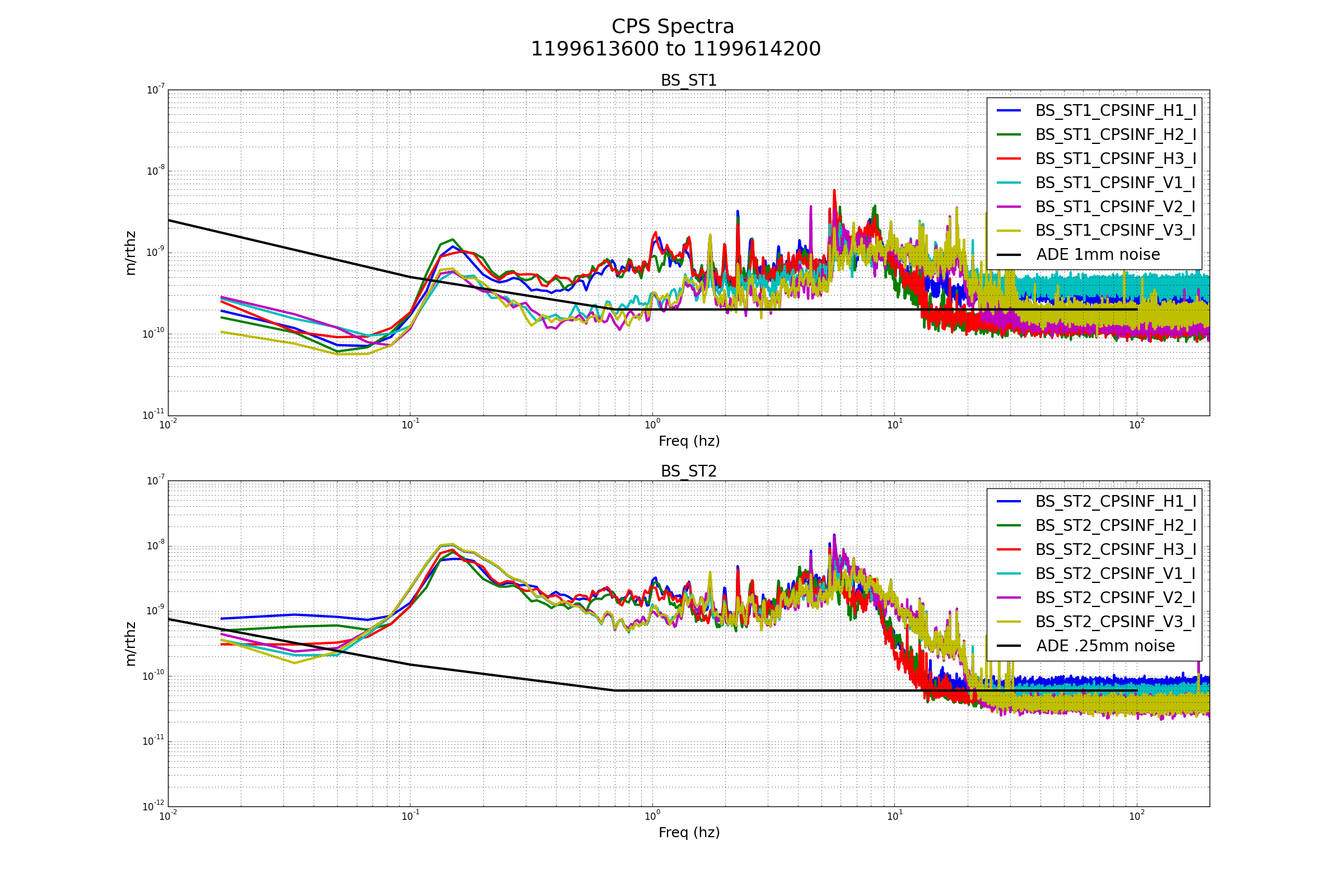
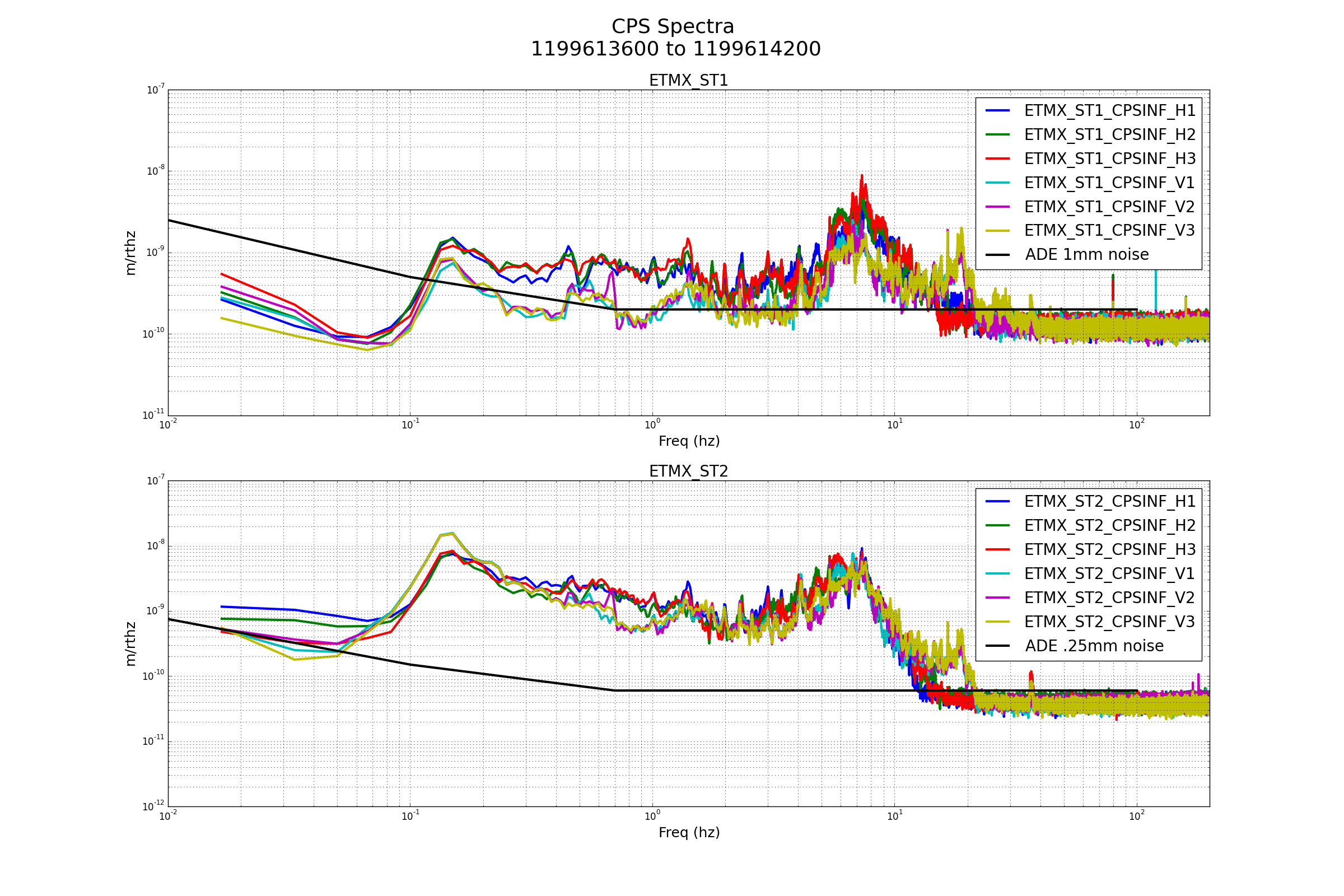
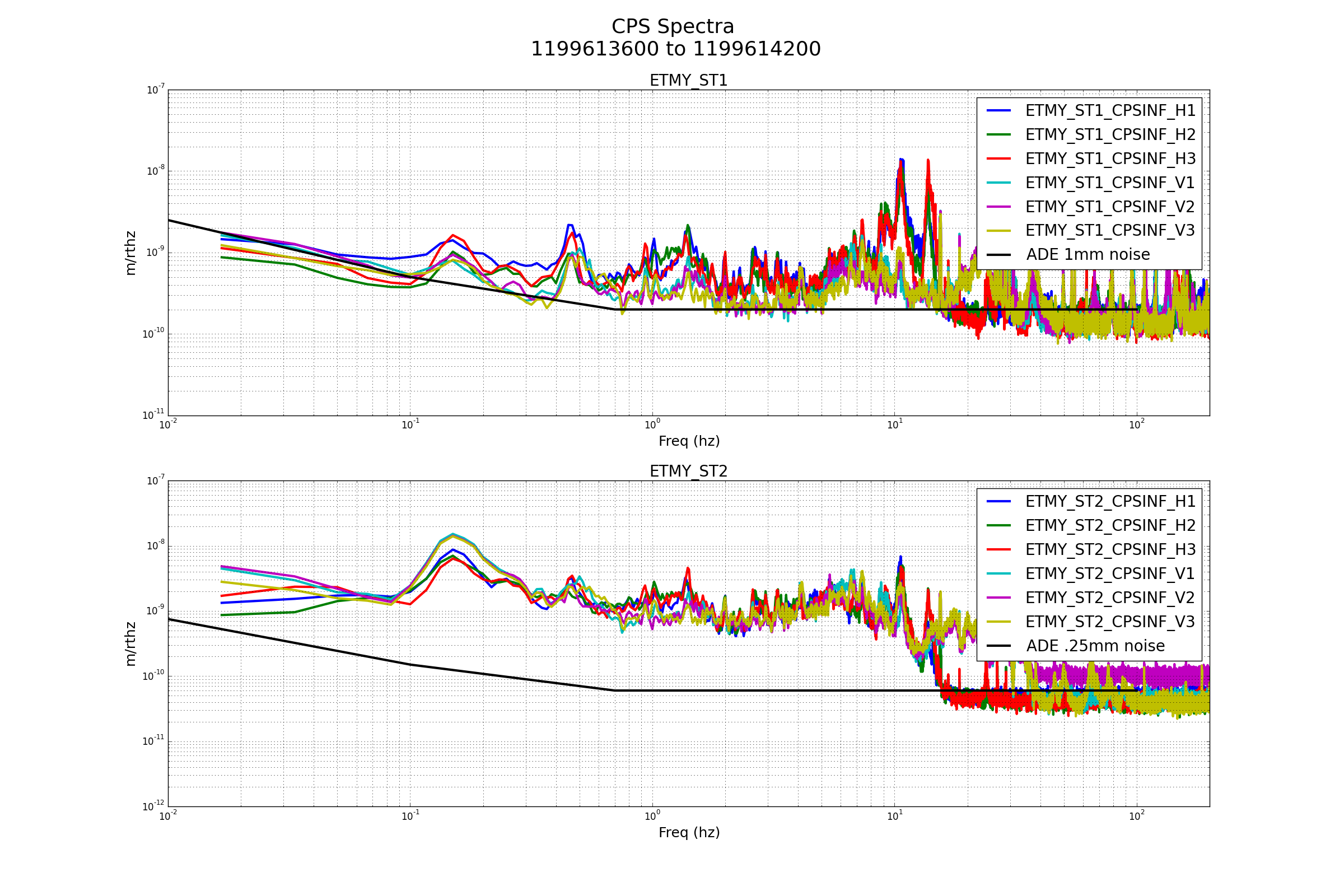
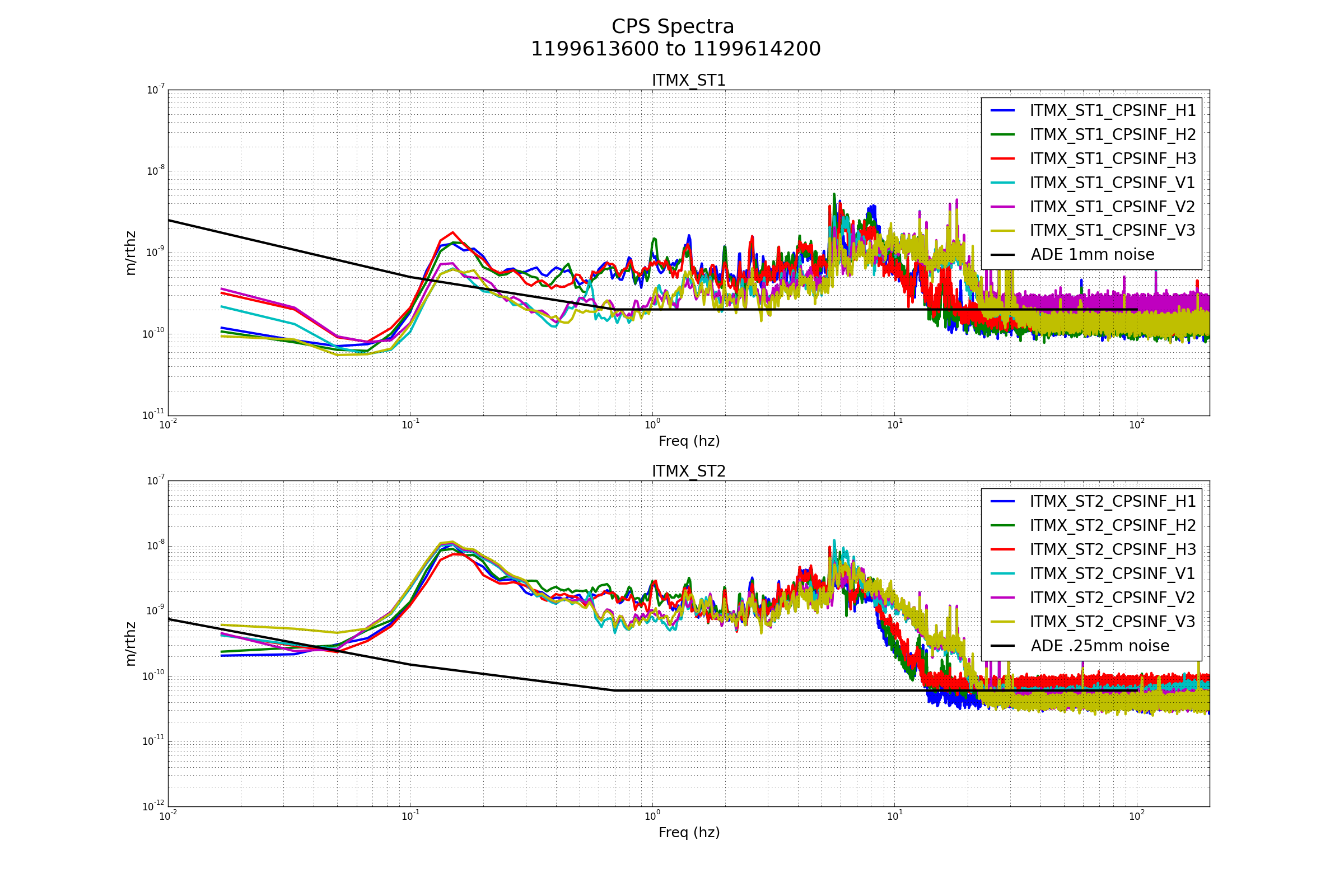
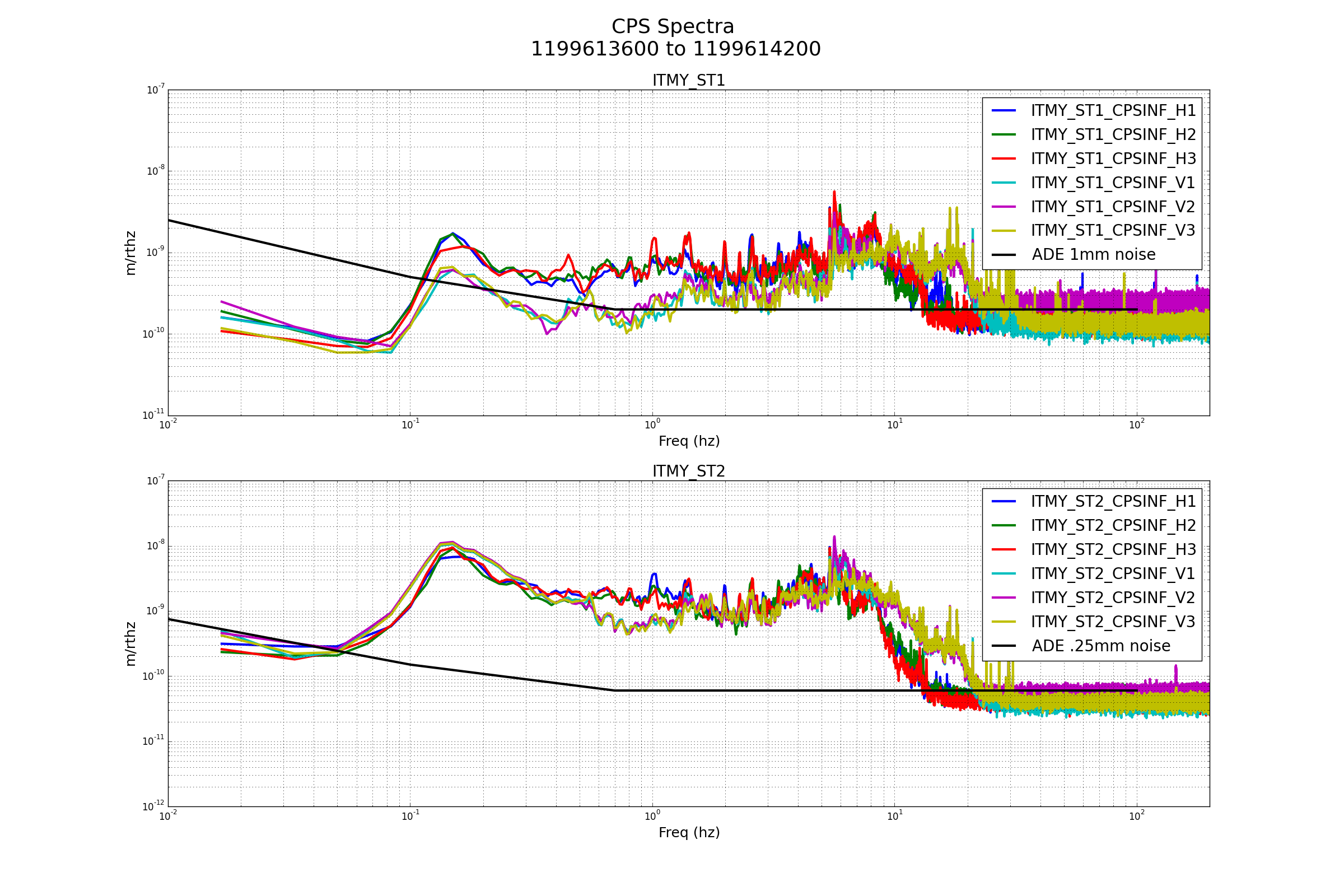
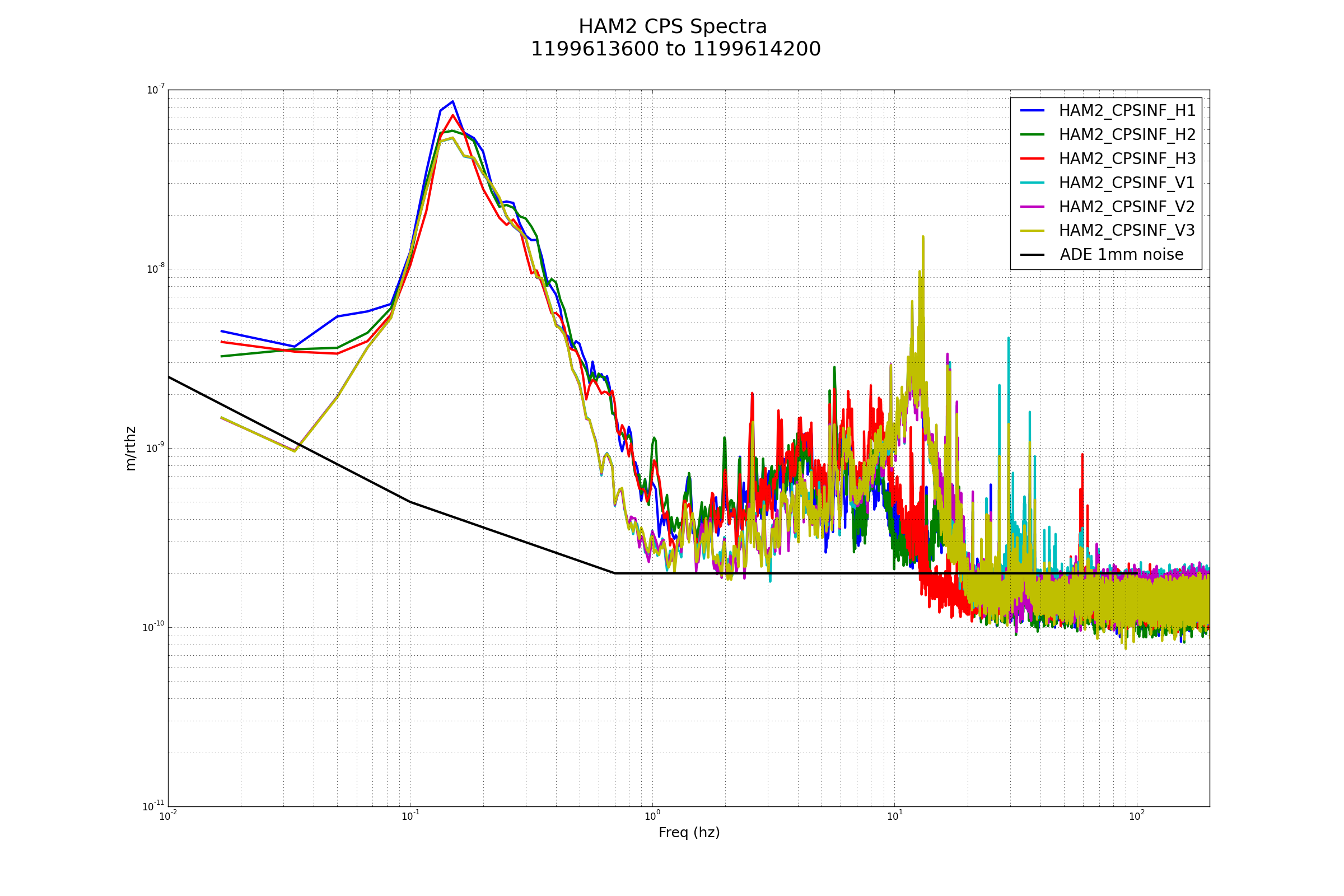
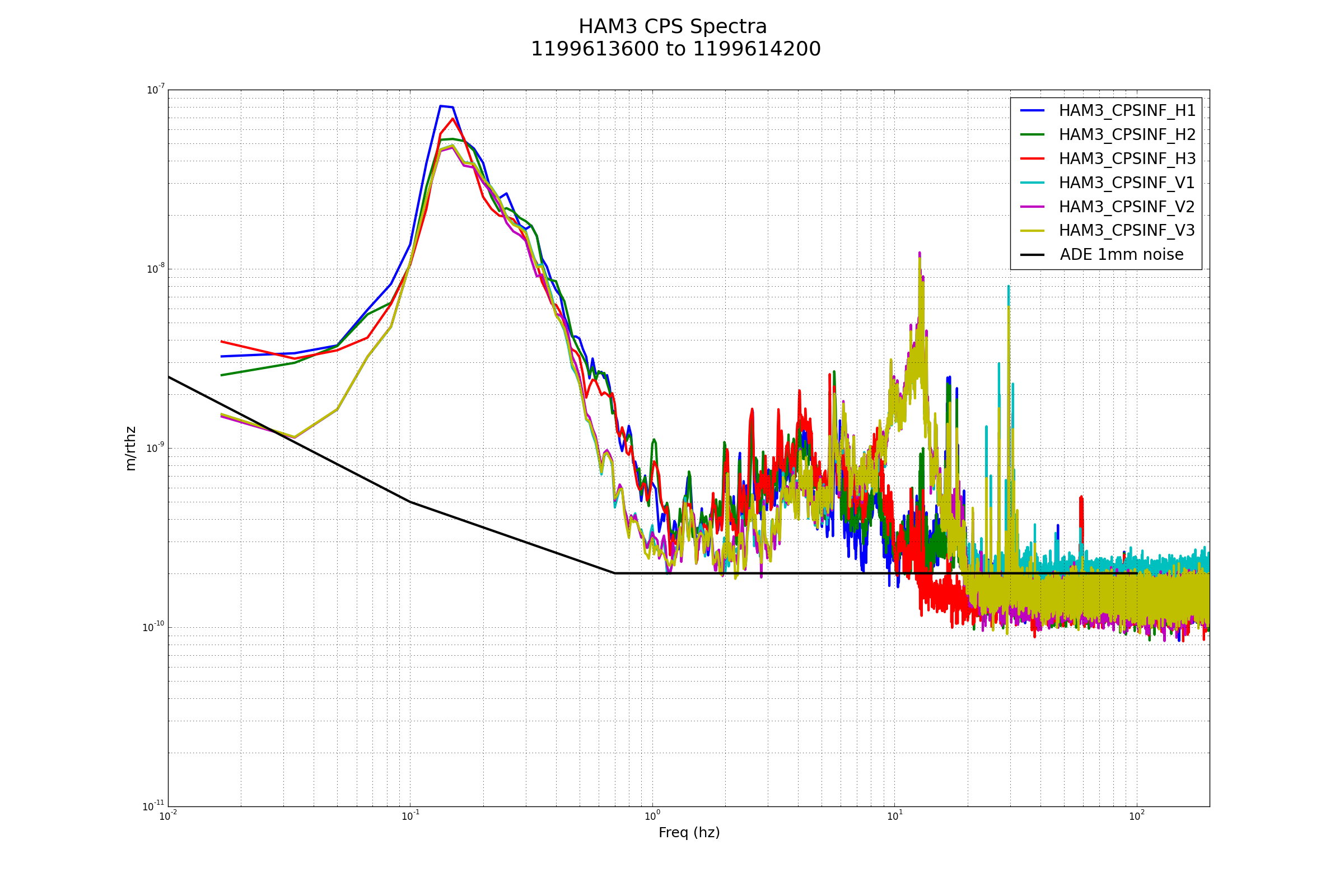
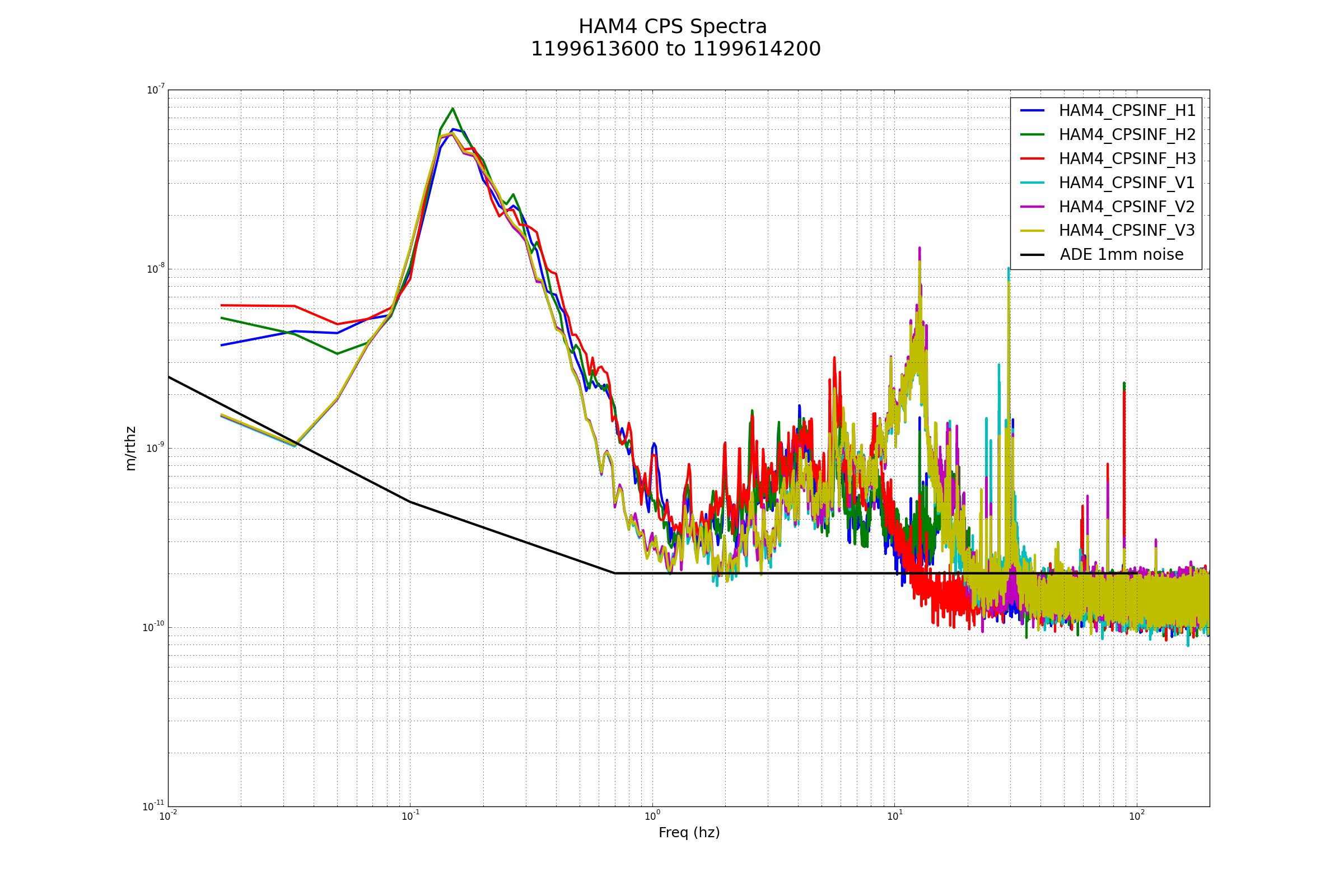
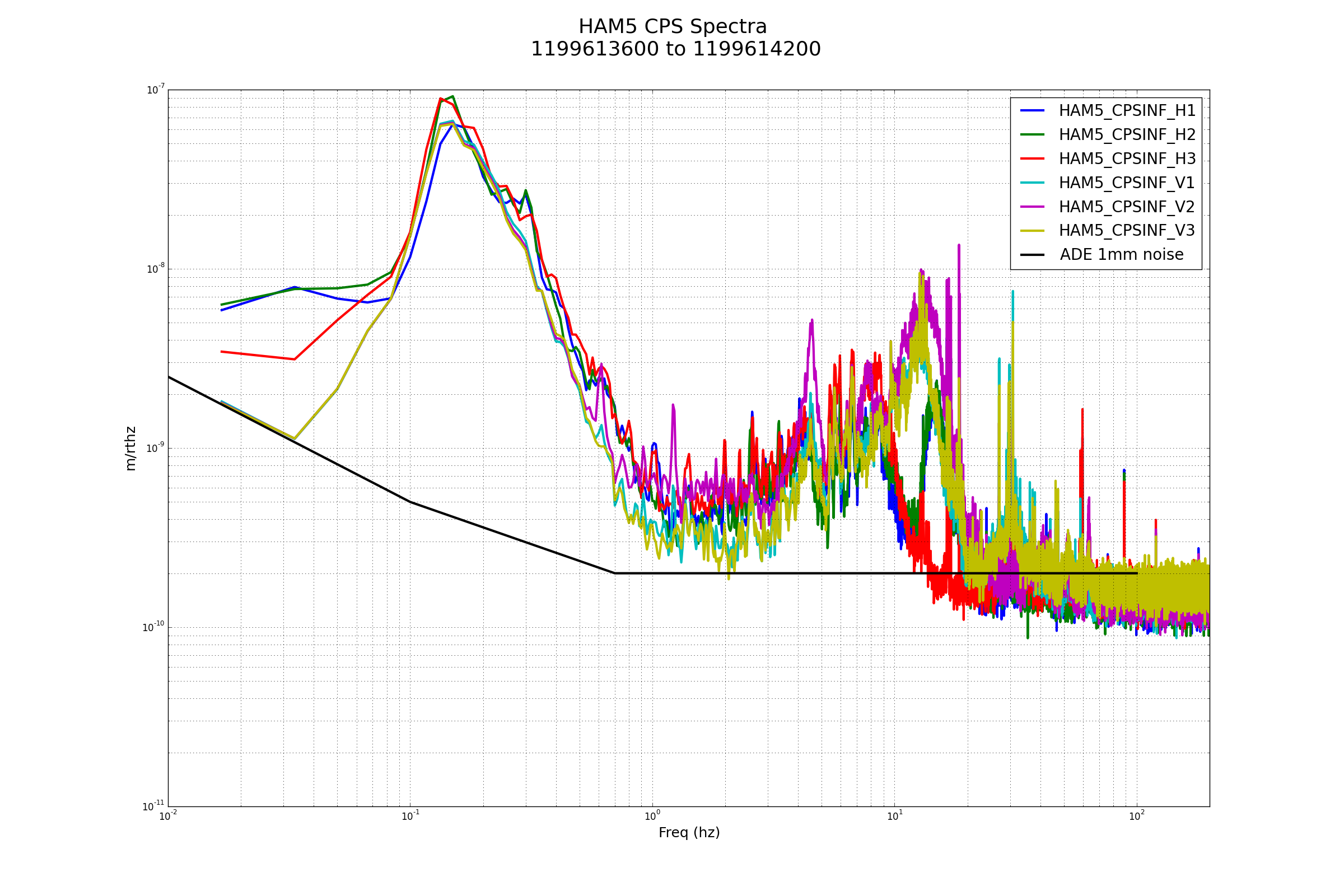
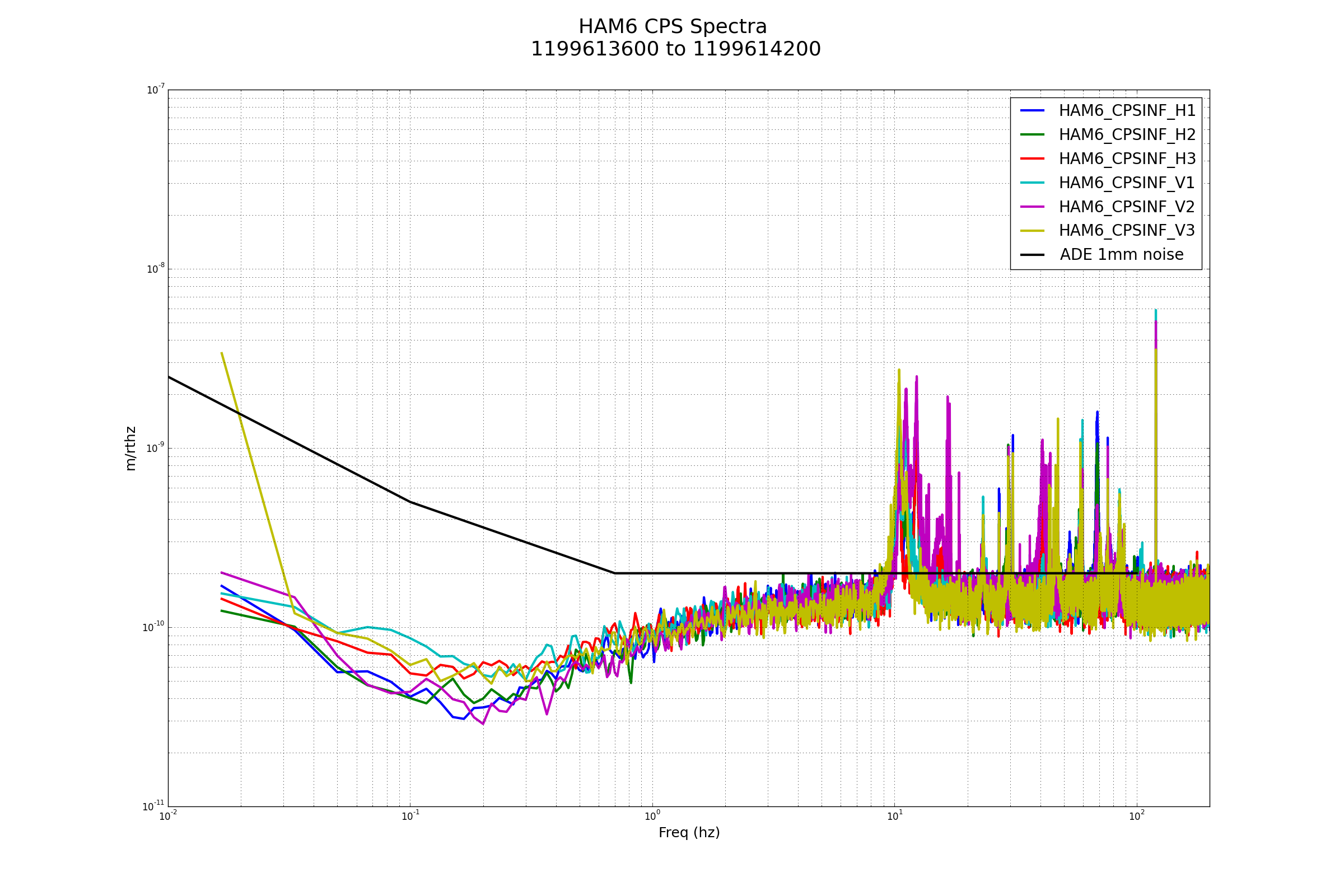
FAMIS 6932 The following appear elevated: BS: ST1 H1, V1 & ST2 H1, V1 ETMY: ST2 V2 ITMX: ST1 V2, ST2 H3 ITMY: ST1 V2, ST2 V2 HAM3: V1
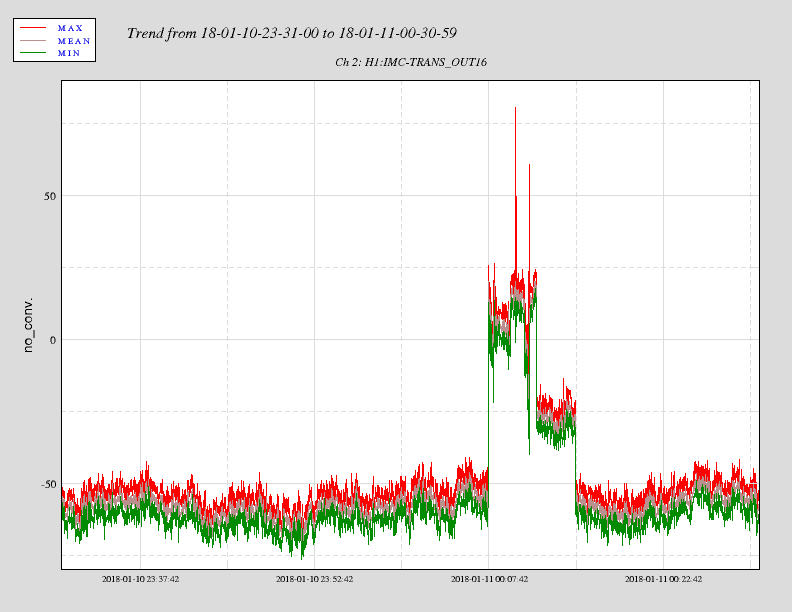
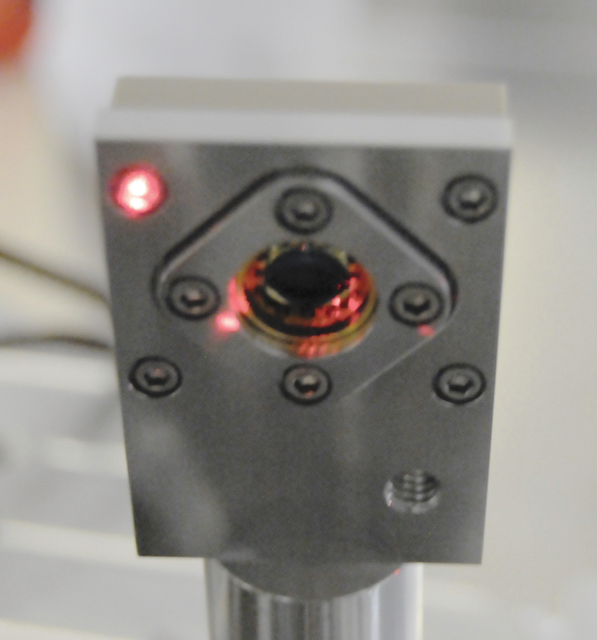
Attached is a picture of MC2 Trans QPD during the initial alignment when I devised a setup that used a red laser pointer to mimic the IMC beam, to align the MC2 Trans QPD.
In the images, there are three beams.
Through careful evaluation, Keita and I determined that the upper left beam is the second internal reflection from MC2 (vertical wedge), the far right beam is a reflection from the black glass that's behind the curved steering mirror to the QPD, and the center beam (slightly clipped on the edge of the QPD aperture, since it was not yet aligned) is the real MC2 transmitted beam that we want to center on the MC2 Trans QPD.
Tests to evaluate the likelihood that the alignment into the IMC could be altered in such a way that one of the two beams we do not want to use ends up on on MC2 Trans QPD are under way.
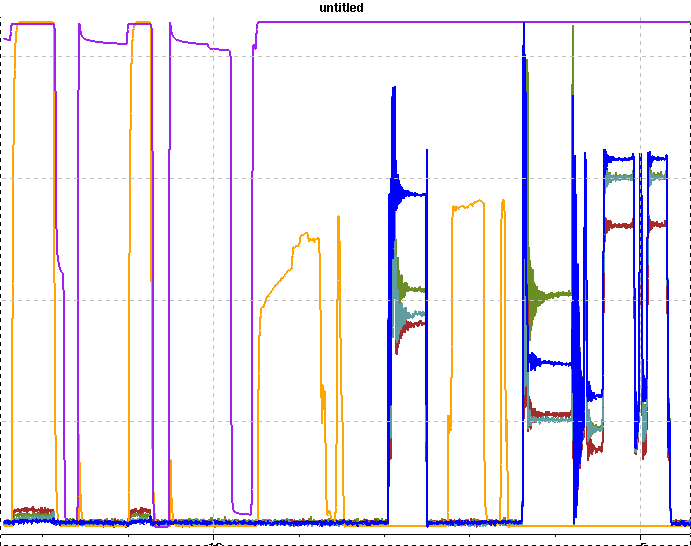
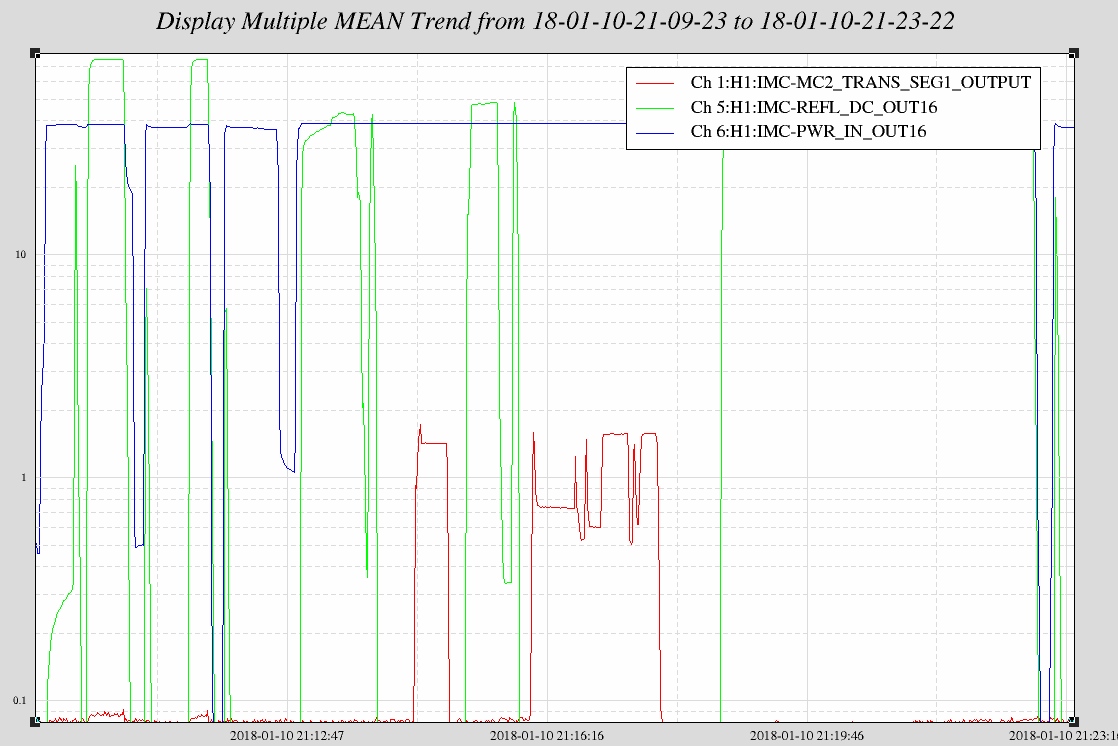
confirmation that currently the wrong beam is centered on MC2 trans: on the left: refl has a beam, MC2 Trans is less than 0.15 on each quadrant: on the right: refl has no ligh, MC2 Trans quadrants are reading signals around 1.5
Realized my snapshot of StripTool did not include enough info - updated dataviewer plot attached.
Sheila, Jenne
We had a large EQ at just about 19:00 UTC, a couple of ISIs tripped but no suspensions so far. I set the seismic configuration to LARGE_EQ_NO_BRSXY after some BSC ISIs had already tripped, while I was doing that some more BSC ISIs tripped as well as BS HEPI, but I don't know if the change in state caused the trips or the earthquake did it. I reset all of the ISI watchdogs, they were various triggers for the trips including GS13s, ST2 CPS, T240s and ST1 actuators. A few minutes later (perhaps at 19:05) ITMX and ITMY tripped again. I have just reset them now at about 19:09, however they are not re-isolating because the guardians are waiting for the T240s to settle.
This should be some interesting data to see how the changes in the ISI models have changed the way things respond.
Our seismic FOM is not updating even when I hit update, and Terramon is down, but the USGS says there is a 7.6 in Honduras.
At around 19:35 ITMX and ITMY tripped to damping only again, both because of the T240s and ST2 CPSs. I am going to leave things this way and head home.
Because it wasn't mentioned here, I want to bump my alog 38921 , where I detail the VERY_LARGE_EQ button on the SEI_CONF screen. This is probably the kind of earthquake we should use that button for. Unfortunately, it probably wouldn't have worked this time, as we had changed the names of the DAMPED state for the chambers. I've updated that now to take all of the ISI's to ISI_DAMPED_HEPI_OFFLINE.
To reiterate what the button does:
1. Turns off all the sensor correction via the SEI_CONF guardian.
2. Switches all the ISI chamber guardians to ISI_DAMPED_HEPI_OFFLINE
3. Switches all the GS13s to low gain (except the BS & HAM6), and all BSC ST1 L4Cs to low gain as well
4. Puts HAM1 HEPI in READY
Also, Jenne reported that the local SEISMON code gave a verbal alarm about 3 minutes before the S-waves arrived and ISIs started tripping. If the code is alive, I'm not surprised it reported the earthquake before USGS or the Terramon webpages.
I took a look at the BS HEPI trip. This trip is very clearly caused by saturations in the vertical actuators. More work is needed to figure out what to do, but I put together a set of plots which show why I think the actuators signals generate the trips.
I'll note that saturated hydraulic actuators should be treated seriously, and are a good reason to turn things off.
But, hopefully we can keep this from happening in a smarter way than just turning everything off.