Displaying reports 49501-49520 of 86137.Go to page Start 2472 2473 2474 2475 2476 2477 2478 2479 2480 End
Reports until 08:18, Saturday 22 July 2017
LHO General
thomas.shaffer@LIGO.ORG - posted 08:18, Saturday 22 July 2017 (37701)
Ops Day Shift Transition

TITLE: 07/22 Day Shift: 15:00-23:00 UTC (08:00-16:00 PST), all times posted in UTC
STATE of H1: Observing at 53Mpc
OUTGOING OPERATOR: Cheryl
CURRENT ENVIRONMENT:
    Wind: 6mph Gusts, 3mph 5min avg
    Primary useism: 0.01 μm/s
    Secondary useism: 0.05 μm/s 
QUICK SUMMARY: Calm envirionment, holding at 53Mpc. 

H1 General
cheryl.vorvick@LIGO.ORG - posted 08:13, Saturday 22 July 2017 - last comment - 08:14, Saturday 22 July 2017(37699)
Ops Owl Summary

TITLE: 07/22 Owl Shift: 07:00-15:00 UTC (00:00-08:00 PST), all times posted in UTC
STATE of H1: Observing at 53Mpc
INCOMING OPERATOR: TJ
SHIFT SUMMARY:
LOG:

Comments related to this report
cheryl.vorvick@LIGO.ORG - 08:14, Saturday 22 July 2017 (37700)
Images attached to this comment
H1 General
cheryl.vorvick@LIGO.ORG - posted 00:37, Saturday 22 July 2017 (37698)
Ops Owl Transition

TITLE: 07/22 Owl Shift: 07:00-15:00 UTC (00:00-08:00 PST), all times posted in UTC
STATE of H1: Observing at 53Mpc
OUTGOING OPERATOR: Patrick
CURRENT ENVIRONMENT:
    Wind: 6mph Gusts, 5mph 5min avg
    Primary useism: 0.01 μm/s
    Secondary useism: 0.06 μm/s
QUICK SUMMARY:

LHO General
patrick.thomas@LIGO.ORG - posted 00:28, Saturday 22 July 2017 (37697)
Ops Eve Shift Summary
TITLE: 07/21 Eve Shift: 23:00-07:00 UTC (16:00-00:00 PST), all times posted in UTC
STATE of H1: Observing at 51Mpc
INCOMING OPERATOR: Cheryl
SHIFT SUMMARY: The biggest trouble has been locking DRMI. PRMI locks easily, but DRMI has had trouble. Prior to the first observing stretch it would keep locking momentarily but not hold. I believe Kiwamu said he saw oscillations in the BS ASC YAW prior to it unlocking. Eventually it just happened to hold. He suggested playing around with the YAW gain for the BS oplev servo (H1:SUS-BS_M2_OLDAMP_Y_GAIN) the next time. Prior to the second observing stretch PRMI would again lock easily, but the StripTool traces stayed low and I could not improve them by moving the PRM or BS. DRMI seemed to have trouble catching lock at all. I played around with the BS oplev servo YAW gain, but found nothing conclusive. Eventually it locked again by chance.
LOG:

23:06 UTC Filiberto swapping BS M2 coil driver for a third unit. Earlier BS M2 coil driver replacement had a 20db gain modification not present in the original. Filiberto getting a third coil driver that does not have this modification.
23:19 UTC Filiberto back
23:22 UTC Starting initial alignment
23:37 UTC Powercycled video2
23:59 UTC Initial alignment done. Jenne had to increase gain on LSC path of X arm IR locking.
DRMI not locking. Locked PRMI. Lockloss during PRMI to DRMI transition.
01:03 UTC Observing
01:27 UTC Damped PI mode 28
05:14 UTC Lock loss
PRMI is locking easily, DRMI is not
06:06 UTC Observing
06:17 UTC Damped PI modes 27 and 28
LHO General
patrick.thomas@LIGO.ORG - posted 20:06, Friday 21 July 2017 (37696)
Ops Eve Mid Shift Summary
Made it back to NLN at 00:59 UTC. DARM noise appears unaltered. Observing.
H1 ISC
daniel.sigg@LIGO.ORG - posted 17:10, Friday 21 July 2017 (37683)
Frequency Noise

The plot is a wide bandwidth frequency noise spectra which can be compared to previous alog 31554. There is no significant difference.

Non-image files attached to this report
H1 SUS (CDS, PEM)
filiberto.clara@LIGO.ORG - posted 16:32, Friday 21 July 2017 (37695)
ESD Electronics - EY

aLOG 37455

This afternoon the ESD electronics at EY were placed on temporary power supplies. This is part of the ongoing line hunting investigation.

H1 SUS (CDS)
filiberto.clara@LIGO.ORG - posted 16:26, Friday 21 July 2017 - last comment - 11:05, Tuesday 10 July 2018(37694)
BS M2 FastIMON UR

aLOG 37666

Looked at the BS UR signal as reported by Jenne. Disconnected noise monitor outputs of coil driver and shorted the inputs to the AA chassis. From here we could see that UR has ~10dB gain difference than the other channels. Power cycled both the AA and coil driver, transfer function showed no change. Coil driver S1000355 in SUS-C6 slot U26 was replaced with S1100039. Transfer function for all signal outputs the same.

F. Clara, J. Driggers, R. McCarthy

Comments related to this report
jeffrey.kissel@LIGO.ORG - 09:35, Monday 24 July 2017 (37736)
Corresponds to FRS Ticket 8594, marked as pending for closure given this fix.
edmond.merilh@LIGO.ORG - 11:05, Tuesday 10 July 2018 (42836)

It was determined that the last interface stages of the driver section for CPB/CBN(Fast Current +/-) that feed the Monitor board weren't able to drive the downstream circuits. ICs  9&10 were replaced and the issue with the channel was resolved.

LHO General
patrick.thomas@LIGO.ORG - posted 16:05, Friday 21 July 2017 (37693)
Ops Eve Shift Transition
TITLE: 07/21 Eve Shift: 23:00-07:00 UTC (16:00-00:00 PST), all times posted in UTC
STATE of H1: Aligning
OUTGOING OPERATOR: Ed
CURRENT ENVIRONMENT:
    Wind: 15mph Gusts, 11mph 5min avg
    Primary useism: 0.02 μm/s
    Secondary useism: 0.05 μm/s 
QUICK SUMMARY:

The BS M2 coil driver was swapped. Jenne, Filiberto and Kiwamu are now troubleshooting issues with actuating on M2.
H1 General
edmond.merilh@LIGO.ORG - posted 15:56, Friday 21 July 2017 (37692)
Shift Summary - Day

TITLE: 07/21 Day Shift: 15:00-23:00 UTC (08:00-16:00 PST), all times posted in UTC
STATE of H1: Aligning
INCOMING OPERATOR: Patrick
SHIFT SUMMARY:

Shift was rather un-eventful. There was planned commissioning at 20:00UTC (see previous aLogs). The artifact from that is a BS that won't behave. Jenne is working on it with Fil, currently. Handing off to Patrick.
LOG:


H1 ISC
kiwamu.izumi@LIGO.ORG - posted 15:45, Friday 21 July 2017 (37691)
REFL LF and intensity spectra comparison; seemingly innocent

As I reported in the ISC call today, the coherence of REFL_A_LF with DARM decreased in the band from 20 - 100 Hz after the earthquake, indicating that some other noise started contaminating DARM.

The attached shows the spectra and coherences before (4/7/2017 13:30 UTC) and after (19/7/2017 9:00 UTC) the earthquake, together with some other intensity monitors. The intensity monitors (POP_A_LF, 2nd loop inner and outer RINs) showed almost the same spectra except for some peaks in 6-9 Hz which are now gone. As for the spectrum of REFL_A_LF, its noise curve between 8 and 100 Hz of REFL_A_LF seems to go up and down as a function of time by 3 dB or so. However, the coherence with DARM is consistently lower than before regardless of the noise floor of REFL is elevated or not.

I conclude that intensity noise is innocent.

Images attached to this report
H1 SUS
jeffrey.kissel@LIGO.ORG - posted 14:54, Friday 21 July 2017 - last comment - 11:50, Friday 28 July 2017(37689)
ETMs Checked for Rubbing with Top-to-Top Mass TFs -- Appear Clear
J. Kissel

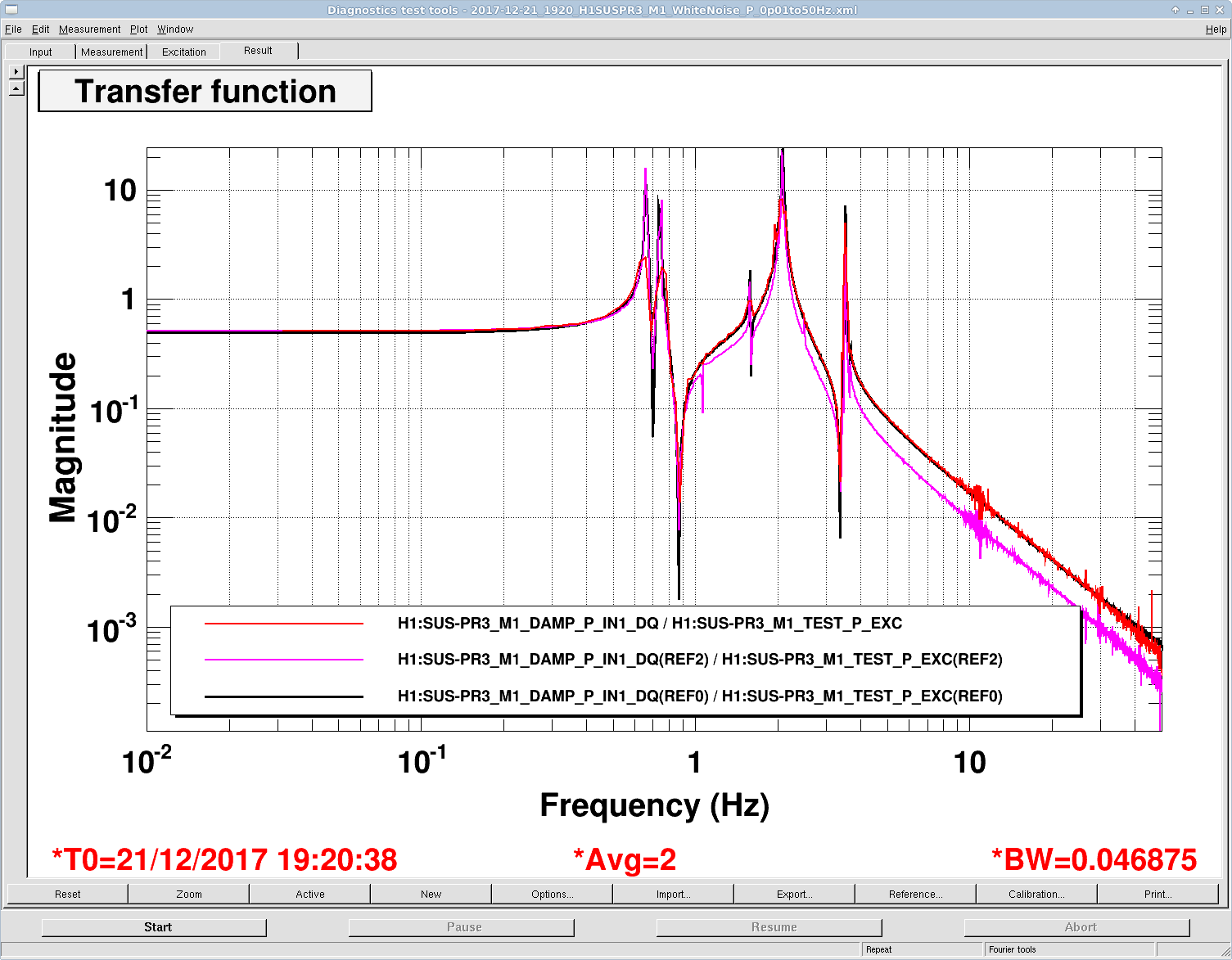
Performed same check on ETMs as I did yesterday on ITMs with standard Top Mass to Top Mass transfer functions.
I similarly attach sneak peak screenshotss of fully processed data, but having watched the TFs go by,
The ETMs are clear of rubbing.

Left to do: all 10 of the triples, 3 doubles, and if we really care, the 9 singles.
(PS, we should get these as reference anyways, in prep for the up-coming vent)

Please ignore the difference with the black references on the reaction chains -- to save time, rather than figure out good templates for the ETMs, I copied over the ITM template and replaced the characters ITM with ETM. We know that ITM reaction chains have different resonance shapes and frequencies that the ETM reaction chains. From years of staring at these, I can tell they're fine. Again, will process these later to show how they really compare what's expected.
The main chains between ETMs and ITMs are identical, so their comparison can be treated as legit.

Data is stored and committed to svn here:
/ligo/svncommon/SusSVN/sus/trunk/QUAD/H1/ETMX/SAGM0/Data/
    2017-07-21_2004_H1SUSETMX_M0_WhiteNoise_L_0p01to50Hz.xml
    2017-07-21_2004_H1SUSETMX_M0_WhiteNoise_P_0p01to50Hz.xml
    2017-07-21_2004_H1SUSETMX_M0_WhiteNoise_R_0p01to50Hz.xml
    2017-07-21_2004_H1SUSETMX_M0_WhiteNoise_T_0p01to50Hz.xml
    2017-07-21_2004_H1SUSETMX_M0_WhiteNoise_V_0p01to50Hz.xml
    2017-07-21_2004_H1SUSETMX_M0_WhiteNoise_Y_0p01to50Hz.xml

/ligo/svncommon/SusSVN/sus/trunk/QUAD/H1/ETMX/SAGR0/Data/
    2017-07-21_2051_H1SUSETMX_R0_WhiteNoise_L_0p01to50Hz.xml
    2017-07-21_2051_H1SUSETMX_R0_WhiteNoise_P_0p01to50Hz.xml
    2017-07-21_2051_H1SUSETMX_R0_WhiteNoise_R_0p01to50Hz.xml
    2017-07-21_2051_H1SUSETMX_R0_WhiteNoise_T_0p01to50Hz.xml
    2017-07-21_2051_H1SUSETMX_R0_WhiteNoise_V_0p01to50Hz.xml
    2017-07-21_2051_H1SUSETMX_R0_WhiteNoise_Y_0p01to50Hz.xml

/ligo/svncommon/SusSVN/sus/trunk/QUAD/H1/ETMY/SAGM0/Data/
    2017-07-21_2005_H1SUSETMY_M0_WhiteNoise_L_0p01to50Hz.xml
    2017-07-21_2005_H1SUSETMY_M0_WhiteNoise_P_0p01to50Hz.xml
    2017-07-21_2005_H1SUSETMY_M0_WhiteNoise_R_0p01to50Hz.xml
    2017-07-21_2005_H1SUSETMY_M0_WhiteNoise_T_0p01to50Hz.xml
    2017-07-21_2005_H1SUSETMY_M0_WhiteNoise_V_0p01to50Hz.xml
    2017-07-21_2005_H1SUSETMY_M0_WhiteNoise_Y_0p01to50Hz.xml

/ligo/svncommon/SusSVN/sus/trunk/QUAD/H1/ETMY/SAGR0/Data/
    2017-07-21_2055_H1SUSETMY_R0_WhiteNoise_L_0p01to50Hz.xml
    2017-07-21_2055_H1SUSETMY_R0_WhiteNoise_P_0p01to50Hz.xml
    2017-07-21_2055_H1SUSETMY_R0_WhiteNoise_R_0p01to50Hz.xml
    2017-07-21_2055_H1SUSETMY_R0_WhiteNoise_T_0p01to50Hz.xml
    2017-07-21_2055_H1SUSETMY_R0_WhiteNoise_V_0p01to50Hz.xml
    2017-07-21_2055_H1SUSETMY_R0_WhiteNoise_Y_0p01to50Hz.xml
Images attached to this report
Comments related to this report
jeffrey.kissel@LIGO.ORG - 14:23, Thursday 27 July 2017 (37816)
More detailed plots of ITMX, compared against previous measurements and model. Both Main and Reaction chains show expected dynamics and are clear of rubbing.

Non-image files attached to this comment
jeffrey.kissel@LIGO.ORG - 14:27, Thursday 27 July 2017 (37819)
More detailed plots of ITMY, compared against previous measurements and model. 

The reaction chain checks out OK.

This latest main chain's data set (2017-07-20) resolution is at 0.02 Hz instead of the previous measurement which was at the standard 0.01 Hz -- so it *looks* like some resonances are truncated, but upon close inspection, they're just not resolving the resonance. 

Not sure what happened during the (main chain) pitch measurement at high frequency, but this behavior has been present in the 2017-04-25 and 2017-01-17 data sets. The last clean undamped data set is way back in 2014-10-28; there is a 2.5 year gap in the data for this chain... so difficult to say.

From my experience, I propose is that the main chain is OK too, given that data points surrounding the resonances match up nicely for all other DOFs. 
However, while I finish out the single / double rubbing checks (or during yet another earthquake) I'll remeasure the main chain with a high resolution and focus on getting a good pitch measurement.
Non-image files attached to this comment
jeffrey.kissel@LIGO.ORG - 14:50, Thursday 27 July 2017 (37820)
More detailed plots of ETMX. I'm 10% suspicious about the main chain (M0) and reaction (R0) chain showing their first two L 2 L resonances a little stunted since these were last measured on 2014-12-22, but this may just be due to lack of coherence. But, as with ITMY above, the data points surrounding the resonances all line up nicely. My yellow flag trigger is twitchy, likely because this is the suspension with one of the worst BSC ISI ST2 longitudinal coupling (see LHO aLOG 37752).

All other dynamics check out... 

Further investigation is needed here (sheesh).
Non-image files attached to this comment
jeffrey.kissel@LIGO.ORG - 14:57, Thursday 27 July 2017 (37821)
More detailed plots of ETMY, compared against previous measurements and model. Both Main and Reaction chains show expected dynamics and are clear of rubbing.
Non-image files attached to this comment
jeffrey.kissel@LIGO.ORG - 11:50, Friday 28 July 2017 (37848)
Because we're also considering TOP Mass flags moving around (not big enough to cause rubbing, but enough to cause (a) a moment of inertia change and therefore resonant frequency change, or (b) a change in cross-coupling to non-diagonal response to diagonal drive, e.g. L to P, or V to L, etc), I also post the individual transfer functions for each QUAD, and a previous measurement against which to compare. 

I've taken a look through all of these, and they don't show much difference. If anything, the new transfer functions just show a more coherent TF because I've improved the drive parameters to get better SNR.

Cross-coupling plots start on pg 7 of each attachment.
Non-image files attached to this comment
LHO FMCS
bubba.gateley@LIGO.ORG - posted 14:31, Friday 21 July 2017 (37686)
E Y Chilled Water Pump Trip again
The # 1 chilled water pump tripped again, this time I caught it in time before it warmed the VEA, thanks to Dave B. and the alarm on my phone. This appears to be a VFD issue and I will investigate more on Tuesday. Meanwhile I have switched back to Chiller 2 which at the moment seems to be running reliably. 
H1 General
edmond.merilh@LIGO.ORG - posted 13:53, Friday 21 July 2017 (37631)
Mid-Shift Summary - Day

H1 locked for 18hr 17min

16:49 restarted the Range Integrand DTT on Video0.

Not much else to report at this point.


H1 ISC
jim.warner@LIGO.ORG - posted 13:42, Friday 21 July 2017 (37684)
HAM4 SRCL feedforward at LHO?

LLO has been trying ground STS feed forward to HAM4 (Rana's alog ). I attach some spectra here suggesting we may want to try it as well. First plot is the coherence between the ground STS and SRCL_CTRL, red and blue are during a lock on Feb 14, green and brown are from a lock this afternoon. Even though our microseism is a factor of ~20 lower than it was during the lock in February, there is still some coherence between the Z STS and SRCL. The second plot shows the ITMY Z (in nm/s) and SRCL_CTRL (don't know the units here) spectra for both locks. The last plot shows the transfer functions from the STS to SRCL, red and blue are February, green and brown are today, looks like the coupling doesn't change much even with very different ground inputs. 

Images attached to this report
H1 General
edmond.merilh@LIGO.ORG - posted 13:04, Friday 21 July 2017 (37682)
19:59 H1 Intent bit Observatory mode set to Commissioning


H1 SUS (SUS)
jenne.driggers@LIGO.ORG - posted 18:04, Thursday 20 July 2017 - last comment - 09:33, Monday 24 July 2017(37666)
Checking coil driver switching

I'm checking the coil driver switching while we wait for the earthquake to ring down, to ensure that the analog switches are actually switching. Here's a rough note of my method:

* Set BIO state request to negative of the value that you want (i.e. -2 for state 2, -3 for state 3).  This gives you control of the coil out filter banks (ex. H1:SUS-ITMX_L2_COILOUTF_UL). Do this for all 4 quadrants.

* Turn off all filters, so you have a flat digital TF from the excitation point to the driver. Do this for all 4 quadrants.

* For BS (only one with oplev damping), disable oplev damping.

* Take TF from coil output filter bank excitation to fastimon channel (ex. H1:SUS-ITMX_L2_COILOUTF_UL_EXC to H1:SUS-ITMX_L2_FASTIMON_UL_OUT).

* Switch analog coil driver state, retake TF, confirm that it changed as expected.

* Put state request back to positive number that it started at; this resets the digital filters appropriately.

All switching seems fine for PRM M3, SRM M3, ITMX L2, ITMY L2, ETMX L2 and ETMY L2, which is all suspensions and stages that we switch coil driver states for, except for BS M2.  BS M2's UR coil is different from the other coils on BS M2. 

I'm attaching a screenshot of the BS measurements, showing that the shape of the UR analog driver is slightly different in each state, and the overall gain is different by about 8dB. 

I ask that the BS M2 coil driver be looked at first thing in the morning.

Images attached to this report
Comments related to this report
andrew.lundgren@LIGO.ORG - 15:00, Friday 21 July 2017 (37690)DetChar, SUS
Looks like BS M2 UR has been like this at least since January. That doesn't mean it shouldn't be fixed, but it does mean that it probably won't help the new noise.

I checked a time in January and another in early June. The noisemon and fastimon have always been lower in amplitude than the others, and have some extra forests of lines. The lines are coherent between the noisemon and fastimon, so I think they are showing real junk somewhere in the drive path.

The plots show a comparison of UR with another quadrant recently, then a similar plot from January. Last, the coherence shows that the lines in the notch at 300 Hz are coherent between noisemon and fastimon, and there's no drop in coherence near the forests of lines.
Images attached to this comment
jeffrey.kissel@LIGO.ORG - 09:33, Monday 24 July 2017 (37735)
Corresponds to FRS Ticket
8594
Ticket has been marked for closure given that the coil driver has been swapped
LHO aLOG 37694
and the problem his disappeared.
H1 ISC
kiwamu.izumi@LIGO.ORG - posted 16:41, Thursday 20 July 2017 - last comment - 14:26, Friday 21 July 2017(37664)
OMC length and test mass oplevs: unlikely to be culprit for low frequency excess

The attached are comparison of the OMC length and oplev spectra before (4/7/2017 12:30 UTC) and after (today; 20/7/2017 21:00 UTC) the Montana earthquake.

Images attached to this report
Comments related to this report
kiwamu.izumi@LIGO.ORG - 14:26, Friday 21 July 2017 (37685)

The attached are the spectra of the BS, PR3 and SR3 oplevs, comparing before and after the earthquake. Again I don't see any suspicious changes except that the BS PIT noise floor improved by a few dB for some reason after the earthquake.

Images attached to this comment
H1 ISC
jenne.driggers@LIGO.ORG - posted 15:04, Tuesday 18 July 2017 - last comment - 14:49, Friday 21 July 2017(37590)
Low frequency sensitivity still problematic after the Montana EQ

Keita and Daniel pointed out that one way to check if all of our range loss is due to subtractable jitter noise or something else, is to compare cleaned data from before the earthquake to after. 

In the attached plot, the blue trace labeled "Orig" is the raw data from the 15th of July, before we (accidentally) switched to using only one DCPD.  The red-orange trace labeled "CleanPostEQ" is from that same 15 July time, but has been cleaned.  The yellow trace labeled "CleanPreEQ" is cleaned data from the 5th of July, just before the big Montana earthquake hit us. 

The ratios in the bottom portion of the plot are the 2 cleaned spectra compared to the raw post-EQ blue spectrum.  Because of this, the % improvements in the title of the plot are misleading.

The conclusion is that we definitely have some noise below 90Hz or so that is not witnessed by the IMC WFS, the PSL bullseye, the ASC Hard loops, or the vertex length loops.

Images attached to this report
Comments related to this report
jenne.driggers@LIGO.ORG - 14:49, Friday 21 July 2017 (37688)

I attach here another set of spectra, where in each figure the blue is cleaned data from before the earthquake (6 July 2017 04:00:00 UTC), the red is cleaned data from after the earthquake (21 Juy 2017 14:00:00 UTC), and yellow is the difference between those 2 spectra.  These traces are the same on all 3 figures. 

The other two traces, purple and green, are lines overlaid to help decide what kind of slope our residual is.  The figure with "f2" in the name has 1/f^2 lines, "f3" in the name has 1/f^3 lines, and "f4" in the name has 1/f^4 lines. 

I'm not sure what would give us 1/f^3 noise, but it looks to me like that might be the best fit.  It's definitely not 1/f^4. 

Images attached to this comment
Displaying reports 49501-49520 of 86137.Go to page Start 2472 2473 2474 2475 2476 2477 2478 2479 2480 End