Interesting pressure trends on X & Y beam manifolds. See my previous aLOG about rate of rise test followed by pumping on just turbos (IPs valved out). PT180 (y-arm) trend has shifted and headed up! Does this mean the fault is in IP6 and not a leak?
Valving in IPs and valving out turbos for the night.
Also interesting is how PT170 steps "up" its reading when reacting to the, as yet unkown internal, gauge "step" change (voltage change?) while PT180 steps "down" when this unknown internal gauge change happens. I wonder if the electronics use varying voltages for various pressure ranges etc?
Those steps that I think you are referring to are me hard closing GV 5,7.
After speaking with Chandra, I've turned the RH drivers back on to do a test on the HWSY alignment right now.
I'm going to turn them off again in about 40 minutes.
The ring heater drivers are now switched off.
Until we open gate valves 1 & 2, we don't have HV interlock protection on the vertex, so we shouldn't leave HVs on when not needed. Thanks!
Because commissioning work is starting in earnest now, all of the seismic systems have been restored to their nominal configurations. This means ITMX & HAM4 HEPI's were unlocked yesterday after the cleanroom was moved out of the way, all HEPI's and ISIs are back up and running and all sensor corrections (including BRSs) are running on all chambers.
The only difficulty we found was the GS13 gain switching on HAM2 is no longer stable (ie we can't switch GS13 gains while the ISI is isolated). Hugh and I are working with Fil to try to figure that out, but this is a new "feature", we will probably be opening an FRS on it soon.
Peter K. & Jeff B. ECR E1700096 Installed the PSL Air Trap/Bleed in the Crystal Chiller return line. The installation went well. Encountered one small issue. The pipe being cut was installed about 6 years ago. It did not cut as cleanly as the new pipe. On a couple of cuts the last third of the pipe broke before it was sheared through. Will need to be cognizant of this when installing the next three assemblies. When the chiller was restarted the water compressed several inches of air in the standpipe. The ball valve at the top of the standpipe was used to bleed off excess air. I left about 4 inches of air trapped in the standpipe to act as a water flow damper. The remaining three air Trap/Bleeders will be installed during the next big vent.
From 1 PM to 4 PM local time. Good catch report: I told Corey it was alright for him to open the high bay rollup door into the LVEA to push a pallet into the LVEA. Later I remembered that the LVEA was in laser hazard and therefore he should not do this. I managed to run over and stop him before he opened the door. 20:22 UTC Corey taking forklift to highbay to drop off pallet. 20:30 UTC Filiberto to end stations to check documentation. 20:40 UTC Karen driving car to VPW 20:42 UTC Corey opening high bay outside rollup door, driving forklift into highbay, dropping off pallet Aidan and TJ to HAM4, work on HWS table ~ 20:59 UTC Let a truck related to Norco through gate. Could not understand driver after three attempts. Gerardo changing IP6 from dualvac to gamma controller 21:22 UTC Filiberto back from end stations 22:13 UTC Betsy to LVEA to store equipment 22:17 UTC Jenne, Vaishali and Jeff to LVEA to talk to Aidan 22:25 UTC Jenne and Vaishali working on MC table 22:25 UTC Jeff K. taking transfer functions of ITMX, turning on sensor correction for ITMX Jenne and Vaishali out of LVEA 23:13 UTC Aidan and TJ done in LVEA, TJ returning to get something 23:19 UTC TJ back
Attached are pictures of the pressure regulator and barometer for the auxiliary water cooling circuit. This circuit serves the power meters and water-cooled beam dumps on the table. The pressure in the circuit was ~3.5 bar, which seems to coincide with when the regulator is fully closed. The pressure is ~2.2 bar with the regulator fully open. Useful information to have when or if we decide to remove the regulator from the cooling circuit in the quest to simplify things.
[John, Chandra]
More investigation on leak hunt of x-beam manifold. Here's what we're trying now:
In regard to GV5 not showing as hard closed on the medm screen. I looked at the Beckhoff code. It appears that I am just not seeing a change in signal (from 0 to 1) for the closed limit switch. Both the code and documentation agree that this should be LY terminal 2 channel 4. On April 8 2015 Kyle reported that GV5 hard closed (https://alog.ligo-wa.caltech.edu/aLOG/index.php?callRep=17748). I see this in the minute trends (attached). This is the most recent time I can find GV5 being hard closed from the alogs. On April 26 2016 LY was upgraded to Beckhoff (https://alog.ligo-wa.caltech.edu/aLOG/index.php?callRep=26803). I guess we should check the wiring into the Beckhoff chassis?
From minute trends, the last time that GV5 hard closed is on March 14 2016. https://alog.ligo-wa.caltech.edu/aLOG/index.php?callRep=26065
J. Kissel As instructed (see LHO aLOG 35977), Nutsinee and Corey reconfigured the ETM ESD systems in such a way that I thought might help mitigate charge accumulation while we're venting essentially immediately after we intentionally broke lock on May 8th 2017 at ~15:15 UTC. I've measured charge today, hoping to see a noticeable improvement, if not at least a change in the trend. For ETMX: We a change in the charge accumulation, if not an improvement. GOOD! for ETMY: We do not see a noticeable charge in the accumulation rate... yet! The optical lever's report of rotational actuation strength shows the effective bias voltage continues to trend negative. HOWEVER, don't yet be discouraged: historically, when we flip the bias voltage, the first data point is confusing. One needs several weeks worth of trend to confirm an accumulation rate and direction. Assuming the IFO is still down, we may take another measurement on Friday to help fill out the data set, to make sure we're doing the right thing.
Covering for Corey while he works on 3IFO at the VPW. - Jenne, Vaishali and Kiwamu working on locking IMC in control room - Aidan and TJ working on HWS in control room - Apollo working on FMCS at end X
J. Kissel Charge measurements prefer the test mass suspension's optical levers be very well centered on their QPDs before starting. As I was centering the optics manually this morning, I found the H1 SUS ETMY suspension suspiciously low (pointed down) in pitch. After some investigation, I've learned that we're taking the opportunity during the break to upgrade the EY VEA HVAC system. After trending the optical lever, the L2 OSEMs in Pitch, and M0 OSEM in Vertical, coupled with the (formerly correct?) channel for temperature, I can see some sort of obvious, large, drift in the suspension that would be easily explained by VEA temperature excursions. I merely post this as a reminder that once we get the VEA temperature back under control -- and back to the VEA's former temperature set point, we'll need to re-assess ETMY and TMSY suspension alignments. For now, I've left ETMY with its alignment centered on the optical lever.
A little more poking around reveals that the Y-End Beam Rotation Sensor also sees an effect of the HVAC upgrade's resulting temperature changes in the Y VEA. Namely, it shows / confirms the ~3 hour, +/- (1 deg F / 0.5 deg C) oscillation in temperature reported by the FMCS channel and by the ETMY optical lever (presumably the vacuum system's effective low-pass filter is filtering out this "fast" oscillation). Note, that the variance in the VEW temperature previously was only about (+/- 0.25 deg F / 0.1 deg C). Since this is seen in both the optical lever and in the beam rotation sensor, I'm quite confident that this is a real temperature swing. Further note -- the static temperature has also changed after the upgrade. We used to hold the VEA at 68.0 deg F / 20 deg C, but it appears as though the upgrade has left the VEA at 67.1 deg F / 19.5 deg C. This likely explains the long term sag / pitch of the ETM. John will write a more detailed log later, but upon pointing this out to him, he adjusted the HEATING OFFSET and COOLING OFFSET in the new HVAC control system in hopes to reduce the ~3 hour temperature oscillation. He changed the values from 1 deg F to 0.25 deg F (though the system echoed back that these are now set to 0.0 deg F). He'll work with Bubba to change the static temperature.
J. Kissel Also note that PCAL Y sees a substantial effect of the large temperature excursions seen in the VEA during the upgrade as well, indicating that there is still some temperature sensitivity left in the system, like what was seen back in January (see, e.g. LHO aLOG 34153). The gross clipping has gone away since the temperature has *mostly* recovered, but -- presumably because of the 0.5 deg C difference in static temperature, the RXPD is reporting 0.2% higher displacement than before the HVAC upgrade. Further, one can see the ~3 hour oscillation in the RX and TX PDs.
For the record I have changed two parameters in the ENDY VEA heat/cool control.
Both "Heating Offset" and "Cooling offset" were set to 1F. I reduced these both to 0.5 after discovering that the system would not accept 0.25. The setpoint is 68F (which it was before)
The control routines may need fine tuning to get back to the control level we had before this upgrade. We await the Apollo expert for this.
See the attached screen shot. An updated temperature trend is also attached and shows a response to our changes.
Without the ALS green beam leaking onto the HWS table, it is a much more laborious exercise to align the HWS beams. However, the process involves these steps:
As of today, we've injected an SR3 oscillation a few times and successfully located the HWSY return beam but not the HWSX return beam. At this point, my suspicion is that ITMX has not returned to its nominal pre-vent alignment with enough precision to get a return beam at all on HWSX. We currently have not ITM OpLevs to check this.
This morning, we are going to proceed with getting the HWSY return beam aligned while Jenne and Co. see if they can get the DRMI aligned.

WP 6625
ECR E1600210
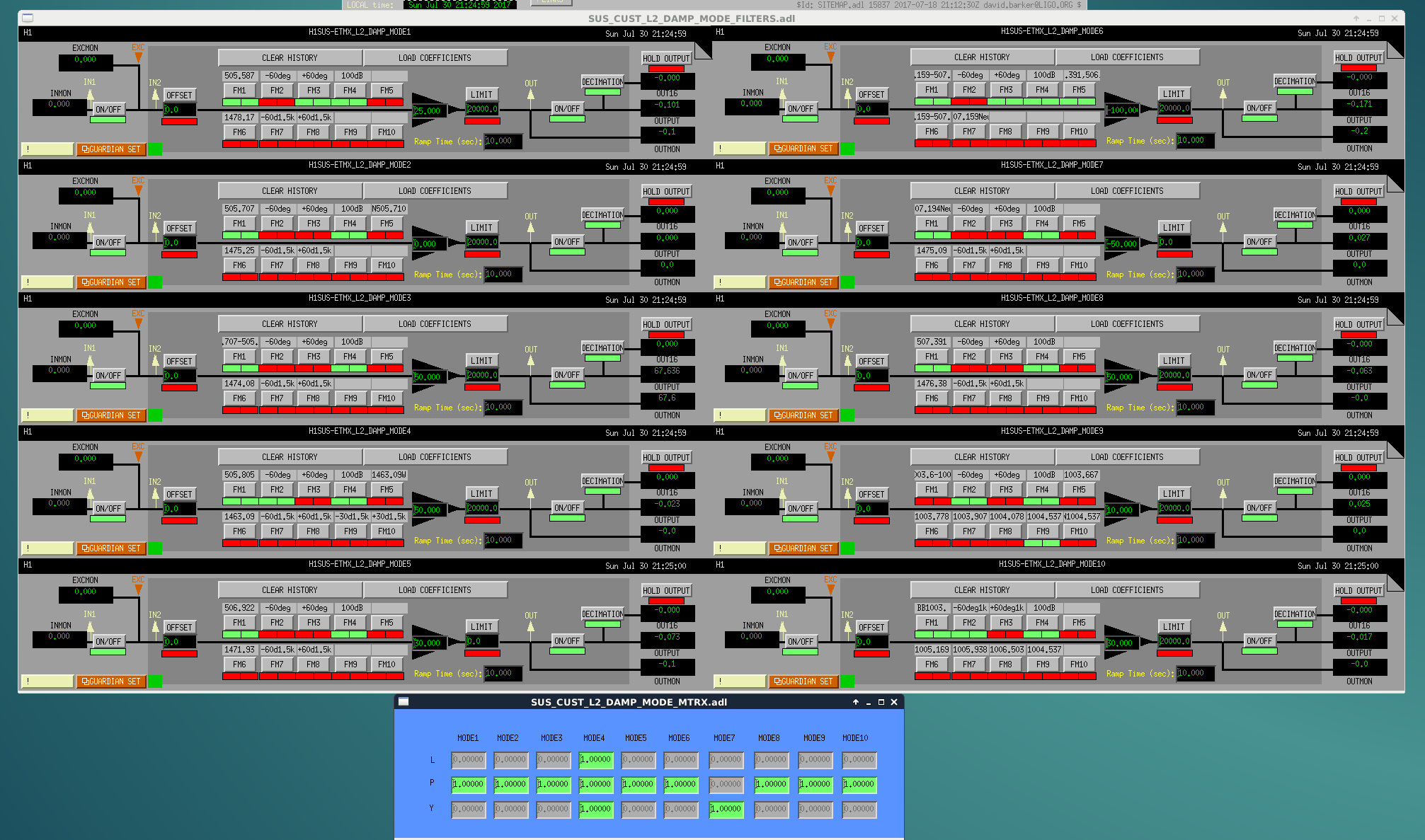
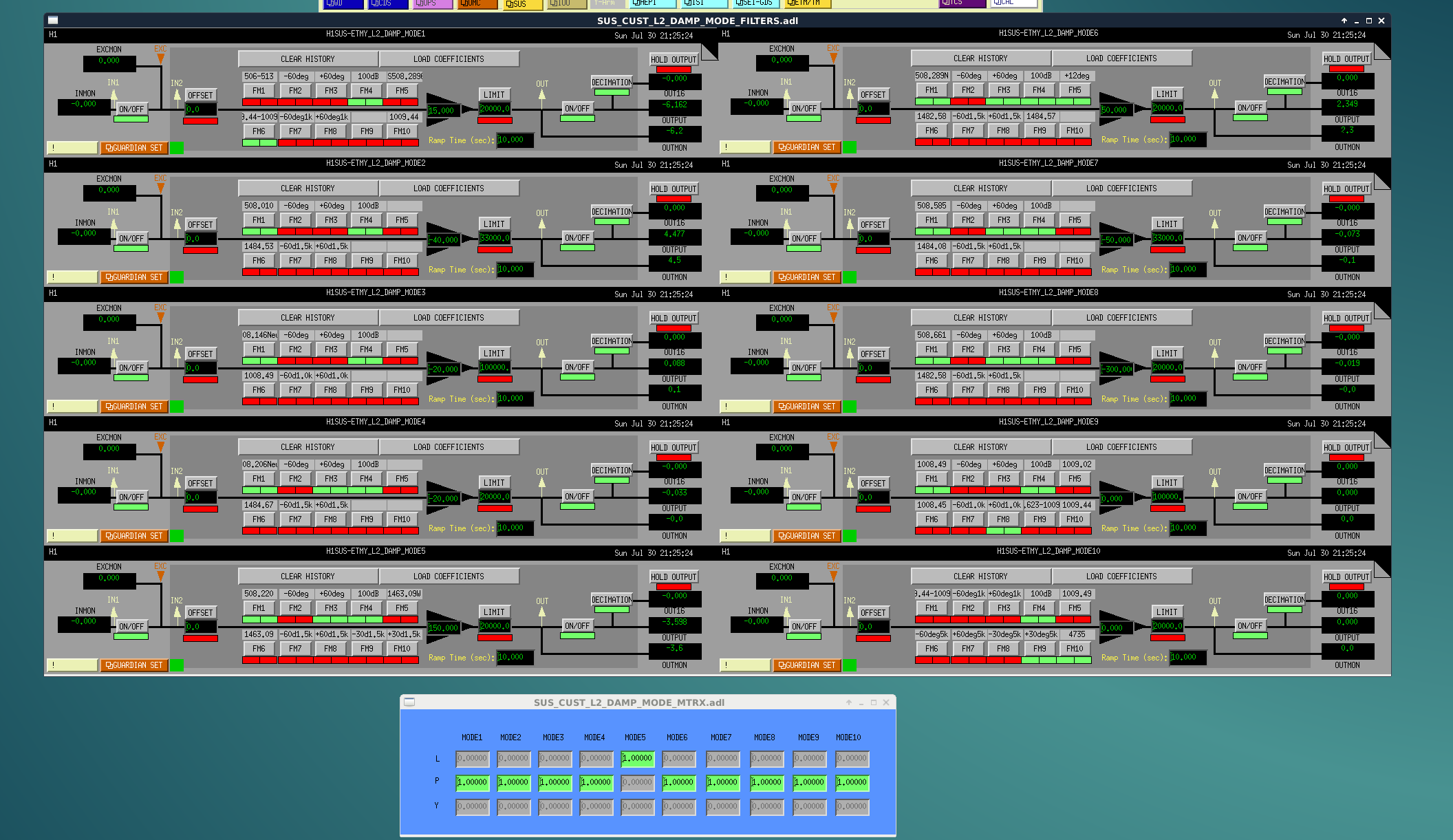
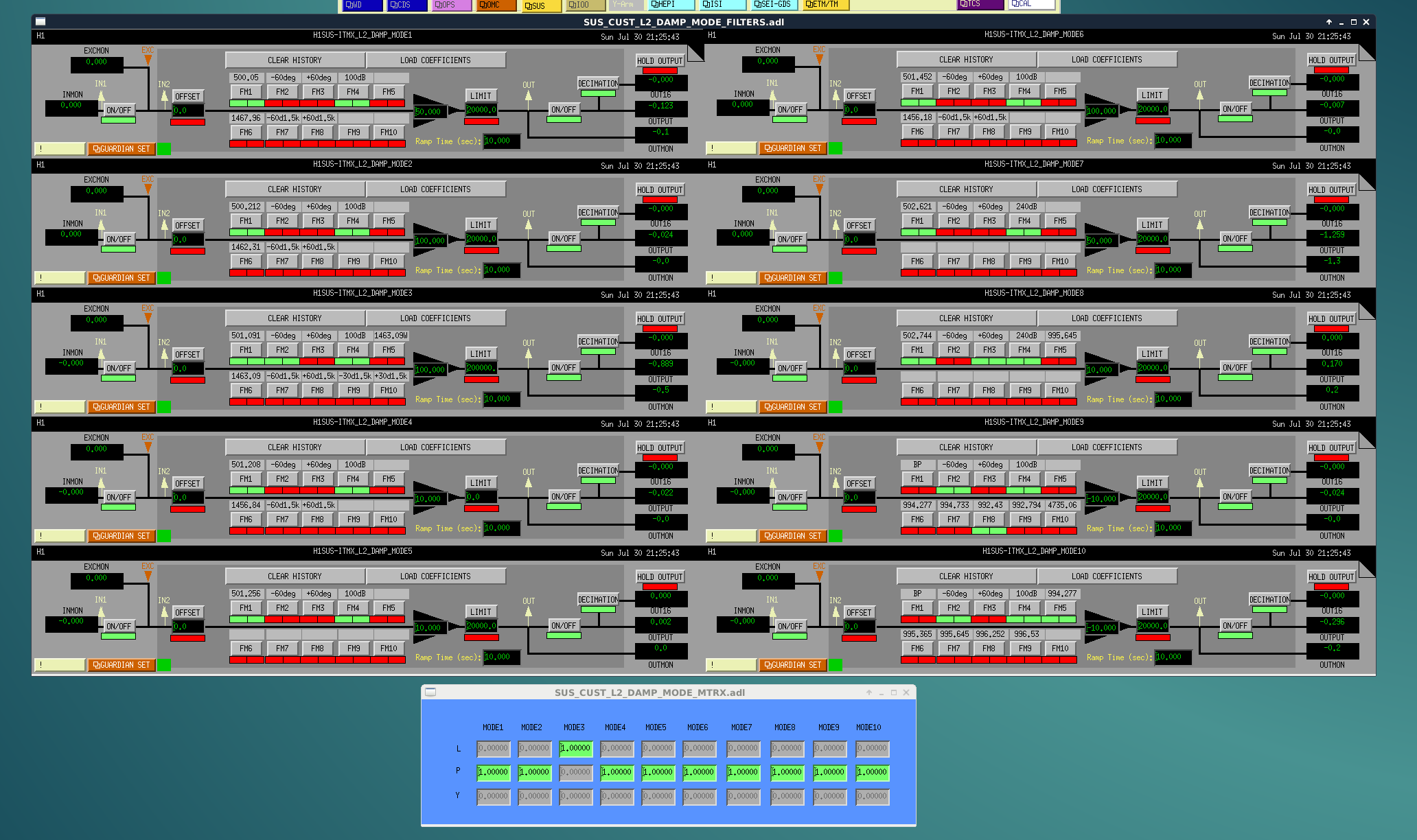
The Kepco HV power supplies for ITMX, ITMY, and ETMX were replaced with an equivalent linear supply made by Mid-Eastern Industries Inc. Power supplies for ETMY were replaced on Dec 5 2016. Alog 32186.
New units installed:
S1700114 & S1700115 ITMY/ITMX
S1700116 & S1700117 ETMX
S1610431 & S1610433 ETMY
Units at EY are S1610431 & S1610432. Previous entry with S1610433 is incorrect.