
thomas.shaffer@LIGO.ORG - posted 10:11, Sunday 23 July 2017 - last comment - 11:00, Sunday 23 July 2017(37716)
Lock loss @ 17:07 UTC
Unknown cause.
Unknown cause.
TITLE: 07/23 Day Shift: 15:00-23:00 UTC (08:00-16:00 PST), all times posted in UTC
STATE of H1: Observing at 53Mpc
OUTGOING OPERATOR: Cheryl
CURRENT ENVIRONMENT:
Wind: 3mph Gusts, 1mph 5min avg
Primary useism: 0.01 μm/s
Secondary useism: 0.05 μm/s
QUICK SUMMARY: Patrick & Cheryl had some issues with violins and some other mysteries. Environment is calm, runnning at 53Mpc on a glitchy 4 hour lock.
TITLE: 07/23 Owl Shift: 07:00-15:00 UTC (00:00-08:00 PST), all times posted in UTC
STATE of H1: Preventive Maintenance
INCOMING OPERATOR: TJ
SHIFT SUMMARY: started with locked, lost lock, relocked, lost lock due to monster PI modes 27 and 28, relocked,
LOG:
I've tested the addition of +30deg phase on ITMY ROLL and for this lock I saved F6 in SDF, but ran out of time to modify guardian.
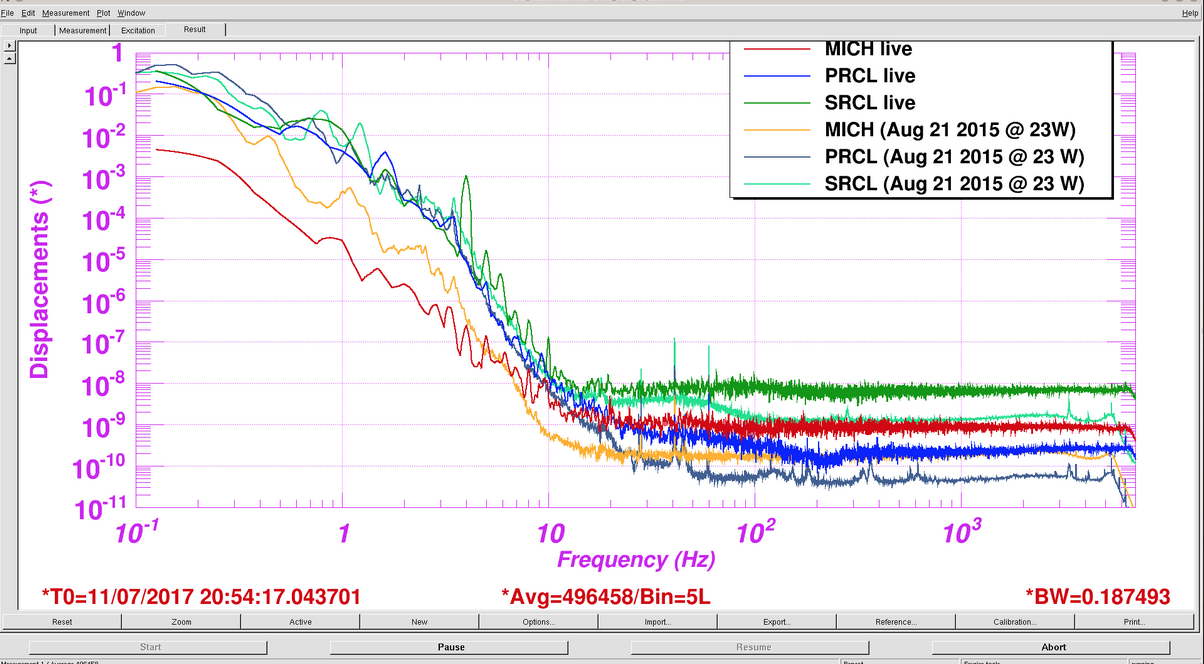
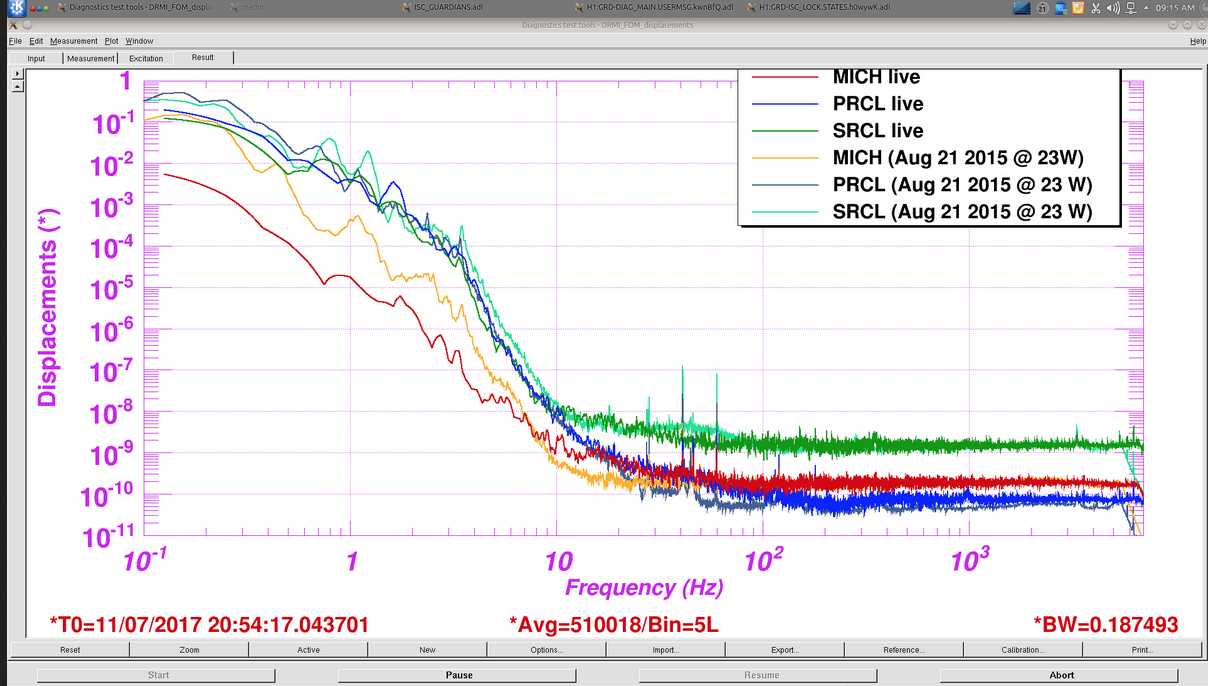
The new filter worked well for me as well. I added it to ISC_LOCK
TITLE: 07/22 Eve Shift: 23:00-07:00 UTC (16:00-00:00 PST), all times posted in UTC
STATE of H1: Lock Acquisition
INCOMING OPERATOR: Cheryl
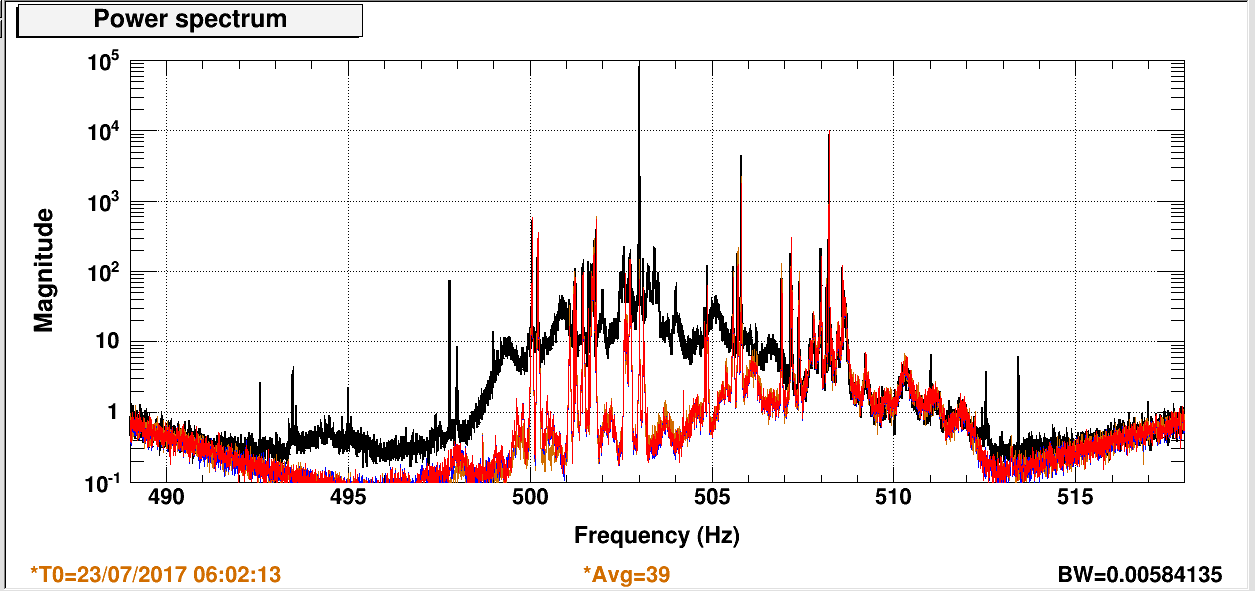
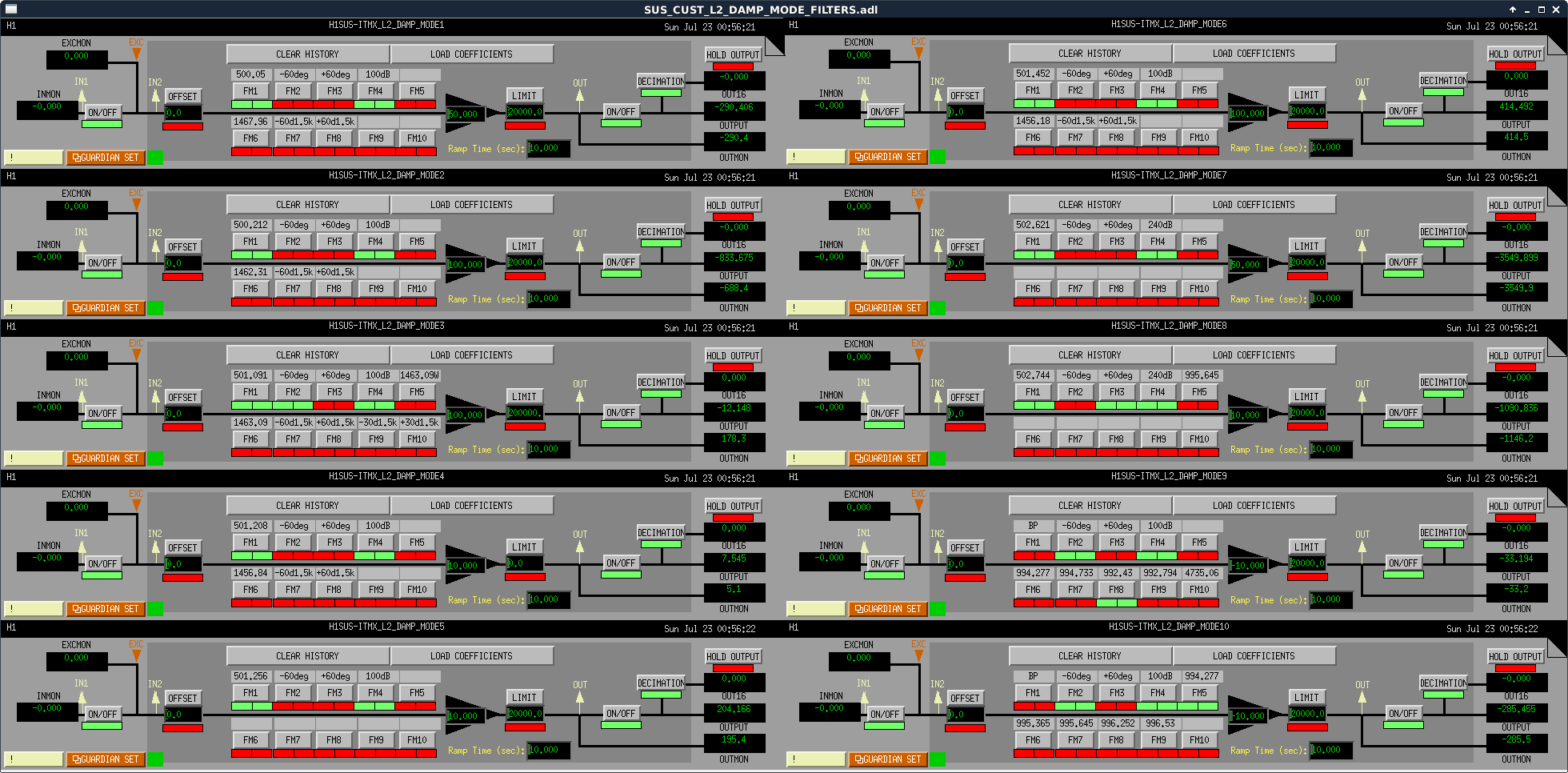
SHIFT SUMMARY: Lost lock at 02:32 UTC. Upon relocking I got stuck at REDUCE_RF45_MODULATION_DEPTH and the OMC DCPDs started saturating (see mid shift report). I then broke the lock intentionally because the DARM spectrum was getting worse and I was afraid that I was ringing something up. Upon relocking the OMC DCPDs started saturating at DC_READOUT and I again broke the lock intentionally. At one point I also broke the lock by putting too high of a gain on one of the ITMY violin damping modes and tripped the RMS WD. I have since spent the majority of the evening sitting at ROLL_MODE_DAMPING and attempting to damp violin modes. I succeeded in damping ITMY mode 5 which seemed to bring down the spectrum considerably. In the first attached image the black line is a reference I took earlier (I'm sorry I didn't note when). I did not have much success damping ETMX mode 4. The only thing I changed was the damping filter gains. I have attached screen shots of the current settings. Towards the end of the shift I changed the bounce mode damping gains for all the optics from .1 to .5 per Cheryl's suggestion.
LOG:

00:46 UTC Kyle called to say he was onsite and would be in the VPW.
01:10 UTC Kyle in control room
01:11 UTC Kyle out of control room
01:32 UTC Kyle leaving
01:49 UTC Verbal alarms GRB alert
02:32 UTC Lock loss
02:48 UTC Verbal alarms GRB alert. Still relocking.
04:31 UTC Verbal alarms GRB alert
05:24 UTC Kim and Dan setting up telescope in parking lot
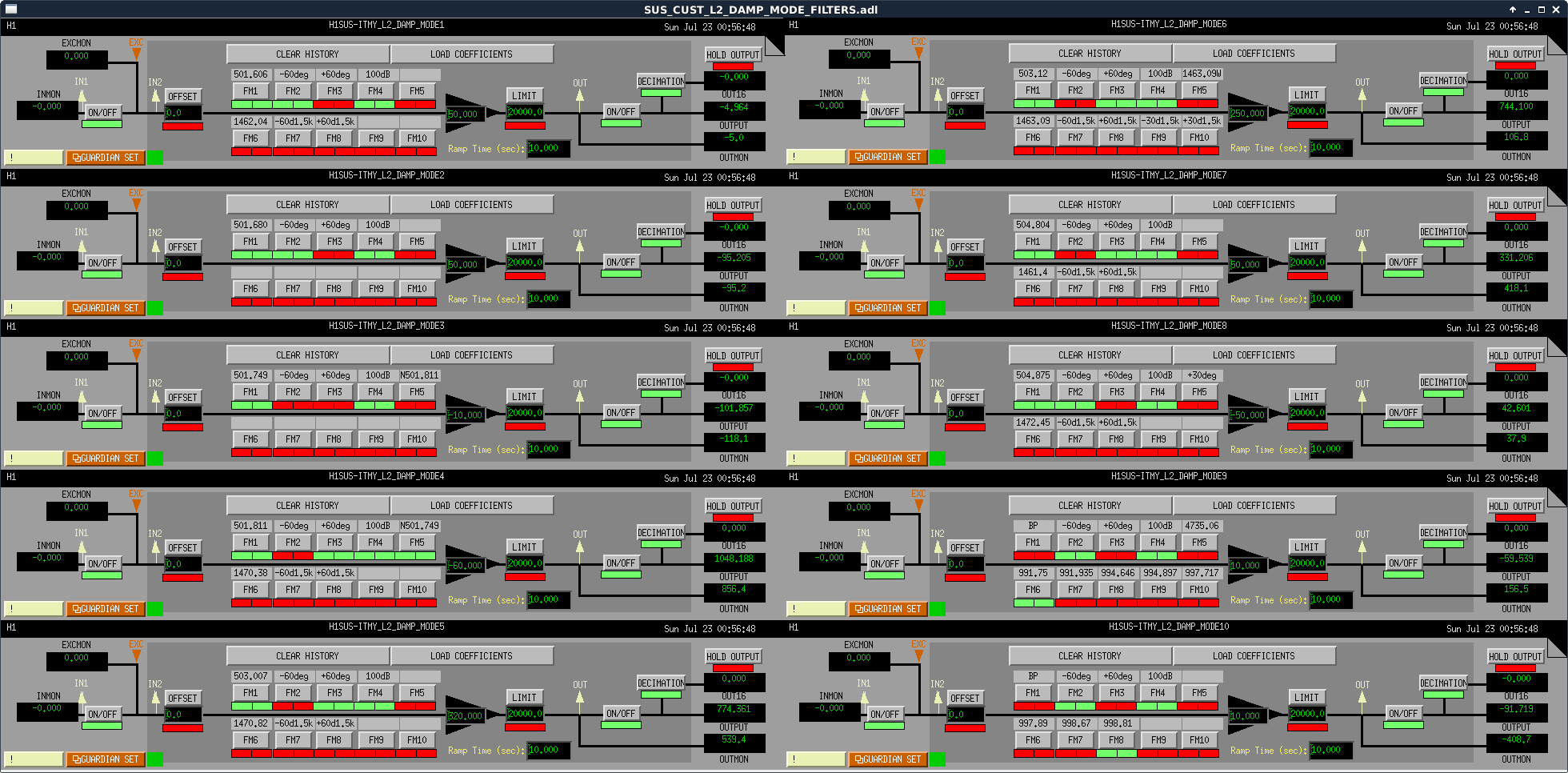
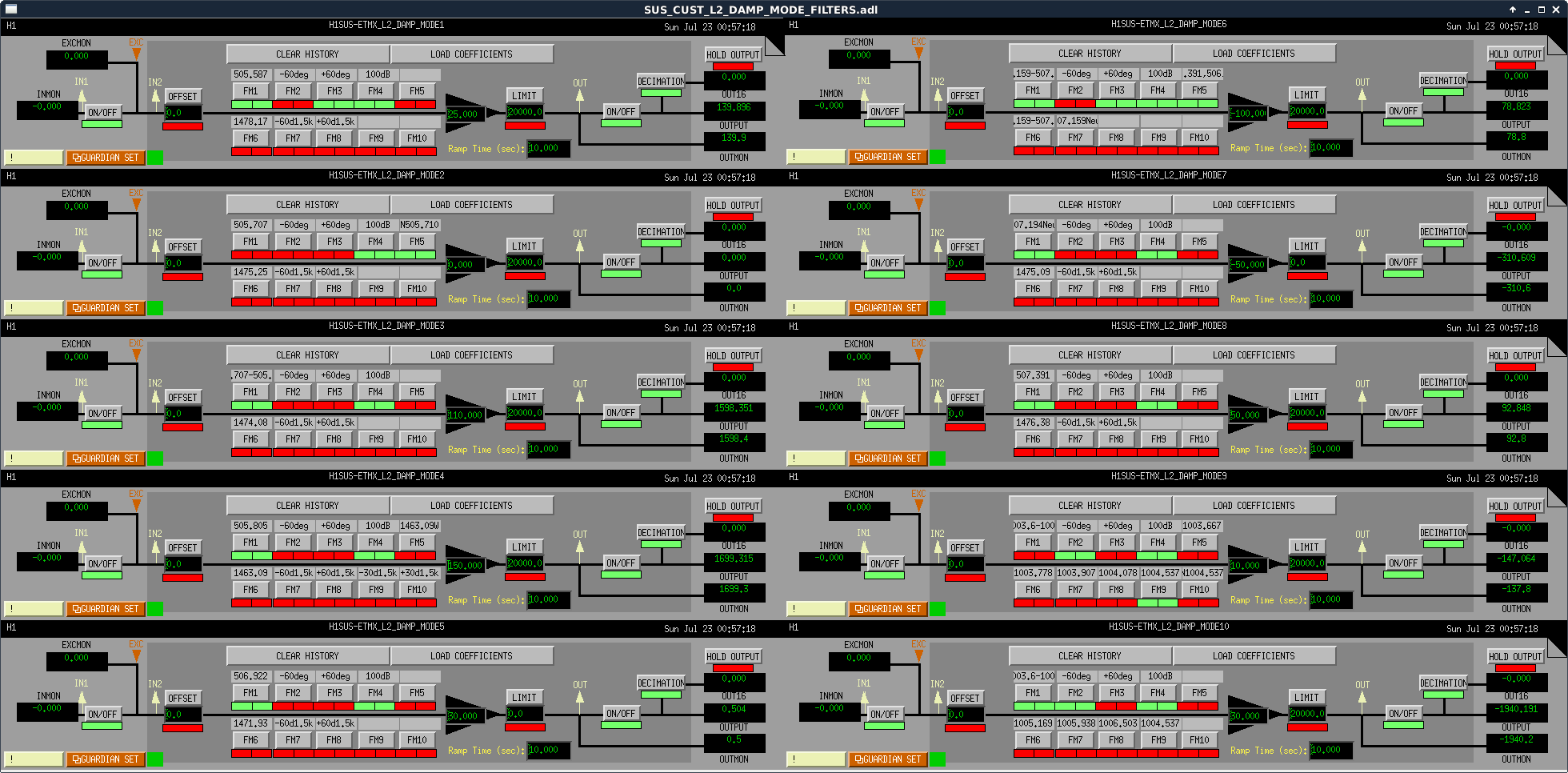
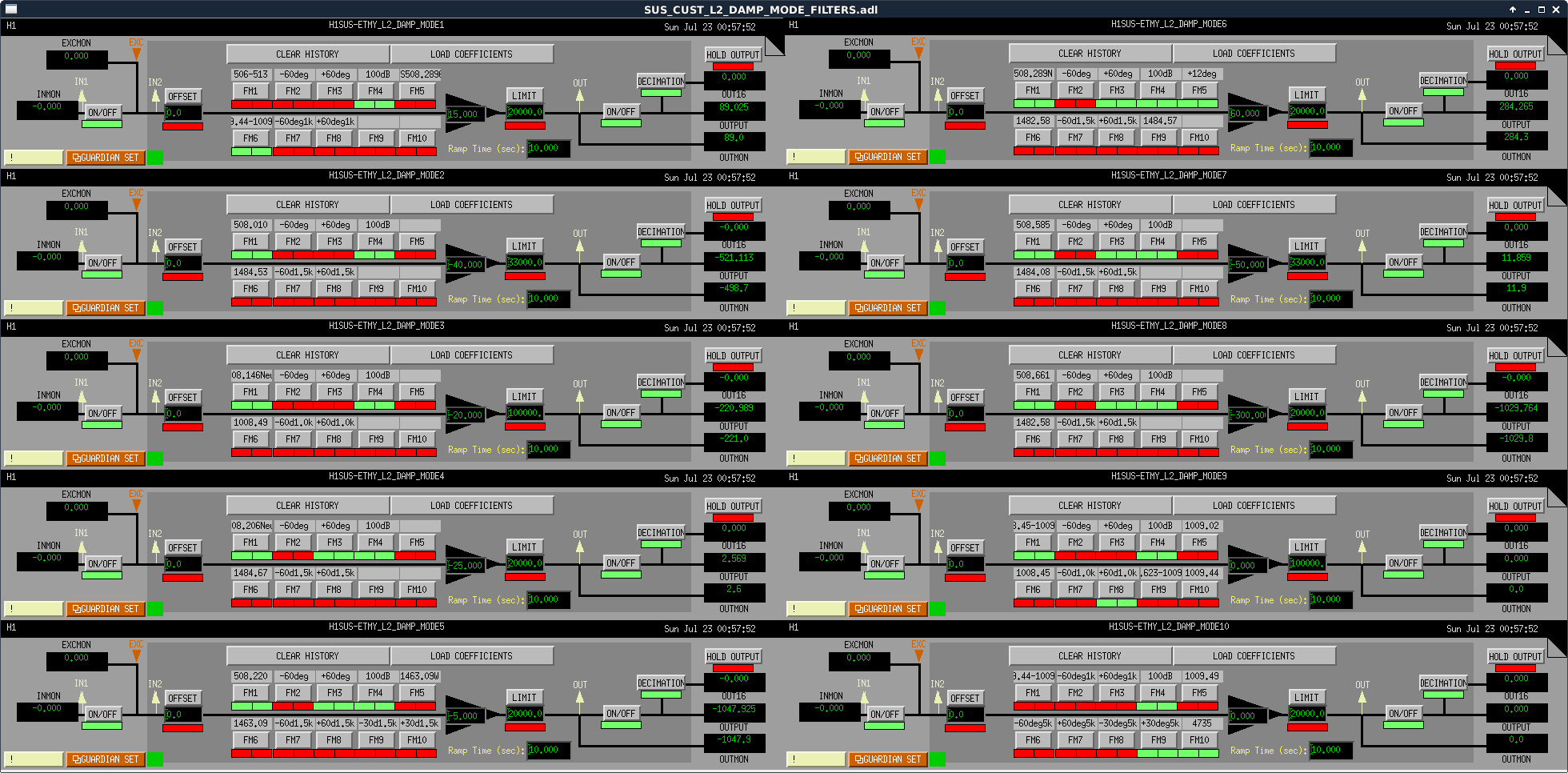
Lost lock at 02:32 UTC. No immediately apparent cause. Relocking. Currently at REDUCE_RF45_MODULATION_DEPTH.
Still at REDUCE_RF45_MODULATION_DEPTH. ISC_LOCK user message says 'waiting for soft loops to converge'. Something does not seem right. The ASC control signals for both pitch and yaw are railing top and bottom on the strip tool and the AS AIR beam spot is jittering. DARM is looking worse and worse.

...Starting to get constant OMC DCPD saturations. Looks like the violins are ringing up. Intentionally killing the lock.
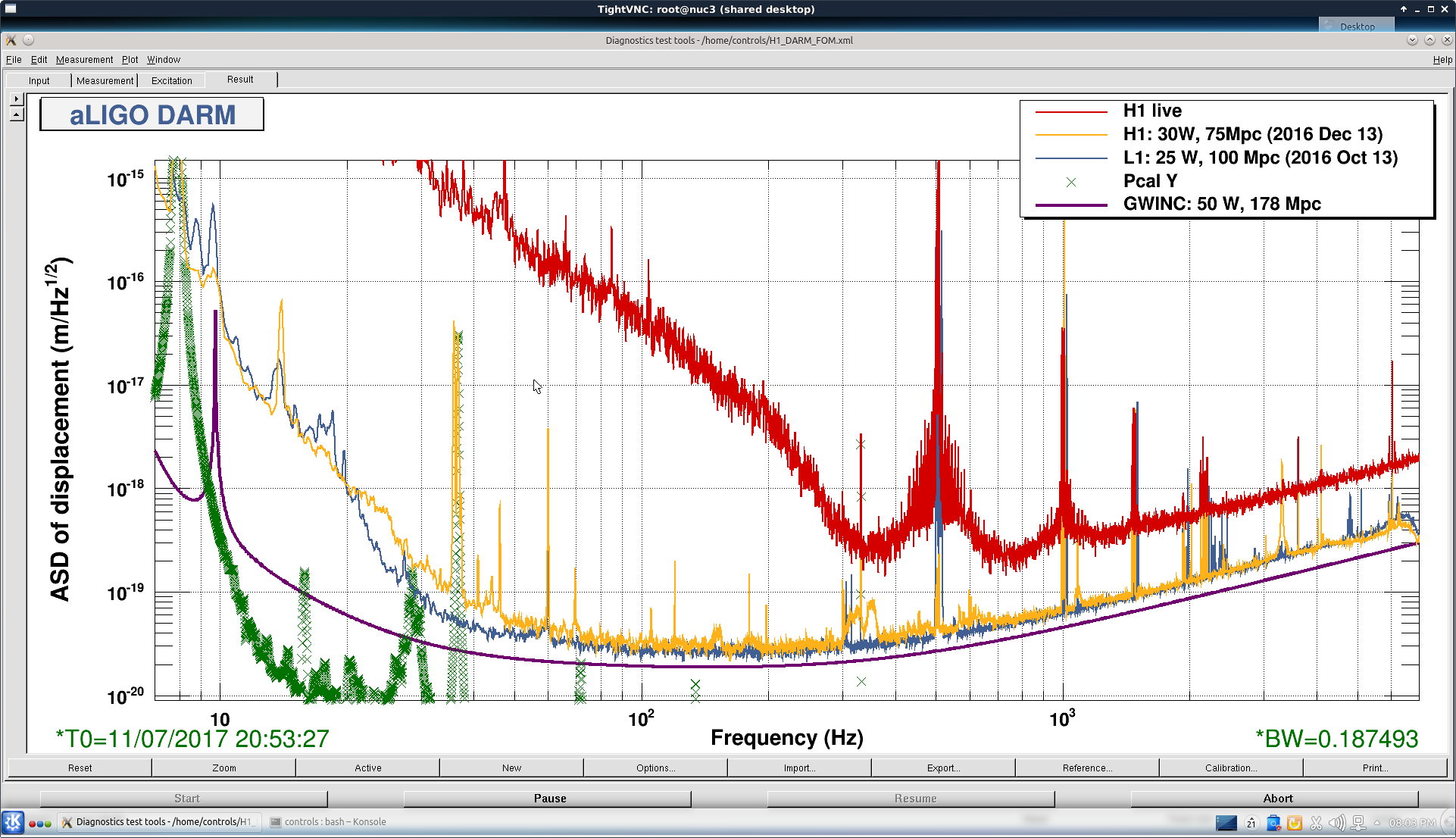
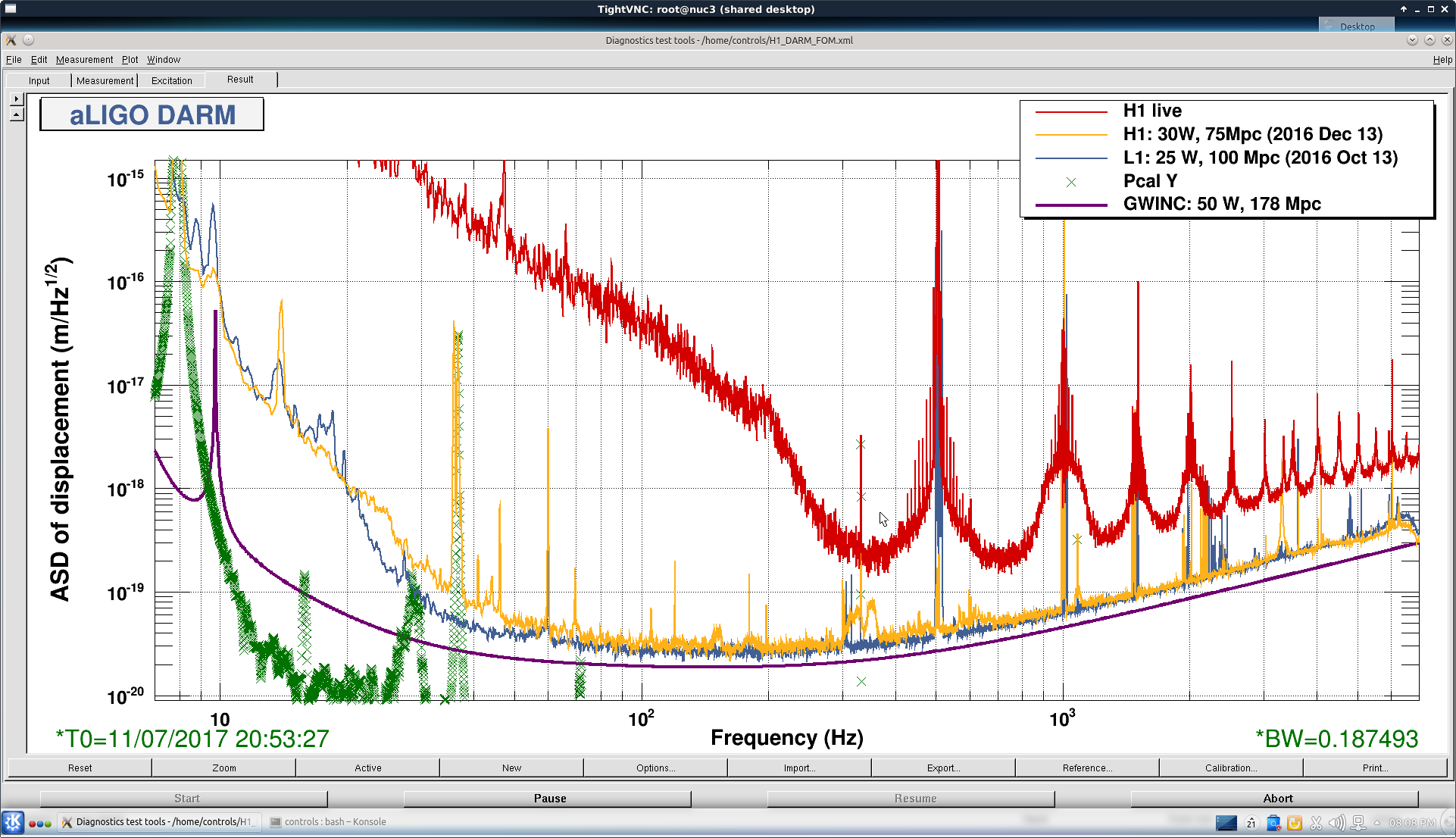
Sitting at ROLL_MODE_DAMPING waiting for violin modes to damp. Seems that ITMY mode 5 and ETMX mode 4 are the highest and taking the longest to ring down.
TITLE: 07/22 Eve Shift: 23:00-07:00 UTC (16:00-00:00 PST), all times posted in UTC
STATE of H1: Observing at 51Mpc
OUTGOING OPERATOR: TJ
CURRENT ENVIRONMENT:
    Wind: 13mph Gusts, 10mph 5min avg
    Primary useism: 0.03 μm/s
    Secondary useism: 0.05 μm/s
QUICK SUMMARY: No issues to report.
The glitchy periods at 10 UTC today, and 8 UTC on July 20, seem to be due to overflows in all of the test mass L2 coils. The cause of the overflows looks to be CSOFT pitch.

The attached plots show timeseries of CSOFT pitch and ITMX L2 master for one quadrant, then a spectrogram of the coil signal. It looks like most of the power is in the 2.8 Hz pitch mode of the test masses. From the summary pages, it looks like the RMS of CSOFT pitch has crept up over the last few months.

When the coil drive goes over 131,072 counts, the DAC overflows and the coil glitches. It's possible that I have things backwards, and the glitch comes first and the overflow is a symptom, but that doesn't seem to match the behavior of the RMS at non-glitchy times.

Is there a way to get CSOFT pitch lower, or maybe suppress some of the feedback at 2.8 Hz (which I think is the biggest contributor)?
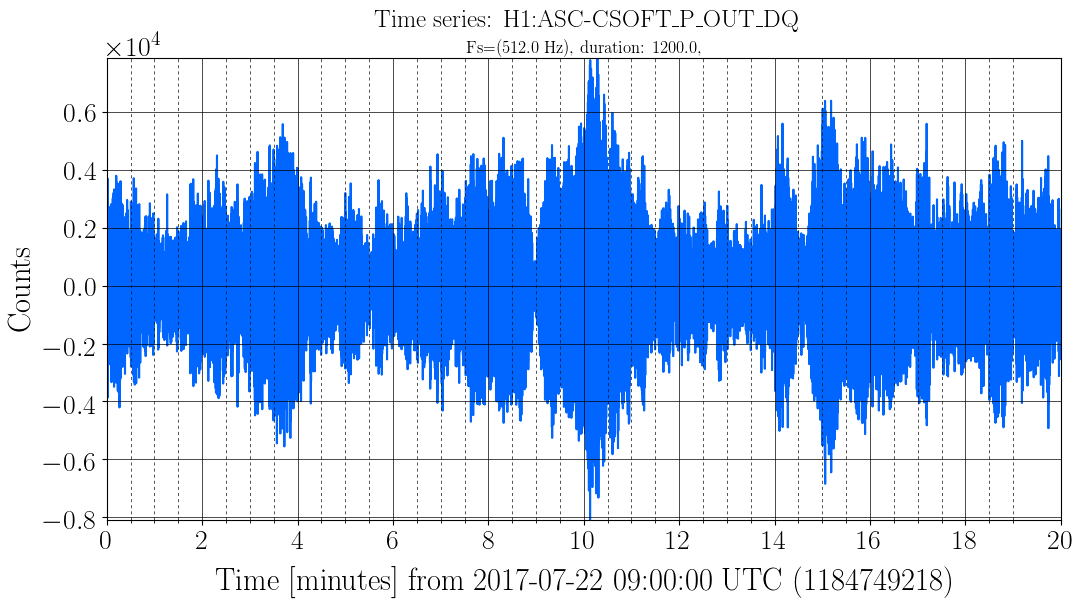
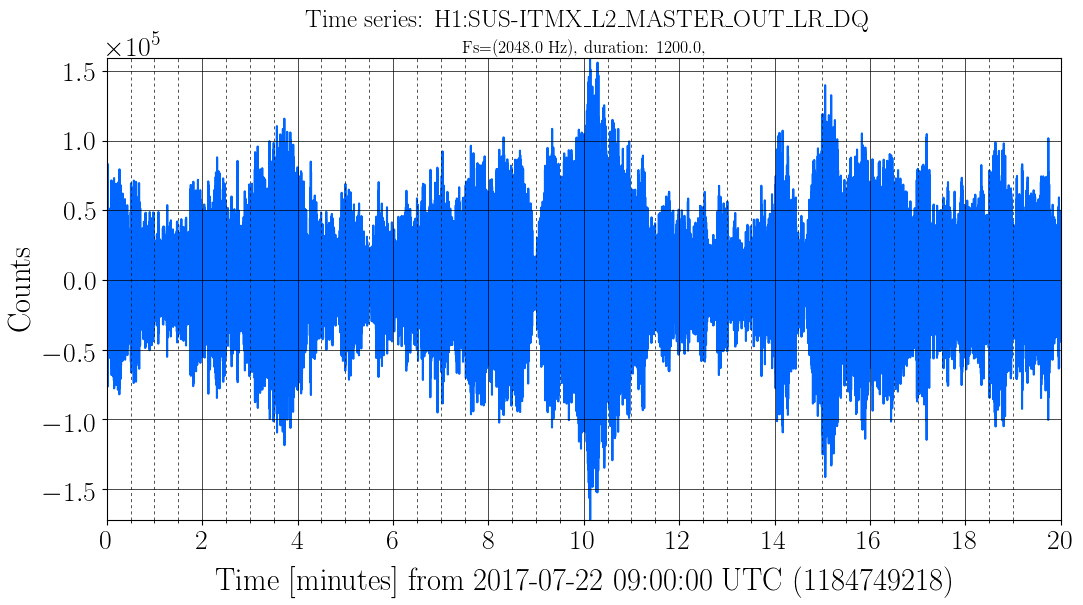
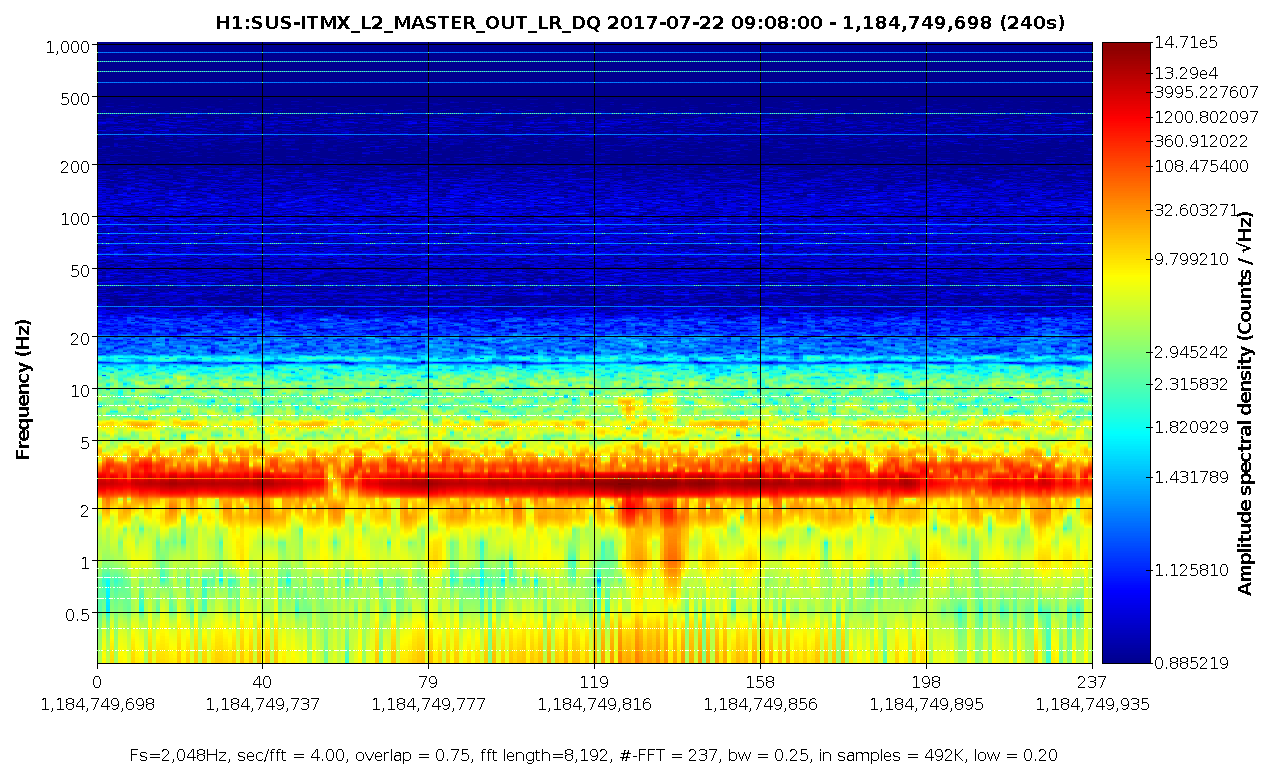
FRS Ticket 8591 has been open on this subject.
Laura, Andy, TJ, Duncan
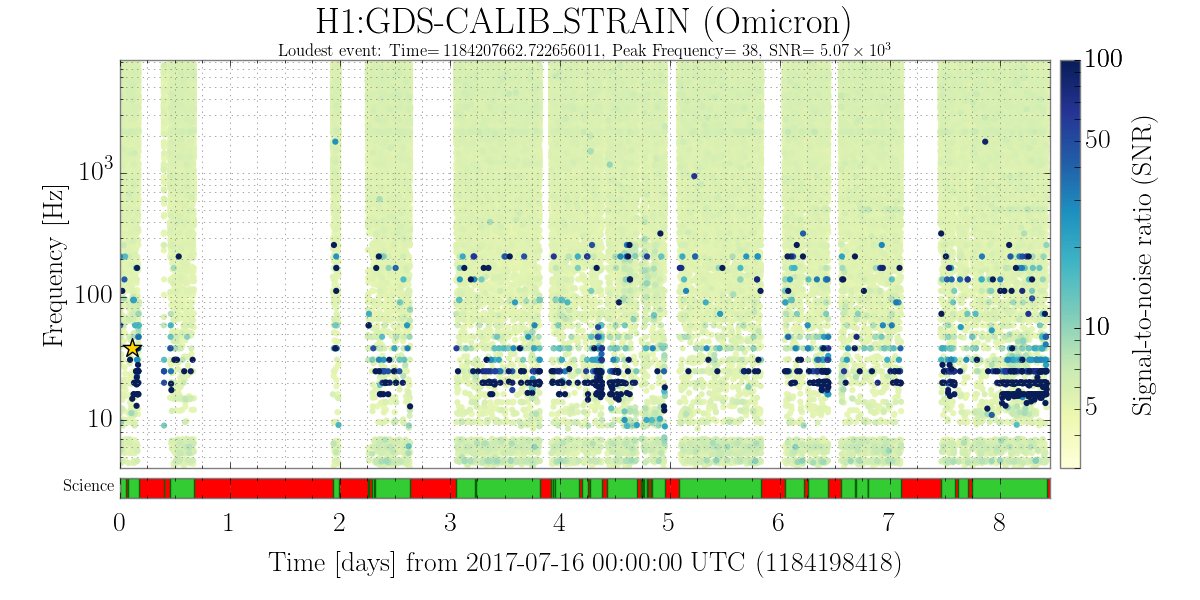
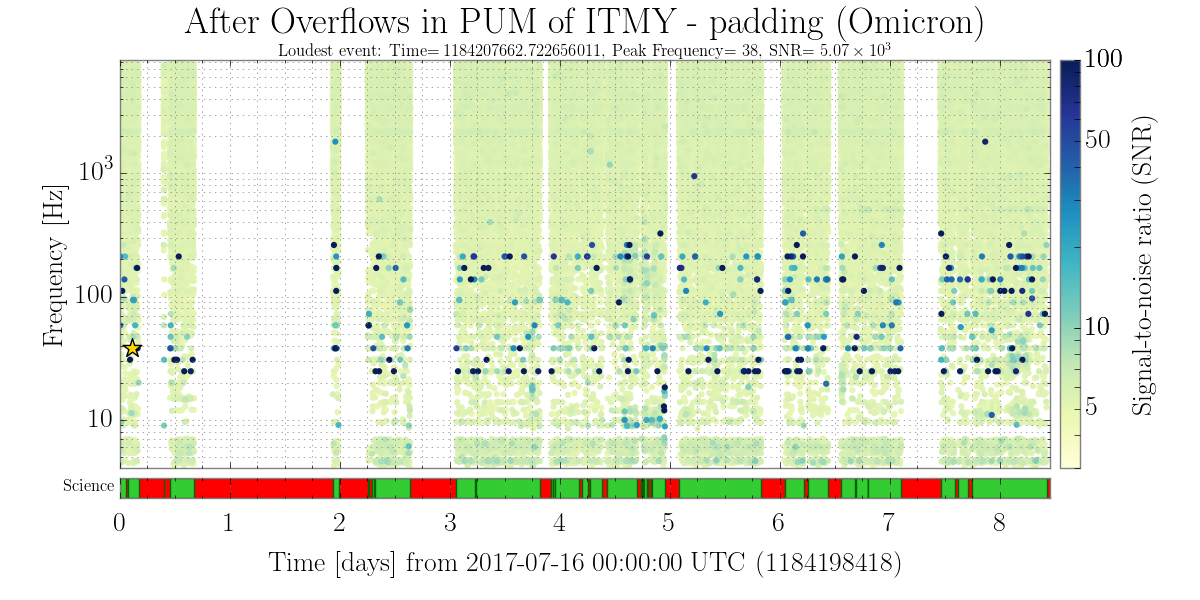
I looked in to the test mass L2 stage DAC overflows and found ITMY is the main culprit. At least the overflows of the ITMY L2 stage encompass the times when ETMX/Y and ITMX are also overflowing. I ran gwdetchar-overflow from the 16th July to today and the attached plots show an omicron glitchgram before and after the ITMY L2 overflows are removed.
I opened our common ASC template for CSOFT_P (in /ligo/svncommon/IscSVN/iscmodeling/trunk/ALIGOH1/ASC_loops/Measurements/CSOFT/), and see that Sheila measured CSOFT pitch on June 26th. It looks from that measurement like we have more than 10dB of gain peaking at 2.8Hz. Ooops. Although, if that's how we've been running since at least mid-June, I guess we haven't noticed it since our microseism has been very low, so we've had much less motion to suppress, so there has been less output from the loops, so we've been narrowly avoiding saturations?
The peak is not present in the soft loop spectra on June 15th, but it is there on the 17th. This coincides most closely with the ISS 3rd loop being re-engaged.
TITLE: 07/22 Day Shift: 15:00-23:00 UTC (08:00-16:00 PST), all times posted in UTC
STATE of H1: Observing at 52Mpc
INCOMING OPERATOR: Patrick
SHIFT SUMMARY: Other than a high ETMY violin mode 5, nothing much to report here. I tried a few variations to damp that mode but only managed to ring up others. Currently the RMS is at 5.12, the start of my shift was 5.08
LOG:
FAMIS4737
All oplevs seem to be where they should be, looks good.
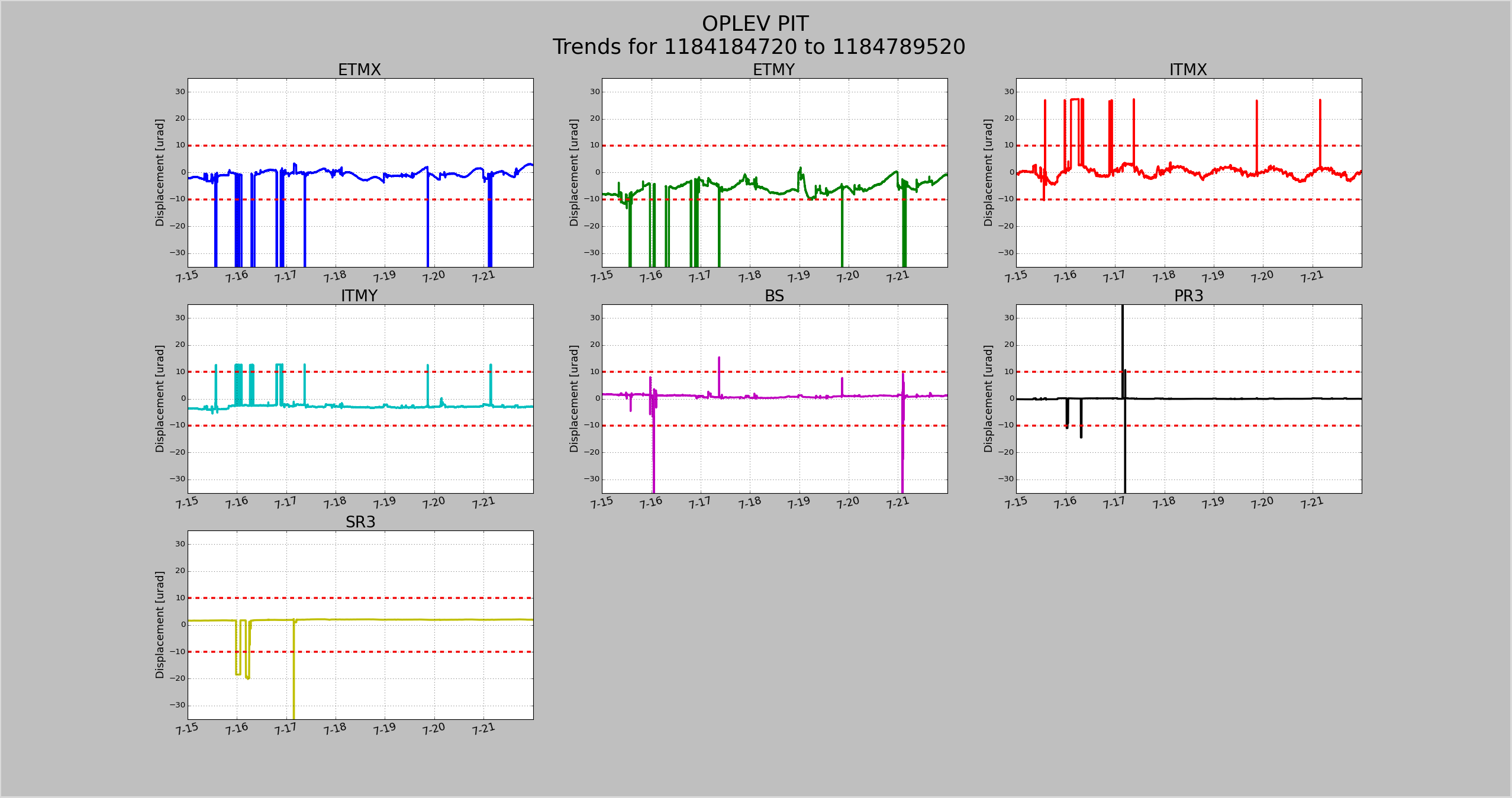
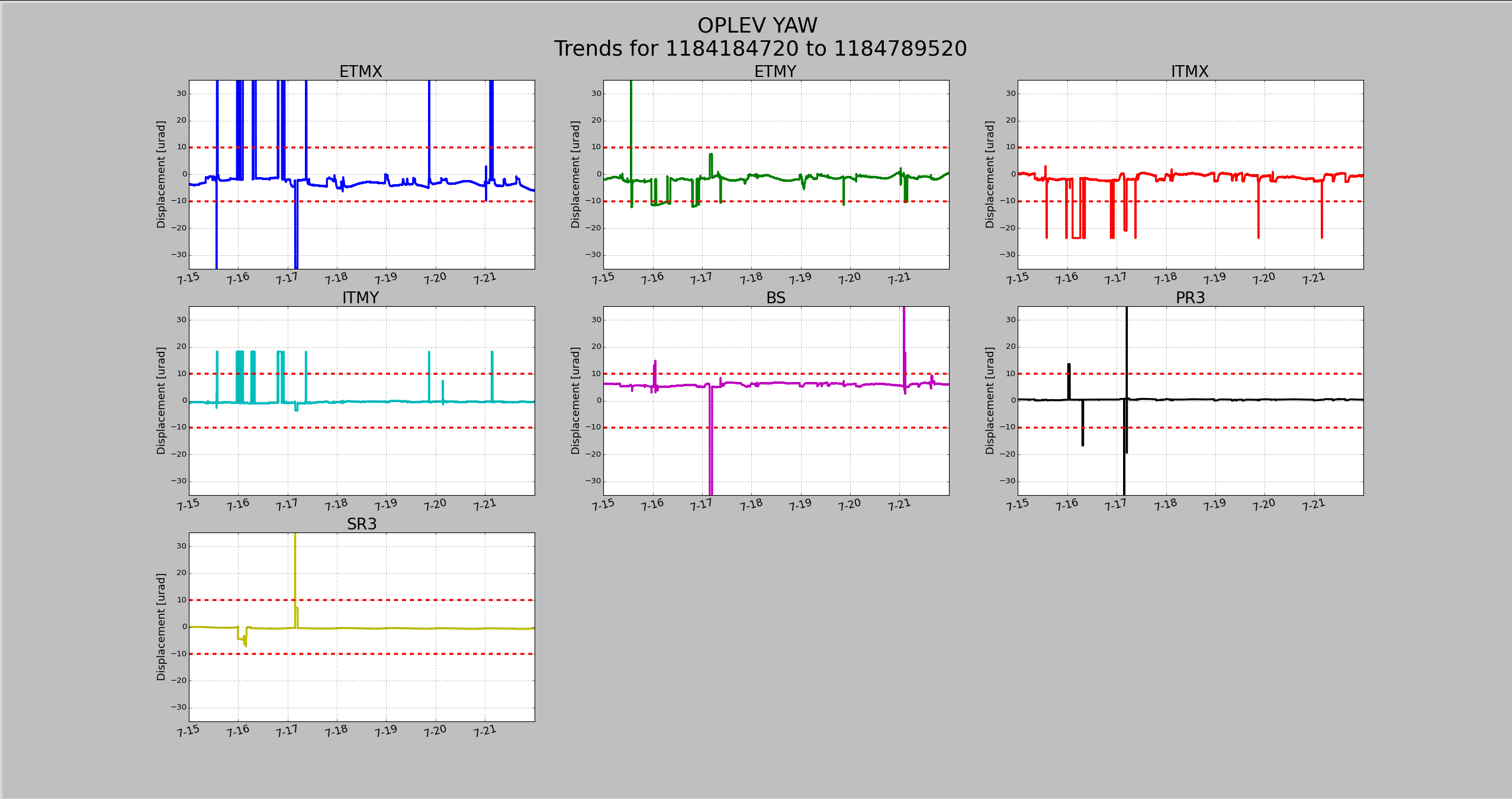
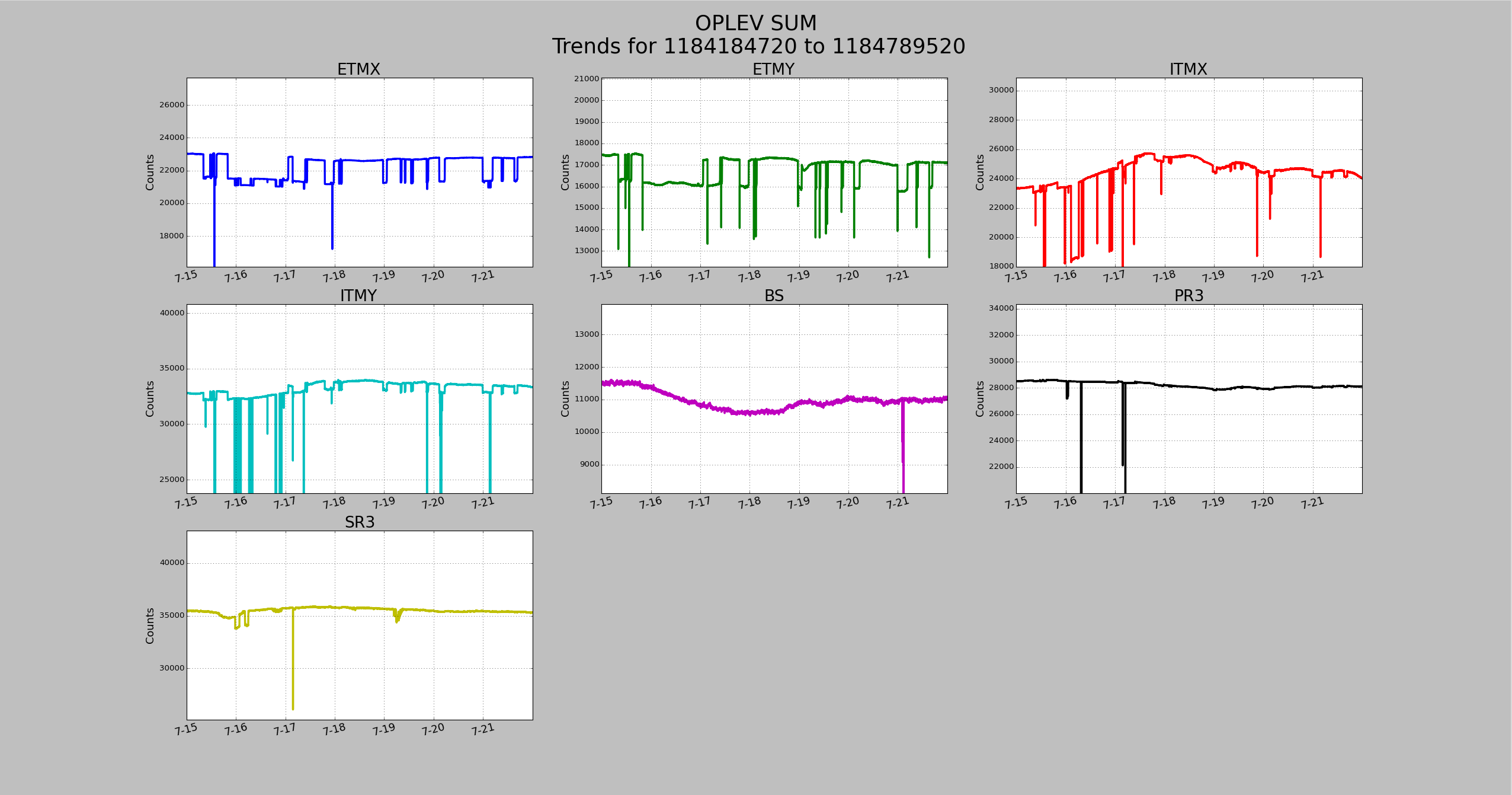
Concur with TJ, all oplevs look normal.
Locked at 53Mpc. I ran A2L at 16:07UTC. ETMY violin mode 5 is a bit rang up, I'll try to damp while LLO is down right now, but it doesn't seem like we have had too much luck wiht this mode recently.
TITLE: 07/22 Day Shift: 15:00-23:00 UTC (08:00-16:00 PST), all times posted in UTC
STATE of H1: Observing at 53Mpc
OUTGOING OPERATOR: Cheryl
CURRENT ENVIRONMENT:
Wind: 6mph Gusts, 3mph 5min avg
Primary useism: 0.01 μm/s
Secondary useism: 0.05 μm/s
QUICK SUMMARY: Calm envirionment, holding at 53Mpc.
TITLE: 07/22 Owl Shift: 07:00-15:00 UTC (00:00-08:00 PST), all times posted in UTC
STATE of H1: Observing at 53Mpc
INCOMING OPERATOR: TJ
SHIFT SUMMARY:
LOG:

TITLE: 07/22 Owl Shift: 07:00-15:00 UTC (00:00-08:00 PST), all times posted in UTC
STATE of H1: Observing at 53Mpc
OUTGOING OPERATOR: Patrick
CURRENT ENVIRONMENT:
Wind: 6mph Gusts, 5mph 5min avg
Primary useism: 0.01 μm/s
Secondary useism: 0.06 μm/s
QUICK SUMMARY:
TITLE: 07/21 Eve Shift: 23:00-07:00 UTC (16:00-00:00 PST), all times posted in UTC
STATE of H1: Observing at 51Mpc
INCOMING OPERATOR: Cheryl
SHIFT SUMMARY: The biggest trouble has been locking DRMI. PRMI locks easily, but DRMI has had trouble. Prior to the first observing stretch it would keep locking momentarily but not hold. I believe Kiwamu said he saw oscillations in the BS ASC YAW prior to it unlocking. Eventually it just happened to hold. He suggested playing around with the YAW gain for the BS oplev servo (H1:SUS-BS_M2_OLDAMP_Y_GAIN) the next time. Prior to the second observing stretch PRMI would again lock easily, but the StripTool traces stayed low and I could not improve them by moving the PRM or BS. DRMI seemed to have trouble catching lock at all. I played around with the BS oplev servo YAW gain, but found nothing conclusive. Eventually it locked again by chance.
LOG:

23:06 UTC Filiberto swapping BS M2 coil driver for a third unit. Earlier BS M2 coil driver replacement had a 20db gain modification not present in the original. Filiberto getting a third coil driver that does not have this modification.
23:19 UTC Filiberto back
23:22 UTC Starting initial alignment
23:37 UTC Powercycled video2
23:59 UTC Initial alignment done. Jenne had to increase gain on LSC path of X arm IR locking.
DRMI not locking. Locked PRMI. Lockloss during PRMI to DRMI transition.
01:03 UTC Observing
01:27 UTC Damped PI mode 28
05:14 UTC Lock loss
PRMI is locking easily, DRMI is not
06:06 UTC Observing
06:17 UTC Damped PI modes 27 and 28
Made it back to NLN at 00:59 UTC. DARM noise appears unaltered. Observing.
Back to Observing. PR3 was off in yaw and violins were all more rung up than usual. There are still a few of the usual culprits that are high, but the rest have damped.